

- Market Size (2026)
- USD 530.6 Mn
- Forecast (2036)
- USD 2037.2 Mn
- CAGR (2026 to 2036)
- 14.4%
How big is the electrolyzer sealants market in 2026?
USD 530.6 million in 2026 and USD 2,037.2 million by 2036 at a 14.4% CAGR.
The electrolyzer sealants industry value is forecast to grow from USD 463.8 million in 2025 to USD 2,037.2 million by 2036 at a 14.4% CAGR as electrolyzer OEMs standardize stack platforms and plant developers assign more risk weight to leakage control. OEM sales are forecast to represent 71.0% share in 2026 because stack makers qualify sealing materials before serial system delivery. Gaskets are expected to secure 62.0% share in 2026, led by repeated cell-frame interfaces and compression control.
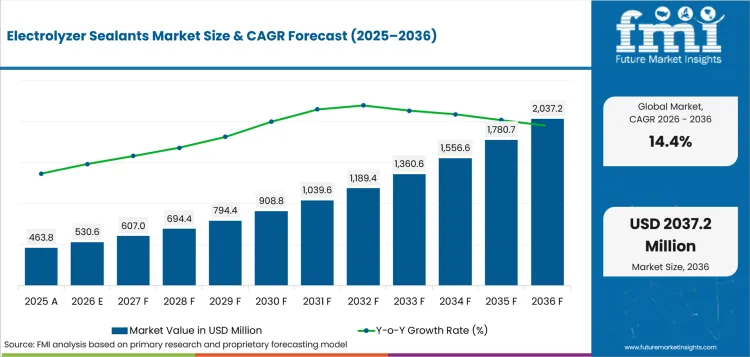
Electrolyzer Sealants Market Overview: Size and Forecast
- 2026 Market Size: USD 530.6 million
- 2036 Market Size: USD 2,037.2 million
- Forecast CAGR: 14.4% from 2026 to 2036
- Leading Form: Gaskets
- Gaskets Share in 2026: 62.0%
- Leading Sales Mix: OEM
- OEM Share in 2026: 71.0%
- Fastest-growing Country: China
- China CAGR: 16.1% by 2036
Summary of the Electrolyzer Sealants Market
- Demand and Growth Drivers
- Rising deployments of PEM and alkaline electrolyzers across green hydrogen projects are driving higher consumption of specialized sealants that can withstand hydrogen exposure, pressure fluctuations, and corrosive operating environments.
- Increasing investments in large-scale hydrogen production facilities are accelerating demand for durable sealing materials that enhance stack reliability, minimize leakage, and reduce maintenance requirements.
- Growth in electrolyzer manufacturing capacity worldwide is boosting sealant sales, as OEMs require high-performance sealing solutions for stack assembly and long-term operational efficiency.
- Adoption of hydrogen technologies in energy, industrial, and mobility applications is expanding the aftermarket and replacement demand for sealants, supporting sustained market revenue growth.
- Product and Segment View
- PEM Electrolyzers are projected to lead the Electrolyzer Type segment with 44.0% share as buyers value pressure-stable stack seals.
- EPDM / Elastomeric is expected to lead the Sealant Chemistry segment with 41.0% share as alkaline duty needs chemical resistance.
- Gaskets are anticipated to lead the Form segment with 62.0% share because stack compression control drives specification.
- The 1-10 MW scale is expected to lead the System Scale segment with 46.0% share as modular plants standardize parts.
- OEM is projected to lead the Sales Mix segment with 71.0% share since approved sealants move with stack platforms.
- Geography and Competitive Outlook
- China is forecast to grow fastest at 16.1% CAGR through 2036 with strong stack manufacturing and alkaline electrolyzer activity.
- India is expected to expand at 15.4% CAGR through 2036 as domestic electrolyzer manufacturing incentives pull component demand.
- Germany is projected to record 14.9% CAGR through 2036 with electrolyzer projects and sealing specialists concentrated in Europe.
- Freudenberg Sealing Technologies, Parker Hannifin, and Trelleborg Sealing Solutions anchor competition through hydrogen sealing portfolios.
- DuPont and Saint-Gobain compete where fluoropolymer, film, and high-purity material experience supports stack design.
- Analyst Opinion
- Nikhil Kaitwade, Associate Vice President at FMI says, "Electrolyzer sealants are becoming a qualification gate instead of a simple component purchase. Buyers ask whether the material can survive stack compression, wet chemistry, oxygen exposure, and service replacement without causing downtime. Suppliers with electrochemistry knowledge and production repeatability across several stack formats should gain serial orders as OEMs move from custom pilot seals to platform-approved designs."
The electrolyzer sealants market is expected to expand through 2036 as stack makers raise output and specify materials before plant delivery. Demand is shaped by PEM pressure cycling, alkaline chemistry exposure, AEM qualification, and aftersales replacement planning.
Electrolyzer sealants are moving from stack consumables into plant-risk control items as electrolysis deployment moves into larger projects. IEA stated in September 2025 that global installed water electrolysis capacity reached 2 GW in 2024. DOE’s March 2024 funding selections directed USD 750 million to 52 projects across 24 states for electrolysis and hydrogen manufacturing. Suppliers with validated materials for PEM pressure cycling and alkaline chemical exposure can enter OEM design files more easily. The same qualification record matters for AEM stack integration.
Which factors support expansion in the electrolyzer sealants market?
Stack qualification, leakage control, and OEM-approved materials support market value across PEM, alkaline, AEM, and SOEC electrolyzer platforms.
- Market value is rising as hydrogen electrolyzer platforms require approved sealants before stack makers raise production output.
- PEM stacks lift average selling value since pressure-stable gaskets need tighter tolerances and stronger electrochemical compatibility.
- Alkaline systems keep volume demand high as large-area frames require elastomeric seals across many repeated cells.
- AEM programs create premium trial demand with buyers testing materials that tolerate alkaline chemistry and membrane movement.
- Service revenue is expected to widen as operators plan gasket replacement cycles after warranty-backed plant handover.
Why is the electrolyzer sealants market growing?
Electrolyzer sealants are gaining value as buyers connect small stack components with large plant availability risk.
- Larger stack modules increase gasket length per system as every cell boundary needs repeatable compression and chemical resistance.
- PEM systems raise sealant value because pressure cycling creates higher qualification needs than low-pressure industrial service.
- Alkaline and AEM systems widen material demand with EPDM / Elastomeric compounds suited to wet alkaline environments.
- OEMs prefer prequalified sealing partners because a failed seal can delay commissioning and weaken warranty confidence.
Electrolyzer sealants are linked to stack qualification because sealing failures can stop commissioning. DOE’s March 2024 funding selections directed USD 750 million toward 52 projects that advance electrolysis technologies and hydrogen system manufacturing. IEA reported in September 2025 that installed water electrolysis capacity reached 2 GW in 2024. These indicators do not convert automatically into sealant revenue, but they raise the value of qualification files, repeatable gasket tooling, and leakage-control evidence.
Project developers in the Power-to-X market and the liquid hydrogen market are expected to favor stack suppliers with documented leakage control. This makes sealant selection part of broader hydrogen-plant risk management rather than a narrow component purchase.
How is the electrolyzer sealants market segmented?
The electrolyzer sealants market is segmented by electrolyzer type, sealant chemistry, form, system scale, sales mix, and region.
- PEM Electrolyzers are projected to account for 44.0% of Electrolyzer Type demand in 2026 as pressure-stable cell sealing drives premium specification.
- EPDM / Elastomeric is expected to lead Sealant Chemistry with 41.0% share in 2026 due to alkaline-stack compatibility.
- Gaskets are anticipated to represent 62.0% of Form demand in 2026 with stack compression and repeatable assembly shaping purchase choice.
- The 1-10 MW scale is expected to account for 46.0% of System Scale demand in 2026 as modular plants use repeated stack blocks.
- OEM channels are projected to account for 71.0% of Sales Mix demand in 2026 with qualification tied to stack platform approval.
Segment demand reflects how stack makers qualify materials. Electrolyzer OEMs normally approve sealing materials before serial delivery, while EPC teams and plant service contractors influence later replacement demand. Material selection depends on stack chemistry, pressure profile, compression behavior, oxygen exposure, hydrogen leakage risk, and validated replacement availability.
Why do PEM electrolyzers lead the electrolyzer type segment?
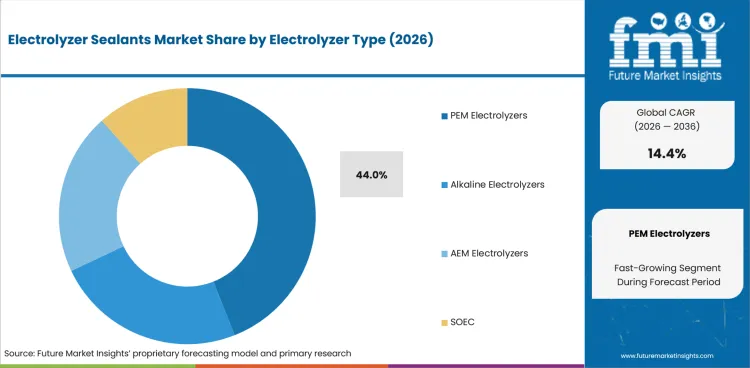
- PEM Electrolyzers are projected to account for 44.0% share in 2026 as pressure cycling and fast response operation need high-integrity stack gaskets.
- Freudenberg states that PEM gaskets prevent cell-to-cell leakage and media escape, so customers test groove stability before accepting serial production designs.
Why does EPDM / Elastomeric lead the sealant chemistry segment?
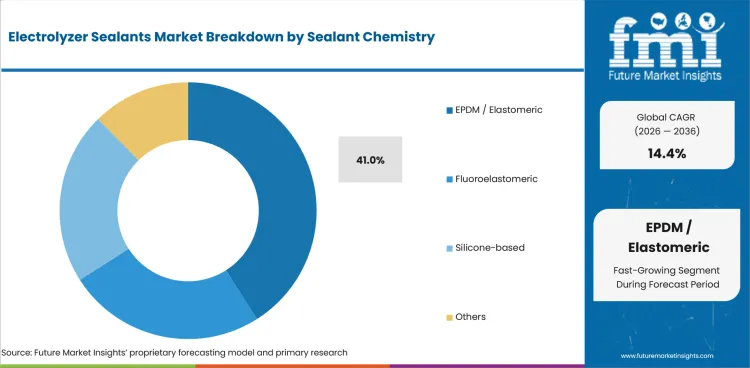
- EPDM / Elastomeric sealants are estimated to represent 41.0% share in 2026 as alkaline and AEM systems need wet-chemistry tolerance.
- Freudenberg describes EPDM use in AEM electrolysis, while alkaline conditions make material selection central to stack sealing durability.
Why do gaskets lead the form segment?
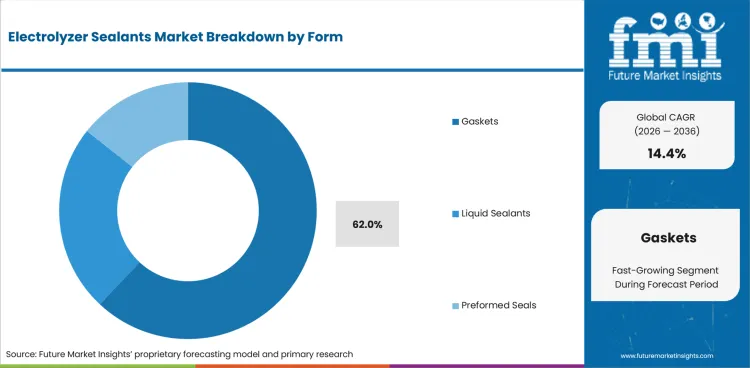
- Gaskets are anticipated to hold 62.0% share in 2026 because every repeated cell boundary needs controlled compression during stack assembly.
- Parker Prädifa lists rubber frame seals, injected composite seals, and PTFE seals for bipolar plates in electrolyzers and fuel cells.
Why does the 1-10 MW system scale lead the market?
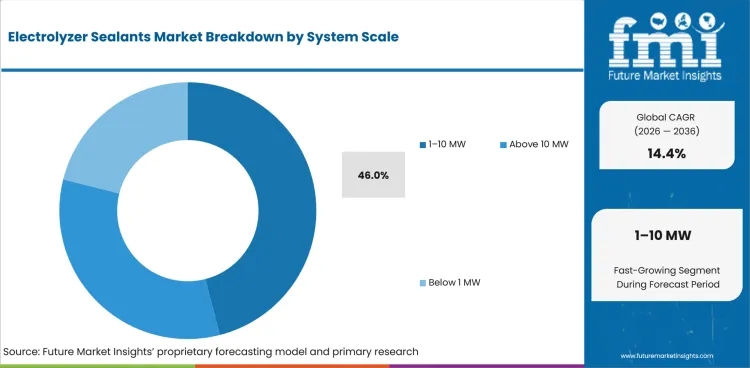
- The 1-10 MW scale is expected to account for 46.0% share in 2026 as modular plants use repeated stack blocks.
- UK hydrogen support includes HAR1 projects expected to become operational between 2025 and the end of 2026, reinforcing demand for modular system components.
Why do OEM channels lead the sales mix segment?
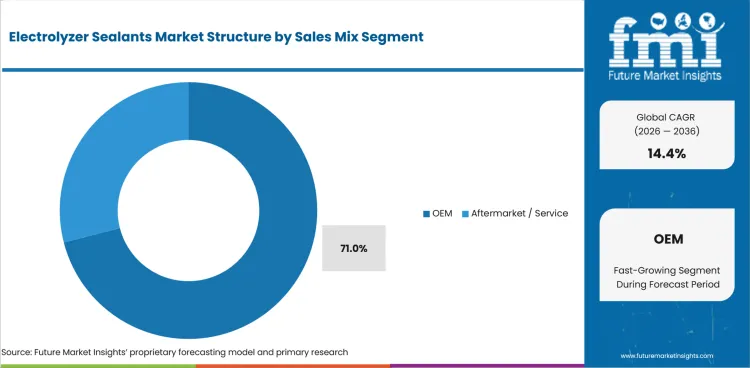
- OEM channels are projected to account for 71.0% share in 2026 as stack makers qualify sealants before plant shipment.
- Aftermarket demand grows later because replacement sealants must match the original material file and validated compression profile.
What are the drivers, restraints, and opportunities in the electrolyzer sealants market?
PEM pressure cycling, alkaline chemistry exposure, and AEM stack development support demand, while long qualification cycles restrain supplier switching.
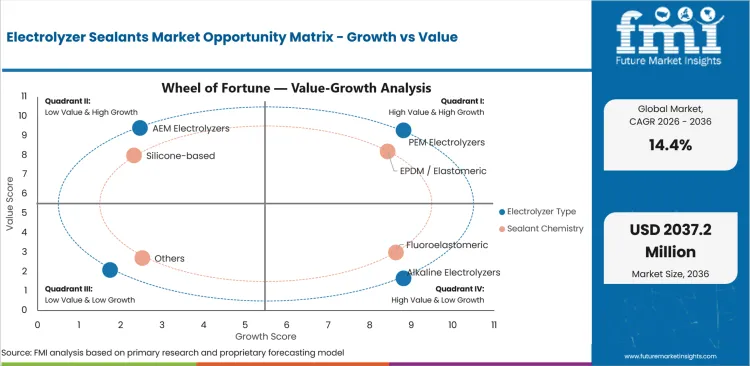
- Driver: Stack pressure cycling drives premium PEM gasket demand as buyers need materials that resist leakage under repeated load changes.
- Driver: Alkaline chemical exposure supports EPDM / Elastomeric demand with large cell frames needing cost-stable sealing performance.
- Opportunity: AEM stack development creates room for suppliers that can combine alkaline resistance with compact cell-frame integration.
- Restraint: Qualification time limits new entrants because OEMs avoid switching materials after stack validation and warranty approval.
- Opportunity: Service replacement creates future revenue as plants age and operators move from commissioning support to maintenance contracts.
PEM Pressure-Seal Qualification
PEM systems create the clearest premium pool for sealant suppliers. Freudenberg’s February 2025 high-pressure gasket design uses retaining features to lock the part in the groove before pressure activates the seal. This design response shows why PEM buyers care about mechanical behavior during both assembly and operation.
Alkaline Chemistry Compatibility
Alkaline electrolyzers create larger volume demand but place pressure on pricing and chemical durability. Freudenberg states that alkaline water electrolysis creates a corrosive environment that shapes sealing material choice. This pushes buyers toward proven elastomer and fluoropolymer options that resist degradation from potassium hydroxide exposure.
AEM and SOEC Qualification Opportunity
AEM and SOEC programs remain smaller than PEM and alkaline systems, but they create premium qualification routes for suppliers with electrochemical material expertise. AEM formats need alkaline-tolerant seals around membrane movement. SOEC formats need materials that can support elevated-temperature system engineering outside conventional elastomer use.
Electrolyzer Sealants Market Demand Outlook
Demand outlook is tied to project readiness rather than only announced hydrogen capacity. Buyers in the low-carbon hydrogen for industrial clusters market are expected to specify approved stack materials when downtime risk becomes part of project finance review.
The hydrogen detection market is adjacent to sealant demand because leak prevention and leak detection are evaluated together during hydrogen plant safety planning.
IEA stated in September 2025 that global installed water electrolysis capacity reached 2 GW in 2024 and added more than 1 GW through July 2025. This capacity base remains small compared with announced plans, so material suppliers need to focus on projects that have funding, offtake, and OEM design freeze evidence.
Which countries are growing fastest in the electrolyzer sealants market?
China 16.1% CAGR, India 15.4% CAGR, Germany 14.9% CAGR, South Korea 14.6% CAGR, France 14.2% CAGR, United States 13.8% CAGR, United Kingdom 13.2% CAGR, and Japan 12.7% CAGR through 2036.
.webp "Top Country Growth Comparison Electrolyzer Sealants Market Cagr (2026 2036)")
| Country | CAGR |
|---|---|
| China | 16.1% |
| India | 15.4% |
| Germany | 14.9% |
| South Korea | 14.6% |
| France | 14.2% |
| United States | 13.8% |
| United Kingdom | 13.2% |
| Japan | 12.7% |
| Source | Future Market Insights, 2026. |
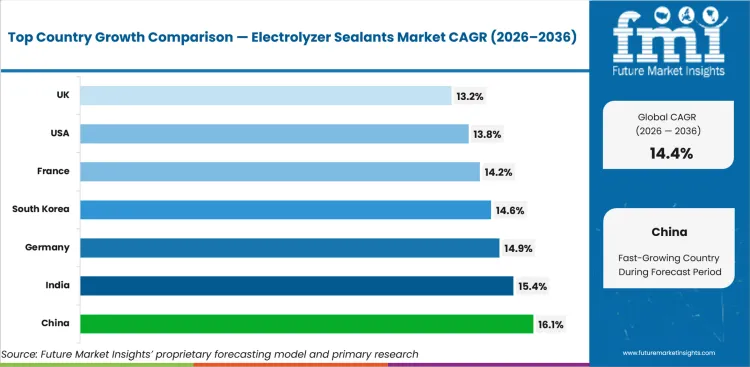
How do country-level CAGRs compare in the electrolyzer sealants market?
China leads country growth while Japan records the most measured expansion outlook among profiled markets.
- China is forecast to record 16.1% CAGR by 2036 as domestic stack manufacturing and alkaline electrolyzer deployment support faster qualification demand.
- India is forecast to record 15.4% CAGR by 2036 as manufacturing awards and industrial hydrogen use pull local component demand.
- Germany is forecast to record 14.9% CAGR by 2036 as industrial hydrogen projects and sealing specialists create a high-value qualification base.
- South Korea is forecast to record 14.6% CAGR by 2036 as clean hydrogen power procurement supports hydrogen equipment qualification.
- France is forecast to record 14.2% CAGR by 2036 as national hydrogen targets and industrial project planning support component demand.
- United States is forecast to record 13.8% CAGR by 2036 as federal funding and hydrogen hub procurement expand the OEM qualification base.
- United Kingdom is forecast to record 13.2% CAGR by 2036 as allocation rounds concentrate demand around supported green hydrogen projects.
- Japan is forecast to record 12.7% CAGR by 2036 as cost-gap support and materials engineering sustain demand despite slower project conversion.
How fast is the electrolyzer sealants market growing in China?
A 16.1% CAGR through 2036 reflects large stack manufacturing and fast alkaline deployment.
Country Market Snapshot Table
| Parameter | Value |
|---|---|
| Market Size in 2025 (Value) | USD 105.1 million |
| Market Size in 2026 (Value) | USD 122.0 million |
| Market Forecast in 2036 (Value) | USD 543.5 million |
| CAGR (2026 to 2036) | 16.1% |
| Years Considered | 2021 to 2036 |
| Base Year | 2025 |
| Forecast Period | 2026 to 2036 |
| Units Considered | Value (USD million) |
| Leading Sub-Region | Inner Mongolia and eastern industrial corridors |
China Electrolyzer Sealants Market Outlook
China demand is shaped by domestic stack manufacturing scale and alkaline electrolyzer deployment. Large cell frames keep EPDM / Elastomeric and fluoropolymer options active across serial assembly programs.
Local stack platforms are expected to pull more sealing qualification into Chinese engineering teams. International suppliers need local testing support and price discipline to remain in approved material files.
Key Growth Drivers
- China’s green hydrogen production base supports qualified stack-component demand. The State Council reported annual green hydrogen production capacity above 150,000 tonnes in 2024.
- Renewable power availability improves electrolyzer project readiness. The National Energy Administration reported renewable power at around 60.0% of installed generation capacity in 2025.
- Alkaline stack production supports EPDM / Elastomeric use because large cell frames need cost-stable sealing surfaces.
- Localized application engineering is expected to help suppliers compete during OEM design freeze and service replacement planning.
Key Restraints
- Grid and power-cost exposure can restrain electrolyzer utilization. China’s National Bureau of Statistics reported industrial-enterprise power generation of 9.4181 trillion kWh in 2024.
- Domestic compounders can compress margins when alkaline projects prioritize cost per sealed area over imported specification breadth.
- Project delivery delays can hold back aftermarket sealant orders when announced hydrogen plants move slower than factory expansion.
What makes China unique
China is unique because stack manufacturing scale and project deployment are concentrated in the same industrial ecosystem.
Key Companies
- LONGi Hydrogen
- Sungrow Hydrogen
- PERIC Hydrogen Technologies
- Cockerill Jingli Hydrogen
- Hygreen Energy
- CIMC Hydrogen Energy
- Freudenberg China
Sales & Marketing Channels
- Direct electrolyzer OEM qualification
- Industrial project EPC procurement
- Provincial hydrogen demonstration projects
- Distributor-led maintenance supply
- Local sealing material agents
- Aftermarket service contracts
Country Segment Breakdown Table
| Segment | Sub-Segments |
|---|---|
| By Electrolyzer Type | PEM Electrolyzers, Alkaline Electrolyzers, AEM Electrolyzers, SOEC |
| By Sealant Chemistry | Silicone-based, EPDM / Elastomeric, Fluoroelastomeric, Other |
| By Form | Gaskets, Liquid Sealants, Preformed Seals |
| By System Scale | <1 MW, 1-10 MW, >10 MW |
| By Sales Mix | OEM, Aftermarket / Service |
| Key Sub-Regions Covered, Industrial Hydrogen Corridors | Inner Mongolia, Hebei, Guangdong, Shandong, Jiangsu, Ningxia |
Frequently Asked Questions
How fast is China electrolyzer sealants market growing?
Sales in China are forecast to grow at 16.1% CAGR from 2026 to 2036.
What supports demand in China?
Demand is supported by stack manufacturing scale and alkaline electrolyzer deployment.
Which channels matter most in China?
Direct OEM qualification and EPC-led project procurement remain the main channels for stack sealing materials.
How fast is the electrolyzer sealants market growing in India?
A 15.4% CAGR through 2036 reflects local manufacturing awards and industrial hydrogen use.
Country Market Snapshot Table
| Parameter | Value |
|---|---|
| Market Size in 2025 (Value) | USD 31.9 million |
| Market Size in 2026 (Value) | USD 36.8 million |
| Market Forecast in 2036 (Value) | USD 154.2 million |
| CAGR (2026 to 2036) | 15.4% |
| Years Considered | 2021 to 2036 |
| Base Year | 2025 |
| Forecast Period | 2026 to 2036 |
| Units Considered | Value (USD million) |
| Leading Sub-Region | Gujarat and western industrial corridors |
India Electrolyzer Sealants Market Outlook
India demand is supported by domestic electrolyzer manufacturing awards and refinery-linked hydrogen demand. Stack localization is expected to increase the need for approved gasket materials and chemical-resistant elastomers.
Sealant suppliers should gain from partnerships with electrolyzer manufacturers that need repeatable materials across early production batches. Import substitution programs can support local compounding and conversion work.
Key Growth Drivers
- Domestic electrolyzer manufacturing awards create a direct component pull. India’s Press Information Bureau stated that electrolyzer manufacturing awards reached 3,000 MW per year in 2025.
- Green hydrogen production awards support stack-component planning. India’s National Green Hydrogen Mission reported approved green hydrogen production capacity of 862,000 tonnes per year in 2025.
- Refinery, fertilizer, and steel pilots are expected to create early channels for qualified gaskets and preformed seals.
- Local manufacturing incentives are likely to favor suppliers that can document material quality and support Indian stack assemblers.
Key Restraints
- Early refinery procurement remains narrow relative to long-term ambition. India’s Press Information Bureau stated in December 2025 that procurement capacity for refineries covered 20,000 tonnes per year of green hydrogen.
- Imported specialty polymers can lengthen lead times when PEM and fluoropolymer sealants need tight purity documentation.
- Project execution risk can delay replacement demand when awarded hydrogen capacity moves through staged commissioning.
What makes India unique
India is unique because policy-backed electrolyzer manufacturing is being built before full domestic hydrogen demand matures.
Key Companies
- Reliance Industries
- Larsen & Toubro
- Adani New Industries
- John Cockerill India
- Ohmium India
- Thermax
- H2e Power
Sales & Marketing Channels
- Electrolyzer OEM qualification
- SIGHT-linked supplier programs
- Refinery hydrogen project procurement
- Industrial EPC specification
- Local gasket distributors
- Aftermarket service contracts
Country Segment Breakdown Table
| Segment | Sub-Segments |
|---|---|
| By Electrolyzer Type | PEM Electrolyzers, Alkaline Electrolyzers, AEM Electrolyzers, SOEC |
| By Sealant Chemistry | Silicone-based, EPDM / Elastomeric, Fluoroelastomeric, Other |
| By Form | Gaskets, Liquid Sealants, Preformed Seals |
| By System Scale | <1 MW, 1-10 MW, >10 MW |
| By Sales Mix | OEM, Aftermarket / Service |
| Key Sub-Regions Covered, Industrial Hydrogen Corridors | Gujarat, Maharashtra, Tamil Nadu, Karnataka, Rajasthan, Andhra Pradesh |
Frequently Asked Questions
How fast is India electrolyzer sealants market growing?
Sales in India are forecast to grow at 15.4% CAGR from 2026 to 2036.
What supports demand in India?
Demand is supported by domestic manufacturing awards and industrial hydrogen projects.
Which channels matter most in India?
Direct OEM qualification and EPC-led project procurement remain the main channels for stack sealing materials.
How fast is the electrolyzer sealants market growing in Germany?
A 14.9% CAGR through 2036 reflects industrial cluster demand and specialist sealing capability.
Country Market Snapshot Table
| Parameter | Value |
|---|---|
| Market Size in 2025 (Value) | USD 42.7 million |
| Market Size in 2026 (Value) | USD 49.1 million |
| Market Forecast in 2036 (Value) | USD 196.6 million |
| CAGR (2026 to 2036) | 14.9% |
| Years Considered | 2021 to 2036 |
| Base Year | 2025 |
| Forecast Period | 2026 to 2036 |
| Units Considered | Value (USD million) |
| Leading Sub-Region | North Rhine-Westphalia and northern hydrogen corridors |
Germany Electrolyzer Sealants Market Outlook
Germany demand is influenced by industrial hydrogen projects and local sealing expertise. Electrolyzer OEMs and EPC teams are expected to keep qualification evidence central to gasket selection.
Buyers are likely to favor suppliers with European production, hydrogen compatibility files, and service capability near industrial clusters. Premium PEM and high-duty alkaline platforms should remain the main value pools.
Key Growth Drivers
- National electrolyzer ambition supports OEM component qualification. The European Hydrogen Observatory reported Germany’s electrolysis capacity target at 10 GW for 2030.
- Public support is expected to pull sealants into project procurement. The European Commission approved a EUR 350.0 million German scheme for renewable hydrogen production in 2024.
- Germany’s sealing-material base supports technical service where OEMs require pressure, chemistry, and compression evidence.
- Industrial corridors in North Rhine-Westphalia and northern Germany are expected to create service demand after plant commissioning.
Key Restraints
- Auction-linked procurement can delay material orders. The European Commission approved EUR 1.3 billion in German Hydrogen Bank state aid in 2026.
- Electricity-price exposure can slow electrolyzer operating hours and reduce early aftermarket sealant replacement.
- Long qualification cycles can hold back new entrants when OEMs require documented durability before changing stack materials.
What makes Germany unique
Germany is unique because hydrogen project support and local sealing specialists are concentrated in the same industrial base.
Key Companies
- Freudenberg Sealing Technologies
- thyssenkrupp nucera
- H-TEC Systems
- Siemens Energy
- SFC Energy
- Westfalen Group
- Wystrach
Sales & Marketing Channels
- Electrolyzer OEM qualification
- Industrial hydrogen EPC specification
- Sealing specialist distributors
- Regional hydrogen cluster procurement
- Chemical industry maintenance teams
- Aftermarket replacement supply
Country Segment Breakdown Table
| Segment | Sub-Segments |
|---|---|
| By Electrolyzer Type | PEM Electrolyzers, Alkaline Electrolyzers, AEM Electrolyzers, SOEC |
| By Sealant Chemistry | Silicone-based, EPDM / Elastomeric, Fluoroelastomeric, Other |
| By Form | Gaskets, Liquid Sealants, Preformed Seals |
| By System Scale | <1 MW, 1-10 MW, >10 MW |
| By Sales Mix | OEM, Aftermarket / Service |
| Key Sub-Regions Covered, Industrial Hydrogen Corridors | North Rhine-Westphalia, Lower Saxony, Bavaria, Baden-Württemberg, Hamburg, Brandenburg |
Frequently Asked Questions
How fast is Germany electrolyzer sealants market growing?
Sales in Germany are forecast to grow at 14.9% CAGR from 2026 to 2036.
What supports demand in Germany?
Demand is supported by industrial hydrogen projects and specialist sealing capability.
Which channels matter most in Germany?
Direct OEM qualification and EPC-led project procurement remain the main channels for stack sealing materials.
How fast is the electrolyzer sealants market growing in South Korea?
A 14.6% CAGR through 2036 reflects clean hydrogen power procurement and industrial group activity.
Country Market Snapshot Table
| Parameter | Value |
|---|---|
| Market Size in 2025 (Value) | USD 21.8 million |
| Market Size in 2026 (Value) | USD 25.0 million |
| Market Forecast in 2036 (Value) | USD 97.8 million |
| CAGR (2026 to 2036) | 14.6% |
| Years Considered | 2021 to 2036 |
| Base Year | 2025 |
| Forecast Period | 2026 to 2036 |
| Units Considered | Value (USD million) |
| Leading Sub-Region | Ulsan and southern industrial corridors |
South Korea Electrolyzer Sealants Market Outlook
South Korea demand is tied to clean hydrogen power procurement and industrial group participation. Equipment suppliers need sealants that can pass compact plant qualification and serve refinery, chemical, and power applications.
Local buyers are expected to emphasize OEM qualification, service readiness, and compatibility with pressure cycling. Government-led bidding creates clearer demand signals but can also expose suppliers to tender timing.
Key Growth Drivers
- Clean hydrogen power tenders create component visibility. Korea.net reported the clean hydrogen power bidding volume at 3,000 GWh per year in 2025.
- Long-term clean hydrogen contracts support equipment qualification. The Green Hydrogen Organisation reported South Korea’s clean hydrogen purchase contracts at 15 years in 2024.
- Industrial clusters in Ulsan and nearby corridors are expected to pull qualified sealing materials into refinery and chemical hydrogen projects.
- Domestic power and industrial groups are expected to favor suppliers with local technical support and short replacement lead times.
Key Restraints
- Auction execution risk can slow sealant orders. Industry reporting found that only 750 GWh was awarded in South Korea’s first clean hydrogen tender.
- Imported specialty material dependence can limit near-term flexibility for PEM and fluoropolymer sealant procurement.
- Compact industrial sites can increase qualification complexity for sealing packages exposed to thermal and pressure cycling.
What makes South Korea unique
South Korea is unique because clean hydrogen demand is linked directly to power-market bidding and industrial offtake planning.
Key Companies
- SK E&S
- Doosan Fuel Cell
- Hyundai Rotem
- Hyosung Heavy Industries
- Hanwha Solutions
- Korea Zinc
- POSCO Holdings
Sales & Marketing Channels
- Hydrogen power bidding project suppliers
- Electrolyzer OEM channels
- Industrial EPC contractors
- Refinery and chemical procurement teams
- Regional distributor networks
- Aftermarket service providers
Country Segment Breakdown Table
| Segment | Sub-Segments |
|---|---|
| By Electrolyzer Type | PEM Electrolyzers, Alkaline Electrolyzers, AEM Electrolyzers, SOEC |
| By Sealant Chemistry | Silicone-based, EPDM / Elastomeric, Fluoroelastomeric, Other |
| By Form | Gaskets, Liquid Sealants, Preformed Seals |
| By System Scale | <1 MW, 1-10 MW, >10 MW |
| By Sales Mix | OEM, Aftermarket / Service |
| Key Sub-Regions Covered, Industrial Hydrogen Corridors | Ulsan, Incheon, Gyeonggi, Jeolla, Busan, Chungcheong |
Frequently Asked Questions
How fast is South Korea electrolyzer sealants market growing?
Sales in South Korea are forecast to grow at 14.6% CAGR from 2026 to 2036.
What supports demand in South Korea?
Demand is supported by clean hydrogen power procurement and industrial group participation.
Which channels matter most in South Korea?
Direct OEM qualification and EPC-led project procurement remain the main channels for stack sealing materials.
How fast is the electrolyzer sealants market growing in France?
A 14.2% CAGR through 2036 reflects national hydrogen targets and industrial hub planning.
Country Market Snapshot Table
| Parameter | Value |
|---|---|
| Market Size in 2025 (Value) | USD 28.9 million |
| Market Size in 2026 (Value) | USD 33.0 million |
| Market Forecast in 2036 (Value) | USD 124.8 million |
| CAGR (2026 to 2036) | 14.2% |
| Years Considered | 2021 to 2036 |
| Base Year | 2025 |
| Forecast Period | 2026 to 2036 |
| Units Considered | Value (USD million) |
| Leading Sub-Region | Auvergne-Rhône-Alpes and northern industrial corridors |
France Electrolyzer Sealants Market Outlook
France demand is supported by hydrogen strategy funding and domestic electrolyzer manufacturing. Sealant suppliers need qualification evidence that fits European stack platforms and industrial hydrogen projects.
Demand is expected to remain concentrated around large industrial sites and domestic OEM programs. Suppliers with local technical service should gain from French procurement routes.
Key Growth Drivers
- National hydrogen targets support stack-component demand. France’s 2025 hydrogen strategy targets 4.5 GW of installed electrolysis capacity by 2030.
- Project pipeline depth supports qualified sealant demand. The European Hydrogen Observatory reported more than 130 low-carbon hydrogen projects in France in 2025.
- Domestic electrolyzer manufacturing is expected to increase demand for prequalified gaskets and elastomeric materials.
- Industrial decarbonization projects are expected to support replacement seals in refinery, chemical, and mobility-linked hydrogen systems.
Key Restraints
- Target revision can moderate order timing. IEA policy tracking reported France’s updated electrolyzer target at 4.0 GW for 2030.
- Project bankability remains sensitive to power costs and hydrogen offtake agreements.
- Supplier qualification can take longer when OEMs require stack-specific durability and chemical compatibility files.
What makes France unique
France is unique because national strategy and domestic electrolyzer manufacturing are tied to industrial decarbonization demand.
Key Companies
- McPhy Energy
- Elogen
- Air Liquide
- HRS
- GTT
- Plastic Omnium
- John Cockerill France
Sales & Marketing Channels
- Domestic electrolyzer OEM programs
- Industrial hydrogen EPC channels
- Refinery and chemical procurement
- Mobility hydrogen infrastructure suppliers
- Regional hydrogen clusters
- Aftermarket service partners
Country Segment Breakdown Table
| Segment | Sub-Segments |
|---|---|
| By Electrolyzer Type | PEM Electrolyzers, Alkaline Electrolyzers, AEM Electrolyzers, SOEC |
| By Sealant Chemistry | Silicone-based, EPDM / Elastomeric, Fluoroelastomeric, Other |
| By Form | Gaskets, Liquid Sealants, Preformed Seals |
| By System Scale | <1 MW, 1-10 MW, >10 MW |
| By Sales Mix | OEM, Aftermarket / Service |
| Key Sub-Regions Covered, Industrial Hydrogen Corridors | Auvergne-Rhône-Alpes, Île-de-France, Normandy, Hauts-de-France, Grand Est, Occitanie |
Frequently Asked Questions
How fast is France electrolyzer sealants market growing?
Sales in France are forecast to grow at 14.2% CAGR from 2026 to 2036.
What supports demand in France?
Demand is supported by national hydrogen targets and industrial hub planning.
Which channels matter most in France?
Direct OEM qualification and EPC-led project procurement remain the main channels for stack sealing materials.
How fast is the electrolyzer sealants market growing in United States?
A 13.8% CAGR through 2036 reflects federal funding and hydrogen hub procurement.
Country Market Snapshot Table
| Parameter | Value |
|---|---|
| Market Size in 2025 (Value) | USD 63.4 million |
| Market Size in 2026 (Value) | USD 72.1 million |
| Market Forecast in 2036 (Value) | USD 262.4 million |
| CAGR (2026 to 2036) | 13.8% |
| Years Considered | 2021 to 2036 |
| Base Year | 2025 |
| Forecast Period | 2026 to 2036 |
| Units Considered | Value (USD million) |
| Leading Sub-Region | Gulf Coast and Midwest hydrogen corridors |
United States Electrolyzer Sealants Market Outlook
United States demand is supported by federal electrolysis funding, hydrogen hubs, and domestic manufacturing programs. Buyers need high-integrity sealing systems that can support PEM and alkaline stack qualification.
The market is expected to favor suppliers with test documentation, domestic availability, and OEM relationships. Aftermarket demand should expand as funded projects move from demonstration into operating plants.
Key Growth Drivers
- Electrolysis component funding supports sealant qualification. The USA Department of Energy selected projects for USD 750.0 million in 2024.
- Domestic electrolyzer growth supports gasket demand. The USA Energy Information Administration reported planned electrolyzer installations at 4,524 MW.
- Hydrogen hub development is expected to pull sealing materials into PEM and alkaline systems across industrial regions.
- Domestic OEM qualification is expected to favor suppliers with traceable materials and local technical service.
Key Restraints
- Tax-credit compliance can delay procurement. The Federal Register published final Section 45V regulations covering lifecycle greenhouse gas emissions rates in 2025.
- Project developers remain exposed to offtake uncertainty before ordering long-lead stack components.
- Specialty polymer qualification can slow supplier switching after OEMs freeze stack designs.
What makes United States unique
The United States is unique because federal electrolysis funding and hydrogen hubs create several separate qualification channels.
Key Companies
- Plug Power
- Bloom Energy
- Cummins Accelera
- Electric Hydrogen
- Nel Hydrogen US
- Verdagy
- Chemours
Sales & Marketing Channels
- Electrolyzer OEM supply contracts
- DOE-funded project procurement
- Hydrogen hub EPC channels
- Industrial gasket distribution
- Refinery and chemical plant buyers
- Aftermarket service providers
Country Segment Breakdown Table
| Segment | Sub-Segments |
|---|---|
| By Electrolyzer Type | PEM Electrolyzers, Alkaline Electrolyzers, AEM Electrolyzers, SOEC |
| By Sealant Chemistry | Silicone-based, EPDM / Elastomeric, Fluoroelastomeric, Other |
| By Form | Gaskets, Liquid Sealants, Preformed Seals |
| By System Scale | <1 MW, 1-10 MW, >10 MW |
| By Sales Mix | OEM, Aftermarket / Service |
| Key Sub-Regions Covered, Industrial Hydrogen Corridors | Gulf Coast, Midwest, California, Pacific Northwest, Northeast, Appalachia |
Frequently Asked Questions
How fast is United States electrolyzer sealants market growing?
Sales in United States are forecast to grow at 13.8% CAGR from 2026 to 2036.
What supports demand in United States?
Demand is supported by federal project funding and hydrogen hub procurement.
Which channels matter most in United States?
Direct OEM qualification and EPC-led project procurement remain the main channels for stack sealing materials.
How fast is the electrolyzer sealants market growing in United Kingdom?
A 13.2% CAGR through 2036 reflects allocation-round projects and cluster-led procurement.
Country Market Snapshot Table
| Parameter | Value |
|---|---|
| Market Size in 2025 (Value) | USD 18.8 million |
| Market Size in 2026 (Value) | USD 21.3 million |
| Market Forecast in 2036 (Value) | USD 73.6 million |
| CAGR (2026 to 2036) | 13.2% |
| Years Considered | 2021 to 2036 |
| Base Year | 2025 |
| Forecast Period | 2026 to 2036 |
| Units Considered | Value (USD million) |
| Leading Sub-Region | Northern England and Scotland hydrogen corridors |
United Kingdom Electrolyzer Sealants Market Outlook
United Kingdom demand is driven by project delivery under hydrogen allocation rounds. Suppliers need to support OEM qualification and service planning for modular plants.
Demand is expected to favor sealants used in PEM and alkaline systems linked to industrial decarbonization. Local technical support can improve supplier selection because projects require documentation before commissioning.
Key Growth Drivers
- HAR1 project delivery supports sealant demand. GOV.UK confirmed 125 MW of electrolytic hydrogen capacity under its first allocation round.
- Regional deployment supports component demand. GOV.UK reported that 27 projects were invited to the next HAR2 stage in 2025.
- Modular hydrogen plants are expected to increase demand for repeatable gasket packages in 1-10 MW systems.
- Industrial clusters are expected to pull sealant suppliers into refinery, chemicals, and transport-linked hydrogen programs.
Key Restraints
- Contract dependency can slow procurement. GOV.UK’s Low Carbon Hydrogen Agreement summary set the HAR1 contract term at 15 years.
- Planning and grid connection timing can delay equipment orders for modular hydrogen projects.
- Smaller domestic stack manufacturing scale can limit local sourcing options for specialty sealing materials.
What makes United Kingdom unique
The United Kingdom is unique because allocation-round projects create clear procurement windows for modular electrolyzer components.
Key Companies
- ITM Power
- Johnson Matthey
- Ceres Power
- Intelligent Energy
- AFC Energy
- BOC UK
- Logan Energy
Sales & Marketing Channels
- HAR project procurement channels
- Electrolyzer OEM partnerships
- Industrial cluster EPC suppliers
- Hydrogen production contractors
- Specialist gasket distributors
- Aftermarket maintenance firms
Country Segment Breakdown Table
| Segment | Sub-Segments |
|---|---|
| By Electrolyzer Type | PEM Electrolyzers, Alkaline Electrolyzers, AEM Electrolyzers, SOEC |
| By Sealant Chemistry | Silicone-based, EPDM / Elastomeric, Fluoroelastomeric, Other |
| By Form | Gaskets, Liquid Sealants, Preformed Seals |
| By System Scale | <1 MW, 1-10 MW, >10 MW |
| By Sales Mix | OEM, Aftermarket / Service |
| Key Sub-Regions Covered, Industrial Hydrogen Corridors | Northern England, Scotland, Wales, Midlands, South East England, Humber |
Frequently Asked Questions
How fast is United Kingdom electrolyzer sealants market growing?
Sales in United Kingdom are forecast to grow at 13.2% CAGR from 2026 to 2036.
What supports demand in United Kingdom?
Demand is supported by allocation rounds and cluster-led hydrogen procurement.
Which channels matter most in United Kingdom?
Direct OEM qualification and EPC-led project procurement remain the main channels for stack sealing materials.
How fast is the electrolyzer sealants market growing in Japan?
A 12.7% CAGR through 2036 reflects policy-backed supply-chain support and high-specification materials demand.
Country Market Snapshot Table
| Parameter | Value |
|---|---|
| Market Size in 2025 (Value) | USD 20.9 million |
| Market Size in 2026 (Value) | USD 23.6 million |
| Market Forecast in 2036 (Value) | USD 77.9 million |
| CAGR (2026 to 2036) | 12.7% |
| Years Considered | 2021 to 2036 |
| Base Year | 2025 |
| Forecast Period | 2026 to 2036 |
| Units Considered | Value (USD million) |
| Leading Sub-Region | Tokyo, Chubu, and Kansai industrial corridors |
Japan Electrolyzer Sealants Market Outlook
Japan demand is supported by hydrogen policy, cost-gap support, and industrial technology programs. Buyers are expected to prioritize high-purity materials and long qualification cycles.
The market is expected to grow through OEM relationships and industrial hydrogen pilots before wider commercial rollout. Sealant suppliers with proven polymer reliability and Japanese technical support should be better placed.
Key Growth Drivers
- Hydrogen investment support creates demand for qualified components. Japan’s 2025 Strategic Energy Plan states that about JPY 3.0 trillion will support low-carbon hydrogen price-gap measures.
- Long-term project support is expected to improve procurement confidence. JOGMEC identified two support routes for low-carbon hydrogen supply chains in 2024.
- Domestic industrial technology programs are expected to favor high-purity sealants used in PEM and SOEC-adjacent systems.
- Local OEM relationships are expected to create demand for materials with documented durability under high-specification operating conditions.
Key Restraints
- High hydrogen cost remains a restraint. OECD reported Japan’s low-carbon hydrogen subsidy at about JPY 3.0 trillion over 15 years.
- Conservative qualification practices can slow supplier switching after OEMs approve stack materials.
- Domestic demand can remain project-led until large offtake contracts support wider electrolyzer utilization.
What makes Japan unique
Japan is unique because hydrogen support is tied to long-term cost-gap funding and high-specification industrial procurement.
Key Companies
- Asahi Kasei
- Toshiba Energy Systems & Solutions
- Iwatani
- ENEOS
- Kawasaki Heavy Industries
- Toray Industries
- Toyota Tsusho
Sales & Marketing Channels
- Electrolyzer OEM qualification channels
- Industrial gas procurement teams
- Hydrogen hub development programs
- Engineering contractors
- Specialty material distributors
- Maintenance and service providers
Country Segment Breakdown Table
| Segment | Sub-Segments |
|---|---|
| By Electrolyzer Type | PEM Electrolyzers, Alkaline Electrolyzers, AEM Electrolyzers, SOEC |
| By Sealant Chemistry | Silicone-based, EPDM / Elastomeric, Fluoroelastomeric, Other |
| By Form | Gaskets, Liquid Sealants, Preformed Seals |
| By System Scale | <1 MW, 1-10 MW, >10 MW |
| By Sales Mix | OEM, Aftermarket / Service |
| Key Sub-Regions Covered, Industrial Hydrogen Corridors | Kanto, Chubu, Kansai, Kyushu, Hokkaido, Tohoku |
Frequently Asked Questions
How fast is Japan electrolyzer sealants market growing?
Sales in Japan are forecast to grow at 12.7% CAGR from 2026 to 2036.
What supports demand in Japan?
Demand is supported by hydrogen policy support and high-specification materials demand.
Which channels matter most in Japan?
Direct OEM qualification and EPC-led project procurement remain the main channels for stack sealing materials.
Who are the leading companies in the electrolyzer sealants market?
Buyers evaluate suppliers by stack compatibility, leak-test documentation, manufacturing repeatability, and service responsiveness.
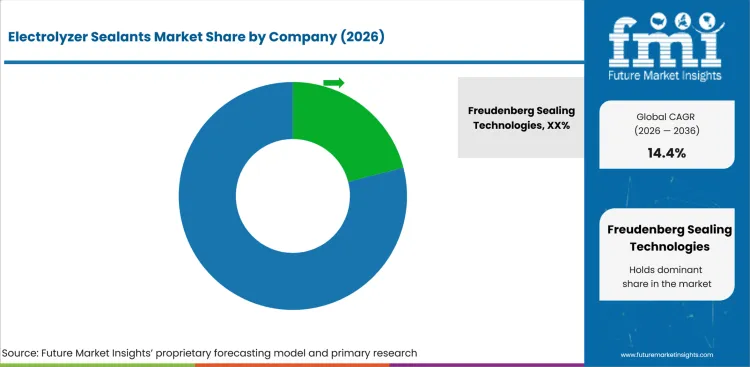
- Global sealing specialists hold an advantage where electrolyzer OEMs require platform-approved materials and repeat production quality.
- Polymer material suppliers compete where fluoropolymer, elastomer, and high-purity films affect stack durability.
- Regional gasket converters gain opportunities when local service teams need replacement parts with validated compression profiles.
- Hydrogen equipment suppliers influence sealant qualification by setting stack design files and maintenance rules.
Competition is led by sealing material suppliers, fluoropolymer specialists, gasket converters, and hydrogen equipment material partners. The competitive base overlaps with the gaskets market because buyers need proven compression behavior and stable converted part quality Sealing suppliers compete through application engineering and validated material files rather than catalog breadth alone. Freudenberg, Parker Hannifin, and Trelleborg Sealing Solutions are well placed where OEMs require hydrogen experience and local engineering support. DuPont and Saint-Gobain compete where specialty films, fluoropolymers, and high-purity materials affect stack design. Regional converters can gain maintenance work when plants move from commissioning into service cycles.
How do top electrolyzer sealants companies compare?
Freudenberg and Parker score strongest on electrolyzer relevance while Trelleborg and DuPont hold strong material positions.
| Company | Relevance to Market Title | Hydrogen Sealing Portfolio | Material Depth | OEM Qualification Access | Channel Reach | Geographic Footprint |
|---|---|---|---|---|---|---|
| Freudenberg Sealing Technologies | Very High | Very Strong | Very Strong | Very Strong | Strong | Global |
| Parker Hannifin | Very High | Very Strong | Strong | Very Strong | Very Strong | Global |
| Trelleborg Sealing Solutions | High | Strong | Strong | Strong | Strong | Global |
| DuPont | High | Moderate | Very Strong | Strong | Very Strong | Global |
| Saint-Gobain | High | Strong | Very Strong | Strong | Strong | Global |
| Greene Tweed | Moderate to High | Strong | Strong | Moderate | Moderate | United States and Europe |
| James Walker | Moderate to High | Strong | Strong | Moderate | Strong | Europe and Asia |
| Precision Polymer Engineering | Moderate | Moderate | Strong | Moderate | Moderate | Europe |
| ERIKS | Moderate | Moderate | Moderate | Moderate | Strong | Europe |
| Datwyler Sealing Solutions | Moderate | Moderate | Strong | Moderate | Strong | Global |
Source: Future Market Insights competitive analysis, 2026.
Who are the key players in the electrolyzer sealants market?
Freudenberg Sealing Technologies, Parker Hannifin, and Trelleborg Sealing Solutions are listed with DuPont and Saint-Gobain among other suppliers.
Key global companies leading the electrolyzer sealants market include:
- Freudenberg Sealing Technologies
- Parker Hannifin Corporation
- Trelleborg Sealing Solutions
- DuPont
- Saint-Gobain
- Greene Tweed
- James Walker
- Precision Polymer Engineering
- ERIKS
- Datwyler Sealing Solutions
Key Developments in Electrolyzer Sealants Market
- In February 2025, Freudenberg Sealing Technologies introduced a high-pressure gasket design for PEM electrolyzers with retaining features that help keep the gasket in its groove.
- In December 2024, Freudenberg Sealing Technologies detailed sealing requirements for AEM electrolysis and highlighted EPDM material relevance under alkaline conditions.
- In March 2025, Parker Prädifa outlined sealing products for electrolyzers and fuel cells including rubber frame seals, injected composite seals, and PTFE seals.
Key Players in the Electrolyzer Sealants Market
Global Sealing Specialists
- Freudenberg Sealing Technologies
- Parker Hannifin Corporation
- Trelleborg Sealing Solutions
- James Walker
- Datwyler Sealing Solutions
Specialty Materials Suppliers
- DuPont
- Saint-Gobain
- Greene Tweed
- Precision Polymer Engineering
Regional Distribution and Service Partners
- ERIKS
- Freudenberg-NOK
- Parker Hannifin UK
- Trelleborg UK
Electrolyzer Sealants Market - Report Scope
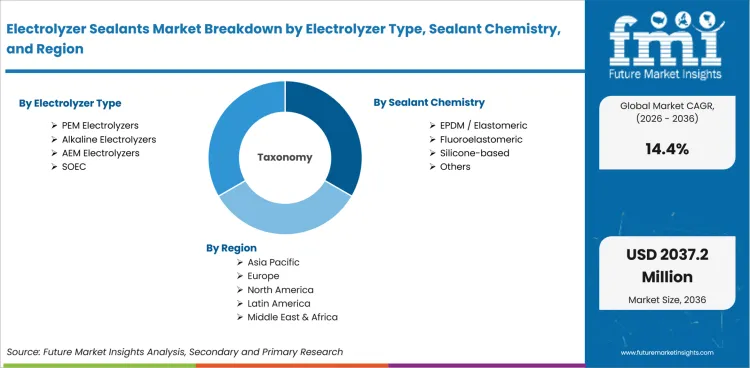
| Parameter | Details |
|---|---|
| Forecast period | 2026 to 2036 |
| Historical period | 2021 to 2025 |
| Quantitative unit | Revenue in USD million |
| By electrolyzer type | PEM Electrolyzers, alkaline electrolyzers, AEM electrolyzers, SOEC |
| By sealant chemistry | Silicone-based, EPDM / Elastomeric, fluoroelastomeric, other |
| By form | Gaskets, liquid sealants, preformed seals |
| By system scale | Below 1 MW, 1-10 MW, above 10 MW |
| By sales mix | OEM, aftermarket / service |
| Regions covered | North America, Europe, East Asia, South Asia and Pacific, Middle East and Africa |
| Countries covered | China, India, Germany, South Korea, France, United States, United Kingdom, Japan |
| Key companies profiled | Freudenberg Sealing Technologies, Parker Hannifin, Trelleborg Sealing Solutions, DuPont, Saint-Gobain |
| Approach | Bottom-up stack-boundary approach using electrolyzer platform output, sealant content, OEM qualification, replacement timing, and country-level project readiness |
Source: Future Market Insights, 2026.
Electrolyzer Sealants Market - Scope & Definition
| Attribute | Detail |
|---|---|
| Market Definition | Gaskets, liquid sealants, and preformed seals used inside or around electrolyzer stacks and balance-of-stack interfaces in PEM, alkaline, AEM, and SOEC systems. |
| Functions Covered | Cell sealing, media separation, leakage prevention, compression control, oxygen-side sealing, hydrogen-side sealing, and replacement sealing during service. |
| Applications Covered | Electrolyzer stack cell frames, bipolar plate interfaces, manifolds, balance-of-stack interfaces, replacement gasket sets, and validated service kits. |
| End-Use Industries | Hydrogen production, industrial gas, renewable power-to-hydrogen, refining, chemicals, steel, mobility hydrogen, and energy storage. |
| Grades Covered | Silicone-based, EPDM / Elastomeric, fluoroelastomeric, and other specialty sealing material grades qualified for electrolyzer service. |
| Inclusions | All commercially supplied electrolyzer sealants across covered electrolyzer technologies, chemistries, forms, system scales, sales channels, and profiled countries. |
| Exclusions | Fuel-cell-only seals, hydrogen cylinder valves, pipeline flange seals, compressor piston rings, generic construction sealants, consumer adhesives, and unrelated industrial gaskets. |
Electrolyzer Sealants Market - Research Methodology
| Method | Description |
|---|---|
| Primary Research | FMI analyst interviews with electrolyzer OEMs, stack integrators, sealing material suppliers, hydrogen plant engineers, EPC contractors, and service providers across key markets. |
| Desk Research | Review of hydrogen policy documents, official funding records, electrolyzer project updates, company product pages, material references, and technical sealing literature. |
| Market Sizing & Forecasting | Bottom-up stack-boundary approach using electrolyzer output, sealant content per stack, replacement timing, material mix, OEM qualification, and country-level project readiness. |
| Data Validation | Cross-verification using project funding records, electrolyzer manufacturing capacity, company product evidence, primary interviews, and comparable gasket and seal revenue pools. |
Electrolyzer Sealants Market Breakdown by Electrolyzer Type, Sealant Chemistry, Form, System Scale, Sales Mix, and Region
Electrolyzer Sealants Market Segmented by Electrolyzer Type
- PEM Electrolyzers
- Alkaline Electrolyzers
- AEM Electrolyzers
- SOEC
Electrolyzer Sealants Market Segmented by Sealant Chemistry
- Silicone-based
- EPDM / Elastomeric
- Fluoroelastomeric
- Other
Electrolyzer Sealants Market Segmented by Form
- Gaskets
- Liquid Sealants
- Preformed Seals
Electrolyzer Sealants Market Segmented by System Scale
- Below 1 MW
- 1-10 MW
- Above 10 MW
Electrolyzer Sealants Market Segmented by Sales Mix
- OEM
- Aftermarket / Service
Electrolyzer Sealants Market by Region
- North America
- Latin America
- Europe
- East Asia
- South Asia and Pacific
- Middle East and Africa
Research Sources and Bibliography
- China State Council. (2025, November 8). Full text: Carbon peaking and carbon neutrality: China’s plans and solutions. English.gov.cn.
- China State Council. (2025, December 5). China sees rapid green and low-carbon energy transition from 2021 to 2025. English.gov.cn.
- National Bureau of Statistics of China. (2025, January 24). Energy production in December 2024. NBS China.
- Press Information Bureau. (2025, November 12). Unlocking India’s green hydrogen production potential. Government of India.
- National Green Hydrogen Mission. (2025, November 28). Approved SIGHT projects under the National Green Hydrogen Mission. Ministry of New and Renewable Energy.
- Press Information Bureau. (2025, December 8). Government highlights key progress under National Green Hydrogen Mission. Government of India.
- European Hydrogen Observatory. (2025, January). The European hydrogen policy landscape. Clean Hydrogen Partnership.
- European Commission. (2024, April 4). Commission approves EUR 350 million German State aid scheme to support renewable hydrogen production. European Commission.
- European Hydrogen Observatory. (2026, May 20). Commission approves EUR 1.3 billion German State aid through Hydrogen Bank auction-as-a-service. Clean Hydrogen Partnership.
- Korea.net. (2025, May 9). Korea opens hydrogen power bidding market for 2025. Government of the Republic of Korea.
- Green Hydrogen Organisation. (2024, May). Accelerating the truly low-carbon hydrogen transition in South Korea: Possible policy actions. GH2.
- Kim & Chang. (2024, May 30). Launch of the Clean Hydrogen Power Auction. Kim & Chang.
- Ministry for the Economy, Finance and Industrial and Digital Sovereignty. (2025, September 30). French national hydrogen strategy. Government of France.
- European Hydrogen Observatory. (2025, June 23). France: National strategies. Clean Hydrogen Partnership.
- International Energy Agency. (2025). Update of national hydrogen strategy. IEA Policies Database.
- USA Department of Energy. (2024, March 13). Funding selections for hydrogen electrolysis, manufacturing, and recycling activities under the Infrastructure Investment and Jobs Act. DOE.
- USA Energy Information Administration. (2024, June 6). Electrolyzers are a small but growing source of USA hydrogen production. EIA.
- USA Department of the Treasury and Internal Revenue Service. (2025, January 10). Credit for production of clean hydrogen and energy credit. Federal Register.
- Department for Energy Security and Net Zero. (2023, December 14). HAR1 successful projects. GOV.UK.
- Department for Energy Security and Net Zero. (2025, July). Hydrogen update to the market: July 2025. GOV.UK.
- Department for Energy Security and Net Zero. (2025, December). Low Carbon Hydrogen Agreement: Key terms summary document. GOV.UK.
- Agency for Natural Resources and Energy. (2025). Strategic energy plan. Ministry of Economy, Trade and Industry.
- Japan Organization for Metals and Energy Security. (2024, October 23). For the establishment of supply chain for low-carbon hydrogen and its derivatives. JOGMEC.
- Organisation for Economic Co-operation and Development. (2024, August). Case study: Japanese government subsidy scheme. OECD.
- International Energy Agency. (2025, September 12). Global Hydrogen Review 2025. IEA.
- Freudenberg Sealing Technologies. (2025, February 4). A high-pressure gasket with a new design for PEM electrolyzers. Freudenberg.
- Freudenberg Sealing Technologies. (2024, December 17). Seals for AEM electrolysis. Freudenberg.
- Parker Hannifin. (2025, March 25). Sealing solutions from Parker Prädifa enhance efficiency and safety of electrolyzers and fuel cells. Parker Hannifin.
This bibliography is provided for reader reference and is not exhaustive. The full report contains the complete reference list and detailed citations.
This Report Answers
- Market size estimates for 2026 and forecasts through 2036 for the electrolyzer sealants market.
- Insights across regional and country-level markets for stack sealing materials.
- Analysis of demand drivers, project-readiness factors, and replacement demand patterns.
- Evaluation of key electrolyzer technologies, sealant chemistries, forms, system scales, and sales channels.
- Assessment of hydrogen policy support, manufacturing programs, and qualification requirements.
- Identification of growth opportunities across PEM, alkaline, AEM, and SOEC stack formats.
- Evaluation of supply chain dynamics, material selection trends, and OEM qualification pathways.
- Country-level growth analysis covering China, India, Germany, South Korea, France, the United States, the United Kingdom, and Japan.
- Assessment of the competitive landscape, including sealing specialists and specialty material suppliers.
- Analysis of purchasing behavior among OEMs, EPC contractors, and service providers.
- Regional outlooks across North America, Europe, East Asia, and South Asia.
- Delivery of market data, forecasts, and supporting analysis in PDF and Excel formats.
Frequently Asked Questions
What is the growth prospect for electrolyzer sealants?
Demand for electrolyzer sealants is expected to rise as stack makers increase platform production and qualify materials for hydrogen service.
Which companies are expected to shape the electrolyzer sealants market?
Freudenberg Sealing Technologies, Parker Hannifin, Trelleborg Sealing Solutions, DuPont, and Saint-Gobain are expected to shape competition through sealing portfolios and material expertise.
Why are sealing specialists investing in electrolyzer sealants?
Sealing specialists are investing in electrolyzer sealants to serve OEM qualification programs and replacement demand from larger hydrogen production plants.
Why are OEM channels important in the electrolyzer sealants market?
OEM channels are important because stack makers approve sealing materials before electrolyzer systems move into serial delivery.
Which product forms are gaining attention in electrolyzer sealants?
Gaskets and preformed seals are gaining attention because repeated cell-frame interfaces require controlled compression and leak prevention.
How do regulations influence electrolyzer sealant demand?
Regulations influence demand by shaping hydrogen project funding, emissions qualification, safety documentation, and procurement timing.
Why is material compatibility important for electrolyzer sealants?
Material compatibility is important because sealants must withstand wet chemistry, oxygen exposure, pressure cycling, and replacement service conditions.
How do aftermarket channels support electrolyzer sealants?
Aftermarket channels support replacement demand when operating plants need validated sealing kits that match original stack material files.
Preview the report firsthand - request a free sample
Get SampleGet the brochure for pricing and purchase details.
Get PDFTable of Content
- Key Takeaways
- Market Size and CAGR
- Top Growth Driver
- Fastest Growing Segment
- Leading Region
- Key Companies
- Emerging Opportunities
- Executive Summary
- Global Market Outlook
- Demand-side Trends
- Supply-side Trends
- Technology Roadmap Analysis
- Analysis and Recommendations
- Analyst Perspective (What is happening? Why now? What should investors know?)
- Key Questions Answered
- How large is the market?
- What is the CAGR?
- What are key trends?
- Which region dominates?
- Who are the leaders?
- Market Overview
- Market Coverage / Taxonomy
- Market Definition / Scope / Limitations
- Research Methodology
- Chapter Orientation
- Analytical Lens and Working Hypotheses
- Market Structure, Signals, and Trend Drivers
- Benchmarking and Cross-market Comparability
- Market Sizing, Forecasting, and Opportunity Mapping
- Research Design and Evidence Framework
- Desk Research Programme (Secondary Evidence)
- Expert Input and Fieldwork (Primary Evidence)
- Tooling, Models, and Reference Databases
- Data Engineering and Model Build
- Quality Assurance and Audit Trail
- Market Background
- Market Dynamics (Drivers, Restraints, Opportunity, Trends)
- Scenario Forecast (Optimistic, Likely, Conservative)
- Impact Analysis
- AI Impact
- Sustainability Impact
- Regulatory Impact
- Technology Impact
- Consumer / Buyer Analysis
- Purchase Drivers
- Adoption Barriers
- Buyer Journey
- Opportunity Map Analysis
- Product Life Cycle Analysis
- Supply Chain Analysis
- Investment Feasibility Matrix
- Value Chain Analysis
- PESTLE and Porter's Analysis
- Regulatory Landscape
- Regional Parent Market Outlook
- Production and Consumption Statistics
- Import and Export Statistics
- Global Market Analysis and Forecast, 2021 to 2036
- Historical Market Size Value (USD Million) Analysis, 2021 to 2025
- Current and Future Market Size Value (USD Million) Projections, 2026 to 2036
- Y-o-Y Growth Trend Analysis
- Absolute $ Opportunity Analysis
- Global Market Pricing Analysis, 2021 to 2036
- Global Market Analysis and Forecast, By Electrolyzer Type, 2021 to 2036
- Introduction / Key Findings
- Historical Market Size Value (USD Million) Analysis By Electrolyzer Type, 2021 to 2025
- Current and Future Market Size Value (USD Million) Analysis and Forecast By Electrolyzer Type, 2026 to 2036
- PEM Electrolyzers
- Alkaline Electrolyzers
- AEM Electrolyzers
- SOEC
- PEM Electrolyzers
- Y-o-Y Growth Trend Analysis By Electrolyzer Type, 2021 to 2025
- Absolute $ Opportunity Analysis By Electrolyzer Type, 2026 to 2036
- Global Market Analysis and Forecast, By Sealant Chemistry, 2021 to 2036
- Introduction / Key Findings
- Historical Market Size Value (USD Million) Analysis By Sealant Chemistry, 2021 to 2025
- Current and Future Market Size Value (USD Million) Analysis and Forecast By Sealant Chemistry, 2026 to 2036
- EPDM / Elastomeric
- Fluoroelastomeric
- Silicone-based
- Others
- EPDM / Elastomeric
- Y-o-Y Growth Trend Analysis By Sealant Chemistry, 2021 to 2025
- Absolute $ Opportunity Analysis By Sealant Chemistry, 2026 to 2036
- Global Market Analysis and Forecast, By Form, 2021 to 2036
- Introduction / Key Findings
- Historical Market Size Value (USD Million) Analysis By Form, 2021 to 2025
- Current and Future Market Size Value (USD Million) Analysis and Forecast By Form, 2026 to 2036
- Gaskets
- Liquid Sealants
- Preformed Seals
- Gaskets
- Y-o-Y Growth Trend Analysis By Form, 2021 to 2025
- Absolute $ Opportunity Analysis By Form, 2026 to 2036
- Global Market Analysis and Forecast, By System Scale, 2021 to 2036
- Introduction / Key Findings
- Historical Market Size Value (USD Million) Analysis By System Scale, 2021 to 2025
- Current and Future Market Size Value (USD Million) Analysis and Forecast By System Scale, 2026 to 2036
- 1–10 MW
- Above 10 MW
- Below 1 MW
- 1–10 MW
- Y-o-Y Growth Trend Analysis By System Scale, 2021 to 2025
- Absolute $ Opportunity Analysis By System Scale, 2026 to 2036
- Global Market Analysis and Forecast, By Sales Mix, 2021 to 2036
- Introduction / Key Findings
- Historical Market Size Value (USD Million) Analysis By Sales Mix, 2021 to 2025
- Current and Future Market Size Value (USD Million) Analysis and Forecast By Sales Mix, 2026 to 2036
- OEM
- Aftermarket / Service
- OEM
- Y-o-Y Growth Trend Analysis By Sales Mix, 2021 to 2025
- Absolute $ Opportunity Analysis By Sales Mix, 2026 to 2036
- Global Market Analysis and Forecast, By Region, 2021 to 2036
- Introduction
- Historical Market Size Value (USD Million) Analysis By Region, 2021 to 2025
- Current Market Size Value (USD Million) Analysis and Forecast By Region, 2026 to 2036
- North America
- Latin America
- Western Europe
- Eastern Europe
- East Asia
- South Asia and Pacific
- Middle East & Africa
- Market Attractiveness Analysis By Region
- North America Market Analysis and Forecast, By Country, 2021 to 2036
- Historical Market Size Value (USD Million) Trend Analysis By Market Taxonomy, 2021 to 2025
- Market Size Value (USD Million) Forecast By Market Taxonomy, 2026 to 2036
- By Country
- USA
- Canada
- Mexico
- By Electrolyzer Type
- By Sealant Chemistry
- By Form
- By System Scale
- By Sales Mix
- By Country
- Market Attractiveness Analysis
- By Country
- By Electrolyzer Type
- By Sealant Chemistry
- By Form
- By System Scale
- By Sales Mix
- Key Takeaways
- Latin America Market Analysis and Forecast, By Country
- Historical Market Size Value (USD Million) Trend Analysis By Market Taxonomy, 2021 to 2025
- Market Size Value (USD Million) Forecast By Market Taxonomy, 2026 to 2036
- By Country
- Brazil
- Chile
- Rest of Latin America
- By Electrolyzer Type
- By Sealant Chemistry
- By Form
- By System Scale
- By Sales Mix
- By Country
- Market Attractiveness Analysis
- By Country
- By Electrolyzer Type
- By Sealant Chemistry
- By Form
- By System Scale
- By Sales Mix
- Key Takeaways
- Western Europe Market Analysis and Forecast, By Country
- Historical Market Size Value (USD Million) Trend Analysis By Market Taxonomy, 2021 to 2025
- Market Size Value (USD Million) Forecast By Market Taxonomy, 2026 to 2036
- By Country
- Germany
- UK
- Italy
- Spain
- France
- Nordic
- BENELUX
- Rest of Western Europe
- By Electrolyzer Type
- By Sealant Chemistry
- By Form
- By System Scale
- By Sales Mix
- By Country
- Market Attractiveness Analysis
- By Country
- By Electrolyzer Type
- By Sealant Chemistry
- By Form
- By System Scale
- By Sales Mix
- Key Takeaways
- Eastern Europe Market Analysis and Forecast, By Country
- Historical Market Size Value (USD Million) Trend Analysis By Market Taxonomy, 2021 to 2025
- Market Size Value (USD Million) Forecast By Market Taxonomy, 2026 to 2036
- By Country
- Russia
- Poland
- Hungary
- Balkan & Baltic
- Rest of Eastern Europe
- By Electrolyzer Type
- By Sealant Chemistry
- By Form
- By System Scale
- By Sales Mix
- By Country
- Market Attractiveness Analysis
- By Country
- By Electrolyzer Type
- By Sealant Chemistry
- By Form
- By System Scale
- By Sales Mix
- Key Takeaways
- East Asia Market Analysis and Forecast, By Country
- Historical Market Size Value (USD Million) Trend Analysis By Market Taxonomy, 2021 to 2025
- Market Size Value (USD Million) Forecast By Market Taxonomy, 2026 to 2036
- By Country
- China
- Japan
- South Korea
- By Electrolyzer Type
- By Sealant Chemistry
- By Form
- By System Scale
- By Sales Mix
- By Country
- Market Attractiveness Analysis
- By Country
- By Electrolyzer Type
- By Sealant Chemistry
- By Form
- By System Scale
- By Sales Mix
- Key Takeaways
- South Asia and Pacific Market Analysis and Forecast, By Country
- Historical Market Size Value (USD Million) Trend Analysis By Market Taxonomy, 2021 to 2025
- Market Size Value (USD Million) Forecast By Market Taxonomy, 2026 to 2036
- By Country
- India
- ASEAN
- Australia & New Zealand
- Rest of South Asia and Pacific
- By Electrolyzer Type
- By Sealant Chemistry
- By Form
- By System Scale
- By Sales Mix
- By Country
- Market Attractiveness Analysis
- By Country
- By Electrolyzer Type
- By Sealant Chemistry
- By Form
- By System Scale
- By Sales Mix
- Key Takeaways
- Middle East & Africa Market Analysis and Forecast, By Country
- Historical Market Size Value (USD Million) Trend Analysis By Market Taxonomy, 2021 to 2025
- Market Size Value (USD Million) Forecast By Market Taxonomy, 2026 to 2036
- By Country
- Kingdom of Saudi Arabia
- Other GCC Countries
- Türkiye
- South Africa
- Other African Union
- Rest of Middle East & Africa
- By Electrolyzer Type
- By Sealant Chemistry
- By Form
- By System Scale
- By Sales Mix
- By Country
- Market Attractiveness Analysis
- By Country
- By Electrolyzer Type
- By Sealant Chemistry
- By Form
- By System Scale
- By Sales Mix
- Key Takeaways
- Key Countries Market Analysis
- USA
- Pricing Analysis
- Market Share Analysis, 2025
- By Electrolyzer Type
- By Sealant Chemistry
- By Form
- By System Scale
- By Sales Mix
- Canada
- Pricing Analysis
- Market Share Analysis, 2025
- By Electrolyzer Type
- By Sealant Chemistry
- By Form
- By System Scale
- By Sales Mix
- Mexico
- Pricing Analysis
- Market Share Analysis, 2025
- By Electrolyzer Type
- By Sealant Chemistry
- By Form
- By System Scale
- By Sales Mix
- Brazil
- Pricing Analysis
- Market Share Analysis, 2025
- By Electrolyzer Type
- By Sealant Chemistry
- By Form
- By System Scale
- By Sales Mix
- Chile
- Pricing Analysis
- Market Share Analysis, 2025
- By Electrolyzer Type
- By Sealant Chemistry
- By Form
- By System Scale
- By Sales Mix
- Germany
- Pricing Analysis
- Market Share Analysis, 2025
- By Electrolyzer Type
- By Sealant Chemistry
- By Form
- By System Scale
- By Sales Mix
- UK
- Pricing Analysis
- Market Share Analysis, 2025
- By Electrolyzer Type
- By Sealant Chemistry
- By Form
- By System Scale
- By Sales Mix
- Italy
- Pricing Analysis
- Market Share Analysis, 2025
- By Electrolyzer Type
- By Sealant Chemistry
- By Form
- By System Scale
- By Sales Mix
- Spain
- Pricing Analysis
- Market Share Analysis, 2025
- By Electrolyzer Type
- By Sealant Chemistry
- By Form
- By System Scale
- By Sales Mix
- France
- Pricing Analysis
- Market Share Analysis, 2025
- By Electrolyzer Type
- By Sealant Chemistry
- By Form
- By System Scale
- By Sales Mix
- India
- Pricing Analysis
- Market Share Analysis, 2025
- By Electrolyzer Type
- By Sealant Chemistry
- By Form
- By System Scale
- By Sales Mix
- ASEAN
- Pricing Analysis
- Market Share Analysis, 2025
- By Electrolyzer Type
- By Sealant Chemistry
- By Form
- By System Scale
- By Sales Mix
- Australia & New Zealand
- Pricing Analysis
- Market Share Analysis, 2025
- By Electrolyzer Type
- By Sealant Chemistry
- By Form
- By System Scale
- By Sales Mix
- China
- Pricing Analysis
- Market Share Analysis, 2025
- By Electrolyzer Type
- By Sealant Chemistry
- By Form
- By System Scale
- By Sales Mix
- Japan
- Pricing Analysis
- Market Share Analysis, 2025
- By Electrolyzer Type
- By Sealant Chemistry
- By Form
- By System Scale
- By Sales Mix
- South Korea
- Pricing Analysis
- Market Share Analysis, 2025
- By Electrolyzer Type
- By Sealant Chemistry
- By Form
- By System Scale
- By Sales Mix
- Russia
- Pricing Analysis
- Market Share Analysis, 2025
- By Electrolyzer Type
- By Sealant Chemistry
- By Form
- By System Scale
- By Sales Mix
- Poland
- Pricing Analysis
- Market Share Analysis, 2025
- By Electrolyzer Type
- By Sealant Chemistry
- By Form
- By System Scale
- By Sales Mix
- Hungary
- Pricing Analysis
- Market Share Analysis, 2025
- By Electrolyzer Type
- By Sealant Chemistry
- By Form
- By System Scale
- By Sales Mix
- Kingdom of Saudi Arabia
- Pricing Analysis
- Market Share Analysis, 2025
- By Electrolyzer Type
- By Sealant Chemistry
- By Form
- By System Scale
- By Sales Mix
- Türkiye
- Pricing Analysis
- Market Share Analysis, 2025
- By Electrolyzer Type
- By Sealant Chemistry
- By Form
- By System Scale
- By Sales Mix
- South Africa
- Pricing Analysis
- Market Share Analysis, 2025
- By Electrolyzer Type
- By Sealant Chemistry
- By Form
- By System Scale
- By Sales Mix
- USA
- Market Structure Analysis
- Competition Dashboard
- Competition Benchmarking
- Market Share Analysis of Top Players
- By Regional
- By Electrolyzer Type
- By Sealant Chemistry
- By Form
- By System Scale
- By Sales Mix
- Emerging Startups
- Innovation Benchmarking
- Competition Analysis
- Competition Deep Dive
- Freudenberg Sealing Technologies
- Overview
- Product Portfolio
- Profitability by Market Segments (Product/Region/Sales Channel)
- Sales Footprint
- Strategy Overview
- Marketing Strategy
- Product Strategy
- Channel Strategy
- Parker Hannifin
- Trelleborg Sealing Solutions
- DuPont
- Saint-Gobain
- Greene Tweed
- James Walker
- Precision Polymer Engineering
- Freudenberg Sealing Technologies
- Case Studies
- Success Stories
- Recent Developments
- Competition Deep Dive
- Assumptions & Acronyms Used


