

- Industry Size (2026)
- USD 2400.0 Mn
- Forecast (2036)
- USD 6815.0 Mn
- CAGR (2026 to 2036)
- 11.0%
CCUS Hydrogen Supply for Steel and Heavy Industry Market Forecast and Outlook 2026 to 2036
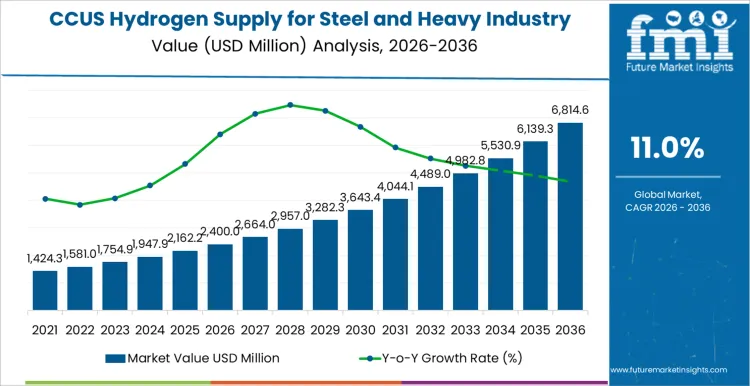
The CCUS hydrogen supply for steel and heavy industry market is projected to expand from USD 2,400.0 million in 2026 to USD 6,815.0 million by 2036, registering an 11.0% CAGR throughout the forecast period. Growth reflects how steel producers and heavy industrial manufacturers are implementing carbon capture technologies with hydrogen production systems to achieve deep decarbonization while maintaining process efficiency and economic competitiveness in carbon-constrained operating environments. CCUS hydrogen systems are engineered for industrial-scale production, carbon emission reduction, and process integration that transforms conventional fossil fuel-based operations into low-carbon manufacturing platforms where hydrogen quality, supply reliability, and carbon capture efficiency influence operational continuity, regulatory compliance, and market positioning strategies.
Large-scale industrial operations are implementing integrated carbon capture and hydrogen production facilities that enable simultaneous emissions reduction and clean fuel supply while optimizing capital efficiency through shared infrastructure and operational synergies. Systems that can demonstrate consistent hydrogen quality, reliable production capacity, and effective carbon capture performance under demanding industrial operating conditions are being integrated earlier in facility planning and investment decision processes. As carbon pricing mechanisms strengthen and industrial decarbonization mandates expand globally, facility operators evaluate CCUS hydrogen systems not only on production economics but also on carbon reduction effectiveness, regulatory compliance support, and integration with existing industrial processes that influence operational efficiency and competitive positioning.
Quick Stats for CCUS Hydrogen Supply for Steel and Heavy Industry Market
- CCUS Hydrogen Supply for Steel and Heavy Industry Market Value (2026): USD 2,400.0 million
- CCUS Hydrogen Supply for Steel and Heavy Industry Market Forecast Value (2036): USD 6,815.0 million
- CCUS Hydrogen Supply for Steel and Heavy Industry Market Forecast CAGR: 11.0%
- Leading End-Use Sector in CCUS Hydrogen Supply for Steel and Heavy Industry Market: Primary Steel and DRI (40%)
- Key Growth Countries in CCUS Hydrogen Supply for Steel and Heavy Industry Market: China, Germany, USA, UK, South Korea, Japan
- Key Players in CCUS Hydrogen Supply for Steel and Heavy Industry Market: Air Liquide, Linde, Air Products, Shell, BP
Blue hydrogen production through steam methane reforming and autothermal reforming with carbon capture leads where established technology maturity and cost competitiveness are essential for large-scale industrial adoption and near-term decarbonization objectives. Industrial off-gas capture and conversion systems dominate applications requiring waste stream utilization and circular economy implementation that optimize resource efficiency while reducing overall facility emissions. Cluster and hub-based supply configurations serve operations demanding economies of scale and shared infrastructure benefits that optimize capital deployment and operational efficiency. Primary steel and direct reduced iron applications remain the largest market segment, followed by refining and chemical processes, while cement and heavy industry provide expanding opportunities for high-temperature process decarbonization.
CCUS Hydrogen Supply for Steel and Heavy Industry Market Key Takeaways
| Metric | Value |
|---|---|
| Market Value (2026) | USD 2,400.0 million |
| Market Forecast Value (2036) | USD 6,815.0 million |
| Forecast CAGR 2026 to 2036 | 11.0% |
How Are Steel Industry Decarbonization Mandates Driving CCUS Hydrogen Investment?
Steel industry decarbonization requirements are driving fundamental transformation in production technologies as manufacturers face regulatory pressure to reduce carbon emissions while maintaining production capacity and cost competitiveness in global markets. Direct reduced iron production using hydrogen represents the most promising pathway for steel decarbonization while requiring substantial hydrogen supply infrastructure that can deliver consistent quality and volume at competitive pricing. This industrial evolution pushes CCUS hydrogen developers toward large-scale production systems that can serve multiple steel production facilities while achieving economies of scale essential for commercial viability.
The integration of carbon capture with hydrogen production creates unique opportunities for steel manufacturers to achieve comprehensive emissions reduction while generating valuable hydrogen feedstock for production processes. Steel industry carbon constraints increasingly require demonstrated emissions reductions rather than theoretical commitments, creating demand for CCUS hydrogen systems that can provide verified carbon capture performance and reliable hydrogen supply under demanding industrial operating conditions. This performance accountability drives innovation in integrated CCUS hydrogen systems that optimize both carbon capture efficiency and hydrogen production economics while supporting steel industry transformation requirements.
How Is the Market Structured Across Hydrogen Production Technologies?
The CCUS hydrogen supply for steel and heavy industry market demonstrates distinct segmentation patterns based on hydrogen production pathways and carbon capture integration approaches that directly influence system economics and industrial adoption rates. Blue hydrogen production through steam methane reforming and autothermal reforming with carbon capture systems achieves 46.0% market share through proven technology maturity and cost competitiveness that enables large-scale deployment while maintaining acceptable production economics for industrial applications. Some projects also compare partial oxidation when feedstock flexibility and capture integration are decision drivers. These systems benefit from established operational experience and supply chain infrastructure while providing scalable carbon capture capabilities that support comprehensive emissions reduction objectives.
Industrial off-gas capture and conversion systems capture 26.0% market adoption through their ability to utilize existing waste streams while providing circular economy benefits that optimize overall facility resource efficiency. These systems enable carbon capture from existing industrial processes while generating hydrogen feedstock that can support production requirements or be utilized for energy applications. The integration of off-gas capture with hydrogen production creates value-added opportunities while supporting comprehensive facility decarbonization through waste stream optimization and emissions reduction.
Which Project Development Configuration Generates the Highest Market Implementation?
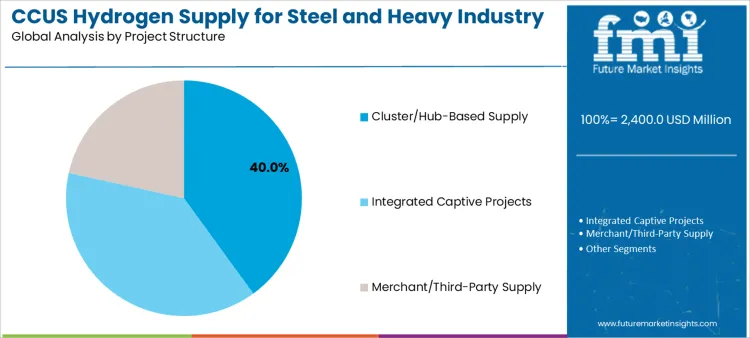
Cluster and hub-based supply systems maintain 40.0% market preference, establishing shared infrastructure development as the preferred approach for achieving economies of scale and optimizing capital deployment across multiple industrial facilities. These configurations enable infrastructure sharing, operational cost optimization, and risk distribution while providing reliable hydrogen supply to multiple customers within defined geographic regions. Hub-based development creates opportunities for specialized CCUS hydrogen facilities that can serve diverse industrial customers while achieving production volumes that support competitive economics and operational efficiency. Oil and gas carbon capture and storage assets can anchor early CO2 transport and injection options near coastal clusters.
Which End-Use Industrial Segment Drives Market Development?
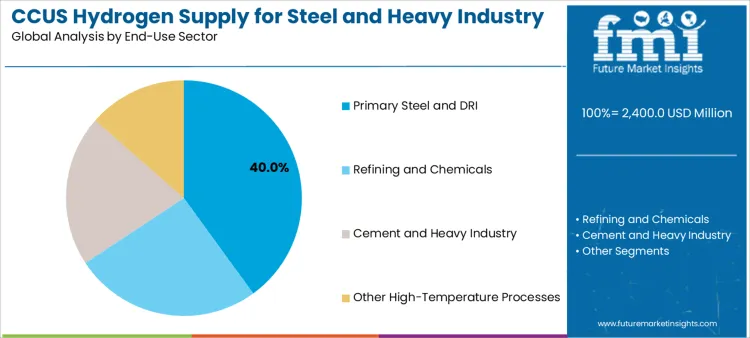
Primary steel and direct reduced iron production represents 40.0% of market applications, establishing steel manufacturing as the primary driver of CCUS hydrogen demand and technology development. These applications require substantial hydrogen volumes, consistent quality specifications, and reliable supply arrangements that support continuous production operations and quality control requirements. Steel industry hydrogen adoption creates opportunities for large-scale CCUS systems while providing anchor customers that support facility investment decisions and long-term supply arrangements essential for project financing and commercial viability.
Which Geographic Development Pattern Leads Infrastructure Deployment?
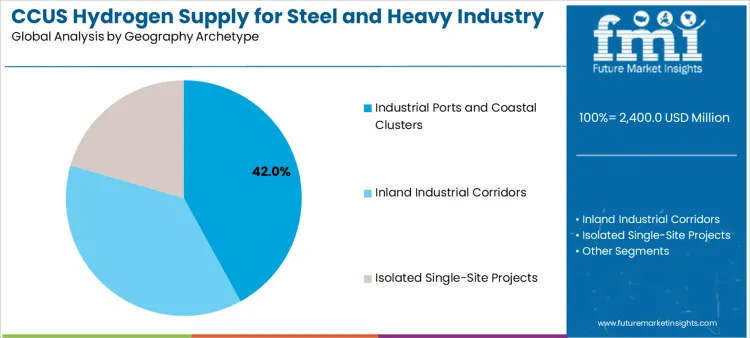
Industrial ports and coastal clusters command 42.0% of geographic development, reflecting the advantages of established industrial infrastructure, transportation access, and carbon storage proximity that optimize CCUS hydrogen project economics and operational efficiency. Coastal locations provide access to offshore carbon storage options while benefiting from existing port infrastructure and industrial utility systems that reduce development costs and timeline requirements. These locations enable economies of scale through facility clustering while providing transportation advantages for hydrogen distribution and carbon storage that optimize overall system economics.
How Is Carbon Pricing Policy Driving Industrial Hydrogen Adoption?
Carbon pricing mechanisms are creating fundamental economic incentives for industrial decarbonization that make CCUS hydrogen systems economically competitive with conventional fossil fuel-based processes while providing predictable operating cost advantages under strengthening carbon price scenarios. Industrial facilities face increasing carbon costs that directly impact production economics and competitive positioning, creating demand for decarbonization technologies that can reduce carbon exposure while maintaining operational efficiency. This economic pressure drives adoption of CCUS hydrogen systems that provide both emissions reduction and operational benefits while supporting long-term competitive positioning under carbon-constrained market conditions.
The implementation of border carbon adjustments and trade-based carbon pricing creates additional economic drivers for industrial decarbonization through market access requirements and competitive positioning considerations. Industrial manufacturers increasingly face market pressure for verified low-carbon production that benefits CCUS hydrogen systems capable of providing transparent carbon reduction documentation and supply chain traceability. These trade policy developments create premium opportunities for low-carbon industrial production while establishing clear economic advantages for early adopters of CCUS hydrogen technologies that can demonstrate verified emissions reductions.
What Technical Integration Challenges Constrain Industrial Implementation?
The primary technical barrier affecting CCUS hydrogen adoption in heavy industry centers on the complexity of integrating new hydrogen production and carbon capture systems with existing industrial processes while maintaining operational reliability and production efficiency. Industrial process integration requires sophisticated engineering that can accommodate hydrogen quality specifications, supply reliability requirements, and process safety considerations while minimizing operational disruption during system installation and commissioning. These technical challenges create barriers to adoption while requiring specialized engineering expertise and comprehensive risk management approaches.
Carbon capture system integration with hydrogen production creates additional technical complexity through shared equipment requirements, process optimization considerations, and operational coordination challenges that can affect both hydrogen quality and carbon capture performance. For many retrofit designs, amine based carbon capture remains the default capture train for blue hydrogen plants. System optimization requires balancing hydrogen production efficiency with carbon capture effectiveness while maintaining overall economic viability and operational reliability essential for industrial applications. These engineering challenges drive system development toward proven technologies and conservative design approaches while potentially limiting innovation and cost optimization opportunities.
How Do Industrial Cluster Development Programs Create Growth Opportunities?
Government and industry initiatives promoting industrial cluster development are creating substantial opportunities for CCUS hydrogen systems through coordinated infrastructure planning and shared investment approaches that optimize project economics while reducing individual facility risk exposure. Industrial cluster programs enable infrastructure sharing, regulatory coordination, and market development activities that benefit CCUS hydrogen projects through reduced development costs and enhanced project viability. These collaborative approaches create opportunities for larger-scale facilities that achieve better economics while serving multiple industrial customers through integrated supply networks.
International cooperation agreements for industrial decarbonization create additional opportunities for CCUS hydrogen technology deployment through shared technology development, financing mechanisms, and market creation initiatives. Cross-border industrial cooperation increasingly emphasizes clean technology deployment and emissions reduction that benefits CCUS hydrogen systems capable of supporting international climate objectives while providing economic benefits to participating countries and companies. These international programs create market development opportunities while establishing technology standards and best practices that support broader market adoption and technology advancement.
How Is the CCUS Hydrogen Supply for Steel and Heavy Industry Market Expected to Evolve Across Major Nations?
The global CCUS hydrogen supply for steel and heavy industry market reflects regional variations in industrial capacity, carbon policy frameworks, and technology investment capabilities that influence market development patterns across different economic zones. Leading industrial economies drive technology advancement and early deployment while emerging markets focus on establishing policy frameworks and infrastructure capabilities that support future CCUS hydrogen adoption and industrial decarbonization objectives.
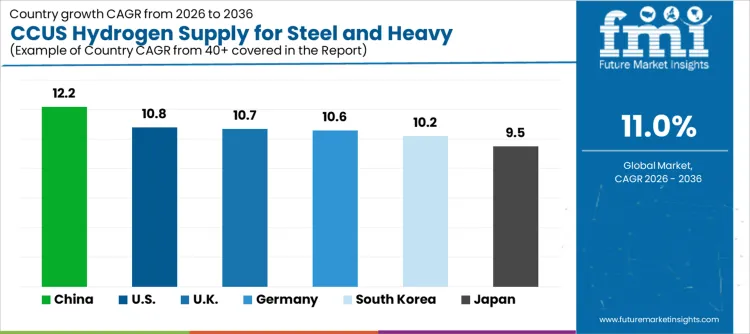
|
Country |
CAGR (%) |
|
China |
12.2% |
|
Germany |
10.6% |
|
USA |
10.8% |
|
Japan |
9.5% |
|
South Korea |
10.2% |
|
UK |
10.7% |
What Drives China's Market Leadership?
China's CCUS hydrogen supply for steel and heavy industry market is projected to achieve the highest growth rate at 12.2% CAGR, driven primarily by massive steel production capacity and comprehensive government policies promoting industrial decarbonization and clean technology deployment. The country's position as the world's largest steel producer creates enormous opportunities for CCUS hydrogen adoption while fostering domestic technology development and manufacturing capabilities. Chinese industrial policies increasingly emphasize carbon emission reduction and clean technology adoption that benefit CCUS hydrogen systems while supporting domestic industry development and international competitiveness.
Government initiatives promoting carbon capture and hydrogen technology development accelerate industrial adoption while creating favorable regulatory conditions for technology deployment and investment attraction. The integration of steel industry modernization with environmental protection creates unique opportunities for CCUS hydrogen systems that can support both industrial competitiveness and environmental objectives while utilizing domestic technology capabilities and manufacturing advantages. China's industrial scale enables cost-effective CCUS hydrogen deployment while supporting technology advancement and export opportunities to international markets seeking similar capabilities.
How Is Germany Advancing Industrial Decarbonization Excellence?
The market for CCUS hydrogen supply for steel and heavy industry in Germany is likely to rise at a CAGR of 10.6% reflects the country's leadership in industrial decarbonization policy implementation and advanced technology development that supports sophisticated CCUS hydrogen deployment across multiple industrial sectors. German regulatory frameworks establish comprehensive requirements for industrial emissions reduction while providing clear incentives for clean technology adoption and investment planning. The emphasis on technological excellence and environmental performance creates opportunities for premium CCUS hydrogen systems that demonstrate superior performance and integration capabilities compared to conventional decarbonization approaches.
The country's strong industrial decarbonization sector combined with advanced research capabilities drives adoption of innovative CCUS hydrogen systems that optimize industrial efficiency while supporting environmental protection objectives. German steel and chemical industries typically implement comprehensive decarbonization strategies that benefit from CCUS hydrogen technologies designed to provide both emissions reduction and operational benefits while maintaining global competitiveness and regulatory compliance.
Why Is the USA Market Emphasizing Technology Innovation and Scale?
The United States market experiences 10.8% CAGR growth supported by substantial industrial production capacity and emerging policy frameworks that create favorable conditions for CCUS hydrogen technology deployment and commercial development. Federal and state-level initiatives promoting clean technology and industrial decarbonization create substantial market opportunities while supporting research and development funding that accelerates technology advancement and commercialization. The emphasis on domestic technology leadership creates opportunities for advanced CCUS hydrogen systems that can serve both domestic and international markets.
Industrial competitiveness concerns drive adoption of CCUS hydrogen technologies that can maintain production efficiency while providing emissions reduction benefits essential for regulatory compliance and market positioning. The development of carbon capture technologies in the USA creates opportunities for integrated systems that combine industrial process optimization with environmental performance while providing comprehensive decarbonization solutions for heavy industry applications.
How Is Japanese Technology Focus Driving Premium Applications?
Sales of CCUS hydrogen supply for steel and heavy industry in Japan are likely to increase at a CAGR of 9.5% is supported by the country's leadership in precision industrial technologies and comprehensive environmental policies that create demand for sophisticated CCUS hydrogen systems with exceptional performance and reliability characteristics. Japanese industrial companies maintain strict quality standards that require CCUS hydrogen systems to demonstrate superior performance consistency and integration capabilities while providing verified environmental benefits that support corporate sustainability objectives and regulatory compliance.
The country's expertise in hydrogen technologies and industrial process optimization creates opportunities for advanced CCUS systems that incorporate precision control and monitoring capabilities while maintaining the reliability standards required for continuous industrial operations. Japanese technology development emphasizes long-term durability and comprehensive performance management that influences global standards for CCUS hydrogen systems while fostering innovation in system integration and operational optimization.
What Opportunities Exist in South Korea's Industrial Ecosystem?
Demand for CCUS hydrogen supply for steel and heavy industry in South Korea is estimated to expand at a CAGR of 10.2% growth is driven by the country's substantial steel and chemical production capacity combined with comprehensive environmental policies that create favorable conditions for CCUS hydrogen market development. Korean industrial companies require CCUS hydrogen systems that support high-quality production while meeting stringent environmental compliance requirements and maintaining international competitiveness. The integration of advanced automation and process control creates demand for CCUS systems with exceptional reliability and performance consistency that enable optimized industrial operations.
The country's leadership in steel production and petrochemical manufacturing creates opportunities for specialized CCUS hydrogen applications that require advanced technical capabilities and integration expertise. Korean industrial technology development emphasizes efficiency and environmental performance that drives demand for CCUS hydrogen systems designed to optimize both production economics and environmental impact while maintaining the quality standards required for global market competitiveness.
What Strategies Help Technology Providers Maintain Competitive Position in CCUS Hydrogen Supply for Steel and Heavy Industry?
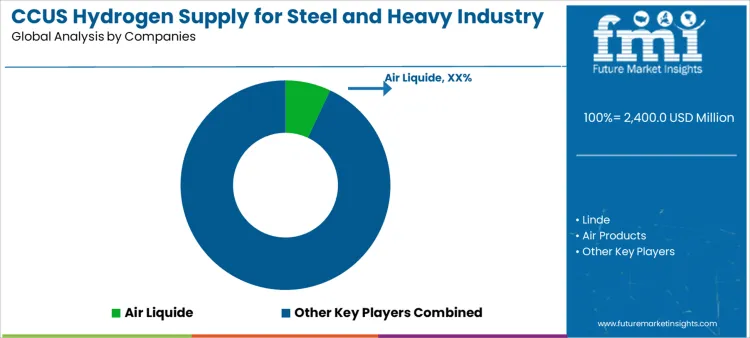
Technology providers maintain market leadership in CCUS hydrogen supply for steel and heavy industry through comprehensive system integration that encompasses hydrogen production, carbon capture, and industrial process optimization while providing proven performance data and reliable operational support that supports customer confidence and investment decisions. Market leaders establish competitive advantages through technology platforms that can demonstrate superior integration capabilities, operational reliability, and carbon capture efficiency while maintaining cost structures that support commercial viability and competitive positioning.
Successful providers invest in comprehensive research and development programs that optimize system performance, reduce costs, and enhance integration capabilities while providing customers with proven technology performance and reliable technical support. Investment in demonstration facilities and reference installations allows technology validation under industrial operating conditions while providing customer confidence and performance optimization opportunities that support market expansion and technology refinement. These capabilities create differentiation opportunities while enabling premium technology positioning that supports long-term customer relationships and market leadership.
Innovation in project development and financing enables providers to offer integrated solutions that address customer requirements for technology performance, project economics, and risk management while supporting successful project implementation and commercial operation. Collaboration with industrial customers, project developers, and financial institutions during project development phases allows optimization of system design and project structure for specific industrial requirements and market conditions while ensuring successful technology deployment and customer satisfaction.
Key Players in the CCUS Hydrogen Supply for Steel and Heavy Industry Market
- Air Liquide
- Linde
- Air Products
- Shell
- BP
- Equinor
- TotalEnergies
- Thyssenkrupp Uhde
- ArcelorMittal
- Tata Steel
Scope of Report
| Items | Values |
|---|---|
| Quantitative Units | USD Million |
| Hydrogen Source Segments | Blue Hydrogen (SMR/ATR + CCS); Industrial Off-Gas + CCS; Other CCUS-Linked Hydrogen Routes |
| End-Use Sector Categories | Primary Steel and DRI; Refining and Chemicals; Cement and Heavy Industry; Other High-Temperature Processes |
| Project Structure Types | Integrated Captive Projects; Cluster/Hub-Based Supply; Merchant/Third-Party Supply |
| Geography Archetype Categories | Industrial Ports and Coastal Clusters; Inland Industrial Corridors; Isolated Single-Site Projects |
| Regions Covered | North America, Europe, Asia Pacific, Latin America, Middle East & Africa |
| Key Countries | USA, Germany, China, Japan, South Korea, UK |
| Key Companies Profiled | Air Liquide, Linde, Air Products, Shell, BP, and others |
| Additional Attributes | Dollar sales measured for CCUS hydrogen supply systems including production facilities, carbon capture equipment, and integration services, specified by hydrogen production capacity, carbon capture efficiency, and industrial process integration |
CCUS Hydrogen Supply for Steel and Heavy Industry Market by Segment
By Hydrogen Source
- Blue Hydrogen (SMR/ATR + CCS)
- Industrial Off-Gas + CCS
- Other CCUS-Linked Hydrogen Routes
By End-Use Sector
- Primary Steel and DRI
- Refining and Chemicals
- Cement and Heavy Industry
- Other High-Temperature Processes
By Project Structure
- Integrated Captive Projects
- Cluster/Hub-Based Supply
- Merchant/Third-Party Supply
By Geography Archetype
- Industrial Ports and Coastal Clusters
- Inland Industrial Corridors
- Isolated Single-Site Projects
Bibliography
- International Energy Agency. (2023). Hydrogen in steelmaking and heavy industry: CCUS‑enabled decarbonization pathways. IEA.
- Intergovernmental Panel on Climate Change. (2023). Mitigation of climate change: Carbon capture, hydrogen, and heavy industry transformation. IPCC.
- Organisation for Economic Co-operation and Development. (2023). Carbon pricing, CCUS, and hydrogen deployment in industrial sectors. OECD Publishing.
- European Commission. (2024). Industrial decarbonisation and hydrogen with carbon capture under the EU Fit for 55 framework. Publications Office of the European Union.
Frequently Asked Questions
How big is the ccus hydrogen supply for steel and heavy industry market in 2026?
The global ccus hydrogen supply for steel and heavy industry market is estimated to be valued at USD 2,400.0 million in 2026.
What will be the size of ccus hydrogen supply for steel and heavy industry market in 2036?
The market size for the ccus hydrogen supply for steel and heavy industry market is projected to reach USD 6,814.6 million by 2036.
How much will be the ccus hydrogen supply for steel and heavy industry market growth between 2026 and 2036?
The ccus hydrogen supply for steel and heavy industry market is expected to grow at a 11.0% CAGR between 2026 and 2036.
What are the key product types in the ccus hydrogen supply for steel and heavy industry market?
The key product types in ccus hydrogen supply for steel and heavy industry market are blue hydrogen (smr/atr + ccs), industrial off-gas + ccs and other ccus-linked hydrogen routes.
Which end-use sector segment to contribute significant share in the ccus hydrogen supply for steel and heavy industry market in 2026?
In terms of end-use sector, primary steel and dri segment to command 40.0% share in the ccus hydrogen supply for steel and heavy industry market in 2026.
Preview the report firsthand - request a free sample
Get SampleGet the brochure for pricing and purchase details.
Get PDFTable of Content
- Executive Summary
- Global Market Outlook
- Demand-side Trends
- Supply-side Trends
- Technology Roadmap Analysis
- Analysis and Recommendations
- Market Overview
- Market Coverage / Taxonomy
- Market Definition / Scope / Limitations
- Market Background
- Market Dynamics
- Drivers
- Restraints
- Opportunity
- Trends
- Scenario Forecast
- Demand in Optimistic Scenario
- Demand in Likely Scenario
- Demand in Conservative Scenario
- Opportunity Map Analysis
- Product Life Cycle Analysis
- Supply Chain Analysis
- Investment Feasibility Matrix
- Value Chain Analysis
- PESTLE and Porter’s Analysis
- Regulatory Landscape
- Regional Parent Market Outlook
- Production and Consumption Statistics
- Import and Export Statistics
- Market Dynamics
- Global Market Analysis 2021 to 2025 and Forecast, 2026 to 2036
- Historical Market Size Value (USD Million) Analysis, 2021 to 2025
- Current and Future Market Size Value (USD Million) Projections, 2026 to 2036
- Y-o-Y Growth Trend Analysis
- Absolute $ Opportunity Analysis
- Global Market Pricing Analysis 2021 to 2025 and Forecast 2026 to 2036
- Global Market Analysis 2021 to 2025 and Forecast 2026 to 2036, By Hydrogen Source
- Introduction / Key Findings
- Historical Market Size Value (USD Million) Analysis By Hydrogen Source , 2021 to 2025
- Current and Future Market Size Value (USD Million) Analysis and Forecast By Hydrogen Source , 2026 to 2036
- Blue Hydrogen (SMR/ATR + CCS)
- Industrial Off-Gas + CCS
- Other CCUS-Linked Hydrogen Routes
- Blue Hydrogen (SMR/ATR + CCS)
- Y-o-Y Growth Trend Analysis By Hydrogen Source , 2021 to 2025
- Absolute $ Opportunity Analysis By Hydrogen Source , 2026 to 2036
- Global Market Analysis 2021 to 2025 and Forecast 2026 to 2036, By End-Use Sector
- Introduction / Key Findings
- Historical Market Size Value (USD Million) Analysis By End-Use Sector, 2021 to 2025
- Current and Future Market Size Value (USD Million) Analysis and Forecast By End-Use Sector, 2026 to 2036
- Primary Steel and DRI
- Refining and Chemicals
- Cement and Heavy Industry
- Other High-Temperature Processes
- Primary Steel and DRI
- Y-o-Y Growth Trend Analysis By End-Use Sector, 2021 to 2025
- Absolute $ Opportunity Analysis By End-Use Sector, 2026 to 2036
- Global Market Analysis 2021 to 2025 and Forecast 2026 to 2036, By Project Structure
- Introduction / Key Findings
- Historical Market Size Value (USD Million) Analysis By Project Structure, 2021 to 2025
- Current and Future Market Size Value (USD Million) Analysis and Forecast By Project Structure, 2026 to 2036
- Cluster/Hub-Based Supply
- Integrated Captive Projects
- Merchant/Third-Party Supply
- Cluster/Hub-Based Supply
- Y-o-Y Growth Trend Analysis By Project Structure, 2021 to 2025
- Absolute $ Opportunity Analysis By Project Structure, 2026 to 2036
- Global Market Analysis 2021 to 2025 and Forecast 2026 to 2036, By Geography Archetype
- Introduction / Key Findings
- Historical Market Size Value (USD Million) Analysis By Geography Archetype, 2021 to 2025
- Current and Future Market Size Value (USD Million) Analysis and Forecast By Geography Archetype, 2026 to 2036
- Industrial Ports and Coastal Clusters
- Inland Industrial Corridors
- Isolated Single-Site Projects
- Industrial Ports and Coastal Clusters
- Y-o-Y Growth Trend Analysis By Geography Archetype, 2021 to 2025
- Absolute $ Opportunity Analysis By Geography Archetype, 2026 to 2036
- Global Market Analysis 2021 to 2025 and Forecast 2026 to 2036, By Region
- Introduction
- Historical Market Size Value (USD Million) Analysis By Region, 2021 to 2025
- Current Market Size Value (USD Million) Analysis and Forecast By Region, 2026 to 2036
- North America
- Latin America
- Western Europe
- Eastern Europe
- East Asia
- South Asia and Pacific
- Middle East & Africa
- Market Attractiveness Analysis By Region
- North America Market Analysis 2021 to 2025 and Forecast 2026 to 2036, By Country
- Historical Market Size Value (USD Million) Trend Analysis By Market Taxonomy, 2021 to 2025
- Market Size Value (USD Million) Forecast By Market Taxonomy, 2026 to 2036
- By Country
- USA
- Canada
- Mexico
- By Hydrogen Source
- By End-Use Sector
- By Project Structure
- By Geography Archetype
- By Country
- Market Attractiveness Analysis
- By Country
- By Hydrogen Source
- By End-Use Sector
- By Project Structure
- By Geography Archetype
- Key Takeaways
- Latin America Market Analysis 2021 to 2025 and Forecast 2026 to 2036, By Country
- Historical Market Size Value (USD Million) Trend Analysis By Market Taxonomy, 2021 to 2025
- Market Size Value (USD Million) Forecast By Market Taxonomy, 2026 to 2036
- By Country
- Brazil
- Chile
- Rest of Latin America
- By Hydrogen Source
- By End-Use Sector
- By Project Structure
- By Geography Archetype
- By Country
- Market Attractiveness Analysis
- By Country
- By Hydrogen Source
- By End-Use Sector
- By Project Structure
- By Geography Archetype
- Key Takeaways
- Western Europe Market Analysis 2021 to 2025 and Forecast 2026 to 2036, By Country
- Historical Market Size Value (USD Million) Trend Analysis By Market Taxonomy, 2021 to 2025
- Market Size Value (USD Million) Forecast By Market Taxonomy, 2026 to 2036
- By Country
- Germany
- UK
- Italy
- Spain
- France
- Nordic
- BENELUX
- Rest of Western Europe
- By Hydrogen Source
- By End-Use Sector
- By Project Structure
- By Geography Archetype
- By Country
- Market Attractiveness Analysis
- By Country
- By Hydrogen Source
- By End-Use Sector
- By Project Structure
- By Geography Archetype
- Key Takeaways
- Eastern Europe Market Analysis 2021 to 2025 and Forecast 2026 to 2036, By Country
- Historical Market Size Value (USD Million) Trend Analysis By Market Taxonomy, 2021 to 2025
- Market Size Value (USD Million) Forecast By Market Taxonomy, 2026 to 2036
- By Country
- Russia
- Poland
- Hungary
- Balkan & Baltic
- Rest of Eastern Europe
- By Hydrogen Source
- By End-Use Sector
- By Project Structure
- By Geography Archetype
- By Country
- Market Attractiveness Analysis
- By Country
- By Hydrogen Source
- By End-Use Sector
- By Project Structure
- By Geography Archetype
- Key Takeaways
- East Asia Market Analysis 2021 to 2025 and Forecast 2026 to 2036, By Country
- Historical Market Size Value (USD Million) Trend Analysis By Market Taxonomy, 2021 to 2025
- Market Size Value (USD Million) Forecast By Market Taxonomy, 2026 to 2036
- By Country
- China
- Japan
- South Korea
- By Hydrogen Source
- By End-Use Sector
- By Project Structure
- By Geography Archetype
- By Country
- Market Attractiveness Analysis
- By Country
- By Hydrogen Source
- By End-Use Sector
- By Project Structure
- By Geography Archetype
- Key Takeaways
- South Asia and Pacific Market Analysis 2021 to 2025 and Forecast 2026 to 2036, By Country
- Historical Market Size Value (USD Million) Trend Analysis By Market Taxonomy, 2021 to 2025
- Market Size Value (USD Million) Forecast By Market Taxonomy, 2026 to 2036
- By Country
- India
- ASEAN
- Australia & New Zealand
- Rest of South Asia and Pacific
- By Hydrogen Source
- By End-Use Sector
- By Project Structure
- By Geography Archetype
- By Country
- Market Attractiveness Analysis
- By Country
- By Hydrogen Source
- By End-Use Sector
- By Project Structure
- By Geography Archetype
- Key Takeaways
- Middle East & Africa Market Analysis 2021 to 2025 and Forecast 2026 to 2036, By Country
- Historical Market Size Value (USD Million) Trend Analysis By Market Taxonomy, 2021 to 2025
- Market Size Value (USD Million) Forecast By Market Taxonomy, 2026 to 2036
- By Country
- Kingdom of Saudi Arabia
- Other GCC Countries
- Turkiye
- South Africa
- Other African Union
- Rest of Middle East & Africa
- By Hydrogen Source
- By End-Use Sector
- By Project Structure
- By Geography Archetype
- By Country
- Market Attractiveness Analysis
- By Country
- By Hydrogen Source
- By End-Use Sector
- By Project Structure
- By Geography Archetype
- Key Takeaways
- Key Countries Market Analysis
- USA
- Pricing Analysis
- Market Share Analysis, 2025
- By Hydrogen Source
- By End-Use Sector
- By Project Structure
- By Geography Archetype
- Canada
- Pricing Analysis
- Market Share Analysis, 2025
- By Hydrogen Source
- By End-Use Sector
- By Project Structure
- By Geography Archetype
- Mexico
- Pricing Analysis
- Market Share Analysis, 2025
- By Hydrogen Source
- By End-Use Sector
- By Project Structure
- By Geography Archetype
- Brazil
- Pricing Analysis
- Market Share Analysis, 2025
- By Hydrogen Source
- By End-Use Sector
- By Project Structure
- By Geography Archetype
- Chile
- Pricing Analysis
- Market Share Analysis, 2025
- By Hydrogen Source
- By End-Use Sector
- By Project Structure
- By Geography Archetype
- Germany
- Pricing Analysis
- Market Share Analysis, 2025
- By Hydrogen Source
- By End-Use Sector
- By Project Structure
- By Geography Archetype
- UK
- Pricing Analysis
- Market Share Analysis, 2025
- By Hydrogen Source
- By End-Use Sector
- By Project Structure
- By Geography Archetype
- Italy
- Pricing Analysis
- Market Share Analysis, 2025
- By Hydrogen Source
- By End-Use Sector
- By Project Structure
- By Geography Archetype
- Spain
- Pricing Analysis
- Market Share Analysis, 2025
- By Hydrogen Source
- By End-Use Sector
- By Project Structure
- By Geography Archetype
- France
- Pricing Analysis
- Market Share Analysis, 2025
- By Hydrogen Source
- By End-Use Sector
- By Project Structure
- By Geography Archetype
- India
- Pricing Analysis
- Market Share Analysis, 2025
- By Hydrogen Source
- By End-Use Sector
- By Project Structure
- By Geography Archetype
- ASEAN
- Pricing Analysis
- Market Share Analysis, 2025
- By Hydrogen Source
- By End-Use Sector
- By Project Structure
- By Geography Archetype
- Australia & New Zealand
- Pricing Analysis
- Market Share Analysis, 2025
- By Hydrogen Source
- By End-Use Sector
- By Project Structure
- By Geography Archetype
- China
- Pricing Analysis
- Market Share Analysis, 2025
- By Hydrogen Source
- By End-Use Sector
- By Project Structure
- By Geography Archetype
- Japan
- Pricing Analysis
- Market Share Analysis, 2025
- By Hydrogen Source
- By End-Use Sector
- By Project Structure
- By Geography Archetype
- South Korea
- Pricing Analysis
- Market Share Analysis, 2025
- By Hydrogen Source
- By End-Use Sector
- By Project Structure
- By Geography Archetype
- Russia
- Pricing Analysis
- Market Share Analysis, 2025
- By Hydrogen Source
- By End-Use Sector
- By Project Structure
- By Geography Archetype
- Poland
- Pricing Analysis
- Market Share Analysis, 2025
- By Hydrogen Source
- By End-Use Sector
- By Project Structure
- By Geography Archetype
- Hungary
- Pricing Analysis
- Market Share Analysis, 2025
- By Hydrogen Source
- By End-Use Sector
- By Project Structure
- By Geography Archetype
- Kingdom of Saudi Arabia
- Pricing Analysis
- Market Share Analysis, 2025
- By Hydrogen Source
- By End-Use Sector
- By Project Structure
- By Geography Archetype
- Turkiye
- Pricing Analysis
- Market Share Analysis, 2025
- By Hydrogen Source
- By End-Use Sector
- By Project Structure
- By Geography Archetype
- South Africa
- Pricing Analysis
- Market Share Analysis, 2025
- By Hydrogen Source
- By End-Use Sector
- By Project Structure
- By Geography Archetype
- USA
- Market Structure Analysis
- Competition Dashboard
- Competition Benchmarking
- Market Share Analysis of Top Players
- By Regional
- By Hydrogen Source
- By End-Use Sector
- By Project Structure
- By Geography Archetype
- Competition Analysis
- Competition Deep Dive
- Air Liquide
- Overview
- Product Portfolio
- Profitability by Market Segments (Product/Age /Sales Channel/Region)
- Sales Footprint
- Strategy Overview
- Marketing Strategy
- Product Strategy
- Channel Strategy
- Linde
- Air Products
- Shell
- BP
- Equinor
- TotalEnergies
- Thyssenkrupp Uhde
- ArcelorMittal
- Tata Steel
- Air Liquide
- Competition Deep Dive
- Assumptions & Acronyms Used
- Research Methodology


