

- Industry Size (2026)
- USD 1.5 Bn
- Forecast (2036)
- USD 12.3 Bn
- CAGR (2026 to 2036)
- 24.1%
Electrolyzer as a Service Market Size and Share Forecast Outlook By FMI
The global Electrolyzer as a Service market was valued at USD 1.2 billion in 2025. FMI estimates the market will reach USD 1.5 billion in 2026 and USD 12.3 billion by 2036, growing at a CAGR of 24.1% over the forecast period.
An absolute opportunity of USD 11.1 billion is expected to be created between 2026 and 2036. The market is set to expand by nearly 8.4 times from the 2026 base. Service-led procurement reduces upfront capital expenditure and shifts operating risk to specialized providers. Output assurance, uptime accountability, and faster deployment through bundled engineering and operations support are priorities in early adoption cycles. These factors keep service contracts relevant across industrial and mobility-linked hydrogen demand centers.
Summary Of Electrolyzer as a Service Market
- Electrolyzer as a Service Market Definition
- The Electrolyzer as a Service market is measured by service revenues generated from contracts where hydrogen production using water electrolysis is provided as a service outcome rather than as customer-owned electrolyzer equipment. Coverage spans output-based pricing, lease or subscription models, and BOOT structures, across onsite behind-the-meter and offsite hub-and-spoke deployment models.
- Demand Drivers
- Upfront electrolyzer capex is being reduced through service contracts, which is supporting earlier project approvals where ownership is not preferred.
- Uptime responsibility and performance risk are being transferred to the service provider through service level terms, which is supporting adoption where internal operations capability is limited.
- Hydrogen output pricing structures are being used to link payments to delivered kilograms, which is supporting procurement where utilization uncertainty is present.
- Key Segments Analysed in the FMI Report
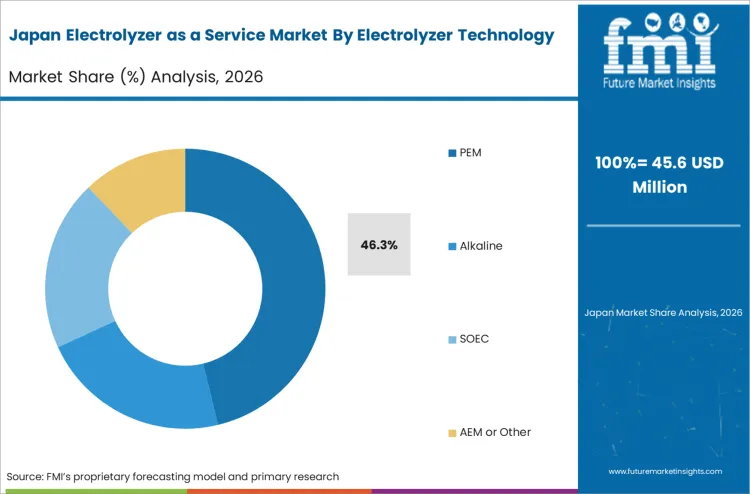
- By Electrolyzer Technology, PEM accounts for 46% of demand, followed by Alkaline at 42%, reflecting technology selection aligned to operational fit under service delivery terms.
- By Contract Model, Pay per kg H2 or Output-based accounts for 39%, followed by Lease or Subscription at 33%, reflecting contracting preference for outcome-linked payments and recurring fee structures.
- By Deployment, Onsite (Behind the meter) accounts for 61%, reflecting adoption where hydrogen is being supplied at the point of use under provider-operated assets.
- Analyst Opinion at FMI
- FMI analysis indicates that early scale-up is being supported where hydrogen demand can be contracted with clear output terms and where service providers can standardize design, monitoring, and maintenance across multiple sites. Technology selection is being influenced by the ability to maintain output under variable power input and by the service provider’s operating playbook. Contract selection is being influenced by the buyer’s preference to reduce ownership responsibility and by the need to align hydrogen procurement costs to delivered output.
- Executive Takeaways
- Service providers should prioritize contract structures with measurable output and availability terms, since performance accountability is being treated as part of the purchase decision.
- OEM and integrator partnerships should be structured around standardized balance of plant and remote monitoring, since repeatable commissioning and maintenance workflows are being used to control operating cost.
- Customer acquisition should be concentrated on industrial and mobility demand nodes with defined offtake, since utilization stability is being treated as a requirement for output-based pricing.
- Methodology
- Market estimates are validated by comparing project pipeline tracking, contract model benchmarking, and provider capacity disclosures against primary interview inputs.
- Pricing and revenue assumptions are built using contract structure benchmarks and are cross-checked with supplier and buyer discussions where available.
- Inputs are normalized to a consistent base year and discrepancies are resolved through targeted verification before being used in the final model.
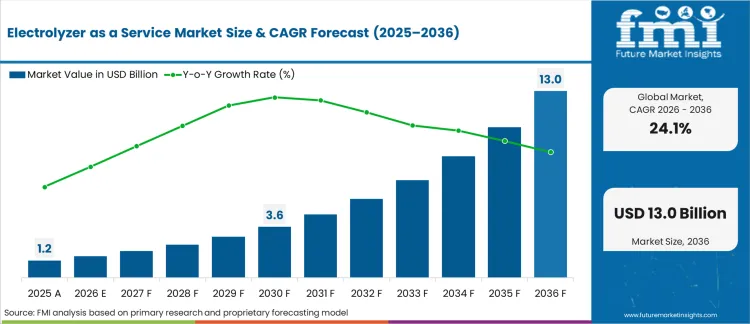
Electrolyzer as a Service gains traction as hydrogen procurement moves toward packaged solutions that combine generation, operations, and delivery responsibility under one contract. In early industrial deployments, buyers focus on continuity of supply and operational accountability rather than owning and running equipment, which supports service-led contracting. As certification and traceability frameworks become more established, long-term supply agreements become easier to structure, monitor, and finance. This allows providers to fund and operate electrolyzer assets while customers pay for delivered hydrogen or contracted availability, improving adoption where capital constraints or operating capability gaps exist.
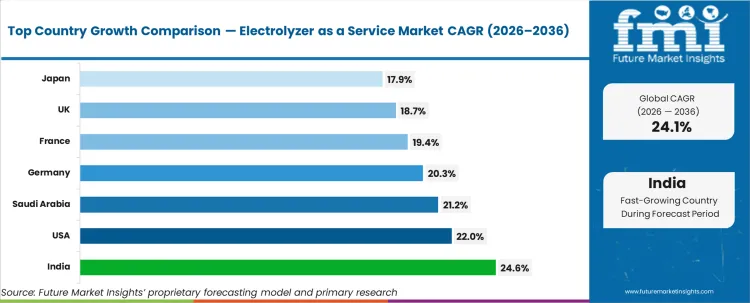
Country-level growth reflects different adoption stages globally. The USA and parts of Europe are being shaped by service contracting where capital outlay, uptime responsibility, and performance risk are being shifted from the buyer to the provider. India and Saudi Arabia are being shaped by planned hydrogen project pipelines where capacity additions are being scheduled across industrial and energy transition use cases. Japan is being shaped by longer procurement and qualification cycles, so growth is paced by project approvals rather than by short-term demand swings.
India is projected at 24.6% CAGR through 2036, supported by service models that reduce upfront capital requirements for early deployments. The USA follows at 22.0% CAGR, where output-based structures align payments with delivered hydrogen. Saudi Arabia is projected at 21.2% CAGR, where large project structures are in use and service contracting is being considered to support commissioning and operations coverage. Germany grows at 20.3% CAGR, where contracts are being structured around performance commitments and compliance requirements. France is projected at 19.4% CAGR, where adoption is linked to industrial offtake and conversion use cases. The UK expands at 18.7% CAGR, where contracting reduces ownership and operating responsibility for adopters. Japan is projected at 17.9% CAGR, where deployment is paced by qualification timelines and reliability verification.
Electrolyzer as a Service Market Analysis
| Metric | Value |
|---|---|
| Market Size, 2026 | USD 1.5 billion |
| Market Size, 2036 | USD 12.3 billion |
| CAGR (2026 to 2036) | 24.1% |
Electrolyzer as a Service Market Definition
Electrolyzer as a Service refers to a commercial delivery model in which hydrogen production capacity from water electrolysis is provided to an end user as a contracted service rather than as a customer-owned electrolyzer asset. Under this model, a service provider typically supplies and operates the electrolyzer system and associated balance of plant, and charges the customer using a defined commercial structure such as payment per kilogram of hydrogen delivered, a fixed subscription or lease fee, or a build own operate transfer arrangement.
Market Inclusions
The market includes revenues generated from Electrolyzer as a Service contracts where hydrogen production from water electrolysis is provided under a service model rather than sold as customer-owned equipment. Coverage includes output-based pay-per-kilogram structures, lease or subscription models, and BOOT arrangements. Revenues captured include bundled operations and maintenance, remote monitoring, performance guarantees, and service level commitments when priced into the contract. The scope covers PEM, alkaline, SOEC, and AEM or other electrolyzer technologies delivered through service agreements, across onsite behind-the-meter deployments and offsite hub-and-spoke supply models, serving industrial, mobility, power-to-X, and utility or storage-related customers.
Market Exclusions
The market excludes one-time capital sales of electrolyzers where the buyer owns and operates the asset without an ongoing service contract. Merchant hydrogen supplied from non-electrolysis routes such as SMR, coal-based production, or partial oxidation is not included unless tied to an electrolyzer service contract. Standalone sales of stacks, power electronics, or other components are excluded when not bundled into a service model. EPC revenue is excluded when it is limited to project build scope with no recurring service revenue. Pilot or demonstration systems without commercial contracts are excluded. Hydrogen transport and distribution services are also excluded unless explicitly packaged inside the electrolyzer service agreement pricing.
Electrolyzer as a Service Research Methodology
- Primary Research: Primary interviews were conducted with electrolyzer OEMs, EaaS platform providers, project developers, EPC contractors, renewable power developers, industrial gas firms, financiers, and end users in each target sector such as refineries, ammonia producers, steel plants, and mobility hubs. Discussions covered contracting models, uptime and availability terms, pricing benchmarks, risk allocation, permitting and grid interconnection issues, and decision criteria for buy versus service. Inputs were used to test assumptions and interpret adoption barriers not visible in public data.
- Desk Research: Desk research compiled evidence from company announcements, offtake and project press releases, tender documents, regulatory and certification guidelines, auction results, and industry datasets on electrolyzer shipments, announced capacity, commissioning timelines, and renewable power buildout.
- Market Sizing and Forecasting: Sizing used a bottom-up approach by country, mapping addressable hydrogen demand suitable for on-site or near-site electrolysis, then applying EaaS penetration scenarios linked to financing access, power cost, and customer risk appetite. Regional and global totals were reconciled using provider pipelines and delivered-hydrogen pricing ranges.
- Data Validation and Update Cycles: Estimates were cross-checked against supply-side capacity, project FIDs, interview feedback, and related hydrogen infrastructure activity. Conflicts between sources were resolved through follow-up calls or document verification before modeling updates.
Segmental Analysis
Electrolyzer as a Service Market Analysis by Technology
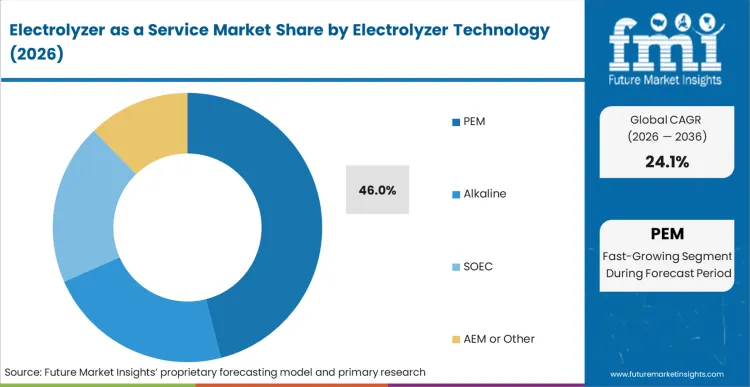
The market is segmented by electrolyzer technology into PEM, Alkaline, SOEC, and AEM or Other. PEM holds the leading share in 2026 at 46%, with Alkaline close behind, while SOEC and AEM or Other remain smaller due to lower commercial rollout and narrower financing comfort relative to the two established routes. PEM adoption in Electrolyzer as a Service is supported where contracts are structured around delivered output and operating KPIs, and where plant operation must follow variable renewable power input without reducing availability. Alkaline adoption remains material where service economics are managed through stable utilization blocks, standardized operating procedures, and predictable maintenance cycles that can be replicated across multiple customer sites. This selection logic is reflected in disclosed industrial-scale PEM deployments such as REFHYNE II in Germany, where Shell has taken a final investment decision for a 100 MW PEM electrolyser at its Rheinland site, with expected output of up to 44,000 kg per day and operation scheduled for 2027, showing PEM being applied at a scale where output and availability targets are defined. [1]
Electrolyzer as a Service Market Analysis by Contract Model
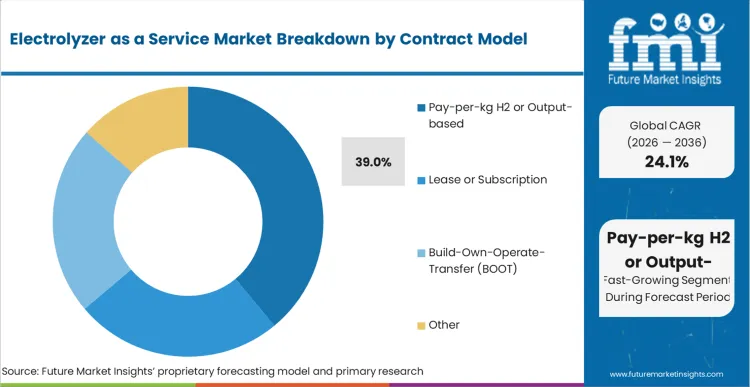
The market is segmented by contract model into Pay per kg H2 or Output-based, Lease or Subscription, BOOT, and Other. Pay per kg H2 or Output-based holds the leading share in 2026 at 39%, reflecting preference for structures where hydrogen is treated as a procured input and payments can be tied to metered delivery, quality specification, and availability. This structure also places operational and performance responsibility with the provider, reducing buyer exposure to downtime and maintenance planning. Lease or subscription models follow where deployment is being moved forward with a recurring charge and where ownership is not being required by the adopter. BOOT structures are used when construction and operating responsibility are placed with the provider and ownership transfer terms are defined in the agreement. A public leasing-based reference that supports the lease or subscription pathway is Snam Hydrogen as a Service, described as providing electrolysis systems on a leasing basis to reduce risks associated with large-scale projects. [2]
Electrolyzer as a Service Market Drivers, Restraints and Opportunities
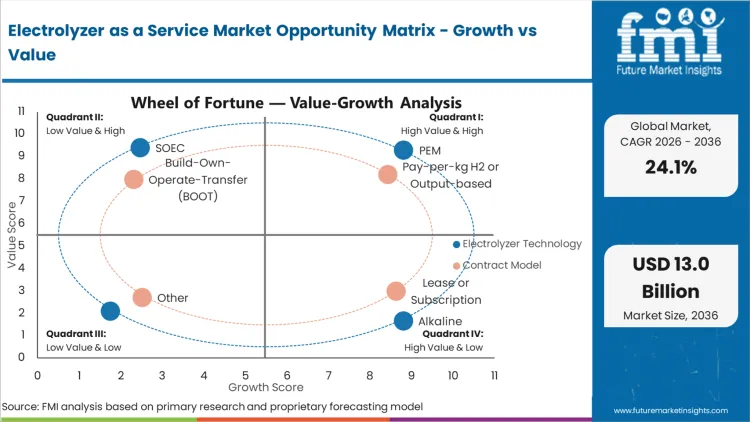
Market performance is being shaped by the pace at which bankable projects are being assembled and moved through execution. Site readiness is being determined by connection studies, electrical upgrade scope, and commissioning resources, which affects how quickly service providers can activate contracted capacity. Commercial readiness is being influenced by how risks are allocated for outages, efficiency drift, and replacement planning across the operating term, as these items affect service pricing and liability. Adoption is also being affected by how hydrogen is being integrated into existing processes, because impurity tolerance, pressure requirements, and interface constraints can add balance of plant scope and extend delivery timelines. Where these elements are clarified early, service providers are able to standardize delivery playbooks, improve scheduling across multiple customer sites, and maintain performance consistency through defined operating procedures and remote diagnostics.
- Buyers are prioritizing contracting formats that reduce internal engineering workload by using bundled delivery and operating accountability from a single service provider.
- Projects are being slowed when interface requirements such as pressure, purity, and compression integration expand balance of plant scope beyond standard packages.
- Providers can expand margins by offering lifecycle add-ons such as spares pooling, performance tuning, and rapid-response service coverage across a multi-site fleet.
Regional Analysis
FMI’s regional analysis covers seven key regions globally, including North America, Latin America, Eastern Europe, Western Europe, South Asia and Pacific, East Asia, and Middle East and Africa. The full report offers market attractiveness analysis and market potential assessment across 30 or more countries based on regional dynamics and trends.
Country-Wise Growth Comparison of Electrolyzer as a Service Market
.webp "Top Country Growth Comparison Electrolyzer As A Service Market Cagr (2026 2036)")
| Country | CAGR (2026 to 2036) |
|---|---|
| India | 24.6% |
| USA | 22.0% |
| Saudi Arabia | 21.2% |
| Germany | 20.3% |
| France | 19.4% |
| UK | 18.7% |
| Japan | 17.9% |
Source: Future Market Insights (FMI) analysis, based on proprietary forecasting model and primary research
North America Market Analysis
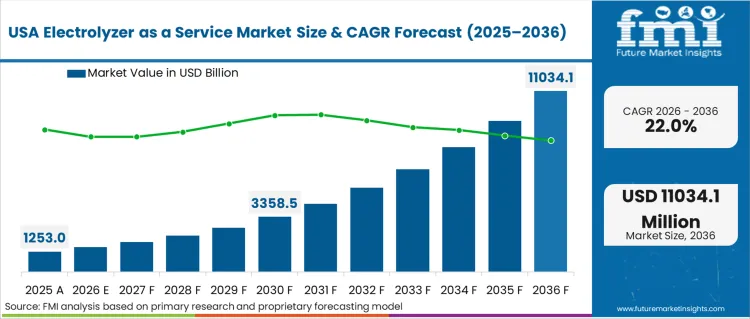
North America is expected to develop as a contract-structured EaaS market where demand is being shaped by hydrogen hub buildouts, large captive industrial loads, and developer-led project aggregation across multi-user clusters. Adoption is expected to be influenced by the ability to pool offtake, standardize contracting across sites, and execute deployments through experienced EPC and operations partners, which supports service-led delivery at scale.
- The USA market is expected to expand at a CAGR of 22.0% during 2026 to 2036, supported by hub-led capacity rollouts and multi-site industrial demand.
- Output-linked procurement and cluster-based deployment support faster commercialization of service contracts.
FMI’s report covers a detailed analysis of the North American market including the USA and regional deployment priorities. Readers can find relevant market potential for service-based electrolysis contracts detailed in the report along with supporting findings.
Europe Market Analysis
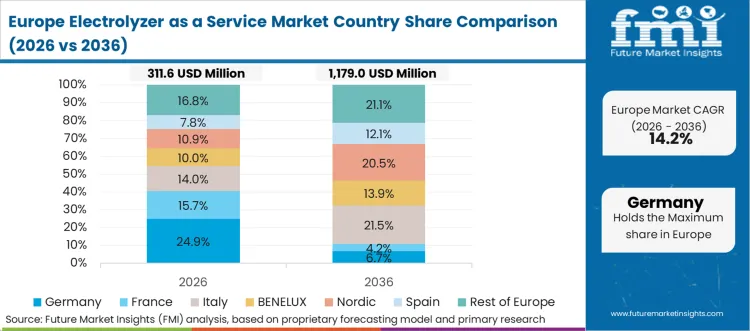
Europe is expected to progress as a compliance-driven EaaS market where adoption is being shaped by guarantees of origin, certification rules, and cross-border corridor planning that require traceable supply and auditable delivery terms. Service models are expected to be preferred where regulatory reporting, emissions accounting, and quality verification are being embedded into hydrogen procurement, making managed service delivery more practical than owner-operated assets.
- Germany is expected to register a CAGR of 20.3% during 2026 to 2036, supported by industrial corridor projects and traceability-led procurement.
- France is projected to grow at a CAGR of 19.4% through 2036, supported by industrial decarbonization programs and public-backed project execution.
- The UK is expected to expand at a CAGR of 18.7% over the forecast period, supported by cluster development and contracting-led adoption in hard-to-abate sectors.
FMI’s assessment of the European market includes country-level analysis for Germany, France, the UK, and other key countries, covering certification influence, contracting structures, and deployment dynamics in detail.
Asia Pacific Market Analysis
Asia Pacific is expected to be driven by manufacturing-led and customer capability-led adoption, where EaaS is being used to bridge gaps in operating expertise, maintenance readiness, and performance assurance for first-time industrial users. Growth is expected to be concentrated where bundled service offerings reduce commissioning risk and where providers can replicate standardized packages across industrial parks, ports, and mobility refueling networks.
- India is expected to grow at a CAGR of 24.6% during 2026 to 2036, supported by early service-led deployments and industrial offtake interest.
- Japan is expected to expand at a CAGR of 17.9% through 2036, supported by structured procurement by mobility and industrial consortia.
FMI’s analysis of the Asia Pacific market includes country-level assessments for India, Japan, and other countries, covering adoption models, operational readiness, and service contracting trends.
Middle East Market Analysis
The Middle East is expected to expand as an export-anchored and project-financed EaaS market, where deployments are being shaped by integrated giga-project structures that bundle renewable power, electrolysis, storage, and derivative conversion under long-term sales agreements. Service models are expected to be used where developers and industrial groups prefer centralized operations and contracted output delivery to manage scale-up and reliability across large complexes.
- Saudi Arabia is projected to rise at a CAGR of 21.2% during 2026 to 2036, supported by export-aligned projects and large-scale integrated developments.
- Long-duration supply agreements and centralized operations support service-based electrolysis deployment.
FMI’s coverage of the Middle East includes country-level analysis of Saudi Arabia and related markets, detailing export-linked project development, contracting trends, and end-user adoption priorities.
Competitive Aligners for Market Players
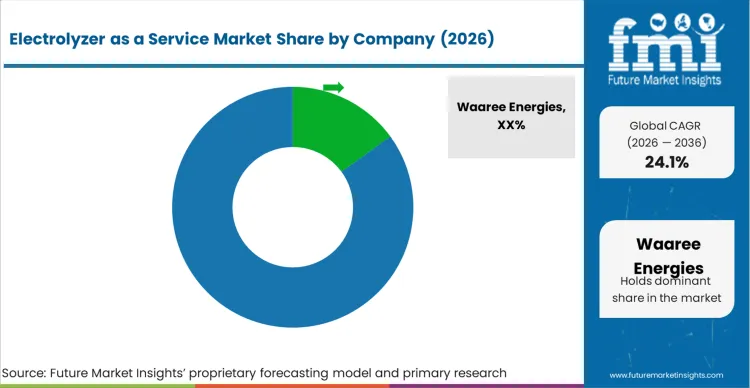
The Electrolyzer as a Service market is taking shape as a contract-led competitive space where differentiation is created less by electrolyzer stack branding and more by the ability to originate projects, finance assets, operate reliably, and lock in long-term offtake. The core competitive variables are access to low-cost renewable power, bankable contracting capability, and execution strength across EPC, commissioning, and multi-year operations. Players with standardized, modular plant designs gain an advantage because they can replicate delivery across sites and shorten deployment cycles, while operators with strong O and M and remote monitoring capabilities can price availability and performance into output-linked contracts.
Recent Developments
- February 23, 2026: Waaree Clean Energy Solutions signed an electrolyzer-as-a-service deal with Zero Footprint Industries for a 2.5 MW alkaline system, which Waaree will install, operate, and supply under a 15-year contract. [3]
- June 25, 2025: ITM Power launched Hydropulse, a Berlin subsidiary that will build, own, and operate modular NEPTUNE electrolyzer plants for industrial users, selling hydrogen under long-term offtake contracts, an explicit Electrolyzer-as-a-Service model. [4]
Key Players Covered in the Study
- Waaree Energies
- ITM Power (Hydropulse)
- Linde
- Air Liquide
- Air Products
- RCT Hydrogen
- Electric Hydrogen
Report Scope
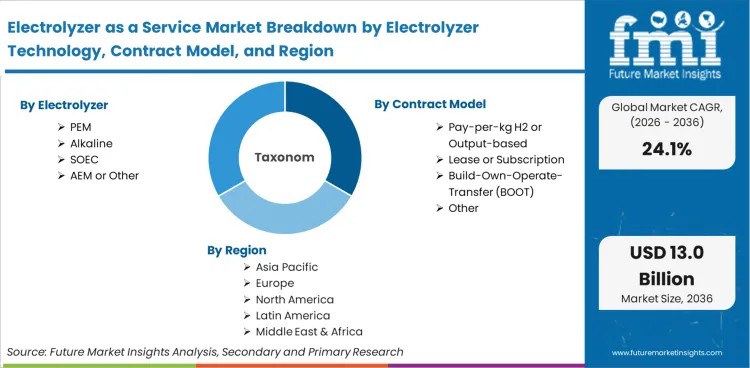
| Metric | Value |
|---|---|
| Quantitative Units | USD 1.5 billion in 2026 to USD 12.3 billion by 2036 at CAGR of 24.1% |
| Market Definition | The Electrolyzer as a Service market comprises service-led delivery models in which a provider finances, installs, owns, and operates electrolyzer systems and supplies hydrogen output or contracted availability to customers under long-term agreements, including associated balance-of-plant, monitoring, maintenance, and operations services bundled within the contract. |
| Electrolyzer Technology Segmentation | PEM, Alkaline, SOEC, AEM or Other |
| Contract Model Segmentation | Pay-per-kg H2 or Output-based, Lease or Subscription, Build-Own-Operate-Transfer (BOOT), Other |
| Customer Type Segmentation | Industrial, Mobility H2 Stations, Power-to-X (e-fuels or ammonia), Utilities or Storage |
| System Size Segmentation | Less than 5 MW, 5 to 20 MW, Greater than 20 MW |
| Deployment Segmentation | Onsite, Offsite |
| Regions Covered | North America, Latin America, Eastern Europe, Western Europe, East Asia, South Asia and Pacific, Middle East and Africa |
| Key Players Covered in the Study | Waaree Energies, ITM Power (Hydropulse), Linde, Air Liquide, Air Products, RCT Hydrogen, Electric Hydrogen |
| Forecast Period | 2026 to 2036 |
| Approach | Hybrid top-down and bottom-up market modelling triangulated using project pipeline mapping by country, provider contract models, power sourcing assumptions, and delivered-hydrogen pricing structures, supported by primary interviews with OEMs, EaaS providers, EPCs, developers, financiers, and end users alongside verification from project announcements and contracting references. |
Electrolyzer as a Service Market Analysis by Segments
By Electrolyzer Technology:
- PEM
- Alkaline
- SOEC
- AEM or Other
By Contract Model:
- Pay-per-kg H2 or Output-based
- Lease or Subscription
- Build-Own-Operate-Transfer (BOOT)
- Other
By Customer Type:
- Industrial
- Mobility H2 Stations
- Power-to-X (e-fuels or ammonia)
- Utilities or Storage
By System Size:
- Less than 5 MW
- 5 to 20 MW
- Greater than 20 MW
By Deployment:
- Onsite
- Offsite
By Region:
- North America
- Latin America
- Eastern Europe
- Western Europe
- East Asia
- South Asia and Pacific
- Middle East and Africa
Bibliography
- [1] Shell. “Shell to build 100-megawatt renewable hydrogen electrolyser in Germany.” Shell Global, 24 Jul 2024. https://www.shell.com/what-we-do/shell-to-build-100-megawatt-renewable-hydrogen-electrolyser-in-germany.html
- [2] Tenova. “Tenova with TenarisDalmine and Snam for Hydrogen Testing in a nation first.” Tenova Newsroom, 03 Jul 2024. https://tenova.com/newsroom/latest-tenova/tenova-tenarisdalmine-and-snam-hydrogen-testing-nation-first
- [3] ITM Power. “Launch of Hydropulse. Solving the Industrial Green Hydrogen Challenge.” ITM Power News, 25 Jun 2025. https://itm-power.com/news/launch-of-hydropulse-solving-the-industrial-green-hydrogen-challenge
- [4] Shukla, Parth. “Waaree to Set Up 2.5 MW Alkaline Electrolyzer for Zero Footprint Industries.” Mercom India, 23 Feb 2026. https://www.mercomindia.com/waaree-to-set-up-2-5-mw-alkaline-electrolyzer-for-zero-footprint-industries
This bibliography is provided for reader reference and is not exhaustive. The full report contains the complete reference list and detailed citations.
This Report Addresses
- Electrolyzer as a Service market sizing for 2026 and 2036 with CAGR for 2026 to 2036 in USD Billion
- Competitive landscape assessment with key providers and commercialization pathways
- Segment-level analysis for By Electrolyzer Technology and By Contract Model, including leading sub-segment shares
- Country-level growth outlook and CAGR comparison for USA, Germany, France, UK, Japan, India, and Saudi Arabia
- Deployment model assessment covering onsite and offsite configurations and operating responsibility allocation
- Contracting structures, service scope boundaries, and performance measurement priorities influencing adoption
- Demand assessment by customer categories and system size bands and implications for project economics
Frequently Asked Questions
What is the market size of the Electrolyzer as a Service market in 2026 and 2036?
The market is valued at USD 1.5 billion in 2026 and is projected to reach USD 12.3 billion by 2036, reflecting a CAGR of 24.1% for 2026 to 2036.
What is the forecast CAGR for Electrolyzer as a Service during 2026 to 2036?
The market is projected to grow at a 24.1% CAGR during the 2026 to 2036 period.
What is meant by Electrolyzer as a Service in this report?
It refers to a service-led model where electrolyzer capacity and hydrogen output are provided under a contract, rather than the customer purchasing and owning the electrolyzer equipment.
What is included in the scope of this report?
The report includes service revenues linked to output-based, lease or subscription, and BOOT structures across electrolyzer technologies, deployment formats, and customer categories covered in the study.
What is excluded from the scope of this report?
One-time electrolyzer equipment sales without a service contract, non-electrolysis hydrogen production routes, standalone component sales, and pilot systems without commercial service contracts are excluded.
Which electrolyzer technology holds the leading share in 2026?
PEM holds the leading share in 2026 at 46%, followed by alkaline technologies, while SOEC and AEM or Other remain smaller.
Which contract model holds the leading share in 2026?
Pay per kg H2 or output-based models hold the leading share in 2026 at 39%, followed by lease or subscription structures.
Which countries are covered in the country-wise CAGR outlook?
The country outlook covers the USA, Germany, France, UK, Japan, India, and Saudi Arabia.
Which country shows the highest CAGR in the outlook set?
India at 24.6% CAGR is the highest growth market within the selected country set.
What customer types are represented in the study segmentation?
Customer types include industrial hydrogen users, mobility hydrogen station operators, Power-to-X project operators, and utilities or storage-related users where electrolysis output is contracted as a service.
What unit and base year are used in this report?
Market sizing is presented in USD billion, with 2026 as the base year and forecasts through 2036.
How is this market sized and validated?
Sizing is built using triangulation across project pipeline tracking, contract model benchmarking, provider disclosures, and primary interviews, with validation checks applied across segment totals and country CAGRs.
Preview the report firsthand - request a free sample
Get SampleGet the brochure for pricing and purchase details.
Get PDFTable of Content
- Executive Summary
- Global Market Outlook
- Demand-side Trends
- Supply-side Trends
- Technology Roadmap Analysis
- Analysis and Recommendations
- Market Overview
- Market Coverage / Taxonomy
- Market Definition / Scope / Limitations
- Research Methodology
- Chapter Orientation
- Analytical Lens and Working Hypotheses
- Market Structure, Signals, and Trend Drivers
- Benchmarking and Cross-market Comparability
- Market Sizing, Forecasting, and Opportunity Mapping
- Research Design and Evidence Framework
- Desk Research Programme (Secondary Evidence)
- Company Annual and Sustainability Reports
- Peer-reviewed Journals and Academic Literature
- Corporate Websites, Product Literature, and Technical Notes
- Earnings Decks and Investor Briefings
- Government Statistics Portals and Public Data Releases
- Press Releases and Reputable Media Coverage
- Specialist Newsletters and Curated Briefings
- Sector Databases and Reference Repositories
- FMI Internal Proprietary Databases and Historical Market Datasets
- Subscription Datasets and Paid Sources
- Social Channels, Communities, and Digital Listening Inputs
- Additional Desk Sources
- Expert Input and Fieldwork (Primary Evidence)
- Primary Modes
- Qualitative Interviews and Expert Elicitation
- Quantitative Surveys and Structured Data Capture
- Blended Approach
- Why Primary Evidence is Used
- Field Techniques
- Interviews
- Surveys
- Focus Groups
- Observational and In-context Research
- Social and Community Interactions
- Stakeholder Universe Engaged
- C-suite Leaders
- Board Members
- Presidents and Vice Presidents
- R&D and Innovation Heads
- Technical Specialists
- Domain Subject-matter Experts
- Scientists
- Physicians and Other Healthcare Professionals
- Governance, Ethics, and Data Stewardship
- Research Ethics
- Data Integrity and Handling
- Primary Modes
- Tooling, Models, and Reference Databases
- Desk Research Programme (Secondary Evidence)
- Data Engineering and Model Build
- Data Acquisition and Ingestion
- Cleaning, Normalisation, and Verification
- Synthesis, Triangulation, and Analysis
- Quality Assurance and Audit Trail
- Market Background
- Market Dynamics
- Drivers
- Restraints
- Opportunity
- Trends
- Scenario Forecast
- Demand in Optimistic Scenario
- Demand in Likely Scenario
- Demand in Conservative Scenario
- Opportunity Map Analysis
- Product Life Cycle Analysis
- Supply Chain Analysis
- Investment Feasibility Matrix
- Value Chain Analysis
- PESTLE and Porter’s Analysis
- Regulatory Landscape
- Regional Parent Market Outlook
- Production and Consumption Statistics
- Import and Export Statistics
- Market Dynamics
- Global Market Analysis 2021 to 2025 and Forecast, 2026 to 2036
- Historical Market Size Value (USD Million) Analysis, 2021 to 2025
- Current and Future Market Size Value (USD Million) Projections, 2026 to 2036
- Y-o-Y Growth Trend Analysis
- Absolute $ Opportunity Analysis
- Global Market Pricing Analysis 2021 to 2025 and Forecast 2026 to 2036
- Global Market Analysis 2021 to 2025 and Forecast 2026 to 2036, By Electrolyzer Technology
- Introduction / Key Findings
- Historical Market Size Value (USD Million) Analysis By Electrolyzer Technology , 2021 to 2025
- Current and Future Market Size Value (USD Million) Analysis and Forecast By Electrolyzer Technology , 2026 to 2036
- PEM
- Alkaline
- SOEC
- AEM or Other
- PEM
- Y-o-Y Growth Trend Analysis By Electrolyzer Technology , 2021 to 2025
- Absolute $ Opportunity Analysis By Electrolyzer Technology , 2026 to 2036
- Global Market Analysis 2021 to 2025 and Forecast 2026 to 2036, By Contract Model
- Introduction / Key Findings
- Historical Market Size Value (USD Million) Analysis By Contract Model, 2021 to 2025
- Current and Future Market Size Value (USD Million) Analysis and Forecast By Contract Model, 2026 to 2036
- Pay-per-kg H2 or Output-based
- Lease or Subscription
- Build-Own-Operate-Transfer (BOOT)
- Other
- Pay-per-kg H2 or Output-based
- Y-o-Y Growth Trend Analysis By Contract Model, 2021 to 2025
- Absolute $ Opportunity Analysis By Contract Model, 2026 to 2036
- Global Market Analysis 2021 to 2025 and Forecast 2026 to 2036, By Region
- Introduction
- Historical Market Size Value (USD Million) Analysis By Region, 2021 to 2025
- Current Market Size Value (USD Million) Analysis and Forecast By Region, 2026 to 2036
- North America
- Latin America
- Western Europe
- Eastern Europe
- East Asia
- South Asia and Pacific
- Middle East & Africa
- Market Attractiveness Analysis By Region
- North America Market Analysis 2021 to 2025 and Forecast 2026 to 2036, By Country
- Historical Market Size Value (USD Million) Trend Analysis By Market Taxonomy, 2021 to 2025
- Market Size Value (USD Million) Forecast By Market Taxonomy, 2026 to 2036
- By Country
- USA
- Canada
- Mexico
- By Electrolyzer Technology
- By Contract Model
- By Country
- Market Attractiveness Analysis
- By Country
- By Electrolyzer Technology
- By Contract Model
- Key Takeaways
- Latin America Market Analysis 2021 to 2025 and Forecast 2026 to 2036, By Country
- Historical Market Size Value (USD Million) Trend Analysis By Market Taxonomy, 2021 to 2025
- Market Size Value (USD Million) Forecast By Market Taxonomy, 2026 to 2036
- By Country
- Brazil
- Chile
- Rest of Latin America
- By Electrolyzer Technology
- By Contract Model
- By Country
- Market Attractiveness Analysis
- By Country
- By Electrolyzer Technology
- By Contract Model
- Key Takeaways
- Western Europe Market Analysis 2021 to 2025 and Forecast 2026 to 2036, By Country
- Historical Market Size Value (USD Million) Trend Analysis By Market Taxonomy, 2021 to 2025
- Market Size Value (USD Million) Forecast By Market Taxonomy, 2026 to 2036
- By Country
- Germany
- UK
- Italy
- Spain
- France
- Nordic
- BENELUX
- Rest of Western Europe
- By Electrolyzer Technology
- By Contract Model
- By Country
- Market Attractiveness Analysis
- By Country
- By Electrolyzer Technology
- By Contract Model
- Key Takeaways
- Eastern Europe Market Analysis 2021 to 2025 and Forecast 2026 to 2036, By Country
- Historical Market Size Value (USD Million) Trend Analysis By Market Taxonomy, 2021 to 2025
- Market Size Value (USD Million) Forecast By Market Taxonomy, 2026 to 2036
- By Country
- Russia
- Poland
- Hungary
- Balkan & Baltic
- Rest of Eastern Europe
- By Electrolyzer Technology
- By Contract Model
- By Country
- Market Attractiveness Analysis
- By Country
- By Electrolyzer Technology
- By Contract Model
- Key Takeaways
- East Asia Market Analysis 2021 to 2025 and Forecast 2026 to 2036, By Country
- Historical Market Size Value (USD Million) Trend Analysis By Market Taxonomy, 2021 to 2025
- Market Size Value (USD Million) Forecast By Market Taxonomy, 2026 to 2036
- By Country
- China
- Japan
- South Korea
- By Electrolyzer Technology
- By Contract Model
- By Country
- Market Attractiveness Analysis
- By Country
- By Electrolyzer Technology
- By Contract Model
- Key Takeaways
- South Asia and Pacific Market Analysis 2021 to 2025 and Forecast 2026 to 2036, By Country
- Historical Market Size Value (USD Million) Trend Analysis By Market Taxonomy, 2021 to 2025
- Market Size Value (USD Million) Forecast By Market Taxonomy, 2026 to 2036
- By Country
- India
- ASEAN
- Australia & New Zealand
- Rest of South Asia and Pacific
- By Electrolyzer Technology
- By Contract Model
- By Country
- Market Attractiveness Analysis
- By Country
- By Electrolyzer Technology
- By Contract Model
- Key Takeaways
- Middle East & Africa Market Analysis 2021 to 2025 and Forecast 2026 to 2036, By Country
- Historical Market Size Value (USD Million) Trend Analysis By Market Taxonomy, 2021 to 2025
- Market Size Value (USD Million) Forecast By Market Taxonomy, 2026 to 2036
- By Country
- Kingdom of Saudi Arabia
- Other GCC Countries
- Turkiye
- South Africa
- Other African Union
- Rest of Middle East & Africa
- By Electrolyzer Technology
- By Contract Model
- By Country
- Market Attractiveness Analysis
- By Country
- By Electrolyzer Technology
- By Contract Model
- Key Takeaways
- Key Countries Market Analysis
- USA
- Pricing Analysis
- Market Share Analysis, 2025
- By Electrolyzer Technology
- By Contract Model
- Canada
- Pricing Analysis
- Market Share Analysis, 2025
- By Electrolyzer Technology
- By Contract Model
- Mexico
- Pricing Analysis
- Market Share Analysis, 2025
- By Electrolyzer Technology
- By Contract Model
- Brazil
- Pricing Analysis
- Market Share Analysis, 2025
- By Electrolyzer Technology
- By Contract Model
- Chile
- Pricing Analysis
- Market Share Analysis, 2025
- By Electrolyzer Technology
- By Contract Model
- Germany
- Pricing Analysis
- Market Share Analysis, 2025
- By Electrolyzer Technology
- By Contract Model
- UK
- Pricing Analysis
- Market Share Analysis, 2025
- By Electrolyzer Technology
- By Contract Model
- Italy
- Pricing Analysis
- Market Share Analysis, 2025
- By Electrolyzer Technology
- By Contract Model
- Spain
- Pricing Analysis
- Market Share Analysis, 2025
- By Electrolyzer Technology
- By Contract Model
- France
- Pricing Analysis
- Market Share Analysis, 2025
- By Electrolyzer Technology
- By Contract Model
- India
- Pricing Analysis
- Market Share Analysis, 2025
- By Electrolyzer Technology
- By Contract Model
- ASEAN
- Pricing Analysis
- Market Share Analysis, 2025
- By Electrolyzer Technology
- By Contract Model
- Australia & New Zealand
- Pricing Analysis
- Market Share Analysis, 2025
- By Electrolyzer Technology
- By Contract Model
- China
- Pricing Analysis
- Market Share Analysis, 2025
- By Electrolyzer Technology
- By Contract Model
- Japan
- Pricing Analysis
- Market Share Analysis, 2025
- By Electrolyzer Technology
- By Contract Model
- South Korea
- Pricing Analysis
- Market Share Analysis, 2025
- By Electrolyzer Technology
- By Contract Model
- Russia
- Pricing Analysis
- Market Share Analysis, 2025
- By Electrolyzer Technology
- By Contract Model
- Poland
- Pricing Analysis
- Market Share Analysis, 2025
- By Electrolyzer Technology
- By Contract Model
- Hungary
- Pricing Analysis
- Market Share Analysis, 2025
- By Electrolyzer Technology
- By Contract Model
- Kingdom of Saudi Arabia
- Pricing Analysis
- Market Share Analysis, 2025
- By Electrolyzer Technology
- By Contract Model
- Turkiye
- Pricing Analysis
- Market Share Analysis, 2025
- By Electrolyzer Technology
- By Contract Model
- South Africa
- Pricing Analysis
- Market Share Analysis, 2025
- By Electrolyzer Technology
- By Contract Model
- USA
- Market Structure Analysis
- Competition Dashboard
- Competition Benchmarking
- Market Share Analysis of Top Players
- By Regional
- By Electrolyzer Technology
- By Contract Model
- Competition Analysis
- Competition Deep Dive
- Waaree Energies
- Overview
- Product Portfolio
- Profitability by Market Segments (Product/Age /Sales Channel/Region)
- Sales Footprint
- Strategy Overview
- Marketing Strategy
- Product Strategy
- Channel Strategy
- ITM Power (Hydropulse)
- Linde
- Air Liquide
- Air Products
- RCT Hydrogen
- Electric Hydrogen
- Waaree Energies
- Competition Deep Dive
- Assumptions & Acronyms Used


