

- Industry Size (2026)
- USD 8.0 Bn
- Forecast (2036):
- USD 14.3 Bn
- CAGR (2026 to 2036)
- 6.0%
Basement Conversion Service Market Forecast and Outlook 2026 to 2036
A rise from USD 8.0 billion in 2026 to USD 14.3 billion by 2036 places the basement conversion service market on a 6.0% CAGR path. The economic rationale for these projects is shaped less by interior design preferences and more by the cost of acquiring additional floor area in built up urban neighborhoods. In many cities, zoning and planning limits restrict outward or upward expansion, which makes internal space reconfiguration a practical alternative. Households evaluate such investments against local property price differentials and rental income potential rather than against general renovation budgets, tying activity closely to housing market pressure and density constraints.
Project initiation and scale depend strongly on permitting timelines, contractor availability, and access to home improvement financing. Local codes governing ceiling height, fire safety, drainage, and daylight access determine both feasibility and cost structure. Districts with experienced contractors and predictable approval processes see steadier project flow. Higher interest rates or tighter credit conditions tend to delay discretionary work, while strong rental markets and multigenerational living needs support conversion activity. The market expands through targeted urban space optimization, not through broad based growth in residential renovation spending.
Quick Stats for Basement Conversion Service Market
- Basement Conversion Service Market Value (2026): USD 8.0 billion
- Basement Conversion Service Market Forecast Value (2036): USD 14.3 billion
- Basement Conversion Service Market Forecast CAGR (2026–2036): 6.0%
- Leading Service Type in Basement Conversion Service Market: Full structural basement conversions
- Leading End Use in Basement Conversion Service Market: Single-family homes
- Key Growth Regions in Basement Conversion Service Market: Asia Pacific, North America, Europe
- Top Players in Basement Conversion Service Market: Basement Systems (Foundation Supportworks), Lifetime Basement Finishing, Basement Renovations LLC, HomeAdvisor Pro Services, Angi (formerly Angie’s List), The London Basement Company, Dream Basement Ltd
What is the Growth Forecast for Basement Conversion Service Market through 2036?
The basement conversion service market grows as homeowners increasingly treat existing floor area as a development asset rather than as storage space. When spending is around USD 5.7 billion, demand is still concentrated in urban and high-density housing markets where extensions are restricted or expensive. Movement to roughly USD 6.7 billion and then to about USD 7.6 billion reflects a steady rise in projects that add bedrooms, rental suites, home offices, and entertainment rooms without changing the building footprint. By the time the market reaches around USD 8.0 billion, basement conversion is no longer seen as a niche renovation. It becomes a mainstream value-creation strategy tied to property prices, remote work patterns, and multigenerational living.
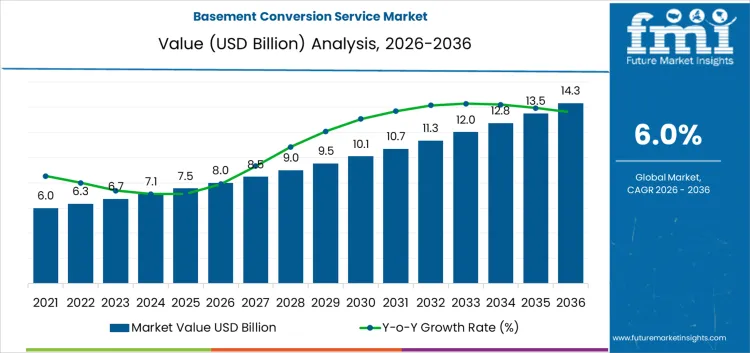
As this mindset spreads, the market advances through approximately USD 8.9 billion, USD 9.9 billion, and then about USD 10.9 billion, supported by higher project counts and by more comprehensive, higher-value conversions that include waterproofing, insulation, structural reinforcement, and full interior finishing. When spending moves into the USD 11.4 to 11.9 billion range, regulatory standardization and contractor specialization start to improve execution reliability and customer confidence. Approaching roughly USD 12.6 billion and then USD 14.3 billion, value growth is driven by larger average project sizes and by wider adoption across mid-range housing segments, not just premium urban properties. The business remains local and project-based, with success dependent on permitting expertise, construction quality, and trust rather than on scale manufacturing economics.
Basement Conversion Service Market Key Takeaways
| Metric | Value |
|---|---|
| Market Value (2026) | USD 8.0 billion |
| Forecast Value (2036) | USD 14.3 billion |
| Forecast CAGR 2026 to 2036 | 6.0% |
How Is the Basement Conversion Service Market Responding to Residential Space Demand?
Basement conversion services are increasingly adopted to transform underutilized below-ground spaces into functional living areas, offices, or recreational rooms. Historically, basements were used primarily for storage, laundry, or mechanical systems, limiting residential space efficiency. Modern conversion services integrate structural reinforcement, waterproofing, insulation, ventilation, and interior finishing to create habitable, safe, and aesthetically appealing spaces.
Homeowners, property developers, and renovation contractors prioritize compliance with building codes, energy efficiency, and design flexibility. Early adoption focused on urban properties with limited living space, while current demand spans suburban homes, multi-family residences, and high-value properties, driven by lifestyle needs, property value enhancement, and personalized living solutions. Structural integrity, moisture control, and design adaptability influence supplier and contractor selection.
Increasing demand for additional living space, property optimization, and home value enhancement is shaping market growth. Compared with conventional basement usage, conversion services emphasize functional layouts, safety compliance, and environmental comfort. Cost structures depend on structural work, finishing materials, and mechanical system integration, concentrating margins among contractors capable of delivering reliable, code-compliant conversions. Homeowners adopt these services to expand usable space, improve property functionality, and enhance real estate value. By 2036, basement conversion services are expected to be a common approach in residential renovation, supporting optimized space utilization, improved living standards, and enhanced property value.
What Factors Are Shaping the Demand for Basement Conversion Service Market, Segment wise by Service Type and End Use Residential, in 2026?
The Basement Conversion Service Market in 2026 is segmented by service type and by residential end use. By service category, demand in the Basement Conversion Service Market is divided into full structural basement conversions, partial basement remodels, basement finishing and insulation, and basement waterproofing or moisture control services, each addressing different starting conditions, budget levels, and regulatory requirements. By residential end use, demand in the Basement Conversion Service Market is organized around single family homes, multifamily dwellings, rental properties, and luxury residential renovations, which differ in space constraints, return expectations, and renovation cycles. These segments show how homeowners and property investors choose between structural change and incremental improvement.
Why Do Full Structural Basement Conversions Lead Service Demand in the Basement Conversion Service Market?
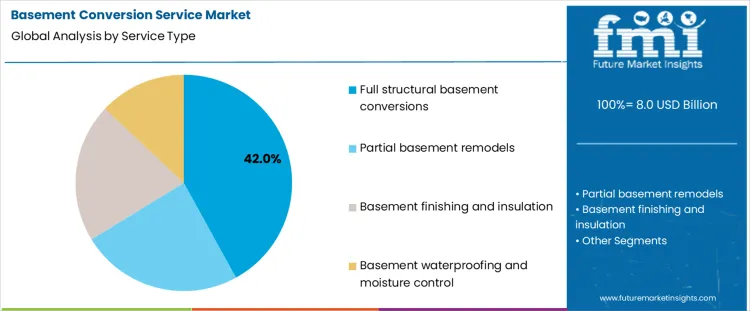
Full structural basement conversions account for about 42% of demand in the Basement Conversion Service Market in 2026 because many properties require fundamental changes before basements can be used as living space. These projects involve excavation, ceiling height adjustment, reinforcement, and compliance with building codes, which turns previously unusable areas into bedrooms, offices, or rental units. In the Basement Conversion Service Market, the value added by such work is high because it increases total usable floor area without expanding the building footprint. Homeowners and investors often prefer a one time, comprehensive project rather than a series of smaller upgrades. This explains why full structural conversions represent the largest service category.
Partial remodels, finishing, and waterproofing services in the Basement Conversion Service Market serve different needs. Partial remodels are chosen when the structure is already adequate. Finishing and insulation focus on comfort rather than on space creation. Waterproofing is often preventive or preparatory rather than a full conversion. These services are important, but their project scope and revenue per job are smaller, which keeps their share below that of full conversions.
Why Do Single Family Homes Dominate End Use Demand in the Basement Conversion Service Market?
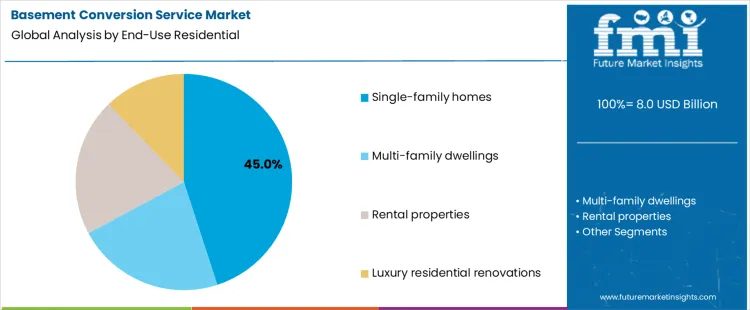
Single family homes represent about 45% of demand in the Basement Conversion Service Market in 2026 because they offer the greatest flexibility for layout change and occupancy conversion. Owners of such homes often use basement projects to add guest rooms, home offices, or recreational spaces, especially where land prices limit horizontal expansion. In the Basement Conversion Service Market, decision making in single family homes is faster because it involves fewer stakeholders than in multi-unit buildings. Renovation cycles in this segment are also steady, driven by lifestyle changes and home value optimization. This combination of flexibility, autonomy, and scale keeps single family homes as the largest end use category.
Multifamily dwellings, rental properties, and luxury renovations in the Basement Conversion Service Market follow different dynamics. Multi-unit projects require coordination among owners or associations. Rental properties focus on cost control and regulatory compliance. Luxury renovations involve fewer projects but higher specifications. These segments contribute to overall activity, but none matches the consistent, broad based demand generated by single family homeowners in the Basement Conversion Service Market.
How Are the Key Dynamics Reshaping the Basement Conversion Service Market?
The category is being shaped by space utilization pressure, planning and construction friction, and the move toward standardized renovation programs. Homeowners and small landlords want more usable area without relocating, but projects face structural unknowns, permitting steps, and disruption risk. At the same time, contractors are packaging repeatable solutions to control timelines, costs, and quality across similar housing types. This creates a market where growth depends on trust, execution reliability, and programmatic delivery rather than on one off design flair. Scale comes from referral networks and portfolio upgrades, not from speculative remodeling or short term property cycles.
Why Is Space Utilization Driving Basement Conversions?
Demand is anchored in the economics of existing homes. Adding bedrooms, offices, or rental units below ground often costs less than moving or extending, especially in dense cities. Changes in work patterns and multigenerational living increase the value of flexible, contained space. For landlords, conversions can unlock incremental rent without changing the building footprint. Once a neighborhood adopts this pattern, expectations reset and projects follow. Volume then tracks housing stock age, zoning allowances, and household composition rather than new build activity, tying growth to renovation waves and portfolio optimization by small property owners.
What Is Slowing Basement Conversion Projects?
The main barrier is project risk and uncertainty. Basements hide structural, moisture, and utility issues that can expand scope and cost after work begins. Permitting, fire egress, and ceiling height rules vary by locality and can force redesigns. Living through construction is disruptive, which delays decisions. Financing is also cautious because returns depend on execution quality. Many owners prefer to postpone until other renovations are planned. These factors lengthen sales cycles and keep demand lumpy, with starts clustered around broader home improvement programs rather than steady, year round commissioning.
How Are Standard Packages Changing Service Delivery?
The trend is toward repeatable conversion systems. Contractors are developing standard layouts, drainage solutions, insulation details, and compliance bundles that fit common house types. This reduces surprises, shortens schedules, and improves price confidence for clients. Marketing shifts from bespoke design to proven outcomes with clear timelines and warranties. For multi property owners, framework agreements and volume discounts become attractive. Over time, success depends less on custom carpentry and more on process control, documentation, and the ability to deliver predictable results across many similar basements.
What is the Demand for Basement Conversion Services by Country?
| Country | CAGR (%) |
|---|---|
| US | 5.5% |
| UK | 5.2% |
| China | 6.5% |
| India | 6.8% |
| Brazil | 5.9% |
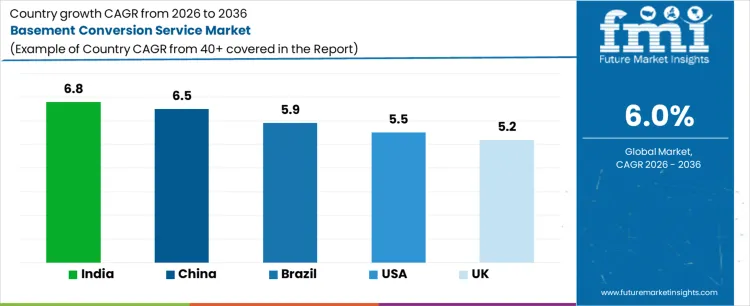
Demand for basement conversion services is rising as residential property owners seek to optimize living space, enhance property value, and improve functionality. India leads with a 6.8% CAGR, driven by growing urban housing demand, rising disposable income, and increased adoption of home improvement services. China follows at 6.5%, supported by residential construction growth and interest in additional usable space. Brazil records 5.9% growth, shaped by urban housing trends and renovation projects. The US grows at 5.5%, influenced by remodeling and property enhancement initiatives. The UK shows 5.2% CAGR, reflecting steady adoption of basement conversion services in residential developments.
How is the United States experiencing growth in the basement conversion service market?
United States is experiencing growth at a CAGR of 5.5%, driven by the high number of single-family homes with underutilized basements in cities such as New York, Los Angeles, and Chicago. Homeowners are converting basements into functional spaces like home offices, gyms, and rental units. Installed base size and predictable renovation cycles support recurring demand. Investments focus on structural safety, finishing quality, and compliance with local building codes. Growth reflects rising interest in home optimization, added living space, and maximizing property value.
- Single-family homes with underutilized basements drive adoption.
- Urban residential clusters concentrate demand.
- Structural safety and finishing quality guide investment.
- Renovation cycles support recurring demand.
How is the United Kingdom witnessing growth in the basement conversion service market?
United Kingdom is witnessing growth at a CAGR of 5.2%, supported by spending on home improvement and urban living enhancements in London, Birmingham, and Manchester. High renovation budgets and willingness to invest in extra living space drive adoption. Market concentration exists in metropolitan areas with dense housing stock. Investments focus on energy-efficient finishes, compliance with UK building regulations, and maximizing usable space. Growth reflects homeowners’ preference for functional upgrades, value addition, and aesthetic improvements.
- Home improvement and renovation spending drives adoption.
- Urban residential hubs concentrate demand.
- Energy-efficient finishes guide investment.
- Compliance with building regulations supports adoption.
How is China experiencing growth in the basement conversion service market?
China is experiencing growth at a CAGR of 6.5%, fueled by tourism and real estate development in Shanghai, Beijing, and Guangzhou. Property developers and individual homeowners invest in basement conversions to create commercial rental units, guest rooms, or storage facilities. Market concentration is high in urban districts with high real estate activity. Investments focus on structural reliability, interior design, and compliance with local building regulations. Growth reflects urban housing expansion, rising property values, and multifunctional basement use in dense metropolitan areas.
- Real estate development and multifunctional use drive adoption.
- Urban districts with high property activity concentrate demand.
- Structural reliability and interior design guide investment.
- Regulatory compliance supports adoption.
How is India witnessing growth in the basement conversion service market?
India is experiencing growth at a CAGR of 6.8%, supported by urban population and hotel/venue density in cities such as Mumbai, Delhi, and Bengaluru. Homeowners and commercial property owners convert basements into guest areas, office spaces, and storage. Market concentration exists in urban residential and commercial zones. Investments focus on cost-effective materials, ventilation solutions, and structural safety. Growth reflects increasing urban housing demand, multifunctional property use, and interest in expanding usable space in dense cities.
- Urban population and hotel/venue density drive adoption.
- Residential and commercial zones concentrate demand.
- Cost-effective materials and ventilation guide investment.
- Structural safety ensures compliance and usability.
How is Brazil experiencing growth in the basement conversion service market?
Brazil is experiencing growth at a CAGR of 5.9%, fueled by the presence of construction companies and renovation service providers in São Paulo, Rio de Janeiro, and Paraná. Professional service networks facilitate basement conversions for residential and commercial purposes, including home offices and leisure spaces. Market concentration exists in major urban centers, while regional dispersion allows smaller cities to adopt the service. Investments focus on structural quality, finishing, and project management efficiency. Growth reflects increasing adoption of professional renovation services and emphasis on enhancing property functionality.
- Construction companies and service providers drive adoption.
- Urban centers concentrate demand.
- Structural quality and finishing guide investment.
- Project management efficiency enhances adoption.
How Are Providers in Basement Conversion Service Market are Differentiating Through Quality, Specialization, and Service Scope?
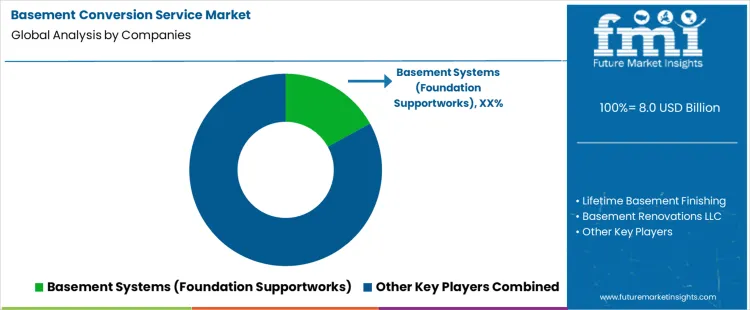
Providers in the basement conversion service market vary in their focus on structural integrity, finish quality, and end to end project management. Basement Systems (Foundation Supportworks) specializes in structural solutions and waterproofing as core elements of basement conversions, prioritizing long term moisture control and foundation stability before finishing work begins. Lifetime Basement Finishing emphasizes turnkey interior build outs that integrate framing, lighting, flooring, and utility upgrades, offering clients a single point of responsibility for design through completion. Basement Renovations LLC operates with a similar full scope approach, tailoring conversions to homeowner needs with attention to layout optimization and code compliance. HomeAdvisor Pro Services and Angi (formerly Angie’s List) serve as digital platforms that connect homeowners with screened local contractors, supporting comparison of bids and reviews rather than providing direct construction services.
The London Basement Company and Dream Basement Ltd compete by offering regionally tailored basement conversion projects with design consultation, planning permissions, and project coordination suited to specific building codes and urban conditions. These firms often handle excavation, structural reinforcement, damp proofing, and finished interiors, positioning themselves as full service specialists for complex basements. Competitive differences arise from experience with local regulations, ability to manage structural and waterproofing prerequisites, finish quality, and project timeline reliability. Clients prioritize providers with demonstrable track records, transparent pricing, and coordination of subcontractors. Companies that combine structural expertise, comprehensive interior finishing services, and project management support maintain relevance as demand for basement living space, home offices, and rental units continues to grow.
Key Players in the Basement Conversion Service Market
- Basement Systems (Foundation Supportworks)
- Lifetime Basement Finishing
- Basement Renovations LLC
- HomeAdvisor Pro Services
- Angi (formerly Angie’s List)
- The London Basement Company
- Dream Basement Ltd
Basement Conversion Service Market Segmentation
Service Type:
- Full structural basement conversions
- Partial basement remodels
- Basement finishing and insulation
- Basement waterproofing and moisture control
End-Use Residential:
- Single-family homes
- Multi-family dwellings
- Rental properties
- Luxury residential renovations
Region
Asia Pacific
- China
- Japan
- South Korea
- India
- Australia & New Zealand
- ASEAN
- Rest of Asia Pacific
Europe
- Germany
- United Kingdom
- France
- Italy
- Spain
- Nordic
- BENELUX
- Rest of Europe
North America
- United States
- Canada
- Mexico
Latin America
- Brazil
- Chile
- Rest of Latin America
Middle East & Africa
- Kingdom of Saudi Arabia
- Other GCC Countries
- Turkey
- South Africa
- Other African Union
- Rest of Middle East & Africa
Bibliography
- Department for Levelling Up, Housing and Communities. (2024). Amendments to Approved Document B: Fire safety. UK Government.
- International Code Council. (2024). International residential code (IRC): 2024 edition. International Code Council.
- National Fire Protection Association. (2024). NFPA 101: Life safety code (2024 ed.). National Fire Protection Association.
Frequently Asked Questions
How big is the basement conversion service market in 2026?
The global basement conversion service market is estimated to be valued at USD 8.0 billion in 2026.
What will be the size of basement conversion service market in 2036?
The market size for the basement conversion service market is projected to reach USD 14.3 billion by 2036.
How much will be the basement conversion service market growth between 2026 and 2036?
The basement conversion service market is expected to grow at a 6.0% CAGR between 2026 and 2036.
What are the key product types in the basement conversion service market?
The key product types in basement conversion service market are full structural basement conversions , partial basement remodels, basement finishing and insulation and basement waterproofing and moisture control.
Which end‑use residential segment to contribute significant share in the basement conversion service market in 2026?
In terms of end‑use residential, single‑family homes segment to command 45.0% share in the basement conversion service market in 2026.
Preview the report firsthand - request a free sample
Get SampleGet the brochure for pricing and purchase details.
Get PDFTable of Content
- Executive Summary
- Global Market Outlook
- Demand-side Trends
- Supply-side Trends
- Technology Roadmap Analysis
- Analysis and Recommendations
- Market Overview
- Market Coverage / Taxonomy
- Market Definition / Scope / Limitations
- Market Background
- Market Dynamics
- Drivers
- Restraints
- Opportunity
- Trends
- Scenario Forecast
- Demand in Optimistic Scenario
- Demand in Likely Scenario
- Demand in Conservative Scenario
- Opportunity Map Analysis
- Product Life Cycle Analysis
- Supply Chain Analysis
- Investment Feasibility Matrix
- Value Chain Analysis
- PESTLE and Porter’s Analysis
- Regulatory Landscape
- Regional Parent Market Outlook
- Production and Consumption Statistics
- Import and Export Statistics
- Market Dynamics
- Global Market Analysis 2021 to 2025 and Forecast, 2026 to 2036
- Historical Market Size Value (USD Million) Analysis, 2021 to 2025
- Current and Future Market Size Value (USD Million) Projections, 2026 to 2036
- Y-o-Y Growth Trend Analysis
- Absolute $ Opportunity Analysis
- Global Market Pricing Analysis 2021 to 2025 and Forecast 2026 to 2036
- Global Market Analysis 2021 to 2025 and Forecast 2026 to 2036, By Service Type
- Introduction / Key Findings
- Historical Market Size Value (USD Million) Analysis By Service Type, 2021 to 2025
- Current and Future Market Size Value (USD Million) Analysis and Forecast By Service Type, 2026 to 2036
- Full structural basement conversions
- Partial basement remodels
- Basement finishing and insulation
- Basement waterproofing and moisture control
- Full structural basement conversions
- Y-o-Y Growth Trend Analysis By Service Type, 2021 to 2025
- Absolute $ Opportunity Analysis By Service Type, 2026 to 2036
- Global Market Analysis 2021 to 2025 and Forecast 2026 to 2036, By End‑Use Residential
- Introduction / Key Findings
- Historical Market Size Value (USD Million) Analysis By End‑Use Residential, 2021 to 2025
- Current and Future Market Size Value (USD Million) Analysis and Forecast By End‑Use Residential, 2026 to 2036
- Single‑family homes
- Multi‑family dwellings
- Rental properties
- Luxury residential renovations
- Single‑family homes
- Y-o-Y Growth Trend Analysis By End‑Use Residential, 2021 to 2025
- Absolute $ Opportunity Analysis By End‑Use Residential, 2026 to 2036
- Global Market Analysis 2021 to 2025 and Forecast 2026 to 2036, By Region
- Introduction
- Historical Market Size Value (USD Million) Analysis By Region, 2021 to 2025
- Current Market Size Value (USD Million) Analysis and Forecast By Region, 2026 to 2036
- North America
- Latin America
- Western Europe
- Eastern Europe
- East Asia
- South Asia and Pacific
- Middle East & Africa
- Market Attractiveness Analysis By Region
- North America Market Analysis 2021 to 2025 and Forecast 2026 to 2036, By Country
- Historical Market Size Value (USD Million) Trend Analysis By Market Taxonomy, 2021 to 2025
- Market Size Value (USD Million) Forecast By Market Taxonomy, 2026 to 2036
- By Country
- USA
- Canada
- Mexico
- By Service Type
- By End‑Use Residential
- By Country
- Market Attractiveness Analysis
- By Country
- By Service Type
- By End‑Use Residential
- Key Takeaways
- Latin America Market Analysis 2021 to 2025 and Forecast 2026 to 2036, By Country
- Historical Market Size Value (USD Million) Trend Analysis By Market Taxonomy, 2021 to 2025
- Market Size Value (USD Million) Forecast By Market Taxonomy, 2026 to 2036
- By Country
- Brazil
- Chile
- Rest of Latin America
- By Service Type
- By End‑Use Residential
- By Country
- Market Attractiveness Analysis
- By Country
- By Service Type
- By End‑Use Residential
- Key Takeaways
- Western Europe Market Analysis 2021 to 2025 and Forecast 2026 to 2036, By Country
- Historical Market Size Value (USD Million) Trend Analysis By Market Taxonomy, 2021 to 2025
- Market Size Value (USD Million) Forecast By Market Taxonomy, 2026 to 2036
- By Country
- Germany
- UK
- Italy
- Spain
- France
- Nordic
- BENELUX
- Rest of Western Europe
- By Service Type
- By End‑Use Residential
- By Country
- Market Attractiveness Analysis
- By Country
- By Service Type
- By End‑Use Residential
- Key Takeaways
- Eastern Europe Market Analysis 2021 to 2025 and Forecast 2026 to 2036, By Country
- Historical Market Size Value (USD Million) Trend Analysis By Market Taxonomy, 2021 to 2025
- Market Size Value (USD Million) Forecast By Market Taxonomy, 2026 to 2036
- By Country
- Russia
- Poland
- Hungary
- Balkan & Baltic
- Rest of Eastern Europe
- By Service Type
- By End‑Use Residential
- By Country
- Market Attractiveness Analysis
- By Country
- By Service Type
- By End‑Use Residential
- Key Takeaways
- East Asia Market Analysis 2021 to 2025 and Forecast 2026 to 2036, By Country
- Historical Market Size Value (USD Million) Trend Analysis By Market Taxonomy, 2021 to 2025
- Market Size Value (USD Million) Forecast By Market Taxonomy, 2026 to 2036
- By Country
- China
- Japan
- South Korea
- By Service Type
- By End‑Use Residential
- By Country
- Market Attractiveness Analysis
- By Country
- By Service Type
- By End‑Use Residential
- Key Takeaways
- South Asia and Pacific Market Analysis 2021 to 2025 and Forecast 2026 to 2036, By Country
- Historical Market Size Value (USD Million) Trend Analysis By Market Taxonomy, 2021 to 2025
- Market Size Value (USD Million) Forecast By Market Taxonomy, 2026 to 2036
- By Country
- India
- ASEAN
- Australia & New Zealand
- Rest of South Asia and Pacific
- By Service Type
- By End‑Use Residential
- By Country
- Market Attractiveness Analysis
- By Country
- By Service Type
- By End‑Use Residential
- Key Takeaways
- Middle East & Africa Market Analysis 2021 to 2025 and Forecast 2026 to 2036, By Country
- Historical Market Size Value (USD Million) Trend Analysis By Market Taxonomy, 2021 to 2025
- Market Size Value (USD Million) Forecast By Market Taxonomy, 2026 to 2036
- By Country
- Kingdom of Saudi Arabia
- Other GCC Countries
- Turkiye
- South Africa
- Other African Union
- Rest of Middle East & Africa
- By Service Type
- By End‑Use Residential
- By Country
- Market Attractiveness Analysis
- By Country
- By Service Type
- By End‑Use Residential
- Key Takeaways
- Key Countries Market Analysis
- USA
- Pricing Analysis
- Market Share Analysis, 2025
- By Service Type
- By End‑Use Residential
- Canada
- Pricing Analysis
- Market Share Analysis, 2025
- By Service Type
- By End‑Use Residential
- Mexico
- Pricing Analysis
- Market Share Analysis, 2025
- By Service Type
- By End‑Use Residential
- Brazil
- Pricing Analysis
- Market Share Analysis, 2025
- By Service Type
- By End‑Use Residential
- Chile
- Pricing Analysis
- Market Share Analysis, 2025
- By Service Type
- By End‑Use Residential
- Germany
- Pricing Analysis
- Market Share Analysis, 2025
- By Service Type
- By End‑Use Residential
- UK
- Pricing Analysis
- Market Share Analysis, 2025
- By Service Type
- By End‑Use Residential
- Italy
- Pricing Analysis
- Market Share Analysis, 2025
- By Service Type
- By End‑Use Residential
- Spain
- Pricing Analysis
- Market Share Analysis, 2025
- By Service Type
- By End‑Use Residential
- France
- Pricing Analysis
- Market Share Analysis, 2025
- By Service Type
- By End‑Use Residential
- India
- Pricing Analysis
- Market Share Analysis, 2025
- By Service Type
- By End‑Use Residential
- ASEAN
- Pricing Analysis
- Market Share Analysis, 2025
- By Service Type
- By End‑Use Residential
- Australia & New Zealand
- Pricing Analysis
- Market Share Analysis, 2025
- By Service Type
- By End‑Use Residential
- China
- Pricing Analysis
- Market Share Analysis, 2025
- By Service Type
- By End‑Use Residential
- Japan
- Pricing Analysis
- Market Share Analysis, 2025
- By Service Type
- By End‑Use Residential
- South Korea
- Pricing Analysis
- Market Share Analysis, 2025
- By Service Type
- By End‑Use Residential
- Russia
- Pricing Analysis
- Market Share Analysis, 2025
- By Service Type
- By End‑Use Residential
- Poland
- Pricing Analysis
- Market Share Analysis, 2025
- By Service Type
- By End‑Use Residential
- Hungary
- Pricing Analysis
- Market Share Analysis, 2025
- By Service Type
- By End‑Use Residential
- Kingdom of Saudi Arabia
- Pricing Analysis
- Market Share Analysis, 2025
- By Service Type
- By End‑Use Residential
- Turkiye
- Pricing Analysis
- Market Share Analysis, 2025
- By Service Type
- By End‑Use Residential
- South Africa
- Pricing Analysis
- Market Share Analysis, 2025
- By Service Type
- By End‑Use Residential
- USA
- Market Structure Analysis
- Competition Dashboard
- Competition Benchmarking
- Market Share Analysis of Top Players
- By Regional
- By Service Type
- By End‑Use Residential
- Competition Analysis
- Competition Deep Dive
- Basement Systems (Foundation Supportworks)
- Overview
- Product Portfolio
- Profitability by Market Segments (Product/Age /Sales Channel/Region)
- Sales Footprint
- Strategy Overview
- Marketing Strategy
- Product Strategy
- Channel Strategy
- Lifetime Basement Finishing
- Basement Renovations LLC
- HomeAdvisor Pro Services
- Angi (formerly Angie’s List)
- The London Basement Company
- Dream Basement Ltd
- Basement Systems (Foundation Supportworks)
- Competition Deep Dive
- Assumptions & Acronyms Used
- Research Methodology


