

- Industry Size (2026)
- USD 22.6 Bn
- Forecast (2036)
- USD 33.7 Bn
- CAGR (2026 to 2036)
- 4.1%
Electroplating Market Size, Market Forecast and Outlook By FMI
The electroplating market is expected to expand from USD 22.6 billion in 2026 to USD 33.7 billion by 2036. The market is anticipated to register a 4.1% CAGR during the forecast period. Nickel plating is likely to lead with nearly 20% share, while base metal plating is projected to account for around 60% of substrate demand in 2026.
Summary of the Electroplating Market
- Demand and Growth Drivers
- Automotive manufacturing is likely to support steady demand for corrosion-resistant coatings.
- Electronics production is increasing the need for reliable conductive surface treatment.
- Industrial machinery applications are strengthening demand for durable plated components.
- Product and Segment View
- Nickel plating is likely to lead due to its corrosion resistance and surface hardness.
- Base metal plating holds strong demand across steel and aluminum components.
- Functional coatings are gaining wider use where durability and conductivity matter.
- Geography and Competitive Outlook
- Asia Pacific is likely to remain the main growth region through manufacturing scale.
- North America is gaining support from aerospace and electric vehicle investments.
- Europe is moving toward cleaner plating technologies under stricter compliance rules.
- Analyst Opinion
- Nikhil Kaitwade, Principal Consultant for Chemicals and Materials at FMI, suggests “The electroplating market is moving toward cleaner chemistry and tighter process control. Companies with automated lines and stronger compliance systems may gain advantage as manufacturers demand reliable coatings with lower environmental burden.”
- Electroplating Market Value Analysis
- The electroplating market is shifting from conventional coating lines toward compliant surface treatment systems.
- Demand is likely to rise as manufacturers require durable and corrosion-resistant components.
- Automation may improve plating consistency across high-volume industrial production.
- Spending is set to grow through cleaner chemistries and wastewater treatment upgrades.
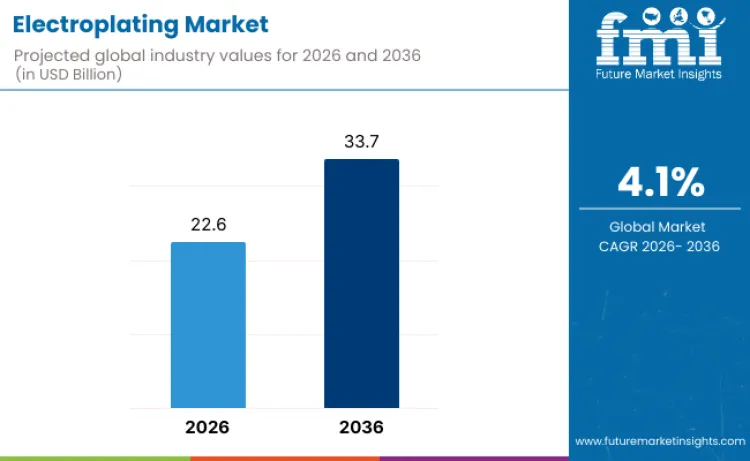
Key Takeaways, Market Size, and Forecast
| Metric | Value |
|---|---|
| Market Size (2026) | USD 22.6 Billion |
| Market Size (2036) | USD 33.7 Billion |
| CAGR (2026–2036) | 4.1% |
| Leading Plating Type | Nickel Plating (20%) |
| Leading Substrate | Base Metal Plating (60%) |
| Leading Region | Asia Pacific |
Electroplating Market Key Takeaways
| Metric | Value |
|---|---|
| Market Value (2026) | USD 22.6 billion |
| Market Forecast Value (2036) | USD 33.7 billion |
| Forecast CAGR (2026-2036) | 4.1% |
How Are the Segments Classified in the Electroplating Market?
The electroplating market is structured around plating metal, substrate type, function, end use, and region. By plating metal, the industry covers widely used materials such as nickel, copper, chromium, zinc, gold, and silver, each selected based on performance and finish requirements. From a substrate perspective, electroplating is applied to both base metals and plastics, supporting applications that range from heavy industrial components to lightweight decorative parts. Functionally, demand is split between decorative uses that enhance appearance and functional coatings that improve durability and resistance. End use spans automotive, electrical and electronics, aerospace and defense, jewelry, machinery components, and other industrial sectors across North America, Latin America, Europe, Asia Pacific, and the Middle East and Africa.
Which Plating Metal Accounts for the Largest Share of Global Demand?
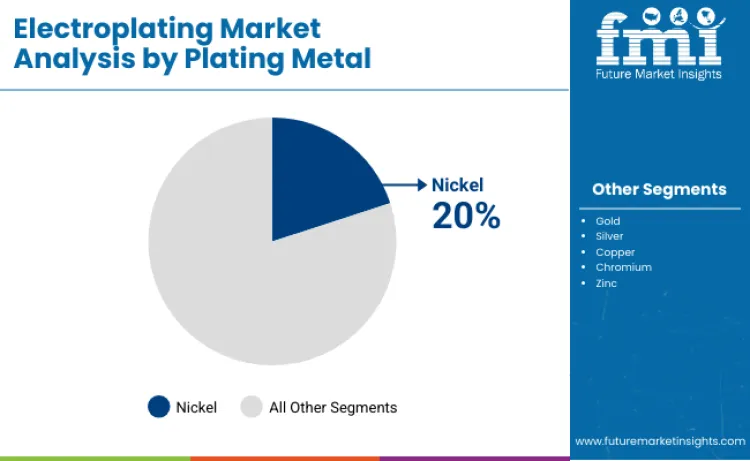
Nickel holds the largest share in the electroplating market, accounting for around 20% of global demand. Its popularity stems from its ability to deliver reliable corrosion protection, improved surface hardness, and a consistent finish across a wide range of components. Nickel electroplating is commonly used in automotive parts, electronic assemblies, aerospace components, and household appliances, where long service life and surface reliability are essential. While other metals such as copper, chromium, and zinc serve specific technical or decorative needs, nickel remains the preferred choice due to its versatility and proven performance across industries.
Which Substrate Type Represents the Largest Share of Global Demand?
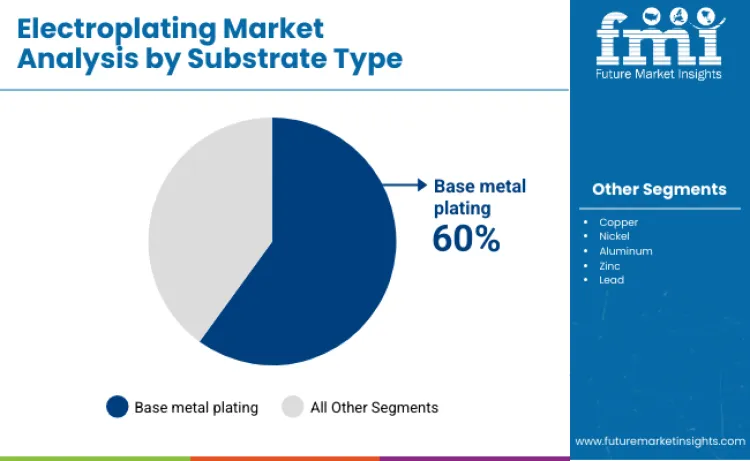
Base metal plating represents the largest substrate segment, contributing roughly 60% of electroplating demand. Manufacturers rely heavily on base metals like steel, copper, aluminum, and zinc because they offer strength, cost efficiency, and compatibility with high volume production processes. Electroplating on base metals enhances corrosion resistance, wear protection, and component durability, making it a standard practice in automotive manufacturing, industrial machinery, and electrical equipment production. Although plastic plating is gaining visibility in decorative and lightweight applications, base metal substrates continue to form the foundation of global electroplating activity.
What Are the Key Dynamics in the Electroplating Market?
Demand for electroplating continues to rise as manufacturers across automotive, electronics, aerospace, and consumer goods focus on improving component durability, corrosion resistance, and surface finish. Electroplating plays a critical role in extending product life, enhancing electrical conductivity, and meeting aesthetic expectations in high volume manufacturing. Growth is further supported by the expansion of electric vehicle production, electronics miniaturization, and the need for precision coated components. As industries modernize production lines, electroplating remains a core surface treatment solution that balances performance, scalability, and cost efficiency.
How Are Manufacturing Standards and Technology Shifts Influencing Electroplating Adoption?
Stricter quality standards and performance requirements are pushing manufacturers to adopt advanced electroplating processes that deliver consistent thickness, uniform coating, and long term reliability. Automotive and electronics manufacturers rely heavily on nickel, copper, and precious metal plating to meet durability and conductivity benchmarks. Automation, IoT-based bath monitoring, and AI-driven process control are transforming plating operations by reducing defects, improving yield, and supporting high volume production. Rapid industrial growth in Asia Pacific, combined with strong automotive and electronics output in North America and Europe, continues to reinforce steady electroplating demand globally.
How Do Environmental Regulations, Capital Intensity, and Operational Challenges Affect Market Scalability?
Environmental and worker safety regulations significantly shape electroplating operations, particularly around the use of hazardous chemicals, wastewater treatment, and emissions control. Compliance with regulations such as REACH and national environmental standards requires substantial investment in cleaner chemistries, effluent treatment systems, and monitoring infrastructure. These requirements raise capital costs and slow capacity expansion, especially for small and mid-sized plating facilities. Volatility in metal prices, energy costs, and the need for skilled labor add operational pressure. Long-term scalability in the electroplating market depends on adopting environmentally compliant technologies, improving process efficiency through automation, and balancing cost structures while meeting increasingly strict regulatory and customer expectations.
How Is Demand for the Electroplating Market Evolving Across Key Countries?
Demand for the electroplating market is steadily increasing, supported by rising requirements for corrosion resistance, conductivity enhancement, and surface durability across automotive, electronics, aerospace, and industrial manufacturing. China leads global growth with a CAGR of 6.3%, driven by large scale automotive output, electronics production, and infrastructure expansion. South Korea follows with a 5.2% CAGR, supported by semiconductors, batteries, and advanced electronics manufacturing. The United States records a 4.6% CAGR backed by automotive, aerospace, defense, and emerging electric vehicle investments. Germany posts a 4.1% CAGR reflecting its strong automotive engineering base and high manufacturing standards. Japan grows at a 3.9% CAGR, supported by precision manufacturing and electronics, while the United Kingdom expands at a 3.8% CAGR, driven by sustainability focused production, automation adoption, and post Brexit supply chain localization.
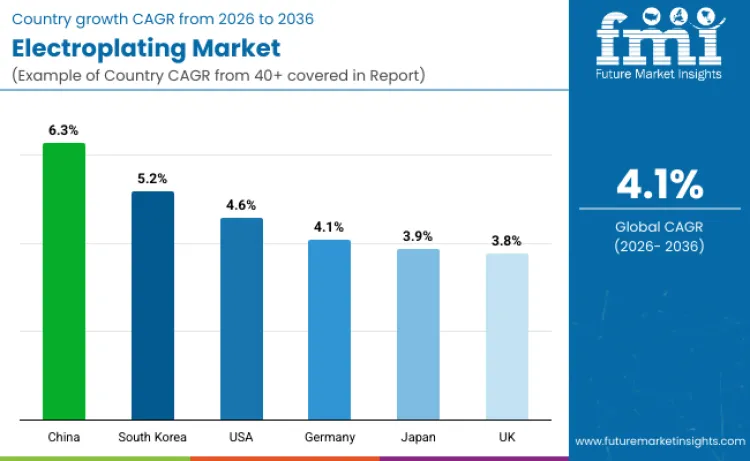
| Country | CAGR (%) |
|---|---|
| China | 6.3% |
| South Korea | 5.2% |
| United States | 4.6% |
| Germany | 4.1% |
| Japan | 3.9% |
| United Kingdom | 3.8% |
Why Is China Leading Electroplating Demand Growth?
China records a CAGR of 6.3%, making it the fastest growing electroplating market globally. This growth is closely tied to the country’s large scale automotive manufacturing, expanding electronics production, and continuous infrastructure development. Electroplating is widely used to improve corrosion resistance, conductivity, and durability of components used in vehicles, machinery, and consumer electronics. Government backed industrial upgrading programs are encouraging manufacturers to adopt automated and environmentally compliant plating processes, which further strengthens demand across both high volume and precision manufacturing segments.
How Is South Korea Strengthening Its Electroplating Market Position?
South Korea is expected to grow at a CAGR of 5.2%, supported by its strong semiconductor, battery, and advanced electronics industries. Electroplating plays a critical role in producing connectors, printed circuit boards, and high precision electronic components. As electronics become smaller and more complex, demand for consistent and high quality plating continues to rise. The country’s focus on clean manufacturing and technological innovation also drives adoption of advanced plating chemistries and process control systems, reinforcing steady demand across industrial and electronics focused applications.
What Is Driving Electroplating Demand in the United States?
The United States is projected to expand at a CAGR of 4.6%, driven by stable demand from automotive, aerospace, defense, and industrial equipment manufacturing. Electroplating remains essential for enhancing wear resistance, extending component life, and meeting strict performance standards. Growing investment in electric vehicles, medical devices, and advanced electronics is further supporting market growth. Manufacturers are increasingly adopting automation and environmentally compliant plating processes, ensuring electroplating remains a core surface treatment solution across both traditional industries and emerging technology driven sectors.
Why Does Germany Remain a Key European Electroplating Market?
Germany is expected to grow at a CAGR of 4.1%, supported by its strong automotive engineering base and advanced industrial manufacturing ecosystem. Electroplating is widely used in vehicle components, machinery parts, and precision equipment to improve durability and surface quality. The country’s emphasis on high manufacturing standards and compliance with strict environmental regulations encourages adoption of advanced and cleaner plating technologies. Ongoing investment in electric vehicle production and smart manufacturing continues to sustain consistent electroplating demand across Germany’s industrial supply chains.
How Is Japan Maintaining Steady Electroplating Demand?
Japan is forecast to grow at a CAGR of 3.9%, reflecting steady demand from precision manufacturing, electronics, and automotive sectors. Electroplating supports the production of compact, high performance components used in consumer electronics, robotics, and specialized industrial equipment. Manufacturers prioritize coating uniformity, reliability, and quality, which sustains consistent plating requirements. Japan’s focus on miniaturization, advanced materials, and environmentally responsible production methods continues to support electroplating adoption, even as the industry grows at a more measured and stable pace.
How Is the United Kingdom Shaping Growth in the Electroplating Market?
The United Kingdom electroplating market is expanding at a CAGR of 3.8%, supported by steady demand from automotive, electronics, aerospace, and defense manufacturing. Growth is closely tied to the country’s push toward sustainable production, where manufacturers are actively replacing conventional plating processes with eco-friendly and energy efficient alternatives. Automation and digital control systems are increasingly deployed to improve coating consistency, reduce waste, and meet national decarbonization targets. Post Brexit supply chain realignment is also encouraging local investment in advanced electroplating capabilities, strengthening domestic production while ensuring regulatory compliance and long term competitiveness.
How Is Competition Shaping the Electroplating Market Globally?
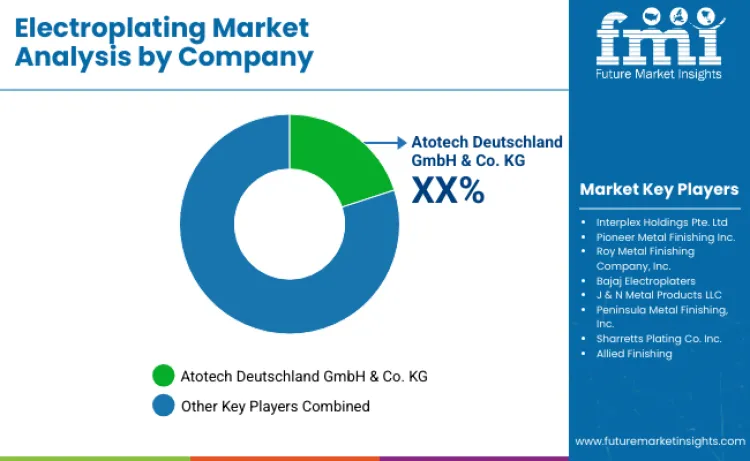
The electroplating market reflects a moderately fragmented yet competitive environment, where demand is shared among established surface treatment specialists, technology driven plating providers, and integrated manufacturing service companies. Competitive strength is shaped by process reliability, environmental compliance, automation capabilities, and the ability to serve high volume industrial customers with consistent quality. Companies are increasingly differentiating themselves through investments in advanced plating chemistries, automated production lines, and quality assurance systems that meet tightening environmental and performance standards. Demand growth favors players that balance cost efficiency with precision, sustainability, and long term customer partnerships across automotive, electronics, aerospace, and industrial manufacturing sectors.
Atotech Deutschland GmbH & Co. KG holds a strong position through its broad technology portfolio and deep relationships with automotive, electronics, and industrial clients. Interplex Holdings Pte. Ltd competes through precision focused plating services and high volume manufacturing support for complex components. Pioneer Metal Finishing Inc. strengthens its presence in aerospace and defense applications requiring strict performance and compliance standards. Roy Metal Finishing Company, Inc. serves both decorative and functional plating needs across industries, and Bajaj Electroplaters supports demand from automotive and industrial customers through reliable, application specific solutions. Competitive dynamics center on technological capability, environmental responsibility, and the ability to deliver scalable, high performance electroplating services.
Key Players in the Electroplating Market
- Atotech Deutschland GmbH & Co. KG
- Interplex Holdings Pte. Ltd
- Pioneer Metal Finishing Inc.
- Roy Metal Finishing Company, Inc.
- Bajaj Electroplaters
- J & N Metal Products LLC
- Peninsula Metal Finishing, Inc.
- Sharretts Plating Co. Inc.
- Allied Finishing
Scope of the Report
| Items | Values |
|---|---|
| Quantitative Units | USD billion |
| Plating Metals Analyzed | Gold, Silver, Copper, Nickel, Chromium, Zinc, Others |
| Substrate Types Covered | Base Metal Plating (Copper, Nickel, Aluminum, Zinc, Lead), Plastic Plating (ABS, PPA, PC, PP, Polysulfone) |
| Functions Analyzed | Decorative, Functional |
| End Use Industries | Automotive, Electrical and Electronics, Aerospace and Defense, Jewelry, Machinery Parts and Components, Other Industrial |
| Regions Covered | North America, Latin America, Europe, Asia Pacific, Middle East and Africa |
| Countries Covered | United States, Canada, United Kingdom, Germany, France, Italy, China, Japan, South Korea, Australia, New Zealand and 40+ countries |
| Key Companies Profiled | Atotech Deutschland GmbH & Co. KG, Interplex Holdings Pte. Ltd, Pioneer Metal Finishing Inc., Roy Metal Finishing Company, Inc., Bajaj Electroplaters |
| Additional Attributes | Dollar sales by plating metal, substrate type, and end use, country-wise demand analysis, regulatory and environmental impact assessment, competitive landscape and company market share analysis, technology and automation trends, investment and capacity expansion outlook (2026 to 2036) |
Electroplating Market by Segments
By Plating Metal:
- Gold
- Silver
- Copper
- Nickel
- Chromium
- Zinc
- Others
By Substrate Type:
- Base Metal Plating
- Copper
- Nickel
- Aluminum
- Zinc
- Lead
- Plastic Plating
- ABS
- PPA
- PC
- PP
- Polysulfone
By Function:
- Decorative
- Functional
By End Use:
- Automotive
- Electrical and Electronics
- Aerospace and Defense
- Jewelry
- Machinery Parts and Components
- Others
By Region:
- North America
- United States
- Canada
- Mexico
- Latin America
- Brazil
- Argentina
- Rest of Latin America
- Europe
- Germany
- United Kingdom
- France
- Italy
- Spain
- Nordic
- BENELUX
- Rest of Europe
- Asia Pacific
- China
- Japan
- South Korea
- India
- ASEAN
- Australia and New Zealand
- Rest of Asia Pacific
- Middle East and Africa
- GCC Countries
- Turkey
- South Africa
- Rest of Middle East and Africa
Frequently Asked Questions
How big is the electroplating market in 2026?
The global electroplating market is estimated to be valued at around USD 22.6 billion in 2026.
What will be the size of the electroplating market in 2036?
The electroplating market is projected to reach USD 33.7 billion by 2036.
How much will the electroplating market grow between 2026 and 2036?
The electroplating market is expected to grow at a CAGR of 4.1% during the 2026 to 2036 period.
Which plating metal holds the largest share in the electroplating market?
Nickel leads the electroplating market, accounting for about 20% share due to its corrosion resistance and wide industrial use.
Which substrate type contributes the largest share in the electroplating market?
Base metal plating dominates the industry with nearly 60% share, supported by high demand from automotive and industrial applications.
Preview the report firsthand - request a free sample
Get SampleGet the brochure for pricing and purchase details.
Get PDFTable of Content
- Executive Summary
- Market Introduction
- Market Overview
- Market Size and Forecast, 2026 to 2036
- Market Value Chain Analysis
- Market Dynamics
- Drivers
- Restraints
- Opportunities
- Trends
- Global Market Analysis, 2026 to 2036
- Market Size and Forecast by Value
- Market Size and Forecast by Volume
- Global Market Analysis by Plating Metal
- Gold
- Silver
- Copper
- Nickel
- Chromium
- Zinc
- Others
- Global Market Analysis by Substrate Type
- Base Metal Plating
- Plastic Plating
- Global Market Analysis by Function
- Decorative
- Functional
- Global Market Analysis by End Use
- Automotive
- Electrical and Electronics
- Aerospace and Defense
- Jewelry
- Machinery Parts and Components
- Others
- Global Market Analysis by Region
- North America
- Latin America
- Europe
- Asia Pacific
- Middle East and Africa
- North America Market Analysis
- Latin America Market Analysis
- Europe Market Analysis
- Asia Pacific Market Analysis
- Middle East and Africa Market Analysis
- Competition Analysis
- Company Profiles
- Assumptions and Acronyms Used
- Research Methodology


