

- Market Size (2026)
- USD 8.9 Bn
- Forecast (2036)
- USD 25.5 Bn
- CAGR (2026 to 2036)
- 11.1%
How big is EPR Compliance & Packaging Recovery Services Market in 2026?
USD 8.9 billion in 2026 and USD 25.5 billion by 2036 at an 11.1% CAGR.
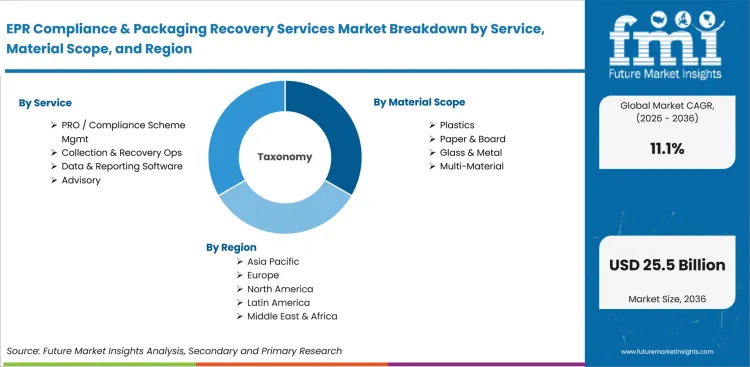
Demand for EPR compliance and packaging recovery services is projected to expand at 11.1% CAGR between 2026 and 2036. Industry valuation is expected to increase from USD 8.9 billion in 2026 to USD 25.5 billion by 2036. Brand owners now manage registration and fee exposure alongside recovery evidence in each covered jurisdiction. CalRecycle stated in June 2025 that Senate Bill 54 requires USD 5 billion in producer payments across ten years. This obligation places packaging EPR compliance platforms inside annual budget planning instead of one-time filing projects.
Country demand differs according to the design and maturity of local producer responsibility systems across major markets. Germany and France use established schemes that require specialist registration knowledge and regular material reconciliation. India and the United States are adding portals or state programs that increase work for regional packaging teams. CalRecycle estimated producer reporting costs at USD 99.6 million across the ten-year implementation period in its June 2025 assessment. The estimate places reporting controls beside EPR advisory services during supplier reviews for multinational brands managing several countries. Multinational brands therefore favor providers that connect fee forecasts to recovery evidence inside one controlled group record.
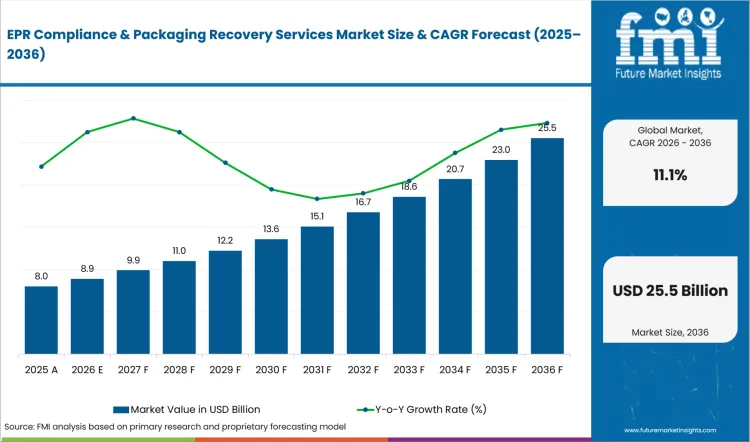
| Metric | Value |
|---|---|
| 2025 Market Size | USD 8.01 billion |
| 2026 Market Size | USD 8.9 billion |
| 2036 Market Size | USD 25.5 billion |
| Forecast CAGR (2026-2036) | 11.1% |
| Service Focus | PRO - Compliance Scheme Management (42.0% share in 2026) |
| Material Scope Focus | Plastics (44.0% share in 2026) |
| Client Type Focus | Brand Owners (47.0% share in 2026) |
Summary of the EPR Compliance & Packaging Recovery Services Market
| Market Signal | Commercial Impact |
|---|---|
| Demand and Growth Drivers | Compliance work is shifting from periodic filing toward continuous control of packaging data and recovery duties in every country where producers sell packaged goods under active EPR rules.
|
| Product and Segment View | Service demand centers on managed schemes and plastics reporting since these areas create recurring work for obligated producers throughout each annual compliance cycle.
|
| Geography and Growth Outlook | Regional growth depends on implementation dates and the number of packaging systems that each producer manages across national or state jurisdictions.
|
| Competitive Landscape | Competition separates authorized scheme operators from cross-border data specialists and recovery providers that support collection or deposit return operations for regulated packaging accounts.
|
| Analyst Perspective | The defining commercial issue is the transfer of packaging cost responsibility from public systems to producers. Service providers therefore need evidence that connects every declared material volume to an approved fee or recovery route.
|
Source: FMI's proprietary forecasting model and primary research
How is the EPR compliance & packaging recovery services market segmented?
service, material scope, client type, model, channel, and region.
The market is segmented by service, material scope, client type, compliance model, distribution channel, and region. Service segments include PRO management, collection and recovery operations, reporting software, and advisory or consulting support for producer organizations. By material scope, the market covers plastics, paper and paperboard, glass, metals, and multi-material packaging formats. Based on client type, the market serves brand owners, packaging producers, converters, and retailers that are subject to EPR compliance obligations. Compliance models include fee-based Producer Responsibility Organization (PRO) arrangements, individual producer compliance programs, and deposit return systems. Distribution channels comprise direct service contracts and partner or third-party channels. Geographically, the market spans North America, Europe, East Asia, and other regulated regions with established packaging recovery and recycling requirements.
What supports demand for PRO - compliance scheme management within the service category?
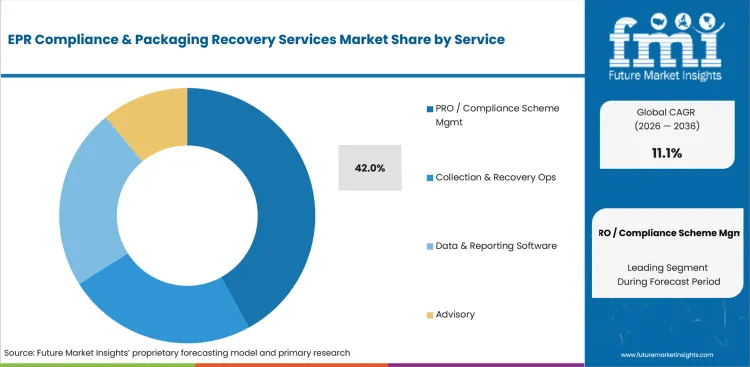
Managed schemes prevent each producer from building separate reporting and recovery operations across every covered jurisdiction. Oregon DEQ approved Circular Action Alliance as the state producer responsibility organization in February 2025. Program duties began in July 2025 and placed producer fee administration beside direct funding for local recycling systems. Service providers in this segment are judged on registration control and reliable volume reconciliation across every declared packaging category.
- PRO - compliance scheme management is projected to hold 42.0% share in 2026 owing to recurring membership administration and fee reporting. Brand owners prefer one accountable operator that manages approved recovery planning across every declared material category. Managed services reduce gaps between reported packaging volumes and invoices issued under each national or state program.
- Compliance teams are expected to favor managed schemes that route data corrections to approved operators before formal filing deadlines. Providers linking scheme membership to packaging EPR software reduce manual handoffs between packaging teams and finance teams. Contract reviews test correction workflows and audit trails before procurement teams compare annual service fees.
How is plastics positioned within the material scope category?
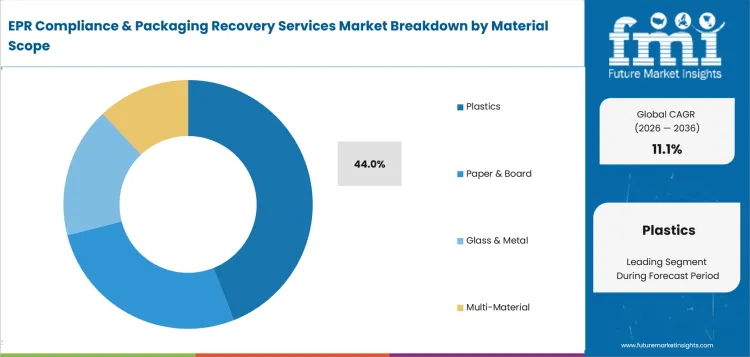
Plastics receives close review since fee schedules separate resin formats and documented recyclability evidence during annual declarations. In November 2025, Ecosurety supported Polytag's Ecotrace Programme for real-time packaging lifecycle data across participating recycling systems. The system creates an audit trail showing how much tagged packaging reaches recycling facilities in real time. This evidence helps service providers connect material declarations to verified recovery outcomes before annual fee calculations.
- Plastics is forecast to represent 44.0% share in 2026 driven by high packaging volumes and detailed classification duties. Service providers need defensible records covering rigid formats and flexible formats across every reporting period. Multi-layer structures require separate evidence since national schemes often assign different recovery treatment or fee calculations.
- Brand teams increasingly purchase plastics support that links reporting fields to internal design-for-recycling packaging decisions. The connection helps procurement teams understand how each specification change affects future compliance fee exposure. Shared material evidence reduces disputes between design teams and compliance teams during annual declarations or recyclability reviews. One common record supports fee forecasting before procurement approves each material change for commercial production.
How do brand owners evaluate services within the client type category?
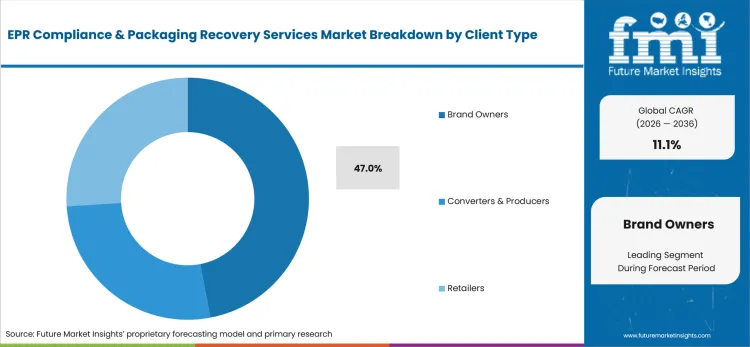
Brand owners control compliance budgets after laws assign responsibility to the entity placing packaged goods on each market. Reconomy reported in May 2025 that it advanced the migration of many EPR platforms to cloud systems during 2024. The company linked this work to improved service for international customers through shared digital systems. This investment reflects demand for records that serve several legal systems without splitting packaging data.
- Brand owners are estimated to account for 47.0% share in 2026 attributable to direct responsibility for registration and fee payment. Supplier reviews examine country coverage and documented ownership of every packaging data correction under each service contract. Procurement teams test each provider's ability to manage product launches that introduce new formats across several national registers.
- Procurement teams are anticipated to favor services that connect legal filings to sustainable packaging portfolios. This connection helps brand owners compare recovery obligations against redesign costs before approving a specification change. Shared records support internal approval after finance teams request predictable fee exposure for each commercial launch. The evidence gives legal teams a consistent basis for reviewing country-specific packaging filing duties in each market.
What are the drivers, restraints, and opportunities in the EPR compliance & packaging recovery services market?
Outsourced reporting is expected to support demand; rule fragmentation is anticipated to raise workload; integrated data and recovery contracts are projected to expand recurring revenue.
- Driver: Brand owners are expected to outsource EPR registration and packaging reporting after obligations expand across more jurisdictions.
- Restraint: Country-specific definitions and evidence rules are anticipated to increase correction work during consolidated reporting.
- Opportunity: Integrated reporting and recovery contracts are projected to create recurring revenue across each packaging compliance cycle.
Approved producer programs place compliance work inside routine operating budgets for brand owners and packaging producers. Colorado CDPHE approved the final Producer Responsibility Program plan for statewide recycling in December 2025. The plan shifts recycling costs from residents and local governments to companies that produce packaging. Providers that control reporting calendars help reduce missed submissions across annual declaration and payment cycles. A stable service relationship helps regional packaging teams resolve corrections before each scheduled fee period.
Rule fragmentation remains one of the main constraints on cross-border service delivery for producers using one packaging data system. The United Kingdom publishes material-specific fees and Germany combines LUCID registration with separate system participation duties. France uses approved eco-organization structures for household packaging and newly regulated professional packaging categories for obligated producers. Local legal review prevents country definitions from breaking the consolidated records used by regional finance teams. The resulting correction burden raises implementation costs for brands operating across several European packaging systems.
A notable opportunity in the industry lies in connecting compliance records to physical recovery evidence across regulated packaging streams. The European Commission reported in February 2025 that Regulation (EU) 2025-40 generally applies from August 12, 2026 across member states. Deposit return support adds a service layer for beverage packaging that needs verified collection information. Providers connected to smart reverse-vending systems help clients compare declared sales against recorded container returns. This evidence gives compliance teams a clearer basis for reviewing recovery performance under each service contract.
Which country CAGRs are profiled in the EPR compliance & packaging recovery services market?
.webp "Top Country Growth Comparison Epr Compliance And Packaging Recovery Services Market Cagr (2026 2036)")
| Country | CAGR |
|---|---|
| United States | 12.6% |
| Germany | 10.4% |
| France | 10.8% |
| United Kingdom | 11.3% |
| Canada | 11.7% |
| India | 13.4% |
| China | 12.1% |
Source: FMI's proprietary forecasting model and primary research
How do country-level CAGRs compare in the EPR compliance & packaging recovery services market?
Country growth reflects implementation timing and the administrative design of packaging obligations across each regulated jurisdiction. India and the United States add registration or fee workflows that increase service demand for producer teams. Germany and France rely on established scheme relationships that reward detailed local regulatory knowledge during contract reviews. The United Kingdom introduces material-level fee planning and Canada combines federal plastics reporting with provincial EPR plans. China adds municipal recovery duties within wider circular-economy rules for packaging producers and delivery companies. These differences place recyclable packaging services beside legal interpretation and packaging data management during supplier selection.
- State programs are turning national packaging portfolios into several reporting calendars for producer and finance teams. Demand in United States is projected to expand at 12.6% CAGR from 2026 to 2036 due to staggered state implementation. Maine DEP reported in February 2025 that its adopted packaging rule defines material categories and methods for producer fees or municipal reimbursement. The rule creates state-specific cost logic that national packaging teams must reconcile with internal material records. Brand owners need providers that separate state filings without breaking one national material record inside internal systems. This structure rewards services that combine local legal knowledge with national reporting controls for large brand portfolios.
- German compliance reviews begin with registration status and verified participation in an approved dual system for regulated packaging. The market is estimated to post 10.4% CAGR from 2026 to 2036 owing to established obligations and PPWR preparation. ZSVR published its 2025 minimum standard in August 2025 after consultation with the German Environment Agency. The standard sets a target for all packaging on the market to reach at least 70% recyclability by 2030. Der Grüne Punkt and Interzero operate inside this established scheme environment through registration and packaging recovery services.
- France combines long-running household packaging obligations with a professional packaging regime that expands producer coverage. Adoption is forecast to rise at 10.8% CAGR from 2026 to 2036 supported by broader reporting duties. The Ministry for Ecological Transition updated its professional packaging guidance in January 2026 for regulated producers. The guidance states that EPR covers professional packaging unless household packaging rules already apply to the same item. CITEO administers household packaging producer services within France's established EPR system and long-running reporting framework.
- The United Kingdom sector is predicted to advance at 11.3% CAGR from 2026 to 2036 led by fee administration. The government published confirmed 2025 base fees in June 2025 for every covered material category. Valpak and Ecosurety compete where clients need packaging data checks before each formal reporting deadline. Contract value depends on accurate material coding and timely correction of producer submissions across annual filing cycles. Suppliers add value after reporting teams connect PackUK invoices to packaging changes planned by commercial teams. Local support remains useful during fee disputes or packaging data corrections before final payment invoices.
- Canadian packaging compliance requires close coordination between provincial stewardship plans and federal plastics reporting requirements. Canada is anticipated to record 11.7% CAGR from 2026 to 2036 supported by layered reporting duties. Environment and Climate Change Canada issued Phase 1 Federal Plastics Registry guidance in May 2025. The guidance covers reports using 2024 data and establishes definitions for producers or obligated packaging categories. Provincial plans add separate operating requirements for collection and recovery evidence across regulated packaging programs. The layered structure rewards firms that maintain province-level rules without fragmenting each producer's national packaging inventory. Local scheme knowledge remains necessary before federal and provincial packaging data enter one controlled record.
- India is transferring plastic packaging registration and certificate activity onto a centralized compliance system for obligated organizations. Adoption is projected to expand at 13.4% CAGR from 2026 to 2036 attributable to portal enforcement and large brand portfolios. CPCB issued an April 2025 notice covering manufacturers and importers of relevant plastic raw materials. The notice extended portal duties to micro producers and small producers alongside sellers using the centralized system. The digital workflow increases demand for data preparation and certificate reconciliation across registered producer accounts.
- Chinese packaging recovery demand is developing through municipal rules and sector-specific circular-economy programs near manufacturing clusters. The market is forecast to grow at 12.1% CAGR from 2026 to 2036 shaped by local collection responsibilities. Shanghai published its no-waste city regulation in April 2025 for producers and local recovery organizations. The regulation applies producer responsibility principles and encourages delivery companies to establish packaging recovery plans. Compliance providers need local operating partners that connect municipal collection evidence to corporate producer records.
Who are the notable companies in the EPR compliance & packaging recovery services market?
Reconomy (Valpak), Landbell Group, Der Grüne Punkt (DSD), Interzero, Reverse Logistics Group, CITEO, TOMRA, Ecosurety, Beyondly, and European Recycling Platform are notable participants in this market.
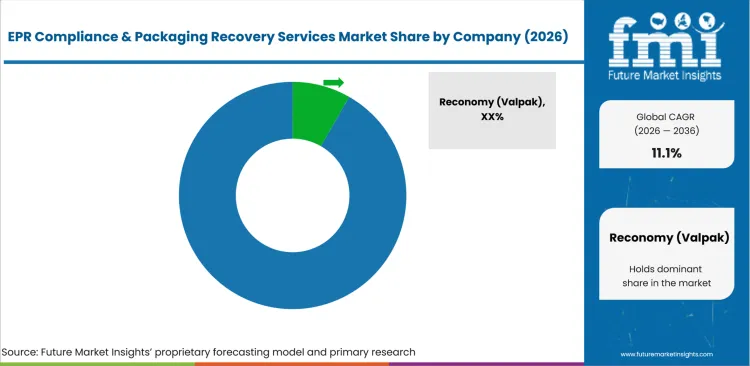
The market combines producer responsibility organizations with compliance software and recovery infrastructure providers serving regulated packaging accounts. Scheme operators gain an advantage after clients need direct membership and formal fee settlement under one contract. Cross-border specialists compete on registration coverage and consistent controls for packaging data across several client groups. Recovery companies become relevant after contracts include collection evidence or deposit return operations across regulated packaging systems. Procurement teams compare correction ownership and legal support before reviewing service fees across multi-country accounts. The circular plastic packaging ecosystem increases demand for suppliers that connect compliance records to packaging design and recycling outcomes.
- Reconomy through Valpak competes with Ecosurety and Beyondly across regulated packaging compliance services in the United Kingdom. Valpak contributes established data controls and both specialists support domestic producer reporting or scheme membership. Procurement comparisons often turn on correction speed and direct access to compliance specialists during filing periods.
- Landbell Group and Reverse Logistics Group share a cross-border basis across environmental registration and compliance services. Producer teams compare local partner coverage and central reporting controls before consolidating country contracts under one agreement. Their distinction rests on consistent application of local rules inside one consolidated client reporting structure.
- Der Grüne Punkt and Interzero compete in Germany where system participation and recovery operations require local scheme knowledge. Interzero adds packaging recyclability assessment that extends its role beyond standard volume declarations for regulated clients. German clients compare system credentials and technical feedback before assigning regulated packaging volumes across approved operating schemes.
- CITEO supports French producer obligations and TOMRA supplies deposit return infrastructure for beverage packaging systems. European Recycling Platform holds an adjacent position by connecting multi-stream compliance and related paper recycling services to broader environmental reporting. Producer teams assess whether each provider's recovery evidence aligns with the duties retained inside the contract.
Competitive Benchmarking: EPR Compliance & Packaging Recovery Services Market
| Company | Compliance Scheme Fit | Packaging Data Support | Recovery Operations | Geographic Reach |
|---|---|---|---|---|
| Reconomy (Valpak) | High | High | Medium | Global |
| Landbell Group | High | High | Medium | Global |
| Der Grüne Punkt (DSD) | High | Medium | High | Country-specific; Germany |
| Interzero | High | High | High | Regional; Europe |
| Reverse Logistics Group | High | High | High | Global |
| CITEO | High | Medium | Medium | Country-specific; France |
| TOMRA | Low | Medium | High | Global |
| Ecosurety | High | High | Low | Country-specific; United Kingdom |
| Beyondly | High | Medium | Low | Country-specific; United Kingdom |
| European Recycling Platform | Medium | Medium | Medium | Regional; Europe |
Scoring basis: High indicates direct and evidenced capability for the stated packaging compliance function at each company. Medium indicates partial capability for the stated function, and Low indicates limited direct evidence supporting that function.
Source: Future Market Insights competitive analysis, 2026. Ratings reflect relative portfolio relevance and workflow fit. Service capability and geographic reach shape the remaining comparison.
Key Developments in the EPR Compliance & Packaging Recovery Services Market
- In December 2025, Landbell Group launched Click & Comply as an online shop for international environmental compliance services. The platform included PPWR preparation for Germany alongside authorized representative support and take-back services across several European countries. The launch gives smaller producer teams direct access to cross-border compliance work without building an internal specialist function. Its online ordering model supports early market entry before product volumes justify a larger regional compliance team.
- In September 2025, Interzero launched Fit for Recycling for packaging recyclability assessments across European markets. The service reviews packaging specifications and adds laboratory analysis at the company's Competence Center for Recycled Plastics. Clients receive PPWR-aligned grading that connects packaging design evidence to compliance records and established take-back operations. One evidence file supports technical design reviews and regulatory discussions before a packaging specification enters wider commercial use.
- In January 2025, TOMRA Collection Austria supported the start of Austria's deposit return scheme with reverse vending equipment. The national program covers eligible plastic bottles and metal cans from 0.1 to 3 liters. TOMRA described reverse vending machines as automated return points that identify containers and issue refund receipts. The rollout shows how deposit infrastructure creates service demand beyond producer registration or annual packaging fee reporting.
- In December 2025, Reverse Logistics Group reported its participation in Uruguay's first deposit return system for single-use beverage containers. The company worked with Plan Vale and local partners on system design and launch support. The project gives RLG direct operating experience inside a Latin American packaging recovery system at national scale. Its role connects compliance planning to return infrastructure for beverage packaging across newer national programs.
Key Players in the EPR Compliance & Packaging Recovery Services Market
Compliance scheme operators
- Reconomy (Valpak)
- Der Grüne Punkt (DSD)
- CITEO
- Ecosurety
- Beyondly
Cross-border compliance and data specialists
- Landbell Group
- Reverse Logistics Group
- European Recycling Platform
Recovery and deposit-system participants
- Interzero
- TOMRA
EPR Compliance & Packaging Recovery Services Market - Report Scope
| Coverage field | Report scope |
|---|---|
| Market breakdown | EPR Compliance & Packaging Recovery Services Market breakdown by Service, Material Scope, Client Type, Model, Channel, and Region |
| Quantitative Units | USD billion |
| Market Definition | Services and operating schemes help producers register packaging obligations and report material volumes under active EPR rules. The scope covers fee administration and recovery evidence alongside reporting software or advisory support tied directly to packaging compliance. |
| Regions Covered | North America, Latin America, Europe, East Asia, South Asia and Pacific, Oceania, and Middle East and Africa |
| Countries Covered | United States, Germany, France, United Kingdom, Canada, India, China, and 25+ countries |
| Key Companies Profiled | Reconomy (Valpak), Landbell Group, Der Grüne Punkt (DSD), Interzero, Reverse Logistics Group, CITEO, TOMRA, Ecosurety, Beyondly, and European Recycling Platform |
| Forecast Period | 2026 to 2036 |
| Approach | Hybrid demand-side and supply-side analysis combines producer counts with packaging volume indicators across each profiled market. Service coverage and scheme maturity are evaluated beside country implementation schedules or verified company capabilities that shape the forecast. |
Source: Future Market Insights - analysis driven by proprietary forecasting models and primary research
EPR Compliance & Packaging Recovery Services Market - Research Methodology
| Method | Approach |
|---|---|
| Primary Research | FMI interviews compliance managers and packaging data owners at brand companies across established and newer EPR markets. Discussions include producer responsibility organizations and recovery operators that administer scheme duties for obligated packaging producers. Interviews examine registration workload and fee reconciliation alongside material classification problems affecting annual declarations for producers. Regional comparisons test whether providers preserve one packaging record across country-specific reporting and recovery workflows. |
| Desk Research | Desk research uses official packaging laws and regulator guidance across every profiled jurisdiction in the defined market. The review covers approved scheme plans and government fee notices affecting obligated producers during implementation. Company evidence documents registration services and reporting platforms alongside direct recovery operations for packaging clients. These sources establish implementation dates and confirm whether each provider serves packaging producer obligations within the defined market. |
| Market Sizing and Forecasting | Market sizing combines estimated service spending with the number of obligated producers in each profiled country. The model separates scheme management from recovery operations and reporting software used by packaging teams. Country forecasts reflect implementation timing and the maturity of each regulated packaging system during the forecast period. Segment shares are reconciled against service delivery patterns so broad waste services outside packaging EPR remain excluded. |
| Data Validation | Forecasts are compared with verified company capabilities and current regulation evidence for packaging obligations in each country. Analysts review country growth against portal launches and approved producer responsibility organizations operating within regulated packaging systems. Material scope is aligned with packaging duties instead of wider waste services outside EPR in the market definition. Outlier growth rates receive another review against implementation timing and documented provider capacity in each country. |
Source: Future Market Insights (FMI) analysis, based on proprietary forecasting model and primary research
EPR Compliance & Packaging Recovery Services Market by Segments
EPR Compliance & Packaging Recovery Services Market segmented by Service:
- PRO - Compliance Scheme Management
- Collection & Recovery Operations
- Data & Reporting Software
- Advisory
EPR Compliance & Packaging Recovery Services Market segmented by Material Scope:
- Plastics
- Paper & Board
- Glass & Metal
- Multi-Material
EPR Compliance & Packaging Recovery Services Market segmented by Client Type:
- Brand Owners
- Converters & Producers
- Retailers
EPR Compliance & Packaging Recovery Services Market segmented by Model:
- Fee-Based PRO
- Individual Compliance
- Deposit Return Systems
EPR Compliance & Packaging Recovery Services Market segmented by Channel:
- Direct
- Partner - Broker
EPR Compliance & Packaging Recovery Services Market by Region:
- North America
- United States
- Canada
- Latin America
- Brazil
- Mexico
- Argentina
- Europe
- Germany
- United Kingdom
- France
- Italy
- Spain
- East Asia
- China
- Japan
- South Korea
- South Asia and Pacific
- India
- Thailand
- Indonesia
- Oceania
- Australia
- New Zealand
- Middle East and Africa
- GCC countries
- South Africa
- Turkey
Research Sources and Bibliography
- California Department of Resources Recycling and Recovery. (2025). SB 54 Plastic Pollution Prevention and Packaging Producer Responsibility Act regulations.
- California Department of Resources Recycling and Recovery. (2025, June 4). Proposed regulations for the Plastic Pollution Prevention and Packaging Producer Responsibility Act: Standardized regulatory impact assessment.
- European Commission. (2025). Packaging waste and Regulation (EU) 2025-40.
- Oregon Department of Environmental Quality. (2025, February 21). DEQ approves Producer Responsibility Organization program plan.
- Colorado Department of Public Health and Environment. (2025, December 10). New statewide recycling plan paves the way for free recycling access.
- Maine Department of Environmental Protection. (2025, February 15). Annual product stewardship report 2025.
- PackUK. (2025, June 30). Extended Producer Responsibility for Packaging: 2025 base fees.
- Zentrale Stelle Verpackungsregister. (2025, August 29). 2025 minimum standard published.
- Ministère de la Transition écologique. (2026, January 21). Emballages professionnels.
- Environment and Climate Change Canada. (2025, May 22). Guide for reporting to the Federal Plastics Registry: Phase 1.
- Central Pollution Control Board. (2025, April 28). Registration notice for the centralized EPR portal for plastic packaging.
- Shanghai Municipal Government. (2025, April 18). Shanghai no-waste city construction regulation.
- Ecosurety. (2025, November 19). Ecosurety supports Polytag's Ecotrace Programme for transparent and traceable recycling data.
- Reconomy. (2025, May 19). Sustainability report 2024.
- Landbell Group. (2025, December 10). All under one roof: New Click & Comply shop open for international compliance.
- Interzero. (2025, September 16). Interzero launches new service Fit for Recycling.
- TOMRA. (2025, January 1). Austria launches new deposit return scheme for recycling single-use drink containers.
- Reverse Logistics Group. (2025, December 12). Global EPR and circular economy trends for 2025-2026.
This bibliography is provided for reader reference and uses primary government, standards-body, official trade body, and company sources.
This Report Answers
- What market value is forecast for EPR compliance and packaging recovery services in 2026 and by 2036?
- What CAGR is forecast for EPR compliance and packaging recovery services during the 2026 to 2036 assessment period?
- Which service and material segments account for the disclosed 2026 demand shares across this regulated service market?
- What reporting duties and recovery pressures support demand among brand owners across regulated packaging jurisdictions?
- How do country CAGRs differ across the seven profiled national markets during the 2026 to 2036 assessment period?
- Which competitive dimensions separate authorized scheme operators from recovery specialists within regulated packaging compliance systems?
- How does FMI validate country forecasts and segment shares for EPR compliance and packaging recovery services?
- What should purchasers assess before selecting one provider for several national markets under a single service contract?
- How do packaging definitions and documentation rules affect supplier selection during national packaging compliance reviews?
Frequently Asked Questions
What is driving growth in the EPR Compliance & Packaging Recovery Services Market?
Growth is supported by wider producer registration duties and recurring packaging fee reporting across regulated markets. Brand owners increasingly use external providers to control recovery evidence and correct packaging records across several jurisdictions.
Who are the key players in the EPR Compliance & Packaging Recovery Services Market?
Notable participants include Reconomy through Valpak and Landbell Group across scheme management and cross-border compliance services. Der Grüne Punkt and Interzero hold established positions in German producer systems and packaging recovery operations.
What is a significant restraint in the EPR Compliance & Packaging Recovery Services Market?
A significant restraint is the variation in packaging definitions and filing rules between national or state programs. Data corrections become costly after group records fail to match local scheme classifications or evidence requirements.
Why should executives track the EPR Compliance & Packaging Recovery Services Market?
Executives should track the market because packaging obligations increasingly affect operating budgets and commercial product launches. Service quality influences fee accuracy and reduces exposure to missed reporting deadlines across each covered jurisdiction.
What business problem does the EPR Compliance & Packaging Recovery Services Market address?
The market addresses the need to register producers and report packaging volumes under extended producer responsibility rules. Providers connect fee administration to documented collection results and recycling evidence used during compliance reviews.
What should procurement leaders evaluate before selecting suppliers?
Procurement leaders should evaluate local scheme authorization and packaging data controls before they appoint a supplier. Contracts should define responsibility for disputed records and specify support for regulator or producer organization inquiries.
What limits return on investment for purchasers?
Return on investment declines when teams duplicate packaging data work across disconnected compliance and finance systems. Poor local coverage raises correction costs and delays submissions that depend on country-specific classifications or evidence.
How do suppliers build long-term account confidence?
Suppliers earn long-term client confidence by maintaining accurate records and consistent support across every covered jurisdiction. Clear responsibility for corrections helps clients renew multi-country contracts after each annual reporting and fee cycle.
Preview the report firsthand - request a free sample
Get SampleGet the brochure for pricing and purchase details.
Get PDFTable of Content
- Key Takeaways
- Market Size and CAGR
- Top Growth Driver
- Fastest Growing Segment
- Leading Region
- Key Companies
- Emerging Opportunities
- Executive Summary
- Global Market Outlook
- Demand-side Trends
- Supply-side Trends
- Technology Roadmap Analysis
- Analysis and Recommendations
- Analyst Perspective (What is happening? Why now? What should investors know?)
- Key Questions Answered
- How large is the market?
- What is the CAGR?
- What are key trends?
- Which region dominates?
- Who are the leaders?
- Market Overview
- Market Coverage / Taxonomy
- Market Definition / Scope / Limitations
- Research Methodology
- Chapter Orientation
- Analytical Lens and Working Hypotheses
- Market Structure, Signals, and Trend Drivers
- Benchmarking and Cross-market Comparability
- Market Sizing, Forecasting, and Opportunity Mapping
- Research Design and Evidence Framework
- Desk Research Programme (Secondary Evidence)
- Expert Input and Fieldwork (Primary Evidence)
- Tooling, Models, and Reference Databases
- Data Engineering and Model Build
- Quality Assurance and Audit Trail
- Market Background
- Market Dynamics (Drivers, Restraints, Opportunity, Trends)
- Scenario Forecast (Optimistic, Likely, Conservative)
- Impact Analysis
- AI Impact
- Sustainability Impact
- Regulatory Impact
- Technology Impact
- Consumer / Buyer Analysis
- Purchase Drivers
- Adoption Barriers
- Buyer Journey
- Opportunity Map Analysis
- Product Life Cycle Analysis
- Supply Chain Analysis
- Investment Feasibility Matrix
- Value Chain Analysis
- PESTLE and Porter's Analysis
- Regulatory Landscape
- Regional Parent Market Outlook
- Production and Consumption Statistics
- Import and Export Statistics
- Global Market Analysis and Forecast, 2021 to 2036
- Historical Market Size Value (USD Billion) Analysis, 2021 to 2025
- Current and Future Market Size Value (USD Billion) Projections, 2026 to 2036
- Y-o-Y Growth Trend Analysis
- Absolute $ Opportunity Analysis
- Global Market Pricing Analysis, 2021 to 2036
- Global Market Analysis and Forecast, By Service, 2021 to 2036
- Introduction / Key Findings
- Historical Market Size Value (USD Billion) Analysis By Service, 2021 to 2025
- Current and Future Market Size Value (USD Billion) Analysis and Forecast By Service, 2026 to 2036
- PRO / Compliance Scheme Mgmt
- Collection & Recovery Ops
- Data & Reporting Software
- Advisory
- PRO / Compliance Scheme Mgmt
- Y-o-Y Growth Trend Analysis By Service, 2021 to 2025
- Absolute $ Opportunity Analysis By Service, 2026 to 2036
- Global Market Analysis and Forecast, By Material Scope, 2021 to 2036
- Introduction / Key Findings
- Historical Market Size Value (USD Billion) Analysis By Material Scope, 2021 to 2025
- Current and Future Market Size Value (USD Billion) Analysis and Forecast By Material Scope, 2026 to 2036
- Plastics
- Paper & Board
- Glass & Metal
- Multi-Material
- Plastics
- Y-o-Y Growth Trend Analysis By Material Scope, 2021 to 2025
- Absolute $ Opportunity Analysis By Material Scope, 2026 to 2036
- Global Market Analysis and Forecast, By Client Type, 2021 to 2036
- Introduction / Key Findings
- Historical Market Size Value (USD Billion) Analysis By Client Type, 2021 to 2025
- Current and Future Market Size Value (USD Billion) Analysis and Forecast By Client Type, 2026 to 2036
- Brand Owners
- Converters & Producers
- Retailers
- Brand Owners
- Y-o-Y Growth Trend Analysis By Client Type, 2021 to 2025
- Absolute $ Opportunity Analysis By Client Type, 2026 to 2036
- Global Market Analysis and Forecast, By Model, 2021 to 2036
- Introduction / Key Findings
- Historical Market Size Value (USD Billion) Analysis By Model, 2021 to 2025
- Current and Future Market Size Value (USD Billion) Analysis and Forecast By Model, 2026 to 2036
- Fee-Based PRO
- Individual Compliance
- Deposit Return Systems
- Fee-Based PRO
- Y-o-Y Growth Trend Analysis By Model, 2021 to 2025
- Absolute $ Opportunity Analysis By Model, 2026 to 2036
- Global Market Analysis and Forecast, By Channel, 2021 to 2036
- Introduction / Key Findings
- Historical Market Size Value (USD Billion) Analysis By Channel, 2021 to 2025
- Current and Future Market Size Value (USD Billion) Analysis and Forecast By Channel, 2026 to 2036
- Direct
- Partner / Broker
- Direct
- Y-o-Y Growth Trend Analysis By Channel, 2021 to 2025
- Absolute $ Opportunity Analysis By Channel, 2026 to 2036
- Global Market Analysis and Forecast, By Region, 2021 to 2036
- Introduction
- Historical Market Size Value (USD Billion) Analysis By Region, 2021 to 2025
- Current Market Size Value (USD Billion) Analysis and Forecast By Region, 2026 to 2036
- North America
- Latin America
- Western Europe
- Eastern Europe
- East Asia
- South Asia and Pacific
- Middle East & Africa
- Market Attractiveness Analysis By Region
- North America Market Analysis and Forecast, By Country, 2021 to 2036
- Historical Market Size Value (USD Billion) Trend Analysis By Market Taxonomy, 2021 to 2025
- Market Size Value (USD Billion) Forecast By Market Taxonomy, 2026 to 2036
- By Country
- USA
- Canada
- By Service
- By Material Scope
- By Client Type
- By Model
- By Channel
- By Country
- Market Attractiveness Analysis
- By Country
- By Service
- By Material Scope
- By Client Type
- By Model
- By Channel
- Key Takeaways
- Latin America Market Analysis and Forecast, By Country
- Historical Market Size Value (USD Billion) Trend Analysis By Market Taxonomy, 2021 to 2025
- Market Size Value (USD Billion) Forecast By Market Taxonomy, 2026 to 2036
- By Country
- Brazil
- Mexico
- Chile
- Rest of Latin America
- By Service
- By Material Scope
- By Client Type
- By Model
- By Channel
- By Country
- Market Attractiveness Analysis
- By Country
- By Service
- By Material Scope
- By Client Type
- By Model
- By Channel
- Key Takeaways
- Western Europe Market Analysis and Forecast, By Country
- Historical Market Size Value (USD Billion) Trend Analysis By Market Taxonomy, 2021 to 2025
- Market Size Value (USD Billion) Forecast By Market Taxonomy, 2026 to 2036
- By Country
- Germany
- UK
- Italy
- Spain
- France
- Nordic
- BENELUX
- Rest of Western Europe
- By Service
- By Material Scope
- By Client Type
- By Model
- By Channel
- By Country
- Market Attractiveness Analysis
- By Country
- By Service
- By Material Scope
- By Client Type
- By Model
- By Channel
- Key Takeaways
- Eastern Europe Market Analysis and Forecast, By Country
- Historical Market Size Value (USD Billion) Trend Analysis By Market Taxonomy, 2021 to 2025
- Market Size Value (USD Billion) Forecast By Market Taxonomy, 2026 to 2036
- By Country
- Russia
- Poland
- Hungary
- Balkan & Baltic
- Rest of Eastern Europe
- By Service
- By Material Scope
- By Client Type
- By Model
- By Channel
- By Country
- Market Attractiveness Analysis
- By Country
- By Service
- By Material Scope
- By Client Type
- By Model
- By Channel
- Key Takeaways
- East Asia Market Analysis and Forecast, By Country
- Historical Market Size Value (USD Billion) Trend Analysis By Market Taxonomy, 2021 to 2025
- Market Size Value (USD Billion) Forecast By Market Taxonomy, 2026 to 2036
- By Country
- China
- Japan
- South Korea
- By Service
- By Material Scope
- By Client Type
- By Model
- By Channel
- By Country
- Market Attractiveness Analysis
- By Country
- By Service
- By Material Scope
- By Client Type
- By Model
- By Channel
- Key Takeaways
- South Asia and Pacific Market Analysis and Forecast, By Country
- Historical Market Size Value (USD Billion) Trend Analysis By Market Taxonomy, 2021 to 2025
- Market Size Value (USD Billion) Forecast By Market Taxonomy, 2026 to 2036
- By Country
- India
- ASEAN
- Australia & New Zealand
- Rest of South Asia and Pacific
- By Service
- By Material Scope
- By Client Type
- By Model
- By Channel
- By Country
- Market Attractiveness Analysis
- By Country
- By Service
- By Material Scope
- By Client Type
- By Model
- By Channel
- Key Takeaways
- Middle East & Africa Market Analysis and Forecast, By Country
- Historical Market Size Value (USD Billion) Trend Analysis By Market Taxonomy, 2021 to 2025
- Market Size Value (USD Billion) Forecast By Market Taxonomy, 2026 to 2036
- By Country
- Kingdom of Saudi Arabia
- Other GCC Countries
- Türkiye
- South Africa
- Other African Union
- Rest of Middle East & Africa
- By Service
- By Material Scope
- By Client Type
- By Model
- By Channel
- By Country
- Market Attractiveness Analysis
- By Country
- By Service
- By Material Scope
- By Client Type
- By Model
- By Channel
- Key Takeaways
- Key Countries Market Analysis
- USA
- Pricing Analysis
- Market Share Analysis, 2025
- By Service
- By Material Scope
- By Client Type
- By Model
- By Channel
- Canada
- Pricing Analysis
- Market Share Analysis, 2025
- By Service
- By Material Scope
- By Client Type
- By Model
- By Channel
- Mexico
- Pricing Analysis
- Market Share Analysis, 2025
- By Service
- By Material Scope
- By Client Type
- By Model
- By Channel
- Brazil
- Pricing Analysis
- Market Share Analysis, 2025
- By Service
- By Material Scope
- By Client Type
- By Model
- By Channel
- Chile
- Pricing Analysis
- Market Share Analysis, 2025
- By Service
- By Material Scope
- By Client Type
- By Model
- By Channel
- Germany
- Pricing Analysis
- Market Share Analysis, 2025
- By Service
- By Material Scope
- By Client Type
- By Model
- By Channel
- UK
- Pricing Analysis
- Market Share Analysis, 2025
- By Service
- By Material Scope
- By Client Type
- By Model
- By Channel
- Italy
- Pricing Analysis
- Market Share Analysis, 2025
- By Service
- By Material Scope
- By Client Type
- By Model
- By Channel
- Spain
- Pricing Analysis
- Market Share Analysis, 2025
- By Service
- By Material Scope
- By Client Type
- By Model
- By Channel
- France
- Pricing Analysis
- Market Share Analysis, 2025
- By Service
- By Material Scope
- By Client Type
- By Model
- By Channel
- India
- Pricing Analysis
- Market Share Analysis, 2025
- By Service
- By Material Scope
- By Client Type
- By Model
- By Channel
- ASEAN
- Pricing Analysis
- Market Share Analysis, 2025
- By Service
- By Material Scope
- By Client Type
- By Model
- By Channel
- Australia & New Zealand
- Pricing Analysis
- Market Share Analysis, 2025
- By Service
- By Material Scope
- By Client Type
- By Model
- By Channel
- China
- Pricing Analysis
- Market Share Analysis, 2025
- By Service
- By Material Scope
- By Client Type
- By Model
- By Channel
- Japan
- Pricing Analysis
- Market Share Analysis, 2025
- By Service
- By Material Scope
- By Client Type
- By Model
- By Channel
- South Korea
- Pricing Analysis
- Market Share Analysis, 2025
- By Service
- By Material Scope
- By Client Type
- By Model
- By Channel
- Russia
- Pricing Analysis
- Market Share Analysis, 2025
- By Service
- By Material Scope
- By Client Type
- By Model
- By Channel
- Poland
- Pricing Analysis
- Market Share Analysis, 2025
- By Service
- By Material Scope
- By Client Type
- By Model
- By Channel
- Hungary
- Pricing Analysis
- Market Share Analysis, 2025
- By Service
- By Material Scope
- By Client Type
- By Model
- By Channel
- Kingdom of Saudi Arabia
- Pricing Analysis
- Market Share Analysis, 2025
- By Service
- By Material Scope
- By Client Type
- By Model
- By Channel
- Türkiye
- Pricing Analysis
- Market Share Analysis, 2025
- By Service
- By Material Scope
- By Client Type
- By Model
- By Channel
- South Africa
- Pricing Analysis
- Market Share Analysis, 2025
- By Service
- By Material Scope
- By Client Type
- By Model
- By Channel
- USA
- Market Structure Analysis
- Competition Dashboard
- Competition Benchmarking
- Market Share Analysis of Top Players
- By Regional
- By Service
- By Material Scope
- By Client Type
- By Model
- By Channel
- Emerging Startups
- Innovation Benchmarking
- Competition Analysis
- Competition Deep Dive
- Reconomy (Valpak)
- Overview
- Product Portfolio
- Profitability by Market Segments
- Sales Footprint
- Strategy Overview
- Marketing Strategy
- Product Strategy
- Channel Strategy
- Landbell Group
- Der Grüne Punkt (DSD)
- Interzero
- Reverse Logistics Group
- CITEO
- TOMRA
- Ecosurety
- Comply Direct
- European Recycling Platform
- Reconomy (Valpak)
- Case Studies
- Success Stories
- Recent Developments
- Competition Deep Dive
- Assumptions & Acronyms Used


