

- Industry Size (2026)
- USD 419.68 Bn
- Forecast (2036)
- USD 716.87 Bn
- CAGR (2026 to 2036)
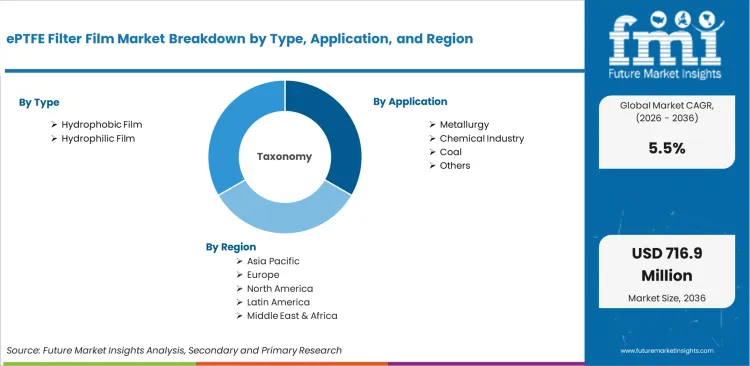
- 5.5%
ePTFE Filter Film Market Size, Market Forecast and Outlook By FMI
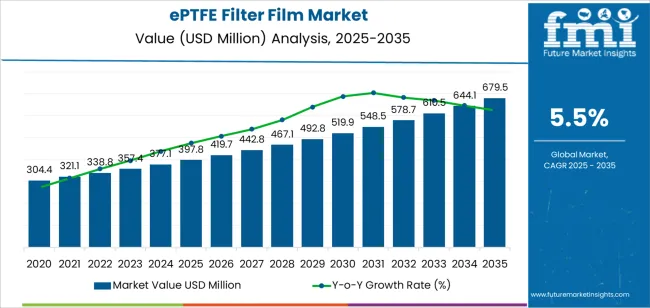
The eptfe filter film market was valued at USD 398 billion in 2025, projected to reach USD 419.68 billion in 2026, and is forecast to expand to USD 716.87 billion by 2036 at a 5.5% CAGR. Industrial Emission Compliance Retrofits requirements and advancing end-use specifications are accelerating adoption across global supply chains. Procurement patterns that once favoured basic commodity alternatives are shifting toward verified, performance-certified product grades as regulatory and operational standards tighten across primary end-use sectors.
Summary of ePTFE Filter Film Market
- Market Snapshot
- The eptfe filter film market is valued at USD 398 billion in 2025 and is projected to reach USD 716.87 billion by 2036.
- The industry is expected to grow at a 5.5% CAGR from 2026 to 2036, creating an incremental opportunity of USD 297.19 billion.
- The market operates as a specification-driven category where regulatory compliance, performance verification, and supply chain qualification define competitive positioning among leading participants.
- Demand and Growth Drivers
- Industrial Emission Compliance Retrofits is generating sustained procurement demand as end-use operators require verified performance against established compliance standards.
- Pharmaceutical Sterile Manufacturing Expansion is expanding the addressable volume base as infrastructure investment and sector growth programmes accelerate adoption in high-growth regions.
- Regulatory alignment and evolving institutional procurement specifications are shifting buyer criteria toward qualified supplier relationships and certified product grades.
- Among key countries, China at 7.4%, India at 6.9%, Germany at 6.3% lead growth, while Brazil at 5.8%, USA at 5.2%, UK at 4.7%, Japan at 4.1% reflect mature replacement-cycle demand patterns.
- Product and Segment View
- The market encompasses Hydrophobic Film, Hydrophilic Film and related configurations serving diverse technical and institutional requirements.
- Hydrophobic Film is poised to lead by Type with 61.3% share in 2026, supported by established adoption patterns and concentrated procurement volumes in primary end-use channels.
- Metallurgy is estimated to command by Application with 43.7% share in 2026, anchored by the largest institutional procurement segment with recurring demand commitments.
- The scope covers Hydrophobic Film, Hydrophilic Film, while excluding unrelated product categories and non-core technical configurations.
- Geography and Competitive Outlook
- China and India are the fastest-growing markets, driven by industrial investment, regulatory compliance programs, and expanding institutional procurement activity.
- Europe and North America represent mature, high-value demand bases sustained by replacement procurement, performance upgrade requirements, and compliance-driven reformulation cycles.
- Competition is shaped by product qualification status, regulatory certification depth, and technical support infrastructure serving buyer specification and validation requirements.
- Key companies active in this market include GORE, Poly Fluoro, Rogers Corporation, Teflex Gasket, Microvent, Trinity Technology Group, GREMCO, Shandong Dongyue Future Hydrogen Energy Materials, Shanghai JINYOU Fluorine Materials, Cobetter, Donaldson (Wuxi) Filters, Nanjing Changkang New Material Technology.
ePTFE Filter Film Market Key Takeaways
| Metric | Details |
|---|---|
| Industry Size (2026) | USD 419.68 billion |
| Industry Value (2036) | USD 716.87 billion |
| CAGR (2026-2036) | 5.5% |
Source: Future Market Insights, 2026
The absolute dollar increment from 2026 to 2036 reaches USD 297.19 million, sustained by industrial emission compliance retrofits across Asia Pacific metallurgy and chemical processing sectors and expanding pharmaceutical sterile filtration demand driven by biologics manufacturing capacity additions. China Ministry of Ecology and Environment ultra-low emission standards for iron and steel sintering processes have made ePTFE membrane bags the de facto specification for compliant stack gas filtration, generating recurring replacement demand cycles across the Chinese steel industry that deliver predictable volume momentum independent of broader construction market fluctuations.
Regional growth trajectories diverge meaningfully across the forecast period. China advances at a 7.4% CAGR, India advances at a 6.9% CAGR, Germany advances at a 6.3% CAGR supported by industrial expansion and institutional procurement growth. Brazil tracks at 5.8%, USA tracks at 5.2%, UK tracks at 4.7%, Japan tracks at 4.1%, reflecting established market infrastructure where replacement cycle and upgrade demand sustain volume without high incremental penetration. The full country breakdown spans: China at 7.4%, India at 6.9%, Germany at 6.3%, Brazil at 5.8%, USA at 5.2%, UK at 4.7%, Japan at 4.1%.
ePTFE Filter Film Market Definition
Expanded polytetrafluoroethylene filter films are microporous fluoropolymer membranes used in industrial filtration systems to separate particulate matter, aerosols, and fine dusts from gas and liquid streams under conditions of elevated temperature, chemical aggression, or stringent emission compliance requirements. Hydrophobic ePTFE filter films repel moisture while capturing sub-micron dry particulates in metallurgical, mining, and chemical processing air filtration applications. Hydrophilic variants are surface-treated to enable aqueous filtration in pharmaceutical sterile processing, water treatment, and biomanufacturing environments. The combination of chemical inertness, temperature tolerance to 260 degrees Celsius, and submicron filtration efficiency positions ePTFE filter films as the specification default in industrial environments where conventional fibreglass or synthetic media degrade under process conditions.
ePTFE Filter Film Market Inclusions
The report covers global and regional market sizing for ePTFE filter films segmented by film type, application sector, and end-use industry. Forecast data spans 2026 to 2036 encompassing hydrophobic and hydrophilic configurations across metallurgy, chemical processing, coal handling, pharmaceutical manufacturing, water treatment, and environmental remediation applications. Regulatory emission standard impact analysis, competing filtration media assessment, and competitive supplier landscape mapping are incorporated.
ePTFE Filter Film Market Exclusions
The scope excludes non-expanded PTFE filter media, fibreglass filter bags and cartridges competing in overlapping applications, and polymeric membrane filtration systems based on polysulfone, polyethersulfone, or PVDF chemistry marketed for liquid microfiltration and ultrafiltration without ePTFE as the primary membrane material. Bulk ePTFE tape, gasket stock, and electronic film products addressed in separate analytical studies fall outside the boundary.
ePTFE Filter Film Market Research Methodology
- Primary Research: FMI analysts conducted structured interviews with procurement decision-makers, product managers, and technical specialists across the eptfe filter film value chain to capture first-hand market intelligence on pricing dynamics, qualification cycles, and demand factors not available through public data sources.
- Desk Research: Secondary data collection incorporated regulatory filings, government procurement databases, trade association publications, peer-reviewed technical literature, and verified company disclosures including annual reports, earnings call transcripts, and official press releases from institutional sources.
- Market-Sizing and Forecasting: Market values are derived through a hybrid bottom-up and top-down methodology combining supply-side production and shipment data with demand-side end-use consumption analysis. Regional forecasts apply segment-specific growth rate inputs validated against macroeconomic and industrial activity benchmarks sourced from multilateral organisations and government statistical agencies.
- Data Validation and Update Cycle: All primary interview findings are cross-validated against secondary sources and quantitative benchmarks. Model projections are stress-tested through scenario analysis incorporating regulatory, macroeconomic, and supply chain risk inputs. Outputs are reviewed and updated on a defined cycle aligned with material developments in the market environment.
Why Is the ePTFE Electronic Film Market Expanding Across Electronics and Automotive Applications?
Market expansion rests on three fundamental shifts driving adoption across chemical and industrial sectors. Industrial modernization growth creates compelling advantages through ePTFE membrane systems that provide comprehensive filtration properties with operational compatibility, enabling manufacturers to manage increasing performance requirements and maintain quality standards while ensuring efficient operations and justifying investment over traditional filtration methods. Advanced chemical resistance modernization accelerates as companies worldwide seek reliable membranes that deliver superior performance directly to industrial systems, enabling contamination reduction that aligns with operational expectations and maximizes industrial productivity. Chemical industry transformation drives adoption from industrial operators requiring specialized membranes that maximize performance while maintaining high-quality reliability during chemical and industrial operations.
However, growth faces headwinds from fluoropolymer raw material cost variations that differ across membrane suppliers regarding pricing stability and supply chain reliability, potentially limiting margin consistency in price-sensitive industrial categories. Manufacturing complexity also persists regarding membrane specifications and chemical requirements that may increase production costs in facilities with demanding quality standards.
Opportunity Pathways - ePTFE Filter Film Market
The ePTFE filter film market represents a compelling intersection of chemical innovation, filtration advancement, and industrial optimization management. With robust growth projected from USD 419.7 million in 2026 to USD 716.9 million by 2036 at a 5.5% CAGR, this market is driven by increasing industrial modernization expansion trends, advanced filtration requirements, and demand for high-performance membrane formats.
The ePTFE filter film market's expansion reflects a fundamental shift in how industrial facilities and chemical operators approach membrane infrastructure. Strong growth opportunities exist across diverse applications, from metallurgy operations requiring high-efficiency membranes to chemical processing systems demanding reliable filtration components. Geographic expansion is particularly pronounced in Asia-Pacific markets, LED by China (7.4% CAGR) and India (6.9% CAGR), while established markets in North America and Europe drive innovation and specialized segment development.
The dominance of hydrophobic film systems and metallurgy applications underscores the importance of proven membrane technology and industrial reliability in driving adoption. Membrane standardization and performance complexity remain key challenges, creating opportunities for companies that can deliver seamless filtration performance while maintaining chemical resistance.
- Pathway A - Metallurgy Expansion. Development of specialized ePTFE membranes for metallurgical applications, metal processing, and extraction systems with enhanced chemical resistance, temperature tolerance, and compatibility with metallurgy standards. Focus on operational efficiency and integration with metal processing protocols. Expected revenue pool: USD 185.3-247.1 million.
- Pathway B - Geographic Expansion & Chemical Penetration. Strong growth opportunities in China (7.4% CAGR) and India (6.9% CAGR) through partnerships with chemical companies, region-specific membrane requirements, and compliance with local industrial standards. Localization addresses cost requirements and enables market penetration. Revenue opportunity: USD 152.4-203.5 million.
- Pathway C - Chemical Industry Applications. Developing specialized membranes for chemical processing systems, pharmaceutical manufacturing, petrochemical operations, and industrial chemistry. Focus on chemical resistance, purity maintenance, and compatibility with chemical manufacturing. Pool: USD 129.1-172.5 million.
- Pathway D - Advanced Hydrophobic Technology Development. Specialized products incorporating enhanced fluoropolymer materials, improved membrane performance, advanced chemical capabilities, and superior resistance characteristics where premium performance and chemical applications justify enhanced specifications. Focus on high-performance chemical processing and material science. Revenue uplift: USD 113.5-151.7 million.
- Pathway E - Type Diversification Programs. Systems designed for specialized filtration applications, custom membrane solutions, advanced chemical systems, and precision industrial operations that appeal to chemical manufacturers and equipment producers. Integration of membrane specifications and chemical requirements. Expected upside: USD 96.9-129.6 million.
- Pathway F - Custom Membrane Solutions & Application Engineering. Incorporating specialized fluoropolymer compositions for custom applications, engineered solutions, technical services, and specialized chemical production that enhance membrane capabilities while providing filtration optimization. Focus on customer-specific requirements and technical support systems. Innovation pool: USD 80.5-107.7 million.
- Pathway G - Research & Development Integration. Tailored solutions incorporating laboratory-grade specifications, testing services, and precision membrane systems for university research programs and chemical R&D facilities. Enhanced appeal for academic institutions and chemical research companies. Strategic value: USD 64.0-85.6 million.
How Is the ePTFE Electronic Film Market Segmented by Type, Application, and End Use?
Primary Classification: The market segments by type into Hydrophobic Film and Hydrophilic Film categories, representing the evolution from standard membrane applications to specialized chemical processing systems for comprehensive operations.
Secondary Breakdown: Application segmentation divides the ePTFE filter film market into Metallurgy, Chemical Industry, Coal, and Others sectors, reflecting distinct requirements for chemical resistance, filtration specifications, and operational performance.
Tertiary Classification: End-use industry segmentation covers Chemical Processing, Industrial Manufacturing, Mining Operations, Environmental Applications, Water Treatment, and Pharmaceutical Manufacturing, representing diverse requirements for membrane specifications and application performance.
Regional Classification: Geographic distribution covers North America, Europe, Asia Pacific, Latin America, and the Middle East & Africa, with developed industrial markets leading innovation while emerging economies show accelerating growth patterns driven by industrialization programs.
The segmentation structure reveals technology progression from standard membrane systems toward integrated high-performance platforms with enhanced chemical resistance capabilities and precision performance, while application diversity spans from metallurgy systems to chemical processing requiring comprehensive membrane properties and intelligent filtration solutions.
By Type, the Hydrophobic Film Segment Accounts for Dominant Market Share
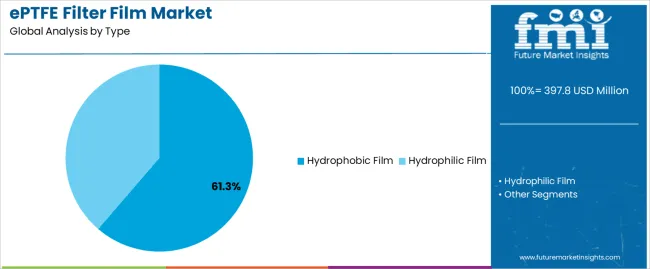
Hydrophobic film segment is estimated to account for 61.3% of the ePTFE filter film market share in 2026. The segment's leading position stems from its fundamental role as a critical component in modern chemical processing applications and its extensive use across multiple industrial and chemical sectors. The hydrophobic film range's dominance is attributed to its superior chemical resistance properties, including excellent water repellency, chemical inertness, and balanced cost-effectiveness that make it indispensable for industrial operations.
Market Position: Hydrophobic film systems command the leading position in the ePTFE filter film market through advanced membrane technologies, including comprehensive chemical resistance properties, uniform performance, and reliable filtration characteristics that enable operators to deploy membranes across diverse industrial environments.
Value Drivers: The segment benefits from industrial preference for proven membrane interfaces that provide exceptional chemical resistance without requiring ultra-premium material costs. Efficient chemical implementation enables deployment in metallurgy, chemical processing, and industrial applications where membrane reliability and chemical compatibility represent critical selection requirements.
Competitive Advantages: Hydrophobic film systems differentiate through excellent chemical capacity, proven industrial reliability, and compatibility with standard chemical processes that enhance membrane capabilities while maintaining economical material profiles suitable for diverse industrial applications.
Key market characteristics:
- Advanced membrane systems with precision chemical control, consistent fluoropolymer properties, and specialized manufacturing capabilities
- Membrane optimization enabling comprehensive industrial integration with minimal chemical impact
- Industrial accessories, including filtration equipment, control systems, and quality control tools for high-volume operations
By Application, the Metallurgy Segment Accounts for the Largest Market Share
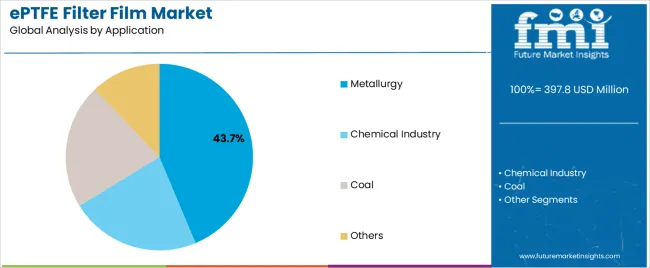
Metallurgy segment is projected to hold 43.7% of the ePTFE filter film market share in 2026. The segment's market leadership is driven by the extensive use of ePTFE membranes in metal processing, extraction operations, industrial metallurgy, and manufacturing infrastructure, where membranes serve as both a filtration component and efficiency solution. The metallurgy sector's consistent demand for reliable membrane systems supports the segment's dominant position.
Market Context: Metallurgy applications dominate the ePTFE filter film market due to widespread adoption of efficient membrane solutions and increasing focus on industrial modernization, performance optimization, and operational management that support metallurgical operations while maintaining quality standards.
Appeal Factors: Industrial consumers prioritize membrane durability, chemical resistance, and integration with standard metallurgical systems that enable coordinated deployment across multiple industrial needs. The segment benefits from substantial metal processing growth and industrial development that emphasize reliable membranes for metallurgy applications.
Growth Drivers: Industrial programs incorporate ePTFE membranes as standard components for filtration systems and metallurgical programs. At the same time, industrial compliance initiatives are increasing demand for advanced features that comply with metallurgy standards and enhance system performance.
Market Challenges: Membrane cost fluctuations and standardization requirements may limit deployment flexibility in ultra-price-sensitive markets or regions with varying industrial requirements.
Application dynamics include:
- Strong growth in metallurgical companies and metal processing manufacturers requiring standardized membrane formats
- Increasing adoption in industrial manufacturers and processing integrators for enhanced metallurgical development
- Rising integration with industrial systems and metal processing control programs
What Are the Primary Drivers, Restraints, and Emerging Trends Shaping the ePTFE Electronic Film Market?
Growth Accelerators: Industrial modernization expansion drives primary adoption as ePTFE membrane systems provide exceptional chemical resistance properties that enable industrial development without performance compromise, supporting modernization advancement and operational efficiency that require reliable membrane formats. Advanced chemical resistance growth accelerates market expansion as companies seek specialized membranes that maintain performance during operation while enhancing industrial convenience through standardized specifications and compatibility. Chemical processing awareness increases worldwide, creating continued demand for ePTFE membrane systems that complement industrial routines and provide operational advantages in filtration performance.
Growth Inhibitors: Fluoropolymer raw material cost volatility challenges differ across membrane markets regarding price stability and supply chain consistency, which may limit margin predictability and cost planning in price-sensitive industrial categories with demanding affordability requirements. Manufacturing complexity persists regarding membrane specifications and chemical standards that may increase production costs in facilities with complex quality protocols. Market fragmentation across multiple membrane specifications and application standards creates compatibility concerns between different membrane systems and existing industrial infrastructure.
Market Evolution Patterns: Adoption accelerates in chemical and industrial sectors where membrane benefits justify equipment investments, with geographic concentration in developed markets transitioning toward mainstream adoption in emerging economies driven by industrialization and chemical expansion. Technology advancement focuses on enhanced chemical resistance properties, improved industrial performance, and integration with automated systems that optimize industrial performance and quality control.
How Does Market Growth Differ Across Leading Countries in the ePTFE Electronic Film Industry?
.webp "Top Country Growth Comparison Eptfe Filter Film Market Cagr (2026 2036)")
The ePTFE filter film market demonstrates varied regional dynamics with growth leaders including China (7.4% CAGR) and India (6.9% CAGR) driving expansion through industrial manufacturing growth and chemical modernization. Steady Performers encompass Germany (6.3% CAGR), Brazil (5.8% CAGR), and the USA (5.2% CAGR), benefiting from established industrial systems and advanced chemical processing adoption.
| Country | CAGR (2026-2036) |
|---|---|
| China | 7.4% |
| India | 6.9% |
| Germany | 6.3% |
| Brazil | 5.8% |
| USA | 5.2% |
| UK | 4.7% |
| Japan | 4.1% |
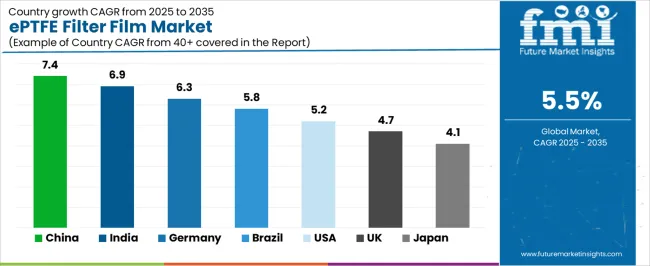
Regional synthesis reveals Asia-Pacific markets leading growth through industrial expansion and chemical development, while European countries maintain steady expansion supported by specialized applications and precision membrane requirements. North American markets show strong growth driven by chemical demand and industrial facility upgrades.
How Is Manufacturing Expansion Accelerating Market Growth in China?
China establishes regional leadership through rapid industrial development and comprehensive chemical modernization, integrating advanced ePTFE membrane systems as standard components in metallurgy manufacturing and chemical operations. The country's 7.4% CAGR through 2036 reflects industrial growth promoting manufacturing density and chemical infrastructure development that mandate the use of reliable membrane systems in industrial operations. Growth concentrates in major industrial centers, including Beijing, Shanghai, and Shenzhen, where chemical networks showcase integrated membrane systems that appeal to manufacturers seeking enhanced production efficiency and international quality standards.
Chinese manufacturers are developing innovative ePTFE membrane solutions that combine local production advantages with international chemical specifications, including advanced fluoropolymer compositions and enhanced chemical resistance capabilities.
Strategic Market Indicators:
- Industrial infrastructure growth providing substantial support for domestic chemical development
- Manufacturing capacity expansion driven by industrial development and membrane demand
- Research sector development for cost-effective membrane solutions targeting domestic and export applications
Why Is Electronic Modernization Driving Market Expansion in India?
The Indian market emphasizes industrial manufacturing applications, including rapid chemical development and comprehensive industrial expansion that increasingly incorporates ePTFE membranes for industrial enhancement and chemical applications. The country is projected to show a 6.9% CAGR through 2036, driven by massive industrial activity under modernization initiatives and demand for standardized, high-quality membrane systems. Indian industrial facilities prioritize cost-effectiveness with ePTFE membranes delivering industrial efficiency through economical membrane usage and reliable performance capabilities.
Technology deployment channels include major industrial companies, chemical integrators, and industrial institutions that support high-volume usage for industrial and chemical applications.
Performance Metrics:
- Industrial facilities in Delhi, Mumbai, and Chennai leading ePTFE membrane adoption for industrial operations
- Industrial development compliance with chemical standards, driving quality selection criteria
How Is Advanced Engineering Sustaining Market Leadership in Germany?
The German market emphasizes advanced industrial manufacturing features, including innovative membrane technologies and integration with comprehensive industrial platforms that manage chemical operations, industrial facilities, and institutional applications through unified membrane systems. The country is projected to show a 6.3% CAGR through 2036, driven by industrial expansion under chemical development trends and demand for premium, reliable membrane systems. German industrial institutions prioritize precision with ePTFE membranes delivering comprehensive industrial performance through enhanced quality protection and operational innovation.
Technology deployment channels include major industrial companies, chemical institutions, and membrane equipment manufacturers that support custom development for premium operations.
Performance Metrics:
- Industrial companies in Baden-Württemberg, Bavaria, and North Rhine-Westphalia leading ePTFE membrane adoption for industrial operations
- Membrane compatibility with chemical requirements, driving specification selection criteria
Why Is Industrial Development Strengthening Market Demand in Brazil?
In São Paulo, Rio de Janeiro, and Belo Horizonte, Brazilian industrial facilities and chemical operators are implementing advanced ePTFE membrane systems to enhance filtration capabilities and support operational performance that aligns with industrial protocols and chemical standards. The Brazilian market demonstrates continued growth with a 5.8% CAGR through 2036, driven by industrial compliance programs and chemical investments that emphasize reliable membrane systems for industrial and chemical applications. Brazilian industrial facilities are prioritizing ePTFE membrane systems that provide exceptional chemical resistance properties while maintaining compliance with industrial standards and minimizing operational complexity, particularly important in industrial and chemical facility operations.
Market expansion benefits from industrial programs that mandate enhanced membrane compliance in chemical specifications, creating continued demand across Brazil's industrial and chemical sectors, where membrane efficiency and system consistency represent critical requirements.
Strategic Market Indicators:
- Industrial operators and chemical companies leading adoption with compliance programs requiring reliable membrane systems
- Chemical standards providing framework support for high-performance membrane acquisition
- Quality control requirements driving demand for certified systems with performance testing documentation
- Specialized industrial segments adopting comprehensive ePTFE membrane solutions for industrial facilities and chemical projects
How Is Technological Innovation Supporting Market Advancement in United States?
The USA market emphasizes industrial manufacturing features, including innovative membrane technologies and integration with comprehensive industrial platforms that manage chemical operations, industrial facilities, and commercial applications through unified membrane systems. The country is projected to show a 5.2% CAGR through 2036, driven by industrial expansion under chemical development trends and industry demand for premium, reliable membrane systems. American industrial companies prioritize innovation with ePTFE membranes delivering comprehensive industrial performance through enhanced quality protection and operational advancement.
Technology deployment channels include major industrial companies, chemical institutions, and membrane manufacturers that support custom development for industrial operations.
Performance Metrics:
- Industrial companies in California, Texas, and Ohio leading ePTFE membrane adoption for industrial operations
- Membrane compatibility with industrial development requirements, driving specification selection criteria
Why Is Research Integration Shaping Market Growth in United Kingdom?
The UK market demonstrates advanced industrial manufacturing deployment, growing at 4.7% CAGR, with documented operational excellence in chemical control and industrial applications through integration with existing industrial systems and quality assurance infrastructure. The country leverages engineering expertise in industrial manufacturing and membrane science to maintain market leadership. Industrial centers, including Birmingham, Manchester, and Leeds, showcase advanced installations where ePTFE membrane systems integrate with comprehensive industrial platforms and chemical systems to optimize industrial development and operational efficiency.
British industrial facilities prioritize membrane precision and system consistency in product selection, creating demand for premium ePTFE membrane systems with advanced features, including enhanced fluoropolymer compositions and integration with automated industrial systems. The ePTFE filter film market benefits from established industrial infrastructure and willingness to invest in specialized membrane technologies that provide superior quality and industrial compliance.
Market Intelligence Brief:
- Precision focus on membrane quality and system uniformity, driving industrial segment growth
- Technology collaboration between British industrial manufacturers and international membrane companies
- Premium industrial systems expanding ePTFE membrane integration in chemical and industrial applications
How Is Precision Manufacturing Enhancing Market Maturity in Japan?
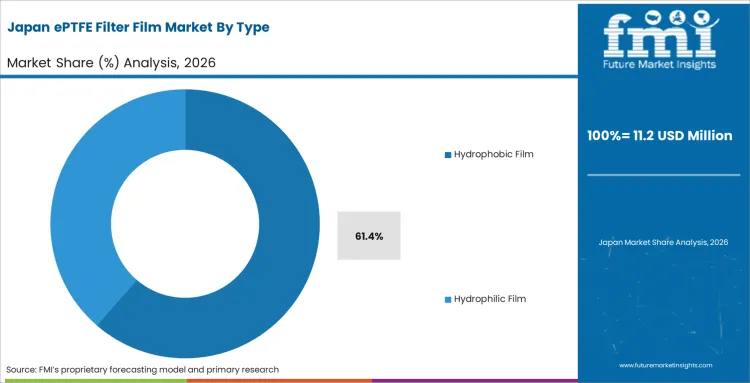
Japan's advanced industrial market demonstrates meticulous ePTFE membrane deployment, growing at 4.1% CAGR, with documented operational excellence in industrial control and chemical applications through integration with existing industrial systems and quality assurance infrastructure. The country leverages engineering expertise in industrial manufacturing and membrane technology to maintain market leadership. Industrial centers, including Tokyo, Osaka, and Nagoya, showcase advanced installations where ePTFE membrane systems integrate with comprehensive industrial platforms and quality systems to optimize industrial development and operational efficiency.
Japanese industrial facilities prioritize membrane precision and system consistency in product selection, creating demand for premium ePTFE membrane systems with advanced features, including ultra-high quality and integration with automated industrial protocols. The ePTFE filter film market benefits from established industrial infrastructure and willingness to invest in specialized membrane technologies that provide superior performance and industrial compliance.
Market Intelligence Brief:
- Precision focus on membrane quality and chemical uniformity, driving industrial segment growth
- Technology collaboration between Japanese industrial manufacturers and international membrane companies
- Premium industrial systems expanding ePTFE membrane integration in chemical and industrial applications
How Is Market Performance Evolving Across Key Economies in Europe?
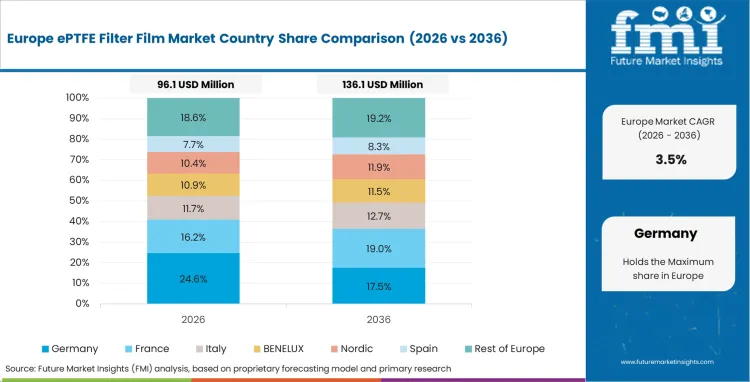
The ePTFE filter film market in Europe is projected to grow from USD 145.2 million in 2026 to USD 248.4 million by 2036, registering a CAGR of 5.5% over the forecast period. Germany is expected to maintain its leadership position with a 39.8% market share in 2026, declining slightly to 39.4% by 2036, supported by its industrial excellence and major manufacturing centers, including Baden-Württemberg and Bavaria.
France follows with a 26.1% share in 2026, projected to reach 26.5% by 2036, driven by comprehensive chemical programs and manufacturing facility initiatives. The United Kingdom holds a 18.7% share in 2026, expected to maintain 19.1% by 2036 through established industrial sectors and chemical adoption. Italy commands a 9.2% share, while Spain accounts for 3.8% in 2026. The Rest of Europe region is anticipated to gain momentum, expanding its collective share from 2.4% to 2.6% by 2036, attributed to increasing industrial development in Eastern European countries and emerging chemical programs implementing standardized membrane systems.
How Competitive Is the Global ePTFE Electronic Film Market and What Defines Its Structure?
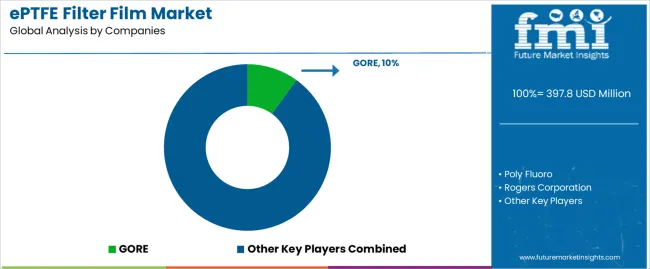
The ePTFE filter film market operates with moderate concentration, featuring approximately 18-25 participants, where leading companies control roughly 62-68% of the global market share through established distribution networks and comprehensive product portfolio capabilities. Competition emphasizes membrane performance, industrial reliability, and chemical resistance optimization rather than premium feature rivalry.
Market leaders encompass GORE, Poly Fluoro, and Rogers Corporation, which maintain competitive advantages through extensive industrial manufacturing expertise, regional distribution networks, and comprehensive technical support capabilities that create industrial loyalty and support chemical requirements. These companies leverage decades of membrane experience and ongoing chemical technology investments to develop advanced ePTFE membrane systems with exceptional quality and industrial features.
Specialty challengers include regional manufacturers and membrane specialists, which compete through specialized application innovation focus and efficient production solutions that appeal to industrial buyers seeking reliable performance formats and custom membrane flexibility. These companies differentiate through operational efficiency emphasis and specialized market focus.
Market dynamics favor participants that combine consistent membrane performance with advanced industrial support, including automated systems and distribution capabilities. Competitive pressure intensifies as traditional membrane manufacturers expand into ePTFE membrane systems. At the same time, specialized chemical producers challenge established players through innovative manufacturing methods and cost-effective production targeting emerging industrial segments.
Who Are the Key Companies Driving Innovation in the ePTFE Electronic Film Market?
- GORE
- Poly Fluoro
- Rogers Corporation
- Teflex Gasket
- Microvent
- Trinity Technology Group
- GREMCO
- Shandong Dongyue Future Hydrogen Energy Materials
- Shanghai JINYOU Fluorine Materials
- Cobetter
- Donaldson (Wuxi) Filters
- Nanjing Changkang New Material Technology
Scope of the Report
| Metric | Value |
|---|---|
| Quantitative Units | USD 419.68 billion to USD 716.87 billion, at a CAGR of 5.5% |
| Market Definition | Expanded polytetrafluoroethylene filter films are microporous fluoropolymer membranes used in industrial filtration systems to separate particulate matter, aerosols, and fine dusts from gas and liquid streams under condi... |
| Type Segmentation | Hydrophobic Film, Hydrophilic Film |
| Application Segmentation | Metallurgy, Chemical Industry, Coal, Others |
| End-Use Industry Segmentation | Chemical Processing, Industrial Manufacturing, Mining Operations, Environmental Applications, Water Treatment, Pharmaceutical Manufacturing |
| Regions Covered | North America, Latin America, Europe, East Asia, South Asia, Oceania, Middle East & Africa |
| Countries Covered | China, India, Germany, Brazil, USA, UK, Japan, and 40 plus countries |
| Key Companies Profiled | GORE, Poly Fluoro, Rogers Corporation, Teflex Gasket, Microvent, Trinity Technology Group, GREMCO, Shandong Dongyue Future Hydrogen Energy Materials, Shanghai JINYOU Fluorine Materials, Cobetter, Donaldson (Wuxi) Filters, Nanjing Changkang New Material Technology |
| Forecast Period | 2026 to 2036 |
| Approach | Hybrid bottom-up and top-down forecasting model validated against primary research and public institutional data sources |
How Is the ePTFE Electronic Film Market Segmented by Type, Application, and Regional Distribution?
Type:
- Hydrophobic Film
- Hydrophilic Film
Application:
- Metallurgy
- Chemical Industry
- Coal
- Others
End-Use Industry:
- Chemical Processing
- Industrial Manufacturing
- Mining Operations
- Environmental Applications
- Water Treatment
- Pharmaceutical Manufacturing
Region:
- North America
- United States
- Canada
- Mexico
- Europe
- Germany
- France
- United Kingdom
- Italy
- Spain
- Nordic
- BENELUX
- Rest of Europe
- Asia Pacific
- China
- Japan
- India
- South Korea
- ASEAN
- Australia & New Zealand
- Rest of Asia Pacific
- Latin America
- Brazil
- Chile
- Rest of Latin America
- Middle East & Africa
- Kingdom of Saudi Arabia
- Other GCC Countries
- Turkey
- South Africa
- Other African Union
- Rest of Middle East & Africa
Bibliography
1. World Health Organization. (2025). World Health Statistics 2025. WHO Press.
2. Organisation for Economic Co-operation and Development. (2025). OECD Industrial Production Statistics. OECD Publishing.
3. World Bank Group. (2025). World Development Indicators 2025. World Bank Open Data.
4. International Energy Agency. (2025). Energy Technology Perspectives 2025. IEA Publications.
5. United Nations Environment Programme. (2025). Global Chemicals Outlook III. UNEP.
6. European Commission, Directorate-General for Internal Market, Industry, Entrepreneurship and SMEs. (2025). European Industrial Strategy Update. European Commission.
7. United States Environmental Protection Agency. (2025). Chemical Data Reporting Summary. USA EPA.
This bibliography is provided for reader reference. The full Future Market Insights report contains the complete reference list with primary research documentation.
This Report Addresses
- Market sizing and quantitative forecast metrics detailing expenditure dedicated to eptfe filter film across major end-use sectors through 2036.
- Segmentation analysis mapping adoption velocity of specific product categories and evaluating technical and regulatory factors driving segment leadership positions.
- Regional deployment intelligence comparing growth dynamics in Asia Pacific against mature market replacement demand in Europe and North America.
- Regulatory compliance assessment analysing how evolving standards and institutional procurement specifications direct buyer decisions toward qualified, certified product sources.
- Competitive posture evaluation tracking supplier positioning, product differentiation strategies, and qualification barriers that sustain pricing power for technically differentiated participants.
- Strategic procurement guidance defining specification requirements and qualification timelines relevant to next-generation sourcing decisions in the eptfe filter film category.
- Supply chain vulnerability analysis identifying sourcing concentration risks and feedstock dependencies that expose buyers and producers to price and availability disruptions.
- Custom data delivery formats encompassing interactive dashboards, raw Excel datasets, and comprehensive PDF narrative reports.
Frequently Asked Questions
How large is the demand for ePTFE Filter Film in the global market in 2026?
Demand for eptfe filter film in the global market is estimated to be valued at USD 419.68 billion in 2026.
What will the market size of ePTFE Filter Film be by 2036?
The eptfe filter film market is projected to reach USD 716.87 billion by 2036, reflecting sustained demand growth across primary end-use segments throughout the forecast period.
What is the expected CAGR for the ePTFE Filter Film market between 2026 and 2036?
The eptfe filter film market is expected to grow at a CAGR of 5.5% between 2026 and 2036, creating an incremental opportunity of USD 297.19 billion.
Which Type segment leads global sales in 2026?
Hydrophobic Film accounts for 61.3% of type share in 2026, supported by established adoption patterns and concentrated institutional procurement demand.
Which Application leads in the ePTFE Filter Film market?
Metallurgy holds 43.7% share by application in 2026, reflecting its position as the primary end-use driver with the most concentrated recurring procurement volumes.
Which country records the fastest growth in the ePTFE Filter Film market?
China records the highest CAGR at 7.4% through 2036, driven by industrial emission compliance retrofits and expanding industrial or institutional procurement activity.
What does FMI forecast for the ePTFE Filter Film market through 2036?
As per FMI analysis, the eptfe filter film market is forecast to grow from USD 419.68 billion in 2026 to USD 716.87 billion by 2036, driven by industrial emission compliance retrofits and pharmaceutical sterile manufacturing expansion.
Preview the report firsthand - request a free sample
Get SampleGet the brochure for pricing and purchase details.
Get PDFTable of Content
- Executive Summary
- Global Market Outlook
- Demand-side Trends
- Supply-side Trends
- Technology Roadmap Analysis
- Analysis and Recommendations
- Market Overview
- Market Coverage / Taxonomy
- Market Definition / Scope / Limitations
- Research Methodology
- Chapter Orientation
- Analytical Lens and Working Hypotheses
- Market Structure, Signals, and Trend Drivers
- Benchmarking and Cross-market Comparability
- Market Sizing, Forecasting, and Opportunity Mapping
- Research Design and Evidence Framework
- Desk Research Programme (Secondary Evidence)
- Company Annual and Sustainability Reports
- Peer-reviewed Journals and Academic Literature
- Corporate Websites, Product Literature, and Technical Notes
- Earnings Decks and Investor Briefings
- Statutory Filings and Regulatory Disclosures
- Technical White Papers and Standards Notes
- Trade Journals, Industry Magazines, and Analyst Briefs
- Conference Proceedings, Webinars, and Seminar Materials
- Government Statistics Portals and Public Data Releases
- Press Releases and Reputable Media Coverage
- Specialist Newsletters and Curated Briefings
- Sector Databases and Reference Repositories
- FMI Internal Proprietary Databases and Historical Market Datasets
- Subscription Datasets and Paid Sources
- Social Channels, Communities, and Digital Listening Inputs
- Additional Desk Sources
- Expert Input and Fieldwork (Primary Evidence)
- Primary Modes
- Qualitative Interviews and Expert Elicitation
- Quantitative Surveys and Structured Data Capture
- Blended Approach
- Why Primary Evidence is Used
- Field Techniques
- Interviews
- Surveys
- Focus Groups
- Observational and In-context Research
- Social and Community Interactions
- Stakeholder Universe Engaged
- C-suite Leaders
- Board Members
- Presidents and Vice Presidents
- R&D and Innovation Heads
- Technical Specialists
- Domain Subject-matter Experts
- Scientists
- Physicians and Other Healthcare Professionals
- Governance, Ethics, and Data Stewardship
- Research Ethics
- Data Integrity and Handling
- Primary Modes
- Tooling, Models, and Reference Databases
- Desk Research Programme (Secondary Evidence)
- Data Engineering and Model Build
- Data Acquisition and Ingestion
- Cleaning, Normalisation, and Verification
- Synthesis, Triangulation, and Analysis
- Quality Assurance and Audit Trail
- Market Background
- Market Dynamics
- Drivers
- Restraints
- Opportunity
- Trends
- Scenario Forecast
- Demand in Optimistic Scenario
- Demand in Likely Scenario
- Demand in Conservative Scenario
- Opportunity Map Analysis
- Product Life Cycle Analysis
- Supply Chain Analysis
- Investment Feasibility Matrix
- Value Chain Analysis
- PESTLE and Porter’s Analysis
- Regulatory Landscape
- Regional Parent Market Outlook
- Production and Consumption Statistics
- Import and Export Statistics
- Market Dynamics
- Global Market Analysis 2021 to 2025 and Forecast, 2026 to 2036
- Historical Market Size Value (USD Million) Analysis, 2021 to 2025
- Current and Future Market Size Value (USD Million) Projections, 2026 to 2036
- Y-o-Y Growth Trend Analysis
- Absolute $ Opportunity Analysis
- Global Market Pricing Analysis 2021 to 2025 and Forecast 2026 to 2036
- Global Market Analysis 2021 to 2025 and Forecast 2026 to 2036, By Type
- Introduction / Key Findings
- Historical Market Size Value (USD Million) Analysis By Type , 2021 to 2025
- Current and Future Market Size Value (USD Million) Analysis and Forecast By Type , 2026 to 2036
- Hydrophobic Film
- Hydrophilic Film
- Hydrophobic Film
- Y-o-Y Growth Trend Analysis By Type , 2021 to 2025
- Absolute $ Opportunity Analysis By Type , 2026 to 2036
- Global Market Analysis 2021 to 2025 and Forecast 2026 to 2036, By Application
- Introduction / Key Findings
- Historical Market Size Value (USD Million) Analysis By Application, 2021 to 2025
- Current and Future Market Size Value (USD Million) Analysis and Forecast By Application, 2026 to 2036
- Metallurgy
- Chemical Industry
- Coal
- Others
- Metallurgy
- Y-o-Y Growth Trend Analysis By Application, 2021 to 2025
- Absolute $ Opportunity Analysis By Application, 2026 to 2036
- Global Market Analysis 2021 to 2025 and Forecast 2026 to 2036, By End-Use Industry
- Introduction / Key Findings
- Historical Market Size Value (USD Million) Analysis By End-Use Industry, 2021 to 2025
- Current and Future Market Size Value (USD Million) Analysis and Forecast By End-Use Industry, 2026 to 2036
- Chemical Processing
- Industrial Manufacturing
- Mining Operations
- Environmental Applications
- Water Treatment
- Pharmaceutical Manufacturing
- Chemical Processing
- Y-o-Y Growth Trend Analysis By End-Use Industry, 2021 to 2025
- Absolute $ Opportunity Analysis By End-Use Industry, 2026 to 2036
- Global Market Analysis 2021 to 2025 and Forecast 2026 to 2036, By Region
- Introduction
- Historical Market Size Value (USD Million) Analysis By Region, 2021 to 2025
- Current Market Size Value (USD Million) Analysis and Forecast By Region, 2026 to 2036
- North America
- Latin America
- Western Europe
- Eastern Europe
- East Asia
- South Asia and Pacific
- Middle East & Africa
- Market Attractiveness Analysis By Region
- North America Market Analysis 2021 to 2025 and Forecast 2026 to 2036, By Country
- Historical Market Size Value (USD Million) Trend Analysis By Market Taxonomy, 2021 to 2025
- Market Size Value (USD Million) Forecast By Market Taxonomy, 2026 to 2036
- By Country
- USA
- Canada
- Mexico
- By Type
- By Application
- By End-Use Industry
- By Country
- Market Attractiveness Analysis
- By Country
- By Type
- By Application
- By End-Use Industry
- Key Takeaways
- Latin America Market Analysis 2021 to 2025 and Forecast 2026 to 2036, By Country
- Historical Market Size Value (USD Million) Trend Analysis By Market Taxonomy, 2021 to 2025
- Market Size Value (USD Million) Forecast By Market Taxonomy, 2026 to 2036
- By Country
- Brazil
- Chile
- Rest of Latin America
- By Type
- By Application
- By End-Use Industry
- By Country
- Market Attractiveness Analysis
- By Country
- By Type
- By Application
- By End-Use Industry
- Key Takeaways
- Western Europe Market Analysis 2021 to 2025 and Forecast 2026 to 2036, By Country
- Historical Market Size Value (USD Million) Trend Analysis By Market Taxonomy, 2021 to 2025
- Market Size Value (USD Million) Forecast By Market Taxonomy, 2026 to 2036
- By Country
- Germany
- UK
- Italy
- Spain
- France
- Nordic
- BENELUX
- Rest of Western Europe
- By Type
- By Application
- By End-Use Industry
- By Country
- Market Attractiveness Analysis
- By Country
- By Type
- By Application
- By End-Use Industry
- Key Takeaways
- Eastern Europe Market Analysis 2021 to 2025 and Forecast 2026 to 2036, By Country
- Historical Market Size Value (USD Million) Trend Analysis By Market Taxonomy, 2021 to 2025
- Market Size Value (USD Million) Forecast By Market Taxonomy, 2026 to 2036
- By Country
- Russia
- Poland
- Hungary
- Balkan & Baltic
- Rest of Eastern Europe
- By Type
- By Application
- By End-Use Industry
- By Country
- Market Attractiveness Analysis
- By Country
- By Type
- By Application
- By End-Use Industry
- Key Takeaways
- East Asia Market Analysis 2021 to 2025 and Forecast 2026 to 2036, By Country
- Historical Market Size Value (USD Million) Trend Analysis By Market Taxonomy, 2021 to 2025
- Market Size Value (USD Million) Forecast By Market Taxonomy, 2026 to 2036
- By Country
- China
- Japan
- South Korea
- By Type
- By Application
- By End-Use Industry
- By Country
- Market Attractiveness Analysis
- By Country
- By Type
- By Application
- By End-Use Industry
- Key Takeaways
- South Asia and Pacific Market Analysis 2021 to 2025 and Forecast 2026 to 2036, By Country
- Historical Market Size Value (USD Million) Trend Analysis By Market Taxonomy, 2021 to 2025
- Market Size Value (USD Million) Forecast By Market Taxonomy, 2026 to 2036
- By Country
- India
- ASEAN
- Australia & New Zealand
- Rest of South Asia and Pacific
- By Type
- By Application
- By End-Use Industry
- By Country
- Market Attractiveness Analysis
- By Country
- By Type
- By Application
- By End-Use Industry
- Key Takeaways
- Middle East & Africa Market Analysis 2021 to 2025 and Forecast 2026 to 2036, By Country
- Historical Market Size Value (USD Million) Trend Analysis By Market Taxonomy, 2021 to 2025
- Market Size Value (USD Million) Forecast By Market Taxonomy, 2026 to 2036
- By Country
- Kingdom of Saudi Arabia
- Other GCC Countries
- Turkiye
- South Africa
- Other African Union
- Rest of Middle East & Africa
- By Type
- By Application
- By End-Use Industry
- By Country
- Market Attractiveness Analysis
- By Country
- By Type
- By Application
- By End-Use Industry
- Key Takeaways
- Key Countries Market Analysis
- USA
- Pricing Analysis
- Market Share Analysis, 2025
- By Type
- By Application
- By End-Use Industry
- Canada
- Pricing Analysis
- Market Share Analysis, 2025
- By Type
- By Application
- By End-Use Industry
- Mexico
- Pricing Analysis
- Market Share Analysis, 2025
- By Type
- By Application
- By End-Use Industry
- Brazil
- Pricing Analysis
- Market Share Analysis, 2025
- By Type
- By Application
- By End-Use Industry
- Chile
- Pricing Analysis
- Market Share Analysis, 2025
- By Type
- By Application
- By End-Use Industry
- Germany
- Pricing Analysis
- Market Share Analysis, 2025
- By Type
- By Application
- By End-Use Industry
- UK
- Pricing Analysis
- Market Share Analysis, 2025
- By Type
- By Application
- By End-Use Industry
- Italy
- Pricing Analysis
- Market Share Analysis, 2025
- By Type
- By Application
- By End-Use Industry
- Spain
- Pricing Analysis
- Market Share Analysis, 2025
- By Type
- By Application
- By End-Use Industry
- France
- Pricing Analysis
- Market Share Analysis, 2025
- By Type
- By Application
- By End-Use Industry
- India
- Pricing Analysis
- Market Share Analysis, 2025
- By Type
- By Application
- By End-Use Industry
- ASEAN
- Pricing Analysis
- Market Share Analysis, 2025
- By Type
- By Application
- By End-Use Industry
- Australia & New Zealand
- Pricing Analysis
- Market Share Analysis, 2025
- By Type
- By Application
- By End-Use Industry
- China
- Pricing Analysis
- Market Share Analysis, 2025
- By Type
- By Application
- By End-Use Industry
- Japan
- Pricing Analysis
- Market Share Analysis, 2025
- By Type
- By Application
- By End-Use Industry
- South Korea
- Pricing Analysis
- Market Share Analysis, 2025
- By Type
- By Application
- By End-Use Industry
- Russia
- Pricing Analysis
- Market Share Analysis, 2025
- By Type
- By Application
- By End-Use Industry
- Poland
- Pricing Analysis
- Market Share Analysis, 2025
- By Type
- By Application
- By End-Use Industry
- Hungary
- Pricing Analysis
- Market Share Analysis, 2025
- By Type
- By Application
- By End-Use Industry
- Kingdom of Saudi Arabia
- Pricing Analysis
- Market Share Analysis, 2025
- By Type
- By Application
- By End-Use Industry
- Turkiye
- Pricing Analysis
- Market Share Analysis, 2025
- By Type
- By Application
- By End-Use Industry
- South Africa
- Pricing Analysis
- Market Share Analysis, 2025
- By Type
- By Application
- By End-Use Industry
- USA
- Market Structure Analysis
- Competition Dashboard
- Competition Benchmarking
- Market Share Analysis of Top Players
- By Regional
- By Type
- By Application
- By End-Use Industry
- Competition Analysis
- Competition Deep Dive
- GORE
- Overview
- Product Portfolio
- Profitability by Market Segments (Product/Age /Sales Channel/Region)
- Sales Footprint
- Strategy Overview
- Marketing Strategy
- Product Strategy
- Channel Strategy
- Poly Fluoro
- Rogers Corporation
- Teflex Gasket
- Microvent
- Trinity Technology Group
- GREMCO
- Shandong Dongyue Future Hydrogen Energy Materials
- Shanghai JINYOU Fluorine Materials
- Cobetter
- Donaldson (Wuxi) Filters
- Nanjing Changkang New Material Technology
- GORE
- Competition Deep Dive
- Assumptions & Acronyms Used


