

- Market Size (2026)
- USD 16.39 Bn
- Forecast (2036)
- USD 27.21 Bn
- CAGR (2026 to 2036)
- 5.2%
Fabric Filter System Market Size, Market Forecast and Outlook By FMI
The fabric filter system market was valued at USD 15.6 billion in 2025. The market is set to reach USD 16.4 billion by 2026-end and grow at a CAGR of 5.2% between 2026-2036 to reach USD 27.2 billion by 2036.
Summary of the Fabric Filter System Market
- Demand and Growth Drivers
- Tightening particulate matter emission standards across power generation, cement, metals, and chemicals industries are mandating fabric filter system installation or upgrade to meet sub-10 mg/Nm3 stack emission limits.
- Coal-fired power plant emission control remains the largest volume driver, with each 500 MW unit requiring baghouse systems containing 5,000 to 15,000 filter bags valued at USD 5 to 15 million per installation.
- Industrial air quality regulation in emerging markets (India CPCB, China MEE, Brazil CONAMA) is creating retrofit and new-build demand as facilities comply with progressively stricter particulate emission limits.
- Product and Segment View
- Among the product segments, the baghouse filter systems account for 65.7% in 2026. The pulse-jet, reverse-air and shaker-type baghouses are used in power generation, cement and heavy industrial dust collection.
- End use industry 67.2%. Power plants: Coal fired, biomass and waste to energy plants need fabric filtration to meet particulate emissions compliance.
- Filtration technology is dominant in the technology segment. The choice of filter media (PTFE membrane, fiberglass, PPS) defines the particulate capture efficiency and the operating temperature capability.
- Geography and Competitive Outlook
- The USA leads at 6.4% CAGR, driven by EPA MATS and NESHAP emission standards requiring baghouse upgrades at coal-fired power plants and industrial facilities.
- South Korea at 6.3% reflects tightening PM2.5 air quality standards and industrial emission regulations driving fabric filter retrofit and replacement.
- Donaldson Company holds the leading position with 16.0% market share through Torit and Donaldson Filtration Solutions product lines and global industrial filtration distribution.
- Analyst Opinion
- The fabric filter system market is structurally tied to emission regulation enforcement, where each tightening of particulate matter limits creates mandatory installation, upgrade, or filter media replacement demand across regulated industries.
- Growth at 5.2% CAGR reflects the combination of tightening emission standards in developed markets, emerging market regulation implementation, and filter bag replacement cycles that create recurring aftermarket revenue.
- Donaldson maintains the leading position through Torit industrial dust collection and Donaldson Filtration Solutions for power and heavy industry, with aftermarket filter bag and cage replacement providing recurring revenue.
- Premium positioning in markets with strict emission limits through companies offering advanced PTFE membrane filter media achieving sub-5 mg/Nm3 emissions and extending bag life.
- Capital allocation toward advanced filter media, IoT-enabled predictive bag replacement, and emerging market distribution is expected to shape competitive positioning through 2036.
Fabric Filter System Market Definition
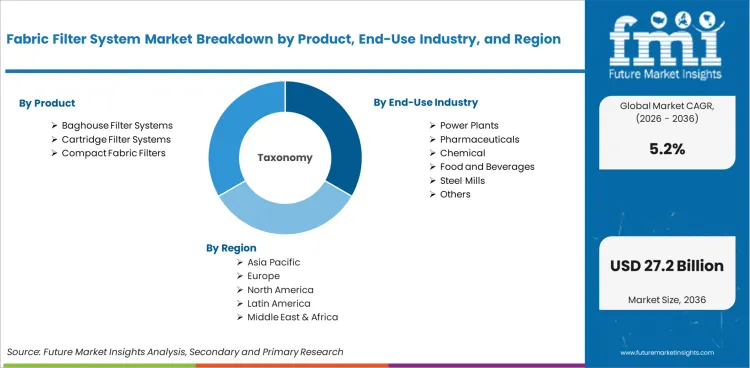
The fabric filter system market includes baghouse filter systems, cartridge filter systems, and compact fabric filters used for particulate matter removal from industrial gas streams. Products serve power plants, pharmaceuticals, chemicals, food and beverages, steel mills, cement, and mining applications.
Fabric Filter System Market Inclusions
Market scope includes baghouse filter systems, cartridge filter systems, and compact fabric filters. Revenue is tracked by product, end-use industry, technology, application, and component (hardware, software, services) from 2026 to 2036.
Fabric Filter System Market Exclusions
The scope does not include electrostatic precipitators, wet scrubbers, cyclone separators, or HVAC air filtration systems for commercial buildings.
Fabric Filter System Market Research Methodology
- Primary Research: FMI analysts interviewed fabric filter OEMs, filter media manufacturers, power plant operators and industrial emission compliance engineers in key markets.
- Desk research: Data was collated from emission regulation databases, power plant capacity statistics, industrial production data and financial disclosures of manufacturers.
- Market Sizing and Forecasting: Bottom-up aggregation from regulated industrial capacity by sector, fabric filter penetration rates, and replacement cycle timing, triangulated with OEM revenue data.
- Data Validation: Validated quarterly vs. emission compliance reporting, filter media production data, and manufacturer revenue reporting.
Why is the Fabric Filter System Market Growing?
- Under EPA MATS, EU Industrial Emissions Directive and China MEE emission standards, power plants are required to achieve particulate emissions below 20 mg/Nm3 which means installation of baghouses or conversion of existing ESPs to baghouses.
- EPA NESHAP and MATS enforcement at coal-fired power plants and industrial boilers are driving baghouse upgrade and filter media replacement. USA is the leading country with 6.4% CAGR.
- Filter bag replacement cycles of 3 to 5 years generate recurring aftermarket revenue of 40 to 50 percent of total market value, providing revenue stability beyond new installation demand.
The fabric filter system market is expanding because of stringent regulations on particulate matter (PM) emissions in the power generation, cement, metals, and chemical sectors. Fabric filters (baghouses) incorporating advanced PTFE membrane media achieve particulate removal efficiencies greater than 99.9% and stack emissions less than 5 mg/Nm3, which is better than electrostatic precipitators under many operating conditions. The need for installation and upgrade is driven by regulatory enforcement requiring sub-20 mg/Nm3 emissions at power plants and sub-10 mg/Nm3 at cement plants.
Aftermarket filter bag and cage replacement yields recurring revenue independent of new installation cycles. Filter bags in coal-fired power plant baghouses must be replaced every 3 to 5 years and a 500 MW unit contains 5,000 to 15,000 bags . This replacement cycle structurally gives an aftermarket of 40 to 50% of total market revenue. The market is anticipated to grow at a 5.2% CAGR during 2026-2036.
Market Segmentation Analysis
- Pulse-jet cleaning is the dominant baghouse type for power plant and heavy industrial applications (product segment) accounting for 65.7% of the product segment.
- In the end-use industry, 67.2% is the power plants, and the largest fabric filter systems are used in the coal-fired, biomass and waste-to-energy plants.
- The component segment is driven by hardware, including filter bags, cages, housings and cleaning mechanisms, which represent the majority of capital and aftermarket spend.
The fabric filter system market has been segmented on the basis of product, end-use industry, technology, application, and component. Each dimension reflects different operating conditions, emission requirements and filter media specifications.
Insights into the Baghouse Filter Systems Product Segment
The baghouse filter systems are projected to hold 65.7% share of the product segment by 2026. The most widely used cleaning method is the pulse-jet baghouse, which employs pulses of compressed air to dislodge the collected dust from the filter bags. Power plant baghouses contain 5,000 to 15,000 filter bags in individual compartments. Filter media include PTFE membrane, fiberglass, and PPS depending on the operating temperature and the chemical resistance needed.
The balance is made up of cartridge filter systems and compact fabric filters. Cartridge filters provide a larger filtration area per footprint for pharmaceutical, food and light industrial applications. Compact fabric filters are meant for installations with limited space.
Insights into the Power Plant End-Use Industry
Power plants hold 67.2% of end-use industry in 2026. Coal-fired power plants generate the largest particulate loading requiring fabric filtration. Emission standards (EPA MATS, EU IED, China MEE ultra-low emission) mandate sub-20 mg/Nm3 stack emissions, requiring either baghouse installation or ESP-to-baghouse conversion. Biomass and waste-to-energy facilities also require fabric filtration for particulate compliance.
The rest is made up of pharmaceuticals, chemicals, food and beverages, steel mills and other industries. The second biggest industrial application is cement plants. Fabric filters are utilized for steel mill sinter plant and blast furnace gas cleaning. Pharmaceutical containment filtration prevents cross-contamination of the product.
Fabric Filter System Market Drivers, Restraints, and Opportunities
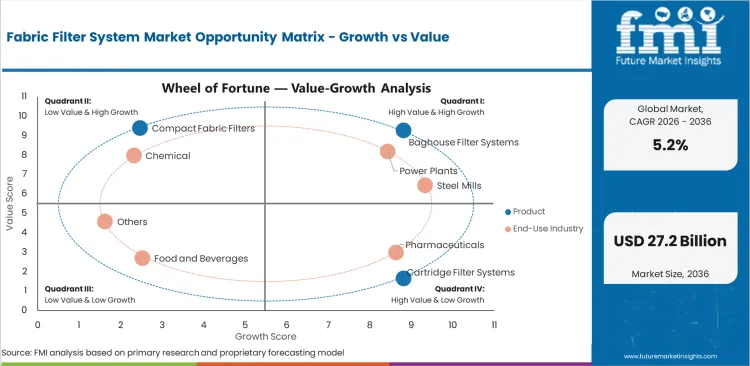
- The tightening of emission regulation establishes a mandatory demand that is insensitive to economic cycles and the compliance deadlines drive the installation timelines.
- Developed markets are seeing retirement of coal power plants reducing new baghouse installation, partially offset by continued operation in China, India and Southeast Asia.
- Advanced PTFE membrane filter media increases bag life and capture efficiency, meeting sub-5 mg/Nm3 standards with reduced replacement frequency.
The Fabric Filter System market is propelled by Emission Regulation, Industrial Production, and Filter Media Technology. Stringent standards and aftermarket replacement cycles are expected to drive growth at a CAGR of 5.2% between 2026 and 2036.
Emission Regulation Tightening
The demand is for ever stricter limits on particulate emissions. EPA MATS, EU IED BAT conclusions, China ultra-low emission standards and India CPCB norms call for sub-20 to sub-10 mg/Nm3 stack emissions at power plants and industrial facilities. Compliance driven installation and upgrade demand.
Coal Plant Transition Impact
Retirement of coal power plants in USA and Europe leads to less new baghouse installation in these markets. This decline is offset by continued coal power operation and new construction in China, India and Southeast Asia. Regardless of retirement timelines, existing plants continue to replace aftermarket bags.
Advanced Filter Media
PTFE membrane laminate filter media captures particulates down to sub-5 mg/Nm3 and extends bag life to 5 to 7 years versus 3 to 4 years for conventional media. The increased per-bag cost is offset by a reduction in replacement frequency and improved emission performance.
IoT Predictive Maintenance
When equipped with sensors that monitor differential pressure, bag condition, and emission levels, baghouses can be used to predict bag replacement and optimize cleaning. IoT monitoring reduces unplanned downtime and optimize operating costs for large multi-compartment installations.
Analysis of Fabric Filter System Market By Key Countries
.webp "Top Country Growth Comparison Fabric Filter System Market Cagr (2026 2036)")
| Country | CAGR |
|---|---|
| USA | 6.4% |
| South Korea | 6.3% |
| European Union | 6.1% |
| UK | 5.9% |
| Japan | 5.8% |
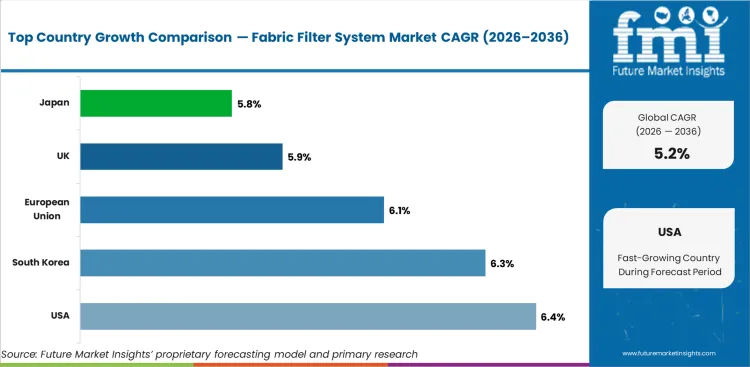
- The USA at 6.4% CAGR reflects EPA MATS and NESHAP enforcement driving baghouse upgrades at coal-fired power plants and industrial facilities.
- South Korea at 6.3% is driven by PM2.5 air quality regulations and industrial emission control requirements.
- The European Union at 6.1% reflects EU IED BAT conclusions mandating advanced particulate emission control at industrial installations.
- Japan at 5.8% is supported by strict air quality standards and replacement cycles at thermal power plants.
The global fabric filter system market is estimated at USD 16.39 billion in 2026 and is projected to expand at 5.2% CAGR from 2026 to 2036. The analysis covers key markets.
Demand Outlook for Fabric Filter System Market in the USA
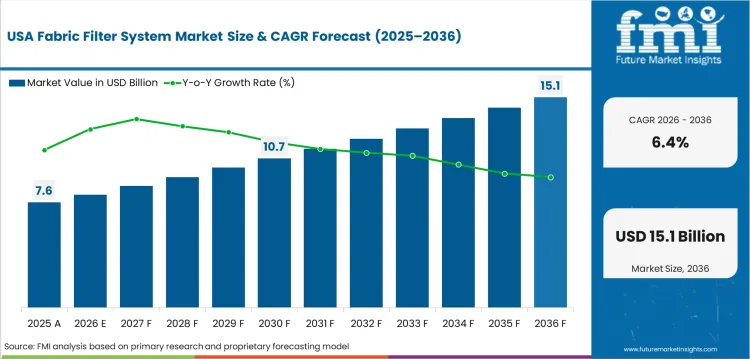
The USA is projected to expand at 6.4% CAGR through 2036. EPA MATS (Mercury and Air Toxics Standards) and NESHAP (National Emission Standards for Hazardous Air Pollutants) enforcement drives baghouse installation, upgrade, and filter media replacement at coal-fired power plants and industrial boilers. Babcock and Wilcox and Donaldson serve US utility and industrial markets.
- EPA MATS compliance at remaining US coal-fired power plants requires baghouse systems achieving sub-12 mg/Nm3 particulate emissions with mercury co-removal capability.
- Donaldson Torit industrial dust collection systems serve USA pharmaceutical, food, metals, and chemical manufacturing facilities requiring OSHA and EPA emission compliance.
- Filter bag replacement cycles at US power plants and cement facilities create aftermarket revenue of USD 2 to 5 million per major facility every 3 to 5 years.
Future Outlook for Fabric Filter System Market in South Korea
South Korea is projected to grow at 6.3% CAGR through 2036. Tightening PM2.5 air quality standards under the Special Act on Fine Dust drive industrial emission control investment. Coal-fired power plant fabric filter retrofit and cement/steel industry upgrades create structured procurement demand.
- Special Act on Fine Dust and Ministry of Environment emission standards mandate advanced particulate control at Korean coal-fired power plants and industrial facilities.
- KEPCO coal-fired power plant fabric filter retrofit and bag replacement at facilities including Dangjin, Hadong, and Taean create multi-year procurement cycles.
- Korean cement manufacturers (Ssangyong Cement, Sungshin Cement) require fabric filter upgrades to meet tightened kiln emission standards.
Opportunity Analysis of Fabric Filter System Market in the European Union
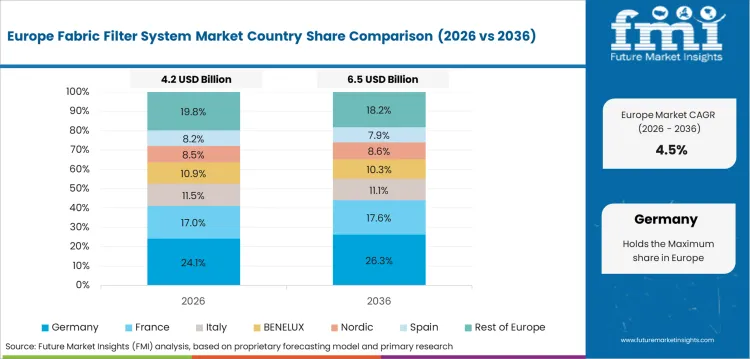
The European Union is projected to expand at 6.1% CAGR through 2036. EU Industrial Emissions Directive BAT (Best Available Techniques) conclusions mandate advanced particulate control at large combustion plants and industrial installations. EU member state implementation deadlines create compliance-driven fabric filter procurement.
- EU IED BAT conclusions for large combustion plants mandate sub-5 to sub-10 mg/Nm3 particulate emissions, requiring PTFE membrane fabric filter installation at regulated facilities.
- EU cement BAT reference document requires advanced baghouse filtration at kiln and clinker cooler exhaust, with compliance deadlines driving procurement across member states.
- Luehr Filter (Germany) and Scheuch (Austria) serve European industrial fabric filter markets with application engineering and aftermarket service capabilities.
In-depth Analysis of Fabric Filter System Market in the UK
The UK is projected to grow at 5.9% CAGR through 2036. Post-Brexit UK emission standards align with EU IED requirements through the Environmental Permitting Regulations. Waste-to-energy facility construction and industrial emission control create fabric filter demand.
- UK Environmental Permitting Regulations maintain emission standards comparable to EU IED for large combustion plants and industrial installations post-Brexit.
- Waste-to-energy facility construction at facilities including Viridor, Veolia, and Suez UK operations requires advanced fabric filtration for particulate and acid gas control.
- Filter bag replacement at existing UK power plants and industrial facilities creates recurring aftermarket demand through established filtration service providers.
Sales Analysis of Fabric Filter System Market in Japan
Japan is projected to grow at 5.8% CAGR through 2036. Strict air quality standards under the Air Pollution Control Act mandate advanced particulate emission control. Thermal power plant fabric filter replacement and industrial emission compliance at cement, steel, and chemical facilities create procurement demand.
- Air Pollution Control Act emission standards at Japanese thermal power plants mandate baghouse systems achieving sub-10 mg/Nm3 particulate emissions.
- Mitsubishi Power, IHI, and Hamon Japan provide fabric filter systems for Japanese utility and industrial air pollution control applications.
- Japanese cement and steel manufacturers (Taiheiyo Cement, Nippon Steel) maintain baghouse systems with regular filter bag replacement creating aftermarket demand.
Competitive Landscape and Strategic Positioning
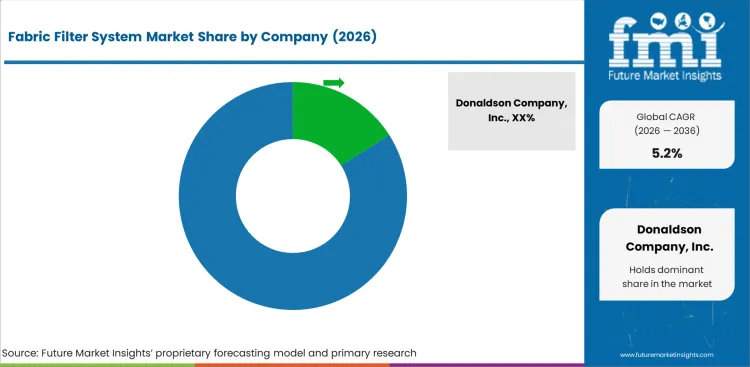
- Donaldson Company is the market leader, with 16.0% market share through Torit industrial dust collection and Donaldson Filtration Solutions for power and heavy industry.
- Thermax and Parker Hannifin compete with Babcock and Wilcox through industrial filtration and power plant emission control portfolios.
- The competitive landscape includes air pollution control OEM’s, filter media manufacturers and industrial dust collection companies.
Donaldson is the leader in industrial dust collection systems with Torit® and in Filtration Solutions for power generation and heavy industry. Ongoing revenue from aftermarket filter bag and cage replacement. We make and ship products to industrial customers around the world in all of the major markets.
Babcock and Wilcox is a provider of utility scale fabric filter systems for coal-fired power plants. Parker Hannifin Industrial Filtration Thermax (India) provides fabric filters for India’s power and industrial markets. Camfil offers solutions for the pharmaceutical and food industries.
Barriers to entry include emission control engineering capability, filter media technology partnerships, relationships with utility and industrial customers, and development of the aftermarket service network. “Strategic priorities include advanced media technology, IoT monitoring and emerging market distribution.
Key Companies in the Fabric Filter System Market
Key global companies leading the fabric filter system market include:
- Donaldson Company (USA), Babcock and Wilcox (USA), and Parker Hannifin (USA) hold leading positions through industrial and power plant fabric filter systems and aftermarket services.
- Thermax Limited (India), Camfil Group (Sweden), and FLSmidth (Denmark) maintain positions through regional industrial filtration leadership and application-specific expertise.
- Luehr Filter (Germany), Hamon Corporation (Belgium), and W.L. Gore (USA) serve specialized filter media and fabric filter application segments.
Competitive Benchmarking: Fabric Filter System Market
| Company | Power Plant Systems | Industrial Dust Collection | Filter Media | Geographic Reach |
|---|---|---|---|---|
| Donaldson Company | Strong | Leading (Torit) | Own + Partners | Global |
| Babcock and Wilcox | Leading (Utility) | Moderate | Partners | Americas, Global |
| Parker Hannifin | Moderate | Strong | Own | Global |
| Thermax Limited | Strong (India) | Strong (India) | Partners | India, Asia |
| Camfil Group | Limited | Strong (Pharma/Food) | Own | Global |
| FLSmidth | Moderate | Strong (Cement/Mining) | Partners | Global |
| Luehr Filter | Moderate | Strong (EU) | Partners | Europe |
| W.L. Gore | None (Media Only) | None (Media Only) | Leading (PTFE) | Global |
Source: Future Market Insights competitive analysis, 2026.
Key Developments in Fabric Filter System Market
- In 2025, Donaldson Company launched an IoT-connected baghouse monitoring system with real-time differential pressure, bag condition, and emission tracking for predictive maintenance at industrial and power plant installations.
- In 2025, W. L. Gore & Associates expanded its industrial filtration portfolio with PTFE membrane filter media designed for high-temperature dust collection applications in cement processing, metals, and waste-to-energy facilities.
- In 2026, Babcock & Wilcox Enterprises continued utility emission control retrofit projects for coal-fired power plants in North America, including fabric filter system upgrades using high-efficiency filter media to support tighter particulate emission compliance requirements.
Key Players in the Fabric Filter System Market
Major Global Players
- Donaldson Company, Inc.
- Babcock & Wilcox Enterprises
- Parker Hannifin Corporation
- Thermax Limited
- Camfil Group
- FLSmidth A/S
Emerging Players/Startups
- Scheuch GmbH
- CECO Environmental
- SLY Inc.
- Alstom (GE Power)
- Intensiv-Filter GmbH
Report Scope and Coverage
| Parameter | Details |
|---|---|
| Quantitative Units | USD 16.39 billion to USD 27.21 billion, at a CAGR of 5.2% |
| Market Definition | The fabric filter system market includes baghouse, cartridge, and compact fabric filters for particulate removal from industrial gas streams in power, cement, metals, and manufacturing. |
| Regions Covered | North America, Latin America, Europe, East Asia, South Asia and Pacific, Middle East and Africa |
| Countries Covered | USA, South Korea, European Union, UK, Japan, 30 plus countries |
| Key Companies Profiled | Donaldson Company, Inc., Babcock & Wilcox Enterprises, Parker Hannifin Corporation, Thermax Limited, Camfil Group, FLSmidth A/S, Luehr Filter GmbH, Hamon Corporation, Filter Concept Pvt. Ltd., W.L. Gore & Associates |
| Forecast Period | 2026 to 2036 |
| Approach | Hybrid bottom-up methodology using regulated industrial capacity, fabric filter penetration, and replacement cycles, triangulated with OEM revenue and filter media production data. |
Segmentation
Fabric Filter System Market Segmented by Product:
- Baghouse Filter Systems
- Pulse Jet Bag Filters
- Reverse Air Bag Filters
- Shaker Bag Filters
- Cartridge Filter Systems
- Pleated Cartridge Filters
- High Efficiency Cartridge Filters
- Compact Fabric Filters
- Modular Filter Units
- Portable Filter Systems
Fabric Filter System Market Segmented by End-Use Industry:
- Power Plants
- Pharmaceuticals
- Chemical
- Food and Beverages
- Steel Mills
- Others
Fabric Filter System Market Segmented by Technology:
- Filtration Technology
- Surface Filtration
- Depth Filtration
- Cleaning Technology
- Pulse Jet Cleaning
- Mechanical Shaking
- Material Technology
- High Temperature Resistant Materials
- Chemical Resistant Fabrics
- Automation Technology
- Smart Monitoring Systems
- Remote Control Systems
Fabric Filter System Market Segmented by Application:
- Power Generation
- Coal Fired Power Plants
- Biomass Power Plants
- Cement Industry
- Clinker Production
- Grinding Units
- Metal and Mining
- Smelting Operations
- Dust Collection
- Chemical Industry
- Process Emissions Control
- Air Pollution Control
- Food and Beverage
- Powder Handling
- Dust Filtration
Fabric Filter System Market Segmented by Component:
- Hardware
- Filter Media
- Woven Fabrics
- Non Woven Fabrics
- Filter Bags and Cartridges
- Standard Filter Bags
- High Temperature Filter Bags
- Housing and Structure
- Steel Casings
- Support Frames
- Air Handling Systems
- Fans and Blowers
- Ducting Systems
- Filter Media
- Software
- Emission Monitoring Software
- Process Control Systems
- Services
- Installation and Commissioning
- Maintenance and Replacement
- Consulting Services
Fabric Filter System Market by Region:
- North America
- USA
- Canada
- Mexico
- Latin America
- Brazil
- Chile
- Rest of Latin America
- Western Europe
- Germany
- UK
- Italy
- Spain
- France
- Nordic
- BENELUX
- Rest of Western Europe
- Eastern Europe
- Russia
- Poland
- Hungary
- Balkan & Baltic
- Rest of Eastern Europe
- East Asia
- China
- Japan
- South Korea
- South Asia and Pacific
- India
- ASEAN
- Australia & New Zealand
- Rest of South Asia and Pacific
- Middle East & Africa
- Kingdom of Saudi Arabia
- Other GCC Countries
- Turkiye
- South Africa
- Other African Union
- Rest of Middle East & Africa
Research Sources and Bibliography
- 1. USA Environmental Protection Agency. (2025). EPA MATS and NESHAP Emission Standards. EPA.
- 2. European Commission. (2025). EU Industrial Emissions Directive BAT Conclusions. EC.
- 3. International Energy Agency. (2025). IEA Coal-Fired Power Plant Database. IEA.
- 4. World Health Organization. (2025). WHO Air Quality Guidelines. WHO.
- 5. World Bank. (2025). World Bank Environmental Regulation and Industrial Emissions Data. World Bank.
This bibliography is provided for reader reference. The full Future Market Insights report contains the complete reference list with publication dates, URLs, and supporting data for all cited works.
This Report Answers
- Estimating the size of the fabric filter system market and revenue projections from 2026 to 2036.
- Segmentation by product, end-use industry, technology, application, and component.
- Insights across key regional markets.
- Analysis of power plant versus industrial and pharmaceutical demand dynamics.
- Assessment of the competitive landscape across air pollution control OEMs and filter media manufacturers.
- Identification of investment opportunities in advanced media, IoT monitoring, and emerging market compliance.
- Emission regulation tracking and compliance timeline analysis.
- Delivery of data in PDF and Excel formats.
Frequently Asked Questions
What is the global market demand for Fabric Filter Systems in 2026?
In 2026, the global fabric filter system market is estimated at USD 16.39 billion.
How big will the Fabric Filter System Market be in 2036?
By 2036, the market is projected to reach USD 27.21 billion.
How much is demand for the Fabric Filter System Market expected to grow between 2026 and 2036?
Between 2026 and 2036, the market is projected to expand at a CAGR of 5.2%.
Which product is expected to lead in the Fabric Filter System Market in 2026?
Baghouse filter systems are expected to hold 65.7% in 2026, with pulse-jet cleaning for power plant and cement applications.
What is causing demand to rise in the USA?
The USA is expected to grow at 6.4% CAGR through 2036, driven by EPA MATS and NESHAP enforcement at coal power plants and industrial facilities.
What is causing demand to rise in South Korea?
South Korea is expected to grow at 6.3% CAGR through 2036, supported by PM2.5 air quality standards and industrial emission regulations.
What does this report mean by Fabric Filter System Market definition?
The market includes baghouse, cartridge, and compact fabric filters for particulate removal from industrial gas streams in power and manufacturing.
How does FMI make the Fabric Filter System Market forecast and validate it?
Forecasting uses hybrid methodology with regulated industrial capacity and filter replacement cycles, validated against OEM revenue and emission compliance data.
Preview the report firsthand - request a free sample
Get SampleGet the brochure for pricing and purchase details.
Get PDFTable of Content
- Executive Summary
- Global Market Outlook
- Demand-side Trends
- Supply-side Trends
- Technology Roadmap Analysis
- Analysis and Recommendations
- Market Overview
- Market Coverage / Taxonomy
- Market Definition / Scope / Limitations
- Research Methodology
- Chapter Orientation
- Analytical Lens and Working Hypotheses
- Market Structure, Signals, and Trend Drivers
- Benchmarking and Cross-market Comparability
- Market Sizing, Forecasting, and Opportunity Mapping
- Research Design and Evidence Framework
- Desk Research Programme (Secondary Evidence)
- Company Annual and Sustainability Reports
- Peer-reviewed Journals and Academic Literature
- Corporate Websites, Product Literature, and Technical Notes
- Earnings Decks and Investor Briefings
- Statutory Filings and Regulatory Disclosures
- Technical White Papers and Standards Notes
- Trade Journals, Industry Magazines, and Analyst Briefs
- Conference Proceedings, Webinars, and Seminar Materials
- Government Statistics Portals and Public Data Releases
- Press Releases and Reputable Media Coverage
- Specialist Newsletters and Curated Briefings
- Sector Databases and Reference Repositories
- FMI Internal Proprietary Databases and Historical Market Datasets
- Subscription Datasets and Paid Sources
- Social Channels, Communities, and Digital Listening Inputs
- Additional Desk Sources
- Expert Input and Fieldwork (Primary Evidence)
- Primary Modes
- Qualitative Interviews and Expert Elicitation
- Quantitative Surveys and Structured Data Capture
- Blended Approach
- Why Primary Evidence is Used
- Field Techniques
- Interviews
- Surveys
- Focus Groups
- Observational and In-context Research
- Social and Community Interactions
- Stakeholder Universe Engaged
- C-suite Leaders
- Board Members
- Presidents and Vice Presidents
- R&D and Innovation Heads
- Technical Specialists
- Domain Subject-matter Experts
- Scientists
- Physicians and Other Healthcare Professionals
- Governance, Ethics, and Data Stewardship
- Research Ethics
- Data Integrity and Handling
- Primary Modes
- Tooling, Models, and Reference Databases
- Desk Research Programme (Secondary Evidence)
- Data Engineering and Model Build
- Data Acquisition and Ingestion
- Cleaning, Normalisation, and Verification
- Synthesis, Triangulation, and Analysis
- Quality Assurance and Audit Trail
- Market Background
- Market Dynamics
- Drivers
- Restraints
- Opportunity
- Trends
- Scenario Forecast
- Demand in Optimistic Scenario
- Demand in Likely Scenario
- Demand in Conservative Scenario
- Opportunity Map Analysis
- Product Life Cycle Analysis
- Supply Chain Analysis
- Investment Feasibility Matrix
- Value Chain Analysis
- PESTLE and Porter’s Analysis
- Regulatory Landscape
- Regional Parent Market Outlook
- Production and Consumption Statistics
- Import and Export Statistics
- Market Dynamics
- Global Market Analysis 2021 to 2025 and Forecast, 2026 to 2036
- Historical Market Size Value (USD Million) Analysis, 2021 to 2025
- Current and Future Market Size Value (USD Million) Projections, 2026 to 2036
- Y-o-Y Growth Trend Analysis
- Absolute $ Opportunity Analysis
- Global Market Pricing Analysis 2021 to 2025 and Forecast 2026 to 2036
- Global Market Analysis 2021 to 2025 and Forecast 2026 to 2036, By Product
- Introduction / Key Findings
- Historical Market Size Value (USD Million) Analysis By Product , 2021 to 2025
- Current and Future Market Size Value (USD Million) Analysis and Forecast By Product , 2026 to 2036
- Baghouse Filter Systems
- Pulse Jet Bag Filters
- Reverse Air Bag Filters
- Shaker Bag Filters
- Cartridge Filter Systems
- Pleated Cartridge Filters
- High Efficiency Cartridge Filters
- Compact Fabric Filters
- Modular Filter Value (USD Million)s
- Portable Filter Systems
- Baghouse Filter Systems
- Y-o-Y Growth Trend Analysis By Product , 2021 to 2025
- Absolute $ Opportunity Analysis By Product , 2026 to 2036
- Global Market Analysis 2021 to 2025 and Forecast 2026 to 2036, By End-Use Industry
- Introduction / Key Findings
- Historical Market Size Value (USD Million) Analysis By End-Use Industry, 2021 to 2025
- Current and Future Market Size Value (USD Million) Analysis and Forecast By End-Use Industry, 2026 to 2036
- Power Plants
- Pharmaceuticals
- Chemical
- Food and Beverages
- Steel Mills
- Others
- Power Plants
- Y-o-Y Growth Trend Analysis By End-Use Industry, 2021 to 2025
- Absolute $ Opportunity Analysis By End-Use Industry, 2026 to 2036
- Global Market Analysis 2021 to 2025 and Forecast 2026 to 2036, By Technology
- Introduction / Key Findings
- Historical Market Size Value (USD Million) Analysis By Technology, 2021 to 2025
- Current and Future Market Size Value (USD Million) Analysis and Forecast By Technology, 2026 to 2036
- Filtration Technology
- Surface Filtration
- Depth Filtration
- Cleaning Technology
- Pulse Jet Cleaning
- Mechanical Shaking
- Material Technology
- High Temperature Resistant Materials
- Chemical Resistant Fabrics
- Automation Technology
- Smart Monitoring Systems
- Remote Control Systems
- Filtration Technology
- Y-o-Y Growth Trend Analysis By Technology, 2021 to 2025
- Absolute $ Opportunity Analysis By Technology, 2026 to 2036
- Global Market Analysis 2021 to 2025 and Forecast 2026 to 2036, By Application
- Introduction / Key Findings
- Historical Market Size Value (USD Million) Analysis By Application, 2021 to 2025
- Current and Future Market Size Value (USD Million) Analysis and Forecast By Application, 2026 to 2036
- Power Generation
- Coal Fired Power Plants
- Biomass Power Plants
- Cement Industry
- Clinker Production
- Grinding Value (USD Million)s
- Metal and Mining
- Smelting Operations
- Dust Collection
- Chemical Industry
- Process Emissions Control
- Air Pollution Control
- Food and Beverage
- Powder Handling
- Dust Filtration
- Power Generation
- Y-o-Y Growth Trend Analysis By Application, 2021 to 2025
- Absolute $ Opportunity Analysis By Application, 2026 to 2036
- Global Market Analysis 2021 to 2025 and Forecast 2026 to 2036, By Component
- Introduction / Key Findings
- Historical Market Size Value (USD Million) Analysis By Component, 2021 to 2025
- Current and Future Market Size Value (USD Million) Analysis and Forecast By Component, 2026 to 2036
- Hardware
- Filter Media
- Woven Fabrics
- Non Woven Fabrics
- Filter Bags and Cartridges
- Standard Filter Bags
- High Temperature Filter Bags
- Housing and Structure
- Steel Casings
- Support Frames
- Air Handling Systems
- Software
- Emission Monitoring Software
- Process Control Systems
- Services
- Installation and Commissioning
- Maintenance and Replacement
- Consulting Services
- Hardware
- Y-o-Y Growth Trend Analysis By Component, 2021 to 2025
- Absolute $ Opportunity Analysis By Component, 2026 to 2036
- Global Market Analysis 2021 to 2025 and Forecast 2026 to 2036, By Region
- Introduction
- Historical Market Size Value (USD Million) Analysis By Region, 2021 to 2025
- Current Market Size Value (USD Million) Analysis and Forecast By Region, 2026 to 2036
- North America
- Latin America
- Western Europe
- Eastern Europe
- East Asia
- South Asia and Pacific
- Middle East & Africa
- Market Attractiveness Analysis By Region
- North America Market Analysis 2021 to 2025 and Forecast 2026 to 2036, By Country
- Historical Market Size Value (USD Million) Trend Analysis By Market Taxonomy, 2021 to 2025
- Market Size Value (USD Million) Forecast By Market Taxonomy, 2026 to 2036
- By Country
- USA
- Canada
- Mexico
- By Product
- By End-Use Industry
- By Technology
- By Application
- By Component
- By Country
- Market Attractiveness Analysis
- By Country
- By Product
- By End-Use Industry
- By Technology
- By Application
- By Component
- Key Takeaways
- Latin America Market Analysis 2021 to 2025 and Forecast 2026 to 2036, By Country
- Historical Market Size Value (USD Million) Trend Analysis By Market Taxonomy, 2021 to 2025
- Market Size Value (USD Million) Forecast By Market Taxonomy, 2026 to 2036
- By Country
- Brazil
- Chile
- Rest of Latin America
- By Product
- By End-Use Industry
- By Technology
- By Application
- By Component
- By Country
- Market Attractiveness Analysis
- By Country
- By Product
- By End-Use Industry
- By Technology
- By Application
- By Component
- Key Takeaways
- Western Europe Market Analysis 2021 to 2025 and Forecast 2026 to 2036, By Country
- Historical Market Size Value (USD Million) Trend Analysis By Market Taxonomy, 2021 to 2025
- Market Size Value (USD Million) Forecast By Market Taxonomy, 2026 to 2036
- By Country
- Germany
- UK
- Italy
- Spain
- France
- Nordic
- BENELUX
- Rest of Western Europe
- By Product
- By End-Use Industry
- By Technology
- By Application
- By Component
- By Country
- Market Attractiveness Analysis
- By Country
- By Product
- By End-Use Industry
- By Technology
- By Application
- By Component
- Key Takeaways
- Eastern Europe Market Analysis 2021 to 2025 and Forecast 2026 to 2036, By Country
- Historical Market Size Value (USD Million) Trend Analysis By Market Taxonomy, 2021 to 2025
- Market Size Value (USD Million) Forecast By Market Taxonomy, 2026 to 2036
- By Country
- Russia
- Poland
- Hungary
- Balkan & Baltic
- Rest of Eastern Europe
- By Product
- By End-Use Industry
- By Technology
- By Application
- By Component
- By Country
- Market Attractiveness Analysis
- By Country
- By Product
- By End-Use Industry
- By Technology
- By Application
- By Component
- Key Takeaways
- East Asia Market Analysis 2021 to 2025 and Forecast 2026 to 2036, By Country
- Historical Market Size Value (USD Million) Trend Analysis By Market Taxonomy, 2021 to 2025
- Market Size Value (USD Million) Forecast By Market Taxonomy, 2026 to 2036
- By Country
- China
- Japan
- South Korea
- By Product
- By End-Use Industry
- By Technology
- By Application
- By Component
- By Country
- Market Attractiveness Analysis
- By Country
- By Product
- By End-Use Industry
- By Technology
- By Application
- By Component
- Key Takeaways
- South Asia and Pacific Market Analysis 2021 to 2025 and Forecast 2026 to 2036, By Country
- Historical Market Size Value (USD Million) Trend Analysis By Market Taxonomy, 2021 to 2025
- Market Size Value (USD Million) Forecast By Market Taxonomy, 2026 to 2036
- By Country
- India
- ASEAN
- Australia & New Zealand
- Rest of South Asia and Pacific
- By Product
- By End-Use Industry
- By Technology
- By Application
- By Component
- By Country
- Market Attractiveness Analysis
- By Country
- By Product
- By End-Use Industry
- By Technology
- By Application
- By Component
- Key Takeaways
- Middle East & Africa Market Analysis 2021 to 2025 and Forecast 2026 to 2036, By Country
- Historical Market Size Value (USD Million) Trend Analysis By Market Taxonomy, 2021 to 2025
- Market Size Value (USD Million) Forecast By Market Taxonomy, 2026 to 2036
- By Country
- Kingdom of Saudi Arabia
- Other GCC Countries
- Turkiye
- South Africa
- Other African Union
- Rest of Middle East & Africa
- By Product
- By End-Use Industry
- By Technology
- By Application
- By Component
- By Country
- Market Attractiveness Analysis
- By Country
- By Product
- By End-Use Industry
- By Technology
- By Application
- By Component
- Key Takeaways
- Key Countries Market Analysis
- USA
- Pricing Analysis
- Market Share Analysis, 2025
- By Product
- By End-Use Industry
- By Technology
- By Application
- By Component
- Canada
- Pricing Analysis
- Market Share Analysis, 2025
- By Product
- By End-Use Industry
- By Technology
- By Application
- By Component
- Mexico
- Pricing Analysis
- Market Share Analysis, 2025
- By Product
- By End-Use Industry
- By Technology
- By Application
- By Component
- Brazil
- Pricing Analysis
- Market Share Analysis, 2025
- By Product
- By End-Use Industry
- By Technology
- By Application
- By Component
- Chile
- Pricing Analysis
- Market Share Analysis, 2025
- By Product
- By End-Use Industry
- By Technology
- By Application
- By Component
- Germany
- Pricing Analysis
- Market Share Analysis, 2025
- By Product
- By End-Use Industry
- By Technology
- By Application
- By Component
- UK
- Pricing Analysis
- Market Share Analysis, 2025
- By Product
- By End-Use Industry
- By Technology
- By Application
- By Component
- Italy
- Pricing Analysis
- Market Share Analysis, 2025
- By Product
- By End-Use Industry
- By Technology
- By Application
- By Component
- Spain
- Pricing Analysis
- Market Share Analysis, 2025
- By Product
- By End-Use Industry
- By Technology
- By Application
- By Component
- France
- Pricing Analysis
- Market Share Analysis, 2025
- By Product
- By End-Use Industry
- By Technology
- By Application
- By Component
- India
- Pricing Analysis
- Market Share Analysis, 2025
- By Product
- By End-Use Industry
- By Technology
- By Application
- By Component
- ASEAN
- Pricing Analysis
- Market Share Analysis, 2025
- By Product
- By End-Use Industry
- By Technology
- By Application
- By Component
- Australia & New Zealand
- Pricing Analysis
- Market Share Analysis, 2025
- By Product
- By End-Use Industry
- By Technology
- By Application
- By Component
- China
- Pricing Analysis
- Market Share Analysis, 2025
- By Product
- By End-Use Industry
- By Technology
- By Application
- By Component
- Japan
- Pricing Analysis
- Market Share Analysis, 2025
- By Product
- By End-Use Industry
- By Technology
- By Application
- By Component
- South Korea
- Pricing Analysis
- Market Share Analysis, 2025
- By Product
- By End-Use Industry
- By Technology
- By Application
- By Component
- Russia
- Pricing Analysis
- Market Share Analysis, 2025
- By Product
- By End-Use Industry
- By Technology
- By Application
- By Component
- Poland
- Pricing Analysis
- Market Share Analysis, 2025
- By Product
- By End-Use Industry
- By Technology
- By Application
- By Component
- Hungary
- Pricing Analysis
- Market Share Analysis, 2025
- By Product
- By End-Use Industry
- By Technology
- By Application
- By Component
- Kingdom of Saudi Arabia
- Pricing Analysis
- Market Share Analysis, 2025
- By Product
- By End-Use Industry
- By Technology
- By Application
- By Component
- Turkiye
- Pricing Analysis
- Market Share Analysis, 2025
- By Product
- By End-Use Industry
- By Technology
- By Application
- By Component
- South Africa
- Pricing Analysis
- Market Share Analysis, 2025
- By Product
- By End-Use Industry
- By Technology
- By Application
- By Component
- USA
- Market Structure Analysis
- Competition Dashboard
- Competition Benchmarking
- Market Share Analysis of Top Players
- By Regional
- By Product
- By End-Use Industry
- By Technology
- By Application
- By Component
- Competition Analysis
- Competition Deep Dive
- Donaldson Company, Inc.
- Overview
- Product Portfolio
- Profitability by Market Segments (Product/Age /Sales Channel/Region)
- Sales Footprint
- Strategy Overview
- Marketing Strategy
- Product Strategy
- Channel Strategy
- Babcock & Wilcox Enterprises
- Parker Hannifin Corporation
- Thermax Limited
- Camfil Group
- FLSmidth A/S
- Luehr Filter GmbH
- Hamon Corporation
- Filter Concept Pvt. Ltd.
- W.L. Gore & Associates
- Donaldson Company, Inc.
- Competition Deep Dive
- Assumptions & Acronyms Used


