

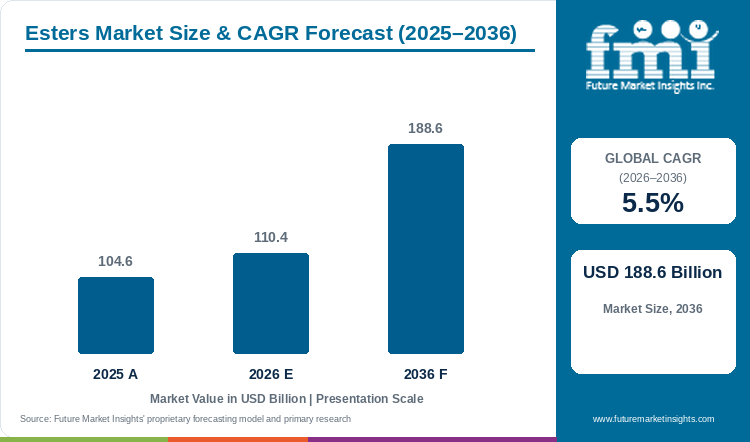
- Market Size (2026)
- USD 110.4 Bn
- Forecast (2036)
- USD 188.6 Bn
- CAGR (2026 to 2036)
- 5.5%
How big is Esters Market in 2026?
The esters market is estimated at USD 104.6 billion in 2025 and is expected to reach USD 110.4 billion in 2026. A 5.5% CAGR is forecast to bring the market to USD 188.6 billion by 2036.
Sales of esters, estimated near USD 104.6 billion for 2025, are projected at USD 110.4 billion in 2026, and the FMI outlook gives a 5.5% CAGR that is likely to carry sales to USD 188.6 billion by 2036. PVC compounders and lubricant blenders are likely to adopt first, since each faces a rule or a performance limit that an ester grade solves. The EPA published final findings on 6 January 2026 that five phthalates, including DEHP and DBP, present an unreasonable risk to human health under certain conditions of use.[1] Risk management rules for those five will follow, so flooring, cable and film makers will move more flexible PVC grades to non-phthalate ester plasticizers.
Competition is consolidating among the large European producers. BASF confirmed on 25 September 2026 exploratory talks with RAG-Stiftung and Evonik Industries about a possible takeover of Evonik and said the outcome remains open.[2] A combined German group would supply lubricant additives, oil additives and plasticizer intermediates from one portfolio, leaving lubricant and coatings buyers fewer large suppliers to bid against each other. Mid-sized oleochemical producers such as KLK OLEO, Emery Oleochemicals and Oleon face the tightest squeeze, since fatty acid esters from those firms compete on price against integrated rivals.
Key Market Trends & Insights
- Methyl esters, at an estimated 18%, rank behind fatty acid esters, which are expected to hold 24% of 2026 product sales.
- Lubricant uses are projected to absorb 22% of 2026 application sales, two points more than plasticizers at an estimated 20%. BASF reported lower 2025 sales volumes in lubricant solutions within the Performance Chemicals division.[3]
- Petrochemical routes give synthetic esters an estimated 46% of 2026 source sales, against 28% for natural and 26% for bio-based esters. Emery Oleochemicals is developing a 100% biobased plasticizer for polyamide under the EDENOL brand.[4]
- Almost three-quarters of 2026 form sales, an expected 72%, will come from liquid esters, as most lubricant, solvent and plasticizer grades ship as low-viscosity fluids.
Regional Highlights
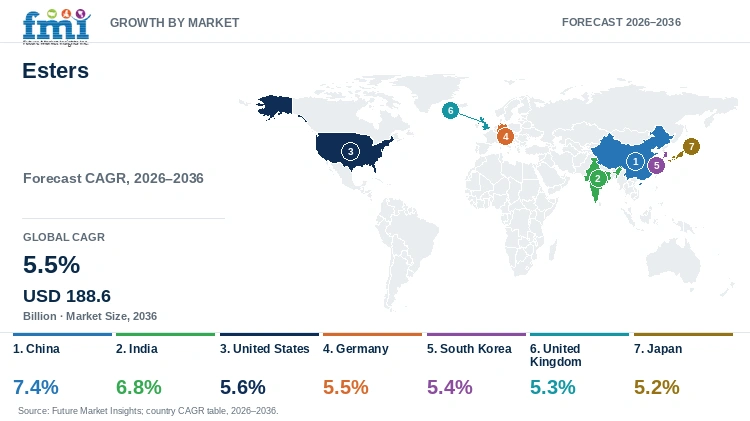
- China, at 7.4%, leads the seven countries in FMI's model, helped by a large home manufacturing base.
- India is second at 6.8% on lubricant blending. The other five stay within 0.4 points of the 5.5% market rate, from the United States at 5.6% down to Japan at 5.2%.
- Lubricant volume at Gulf Oil Lubricants India rose 17% for April to June 2026.[5]
Market Size & Forecast
Table 1: Market Size and Forecast for the Esters Market (USD billion and percentage), 2025 to 2036
| Metric | Value |
|---|---|
| 2025 Market Size | USD 104.6 billion |
| Estimated Market Size in 2026 | USD 110.4 billion |
| Projected Market Size by 2036 | USD 188.6 billion |
| CAGR, 2026 to 2036 | 5.5% |
| Added Revenue, 2026 to 2036 | USD 78.2 billion |
| Market Expansion Multiple | 1.7x |
Ester orders move with the paint, PVC and lubricant formulation cycles of large buyers. Higher price and volume in acrylic monomers and architectural coatings drove growth across all regions for Dow Coatings & Performance Monomers in Q2 2026.[6] Acrylic esters are the monomers behind water-based binders, and the acrylic emulsions market is projected to rise at a 7.7% CAGR, which supports steady orders for butyl and ethylhexyl acrylate. In FMI's numbers, ester sales are expected to gain USD 78.2 billion by 2036, which leaves the market roughly 70% larger than in 2026. Construction weakness poses the biggest risk, and Eastman cited weak North American building and construction demand, along with 5% lower selling prices, for a 10% drop in 2025 Chemical Intermediates sales.[7]
Phthalate Rules, Bio-Based Grades and Consolidation
Plasticizer rules on both sides of the Atlantic are pushing PVC formulators toward ester alternatives. ECHA opened a public consultation on a French proposal for harmonised classification of C4 to C6 ortho-phthalates on 28 January 2026, European Plasticisers reported.[8] The EPA found unreasonable risk for BBP, DBP, DCHP, DEHP and DIBP under certain conditions of use and will now begin TSCA risk management rulemakings.[1] Compounders in Europe and the United States will qualify adipate, terephthalate and bio-based ester grades before the rules take effect.
Oleochemical producers are answering with bio-based esters for new polymers. Emery Oleochemicals is testing a replacement for BBSA in polyamide with 100% biobased carbon content and no chemical hazard labelling.[4] Lower volumes in lubricant solutions cut BASF Performance Chemicals sales by 7.8% in 2025, to EUR 3,794 million.[3] Large producers are reviewing portfolios, and mid-sized oleochemical firms will gain polymer and lubricant work through bio-based grades.
Table 2: Rule, Product and Producer Indicators for the Esters Market (values, dates and growth), 2025 to 2026
| Indicator | Data Point | Relevance | Source |
|---|---|---|---|
| EPA final risk evaluations, January 2026 | Five phthalates with unreasonable risk | PVC makers prepare to switch to ester plasticizers. | [1] |
| ECHA consultation on C4 to C6 ortho-phthalates | Opened 28 January 2026 | EU plasticizer rules are tightening. | [8] |
| Dow Performance Materials & Coatings, Q2 2026 | USD 2,361 million; up 11% | Acrylic monomer orders are rising. | [6] |
| BASF Performance Chemicals, 2025 | EUR 3,794 million; down 7.8% | Lubricant solution volumes fell. | [3] |
| Eastman Chemical Intermediates, 2025 | Sales down 10% | Construction-linked chemicals are weak. | [7] |
| Gulf Oil Lubricants India, Q1 FY27 | Lubricant volume up 17% | Indian lubricant blending is expanding. | [5] |
Analyst Perspective
“I expect ester plasticizers to take the most new volume through 2036, because phthalate rules in the United States and Europe now have firm dates for evaluation and classification. Producers with qualified adipate, terephthalate and bio-based grades in flooring and cable will gain the switch orders first.”
- Nikhil Kaitwade, Principal Consultant, Future Market Insights.
How is the esters market segmented?
The market is segmented into product, application, source, form, and region. Fatty acid esters are expected to lead product sales with 24% share in 2026, and lubricants are projected to lead applications with 22%.
By product: fatty acid esters, dibasic esters, polyol esters, methyl esters, nitrate esters, vinyl esters, phosphate esters, acrylic esters, and sucrose esters.
By application: lubricants, solvents, plasticizers, fuel and oil additives, flame retardants, insecticides, and explosives.
By source: natural esters, synthetic esters, and bio-based esters.
By form: liquid esters, powder esters, and gel esters.
By region: North America, Latin America, Western Europe, Eastern Europe, East Asia, South Asia and Pacific, and Middle East and Africa.
Why do fatty acid esters lead ester sales by product?
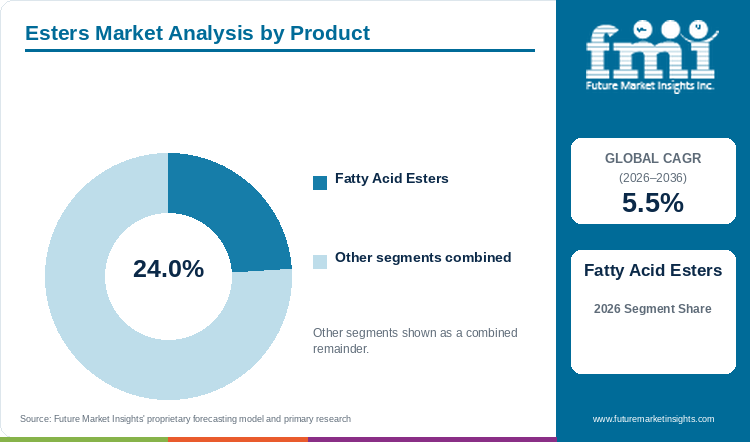
Fatty acid esters are expected to lead product sales with 24% share in 2026, with methyl esters at an estimated 18% and acrylic esters at about 15%.
Table 3: Product Share for the Esters Market (percentage share), 2026
| Product | Estimated Share (2026) |
|---|---|
| Fatty Acid Esters | 24% |
| Methyl Esters | 18% |
| Acrylic Esters | 15% |
| Polyol Esters | 10% |
| Phosphate Esters | 8% |
| Dibasic Esters | 7% |
| Vinyl Esters | 7% |
| Nitrate Esters | 6% |
| Sucrose Esters | 5% |
| Total | 100.0% |
Table 4: Product Leadership and Market Growth for the Esters Market (segment and CAGR percentage), 2026 to 2036
| Metric | Value |
|---|---|
| Global CAGR (2026 to 2036) | 5.5% |
| Leading Segment | Fatty Acid Esters |
Fatty acid esters will lead with 24% share in 2026, as detergent makers, lubricant blenders and cosmetic formulators all buy them, and the fatty esters market is forecast to expand at a CAGR of 4.4%. Methyl esters, an estimated 18%, go mostly into biodiesel, so orders rise and fall with fuel blending rules. Acrylic esters, about 15%, are monomers for paints and adhesives, and coatings cycles set the volume. Polyol esters, near 10%, serve jet engine oils and refrigeration compressors at high prices and low tonnage. Phosphate esters, around 8%, sell as flame retardants and fire-resistant hydraulic fluids. Dibasic and vinyl esters, about 7% each, cover low-VOC solvents and corrosion-resistant resins, and nitrate esters, near 6%, and sucrose esters, about 5%, stay in explosives, drugs and food emulsifiers. Acrylic monomer price and volume both rose at Dow in the June quarter.[6] A formulator needing one ester for many products will choose a fatty acid ester, and a specialist need goes to the smaller groups.
- Biodegradable lubricant base stocks and surfactant intermediates for soaps and detergents make up the fatty acid ester group.
- In May 2026, Emery Oleochemicals said final application testing of the BBSA replacement was under way in the company application laboratory.[4]
Why do lubricants lead ester sales by application?
Lubricants are projected to lead with 22% of application sales in 2026, with plasticizers at an estimated 20%.
Table 5: Application Share for the Esters Market (percentage share), 2026
| Application | Estimated Share (2026) |
|---|---|
| Lubricants | 22% |
| Plasticizers | 20% |
| Solvents | 18% |
| Fuel and Oil Additives | 17% |
| Flame Retardants | 9% |
| Insecticides | 7% |
| Explosives | 7% |
| Total | 100.0% |
Lubricants are projected to lead with 22% share in 2026, since blenders pay for heat stability. Synthetic and biodegradable ester base stocks hold viscosity at high temperature, so engine, compressor and hydraulic oil blenders pay for them in demanding grades. Plasticizers, an estimated 20%, are close behind and gain from phthalate rules, and the plastic additives market is expected to grow at a 4.2% CAGR. Solvents, about 18%, face pressure from water-based coatings. Fuel and oil additives, near 17%, follow blending rules and engine oil specifications. Flame retardants, near 9%, and insecticides and explosives, about 7% each, serve narrow buyer groups. Gulf Oil Lubricants India reported strong double-digit growth in industrial, infrastructure and mining lubricants for April to June 2026.[5] An oil blender comparing an ester with a mineral base will pay for the ester only in heat-stressed or biodegradable grades.
- Industrial machinery oils and automotive engine oils form the two lubricant groups.
- BASF reported lower 2025 sales volumes in lubricant solutions, along with antioxidants and light stabilizers.[3]
What keeps synthetic esters ahead by source?
Synthetic esters are estimated to lead source sales with 46% share in 2026, ahead of natural esters at 28%.
Table 6: Source Share for the Esters Market (percentage share), 2026
| Source | Estimated Share (2026) |
|---|---|
| Synthetic Esters | 46% |
| Natural Esters | 28% |
| Bio-Based Esters | 26% |
| Total | 100.0% |
Synthetic esters are estimated to lead with 46% share in 2026, because acrylates, plasticizers and polyol lubricant esters are made from petrochemical alcohols and acids at large scale. Natural esters, at 28%, come from vegetable oils and animal fats, and price swings in palm and soybean oil move the cost. Bio-based esters, about 26%, use plant-sourced alcohols and acids and sell at a premium to buyers with renewable carbon targets. The epoxidized soybean oil market is likely to grow at a 5.6% CAGR, which shows PVC makers paying for plant-based plasticizers. Emery Oleochemicals said the planned EDENOL plasticizer will need no chemical hazard labelling.[4] A compounder meeting a price target will buy a synthetic ester, and a brand with a renewable carbon claim will pay for the bio-based grade.
- Chemically synthesized and specialty synthetic grades make up the synthetic group.
- In January 2026, Eastman expected earnings in Chemical Intermediates to improve on far fewer shutdowns and modest North American growth.[7]
Which form leads ester sales?
Liquid esters are likely to lead form sales with 72% share in 2026, with powder esters at an estimated 18%.
Table 7: Form Share for the Esters Market (percentage share), 2026
| Form | Estimated Share (2026) |
|---|---|
| Liquid Esters | 72% |
| Powder Esters | 18% |
| Gel Esters | 10% |
| Total | 100.0% |
Liquid esters will lead with 72% share in 2026, as lubricants, solvents, plasticizers and acrylic monomers move by tank truck and pipe into blending vessels. Powder esters, an estimated 18%, include sucrose and some fatty esters for food, cosmetics and PVC dry blends. Gel esters, about 10%, serve thickened industrial and cosmetic formulas. Architectural coatings and acrylic monomers both grew at Dow over April to June 2026.[6] Bulk liquid handling keeps the cost per tonne lowest, so high-volume buyers will stay with liquids.
- Low-viscosity and high-purity liquids form the liquid ester group.
- Performance Materials & Coatings sales at Dow came to USD 2,361 million in Q2 2026, an 11% increase on Q2 2025.[6]
What are the drivers, restraints, and opportunities in the esters market?
Phthalate rules and heat-stable lubricant grades push buyers toward esters, and feedstock price swings squeeze producer margins. Bio-based esters for polymers and lubricants open new buyers.
- Driver: Tighter phthalate rules in the United States and Europe push PVC compounders to qualify ester plasticizers for flooring, cable and film.
- Restraint: Swings in vegetable oil and petrochemical feedstock prices change ester costs from quarter to quarter, which squeezes margins for producers without integrated supply.
- Opportunity: Bio-based esters with no hazard labelling give polymer and lubricant buyers a renewable option, which brings oleochemical producers into new applications.
Phthalate Rules Move PVC Toward Ester Plasticizers
Rules on phthalates are the strongest push toward ester plasticizers, because flooring, cable and film makers cannot wait for final bans to start testing. ECHA opened a consultation on harmonised classification of C4 to C6 ortho-phthalates on 28 January 2026.[8] European Plasticisers said the proposal mainly targets substances already heavily regulated or no longer marketed.[8] The EPA will begin TSCA risk management rulemakings for five phthalates.[1] Compounders will run qualification trials on non-phthalate esters through 2027.
Feedstock Swings and Weak Construction Squeeze Margins
Producers of esters face feedstock price swings and soft construction demand, FMI's model shows. Eastman reported 2025 Chemical Intermediates sales down 10% from lower volume and 5% lower selling prices.[7] BASF reported that prices in Dispersions & Resins fell in 2025, mainly on lower raw material prices and a competitive environment.[3] Producers without integrated feedstock will see margins narrow when oil and vegetable oil prices move.
Bio-Based Grades Bring Esters Into New Polymers
Adoption of bio-based esters will grow in polymers and lubricants that need a renewable label. An EDENOL plasticizer from Emery Oleochemicals is in development to replace BBSA in polyamide coatings, adhesives and moulded parts.[4] The lubricant additives market is projected to grow at a CAGR of 4.6%, and biodegradable ester base stocks will gain in marine and forestry oils. Oleochemical producers with bio-based grades will add polymer and lubricant customers.
Which country CAGRs are profiled in the esters market?
Table 8: Country CAGR Comparison for the Esters Market (CAGR percentage), 2026 to 2036
| Country | CAGR (2026 to 2036) |
|---|---|
| China | 7.4% |
| India | 6.8% |
| United States | 5.6% |
| Germany | 5.5% |
| South Korea | 5.4% |
| United Kingdom | 5.3% |
| Japan | 5.2% |
How do country-level CAGRs compare in the esters market?
US flooring and cable makers face TSCA rulemakings on five phthalates after the EPA's January 2026 risk evaluations.[1] FMI's table has China and India, at 7.4% and 6.8%, as the two clear leaders. The United States, at 5.6%, is the only other country above the 5.5% market pace, and Germany matches the market. South Korea, the United Kingdom and Japan run just below, between 5.2% and 5.4%. Chemical capacity in China, lubricant blending in India, plasticizer rules in the United States, producer restructuring in Germany and mature industrial bases in South Korea, the United Kingdom and Japan separate the seven.
- Chinese plants supply coatings, plastics and lubricants for a large home industry.
- Lubricant blending in India is growing at double digits.
- Phthalate rulemaking drives plasticizer switching in the United States.
- German producers are reviewing portfolios as BASF studies a takeover of Evonik.
- South Korea buys esters for electronics, coatings and vehicle lubricants.
- British demand follows coatings and lubricant blending at a mature level.
- Japan has the slowest profiled growth on a mature chemical base.
Full report country CAGRs cover: Coverage runs from China at the top to Japan at the bottom. India is second, the United States edges past the 5.5% global rate and Germany equals that rate, South Korea and the United Kingdom fall a little short, and Latin America, Eastern Europe, and Middle East and Africa are handled through regional tables.
Country-wise Analysis
China Esters Market Outlook (2026 to 2036)
Croda finished an Asia expansion in H1 2026, adding two production sites in India and China.[9] Chinese coatings, PVC and lubricant plants buy esters for a large domestic manufacturing base. China is likely to grow at a 7.4% CAGR on FMI's figures, 1.9 points faster than the market. Acrylic esters for water-based paints and plasticizers for cable and film will account for much of the new volume.
Key takeaway: China heads the list at 7.4% on the strength of home manufacturing.
India Esters Market Outlook (2026 to 2036)
Gulf Oil Lubricants India reported Q1 FY27 revenue from operations of Rs 1,320.4 crore, up 32.5%, with lubricant volume up 17%.[5] Indian blenders of industrial, infrastructure and mining oils grew at strong double digits in the same quarter. As blenders add synthetic grades, demand for esters in India is likely to grow at a 6.8% CAGR between 2026 and 2036.
Key takeaway: Lubricant volume growth puts India second at 6.8%.
United States Esters Market Outlook (2026 to 2036)
The EPA published final risk evaluations for BBP, DBP, DCHP, DEHP and DIBP on 6 January 2026.[1] Eastman expected Chemical Intermediates earnings to improve in 2026 on far fewer shutdowns.[7] The FMI outlook gives the United States a 5.6% CAGR, a shade faster than the market, as PVC compounders switch plasticizers.
Key takeaway: Phthalate rulemaking keeps American demand a little ahead of the market.
Germany Esters Market Outlook (2026 to 2036)
Talks about a BASF takeover of Evonik were confirmed as exploratory in September 2026.[2] BASF reported lower 2025 volumes in lubricant solutions.[3] German demand is expected to match the market, growing at a 5.5% CAGR, as German producers restructure portfolios and supply EU rules on plasticizers.
Key takeaway: Producer consolidation and EU plasticizer rules hold Germany at the 5.5% global rate.
South Korea Esters Market Outlook (2026 to 2036)
South Korea is projected at 5.4%, a tenth under the global pace. Korean electronics, coatings and vehicle plants buy acrylic, phosphate and polyol esters, and steady output from those plants will hold ester orders near the global rate.
Key takeaway: Electronics and vehicle plants keep South Korea at 5.4%.
United Kingdom Esters Market Outlook (2026 to 2036)
Croda, a British maker of specialty esters and surfactants, grew sales 2.9% to GBP 880.5 million in the six months to June 2026, though Industrial Specialties fell 2%.[9] For the United Kingdom, a 5.3% CAGR is expected, short of the 5.5% rate for the market as a whole. British coatings and lubricant blenders buy specialty esters for paints, hydraulic fluids and engine oils, and a mature industrial base keeps volume growth modest.
Key takeaway: A mature blending base holds the United Kingdom at 5.3%.
Japan Esters Market Outlook (2026 to 2036)
FMI's projection puts Japan at a 5.2% CAGR, the weakest of the seven. Japanese automotive and electronics makers buy high-purity esters for lubricants and coatings, and a mature chemical base limits new volume.
Key takeaway: Japan ends the list at 5.2% on a mature chemical base.
Who are the notable companies in the esters market?
BASF, Evonik, LANXESS, ExxonMobil, Croda, INEOS, KLK OLEO, Eastman, Dow, Emery Oleochemicals, Stepan, Corbion, Sasol, Oleon, Ecogreen Oleochemicals, Esters and Solvents LLP, Cailà & Parés, A&A Fratelli Parodi and Mosselman are the profiled companies.
Lubricant blenders and PVC compounders choose ester suppliers on qualified grades, feedstock security and price. BASF confirmed exploratory takeover talks with Evonik in September 2026.[2] Dow net sales rose 20% in the June quarter, to USD 12.1 billion.[6] Chemical Intermediates sales at Eastman fell 10% in 2025.[7] Emery Oleochemicals is developing a biobased EDENOL plasticizer.[4] Evonik, LANXESS, ExxonMobil, Croda, INEOS, KLK OLEO, Stepan, Corbion, Sasol, Oleon, Ecogreen Oleochemicals, Esters and Solvents LLP, Cailà & Parés, A&A Fratelli Parodi and Mosselman complete the profiled group.
- Integrated chemical groups: BASF, Evonik, Dow, ExxonMobil, INEOS and Sasol.
- Specialty and plasticizer producers: LANXESS, Eastman, Croda and Stepan.
- Oleochemical producers: KLK OLEO, Emery Oleochemicals, Oleon, Ecogreen Oleochemicals and Corbion.
- Regional ester makers: Esters and Solvents LLP, Cailà & Parés, A&A Fratelli Parodi and Mosselman.
Competitive Benchmarking: Esters Market
Table 9: Competitive Benchmarking for the Esters Market (qualitative documentation ratings), 2026
| Company | Lubricant Esters | Plasticizers | Bio-Based Grades | Recency |
|---|---|---|---|---|
| BASF | High | Medium | Low | High |
| Dow | Low | Low | Low | High |
| Eastman | Low | Medium | Low | Medium |
| Emery Oleochemicals | Medium | High | High | Medium |
| Evonik | Medium | Low | Low | High |
Ratings follow the amount of dated company material and say nothing about sales size.
Key Developments in the Esters Market
- On 25 September 2026, BASF confirmed exploratory talks with RAG-Stiftung and Evonik about a possible takeover of Evonik.[2]
- On 3 August 2026, Gulf Oil Lubricants India reported 17% lubricant volume growth for Q1 FY27.[5]
- On 23 July 2026, Dow reported higher price and volume in acrylic monomers for the second quarter.[6]
- In May 2026, Emery Oleochemicals reported progress on a biobased replacement for BBSA.[4]
- On 7 May 2026, European Plasticisers published comments on the ECHA proposal for C4 to C6 ortho-phthalates.[8]
- On 27 February 2026, BASF reported 2025 Performance Chemicals sales of EUR 3,794 million.[3]
- On 29 January 2026, Eastman reported 2025 Chemical Intermediates sales down 10%.[7]
- On 6 January 2026, the EPA published final risk evaluations for five phthalates.[1]
Key Players in the Esters Market
Integrated Chemical Groups
- BASF
- Evonik
- Dow
- ExxonMobil
- INEOS
- Sasol
Specialty and Plasticizer Producers
- LANXESS
- Eastman
- Croda
- Stepan
Oleochemical Producers
- KLK OLEO
- Emery Oleochemicals
- Oleon
- Ecogreen Oleochemicals
- Corbion
Regional Ester Makers
- Esters and Solvents LLP
- Cailà & Parés
- A&A Fratelli Parodi
- Mosselman
Esters Market - Report Scope
Table 10: Report Scope for the Esters Market (coverage fields and definitions), 2026 to 2036
| Coverage field | Report scope |
|---|---|
| Market breakdown | Product; application; source; form; region |
| Quantitative units | USD billion |
| Market definition | Organic esters sold as lubricant base stocks, plasticizers, solvents, monomers, fuel and oil additives, flame retardants and specialty intermediates, from natural, synthetic and bio-based feedstocks. |
| Regions covered | North America; Latin America; Western Europe; Eastern Europe; East Asia; South Asia and Pacific; Middle East and Africa |
| Countries covered | United States; Canada; Brazil; Mexico; Argentina; Chile; Germany; France; United Kingdom; Italy; Spain; Benelux; Nordics; Poland; Czech Republic; Romania; Hungary; China; Japan; South Korea; India; ASEAN; Australia and New Zealand; GCC Countries; South Africa; Türkiye; Israel |
| Key companies profiled | BASF, Evonik, LANXESS, ExxonMobil, Croda, INEOS, KLK OLEO, Eastman, Dow, Emery Oleochemicals, Stepan, Corbion, Sasol, Oleon, Ecogreen Oleochemicals, Esters and Solvents LLP, Cailà & Parés, A&A Fratelli Parodi, Mosselman |
| Forecast period | 2026 to 2036 |
Esters Market - Research Methodology
Table 11: Research Methodology for the Esters Market (research methods and approach), 2026 edition
| Method | Approach |
|---|---|
| Data Sources | Chemical producer results, regulator notices, trade association releases and company news from May 2025 onward. |
| Desk Research | Desk research covers phthalate rules, bio-based plasticizers, acrylic monomers, lubricants and producer consolidation. |
| Market Sizing and Forecasting | Sizing starts from the 2025 base of USD 104.6 billion and the 5.5% CAGR from 2026 to 2036. |
| Data Validation | Sales, dates and rule steps were matched to the company or authority that issued them. |
Esters Market by Segments
Esters Market segmented by Product:
- Fatty Acid Esters
- Dibasic Esters
- Polyol Esters
- Methyl Esters
- Nitrate Esters
- Vinyl Esters
- Phosphate Esters
- Acrylic Esters
- Sucrose Esters
Esters Market segmented by Application:
- Lubricants
- Solvents
- Plasticizers
- Fuel and Oil Additives
- Flame Retardants
- Insecticides
- Explosives
Esters Market segmented by Source:
- Natural Esters
- Synthetic Esters
- Bio-Based Esters
Esters Market segmented by Form:
- Liquid Esters
- Powder Esters
- Gel Esters
Esters Market by Region
- North America
- United States
- Canada
- Latin America
- Brazil
- Mexico
- Argentina
- Chile
- Western Europe
- Germany
- France
- United Kingdom
- Italy
- Spain
- Benelux
- Nordics
- Eastern Europe
- Poland
- Czech Republic
- Romania
- Hungary
- East Asia
- China
- Japan
- South Korea
- South Asia and Pacific
- India
- ASEAN
- Australia and New Zealand
- Middle East and Africa
- GCC Countries
- South Africa
- Türkiye
- Israel
Research Sources and Bibliography
- [1] U.S. Small Business Administration, Office of Advocacy. (2026, January 8). EPA Issues Final Risk Evaluations for Five Plasticizer Chemicals. https://advocacy.sba.gov/2026/01/08/epa-issues-final-risk-evaluations-for-five-plasticizer-chemicals/
- [2] BASF SE. (2026, September 25). BASF confirms exploratory talks regarding potential takeover of Evonik. https://www.basf.com/global/en/media/news-releases/2026/09/p-26-172
- [3] BASF SE. (2026, February 27). BASF Report 2025, Industrial Solutions segment. https://report.basf.com/2025/en/combined-managements-report/basf-groups-business-year/segments/industrial-solutions
- [4] Emery Oleochemicals. (2026, May). Emery Oleochemicals Advances Development of a Next-Generation Alternative to BBSA. https://www.emeryoleo.com/news/emery-oleochemicals-advances-development-next-generation-alternative-bbsa
- [5] Gulf Oil Lubricants India Limited (NSE filing). (2026, August 3). Gulf Oil's Execution Agility Powers All-Time Record Results. https://nsearchives.nseindia.com/corporate/GULFOILLUB_03082026181832_Pressrelease.pdf
- [6] Dow Inc. (2026, July 23). Dow 2Q26 Earnings News Release. https://s23.q4cdn.com/981382065/files/doc_financials/2026/q2/Dow-2Q26-Earnings-News-Release.pdf
- [7] Eastman Chemical Company. (2026, January 29). Eastman Q4 and FY 2025 Prepared Comments. https://s29.q4cdn.com/397220757/files/doc_financials/2025/q4/Eastman-Q4-and-FY-2025-Prepared-Comments-FINAL.pdf
- [8] European Plasticisers. (2026, May 7). ECHA public consultation: CLH proposal for C4-C6 ortho-phthalates. https://www.plasticisers.org/news/echa-public-consoltation-clh-proposal-for-c4-c6-ortho-phthalates/
- [9] Croda International Plc. (2026, July 28). Results for the six months ended 30 June 2026. https://www.croda.com/en-gb/media-hub/news/general/2026-half-year-results
This bibliography is provided for reader reference. The full report contains the complete reference list and detailed citations.
This Report Answers
- How big is the esters market during 2026?
- What market size is projected by 2036?
- Which product holds notable share?
- Which application holds notable share?
- Which countries have notable growth?
- Which companies are notable in the market?
Frequently Asked Questions
How large is the esters market expected in 2026?
For 2026, the estimate is USD 110.4 billion, after USD 104.6 billion in 2025. FMI expects USD 188.6 billion by 2036.
What CAGR is projected for the esters market through 2036?
The projected CAGR is 5.5% from 2026 to 2036. Phthalate rules and heat-stable lubricant grades are moving buyers toward ester products.
Which product holds a notable market share in 2026?
The top product is fatty acid esters, expected at 24% share in 2026. Methyl esters follow at an estimated 18%.
Which application holds a notable market share in 2026?
Lubricant uses are projected to lead applications with 22% share in 2026. Plasticizers are close behind at an estimated 20%.
Which country has a notable expansion outlook through 2036?
The fastest profiled outlook belongs to China, at a 7.4% CAGR from 2026 to 2036, as per FMI. India follows at 6.8%, and Japan is lowest at 5.2%.
Who are the key companies in the esters market?
The profiled companies include BASF, Evonik, LANXESS, ExxonMobil, Croda, INEOS, KLK OLEO, Eastman, Dow, Emery Oleochemicals, Stepan, Corbion, Sasol, Oleon, Ecogreen Oleochemicals, Esters and Solvents LLP, Cailà & Parés, A&A Fratelli Parodi and Mosselman. BASF is in exploratory talks about a takeover of Evonik.
Preview the report firsthand - request a free sample
Get SampleGet the brochure for pricing and purchase details.
Get PDFTable of Content
- Key Takeaways
- Market Size and CAGR
- Top Growth Driver
- Fastest Growing Segment
- Leading Region
- Key Companies
- Emerging Opportunities
- Executive Summary
- Global Market Outlook
- Demand-side Trends
- Supply-side Trends
- Technology Roadmap Analysis
- Analysis and Recommendations
- Analyst Perspective (What is happening? Why now? What should investors know?)
- Key Questions Answered
- How large is the market?
- What is the CAGR?
- What are key trends?
- Which region dominates?
- Who are the leaders?
- Market Overview
- Market Coverage / Taxonomy
- Market Definition / Scope / Limitations
- Research Methodology
- Chapter Orientation
- Analytical Lens and Working Hypotheses
- Market Structure, Signals, and Trend Drivers
- Benchmarking and Cross-market Comparability
- Market Sizing, Forecasting, and Opportunity Mapping
- Research Design and Evidence Framework
- Desk Research Programme (Secondary Evidence)
- Expert Input and Fieldwork (Primary Evidence)
- Tooling, Models, and Reference Databases
- Data Engineering and Model Build
- Quality Assurance and Audit Trail
- Market Background
- Market Dynamics (Drivers, Restraints, Opportunity, Trends)
- Scenario Forecast (Optimistic, Likely, Conservative)
- Impact Analysis
- AI Impact
- Sustainability Impact
- Regulatory Impact
- Technology Impact
- Consumer / Buyer Analysis
- Purchase Drivers
- Adoption Barriers
- Buyer Journey
- Opportunity Map Analysis
- Product Life Cycle Analysis
- Supply Chain Analysis
- Investment Feasibility Matrix
- Value Chain Analysis
- PESTLE and Porter's Analysis
- Regulatory Landscape
- Regional Parent Market Outlook
- Production and Consumption Statistics
- Import and Export Statistics
- Global Market Analysis and Forecast, 2021 to 2036
- Historical Market Size Value (USD Billion) Analysis, 2021 to 2025
- Current and Future Market Size Value (USD Billion) Projections, 2026 to 2036
- Y-o-Y Growth Trend Analysis
- Absolute $ Opportunity Analysis
- Global Market Pricing Analysis, 2021 to 2036
- Global Market Analysis and Forecast, By Product, 2021 to 2036
- Introduction / Key Findings
- Historical Market Size Value (USD Billion) Analysis By Product, 2021 to 2025
- Current and Future Market Size Value (USD Billion) Analysis and Forecast By Product, 2026 to 2036
- Fatty Acid Esters
- Dibasic Esters
- Polyol Esters
- Methyl Esters
- Nitrate Esters
- Vinyl Esters
- Phosphate Esters
- Acrylic Esters
- Sucrose Esters
- Y-o-Y Growth Trend Analysis By Product, 2021 to 2025
- Absolute $ Opportunity Analysis By Product, 2026 to 2036
- Global Market Analysis and Forecast, By Application, 2021 to 2036
- Introduction / Key Findings
- Historical Market Size Value (USD Billion) Analysis By Application, 2021 to 2025
- Current and Future Market Size Value (USD Billion) Analysis and Forecast By Application, 2026 to 2036
- Lubricants
- Solvents
- Plasticizers
- Fuel and Oil Additives
- Flame Retardants
- Insecticides
- Explosives
- Y-o-Y Growth Trend Analysis By Application, 2021 to 2025
- Absolute $ Opportunity Analysis By Application, 2026 to 2036
- Global Market Analysis and Forecast, By Source, 2021 to 2036
- Introduction / Key Findings
- Historical Market Size Value (USD Billion) Analysis By Source, 2021 to 2025
- Current and Future Market Size Value (USD Billion) Analysis and Forecast By Source, 2026 to 2036
- Natural Esters
- Synthetic Esters
- Bio-Based Esters
- Y-o-Y Growth Trend Analysis By Source, 2021 to 2025
- Absolute $ Opportunity Analysis By Source, 2026 to 2036
- Global Market Analysis and Forecast, By Form, 2021 to 2036
- Introduction / Key Findings
- Historical Market Size Value (USD Billion) Analysis By Form, 2021 to 2025
- Current and Future Market Size Value (USD Billion) Analysis and Forecast By Form, 2026 to 2036
- Liquid Esters
- Powder Esters
- Gel Esters
- Y-o-Y Growth Trend Analysis By Form, 2021 to 2025
- Absolute $ Opportunity Analysis By Form, 2026 to 2036
- Global Market Analysis and Forecast, By Region, 2021 to 2036
- Introduction
- Historical Market Size Value (USD Billion) Analysis By Region, 2021 to 2025
- Current Market Size Value (USD Billion) Analysis and Forecast By Region, 2026 to 2036
- North America
- Latin America
- Western Europe
- Eastern Europe
- East Asia
- South Asia and Pacific
- Middle East and Africa
- Market Attractiveness Analysis By Region
- North America Market Analysis and Forecast, By Country, 2021 to 2036
- Historical Market Size Value (USD Billion) Trend Analysis By Market Taxonomy, 2021 to 2025
- Market Size Value (USD Billion) Forecast By Market Taxonomy, 2026 to 2036
- By Country
- United States
- Canada
- By Product
- By Application
- By Source
- By Form
- By Country
- Market Attractiveness Analysis
- By Country
- By Product
- By Application
- By Source
- By Form
- Key Takeaways
- Latin America Market Analysis and Forecast, By Country
- Historical Market Size Value (USD Billion) Trend Analysis By Market Taxonomy, 2021 to 2025
- Market Size Value (USD Billion) Forecast By Market Taxonomy, 2026 to 2036
- By Country
- Brazil
- Mexico
- Argentina
- Chile
- By Product
- By Application
- By Source
- By Form
- By Country
- Market Attractiveness Analysis
- By Country
- By Product
- By Application
- By Source
- By Form
- Key Takeaways
- Western Europe Market Analysis and Forecast, By Country
- Historical Market Size Value (USD Billion) Trend Analysis By Market Taxonomy, 2021 to 2025
- Market Size Value (USD Billion) Forecast By Market Taxonomy, 2026 to 2036
- By Country
- Germany
- France
- United Kingdom
- Italy
- Spain
- Benelux
- Nordics
- By Product
- By Application
- By Source
- By Form
- By Country
- Market Attractiveness Analysis
- By Country
- By Product
- By Application
- By Source
- By Form
- Key Takeaways
- Eastern Europe Market Analysis and Forecast, By Country
- Historical Market Size Value (USD Billion) Trend Analysis By Market Taxonomy, 2021 to 2025
- Market Size Value (USD Billion) Forecast By Market Taxonomy, 2026 to 2036
- By Country
- Poland
- Czech Republic
- Romania
- Hungary
- By Product
- By Application
- By Source
- By Form
- By Country
- Market Attractiveness Analysis
- By Country
- By Product
- By Application
- By Source
- By Form
- Key Takeaways
- East Asia Market Analysis and Forecast, By Country
- Historical Market Size Value (USD Billion) Trend Analysis By Market Taxonomy, 2021 to 2025
- Market Size Value (USD Billion) Forecast By Market Taxonomy, 2026 to 2036
- By Country
- China
- Japan
- South Korea
- By Product
- By Application
- By Source
- By Form
- By Country
- Market Attractiveness Analysis
- By Country
- By Product
- By Application
- By Source
- By Form
- Key Takeaways
- South Asia and Pacific Market Analysis and Forecast, By Country
- Historical Market Size Value (USD Billion) Trend Analysis By Market Taxonomy, 2021 to 2025
- Market Size Value (USD Billion) Forecast By Market Taxonomy, 2026 to 2036
- By Country
- India
- ASEAN
- Australia and New Zealand
- By Product
- By Application
- By Source
- By Form
- By Country
- Market Attractiveness Analysis
- By Country
- By Product
- By Application
- By Source
- By Form
- Key Takeaways
- Middle East and Africa Market Analysis and Forecast, By Country
- Historical Market Size Value (USD Billion) Trend Analysis By Market Taxonomy, 2021 to 2025
- Market Size Value (USD Billion) Forecast By Market Taxonomy, 2026 to 2036
- By Country
- GCC Countries
- South Africa
- Türkiye
- Israel
- By Product
- By Application
- By Source
- By Form
- By Country
- Market Attractiveness Analysis
- By Country
- By Product
- By Application
- By Source
- By Form
- Key Takeaways
- Key Countries Market Analysis
- United States
- Pricing Analysis
- Market Share Analysis, 2025
- By Product
- By Application
- By Source
- By Form
- Canada
- Pricing Analysis
- Market Share Analysis, 2025
- By Product
- By Application
- By Source
- By Form
- Mexico
- Pricing Analysis
- Market Share Analysis, 2025
- By Product
- By Application
- By Source
- By Form
- Brazil
- Pricing Analysis
- Market Share Analysis, 2025
- By Product
- By Application
- By Source
- By Form
- Chile
- Pricing Analysis
- Market Share Analysis, 2025
- By Product
- By Application
- By Source
- By Form
- Germany
- Pricing Analysis
- Market Share Analysis, 2025
- By Product
- By Application
- By Source
- By Form
- United Kingdom
- Pricing Analysis
- Market Share Analysis, 2025
- By Product
- By Application
- By Source
- By Form
- Italy
- Pricing Analysis
- Market Share Analysis, 2025
- By Product
- By Application
- By Source
- By Form
- Spain
- Pricing Analysis
- Market Share Analysis, 2025
- By Product
- By Application
- By Source
- By Form
- France
- Pricing Analysis
- Market Share Analysis, 2025
- By Product
- By Application
- By Source
- By Form
- India
- Pricing Analysis
- Market Share Analysis, 2025
- By Product
- By Application
- By Source
- By Form
- ASEAN
- Pricing Analysis
- Market Share Analysis, 2025
- By Product
- By Application
- By Source
- By Form
- Australia and New Zealand
- Pricing Analysis
- Market Share Analysis, 2025
- By Product
- By Application
- By Source
- By Form
- China
- Pricing Analysis
- Market Share Analysis, 2025
- By Product
- By Application
- By Source
- By Form
- Japan
- Pricing Analysis
- Market Share Analysis, 2025
- By Product
- By Application
- By Source
- By Form
- South Korea
- Pricing Analysis
- Market Share Analysis, 2025
- By Product
- By Application
- By Source
- By Form
- Poland
- Pricing Analysis
- Market Share Analysis, 2025
- By Product
- By Application
- By Source
- By Form
- Hungary
- Pricing Analysis
- Market Share Analysis, 2025
- By Product
- By Application
- By Source
- By Form
- Türkiye
- Pricing Analysis
- Market Share Analysis, 2025
- By Product
- By Application
- By Source
- By Form
- South Africa
- Pricing Analysis
- Market Share Analysis, 2025
- By Product
- By Application
- By Source
- By Form
- United States
- Market Structure Analysis
- Competition Dashboard
- Competition Benchmarking
- Market Share Analysis of Top Players
- By Regional
- By Product
- By Application
- By Source
- By Form
- Emerging Startups
- Innovation Benchmarking
- Competition Analysis
- Competition Deep Dive
- BASF
- Overview
- Product Portfolio
- Profitability by Market Segments
- Sales Footprint
- Strategy Overview
- Marketing Strategy
- Product Strategy
- Channel Strategy
- Dow
- Eastman
- Emery Oleochemicals
- Evonik
- ExxonMobil
- INEOS
- Sasol
- LANXESS
- Croda
- Stepan
- KLK OLEO
- Oleon
- Ecogreen Oleochemicals
- Corbion
- Esters and Solvents LLP
- Cailà & Parés
- A&A Fratelli Parodi
- Mosselman
- BASF
- Case Studies
- Success Stories
- Recent Developments
- Competition Deep Dive
- Assumptions & Acronyms Used


