

- Market Size (2026)
- USD 176.0 Mn
- Forecast (2036)
- USD 754.0 Mn
- CAGR (2026 to 2036)
- 15.7%
How big is EV Traction Motor Shaft Grounding Rings Market in 2026?
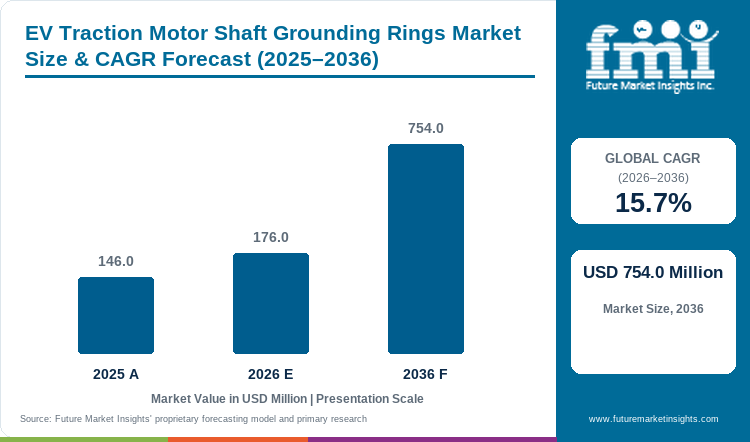
USD 176.0 million in 2026 and USD 754.0 million by 2036 at a 15.7% CAGR.
The market was valued at USD 146.0 million in 2025. Demand is estimated at USD 176.0 million in 2026 and is projected to reach USD 754.0 million by 2036 at 15.7% CAGR. The estimate covers conductive rings and brush assemblies installed to divert traction-motor shaft current away from bearings. It includes OEM fitment plus service replacement. Insulated bearings, conductive grease and general industrial motor rings sold outside road-vehicle traction systems are excluded.
Demand develops alongside the electric vehicle motor market, because inverter-fed traction motors can create high-frequency shaft voltage and bearing current. Grounding-ring revenue depends on ring penetration, motors per vehicle and the share of platforms using alternative mitigation.
Key Takeaways
- The market is valued at USD 176.0 million in 2026 and is projected to create USD 578.0 million in additional value by 2036.
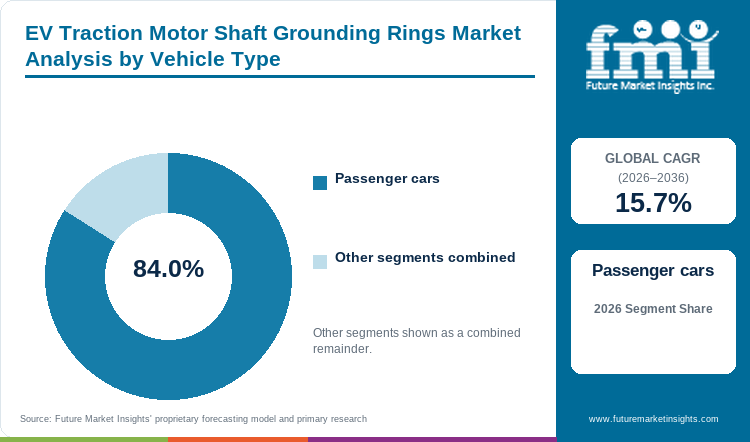
- Passenger cars is projected to hold 84.0% of Vehicle Type demand in 2026 because electric passenger-car output forms the main traction-motor pool.
- Battery electric vehicles is projected to hold 78.0% of EV Architecture demand in 2026 because BEVs form the main electric-drive production base.
- Single-motor vehicles is projected to hold 62.0% of Motor Configuration demand in 2026 because cost-focused EV platforms commonly use one traction motor.
- Insulated or hybrid bearings and conductive lubricants can replace a grounding ring on platforms where the alternate design meets current and durability targets.
- Some of the key players in this market include Electro Static Technology, SKF, Helwig Carbon Products, Schunk Carbon Technology, Mersen, Morgan Advanced Materials, Schaeffler, NSK, NTN, Timken.
Analyst Perspective
"A shaft-grounding ring is a small component inside an expensive e-drive. Its commercial value comes from providing a stable current path without adding unacceptable drag, debris or service risk."
- Nikhil Kaitwade, Principal Consultant, Future Market Insights
How is the EV traction motor shaft grounding rings market segmented?
The EV traction motor shaft grounding rings market is segmented by vehicle type, EV architecture, motor configuration, grounding element design, sales channel and region.
Vehicle type defines the production pool. EV architecture and motor configuration determine exposure to inverter-fed traction systems. Grounding-element design separates contact technologies, while sales channel distinguishes vehicle-platform fitment from service replacement.
Why do passenger cars lead vehicle-type demand?
Passenger cars provide the deepest pool of electric traction motors, but the relevance to shaft grounding goes beyond vehicle count. Each new e-drive architecture requires decisions around shaft voltage, bearing insulation, grounding location and available axial space near the rotor shaft. Passenger EV platforms are produced in volumes high enough to justify dedicated ring geometries and motor-specific qualification rather than generic industrial components. More than 20 million electric cars were sold worldwide in 2025, equivalent to one-quarter of global new-car sales, so passenger EV programs dominate the number of traction motors entering service.
- Passenger cars account for 84.0% of vehicle-type demand in 2026.
- Global electric-car sales exceeded 20 million units in 2025. That scale creates repeated qualification opportunities across new motor families, bearing layouts and vehicle platforms rather than a single standardized ring specification.
Why do battery electric vehicles lead architecture demand?
A BEV keeps the traction motor and inverter at the center of propulsion whenever the vehicle is driven. Fast switching inside the inverter creates common-mode voltage, and part of that electrical energy can appear on the motor shaft. If the voltage across the bearing film becomes high enough, discharge can occur through the bearing rather than through the intended grounding path. Repeated electrical discharge can produce pitting and eventually fluting on the raceway. A shaft-grounding device is therefore designed as a deliberately lower-impedance route between the rotating shaft and grounded motor frame. AEGIS describes this function as diverting capacitive shaft current away from bearings, while Helwig specifies silver-graphite brushes for motors driven by PWM controllers for the same underlying reason.
- Battery electric vehicles represent 78.0% of architecture demand in 2026.
- BEVs represented 65% of global electric-car sales in 2025. Their full electric-propulsion architecture makes inverter-induced bearing-current control relevant across the primary traction drive rather than an intermittently used auxiliary motor.
Why do single-motor vehicles lead configuration demand?
Motor count changes both the addressable unit volume and the engineering problem. A single-motor platform has one principal traction unit, one rotor shaft and one primary bearing system requiring an electrical protection strategy. This architecture remains attractive for volume EVs because it avoids the cost, mass and packaging of a second drive unit. Dual-motor vehicles can raise grounding-device content per vehicle, but they also introduce separate front and rear e-drive designs that may require different ring diameters, mounting approaches or even different bearing-current mitigation methods. The market therefore reflects a trade-off: one-motor vehicles create more vehicle-level volume, while multi-motor vehicles can carry more grounding content per unit.
- Single-motor vehicles make up 62.0% of configuration demand in 2026.
- Dual-motor and higher-performance platforms can require protection at more than one traction unit, increasing content per vehicle even though their fitment base remains narrower than mainstream one-motor architectures.
Why do carbon-fiber and brush rings lead design demand?
The electrical path has to remain conductive while the shaft rotates at high speed, shifts slightly under bearing tolerances and operates through repeated thermal cycles. Conductive-fiber rings solve this by placing a very large number of fine contacts around the shaft circumference. AEGIS uses multiple circumferential rows of microfibers, creating hundreds of thousands to millions of potential discharge points rather than concentrating current through a small contact area. Its published design also relies on light contact and very low wear. Brush systems use a different approach: Helwig applies positive spring force to a silver-graphite brush so that electrical contact is maintained continuously as the shaft rotates. The two technologies compete on contact stability, high-frequency impedance, wear behavior, packaging and maintenance requirements.
- Carbon-fiber and brush rings hold 67.0% of design demand in 2026.
- AEGIS surrounds the shaft with 360-degree conductive microfiber contact, while Helwig uses a spring-loaded silver-graphite brush. Both architectures create an alternative path to ground so current does not discharge through the bearing.
Why does OEM supply lead the sales channel?
Grounding performance depends on the complete motor system, not the ring in isolation. Engineers have to know where shaft voltage is generated, which bearing is exposed, whether another bearing is insulated, how the motor housing is bonded to ground and where the grounding device can physically contact the shaft. The electrical problem can also change with motor size and architecture. AEGIS distinguishes capacitive EDM current from high-frequency circulating current and notes that larger motors may require both shaft grounding and bearing insulation rather than grounding alone. That kind of interaction makes the device part of e-drive validation, where bearing strategy, electromagnetic behavior, mechanical packaging and durability are resolved before series production.
- OEM supply captures 88.5% of sales-channel demand in 2026.
- The commercial advantage sits upstream in motor development: once shaft diameter, bearing arrangement, housing geometry and grounding path are frozen, changing the protection method later can require mechanical and electrical revalidation. Retrofit rings and brushes remain relevant for motor repair, but automotive production volume is concentrated in parts qualified with the original e-drive.
What are the drivers, restraints and opportunities in the EV Traction Motor Shaft Grounding Rings Market?
Electric-drive output raises demand, alternative bearing-current controls limit penetration, and multi-motor architectures create an opportunity for more grounding devices per vehicle.
- Driver: Rising electric-vehicle production expands the number of inverter-fed traction motors that require bearing-current control.
- Restraint: Insulated bearings and other mitigation routes can remove the need for a separate shaft-grounding ring.
- Opportunity: Dual-motor vehicles and aging e-axles can increase component intensity and service replacement.
Expansion of the motor bearings market increases the addressable traction-motor pool. The IEA recorded more than 20.0 million electric-car sales in 2025 and expects substantial growth through 2035.
Electrical bearing protection is a system decision. Engineers can use a conductive ring, a hybrid ceramic bearing, an insulating coating or a combination. The ring therefore has to demonstrate low resistance across speed, temperature and contamination conditions before it displaces another approach.
The automotive electric drivetrain components market creates additional demand where e-drive repair programs replace worn contact elements or add bearing-current protection. Service access and platform-specific mounting will decide how quickly this channel develops.
Which country CAGRs are profiled in the EV Traction Motor Shaft Grounding Rings Market?
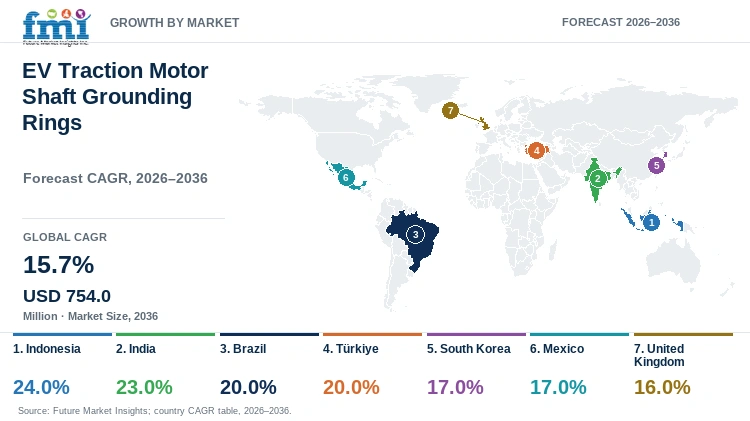
| Country | CAGR |
|---|---|
| Indonesia | 24.0% |
| India | 23.0% |
| Brazil | 20.0% |
| Türkiye | 20.0% |
| South Korea | 17.0% |
| Mexico | 17.0% |
| United Kingdom | 16.0% |
How do country-level CAGRs compare in the EV Traction Motor Shaft Grounding Rings Market?
Country demand depends on where electric traction motors are being produced, how quickly EV platforms are scaling, and whether grounding protection is specified locally or imported with the motor assembly. Indonesia and India are expanding from relatively small electric-car bases, which creates room for new e-drive qualifications. Brazil and Türkiye are moving through a faster adoption phase. South Korea already has a strong automotive and battery manufacturing base, while Mexico is tied closely to North American vehicle programs. The United Kingdom presents a different profile, with high EV penetration increasing the installed pool of traction motors that may later require service attention. Global electric-car sales exceeded 20 million units in 2025, with emerging markets outside China contributing much of the incremental growth.
- Indonesia: Electric-car sales rose 125% in 2025. That expansion enlarges the traction-motor base quickly enough to justify new supplier qualifications for shaft-grounding rings and related bearing-protection hardware.
- India: Electric-car sales increased 75% in 2025 to 165,000 units, and roughly 60% of those vehicles were produced domestically by Tata and Mahindra. Local motor assembly gives grounding suppliers a clearer path into platform engineering than a market supplied mainly through finished-vehicle imports.
- Brazil: Electric-car sales rose 40% in 2025. Near-term ring demand is still linked heavily to imported e-drives, but growing regional vehicle investment creates scope for local motor and component sourcing later in the forecast.
- Türkiye: EV adoption accelerated sharply in 2025, while domestic vehicle manufacturing gives suppliers access to both local and European platform programs. Grounding-ring qualification therefore depends on the traction-motor architecture selected for each vehicle rather than EV registrations alone.
- South Korea: The opportunity is tied to domestic e-drive engineering and export vehicle programs. Higher-voltage platforms and multi-motor configurations increase the number of bearing-current paths that motor designers have to manage.
- Mexico: Domestic EV sales are only part of the picture. Electric-car sales more than tripled in 2025, but the larger commercial opportunity for grounding suppliers comes from traction motors and vehicles assembled for North American programs.
- United Kingdom: Electric-car sales increased by more than 25% in 2025. A growing installed EV fleet supports OEM demand today and gradually creates a service population of traction motors exposed to bearing-current and shaft-voltage issues over longer operating lives.
Across the key countries in this market, these rates measure revenue within the defined product boundary and do not represent growth of the wider electric-vehicle component industry.
Country-wise Analysis
- Indonesia: 24.0% CAGR through 2036. A 125% increase in electric-car sales during 2025 shows how quickly the addressable motor base can expand from a low starting point. Grounding-ring suppliers still need application engineering close to the motor program, since ring diameter, mounting position and conductive path are established with the e-drive rather than added generically after assembly.
- India: 23.0% CAGR through 2036. Local production matters more here than registrations alone. Electric-car sales reached 165,000 units in 2025, with domestic manufacturers accounting for about 60% of that volume. As locally engineered passenger and commercial EV programs multiply, compact grounding rings can be qualified alongside the traction motor instead of entering only through imported drive units.
- Brazil: 20.0% CAGR through 2036. Electric-car sales expanded 40% in 2025, widening the installed traction-motor pool. Imported vehicles and e-drives dominate much of the near-term requirement, so the stronger local sourcing opportunity emerges when vehicle and motor production deepen enough for grounding protection to be specified within regional OEM programs.
- Türkiye: 20.0% CAGR through 2036. Rapid EV adoption combines with domestic vehicle manufacturing, giving grounding suppliers more than one route into the market. A supplier can enter through locally engineered e-drives, European platform sourcing or imported motor assemblies that require regional technical support.
- South Korea: 17.0% CAGR through 2036. The technical case is stronger than the sales-volume story alone. High-voltage e-drive platforms, export-oriented EV programs and multi-motor configurations increase the importance of managing inverter-induced shaft voltage before it reaches motor bearings. Qualification therefore sits close to motor design and bearing-system validation.
- Mexico: 17.0% CAGR through 2036. Electric-car sales more than tripled in 2025, but domestic retail demand does not define the market. Grounding-ring revenue is more closely tied to which EV and traction-motor programs are assigned to Mexican plants, how much of the e-drive is localized, and whether North American OEMs specify shaft-grounding protection at the motor level.
- United Kingdom: 16.0% CAGR through 2036. Electric-car sales rose more than 25% in 2025, steadily enlarging the population of inverter-fed traction motors in service. New vehicles support OEM ring demand, while the older end of the EV fleet gradually creates opportunities for bearing diagnostics, motor rebuilding and replacement grounding hardware.
Who are the notable companies in the EV Traction Motor Shaft Grounding Rings Market?
Electro Static Technology, SKF, Helwig Carbon Products, Schunk Carbon Technology, Mersen, Morgan Advanced Materials, Schaeffler, NSK, NTN, Timken are the notable companies profiled in this market.
Direct competition is concentrated among suppliers with a documented conductive ring or shaft brush for electric drives. Bearing companies influence the same design decision through insulation and hybrid materials, so they are benchmarked as adjacent participants and remain Unscored where a dedicated automotive grounding ring is not confirmed.
- Direct Automotive Grounding Platforms: Electro Static Technology, SKF, Helwig Carbon Products.
- Carbon Contact Specialists: Schunk Carbon Technology, Mersen, Morgan Advanced Materials.
- Adjacent EV Bearing Platforms: Schaeffler, NSK, NTN, Timken.
Competitive Benchmarking: EV Traction Motor Shaft Grounding Rings Market
| Company | Direct EV Ring Evidence | Contact Technology | EV Application Support | Geographic Reach |
|---|---|---|---|---|
| Electro Static Technology | High | High | High | Global |
| SKF | High | High | High | Global |
| Helwig Carbon Products | High | High | Medium | North America, export |
| Schunk Carbon Technology | Medium | High | High | Global |
| Mersen | Unscored | High | High | Global |
| Morgan Advanced Materials | Unscored | High | High | Global |
| Schaeffler | Unscored | High | High | Global |
| NSK | Unscored | High | High | Global |
| NTN | Unscored | High | High | Global |
| Timken | Unscored | Medium | High | Global |
High direct evidence requires a named automotive shaft-grounding ring or brush. Medium reflects relevant current-transfer capability. Unscored identifies adjacent EV bearing technology without a confirmed ring product.
Key Developments in the EV Traction Motor Shaft Grounding Rings Market
- In May 2026, the IEA published Global EV Outlook 2026 and reported that electric-car sales exceeded 20.0 million units in 2025, enlarging the traction-motor base addressed by grounding devices.
- In February 2025, Helwig Carbon Products published updated axial BPK material for low-resistance shaft grounding, supporting continued development of brush-based protection systems.
- In April 2024, SKF announced a conductive brush ring for EV e-axles that creates an electrical path between the rotor shaft and housing.
Key Players in the EV Traction Motor Shaft Grounding Rings Market
Direct Automotive Grounding Platforms
- Electro Static Technology
- SKF
- Helwig Carbon Products
Carbon Contact Specialists
- Schunk Carbon Technology
- Mersen
- Morgan Advanced Materials
Adjacent EV Bearing Platforms
- Schaeffler
- NSK
- NTN
- Timken
EV Traction Motor Shaft Grounding Rings Market - Report Scope
| Coverage field | Report scope |
|---|---|
| Market Size | USD 176.0 million in 2026 and USD 754.0 million by 2036 at 15.7% CAGR. |
| Market Definition | Conductive ring and brush assemblies that connect an EV traction-motor shaft to the housing so electrical current bypasses the bearings. |
| Segmentation | Vehicle type, ev architecture, motor configuration, grounding element design, sales channel and region. |
| Regional Coverage | North America, Latin America, Western Europe, Eastern Europe, East Asia, South Asia and Pacific, and Middle East and Africa. |
| Countries Covered | Indonesia, India, Brazil, Türkiye, South Korea, Mexico, United Kingdom and more than 20 countries included in the full report. |
| Key Companies Profiled | Electro Static Technology, SKF, Helwig Carbon Products, Schunk Carbon Technology, Mersen, Morgan Advanced Materials, Schaeffler, NSK, NTN, Timken. |
| Forecast Period | 2026 to 2036. |
| Approach | Bottom-up model using electric-vehicle sales, traction motors per vehicle, grounding-device penetration, OEM pricing and service replacement. |
EV Traction Motor Shaft Grounding Rings Market - Research Methodology
| Method | Approach |
|---|---|
| Primary Research | Direct-source research reviewed manufacturer technical sheets, patent records, official statistics and regulator publications. Each source was tested against the defined product boundary and the application evidence required for inclusion. |
| Desk Research | Desk research covered government statistics, standards, industry associations, technical literature, patents, official product information and corporate announcements. Evidence was screened for scope, date and direct relevance. |
| Market Sizing and Forecasting | Bottom-up model using electric-vehicle sales, traction motors per vehicle, grounding-device penetration, OEM pricing and service replacement. |
| Data Validation | Estimates were checked against parent-market activity, installed-base indicators, product specifications and supplier participation. Adjacent products without the defined function were excluded. |
EV Traction Motor Shaft Grounding Rings Market by Segments
EV Traction Motor Shaft Grounding Rings Market segmented by Vehicle Type:
- Passenger cars
- Light commercial vehicles
- Medium and heavy trucks
- Buses and coaches
EV Traction Motor Shaft Grounding Rings Market segmented by EV Architecture:
- Battery electric vehicles
- Plug-in hybrid and extended-range vehicles
- Fuel-cell electric vehicles
EV Traction Motor Shaft Grounding Rings Market segmented by Motor Configuration:
- Single-motor vehicles
- Dual-motor vehicles
- Vehicles with three or more motors
EV Traction Motor Shaft Grounding Rings Market segmented by Grounding Element Design:
- Carbon-fiber and brush rings
- Conductive lip and nonwoven contacts
- Spring and metal contacts
EV Traction Motor Shaft Grounding Rings Market segmented by Sales Channel:
- OEM supply
- Service and aftermarket
EV Traction Motor Shaft Grounding Rings Market by Region:
- North America
- United States
- Canada
- Latin America
- Brazil
- Mexico
- Argentina
- Chile
- Western Europe
- Germany
- France
- United Kingdom
- Italy
- Spain
- Benelux
- Nordics
- Eastern Europe
- Poland
- Czech Republic
- Romania
- Hungary
- East Asia
- China
- Japan
- South Korea
- South Asia and Pacific
- India
- ASEAN
- Australia and New Zealand
- Middle East and Africa
- GCC Countries
- South Africa
- Türkiye
- Israel
Research Sources and Bibliography
- International Energy Agency. (2026, May 20). Global EV Outlook 2026: Trends in electric cars.
- International Energy Agency. (2026). Global EV Outlook 2026: Outlook for electric mobility.
- United States Department of Energy, Office of Scientific and Technical Information. (2021). Technical literature on common-mode effects and bearing currents in electric drives.
- German Patent and Trade Mark Office. (2024). DE102019119207B4, shaft-grounding ring for an electric-vehicle traction motor.
- Tribology International. (2024). Research on electrical bearing damage and mitigation in electric drives.
- Electro Static Technology. (n.d.; accessed September 24, 2026). Electric vehicle shaft-grounding solutions.
- SKF. (2024, April 4). Conductive brush ring for advanced electric-vehicle powertrains.
- Helwig Carbon Products. (2025). Axially Mounted Bearing Protection Kit brochure.
- Future Market Insights. (2026). Electric Vehicle Motor Market.
- Future Market Insights. (2026). Motor Bearings Market.
This bibliography is provided for reader reference and is not exhaustive. The full report contains the complete reference list and detailed citations.
This Report Answers
- How large is the EV traction motor shaft grounding rings market in 2026 and 2036?
- Which product specification leads demand in 2026?
- What operating condition converts technical need into a purchase?
- Which constraint can delay qualification or replacement?
- How do country growth rates compare across the profiled markets?
- Which companies provide direct or adjacent market capability?
Frequently Asked Questions
How big is the EV traction motor shaft grounding rings market in 2026?
The EV traction motor shaft grounding rings market is valued at USD 176.0 million in 2026 and is projected to reach USD 754.0 million by 2036. The estimate covers revenue within the stated market definition and excludes adjacent equipment or chemicals sold without the required function.
What is the CAGR of the EV traction motor shaft grounding rings market from 2026 to 2036?
The market is projected to grow at 15.7% CAGR between 2026 and 2036. Expansion depends on end-market output together with the rate at which plants adopt higher-specification products.
Which vehicle type leads the EV traction motor shaft grounding rings market?
Passenger cars is expected to hold 84.0% share in 2026 because electric passenger-car output forms the main traction-motor pool. Commercial vehicles add value through higher-duty motors but remain smaller in unit volume.
Which countries are projected to record higher growth?
Indonesia is projected at 24.0% CAGR, followed by India at 23.0% and Brazil at 20.0% through 2036. The comparison reflects local production investment and the timing of replacement or qualification cycles.
Which companies are active in the EV traction motor shaft grounding rings market?
The profiled group includes Electro Static Technology, SKF, Helwig Carbon Products, Schunk Carbon Technology, Mersen, Morgan Advanced Materials, Schaeffler, NSK, NTN, Timken. Capability differs by product range and application evidence.
Preview the report firsthand - request a free sample
Get SampleGet the brochure for pricing and purchase details.
Get PDFTable of Content
- Key Takeaways
- Market Size and CAGR
- Top Growth Driver
- Fastest Growing Segment
- Leading Region
- Key Companies
- Emerging Opportunities
- Executive Summary
- Global Market Outlook
- Demand-side Trends
- Supply-side Trends
- Technology Roadmap Analysis
- Analysis and Recommendations
- Analyst Perspective (What is happening? Why now? What should investors know?)
- Key Questions Answered
- How large is the market?
- What is the CAGR?
- What are key trends?
- Which region dominates?
- Who are the leaders?
- Market Overview
- Market Coverage / Taxonomy
- Market Definition / Scope / Limitations
- Research Methodology
- Chapter Orientation
- Analytical Lens and Working Hypotheses
- Market Structure, Signals, and Trend Drivers
- Benchmarking and Cross-market Comparability
- Market Sizing, Forecasting, and Opportunity Mapping
- Research Design and Evidence Framework
- Desk Research Programme (Secondary Evidence)
- Expert Input and Fieldwork (Primary Evidence)
- Tooling, Models, and Reference Databases
- Data Engineering and Model Build
- Quality Assurance and Audit Trail
- Market Background
- Market Dynamics (Drivers, Restraints, Opportunity, Trends)
- Scenario Forecast (Optimistic, Likely, Conservative)
- Impact Analysis
- AI Impact
- Sustainability Impact
- Regulatory Impact
- Technology Impact
- Consumer / Buyer Analysis
- Purchase Drivers
- Adoption Barriers
- Buyer Journey
- Opportunity Map Analysis
- Product Life Cycle Analysis
- Supply Chain Analysis
- Investment Feasibility Matrix
- Value Chain Analysis
- PESTLE and Porter's Analysis
- Regulatory Landscape
- Regional Parent Market Outlook
- Production and Consumption Statistics
- Import and Export Statistics
- Global Market Analysis and Forecast, 2021 to 2036
- Historical Market Size Value (USD Million) Analysis, 2021 to 2025
- Current and Future Market Size Value (USD Million) Projections, 2026 to 2036
- Y-o-Y Growth Trend Analysis
- Absolute $ Opportunity Analysis
- Global Market Pricing Analysis, 2021 to 2036
- Global Market Analysis and Forecast, By Vehicle Type, 2021 to 2036
- Introduction / Key Findings
- Historical Market Size Value (USD Million) Analysis By Vehicle Type, 2021 to 2025
- Current and Future Market Size Value (USD Million) Analysis and Forecast By Vehicle Type, 2026 to 2036
- Passenger cars
- Light commercial vehicles
- Medium and heavy trucks
- Buses and coaches
- Y-o-Y Growth Trend Analysis By Vehicle Type, 2021 to 2025
- Absolute $ Opportunity Analysis By Vehicle Type, 2026 to 2036
- Global Market Analysis and Forecast, By EV Architecture, 2021 to 2036
- Introduction / Key Findings
- Historical Market Size Value (USD Million) Analysis By EV Architecture, 2021 to 2025
- Current and Future Market Size Value (USD Million) Analysis and Forecast By EV Architecture, 2026 to 2036
- Battery electric vehicles
- Plug-in hybrid and extended-range vehicles
- Fuel-cell electric vehicles
- Y-o-Y Growth Trend Analysis By EV Architecture, 2021 to 2025
- Absolute $ Opportunity Analysis By EV Architecture, 2026 to 2036
- Global Market Analysis and Forecast, By Motor Configuration, 2021 to 2036
- Introduction / Key Findings
- Historical Market Size Value (USD Million) Analysis By Motor Configuration, 2021 to 2025
- Current and Future Market Size Value (USD Million) Analysis and Forecast By Motor Configuration, 2026 to 2036
- Single-motor vehicles
- Dual-motor vehicles
- Vehicles with three or more motors
- Y-o-Y Growth Trend Analysis By Motor Configuration, 2021 to 2025
- Absolute $ Opportunity Analysis By Motor Configuration, 2026 to 2036
- Global Market Analysis and Forecast, By Grounding Element Design, 2021 to 2036
- Introduction / Key Findings
- Historical Market Size Value (USD Million) Analysis By Grounding Element Design, 2021 to 2025
- Current and Future Market Size Value (USD Million) Analysis and Forecast By Grounding Element Design, 2026 to 2036
- Carbon-fiber and brush rings
- Conductive lip and nonwoven contacts
- Spring and metal contacts
- Y-o-Y Growth Trend Analysis By Grounding Element Design, 2021 to 2025
- Absolute $ Opportunity Analysis By Grounding Element Design, 2026 to 2036
- Global Market Analysis and Forecast, By Sales Channel, 2021 to 2036
- Introduction / Key Findings
- Historical Market Size Value (USD Million) Analysis By Sales Channel, 2021 to 2025
- Current and Future Market Size Value (USD Million) Analysis and Forecast By Sales Channel, 2026 to 2036
- OEM supply
- Service and aftermarket
- Y-o-Y Growth Trend Analysis By Sales Channel, 2021 to 2025
- Absolute $ Opportunity Analysis By Sales Channel, 2026 to 2036
- Global Market Analysis and Forecast, By Region, 2021 to 2036
- Introduction
- Historical Market Size Value (USD Million) Analysis By Region, 2021 to 2025
- Current Market Size Value (USD Million) Analysis and Forecast By Region, 2026 to 2036
- North America
- Latin America
- Western Europe
- Eastern Europe
- East Asia
- South Asia and Pacific
- Middle East and Africa
- Market Attractiveness Analysis By Region
- North America Market Analysis and Forecast, By Country, 2021 to 2036
- Historical Market Size Value (USD Million) Trend Analysis By Market Taxonomy, 2021 to 2025
- Market Size Value (USD Million) Forecast By Market Taxonomy, 2026 to 2036
- By Country
- United States
- Canada
- By Vehicle Type
- By EV Architecture
- By Motor Configuration
- By Grounding Element Design
- By Sales Channel
- By Country
- Market Attractiveness Analysis
- By Country
- By Vehicle Type
- By EV Architecture
- By Motor Configuration
- By Grounding Element Design
- By Sales Channel
- Key Takeaways
- Latin America Market Analysis and Forecast, By Country
- Historical Market Size Value (USD Million) Trend Analysis By Market Taxonomy, 2021 to 2025
- Market Size Value (USD Million) Forecast By Market Taxonomy, 2026 to 2036
- By Country
- Brazil
- Mexico
- Argentina
- Chile
- By Vehicle Type
- By EV Architecture
- By Motor Configuration
- By Grounding Element Design
- By Sales Channel
- By Country
- Market Attractiveness Analysis
- By Country
- By Vehicle Type
- By EV Architecture
- By Motor Configuration
- By Grounding Element Design
- By Sales Channel
- Key Takeaways
- Western Europe Market Analysis and Forecast, By Country
- Historical Market Size Value (USD Million) Trend Analysis By Market Taxonomy, 2021 to 2025
- Market Size Value (USD Million) Forecast By Market Taxonomy, 2026 to 2036
- By Country
- Germany
- France
- United Kingdom
- Italy
- Spain
- Benelux
- Nordics
- By Vehicle Type
- By EV Architecture
- By Motor Configuration
- By Grounding Element Design
- By Sales Channel
- By Country
- Market Attractiveness Analysis
- By Country
- By Vehicle Type
- By EV Architecture
- By Motor Configuration
- By Grounding Element Design
- By Sales Channel
- Key Takeaways
- Eastern Europe Market Analysis and Forecast, By Country
- Historical Market Size Value (USD Million) Trend Analysis By Market Taxonomy, 2021 to 2025
- Market Size Value (USD Million) Forecast By Market Taxonomy, 2026 to 2036
- By Country
- Poland
- Czech Republic
- Romania
- Hungary
- By Vehicle Type
- By EV Architecture
- By Motor Configuration
- By Grounding Element Design
- By Sales Channel
- By Country
- Market Attractiveness Analysis
- By Country
- By Vehicle Type
- By EV Architecture
- By Motor Configuration
- By Grounding Element Design
- By Sales Channel
- Key Takeaways
- East Asia Market Analysis and Forecast, By Country
- Historical Market Size Value (USD Million) Trend Analysis By Market Taxonomy, 2021 to 2025
- Market Size Value (USD Million) Forecast By Market Taxonomy, 2026 to 2036
- By Country
- China
- Japan
- South Korea
- By Vehicle Type
- By EV Architecture
- By Motor Configuration
- By Grounding Element Design
- By Sales Channel
- By Country
- Market Attractiveness Analysis
- By Country
- By Vehicle Type
- By EV Architecture
- By Motor Configuration
- By Grounding Element Design
- By Sales Channel
- Key Takeaways
- South Asia and Pacific Market Analysis and Forecast, By Country
- Historical Market Size Value (USD Million) Trend Analysis By Market Taxonomy, 2021 to 2025
- Market Size Value (USD Million) Forecast By Market Taxonomy, 2026 to 2036
- By Country
- India
- ASEAN
- Australia and New Zealand
- By Vehicle Type
- By EV Architecture
- By Motor Configuration
- By Grounding Element Design
- By Sales Channel
- By Country
- Market Attractiveness Analysis
- By Country
- By Vehicle Type
- By EV Architecture
- By Motor Configuration
- By Grounding Element Design
- By Sales Channel
- Key Takeaways
- Middle East and Africa Market Analysis and Forecast, By Country
- Historical Market Size Value (USD Million) Trend Analysis By Market Taxonomy, 2021 to 2025
- Market Size Value (USD Million) Forecast By Market Taxonomy, 2026 to 2036
- By Country
- GCC Countries
- South Africa
- Türkiye
- Israel
- By Vehicle Type
- By EV Architecture
- By Motor Configuration
- By Grounding Element Design
- By Sales Channel
- By Country
- Market Attractiveness Analysis
- By Country
- By Vehicle Type
- By EV Architecture
- By Motor Configuration
- By Grounding Element Design
- By Sales Channel
- Key Takeaways
- Key Countries Market Analysis
- United States
- Pricing Analysis
- Market Share Analysis, 2025
- By Vehicle Type
- By EV Architecture
- By Motor Configuration
- By Grounding Element Design
- By Sales Channel
- Canada
- Pricing Analysis
- Market Share Analysis, 2025
- By Vehicle Type
- By EV Architecture
- By Motor Configuration
- By Grounding Element Design
- By Sales Channel
- Mexico
- Pricing Analysis
- Market Share Analysis, 2025
- By Vehicle Type
- By EV Architecture
- By Motor Configuration
- By Grounding Element Design
- By Sales Channel
- Brazil
- Pricing Analysis
- Market Share Analysis, 2025
- By Vehicle Type
- By EV Architecture
- By Motor Configuration
- By Grounding Element Design
- By Sales Channel
- Chile
- Pricing Analysis
- Market Share Analysis, 2025
- By Vehicle Type
- By EV Architecture
- By Motor Configuration
- By Grounding Element Design
- By Sales Channel
- Germany
- Pricing Analysis
- Market Share Analysis, 2025
- By Vehicle Type
- By EV Architecture
- By Motor Configuration
- By Grounding Element Design
- By Sales Channel
- United Kingdom
- Pricing Analysis
- Market Share Analysis, 2025
- By Vehicle Type
- By EV Architecture
- By Motor Configuration
- By Grounding Element Design
- By Sales Channel
- Italy
- Pricing Analysis
- Market Share Analysis, 2025
- By Vehicle Type
- By EV Architecture
- By Motor Configuration
- By Grounding Element Design
- By Sales Channel
- Spain
- Pricing Analysis
- Market Share Analysis, 2025
- By Vehicle Type
- By EV Architecture
- By Motor Configuration
- By Grounding Element Design
- By Sales Channel
- France
- Pricing Analysis
- Market Share Analysis, 2025
- By Vehicle Type
- By EV Architecture
- By Motor Configuration
- By Grounding Element Design
- By Sales Channel
- India
- Pricing Analysis
- Market Share Analysis, 2025
- By Vehicle Type
- By EV Architecture
- By Motor Configuration
- By Grounding Element Design
- By Sales Channel
- ASEAN
- Pricing Analysis
- Market Share Analysis, 2025
- By Vehicle Type
- By EV Architecture
- By Motor Configuration
- By Grounding Element Design
- By Sales Channel
- Australia and New Zealand
- Pricing Analysis
- Market Share Analysis, 2025
- By Vehicle Type
- By EV Architecture
- By Motor Configuration
- By Grounding Element Design
- By Sales Channel
- China
- Pricing Analysis
- Market Share Analysis, 2025
- By Vehicle Type
- By EV Architecture
- By Motor Configuration
- By Grounding Element Design
- By Sales Channel
- Japan
- Pricing Analysis
- Market Share Analysis, 2025
- By Vehicle Type
- By EV Architecture
- By Motor Configuration
- By Grounding Element Design
- By Sales Channel
- South Korea
- Pricing Analysis
- Market Share Analysis, 2025
- By Vehicle Type
- By EV Architecture
- By Motor Configuration
- By Grounding Element Design
- By Sales Channel
- Poland
- Pricing Analysis
- Market Share Analysis, 2025
- By Vehicle Type
- By EV Architecture
- By Motor Configuration
- By Grounding Element Design
- By Sales Channel
- Hungary
- Pricing Analysis
- Market Share Analysis, 2025
- By Vehicle Type
- By EV Architecture
- By Motor Configuration
- By Grounding Element Design
- By Sales Channel
- Türkiye
- Pricing Analysis
- Market Share Analysis, 2025
- By Vehicle Type
- By EV Architecture
- By Motor Configuration
- By Grounding Element Design
- By Sales Channel
- South Africa
- Pricing Analysis
- Market Share Analysis, 2025
- By Vehicle Type
- By EV Architecture
- By Motor Configuration
- By Grounding Element Design
- By Sales Channel
- Indonesia
- Pricing Analysis
- Market Share Analysis, 2025
- By Vehicle Type
- By EV Architecture
- By Motor Configuration
- By Grounding Element Design
- By Sales Channel
- United States
- Market Structure Analysis
- Competition Dashboard
- Competition Benchmarking
- Market Share Analysis of Top Players
- By Regional
- By Vehicle Type
- By EV Architecture
- By Motor Configuration
- By Grounding Element Design
- By Sales Channel
- Emerging Startups
- Innovation Benchmarking
- Competition Analysis
- Competition Deep Dive
- Electro Static Technology
- Overview
- Product Portfolio
- Profitability by Market Segments
- Sales Footprint
- Strategy Overview
- Marketing Strategy
- Product Strategy
- Channel Strategy
- SKF
- Helwig Carbon Products
- Schunk Carbon Technology
- Mersen
- Morgan Advanced Materials
- Schaeffler
- NSK
- NTN
- Timken
- Electro Static Technology
- Case Studies
- Success Stories
- Recent Developments
- Competition Deep Dive
- Assumptions & Acronyms Used


