

- Market Size (2026)
- USD 640.6 Mn
- Forecast (2036)
- USD 1919.7 Mn
- CAGR (2026 to 2036)
- 11.6%
How big is the EV drive mode selectors market in 2026?
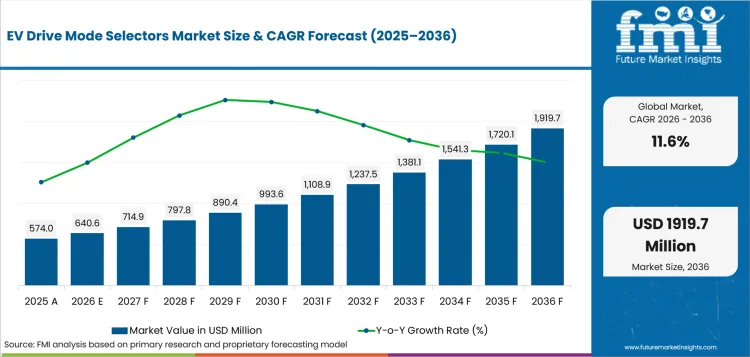
USD 640.6 million in 2026 and USD 1,919.7 million by 2036 at an 11.6% CAGR.
The EV drive mode selectors market is expected to grow from USD 574.0 million in 2025 to USD 1919.7 million by 2036 at an 11.6% CAGR. Rotary Selectors are projected to hold a 37.5% market share in 2026, driven by their compact and tactile design preferred in both premium and mainstream EV cabins, while Battery EVs are expected to account for 58.0% of the market, reflecting the growing need for integrated drive-state control systems in dedicated EV platforms.
| Metric | Value |
|---|---|
| 2026 Market Size | USD 640.6 million |
| 2036 Market Size | USD 1,919.7 million |
| Forecast CAGR (2026-2036) | 11.6% |
| Leading Selector Type | Rotary Selectors |
| Rotary Selectors Share (2026) | 37.5% |
| Leading Vehicle Type | Battery EVs |
| Battery EVs Share (2026) | 58.0% |
| Fastest-growing Country | China |
| China CAGR by 2036 | 13.4% |
Summary of the EV Drive Mode Selectors Market
| Market Signal | Commercial Impact |
|---|---|
| Demand and Growth Drivers | Demand for EV drive mode selectors is projected to expand through 2036 as automakers replace mechanical gear linkages with electronic shift-by-wire systems that improve cabin flexibility and driving experience.
|
| Product and Segment View | Rotary selectors, battery EVs, drive/reverse selection functions, and shift-by-wire interfaces continue to lead their respective market segments.
|
| Geography and Growth Outlook | Asia continues to dominate market expansion as regional automakers accelerate EV production and localization strategies.
|
| Competitive Landscape | Competition increasingly centers on control quality, electronic integration, and functional safety.
|
| Analyst Perspective | EV drive mode selectors are evolving into critical human-machine interface components as automakers prioritize intuitive operation, functional safety, and electronic reliability.
- Nikhil Kaitwade, Principal Analyst at Future Market Insights |
Selector demand is moving from basic PRND controls into mode logic that coordinates traction and cabin interface cues. This shift places electronic shift-by-wire selector modules closer to vehicle control software during platform sourcing. EV production scale is a significant volume trigger for selector modules. The International Energy Agency reported that electric car sales exceeded 20 million in 2025. European BEV registrations reached 546,937 units in the first quarter of 2026. This supports platform-level sourcing for gear shifter systems that can move across multiple EV nameplates.
Which factors support expansion in the EV drive mode selectors market?
Factory-installed electronic selector revenue supports market value due to wider use of software-controlled cabin interfaces in EV programs.
- Market value is supported by electronic selector modules specified before vehicle launch and validated against powertrain controllers.
- Supplier pricing reflects sensor redundancy and functional safety work before cabin appearance affects buyer preference.
- Revenue is expected to improve due to more BEV platforms using dedicated direction and park controls across trim levels.
- OEM trust improves due to clear haptic or tactile confirmation during startup and shutdown.
Why is the EV drive mode selectors market growing?
Electronic selector demand follows EV platform volume instead of aftermarket replacement cycles. IEA data shows the EV fleet is widening across major regions, which expands the number of vehicles needing factory-installed drive-state input modules.
Cabin packaging is another reason buyers are shifting away from mechanical linkage. Traditional shift levers take console space and add assembly paths that EV platforms do not always need. By-wire interface demand fits x-by-wire control platforms due to software-controlled vehicle commands.
How is the EV drive mode selectors market segmented?
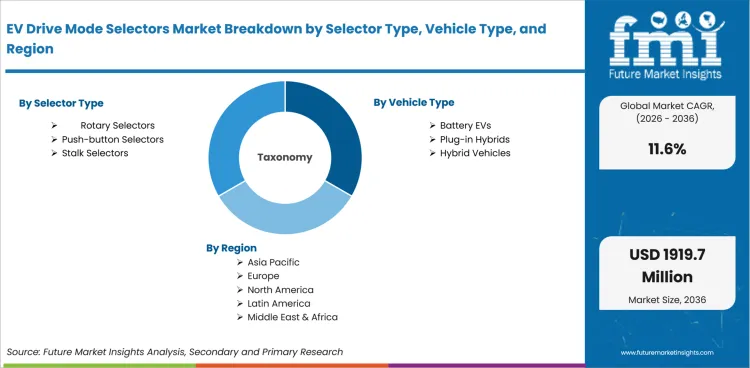
The EV drive mode selectors industry is segmented by selector type, vehicle type, function, interface, and sales channel.
- Rotary Selectors are projected to account for 37.5% share in 2026 due to compact tactile controls that fit EV cabin packaging.
- Battery EVs are anticipated to represent 58.0% share in 2026, supported by dedicated drive-state control across pure-electric platforms.
- Direction-control requirements support a 44.0% share for Drive / Reverse Selection in 2026 across EV platforms.
- Shift-by-wire interfaces are projected to account for 61.0% share in 2026 owing to signal control that reduces mechanical packaging limits.
- OEM channels are expected to represent 76.0% share in 2026 owing to early selector decisions made during platform development.
Which selector type category holds a notable share in the EV drive mode selectors market?
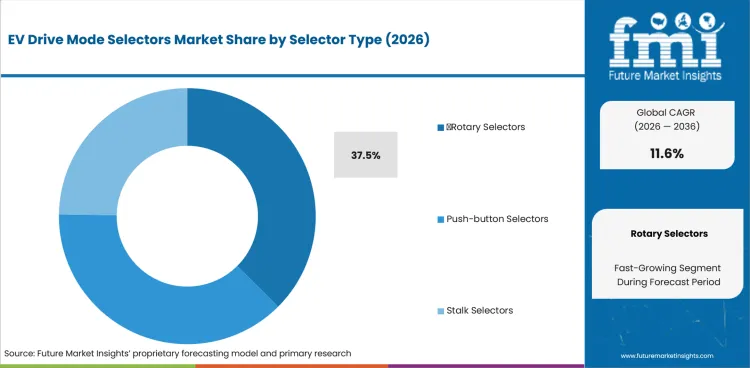
- Rotary Selectors are projected to account for 37.5% share in 2026, supported by tactile confirmation and space-saving console design.
- Push-button and stalk selectors gain use in programs that prioritize simple operation and lower cabin packaging cost.
How does the vehicle type segment perform in the EV drive mode selectors market?
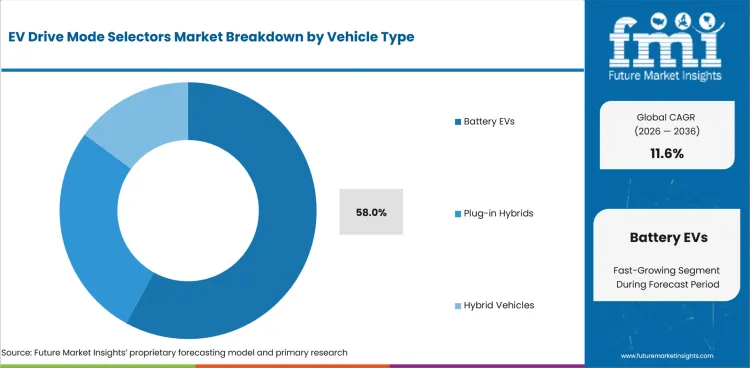
- Battery EVs are forecast to represent 58.0% share in 2026 due to dedicated direction and mode selection without mechanical gear linkage.
- Plug-in hybrids retain demand for selector modules that coordinate electric drive modes and conventional powertrain behavior.
What drives demand across the function segment in the EV drive mode selectors market?
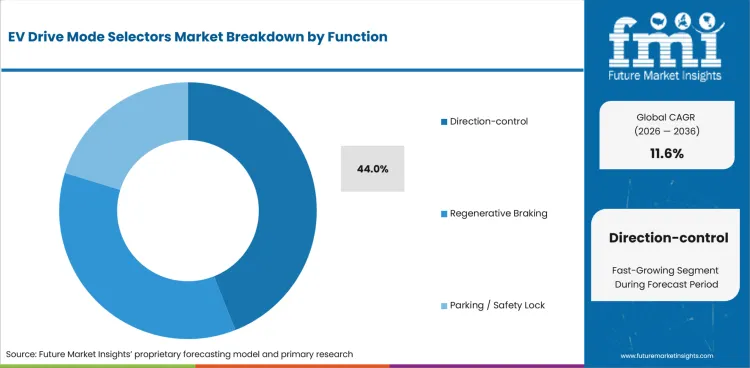
- Direction selection is anticipated to hold 44.0% share in 2026 due to reliable command requirements across EV platforms.
- Terrain and performance modes add value in SUV and pickup EV programs that need clear driver control choices.
Which interface segment shows a prominent position in the EV drive mode selectors market?
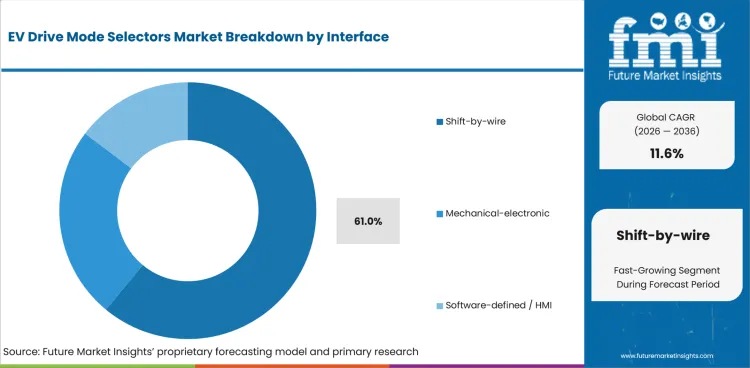
- Shift-by-wire is projected to account for 61.0% share in 2026 due to electronic signal control and flexible interior layouts.
- Mechanical-electronic selectors remain relevant for lower-cost platforms that need physical fallback and simpler service routines.
How are buyers selecting across sales channel options in the EV drive mode selectors market?
- OEM is estimated to represent 76.0% share in 2026 owing to specification inside platform electrical architecture and interior programs.
- Tier-1 integrated modules gain support in programs that want one validated cockpit package covering switches and wiring interfaces.
By-wire selectors need redundancy in sensing and communication. The module must confirm the selected state without a direct mechanical link. That keeps automotive sensors relevant to platform validation.
What are the driver, restraints, and opportunities in the EV drive mode selectors market?
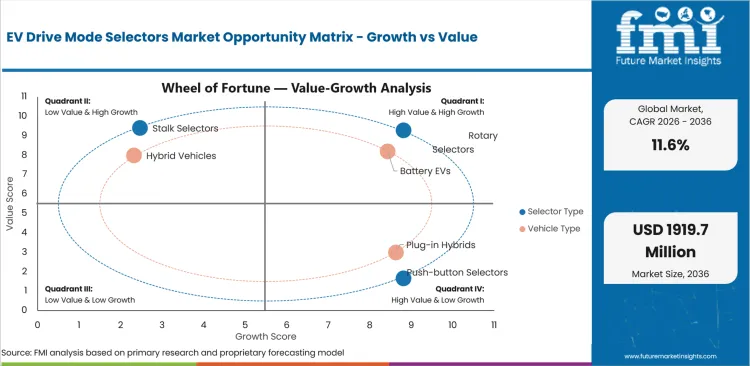
EV platform growth supports demand while touch-only interface risk limits faster adoption in safety-sensitive programs.
- Driver: EV platform growth is expected to lift selector demand due to electronic direction control.
- Restraint: Touch-only interface risk can restrain adoption if safety teams see weak driver confirmation in moving vehicles.
- Opportunity: Localized EV assembly creates supplier openings for validated selector modules built near OEM plants.
By-wire Selector Validation Outlook
By-wire selectors create value by making the driver command part of the vehicle control network. UN cybersecurity and software-update rules raised scrutiny on electronic vehicle functions after July 2024 type-approval changes. Suppliers that have testing depth can defend pricing in safety-sensitive programs.
Cabin Interface Repackaging Analysis
EV interiors give designers more freedom on platforms that avoid conventional transmission tunnels. Continental implemented a cross-domain high-performance computer in May 2024. The same direction supports automotive electronics content inside selector decisions.
Touch Feedback Restraint Analysis
Touch and haptic selectors can raise concern if the driver needs quick confirmation. NHTSA shift-control rules show why direction state and interlock behavior must be clear. Haptic selector programs therefore need automotive MEMS sensors and reliable feedback paths before wider sourcing.
Which countries are growing fastest in the EV drive mode selectors market?
China 13.4% CAGR; India 12.8% CAGR; South Korea 11.2% CAGR; United States 10.7% CAGR; Germany 10.5% CAGR; France 10.2% CAGR; United Kingdom 10.1% CAGR; and Japan 8.9% CAGR by 2036.
.webp "Top Country Growth Comparison Ev Drive Mode Selectors Market Cagr (2026 2036)")
| Country | CAGR |
|---|---|
| China | 13.4% |
| India | 12.8% |
| South Korea | 11.2% |
| United States | 10.7% |
| Germany | 10.5% |
| France | 10.2% |
| United Kingdom | 10.1% |
| Japan | 8.9% |
Source: Future Market Insights, 2026.
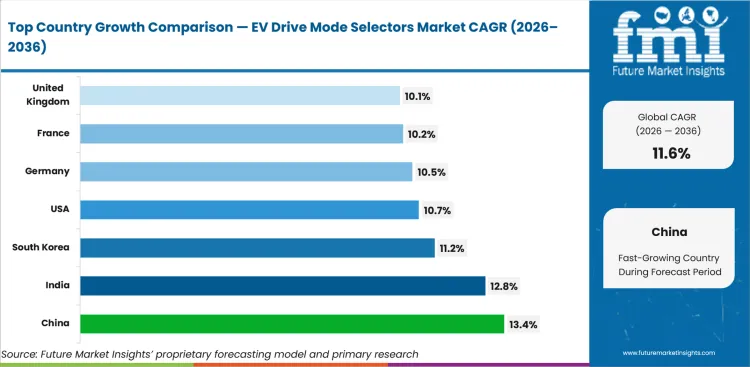
How do country-level CAGRs compare in the EV drive mode selectors market?
China records a notable country growth outlook. Japan shows a cautious expansion profile among the profiled markets.
- China is forecast to record 13.4% CAGR by 2036, supported by NEV production scale and domestic smart-cockpit programs.
- India is projected to grow at 12.8% CAGR by 2036, owing to EV localization and component qualification support.
- South Korea is expected to advance at 11.2% CAGR by 2036, attributable to domestic platform depth and export discipline.
- The United States is estimated to rise at 10.7% CAGR by 2036 due to large EV platforms needing validated mode control.
- Germany is projected to post 10.5% CAGR by 2036, supported by premium OEM validation and by-wire supplier depth.
- France is forecast to grow at 10.2% CAGR by 2036, driven by compact EV programs that require clear cabin controls.
- The United Kingdom is expected to record 10.1% CAGR by 2036, led by fleet EV specification and engineering support.
- Japan is projected to advance at 8.9% CAGR by 2036 due to hybrid platform continuity slowing pure BEV selector replacement.
How is China performing in the EV drive mode selectors market?
A 13.4% CAGR by 2036 reflects large NEV platform scale and faster smart-cockpit sourcing cycles.
Country Market Snapshot Table
| Parameter | Value |
|---|---|
| Market Size in 2025 (Value) | USD 149.9 million |
| Market Size in 2026 (Value) | USD 170.0 million |
| Market Forecast in 2036 (Value) | USD 597.8 million |
| CAGR (2026 to 2036) | 13.4% |
| Years Considered | 2021 to 2036 |
| Base Year | 2025 |
| Forecast Period | 2026 to 2036 |
| Units Considered | Value (USD million) |
| Leading Sub-Region | Yangtze River Delta and Guangdong EV clusters |
China EV Drive Mode Selectors Market Outlook
China's selector outlook is built around NEV platform scale. Smart-cockpit sourcing is more local than in many export markets. Domestic OEMs therefore judge rotary and stalk modules on launch timing and software handoff.
Key Growth Drivers
- NEV platform scale is expected to drive selector module nominations. China reported NEV production of 16.626 million units in 2025.
- Domestic NEV sales are expected to widen smart-cockpit sourcing. Official statistics placed 2025 NEV sales at 16.49 million units.
- Rural NEV campaigns are projected to broaden demand for lower-cost selector interfaces beyond large cities.
- Fast model cycles are likely to support touch and haptic trials across smart cockpit programs.
Key Restraints
- Price competition can compress selector-module margins. Official data showed NEV sales reached 46.7% of total new vehicle sales in the first ten months of 2025.
- Fast model refresh cycles can create late engineering changes for supplier validation teams.
- Local sourcing pressure can limit imported selector modules without cost or software advantages.
What makes China unique
China is unique due to large NEV platform scale and faster smart-cockpit sourcing cycles.
Key Companies
- BYD
- Desay SV Automotive
- Neusoft Reach
- Jingwei Hirain Technologies
- Joyson Electronics
- HASCO Automotive Electronics
Sales & Marketing Channels
- Local OEM sourcing teams
- Tier-1 module contracts
- Smart cockpit integrators
- Joint venture OEM programs
- Localized production bids
- Engineering center demonstrations
Country Segment Breakdown Table
| Segment | Sub-Segments |
|---|---|
| By Selector Type | Rotary Selectors · Push-button Selectors · Stalk Selectors · Touch / Haptic Selectors |
| By Vehicle Type | Battery EVs · Plug-in Hybrids · Hybrid Vehicles · Commercial EVs |
| By Function | Drive / Reverse Selection · Terrain / Performance Modes · Regenerative Braking Modes · Parking / Safety Lock |
| By Interface | Mechanical-electronic · Shift-by-wire · Software-defined / HMI |
| By Sales Channel | OEM · Tier-1 Integrated Module |
| Key Sub-Regions Covered, Urban Retail Clusters | Shanghai · Shenzhen · Guangzhou · Hefei · Chongqing · Wuhan |
Frequently Asked Questions
How fast is China EV drive mode selectors market growing?
Sales in China are forecast to scale at 13.4% CAGR from 2026 to 2036, guided by local EV platform activity.
Who leads China EV drive mode selectors market?
BYD and Desay SV Automotive compete on local manufacturing and vehicle electronics presence. Neusoft Reach and Jingwei Hirain Technologies also support local EV electronics programs.
What is driving adoption in China EV drive mode selectors market?
EV platform sourcing and validated driver-interface control are supporting adoption across OEM programs.
What supports EV drive mode selectors growth in India?
A 12.8% CAGR by 2036 reflects price-sensitive EV localization and newer supplier qualification programs.
Country Market Snapshot Table
| Parameter | Value |
|---|---|
| Market Size in 2025 (Value) | USD 33.7 million |
| Market Size in 2026 (Value) | USD 38.0 million |
| Market Forecast in 2036 (Value) | USD 126.7 million |
| CAGR (2026 to 2036) | 12.8% |
| Years Considered | 2021 to 2036 |
| Base Year | 2025 |
| Forecast Period | 2026 to 2036 |
| Units Considered | Value (USD million) |
| Leading Sub-Region | Tamil Nadu, Maharashtra, and NCR EV clusters |
India EV Drive Mode Selectors Market Outlook
India's EV drive mode selector industry growth is expected to be driven by passenger EV localization and commercial EV programs. Two-wheeler volume creates a limit for car-selector conversion. Passenger EV sourcing therefore favors low-cost rotary and push-button modules tied to warranty control.
Key Growth Drivers
- EV registration scale is expected to support local supplier qualification. NITI Aayog reported more than 6.5 million EVs operating on Indian roads by June 2025.
- Policy support is projected to strengthen component localization. PIB reported more than one million EV sales in financial year 2024-25.
- Passenger EV launches are likely to favor simple rotary and push-button controls due to lower warranty exposure.
- Commercial EV fleets are expected to support durable direction switches and clear park-lock feedback.
Key Restraints
- Two-wheelers dominate EV volume and limit direct car-selector conversion. NITI Aayog reported EVs were 7.7% of new vehicle sales in 2024.
- Passenger EV buyers remain price-sensitive and can favor low-cost mechanical-electronic controls.
- Charging and service gaps outside major clusters can slow premium EV trim rollout.
What makes India unique
India is unique due to price-sensitive EV localization and newer supplier qualification programs.
Key Companies
- Minda Corporation
- Uno Minda
- Tata AutoComp Systems
- Sona Comstar
- Bosch India
- Varroc Engineering
Sales & Marketing Channels
- OEM localization programs
- Tier-1 supplier nominations
- Commercial fleet procurement
- State EV manufacturing clusters
- Dealer network feedback
- Cost-down engineering workshops
Country Segment Breakdown Table
| Segment | Sub-Segments |
|---|---|
| By Selector Type | Rotary Selectors · Push-button Selectors · Stalk Selectors · Touch / Haptic Selectors |
| By Vehicle Type | Battery EVs · Plug-in Hybrids · Hybrid Vehicles · Commercial EVs |
| By Function | Drive / Reverse Selection · Terrain / Performance Modes · Regenerative Braking Modes · Parking / Safety Lock |
| By Interface | Mechanical-electronic · Shift-by-wire · Software-defined / HMI |
| By Sales Channel | OEM · Tier-1 Integrated Module |
| Key Sub-Regions Covered, Urban Retail Clusters | Chennai · Pune · NCR · Bengaluru · Sanand · Hosur |
Frequently Asked Questions
How fast is India EV drive mode selectors market growing?
Sales in India are forecast to scale at 12.8% CAGR from 2026 to 2036, guided by local EV platform activity.
Who leads India EV drive mode selectors market?
Minda Corporation and Uno Minda compete on local manufacturing and vehicle electronics presence. Tata AutoComp Systems and Sona Comstar support regional EV supplier programs.
What is driving adoption in India EV drive mode selectors market?
EV platform sourcing and validated driver-interface control are supporting adoption across OEM programs.
How is the EV drive mode selectors forecast developing in South Korea?
An 11.2% CAGR by 2036 reflects Hyundai and Kia platform concentration and export program discipline.
Country Market Snapshot Table
| Parameter | Value |
|---|---|
| Market Size in 2025 (Value) | USD 36.0 million |
| Market Size in 2026 (Value) | USD 40.0 million |
| Market Forecast in 2036 (Value) | USD 115.6 million |
| CAGR (2026 to 2036) | 11.2% |
| Years Considered | 2021 to 2036 |
| Base Year | 2025 |
| Forecast Period | 2026 to 2036 |
| Units Considered | Value (USD million) |
| Leading Sub-Region | Seoul Capital Area and Ulsan vehicle clusters |
South Korea EV Drive Mode Selectors Market Outlook
South Korea's outlook is influenced by key players such as Hyundai and Kia platform concentration. Export programs keep selector requirements tied to global safety and interface rules. Domestic electronics suppliers can integrate selector input, cluster signals and body-control functions.
Key Growth Drivers
- EV output is expected to support local selector sourcing. The U.S. International Trade Administration reported Korea produced 407,009 EVs in 2025.
- EV manufacturing share is expected to lift module qualification work. The same source placed EVs at 11% of Korea’s total automobile production in 2025.
- Hyundai and Kia platform depth is likely to sustain repeat interface nominations across domestic and export models.
- Domestic electronics capability is expected to support integrated selectors for cluster and body-control systems.
Key Restraints
- Export program exposure can make selector specifications dependent on overseas safety and user-interface rules. The U.S. International Trade Administration recorded 19% annual EV market growth from 2020 to 2024.
- High OEM concentration can limit negotiation room for smaller domestic interface suppliers.
- Conservative validation cycles may slow new touch and haptic selector adoption.
What makes South Korea unique
South Korea is unique due to Hyundai and Kia platform concentration and export program discipline.
Key Companies
- Hyundai Mobis
- HL Mando
- Hyundai Kefico
- LG Electronics Vehicle Solutions
- SL Corporation
- Korea Electric Terminal
Sales & Marketing Channels
- Hyundai and Kia sourcing routes
- Domestic Tier-1 panels
- Export platform bids
- Electronics module integrators
- Design-center demonstrations
- Safety validation support
Country Segment Breakdown Table
| Segment | Sub-Segments |
|---|---|
| By Selector Type | Rotary Selectors · Push-button Selectors · Stalk Selectors · Touch / Haptic Selectors |
| By Vehicle Type | Battery EVs · Plug-in Hybrids · Hybrid Vehicles · Commercial EVs |
| By Function | Drive / Reverse Selection · Terrain / Performance Modes · Regenerative Braking Modes · Parking / Safety Lock |
| By Interface | Mechanical-electronic · Shift-by-wire · Software-defined / HMI |
| By Sales Channel | OEM · Tier-1 Integrated Module |
| Key Sub-Regions Covered, Urban Retail Clusters | Seoul · Ulsan · Hwaseong · Gwangmyeong · Daegu · Busan |
Frequently Asked Questions
How fast is South Korea EV drive mode selectors market growing?
Sales in South Korea are forecast to scale at 11.2% CAGR from 2026 to 2036, guided by local EV platform activity.
Who leads South Korea EV drive mode selectors market?
Hyundai Mobis and HL Mando compete on local manufacturing and vehicle electronics presence. Hyundai Kefico and LG Electronics Vehicle Solutions support regional control-system programs.
What is driving adoption in South Korea EV drive mode selectors market?
EV platform sourcing and validated driver-interface control are supporting adoption across OEM programs.
How fast is the EV drive mode selectors market growing in the United States?
A 10.7% CAGR by 2036 reflects pickup and SUV programs that need terrain-mode logic.
Country Market Snapshot Table
| Parameter | Value |
|---|---|
| Market Size in 2025 (Value) | USD 86.7 million |
| Market Size in 2026 (Value) | USD 96.0 million |
| Market Forecast in 2036 (Value) | USD 265.3 million |
| CAGR (2026 to 2036) | 10.7% |
| Years Considered | 2021 to 2036 |
| Base Year | 2025 |
| Forecast Period | 2026 to 2036 |
| Units Considered | Value (USD million) |
| Leading Sub-Region | Detroit and California EV program corridors |
United States EV Drive Mode Selectors Market Outlook
The United States outlook is anchored in high-value EV pickups and SUVs. Selector value is concentrated beyond basic direction choice. Tow modes and terrain modes make tactile confirmation important for larger cabins.
Key Growth Drivers
- Large EV platform volume is expected to support selector sourcing. Argonne National Laboratory recorded approximately 1.5 million plug-in electric vehicles sold in 2025.
- Public charging buildout is expected to reinforce EV model planning. The U.S. Department of Energy counted more than 60,000 public charging stations in 2024.
- Electric pickups are projected to raise demand for terrain and tow mode controls in higher-value cabins.
- Federal shift-control requirements are expected to keep validated interlock systems in supplier qualification discussions.
Key Restraints
- EV sales volatility can tighten price negotiation. Argonne National Laboratory reported 2025 plug-in electric vehicle sales fell 4% from 2024.
- Touch-only selectors may face safety review pressure in large vehicles that need quick state confirmation.
- Platform timing can shift due to incentive and trade-policy changes across lower-cost EV programs.
What makes United States unique
The United States is unique due to pickup and SUV EV programs that need terrain-mode logic.
Key Companies
- Methode Electronics
- Aptiv
- CTS Corporation
- Stoneridge
- BorgWarner
- TE Connectivity
Sales & Marketing Channels
- OEM platform sourcing
- Tier-1 module integration
- Detroit engineering center engagement
- EV startup sourcing teams
- Dealer feedback loops
- Safety validation partnerships
Country Segment Breakdown Table
| Segment | Sub-Segments |
|---|---|
| By Selector Type | Rotary Selectors · Push-button Selectors · Stalk Selectors · Touch / Haptic Selectors |
| By Vehicle Type | Battery EVs · Plug-in Hybrids · Hybrid Vehicles · Commercial EVs |
| By Function | Drive / Reverse Selection · Terrain / Performance Modes · Regenerative Braking Modes · Parking / Safety Lock |
| By Interface | Mechanical-electronic · Shift-by-wire · Software-defined / HMI |
| By Sales Channel | OEM · Tier-1 Integrated Module |
| Key Sub-Regions Covered, Urban Retail Clusters | Detroit · California · Texas · Tennessee · Ohio · South Carolina |
Frequently Asked Questions
How fast is United States EV drive mode selectors market growing?
Sales in the United States are forecast to scale at 10.7% CAGR from 2026 to 2036, guided by local EV platform activity.
Who leads United States EV drive mode selectors market?
Methode Electronics and Aptiv compete on local manufacturing and vehicle electronics presence. CTS Corporation and Stoneridge support regional automotive control programs.
What is driving adoption in United States EV drive mode selectors market?
EV platform sourcing and validated driver-interface control are supporting adoption across OEM programs.
What is shaping EV drive mode selectors demand in Germany?
A 10.5% CAGR by 2036 reflects premium OEM validation standards and deep by-wire supplier capability.
Country Market Snapshot Table
| Parameter | Value |
|---|---|
| Market Size in 2025 (Value) | USD 54.3 million |
| Market Size in 2026 (Value) | USD 60.0 million |
| Market Forecast in 2036 (Value) | USD 162.8 million |
| CAGR (2026 to 2036) | 10.5% |
| Years Considered | 2021 to 2036 |
| Base Year | 2025 |
| Forecast Period | 2026 to 2036 |
| Units Considered | Value (USD million) |
| Leading Sub-Region | Bavaria and Baden-Wuerttemberg OEM clusters |
Germany EV Drive Mode Selectors Market Outlook
Germany's outlook is shaped by premium OEM validation and supplier depth. Supplier competition is more demanding than in cost-led markets. Bosch and ZF compete alongside Continental and Preh in a supplier base that must prove haptic feel and functional safety. This keeps automotive actuator systems relevant to selector command execution.
Key Growth Drivers
- BEV registrations are expected to support selector program volume. ACEA reported Germany’s battery-electric car registrations rose 43.2% in 2025.
- German supplier depth is expected to support by-wire validation. Continental implemented a cross-domain vehicle computer in May 2024.
- Premium EV cabins are likely to favor rotary and haptic controls that give clearer state confirmation.
- Early Tier-1 nominations are expected to keep selector design tied to platform electrical architecture.
Key Restraints
- Incentive uncertainty can slow EV orders among private buyers. ACEA reported EU new car registrations rose only 1.8% in 2025.
- Premium validation cycles can lengthen nomination timing for new haptic selector designs.
- High engineering expectations may exclude smaller suppliers without functional safety evidence.
What makes Germany unique
Germany is unique due to premium OEM validation standards and deep by-wire supplier capability.
Key Companies
- Bosch Mobility
- ZF Friedrichshafen
- Continental Automotive
- Preh GmbH
- KOSTAL Automobil Elektrik
- Marquardt Group
Sales & Marketing Channels
- OEM engineering centers
- Tier-1 validation programs
- Premium cabin design reviews
- By-wire integration bids
- Supplier technical workshops
- Functional safety audits
Country Segment Breakdown Table
| Segment | Sub-Segments |
|---|---|
| By Selector Type | Rotary Selectors · Push-button Selectors · Stalk Selectors · Touch / Haptic Selectors |
| By Vehicle Type | Battery EVs · Plug-in Hybrids · Hybrid Vehicles · Commercial EVs |
| By Function | Drive / Reverse Selection · Terrain / Performance Modes · Regenerative Braking Modes · Parking / Safety Lock |
| By Interface | Mechanical-electronic · Shift-by-wire · Software-defined / HMI |
| By Sales Channel | OEM · Tier-1 Integrated Module |
| Key Sub-Regions Covered, Urban Retail Clusters | Bavaria · Baden-Wuerttemberg · Lower Saxony · North Rhine-Westphalia · Saxony · Hesse |
Frequently Asked Questions
How fast is Germany EV drive mode selectors market growing?
Sales in Germany are forecast to scale at 10.5% CAGR from 2026 to 2036, guided by local EV platform activity.
Who leads Germany EV drive mode selectors market?
Bosch Mobility and ZF Friedrichshafen compete on local engineering depth. Continental Automotive and Preh GmbH support cockpit electronics and HMI production programs.
What is driving adoption in Germany EV drive mode selectors market?
EV platform sourcing and validated driver-interface control are supporting adoption across OEM programs.
How does France compare in the EV drive mode selectors market?
A 10.2% CAGR by 2036 reflects compact EV programs and a supplier base focused on cockpit electronics.
Country Market Snapshot Table
| Parameter | Value |
|---|---|
| Market Size in 2025 (Value) | USD 28.1 million |
| Market Size in 2026 (Value) | USD 31.0 million |
| Market Forecast in 2036 (Value) | USD 81.9 million |
| CAGR (2026 to 2036) | 10.2% |
| Years Considered | 2021 to 2036 |
| Base Year | 2025 |
| Forecast Period | 2026 to 2036 |
| Units Considered | Value (USD million) |
| Leading Sub-Region | Ile-de-France and Auvergne-Rhone-Alpes supplier clusters |
France EV Drive Mode Selectors Market Outlook
Demand in France is supported by compact EV programs and fleet-friendly cabins. Compact platforms make control simplicity more important than premium console content. Valeo and Forvia therefore need selector designs that reduce handover friction in fleet use.
Key Growth Drivers
- Electrified vehicle share is expected to support selector demand. EAFO reported France reached 31.3% electrified vehicle share in December 2025.
- Battery-electric uptake is expected to support compact EV programs. EAFO placed France’s BEV share at 22.4% in December 2025.
- Local cockpit-electronics suppliers are likely to shape selector choices across compact and mid-size EVs.
- Fleet and leasing channels are projected to favor interfaces that reduce driver handover time.
Key Restraints
- Total vehicle market softness can restrain EV module awards. EAFO reported France had a 6% decline in total new vehicle registrations in April 2025.
- Budget EV programs can favor basic stalk selectors over higher-cost haptic modules.
- Interface suppliers must adapt to compact cabin layouts without adding driver confusion.
What makes France unique
France is unique due to compact EV programs and a supplier base focused on cockpit electronics.
Key Companies
- Valeo
- Forvia
- Renault Group
- Stellantis France
- ACTIA Group
- OPmobility
Sales & Marketing Channels
- OEM platform sourcing
- Tier-1 cockpit electronics bids
- Compact EV program nominations
- Fleet specification reviews
- Engineering services channels
- Dealer feedback programs
Country Segment Breakdown Table
| Segment | Sub-Segments |
|---|---|
| By Selector Type | Rotary Selectors · Push-button Selectors · Stalk Selectors · Touch / Haptic Selectors |
| By Vehicle Type | Battery EVs · Plug-in Hybrids · Hybrid Vehicles · Commercial EVs |
| By Function | Drive / Reverse Selection · Terrain / Performance Modes · Regenerative Braking Modes · Parking / Safety Lock |
| By Interface | Mechanical-electronic · Shift-by-wire · Software-defined / HMI |
| By Sales Channel | OEM · Tier-1 Integrated Module |
| Key Sub-Regions Covered, Urban Retail Clusters | Ile-de-France · Auvergne-Rhone-Alpes · Hauts-de-France · Grand Est · Normandy · Occitanie |
Frequently Asked Questions
How fast is France EV drive mode selectors market growing?
Sales in France are forecast to scale at 10.2% CAGR from 2026 to 2036, guided by local EV platform activity.
Who leads France EV drive mode selectors market?
Valeo and Forvia compete on local manufacturing and engineering presence. Renault Group and Stellantis France support the local EV platform base.
What is driving adoption in France EV drive mode selectors market?
EV platform sourcing and validated driver-interface control are supporting adoption across OEM programs.
What is the EV drive mode selectors market outlook in the United Kingdom?
A 10.1% CAGR by 2036 reflects fleet-led EV specification and engineering-service influence.
Country Market Snapshot Table
| Parameter | Value |
|---|---|
| Market Size in 2025 (Value) | USD 23.6 million |
| Market Size in 2026 (Value) | USD 26.0 million |
| Market Forecast in 2036 (Value) | USD 68.1 million |
| CAGR (2026 to 2036) | 10.1% |
| Years Considered | 2021 to 2036 |
| Base Year | 2025 |
| Forecast Period | 2026 to 2036 |
| Units Considered | Value (USD million) |
| Leading Sub-Region | Midlands and South East engineering corridors |
United Kingdom EV Drive Mode Selectors Market Outlook
The United Kingdom outlook is shaped by ZEV compliance and fleet channels. Fleet buyers need controls that are easy to explain across shared vehicles. Push-button and stalk selectors are better suited to company-car and delivery fleets than touch-only layouts.
Key Growth Drivers
- ZEV compliance rules are expected to keep EV models in OEM planning. UK guidance set the 2026 non-ZEV car target at 67%.
- Fleet specification is expected to lift simple selector interfaces. Government vehicle trading guidance retained separate car and van compliance schemes in 2025.
- Urban delivery fleets are likely to support durable drive and park controls for high-use vehicles.
- Company-car channels are expected to bring selector decisions into repeat fleet procurement.
Key Restraints
- Charging access can limit private EV adoption outside dense corridors. Government toolkit guidance shows Level 1 charging can take 40 to 50 hours for a BEV to reach 80%.
- Fleet buyers may avoid unusual interfaces that raise driver handover time across shared vehicles.
- Local supplier depth remains narrower than Germany or Japan for direct selector-module production.
What makes United Kingdom unique
The United Kingdom is unique due to fleet-led EV specification and engineering-service influence.
Key Companies
- Jaguar Land Rover
- Aptiv UK
- Bosch UK
- ZF Automotive UK
- Continental Automotive UK
- Ricardo
Sales & Marketing Channels
- Fleet leasing companies
- OEM corporate sales
- Dealer fleet desks
- Urban delivery procurement
- Tier-1 engineering support
- Vehicle conversion partners
Country Segment Breakdown Table
| Segment | Sub-Segments |
|---|---|
| By Selector Type | Rotary Selectors · Push-button Selectors · Stalk Selectors · Touch / Haptic Selectors |
| By Vehicle Type | Battery EVs · Plug-in Hybrids · Hybrid Vehicles · Commercial EVs |
| By Function | Drive / Reverse Selection · Terrain / Performance Modes · Regenerative Braking Modes · Parking / Safety Lock |
| By Interface | Mechanical-electronic · Shift-by-wire · Software-defined / HMI |
| By Sales Channel | OEM · Tier-1 Integrated Module |
| Key Sub-Regions Covered, Urban Retail Clusters | West Midlands · South East England · North West England · Wales · Scotland · London corridor |
Frequently Asked Questions
How fast is United Kingdom EV drive mode selectors market growing?
Sales in the United Kingdom are forecast to scale at 10.1% CAGR from 2026 to 2036, guided by local EV platform activity.
Who leads United Kingdom EV drive mode selectors market?
Jaguar Land Rover and Aptiv UK support local vehicle electronics programs. Bosch UK and ZF Automotive UK add engineering and control-system capability.
What is driving adoption in United Kingdom EV drive mode selectors market?
EV platform sourcing and validated driver-interface control are supporting adoption across OEM programs.
How is Japan performing in the EV drive mode selectors market?
An 8.9% CAGR by 2036 reflects hybrid interface experience and strict driver-feedback expectations.
Country Market Snapshot Table
| Parameter | Value |
|---|---|
| Market Size in 2025 (Value) | USD 43.2 million |
| Market Size in 2026 (Value) | USD 47.0 million |
| Market Forecast in 2036 (Value) | USD 110.2 million |
| CAGR (2026 to 2036) | 8.9% |
| Years Considered | 2021 to 2036 |
| Base Year | 2025 |
| Forecast Period | 2026 to 2036 |
| Units Considered | Value (USD million) |
| Leading Sub-Region | Aichi and Kanto vehicle electronics clusters |
Japan EV Drive Mode Selectors Market Outlook
Japan industry is propelled by clean vehicle subsidies and strict driver-feedback expectations. Hybrid experience gives domestic suppliers useful interface know-how. Companies therefore need to balance tactile precision against compact cabin constraints.
Key Growth Drivers
- Clean vehicle subsidies are expected to support EV platform planning. METI listed a maximum EV subsidy of 850,000 yen for eligible vehicles in June 2024.
- Light automobile EV support is expected to broaden compact cabin requirements. METI set the light EV subsidy ceiling at 550,000 yen in June 2024.
- Hybrid experience is likely to support electronic selector know-how across Japanese Tier-1 suppliers.
- Reliability testing discipline is expected to favor tactile controls over unclear screen-only commands.
Key Restraints
- Compact vehicle price sensitivity can hold back premium selector content. METI subsidy rules apply only to vehicles registered on or after April 1, 2024.
- Hybrid platform continuity may delay pure BEV selector redesign in some model lines.
- Driver-feedback expectations can slow touch-only control adoption in mainstream vehicles.
What makes Japan unique
Japan is unique due to hybrid interface experience and strict driver-feedback expectations.
Key Companies
- Denso
- Tokai Rika
- Toyodenso
- Alps Alpine
- Yazaki
- Sumitomo Wiring Systems
Sales & Marketing Channels
- OEM platform sourcing
- Domestic Tier-1 qualification
- Kei vehicle program sourcing
- Dealer feedback channels
- Reliability testing partnerships
- Hybrid system engineering reviews
Country Segment Breakdown Table
| Segment | Sub-Segments |
|---|---|
| By Selector Type | Rotary Selectors · Push-button Selectors · Stalk Selectors · Touch / Haptic Selectors |
| By Vehicle Type | Battery EVs · Plug-in Hybrids · Hybrid Vehicles · Commercial EVs |
| By Function | Drive / Reverse Selection · Terrain / Performance Modes · Regenerative Braking Modes · Parking / Safety Lock |
| By Interface | Mechanical-electronic · Shift-by-wire · Software-defined / HMI |
| By Sales Channel | OEM · Tier-1 Integrated Module |
| Key Sub-Regions Covered, Urban Retail Clusters | Aichi · Tokyo · Kanagawa · Shizuoka · Hiroshima · Fukuoka |
Frequently Asked Questions
How fast is Japan EV drive mode selectors market growing?
Sales in Japan are forecast to scale at 8.9% CAGR from 2026 to 2036, guided by local EV platform activity.
Who leads Japan EV drive mode selectors market?
Denso and Tokai Rika compete on local manufacturing and vehicle electronics presence. Toyodenso and Alps Alpine support interface and control-product depth.
What is driving adoption in Japan EV drive mode selectors market?
EV platform sourcing and validated driver-interface control are supporting adoption across OEM programs.
Who are the leading companies in the EV drive mode selectors market?
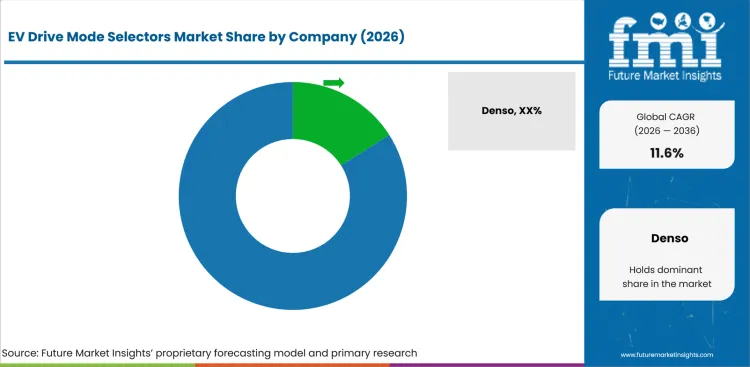
Denso, Tokai Rika, Ficosa, Bosch. ZF, Continental, and Methode Electronics are some of the key players
- Direct selector suppliers compete on shift-by-wire know-how and OEM validation history.
- Motion-control suppliers gain influence due to by-wire systems that interpret vehicle state commands.
- Cockpit electronics suppliers improve access by combining selector input and display or lighting cues.
- Regional suppliers win nominations by using localized production that lowers cost and shortens engineering response time.
How do top EV drive mode selectors companies compare?
Denso and Tokai Rika score better on direct selector depth. Bosch and ZF focus more on adjacent vehicle control integration.
| Company | Shift-by-wire Module Depth | HMI Integration Capability | Functional Safety Validation | Geographic Footprint |
|---|---|---|---|---|
| Denso | High | Medium | Strong | Global |
| Tokai Rika | High | High | Strong | Japan, Asia, Global |
| Ficosa | High | Medium | Strong | Europe, Asia, Americas |
| Bosch Mobility | Medium | High | Strong | Global |
| ZF Friedrichshafen | Medium | High | Strong | Global |
| Continental Automotive | Medium | High | Strong | Global |
| Methode Electronics | Medium | High | Moderate | North America, Europe, Asia |
| Minda Corporation | Low | Medium | Moderate | India, Asia |
Source: Future Market Insights competitive analysis, 2026.
Who are the key players in the EV drive mode selectors market?
Direct selector suppliers are listed alongside motion-control and cockpit electronics suppliers.
Key global companies leading the EV drive mode selectors market include:
- Denso
- Tokai Rika
- Ficosa
- Bosch Mobility
- ZF Friedrichshafen
- Continental Automotive
- Aptiv
- Methode Electronics
- Minda Corporation
- Preh GmbH
Key Developments in EV Drive Mode Selectors Market
- In May 2024, Continental implemented a cross-domain high-performance computer that hosted cockpit and vehicle functions in one car application.
- In July 2024, ZF expanded its cubiX vehicle motion control portfolio to commercial vehicles and added new functions for passenger cars.
- In March 2026, Minda Corporation and Turntide formed a joint venture to develop new-generation EV powertrain solutions for India.
Key Players in the EV Drive Mode Selectors Market
Direct Selector and Shift-by-wire Suppliers
- Denso
- Tokai Rika
- Ficosa
- KOSTAL Automobil Elektrik
- Preh GmbH
Motion Control and Cockpit Electronics Companies
- Bosch Mobility
- ZF Friedrichshafen
- Continental Automotive
- Aptiv
- Valeo
- Forvia
Interface and Regional Control Suppliers
- Methode Electronics
- Minda Corporation
- Uno Minda
- Marquardt Group
- Desay SV Automotive
- Hyundai Mobis
EV Drive Mode Selectors Market - Report Scope
| Report Attribute | Details |
|---|---|
| Forecast period | 2026 to 2036 |
| Historical period | 2021 to 2025 |
| Quantitative unit | Value in USD million |
| Segmentation by Selector Type | Rotary Selectors, Push-button Selectors, Stalk Selectors, Touch / Haptic Selectors |
| Segmentation by Vehicle Type | Battery EVs, Plug-in Hybrids, Hybrid Vehicles, Commercial EVs |
| Segmentation by Function | Drive / Reverse Selection, Terrain / Performance Modes, Regenerative Braking Modes, Parking / Safety Lock |
| Segmentation by Interface | Mechanical-electronic, Shift-by-wire, Software-defined / HMI |
| Segmentation by Sales Channel | OEM and Tier-1 Integrated Module |
| Regions covered | North America, Latin America, Europe, East Asia, South Asia and Pacific, Middle East and Africa |
| Countries covered | United States, United Kingdom, Germany, France, Japan, China, South Korea, and India |
| Key companies profiled | Denso, Tokai Rika, Ficosa, Bosch, ZF, Continental, Aptiv, Methode Electronics, and Minda Corporation |
| Approach | FMI estimates based on EV platform volume, selector content per vehicle, interface mix, supplier validation checks, and country sourcing patterns |
Source: Future Market Insights, 2026.
EV Drive Mode Selectors Market - Scope & Definition
| Scope Item | Definition |
|---|---|
| Market Definition | Driver-interface modules that select direction, drive states, terrain modes, regenerative braking levels, or park lock functions in electrified vehicles. |
| Functions Covered | Drive / Reverse Selection, Terrain / Performance Modes, Regenerative Braking Modes, and Parking / Safety Lock. |
| Applications Covered | Battery EVs, plug-in hybrids, hybrid vehicles, and commercial EVs. |
| End-Use Industries | Passenger vehicles, light commercial vehicles, fleet EVs, and OEM platform programs. |
| Grades Covered | Mechanical-electronic selectors, shift-by-wire selectors, and software-defined or HMI-linked selectors. |
| Inclusions | Rotary selectors, push-button selectors, stalk selectors, touch selectors, haptic selectors, and Tier-1 integrated modules. |
| Exclusions | Manual transmission shifters, ICE-only selector cables, aftermarket decorative knobs, steering paddles without EV drive-state control, and infotainment-only menus. |
EV Drive Mode Selectors Market - Research Methodology
| Methodology Item | Approach |
|---|---|
| Primary Research | FMI analysts reviewed inputs from EV program managers, cockpit electronics suppliers, Tier-1 interface designers, and vehicle control engineers. |
| Desk Research | Desk research covered safety rules, EV sales data, vehicle electronics standards, official company pages, and supplier product portfolios. |
| Market Sizing & Forecasting | The model combined EV production outlook, selector content per vehicle, average module pricing, interface mix, and country platform activity. |
| Data Validation | Forecasts were checked against EV sales trends, vehicle electronics adoption, by-wire interface evidence, and company portfolio relevance. |
EV Drive Mode Selectors Market Breakdown by Selector Type, Vehicle Type, Function, Interface, Sales Channel, and Region
EV Drive Mode Selectors Market Segmented by Selector Type:
- Rotary Selectors
- Push-button Selectors
- Stalk Selectors
- Touch / Haptic Selectors
EV Drive Mode Selectors Market Segmented by Vehicle Type:
- Battery EVs
- Plug-in Hybrids
- Hybrid Vehicles
- Commercial EVs
EV Drive Mode Selectors Market Segmented by Function:
- Drive / Reverse Selection
- Terrain / Performance Modes
- Regenerative Braking Modes
- Parking / Safety Lock
EV Drive Mode Selectors Market Segmented by Interface:
- Mechanical-electronic
- Shift-by-wire
- Software-defined / HMI
EV Drive Mode Selectors Market Segmented by Sales Channel:
- OEM
- Tier-1 Integrated Module
EV Drive Mode Selectors Market by Region:
- North America
- Latin America
- Europe
- East Asia
- South Asia and Pacific
- Middle East and Africa
Research Sources and Bibliography
- International Energy Agency. (2026, May). Trends in electric cars: Global EV Outlook 2026. International Energy Agency.
- International Energy Agency. (2025, April). Trends in electric car markets: Global EV Outlook 2025. International Energy Agency.
- European Automobile Manufacturers’ Association. (2026, April 23). New car registrations: +4% in Q1 2026; battery-electric 19.4% market share. ACEA.
- Argonne National Laboratory. (2026). Light duty electric drive vehicles monthly sales updates. Argonne National Laboratory.
- U.S. Department of Energy. (2025). Electric vehicle benefits and considerations. Alternative Fuels Data Center.
- U.S. Department of Transportation. (2025, January 31). Charger types and speeds. Rural EV Toolkit.
- UK Department for Transport. (2025, November 19). The vehicle emissions trading schemes: How to comply. GOV.UK.
- European Alternative Fuels Observatory. (2026, January 21). France’s EV market in 2025: Renewed momentum and a growing fleet. European Commission.
- European Alternative Fuels Observatory. (2025, April). France’s BEV market gains momentum in April 2025 as Renault leads the charge. European Commission.
- Agency for Natural Resources and Energy. (2024, June 24). Subsidies upgraded for the purchase of clean energy vehicles. Ministry of Economy, Trade and Industry.
- The State Council of the People’s Republic of China. (2026, January 14). China’s auto output, sales reach new highs in 2025.
- The State Council of the People’s Republic of China. (2025, June 3). China launches NEV promotional campaigns in rural regions.
- U.S. International Trade Administration. (2025, July 21). South Korea electric vehicles EV market. U.S. Department of Commerce.
- NITI Aayog. (2025, August). Electric vehicles in India: Unlocking a $200 billion opportunity. Government of India.
- NITI Aayog. (2025, August). India electric mobility index 2024. Government of India.
- Press Information Bureau. (2025, April 1). The Ministry of Heavy Industries has successfully achieved sales of more than one million EVs in this financial year 2024-25. Government of India.
- Continental AG. (2024, May 13). Continental implements pioneering cross-domain high-performance computer.
- ZF Friedrichshafen AG. (2024, July 2). The new nerve center: ZF expands its cubiX vehicle motion control portfolio to commercial vehicles.
- Turntide Technologies. (2026, March 10). Minda & Turntide form joint venture.
- Ficosa International S.A. (2026). Shift by wire: SbW.
- KOSTAL Automobil Elektrik GmbH & Co. KG. (2026). Drive controls.
- Marquardt Group. (2026). Switch portfolio for every industry.
- Spark Minda. (2025, June 11). Minda Corporation forms joint venture with Toyodenso of Japan for automotive switches.
This bibliography is provided for reader reference and supports the statistics and company developments used in the report.
This Report Answers
- The report provides market size estimates for 2026 and forecasts for the 2026 to 2036 period for the EV drive mode selectors market.
- Insights across regional and country-level EV selector demand patterns.
- Analysis of demand drivers and vehicle platform behavior affecting selector qualification requirements.
- The report evaluates selector type and vehicle type segments and reviews function and interface segments.
- Assessment of safety validation and by-wire integration risks affecting market development.
- Identification of growth opportunities across rotary and touch selector formats.
- Evaluation of competitive conditions across direct selector suppliers and adjacent motion-control companies.
- Country-level growth analysis covering China; India; South Korea; the United States; Germany; France; the United Kingdom; and Japan.
- Assessment of local and regional company presence in each profiled country.
- Analysis of report scope and methodology used for the market forecast.
- Regional outlooks across North America; Europe; East Asia; South Asia and Pacific; Latin America; and Middle East and Africa.
- Delivery of market data and supporting analysis in Microsoft Word format.
Frequently Asked Questions
What is the growth prospect for EV drive mode selectors?
Demand for EV drive mode selectors is expected to rise with wider use of electronic direction control and software-defined cabin interfaces in EV platforms.
Which companies are expected to shape the EV drive mode selectors market?
Denso and Tokai Rika are expected to shape supplier competition with Ficosa and Bosch. ZF, Continental and Methode Electronics also influence integration decisions.
Why are OEM channels important in the EV drive mode selectors market?
OEM channels matter through early platform specification and cockpit architecture fit.
Which selector formats are gaining attention in EV drive mode selectors?
Rotary and stalk selector formats are gaining attention while OEMs balance cabin space with driver confirmation.
How do safety rules influence EV drive mode selector launches?
Safety rules influence selector launches by requiring clear direction state and interlock behavior.
Why is shift-by-wire important for EV drive mode selectors?
Shift-by-wire matters by replacing mechanical linkage with electronic signals for flexible EV cabin layouts.
How do country markets differ in EV drive mode selectors?
China and India offer faster platform growth. Germany and Japan influence validation and interface standards.
Why do local companies matter in country sections?
Local companies matter through engineering support near vehicle plants and faster change handling.
Preview the report firsthand - request a free sample
Get SampleGet the brochure for pricing and purchase details.
Get PDFTable of Content
- Key Takeaways
- Market Size and CAGR
- Top Growth Driver
- Fastest Growing Segment
- Leading Region
- Key Companies
- Emerging Opportunities
- Executive Summary
- Global Market Outlook
- Demand-side Trends
- Supply-side Trends
- Technology Roadmap Analysis
- Analysis and Recommendations
- Analyst Perspective (What is happening? Why now? What should investors know?)
- Key Questions Answered
- How large is the market?
- What is the CAGR?
- What are key trends?
- Which region dominates?
- Who are the leaders?
- Market Overview
- Market Coverage / Taxonomy
- Market Definition / Scope / Limitations
- Research Methodology
- Chapter Orientation
- Analytical Lens and Working Hypotheses
- Market Structure, Signals, and Trend Drivers
- Benchmarking and Cross-market Comparability
- Market Sizing, Forecasting, and Opportunity Mapping
- Research Design and Evidence Framework
- Desk Research Programme (Secondary Evidence)
- Expert Input and Fieldwork (Primary Evidence)
- Tooling, Models, and Reference Databases
- Data Engineering and Model Build
- Quality Assurance and Audit Trail
- Market Background
- Market Dynamics (Drivers, Restraints, Opportunity, Trends)
- Scenario Forecast (Optimistic, Likely, Conservative)
- Impact Analysis
- AI Impact
- Sustainability Impact
- Regulatory Impact
- Technology Impact
- Consumer / Buyer Analysis
- Purchase Drivers
- Adoption Barriers
- Buyer Journey
- Opportunity Map Analysis
- Product Life Cycle Analysis
- Supply Chain Analysis
- Investment Feasibility Matrix
- Value Chain Analysis
- PESTLE and Porter's Analysis
- Regulatory Landscape
- Regional Parent Market Outlook
- Production and Consumption Statistics
- Import and Export Statistics
- Global Market Analysis and Forecast, 2021 to 2036
- Historical Market Size Value (USD Million) Analysis, 2021 to 2025
- Current and Future Market Size Value (USD Million) Projections, 2026 to 2036
- Y-o-Y Growth Trend Analysis
- Absolute $ Opportunity Analysis
- Global Market Pricing Analysis, 2021 to 2036
- Global Market Analysis and Forecast, By Selector Type, 2021 to 2036
- Introduction / Key Findings
- Historical Market Size Value (USD Million) Analysis By Selector Type, 2021 to 2025
- Current and Future Market Size Value (USD Million) Analysis and Forecast By Selector Type, 2026 to 2036
- Rotary Selectors
- Push-button Selectors
- Stalk Selectors
- Rotary Selectors
- Y-o-Y Growth Trend Analysis By Selector Type, 2021 to 2025
- Absolute $ Opportunity Analysis By Selector Type, 2026 to 2036
- Global Market Analysis and Forecast, By Vehicle Type, 2021 to 2036
- Introduction / Key Findings
- Historical Market Size Value (USD Million) Analysis By Vehicle Type, 2021 to 2025
- Current and Future Market Size Value (USD Million) Analysis and Forecast By Vehicle Type, 2026 to 2036
- Battery EVs
- Plug-in Hybrids
- Hybrid Vehicles
- Battery EVs
- Y-o-Y Growth Trend Analysis By Vehicle Type, 2021 to 2025
- Absolute $ Opportunity Analysis By Vehicle Type, 2026 to 2036
- Global Market Analysis and Forecast, By Function, 2021 to 2036
- Introduction / Key Findings
- Historical Market Size Value (USD Million) Analysis By Function, 2021 to 2025
- Current and Future Market Size Value (USD Million) Analysis and Forecast By Function, 2026 to 2036
- Direction-control
- Regenerative Braking
- Parking / Safety Lock
- Direction-control
- Y-o-Y Growth Trend Analysis By Function, 2021 to 2025
- Absolute $ Opportunity Analysis By Function, 2026 to 2036
- Global Market Analysis and Forecast, By Interface, 2021 to 2036
- Introduction / Key Findings
- Historical Market Size Value (USD Million) Analysis By Interface, 2021 to 2025
- Current and Future Market Size Value (USD Million) Analysis and Forecast By Interface, 2026 to 2036
- Shift-by-wire
- Mechanical-electronic
- Software-defined / HMI
- Shift-by-wire
- Y-o-Y Growth Trend Analysis By Interface, 2021 to 2025
- Absolute $ Opportunity Analysis By Interface, 2026 to 2036
- Global Market Analysis and Forecast, By Sales Channel, 2021 to 2036
- Introduction / Key Findings
- Historical Market Size Value (USD Million) Analysis By Sales Channel, 2021 to 2025
- Current and Future Market Size Value (USD Million) Analysis and Forecast By Sales Channel, 2026 to 2036
- OEM
- Tier-1 Integrated Module
- OEM
- Y-o-Y Growth Trend Analysis By Sales Channel, 2021 to 2025
- Absolute $ Opportunity Analysis By Sales Channel, 2026 to 2036
- Global Market Analysis and Forecast, By Region, 2021 to 2036
- Introduction
- Historical Market Size Value (USD Million) Analysis By Region, 2021 to 2025
- Current Market Size Value (USD Million) Analysis and Forecast By Region, 2026 to 2036
- North America
- Latin America
- Western Europe
- Eastern Europe
- East Asia
- South Asia and Pacific
- Middle East & Africa
- Market Attractiveness Analysis By Region
- North America Market Analysis and Forecast, By Country, 2021 to 2036
- Historical Market Size Value (USD Million) Trend Analysis By Market Taxonomy, 2021 to 2025
- Market Size Value (USD Million) Forecast By Market Taxonomy, 2026 to 2036
- By Country
- USA
- Canada
- Mexico
- By Selector Type
- By Vehicle Type
- By Function
- By Interface
- By Sales Channel
- By Country
- Market Attractiveness Analysis
- By Country
- By Selector Type
- By Vehicle Type
- By Function
- By Interface
- By Sales Channel
- Key Takeaways
- Latin America Market Analysis and Forecast, By Country
- Historical Market Size Value (USD Million) Trend Analysis By Market Taxonomy, 2021 to 2025
- Market Size Value (USD Million) Forecast By Market Taxonomy, 2026 to 2036
- By Country
- Brazil
- Chile
- Rest of Latin America
- By Selector Type
- By Vehicle Type
- By Function
- By Interface
- By Sales Channel
- By Country
- Market Attractiveness Analysis
- By Country
- By Selector Type
- By Vehicle Type
- By Function
- By Interface
- By Sales Channel
- Key Takeaways
- Western Europe Market Analysis and Forecast, By Country
- Historical Market Size Value (USD Million) Trend Analysis By Market Taxonomy, 2021 to 2025
- Market Size Value (USD Million) Forecast By Market Taxonomy, 2026 to 2036
- By Country
- Germany
- UK
- Italy
- Spain
- France
- Nordic
- BENELUX
- Rest of Western Europe
- By Selector Type
- By Vehicle Type
- By Function
- By Interface
- By Sales Channel
- By Country
- Market Attractiveness Analysis
- By Country
- By Selector Type
- By Vehicle Type
- By Function
- By Interface
- By Sales Channel
- Key Takeaways
- Eastern Europe Market Analysis and Forecast, By Country
- Historical Market Size Value (USD Million) Trend Analysis By Market Taxonomy, 2021 to 2025
- Market Size Value (USD Million) Forecast By Market Taxonomy, 2026 to 2036
- By Country
- Russia
- Poland
- Hungary
- Balkan & Baltic
- Rest of Eastern Europe
- By Selector Type
- By Vehicle Type
- By Function
- By Interface
- By Sales Channel
- By Country
- Market Attractiveness Analysis
- By Country
- By Selector Type
- By Vehicle Type
- By Function
- By Interface
- By Sales Channel
- Key Takeaways
- East Asia Market Analysis and Forecast, By Country
- Historical Market Size Value (USD Million) Trend Analysis By Market Taxonomy, 2021 to 2025
- Market Size Value (USD Million) Forecast By Market Taxonomy, 2026 to 2036
- By Country
- China
- Japan
- South Korea
- By Selector Type
- By Vehicle Type
- By Function
- By Interface
- By Sales Channel
- By Country
- Market Attractiveness Analysis
- By Country
- By Selector Type
- By Vehicle Type
- By Function
- By Interface
- By Sales Channel
- Key Takeaways
- South Asia and Pacific Market Analysis and Forecast, By Country
- Historical Market Size Value (USD Million) Trend Analysis By Market Taxonomy, 2021 to 2025
- Market Size Value (USD Million) Forecast By Market Taxonomy, 2026 to 2036
- By Country
- India
- ASEAN
- Australia & New Zealand
- Rest of South Asia and Pacific
- By Selector Type
- By Vehicle Type
- By Function
- By Interface
- By Sales Channel
- By Country
- Market Attractiveness Analysis
- By Country
- By Selector Type
- By Vehicle Type
- By Function
- By Interface
- By Sales Channel
- Key Takeaways
- Middle East & Africa Market Analysis and Forecast, By Country
- Historical Market Size Value (USD Million) Trend Analysis By Market Taxonomy, 2021 to 2025
- Market Size Value (USD Million) Forecast By Market Taxonomy, 2026 to 2036
- By Country
- Kingdom of Saudi Arabia
- Other GCC Countries
- Türkiye
- South Africa
- Other African Union
- Rest of Middle East & Africa
- By Selector Type
- By Vehicle Type
- By Function
- By Interface
- By Sales Channel
- By Country
- Market Attractiveness Analysis
- By Country
- By Selector Type
- By Vehicle Type
- By Function
- By Interface
- By Sales Channel
- Key Takeaways
- Key Countries Market Analysis
- USA
- Pricing Analysis
- Market Share Analysis, 2025
- By Selector Type
- By Vehicle Type
- By Function
- By Interface
- By Sales Channel
- Canada
- Pricing Analysis
- Market Share Analysis, 2025
- By Selector Type
- By Vehicle Type
- By Function
- By Interface
- By Sales Channel
- Mexico
- Pricing Analysis
- Market Share Analysis, 2025
- By Selector Type
- By Vehicle Type
- By Function
- By Interface
- By Sales Channel
- Brazil
- Pricing Analysis
- Market Share Analysis, 2025
- By Selector Type
- By Vehicle Type
- By Function
- By Interface
- By Sales Channel
- Chile
- Pricing Analysis
- Market Share Analysis, 2025
- By Selector Type
- By Vehicle Type
- By Function
- By Interface
- By Sales Channel
- Germany
- Pricing Analysis
- Market Share Analysis, 2025
- By Selector Type
- By Vehicle Type
- By Function
- By Interface
- By Sales Channel
- UK
- Pricing Analysis
- Market Share Analysis, 2025
- By Selector Type
- By Vehicle Type
- By Function
- By Interface
- By Sales Channel
- Italy
- Pricing Analysis
- Market Share Analysis, 2025
- By Selector Type
- By Vehicle Type
- By Function
- By Interface
- By Sales Channel
- Spain
- Pricing Analysis
- Market Share Analysis, 2025
- By Selector Type
- By Vehicle Type
- By Function
- By Interface
- By Sales Channel
- France
- Pricing Analysis
- Market Share Analysis, 2025
- By Selector Type
- By Vehicle Type
- By Function
- By Interface
- By Sales Channel
- India
- Pricing Analysis
- Market Share Analysis, 2025
- By Selector Type
- By Vehicle Type
- By Function
- By Interface
- By Sales Channel
- ASEAN
- Pricing Analysis
- Market Share Analysis, 2025
- By Selector Type
- By Vehicle Type
- By Function
- By Interface
- By Sales Channel
- Australia & New Zealand
- Pricing Analysis
- Market Share Analysis, 2025
- By Selector Type
- By Vehicle Type
- By Function
- By Interface
- By Sales Channel
- China
- Pricing Analysis
- Market Share Analysis, 2025
- By Selector Type
- By Vehicle Type
- By Function
- By Interface
- By Sales Channel
- Japan
- Pricing Analysis
- Market Share Analysis, 2025
- By Selector Type
- By Vehicle Type
- By Function
- By Interface
- By Sales Channel
- South Korea
- Pricing Analysis
- Market Share Analysis, 2025
- By Selector Type
- By Vehicle Type
- By Function
- By Interface
- By Sales Channel
- Russia
- Pricing Analysis
- Market Share Analysis, 2025
- By Selector Type
- By Vehicle Type
- By Function
- By Interface
- By Sales Channel
- Poland
- Pricing Analysis
- Market Share Analysis, 2025
- By Selector Type
- By Vehicle Type
- By Function
- By Interface
- By Sales Channel
- Hungary
- Pricing Analysis
- Market Share Analysis, 2025
- By Selector Type
- By Vehicle Type
- By Function
- By Interface
- By Sales Channel
- Kingdom of Saudi Arabia
- Pricing Analysis
- Market Share Analysis, 2025
- By Selector Type
- By Vehicle Type
- By Function
- By Interface
- By Sales Channel
- Türkiye
- Pricing Analysis
- Market Share Analysis, 2025
- By Selector Type
- By Vehicle Type
- By Function
- By Interface
- By Sales Channel
- South Africa
- Pricing Analysis
- Market Share Analysis, 2025
- By Selector Type
- By Vehicle Type
- By Function
- By Interface
- By Sales Channel
- USA
- Market Structure Analysis
- Competition Dashboard
- Competition Benchmarking
- Market Share Analysis of Top Players
- By Regional
- By Selector Type
- By Vehicle Type
- By Function
- By Interface
- By Sales Channel
- Emerging Startups
- Innovation Benchmarking
- Competition Analysis
- Competition Deep Dive
- Denso
- Overview
- Product Portfolio
- Profitability by Market Segments (Product/Region/Sales Channel)
- Sales Footprint
- Strategy Overview
- Marketing Strategy
- Product Strategy
- Channel Strategy
- Tokai Rika
- Ficosa
- Bosch Mobility
- ZF Friedrichshafen
- Continental Automotive
- Aptiv
- Denso
- Case Studies
- Success Stories
- Recent Developments
- Competition Deep Dive
- Assumptions & Acronyms Used


