

- Market Size (2026)
- USD 1.7 Bn
- Forecast (2036)
- USD 3.6 Bn
- CAGR (2026 to 2036)
- 7.8%
Multi-Mode Hybrid Drivetrain Control Units Market Size, Market Forecast and Outlook By FMI
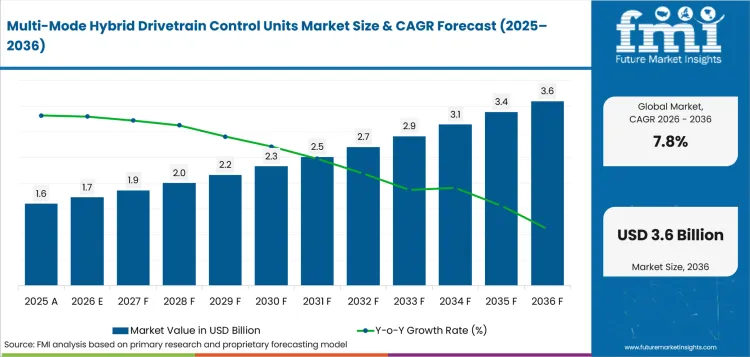
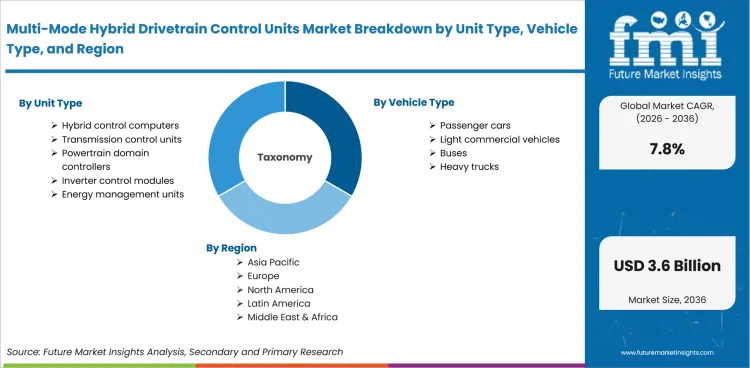
The Multi-Mode Hybrid Drivetrain Control Units Market is expected to grow from USD 1.6 billion in 2025 to USD 3.6 billion by 2036 at a 7.8% CAGR, driven by fuel economy needs and smoother engine-motor switching, with OEM line fit accounting for 79.0% share and passenger cars contributing 64.0% share as automakers prioritize efficiency and drivability.
Key Takeaways Market Size and Forecast
- Multi-mode hybrid drivetrain control units market was valued at USD 1.6 billion in 2025.
- Market value is expected to reach USD 1.7 billion in 2026.
- By 2036, industry value is forecast to reach USD 3.6 billion.
- Demand is expected to expand at 7.8% CAGR from 2026 to 2036.
- Market revenue is predicted to add USD 1.9 billion in incremental opportunity.
- OEM line fit is anticipated to represent 79.0% share of integration channel demand in 2026.
- Passenger cars are expected to account for 64.0% share of vehicle type demand in 2026.
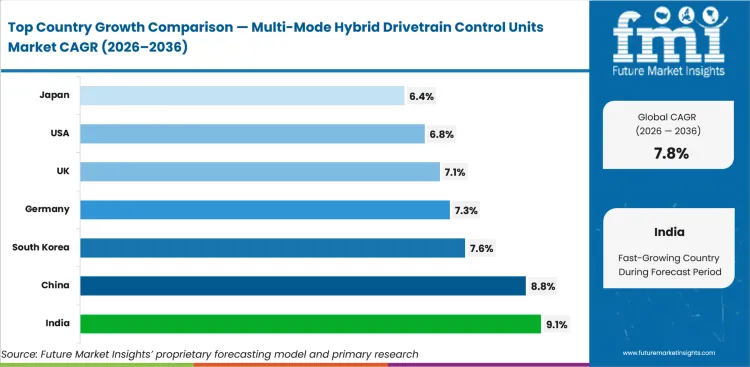
- India at 9.1% CAGR and China at 8.8% CAGR are forecast to lead country-level expansion by 2036.
Summary of the Multi-Mode Hybrid Drivetrain Control Units Market
- Demand and Growth Drivers
- Automakers use hybrid control units to manage electric power and engine power through one system. This helps vehicles switch between driving modes more smoothly.
- Fuel-efficiency rules are pushing vehicle makers to improve hybrid drivetrain performance. Control units help reduce fuel use by managing torque split and energy recovery more accurately.
- Hybrid vehicle platforms are becoming more software-based. Suppliers with safe control software and calibration support are gaining more value in new vehicle programs.
- Product and Segment View
- Hybrid control computers form the main product group because they manage key drivetrain decisions. They coordinate engine start and motor torque during different driving conditions.
- Passenger cars create steady demand because hybrid systems are moving into high-volume models. Automakers use these systems to improve fuel use without full charging dependence.
- High voltage units are gaining importance in plug-in hybrid platforms. These units support electric launch and handle more power during hybrid driving.
- Geography and Competitive Outlook
- China and India are seeing faster demand as hybrid models enter more mainstream vehicle programs. Local production interest is also supporting control unit suppliers.
- Germany and Japan have a clear advantage because both markets have established powertrain electronics companies. These suppliers already work closely with global automakers.
- Competition is moving toward software quality and system integration. Suppliers that can prove smooth mode switching will have a stronger position in new hybrid programs.
- Analyst Opinion
- Nikhil Kaitwade of FMI says, “Hybrid control is becoming a key part of vehicle behavior. Automakers need modules that can shift between engine power and motor power without drivability issues. Suppliers with proven calibration data and safe software will be preferred as hybrid platforms carry more control work.”
- Multi-Mode Hybrid Drivetrain Control Units Market Value Analysis
- The multi-mode hybrid drivetrain control units market is moving from basic powertrain control into a more advanced vehicle software function.
- Demand is rising because automakers need smoother switching between electric drive and engine drive.
- The market is gaining value as hybrid platforms use more control software for torque split and energy recovery.
- Growth is supported by the need for lower fuel use and better vehicle performance across mixed driving modes.
Powertrain control is moving into fewer control units in hybrid vehicles. In April 2024 Vitesco Technologies highlighted integrated control solutions for hybrid drivetrains. These systems coordinate electric machine functions with power electronics and transmission controls. This helps reduce system complexity and improves energy use. Automakers now need control units that can manage several drivetrain modes through one platform. Fuel-efficiency and emissions rules are pushing companies toward hybrid systems that balance electric power with engine power. Suppliers are improving software to make mode switching smoother and energy use more accurate. Better control strategies help automakers meet rules without major hardware changes. As hybrid systems become more complex, software is becoming a key point of competition. Suppliers with control logic and vehicle-level optimization are gaining a stronger role in new hybrid programs.
Multi-Mode Hybrid Drivetrain Control Units Market Definition
Multi-mode hybrid drivetrain control units are electronic modules and embedded software used in hybrid vehicles. They manage how a vehicle shifts between electric drive and engine drive. These units help control engine start, motor torque and energy recovery. They also support smoother driving by coordinating battery use with transmission response.
Multi-Mode Hybrid Drivetrain Control Units Market Inclusions
Scope includes hybrid control computers and transmission control units used in hybrid drivetrains. Powertrain domain controllers are included when they manage hybrid mode switching. Inverter control modules and energy management units are included when they guide hybrid drive behavior. Scope covers controllers used in passenger cars and light commercial vehicles. Buses and heavy trucks are included when they use multi-mode hybrid drivetrain systems. Plug-in hybrids, full hybrids, mild hybrids and range extenders are included in the hybrid mode scope. Revenue scope covers 2026 to 2036. Key stakeholders include automakers and Tier-1 drivetrain suppliers. Semiconductor firms and calibration software providers support controller design. Vehicle software companies and system integrators complete the inclusion scope.
Multi-Mode Hybrid Drivetrain Control Units Market Exclusions
Scope excludes standalone battery management systems and pure battery-electric drive controllers. Conventional engine control units are excluded when no hybrid mode function is present. Mechanical transmissions and clutches are excluded unless sold with embedded hybrid control electronics. General wiring harnesses are excluded unless they are bundled with a certified control unit package.
Multi-Mode Hybrid Drivetrain Control Units Market Research Methodology
- Primary Research: FMI analysts reviewed hybrid drivetrain programs and Tier-1 supplier portfolios across major vehicle markets.
- Desk Research: Analysis used public data from energy agencies and vehicle regulators.
- Market Sizing and Forecasting: Market size was estimated through hybrid vehicle volumes and controller content per vehicle.
- Data Validation: Forecast checks compared EV and hybrid sales signals with supplier launches.
Why is the Multi-Mode Hybrid Drivetrain Control Units Market Growing?
- Hybrid platforms need tighter control as automakers add electric drive modes to mainstream vehicles.
- Fuel economy regulation raises demand for controllers that reduce engine running time.
- Software-defined architectures support demand for automotive ECU consolidation as drivetrain decisions move toward fewer controllers.
Hybrid control unit demand is rising as automakers need smoother torque transfer across mixed propulsion systems. IEA reported electric car sales above 20.0 million units in 2025. Pure battery-electric expansion does not remove hybrid need. Some markets still face charging gaps. Multi-mode control units give automakers a middle route by improving fuel economy in vehicles with engine backup.
Policy pressure supports more drivetrain software. NHTSA finalized fuel economy standards in June 2024. Average light-duty vehicle fuel economy is targeted near 50.4 miles per gallon by model year 2031. Compliance depends on real-world efficiency gains and certified test-cycle results. Hybrid mode control supports better engine stop-start timing and energy recovery.
Market Segmentation Analysis
- Hybrid control computers are expected to lead unit type demand in 2026.
- Passenger cars are forecast to account for 64.0% share in 2026.
- Plug-in hybrids are expected to account for 39.5% share during 2026.
- OEM line fit is expected to represent 79.0% share in 2026.
- High voltage units are anticipated to take 58.0% share of voltage class demand in 2026.
The market is divided into five primary segment groups based on unit type and vehicle type. Hybrid mode, integration channel and voltage class complete the structure. Unit type covers hybrid control computers and transmission control units. Powertrain domain controllers sit in the same scope. Inverter control modules and energy management units complete the unit type group. Vehicle type covers passenger cars and light commercial vehicles. Buses and heavy trucks complete the vehicle scope. Hybrid mode covers plug-in hybrids and full hybrids. Mild hybrids and range extenders complete the hybrid mode scope. Integration channel covers OEM line fit and service spares. Retrofit replacement completes the integration channel scope. Voltage class covers high voltage units and 48V units. Low voltage units complete the voltage scope.
Insights into Multi-Mode Hybrid Drivetrain Control Units Market by Unit Type
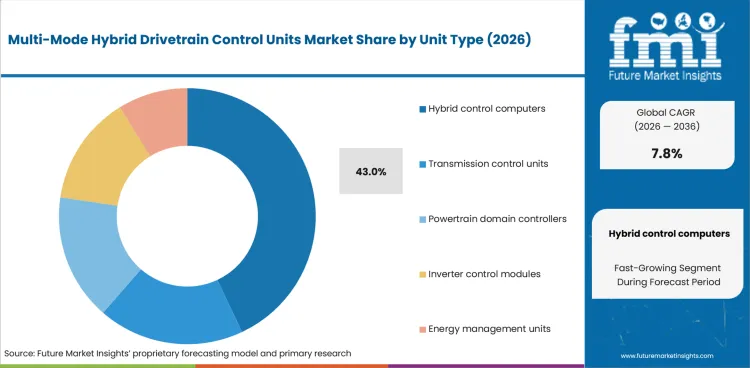
- Hybrid control computers are expected to hold 43.0% share in 2026. Automakers need one controller to coordinate engine start and motor torque. Clutch timing and energy recovery are handled inside the same software layer.
- Transmission control units add value in multi-mode hybrid platforms. Electronic control unit in automotive systems software must manage clutch events during electric drive shifts.
Insights into Multi-Mode Hybrid Drivetrain Control Units Market by Vehicle Type
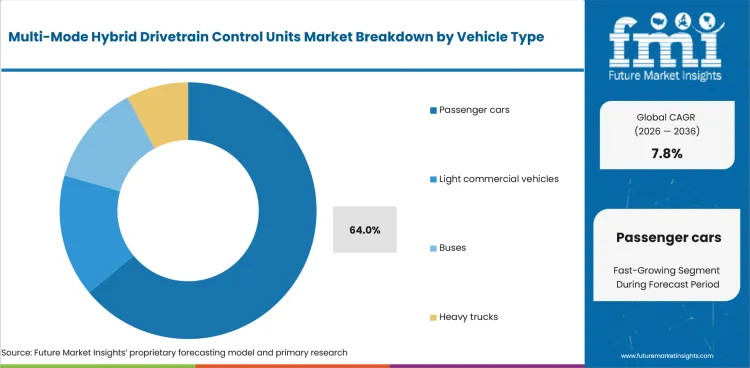
- Passenger cars are expected to account for 64.0% share in 2026. Hybrid packages support sedans and sport utility vehicles that need fuel savings with limited charging dependence.
- Light commercial vehicles need durable control units for stop-start routes. Payload changes make torque control more important in urban duty cycles.
Insights into Multi-Mode Hybrid Drivetrain Control Units Market by Hybrid Mode
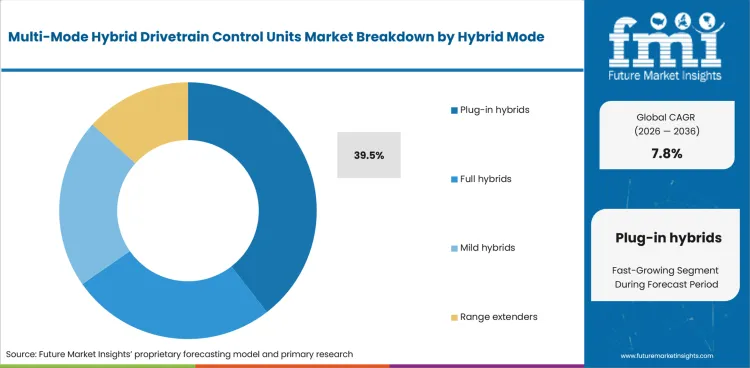
- Plug-in hybrid controllers need deeper battery and inverter coordination. Their share is forecast at 39.5% in 2026 as electric-only driving expands.
- Full hybrids use established engine-motor coordination. Range extenders need generator control and battery state management for flexible trip range.
Insights into Multi-Mode Hybrid Drivetrain Control Units Market by Integration Channel
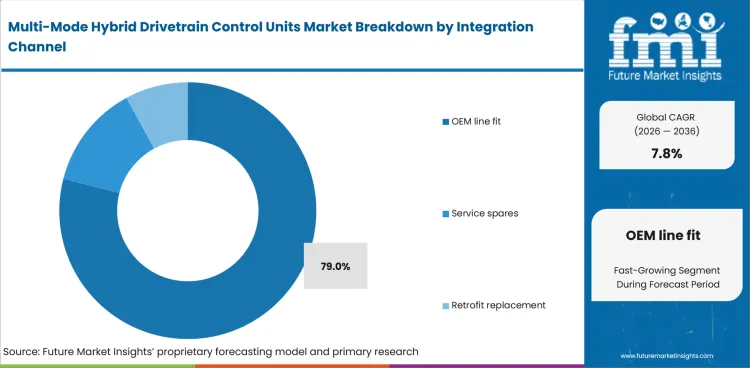
- OEM line fit is expected to represent 79.0% share in 2026. Drivetrain control units must be calibrated with powertrain hardware before vehicle production begins.
- Service spares depend on authorized calibration files and vehicle-level diagnostics. Replacement work is more restricted than mechanical drivetrain service.
Insights into Multi-Mode Hybrid Drivetrain Control Units Market by Voltage Class
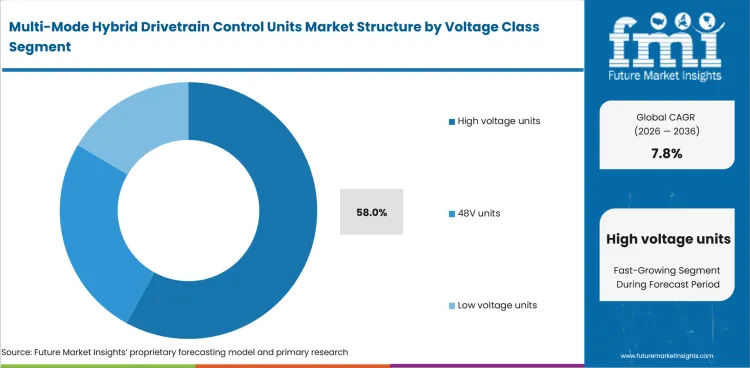
- High voltage units are anticipated to hold 58.0% share in 2026. Plug-in hybrid and full hybrid platforms need higher power handling for electric launch.
- 48V units support mild hybrid volumes. High voltage controllers carry greater value as traction motors and electric vehicle motor packages take more torque responsibility.
Multi-Mode Hybrid Drivetrain Control Units Market Drivers Restraints and Opportunities
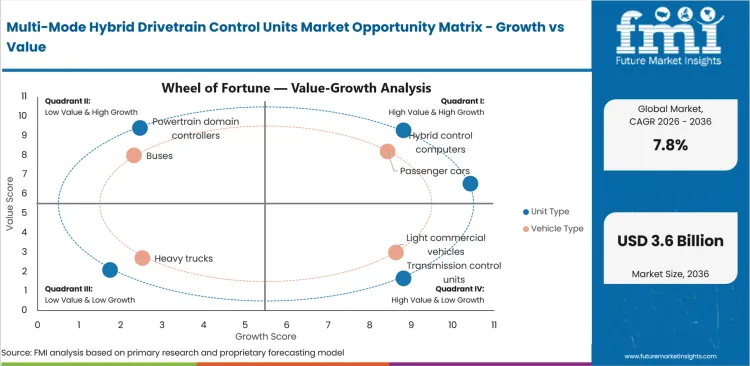
- Hybrid mode calibration is raising demand for multi-mode control units.
- Software validation cost can slow smaller programs.
- Domain control creates a higher-value route as hybrid control moves closer to software-defined vehicle architecture.
Hybrid Mode Calibration Is Raising Controller Value
Magna introduced DHD REX in March 2026 as a dedicated hybrid drive for range-extended electric vehicles. The system supports electric driving and generating mode. Optional parallel hybrid mode gives automakers another route for engine backup. Multi-mode control units become important as each mode needs clean torque transfer. Suppliers can add value when software keeps mode shifts smooth and predictable.
Validation Cost Slows Smaller Programs
Hybrid drivetrain control units must meet functional safety and vehicle-level validation needs before launch. Software checks cover fault handling and safe torque reduction during control failures. Smaller automakers can face longer approval cycles if calibration staff are limited. Cost pressure favors scale suppliers because validated software can be reused across several model programs.
Domain Control Opens Upgrade Potential
Marelli unveiled Intelligent Energy Management technology in December 2025 for hybrid and electric vehicles. The system monitors and adjusts power delivery for energy distribution. It supports energy recovery and battery efficiency. The same control need supports hybrid drivetrain software as power moves between motor and engine.
Competitive Landscape and Strategic Positioning
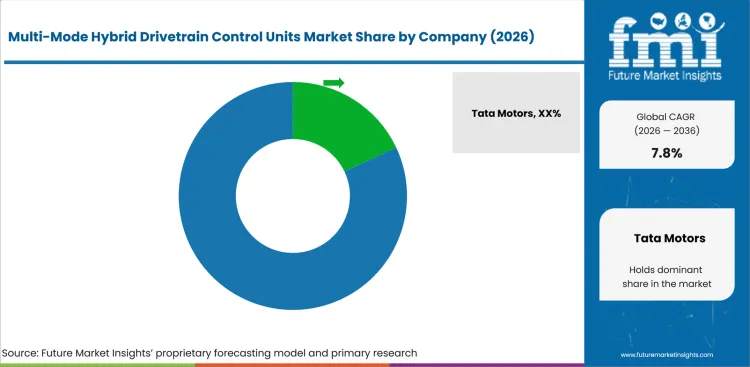
- Competition centers on functional safety software and calibration reuse.
- Hybrid control suppliers win by proving smooth torque transfer.
- Transmission specialists hold an advantage when controls are packaged with clutch hardware.
- Entry barriers include OEM validation time and vehicle-level fault handling.
Competitive position depends on validated control software and OEM program access. Bosch stated in September 2025 its Vehicle Motion Management centrally controls brakes and steering. The system also controls powertrain and chassis functions. The control layer supports suppliers that can connect drivetrain response with wider vehicle motion. Hybrid control clients will prefer suppliers with safe software and reusable calibration files.
DENSO’s Power Control Unit work shows how inverter control supports hybrid drive and regenerative recovery. The inverter converts current to drive the motor and helps recover regenerated electric power. This fits hybrid control units because energy recovery must match motor drive requests. Supplier advantage will depend on software validation speed and repeatable calibration. Plug-in hybrid electric vehicles will keep controller needs high as electric drive and engine backup share the same drivetrain.
Key Companies in the Multi-Mode Hybrid Drivetrain Control Units Market
Hybrid Control Leaders
- Robert Bosch GmbH
- ZF Friedrichshafen AG
Electrified Drivetrain Suppliers
- Schaeffler AG
- BorgWarner Inc.
Mobility Electronics Specialists
- Magna International Inc.
- DENSO Corporation
- Hyundai Mobis Co., Ltd.
Competitive Benchmarking Multi-Mode Hybrid Drivetrain Control Units Market
| Company | Hybrid Control Depth | Transmission Integration | Safety Software Support | Geographic Footprint |
|---|---|---|---|---|
| Robert Bosch GmbH | High | Medium | High | Global with European strength |
| ZF Friedrichshafen AG | High | High | High | Global with German production depth |
| Schaeffler AG | High | Medium | Medium | Europe and Asia centered |
| BorgWarner Inc. | Medium | High | Medium | Global with China program depth |
| Magna International Inc. | Medium | High | Medium | North America and Europe centered |
| DENSO Corporation | Medium | Medium | High | Japan and global OEM programs |
| Hyundai Mobis Co., Ltd. | Medium | Medium | Medium | South Korea and global supply core |
Source: Future Market Insights competitive analysis, 2026.
Key Developments in Multi-Mode Hybrid Drivetrain Control Units Market
- In October 2025, BorgWarner secured a contract to supply a 7-in-1 Integrated Drive Module to a leading Chinese OEM for a hybrid SUV. The module combines two electric motors with a dual inverter and vehicle control unit functions.
- In April 2026, Schaeffler announced volume production for its MultiMode dedicated hybrid transmission across European and Asian vehicle manufacturers.
Key Players in the Multi-Mode Hybrid Drivetrain Control Units Market
Major Global Players
- Robert Bosch GmbH
- ZF Friedrichshafen AG
- Schaeffler AG
- BorgWarner Inc.
- Magna International Inc.
Specialist and Regional Players
- DENSO Corporation
- Hyundai Mobis Co., Ltd.
- Marelli Holdings Co., Ltd.
- HELLA GmbH & Co. KGaA
- Hitachi Astemo Ltd.
Analysis of Multi-Mode Hybrid Drivetrain Control Units Market by Key Countries
.webp "Top Country Growth Comparison Multi Mode Hybrid Drivetrain Control Units Market Cagr (2026 2036)")
| Country | CAGR |
|---|---|
| United States | 6.8% |
| China | 8.8% |
| India | 9.1% |
| Germany | 7.3% |
| Japan | 6.4% |
| South Korea | 7.6% |
| United Kingdom | 7.1% |
Source: Future Market Insights, 2026.
Sales Analysis of Multi-Mode Hybrid Drivetrain Control Units Market in the United States
Established North American market · 2026 to 2036
United States Market Outlook
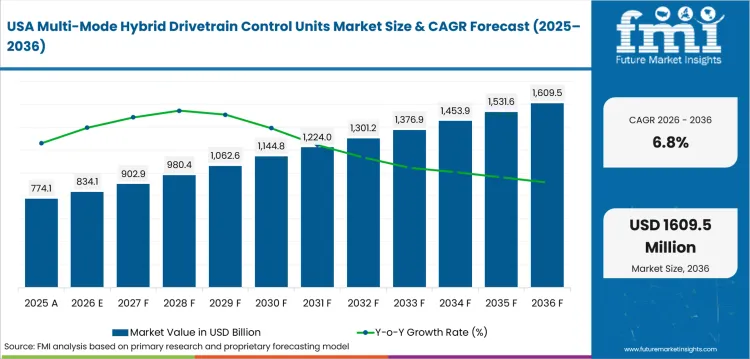
The United States market is projected to expand at 6.8% CAGR through 2036. Demand comes from fuel economy rules and hybrid use in sport utility vehicles.
Hybrid drivetrain control units help automakers improve fuel use without removing engine backup. OEM line fit carries the main share because hybrid controllers need vehicle-level calibration before launch.
Key Growth Drivers
- USA Energy Information Administration reported in February 2026 that electrified vehicles made up about 22.0% of light-duty vehicle sales in 2025. This creates demand for control units used in hybrid and plug-in hybrid models.
- National Highway Traffic Safety Administration reported in June 2024 that light-duty fuel economy is targeted near 50.4 miles per gallon by model year 2031. This increases need for hybrid controllers that manage engine stop-start timing.
- Hybrid pickups need stable torque control during towing. This favors control units that can adjust engine power and motor assist.
- OEMs prefer validated software for hybrid drivetrains. A control error can affect drivability and vehicle safety checks.
Key Restraints
- USA Energy Information Administration reported in February 2026 that battery-electric vehicle sales fell to below 6.0% of the market in the final months of 2025. This can make some OEMs cautious with near-term electrified model plans.
- National Highway Traffic Safety Administration reported in June 2024 that passenger car standards rise 2.0% per year for model years 2027 to 2031. Gradual rule movement can spread controller demand across several launch cycles.
- Service replacement is restricted because calibration files are controlled by OEMs. This limits open aftermarket demand.
What makes the United States unique
The United States has large vehicles and strict fuel economy pressure. Pickup and SUV platforms need stronger torque control than small passenger cars.
Key Companies
- BorgWarner Inc.
- Magna International Inc.
- American Axle & Manufacturing
- Eaton Corporation
- TREMEC Corporation
Sales and Marketing Channels
- OEM line fit programs
- Tier-1 drivetrain supply agreements
- Authorized service spares
- Engineering validation centers
- Powertrain software support channels
Market Taxonomy and Sub-Regions Covered
| Segment | Sub-Segments |
|---|---|
| By Unit Type | Hybrid Control Computers · Transmission Control Units · Powertrain Domain Controllers · Inverter Control Modules · Energy Management Units |
| By Vehicle Type | Passenger Cars · Light Commercial Vehicles · Buses · Heavy Trucks |
| By Hybrid Mode | Plug-in Hybrids · Full Hybrids · Mild Hybrids · Range Extenders |
| By Integration Channel | OEM Line Fit · Service Spares · Retrofit Replacement |
| By Voltage Class | High Voltage Units · 48V Units · Low Voltage Units |
| Key Sub-Regions Covered (USA) | Michigan · Ohio · California · Texas · Tennessee · South Carolina |
Frequently Asked Questions
How fast is the United States multi-mode hybrid drivetrain control units market growing?
The United States market is projected to expand at 6.8% CAGR through 2036.
What drives demand in the United States?
Demand is led by fuel economy rules and hybrid vehicle use in SUVs. OEM calibration needs also raise demand for validated control units.
Which segment leads in the United States?
Passenger cars lead with 61.0% share in 2026. Sport utility vehicles inside this group need hybrid control for torque assist and fuel savings.
Sales Analysis of Multi-Mode Hybrid Drivetrain Control Units Market in China
High-volume country market · 2026 to 2036
China Market Outlook
China is forecast to expand at 8.8% CAGR by 2036. Demand comes from plug-in hybrid platforms and extended-range vehicles.
Chinese automakers use hybrid control units to manage electric drive and engine backup. Local supplier depth also reduces sourcing time for OEMs working across several vehicle platforms.
Key Growth Drivers
- International Energy Agency reported in May 2026 that more than 13.0 million electric cars were sold in China in 2025. This raises demand for drivetrain electronics across electrified vehicles.
- China’s State Council reported in November 2025 that NEV production reached nearly 13.02 million units in the first ten months of 2025. This creates large demand for vehicle control and power electronics.
- Domestic plug-in hybrid platforms need control units that coordinate battery state and engine backup. This raises controller value per vehicle.
- Export programs create demand for control software suited to foreign emissions rules. Local suppliers must improve validation and diagnostics.
Key Restraints
- China’s State Council reported in November 2025 that NEV sales accounted for 51.6% of all new vehicle sales in October 2025. High NEV volume can increase price pressure on controller suppliers.
- Frequent model refresh cycles can shorten supplier planning windows. Control-unit makers must keep software ready for faster launch schedules.
What makes China unique
China has a strong plug-in hybrid and extended-range vehicle base. This makes controller cost and software reuse more important than in smaller markets.
Key Companies
- BYD Company Limited
- Geely Auto
- Chery Automobile
- Great Wall Motor
- Seres Group
Sales and Marketing Channels
- Direct OEM supply programs
- Local Tier-1 electronics channels
- Joint validation labs
- Export platform supply
- Authorized parts channels
Market Taxonomy and Sub-Regions Covered
| Segment | Sub-Segments |
|---|---|
| By Unit Type | Hybrid Control Computers · Transmission Control Units · Powertrain Domain Controllers · Inverter Control Modules · Energy Management Units |
| By Vehicle Type | Passenger Cars · Light Commercial Vehicles · Buses · Heavy Trucks |
| By Hybrid Mode | Plug-in Hybrids · Full Hybrids · Mild Hybrids · Range Extenders |
| By Integration Channel | OEM Line Fit · Service Spares · Retrofit Replacement |
| By Voltage Class | High Voltage Units · 48V Units · Low Voltage Units |
| Key Sub-Regions Covered (China) | Guangdong · Shanghai · Jiangsu · Zhejiang · Chongqing · Anhui |
Frequently Asked Questions
How fast is China’s multi-mode hybrid drivetrain control units market growing?
China is forecast to expand at 8.8% CAGR by 2036.
What drives demand in China?
Demand comes from high plug-in hybrid output and extended-range vehicle programs. Local power electronics capacity also improves controller supply.
Which segment leads in China?
Passenger cars lead with 66.0% share in 2026. High-volume car and SUV programs create the main demand for hybrid control units.
Sales Analysis of Multi-Mode Hybrid Drivetrain Control Units Market in India
Fastest-growing country market · 2026 to 2036
India Market Outlook
India is expected to record 9.1% CAGR during the forecast period. Demand comes from local electrified vehicle production and urban stop-start driving.
The market is smaller than China and the United States. It expands faster because automakers are testing lower-emission powertrains for buyers who need lower fuel cost with engine backup.
Key Growth Drivers
- International Energy Agency reported in May 2026 that electric car sales in India reached 165,000 units in 2025. This shows that electrified passenger car demand is moving beyond early trials.
- International Energy Agency reported in May 2026 that India electric car sales rose 75.0% year over year in 2025. This gives local suppliers a stronger reason to build control electronics capability.
- India’s Ministry of Heavy Industries reported in February 2025 that PM E-DRIVE carries an outlay of Rs. 10,900 crore. The scheme raises testing and EV ecosystem activity.
- Urban traffic creates repeated stop-start conditions. Hybrid control units can manage regenerative braking and engine shutoff in these duty cycles.
Key Restraints
- International Energy Agency reported in May 2026 that electric cars represented nearly 4.0% of India’s total car sales in 2025. The small base limits immediate scale for dedicated hybrid control units.
- International Energy Agency reported that roughly 60.0% of India’s 2025 electric car sales came from domestic automakers. Local supply can improve over time but near-term controller sourcing still needs cost control.
- Service training is uneven outside major cities. Hybrid controller replacement needs approved tools and trained technicians.
What makes India unique
India has a high-growth path and strong cost pressure. Hybrid control units must be localized to reach mid-priced passenger vehicles.
Key Companies
- Tata Motors
- Mahindra & Mahindra
- Maruti Suzuki India
- Sona BLW Precision Forgings
- Uno Minda
Sales and Marketing Channels
- OEM localization programs
- Tier-1 supplier contracts
- Dealer service networks
- Vehicle testing agencies
- Local electronics assembly channels
Market Taxonomy and Sub-Regions Covered
| Segment | Sub-Segments |
|---|---|
| By Unit Type | Hybrid Control Computers · Transmission Control Units · Powertrain Domain Controllers · Inverter Control Modules · Energy Management Units |
| By Vehicle Type | Passenger Cars · Light Commercial Vehicles · Buses · Heavy Trucks |
| By Hybrid Mode | Plug-in Hybrids · Full Hybrids · Mild Hybrids · Range Extenders |
| By Integration Channel | OEM Line Fit · Service Spares · Retrofit Replacement |
| By Voltage Class | High Voltage Units · 48V Units · Low Voltage Units |
| Key Sub-Regions Covered (India) | Maharashtra · Tamil Nadu · Karnataka · Gujarat · Haryana · Uttar Pradesh |
Frequently Asked Questions
How fast is India’s multi-mode hybrid drivetrain control units market growing?
India is expected to record 9.1% CAGR during the forecast period.
What drives demand in India?
Demand is led by local electrified vehicle production and urban fuel-saving needs. Policy spending on EV systems also helps suppliers.
Which segment leads in India?
Passenger cars lead with 68.0% share in 2026. Compact cars and sport utility vehicles create the main volume for hybrid control units.
Sales Analysis of Multi-Mode Hybrid Drivetrain Control Units Market in Germany
Premium hybrid platform market · 2026 to 2036
Germany Market Outlook
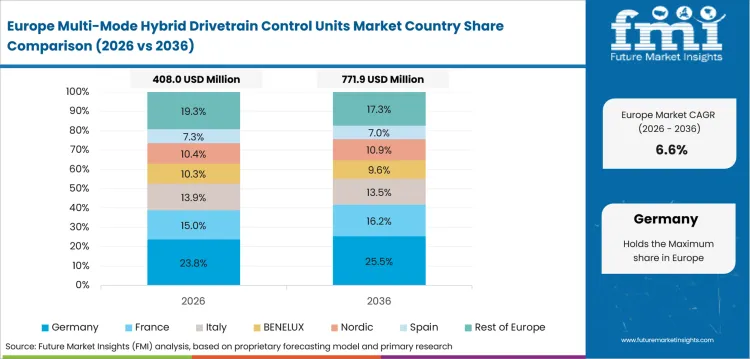
Germany is forecast at 7.3% CAGR between 2026 and 2036. Demand is led by premium hybrid vehicles and supplier depth in drivetrain electronics.
German automakers need control units that keep engine restart smooth and electric launch clean. Supplier selection depends on safety files and proven integration with transmission systems.
Key Growth Drivers
- European Alternative Fuels Observatory reported in May 2025 that Germany recorded 24,317 plug-in hybrid registrations in April 2025. This creates demand for hybrid control units in electrified cars.
- European Alternative Fuels Observatory reported that German plug-in hybrid registrations rose 60.7% year over year in April 2025. This raises demand for controllers that manage battery use and engine restart.
- VDA reported in May 2025 that 242,700 passenger cars were registered in Germany in April 2025. This gives suppliers a large monthly vehicle base for drivetrain electronics.
- Premium buyers expect smooth drivability. This makes mode switching and torque blending important purchase criteria for OEM programs.
Key Restraints
- Germany's faster electrified-platform transition raises validation pressure for hybrid controller suppliers. Programs must support battery-electric, plug-in hybrid, and full-hybrid architectures at the same time, which increases software calibration workload and can delay supplier approvals.
- European Alternative Fuels Observatory reported in May 2025 that Germany’s overall new passenger car market was down 0.2% year over year in April 2025. Flat vehicle demand can slow controller volume.
- Germany’s engineering cost structure can raise validation expense. This can shift some controller production to lower-cost locations.
What makes Germany unique
Germany combines premium vehicle platforms with deep drivetrain supplier capability. This makes it a high-value market for validated hybrid control software.
Key Companies
- Robert Bosch GmbH
- ZF Friedrichshafen AG
- AUMOVIO
- Schaeffler AG
- Mercedes-Benz Group
Sales and Marketing Channels
- OEM engineering programs
- Transmission system supply
- Powertrain software validation
- Tier-1 integration channels
- Authorized service parts
Market Taxonomy and Sub-Regions Covered
| Segment | Sub-Segments |
|---|---|
| By Unit Type | Hybrid Control Computers · Transmission Control Units · Powertrain Domain Controllers · Inverter Control Modules · Energy Management Units |
| By Vehicle Type | Passenger Cars · Light Commercial Vehicles · Buses · Heavy Trucks |
| By Hybrid Mode | Plug-in Hybrids · Full Hybrids · Mild Hybrids · Range Extenders |
| By Integration Channel | OEM Line Fit · Service Spares · Retrofit Replacement |
| By Voltage Class | High Voltage Units · 48V Units · Low Voltage Units |
| Key Sub-Regions Covered (Germany) | Baden-Württemberg · Bavaria · Lower Saxony · North Rhine-Westphalia · Hesse · Saxony |
Frequently Asked Questions
How fast is Germany’s multi-mode hybrid drivetrain control units market growing?
Germany is forecast at 7.3% CAGR between 2026 and 2036.
What drives demand in Germany?
Demand is led by premium plug-in hybrids and advanced drivetrain engineering. Smooth mode switching is important for German vehicle programs.
Which segment leads in Germany?
Passenger cars lead with 62.0% share in 2026. Premium hybrid cars need higher-value control units and calibration support.
Sales Analysis of Multi-Mode Hybrid Drivetrain Control Units Market in Japan
Established hybrid technology market · 2026 to 2036
Japan Market Outlook
Japan is forecast to rise at 6.4% CAGR through 2036. Demand is steady because hybrid powertrains are already well accepted in passenger cars.
Japanese OEMs place high value on reliability and long model-cycle support. Control-unit suppliers need proven calibration files and stable hardware platforms.
Key Growth Drivers
- Japan Automobile Manufacturers Association reported in September 2025 that electrified vehicles crossed a little over 60.0% of new passenger car registrations in 2024. This supports steady demand for hybrid drivetrain control.
- USA International Trade Administration reported in November 2025 that Japanese hybrid vehicle sales exceeded 2.0 million units in 2024. This shows deep demand for hybrid systems.
- USA International Trade Administration reported in November 2025 that hybrids accounted for 54.8% of Japan’s new passenger car sales. This gives controller suppliers a clear passenger vehicle base.
- Export programs need control software suited to foreign fuel rules. This keeps hybrid controller work important for Japanese automakers.
Key Restraints
- Japan Automobile Manufacturers Association reported in September 2025 that electrified vehicles already held more than 60.0% of new passenger car registrations in 2024. High penetration can slow first-time controller demand.
- USA International Trade Administration reported in November 2025 that total new vehicle sales in Japan were 4,421,494 units in 2024. A large but steady market can slow supplier switching.
- Smaller plug-in hybrid volume can limit demand for high-voltage control units compared with full hybrid units.
What makes Japan unique
Japan has one of the deepest hybrid knowledge bases in the world. Demand is less about first-time adoption and more about proven controller reliability.
Key Companies
- Toyota Motor Corporation
- DENSO Corporation
- Aisin Corporation
- Honda Motor Co.
- Hitachi Astemo
Sales and Marketing Channels
- OEM platform integration
- Keiretsu supplier networks
- Authorized service channels
- Export model programs
- Power electronics supply routes
Market Taxonomy and Sub-Regions Covered
| Segment | Sub-Segments |
|---|---|
| By Unit Type | Hybrid Control Computers · Transmission Control Units · Powertrain Domain Controllers · Inverter Control Modules · Energy Management Units |
| By Vehicle Type | Passenger Cars · Light Commercial Vehicles · Buses · Heavy Trucks |
| By Hybrid Mode | Plug-in Hybrids · Full Hybrids · Mild Hybrids · Range Extenders |
| By Integration Channel | OEM Line Fit · Service Spares · Retrofit Replacement |
| By Voltage Class | High Voltage Units · 48V Units · Low Voltage Units |
| Key Sub-Regions Covered (Japan) | Aichi · Tokyo · Shizuoka · Kanagawa · Saitama · Fukuoka |
Frequently Asked Questions
How fast is Japan’s multi-mode hybrid drivetrain control units market growing?
Japan is forecast to rise at 6.4% CAGR through 2036.
What drives demand in Japan?
Demand is led by long-standing hybrid use and passenger car platform depth. Export programs add demand for reliable control software.
Which segment leads in Japan?
Passenger cars lead with 70.0% share in 2026. Hybrid technology is concentrated in passenger vehicle platforms.
Sales Analysis of Multi-Mode Hybrid Drivetrain Control Units Market in South Korea
Electronics-led hybrid supply market · 2026 to 2036
South Korea Market Outlook
South Korea is expected to advance at 7.6% CAGR during the forecast period. Demand is shaped by local automakers and power electronics strength.
Hybrid control units matter because South Korean OEMs serve domestic and overseas markets. Each export model needs calibration that matches local fuel and driving rules.
Key Growth Drivers
- International Energy Agency reported in May 2026 that Korea had 51,000 fast and ultra-fast public charging points in 2025. This improves plug-in hybrid confidence.
- International Energy Agency reported in May 2026 that Korea had just over 2.0 electric light-duty vehicles per public charging point in 2025. This improves charging access for plug-in hybrid buyers.
- International Energy Agency reported in May 2026 that Korea had over 9.0 kW of rated public charging capacity per electric light-duty vehicle in 2025. This supports electrified vehicle use.
- Domestic OEMs can match hybrid control units with in-house electronics. This reduces integration friction during model launch.
Key Restraints
- International Energy Agency reported in May 2026 that only about 30.0% of battery-electric cars can use ultra-fast charging today. This can keep some buyers cautious about electrified models.
- International Energy Agency reported in May 2026 that Korea had 47,000 fast charging points in 2024 before reaching 51,000 in 2025. Expansion is moving forward but it still requires steady capital input.
- Export models need several calibration versions. This increases software workload for suppliers.
What makes South Korea unique
South Korea has deep vehicle electronics capability and global OEM reach. This helps suppliers connect hybrid control with export-ready powertrain platforms.
Key Companies
- Hyundai Motor Company
- Hyundai Mobis Co., Ltd.
- Kia Corporation
- Hyundai Transys Inc.
Sales and Marketing Channels
- Hyundai Motor Group supply channels
- Tier-1 electronics contracts
- Export platform validation
- Authorized service networks
- Power module integration routes
Market Taxonomy and Sub-Regions Covered
| Segment | Sub-Segments |
|---|---|
| By Unit Type | Hybrid Control Computers · Transmission Control Units · Powertrain Domain Controllers · Inverter Control Modules · Energy Management Units |
| By Vehicle Type | Passenger Cars · Light Commercial Vehicles · Buses · Heavy Trucks |
| By Hybrid Mode | Plug-in Hybrids · Full Hybrids · Mild Hybrids · Range Extenders |
| By Integration Channel | OEM Line Fit · Service Spares · Retrofit Replacement |
| By Voltage Class | High Voltage Units · 48V Units · Low Voltage Units |
| Key Sub-Regions Covered (South Korea) | Seoul · Gyeonggi · Ulsan · Busan · Incheon · Chungcheong |
Frequently Asked Questions
How fast is South Korea’s multi-mode hybrid drivetrain control units market growing?
South Korea is expected to advance at 7.6% CAGR during the forecast period.
What drives demand in South Korea?
Demand is led by local OEM programs and strong electronics capability. Export models need control units suited to several driving conditions.
Which segment leads in South Korea?
Passenger cars lead with 64.5% share in 2026. Local OEMs use hybrid systems across mainstream and export models.
Sales Analysis of Multi-Mode Hybrid Drivetrain Control Units Market in the United Kingdom
Policy-shaped electrified vehicle market · 2026 to 2036
United Kingdom Market Outlook
The United Kingdom is expected to post 7.1% CAGR by 2036. Demand comes from lower-emission vehicle policy and fleet replacement.
Hybrid control units are useful in the country because many drivers need lower fuel use with engine backup. Fleet users also need systems with reliable diagnostics and predictable service access.
Key Growth Drivers
- UK Department for Transport reported in April 2026 that 473,000 zero-emission cars were registered for the first time in 2025. This reflects wider readiness for electrified vehicle technology.
- UK Department for Transport reported in April 2026 that zero-emission cars accounted for 23.0% of new car registrations in 2025. This pushes automakers to offer lower-emission powertrains.
- UK Department for Transport reported in April 2026 that licensed zero-emission vehicles reached 2,012,000 at the end of 2025, up 31.2% from 2024. This creates a larger service pool for electrified vehicle systems.
- Fleet operators need predictable fuel savings. Hybrid control units help manage engine use in high-mileage service.
Key Restraints
- UK Department for Transport reported in April 2026 that zero-emission light goods vehicles accounted for 9.0% of new LGV registrations in 2025. Slower van electrification can limit control-unit demand in commercial vehicles.
- UK Department for Transport reported in April 2026 that zero-emission heavy goods vehicles accounted for 1.4% of new HGV registrations in 2025. Heavy vehicle control-unit demand may develop more slowly.
- Higher repair complexity can slow replacement demand. Hybrid drivetrain controllers need trained technicians and approved diagnostic tools.
What makes the United Kingdom unique
The United Kingdom has strong policy pressure and a fleet-heavy vehicle market. Hybrid controllers gain value when fuel savings and service access are both important.
Key Companies
- GKN Automotive
- Jaguar Land Rover
- Ricardo plc
- Motion Applied
- Drive System Design Ltd.
Sales and Marketing Channels
- OEM engineering programs
- Fleet supply channels
- Powertrain testing providers
- Authorized repair networks
- Specialist drivetrain consultants
Market Taxonomy and Sub-Regions Covered
| Segment | Sub-Segments |
|---|---|
| By Unit Type | Hybrid Control Computers · Transmission Control Units · Powertrain Domain Controllers · Inverter Control Modules · Energy Management Units |
| By Vehicle Type | Passenger Cars · Light Commercial Vehicles · Buses · Heavy Trucks |
| By Hybrid Mode | Plug-in Hybrids · Full Hybrids · Mild Hybrids · Range Extenders |
| By Integration Channel | OEM Line Fit · Service Spares · Retrofit Replacement |
| By Voltage Class | High Voltage Units · 48V Units · Low Voltage Units |
| Key Sub-Regions Covered (United Kingdom) | West Midlands · London · South East England · North West England · Wales · Scotland |
Frequently Asked Questions
How fast is the United Kingdom multi-mode hybrid drivetrain control units market growing?
The United Kingdom is expected to post 7.1% CAGR by 2036.
What drives demand in the United Kingdom?
Demand is led by lower-emission vehicle policy and fleet replacement needs. Hybrid systems help drivers reduce fuel use without full charging reliance.
Which segment leads in the United Kingdom?
Passenger cars lead with 63.0% share in 2026. Lower-emission car choices make up the main electrified vehicle opportunity.
Report Scope and Coverage
| Parameter | Details |
|---|---|
| Quantitative Units | USD 1.7 billion to USD 3.6 billion at 7.8% CAGR |
| Market Definition | Electronic control units and embedded software used to manage multi-mode hybrid drivetrain operation |
| Segments Covered | Unit type, vehicle type, hybrid mode, integration channel, voltage class, and region |
| Unit Type | Hybrid control computers, transmission control units, powertrain domain controllers, inverter control modules, and energy management units |
| Vehicle Type | Passenger cars, light commercial vehicles, buses, and heavy trucks |
| Hybrid Mode | Plug-in hybrids, full hybrids, mild hybrids, and range extenders |
| Integration Channel | OEM line fit, service spares, and retrofit replacement |
| Voltage Class | High voltage units, 48V units, and low voltage units |
| Regions Covered | North America, Latin America, Western Europe, Eastern Europe, East Asia, South Asia and Pacific, Middle East and Africa |
| Countries Covered | United States, China, India, Germany, Japan, South Korea, United Kingdom, and 30+ countries |
| Key Companies Profiled | Robert Bosch GmbH, ZF Friedrichshafen AG, Schaeffler AG, BorgWarner Inc., Magna International Inc., DENSO Corporation, and Hyundai Mobis Co., Ltd. |
| Forecast Period | 2026 to 2036 |
| Approach | Hybrid bottom-up and top-down method using vehicle volumes, controller content, supplier launches, policy signals, and OEM program activity |
Source: Future Market Insights, 2026.
Multi-Mode Hybrid Drivetrain Control Units Market Breakdown by Unit Type and Vehicle Type
Multi-Mode Hybrid Drivetrain Control Units Market Segmented by Unit Type
- Hybrid control computers
- Transmission control units
- Powertrain domain controllers
- Inverter control modules
- Energy management units
Multi-Mode Hybrid Drivetrain Control Units Market Segmented by Vehicle Type
- Passenger cars
- Light commercial vehicles
- Buses
- Heavy trucks
Multi-Mode Hybrid Drivetrain Control Units Market Segmented by Hybrid Mode
- Plug-in hybrids
- Full hybrids
- Mild hybrids
- Range extenders
Multi-Mode Hybrid Drivetrain Control Units Market Segmented by Integration Channel
- OEM line fit
- Service spares
- Retrofit replacement
Multi-Mode Hybrid Drivetrain Control Units Market Segmented by Voltage Class
- High voltage units
- 48V units
- Low voltage units
Multi-Mode Hybrid Drivetrain Control Units Market by Region
- North America
- Latin America
- Western Europe
- Eastern Europe
- East Asia
- South Asia and Pacific
- Middle East and Africa
Research Sources and Bibliography
- International Energy Agency. (2026, May 20). Global EV Outlook 2026: Executive summary. International Energy Agency.
- International Energy Agency. (2026, May 20). Trends in electric cars. In Global EV Outlook 2026. International Energy Agency.
- International Energy Agency. (2026, May 20). Electric vehicle charging. In Global EV Outlook 2026. International Energy Agency.
- USA Energy Information Administration. (2026, February 9). Electric vehicle sales fell as hybrid vehicle sales continued to rise in 2025. USA Energy Information Administration.
- National Highway Traffic Safety Administration. (2024, June 7). New fuel economy standards for MY 2027-2031. National Highway Traffic Safety Administration.
- State Council of the People’s Republic of China. (2025, November 11). China’s NEV output, sales surge in first 10 months of 2025. State Council of the People’s Republic of China.
- Ministry of Heavy Industries. (2025). Annual report 2024-25. Government of India.
- European Alternative Fuels Observatory. (2025, May 8). Germany: BEV registrations surge by 54% in April 2025. European Alternative Fuels Observatory.
- German Association of the Automotive Industry. (2025, May 5). Car production down in April. VDA.
- German Association of the Automotive Industry. (2026, May 6). Production and market April 2026. VDA.
- Japan Automobile Manufacturers Association. (2025). The motor industry of Japan 2025. Japan Automobile Manufacturers Association.
- International Trade Administration. (2025, November 20). Japan - Automotive. USA Department of Commerce.
- Department for Transport. (2026, April 29). Vehicle licensing statistics, United Kingdom: 2025. GOV.UK.
- Magna International Inc. (2026, March 24). Magna unveils DHD REX hybrid drive for enhanced EV range. Magna International Inc.
- Marelli Holdings Co., Ltd. (2025, December 3). Marelli unveils Intelligent Energy Management technology for hybrid and electric vehicles at Berlin CTI Symposium 2025. Marelli Holdings Co., Ltd.
- Robert Bosch GmbH. (2025, September 8). IAA Mobility 2025: Bosch is shaping the new vehicle world with intelligent hardware and software solutions. Bosch Media Service.
- BorgWarner Inc. (2025, October 30). BorgWarner to supply leading Chinese OEM with 7-in-1 Integrated Drive Module. BorgWarner Inc.
- Schaeffler AG. (2026, April 27). Not just a bridging technology: Schaeffler offers extensive range from components to systems for all hybrid powertrains. Schaeffler AG.
- DENSO Corporation. (n.d.). Power control unit. DENSO Corporation.
This Report Answers
- What is the current value of the multi-mode hybrid drivetrain control units market?
- What value can the market reach by 2036?
- Which unit type is expected to carry the main share in 2026?
- Which vehicle type contributes the main demand share in 2026?
- Which countries are forecast to expand faster than the global average?
- How does OEM line fit shape supplier revenue in this market?
- Which companies are active in hybrid drivetrain control units?
- How did FMI size the market and validate the 2026 to 2036 forecast?
Frequently Asked Questions
What is the multi-mode hybrid drivetrain control units market size in 2026?
Multi-mode hybrid drivetrain control units market is expected to reach USD 1.7 billion in 2026 based on hybrid vehicle volume and controller content per vehicle.
What is the 2036 forecast value?
Demand is forecast to reach USD 3.6 billion by 2036 as hybrid mode control spreads across passenger cars and light commercial vehicles.
What CAGR is expected during the forecast period?
Multi-mode hybrid drivetrain control units demand is expected to expand at 7.8% CAGR from 2026 to 2036.
Which unit type leads the market?
Hybrid control computers are expected to lead unit type demand with 43.0% share in 2026 due to torque split and energy recovery control needs.
Which vehicle type contributes the main share?
Passenger cars are expected to account for 64.0% share of vehicle type demand in 2026 as hybrid packages scale across high-volume model lines.
Which country is forecast to expand fastest?
India is expected to record 9.1% CAGR through 2036 as electric car sales and local production interest support hybrid control localization.
Why does OEM line fit dominate demand?
OEM line fit is expected to hold 79.0% share in 2026 since hybrid control units need calibration and safety approval before vehicle launch.
Which companies are active in this market?
Robert Bosch GmbH and ZF Friedrichshafen AG are key companies in this market. Schaeffler AG and BorgWarner Inc. have active roles. Magna International Inc. and DENSO Corporation support system programs. Hyundai Mobis Co., Ltd. serves regional and global OEM needs.
Preview the report firsthand - request a free sample
Get SampleGet the brochure for pricing and purchase details.
Get PDFTable of Content
- Key Takeaways
- Market Size and CAGR
- Top Growth Driver
- Fastest Growing Segment
- Leading Region
- Key Companies
- Emerging Opportunities
- Executive Summary
- Global Market Outlook
- Demand-side Trends
- Supply-side Trends
- Technology Roadmap Analysis
- Analysis and Recommendations
- Analyst Perspective (What is happening? Why now? What should investors know?)
- Key Questions Answered
- How large is the market?
- What is the CAGR?
- What are key trends?
- Which region dominates?
- Who are the leaders?
- Market Overview
- Market Coverage / Taxonomy
- Market Definition / Scope / Limitations
- Research Methodology
- Chapter Orientation
- Analytical Lens and Working Hypotheses
- Market Structure, Signals, and Trend Drivers
- Benchmarking and Cross-market Comparability
- Market Sizing, Forecasting, and Opportunity Mapping
- Research Design and Evidence Framework
- Desk Research Programme (Secondary Evidence)
- Expert Input and Fieldwork (Primary Evidence)
- Tooling, Models, and Reference Databases
- Data Engineering and Model Build
- Quality Assurance and Audit Trail
- Market Background
- Market Dynamics (Drivers, Restraints, Opportunity, Trends)
- Scenario Forecast (Optimistic, Likely, Conservative)
- Impact Analysis
- AI Impact
- Sustainability Impact
- Regulatory Impact
- Technology Impact
- Consumer / Buyer Analysis
- Purchase Drivers
- Adoption Barriers
- Buyer Journey
- Opportunity Map Analysis
- Product Life Cycle Analysis
- Supply Chain Analysis
- Investment Feasibility Matrix
- Value Chain Analysis
- PESTLE and Porter's Analysis
- Regulatory Landscape
- Regional Parent Market Outlook
- Production and Consumption Statistics
- Import and Export Statistics
- Global Market Analysis and Forecast, 2021 to 2036
- Historical Market Size Value (USD Billion) & Volume (Unit) Analysis, 2021 to 2025
- Current and Future Market Size Value (USD Billion) & Volume (Unit) Projections, 2026 to 2036
- Y-o-Y Growth Trend Analysis
- Absolute $ Opportunity Analysis
- Global Market Pricing Analysis, 2021 to 2036
- Global Market Analysis and Forecast, By Value (USD Billion) & Volume (Unit) Type, 2021 to 2036
- Introduction / Key Findings
- Historical Market Size Value (USD Billion) & Volume (Unit) Analysis By Value (USD Billion) & Volume (Unit) Type, 2021 to 2025
- Current and Future Market Size Value (USD Billion) & Volume (Unit) Analysis and Forecast By Value (USD Billion) & Volume (Unit) Type, 2026 to 2036
- Hybrid Control Computers
- Transmission Control Value (USD Billion) & Volume (Unit)s
- Powertrain Domain Controllers
- Inverter Control Modules
- Energy Management Value (USD Billion) & Volume (Unit)s
- Hybrid Control Computers
- Y-o-Y Growth Trend Analysis By Value (USD Billion) & Volume (Unit) Type, 2021 to 2025
- Absolute $ Opportunity Analysis By Value (USD Billion) & Volume (Unit) Type, 2026 to 2036
- Global Market Analysis and Forecast, By Vehicle Type, 2021 to 2036
- Introduction / Key Findings
- Historical Market Size Value (USD Billion) & Volume (Unit) Analysis By Vehicle Type, 2021 to 2025
- Current and Future Market Size Value (USD Billion) & Volume (Unit) Analysis and Forecast By Vehicle Type, 2026 to 2036
- Passenger Cars
- Light Commercial Vehicles
- Buses
- Heavy Trucks
- Passenger Cars
- Y-o-Y Growth Trend Analysis By Vehicle Type, 2021 to 2025
- Absolute $ Opportunity Analysis By Vehicle Type, 2026 to 2036
- Global Market Analysis and Forecast, By Hybrid Mode, 2021 to 2036
- Introduction / Key Findings
- Historical Market Size Value (USD Billion) & Volume (Unit) Analysis By Hybrid Mode, 2021 to 2025
- Current and Future Market Size Value (USD Billion) & Volume (Unit) Analysis and Forecast By Hybrid Mode, 2026 to 2036
- Plug-in Hybrids
- Full Hybrids
- Mild Hybrids
- Range Extenders
- Plug-in Hybrids
- Y-o-Y Growth Trend Analysis By Hybrid Mode, 2021 to 2025
- Absolute $ Opportunity Analysis By Hybrid Mode, 2026 to 2036
- Global Market Analysis and Forecast, By Integration Channel, 2021 to 2036
- Introduction / Key Findings
- Historical Market Size Value (USD Billion) & Volume (Unit) Analysis By Integration Channel, 2021 to 2025
- Current and Future Market Size Value (USD Billion) & Volume (Unit) Analysis and Forecast By Integration Channel, 2026 to 2036
- OEM Line Fit
- Service Spares
- Retrofit Replacement
- OEM Line Fit
- Y-o-Y Growth Trend Analysis By Integration Channel, 2021 to 2025
- Absolute $ Opportunity Analysis By Integration Channel, 2026 to 2036
- Global Market Analysis and Forecast, By Voltage Class, 2021 to 2036
- Introduction / Key Findings
- Historical Market Size Value (USD Billion) & Volume (Unit) Analysis By Voltage Class, 2021 to 2025
- Current and Future Market Size Value (USD Billion) & Volume (Unit) Analysis and Forecast By Voltage Class, 2026 to 2036
- High Voltage Value (USD Billion) & Volume (Unit)s
- 48V Value (USD Billion) & Volume (Unit)s
- Low Voltage Value (USD Billion) & Volume (Unit)s
- High Voltage Value (USD Billion) & Volume (Unit)s
- Y-o-Y Growth Trend Analysis By Voltage Class, 2021 to 2025
- Absolute $ Opportunity Analysis By Voltage Class, 2026 to 2036
- Global Market Analysis and Forecast, By Region, 2021 to 2036
- Introduction
- Historical Market Size Value (USD Billion) & Volume (Unit) Analysis By Region, 2021 to 2025
- Current Market Size Value (USD Billion) & Volume (Unit) Analysis and Forecast By Region, 2026 to 2036
- North America
- Latin America
- Western Europe
- Eastern Europe
- East Asia
- South Asia and Pacific
- Middle East & Africa
- Market Attractiveness Analysis By Region
- North America Market Analysis and Forecast, By Country, 2021 to 2036
- Historical Market Size Value (USD Billion) & Volume (Unit) Trend Analysis By Market Taxonomy, 2021 to 2025
- Market Size Value (USD Billion) & Volume (Unit) Forecast By Market Taxonomy, 2026 to 2036
- By Country
- USA
- Canada
- Mexico
- By Value (USD Billion) & Volume (Unit) Type
- By Vehicle Type
- By Hybrid Mode
- By Integration Channel
- By Voltage Class
- By Country
- Market Attractiveness Analysis
- By Country
- By Value (USD Billion) & Volume (Unit) Type
- By Vehicle Type
- By Hybrid Mode
- By Integration Channel
- By Voltage Class
- Key Takeaways
- Latin America Market Analysis and Forecast, By Country
- Historical Market Size Value (USD Billion) & Volume (Unit) Trend Analysis By Market Taxonomy, 2021 to 2025
- Market Size Value (USD Billion) & Volume (Unit) Forecast By Market Taxonomy, 2026 to 2036
- By Country
- Brazil
- Chile
- Rest of Latin America
- By Value (USD Billion) & Volume (Unit) Type
- By Vehicle Type
- By Hybrid Mode
- By Integration Channel
- By Voltage Class
- By Country
- Market Attractiveness Analysis
- By Country
- By Value (USD Billion) & Volume (Unit) Type
- By Vehicle Type
- By Hybrid Mode
- By Integration Channel
- By Voltage Class
- Key Takeaways
- Western Europe Market Analysis and Forecast, By Country
- Historical Market Size Value (USD Billion) & Volume (Unit) Trend Analysis By Market Taxonomy, 2021 to 2025
- Market Size Value (USD Billion) & Volume (Unit) Forecast By Market Taxonomy, 2026 to 2036
- By Country
- Germany
- UK
- Italy
- Spain
- France
- Nordic
- BENELUX
- Rest of Western Europe
- By Value (USD Billion) & Volume (Unit) Type
- By Vehicle Type
- By Hybrid Mode
- By Integration Channel
- By Voltage Class
- By Country
- Market Attractiveness Analysis
- By Country
- By Value (USD Billion) & Volume (Unit) Type
- By Vehicle Type
- By Hybrid Mode
- By Integration Channel
- By Voltage Class
- Key Takeaways
- Eastern Europe Market Analysis and Forecast, By Country
- Historical Market Size Value (USD Billion) & Volume (Unit) Trend Analysis By Market Taxonomy, 2021 to 2025
- Market Size Value (USD Billion) & Volume (Unit) Forecast By Market Taxonomy, 2026 to 2036
- By Country
- Russia
- Poland
- Hungary
- Balkan & Baltic
- Rest of Eastern Europe
- By Value (USD Billion) & Volume (Unit) Type
- By Vehicle Type
- By Hybrid Mode
- By Integration Channel
- By Voltage Class
- By Country
- Market Attractiveness Analysis
- By Country
- By Value (USD Billion) & Volume (Unit) Type
- By Vehicle Type
- By Hybrid Mode
- By Integration Channel
- By Voltage Class
- Key Takeaways
- East Asia Market Analysis and Forecast, By Country
- Historical Market Size Value (USD Billion) & Volume (Unit) Trend Analysis By Market Taxonomy, 2021 to 2025
- Market Size Value (USD Billion) & Volume (Unit) Forecast By Market Taxonomy, 2026 to 2036
- By Country
- China
- Japan
- South Korea
- By Value (USD Billion) & Volume (Unit) Type
- By Vehicle Type
- By Hybrid Mode
- By Integration Channel
- By Voltage Class
- By Country
- Market Attractiveness Analysis
- By Country
- By Value (USD Billion) & Volume (Unit) Type
- By Vehicle Type
- By Hybrid Mode
- By Integration Channel
- By Voltage Class
- Key Takeaways
- South Asia and Pacific Market Analysis and Forecast, By Country
- Historical Market Size Value (USD Billion) & Volume (Unit) Trend Analysis By Market Taxonomy, 2021 to 2025
- Market Size Value (USD Billion) & Volume (Unit) Forecast By Market Taxonomy, 2026 to 2036
- By Country
- India
- ASEAN
- Australia & New Zealand
- Rest of South Asia and Pacific
- By Value (USD Billion) & Volume (Unit) Type
- By Vehicle Type
- By Hybrid Mode
- By Integration Channel
- By Voltage Class
- By Country
- Market Attractiveness Analysis
- By Country
- By Value (USD Billion) & Volume (Unit) Type
- By Vehicle Type
- By Hybrid Mode
- By Integration Channel
- By Voltage Class
- Key Takeaways
- Middle East & Africa Market Analysis and Forecast, By Country
- Historical Market Size Value (USD Billion) & Volume (Unit) Trend Analysis By Market Taxonomy, 2021 to 2025
- Market Size Value (USD Billion) & Volume (Unit) Forecast By Market Taxonomy, 2026 to 2036
- By Country
- Kingdom of Saudi Arabia
- Other GCC Countries
- Türkiye
- South Africa
- Other African Union
- Rest of Middle East & Africa
- By Value (USD Billion) & Volume (Unit) Type
- By Vehicle Type
- By Hybrid Mode
- By Integration Channel
- By Voltage Class
- By Country
- Market Attractiveness Analysis
- By Country
- By Value (USD Billion) & Volume (Unit) Type
- By Vehicle Type
- By Hybrid Mode
- By Integration Channel
- By Voltage Class
- Key Takeaways
- Key Countries Market Analysis
- USA
- Pricing Analysis
- Market Share Analysis, 2025
- By Value (USD Billion) & Volume (Unit) Type
- By Vehicle Type
- By Hybrid Mode
- By Integration Channel
- By Voltage Class
- Canada
- Pricing Analysis
- Market Share Analysis, 2025
- By Value (USD Billion) & Volume (Unit) Type
- By Vehicle Type
- By Hybrid Mode
- By Integration Channel
- By Voltage Class
- Mexico
- Pricing Analysis
- Market Share Analysis, 2025
- By Value (USD Billion) & Volume (Unit) Type
- By Vehicle Type
- By Hybrid Mode
- By Integration Channel
- By Voltage Class
- Brazil
- Pricing Analysis
- Market Share Analysis, 2025
- By Value (USD Billion) & Volume (Unit) Type
- By Vehicle Type
- By Hybrid Mode
- By Integration Channel
- By Voltage Class
- Chile
- Pricing Analysis
- Market Share Analysis, 2025
- By Value (USD Billion) & Volume (Unit) Type
- By Vehicle Type
- By Hybrid Mode
- By Integration Channel
- By Voltage Class
- Germany
- Pricing Analysis
- Market Share Analysis, 2025
- By Value (USD Billion) & Volume (Unit) Type
- By Vehicle Type
- By Hybrid Mode
- By Integration Channel
- By Voltage Class
- UK
- Pricing Analysis
- Market Share Analysis, 2025
- By Value (USD Billion) & Volume (Unit) Type
- By Vehicle Type
- By Hybrid Mode
- By Integration Channel
- By Voltage Class
- Italy
- Pricing Analysis
- Market Share Analysis, 2025
- By Value (USD Billion) & Volume (Unit) Type
- By Vehicle Type
- By Hybrid Mode
- By Integration Channel
- By Voltage Class
- Spain
- Pricing Analysis
- Market Share Analysis, 2025
- By Value (USD Billion) & Volume (Unit) Type
- By Vehicle Type
- By Hybrid Mode
- By Integration Channel
- By Voltage Class
- France
- Pricing Analysis
- Market Share Analysis, 2025
- By Value (USD Billion) & Volume (Unit) Type
- By Vehicle Type
- By Hybrid Mode
- By Integration Channel
- By Voltage Class
- India
- Pricing Analysis
- Market Share Analysis, 2025
- By Value (USD Billion) & Volume (Unit) Type
- By Vehicle Type
- By Hybrid Mode
- By Integration Channel
- By Voltage Class
- ASEAN
- Pricing Analysis
- Market Share Analysis, 2025
- By Value (USD Billion) & Volume (Unit) Type
- By Vehicle Type
- By Hybrid Mode
- By Integration Channel
- By Voltage Class
- Australia & New Zealand
- Pricing Analysis
- Market Share Analysis, 2025
- By Value (USD Billion) & Volume (Unit) Type
- By Vehicle Type
- By Hybrid Mode
- By Integration Channel
- By Voltage Class
- China
- Pricing Analysis
- Market Share Analysis, 2025
- By Value (USD Billion) & Volume (Unit) Type
- By Vehicle Type
- By Hybrid Mode
- By Integration Channel
- By Voltage Class
- Japan
- Pricing Analysis
- Market Share Analysis, 2025
- By Value (USD Billion) & Volume (Unit) Type
- By Vehicle Type
- By Hybrid Mode
- By Integration Channel
- By Voltage Class
- South Korea
- Pricing Analysis
- Market Share Analysis, 2025
- By Value (USD Billion) & Volume (Unit) Type
- By Vehicle Type
- By Hybrid Mode
- By Integration Channel
- By Voltage Class
- Russia
- Pricing Analysis
- Market Share Analysis, 2025
- By Value (USD Billion) & Volume (Unit) Type
- By Vehicle Type
- By Hybrid Mode
- By Integration Channel
- By Voltage Class
- Poland
- Pricing Analysis
- Market Share Analysis, 2025
- By Value (USD Billion) & Volume (Unit) Type
- By Vehicle Type
- By Hybrid Mode
- By Integration Channel
- By Voltage Class
- Hungary
- Pricing Analysis
- Market Share Analysis, 2025
- By Value (USD Billion) & Volume (Unit) Type
- By Vehicle Type
- By Hybrid Mode
- By Integration Channel
- By Voltage Class
- Kingdom of Saudi Arabia
- Pricing Analysis
- Market Share Analysis, 2025
- By Value (USD Billion) & Volume (Unit) Type
- By Vehicle Type
- By Hybrid Mode
- By Integration Channel
- By Voltage Class
- Türkiye
- Pricing Analysis
- Market Share Analysis, 2025
- By Value (USD Billion) & Volume (Unit) Type
- By Vehicle Type
- By Hybrid Mode
- By Integration Channel
- By Voltage Class
- South Africa
- Pricing Analysis
- Market Share Analysis, 2025
- By Value (USD Billion) & Volume (Unit) Type
- By Vehicle Type
- By Hybrid Mode
- By Integration Channel
- By Voltage Class
- USA
- Market Structure Analysis
- Competition Dashboard
- Competition Benchmarking
- Market Share Analysis of Top Players
- By Regional
- By Value (USD Billion) & Volume (Unit) Type
- By Vehicle Type
- By Hybrid Mode
- By Integration Channel
- By Voltage Class
- Emerging Startups
- Innovation Benchmarking
- Competition Analysis
- Competition Deep Dive
- Robert Bosch GmbH
- Overview
- Product Portfolio
- Profitability by Market Segments (Product/Region/Sales Channel)
- Sales Footprint
- Strategy Overview
- Marketing Strategy
- Product Strategy
- Channel Strategy
- ZF Friedrichshafen AG
- Schaeffler AG
- BorgWarner Inc.
- Magna International Inc.
- DENSO Corporation
- Hyundai Mobis Co., Ltd.
- Marelli Holdings Co., Ltd.
- HELLA GmbH & Co. KGaA
- Hitachi Astemo Ltd.
- Robert Bosch GmbH
- Case Studies
- Success Stories
- Recent Developments
- Competition Deep Dive
- Assumptions & Acronyms Used


