

- Market Size (2026)
- USD 151.3 Mn
- Forecast (2036)
- USD 314.7 Mn
- CAGR (2026 to 2036)
- 7.6%
How big is the Fat Modular Nutrition Market in 2026?
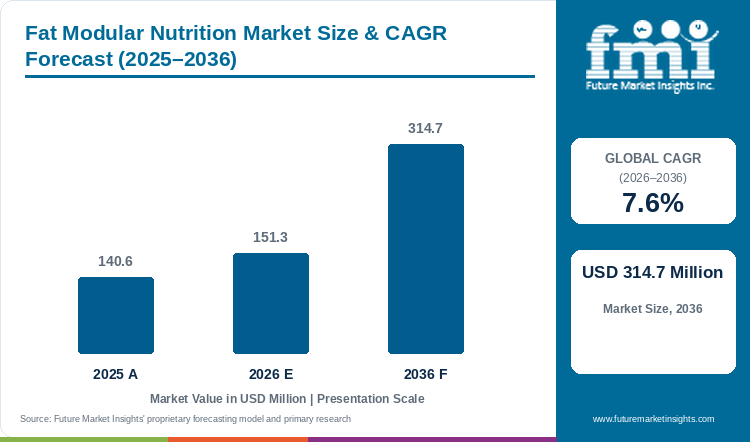
USD 151.3 Million in 2026 and USD 314.7 Million by 2036 at a 7.6% CAGR.
The fat modular nutrition market stands at USD 151.3 Million in 2026 and is projected to reach USD 314.7 Million by 2036, growing at a 7.6% CAGR. Market demand is heavily concentrated in clinical settings where dietitians require high calorie density without adding significant fluid volume, or where the specific type of dietary fat must be strictly controlled. The fat modular nutrition market was valued at approximately USD 140.6 Million in 2025. A 2023 meta-analysis of 47,654 hospitalized adults reported a malnutrition prevalence of 39% following a two-step GLIM assessment. While this massive clinical burden does not automatically translate into fat module sales, it vastly expands the pool of patients in which dietitians consider concentrated energy fortification when ordinary intake or standard supplements prove insufficient.[10]
Commercial conversion varies significantly by care pathway. In the USA, FDA guidance restricts medical food usage to distinctive nutritional requirements under ongoing medical supervision, while HCPCS B4155 identifies modular enteral nutrients that can include medium-chain triglycerides. European markets enforce their own strict notification and labeling rules. South Korea and Japan present strong aging-related nutrition needs, but suppliers must still navigate locally acceptable claims and clinical use protocols. Consequently, clinical interest only translates into recurring revenue when a product perfectly matches the prescribed fat profile, the purchasing channel can replenish it reliably, and reimbursement or institutional budgets actively support repeat use.[1][2][3][7][9]
Market Size and Forecast
Table 1: Market Size and Forecast for the Fat Modular Nutrition Market (USD Million), 2025 to 2036
| Metric | Value |
|---|---|
| Estimated Market Size in 2025 | USD 140.6 Million |
| Estimated Market Size in 2026 | USD 151.3 Million |
| Projected Market Size by 2036 | USD 314.7 Million |
| CAGR, 2026 to 2036 | 7.6% |
Key Takeaways
- Clinical Energy Fortification: Condition-specific fat handling and the need for concentrated energy create the core market demand. Suppliers secure repeat orders when specialized modules integrate seamlessly into existing dietetic plans without displacing the primary feeding regimen.
- LCT Emulsions Dominate Lipid Type: LCT Emulsions lead with a 42.3% share in 2026 because they deliver highly concentrated energy in small volumes and can be easily added to foods, oral supplements, or enteral tube feeds.
- Malnutrition Energy Boost Leads Indication: This segment captures 42.9% of 2026 revenue because undernutrition is highly prevalent in medical care, and calorie-dense modules can raise energy intake without materially increasing feed volume.
- Emulsions Lead Product Form: Emulsions command 52.1% of 2026 revenue because they combine precise dose flexibility with straightforward mixing and enteral administration across both hospital and home-care workflows.
- Purchasing Friction Beyond Clinical Need: The primary barrier to adoption is not just clinical need. Strict medical supervision, tolerance limits at higher MCT loads, essential fatty acid balancing, and complex reimbursement rules can severely delay repeat use.
Profiled Companies: Danone Nutricia, Vitaflo / Nestle Health Science, Solace Nutrition, Abbott, Fresenius Kabi, Stepan, Medtrition, and Global Health Products.
Analyst Perspective
“Revenue scales predictably when a clinically appropriate fat profile is paired with dependable replenishment and a reimbursement or institutional purchasing route that actively supports repeated use. Product quality alone cannot overcome the administrative friction of medical food qualification.”
- Anurag Sharma, Future Market Insights
How is the fat modular nutrition market segmented?
The market is segmented by Lipid Type, Indication, Product Form, Age Group and Sales Channel.
By Lipid Type, the market includes LCT Emulsions, MCT Emulsions & Oils, MCT / LCT Blends, Structured Lipids, and Others. By Indication, it covers Malnutrition Energy Boost, Fat Malabsorption & Cholestasis, Ketogenic Diet Support, Chylothorax, and Others. Product Form comprises Emulsions, Oils, Powders, and Others. Age Group comprises Pediatric, Adult, and Geriatric demand. Sales Channel includes Hospital Pharmacy, Retail Pharmacy, Online, Institutional Tender, and Others.
Why do LCT Emulsions anchor the Lipid Type category?
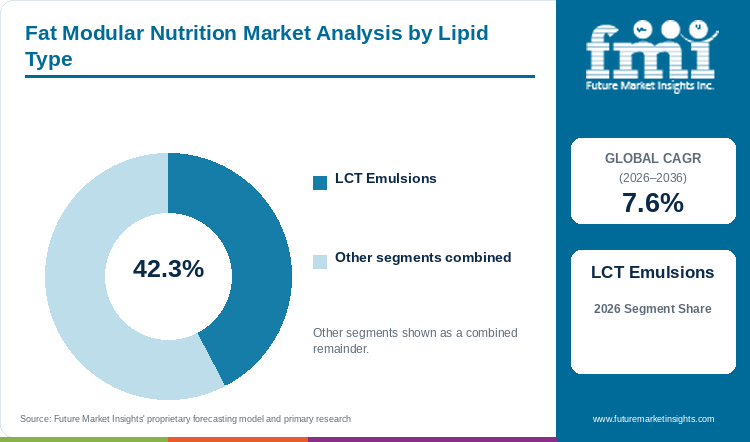
LCT Emulsions hold 42.3% of Lipid Type in 2026.
LCT emulsions provide a direct method to increase caloric density while keeping the underlying diet or feed composition largely intact. Nutricia describes Calogen as a high-energy LCT fat emulsion used to supplement or fortify diets when regular intake falls short of energy requirements. This positioning is ideal for malnutrition management, fluid restriction, and feed fortification. Because MCT products serve more specialized fat-handling needs, the LCT format addresses a much broader energy-boost use case within the defined modular boundary. LCT Emulsions hold 42.3% of 2026 revenue, leveraging their broad utility across oral and enteral workflows without requiring a complete overhaul of the feeding formula.[14]
- LCT Emulsions account for 42.3% of Lipid Type in 2026.
- Broad Utility Across Care Settings: The leading market position is driven by the format's ability to seamlessly fortify both oral diets and enteral tube feeds, providing concentrated energy without disrupting the core nutritional prescription.
- Supply Chain and Channel Replenishment: Despite being a clinically established module, sustained revenue relies heavily on dependable channel replenishment, as evidenced by Nutricia actively managing stock levels for hospital and community pharmacy supplies in early 2024.[16]
Why does Malnutrition Energy Boost lead the Indication category?
Malnutrition Energy Boost holds 42.9% of Indication in 2026.
Energy boosting represents the widest indication because it can be layered onto a vast array of disease-specific feeding plans. A 2023 GLIM meta-analysis revealed a substantial malnutrition prevalence among hospitalized adults, linking it directly to higher mortality risks. Fat modules do not replace comprehensive nutrition assessments or complete feeding regimens. Instead, they become highly relevant when a dietitian needs to deliver more calories in a strictly limited volume, adding fat without upsetting the required protein, carbohydrate, or electrolyte balance. Malnutrition Energy Boost captures 42.9% of 2026 revenue, benefiting from a massive clinical pool where calorie shortfalls must be corrected without increasing meal or feed volume.[10]
- Malnutrition Energy Boost accounts for 42.9% of Indication in 2026.
- Addressing Volume-Constrained Caloric Deficits: The segment dominates because it offers a highly efficient solution for correcting severe energy deficits in patients who cannot tolerate large volumes of standard food or enteral formulas.
- Screening-Driven Clinical Intervention: High malnutrition prevalence rates validated by standardized GLIM assessments actively drive dietitians to integrate targeted fat modules into individualized, screening-driven nutrition intervention protocols.
What makes Emulsions the preferred Product Form?
Emulsions hold 52.1% of Product Form in 2026.
Emulsions effectively solve a practical dosing challenge by allowing concentrated fat to be delivered in a format that mixes easily into drinks, foods, and enteral feeds. Nutricia offers both Calogen as an LCT emulsion and Liquigen as an MCT emulsion, both of which are nutritionally incomplete and intended for strict medical supervision. While straight oils offer high fat purity and powders improve portability, emulsions retain a distinct advantage when clinicians require a ready-to-dose liquid that disperses far more predictably than pure oil in routine feeding workflows. Emulsions command 52.1% of 2026 revenue, reflecting their superior administration flexibility across both oral fortification and tube-feeding applications.[14][15]
- Emulsions account for 52.1% of Product Form in 2026.
- Administration Flexibility and Predictability: Emulsions lead the market because they disperse reliably in both oral and enteral applications, eliminating the separation and dosing issues frequently associated with straight lipid oils.
- Integration into Replenishment Workflows: Liquid modular formats are deeply embedded into real-world pharmacy and institutional replenishment workflows, functioning as essential, routinely stocked clinical tools rather than niche specialist ingredients.
What are the drivers, restraints and opportunities in the fat modular nutrition market?
Disease-related malnutrition and condition-specific fat handling support demand, while clinical eligibility and tolerance constrain use, and better-evidenced dose-precise modules create an opportunity for suppliers.
- Driver: Disease-related malnutrition and disorder-specific fat handling create immense demand for concentrated energy and tailored MCT/LCT delivery.
- Restraint: Clinical supervision, tolerance limits, evidence gaps at high MCT exposure, and strict reimbursement or notification requirements slow substitution and repeat use.
- Opportunity: Suppliers can grow through dose-precise modules with condition-specific evidence, reliable pharmacy or DME access, and multiple formats that simplify individualized prescriptions.
The strongest driver is the urgent need to correct energy deficits or modify fat handling without rebuilding the entire nutrition prescription. The 2023 GLIM meta-analysis found malnutrition in 39% of hospitalized adults and linked it to materially higher mortality risks. In parallel, MCT possesses a defined physiological role when long-chain fat absorption or lymphatic transport is impaired. These distinct needs create separate purchase triggers. Dietitians frequently use LCT modules to raise calories, while MCT modules support selected cholestatic or chylous pathways as well as fatty-acid oxidation and ketogenic protocols. Demand is strongest when the module solves one narrow nutritional problem without disturbing the rest of the regimen.[10][11][12]
The main restraint appears at clinical qualification and sustained use. FDA guidance defines medical foods narrowly and expects ongoing medical supervision. A 2023 cholestasis review found that while MCT supplementation improved fat absorption, it also linked very high MCT proportions to essential fatty acid deficiency, noting that much of the supporting evidence is quite old. Nutricia separately warns that rapid intake of large MCT quantities can cause vomiting or diarrhea. These limits do not remove demand, but they make dose selection, monitoring, and product tolerance a mandatory part of the purchasing decision, reducing casual substitution and slowing repeat ordering when clinical follow-up is weak.[1][11][15]
The clearest opportunity lies in developing a more usable clinical module rather than simply a higher-fat product. Suppliers can combine standardized dosing with emulsion, oil, and powder formats that fit distinct care settings. Better documentation for chylous disease, malabsorption, and ketogenic use can drastically reduce uncertainty around product selection. US access heavily benefits from clear coding and reimbursement support, while European and Asian suppliers must strictly align with local medical food or special dietary use rules. Companies offering dependable supply, practical packaging, and transparent composition can help clinicians titrate MCT or LCT exposure much more confidently.[18][20]
Which country CAGRs are profiled in the fat modular nutrition market?
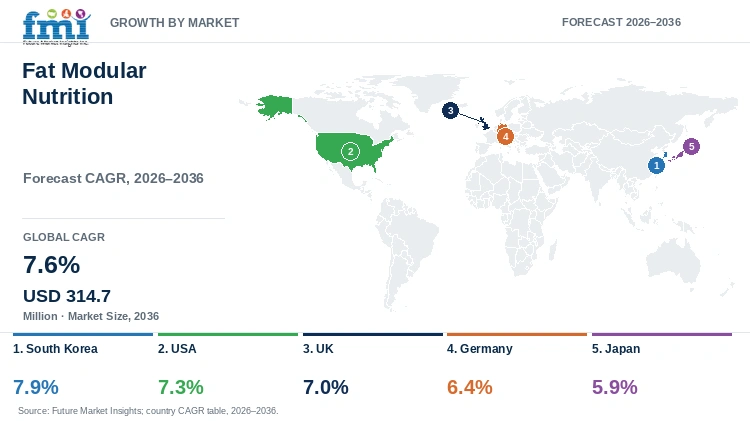
The following country CAGRs cover 2026 to 2036.
Table 2: Country CAGRs for the Fat Modular Nutrition Market (CAGR, %), 2026 to 2036
| Country | CAGR |
|---|---|
| South Korea | 7.9% |
| USA | 7.3% |
| UK | 7.0% |
| Germany | 6.4% |
| Japan | 5.9% |
Country-wise Analysis
- South Korea: South Korea is set to grow at 7.9% CAGR from 2026 to 2036. Statistics Korea reported that people aged 65 and over represented 20.3% of the population in 2025, projecting that share to reach about 30% by 2036. This massive age shift expands the pool of patients who may require clinical nutrition during acute illness or chronic disease. MFDS standards strictly define foods for special medical purposes for oral or tube feeding when ordinary nutrition is insufficient. Suppliers therefore need composition, labeling, and medical-use evidence that perfectly fit local clinical practice rather than relying on general wellness positioning.[8][9]
- USA: The FDA's March 2023 guidance requires a medical food to address distinctive nutritional requirements and to be used under ongoing medical supervision. Access also heavily depends on the route of administration. CMS describes HCPCS B4155 as a code for nutritionally incomplete or modular enteral nutrients, including fat such as MCT, when administered through an enteral feeding tube. Vitaflo and Solace actively publish B4155 coding for selected MCT products, demonstrating how suppliers support complex reimbursement workflows. The ultimate commercial gate is documentation, as a clinically suitable module must also fit payer, DME, pharmacy, or institutional purchasing rules.[1][2][18][20]
- UK: The Department of Health and Social Care updated its FSMP guidance page in April 2024 and maintains strict notification routes for foods for special medical purposes. Nutricia's UK product pages list PIP codes for both Calogen and Liquigen, heavily supporting pharmacy identification. A February 2024 stock notice also showed Calogen formats moving through Homeward and wholesaler replenishment schedules. This makes the UK a highly channel-sensitive market where clinical familiarity matters, but product continuity and correct pharmacy fulfillment are equally important to sustained use.[3][14][15][16]
- Germany: Destatis reported in August 2026 that 19.3 million people were aged 65 or older in 2025, equal to 23% of the population. This demographic base strongly supports demand for medical nutrition across hospital and community care. The BVL and BfArM position paper states that FSMPs serve patients whose nutrient needs cannot be met through ordinary food and should be used under medical supervision. First market placement must be notified to the BVL with a label sample. Suppliers therefore compete heavily on clinical fit and compliant classification, not just on calorie density or fat source.[4][5]
- Japan: Japan has the lowest profiled rate at a 5.9% CAGR from 2026 to 2036, yet its underlying clinical nutrition need remains absolutely substantial. The Statistics Bureau reported 36.24 million people aged 65 or older in 2024, equal to 29.3% of the population. Consumer Affairs Agency materials classify foods for patients within the Foods for Special Dietary Uses system and require explicit permission to market products with those special-use claims. This creates a high-need but highly permission-sensitive environment. Suppliers must localize labeling and evidence while working through medical channels that can clearly explain when a concentrated fat module is appropriate over a complete formula.[6][7]
Who are the notable companies in the fat modular nutrition market?
Danone Nutricia, Vitaflo / Nestle Health Science, Solace Nutrition, Abbott, Fresenius Kabi, Stepan, Medtrition, and Global Health Products are the notable companies profiled in this market.
Competition is distinctly split across three business models. Danone Nutricia, Vitaflo / Nestle Health Science, and Solace Nutrition sell specialist medical foods that can be dosed as fat modules or condition-specific MCT products. Stepan supplies MCT ingredients and custom lipid capability upstream, while Abbott and Fresenius Kabi bring broader clinical nutrition formulation and deep institutional relationships. Medtrition and Global Health Products are established medical nutrition suppliers with strong institutional channels, although public evidence for standalone fat-module breadth is narrower. This structure makes the market less about one universal portfolio and much more about clinical specificity, access, and the ability to support repeat ordering.[14][15][17][19][22][24][25][26]
- Dedicated Fat-Modular Medical Nutrition: Danone Nutricia, Vitaflo / Nestle Health Science, and Solace Nutrition possess documented specialist products that directly alter fat intake or deliver MCT in measured, clinically validated formats.
- Lipid Formulation and Clinical Nutrition Platforms: Abbott, Fresenius Kabi, and Stepan contribute broader formula design, clinical nutrition infrastructure, or specialty-lipid inputs. Their in-scope standalone module evidence varies significantly by company.
- Institutional Modular Nutrition Channels: Medtrition and Global Health Products serve healthcare nutrition buyers through extensive medical food portfolios and distribution networks. Their documented fat-specific portfolios are more limited than their broader modular nutrition activity.
Competitive Benchmarking: Fat Modular Nutrition Market
Table 3: Competitive Benchmarking for the Fat Modular Nutrition Market
| Company | Standalone Fat-Module Evidence | MCT/LCT Clinical Fit | Clinical Procurement Access | Geographic Reach |
|---|---|---|---|---|
| Danone Nutricia | High | High | High | United Kingdom product and pharmacy channels |
| Vitaflo / Nestle Health Science | High | High | High | USA, UK and multiple international Vitaflo markets |
| Solace Nutrition | High | High | High | USA direct, DME, specialty-pharmacy and hospital ordering channels |
| Abbott | Not specified | Medium | Not specified | USA product availability |
| Fresenius Kabi | Not specified | Not specified | Medium | Global clinical-nutrition network with R&D nodes in Germany, India and China |
| Stepan | High | Medium | Medium | USA ingredient supply with specialty-lipid applications in clinical nutrition |
| Medtrition | Not specified | Medium | Medium | USA base with medical-food use in clinical settings and home care |
| Global Health Products | Not specified | Not specified | High | USA clinical-nutrition manufacturing and distribution channels |
Scoring basis: Standalone Fat-Module Evidence rates whether a company documents a dedicated fat module or independently dosed lipid ingredient. MCT/LCT Clinical Fit assesses documented capability to match fat architecture with clinical use. Clinical Procurement Access assesses pharmacy and reimbursement support, covering DME, institutional, or specialist ordering.
Key Developments in the Fat Modular Nutrition Market
- In July 2026, Stepan announced an effective price increase of USD 0.04 to USD 0.20 per pound for NEOBEE medium-chain triglycerides. This change raises the ingredient-cost floor for MCT-based formulations and gives downstream manufacturers another reason to manage contracts, pack sizes, and margin exposure carefully.[23]
- In June 2025, Fresenius Kabi opened an expanded Enteral Nutrition R&D center in Gurugram, India, as part of its global nutrition innovation network. This investment expands formulation and development capacity highly relevant to FSMP and enteral nutrition categories.[24]
- In February 2024, Danone Nutricia published a UK stock notice showing several Calogen presentations moving through low-stock and replenishment windows for Homeward and wholesalers. This highlights a practical competitive lever, as continuity of supply directly affects whether clinicians maintain a prescribed module or are forced to seek an alternative format.[16]
Key Players in the Fat Modular Nutrition Market
- Dedicated Fat-Modular Medical Nutrition
- Danone Nutricia
- Vitaflo / Nestle Health Science
- Solace Nutrition
- Lipid Formulation and Clinical Nutrition Platforms
- Abbott
- Fresenius Kabi
- Stepan
- Institutional Modular Nutrition Channels
- Medtrition
- Global Health Products
Fat Modular Nutrition Market - Report Scope
Table 4: Report scope for the Fat Modular Nutrition Market (USD Million), 2026 to 2036
| Coverage field | Report scope |
|---|---|
| Market breakdown | Lipid Type; Indication; Product Form; Age Group; Sales Channel |
| Quantitative Units | USD Million |
| Market Definition | Revenue from independently sold fat modular nutrition products within the stated segmentation universe. Included products are fat-only or fat-dominant modules used to fortify oral or enteral regimens or to alter dietary fat type. Excluded revenue includes downstream complete formulas, finished oral nutritional supplements, parenteral lipid emulsions, ordinary culinary MCT oils, and substitute products. |
| Regions Covered | North America; Latin America; Western Europe; Eastern Europe; East Asia; South Asia and Pacific; Middle East and Africa |
| Countries Covered | USA; UK; Germany; Japan; South Korea |
| Key Companies Profiled | Danone Nutricia; Vitaflo / Nestle Health Science; Solace Nutrition; Abbott; Fresenius Kabi; Stepan; Medtrition; Global Health Products |
| Forecast Period | 2026 to 2036 |
| Approach | Primary and secondary research with market triangulation. |
Fat Modular Nutrition Market - Research Methodology
Table 5: Research methodology for the Fat Modular Nutrition Market (USD Million), 2026 to 2036
| Method | Approach |
|---|---|
| Primary Research | FMI analysts gathered input from manufacturers, service providers, distributors, end users, procurement teams and subject-matter experts. Interviews examined purchasing decisions, adoption barriers, approval requirements, pricing considerations and expectations for technical support. |
| Desk Research | Desk research covered government statistics, regulatory publications, trade data, industry associations, technical literature, standards, company filings and official corporate announcements. Claims relating to performance, applications, approvals and commercial activity were retained only when supported by credible public evidence. |
| Market Sizing and Forecasting | The market model combined the baseline value with historical performance, segment structure, pricing and volume indicators, adoption levels, company participation and country-level demand conditions. Forecast assumptions considered economic activity, regulatory developments, technology adoption and purchasing cycles. |
| Data Validation | Estimates were checked against multiple independent indicators, including public data, company activity, trade patterns and findings from primary interviews. Adjacent categories, unsupported claims and overlapping revenues were excluded to reduce double counting. |
Fat Modular Nutrition Market by Segments
Fat Modular Nutrition Market segmented by Lipid Type:
- LCT Emulsions
- MCT Emulsions & Oils
- MCT / LCT Blends
- Structured Lipids
- Others
Fat Modular Nutrition Market segmented by Indication:
- Malnutrition Energy Boost
- Fat Malabsorption & Cholestasis
- Ketogenic Diet Support
- Chylothorax
- Others
Fat Modular Nutrition Market segmented by Product Form:
- Emulsions
- Oils
- Powders
- Others
Fat Modular Nutrition Market segmented by Age Group:
- Pediatric
- Adult
- Geriatric
Fat Modular Nutrition Market segmented by Sales Channel:
- Hospital Pharmacy
- Retail Pharmacy
- Online
- Institutional Tender
- Others
Fat Modular Nutrition Market by Region:
- North America
- United States
- Canada
- Latin America
- Brazil
- Mexico
- Argentina
- Chile
- Western Europe
- Germany
- France
- United Kingdom
- Italy
- Spain
- Benelux
- Nordics
- Eastern Europe
- Poland
- Czech Republic
- Romania
- Hungary
- East Asia
- China
- Japan
- South Korea
- South Asia and Pacific
- India
- ASEAN
- Australia and New Zealand
- Middle East and Africa
- GCC Countries
- South Africa
- Türkiye
- Israel
Research Sources and Bibliography
- [1] U.S. Food and Drug Administration (2023, March). Guidance for Industry: Frequently Asked Questions About Medical Foods. https://www.fda.gov/regulatory-information/search-fda-guidance-documents/guidance-industry-frequently-asked-questions-about-medical-foods-third-edition
- [2] Centers for Medicare & Medicaid Services (2025). 2025 HCPCS Level II Final Coding, Benefit Category and Payment Determinations.
- [3] Department of Health and Social Care (2024, April 3). Infant and follow-on formula and food for special medical purposes.
- [4] BVL and BfArM (n.d.). Position paper on the characterization of foods for special medical purposes.
- [5] Statistisches Bundesamt (Destatis) (2026, August 18). Older people: population aged 65 and over.
- [6] Statistics Bureau of Japan (2025, September). Statistical Handbook of Japan 2025.
- [7] Consumer Affairs Agency, Japan (n.d.). Foods for Special Dietary Uses.
- [8] Statistics Korea (2025, September 29). 2025 Statistics on the Aged.
- [9] Ministry of Food and Drug Safety, Republic of Korea (n.d.). Article 5. Standards and Specifications for Each Food Product.
- [10] Bian et al. (2023). Prevalence of malnutrition based on GLIM criteria: systematic review and meta-analysis. https://pmc.ncbi.nlm.nih.gov/articles/PMC10352804/
- [11] Mancell et al. (2023, September 24). Medium-chain triglycerides and the impact on fat absorption, growth, nutritional status and clinical outcomes in children with cholestatic liver disease.
- [12] Kovacic et al. (2024, May 22). Comprehensive nutrition guidelines and management strategies for enteropathy in children.
- [13] Abbasi et al. (2025, January 17). Illuminating the Safety, Tolerability, and Efficacy of Different Ketogenic Diets for Individuals with Epilepsy.
- [14] Nutricia (n.d.). Calogen Neutral.
- [15] Nutricia (n.d.). Liquigen.
- [16] Nutricia (2024, February 12). UK stock update.
- [17] Vitaflo USA (n.d.). MCTprocal for FAOD and the Ketogenic Diet.
- [18] Vitaflo USA (2025, March). Vitaflo USA Reimbursement and Product Codes.
- [19] Solace Nutrition (n.d.). neoKe MCT70 FAQ.
- [20] Solace Nutrition (n.d.). How to Order Medical Food Products.
- [21] Solace Nutrition (2021). Solace Nutrition Product Lines.
- [22] Stepan Company (n.d.). NEOBEE M-5.
- [23] Stepan Company (2026, July 1). Pricing Announcements: NEOBEE medium-chain triglycerides. https://www.stepan.com/content/stepan-dot-com/en/news-events/pricing-announcements.html
- [24] Fresenius Kabi (2025, June 26). New R&D center in India strengthens Fresenius Kabi’s innovation network. https://www.fresenius-kabi.com/news/new-r-and-d-center-india
- [25] Abbott Nutrition (2025). Adult Product Reference: Vital 1.5 Cal.
- [26] Medtrition (2025, July). Gelatein MCT Product Guide.
- [27] Global Health Products (n.d.). About Global Health Products.
- [28] Global Health Products (2026, January 26). Gordon Food Service Now Stocking Select Products.
- [29] Nestlé (2010, August 2). Nestlé to enter global market for clinical nutrition products for people with inherited metabolic disorders.
This Report Answers
- How large is the Fat Modular Nutrition Market in 2026, and what value is forecast for 2036?
- Which clinical and operating pressures support demand for fat modular nutrition?
- Why do LCT Emulsions hold the leading Lipid Type position?
- Why does Malnutrition Energy Boost lead the Indication category?
- How do profiled country growth rates differ across South Korea, USA, UK, Germany, and Japan?
- Which companies supply or support relevant fat-module, clinical-nutrition, or specialty-lipid categories?
- What limits adoption, switching, and repeat purchasing of fat modular nutrition?
- What should clinical and procurement buyers evaluate before purchasing a fat modular product?
Frequently Asked Questions
How big is the Fat Modular Nutrition Market in 2026, and what is forecast for 2036?
The market is valued at USD 151.3 Million in 2026 and is forecast to reach USD 314.7 Million by 2036. Growth heavily depends on clinically directed use in energy fortification and condition-specific fat management.
What is the CAGR of the Fat Modular Nutrition Market from 2026 to 2036?
The market is forecast to grow at a 7.6% CAGR from 2026 to 2036. The rate reflects expanding clinical use, but actual revenue conversion still depends on qualification, reimbursement, and reliable supply.
Which Lipid Type leads the Fat Modular Nutrition Market?
LCT Emulsions lead Lipid Type with 42.3% of 2026 revenue. Their position is heavily supported by broad use as concentrated energy fortifiers in both oral and enteral care settings.
Which Indication leads the Fat Modular Nutrition Market?
Malnutrition Energy Boost leads Indication with 42.9% of 2026 revenue. It addresses a vastly wider clinical need than the more condition-specific malabsorption, ketogenic, and chylothorax applications.
Which profiled countries have the highest growth rates in the Fat Modular Nutrition Market?
South Korea has the highest profiled CAGR at 7.9%, followed by the USA at 7.3% and the UK at 7.0%.
Which companies are active in the Fat Modular Nutrition Market?
Profiled companies are Danone Nutricia, Vitaflo / Nestle Health Science, Solace Nutrition, Abbott, Fresenius Kabi, Stepan, Medtrition, and Global Health Products. Their roles range from direct fat modules to specialty lipids, broader clinical nutrition, and institutional distribution.
Preview the report firsthand - request a free sample
Get SampleGet the brochure for pricing and purchase details.
Get PDFTable of Content
- Key Takeaways
- Market Size and CAGR
- Top Growth Driver
- Fastest Growing Segment
- Leading Region
- Key Companies
- Emerging Opportunities
- Executive Summary
- Global Market Outlook
- Demand-side Trends
- Supply-side Trends
- Technology Roadmap Analysis
- Analysis and Recommendations
- Analyst Perspective (What is happening? Why now? What should investors know?)
- Key Questions Answered
- How large is the market?
- What is the CAGR?
- What are key trends?
- Which region dominates?
- Who are the leaders?
- Market Overview
- Market Coverage / Taxonomy
- Market Definition / Scope / Limitations
- Research Methodology
- Chapter Orientation
- Analytical Lens and Working Hypotheses
- Market Structure, Signals, and Trend Drivers
- Benchmarking and Cross-market Comparability
- Market Sizing, Forecasting, and Opportunity Mapping
- Research Design and Evidence Framework
- Desk Research Programme (Secondary Evidence)
- Expert Input and Fieldwork (Primary Evidence)
- Tooling, Models, and Reference Databases
- Data Engineering and Model Build
- Quality Assurance and Audit Trail
- Market Background
- Market Dynamics (Drivers, Restraints, Opportunity, Trends)
- Scenario Forecast (Optimistic, Likely, Conservative)
- Impact Analysis
- AI Impact
- Sustainability Impact
- Regulatory Impact
- Technology Impact
- Consumer / Buyer Analysis
- Purchase Drivers
- Adoption Barriers
- Buyer Journey
- Opportunity Map Analysis
- Product Life Cycle Analysis
- Supply Chain Analysis
- Investment Feasibility Matrix
- Value Chain Analysis
- PESTLE and Porter's Analysis
- Regulatory Landscape
- Regional Parent Market Outlook
- Production and Consumption Statistics
- Import and Export Statistics
- Global Market Analysis and Forecast, 2021 to 2036
- Historical Market Size Value (USD Million) Analysis, 2021 to 2025
- Current and Future Market Size Value (USD Million) Projections, 2026 to 2036
- Y-o-Y Growth Trend Analysis
- Absolute $ Opportunity Analysis
- Global Market Pricing Analysis, 2021 to 2036
- Global Market Analysis and Forecast, By Lipid Type, 2021 to 2036
- Introduction / Key Findings
- Historical Market Size Value (USD Million) Analysis By Lipid Type, 2021 to 2025
- Current and Future Market Size Value (USD Million) Analysis and Forecast By Lipid Type, 2026 to 2036
- LCT Emulsions
- MCT Emulsions & Oils
- MCT / LCT Blends
- Structured Lipids
- Others
- Y-o-Y Growth Trend Analysis By Lipid Type, 2021 to 2025
- Absolute $ Opportunity Analysis By Lipid Type, 2026 to 2036
- Global Market Analysis and Forecast, By Indication, 2021 to 2036
- Introduction / Key Findings
- Historical Market Size Value (USD Million) Analysis By Indication, 2021 to 2025
- Current and Future Market Size Value (USD Million) Analysis and Forecast By Indication, 2026 to 2036
- Malnutrition Energy Boost
- Fat Malabsorption & Cholestasis
- Ketogenic Diet Support
- Chylothorax
- Others
- Y-o-Y Growth Trend Analysis By Indication, 2021 to 2025
- Absolute $ Opportunity Analysis By Indication, 2026 to 2036
- Global Market Analysis and Forecast, By Product Form, 2021 to 2036
- Introduction / Key Findings
- Historical Market Size Value (USD Million) Analysis By Product Form, 2021 to 2025
- Current and Future Market Size Value (USD Million) Analysis and Forecast By Product Form, 2026 to 2036
- Emulsions
- Oils
- Powders
- Others
- Y-o-Y Growth Trend Analysis By Product Form, 2021 to 2025
- Absolute $ Opportunity Analysis By Product Form, 2026 to 2036
- Global Market Analysis and Forecast, By Age Group, 2021 to 2036
- Introduction / Key Findings
- Historical Market Size Value (USD Million) Analysis By Age Group, 2021 to 2025
- Current and Future Market Size Value (USD Million) Analysis and Forecast By Age Group, 2026 to 2036
- Pediatric
- Adult
- Geriatric
- Y-o-Y Growth Trend Analysis By Age Group, 2021 to 2025
- Absolute $ Opportunity Analysis By Age Group, 2026 to 2036
- Global Market Analysis and Forecast, By Sales Channel, 2021 to 2036
- Introduction / Key Findings
- Historical Market Size Value (USD Million) Analysis By Sales Channel, 2021 to 2025
- Current and Future Market Size Value (USD Million) Analysis and Forecast By Sales Channel, 2026 to 2036
- Hospital Pharmacy
- Retail Pharmacy
- Online
- Institutional Tender
- Others
- Y-o-Y Growth Trend Analysis By Sales Channel, 2021 to 2025
- Absolute $ Opportunity Analysis By Sales Channel, 2026 to 2036
- Global Market Analysis and Forecast, By Region, 2021 to 2036
- Introduction
- Historical Market Size Value (USD Million) Analysis By Region, 2021 to 2025
- Current Market Size Value (USD Million) Analysis and Forecast By Region, 2026 to 2036
- North America
- Latin America
- Western Europe
- Eastern Europe
- East Asia
- South Asia and Pacific
- Middle East and Africa
- Market Attractiveness Analysis By Region
- North America Market Analysis and Forecast, By Country, 2021 to 2036
- Historical Market Size Value (USD Million) Trend Analysis By Market Taxonomy, 2021 to 2025
- Market Size Value (USD Million) Forecast By Market Taxonomy, 2026 to 2036
- By Country
- United States
- Canada
- By Lipid Type
- By Indication
- By Product Form
- By Age Group
- By Sales Channel
- By Country
- Market Attractiveness Analysis
- By Country
- By Lipid Type
- By Indication
- By Product Form
- By Age Group
- By Sales Channel
- Key Takeaways
- Latin America Market Analysis and Forecast, By Country
- Historical Market Size Value (USD Million) Trend Analysis By Market Taxonomy, 2021 to 2025
- Market Size Value (USD Million) Forecast By Market Taxonomy, 2026 to 2036
- By Country
- Brazil
- Mexico
- Argentina
- Chile
- By Lipid Type
- By Indication
- By Product Form
- By Age Group
- By Sales Channel
- By Country
- Market Attractiveness Analysis
- By Country
- By Lipid Type
- By Indication
- By Product Form
- By Age Group
- By Sales Channel
- Key Takeaways
- Western Europe Market Analysis and Forecast, By Country
- Historical Market Size Value (USD Million) Trend Analysis By Market Taxonomy, 2021 to 2025
- Market Size Value (USD Million) Forecast By Market Taxonomy, 2026 to 2036
- By Country
- Germany
- France
- United Kingdom
- Italy
- Spain
- Benelux
- Nordics
- By Lipid Type
- By Indication
- By Product Form
- By Age Group
- By Sales Channel
- By Country
- Market Attractiveness Analysis
- By Country
- By Lipid Type
- By Indication
- By Product Form
- By Age Group
- By Sales Channel
- Key Takeaways
- Eastern Europe Market Analysis and Forecast, By Country
- Historical Market Size Value (USD Million) Trend Analysis By Market Taxonomy, 2021 to 2025
- Market Size Value (USD Million) Forecast By Market Taxonomy, 2026 to 2036
- By Country
- Poland
- Czech Republic
- Romania
- Hungary
- By Lipid Type
- By Indication
- By Product Form
- By Age Group
- By Sales Channel
- By Country
- Market Attractiveness Analysis
- By Country
- By Lipid Type
- By Indication
- By Product Form
- By Age Group
- By Sales Channel
- Key Takeaways
- East Asia Market Analysis and Forecast, By Country
- Historical Market Size Value (USD Million) Trend Analysis By Market Taxonomy, 2021 to 2025
- Market Size Value (USD Million) Forecast By Market Taxonomy, 2026 to 2036
- By Country
- China
- Japan
- South Korea
- By Lipid Type
- By Indication
- By Product Form
- By Age Group
- By Sales Channel
- By Country
- Market Attractiveness Analysis
- By Country
- By Lipid Type
- By Indication
- By Product Form
- By Age Group
- By Sales Channel
- Key Takeaways
- South Asia and Pacific Market Analysis and Forecast, By Country
- Historical Market Size Value (USD Million) Trend Analysis By Market Taxonomy, 2021 to 2025
- Market Size Value (USD Million) Forecast By Market Taxonomy, 2026 to 2036
- By Country
- India
- ASEAN
- Australia and New Zealand
- By Lipid Type
- By Indication
- By Product Form
- By Age Group
- By Sales Channel
- By Country
- Market Attractiveness Analysis
- By Country
- By Lipid Type
- By Indication
- By Product Form
- By Age Group
- By Sales Channel
- Key Takeaways
- Middle East and Africa Market Analysis and Forecast, By Country
- Historical Market Size Value (USD Million) Trend Analysis By Market Taxonomy, 2021 to 2025
- Market Size Value (USD Million) Forecast By Market Taxonomy, 2026 to 2036
- By Country
- GCC Countries
- South Africa
- Türkiye
- Israel
- By Lipid Type
- By Indication
- By Product Form
- By Age Group
- By Sales Channel
- By Country
- Market Attractiveness Analysis
- By Country
- By Lipid Type
- By Indication
- By Product Form
- By Age Group
- By Sales Channel
- Key Takeaways
- Key Countries Market Analysis
- United States
- Pricing Analysis
- Market Share Analysis, 2025
- By Lipid Type
- By Indication
- By Product Form
- By Age Group
- By Sales Channel
- Canada
- Pricing Analysis
- Market Share Analysis, 2025
- By Lipid Type
- By Indication
- By Product Form
- By Age Group
- By Sales Channel
- Mexico
- Pricing Analysis
- Market Share Analysis, 2025
- By Lipid Type
- By Indication
- By Product Form
- By Age Group
- By Sales Channel
- Brazil
- Pricing Analysis
- Market Share Analysis, 2025
- By Lipid Type
- By Indication
- By Product Form
- By Age Group
- By Sales Channel
- Chile
- Pricing Analysis
- Market Share Analysis, 2025
- By Lipid Type
- By Indication
- By Product Form
- By Age Group
- By Sales Channel
- Germany
- Pricing Analysis
- Market Share Analysis, 2025
- By Lipid Type
- By Indication
- By Product Form
- By Age Group
- By Sales Channel
- United Kingdom
- Pricing Analysis
- Market Share Analysis, 2025
- By Lipid Type
- By Indication
- By Product Form
- By Age Group
- By Sales Channel
- Italy
- Pricing Analysis
- Market Share Analysis, 2025
- By Lipid Type
- By Indication
- By Product Form
- By Age Group
- By Sales Channel
- Spain
- Pricing Analysis
- Market Share Analysis, 2025
- By Lipid Type
- By Indication
- By Product Form
- By Age Group
- By Sales Channel
- France
- Pricing Analysis
- Market Share Analysis, 2025
- By Lipid Type
- By Indication
- By Product Form
- By Age Group
- By Sales Channel
- India
- Pricing Analysis
- Market Share Analysis, 2025
- By Lipid Type
- By Indication
- By Product Form
- By Age Group
- By Sales Channel
- ASEAN
- Pricing Analysis
- Market Share Analysis, 2025
- By Lipid Type
- By Indication
- By Product Form
- By Age Group
- By Sales Channel
- Australia and New Zealand
- Pricing Analysis
- Market Share Analysis, 2025
- By Lipid Type
- By Indication
- By Product Form
- By Age Group
- By Sales Channel
- China
- Pricing Analysis
- Market Share Analysis, 2025
- By Lipid Type
- By Indication
- By Product Form
- By Age Group
- By Sales Channel
- Japan
- Pricing Analysis
- Market Share Analysis, 2025
- By Lipid Type
- By Indication
- By Product Form
- By Age Group
- By Sales Channel
- South Korea
- Pricing Analysis
- Market Share Analysis, 2025
- By Lipid Type
- By Indication
- By Product Form
- By Age Group
- By Sales Channel
- Poland
- Pricing Analysis
- Market Share Analysis, 2025
- By Lipid Type
- By Indication
- By Product Form
- By Age Group
- By Sales Channel
- Hungary
- Pricing Analysis
- Market Share Analysis, 2025
- By Lipid Type
- By Indication
- By Product Form
- By Age Group
- By Sales Channel
- Türkiye
- Pricing Analysis
- Market Share Analysis, 2025
- By Lipid Type
- By Indication
- By Product Form
- By Age Group
- By Sales Channel
- South Africa
- Pricing Analysis
- Market Share Analysis, 2025
- By Lipid Type
- By Indication
- By Product Form
- By Age Group
- By Sales Channel
- United States
- Market Structure Analysis
- Competition Dashboard
- Competition Benchmarking
- Market Share Analysis of Top Players
- By Regional
- By Lipid Type
- By Indication
- By Product Form
- By Age Group
- By Sales Channel
- Emerging Startups
- Innovation Benchmarking
- Competition Analysis
- Competition Deep Dive
- Danone Nutricia
- Overview
- Product Portfolio
- Profitability by Market Segments
- Sales Footprint
- Strategy Overview
- Marketing Strategy
- Product Strategy
- Channel Strategy
- Vitaflo / Nestle Health Science
- Solace Nutrition
- Abbott
- Fresenius Kabi
- Stepan
- Medtrition
- Global Health Products
- Dedicated Fat-Modular Medical Nutrition
- Lipid Formulation and Clinical Nutrition Platforms
- Institutional Modular Nutrition Channels
- Danone Nutricia
- Case Studies
- Success Stories
- Recent Developments
- Competition Deep Dive
- Assumptions & Acronyms Used


