

- Market Size (2026)
- USD 1.8 Bn
- Forecast (2036)
- USD 4.5 Bn
- CAGR (2026 to 2036)
- 9.7%
How big is the Fat Cavitation Market in 2026?
USD 1.8 billion in 2026 and USD 4.5 billion by 2036 at a 9.7% CAGR.
Sales in the fat cavitation market are projected to grow at a 9.7% CAGR through 2036, increasing valuation from USD 1.8 billion in 2026 to USD 4.5 billion by 2036. Expansion is being supported by rising demand for non-surgical body contouring procedures among individuals seeking localized fat reduction with limited downtime. FDA guidance notes that therapeutic ultrasound can rupture subcutaneous fat cells and reduce treated-area circumference, supporting the use of ultrasound-based technologies for non-invasive fat reduction treatments.
USA growth is expected to remain slightly ahead of France as physician-led aesthetic networks increasingly incorporate body-contouring services into post-weight-loss care pathways. The American Society of Plastic Surgeons reported in June 2025 that 41% of GLP-1 patients under member-surgeon care were considering a non-surgical procedure during 2024, indicating a sizeable pool of potential candidates for non-invasive contouring treatments. This trend supports demand for fat cavitation systems across medical aesthetics practices, while France faces comparatively narrower ultrasound practice requirements and more localized service availability.
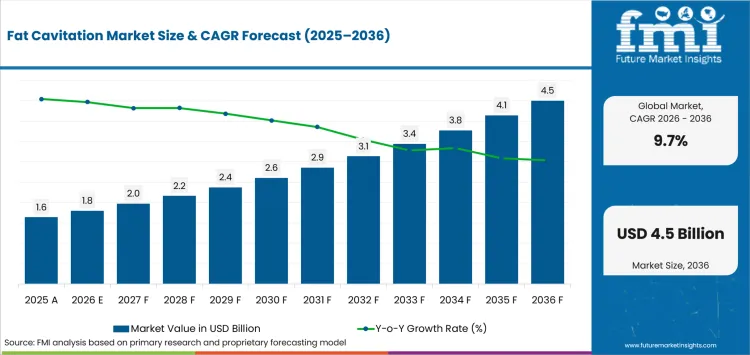
Key Takeaways of Fat Cavitation Market
- Clinic demand rises as non-invasive programs address localized fat concerns without incisions or extended surgical recovery.
- Ultrasonic fat cavitation devices are projected to represent 48.0% by product in 2026 owing to their direct acoustic treatment route.
- Body contouring is estimated to account for 42.0% by application in 2026 as abdominal and limb protocols support recurring sessions.
- Beauty and aesthetic clinics are forecast to capture 46.0% by end user in 2026 due to supervised consultation and trained operation.
- Variable outcomes and technology-specific complications restrict wider adoption as clinics align patient screening with authorized treatment claims.
- Eight companies span focused ultrasound and multi-energy body treatment: Cynosure Lutronic, Candela Medical, Venus Concept Inc., InMode Ltd., BTL Industries, Cutera, Inc., Alma Lasers Ltd. and Classys Inc.
Analyst Perspective
“Clinics should evaluate fat cavitation systems by patient screening, applicator control and service continuity across each scheduled treatment course. Commercial performance depends on realistic circumference claims plus training that limits operator variation and avoidable downtime.”
- Rahul Pandita, Principal Consultant, Future Market Insights
How is the Fat Cavitation Market segmented?
The fat cavitation market is segmented by product, application, end user, technology, distribution channel and region.
The fat cavitation market covers product, application, end user, technology, distribution channel and region. Products include ultrasonic, radiofrequency-cavitation, laser-assisted and multifunction systems. Applications include body contouring, cellulite reduction, skin tightening and wellness. End users include beauty clinics, hospitals, medical spas and home users. Technologies cover ultrasound, radiofrequency-assisted cavitation and combined energy systems. Distribution includes direct sales, medical device distributors, specialist dealers and online channels.
How do clinics evaluate ultrasonic fat cavitation devices?
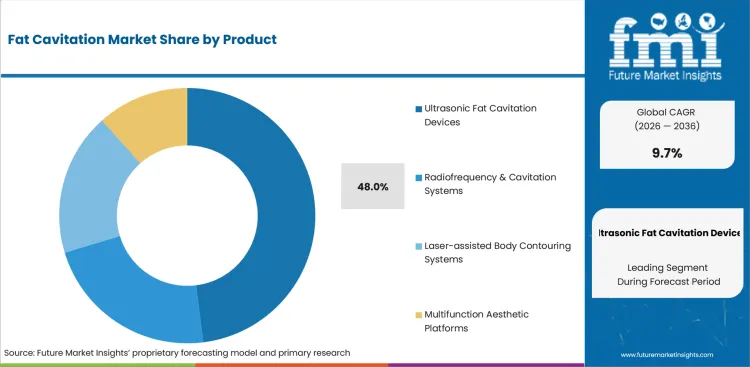
Ultrasonic fat cavitation devices direct acoustic energy toward subcutaneous tissue without breaking the skin. FDA guidance links therapeutic ultrasound with fat-cell rupture and reduced circumference, but complete contact remains essential. Clinics compare these aesthetic medical devices by output control and operator training. They compare body slimming devices by treatment-area fit and service support across recurring professional treatment programs.
- In 2026, ultrasonic fat cavitation devices are expected to represent 48.0% of product demand owing to their direct acoustic treatment route.
- Specialist clinics favor documented protocols that maintain stable coupling and consistent handpiece placement across recurring treatment programs and several body areas.
What supports demand for body contouring within the application category?
Body contouring converts equipment purchases into scheduled abdominal and limb treatment programs. Clinics can add cellulite treatment under separate protocols that preserve distinct objectives and patient expectations. Clear body-area mapping helps operators clearly separate abdominal goals from thigh or arm programs.
- Based on application, body contouring is projected to account for 42.0% in 2026 due to recurring protocols across several treatment areas.
- FDA guidance separates circumference change from obesity treatment, helping clinics explain temporary outcomes and planned session counts without presenting contouring as weight-loss care. The distinction reduces claim risk during consultation and follow-up.
What role do beauty and aesthetic clinics play within the end user category?
Beauty and aesthetic clinics combine consultation, contraindication screening and supervised operation inside one specialist setting. medical spa services can add adjacent skin programs when records preserve separate indications and follow-up. This integrated workflow supports repeat appointments without transferring records between unrelated providers.
- The beauty and aesthetic clinics segment is likely to capture 46.0% share in 2026 owing to specialist consultation and trained operation.
- Equipment demonstrations and course scheduling support adoption, but financing costs and uneven technical service can delay purchases among smaller independent clinics. Service response remains critical when clinics depend on one system for several scheduled procedures.
How does ultrasound cavitation influence selection within the technology category?
Ultrasound cavitation provides the direct acoustic route for localized subcutaneous treatment during non-invasive sessions. Clinics compare ultrasound skin tightening systems by controlled output, applicator contact and treatment-area suitability. Protocol selection also depends on tissue depth and device authorization for each intended body area.
- By technology, ultrasound cavitation is forecast to represent 53.0% in 2026 due to its central role in dedicated and multi-frequency platforms.
- FDA guidance requires complete skin contact and identifies tissue burns as a potential complication from incorrect therapeutic ultrasound use. Documented coupling and handpiece control therefore influence purchase decisions among professional operators.
What are the drivers, restraints and opportunities in the Fat Cavitation Market?
Localized treatment courses support clinic investment despite outcome variability as combination platforms increase treatment-room utilization.
- Driver: Specialist clinics can add localized fat-reduction programs without operating-room infrastructure or extended surgical recovery for suitable patients.
- Restraint: Temporary effects and technology-specific complications require conservative screening plus disciplined claims across professional aesthetic settings.
- Opportunity: Combination platforms can spread capital cost across contouring, skin-firming and muscle-conditioning appointments under separate treatment protocols.
Specialist clinics convert interest into orders through defined treatment courses for localized fat concerns. Broader skin care devices portfolios can support adjacent consultations, but cavitation protocols must remain separate from weight-management services.
Outcome variability increases consultation requirements across diverse patient profiles as FDA guidance lists pain, swelling, redness and burns across non-invasive body-contouring technologies. Clinics therefore require traceable training and claims matched to each authorized site.
Combination platforms improve room utilization by assigning each modality a defined purpose. Clinics can pair radiofrequency beauty equipment with ultrasound under separate contouring and skin-firming protocols. Dependable technical support protects appointment capacity across recurring clinic schedules and regional service territories.
Which country CAGRs are profiled in the Fat Cavitation Market?
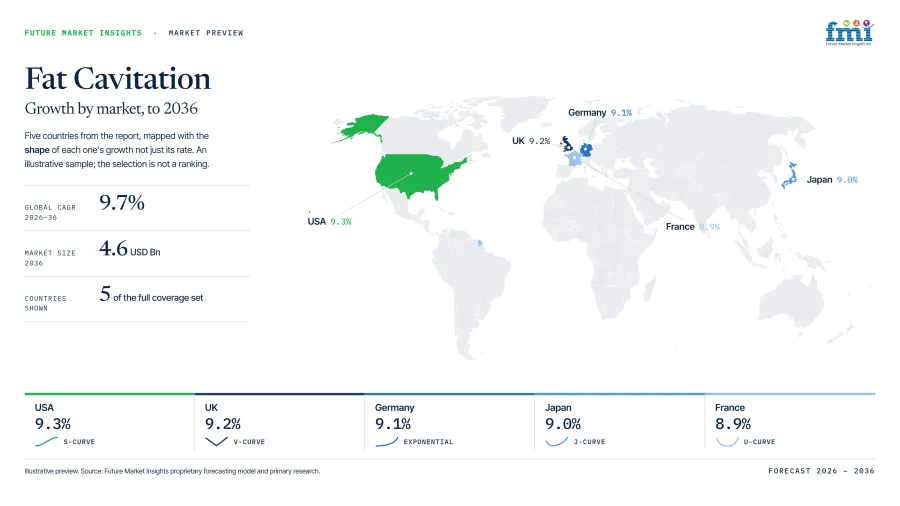
| Country | CAGR |
|---|---|
| USA | 9.3% |
| United Kingdom | 9.2% |
| Germany | 9.1% |
| Japan | 9.0% |
| France | 8.9% |
How do country-level CAGRs compare in the Fat Cavitation Market?
The country forecasts are exceptionally close across the fat cavitation market, with only 0.4 percentage points separating the USA and France. The five countries form a tightly grouped cluster, indicating broadly similar demand for non-invasive body contouring treatments. The limited variation suggests that market growth is being driven by common factors such as rising interest in aesthetic procedures, shorter recovery times and expanding availability of cosmetic treatment services.
- The USA benefits from a large and established medical aesthetics industry.
- The United Kingdom supports demand through increasing adoption of non-surgical body contouring treatments.
- Germany reflects steady growth driven by a mature aesthetic medicine sector.
- Japan continues to expand through demand for advanced cosmetic and wellness procedures.
- France maintains momentum through strong consumer interest in minimally invasive aesthetic treatments.
Comparable CAGRs may still reflect different market conditions because treatment pricing, clinic networks, regulatory requirements and consumer preferences vary across countries. The full report provides country-level CAGR analysis across North America, Latin America, Europe, East Asia, South Asia, Oceania and the Middle East and Africa.
Country-wise Analysis
- Professional aesthetic clinics in the USA combine physician oversight with medical-spa networks that support screening, equipment demonstrations and scheduled technical service across major treatment corridors and suburban markets. Adoption of fat cavitation equipment is estimated to expand at 9.3% CAGR through 2036, aided by dense clinic coverage despite capital thresholds and indication-specific authorization requirements among smaller practices across several body areas. The American Society of Plastic Surgeons reported 1.5% growth in minimally invasive treatments during 2024, yet rural service distance and lower room utilization can materially delay equipment purchases outside major metropolitan areas and reduce expected appointment yield.
- British clinics purchase professional aesthetic equipment through private networks that require documented operator training, maintenance support and incident-response procedures plus scheduled replacement planning across regional service territories. The United Kingdom fat cavitation outlook is anticipated to advance at 9.2% CAGR over the assessment period, supported by specialist clinic density despite service gaps outside major cities across Great Britain. The Medicines and Healthcare products Regulatory Agency made new surveillance rules effective in June 2025, reducing serious-incident reporting from 30 days to 15 days and increasing documentation demands for manufacturers, distributors and regional service teams during audits and routine post-market reviews.
- German aesthetic practices operate under European device law and national vigilance routes that require conformity records, trained operation and dependable post-sale service plus field engineering support across nationwide service territories. The German fat cavitation sector is projected to record 9.1% CAGR during the assessment period, reinforced by established clinical infrastructure despite detailed maintenance obligations among independent practices and distributor networks. BfArM recorded 46,326 medical-device risk reports during 2024 with 85 assigned to ultrasound technology, making service documentation and incident response stricter purchasing conditions before equipment orders can convert commercially across independent clinics and smaller regional treatment networks nationwide.
- Japanese beauty establishments form a broad service network supported by licensed professionals, urban distributors and translated operator education plus scheduled maintenance across dense metropolitan treatment corridors. Fat cavitation sales in Japan are forecast to expand at 9.0% CAGR by 2036, influenced by dense beauty infrastructure despite financing and technical-service gaps outside major cities and prefectural capitals. Japan's Ministry of Health, Labour and Welfare counted 277,752 beauty establishments at fiscal 2024 year-end with 1.3% annual growth, yet smaller providers can delay equipment purchases when regional maintenance coverage and planned appointment volume remain limited over time and across less populated prefectures.
- French lipocavitation services follow a narrow professional route as national rules reserve ultrasound treatment for physicians and physiotherapists across metropolitan areas, regional healthcare zones and private clinics. France is estimated to post 8.9% CAGR over the forecast period, supported by qualified practitioner networks despite restricted operator availability and protocol-specific legal interpretation across aesthetic channels and distributor planning. DREES counted 111,400 active physiotherapists in January 2026 with more than eight in ten working exclusively in private practice, yet uneven regional service access can limit equipment orders across smaller cities and treatment corridors during expansion and scheduled distributor coverage planning.
Who are the notable companies in the Fat Cavitation Market?
Cynosure Lutronic, Candela Medical, Venus Concept Inc., InMode Ltd., BTL Industries, Cutera, Inc., Alma Lasers Ltd. and Classys Inc. are the notable companies in the fat cavitation market.
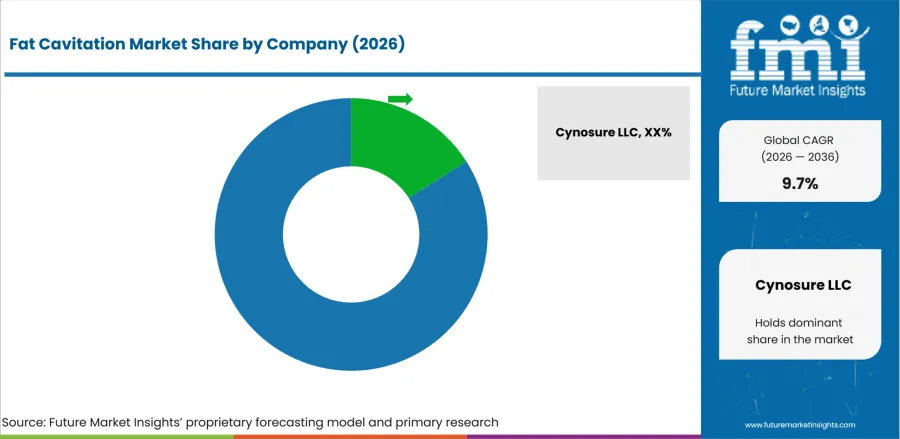
The competitive outlook is moderately fragmented as ultrasound specialists compete with multi-energy platform providers. Entry depends on authorization coverage, operator training and responsive service instead of portfolio size. Clinics compare dermatology lasers with acoustic systems by treatment coverage and workflow fit across local service models.
- BTL Industries, Alma Lasers Ltd. and Classys Inc. compete with verified ultrasound body-treatment platforms and adjacent energy functions.
- Venus Concept Inc. and InMode Ltd. combine electrical or mechanical functions with radiofrequency across body contouring and skin-treatment objectives.
- Cynosure Lutronic, Candela Medical and Cutera, Inc. address fat reduction or body treatment with laser, focused ultrasound or radiofrequency systems.
Competitive Benchmarking: Fat Cavitation Market
| Company | Ultrasound or Cavitation Fit | Combination Energy Breadth | Body Treatment Coverage | Geographic Reach |
|---|---|---|---|---|
| Cynosure Lutronic | Low | Low | Low | Global |
| Candela Medical | High | Medium | Medium | 60+ countries |
| Venus Concept Inc. | Low | High | High | 60+ countries |
| InMode Ltd. | Low | High | High | 101+ countries |
| BTL Industries | High | High | High | International |
| Cutera, Inc. | Low | Medium | Medium | International |
| Alma Lasers Ltd. | High | Medium | Low | Global |
| Classys Inc. | High | Medium | Medium | International |
Key Developments in the Fat Cavitation Market
- In March 2026, BTL Industries gained a new USA regulatory route for a multimodal body-treatment system. FDA cleared BTL-785NEH with radiofrequency, ultrasound and electrostimulation applicators for large and small treatment areas. The clearance expands integrated platform choice and requires regional service teams to support several applicator types across one installed system in professional clinics.
- In November 2025, Venus Concept expanded authorized multimodal options for USA aesthetic clinics. FDA cleared Venus NOVA with electrical muscle stimulation, radiofrequency, pulsed electromagnetic fields and variable vacuum for body and skin treatments. The system gives clinics one platform for several objectives under separate protocols and documented operator safeguards across recurring clinic appointment programs.
- In March 2026, Classys partnered with Cartessa Aesthetics to introduce QUADESSY, a hybrid radiofrequency-microneedling platform combining minimally invasive and non-invasive RF technologies, to the USA market. The launch extends Classys's energy-based portfolio through an established North American distribution partner.
Key Players in the Fat Cavitation Market
Ultrasound and Combination Platforms
- BTL Industries
- Alma Lasers Ltd.
- Classys Inc.
Laser and Radiofrequency Body Systems
- Cynosure Lutronic
- Candela Medical
- InMode Ltd.
- Cutera, Inc.
Multi-technology Body Platforms
- Venus Concept Inc.
Fat Cavitation Market - Report Scope
| Coverage field | Report scope |
|---|---|
| Market breakdown | By product, application, end user, technology, distribution channel and region. |
| Quantitative Units | Revenue in USD billion and CAGR in %. |
| Market Definition | Equipment used for non-invasive localized fat cavitation and adjacent energy-based body contouring across professional and home settings. |
| Regions Covered | North America, Latin America, Western Europe, Eastern Europe, East Asia, South Asia and Pacific, and Middle East and Africa. |
| Countries Covered | USA, United Kingdom, Germany, Japan, France, and 20+ countries included in the full report. |
| Key Companies Profiled | Cynosure Lutronic, Candela Medical, Venus Concept Inc., InMode Ltd., BTL Industries, Cutera, Inc., Alma Lasers Ltd. and Classys Inc. |
| Forecast Period | 2026 to 2036. |
| Approach | Primary and secondary research with market triangulation. |
Fat Cavitation Market - Research Methodology
| Method | Approach |
|---|---|
| Primary Research | FMI analysts gathered input from manufacturers, service providers, technology developers, distributors, end users, procurement teams, and subject-matter experts. Interviews examined purchasing decisions, product or service evaluation, adoption barriers, approval requirements, pricing considerations, and expectations for technical or commercial support. Respondents were also asked what evidence is required before a trial, pilot, or initial order develops into regular purchasing. |
| Desk Research | Desk research covered government statistics, regulatory publications, trade data, industry associations, technical literature, standards, company filings, product information, and official corporate announcements. Sources were reviewed for relevance, publication date, geographic coverage, and consistency with the defined market scope. Claims relating to performance, applications, approvals, capacity, investment, and commercial activity were retained only when supported by credible public evidence. |
| Market Sizing and Forecasting | The market model combined the baseline value with historical performance, segment structure, pricing and volume indicators, adoption levels, company participation, and country-level demand conditions. Forecast assumptions considered economic activity, investment trends, regulatory developments, technology adoption, purchasing cycles, supply availability, and barriers to wider market use. Segment and regional estimates were reconciled before the final market total was calculated. |
| Data Validation | Estimates were checked against multiple independent indicators, including public data, company activity, trade patterns, industry developments, and findings from primary interviews. Validation also tested whether products, services, applications, and company revenues fell within the defined market boundaries. Adjacent categories, unsupported claims, overlapping revenues, and activities without direct market relevance were excluded to reduce double counting and maintain consistency across segments and countries. |
Fat Cavitation Market by Segments
Fat Cavitation Market segmented by Product:
- Ultrasonic Fat Cavitation Devices
- Portable Devices
- Professional Clinic Systems
- Multi-frequency Systems
- Radiofrequency & Cavitation Systems
- Bipolar RF Systems
- Multipolar RF Systems
- Combination RF-Cavitation Devices
- Laser-assisted Body Contouring Systems
- Low-level Laser Therapy Systems
- Diode Laser Systems
- Hybrid Laser Platforms
- Multifunction Aesthetic Platforms
- Cavitation - Vacuum Therapy
- Cavitation - EMS Systems
- Cavitation - Skin Tightening Systems
Fat Cavitation Market segmented by Application:
- Body Contouring
- Abdominal Fat Reduction
- Thigh Contouring
- Arm Contouring
- Cellulite Reduction
- Grade I Cellulite
- Grade II Cellulite
- Advanced Cellulite Treatment
- Skin Tightening
- Post-weight Loss Tightening
- Postpartum Tightening
- Anti-aging Skin Firming
- Lymphatic Drainage & Wellness
- Post-treatment Recovery
- Detoxification Therapy
- Circulation Improvement
Fat Cavitation Market segmented by End User:
- Beauty & Aesthetic Clinics
- Medical Aesthetic Clinics
- Cosmetic Clinics
- Body Contouring Centers
- Hospitals
- Dermatology Departments
- Plastic Surgery Centers
- Outpatient Facilities
- Medical Spas
- Day Spas
- Wellness Centers
- Resort Spas
- Home Users
- Personal Beauty Devices
- Consumer Wellness Devices
Fat Cavitation Market segmented by Technology:
- Ultrasound Cavitation
- 40 kHz Systems
- 80 kHz Systems
- Multi-frequency Ultrasound
- Radiofrequency-assisted Cavitation
- Bipolar RF
- Multipolar RF
- Fractional RF
- Combined Energy-based Systems
- Ultrasound + RF
- Ultrasound + Vacuum
- Cavitation + EMS
Fat Cavitation Market segmented by Distribution Channel:
- Direct Sales
- Manufacturer Sales
- Clinic Partnerships
- Authorized Dealers
- Medical Device Distributors
- National Distributors
- Regional Distributors
- Specialty Medical Suppliers
- Aesthetic Equipment Suppliers
- Beauty Equipment Dealers
- Spa Equipment Suppliers
- Salon Equipment Distributors
- Online Sales
- E-commerce Platforms
- Manufacturer Websites
- Specialty Equipment Portals
Fat Cavitation Market by Region:
- North America
- United States
- Canada
- Mexico
- Latin America
- Brazil
- Chile
- Rest of Latin America
- Western Europe
- Germany
- United Kingdom
- Italy
- Spain
- France
- Nordics
- Benelux
- Rest of Western Europe
- Eastern Europe
- Russia
- Poland
- Hungary
- Balkan and Baltic States
- Rest of Eastern Europe
- East Asia
- China
- Japan
- South Korea
- South Asia and Pacific
- India
- ASEAN
- Australia and New Zealand
- Rest of South Asia and Pacific
- Middle East and Africa
- Kingdom of Saudi Arabia
- Other GCC Countries
- Türkiye
- South Africa
- Other African Union Countries
- Rest of Middle East and Africa
Research Sources and Bibliography
- USA Food and Drug Administration. (2025). Non-invasive body contouring technologies.
- American Society of Plastic Surgeons. (2025, June 25). Interest in aesthetic health remained consistent despite economic uncertainty in 2024, according to new report from American Society of Plastic Surgeons.
- Medicines and Healthcare products Regulatory Agency. (2025, June 16). First major overhaul of medical device regulation comes into force across Great Britain.
- Federal Institute for Drugs and Medical Devices. (2025, August 6). Statistische Auswertungen zu Medizinprodukten.
- Ministry of Health, Labour and Welfare. (2025, October 21).
- Direction générale de la concurrence, de la consommation et de la répression des fraudes. (2026, February 19). FAQ - Encadrement des soins esthétiques et de la coiffure.
- Direction de la recherche, des études, de l’évaluation et des statistiques. (2026, July 2). Les effectifs de kinésithérapeutes, pharmaciens, chirurgiens-dentistes, sages-femmes et pédicures-podologues continuent de progresser entre début 2025 et début 2026.
- Cynosure Lutronic. (2026). About Cynosure Lutronic. Retrieved August 5, 2026.
- USA Food and Drug Administration. (2017, June 13). 510(k) premarket notification: SculpSure (K171111).
- Candela Medical. (2026). About us. Retrieved August 5, 2026.
- USA Food and Drug Administration. (2016, July 8). 510(k) premarket notification: UltraShape Power System (K160896).
- Venus Concept. (2025, November 10). Venus Concept receives 510(k) for the Venus NOVA, its most advanced multi-application platform for non-invasive body and skin treatments.
- InMode Ltd. (2026). Annual report for the year ended December 31, 2025.
- USA Food and Drug Administration. (2026, March 17). 510(k) premarket notification: BTL-785NEH (K253750).
- USA Food and Drug Administration. (2018, June 6). 510(k) premarket notification: truSculpt RF device (K180709).
- Cutera, Inc. (2026). About us. Retrieved August 5, 2026.
- Alma Lasers. (2025, June 19). Peer-reviewed study in Nature Scientific Reports demonstrates non-invasive fat reduction using Alma’s energy-based technology.
- Classys Inc. (2025, August 5).
- USA Food and Drug Administration. (2026, January 15). 510(k) premarket notification: Ignite RF System (K251254).
- Classys Inc. (2025, August 8).
- Sofwave Medical Ltd. (2025, September 4). Sofwave receives FDA, pre-market clearance for Pure Impact VIP™ standalone EMS device for comprehensive multi-body area muscle strengthening and firming.
This bibliography is provided for reader reference and is not exhaustive. The full report contains the complete reference list and detailed citations.
This Report Answers
- What are the global Fat Cavitation Market values in 2026 and 2036?
- Which product category accounts for 48.0% of the Fat Cavitation Market share in 2026?
- How do application preferences and end-user requirements shape demand for fat cavitation equipment?
- Why does ultrasound cavitation hold the largest share of the market by technology type?
- How do market growth rates and adoption trends compare across key countries through 2036?
- Which leading companies provide ultrasound cavitation systems and combination body-contouring platforms?
- What regulatory, operational, and cost-related factors restrict adoption in professional aesthetic settings?
- How should clinics evaluate dedicated fat cavitation devices versus multifunctional aesthetic treatment systems?
Frequently Asked Questions
How big is the Fat Cavitation Market in 2026?
USD 1.8 billion is the 2026 value of the Fat Cavitation Market across professional and home equipment routes. Clinic investment depends on localized treatment demand plus operator training and service support that maintains consistent performance across recurring body-contouring programs.
What is the CAGR of the Fat Cavitation Market from 2026 to 2036?
The Fat Cavitation Market is projected to expand at 9.7% CAGR from 2026 to 2036 across global equipment channels. Forecast growth depends on supervised protocols plus combination platforms that improve room utilization under indication-specific controls and dependable regional maintenance.
Which product category is projected to lead the Fat Cavitation Market?
Ultrasonic fat cavitation devices are projected to represent 48.0% share by product in 2026. Direct acoustic treatment supports portable devices and professional platforms that require configurable output plus documented training and service across repeated treatment programs.
Which technology is projected to account for leading share in the Fat Cavitation Market?
Ultrasound cavitation is projected to represent 53.0% share in 2026. Dedicated systems and multi-frequency platforms require controlled output plus complete applicator contact and trained operation across selected body treatment areas and recurring clinic sessions.
Which companies are active in the Fat Cavitation Market?
Key players in the fat cavitation market across ultrasound and multi-energy equipment routes include Cynosure Lutronic, Candela Medical, Venus Concept Inc., InMode Ltd., BTL Industries, Cutera, Inc., Alma Lasers Ltd. and Classys Inc.
Preview the report firsthand - request a free sample
Get SampleGet the brochure for pricing and purchase details.
Get PDFTable of Content
- Key Takeaways
- Market Size and CAGR
- Top Growth Driver
- Fastest Growing Segment
- Leading Region
- Key Companies
- Emerging Opportunities
- Executive Summary
- Global Market Outlook
- Demand-side Trends
- Supply-side Trends
- Technology Roadmap Analysis
- Analysis and Recommendations
- Analyst Perspective (What is happening? Why now? What should investors know?)
- Key Questions Answered
- How large is the market?
- What is the CAGR?
- What are key trends?
- Which region dominates?
- Who are the leaders?
- Market Overview
- Market Coverage / Taxonomy
- Market Definition / Scope / Limitations
- Research Methodology
- Chapter Orientation
- Analytical Lens and Working Hypotheses
- Market Structure, Signals, and Trend Drivers
- Benchmarking and Cross-market Comparability
- Market Sizing, Forecasting, and Opportunity Mapping
- Research Design and Evidence Framework
- Desk Research Programme (Secondary Evidence)
- Expert Input and Fieldwork (Primary Evidence)
- Tooling, Models, and Reference Databases
- Data Engineering and Model Build
- Quality Assurance and Audit Trail
- Market Background
- Market Dynamics (Drivers, Restraints, Opportunity, Trends)
- Scenario Forecast (Optimistic, Likely, Conservative)
- Impact Analysis
- AI Impact
- Sustainability Impact
- Regulatory Impact
- Technology Impact
- Consumer / Buyer Analysis
- Purchase Drivers
- Adoption Barriers
- Buyer Journey
- Opportunity Map Analysis
- Product Life Cycle Analysis
- Supply Chain Analysis
- Investment Feasibility Matrix
- Value Chain Analysis
- PESTLE and Porter's Analysis
- Regulatory Landscape
- Regional Parent Market Outlook
- Production and Consumption Statistics
- Import and Export Statistics
- Global Market Analysis and Forecast, 2021 to 2036
- Historical Market Size Value (USD Billion) Analysis, 2021 to 2025
- Current and Future Market Size Value (USD Billion) Projections, 2026 to 2036
- Y-o-Y Growth Trend Analysis
- Absolute $ Opportunity Analysis
- Global Market Pricing Analysis, 2021 to 2036
- Global Market Analysis and Forecast, By Product, 2021 to 2036
- Introduction / Key Findings
- Historical Market Size Value (USD Billion) Analysis By Product, 2021 to 2025
- Current and Future Market Size Value (USD Billion) Analysis and Forecast By Product, 2026 to 2036
- Ultrasonic Fat Cavitation Devices
- Portable Devices
- Professional Clinic Systems
- Multi-frequency Systems
- Radiofrequency & Cavitation Systems
- Bipolar RF Systems
- Multipolar RF Systems
- Combination RF-Cavitation Devices
- Laser-assisted Body Contouring Systems
- Low-level Laser Therapy Systems
- Diode Laser Systems
- Hybrid Laser Platforms
- Multifunction Aesthetic Platforms
- Cavitation - Vacuum Therapy
- Cavitation - EMS Systems
- Cavitation - Skin Tightening Systems
- Ultrasonic Fat Cavitation Devices
- Y-o-Y Growth Trend Analysis By Product, 2021 to 2025
- Absolute $ Opportunity Analysis By Product, 2026 to 2036
- Global Market Analysis and Forecast, By Application, 2021 to 2036
- Introduction / Key Findings
- Historical Market Size Value (USD Billion) Analysis By Application, 2021 to 2025
- Current and Future Market Size Value (USD Billion) Analysis and Forecast By Application, 2026 to 2036
- Body Contouring
- Abdominal Fat Reduction
- Thigh Contouring
- Arm Contouring
- Cellulite Reduction
- Grade I Cellulite
- Grade II Cellulite
- Advanced Cellulite Treatment
- Skin Tightening
- Post-weight Loss Tightening
- Postpartum Tightening
- Anti-aging Skin Firming
- Lymphatic Drainage & Wellness
- Post-treatment Recovery
- Detoxification Therapy
- Circulation Improvement
- Body Contouring
- Y-o-Y Growth Trend Analysis By Application, 2021 to 2025
- Absolute $ Opportunity Analysis By Application, 2026 to 2036
- Global Market Analysis and Forecast, By End User, 2021 to 2036
- Introduction / Key Findings
- Historical Market Size Value (USD Billion) Analysis By End User, 2021 to 2025
- Current and Future Market Size Value (USD Billion) Analysis and Forecast By End User, 2026 to 2036
- Beauty & Aesthetic Clinics
- Medical Aesthetic Clinics
- Cosmetic Clinics
- Body Contouring Centers
- Hospitals
- Dermatology Departments
- Plastic Surgery Centers
- Outpatient Facilities
- Medical Spas
- Luxury Medical Spas
- Wellness Centers
- Day Spas
- Home Users
- Home-use Devices
- Personal Beauty Devices
- Consumer Wellness Devices
- Beauty & Aesthetic Clinics
- Y-o-Y Growth Trend Analysis By End User, 2021 to 2025
- Absolute $ Opportunity Analysis By End User, 2026 to 2036
- Global Market Analysis and Forecast, By Technology, 2021 to 2036
- Introduction / Key Findings
- Historical Market Size Value (USD Billion) Analysis By Technology, 2021 to 2025
- Current and Future Market Size Value (USD Billion) Analysis and Forecast By Technology, 2026 to 2036
- Ultrasound Cavitation
- 40 kHz Systems
- 80 kHz Systems
- Multi-frequency Ultrasound
- Radiofrequency-assisted Cavitation
- Bipolar RF
- Multipolar RF
- Fractional RF
- Combined Energy-based Systems
- Ultrasound - RF
- Ultrasound - Vacuum
- Ultrasound - EMS
- Ultrasound Cavitation
- Y-o-Y Growth Trend Analysis By Technology, 2021 to 2025
- Absolute $ Opportunity Analysis By Technology, 2026 to 2036
- Global Market Analysis and Forecast, By Distribution Channel, 2021 to 2036
- Introduction / Key Findings
- Historical Market Size Value (USD Billion) Analysis By Distribution Channel, 2021 to 2025
- Current and Future Market Size Value (USD Billion) Analysis and Forecast By Distribution Channel, 2026 to 2036
- Direct Sales
- Manufacturer Sales
- Clinic Partnerships
- Authorized Dealers
- Medical Device Distributors
- National Distributors
- Regional Distributors
- Aesthetic Equipment Suppliers
- Online Sales
- E-commerce Platforms
- Manufacturer Websites
- Specialty Medical Equipment Portals
- Direct Sales
- Y-o-Y Growth Trend Analysis By Distribution Channel, 2021 to 2025
- Absolute $ Opportunity Analysis By Distribution Channel, 2026 to 2036
- Global Market Analysis and Forecast, By Region, 2021 to 2036
- Introduction
- Historical Market Size Value (USD Billion) Analysis By Region, 2021 to 2025
- Current Market Size Value (USD Billion) Analysis and Forecast By Region, 2026 to 2036
- North America
- Latin America
- Western Europe
- Eastern Europe
- East Asia
- South Asia and Pacific
- Middle East & Africa
- Market Attractiveness Analysis By Region
- North America Market Analysis and Forecast, By Country, 2021 to 2036
- Historical Market Size Value (USD Billion) Trend Analysis By Market Taxonomy, 2021 to 2025
- Market Size Value (USD Billion) Forecast By Market Taxonomy, 2026 to 2036
- By Country
- USA
- Canada
- By Product
- By Application
- By End User
- By Technology
- By Distribution Channel
- By Country
- Market Attractiveness Analysis
- By Country
- By Product
- By Application
- By End User
- By Technology
- By Distribution Channel
- Key Takeaways
- Latin America Market Analysis and Forecast, By Country
- Historical Market Size Value (USD Billion) Trend Analysis By Market Taxonomy, 2021 to 2025
- Market Size Value (USD Billion) Forecast By Market Taxonomy, 2026 to 2036
- By Country
- Brazil
- Mexico
- Chile
- Rest of Latin America
- By Product
- By Application
- By End User
- By Technology
- By Distribution Channel
- By Country
- Market Attractiveness Analysis
- By Country
- By Product
- By Application
- By End User
- By Technology
- By Distribution Channel
- Key Takeaways
- Western Europe Market Analysis and Forecast, By Country
- Historical Market Size Value (USD Billion) Trend Analysis By Market Taxonomy, 2021 to 2025
- Market Size Value (USD Billion) Forecast By Market Taxonomy, 2026 to 2036
- By Country
- Germany
- UK
- Italy
- Spain
- France
- Nordic
- BENELUX
- Rest of Western Europe
- By Product
- By Application
- By End User
- By Technology
- By Distribution Channel
- By Country
- Market Attractiveness Analysis
- By Country
- By Product
- By Application
- By End User
- By Technology
- By Distribution Channel
- Key Takeaways
- Eastern Europe Market Analysis and Forecast, By Country
- Historical Market Size Value (USD Billion) Trend Analysis By Market Taxonomy, 2021 to 2025
- Market Size Value (USD Billion) Forecast By Market Taxonomy, 2026 to 2036
- By Country
- Russia
- Poland
- Hungary
- Balkan & Baltic
- Rest of Eastern Europe
- By Product
- By Application
- By End User
- By Technology
- By Distribution Channel
- By Country
- Market Attractiveness Analysis
- By Country
- By Product
- By Application
- By End User
- By Technology
- By Distribution Channel
- Key Takeaways
- East Asia Market Analysis and Forecast, By Country
- Historical Market Size Value (USD Billion) Trend Analysis By Market Taxonomy, 2021 to 2025
- Market Size Value (USD Billion) Forecast By Market Taxonomy, 2026 to 2036
- By Country
- China
- Japan
- South Korea
- By Product
- By Application
- By End User
- By Technology
- By Distribution Channel
- By Country
- Market Attractiveness Analysis
- By Country
- By Product
- By Application
- By End User
- By Technology
- By Distribution Channel
- Key Takeaways
- South Asia and Pacific Market Analysis and Forecast, By Country
- Historical Market Size Value (USD Billion) Trend Analysis By Market Taxonomy, 2021 to 2025
- Market Size Value (USD Billion) Forecast By Market Taxonomy, 2026 to 2036
- By Country
- India
- ASEAN
- Australia & New Zealand
- Rest of South Asia and Pacific
- By Product
- By Application
- By End User
- By Technology
- By Distribution Channel
- By Country
- Market Attractiveness Analysis
- By Country
- By Product
- By Application
- By End User
- By Technology
- By Distribution Channel
- Key Takeaways
- Middle East & Africa Market Analysis and Forecast, By Country
- Historical Market Size Value (USD Billion) Trend Analysis By Market Taxonomy, 2021 to 2025
- Market Size Value (USD Billion) Forecast By Market Taxonomy, 2026 to 2036
- By Country
- Kingdom of Saudi Arabia
- Other GCC Countries
- Türkiye
- South Africa
- Other African Union
- Rest of Middle East & Africa
- By Product
- By Application
- By End User
- By Technology
- By Distribution Channel
- By Country
- Market Attractiveness Analysis
- By Country
- By Product
- By Application
- By End User
- By Technology
- By Distribution Channel
- Key Takeaways
- Key Countries Market Analysis
- USA
- Pricing Analysis
- Market Share Analysis, 2025
- By Product
- By Application
- By End User
- By Technology
- By Distribution Channel
- Canada
- Pricing Analysis
- Market Share Analysis, 2025
- By Product
- By Application
- By End User
- By Technology
- By Distribution Channel
- Mexico
- Pricing Analysis
- Market Share Analysis, 2025
- By Product
- By Application
- By End User
- By Technology
- By Distribution Channel
- Brazil
- Pricing Analysis
- Market Share Analysis, 2025
- By Product
- By Application
- By End User
- By Technology
- By Distribution Channel
- Chile
- Pricing Analysis
- Market Share Analysis, 2025
- By Product
- By Application
- By End User
- By Technology
- By Distribution Channel
- Germany
- Pricing Analysis
- Market Share Analysis, 2025
- By Product
- By Application
- By End User
- By Technology
- By Distribution Channel
- UK
- Pricing Analysis
- Market Share Analysis, 2025
- By Product
- By Application
- By End User
- By Technology
- By Distribution Channel
- Italy
- Pricing Analysis
- Market Share Analysis, 2025
- By Product
- By Application
- By End User
- By Technology
- By Distribution Channel
- Spain
- Pricing Analysis
- Market Share Analysis, 2025
- By Product
- By Application
- By End User
- By Technology
- By Distribution Channel
- France
- Pricing Analysis
- Market Share Analysis, 2025
- By Product
- By Application
- By End User
- By Technology
- By Distribution Channel
- India
- Pricing Analysis
- Market Share Analysis, 2025
- By Product
- By Application
- By End User
- By Technology
- By Distribution Channel
- ASEAN
- Pricing Analysis
- Market Share Analysis, 2025
- By Product
- By Application
- By End User
- By Technology
- By Distribution Channel
- Australia & New Zealand
- Pricing Analysis
- Market Share Analysis, 2025
- By Product
- By Application
- By End User
- By Technology
- By Distribution Channel
- China
- Pricing Analysis
- Market Share Analysis, 2025
- By Product
- By Application
- By End User
- By Technology
- By Distribution Channel
- Japan
- Pricing Analysis
- Market Share Analysis, 2025
- By Product
- By Application
- By End User
- By Technology
- By Distribution Channel
- South Korea
- Pricing Analysis
- Market Share Analysis, 2025
- By Product
- By Application
- By End User
- By Technology
- By Distribution Channel
- Russia
- Pricing Analysis
- Market Share Analysis, 2025
- By Product
- By Application
- By End User
- By Technology
- By Distribution Channel
- Poland
- Pricing Analysis
- Market Share Analysis, 2025
- By Product
- By Application
- By End User
- By Technology
- By Distribution Channel
- Hungary
- Pricing Analysis
- Market Share Analysis, 2025
- By Product
- By Application
- By End User
- By Technology
- By Distribution Channel
- Kingdom of Saudi Arabia
- Pricing Analysis
- Market Share Analysis, 2025
- By Product
- By Application
- By End User
- By Technology
- By Distribution Channel
- Türkiye
- Pricing Analysis
- Market Share Analysis, 2025
- By Product
- By Application
- By End User
- By Technology
- By Distribution Channel
- South Africa
- Pricing Analysis
- Market Share Analysis, 2025
- By Product
- By Application
- By End User
- By Technology
- By Distribution Channel
- USA
- Market Structure Analysis
- Competition Dashboard
- Competition Benchmarking
- Market Share Analysis of Top Players
- By Regional
- By Product
- By Application
- By End User
- By Technology
- By Distribution Channel
- Emerging Startups
- Innovation Benchmarking
- Competition Analysis
- Competition Deep Dive
- Cynosure LLC
- Overview
- Product Portfolio
- Profitability by Market Segments
- Sales Footprint
- Strategy Overview
- Marketing Strategy
- Product Strategy
- Channel Strategy
- Candela Medical
- Lumenis Ltd.
- Venus Concept Inc.
- InMode Ltd.
- BTL Industries
- Cutera, Inc.
- Alma Lasers Ltd.
- Zimmer MedizinSysteme GmbH
- Classys Inc.
- Cynosure LLC
- Case Studies
- Success Stories
- Recent Developments
- Competition Deep Dive
- Assumptions & Acronyms Used


