

- Market Size (2026)
- USD 4.7 Bn
- Forecast (2036)
- USD 7.3 Bn
- CAGR (2026 to 2036)
- 4.5%
Fava Beans Market Size, Market Forecast and Outlook By FMI
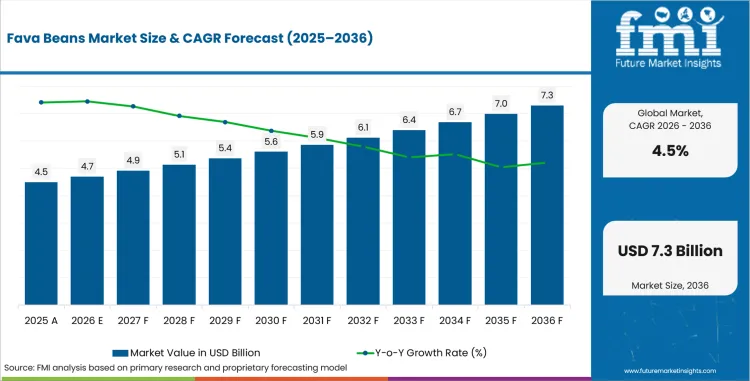
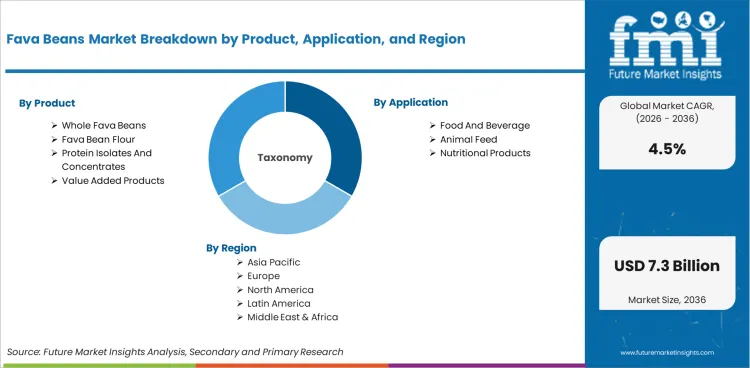
The fava beans market was valued at USD 4.5 billion in 2025. The market is set to reach USD 4.7 billion by 2026-end and grow at a CAGR of 4.5% between 2026-2036 to reach USD 7.3 billion by 2036. Whole Fava Beans will dominate with a 55.0% share, while Food And Beverage will lead with a 60.0% share.
Key Takeaways, Market Size, and Forecast
- The fava beans market was valued at USD 4.5 billion in 2025.
- By 2036, the Fava Beans Market is expected to be worth USD 7.3 billion.
- From 2026 to 2036, the market is projected to expand at a CAGR of 4.5%.
- The market is projected to create an incremental opportunity of USD 2.6 billion between 2026 and 2036.
- In 2026, whole fava beans is expected to account for 55% of the product segment, driven by demand for whole dried and processed fava bean products used as protein ingredients in food manufacturing and as a direct consumption staple in Mediterranean and Middle Eastern diets.
- Japan (6%) and China (5.1%) are two of the fastest growing markets in the world.
Summary of the Fava Beans Market
- Demand and Growth Drivers
- Plant-based protein demand is repositioning fava beans from a traditional dietary staple to a high-value protein ingredient, with fava bean protein isolate gaining adoption in meat alternative, dairy alternative, and sports nutrition formulations.
- Mediterranean and Middle Eastern culinary heritage provides a stable consumption base for fava bean products including ful medames, falafel, and traditional preparations that sustain baseline procurement volumes.
- Nitrogen-fixing crop rotation benefits make fava beans attractive to farmers seeking soil health improvement, reducing input costs while expanding supply availability for food and feed applications.
- Product and Segment View
- Whole Fava Beans is likely to remain the leading product segment at 55% share, supported by established demand and procurement patterns.
- Food And Beverage is likely to account for 60% of the application segment, reflecting buyer preference and consumption patterns.
- Food Manufacturers is expected to dominate the end use segment with 65% share during the forecast period.
- Geography and Competitive Outlook
- Japan is likely to remain a key market at 6% CAGR, supported by strong demand fundamentals and expanding adoption.
- China is likely to sustain growth at 5.1% CAGR owing to rising investment and expanding infrastructure.
- Companies with integrated capabilities and multi-channel distribution are likely to gain traction during the forecast period.
- Analyst Opinion
- The fava beans market is evolving with clear segment leaders, established supply chains, and distribution patterns shaping competitive dynamics.
- Adoption is increasing due to rising demand fundamentals, expanding infrastructure investment, and growing awareness of product benefits across end-user segments.
- Demand is further supported by product format diversification and geographic expansion into developing markets with consumption growth or infrastructure potential.
- Companies that can provide consistent quality while optimizing cost across key segments are likely to strengthen their position over the forecast period.
Fava Beans Market Definition
The fava beans market encompasses commercially traded broad bean products used as food ingredients, direct consumption staples, and animal feed components. Product categories include whole fava beans, split fava beans, fava bean flour, and fava bean protein isolate sourced from conventional and organic cultivation.
Fava Beans Market Inclusions
Market scope covers all commercially traded fava bean products categorized by product (whole fava beans, split fava beans, fava bean flour, fava bean protein isolate), application (food and beverage, animal feed, industrial), end use (food manufacturers, retail consumers, feed manufacturers), distribution channel (direct sales, offline retail, online retail), form (whole beans, split beans, flour, protein isolate), nature (conventional, organic), and pricing tier (mid range, economy, premium). The revenue range spans from 2026 to 2036.
Fava Beans Market Exclusions
The scope does not include other pulse crops such as lentils, chickpeas, or peas, or fava bean products used exclusively in garden seed and ornamental plant applications.
Fava Beans Market Research Methodology
- Primary Research: FMI analysts engaged with pulse processors, agricultural commodity traders, plant-based protein manufacturers, and food ingredient buyers across key markets.
- Desk Research: Combined data from pulse industry associations, agricultural production databases, and plant-protein market reports.
- Market sizing and forecasting: Bottom-up aggregation across product formats and application segments, with regional production curves adjusted for acreage, yield, and trade flow patterns.
- Data validation: Cross-checked quarterly against FAO pulse production statistics and international trade data.
Why is the Fava Beans Market Growing?
- The demand for plant-based protein is transforming fava beans from traditional dietary staples to high-value protein ingredients, with fava bean protein isolate being adopted in meat alternative.
- Ful medames and falafel products based on fava beans have a strong consumption basis of the Mediterranean and Middle East culinary heritage.
- The benefits of nitrogen-fixing crop rotation make fava beans attractive to farmers looking for improved soil health, lower input costs and increased supply for food and feed applications.
Demand for plant-based protein is boosting fava beans from a traditional staple to a functional ingredient category, driving the fava beans market at a CAGR of 4.5%. Based on product segment, whole fava beans segment dominates with a share of 55.0% for applications of direct consumption and food manufacturing. Food and beverage applications demand 60.0% of demand with traditional preparations, protein ingredient manufacturing and bakery applications being the major use categories.
The food manufacturers segment accounts for 65.0% of the end-user demand, with the increasing volumes of the extraction of protein isolates and production of flour for plant-based product formulation. The B2B nature of commodity pulse procurement means that 60.0% of distribution is through direct sales channels. Organic fava beans grow at a premium supported by clean-label and sustainable agriculture consumer demand, with conventional cultivation making up 70.0% of the nature segment
Market Segmentation Analysis
- Whole Fava Beans account for 55% of the product segment, indicating entrenched demand patterns.
- Food Manufacturers account for 65% share of the end use segment.
On the basis of product, application, end use, distribution channel, form, nature, pricing tier, the report segments the fava beans market.
Insights into the Whole Fava Beans Product Segment
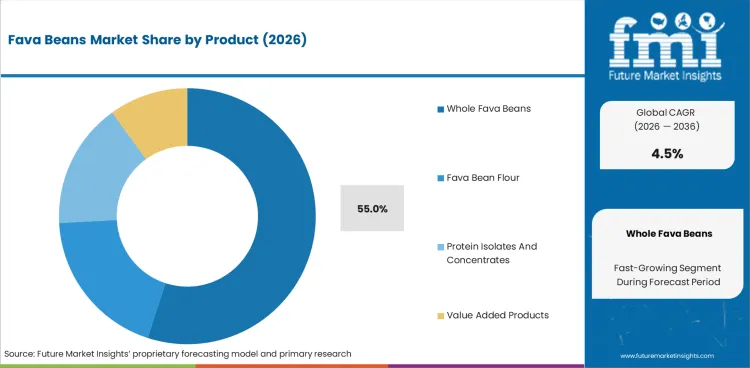
Whole fava beans are projected to account for 55.0% of the product segment in 2026. Ful medames, stews, falafel and other manufactured foods traditionally use whole beans that have been dried. The higher value processed alternatives are in formats of split beans and flour. Fava bean protein isolate is the fastest growing format, used by plant-based meat and dairy alternative manufacturers who need high-protein allergen friendly ingredient inputs.
Insights into the Food And Beverage Application Segment
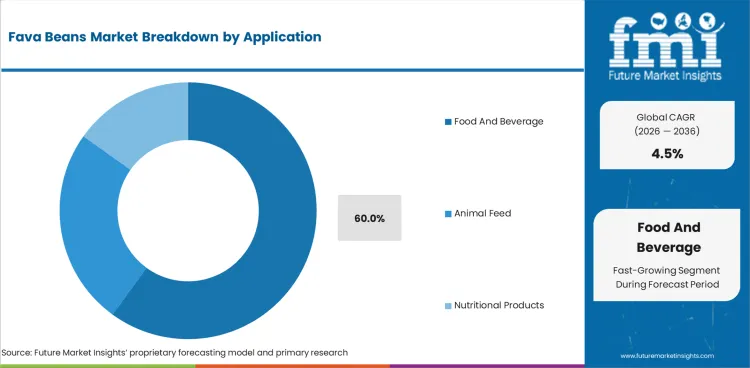
The application segment held the largest share of 60.0% in food and beverage. Most whole bean production is consumed in the traditional Mediterranean and Middle Eastern preparations. Meat alternative, dairy alternative and sports nutrition manufacturers use fava bean protein isolate in plant-based protein products. Use of fava bean flour in bakery applications can be used for protein enrichment and gluten free positioning. Lower grade production has a secondary use as animal feed .
Fava Beans Market Drivers, Restraints, and Opportunities
- Structured demand is building across key segments for plant-based protein ingredients.
- Favism (G6PD Deficiency) and moderating growth in some segments.
Demand-side catalysts and supply-side constraints that are region-, application and price tier-specific dictate the fava beans market.
Plant-Based Protein Ingredient Demand
Demand driven by plant-based food manufacturer purchasing of fava bean protein isolate as allergen-friendly, high-protein ingredient. Fava beans are a soy-free, pea-alternative protein source that provides a solution for consumers with multiple allergen restrictions and increasing addressability in the plant protein space.
Traditional Dietary Staple Consumption Base
In Mediterranean, Middle Eastern and North African countries, where ful medames, falafel and traditional preparations create a solid baseline demand, fava bean consumption supports growth. Cultural dietary integration provides a constant stream of purchases, unaffected by health trend cycles.
Favism (G6PD Deficiency) and Allergen Concerns
A barrier to adoption is the risk of favism in those with G6PD enzyme deficiency, which is particularly common in the Mediterranean, Middle East and African regions. Consumer awareness of fava bean sensitivity and allergen labeling limits category growth in health-conscious markets.
Crop Rotation Benefits and Supply Expansion
Fava beans are good for growth due to their nitrogen fixing capabilities that enhance soil health and reduce fertilizer input cost in crop rotation systems. The EU and Canada have incentive programs for agriculture that encourage growing of pulses, which raises the availability of fava beans for food and protein applications.
Analysis of Fava Beans Market By Key Countries
.webp "Top Country Growth Comparison Fava Beans Market Cagr (2026 2036)")
| Country | CAGR |
|---|---|
| Japan | 6% |
| China | 5.1% |
| India | 4.9% |
| Germany | 4.6% |
| USA | 4.1% |
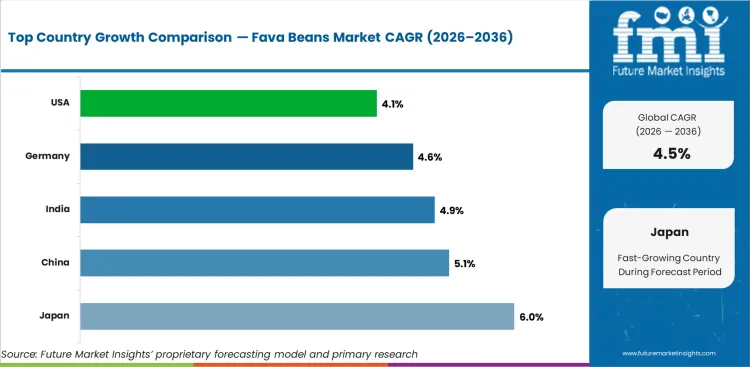
- Japan leads at 6% CAGR, supported by the largest demand base and expanding adoption.
- China at 5.1% shows strong demand supported by rising investment and infrastructure expansion.
- India (4.9%) and Germany (4.6%) sustain growth through expanding market development.
The global fava beans market is projected to expand at 4.5% per year from 2026 to 2036. The study covers more than 30 countries.
In-depth Analysis of Fava Beans Market in Japan
Japan is in front at 6.0% through 2036. In Japan, fava beans (soramame) are a seasonal vegetable treat for consumers, eaten fresh in the springtime. The demand for processed fava bean products that can be used year-round is growing, as is the interest in plant-based protein and functional ingredients.
- Cultural acceptance and consumer acceptance of soramame for fresh seasonal consumption.
- The growing interest in plant-based protein is driving demand for processed fava bean ingredient products.
- Japanese food manufacturers use fava bean flour and protein as functional food ingredients.
Sales Analysis of Fava Beans Market in China
China will grow at 5.1% through 2036 China is one of the world’s biggest producers of fava beans, mainly grown in Yunnan, Sichuan and Gansu provinces. Domestic demand is supported by rising plant-based food manufacturing and traditional snack eating.
- The strong domestic production base in Yunnan, Sichuan and Gansu provinces ensures a steady supply.
- Rising demand for fava bean protein ingredients for plant-based food manufacturing growth.
- Traditional snack consumption of fried and seasoned fava beans supports retail demand.
In-depth Analysis of Fava Beans Market in Germany
Germany will expand 4.5% through 2036. In Germany, the EU Common Agricultural Policy incentives for pulse cultivation and the German consumer interest in plant-based protein support market development. There is an increasing use of fava bean protein isolate in food manufacturing.
- Domestic acreage of fava beans is increasing with the help of EU CAP incentives for pulse cultivation.
- Growing consumer interest in plant-based protein is driving demand for fava bean-derived ingredients.
- The food manufacturing industry incorporates fava bean flour and protein in health-positioned products.
Future Outlook for Fava Beans Market in the United States
The USA is growing at 3.8% through 2036. Plant-based protein manufacturers are adopting fava bean protein isolate as an allergen-friendly alternative to soy and pea protein. ADM and Cargill serve through commodity trading and ingredient processing capabilities.
- Plant-based protein manufacturers adopt fava bean as an allergen-friendly soy and pea alternative.
- ADM and Cargill provide commodity trading and ingredient processing capabilities.
- Gluten-free and clean-label bakery applications incorporate fava bean flour for protein enrichment.
Opportunity Analysis of Fava Beans Market in the United Kingdom
The UK is growing at 3.5% through 2036. UK pulse cultivation is expanding under environmental sustainability incentives. Fava beans are gaining attention as a domestically produced plant-protein crop suited to UK growing conditions.
- Environmental sustainability incentives support UK pulse cultivation expansion.
- Domestically produced fava beans serve as a local plant-protein ingredient source.
- Plant-based food manufacturers are sourcing UK-grown fava beans for clean-label positioning.
Competitive Landscape and Strategic Positioning
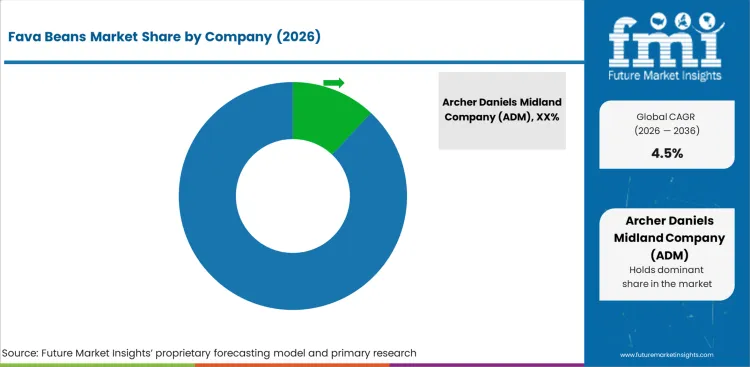
- Archer Daniels Midland Company is a leader in the procurement of integrated agricultural commodities, processing of pulse crops and distribution of global ingredients to customers in the food manufacturing and animal feed industries.
- Cargill Incorporated operates in commodity trading on a scale, infrastructure for oilseed and pulse processing and ingredient supply relationships with plant-based food manufacturers.
- Canadian specialists like the Alberta Pulse Growers Commission, Stamp Seeds and Prairie Fava service the premium and organic segments because of their proximity to major North American growing regions.
The competitive landscape is fragmented, with integrated capabilities, established procurement relationships and multi-segment application coverage.
Key Companies in the Fava Beans Market
Key global companies leading the fava beans market include:
- Archer Daniels Midland Company (USA), Cargill Incorporated (USA), and Bunge Limited (USA) lead through integrated agricultural commodity trading, pulse processing, and global ingredient distribution infrastructure.
- Unigrain Pty Ltd (Australia), Roland Beans (USA), and Aviip Group (Europe) serve through regional pulse trading, product range diversity, and established food manufacturer procurement relationships.
- Alberta Pulse Growers Commission (Canada), Stamp Seeds Inc. (Canada), Pawnee Buttes Seed Inc. (USA), and Prairie Fava Ltd. (Canada) compete through growing-region proximity, organic certification, and specialty pulse market expertise.
Competitive Benchmarking: Fava Beans Market
| Company | Sourcing Scale | Processing Capability | Protein Isolate | Distribution Reach |
|---|---|---|---|---|
| ADM | Very High | Very High | High | Global |
| Cargill | Very High | Very High | Medium | Global |
| Bunge | Very High | High | Low | Global |
| Unigrain | Medium | Medium | Low | Australia, Export |
| Roland Beans | Medium | Medium | Low | N. America |
| Alberta Pulse Growers | Medium | Medium | Medium | N. America |
| Stamp Seeds | Low | Low | Low | N. America |
| Prairie Fava | Low | Medium | High | N. America |
| Aviip Group | Medium | Medium | Medium | Europe |
| Pawnee Buttes | Low | Low | Low | N. America |
Source: Future Market Insights competitive analysis, 2026.
Key Developments in Fava Beans Market
- In 2025, ADM continued to strengthen its position in the fava bean protein segment through enhanced R&D capabilities and improved extraction technologies for fava bean protein isolates to serve growing demand for allergen-friendly plant-based ingredients.
- In 2025, Prairie Fava received CAD $1.5 million in government funding to optimize its processing operations and expand its grower network, supporting increased production of fava bean ingredients including protein concentrates for clean-label plant-based applications in North America.
Key Players in the Fava Beans Market
Major Global Players
- Archer Daniels Midland Company (ADM)
- Unigrain Pty Ltd
- Roland Beans
- Aviip Group
- Alberta Pulse Growers Commission
Emerging Players/Startups
- Stamp Seeds Inc.
- Pawnee Buttes Seed Inc.
- Prairie Fava Ltd.
- Cargill Incorporated
- Bunge Limited
Report Scope and Coverage
| Parameter | Details |
|---|---|
| Quantitative Units | USD 4.7 billion to USD 7.3 billion, at a CAGR of 4.5% |
| Market Definition | The fava beans market encompasses commercially traded broad bean products used as food ingredients, direct consumption staples, and animal feed components. Product categories include whole fava beans, split fava beans, fava bean flour, and fava bean protein isolate sourced from conventional and organic cultivation. |
| Regions Covered | North America, Latin America, Europe, East Asia, South Asia and Pacific, Middle East and Africa |
| Countries Covered | Japan, China, India, Germany, USA, 30 plus countries |
| Key Companies Profiled | Archer Daniels Midland Company (ADM), Unigrain Pty Ltd, Roland Beans, Aviip Group, Alberta Pulse Growers Commission, Stamp Seeds Inc., Pawnee Buttes Seed Inc., Prairie Fava Ltd. |
| Forecast Period | 2026 to 2036 |
| Approach | Hybrid bottom-up and top-down methodology starting with verified transaction data, projecting adoption velocity across segments and regions. |
Market Segmentation Analysis
Fava Beans Market Segmented by Product:
- Whole Fava Beans
- Raw Whole Beans
- Dried Beans
- Fresh Beans
- Processed Whole Beans
- Dehulled Beans
- Split Beans
- Raw Whole Beans
- Fava Bean Flour
- Fine Flour
- Food Grade Flour
- Bakery Grade Flour
- Coarse Flour
- Animal Feed Grade
- Industrial Grade
- Fine Flour
- Protein Isolates And Concentrates
- Protein Concentrates
- Low Purity Concentrates
- High Protein Concentrates
- Protein Isolates
- High Purity Isolates
- Functional Protein Isolates
- Protein Concentrates
- Value Added Products
- Snacks And Ready Products
- Roasted Beans
- Seasoned Snacks
- Meat Alternatives
- Plant Based Meat
- Protein Blends
- Snacks And Ready Products
Fava Beans Market Segmented by Application:
- Food And Beverage
- Bakery And Confectionery
- Bread And Buns
- Snacks And Biscuits
- Meat Alternatives
- Plant Based Meat
- Protein Products
- Soups And Ready Meals
- Instant Soups
- Convenience Meals
- Bakery And Confectionery
- Animal Feed
- Livestock Feed
- Cattle Feed
- Poultry Feed
- Aquaculture Feed
- Fish Feed
- Shrimp Feed
- Livestock Feed
- Nutritional Products
- Sports Nutrition
- Protein Supplements
- Energy Products
- Clinical Nutrition
- Dietary Products
- Medical Nutrition
- Sports Nutrition
Fava Beans Market Segmented by End Use:
- Food Manufacturers
- Processed Food Companies
- Bakery Manufacturers
- Plant Based Food Producers
- Snack Manufacturers
- Ready To Eat Producers
- Convenience Food Brands
- Processed Food Companies
- Feed Manufacturers
- Livestock Feed Producers
- Commercial Feed Mills
- Integrated Feed Producers
- Aquaculture Feed Producers
- Fish Feed Companies
- Shrimp Feed Companies
- Livestock Feed Producers
- Nutritional Product Manufacturers
- Supplement Manufacturers
- Protein Supplement Brands
- Health Nutrition Brands
- Supplement Manufacturers
Fava Beans Market Segmented by Distribution Channel:
- Direct Sales
- Manufacturer To Industry
- Bulk Supply Agreements
- Long Term Contracts
- Agricultural Cooperatives
- Farmer Networks
- Regional Supply Chains
- Manufacturer To Industry
- Retail Distribution
- Supermarkets And Hypermarkets
- Packaged Beans
- Processed Products
- Online Retail
- E Commerce Platforms
- Direct To Consumer Sales
- Supermarkets And Hypermarkets
Fava Beans Market Segmented by Form:
- Whole Beans
- Raw Form
- Dried Beans
- Fresh Beans
- Processed Form
- Dehulled Beans
- Split Beans
- Raw Form
- Powder And Flour
- Fine Flour
- Food Grade Flour
- Bakery Grade Flour
- Coarse Flour
- Feed Grade Flour
- Industrial Grade Flour
- Fine Flour
- Protein Extracts
- Protein Concentrates
- Standard Concentrates
- High Protein Concentrates
- Protein Isolates
- High Purity Isolates
- Functional Isolates
- Protein Concentrates
Fava Beans Market Segmented by Nature:
- Conventional
- Standard Farming
- Commercial Cultivation
- High Yield Varieties
- Standard Farming
- Organic
- Certified Organic
- Organic Farming
- Sustainable Cultivation
- Certified Organic
Fava Beans Market Segmented by Pricing Tier:
- Mid Range
- Standard Commercial Products
- Packaged Beans And Ingredients
- Standard Commercial Products
- Economy
- Bulk Commodity Products
- Raw Beans
- Feed Grade Products
- Bulk Commodity Products
- Premium
- Organic And Specialty Products
- Certified Organic Beans
- High Protein Ingredients
- Organic And Specialty Products
Fava Beans Market by Region:
- North America
- USA
- Canada
- Mexico
- Latin America
- Brazil
- Chile
- Rest of Latin America
- Western Europe
- Germany
- UK
- Italy
- Spain
- France
- Nordic
- BENELUX
- Rest of Western Europe
- Eastern Europe
- Russia
- Poland
- Hungary
- Balkan & Baltic
- Rest of Eastern Europe
- East Asia
- China
- Japan
- South Korea
- South Asia and Pacific
- India
- ASEAN
- Australia & New Zealand
- Rest of South Asia and Pacific
- Middle East & Africa
- Kingdom of Saudi Arabia
- Other GCC Countries
- Turkiye
- South Africa
- Other African Union
- Rest of Middle East & Africa
Research Sources and Bibliography
- 1. Food and Agriculture Organization. (2025). FAO Global Pulse Production and Trade Report. FAO.
- 2. European Commission. (2024). EU Common Agricultural Policy: Pulse Crop Cultivation Incentives. EC.
- 3. International Pulse Crops Research Institute. (2025). Global Fava Bean Production Statistics. IPCRI.
- 4. USA Department of Agriculture. (2025). USDA Pulse Crop Yearbook: Fava Bean Statistics. USDA.
- 5. World Health Organization. (2024). WHO Nutritional Guidelines: Plant-Based Protein Sources. WHO.
This bibliography is provided for reader reference.
This Report Answers
- Estimating the market size and revenue generation from 2026 to 2036.
- Segmenting by product, application, end use, distribution channel, form, nature, and pricing tier.
- Providing regional insights across more than 30 markets.
- Analyzing plant-based protein transition impact on fava bean demand.
- Assessing the competitive landscape across commodity and specialty segments.
- Identifying investment opportunities in protein isolate and organic cultivation.
- Tracking crop rotation incentives and pulse cultivation expansion trends.
- Delivering data in PDF and Excel formats.
Frequently Asked Questions
How big is the fava beans market in 2026?
The global fava beans market is estimated to be valued at USD 4.70 billion in 2026.
What will be the size of fava beans market in 2036?
The market size for the fava beans market is projected to reach USD 7.30 billion by 2036.
How much will be the fava beans market growth between 2026 and 2036?
The fava beans market is expected to grow at a 4.5% CAGR between 2026 and 2036.
What are the key product types in the fava beans market?
The key product types in fava beans market are whole fava beans, fava bean flour, protein isolates and concentrates and value added products.
Which application segment is expected to contribute significant share in the fava beans market in 2026?
In terms of application, food and beverage segment is expected to command 60.0% share in the fava beans market in 2026.
Preview the report firsthand - request a free sample
Get SampleGet the brochure for pricing and purchase details.
Get PDFTable of Content
- Executive Summary
- Global Market Outlook
- Demand-side Trends
- Supply-side Trends
- Technology Roadmap Analysis
- Analysis and Recommendations
- Market Overview
- Market Coverage / Taxonomy
- Market Definition / Scope / Limitations
- Research Methodology
- Chapter Orientation
- Analytical Lens and Working Hypotheses
- Market Structure, Signals, and Trend Drivers
- Benchmarking and Cross-market Comparability
- Market Sizing, Forecasting, and Opportunity Mapping
- Research Design and Evidence Framework
- Desk Research Programme (Secondary Evidence)
- Company Annual and Sustainability Reports
- Peer-reviewed Journals and Academic Literature
- Corporate Websites, Product Literature, and Technical Notes
- Earnings Decks and Investor Briefings
- Statutory Filings and Regulatory Disclosures
- Technical White Papers and Standards Notes
- Trade Journals, Industry Magazines, and Analyst Briefs
- Conference Proceedings, Webinars, and Seminar Materials
- Government Statistics Portals and Public Data Releases
- Press Releases and Reputable Media Coverage
- Specialist Newsletters and Curated Briefings
- Sector Databases and Reference Repositories
- FMI Internal Proprietary Databases and Historical Market Datasets
- Subscription Datasets and Paid Sources
- Social Channels, Communities, and Digital Listening Inputs
- Additional Desk Sources
- Expert Input and Fieldwork (Primary Evidence)
- Primary Modes
- Qualitative Interviews and Expert Elicitation
- Quantitative Surveys and Structured Data Capture
- Blended Approach
- Why Primary Evidence is Used
- Field Techniques
- Interviews
- Surveys
- Focus Groups
- Observational and In-context Research
- Social and Community Interactions
- Stakeholder Universe Engaged
- C-suite Leaders
- Board Members
- Presidents and Vice Presidents
- R&D and Innovation Heads
- Technical Specialists
- Domain Subject-matter Experts
- Scientists
- Physicians and Other Healthcare Professionals
- Governance, Ethics, and Data Stewardship
- Research Ethics
- Data Integrity and Handling
- Primary Modes
- Tooling, Models, and Reference Databases
- Desk Research Programme (Secondary Evidence)
- Data Engineering and Model Build
- Data Acquisition and Ingestion
- Cleaning, Normalisation, and Verification
- Synthesis, Triangulation, and Analysis
- Quality Assurance and Audit Trail
- Market Background
- Market Dynamics
- Drivers
- Restraints
- Opportunity
- Trends
- Scenario Forecast
- Demand in Optimistic Scenario
- Demand in Likely Scenario
- Demand in Conservative Scenario
- Opportunity Map Analysis
- Product Life Cycle Analysis
- Supply Chain Analysis
- Investment Feasibility Matrix
- Value Chain Analysis
- PESTLE and Porter’s Analysis
- Regulatory Landscape
- Regional Parent Market Outlook
- Production and Consumption Statistics
- Import and Export Statistics
- Market Dynamics
- Global Market Analysis 2021 to 2025 and Forecast, 2026 to 2036
- Historical Market Size Value (USD Million) Analysis, 2021 to 2025
- Current and Future Market Size Value (USD Million) Projections, 2026 to 2036
- Y-o-Y Growth Trend Analysis
- Absolute $ Opportunity Analysis
- Global Market Pricing Analysis 2021 to 2025 and Forecast 2026 to 2036
- Global Market Analysis 2021 to 2025 and Forecast 2026 to 2036, By Product
- Introduction / Key Findings
- Historical Market Size Value (USD Million) Analysis By Product , 2021 to 2025
- Current and Future Market Size Value (USD Million) Analysis and Forecast By Product , 2026 to 2036
- Whole Fava Beans
- Raw Whole Beans
- Dried Beans
- Fresh Beans
- Processed Whole Beans
- Dehulled Beans
- Split Beans
- Fava Bean Flour
- Fine Flour
- Food Grade Flour
- Bakery Grade Flour
- Coarse Flour
- Animal Feed Grade
- Protein Isolates And Concentrates
- Protein Concentrates
- Low Purity Concentrates
- High Protein Concentrates
- Protein Isolates
- High Purity Isolates
- Value Added Products
- Snacks And Ready Products
- Roasted Beans
- Seasoned Snacks
- Meat Alternatives
- Plant Based Meat
- Whole Fava Beans
- Y-o-Y Growth Trend Analysis By Product , 2021 to 2025
- Absolute $ Opportunity Analysis By Product , 2026 to 2036
- Global Market Analysis 2021 to 2025 and Forecast 2026 to 2036, By Application
- Introduction / Key Findings
- Historical Market Size Value (USD Million) Analysis By Application, 2021 to 2025
- Current and Future Market Size Value (USD Million) Analysis and Forecast By Application, 2026 to 2036
- Food And Beverage
- Bakery And Confectionery
- Bread And Buns
- Snacks And Biscuits
- Meat Alternatives
- Plant Based Meat
- Protein Products
- Soups And Ready Meals
- Instant Soups
- Convenience Meals
- Animal Feed
- Livestock Feed
- Cattle Feed
- Poultry Feed
- Aquaculture Feed
- Fish Feed
- Nutritional Products
- Sports Nutrition
- Protein Supplements
- Energy Products
- Clinical Nutrition
- Dietary Products
- Food And Beverage
- Y-o-Y Growth Trend Analysis By Application, 2021 to 2025
- Absolute $ Opportunity Analysis By Application, 2026 to 2036
- Global Market Analysis 2021 to 2025 and Forecast 2026 to 2036, By End Use
- Introduction / Key Findings
- Historical Market Size Value (USD Million) Analysis By End Use, 2021 to 2025
- Current and Future Market Size Value (USD Million) Analysis and Forecast By End Use, 2026 to 2036
- Food Manufacturers
- Processed Food Companies
- Bakery Manufacturers
- Plant Based Food Producers
- Snack Manufacturers
- Ready To Eat Producers
- Convenience Food Brands
- Feed Manufacturers
- Livestock Feed Producers
- Commercial Feed Mills
- Integrated Feed Producers
- Aquaculture Feed Producers
- Fish Feed Companies
- Nutritional Product Manufacturers
- Supplement Manufacturers
- Protein Supplement Brands
- Health Nutrition Brands
- Food Manufacturers
- Y-o-Y Growth Trend Analysis By End Use, 2021 to 2025
- Absolute $ Opportunity Analysis By End Use, 2026 to 2036
- Global Market Analysis 2021 to 2025 and Forecast 2026 to 2036, By Distribution Channel
- Introduction / Key Findings
- Historical Market Size Value (USD Million) Analysis By Distribution Channel, 2021 to 2025
- Current and Future Market Size Value (USD Million) Analysis and Forecast By Distribution Channel, 2026 to 2036
- Direct Sales
- Manufacturer To Industry
- Bulk Supply Agreements
- Long Term Contracts
- Agricultural Cooperatives
- Farmer Networks
- Regional Supply Chains
- Retail Distribution
- Supermarkets And Hypermarkets
- Packaged Beans
- Processed Products
- Online Retail
- E Commerce Platforms
- Direct Sales
- Y-o-Y Growth Trend Analysis By Distribution Channel, 2021 to 2025
- Absolute $ Opportunity Analysis By Distribution Channel, 2026 to 2036
- Global Market Analysis 2021 to 2025 and Forecast 2026 to 2036, By Form
- Introduction / Key Findings
- Historical Market Size Value (USD Million) Analysis By Form, 2021 to 2025
- Current and Future Market Size Value (USD Million) Analysis and Forecast By Form, 2026 to 2036
- Whole Beans
- Raw Form
- Dried Beans
- Fresh Beans
- Processed Form
- Dehulled Beans
- Split Beans
- Powder And Flour
- Fine Flour
- Food Grade Flour
- Bakery Grade Flour
- Coarse Flour
- Feed Grade Flour
- Protein Extracts
- Protein Concentrates
- Standard Concentrates
- High Protein Concentrates
- Protein Isolates
- High Purity Isolates
- Whole Beans
- Y-o-Y Growth Trend Analysis By Form, 2021 to 2025
- Absolute $ Opportunity Analysis By Form, 2026 to 2036
- Global Market Analysis 2021 to 2025 and Forecast 2026 to 2036, By Nature
- Introduction / Key Findings
- Historical Market Size Value (USD Million) Analysis By Nature, 2021 to 2025
- Current and Future Market Size Value (USD Million) Analysis and Forecast By Nature, 2026 to 2036
- Conventional
- Standard Farming
- Commercial Cultivation
- High Yield Varieties
- Organic
- Certified Organic
- Organic Farming
- Sustainable Cultivation
- Conventional
- Y-o-Y Growth Trend Analysis By Nature, 2021 to 2025
- Absolute $ Opportunity Analysis By Nature, 2026 to 2036
- Global Market Analysis 2021 to 2025 and Forecast 2026 to 2036, By Pricing Tier
- Introduction / Key Findings
- Historical Market Size Value (USD Million) Analysis By Pricing Tier, 2021 to 2025
- Current and Future Market Size Value (USD Million) Analysis and Forecast By Pricing Tier, 2026 to 2036
- Mid Range
- Standard Commercial Products
- Packaged Beans And Ingredients
- Economy
- Bulk Commodity Products
- Raw Beans
- Feed Grade Products
- Premium
- Organic And Specialty Products
- Certified Organic Beans
- High Protein Ingredients
- Mid Range
- Y-o-Y Growth Trend Analysis By Pricing Tier, 2021 to 2025
- Absolute $ Opportunity Analysis By Pricing Tier, 2026 to 2036
- Global Market Analysis 2021 to 2025 and Forecast 2026 to 2036, By Region
- Introduction
- Historical Market Size Value (USD Million) Analysis By Region, 2021 to 2025
- Current Market Size Value (USD Million) Analysis and Forecast By Region, 2026 to 2036
- North America
- Latin America
- Western Europe
- Eastern Europe
- East Asia
- South Asia and Pacific
- Middle East & Africa
- Market Attractiveness Analysis By Region
- North America Market Analysis 2021 to 2025 and Forecast 2026 to 2036, By Country
- Historical Market Size Value (USD Million) Trend Analysis By Market Taxonomy, 2021 to 2025
- Market Size Value (USD Million) Forecast By Market Taxonomy, 2026 to 2036
- By Country
- USA
- Canada
- Mexico
- By Product
- By Application
- By End Use
- By Distribution Channel
- By Form
- By Nature
- By Pricing Tier
- By Country
- Market Attractiveness Analysis
- By Country
- By Product
- By Application
- By End Use
- By Distribution Channel
- By Form
- By Nature
- By Pricing Tier
- Key Takeaways
- Latin America Market Analysis 2021 to 2025 and Forecast 2026 to 2036, By Country
- Historical Market Size Value (USD Million) Trend Analysis By Market Taxonomy, 2021 to 2025
- Market Size Value (USD Million) Forecast By Market Taxonomy, 2026 to 2036
- By Country
- Brazil
- Chile
- Rest of Latin America
- By Product
- By Application
- By End Use
- By Distribution Channel
- By Form
- By Nature
- By Pricing Tier
- By Country
- Market Attractiveness Analysis
- By Country
- By Product
- By Application
- By End Use
- By Distribution Channel
- By Form
- By Nature
- By Pricing Tier
- Key Takeaways
- Western Europe Market Analysis 2021 to 2025 and Forecast 2026 to 2036, By Country
- Historical Market Size Value (USD Million) Trend Analysis By Market Taxonomy, 2021 to 2025
- Market Size Value (USD Million) Forecast By Market Taxonomy, 2026 to 2036
- By Country
- Germany
- UK
- Italy
- Spain
- France
- Nordic
- BENELUX
- Rest of Western Europe
- By Product
- By Application
- By End Use
- By Distribution Channel
- By Form
- By Nature
- By Pricing Tier
- By Country
- Market Attractiveness Analysis
- By Country
- By Product
- By Application
- By End Use
- By Distribution Channel
- By Form
- By Nature
- By Pricing Tier
- Key Takeaways
- Eastern Europe Market Analysis 2021 to 2025 and Forecast 2026 to 2036, By Country
- Historical Market Size Value (USD Million) Trend Analysis By Market Taxonomy, 2021 to 2025
- Market Size Value (USD Million) Forecast By Market Taxonomy, 2026 to 2036
- By Country
- Russia
- Poland
- Hungary
- Balkan & Baltic
- Rest of Eastern Europe
- By Product
- By Application
- By End Use
- By Distribution Channel
- By Form
- By Nature
- By Pricing Tier
- By Country
- Market Attractiveness Analysis
- By Country
- By Product
- By Application
- By End Use
- By Distribution Channel
- By Form
- By Nature
- By Pricing Tier
- Key Takeaways
- East Asia Market Analysis 2021 to 2025 and Forecast 2026 to 2036, By Country
- Historical Market Size Value (USD Million) Trend Analysis By Market Taxonomy, 2021 to 2025
- Market Size Value (USD Million) Forecast By Market Taxonomy, 2026 to 2036
- By Country
- China
- Japan
- South Korea
- By Product
- By Application
- By End Use
- By Distribution Channel
- By Form
- By Nature
- By Pricing Tier
- By Country
- Market Attractiveness Analysis
- By Country
- By Product
- By Application
- By End Use
- By Distribution Channel
- By Form
- By Nature
- By Pricing Tier
- Key Takeaways
- South Asia and Pacific Market Analysis 2021 to 2025 and Forecast 2026 to 2036, By Country
- Historical Market Size Value (USD Million) Trend Analysis By Market Taxonomy, 2021 to 2025
- Market Size Value (USD Million) Forecast By Market Taxonomy, 2026 to 2036
- By Country
- India
- ASEAN
- Australia & New Zealand
- Rest of South Asia and Pacific
- By Product
- By Application
- By End Use
- By Distribution Channel
- By Form
- By Nature
- By Pricing Tier
- By Country
- Market Attractiveness Analysis
- By Country
- By Product
- By Application
- By End Use
- By Distribution Channel
- By Form
- By Nature
- By Pricing Tier
- Key Takeaways
- Middle East & Africa Market Analysis 2021 to 2025 and Forecast 2026 to 2036, By Country
- Historical Market Size Value (USD Million) Trend Analysis By Market Taxonomy, 2021 to 2025
- Market Size Value (USD Million) Forecast By Market Taxonomy, 2026 to 2036
- By Country
- Kingdom of Saudi Arabia
- Other GCC Countries
- Turkiye
- South Africa
- Other African Union
- Rest of Middle East & Africa
- By Product
- By Application
- By End Use
- By Distribution Channel
- By Form
- By Nature
- By Pricing Tier
- By Country
- Market Attractiveness Analysis
- By Country
- By Product
- By Application
- By End Use
- By Distribution Channel
- By Form
- By Nature
- By Pricing Tier
- Key Takeaways
- Key Countries Market Analysis
- USA
- Pricing Analysis
- Market Share Analysis, 2025
- By Product
- By Application
- By End Use
- By Distribution Channel
- By Form
- By Nature
- By Pricing Tier
- Canada
- Pricing Analysis
- Market Share Analysis, 2025
- By Product
- By Application
- By End Use
- By Distribution Channel
- By Form
- By Nature
- By Pricing Tier
- Mexico
- Pricing Analysis
- Market Share Analysis, 2025
- By Product
- By Application
- By End Use
- By Distribution Channel
- By Form
- By Nature
- By Pricing Tier
- Brazil
- Pricing Analysis
- Market Share Analysis, 2025
- By Product
- By Application
- By End Use
- By Distribution Channel
- By Form
- By Nature
- By Pricing Tier
- Chile
- Pricing Analysis
- Market Share Analysis, 2025
- By Product
- By Application
- By End Use
- By Distribution Channel
- By Form
- By Nature
- By Pricing Tier
- Germany
- Pricing Analysis
- Market Share Analysis, 2025
- By Product
- By Application
- By End Use
- By Distribution Channel
- By Form
- By Nature
- By Pricing Tier
- UK
- Pricing Analysis
- Market Share Analysis, 2025
- By Product
- By Application
- By End Use
- By Distribution Channel
- By Form
- By Nature
- By Pricing Tier
- Italy
- Pricing Analysis
- Market Share Analysis, 2025
- By Product
- By Application
- By End Use
- By Distribution Channel
- By Form
- By Nature
- By Pricing Tier
- Spain
- Pricing Analysis
- Market Share Analysis, 2025
- By Product
- By Application
- By End Use
- By Distribution Channel
- By Form
- By Nature
- By Pricing Tier
- France
- Pricing Analysis
- Market Share Analysis, 2025
- By Product
- By Application
- By End Use
- By Distribution Channel
- By Form
- By Nature
- By Pricing Tier
- India
- Pricing Analysis
- Market Share Analysis, 2025
- By Product
- By Application
- By End Use
- By Distribution Channel
- By Form
- By Nature
- By Pricing Tier
- ASEAN
- Pricing Analysis
- Market Share Analysis, 2025
- By Product
- By Application
- By End Use
- By Distribution Channel
- By Form
- By Nature
- By Pricing Tier
- Australia & New Zealand
- Pricing Analysis
- Market Share Analysis, 2025
- By Product
- By Application
- By End Use
- By Distribution Channel
- By Form
- By Nature
- By Pricing Tier
- China
- Pricing Analysis
- Market Share Analysis, 2025
- By Product
- By Application
- By End Use
- By Distribution Channel
- By Form
- By Nature
- By Pricing Tier
- Japan
- Pricing Analysis
- Market Share Analysis, 2025
- By Product
- By Application
- By End Use
- By Distribution Channel
- By Form
- By Nature
- By Pricing Tier
- South Korea
- Pricing Analysis
- Market Share Analysis, 2025
- By Product
- By Application
- By End Use
- By Distribution Channel
- By Form
- By Nature
- By Pricing Tier
- Russia
- Pricing Analysis
- Market Share Analysis, 2025
- By Product
- By Application
- By End Use
- By Distribution Channel
- By Form
- By Nature
- By Pricing Tier
- Poland
- Pricing Analysis
- Market Share Analysis, 2025
- By Product
- By Application
- By End Use
- By Distribution Channel
- By Form
- By Nature
- By Pricing Tier
- Hungary
- Pricing Analysis
- Market Share Analysis, 2025
- By Product
- By Application
- By End Use
- By Distribution Channel
- By Form
- By Nature
- By Pricing Tier
- Kingdom of Saudi Arabia
- Pricing Analysis
- Market Share Analysis, 2025
- By Product
- By Application
- By End Use
- By Distribution Channel
- By Form
- By Nature
- By Pricing Tier
- Turkiye
- Pricing Analysis
- Market Share Analysis, 2025
- By Product
- By Application
- By End Use
- By Distribution Channel
- By Form
- By Nature
- By Pricing Tier
- South Africa
- Pricing Analysis
- Market Share Analysis, 2025
- By Product
- By Application
- By End Use
- By Distribution Channel
- By Form
- By Nature
- By Pricing Tier
- USA
- Market Structure Analysis
- Competition Dashboard
- Competition Benchmarking
- Market Share Analysis of Top Players
- By Regional
- By Product
- By Application
- By End Use
- By Distribution Channel
- By Form
- By Nature
- By Pricing Tier
- Competition Analysis
- Competition Deep Dive
- Archer Daniels Midland Company (ADM)
- Overview
- Product Portfolio
- Profitability by Market Segments (Product/Age /Sales Channel/Region)
- Sales Footprint
- Strategy Overview
- Marketing Strategy
- Product Strategy
- Channel Strategy
- Unigrain Pty Ltd
- Roland Beans
- Aviip Group
- Alberta Pulse Growers Commission
- Stamp Seeds Inc.
- Pawnee Buttes Seed Inc.
- Prairie Fava Ltd.
- Cargill Incorporated
- Bunge Limited
- Archer Daniels Midland Company (ADM)
- Competition Deep Dive
- Assumptions & Acronyms Used


