

- Industry Size (2025)
- USD 9.9 Bn
- Forecast (2035)
- USD 18.5 Bn
- CAGR (2025 to 2035)
- 6.5%
Fetal And Neonatal Care Equipment Market Size and Share Forecast Outlook 2025 to 2035
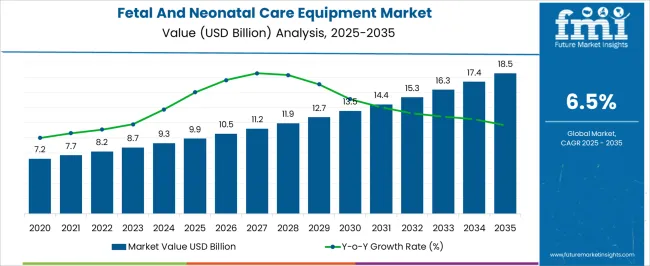
The Fetal And Neonatal Care Equipment Market is estimated to be valued at USD 9.9 billion in 2025 and is projected to reach USD 18.5 billion by 2035, registering a compound annual growth rate (CAGR) of 6.5% over the forecast period.
Quick Stats for Fetal And Neonatal Care Equipment Market
- Fetal And Neonatal Care Equipment Market Value (2025): USD 9.9 billion
- Fetal And Neonatal Care Equipment Market Forecast Value (2035): USD 18.5 billion
- Fetal And Neonatal Care Equipment Market Forecast CAGR: 6.5%
- Leading Segment in Fetal And Neonatal Care Equipment Market in 2025: Ultrasound Devices (22.3%)
- Key Growth Regions in Fetal And Neonatal Care Equipment Market: North America, Asia-Pacific, Europe
- Top Key Players in Fetal And Neonatal Care Equipment Market: Cardinal Health, Drägerwerk AG & Co. KGaA, Koninklijke Philips N.V., GE Healthcare, Medtronic, Vyaire, BD, Utah Medical Products, Inc., Natus Medical Incorporated, Ambu A/S, Inspiration Healthcare Group plc, Atom Medical Corp., Fisher & Paykel Healthcare Limited, Masimo
Fetal And Neonatal Care Equipment Market Key Takeaways
| Metric | Value |
|---|---|
| Fetal And Neonatal Care Equipment Market Estimated Value in (2025 E) | USD 9.9 billion |
| Fetal And Neonatal Care Equipment Market Forecast Value in (2035 F) | USD 18.5 billion |
| Forecast CAGR (2025 to 2035) | 6.5% |
Why is the Fetal And Neonatal Care Equipment Market Growing?
The Fetal And Neonatal Care Equipment market is witnessing steady growth, driven by increasing global awareness regarding maternal and neonatal health and rising investments in healthcare infrastructure. The growing focus on reducing infant and maternal mortality rates is contributing to the widespread adoption of advanced monitoring and diagnostic equipment in hospitals and clinics. Technological advancements, such as high-resolution imaging, AI-based analytics, and portable monitoring devices, are enhancing diagnostic accuracy and improving patient outcomes.
Rising prevalence of high-risk pregnancies, premature births, and congenital disorders is further fueling demand for specialized fetal and neonatal care equipment. The market is supported by government initiatives and public health programs aimed at improving maternal and child health in both developed and emerging regions.
Continuous innovation in device design, functionality, and usability is improving operational efficiency for healthcare providers As healthcare facilities increasingly prioritize early diagnosis and continuous monitoring, the Fetal And Neonatal Care Equipment market is poised for sustained expansion, with hospitals and specialized care centers serving as primary growth drivers.
Segmental Analysis
The fetal and neonatal care equipment market is segmented by product type, end user, and geographic regions. By product type, fetal and neonatal care equipment market is divided into Ultrasound Devices, Fetal Doppler, Fetal Magnetic Resonance Imaging System, Fetal Monitors, Fetal Pulse Oximeter, Incubators, Phototherapy Equipment, Neonatal Ventilators, Oxygen Analyzers, Neonatal Monitoring Devices, and Others (Apnea, Feeding Tubes, Cardiac Monitors, etc.). In terms of end user, fetal and neonatal care equipment market is classified into Hospitals, Diagnostic Centers, Pediatric Clinics, and Ambulatory Surgical Centers. Regionally, the fetal and neonatal care equipment industry is classified into North America, Latin America, Western Europe, Eastern Europe, Balkan & Baltic Countries, Russia & Belarus, Central Asia, East Asia, South Asia & Pacific, and the Middle East & Africa.
Insights into the Ultrasound Devices Product Type Segment
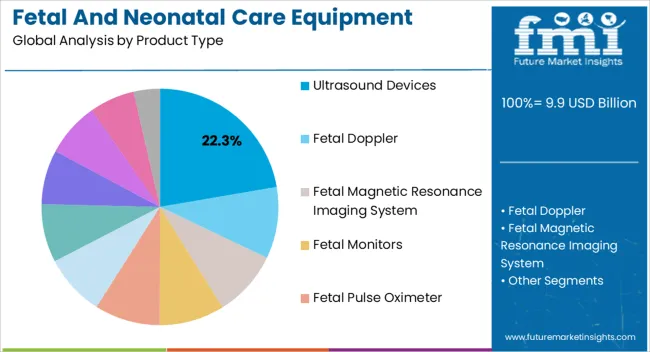
The ultrasound devices product type segment is projected to hold 22.3% of the market revenue in 2025, establishing it as the leading product type. This segment’s growth is being driven by the widespread use of non-invasive imaging for prenatal diagnosis, fetal monitoring, and early detection of congenital anomalies. Ultrasound devices provide real-time visualization, enabling accurate assessment of fetal development, positioning, and vital parameters without exposing patients to radiation.
The integration of advanced imaging technologies, AI-assisted analysis, and 3D/4D imaging capabilities has enhanced diagnostic precision, improving clinical decision-making and patient outcomes. Hospitals and specialized maternity centers increasingly prefer these devices due to their versatility, ease of use, and reliability.
Rising demand for portable and high-resolution imaging equipment for both urban and rural healthcare settings has further accelerated adoption As maternal and neonatal care standards continue to evolve, ultrasound devices are expected to maintain their leadership position, supported by continuous technological innovation and growing demand for precise prenatal monitoring.
Insights into the Hospitals End-User Segment
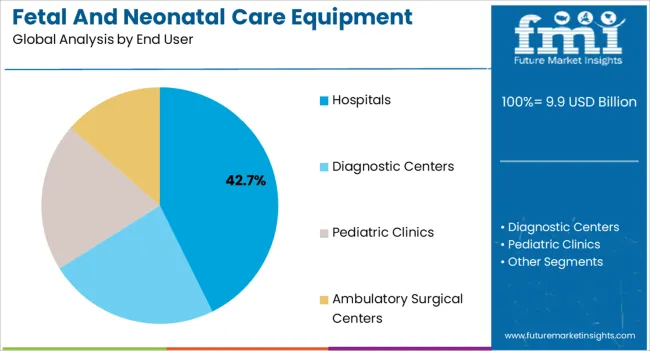
The hospitals end-user segment is anticipated to account for 42.7% of the market revenue in 2025, making it the largest end-use category. Growth is being driven by the need for comprehensive maternal and neonatal care services in hospital settings, where advanced monitoring, diagnostic, and life-support equipment is critical. Hospitals serve as the primary providers of specialized prenatal and postnatal care, where early detection of fetal and neonatal complications is essential for reducing mortality and morbidity.
The adoption of integrated care systems, including portable and AI-enabled devices, supports continuous monitoring and improves patient management. Government support, public healthcare initiatives, and private investments in hospital infrastructure are further strengthening demand.
Increasing hospital capacity, combined with rising awareness of high-risk pregnancies, premature births, and neonatal disorders, has reinforced the segment’s growth As hospitals prioritize patient safety, early intervention, and operational efficiency, they are expected to remain the leading end users of fetal and neonatal care equipment, driving long-term market expansion.
Market Overview
Fetal And Neonatal Care Equipment Market Overview
Fetal and neonatal care focuses on aspects of child health and diseases from perinatal period to adolescence stage. According to the World Health Organization (WHO), 340,000 maternal deaths, 2.7 Mn stillbirths and 3.1 Mn neonatal deaths occur worldwide each year.
As per a recent study the rate of maternal death, stillbirth and early neonatal death have declined in the high as well as few middle-income countries, primarily because of improved obstetric care. There are 17 National Institute of Child Health and Development Neonatal Research Network in USA where programs are introduced or experimented in order to enhance the quality and research for better outcomes of patients.
In 2025, Children's Health launched Texas’ first dedicated neonatal telemedicine service which offers physicians availability at other NICU’s hospitals for neonatal cases. Vendors focus on providing highly efficient and low cost equipment in order to cater to the neonatal segment which reduces morbidity and mortality in regions with poor resources and less skilled physicians.
Analysis of Fetal And Neonatal Care Equipment Market By Key Countries
| Country | CAGR |
|---|---|
| China | 8.7% |
| India | 8.1% |
| Germany | 7.4% |
| France | 6.8% |
| UK | 6.1% |
| USA | 5.5% |
| Brazil | 4.9% |
Country-wise Analysis
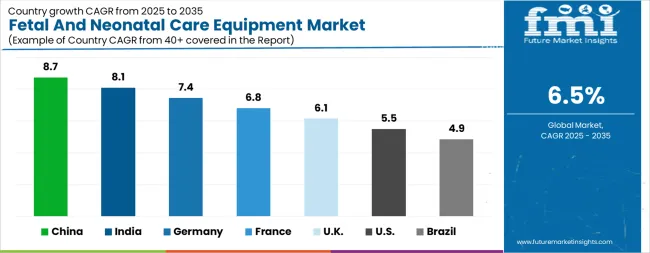
The Fetal And Neonatal Care Equipment Market is expected to register a CAGR of 6.5% during the forecast period, exhibiting varied country level momentum. China leads with the highest CAGR of 8.7%, followed by India at 8.1%. Developed markets such as Germany, France, and the UK continue to expand steadily, while the USA is likely to grow at consistent rates. Brazil posts the lowest CAGR at 4.9%, yet still underscores a broadly positive trajectory for the global Fetal And Neonatal Care Equipment Market. In 2024, Germany held a dominant revenue in the Western Europe market and is expected to grow with a CAGR of 7.4%. The USA Fetal And Neonatal Care Equipment Market is estimated to be valued at USD 3.6 billion in 2025 and is anticipated to reach a valuation of USD 6.1 billion by 2035. Sales are projected to rise at a CAGR of 5.5% over the forecast period between 2025 and 2035. While Japan and South Korea markets are estimated to be valued at USD 470.7 million and USD 255.8 million respectively in 2025.
Key Players in the Fetal And Neonatal Care Equipment Market
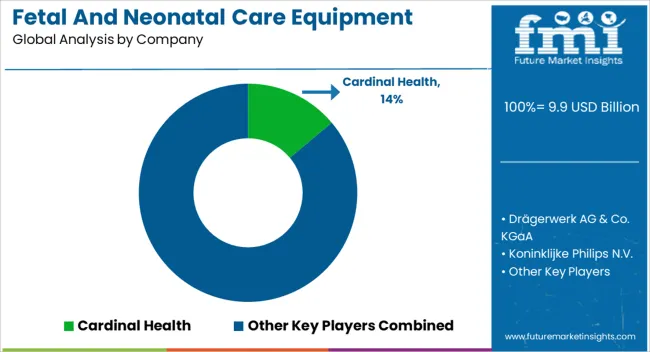
- Cardinal Health
- Drägerwerk AG & Co. KGaA
- Koninklijke Philips N.V.
- GE Healthcare
- Medtronic
- Vyaire
- BD
- Utah Medical Products, Inc.
- Natus Medical Incorporated
- Ambu A/S
- Inspiration Healthcare Group plc
- Atom Medical Corp.
- Fisher & Paykel Healthcare Limited
- Masimo
Scope of the Report
| Item | Value |
|---|---|
| Quantitative Units | USD 9.9 Billion |
| Product Type | Ultrasound Devices, Fetal Doppler, Fetal Magnetic Resonance Imaging System, Fetal Monitors, Fetal Pulse Oximeter, Incubators, Phototherapy Equipment, Neonatal Ventilators, Oxygen Analyzers, Neonatal Monitoring Devices, and Others (Apnea, Feeding Tubes, Cardiac Monitors, etc.) |
| End User | Hospitals, Diagnostic Centers, Pediatric Clinics, and Ambulatory Surgical Centers |
| Regions Covered | North America, Europe, Asia-Pacific, Latin America, Middle East & Africa |
| Country Covered | United States, Canada, Germany, France, United Kingdom, China, Japan, India, Brazil, South Africa |
| Key Companies Profiled | Cardinal Health, Drägerwerk AG & Co. KGaA, Koninklijke Philips N.V., GE Healthcare, Medtronic, Vyaire, BD, Utah Medical Products, Inc., Natus Medical Incorporated, Ambu A/S, Inspiration Healthcare Group plc, Atom Medical Corp., Fisher & Paykel Healthcare Limited, and Masimo |
Fetal And Neonatal Care Equipment Market by Segments
Product Type:
- Ultrasound Devices
- Fetal Doppler
- Fetal Magnetic Resonance Imaging System
- Fetal Monitors
- Fetal Pulse Oximeter
- Incubators
- Phototherapy Equipment
- Neonatal Ventilators
- Oxygen Analyzers
- Neonatal Monitoring Devices
- Others (Apnea, Feeding Tubes, Cardiac Monitors, etc.)
End User:
- Hospitals
- Diagnostic Centers
- Pediatric Clinics
- Ambulatory Surgical Centers
Region:
- North America
- USA
- Canada
- Mexico
- Latin America
- Brazil
- Chile
- Rest of Latin America
- Western Europe
- Germany
- UK
- Italy
- Spain
- France
- Nordic
- BENELUX
- Rest of Western Europe
- Eastern Europe
- Russia
- Poland
- Hungary
- Balkan & Baltic
- Rest of Eastern Europe
- East Asia
- China
- Japan
- South Korea
- South Asia and Pacific
- India
- ASEAN
- Australia & New Zealand
- Rest of South Asia and Pacific
- Middle East & Africa
- Kingdom of Saudi Arabia
- Other GCC Countries
- Turkiye
- South Africa
- Other African Union
- Rest of Middle East & Africa
Frequently Asked Questions
How big is the fetal and neonatal care equipment market in 2025?
The global fetal and neonatal care equipment market is estimated to be valued at USD 9.9 billion in 2025.
What will be the size of fetal and neonatal care equipment market in 2035?
The market size for the fetal and neonatal care equipment market is projected to reach USD 18.5 billion by 2035.
How much will be the fetal and neonatal care equipment market growth between 2025 and 2035?
The fetal and neonatal care equipment market is expected to grow at a 6.5% CAGR between 2025 and 2035.
What are the key product types in the fetal and neonatal care equipment market?
The key product types in fetal and neonatal care equipment market are ultrasound devices, fetal doppler, fetal magnetic resonance imaging system, fetal monitors, fetal pulse oximeter, incubators, phototherapy equipment, neonatal ventilators, oxygen analyzers, neonatal monitoring devices and others (apnea, feeding tubes, cardiac monitors, etc.).
Which end user segment to contribute significant share in the fetal and neonatal care equipment market in 2025?
In terms of end user, hospitals segment to command 42.7% share in the fetal and neonatal care equipment market in 2025.
Preview the report firsthand - request a free sample
Get SampleGet the brochure for pricing and purchase details.
Get PDFTable of Content
- Executive Summary
- Global Market Outlook
- Demand-side Trends
- Supply-side Trends
- Technology Roadmap Analysis
- Analysis and Recommendations
- Market Overview
- Market Coverage / Taxonomy
- Market Definition / Scope / Limitations
- Market Background
- Market Dynamics
- Drivers
- Restraints
- Opportunity
- Trends
- Scenario Forecast
- Demand in Optimistic Scenario
- Demand in Likely Scenario
- Demand in Conservative Scenario
- Opportunity Map Analysis
- Product Life Cycle Analysis
- Supply Chain Analysis
- Investment Feasibility Matrix
- Value Chain Analysis
- PESTLE and Porter’s Analysis
- Regulatory Landscape
- Regional Parent Market Outlook
- Production and Consumption Statistics
- Import and Export Statistics
- Market Dynamics
- Global Market Analysis 2020 to 2024 and Forecast, 2025 to 2035
- Historical Market Size Value (USD Million) Analysis, 2020 to 2024
- Current and Future Market Size Value (USD Million) Projections, 2025 to 2035
- Y-o-Y Growth Trend Analysis
- Absolute $ Opportunity Analysis
- Global Market Pricing Analysis 2020 to 2024 and Forecast 2025 to 2035
- Global Market Analysis 2020 to 2024 and Forecast 2025 to 2035, By Product Type
- Introduction / Key Findings
- Historical Market Size Value (USD Million) Analysis By Product Type , 2020 to 2024
- Current and Future Market Size Value (USD Million) Analysis and Forecast By Product Type , 2025 to 2035
- Ultrasound Devices
- Fetal Doppler
- Fetal Magnetic Resonance Imaging System
- Fetal Monitors
- Fetal Pulse Oximeter
- Incubators
- Phototherapy Equipment
- Neonatal Ventilators
- Oxygen Analyzers
- Neonatal Monitoring Devices
- Others (Apnea, Feeding Tubes, Cardiac Monitors, etc.)
- Y-o-Y Growth Trend Analysis By Product Type , 2020 to 2024
- Absolute $ Opportunity Analysis By Product Type , 2025 to 2035
- Global Market Analysis 2020 to 2024 and Forecast 2025 to 2035, By End User
- Introduction / Key Findings
- Historical Market Size Value (USD Million) Analysis By End User, 2020 to 2024
- Current and Future Market Size Value (USD Million) Analysis and Forecast By End User, 2025 to 2035
- Hospitals
- Diagnostic Centers
- Pediatric Clinics
- Ambulatory Surgical Centers
- Y-o-Y Growth Trend Analysis By End User, 2020 to 2024
- Absolute $ Opportunity Analysis By End User, 2025 to 2035
- Global Market Analysis 2020 to 2024 and Forecast 2025 to 2035, By Region
- Introduction
- Historical Market Size Value (USD Million) Analysis By Region, 2020 to 2024
- Current Market Size Value (USD Million) Analysis and Forecast By Region, 2025 to 2035
- North America
- Latin America
- Western Europe
- Eastern Europe
- East Asia
- South Asia and Pacific
- Middle East & Africa
- Market Attractiveness Analysis By Region
- North America Market Analysis 2020 to 2024 and Forecast 2025 to 2035, By Country
- Historical Market Size Value (USD Million) Trend Analysis By Market Taxonomy, 2020 to 2024
- Market Size Value (USD Million) Forecast By Market Taxonomy, 2025 to 2035
- By Country
- USA
- Canada
- Mexico
- By Product Type
- By End User
- By Country
- Market Attractiveness Analysis
- By Country
- By Product Type
- By End User
- Key Takeaways
- Latin America Market Analysis 2020 to 2024 and Forecast 2025 to 2035, By Country
- Historical Market Size Value (USD Million) Trend Analysis By Market Taxonomy, 2020 to 2024
- Market Size Value (USD Million) Forecast By Market Taxonomy, 2025 to 2035
- By Country
- Brazil
- Chile
- Rest of Latin America
- By Product Type
- By End User
- By Country
- Market Attractiveness Analysis
- By Country
- By Product Type
- By End User
- Key Takeaways
- Western Europe Market Analysis 2020 to 2024 and Forecast 2025 to 2035, By Country
- Historical Market Size Value (USD Million) Trend Analysis By Market Taxonomy, 2020 to 2024
- Market Size Value (USD Million) Forecast By Market Taxonomy, 2025 to 2035
- By Country
- Germany
- UK
- Italy
- Spain
- France
- Nordic
- BENELUX
- Rest of Western Europe
- By Product Type
- By End User
- By Country
- Market Attractiveness Analysis
- By Country
- By Product Type
- By End User
- Key Takeaways
- Eastern Europe Market Analysis 2020 to 2024 and Forecast 2025 to 2035, By Country
- Historical Market Size Value (USD Million) Trend Analysis By Market Taxonomy, 2020 to 2024
- Market Size Value (USD Million) Forecast By Market Taxonomy, 2025 to 2035
- By Country
- Russia
- Poland
- Hungary
- Balkan & Baltic
- Rest of Eastern Europe
- By Product Type
- By End User
- By Country
- Market Attractiveness Analysis
- By Country
- By Product Type
- By End User
- Key Takeaways
- East Asia Market Analysis 2020 to 2024 and Forecast 2025 to 2035, By Country
- Historical Market Size Value (USD Million) Trend Analysis By Market Taxonomy, 2020 to 2024
- Market Size Value (USD Million) Forecast By Market Taxonomy, 2025 to 2035
- By Country
- China
- Japan
- South Korea
- By Product Type
- By End User
- By Country
- Market Attractiveness Analysis
- By Country
- By Product Type
- By End User
- Key Takeaways
- South Asia and Pacific Market Analysis 2020 to 2024 and Forecast 2025 to 2035, By Country
- Historical Market Size Value (USD Million) Trend Analysis By Market Taxonomy, 2020 to 2024
- Market Size Value (USD Million) Forecast By Market Taxonomy, 2025 to 2035
- By Country
- India
- ASEAN
- Australia & New Zealand
- Rest of South Asia and Pacific
- By Product Type
- By End User
- By Country
- Market Attractiveness Analysis
- By Country
- By Product Type
- By End User
- Key Takeaways
- Middle East & Africa Market Analysis 2020 to 2024 and Forecast 2025 to 2035, By Country
- Historical Market Size Value (USD Million) Trend Analysis By Market Taxonomy, 2020 to 2024
- Market Size Value (USD Million) Forecast By Market Taxonomy, 2025 to 2035
- By Country
- Kingdom of Saudi Arabia
- Other GCC Countries
- Turkiye
- South Africa
- Other African Union
- Rest of Middle East & Africa
- By Product Type
- By End User
- By Country
- Market Attractiveness Analysis
- By Country
- By Product Type
- By End User
- Key Takeaways
- Key Countries Market Analysis
- USA
- Pricing Analysis
- Market Share Analysis, 2024
- By Product Type
- By End User
- Canada
- Pricing Analysis
- Market Share Analysis, 2024
- By Product Type
- By End User
- Mexico
- Pricing Analysis
- Market Share Analysis, 2024
- By Product Type
- By End User
- Brazil
- Pricing Analysis
- Market Share Analysis, 2024
- By Product Type
- By End User
- Chile
- Pricing Analysis
- Market Share Analysis, 2024
- By Product Type
- By End User
- Germany
- Pricing Analysis
- Market Share Analysis, 2024
- By Product Type
- By End User
- UK
- Pricing Analysis
- Market Share Analysis, 2024
- By Product Type
- By End User
- Italy
- Pricing Analysis
- Market Share Analysis, 2024
- By Product Type
- By End User
- Spain
- Pricing Analysis
- Market Share Analysis, 2024
- By Product Type
- By End User
- France
- Pricing Analysis
- Market Share Analysis, 2024
- By Product Type
- By End User
- India
- Pricing Analysis
- Market Share Analysis, 2024
- By Product Type
- By End User
- ASEAN
- Pricing Analysis
- Market Share Analysis, 2024
- By Product Type
- By End User
- Australia & New Zealand
- Pricing Analysis
- Market Share Analysis, 2024
- By Product Type
- By End User
- China
- Pricing Analysis
- Market Share Analysis, 2024
- By Product Type
- By End User
- Japan
- Pricing Analysis
- Market Share Analysis, 2024
- By Product Type
- By End User
- South Korea
- Pricing Analysis
- Market Share Analysis, 2024
- By Product Type
- By End User
- Russia
- Pricing Analysis
- Market Share Analysis, 2024
- By Product Type
- By End User
- Poland
- Pricing Analysis
- Market Share Analysis, 2024
- By Product Type
- By End User
- Hungary
- Pricing Analysis
- Market Share Analysis, 2024
- By Product Type
- By End User
- Kingdom of Saudi Arabia
- Pricing Analysis
- Market Share Analysis, 2024
- By Product Type
- By End User
- Turkiye
- Pricing Analysis
- Market Share Analysis, 2024
- By Product Type
- By End User
- South Africa
- Pricing Analysis
- Market Share Analysis, 2024
- By Product Type
- By End User
- USA
- Market Structure Analysis
- Competition Dashboard
- Competition Benchmarking
- Market Share Analysis of Top Players
- By Regional
- By Product Type
- By End User
- Competition Analysis
- Competition Deep Dive
- Cardinal Health
- Overview
- Product Portfolio
- Profitability by Market Segments (Product/Age /Sales Channel/Region)
- Sales Footprint
- Strategy Overview
- Marketing Strategy
- Product Strategy
- Channel Strategy
- Drägerwerk AG & Co. KGaA
- Koninklijke Philips N.V.
- GE Healthcare
- Medtronic
- Vyaire
- BD
- Utah Medical Products, Inc.
- Natus Medical Incorporated
- Ambu A/S
- Inspiration Healthcare Group plc
- Atom Medical Corp.
- Fisher & Paykel Healthcare Limited
- Masimo
- Cardinal Health
- Competition Deep Dive
- Assumptions & Acronyms Used
- Research Methodology


