

- Industry Size (2025)
- USD 99.5 Mn
- Forecast (2035)
- USD 176.9 Mn
- CAGR (2025 to 2035)
- 5.9%
Demand for Burn Care in Japan Forecast and Outlook 2025 to 2035
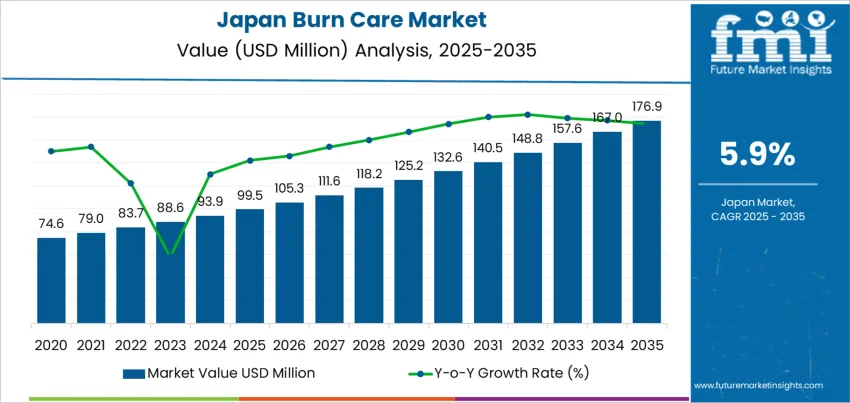
Demand for burn care in Japan is valued at USD 99.5 million in 2025 and is expected to reach USD 176.9 million by 2035, expanding at a CAGR of 5.9%. Early growth reflects steady incidence across domestic, industrial, and transportation-related injuries, alongside Japan’s organized emergency response and trauma referral systems. Acute care products such as wound dressings, biologic skin substitutes, topical antimicrobials, and fluid resuscitation solutions account for most early spending. Tertiary hospitals and regional burn centers remain the primary treatment hubs due to the need for surgical intervention, grafting, and infection control. Aging infrastructure in residential buildings and continued exposure to thermal and chemical hazards in manufacturing sustain consistent admission volumes across major prefectures.
After 2030, demand growth in Japan reflects longer treatment duration and higher per-patient care intensity rather than faster patient inflow. Market value rises from about USD 132.6 million in 2030 toward USD 176.9 million by 2035 as advanced wound therapies, negative pressure systems, and regenerative skin products see wider clinical use. Outpatient burn rehabilitation and scar management services expand through specialty clinics and long-term care facilities. Pediatric burn treatment also contributes steady value through structured follow-up care. Domestic medical supply firms and global wound care companies compete through product performance, infection control outcomes, and clinical handling efficiency. Later-stage spending patterns are shaped by post-acute recovery requirements, surgical revision needs, and long-term cosmetic and functional restoration programs within Japans hospital network.
Quick Stats of the Demand for Burn Care in Japan
- Demand for Burn Care in Japan Value (2025): USD 99.5 million
- Demand for Burn Care in Japan Forecast Value (2035): USD 176.9 million
- Demand for Burn Care in Japan Forecast CAGR (2025–2035): 5.9%
- Demand for Burn Care in Japan Leading Product Type: Burn Wound Dressings (68%)
- Demand for Burn Care in Japan Key Growth Regions: Kyushu & Okinawa, Kanto, Kansai, Chubu, Tohoku, Rest of Japan
- Demand for Burn Care in Japan Top Players: Smith & Nephew, Mölnlycke Health Care AB, Cardinal Health, ConvaTec Inc., Urgo Medical North America
What is the Demand Forecast for Burn Care in Japan through 2035?
Burn care demand in Japan is shaped by emergency medicine capacity, industrial safety dynamics, and the expanding role of advanced wound management rather than by elective clinical spending. Demand increases from USD 99.5 million in 2025 to USD 105.3 million by 2026 and USD 111.6 million by 2027, reaching USD 125.2 million by 2030 and adding USD 25.7 million from the 2025 base. This phase reflects steady utilization of dressings, skin substitutes, negative pressure therapy, and infection control solutions across trauma centers and acute care hospitals. Growth is supported by aging-related injury risk, urban density, and rising survival rates that extend burn treatment duration beyond immediate emergency response.
From 2030 to 2035, the market expands from USD 125.2 million to USD 176.9 million, adding USD 51.7 million in the second half of the decade. This back weighted acceleration reflects broader adoption of bioengineered skin grafts, artificial dermal matrices, and regenerative wound therapies that significantly raise per-patient treatment value. Demand also strengthens as post-burn rehabilitation, contracture management, and long-term scar treatment become integrated components of care pathways. As Japan continues to prioritize trauma system resilience and advanced wound healing standards, burn care shifts from basic emergency response toward comprehensive multi-stage therapeutic management, sustaining long-term demand growth through 2035.
Burn Care Industry in Japan Key Takeaways
| Metric | Value |
|---|---|
| Industry Value (2025) | USD 99.5 million |
| Forecast Value (2035) | USD 176.9 million |
| Forecast CAGR (2025–2035) | 5.9% |
What Is Driving Demand for Burn Care in Japan?
Demand for burn care in Japan has expanded due to demographic, societal, and clinical-care shifts. The country’s growing elderly population raises vulnerability to thermal and scald injuries at home. Older adults’ thinner skin and slower healing rates contribute to deeper burns and higher complication risks when accidents occur. Meanwhile, industrial activity and urban housing density continue to expose workers and residents to fire, hot-liquid, or chemical accident risks. As a result, more patients require specialized burn-injury management, including wound care dressings, infection control, debridement, and reconstructive treatment. Improved diagnostic awareness and rising standards for emergency and post-injury care have increased use of advanced burn-treatment protocols rather than minimal first aid.
Future demand will depend on the intensification of chronic care needs, advances in treatment technologies, and the spread of specialized burn units beyond major cities. As survival rates improve, more patients require long-term follow-up: scar management, skin grafts, rehabilitation, and quality-of-life interventions. Regenerative dressings, bio-engineered skin substitutes and advanced wound-healing materials are likely to be adopted more widely. At the same time, demand may concentrate not just on acute hospital care but on outpatient wound therapy and home-care support. Barriers include uneven distribution of specialist burn care across regions, high treatment costs for complex burns, and limited awareness among patients about long-term care requirements. Market growth will depend on balancing clinical capability, accessibility, and long-term care infrastructure.
How Are Product Type and End Use Structuring the Demand for Burn Care in Japan?
The demand for burn care in Japan is structured by product type and end use setting. Burn wound dressings account for 68% of total demand, followed by topical burn medications used across acute and recovery phases of treatment. By end use, hospitals represent 52.0% of total utilization, followed by clinics and other care settings. Demand behavior is shaped by burn injury severity, infection prevention priorities, surgical intervention rates, and post injury rehabilitation needs. These segments reflect how treatment intensity, wound management requirements, and institutional care pathways influence product selection across emergency departments, surgical wards, outpatient burn clinics, and long term care facilities in Japan.
Why Do Burn Wound Dressings Lead the Burn Care Product Demand in Japan?
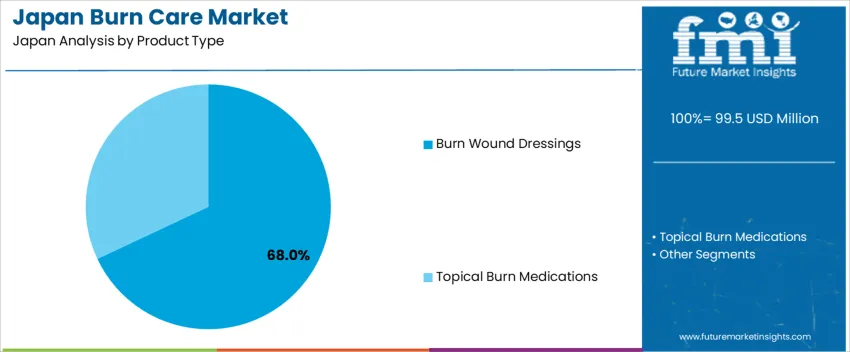
Burn wound dressings account for 68% of total burn care demand in Japan due to their central role in initial wound protection, infection control, and tissue regeneration support. These dressings are applied immediately after injury to manage exudate, maintain a moist wound environment, and reduce microbial contamination. Advanced dressings such as hydrocolloids, foams, alginates, and antimicrobial impregnated materials are widely used in moderate to severe burn cases. Their ability to support faster epithelialization and reduce dressing change frequency improves patient comfort and clinical workflow efficiency.
Burn dressings are also essential in post surgical graft care and prolonged healing phases where continuous coverage is required. Japan’s clinical protocols emphasize early wound stabilization to prevent systemic infection and scarring complications. Recurrent dressing replacement over extended treatment periods sustains high unit consumption per patient. These wound protection requirements, infection control priorities, and long treatment cycles position burn wound dressings as the dominant product type in the Japan burn care demand structure.
Why Do Hospitals Dominate the Burn Care End Use Demand in Japan?
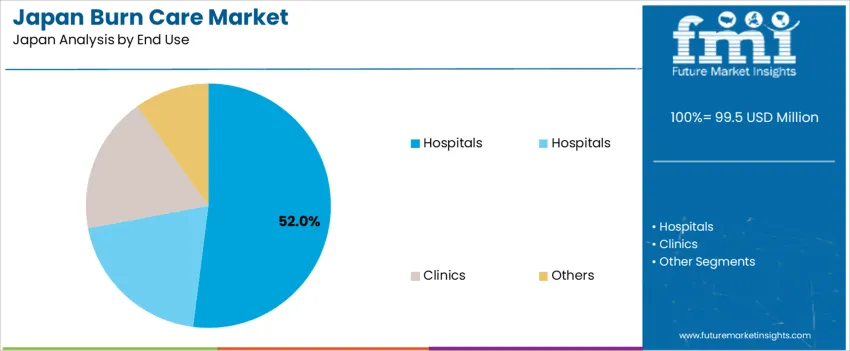
Hospitals account for 52.0% of total burn care demand in Japan due to their role as primary treatment centers for moderate to severe burn injuries. Patients suffering from thermal burns, chemical burns, or electrical injuries are typically admitted for emergency stabilization, surgical debridement, and infection management. Hospitals provide access to intensive care units, operating theaters, and multidisciplinary burn teams required for complex wound management. These capabilities concentrate the majority of burn treatment volume within hospital settings.
Hospital care also supports long inpatient stays for extensive burns that require repeated dressing changes, skin grafting, and monitoring for systemic complications. Specialized burn units in tertiary hospitals handle high severity cases transferred from regional clinics. Post operative recovery and rehabilitation often extend hospital utilization further. These injury severity patterns, surgical intervention needs, and intensive monitoring requirements sustain hospitals as the dominant end use segment in the Japan burn care demand landscape.
Why Is Burn Care in Japan Framed as a Long-Term Functional Recovery Issue Rather Than an Emergency-Only Service?
Demand for burn care in Japan extends far beyond acute emergency response and into prolonged functional rehabilitation. An aging population increases burn risk during routine home activities such as cooking, bathing, and use of heating devices. Survivors often require extended wound management, graft follow-ups, scar modulation, and mobility restoration. The health system emphasizes reintegration into daily life, not only survival. This shifts demand toward sustained outpatient burn management, pressure therapy, and reconstructive support. Burn care therefore operates as a long-term recovery discipline rather than a short-duration trauma service.
How Do Household Injury Patterns and Industrial Safety Culture Shape Case Distribution?
In Japan, a large share of burn cases originates from domestic kitchens, space heaters, and hot-water bathing rather than from large-scale industrial accidents. At the same time, strict workplace safety protocols reduce severe factory-related burns but generate steady low-to-moderate injury volumes that still require specialized care. Food service operations, chemical handling, and manufacturing remain secondary contributors. This dual pattern creates a burn care system that must manage both fragile elderly household patients and technically complex occupational injuries within the same clinical infrastructure.
What Capacity Limits, Specialized Staffing, and Infection Control Requirements Restrict Expansion?
Burn care in Japan is constrained by the limited number of dedicated burn units, high staffing intensity, and strict infection control demands. Severe burn cases require isolation, continuous monitoring, and multidisciplinary teams, which restrict patient throughput. Skin grafting capacity, donor site management, and postoperative rehabilitation scheduling create additional bottlenecks. Rural hospitals often stabilize and transfer patients due to lack of specialized facilities. These structural constraints keep advanced burn care concentrated in regional centers rather than allowing broad national dispersion.
How Are Regenerative Medicine, Tele-Burn Triage, and Scar Management Redefining Future Demand?
Future burn care demand in Japan is shifting toward regenerative wound therapies, telemedicine-supported triage, and long-term aesthetic recovery. Bioengineered skin layers and growth-factor treatments aim to reduce graft dependency and accelerate epithelialization. Remote burn assessment tools allow early specialist guidance from regional centers to smaller hospitals. Scar modulation using laser therapy and pressure systems is expanding as survival rates improve. These trends show burn care evolving from crisis management into a technologically guided continuum focused on tissue restoration and long-term quality of life.
What is the Demand for Burn Care in Japan by Region?
| Region | CAGR (%) |
|---|---|
| Kyushu & Okinawa | 7.4% |
| Kanto | 6.8% |
| Kansai | 6.0% |
| Chubu | 5.3% |
| Tohoku | 4.6% |
| Rest of Japan | 4.4% |
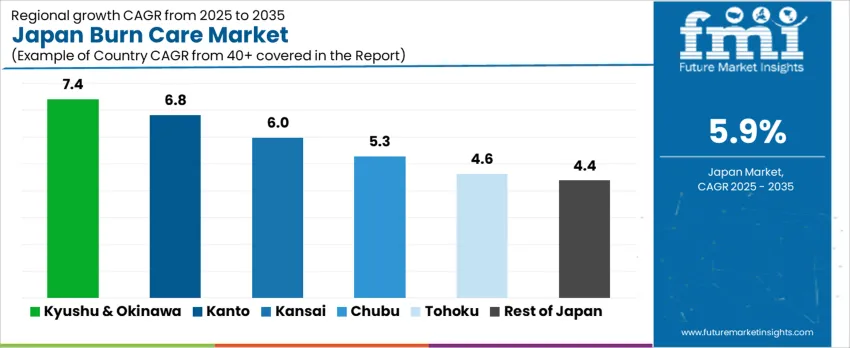
The demand for burn care in Japan is rising steadily across all regions, with Kyushu & Okinawa leading at a 7.4% CAGR. Growth in this region is supported by improved emergency care access, rising industrial and household accident reporting, and expansion of specialized burn treatment units in regional hospitals. Kanto follows at 6.8%, driven by large tertiary hospitals, trauma centers, and high treatment volumes in dense urban settings. Kansai records 6.0% growth, supported by established medical infrastructure and steady demand for reconstructive and long-term wound management services. Chubu at 5.3% reflects moderate uptake linked to regional hospital upgrades. Tohoku and Rest of Japan, at 4.6% and 4.4%, show slower but stable growth shaped by lower population density and fewer specialized burn care centers.
How Is Emergency Care Expansion Supporting Burn Treatment Demand in Kyushu And Okinawa?
Emergency treatment activity in Kyushu and Okinawa is advancing at a CAGR of 7.4% through 2035 for burn care demand, supported by regional trauma unit expansion, industrial accident management, and growing surgical skin reconstruction capacity. Chemical exposure from manufacturing sites and domestic fire injuries generate steady inpatient volumes. Hospitals strengthen wound debridement, grafting, and negative pressure therapy services. Medical travel from island communities adds to referral load. Demand remains injury driven, with consistent growth aligned to trauma response readiness, specialist staffing expansion, and standardized burn treatment protocols across regional critical care hospitals.
- Trauma unit expansion drives inpatient burn treatment volume
- Industrial exposure supports steady emergency admissions
- Skin grafting services strengthen surgical care capacity
- Inter regional referrals add sustained procedural flow
What Is Sustaining Strong Burn Care Utilization Across Kanto?
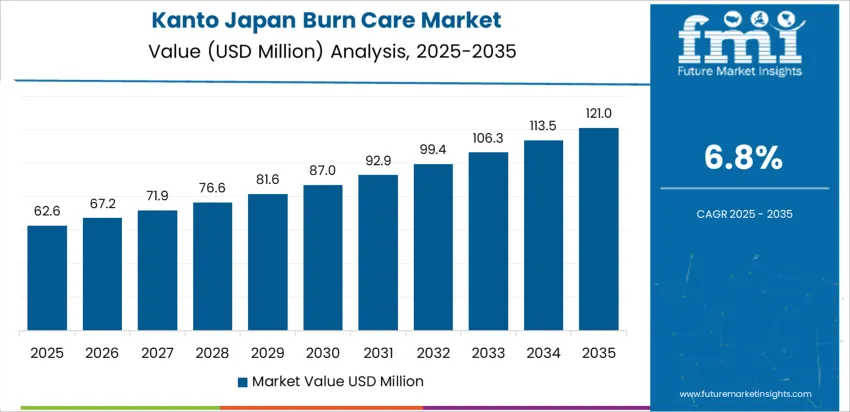
Clinical concentration in Kanto supports a CAGR of 6.8% through 2035 for burn care demand, driven by high population density, advanced trauma centers, and national medical referral infrastructure. Severe thermal injuries, electrical burns, and chemical exposure cases concentrate in tertiary hospitals. Plastic surgery units manage reconstructive treatment phases. Multidisciplinary burn teams improve long term recovery outcomes. Demand remains referral driven and acuity focused, shaped by complex case volumes, specialized ICU coverage, and consistent availability of advanced wound management technologies across metropolitan medical centers.
- National trauma centers manage high severity burn cases
- Reconstructive surgery supports long term recovery care
- Electrical and chemical burns raise treatment complexity
- Multidisciplinary teams improve clinical outcomes
Why Is Kansai Emerging as a Stable Secondary Burn Care Market?
Regional hospital balance in Kansai supports a CAGR of 6.0% through 2035 for burn care demand, shaped by urban residential density, light industrial activity, and steady domestic fire incident rates. Municipal hospitals manage moderate severity burns and early wound stabilization. Severe cases transfer to specialized units within the region. Rehabilitation centers contribute to post acute skin recovery. Demand remains volume stable and stepwise, aligned with predictable household accident incidence, controlled industrial safety exposure, and consistent emergency department intake across urban and suburban treatment networks.
- Municipal hospitals manage moderate burn injuries
- Regional transfers support severe case handling
- Rehabilitation centers sustain post acute care demand
- Domestic fire incidents anchor baseline treatment volume
How Is Workforce Demography Influencing Burn Care Demand in Chubu?
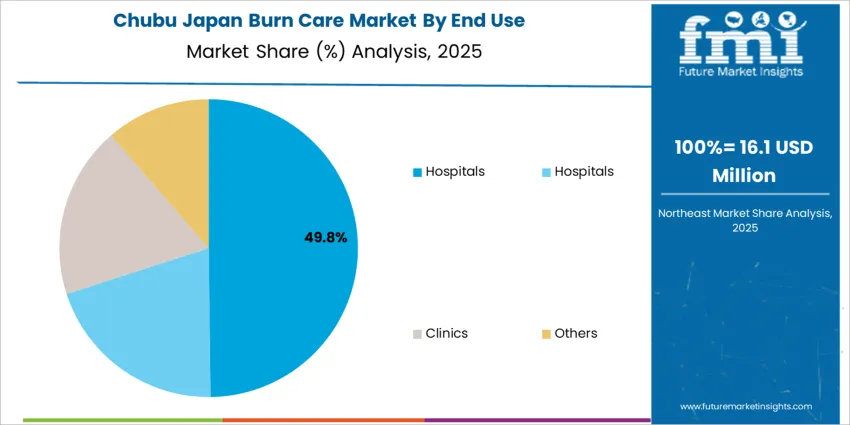
Industrial population dynamics in Chubu support a CAGR of 5.3% through 2035 for burn care demand, influenced by manufacturing related thermal exposure, occupational safety incidents, and emergency department utilization. Welding, automotive assembly, and machinery operations contribute to workplace burn injury risk. Hospitals expand wound dressing, infection control, and surgical skin repair capability. Employer backed insurance ensures continuity of inpatient care. Demand remains treatment focused rather than research driven, with utilization aligned to workplace injury management, predictable emergency inflow, and stable surgical service availability.
- Manufacturing exposure supports occupational burn treatment demand
- Emergency departments anchor acute wound management
- Employer insurance maintains inpatient care continuity
- Surgical repair supports post injury functional recovery
What Is Guiding Moderate Burn Care Growth in Tohoku?
Public hospital coverage in Tohoku supports a CAGR of 4.6% through 2035 for burn care demand, shaped by aging housing infrastructure, seasonal heating related accidents, and gradual trauma service upgrades. Scald injuries and domestic fire incidents dominate treatment volume. Smaller hospitals manage early stabilization before regional transfers. Limited specialist density moderates high complexity care penetration. Demand remains necessity driven and clinically steady, with growth aligned to household accident patterns, routine emergency response capacity, and controlled improvement in regional wound care infrastructure.
- Seasonal heating accidents sustain domestic burn incidence
- Early stabilization occurs at community hospitals
- Regional transfers handle complex injuries
- Public funding supports gradual trauma service improvement
Why Does the Rest of Japan Show Slower but Stable Burn Care Expansion?
Community hospital networks across the rest of Japan reflect a CAGR of 4.4% through 2035 for burn care demand, supported by municipal emergency departments, stable household injury rates, and national insurance reimbursement continuity. Treatment centers focus on superficial and moderate burns, wound cleaning, and infection prevention. Advanced reconstructive procedures remain concentrated in major metros. Patient referral pathways guide severe cases to specialized units. Demand remains steady and necessity oriented, with predictable utilization linked to routine domestic accidents, outpatient wound care follow ups, and essential emergency service coverage.
- Municipal emergency units manage routine burn injuries
- Outpatient wound care supports follow up treatment
- Severe cases move through established referral routes
- Insurance stability supports predictable access to care
What Is Driving the Demand for Burn Care in Japan and Who Are the Key Players Shaping the Market?
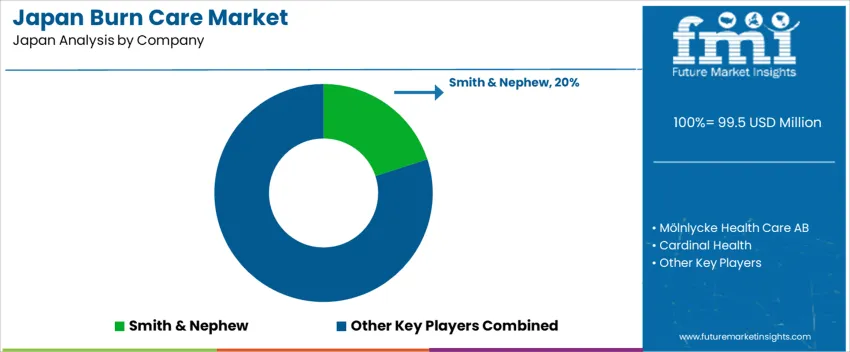
Demand for burn care in Japan rises as older adults and workplace-related injuries increase the incidence of thermal, scald, and contact burns. Elderly individuals are especially vulnerable to burns at home due to reduced mobility, sensory decline, and slower skin regeneration. Hospitals and emergency care units are expanding capacity for burn treatment as demographic shifts lead to more age-related burn injury cases. Advances in wound-care materials, topical dressings, and bioengineered skin substitutes support improved treatment outcomes and reduce complications. Growing awareness of best practices in acute care and rehabilitation also drives adoption of modern burn care solutions across healthcare facilities.
Major firms influencing the burn-care supply base in Japan include Smith & Nephew, Mölnlycke Health Care AB, Cardinal Health, ConvaTec Inc., and Urgo Medical. These companies supply advanced wound dressings, antimicrobial and hydrogel dressings, skin graft substitutes, and burn-management products used in acute care, reconstructive surgery, and rehabilitation. Their presence enables hospitals and clinics to adopt standardized burn-management protocols and ensures availability of specialized products across regions. The competitive landscape supports ongoing expansion of burn care services and improved access to treatment.
Key Players in Burn Care Industry in Japan
- Smith & Nephew
- Mölnlycke Health Care AB
- Cardinal Health
- Convatec Inc.
- Urgo Medical North America
Scope of the Report
| Items | Values |
|---|---|
| Quantitative Units (2025) | USD million |
| Product Type | Burn Wound Dressings, Topical Burn Medications |
| End Use | Hospitals, Clinics, Others |
| Region | Kyushu & Okinawa, Kanto, Kinki, Chubu, Tohoku, Rest of Japan |
| Key Companies Profiled | Smith & Nephew, Mölnlycke Health Care AB, Cardinal Health, ConvaTec Inc., Urgo Medical North America |
| Additional Attributes | Dollar by sales by product type, end use, and region. Includes inpatient and outpatient burn care, emergency and trauma-related admission rates, surgical intervention volumes, skin graft and bioengineered wound therapy usage, infection control measures, scar management, long-term rehabilitation programs, pediatric and geriatric burn care, hospital staffing intensity, trauma center coverage, clinical outcomes, post-acute follow-up, regional hospital network impact, and integration with Japan national emergency response and trauma referral protocols. |
Burn Care Industry in Japan Segmentation
Product Type:
- Burn Wound Dressings
- Topical Burn Medications
End Use:
- Hospitals
- Clinics
- Others
Region:
- Kyushu & Okinawa
- Kanto
- Kansai
- Chubu
- Tohoku
- Rest of Japan
Frequently Asked Questions
How big is the demand for burn care in Japan in 2025?
The demand for burn care in Japan is estimated to be valued at USD 99.5 million in 2025.
What will be the size of burn care in Japan in 2035?
The market size for the burn care in Japan is projected to reach USD 176.9 million by 2035.
How much will be the demand for burn care in Japan growth between 2025 and 2035?
The demand for burn care in Japan is expected to grow at a 5.9% CAGR between 2025 and 2035.
What are the key product types in the burn care in Japan?
The key product types in burn care in Japan are burn wound dressings and topical burn medications.
Which end use segment is expected to contribute significant share in the burn care in Japan in 2025?
In terms of end use, hospitals segment is expected to command 52.0% share in the burn care in Japan in 2025.
Preview the report firsthand - request a free sample
Get SampleGet the brochure for pricing and purchase details.
Get PDFTable of Content
- Executive Summary
- Japan Market Outlook
- Demand-side Trends
- Supply-side Trends
- Technology Roadmap Analysis
- Analysis and Recommendations
- Market Overview
- Market Coverage / Taxonomy
- Market Definition / Scope / Limitations
- Market Background
- Market Dynamics
- Drivers
- Restraints
- Opportunity
- Trends
- Scenario Forecast
- Demand in Optimistic Scenario
- Demand in Likely Scenario
- Demand in Conservative Scenario
- Opportunity Map Analysis
- Product Life Cycle Analysis
- Supply Chain Analysis
- Investment Feasibility Matrix
- Value Chain Analysis
- PESTLE and Porter’s Analysis
- Regulatory Landscape
- Regional Parent Market Outlook
- Production and Consumption Statistics
- Import and Export Statistics
- Market Dynamics
- Japan Market Analysis 2020 to 2024 and Forecast, 2025 to 2035
- Historical Market Size Value (USD Million) Analysis, 2020 to 2024
- Current and Future Market Size Value (USD Million) Projections, 2025 to 2035
- Y-o-Y Growth Trend Analysis
- Absolute $ Opportunity Analysis
- Japan Market Pricing Analysis 2020 to 2024 and Forecast 2025 to 2035
- Japan Market Analysis 2020 to 2024 and Forecast 2025 to 2035, By Product Type
- Introduction / Key Findings
- Historical Market Size Value (USD Million) Analysis By Product Type , 2020 to 2024
- Current and Future Market Size Value (USD Million) Analysis and Forecast By Product Type , 2025 to 2035
- Burn Wound Dressings
- Topical Burn Medications
- Y-o-Y Growth Trend Analysis By Product Type , 2020 to 2024
- Absolute $ Opportunity Analysis By Product Type , 2025 to 2035
- Japan Market Analysis 2020 to 2024 and Forecast 2025 to 2035, By End Use
- Introduction / Key Findings
- Historical Market Size Value (USD Million) Analysis By End Use, 2020 to 2024
- Current and Future Market Size Value (USD Million) Analysis and Forecast By End Use, 2025 to 2035
- Hospitals
- Hospitals
- Clinics
- Others
- Y-o-Y Growth Trend Analysis By End Use, 2020 to 2024
- Absolute $ Opportunity Analysis By End Use, 2025 to 2035
- Market Structure Analysis
- Competition Dashboard
- Competition Benchmarking
- Market Share Analysis of Top Players
- By Regional
- By Product Type
- By End Use
- Competition Analysis
- Competition Deep Dive
- Smith & Nephew
- Overview
- Product Portfolio
- Profitability by Market Segments (Product/Age /Sales Channel/Region)
- Sales Footprint
- Strategy Overview
- Marketing Strategy
- Product Strategy
- Channel Strategy
- Mölnlycke Health Care AB
- Cardinal Health
- Convatec Inc.
- Urgo Medical North America
- Smith & Nephew
- Competition Deep Dive
- Assumptions & Acronyms Used
- Research Methodology


