

- Market Size (2026)
- USD 254.7 Mn
- Forecast (2036)
- USD 710.3 Mn
- CAGR (2026 to 2036)
- 10.8%
How Big is the Fig & Prune Fruit Pastes Market in 2026?
The fig & prune fruit pastes market is estimated at USD 254.7 million in 2026.
The global fig & prune fruit pastes market was valued at USD 229.9 million in 2025 and is estimated to reach USD 254.7 million in 2026. The market is projected to reach USD 710.3 million by 2036, expanding at a compound annual growth rate (CAGR) of 10.8% between 2026 and 2036. Standard grade accounted for the largest share of the market, contributing 40.0% of total revenue in 2026. Demand is supported by the functional role of fig and prune solids, which contribute flavour, binding and moisture retention in doughs, cakes and fruit centres. Fruit supply is tightening. According to Sunsweet Growers, global prune production for 2025/26 is estimated at 193,000 metric tons, roughly 6.0% less than in 2024/25 and 10.0% less than in 2023/24[5]. Production is expected to fall short of global consumption by about 12,000 metric tons, and carryover inventories are projected to fall to historical lows[5]. Supply of figs has also been disrupted. Valley Fig Growers announced the closure of its operations on 31 July 2026 after 67 years, citing market conditions and operating costs[4].
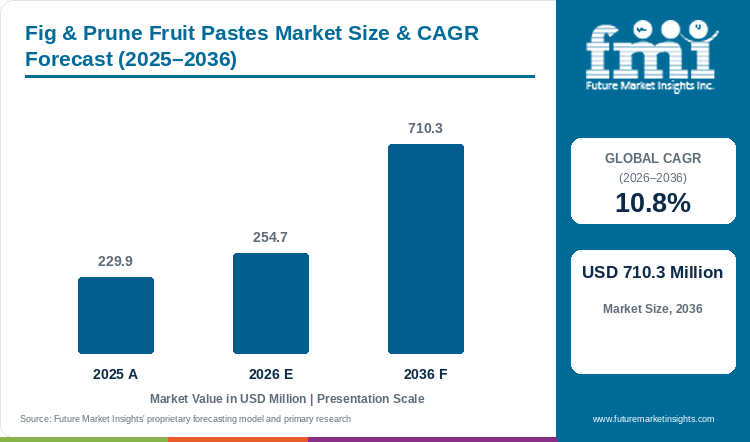
Table 1: Fig & Prune Fruit Pastes Market Size and Forecast (USD million), 2025 to 2036
| Market size and forecast | Value |
|---|---|
| 2025 market size | USD 229.9 million |
| Estimated market size in 2026 | USD 254.7 million |
| Projected market size by 2036 | USD 710.3 million |
| CAGR (2026-2036) | 10.8% |
| Added revenue, 2026 to 2036 | USD 455.6 million |
Key Market Trends & Insights
- By Product Type: The Standard grade segment accounted for the largest share of the fig & prune fruit pastes market in 2026, representing 40.0% of total market revenue.
- By Form: Powder / dry products held the leading market position with a share of 40.0% in 2026, allowing fruit solids to enter dry mixes with controlled hydration.
- By Application: Bread & rolls remained the largest application segment, accounting for 37.0% of the market in 2026.
Regional Highlights
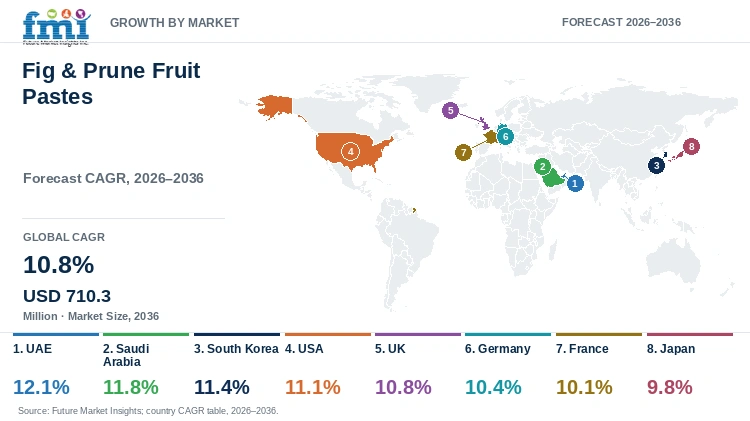
- Fastest-growing country: The UAE is expected to record the highest growth rate among the eight profiled countries, with a projected CAGR of 12.1% between 2026 and 2036.
- Growth across other countries: Saudi Arabia is projected to expand at a CAGR of 11.8%, followed by South Korea at 11.4% and the USA at 11.1%. Japan is expected to register comparatively slower growth, with a CAGR of 9.8% during the forecast period.
The availability of fruit remains the most important factor influencing the supply of prune and fig pastes. Sunsweet estimates that California harvested 64,000 metric tons of prunes in August 2025, a smaller crop than in the previous two years, as a result of accumulated stress on orchards from the prior year[5]. The United States Department of Agriculture (USDA) reports 73,210 tons of utilised California prune production on a dry basis for 2025[3]. Chile produced an average crop of approximately 75,000 metric tons, while Argentina's harvest was estimated at 15,000 metric tons after repeated weather damage[5]. Sunsweet expects firm to rising prices, particularly for larger, premium fruit[5]. Such conditions can increase the cost of processed fruit pastes and encourage bakeries to secure supply contracts earlier.
The fig supply base has also changed. Valley Fig Growers announced the closure of its operations on 31 July 2026 after 67 years, citing market conditions and operating costs[4]. For affected customers, alternative supply involves qualification as well as availability. Pastes with a similar description may differ in firmness, colour and behaviour during extrusion or baking, and such differences can alter an established recipe. The withdrawal gives greater commercial importance to processors able to reproduce the accepted fruit profile and support the transition to a dependable supply arrangement.
Processors offer several ingredient formats. California Prunes lists paste, puree and powder, including whole-fruit powder for bakery mixes, and California Figs describes paste, diced fruit and powder for product development[1][2]. Paste provides a defined fruit phase, whereas powder distributes solids through a dry mix and introduces its own hydration requirements. Diced preparations retain a more visible texture. These distinctions connect the choice of fruit inclusions with the work carried out before and during mixing, and allow manufacturers to retain fruit identity while adapting preparation to each bakery product.
Table 2: Supporting Industry Indicators for the Fig & Prune Fruit Pastes Market, 2025 to 2026
| Indicator | Data point | Why it matters | Source |
|---|---|---|---|
| Global prune supply | Global prune production for 2025/26 is estimated at 193,000 metric tons, roughly 6.0% less than in 2024/25. | Lower fruit supply can raise the cost of prune pastes. | [5] |
| Supply deficit | Production is expected to fall short of global consumption by about 12,000 metric tons, with carryover at historical lows. | Low inventories leave little buffer against future crop shortfalls. | [5] |
| California crop | California harvested an estimated 64,000 metric tons of prunes in August 2025, smaller than in the previous two years. | California is one of the two largest prune origins. | [5] |
| California utilisation | USDA reports 73,210 tons of utilised California prune production on a dry basis for 2025. | The crop provides an official supply reference for processors. | [3] |
| Other origins | Chile produced approximately 75,000 metric tons, while Argentina's crop was estimated at 15,000 metric tons. | Southern hemisphere supply affects global availability and price. | [5] |
| Price outlook | Sunsweet expects firm to rising prices, particularly for larger, premium sizes. | Higher fruit prices feed into paste costs. | [5] |
| Fig processor closure | Valley Fig Growers announced closure on 31 July 2026 after 67 years. | Affected customers require alternative fig supply qualified against their recipes. | [4] |
| Prune ingredient formats | California Prunes lists paste, puree and powder, including whole-fruit powder for bakery mixes. | Format choice changes preparation work in the bakery. | [1] |
| Fig formulation options | California Figs describes paste, diced fruit and powder for product development. | Grind and moisture link fruit identity with binding and texture. | [2] |
Demand Intensity Analysis
A comparison of FMI's market estimate with global prune production provides a measure of value added by processing. Global prune production for 2025/26 is estimated at 193,000 metric tons[5]. FMI estimated the fig & prune fruit pastes market at USD 229.9 million in 2025, which is equivalent to approximately USD 1,190.0 for every metric ton of prunes produced worldwide. The figure is modest in relation to the value of dried fruit, as paste represents only a share of total prune use, and FMI's estimate also includes fig-based ingredients.
The structure of supply provides another reference point. Chile accounts for approximately 38.9% of the estimated 2025/26 global prune crop and California for approximately 33.2%[5]. Since production is expected to fall short of consumption by about 12,000 metric tons, the deficit is equivalent to approximately 6.0% of global output. This indicates that processors may compete for limited fruit, which supports Sunsweet's expectation of firm to rising prices[5].
A similar comparison can be made between projected market growth and fruit supply. FMI expects the market to grow at a CAGR of 10.8% between 2026 and 2036, while global prune production has declined for three consecutive years[5]. The difference implies that growth will rely on higher prices, a shift towards processed formats such as paste and powder, and wider use of fruit solids for their functional properties, rather than on growth in fruit volumes. The closure of Valley Fig Growers[4] adds a further constraint on fig supply in North America.
Segment values show where demand is concentrated. Standard grade represented USD 101.9 million of Product Type revenue in 2026, while Powder / dry also represented USD 101.9 million on the separate Form axis. Bread & rolls accounted for USD 94.2 million of Application revenue, and Direct to industrial bakeries accounted for USD 124.8 million. The market is projected to add USD 455.6 million in revenue between 2026 and 2036, reaching 2.8 times its 2026 value.
Table 3: Demand Intensity Metrics for the Fig & Prune Fruit Pastes Market, 2025/26 Crop Data Against 2025 and 2026 Market Values
| Demand intensity metric | Value | Basis |
|---|---|---|
| FMI market value, 2025 | USD 229.9 million | FMI estimate of fig and prune paste revenue. |
| Global prune production, 2025/26 | 193,000 metric tons | Sunsweet estimate. |
| FMI value per metric ton of prunes produced | USD 1,190.0 | The calculation divides USD 229.9 million by 193,000 metric tons. |
| Chile share of global prune crop | 38.9% | 75,000 metric tons divided by 193,000 metric tons. |
| California share of global prune crop | 33.2% | 64,000 metric tons divided by 193,000 metric tons. |
| Supply deficit relative to production | Approximately 6.0% | 12,000 metric tons divided by 193,000 metric tons. |
| Change in global prune production, 2025/26 | Approximately -6.0% | Sunsweet estimate against 2024/25. |
| FMI value CAGR, 2026 to 2036 | 10.8% | FMI market forecast. |
| Standard grade revenue, 2026 | USD 101.9 million | 40.0% of the market. |
| Direct industrial bakery revenue, 2026 | USD 124.8 million | 49.0% of the market. |
| Added market revenue, 2026 to 2036 | USD 455.6 million | FMI forecast. |
| Market expansion multiple | 2.8 times | Projected 2036 market value relative to 2026. |
Analyst Perspective
"With prune supply falling for a third year and a major fig processor closing, the bakeries that have qualified a second source of fruit paste will face the least disruption."
- Nandini Roy Choudhury, Principal Analyst at Future Market Insights
How is the fig & prune fruit pastes market segmented?
The fig & prune fruit pastes market is segmented by product type, form, application, claim and sales channel. Product Type comprises Standard grade, Premium / specialty grade, Organic certified and Clean label grade. Form comprises Powder / dry, Liquid, Paste / semi-solid and Granules / pieces. Application comprises Bread & rolls, Cakes & muffins, Biscuits & cookies, Viennoiserie & pastry and Other bakery & snacks. Claim comprises Conventional, Clean label, Organic and Non-GMO / identity preserved. Sales Channel comprises Direct to industrial bakeries, Ingredient distributors, Foodservice & artisan supply and Online B2B.
Why does Standard grade anchor Product Type demand?
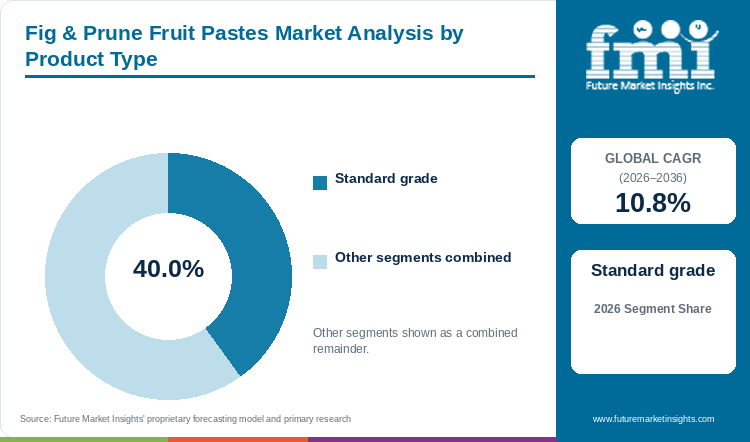
Standard grade leads Product Type at 40.0% in 2026.
Fig and prune pastes vary in how they spread, extrude and interact with dough, depending on moisture and particle size. Standard grades provide a defined combination of these properties for recurring production and generated approximately USD 101.9 million in 2026. Premium and specialty alternatives add distinctions in flavour or provenance, while organic and clean label grades carry separate sourcing requirements. With global prune production declining[5], a standard specification also helps bakeries assess successive deliveries against a consistent handling target as fruit quality changes from season to season.
- Standard grade leads Product Type at 40.0% in 2026.
- Moisture and particle specifications provide the reference for comparing grade and certification options.
How does Powder / dry shape the preferred Form?
Powder / dry represents 40.0% of Form in 2026.
Bakeries using powder add fruit solids at the dry-weighing stage and avoid some of the work involved in pumping or breaking down paste, which helps explain why Powder / dry generated approximately USD 101.9 million in 2026. California Prunes identifies whole-fruit powder for bakery mixes[1]. Its use still changes the recipe's water balance, with dispersion and hydration influencing the finished texture. Liquid grades suit continuous mixing, while paste provides binding and pieces retain a visible fruit structure.
- Powder / dry represents 40.0% of Form in 2026.
- Powder hydration forms part of the complete recipe's water balance.
What makes Bread & rolls the primary Application?
Bread & rolls lead Application with 37.0% in 2026.
Fruit breads and rolls are the largest application, accounting for approximately USD 94.2 million in 2026, as they provide a recurring setting in which fig and prune solids affect crumb softness, moisture retention, flavour and colour. A darker preparation may not suit a pale loaf at the same dose used elsewhere. Cakes place different demands on tenderness and fat replacement, while biscuit formulations must account for spread and texture. For bread and rolls, assessment needs to continue after normal cooling and holding, so that the finished crumb retains the weight and structure the customer expects.
- Bread & rolls lead Application with 37.0% in 2026.
- A useful fruit dose should retain the intended loaf volume and crumb texture.
Why does Conventional remain the leading Claim?
Conventional holds 49.0% of Claim in 2026.
Conventional products accounted for 49.0% of the Claim segment in 2026, but composition deserves attention whatever claim appears on the finished food. Added carriers or sweeteners change how a preparation should be compared with a pure fruit ingredient. Prunes and figs also contain naturally occurring sugars, so a reduced-sugar claim must be considered in the context of the complete recipe. Organic and identity-preserved products require the relevant sourcing records, while clean label is a formulation position rather than a single legal category.
- Conventional holds 49.0% of Claim in 2026.
- Composition records should distinguish the fruit's own sugars from added ingredients.
Why do Direct to industrial bakeries contracts dominate Sales Channel?
Direct to industrial bakeries accounts for 49.0% of Sales Channel in 2026.
Industrial bakeries use direct supply agreements to address paste firmness, pack configuration, moisture and microbiological specifications, and direct sales generated approximately USD 124.8 million in 2026. Some grades require breaking down before mixing, while softer preparations can be pumped more directly. The production schedule also defines the quantities needed over the supply period, which is particularly important when carryover stocks are low[5]. Distributors serve smaller or mixed orders, and artisan channels provide packs for shorter runs.
- Direct to industrial bakeries accounts for 49.0% of Sales Channel in 2026.
- Pack configuration and firmness affect the preparation required before mixing.
What are the drivers, restraints and opportunities in the fig & prune fruit pastes market?
Fruit function supports purchases beyond a single flavour trend, although falling fruit supply and processor closures restrain the market, while format selection creates room for tailored ingredient programmes.
Fruit function supports purchases beyond a single flavour trend
Fig and prune solids influence binding and moisture retention as well as flavour and colour. California Prunes describes moisture-retention and fat-reduction uses, while California Figs identifies texture and moisture functions in formulated foods[1][2]. These properties link the ingredient with specific production outcomes, such as tenderness in cake, cohesion in a fruit centre or the distribution of moisture through dough. Once the function is established, repeat purchasing has a basis beyond a temporary flavour launch. Processors participate in wider bakery ingredient systems through the consistency of the grades they supply.
Falling fruit supply and processor closures restrain the market
Global prune production has fallen for three consecutive seasons, and the 2025/26 crop of 193,000 metric tons is expected to fall short of consumption by about 12,000 metric tons[5]. On the fig side, Valley Fig Growers' closure on 31 July 2026 removes an established processor[4]. Replacing supply is difficult because the same fruit-paste name can cover materials with different handling properties. Fruit selection, moisture and grinding affect firmness and colour, and a replacement can require changes to preparation or water addition. The bakery must establish whether the new material spreads or extrudes as expected, which can delay a switch that initially appears straightforward.
Format selection creates room for tailored ingredient programmes
Paste, puree, powder and diced fruit offer distinct ways to place fig and prune solids within a recipe, and California Prunes and California Figs both describe multiple commercial forms[1][2]. A firm paste supports a defined centre, a softer preparation changes blending requirements, and a powder enters the dry-mixing stage. Application development can therefore increase the range of products served without relying on new flavours. In fruit-based snacks, the relationship between paste, fruit preserves and surrounding ingredients also influences cohesion. With fruit supply tight[5], processors that convert each ton of fruit into higher-value formats are well positioned.
Which country CAGRs are profiled in the fig & prune fruit pastes market?
Table 4: Country growth outlook for the fig & prune fruit pastes market
| Country | CAGR |
|---|---|
| UAE | 12.1% |
| Saudi Arabia | 11.8% |
| South Korea | 11.4% |
| USA | 11.1% |
| UK | 10.8% |
| Germany | 10.4% |
| France | 10.1% |
| Japan | 9.8% |
UAE
- The UAE is the fastest-growing market among the profiled countries, with a forecast CAGR of 12.1% from 2026 to 2036. Fruit-centred pastries and doughs containing dispersed fruit solids create different preparation requirements in the country. Ready paste reduces work before portioning, while dry grades place hydration within the mixing operation. Handling before mixing and the quantity usable from an opened pack affect the cost of each route. Consistent grind and moisture then allow imported supply to support larger orders without repeated adjustment.
Saudi Arabia
- In Saudi bakery products, paste firmness and fruit solids determine whether a centre can be portioned cleanly without becoming too dense. Saudi Arabia is forecast to grow at a CAGR of 11.8% for 2026 to 2036. Water addition and the surrounding dough influence how much preparation is needed for the intended eating quality, while equipment compatibility affects whether the same specification can support larger batches. Regular production requires continuity in the approved fruit profile, which is more difficult when global prune stocks are low[5].
South Korea
- With a forecast CAGR of 11.4% from 2026 to 2036, South Korea ranks third among the profiled countries. A South Korean bakery seeking visible fruit texture will choose a different ingredient from one seeking a smooth centre, as grind and moisture influence both. Trial batches can establish whether the centre retains the intended eating quality after storage. If the aim is to distribute fruit through the dough, a dry preparation offers another route with its own hydration requirements, and these differences need to be settled before a recipe is expanded.
USA
- California provides an identifiable supply base for US processors, although Sunsweet estimates that the state harvested only 64,000 metric tons of prunes in August 2025, a smaller crop than in the previous two years[5]. USDA reports 73,210 tons of utilised prunes on a dry basis for 2025[3]. The USA market is forecast to grow at a CAGR of 11.1% from 2026 to 2036. Valley Fig Growers' closure in July 2026 requires affected customers to find alternative fig supply[4]. A common product description is insufficient for that comparison, as moisture and grind can change handling and the finished recipe.
UK
- UK bakeries use fig and prune preparations in cakes, fruit-centred biscuits and breads, where they alter colour as well as texture. The UK is forecast to grow at a CAGR of 10.8% from 2026 to 2036. Paste, puree and powder offer different ways to introduce fruit solids, and their preparation needs should be explained before a trial. Smaller bakeries benefit from distributors willing to supply manageable quantities while a recipe is developed. After approval, stable fruit solids and clear instructions reduce the need to adjust water or mixing time.
Germany
- Germany's forecast CAGR is 10.4% from 2026 to 2036. Bulk paste firmness determines the preparation required in German bakery plants before blending or portioning. A firm block suits equipment designed to break it down, while a softer grade changes the balance between ingredient price and processing time. Usable fruit solids and the associated water adjustment provide further points of comparison. Where certification or identity preservation forms part of the product brief, sourcing records remain attached to the specification.
France
- In French pastry, fruit character is central to the appeal of fig and prune preparations. Fig paste provides a distinct centre, while prune ingredients bring a darker colour and flavour. France is forecast to grow at a CAGR of 10.1% for 2026 to 2036. Refinement and sweetness interact with the surrounding dough, so smooth and textured preparations can produce different eating qualities at the same portion weight. Pack configuration separates the needs of specialist accounts from those of bulk industrial users.
Japan
- Japan is expected to register the slowest growth among the profiled countries, with a forecast CAGR of 9.8% from 2026 to 2036. Portion density and hydration distinguish the uses of fruit paste and powder in Japanese bakery products. Paste must deliver the desired fruit character within a defined centre, whereas powder changes the water balance of the dough. Composition records distinguish pure fruit material from blended preparations, and stable grind and moisture limit the adjustments required between imported deliveries.
Who are the notable companies in the fig & prune fruit pastes market?
Sunsweet Ingredients; Mariani; Taylor Brothers Farms; San Joaquin Figs; Osman Akça
Sunsweet Ingredients, Mariani and Taylor Brothers Farms supply prune preparations, while San Joaquin Figs and Osman Akça offer fig paste. Sunsweet publishes regular assessments of global supply and projected a 6.0% decline in 2025/26 production[5]. The closure of Valley Fig Growers in July 2026[4] has reduced the number of established fig processors serving North American customers. Processing determines the moisture, grind and firmness with which fruit reaches the bakery.
Grind, moisture and blending can determine whether a paste needs further preparation before entering the recipe. A dependable specification helps the bakery judge each delivery and keeps changes in agricultural supply from turning into repeated adjustments on the production floor.
Competitive Benchmarking: Fig & Prune Fruit Pastes Market
Table 5: Company capabilities in the fig & prune fruit pastes market
| Company | Relevant offering | Purchasing consideration |
|---|---|---|
| Sunsweet Ingredients | Prune paste and other prune ingredients | Select texture and moisture function |
| Mariani | Bulk prune paste | Agree the required paste specification |
| Taylor Brothers Farms | Conventional and organic prune paste | Match composition and case format to use |
| San Joaquin Figs | Nutra Fig industrial fig paste | Specify variety blend and grind |
| Osman Akça | Fig paste and processed fig ingredients | Qualify the selected fruit-paste grade |
Key Developments in the Fig & Prune Fruit Pastes Market
- In March 2026, Sunsweet Growers estimated 2025/26 global prune production at 193,000 metric tons, roughly 6.0% less than the previous season, and expected firm to rising prices[5].
- In 2026, Valley Fig Growers announced that it would close operations on 31 July 2026 after 67 years, citing market conditions and operating costs[4].
- USDA's 2025 California agriculture overview, published in 2026, reports 73,210 tons of utilised prune production on a dry basis[3].
Key Players in the Fig & Prune Fruit Pastes Market
- Sunsweet Ingredients
- Mariani
- Taylor Brothers Farms
- San Joaquin Figs
- Osman Akça
Fig & Prune Fruit Pastes Market - Report Scope
Table 6: Report scope for the fig & prune fruit pastes market
| Coverage field | Report scope |
|---|---|
| Market breakdown | Product Type; Form; Application; Claim; Sales Channel |
| Quantitative Units | USD Million |
| Market Definition | Revenue generated from fig- and prune-derived fruit pastes and directly related ingredient formats sold within the specified grade, form, bakery application, claim and sales-channel categories. Excludes the value of finished bread, pastry and snacks as well as standalone non-fig/non-prune fruit fillings, jams, dates and other substitute ingredients. For blended or bundled sales, only the attributable fig/prune ingredient component falls within scope; unrelated mixes and services are excluded. |
| Regions Covered | North America; Latin America; Western Europe; Eastern Europe; East Asia; South Asia and Pacific; Middle East and Africa |
| Countries Covered | UAE; Saudi Arabia; South Korea; USA; UK; Germany; France; Japan |
| Key Companies Profiled | Sunsweet Ingredients; Mariani; Taylor Brothers Farms; San Joaquin Figs; Osman Akça |
| Forecast Period | 2026 to 2036 |
| Approach | Market assessment supported by official technical and regulatory publications, company product information and country operating conditions. |
Fig & Prune Fruit Pastes Market - Research Methodology
Table 7: Research approach for the fig & prune fruit pastes market
| Method | Approach |
|---|---|
| Market definition | The assessment separates qualifying ingredient revenue from finished bakery products and unrelated formulation inputs. |
| Secondary evidence | Government publications, regulatory material, technical literature and first-party product documentation establish the operating context. |
| Commercial assessment | Product performance, supply continuity and customer qualification requirements are considered within each segment and country profile. |
| Comparability | Market values, segment shares and country forecasts use the stated revenue boundary, units and forecast period. |
Fig & Prune Fruit Pastes Market by Segments
Product Type
- Standard grade
- Premium / specialty grade
- Organic certified
- Clean label grade
Form
- Powder / dry
- Liquid
- Paste / semi-solid
- Granules / pieces
Application
- Bread & rolls
- Cakes & muffins
- Biscuits & cookies
- Viennoiserie & pastry
- Other bakery & snacks
Claim
- Conventional
- Clean label
- Organic
- Non-GMO / identity preserved
Sales Channel
- Direct to industrial bakeries
- Ingredient distributors
- Foodservice & artisan supply
- Online B2B
Fig & Prune Fruit Pastes Market by Region
- North America
- United States
- Canada
- Latin America
- Brazil
- Mexico
- Argentina
- Chile
- Western Europe
- Germany
- France
- United Kingdom
- Italy
- Spain
- Benelux
- Nordics
- Eastern Europe
- Poland
- Czech Republic
- Romania
- Hungary
- East Asia
- China
- Japan
- South Korea
- South Asia and Pacific
- India
- ASEAN
- Australia and New Zealand
- Middle East and Africa
- GCC Countries
- South Africa
- Türkiye
- Israel
Research Sources and Bibliography
- [1] California Prunes. (n.d.). Prune Products.
- [2] California Figs. (n.d.). Product Developers.
- [3] USDA National Agricultural Statistics Service. (2026). 2025 state agriculture overview: California.
- [4] Valley Fig Growers. (2026). Closure announcement.
- [5] Sunsweet Growers Inc. (2026, March 24). PR Newswire. Global prune crop and market update: Spring 2026.
Future Market Insights. (2026). Fig & Prune Fruit Pastes Market: Global Industry Analysis and Opportunity Assessment 2036.
This Report Answers
- What are the 2026 and 2036 market values for fig & prune fruit pastes?
- Which bakery reformulation pressures support demand for fig- and prune-derived ingredients?
- Why does Standard grade lead the Product Type segmentation?
- Why is Powder / dry the largest Form category?
- How do the eight profiled country growth rates compare?
- Which companies document fig- or prune-related offers and adjacent bakery-fruit capabilities?
Frequently Asked Questions
How big is the fig & prune fruit pastes market in 2026, and what is forecast for 2036?
The market is valued at USD 254.7 million in 2026 and is projected to reach USD 710.3 million by 2036. These values cover fig and prune ingredient revenue rather than downstream bakery sales.
What CAGR is forecast for the fig & prune fruit pastes market from 2026 to 2036?
The market is projected to grow at a CAGR of 10.8% from 2026 to 2036, despite three consecutive years of lower global prune production.
Which Product Type leads in 2026?
Standard grade leads with 40.0% in 2026, reflecting industrial preference for repeatable specifications and manageable costs.
Which Form represents the largest 2026 segment?
Powder / dry leads with 40.0% in 2026, as it fits dry premix and dosing systems, although it requires hydration control.
Which profiled countries have the highest projected growth rates?
The UAE leads at 12.1%, followed by Saudi Arabia at 11.8% and South Korea at 11.4% from 2026 to 2036.
Which companies are profiled in the fig & prune fruit pastes market?
The report profiles Sunsweet Ingredients, Mariani, Taylor Brothers Farms, San Joaquin Figs and Osman Akça.
Preview the report firsthand - request a free sample
Get SampleGet the brochure for pricing and purchase details.
Get PDFTable of Content
- Key Takeaways
- Market Size and CAGR
- Top Growth Driver
- Fastest Growing Segment
- Leading Region
- Key Companies
- Emerging Opportunities
- Executive Summary
- Global Market Outlook
- Demand-side Trends
- Supply-side Trends
- Technology Roadmap Analysis
- Analysis and Recommendations
- Analyst Perspective (What is happening? Why now? What should investors know?)
- Key Questions Answered
- How large is the market?
- What is the CAGR?
- What are key trends?
- Which region dominates?
- Who are the leaders?
- Market Overview
- Market Coverage / Taxonomy
- Market Definition / Scope / Limitations
- Research Methodology
- Chapter Orientation
- Analytical Lens and Working Hypotheses
- Market Structure, Signals, and Trend Drivers
- Benchmarking and Cross-market Comparability
- Market Sizing, Forecasting, and Opportunity Mapping
- Research Design and Evidence Framework
- Desk Research Programme (Secondary Evidence)
- Expert Input and Fieldwork (Primary Evidence)
- Tooling, Models, and Reference Databases
- Data Engineering and Model Build
- Quality Assurance and Audit Trail
- Market Background
- Market Dynamics (Drivers, Restraints, Opportunity, Trends)
- Scenario Forecast (Optimistic, Likely, Conservative)
- Impact Analysis
- AI Impact
- Sustainability Impact
- Regulatory Impact
- Technology Impact
- Consumer / Buyer Analysis
- Purchase Drivers
- Adoption Barriers
- Buyer Journey
- Opportunity Map Analysis
- Product Life Cycle Analysis
- Supply Chain Analysis
- Investment Feasibility Matrix
- Value Chain Analysis
- PESTLE and Porter's Analysis
- Regulatory Landscape
- Regional Parent Market Outlook
- Production and Consumption Statistics
- Import and Export Statistics
- Global Market Analysis and Forecast, 2021 to 2036
- Historical Market Size Value (USD Million) Analysis, 2021 to 2025
- Current and Future Market Size Value (USD Million) Projections, 2026 to 2036
- Y-o-Y Growth Trend Analysis
- Absolute $ Opportunity Analysis
- Global Market Pricing Analysis, 2021 to 2036
- Global Market Analysis and Forecast, By Product Type, 2021 to 2036
- Introduction / Key Findings
- Historical Market Size Value (USD Million) Analysis By Product Type, 2021 to 2025
- Current and Future Market Size Value (USD Million) Analysis and Forecast By Product Type, 2026 to 2036
- Standard grade
- Premium / specialty grade
- Organic certified
- Clean label grade
- Y-o-Y Growth Trend Analysis By Product Type, 2021 to 2025
- Absolute $ Opportunity Analysis By Product Type, 2026 to 2036
- Global Market Analysis and Forecast, By Form, 2021 to 2036
- Introduction / Key Findings
- Historical Market Size Value (USD Million) Analysis By Form, 2021 to 2025
- Current and Future Market Size Value (USD Million) Analysis and Forecast By Form, 2026 to 2036
- Powder / dry
- Liquid
- Paste / semi-solid
- Granules / pieces
- Y-o-Y Growth Trend Analysis By Form, 2021 to 2025
- Absolute $ Opportunity Analysis By Form, 2026 to 2036
- Global Market Analysis and Forecast, By Application, 2021 to 2036
- Introduction / Key Findings
- Historical Market Size Value (USD Million) Analysis By Application, 2021 to 2025
- Current and Future Market Size Value (USD Million) Analysis and Forecast By Application, 2026 to 2036
- Bread & rolls
- Cakes & muffins
- Biscuits & cookies
- Viennoiserie & pastry
- Other bakery & snacks
- Y-o-Y Growth Trend Analysis By Application, 2021 to 2025
- Absolute $ Opportunity Analysis By Application, 2026 to 2036
- Global Market Analysis and Forecast, By Claim, 2021 to 2036
- Introduction / Key Findings
- Historical Market Size Value (USD Million) Analysis By Claim, 2021 to 2025
- Current and Future Market Size Value (USD Million) Analysis and Forecast By Claim, 2026 to 2036
- Conventional
- Clean label
- Organic
- Non-GMO / identity preserved
- Y-o-Y Growth Trend Analysis By Claim, 2021 to 2025
- Absolute $ Opportunity Analysis By Claim, 2026 to 2036
- Global Market Analysis and Forecast, By Sales Channel, 2021 to 2036
- Introduction / Key Findings
- Historical Market Size Value (USD Million) Analysis By Sales Channel, 2021 to 2025
- Current and Future Market Size Value (USD Million) Analysis and Forecast By Sales Channel, 2026 to 2036
- Direct to industrial bakeries
- Ingredient distributors
- Foodservice & artisan supply
- Online B2B
- Y-o-Y Growth Trend Analysis By Sales Channel, 2021 to 2025
- Absolute $ Opportunity Analysis By Sales Channel, 2026 to 2036
- Global Market Analysis and Forecast, By Region, 2021 to 2036
- Introduction
- Historical Market Size Value (USD Million) Analysis By Region, 2021 to 2025
- Current Market Size Value (USD Million) Analysis and Forecast By Region, 2026 to 2036
- North America
- Latin America
- Western Europe
- Eastern Europe
- East Asia
- South Asia and Pacific
- Middle East and Africa
- Market Attractiveness Analysis By Region
- North America Market Analysis and Forecast, By Country, 2021 to 2036
- Historical Market Size Value (USD Million) Trend Analysis By Market Taxonomy, 2021 to 2025
- Market Size Value (USD Million) Forecast By Market Taxonomy, 2026 to 2036
- By Country
- United States
- Canada
- By Product Type
- By Form
- By Application
- By Claim
- By Sales Channel
- By Country
- Market Attractiveness Analysis
- By Country
- By Product Type
- By Form
- By Application
- By Claim
- By Sales Channel
- Key Takeaways
- Latin America Market Analysis and Forecast, By Country
- Historical Market Size Value (USD Million) Trend Analysis By Market Taxonomy, 2021 to 2025
- Market Size Value (USD Million) Forecast By Market Taxonomy, 2026 to 2036
- By Country
- Brazil
- Mexico
- Argentina
- Chile
- By Product Type
- By Form
- By Application
- By Claim
- By Sales Channel
- By Country
- Market Attractiveness Analysis
- By Country
- By Product Type
- By Form
- By Application
- By Claim
- By Sales Channel
- Key Takeaways
- Western Europe Market Analysis and Forecast, By Country
- Historical Market Size Value (USD Million) Trend Analysis By Market Taxonomy, 2021 to 2025
- Market Size Value (USD Million) Forecast By Market Taxonomy, 2026 to 2036
- By Country
- Germany
- France
- United Kingdom
- Italy
- Spain
- Benelux
- Nordics
- By Product Type
- By Form
- By Application
- By Claim
- By Sales Channel
- By Country
- Market Attractiveness Analysis
- By Country
- By Product Type
- By Form
- By Application
- By Claim
- By Sales Channel
- Key Takeaways
- Eastern Europe Market Analysis and Forecast, By Country
- Historical Market Size Value (USD Million) Trend Analysis By Market Taxonomy, 2021 to 2025
- Market Size Value (USD Million) Forecast By Market Taxonomy, 2026 to 2036
- By Country
- Poland
- Czech Republic
- Romania
- Hungary
- By Product Type
- By Form
- By Application
- By Claim
- By Sales Channel
- By Country
- Market Attractiveness Analysis
- By Country
- By Product Type
- By Form
- By Application
- By Claim
- By Sales Channel
- Key Takeaways
- East Asia Market Analysis and Forecast, By Country
- Historical Market Size Value (USD Million) Trend Analysis By Market Taxonomy, 2021 to 2025
- Market Size Value (USD Million) Forecast By Market Taxonomy, 2026 to 2036
- By Country
- China
- Japan
- South Korea
- By Product Type
- By Form
- By Application
- By Claim
- By Sales Channel
- By Country
- Market Attractiveness Analysis
- By Country
- By Product Type
- By Form
- By Application
- By Claim
- By Sales Channel
- Key Takeaways
- South Asia and Pacific Market Analysis and Forecast, By Country
- Historical Market Size Value (USD Million) Trend Analysis By Market Taxonomy, 2021 to 2025
- Market Size Value (USD Million) Forecast By Market Taxonomy, 2026 to 2036
- By Country
- India
- ASEAN
- Australia and New Zealand
- By Product Type
- By Form
- By Application
- By Claim
- By Sales Channel
- By Country
- Market Attractiveness Analysis
- By Country
- By Product Type
- By Form
- By Application
- By Claim
- By Sales Channel
- Key Takeaways
- Middle East and Africa Market Analysis and Forecast, By Country
- Historical Market Size Value (USD Million) Trend Analysis By Market Taxonomy, 2021 to 2025
- Market Size Value (USD Million) Forecast By Market Taxonomy, 2026 to 2036
- By Country
- GCC Countries
- South Africa
- Türkiye
- Israel
- By Product Type
- By Form
- By Application
- By Claim
- By Sales Channel
- By Country
- Market Attractiveness Analysis
- By Country
- By Product Type
- By Form
- By Application
- By Claim
- By Sales Channel
- Key Takeaways
- Key Countries Market Analysis
- United States
- Pricing Analysis
- Market Share Analysis, 2025
- By Product Type
- By Form
- By Application
- By Claim
- By Sales Channel
- Canada
- Pricing Analysis
- Market Share Analysis, 2025
- By Product Type
- By Form
- By Application
- By Claim
- By Sales Channel
- Mexico
- Pricing Analysis
- Market Share Analysis, 2025
- By Product Type
- By Form
- By Application
- By Claim
- By Sales Channel
- Brazil
- Pricing Analysis
- Market Share Analysis, 2025
- By Product Type
- By Form
- By Application
- By Claim
- By Sales Channel
- Chile
- Pricing Analysis
- Market Share Analysis, 2025
- By Product Type
- By Form
- By Application
- By Claim
- By Sales Channel
- Germany
- Pricing Analysis
- Market Share Analysis, 2025
- By Product Type
- By Form
- By Application
- By Claim
- By Sales Channel
- United Kingdom
- Pricing Analysis
- Market Share Analysis, 2025
- By Product Type
- By Form
- By Application
- By Claim
- By Sales Channel
- Italy
- Pricing Analysis
- Market Share Analysis, 2025
- By Product Type
- By Form
- By Application
- By Claim
- By Sales Channel
- Spain
- Pricing Analysis
- Market Share Analysis, 2025
- By Product Type
- By Form
- By Application
- By Claim
- By Sales Channel
- France
- Pricing Analysis
- Market Share Analysis, 2025
- By Product Type
- By Form
- By Application
- By Claim
- By Sales Channel
- India
- Pricing Analysis
- Market Share Analysis, 2025
- By Product Type
- By Form
- By Application
- By Claim
- By Sales Channel
- ASEAN
- Pricing Analysis
- Market Share Analysis, 2025
- By Product Type
- By Form
- By Application
- By Claim
- By Sales Channel
- Australia and New Zealand
- Pricing Analysis
- Market Share Analysis, 2025
- By Product Type
- By Form
- By Application
- By Claim
- By Sales Channel
- China
- Pricing Analysis
- Market Share Analysis, 2025
- By Product Type
- By Form
- By Application
- By Claim
- By Sales Channel
- Japan
- Pricing Analysis
- Market Share Analysis, 2025
- By Product Type
- By Form
- By Application
- By Claim
- By Sales Channel
- South Korea
- Pricing Analysis
- Market Share Analysis, 2025
- By Product Type
- By Form
- By Application
- By Claim
- By Sales Channel
- Poland
- Pricing Analysis
- Market Share Analysis, 2025
- By Product Type
- By Form
- By Application
- By Claim
- By Sales Channel
- Hungary
- Pricing Analysis
- Market Share Analysis, 2025
- By Product Type
- By Form
- By Application
- By Claim
- By Sales Channel
- Türkiye
- Pricing Analysis
- Market Share Analysis, 2025
- By Product Type
- By Form
- By Application
- By Claim
- By Sales Channel
- South Africa
- Pricing Analysis
- Market Share Analysis, 2025
- By Product Type
- By Form
- By Application
- By Claim
- By Sales Channel
- UAE
- Pricing Analysis
- Market Share Analysis, 2025
- By Product Type
- By Form
- By Application
- By Claim
- By Sales Channel
- Saudi Arabia
- Pricing Analysis
- Market Share Analysis, 2025
- By Product Type
- By Form
- By Application
- By Claim
- By Sales Channel
- United States
- Market Structure Analysis
- Competition Dashboard
- Competition Benchmarking
- Market Share Analysis of Top Players
- By Regional
- By Product Type
- By Form
- By Application
- By Claim
- By Sales Channel
- Emerging Startups
- Innovation Benchmarking
- Competition Analysis
- Competition Deep Dive
- Sunsweet Ingredients
- Overview
- Product Portfolio
- Profitability by Market Segments
- Sales Footprint
- Strategy Overview
- Marketing Strategy
- Product Strategy
- Channel Strategy
- Mariani
- Taylor Brothers Farms
- San Joaquin Figs
- Osman Akça
- Sunsweet Ingredients
- Case Studies
- Success Stories
- Recent Developments
- Competition Deep Dive
- Assumptions & Acronyms Used


