

- Market Size (2026)
- USD 185.1 Mn
- Forecast (2036)
- USD 367.5 Mn
- CAGR (2026 to 2036)
- 7.1%
How big is Fig Paste Market in 2026?
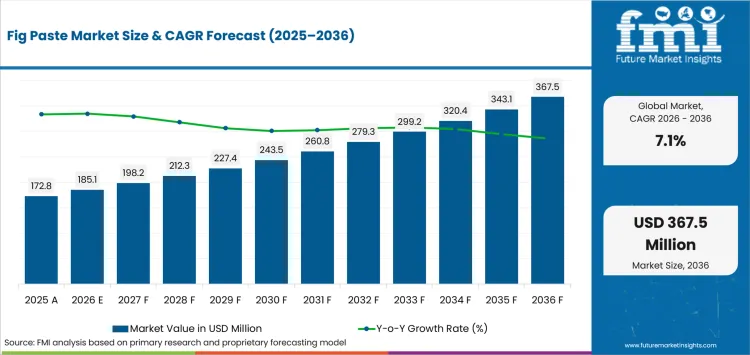
USD 185.1 million in 2026 and USD 367.5 million by 2036 at a 7.1% CAGR.
Demand for fig paste is projected to expand at 7.1% CAGR between 2026 and 2036, raising valuation from USD 185.1 million to USD 367.5 million. Industrial bakeries qualify processed fig paste alongside other bakery ingredients once sweetness, moisture and microbiological quality remain stable. CSIR-CFTRI listed dried figs and fig powder as commercialized on August 3, 2026, with bakery use, easy storage and year-round availability. These attributes reduce raw-fruit preparation but do not remove particle-size, water-activity and bake-performance checks.
Country conversion differs with manufacturing depth and access to food plants. At Make it in the Emirates on May 7, 2026, the Ministry of Industry and Advanced Technology recorded 1,245 exhibitors and more than 200 agreements. The concentration gives UAE ingredient sellers faster access to processors, though imported figs still require origin and contaminant records.
Key Takeaways
- Demand rises as industrial bakeries replace variable fruit preparation with fig ingredients supplied to repeatable sweetness, moisture and microbiological specifications.
- By product type, standard grade is estimated to hold 37.0% in 2026, owing to conventional recipes that avoid specialty certification.
- In 2026, powder - dry is expected to lead form with 45.0% share, driven by ambient storage and controlled dosing.
- Bread & rolls is projected to hold 35.0% of application demand in 2026, attributable to high-throughput lines using fig ingredients in several positions.
- Raw-fruit variation and aflatoxin controls can raise testing, rejection and alternate-source costs before industrial approval.
- Some of the key players in this market include Barry Callebaut, Puratos, Dawn Foods, Zeelandia, CSM Ingredients, Bakels, AGRANA, Zentis, Fabbri 1905, and Irca Group.
Analyst Perspective
"Industrial bakeries reorder fig paste after crop variation stops changing dosing, bake behavior and finished flavor. A defensible specification protects the production schedule by holding fruit solids, moisture and contaminant controls through lot changes."
- Nandini Roy Choudhury, Principal Consultant, Future Market Insights
How is the fig paste market segmented?
The fig paste market is segmented by product type, form, application, claim, sales channel and region.
The fig paste market is segmented by product type, form, application, claim and sales channel. Product type covers standard grade, premium - specialty grade, organic certified and clean label grade. Forms include powder - dry, liquid, paste - semi-solid and granules - pieces. Applications cover bread & rolls, cakes & muffins, biscuits & cookies, viennoiserie & pastry and other bakery & snacks. Claims include conventional, clean label, organic and Non-GMO - identity preserved. Sales channels comprise direct to industrial bakeries, ingredient distributors, foodservice & artisan supply and online B2B.
What supports bread & rolls within the application category?
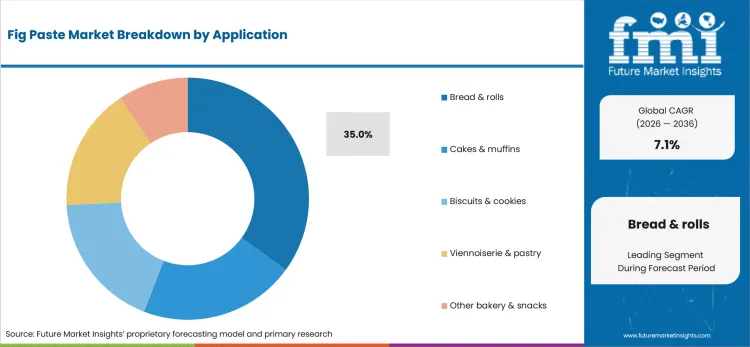
Bread & rolls give fig ingredients several positions in high-throughput production. Plants can meter fruit into dough, use it as a filling or retain visible pieces with existing bakery processing equipment.
- By application, bread & rolls is forecast to represent 35.0% in 2026, driven by one production platform accepting fig flavor, sweetness or visible fruit.
- In June 2025, South Korea's agriculture ministry presented products from 102 bakeries and awarded a ministerial prize to a fig butter-and-milk item. The event confirms professional bakery experimentation with fig flavor before any commercial fig specification is approved on industrial bakery lines.
What makes standard grade central to the product type category?
Standard grade suits industrial bakery programs buying fig ingredients for flavor and process performance without a sourcing claim. Formulators can adjust sweetness and texture before adding certification and segregation work required by clean-label ingredients or identity-preserved specifications.
- By product type, standard grade is estimated to hold 37.0% in 2026, owing to conventional recipes that qualify safety and processing performance without provenance claims.
- In April 2025, Dawn Foods introduced a seasonal cake program with three mixes and two icings for USA bakeries. The launch documents demand for pre-formulated systems that reduce in-house development before commercial production.
Why does powder - dry lead the form category?
Powder - dry formats suit plants that meter ingredients before hydration. Lower bulk water reduces handling versus high-moisture fruit systems and fits dry rooms already used for fruit powders, flour and sugar in routine production.
- Powder - dry is set to lead form with 45.0% share in 2026, attributable to ambient storage and controlled dosing on suitable lines.
- In March 2026, CSM Ingredients launched Tiger Granulat as a powdered version of a bakery paste for bread and savory applications. The format documents commercial interest in dry delivery, although each plant still must validate rehydration and line performance.
How does conventional lead the claim category?
Conventional fig ingredients let plants focus on food safety and process consistency without organic chain-of-custody controls. Claim-led briefs must preserve certification and segregation used in organic foods, so price realization has to justify extra handling.
- In 2026, conventional is expected to lead claim with 52.0% share, because most industrial recipes qualify fig ingredients without an added certification route.
- In September 2025, Dawn Foods introduced cleaner-ingredient colorful buttercremes and planned 17 colors by the first half of 2026. The launch documents formulation work for claim-sensitive bakery lines where ingredient declarations and process performance must hold together.
Why is direct to industrial bakeries central to the sales channel?
Direct supply becomes useful once a bakery fixes viscosity, water activity or pack format during line approval. R&D and quality teams then control trials directly with the ingredient producer, similar to industrial bakery mixes.
- The sales channel category is forecast to be led by direct to industrial bakeries at 50.0% share in 2026, due to line trials requiring account-level technical coordination.
- In August 2025, Puratos opened an Innovation Center in Montreal and announced another hub in Costa Rica. The network brings technical development and training closer to professional bakeries, reducing travel during line trials without replacing site-specific approval.
What are the drivers, restraints and opportunities in the Fig Paste Market?
Standardized fruit processing raises industrial use, aflatoxin controls increase qualification costs, and reformulation work gives certified application-specific fig systems a clearer revenue route.
- Driver: Industrial bakeries need repeatable fig flavor and sweetness in formats that reduce fruit preparation and hold physical specifications between lots.
- Restraint: Aflatoxin screening and raw-fruit variation can increase testing costs, delay approval and force alternate sourcing after a failed lot.
- Opportunity: Reformulation and certified bakery programs can pay for fig systems that pair claim documentation with stable processing performance.
Industrial demand depends on converting seasonal figs into repeatable bakery specifications. Türkiye's Ministry of Agriculture and Forestry estimated on August 31, 2026 that production would reach about 388,000 tonnes fresh and 94,000 tonnes dried. Large harvests improve availability for fruit and vegetable ingredients, but repeat orders still require stable fruit solids and microbiological control.
Food-safety qualification can stop a technically acceptable fig ingredient before production. The United Kingdom's 2025/2026 National Monitoring Plan places dried figs in high-priority aflatoxin sampling. One rejected lot can interrupt a scheduled bakery run, making origin records and pre-shipment testing part of approval.
Claim-led fig systems can enter processors investing in certified production. Germany's agriculture ministry launched an organic-processing practice network in May 2025 and selected 60 of 80 planned partners, including bakeries and spread producers. Organic certification widens the brief only if viscosity, water activity and bake performance pass commercial trials.
Which country CAGRs are profiled in the Fig Paste Market?
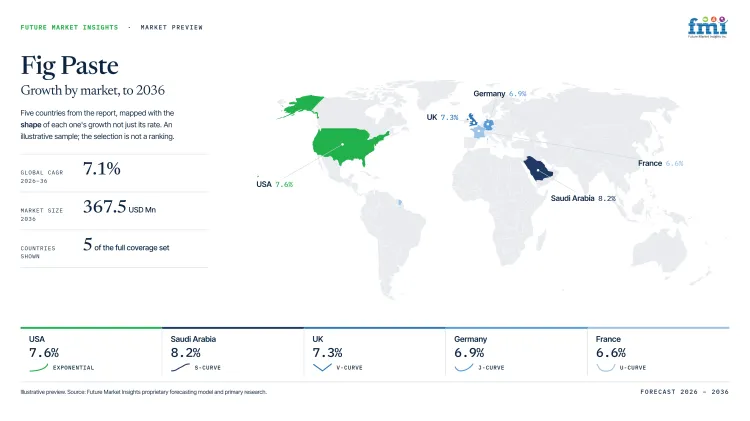
| Country | CAGR |
|---|---|
| UAE | 8.5% |
| Saudi Arabia | 8.2% |
| South Korea | 7.9% |
| USA | 7.6% |
| UK | 7.2% |
| Germany | 6.9% |
| France | 6.6% |
| Japan | 6.3% |
How do country-level CAGRs compare in the Fig Paste Market?
The upper band groups UAE, Saudi Arabia and South Korea within 0.6 percentage points. USA and UK form a middle tier before Germany, France and Japan step down gradually. The 2.2-point spread describes different conversion conditions rather than current market size, so channel access and processing depth matter more than rank alone.
- UAE pairs regional logistics with local conversion.
- Saudi Arabia can industrialize domestic fig supply.
- South Korea rewards fast bakery refreshes.
- USA scale supports direct technical qualification.
- UK retailers reward specification discipline.
- German plants favor process-compatible fruit systems.
- French pastry routes broaden fig applications.
- Japanese premium formats reward specification depth.
Similar forecast rates can still produce different entry costs because qualification and channel structures vary by country. The full report provides country-level CAGR analysis across North America, Latin America, Western Europe, Eastern Europe, East Asia, South Asia and Pacific and the Middle East and Africa.
Country-wise Analysis
- California gives USA processors a domestic fig origin, but pest controls can interrupt fruit movement before an ingredient plant receives the crop. In October 2025, the California Department of Food and Agriculture placed a 75-square-mile Los Angeles County area under Caribbean fruit fly quarantine and listed figs among host crops. Fig paste demand in the USA is forecast to rise at 7.6% CAGR over the forecast period, attributable to bakery accounts that can qualify either origin against plant specifications. Alternate origins still need contaminant records and comparable flavor, moisture and physical performance under routine plant quality plans after a local disruption.
- German bakery plants can test specialty fruit systems against mature process controls, although failed trials become harder to absorb as ingredient costs rise. Destatis recorded a 12.8% year-on-year increase in wholesale prices for sugar, confectionery and bakery products in December 2025. Organic-processing knowledge gives claim-led offers a practical entry route into qualified bakery programs. Germany is estimated to post 6.9% CAGR over the forecast period, given established production that can absorb differentiated fig systems without a new processing platform. The commercial limit is formulation economics because fruit solids, yield and line behavior must justify any premium for provenance or certification.
- French sweet-bakery formulators balance fruit solids against other sweeteners, so fig contribution must fit the recipe's nutrition target and sensory brief. In September 2025, the agriculture ministry launched a collective-agreement framework seeking lower sugar and documenting work by bakery, viennoiserie and pastry companies. Recipe-development programs give fig processors a route into sweet-bakery trials. Demand for fig paste in France is projected to record 6.6% CAGR during the assessment period, supported by controlled fruit solids contributing flavor without abandoning familiar formats. Texture and bake performance remain the friction. Accounts will favor systems that hold deposition and finished-product quality after sugar changes.
- UK industrial bakers sell sweet lines through retailers covered by less-healthy food promotion rules, so recipe composition can affect merchandising as well as processing. Fig paste sales in the UK are forecast to expand at 7.2% CAGR by 2036, tied to fruit ingredients entering reformulation briefs that preserve familiar taste. The October 2025 government response keeps cakes and sweet biscuits within relevant categories and covers qualifying morning goods. Large retail channels provide scale for approved recipes. Nutrient targets and depositor performance limit substitutions, making clear composition data and repeatable line trials necessary before a fruit system reaches a retail product.
- Saudi processors have unusual access to locally grown figs, giving industrial fruit-preparation projects a domestic feedstock option. GASTAT published in December 2025 that figs reached 99% self-sufficiency in 2024. Saudi Arabia's fig paste outlook is anticipated to advance at 8.2% CAGR over the assessment period, driven by domestic availability that makes local conversion more practical. The crop can reduce import exposure, but processors still must standardize solids and microbiological quality after harvest conditions change. Industrial processing capacity is the enabler at scale. Commercial success depends on bakery-ready lots with stable pack formats and test records through year-round purchasing without interruptions.
- UAE food manufacturers operate in an import-intensive supply system, and Dubai is adding inspected food businesses inside the country. Dubai Municipality recorded 34,700 food inspections and 2,336 new food establishments during the first half of 2025. Logistics give fig processors a sourcing pool, but imported fruit still needs consistent origin and contaminant documentation. By 2036, the UAE is projected to grow at 8.5% CAGR, helped by a local conversion base that shortens access to industrial users. Food capacity raises the number of accounts able to use fruit preparations. Fast service windows favor inventory models that preserve lot testing.
- Japanese bakery plants treat imported fruit as controlled material, so origin and contaminant records can outweigh novelty. Adoption of fig paste in Japan is estimated to expand at 6.3% CAGR through 2036, because professional bakers can use fruit systems after raw material clears the import gate and line specification. The Ministry of Health, Labour and Welfare posted an August 17, 2026 inspection order for Spanish dried figs covering total aflatoxin. Plant quality control gives qualified origins a route to use. One failed origin can narrow the supply pool, making alternate sourcing and certificates of analysis central to long-term account retention.
- South Korean bakery teams move quickly from concept work to limited launches, but imported dried figs face a food-safety gate before they can support that pace. MFDS issued Inspection Instruction 2026-23 in April 2026 for aflatoxin testing on Turkish dried figs. In South Korea, fig paste demand is predicted to advance at 7.9% CAGR through 2036, aided by dense urban bakery channels that can scale a successful flavor quickly. Rapid application development is the enabler. Import qualification is the friction, so companies completing origin review and testing before shipment can protect launch speed without shifting risk to industrial bakery customers.
Who are the notable companies in the Fig Paste Market?
Barry Callebaut, Puratos, Dawn Foods, Zeelandia, CSM Ingredients, Bakels, AGRANA, Zentis, Fabbri 1905, and Irca Group are notable companies serving the fig paste market.
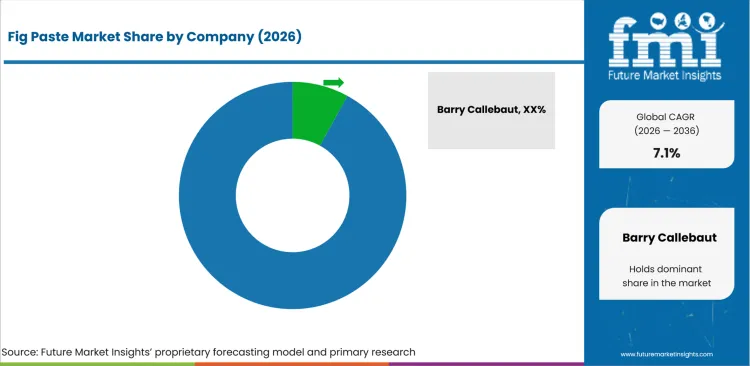
Industrial bakeries source fig systems from bakery platforms and fruit-preparation specialists rather than dedicated fig processors alone. Puratos, Dawn Foods, Zeelandia, CSM Ingredients and Bakels bring bakery application depth. AGRANA, Zentis and Irca Group focus on fruit formulation, while Barry Callebaut and Fabbri 1905 overlap through adjacent confectionery fillings. Plant fit and quality approval determine account selection.
- Integrated bakery solution suppliers: Puratos, Dawn Foods, Zeelandia, CSM Ingredients and Bakels focus on application support and line fit.
- Fruit preparation specialists: AGRANA, Zentis and Irca Group focus on fruit formulation, texture control and industrial formats.
- Broad ingredient and specialty fruit platforms: Barry Callebaut and Fabbri 1905 participate in adjacent bakery and pastry systems.
Competitive Benchmarking: Fig Paste Market
| Company | Fruit Preparation Depth | Industrial Bakery Fit | Claim & Format Flexibility | Geographic Reach |
|---|---|---|---|---|
| Barry Callebaut | Medium | High | Medium | Global ingredient platform |
| Puratos | Medium | High | High | 135+ countries |
| Dawn Foods | Medium | High | High | 100+ countries |
| Zeelandia | Medium | High | Medium | Global bakery network |
| CSM Ingredients | Medium | High | High | Europe-led international reach |
| Bakels | Medium | High | Medium | 38+ companies on five continents |
| AGRANA | High | High | High | 36 Food & Beverage Solutions sites |
| Zentis | High | High | High | Europe-led international fruit business |
| Fabbri 1905 | Medium | Medium | Medium | International professional pastry markets |
| Irca Group | High | High | Medium | 19 facilities, 100+ countries |
Scoring basis: High means broad documented capability, Medium means credible but narrower evidence and Low means one limited documented route. The criteria assess fruit preparation depth, industrial bakery fit and claim or format flexibility. Geographic reach is descriptive.
Key Developments in the Fig Paste Market
- In April 2026, AGRANA completed its Mercator-Emba acquisition after competition approvals. The deal added a Slovenian production site and food-processing access.
- In March 2026, Puratos agreed to acquire Dawn Foods subject to regulatory approvals. The transaction remains pending until closing conditions are completed.
- In September 2025, Dawn Foods expanded Royal Steensma in North America with fruit glazes and premium bakery products. The action places fruit formats inside bakery and manufacturing accounts.
Key Players in the Fig Paste Market
Integrated Bakery Solution Suppliers
- Puratos
- Dawn Foods
- Zeelandia
- CSM Ingredients
- Bakels
Fruit Preparation Specialists
- AGRANA
- Zentis
- Irca Group
Broad Ingredient and Specialty Fruit Platforms
- Barry Callebaut
- Fabbri 1905
Fig Paste Market - Report Scope
| Coverage field | Report scope |
|---|---|
| Market breakdown | By product type, form, application, claim, sales channel and region. |
| Quantitative Units | USD million. |
| Market Definition | Commercial fig-derived ingredient preparations sold for fig-paste functionality within the stated segmentation universe. Finished bakery revenue, raw whole figs and substitute fruit pastes are excluded. |
| Regions Covered | North America, Latin America, Western Europe, Eastern Europe, East Asia, South Asia and Pacific and Middle East and Africa. |
| Countries Covered | USA, Germany, France, UK, Saudi Arabia, UAE, Japan, South Korea, and 20+ countries included in the full report. |
| Key Companies Profiled | Barry Callebaut, Puratos, Dawn Foods, Zeelandia, CSM Ingredients, Bakels, AGRANA, Zentis, Fabbri 1905, Irca Group. |
| Forecast Period | 2026 to 2036. |
| Approach | Primary and secondary research with market triangulation. |
Fig Paste Market - Research Methodology
| Method | Approach |
|---|---|
| Primary Research | FMI analysts gathered input from manufacturers, service providers, technology developers, distributors, end users, procurement teams, and subject-matter experts. Interviews examined purchasing decisions, product or service evaluation, adoption barriers, approval requirements, pricing considerations, and expectations for technical or commercial support. Respondents were also asked what evidence is required before a trial, pilot, or initial order develops into regular purchasing. |
| Desk Research | Desk research covered government statistics, regulatory publications, trade data, industry associations, technical literature, standards, company filings, product information, and official corporate announcements. Sources were reviewed for relevance, publication date, geographic coverage, and consistency with the defined market scope. Claims relating to performance, applications, approvals, capacity, investment, and commercial activity were retained only when supported by credible public evidence. |
| Market Sizing and Forecasting | The market model combined the baseline value with historical performance, segment structure, pricing and volume indicators, adoption levels, company participation, and country-level demand conditions. Forecast assumptions considered economic activity, investment trends, regulatory developments, technology adoption, purchasing cycles, supply availability, and barriers to wider market use. Segment and regional estimates were reconciled before the final market total was calculated. |
| Data Validation | Estimates were checked against multiple independent indicators, including public data, company activity, trade patterns, industry developments, and findings from primary interviews. Validation also tested whether products, services, applications, and company revenues fell within the defined market boundaries. Adjacent categories, unsupported claims, overlapping revenues, and activities without direct market relevance were excluded to reduce double counting and maintain consistency across segments and countries. |
Fig Paste Market by Segments
Fig Paste Market segmented by Product Type:
- Standard grade
- Premium - specialty grade
- Organic certified
- Clean label grade
Fig Paste Market segmented by Form:
- Powder - dry
- Liquid
- Paste - semi-solid
- Granules - pieces
Fig Paste Market segmented by Application:
- Bread & rolls
- Cakes & muffins
- Biscuits & cookies
- Viennoiserie & pastry
- Other bakery & snacks
Fig Paste Market segmented by Claim:
- Conventional
- Clean label
- Organic
- Non-GMO - identity preserved
Fig Paste Market segmented by Sales Channel:
- Direct to industrial bakeries
- Ingredient distributors
- Foodservice & artisan supply
- Online B2B
Fig Paste Market by Region:
- North America
- United States
- Canada
- Latin America
- Brazil
- Mexico
- Argentina
- Chile
- Western Europe
- Germany
- France
- United Kingdom
- Italy
- Spain
- Benelux
- Nordics
- Eastern Europe
- Poland
- Czech Republic
- Romania
- Hungary
- East Asia
- China
- Japan
- South Korea
- South Asia and Pacific
- India
- ASEAN
- Australia and New Zealand
- Middle East and Africa
- GCC Countries
- South Africa
- Türkiye
- Israel
Research Sources and Bibliography
- Council of Scientific & Industrial Research. (2026, August 3). Value added products from figs
- UAE Ministry of Industry and Advanced Technology. (2026, May 7). Make it in the Emirates concludes largest edition yet
- Dawn Foods. (2025, April 3). Dawn Foods Unveils New Products to Meet Seasonal Flavor Demand
- CSM Ingredients. (2026, March 10). CSM Ingredients launches Tiger Granulat
- Ministry of Agriculture, Food and Rural Affairs, Republic of Korea. (2025, June 19). A Pop-up Space at Seongsu Station Exhibits Floury Rice-based Baked Goods Made with New Recipes by 102 Bakeries
- Dawn Foods. (2025, September 13). Dawn Foods Introduces New Dawn Balance® Cleaner Ingredients Colorful Buttercreme Style Icings
- Puratos. (2025, August 25). Puratos Announces Two New Hubs for Food Innovation: Montreal and Costa Rica
- UK Government. (2026, July 23). UK National Monitoring Plan sampling priorities for imported foods: 2025/2026
- Ministère de l’Agriculture et de la Souveraineté alimentaire. (2025, September 6). Lancement du nouveau référentiel des accords collectifs pour améliorer la qualité nutritionnelle et la durabilité de l’offre alimentaire
- California Department of Food and Agriculture. (2025, October 13). First Caribbean Fruit Fly Quarantine in California Since 1985
- German Federal Statistical Office. (2026, January). Wholesale prices in December 2025: +1.2% on December 2024
- UK Government. (2025, October 1). Restricting promotions of products high in fat, sugar and salt by location and by price: government response to public consultation
- General Authority for Statistics, Saudi Arabia. (2025, December 11). GASTAT publishes Food Security Statistics 2024 results
- Dubai Municipality. (2025, July 30). Over 34,000 food inspections conducted in first half of 2025
- Ministry of Health, Labour and Welfare, Japan. (2026, August 17). 2026 Inspection Order Implementation Notices
- Ministry of Food and Drug Safety, Republic of Korea. (2026, April 22). Inspection Instruction 2026-23: Aflatoxin Test for Turkish Dried Figs
- Puratos. (2026, March 10). Puratos to Acquire Dawn Foods, Bringing Together Complementary Capabilities in Professional Bakery
- CSM Ingredients. (2026, May 12). CSM Ingredients Launches Creami®, a Comprehensive Range of Indulgent Fillings for Bakery, Pastry and Confectionery Professionals
- AGRANA. (2026, April 23). AGRANA launch in Slovenia: acquisition of the food company Mercator-Emba successfully concluded
- Puratos. (2026). Puratos Today
- Zeelandia. (2026). Zeelandia publishes Sustainability Report 2025
- Bakels Group. (2026). Bakels Group: Bakery Ingredients Since 1904
- AGRANA. (2026). Food & Beverage Solutions segment
- IRCA Group. (2026, June 29). CVC Capital Partners agrees to acquire Irca from Advent
- Barry Callebaut. (2025, November 13). Barry Callebaut Opens Third Canadian Chocolate Factory in Brantford, Ontario
- Zentis. (2025, August 15). Jetzt wird’s bärig lecker - Zentis und Bärchen® launchen Fruchtaufstriche für die ganze Familie
- IRCA Group. (2026, May 8). Dobla Asia achieves BRC A+ rating in Vietnam
- Fabbri 1905. (2026, January 16). Fabbri 1905 entra nel mondo dello street food e ridefinisce il fuoricasa Made in Italy
- Republic of Türkiye Ministry of Agriculture and Forestry. (2026, August 31). Türkiye ranks first in world fig production with a 28% share
- Barry Callebaut. (2026, June 2). Barry Callebaut launches Focus for Growth action plan
- Bakels Group. (2025, June). Bakels Worldwide Review: Food manufacturing for tomorrow
- Barry Callebaut. (2026, February 10). Barry Callebaut Opens Global Innovation Center in Singapore, Pioneering the Future of Chocolate Through AI and Advanced Innovation
- Puratos. (2026, February 25). Puratos launches direct presence in Albania with Puratos Albania
- Dawn Foods. (2025, September 13). Dawn Foods Expands Royal Steensma Product Line in North America With Four New Premium, Easy-to-use Products
This bibliography is provided for reader reference and is not exhaustive. The full report contains the complete reference list and detailed citations.
This Report Answers
- What is the fig paste market size in 2026 and what value is forecast for 2036?
- Which processing controls turn fig ingredients into repeat industrial bakery purchases?
- Why does standard grade lead product type?
- How does powder - dry change storage and dosing requirements?
- Why does bread & rolls lead application demand?
- How do approved country growth rates differ?
- Which food-safety conditions slow qualification?
- How do the notable companies differ by market role?
Frequently Asked Questions
How big is the fig paste market in 2026?
The fig paste market is valued at USD 185.1 million in 2026 and is projected to reach USD 367.5 million by 2036. Growth follows industrial bakery use of processed fig formats with repeatable handling.
What is the CAGR of the fig paste market from 2026 to 2036?
The fig paste market is projected to grow at 7.1% CAGR between 2026 and 2036. Expansion depends on processors qualifying stable sweetness, moisture, microbiological quality and line performance.
Which product type leads the fig paste market?
The standard grade segment is expected to hold 37.0% of the fig paste market in 2026, attributable to conventional recipes qualifying without specialty certification. Broader sourcing reduces segregation work for industrial bakeries.
Which form leads the fig paste market?
The powder - dry segment is expected to hold 45.0% of the fig paste market in 2026, supported by ambient storage and controlled dry dosing. Lower bulk water reduces handling in established dry ingredient rooms.
Which countries are projected to record the highest growth in the fig paste market?
The UAE is projected to grow at 8.5% CAGR, followed by Saudi Arabia at 8.2% and South Korea at 7.9% through 2036. Faster growth follows different combinations of local conversion, domestic fruit availability and bakery development.
Which companies are active in the fig paste market?
Key companies operating in the market include Barry Callebaut, Puratos, Dawn Foods, Zeelandia, CSM Ingredients, Bakels, AGRANA, Zentis, Fabbri 1905, and Irca Group. Their positions differ by bakery support, fruit depth, format breadth and regional coverage.
Preview the report firsthand - request a free sample
Get SampleGet the brochure for pricing and purchase details.
Get PDFTable of Content
- Key Takeaways
- Market Size and CAGR
- Top Growth Driver
- Fastest Growing Segment
- Leading Region
- Key Companies
- Emerging Opportunities
- Executive Summary
- Global Market Outlook
- Demand-side Trends
- Supply-side Trends
- Technology Roadmap Analysis
- Analysis and Recommendations
- Analyst Perspective (What is happening? Why now? What should investors know?)
- Key Questions Answered
- How large is the market?
- What is the CAGR?
- What are key trends?
- Which region dominates?
- Who are the leaders?
- Market Overview
- Market Coverage / Taxonomy
- Market Definition / Scope / Limitations
- Research Methodology
- Chapter Orientation
- Analytical Lens and Working Hypotheses
- Market Structure, Signals, and Trend Drivers
- Benchmarking and Cross-market Comparability
- Market Sizing, Forecasting, and Opportunity Mapping
- Research Design and Evidence Framework
- Desk Research Programme (Secondary Evidence)
- Expert Input and Fieldwork (Primary Evidence)
- Tooling, Models, and Reference Databases
- Data Engineering and Model Build
- Quality Assurance and Audit Trail
- Market Background
- Market Dynamics (Drivers, Restraints, Opportunity, Trends)
- Scenario Forecast (Optimistic, Likely, Conservative)
- Impact Analysis
- AI Impact
- Sustainability Impact
- Regulatory Impact
- Technology Impact
- Consumer / Buyer Analysis
- Purchase Drivers
- Adoption Barriers
- Buyer Journey
- Opportunity Map Analysis
- Product Life Cycle Analysis
- Supply Chain Analysis
- Investment Feasibility Matrix
- Value Chain Analysis
- PESTLE and Porter's Analysis
- Regulatory Landscape
- Regional Parent Market Outlook
- Production and Consumption Statistics
- Import and Export Statistics
- Global Market Analysis and Forecast, 2021 to 2036
- Historical Market Size Value (USD Million) Analysis, 2021 to 2025
- Current and Future Market Size Value (USD Million) Projections, 2026 to 2036
- Y-o-Y Growth Trend Analysis
- Absolute $ Opportunity Analysis
- Global Market Pricing Analysis, 2021 to 2036
- Global Market Analysis and Forecast, By Product Type, 2021 to 2036
- Introduction / Key Findings
- Historical Market Size Value (USD Million) Analysis By Product Type, 2021 to 2025
- Current and Future Market Size Value (USD Million) Analysis and Forecast By Product Type, 2026 to 2036
- Standard grade
- Premium / specialty grade
- Organic certified
- Clean label grade
- Standard grade
- Y-o-Y Growth Trend Analysis By Product Type, 2021 to 2025
- Absolute $ Opportunity Analysis By Product Type, 2026 to 2036
- Global Market Analysis and Forecast, By Form, 2021 to 2036
- Introduction / Key Findings
- Historical Market Size Value (USD Million) Analysis By Form, 2021 to 2025
- Current and Future Market Size Value (USD Million) Analysis and Forecast By Form, 2026 to 2036
- Powder / dry
- Liquid
- Paste / semi-solid
- Granules / pieces
- Powder / dry
- Y-o-Y Growth Trend Analysis By Form, 2021 to 2025
- Absolute $ Opportunity Analysis By Form, 2026 to 2036
- Global Market Analysis and Forecast, By Application, 2021 to 2036
- Introduction / Key Findings
- Historical Market Size Value (USD Million) Analysis By Application, 2021 to 2025
- Current and Future Market Size Value (USD Million) Analysis and Forecast By Application, 2026 to 2036
- Bread & rolls
- Cakes & muffins
- Biscuits & cookies
- Viennoiserie & pastry
- Other bakery & snacks
- Bread & rolls
- Y-o-Y Growth Trend Analysis By Application, 2021 to 2025
- Absolute $ Opportunity Analysis By Application, 2026 to 2036
- Global Market Analysis and Forecast, By Claim, 2021 to 2036
- Introduction / Key Findings
- Historical Market Size Value (USD Million) Analysis By Claim, 2021 to 2025
- Current and Future Market Size Value (USD Million) Analysis and Forecast By Claim, 2026 to 2036
- Conventional
- Clean label
- Organic
- Non-GMO / identity preserved
- Conventional
- Y-o-Y Growth Trend Analysis By Claim, 2021 to 2025
- Absolute $ Opportunity Analysis By Claim, 2026 to 2036
- Global Market Analysis and Forecast, By Sales Channel, 2021 to 2036
- Introduction / Key Findings
- Historical Market Size Value (USD Million) Analysis By Sales Channel, 2021 to 2025
- Current and Future Market Size Value (USD Million) Analysis and Forecast By Sales Channel, 2026 to 2036
- Direct to industrial bakeries
- Ingredient distributors
- Foodservice & artisan supply
- Online B2B
- Direct to industrial bakeries
- Y-o-Y Growth Trend Analysis By Sales Channel, 2021 to 2025
- Absolute $ Opportunity Analysis By Sales Channel, 2026 to 2036
- Global Market Analysis and Forecast, By Region, 2021 to 2036
- Introduction
- Historical Market Size Value (USD Million) Analysis By Region, 2021 to 2025
- Current Market Size Value (USD Million) Analysis and Forecast By Region, 2026 to 2036
- North America
- Latin America
- Western Europe
- Eastern Europe
- East Asia
- South Asia and Pacific
- Middle East & Africa
- Market Attractiveness Analysis By Region
- North America Market Analysis and Forecast, By Country, 2021 to 2036
- Historical Market Size Value (USD Million) Trend Analysis By Market Taxonomy, 2021 to 2025
- Market Size Value (USD Million) Forecast By Market Taxonomy, 2026 to 2036
- By Country
- USA
- Canada
- By Product Type
- By Form
- By Application
- By Claim
- By Sales Channel
- By Country
- Market Attractiveness Analysis
- By Country
- By Product Type
- By Form
- By Application
- By Claim
- By Sales Channel
- Key Takeaways
- Latin America Market Analysis and Forecast, By Country
- Historical Market Size Value (USD Million) Trend Analysis By Market Taxonomy, 2021 to 2025
- Market Size Value (USD Million) Forecast By Market Taxonomy, 2026 to 2036
- By Country
- Brazil
- Mexico
- Chile
- Rest of Latin America
- By Product Type
- By Form
- By Application
- By Claim
- By Sales Channel
- By Country
- Market Attractiveness Analysis
- By Country
- By Product Type
- By Form
- By Application
- By Claim
- By Sales Channel
- Key Takeaways
- Western Europe Market Analysis and Forecast, By Country
- Historical Market Size Value (USD Million) Trend Analysis By Market Taxonomy, 2021 to 2025
- Market Size Value (USD Million) Forecast By Market Taxonomy, 2026 to 2036
- By Country
- Germany
- UK
- Italy
- Spain
- France
- Nordic
- BENELUX
- Rest of Western Europe
- By Product Type
- By Form
- By Application
- By Claim
- By Sales Channel
- By Country
- Market Attractiveness Analysis
- By Country
- By Product Type
- By Form
- By Application
- By Claim
- By Sales Channel
- Key Takeaways
- Eastern Europe Market Analysis and Forecast, By Country
- Historical Market Size Value (USD Million) Trend Analysis By Market Taxonomy, 2021 to 2025
- Market Size Value (USD Million) Forecast By Market Taxonomy, 2026 to 2036
- By Country
- Russia
- Poland
- Hungary
- Balkan & Baltic
- Rest of Eastern Europe
- By Product Type
- By Form
- By Application
- By Claim
- By Sales Channel
- By Country
- Market Attractiveness Analysis
- By Country
- By Product Type
- By Form
- By Application
- By Claim
- By Sales Channel
- Key Takeaways
- East Asia Market Analysis and Forecast, By Country
- Historical Market Size Value (USD Million) Trend Analysis By Market Taxonomy, 2021 to 2025
- Market Size Value (USD Million) Forecast By Market Taxonomy, 2026 to 2036
- By Country
- China
- Japan
- South Korea
- By Product Type
- By Form
- By Application
- By Claim
- By Sales Channel
- By Country
- Market Attractiveness Analysis
- By Country
- By Product Type
- By Form
- By Application
- By Claim
- By Sales Channel
- Key Takeaways
- South Asia and Pacific Market Analysis and Forecast, By Country
- Historical Market Size Value (USD Million) Trend Analysis By Market Taxonomy, 2021 to 2025
- Market Size Value (USD Million) Forecast By Market Taxonomy, 2026 to 2036
- By Country
- India
- ASEAN
- Australia & New Zealand
- Rest of South Asia and Pacific
- By Product Type
- By Form
- By Application
- By Claim
- By Sales Channel
- By Country
- Market Attractiveness Analysis
- By Country
- By Product Type
- By Form
- By Application
- By Claim
- By Sales Channel
- Key Takeaways
- Middle East & Africa Market Analysis and Forecast, By Country
- Historical Market Size Value (USD Million) Trend Analysis By Market Taxonomy, 2021 to 2025
- Market Size Value (USD Million) Forecast By Market Taxonomy, 2026 to 2036
- By Country
- Kingdom of Saudi Arabia
- Other GCC Countries
- Türkiye
- South Africa
- Other African Union
- Rest of Middle East & Africa
- By Product Type
- By Form
- By Application
- By Claim
- By Sales Channel
- By Country
- Market Attractiveness Analysis
- By Country
- By Product Type
- By Form
- By Application
- By Claim
- By Sales Channel
- Key Takeaways
- Key Countries Market Analysis
- USA
- Pricing Analysis
- Market Share Analysis, 2025
- By Product Type
- By Form
- By Application
- By Claim
- By Sales Channel
- Canada
- Pricing Analysis
- Market Share Analysis, 2025
- By Product Type
- By Form
- By Application
- By Claim
- By Sales Channel
- Mexico
- Pricing Analysis
- Market Share Analysis, 2025
- By Product Type
- By Form
- By Application
- By Claim
- By Sales Channel
- Brazil
- Pricing Analysis
- Market Share Analysis, 2025
- By Product Type
- By Form
- By Application
- By Claim
- By Sales Channel
- Chile
- Pricing Analysis
- Market Share Analysis, 2025
- By Product Type
- By Form
- By Application
- By Claim
- By Sales Channel
- Germany
- Pricing Analysis
- Market Share Analysis, 2025
- By Product Type
- By Form
- By Application
- By Claim
- By Sales Channel
- UK
- Pricing Analysis
- Market Share Analysis, 2025
- By Product Type
- By Form
- By Application
- By Claim
- By Sales Channel
- Italy
- Pricing Analysis
- Market Share Analysis, 2025
- By Product Type
- By Form
- By Application
- By Claim
- By Sales Channel
- Spain
- Pricing Analysis
- Market Share Analysis, 2025
- By Product Type
- By Form
- By Application
- By Claim
- By Sales Channel
- France
- Pricing Analysis
- Market Share Analysis, 2025
- By Product Type
- By Form
- By Application
- By Claim
- By Sales Channel
- India
- Pricing Analysis
- Market Share Analysis, 2025
- By Product Type
- By Form
- By Application
- By Claim
- By Sales Channel
- ASEAN
- Pricing Analysis
- Market Share Analysis, 2025
- By Product Type
- By Form
- By Application
- By Claim
- By Sales Channel
- Australia & New Zealand
- Pricing Analysis
- Market Share Analysis, 2025
- By Product Type
- By Form
- By Application
- By Claim
- By Sales Channel
- China
- Pricing Analysis
- Market Share Analysis, 2025
- By Product Type
- By Form
- By Application
- By Claim
- By Sales Channel
- Japan
- Pricing Analysis
- Market Share Analysis, 2025
- By Product Type
- By Form
- By Application
- By Claim
- By Sales Channel
- South Korea
- Pricing Analysis
- Market Share Analysis, 2025
- By Product Type
- By Form
- By Application
- By Claim
- By Sales Channel
- Russia
- Pricing Analysis
- Market Share Analysis, 2025
- By Product Type
- By Form
- By Application
- By Claim
- By Sales Channel
- Poland
- Pricing Analysis
- Market Share Analysis, 2025
- By Product Type
- By Form
- By Application
- By Claim
- By Sales Channel
- Hungary
- Pricing Analysis
- Market Share Analysis, 2025
- By Product Type
- By Form
- By Application
- By Claim
- By Sales Channel
- Kingdom of Saudi Arabia
- Pricing Analysis
- Market Share Analysis, 2025
- By Product Type
- By Form
- By Application
- By Claim
- By Sales Channel
- Türkiye
- Pricing Analysis
- Market Share Analysis, 2025
- By Product Type
- By Form
- By Application
- By Claim
- By Sales Channel
- South Africa
- Pricing Analysis
- Market Share Analysis, 2025
- By Product Type
- By Form
- By Application
- By Claim
- By Sales Channel
- USA
- Market Structure Analysis
- Competition Dashboard
- Competition Benchmarking
- Market Share Analysis of Top Players
- By Regional
- By Product Type
- By Form
- By Application
- By Claim
- By Sales Channel
- Emerging Startups
- Innovation Benchmarking
- Competition Analysis
- Competition Deep Dive
- Barry Callebaut
- Overview
- Product Portfolio
- Profitability by Market Segments
- Sales Footprint
- Strategy Overview
- Marketing Strategy
- Product Strategy
- Channel Strategy
- Puratos
- Dawn Foods
- Zeelandia
- CSM Ingredients
- Bakels
- AGRANA
- Zentis
- Fabbri 1905
- Irca Group
- Barry Callebaut
- Case Studies
- Success Stories
- Recent Developments
- Competition Deep Dive
- Assumptions & Acronyms Used


