

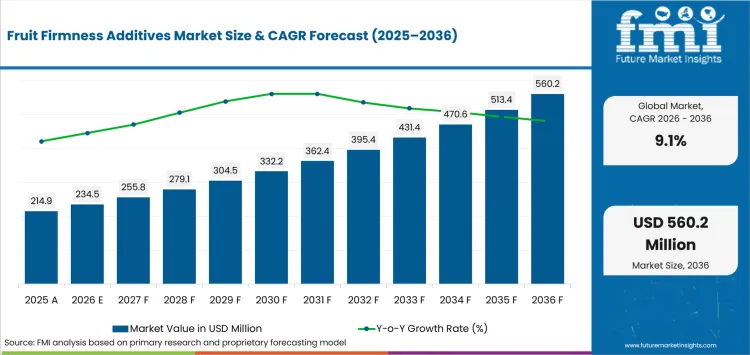
- Market Size (2026)
- USD 234.5 Mn
- Forecast (2036)
- USD 560.2 Mn
- CAGR (2026 to 2036)
- 9.1%
How big is Fruit Firmness Additives Market in 2026?
USD 234.5 million in 2026 and USD 560.2 million by 2036 at a 9.1% CAGR.
Demand for fruit firmness additives is projected to expand at 9.1% CAGR between 2026 and 2036, increasing valuation from USD 234.5 million to USD 560.2 million. Maintaining texture and shelf life remains a priority for fruit producers, exporters and retailers seeking to reduce losses across the supply chain. UNECE reported in May 2026 that fruits and vegetables recorded a 25.4% post-harvest loss rate during 2023. The scale of these losses highlights the commercial importance of technologies that help preserve product quality after harvest. Fruit firmness additives can support longer marketable life by slowing softening and maintaining texture during storage, transport and retail display.
Crop concentration changes the economics of treatment trials and technical support across country markets. Japan's concentrated apple production and packing system illustrates the effect. The Ministry of Agriculture, Forestry and Fisheries published in May 2025 that Japan harvested 609,200 tonnes of apples during 2024. Treatment providers can concentrate trials near major packing regions. Import-heavy markets require evidence that endures across longer origin-to-destination handling routes.
Key Takeaways of Fruit Firmness Additives Market
- Fresh-produce handlers purchase firmness additives if avoided softness or dehydration threatens fruit at its intended selling grade.
- By product type, edible coatings are estimated to hold 44.3% share in 2026 because direct surface treatment fits existing postharvest application routines.
- Pome and stone fruit are projected to account for 41.9% of commodity demand in 2026 owing to their strong commercial sensitivity to texture loss.
- Packhouse is set to lead the application point category with 45.8% share in 2026 due to controlled treatment before storage and shipment.
- Crop-specific qualification slows wider adoption because food-contact status and treatment efficacy must remain acceptable for the intended commodity and destination.
- Some of the key players in this market include AgroFresh Solutions, Inc., DECCO (UPL), Citrosol, JBT Marel Corporation, StePacPPC, Fresh Inset S.A., Apeel Sciences, and Nabaco, Inc.
Analyst Perspective
"Packhouses should compare firmness treatments against the grade losses recorded for each crop and storage window. The stronger offer proves texture retention at commercial line speed while carrying the documentation required by destination markets."
- Nandini Roy Choudhury, Principal Consultant, Future Market Insights
How is the Fruit Firmness Additives Market segmented?
The fruit firmness additives market is segmented by product type, commodity, application point, technology base and sales channel.
The fruit firmness additives market is segmented by product type, commodity, application point, technology base and sales channel. Product type includes edible coatings, active sachets and liners, wash and drench treatments, storage-room treatments and others. Commodity covers pome and stone fruit, citrus, berries and grapes, tropical fruit, vegetables and others. Application point includes packhouse, storage facility, transit and retail and others. Technology base covers biological or microbial, plant-extract-based, mineral and wax-based and others. Sales channel includes packhouse suppliers, post-harvest service providers, direct sales and others.
What makes Edible Coatings central to the Product Type category?
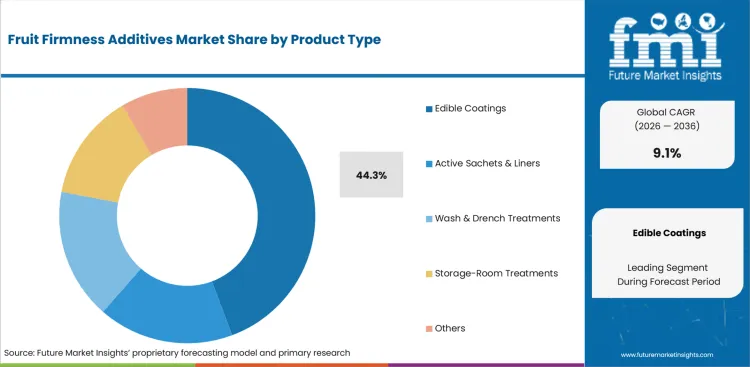
Edible coatings control moisture exchange at the fruit surface and avoid a separate storage-room treatment step. Their commercial fit depends on uniform application and compatibility with existing waxing lines. In May 2025, USDA Agricultural Research Service began a nanoparticle-coating project to test fresh-produce and food-contact surfaces for commercial feasibility.
- By product type, edible coatings are estimated to hold 44.3% in 2026 owing to surface application that limits moisture exchange on existing packing lines.
- Packhouses can evaluate edible films and coatings beside produce packaging choices, which makes application cost and line compatibility visible during qualification.
Why does Pome & Stone fruit lead the Commodity category?
Texture retention is a central criterion in commercial postharvest evaluation of pome and stone fruit. Apples support longer storage programs, while stone fruit requires tighter handling windows. Destatis documented in January 2025 that Germany harvested 872,000 tonnes of apples in 2024 and directed 73.2% toward table-fruit marketing.
- Pome and stone fruit are projected to hold 41.9% of commodity revenue in 2026 due to their strong dependence on saleable firmness.
- Freshness and ripening control matters most where quality is checked repeatedly before release, so active packaging can complement coating or storage treatments.
How does Packhouse shape the application point category?
Fruit reaches the packhouse after cleaning and grading, allowing operators to control treatment before storage or shipment. StePacPPC announced in March 2025 that Xflow films were designed for automated fresh-produce packing on horizontal and vertical form-fill-seal equipment. That setup places preservation material inside the existing packing workflow for routine use.
- In 2026, packhouse is expected to lead application point with 45.8% share because operators can control treatment or packaging conditions before outbound logistics.
- Micro-perforated films and modified atmosphere packaging can be assessed at the same facility, helping quality teams compare process fit before commercial rollout.
What supports Biological / Microbial within the Technology Base category?
Biological and microbial approaches offer a lower-residue route where decay control must also preserve firmness. In May 2025, USDA Agricultural Research Service started a project covering GRAS substances and storage technologies for blueberries and table grapes. The project evaluates disease control alongside retained postharvest quality in commercial storage trials.
- By technology base, biological and microbial systems are forecast to represent 47.9% in 2026 due to decay control that protects texture beside storage quality.
- Active and intelligent packaging gives formulators another preservation interface, although commercial adoption requires crop-specific evidence under actual storage conditions.
What are the drivers, restraints and opportunities in the Fruit Firmness Additives Market?
Measurable grade retention increases demand, crop-specific qualification slows adoption and packaging-based preservation offers a route to lower-loss handling without new wet-treatment steps.
- Driver: Packers commit budget after firmness preservation reduces downgraded cartons and protects a larger share of intended fresh-market output.
- Restraint: Food-contact qualification and commodity approvals can delay adoption even after a treatment performs well in technical trials.
- Opportunity: Active packaging and lower-residue preservation formats can win orders if they fit existing packing equipment and document crop-level performance.
Packers pay for firmness preservation because each avoided downgrade protects more of the packed crop's intended selling grade. UNECE stated in May 2026 that one 2025 table-grape standard change reduced related packhouse losses from nearly 5% to below 1%. The loss reduction gives packhouses a direct benchmark for funding post-harvest treatment programs against rejected or downgraded output during routine grading.
Market-specific registration slows commercial handling even after technical performance is confirmed. In January 2025, Fresh Inset stated that Vidre+ active packaging was registered in Peru and introduced in the United States. Different approval schedules lengthen rollout for companies serving several export destinations. One preservation format must also carry operating instructions that fit several packing sites.
Packaging formats offer a revenue route if they reduce shrink without requiring another wet-treatment step on the line. StePacPPC reported in January 2025 that one foodservice customer cut scrap 5% and increased shelf life 10% after adopting its modified-atmosphere films. The measured result gives packhouses a direct operating case for smart and intelligent packaging that extends freshness without new dosing equipment or another liquid-treatment station.
Which country CAGRs are profiled in the Fruit Firmness Additives Market?
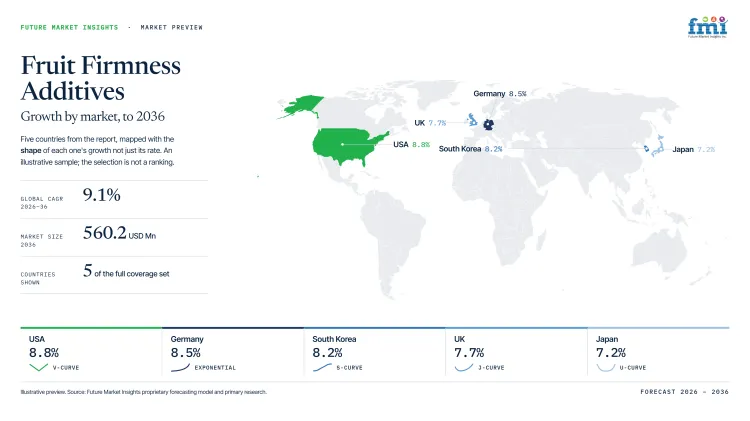
| Country | CAGR |
|---|---|
| USA | 8.8% |
| Germany | 8.5% |
| South Korea | 8.2% |
| UK | 7.7% |
| Japan | 7.2% |
How do country-level CAGRs compare in the Fruit Firmness Additives Market?
The 1.6 percentage-point spread creates a compact upper group and two slower markets. USA and Germany occupy the top positions. South Korea remains close, while UK and Japan form the lower pair. Crop concentration and trade routes explain the spacing. It does not rank current market size.
- USA uses large Washington apple volumes to sustain scaled packhouse treatment trials.
- Germany concentrates table-apple handling around major producing states and regional storage hubs.
- South Korea pairs concentrated apple output with quality-sensitive routines during commercial storage.
- UK import dependence shifts treatment influence toward overseas packhouses and export programs.
- Japan's regional apple concentration favors localized trials before broader product switching nationwide.
Treatment location and service distance alter order conversion even where country growth rates remain close. The full report provides country-level CAGR analysis across North America, Latin America, Europe, East Asia, South Asia, Oceania and the Middle East and Africa.
Country-wise Analysis
- Washington packhouses handle high apple volumes against clear grade specifications during long storage programs. In August 2026, USDA NASS listed 5.655 billion pounds of fresh-market Washington apples for the 2025 crop year. Fruit firmness additive demand in USA is forecast to rise at 8.8% CAGR over the forecast period. Fresh-market throughput makes crop-level performance trials commercially worthwhile. Food-contact documentation and cultivar-specific proof remain material frictions because each formulation must fit legal requirements and current line settings during peak harvest operations. Companies that pair dosing guidance with crop evidence have a clearer route to repeat orders than firms selling chemistry without packhouse implementation support.
- Germany's concentrated apple production in Lower Saxony, Hamburg and Baden-Württemberg places treatment consistency at the center of annual intake planning. Germany's 2025 apple harvest reached 1.138 million tonnes, according to Destatis's December 2025 release, and 75.5% went to table-fruit marketing. Weather differences between growing regions can alter fruit condition at intake and change trial results between seasons. Germany is estimated to post 8.5% CAGR over the forecast period despite lot-level variability. Regional validation matters more than broad shelf-life claims when companies standardize application settings between major producing areas.
- Tighter crop availability in South Korea has increased attention to quality retention on saleable apples. Fruit firmness additive sales are forecast to expand at 8.2% CAGR by 2036 because storage routines place high commercial weight on retained quality. Statistics Korea documented in December 2025 that apple production reached 448 thousand tonnes and declined 2.6% from 2024. Lower national crop volume can restrict the scale of individual trials despite strong quality incentives. Companies that adapt protocols to local cultivars and regional storage practice have a clearer order path than firms using one national application specification.
- Firmness protection for UK fruit often begins at overseas packing sites because distributors depend heavily on imported supply. DEFRA published in June 2026 that home production represented 14% of total fruit supply in 2025 while imports reached 3.6 million tonnes. The UK fruit firmness additives outlook is anticipated to advance at 7.7% CAGR over the assessment period. Long distribution routes and exporter-led application decisions shape that outlook. Origin diversity complicates one-specification treatment programs, so commercial entry depends on documentation that travels with each origin program and technical support at the overseas treatment point.
- Adoption of fruit firmness additives in Japan is estimated to expand at 7.2% CAGR through 2036. Japanese apple packing is concentrated in a few prefectures, allowing treatment trials to stay close to regional grading and storage routines. In May 2026, MAFF recorded 577,400 tonnes of Japanese apple production for 2025 with Aomori accounting for 61% and Nagano for 18%. Cultivar differences and long-standing storage practice slow broad product substitution during qualification. Companies that prove performance in Aomori and Nagano can build a stronger national case than those starting with one uniform treatment specification.
Who are the notable companies in the Fruit Firmness Additives Market?
AgroFresh Solutions, Inc., DECCO (UPL), Citrosol, JBT Marel Corporation, StePacPPC, Fresh Inset S.A., Apeel Sciences and Nabaco, Inc. are the notable companies profiled in this market.
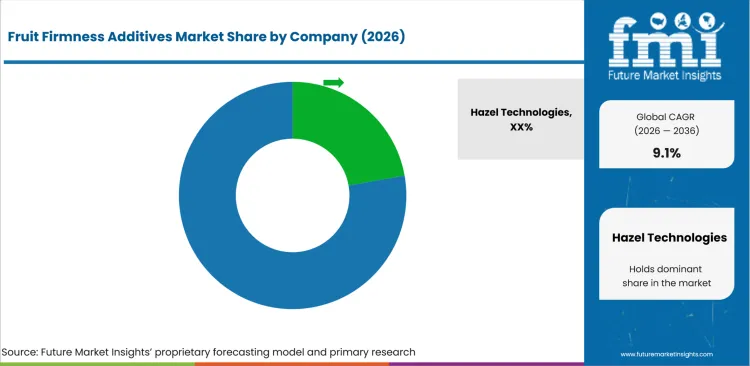
Competition spans chemical treatments, edible barriers and atmosphere-control formats, but entry depends on crop proof and application support rather than corporate scale alone. The strongest next-generation packaging positions also reduce process disruption during packhouse qualification.
- Integrated postharvest treatment and application platforms include AgroFresh Solutions, Inc., DECCO (UPL), Citrosol and JBT Marel Corporation.
- Active-packaging and atmosphere-control specialists include StePacPPC and Fresh Inset S.A., with each targeting freshness retention during storage or shipment.
- Edible-barrier specialists include Apeel Sciences and Nabaco, Inc., which focus on surface protection during postharvest handling and distribution.
Competitive Benchmarking: Fruit Firmness Additives Market
| Company | Preservation Format Breadth | Packhouse Integration | Crop & Qualification Support | Geographic Reach |
|---|---|---|---|---|
| AgroFresh Solutions, Inc. | High | High | High | Global; 50+ countries |
| DECCO (UPL) | High | High | High | 40+ countries |
| Citrosol | High | High | High | Europe, Africa and Latin America |
| JBT Marel Corporation | Medium | High | Medium | Global |
| StePacPPC | Medium | High | High | Americas, Europe and Middle East |
| Fresh Inset S.A. | Low | Medium | Medium | Europe, USA and Peru |
| Apeel Sciences | Low | Medium | High | Americas and selected international markets |
| Nabaco, Inc. | Low | Medium | High | North America with global distribution partner |
Scoring basis: High preservation breadth requires at least three documented freshness-control routes while Medium requires two and Low identifies one. High packhouse integration requires line or equipment integration plus technical implementation support while Medium reflects one documented operating route and Low reflects a simpler application path. High crop and qualification support requires three documented crop or approval groups while Medium requires two and Low identifies one. Geographic reach records active regions and does not rank company size or revenue.
Key Developments in the Fruit Firmness Additives Market
- In January 2026, StePacPPC introduced an Xtend MA/MH bulk packaging format tailored to dragon fruit moving from Ecuador to the USA and Europe.
- In September 2025, DECCO (UPL) announced a new production plant in Valencia that was scheduled to raise its global manufacturing network to nine sites.
- In June 2025, AgroFresh Solutions, Inc. signed an exclusive global distribution agreement with Nabaco, Inc. for the NatuWrap fruit-protection platform.
Key Players in the Fruit Firmness Additives Market
Integrated Postharvest Treatment and Application Platforms
- AgroFresh Solutions, Inc.
- DECCO (UPL)
- Citrosol
- JBT Marel Corporation
Active Packaging and Atmosphere-Control Specialists
- StePacPPC
- Fresh Inset S.A.
Edible Barrier Specialists
- Apeel Sciences
- Nabaco, Inc.
Fruit Firmness Additives Market - Report Scope
| Coverage field | Report scope |
|---|---|
| Market breakdown | By product type, commodity, application point, technology base, sales channel and region. |
| Quantitative Units | USD million. |
| Market Definition | Commercial postharvest coatings, active freshness formats, wash or drench treatments and storage treatments sold to retain firmness, texture, hydration or ripening control after harvest. |
| Regions Covered | North America, Latin America, Europe, East Asia, South Asia and Pacific, and Middle East and Africa. |
| Countries Covered | USA, Germany, South Korea, UK, Japan, and 20+ countries included in the full report. |
| Key Companies Profiled | AgroFresh Solutions, Inc., DECCO (UPL), Citrosol, JBT Marel Corporation, StePacPPC, Fresh Inset S.A., Apeel Sciences, Nabaco, Inc. |
| Forecast Period | 2026 to 2036. |
| Approach | Primary and secondary research with market triangulation. |
Fruit Firmness Additives Market - Research Methodology
| Method | Approach |
|---|---|
| Primary Research | FMI analysts gathered input from manufacturers, service providers, technology developers, distributors, end users, procurement teams, and subject-matter experts. Interviews examined purchasing decisions, product or service evaluation, adoption barriers, approval requirements, pricing considerations, and expectations for technical or commercial support. Respondents were also asked what evidence is required before a trial, pilot, or initial order develops into regular purchasing. |
| Desk Research | Desk research covered government statistics, regulatory publications, trade data, industry associations, technical literature, standards, company filings, product information, and official corporate announcements. Sources were reviewed for relevance, publication date, geographic coverage, and consistency with the defined market scope. Claims relating to performance, applications, approvals, capacity, investment, and commercial activity were retained only when supported by credible public evidence. |
| Market Sizing and Forecasting | The market model combined the baseline value with historical performance, segment structure, pricing and volume indicators, adoption levels, company participation, and country-level demand conditions. Forecast assumptions considered economic activity, investment trends, regulatory developments, technology adoption, purchasing cycles, supply availability, and barriers to wider market use. Segment and regional estimates were reconciled before the final market total was calculated. |
| Data Validation | Estimates were checked against multiple independent indicators, including public data, company activity, trade patterns, industry developments, and findings from primary interviews. Validation also tested whether products, services, applications, and company revenues fell within the defined market boundaries. Adjacent categories, unsupported claims, overlapping revenues, and activities without direct market relevance were excluded to reduce double counting and maintain consistency across segments and countries. |
Fruit Firmness Additives Market by Segments
Fruit Firmness Additives Market segmented by Product Type:
- Edible Coatings
- Active Sachets & Liners
- Wash & Drench Treatments
- Storage-Room Treatments
- Others
Fruit Firmness Additives Market segmented by Commodity:
- Pome & Stone Fruit
- Citrus
- Berries & Grapes
- Tropical Fruit
- Vegetables
- Others
Fruit Firmness Additives Market segmented by Application Point:
- Packhouse
- Storage Facility
- Transit & Retail
- Others
Fruit Firmness Additives Market segmented by Technology Base:
- Biological / Microbial
- Plant-Extract-Based
- Mineral & Wax-Based
- Others
Fruit Firmness Additives Market segmented by Sales Channel:
- Packhouse Suppliers
- Post-Harvest Service Providers
- Direct Sales
- Others
Fruit Firmness Additives Market by Region:
- North America
- United States
- Canada
- Latin America
- Brazil
- Mexico
- Chile
- Rest of Latin America
- Western Europe
- Germany
- United Kingdom
- Italy
- Spain
- France
- Nordics
- Benelux
- Rest of Western Europe
- Eastern Europe
- Russia
- Poland
- Hungary
- Balkan and Baltic States
- Rest of Eastern Europe
- East Asia
- China
- Japan
- South Korea
- South Asia and Pacific
- India
- ASEAN
- Australia and New Zealand
- Rest of South Asia and Pacific
- Middle East and Africa
- Kingdom of Saudi Arabia
- Other GCC Countries
- Türkiye
- South Africa
- Other African Union Countries
- Rest of Middle East and Africa
Research Sources and Bibliography
- United Nations Economic Commission for Europe. (2026, May 28). UNECE develops new guidance to reduce food loss in fresh and dried produce.
- Ministry of Agriculture, Forestry and Fisheries, Japan. (2025, May 27). 令和6年産りんごの結果樹面積、10a当たり収量、収穫量及び出荷量.
- USA Department of Agriculture, Agricultural Research Service. (2025, May 19). Nano Particle Coatings In Supply Chains of Fresh Produce to Improve Food Safety and Quality.
- Statistisches Bundesamt (Destatis). (2025, January 10). Apfelernte 2024: Mit 872 000 Tonnen zweitniedrigste Ernte der vergangenen zehn Jahre.
- StePacPPC. (2025, March 24). StePacPPC’s Xflow™ Technology: Revolutionizing Automated Packaging for Foodservice Efficiency.
- USA Department of Agriculture, Agricultural Research Service. (2025, May 18). Innovative Approaches to Control Postharvest Diseases and Expand Market Opportunities of Fresh Fruits.
- Fresh Inset S.A. (2025, January 21). Revolutionizing Produce Freshness with Vidre+™ Active Packaging.
- StePacPPC. (2025, January 28). StePacPPC’s Packaging Helps Foodservice Operations Minimize Waste.
- USA Department of Agriculture, National Agricultural Statistics Service. (2026, August 17). 2025 State Agriculture Overview: Washington.
- Statistisches Bundesamt (Destatis). (2025, December 19). Apfelernte 2025: Mit 1 138 000 Tonnen zweithöchste Ernte der vergangenen zehn Jahre.
- Statistics Korea. (2025, December 24). Final Results of the Cultivated Area and Production of Autumn Cabbages, Autumn Radishes, Beans, Apples and Pears in 2025.
- Department for Environment, Food & Rural Affairs. (2026, June 25). Horticulture statistics 2025.
- Ministry of Agriculture, Forestry and Fisheries, Japan. (2026, May 26). 令和7年産りんごの栽培面積、結果樹面積、収穫量及び出荷量.
- AgroFresh Solutions, Inc. (2026, March 10). AgroFresh to Demonstrate Leading Portfolio of Citrus Protection Solutions at Citrus Showcase.
- Citrosol. (2025, September 11). Citrosol renews itself at Fruit Attraction 2025 and premieres location in Hall 10.
- JBT Marel Corporation. (2026, March 2). 10-K: Annual report [Section 13 and 15(d), not S-K Item 405].
- Fresh Inset S.A. (2025, March 31). Fresh Inset In the News (Q1 2025).
- Apeel Sciences. (2025, June 3). Apeel Sciences Recognized by Food & Wine as a 2025 Game Changer for Food Innovation.
- AgroFresh Solutions, Inc. (2025, June 18). AgroFresh Expands Global Post-Harvest Solutions Portfolio with NatuWrap® in Exclusive Distribution Agreement with Nabaco®.
- StePacPPC. (2026, January 19). StePacPPC’s Advanced Packaging Extends Global Access of Dragon Fruit.
- DECCO. (2025, September 23). DECCO Expands Global Footprint with New Plant in Valencia, Spain.
- AgroFresh Solutions, Inc. (2026, April 28). AgroFresh Opens New Asia Pacific R&D Center in Yangling, China.
- DECCO. (2025, January 21). DECCO Ibérica receives the registration for DECCO Zox: First Product formulated with Azoxystrobin in Europe in Postharvest Citrus Protection.
- Citrosol. (2025, September 25). Citrosol expands its global footprint.
- StePacPPC. (2026, May 24). Transition to FSSC 22000 Certification.
- AgroFresh Solutions, Inc. (2025, May 20). Biotalys and AgroFresh Partner to Protect Fresh Produce.
- Fresh Inset S.A. (2025, April 30). Fresh Inset and Interoc sign LOI to bring Vidre+™ to Peru.
- Hazel Technologies, Inc. (2025, March 17). New packaging technology eliminates the need for ice when shipping broccoli.
- It's Fresh. (2026, May 1). Where shelf life, quality & recyclable packaging all meet.
This bibliography is provided for reader reference and is not exhaustive. The full report contains the complete reference list and detailed citations
This Report Answers
- How large is the fruit firmness additives market in 2026 and what value is projected by 2036?
- Which postharvest losses make firmness preservation a recurring commercial purchase for fresh-produce handlers?
- Why do edible coatings hold the leading position within product type?
- How does pome and stone fruit shape demand for firmness-preservation treatments?
- Why does packhouse hold the leading position within application point?
- How do country growth rates differ across USA, Germany, South Korea, UK and Japan?
- Which companies provide coatings, active packaging, postharvest treatments or application systems?
- How do registration and crop-specific qualification limit adoption of firmness-control products?
- What should packhouse operators evaluate before adopting a new fruit firmness treatment?
Frequently Asked Questions
How big is the fruit firmness additives market in 2026?
The fruit firmness additives market is valued at USD 234.5 million in 2026 and is projected to reach USD 560.2 million by 2036. Longer storage and distribution windows increase the commercial value of retaining saleable texture.
What is the CAGR of the fruit firmness additives market from 2026 to 2036?
The fruit firmness additives market is projected to grow at a CAGR of 9.1% between 2026 and 2036. Expansion is supported by postharvest loss reduction and the need to protect fresh-market grade during storage and shipment.
Which product type leads the fruit firmness additives market?
The edible coatings segment is expected to hold 44.3% of the fruit firmness additives market in 2026, driven by surface application on existing packing lines. The format limits moisture exchange without requiring a separate storage-room treatment step.
Which countries are projected to record the highest growth in the fruit firmness additives market?
USA is projected to grow at 8.8% CAGR followed by Germany at 8.5% and South Korea at 8.2% through 2036. Their growth paths reflect sizable fruit-handling bases and quality-sensitive postharvest programs with different local qualification requirements.
Which companies are active in the fruit firmness additives market?
Key companies operating in the fruit firmness additives market include AgroFresh Solutions, Inc., DECCO (UPL), Citrosol, JBT Marel Corporation, StePacPPC, Fresh Inset S.A., Apeel Sciences, and Nabaco, Inc. Their positions span coatings, postharvest treatments, active packaging and application integration at commercial packing sites.
Preview the report firsthand - request a free sample
Get SampleGet the brochure for pricing and purchase details.
Get PDFTable of Content
- Key Takeaways
- Market Size and CAGR
- Top Growth Driver
- Fastest Growing Segment
- Leading Region
- Key Companies
- Emerging Opportunities
- Executive Summary
- Global Market Outlook
- Demand-side Trends
- Supply-side Trends
- Technology Roadmap Analysis
- Analysis and Recommendations
- Analyst Perspective (What is happening? Why now? What should investors know?)
- Key Questions Answered
- How large is the market?
- What is the CAGR?
- What are key trends?
- Which region dominates?
- Who are the leaders?
- Market Overview
- Market Coverage / Taxonomy
- Market Definition / Scope / Limitations
- Research Methodology
- Chapter Orientation
- Analytical Lens and Working Hypotheses
- Market Structure, Signals, and Trend Drivers
- Benchmarking and Cross-market Comparability
- Market Sizing, Forecasting, and Opportunity Mapping
- Research Design and Evidence Framework
- Desk Research Programme (Secondary Evidence)
- Expert Input and Fieldwork (Primary Evidence)
- Tooling, Models, and Reference Databases
- Data Engineering and Model Build
- Quality Assurance and Audit Trail
- Market Background
- Market Dynamics (Drivers, Restraints, Opportunity, Trends)
- Scenario Forecast (Optimistic, Likely, Conservative)
- Impact Analysis
- AI Impact
- Sustainability Impact
- Regulatory Impact
- Technology Impact
- Consumer / Buyer Analysis
- Purchase Drivers
- Adoption Barriers
- Buyer Journey
- Opportunity Map Analysis
- Product Life Cycle Analysis
- Supply Chain Analysis
- Investment Feasibility Matrix
- Value Chain Analysis
- PESTLE and Porter's Analysis
- Regulatory Landscape
- Regional Parent Market Outlook
- Production and Consumption Statistics
- Import and Export Statistics
- Global Market Analysis and Forecast, 2021 to 2036
- Historical Market Size Value (USD Million) Analysis, 2021 to 2025
- Current and Future Market Size Value (USD Million) Projections, 2026 to 2036
- Y-o-Y Growth Trend Analysis
- Absolute $ Opportunity Analysis
- Global Market Pricing Analysis, 2021 to 2036
- Global Market Analysis and Forecast, By Product Type, 2021 to 2036
- Introduction / Key Findings
- Historical Market Size Value (USD Million) Analysis By Product Type, 2021 to 2025
- Current and Future Market Size Value (USD Million) Analysis and Forecast By Product Type, 2026 to 2036
- Edible Coatings
- Active Sachets & Liners
- Wash & Drench Treatments
- Storage-Room Treatments
- Others
- Edible Coatings
- Y-o-Y Growth Trend Analysis By Product Type, 2021 to 2025
- Absolute $ Opportunity Analysis By Product Type, 2026 to 2036
- Global Market Analysis and Forecast, By Commodity, 2021 to 2036
- Introduction / Key Findings
- Historical Market Size Value (USD Million) Analysis By Commodity, 2021 to 2025
- Current and Future Market Size Value (USD Million) Analysis and Forecast By Commodity, 2026 to 2036
- Pome & Stone Fruit
- Citrus
- Berries & Grapes
- Tropical Fruit
- Vegetables
- Others
- Pome & Stone Fruit
- Y-o-Y Growth Trend Analysis By Commodity, 2021 to 2025
- Absolute $ Opportunity Analysis By Commodity, 2026 to 2036
- Global Market Analysis and Forecast, By Application Point, 2021 to 2036
- Introduction / Key Findings
- Historical Market Size Value (USD Million) Analysis By Application Point, 2021 to 2025
- Current and Future Market Size Value (USD Million) Analysis and Forecast By Application Point, 2026 to 2036
- Packhouse
- Storage Facility
- Transit & Retail
- Others
- Packhouse
- Y-o-Y Growth Trend Analysis By Application Point, 2021 to 2025
- Absolute $ Opportunity Analysis By Application Point, 2026 to 2036
- Global Market Analysis and Forecast, By Technology Base, 2021 to 2036
- Introduction / Key Findings
- Historical Market Size Value (USD Million) Analysis By Technology Base, 2021 to 2025
- Current and Future Market Size Value (USD Million) Analysis and Forecast By Technology Base, 2026 to 2036
- Biological / Microbial
- Plant-Extract-Based
- Mineral & Wax-Based
- Others
- Biological / Microbial
- Y-o-Y Growth Trend Analysis By Technology Base, 2021 to 2025
- Absolute $ Opportunity Analysis By Technology Base, 2026 to 2036
- Global Market Analysis and Forecast, By Sales Channel, 2021 to 2036
- Introduction / Key Findings
- Historical Market Size Value (USD Million) Analysis By Sales Channel, 2021 to 2025
- Current and Future Market Size Value (USD Million) Analysis and Forecast By Sales Channel, 2026 to 2036
- Packhouse Suppliers
- Post-Harvest Service Providers
- Direct Sales
- Others
- Packhouse Suppliers
- Y-o-Y Growth Trend Analysis By Sales Channel, 2021 to 2025
- Absolute $ Opportunity Analysis By Sales Channel, 2026 to 2036
- Global Market Analysis and Forecast, By Region, 2021 to 2036
- Introduction
- Historical Market Size Value (USD Million) Analysis By Region, 2021 to 2025
- Current Market Size Value (USD Million) Analysis and Forecast By Region, 2026 to 2036
- North America
- Latin America
- Western Europe
- Eastern Europe
- East Asia
- South Asia and Pacific
- Middle East & Africa
- Market Attractiveness Analysis By Region
- North America Market Analysis and Forecast, By Country, 2021 to 2036
- Historical Market Size Value (USD Million) Trend Analysis By Market Taxonomy, 2021 to 2025
- Market Size Value (USD Million) Forecast By Market Taxonomy, 2026 to 2036
- By Country
- USA
- Canada
- By Product Type
- By Commodity
- By Application Point
- By Technology Base
- By Sales Channel
- By Country
- Market Attractiveness Analysis
- By Country
- By Product Type
- By Commodity
- By Application Point
- By Technology Base
- By Sales Channel
- Key Takeaways
- Latin America Market Analysis and Forecast, By Country
- Historical Market Size Value (USD Million) Trend Analysis By Market Taxonomy, 2021 to 2025
- Market Size Value (USD Million) Forecast By Market Taxonomy, 2026 to 2036
- By Country
- Brazil
- Mexico
- Chile
- Rest of Latin America
- By Product Type
- By Commodity
- By Application Point
- By Technology Base
- By Sales Channel
- By Country
- Market Attractiveness Analysis
- By Country
- By Product Type
- By Commodity
- By Application Point
- By Technology Base
- By Sales Channel
- Key Takeaways
- Western Europe Market Analysis and Forecast, By Country
- Historical Market Size Value (USD Million) Trend Analysis By Market Taxonomy, 2021 to 2025
- Market Size Value (USD Million) Forecast By Market Taxonomy, 2026 to 2036
- By Country
- Germany
- UK
- Italy
- Spain
- France
- Nordic
- BENELUX
- Rest of Western Europe
- By Product Type
- By Commodity
- By Application Point
- By Technology Base
- By Sales Channel
- By Country
- Market Attractiveness Analysis
- By Country
- By Product Type
- By Commodity
- By Application Point
- By Technology Base
- By Sales Channel
- Key Takeaways
- Eastern Europe Market Analysis and Forecast, By Country
- Historical Market Size Value (USD Million) Trend Analysis By Market Taxonomy, 2021 to 2025
- Market Size Value (USD Million) Forecast By Market Taxonomy, 2026 to 2036
- By Country
- Russia
- Poland
- Hungary
- Balkan & Baltic
- Rest of Eastern Europe
- By Product Type
- By Commodity
- By Application Point
- By Technology Base
- By Sales Channel
- By Country
- Market Attractiveness Analysis
- By Country
- By Product Type
- By Commodity
- By Application Point
- By Technology Base
- By Sales Channel
- Key Takeaways
- East Asia Market Analysis and Forecast, By Country
- Historical Market Size Value (USD Million) Trend Analysis By Market Taxonomy, 2021 to 2025
- Market Size Value (USD Million) Forecast By Market Taxonomy, 2026 to 2036
- By Country
- China
- Japan
- South Korea
- By Product Type
- By Commodity
- By Application Point
- By Technology Base
- By Sales Channel
- By Country
- Market Attractiveness Analysis
- By Country
- By Product Type
- By Commodity
- By Application Point
- By Technology Base
- By Sales Channel
- Key Takeaways
- South Asia and Pacific Market Analysis and Forecast, By Country
- Historical Market Size Value (USD Million) Trend Analysis By Market Taxonomy, 2021 to 2025
- Market Size Value (USD Million) Forecast By Market Taxonomy, 2026 to 2036
- By Country
- India
- ASEAN
- Australia & New Zealand
- Rest of South Asia and Pacific
- By Product Type
- By Commodity
- By Application Point
- By Technology Base
- By Sales Channel
- By Country
- Market Attractiveness Analysis
- By Country
- By Product Type
- By Commodity
- By Application Point
- By Technology Base
- By Sales Channel
- Key Takeaways
- Middle East & Africa Market Analysis and Forecast, By Country
- Historical Market Size Value (USD Million) Trend Analysis By Market Taxonomy, 2021 to 2025
- Market Size Value (USD Million) Forecast By Market Taxonomy, 2026 to 2036
- By Country
- Kingdom of Saudi Arabia
- Other GCC Countries
- Türkiye
- South Africa
- Other African Union
- Rest of Middle East & Africa
- By Product Type
- By Commodity
- By Application Point
- By Technology Base
- By Sales Channel
- By Country
- Market Attractiveness Analysis
- By Country
- By Product Type
- By Commodity
- By Application Point
- By Technology Base
- By Sales Channel
- Key Takeaways
- Key Countries Market Analysis
- USA
- Pricing Analysis
- Market Share Analysis, 2025
- By Product Type
- By Commodity
- By Application Point
- By Technology Base
- By Sales Channel
- Canada
- Pricing Analysis
- Market Share Analysis, 2025
- By Product Type
- By Commodity
- By Application Point
- By Technology Base
- By Sales Channel
- Mexico
- Pricing Analysis
- Market Share Analysis, 2025
- By Product Type
- By Commodity
- By Application Point
- By Technology Base
- By Sales Channel
- Brazil
- Pricing Analysis
- Market Share Analysis, 2025
- By Product Type
- By Commodity
- By Application Point
- By Technology Base
- By Sales Channel
- Chile
- Pricing Analysis
- Market Share Analysis, 2025
- By Product Type
- By Commodity
- By Application Point
- By Technology Base
- By Sales Channel
- Germany
- Pricing Analysis
- Market Share Analysis, 2025
- By Product Type
- By Commodity
- By Application Point
- By Technology Base
- By Sales Channel
- UK
- Pricing Analysis
- Market Share Analysis, 2025
- By Product Type
- By Commodity
- By Application Point
- By Technology Base
- By Sales Channel
- Italy
- Pricing Analysis
- Market Share Analysis, 2025
- By Product Type
- By Commodity
- By Application Point
- By Technology Base
- By Sales Channel
- Spain
- Pricing Analysis
- Market Share Analysis, 2025
- By Product Type
- By Commodity
- By Application Point
- By Technology Base
- By Sales Channel
- France
- Pricing Analysis
- Market Share Analysis, 2025
- By Product Type
- By Commodity
- By Application Point
- By Technology Base
- By Sales Channel
- India
- Pricing Analysis
- Market Share Analysis, 2025
- By Product Type
- By Commodity
- By Application Point
- By Technology Base
- By Sales Channel
- ASEAN
- Pricing Analysis
- Market Share Analysis, 2025
- By Product Type
- By Commodity
- By Application Point
- By Technology Base
- By Sales Channel
- Australia & New Zealand
- Pricing Analysis
- Market Share Analysis, 2025
- By Product Type
- By Commodity
- By Application Point
- By Technology Base
- By Sales Channel
- China
- Pricing Analysis
- Market Share Analysis, 2025
- By Product Type
- By Commodity
- By Application Point
- By Technology Base
- By Sales Channel
- Japan
- Pricing Analysis
- Market Share Analysis, 2025
- By Product Type
- By Commodity
- By Application Point
- By Technology Base
- By Sales Channel
- South Korea
- Pricing Analysis
- Market Share Analysis, 2025
- By Product Type
- By Commodity
- By Application Point
- By Technology Base
- By Sales Channel
- Russia
- Pricing Analysis
- Market Share Analysis, 2025
- By Product Type
- By Commodity
- By Application Point
- By Technology Base
- By Sales Channel
- Poland
- Pricing Analysis
- Market Share Analysis, 2025
- By Product Type
- By Commodity
- By Application Point
- By Technology Base
- By Sales Channel
- Hungary
- Pricing Analysis
- Market Share Analysis, 2025
- By Product Type
- By Commodity
- By Application Point
- By Technology Base
- By Sales Channel
- Kingdom of Saudi Arabia
- Pricing Analysis
- Market Share Analysis, 2025
- By Product Type
- By Commodity
- By Application Point
- By Technology Base
- By Sales Channel
- Türkiye
- Pricing Analysis
- Market Share Analysis, 2025
- By Product Type
- By Commodity
- By Application Point
- By Technology Base
- By Sales Channel
- South Africa
- Pricing Analysis
- Market Share Analysis, 2025
- By Product Type
- By Commodity
- By Application Point
- By Technology Base
- By Sales Channel
- USA
- Market Structure Analysis
- Competition Dashboard
- Competition Benchmarking
- Market Share Analysis of Top Players
- By Regional
- By Product Type
- By Commodity
- By Application Point
- By Technology Base
- By Sales Channel
- Emerging Startups
- Innovation Benchmarking
- Competition Analysis
- Competition Deep Dive
- Hazel Technologies
- Overview
- Product Portfolio
- Profitability by Market Segments
- Sales Footprint
- Strategy Overview
- Marketing Strategy
- Product Strategy
- Channel Strategy
- DECCO (UPL)
- Pace International
- Xeda International
- Citrosol
- Fomesa Fruitech
- JBT Corporation
- StePac
- Hazel Technologies
- Case Studies
- Success Stories
- Recent Developments
- Competition Deep Dive
- Assumptions & Acronyms Used


