

- Market Size (2026)
- USD 4.8 Bn
- Forecast (2036)
- USD 8.5 Bn
- CAGR (2026 to 2036)
- 5.9%
How big is Active Packaging (Freshness / Ripening Control) Market in 2026?
USD 4.8 billion in 2026 and USD 8.5 billion by 2036 at a 5.9% CAGR.
Sales in active packaging (freshness / ripening control) market are projected to rise from USD 4.8 billion in 2026 and surpass USD 8.5 billion by 2036 at 5.9% CAGR from 2026 to 2036. The industry covers packages that absorb ethylene or oxygen and systems that manage moisture or release antimicrobial agents within a defined food-contact use. European Commission Regulation 450/2009 requires active materials to remain safe and establishes added labeling duties for substances released into food. The regulation separates active functions from passive barriers and clarifies the technical boundary around the wider active and intelligent packaging market. Commercial programs depend on agent capacity that remains stable throughout storage and transport under the approved package specification.
Fresh-produce packers compare active-material capacity with respiration rate and package volume during commercial trials on established converting lines. In May 2026, the FDA evaluated eight phthalates authorized as food-contact plasticizers and proposed grouping four substances for later cumulative risk assessment. American programs therefore require current material records alongside food-specific migration evidence and line compatibility results. German programs give greater attention to recovery compatibility under European packaging requirements that affect material selection. Japanese programs also follow a positive-list system that limits synthetic-resin constituents to listed substances or approved new entries. Cold-chain handling for perishable products across distribution also shapes fresh food packaging decisions. Sealing performance and controlled permeability across converting operations remain central to food packaging film selection.
-market-value-analysis.webp "Active Packaging (freshness Ripening Control) Market Value Analysis")
Key Takeaways of Active Packaging (Freshness Ripening Control) Market
- Demand for active freshness control reflects longer distribution routes that expose food to several interacting causes of quality loss.
- By type, ethylene scavengers are projected to account for 41.7% share in 2026 due to their direct effect on ripening gases.
- Produce is estimated to hold 40.2% of application revenue in 2026 owing to high sensitivity across storage and transport.
- Material authorization and package-specific trials remain key constraints since active performance changes across humidity and temperature conditions.
- Competition spans Amcor and specialist companies that differentiate through gas control and absorbent formats alongside testing and regional support.
Analyst Perspective
“Active packaging earns a price premium through control capacity that matches the food’s respiration rate and the expected distribution period. Produce programs should test seal quality and moisture exposure together since either factor can erase laboratory gains during commercial transport. Investment improves when measurable shelf-life extension uses compliant materials and release criteria that packhouses can reproduce across normal harvest variation.”
- Nandini Roy Choudhury, Principal Analyst, Future Market Insights
How is the Active Packaging (Freshness Ripening Control) Market segmented?
The active packaging (freshness / ripening control) industry is segmented by type, application, and region.
The market is segmented by type, application, and region to reflect product function, food use, and national operating conditions. Type comprises ethylene scavengers, moisture or oxygen absorbers, antimicrobial systems, and clay-based formats used for defined package functions. Application segmentation covers produce, meat, bakery products, and dairy products with different respiration, oxidation, and moisture risks. Regional analysis covers North America, Latin America, Western Europe, Eastern Europe, East Asia, South Asia and Pacific, and the Middle East and Africa. Country adoption varies with food-contact authorization, cold-chain conditions, packaging recovery requirements, and access to application testing.
What supports ethylene scavengers within the type category?
-market-analysis-by-type.webp "Active Packaging (freshness Ripening Control) Market Analysis By Type")
Climacteric fruit releases ethylene throughout storage and transport which continues the ripening process inside closed distribution packs. In January 2025, It’s Fresh reported established RYPEN case-liner manufacturing in South Africa and Chile alongside distribution agreements covering those countries and Peru. The announcement documents a commercial route for ethylene control across export packaging rather than a laboratory performance claim. Packaging teams must match removal capacity with crop sensitivity and transit duration since moisture and air exchange can reduce practical performance. Related oxygen scavenger labels show how compact active components require controlled placement and reliable seal validation.
- The type category is forecast to be led by ethylene scavengers at 41.7% share in 2026 due to direct control of ripening gases inside sealed produce packs. The segment supports fruit shipments that need additional selling time without changing the food product or the refrigeration process.
- Exporters adopt ethylene-control liners and inserts that fit established cartons without slowing normal packing operations. Adoption weakens if active capacity falls below crop output or moisture limits adsorption across long distribution routes.
What drives produce's position in the application category?
-market-analysis-by-application.webp "Active Packaging (freshness Ripening Control) Market Analysis By Application")
Fresh produce combines biological respiration with visible quality changes that affect retailer acceptance throughout distribution. Commercial trials need commodity-specific permeability and temperature conditions rather than one atmosphere target across every crop. Amcor stated in March 2025 that its P-Plus liners can extend shelf life by up to four times compared with traditional packaging. The company connected this performance with longer shipment periods and wider destination options for fruits and vegetables. Comparable produce packaging programs also require cooling and venting controls that preserve the intended atmosphere.
- The produce segment is likely to capture 40.2% share in 2026 attributable to frequent quality losses during storage and transport. The segment benefits from applications that protect usable selling time across fruits and vegetables with limited tolerance for distribution delays.
- Growers and packhouses adopt active produce formats through trials that reproduce benefits across harvest maturity and normal pack temperatures. Effective programs connect the package function with cooling discipline and inspection criteria across commercial handling.
What are the drivers, restraints, and opportunities in the Active Packaging (Freshness Ripening Control) Market?
Longer produce distribution routes increase demand for packaging that controls ripening gases and protects usable selling time. Package-specific migration and performance testing limit standardization across crops and storage conditions. Retail-ready active films create a practical expansion route through easier line integration and fewer loose inserts.
- Driver: Longer distribution routes increase the value of preserving arrival condition across produce and other perishable food categories.
- Restraint: Food-contact authorization and package recovery requirements slow adoption across materials with different active components.
- Opportunity: Retail-ready liners and films can add freshness control without replacing established packhouse equipment or handling routines.
Long distribution routes support demand because commercial value depends on product condition at arrival rather than packhouse quality alone. In March 2025 AgroFresh announced that its table-grape portfolio in Brazil would combine Uvasys sheets with SmartFresh InBox across storage and transport programs. The announcement connects active protection with a defined crop and a documented commercial distribution route. Packaging companies gain repeat orders through verified freshness control that reduces rejected loads and protects the available selling period. Related antimicrobial packaging formats require separate release and food-contact evidence for dependable fungal control in commercial packs.
European packaging requirements is one of the significant restraint for active formats that combine several materials or use specialized carrier layers. In February 2025 the Packaging and Packaging Waste Regulation entered into force across the European Union and established requirements covering packaging composition and recoverability. The regulation governs package structure and recovery without proving the performance of any active agent. Developers therefore need a compliant recovery route alongside migration evidence and functional results for each intended food application.
Retail-ready integration creates an opportunity for active components that fit established films or pads without reducing normal packing speed. In September 2025 It’s Fresh presented RYPEN Leaf and Pad formats alongside its Case Liner for produce applications. The broader format range gives packhouses more placement choices across transport and shelf-ready commercial packages. The modified atmospheric packaging market provides a useful design comparison for controlling the package environment. Active formats need separate migration and disposal controls that match crop sensitivity and airflow conditions.
Which country CAGRs are profiled in the Active Packaging (Freshness Ripening Control) Market?
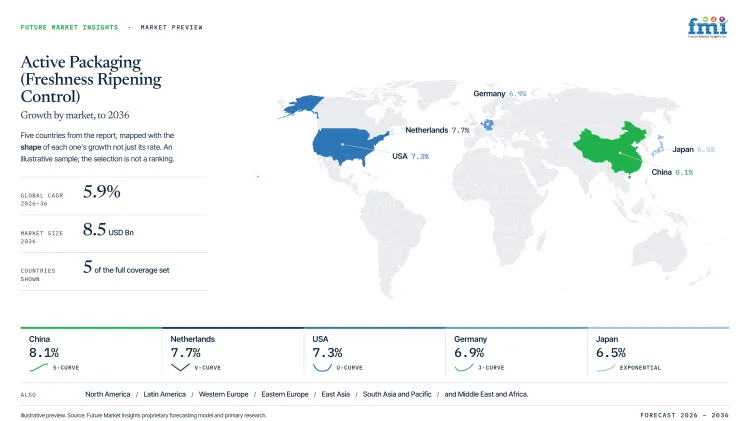
| Country | CAGR |
|---|---|
| USA | 7.3% |
| Japan | 6.5% |
| Germany | 6.9% |
| China | 8.1% |
| Netherlands | 7.7% |
How do country-level CAGRs compare in the Active Packaging (Freshness Ripening Control) Market?
The country forecasts show a gradual progression instead of clearly separated growth tiers across the active packaging (freshness / ripening control) market. China and the Netherlands form an upper group that reflects strong momentum in advanced packaging adoption for food preservation and shelf-life extension. The USA remains closely connected to this group, indicating widespread interest in packaging technologies that improve product quality during storage and distribution. Germany and Japan follow within a relatively narrow range and maintain steady growth profiles. The overall pattern suggests that demand for freshness monitoring, ripening management and food waste reduction solutions is expanding across all five markets, with differences influenced by supply chain requirements, packaging innovation and food industry adoption priorities.
- China shows a notable position within the comparison as food manufacturers and retailers increasingly adopt active packaging technologies to improve product freshness and reduce distribution losses.
- The Netherlands benefits from a strong packaging innovation ecosystem and continued investment in solutions that enhance shelf life across fresh produce and packaged food applications.
- The USA maintains a solid position through growing demand for packaging systems that support food quality, inventory management and waste reduction objectives.
- Germany reflects steady market development as food producers incorporate freshness-preserving materials and smart packaging features into product protection strategies.
- Japan continues to support market expansion through its focus on food quality preservation, packaging efficiency and advanced technologies for freshness and ripening control.
Comparable CAGRs do not create identical market conditions across countries. Differences in food distribution networks, packaging regulations, retailer requirements and technology adoption patterns can influence implementation timelines and commercial opportunities. Similar growth forecasts may therefore reflect different deployment models and end-user priorities across the active packaging value chain. The full report provides country-level CAGR analysis across North America, Latin America, Europe, East Asia, South Asia, Oceania and the Middle East and Africa.
Country-wise Analysis
- United States food-contact programs require manufacturers to confirm that active agents and carrier materials remain authorized for every intended food use. The USA's active packaging outlook is anticipated to advance at 7.3% CAGR over the assessment period, supported by broad fresh-food distribution networks. In August 2025, the FDA updated its public list of chemicals under post-market review and created a separate entry for lead in food-contact uses. The review framework gives packaging developers a clearer route for tracking material status during formulation and commercial qualification. Different state packaging rules remain a material friction because national programs can require separate recovery or labeling adjustments.
- Japanese packaging programs apply a positive-list system to synthetic-resin materials used in domestic and imported food containers. The Consumer Affairs Agency states that revised positive-list arrangements have applied since June 1, 2025, for covered food-contact materials. Adoption of freshness-control packaging in Japan is estimated to expand at 6.5% CAGR through 2036, shaped by strict material qualification and retailer standards. Listed-constituent checks create a direct adoption enabler by giving manufacturers a defined basis for selecting compliant resin formulations. New material entries and detailed retailer specifications remain a friction because each active format needs evidence for its intended use.
- German packaging programs combine European food-contact duties with national collection and recycling obligations for consumer food packs. The German Environment Agency reported in January 2026 that dual systems recycled about 5.5 million tonnes of packaging waste during 2024. Established recovery infrastructure gives developers a practical route for testing disposal claims alongside active-package performance. Active packaging demand in Germany is forecast to rise at 6.9% CAGR over the forecast period, reinforced by converting capacity and organized recovery systems. Composite structures remain a material friction since recyclability reviews can reject formats that perform well during shelf-life trials.
- Chinese packaging programs operate under national supervision sampling that checks safety and functional performance across food-contact formats. In January 2026, the State Administration for Market Regulation reported six failed cling-film batches within its national sampling program. The Chinese active packaging sector is projected to record 8.1% CAGR during the assessment period, driven by high-volume food distribution. Five batches failed oxygen-barrier tests and three failed water-vapor tests across the inspected product group. Formal testing gives packaging developers clearer specifications, but regional enforcement differences can extend qualification across several provinces.
- Dutch retailers operate concentrated grocery networks that measure food losses across fresh categories and compare results between participating chains. Consistent monitoring gives packaging teams a direct basis for selecting shelf-life trials around measured loss categories. Wageningen University & Research reported in July 2026 that supermarket food waste remained at 0.9% during 2025. Freshness-control packaging sales in the Netherlands are forecast to expand at 7.7% CAGR by 2036, supported by coordinated distribution and measured waste programs. European migration and recovery rules remain a friction since active components can narrow the available material and disposal choices.
Who are the notable companies in the Active Packaging (Freshness Ripening Control) Market?
Amcor, Mitsubishi Gas Chemical Company, Inc., Bioconservacion, Sirane, It’s Fresh!, and AgroFresh are the notable companies shaping this market.
-market-analysis-by-company.webp "Active Packaging (freshness Ripening Control) Market Analysis By Company")
Competition combines large packaging groups with specialists focused on oxygen absorption and ethylene control across produce liners and active sachets. MGC operates a dedicated atmospheric-control division that includes oxygen absorbers and oxygen-absorbing films for commercial food applications. Specialist companies compete through narrower crop knowledge and agent formats supported by application testing across defined transport conditions. The next-generation packaging market provides a useful technology comparison for emerging package functions and converting requirements. Exact inclusion in the active packaging market requires a verified scavenging or freshness-control function within the finished package system.
- Amcor combines fresh-produce liners with converting resources that support trials across several commercial distribution routes. AgroFresh adds active protection formats and post-harvest services for crop programs operating across more than fifty countries.
- MGC supplies oxygen-absorbing sachets and films for sealed food packages across several commercial applications worldwide. Bioconservacion provides ethylene-control sachets for produce programs that require humidity-tolerant performance throughout extended transport routes.
- Sirane develops absorbent and ethylene-control produce pads for selected commercial packing formats and distribution conditions. The RYPEN portfolio adds ethylene-management liners and inserts supported by regional manufacturing and export-market distribution arrangements.
Competitive Benchmarking: Active Packaging (Freshness / Ripening Control) Market
| Company | Active Gas Control | Produce Application Support | Validation and Scale Support | Geographic Reach |
|---|---|---|---|---|
| Amcor | High | High | High | Global |
| Mitsubishi Gas Chemical Company, Inc. | High | Medium | High | Global |
| Bioconservacion | High | High | Medium | Europe, Americas, Middle East |
| Sirane | High | High | Medium | Global |
| It’s Fresh! | High | High | Medium | Europe, Americas, Africa |
| AgroFresh | High | High | High | Global |
Key Developments in the Active Packaging (Freshness / Ripening Control) Market
- In May 2025, Amcor documented its collaboration with BelOrta on P-Plus liners for pear shipments. The package regulates oxygen and carbon dioxide to slow ripening and reduce dehydration across distribution. The development demonstrates how commodity-specific permeability supports a commercial produce program with measurable shelf-life objectives. Each crop requires a separate specification that reflects its respiration rate and expected storage conditions.
- In April 2025, AgroFresh introduced the Proteku sulfur-dioxide sheet for table grapes in Italy and wider European markets. The format operates inside grape packaging to reduce Botrytis losses throughout commercial storage and shipment. The launch broadens access to active protection for exporters serving longer international produce distribution routes. Commercial programs must match sheet release performance with grape variety and expected transport conditions throughout distribution.
- In February 2025, Mitsubishi Gas Chemical announced the establishment of its LivingTech and Hygiene Solutions Division. The division groups atmospheric-control products that include oxygen absorbers and oxygen-absorbing films for food packaging. The change gives active-packaging programs a dedicated business route for product support and commercial coordination. Customers need package-specific capacity data and documented food-contact validation for every intended commercial food-packaging application.
- In May 2026, It’s Fresh joined the IFPA Packaging Innovation Program to integrate RYPEN into retail-ready recyclable formats. The planned work covers recyclable film designed for cardboard punnets and prepared salad packaging applications. The program brings ethylene management closer to the retail package without adding a separate loose insert. Commercial adoption depends on verified film performance and reliable compatibility with existing commercial packing equipment.
Key Players in the Active Packaging (Freshness / Ripening Control) Market
Diversified Packaging Companies
- Amcor
- AgroFresh
Atmospheric Control Specialists
- Mitsubishi Gas Chemical Company, Inc.
- Bioconservacion
Produce-Focused Active Packaging Specialists
- Sirane
- It’s Fresh!
Active Packaging (Freshness / Ripening Control) Market - Report Scope
-market-breakdown-by-type,-application,-and-region.webp "Active Packaging (freshness Ripening Control) Market Breakdown By Type, Application, And Region")
| Coverage field | Report scope |
|---|---|
| Market breakdown | Type, application, and region. |
| Quantitative Units | Revenue in USD Million, CAGR in %. |
| Market Definition | Packaging that actively manages freshness or ripening through ethylene control and oxygen or moisture absorption together with antimicrobial action. |
| Regions Covered | North America, Latin America, Western Europe, Eastern Europe, East Asia, South Asia and Pacific, and Middle East and Africa. |
| Countries Covered | USA, Japan, Germany, China, Netherlands, and more than twenty-five additional countries. |
| Key Companies Profiled | Amcor, Mitsubishi Gas Chemical Company, Inc., Bioconservacion, Sirane, It’s Fresh!, and AgroFresh |
| Forecast Period | 2026 to 2036. |
| Approach | Hybrid bottom-up and top-down market sizing supported by primary interviews and official desk research. |
Active Packaging (Freshness / Ripening Control) Market - Research Methodology
| Method | Approach |
|---|---|
| Primary Research | FMI analysts gathered input from manufacturers, service providers, technology developers, distributors, end users, procurement teams, and subject-matter experts. Interviews examined purchasing decisions, product or service evaluation, adoption barriers, approval requirements, pricing considerations, and expectations for technical or commercial support. Respondents were also asked what evidence is required before a trial, pilot, or initial order develops into regular purchasing. |
| Desk Research | Desk research covered government statistics, regulatory publications, trade data, industry associations, technical literature, standards, company filings, product information, and official corporate announcements. Sources were reviewed for relevance, publication date, geographic coverage, and consistency with the defined market scope. Claims relating to performance, applications, approvals, capacity, investment, and commercial activity were retained only when supported by credible public evidence. |
| Market Sizing and Forecasting | The market model combined the baseline value with historical performance, segment structure, pricing and volume indicators, adoption levels, company participation, and country-level demand conditions. Forecast assumptions considered economic activity, investment trends, regulatory developments, technology adoption, purchasing cycles, supply availability, and barriers to wider market use. Segment and regional estimates were reconciled before the final market total was calculated. |
| Data Validation | Estimates were checked against multiple independent indicators, including public data, company activity, trade patterns, industry developments, and findings from primary interviews. Validation also tested whether products, services, applications, and company revenues fell within the defined market boundaries. Adjacent categories, unsupported claims, overlapping revenues, and activities without direct market relevance were excluded to reduce double counting and maintain consistency across segments and countries. |
Active Packaging (Freshness / Ripening Control) Market by Segments
Active Packaging (Freshness / Ripening Control) Market segmented by Type:
- Ethylene Scavengers
- Moisture/O2 Absorbers
- Antimicrobial
- Clay-based
Active Packaging (Freshness / Ripening Control) Market segmented by Application:
- Produce
- Meat
- Bakery
- Dairy
Active Packaging (Freshness / Ripening Control) Market by Region:
- North America
- USA
- Canada
- Latin America
- Brazil
- Mexico
- Argentina
- Chile
- Western Europe
- Germany
- France
- United Kingdom
- Italy
- Spain
- Benelux
- Nordics
- Eastern Europe
- Poland
- Czech Republic
- Romania
- Hungary
- East Asia
- China
- Japan
- South Korea
- South Asia and Pacific
- India
- ASEAN
- Australia and New Zealand
- Middle East and Africa
- GCC Countries
- South Africa
- Türkiye
- Israel
Research Sources and Bibliography
- European Commission. (2009, May 29). Commission Regulation (EC) No 450/2009 of 29 May 2009 on active and intelligent materials and articles intended to come into contact with food (Text with EEA relevance).
- USA Food and Drug Administration. (2026, May 27). Phthalates in Food Packaging and Food Contact Applications.
- It’s Fresh! (2025, January 17). RYPEN is a finalist for the Fruit Logistica Innovation award.
- Amcor. (2025, March 17). Fresh Thinking for Fruits and Vegetables - Extend the Shelf Life up to 4 Times.
- AgroFresh. (2025, March 17). AgroFresh Presents New Digital Post-Harvest Technology at Fruit Attraction 2025 in São Paulo.
- European Commission. (2025, February 11). New rules enter into force for a more sustainable and competitive packaging economy.
- It’s Fresh! (2025, September 16). Visit RYPEN at Fruit Attraction 2025.
- USA Food and Drug Administration. (2025, August 19). FDA Update on Post-market Assessment of Chemicals in the Food Supply.
- Consumer Affairs Agency. (n.d.). [Positive-list system for food utensils and container packaging after June 1, 2025].
- Umweltbundesamt. (2026, January 27). Facts against myths: Packaging waste recycling in Germany is working.
- State Administration for Market Regulation. (2026, January 26).[2025 national product quality supervision sampling results for food-contact paper containers and seventeen other product categories].
- Wageningen University & Research. (2026, July 9). Food waste in supermarkets down to 0,89%.
- Mitsubishi Gas Chemical Company, Inc. (n.d.). LivingTech and Hygiene Solutions Division.
- Bioconservacion. (n.d.). ETHYL STOPPER Sachets.
- Sirane. (n.d.). Ethylene absorbent pads for fruit - Dri-Fresh Fresh-Hold EA.
- Amcor. (2025, May 23). How BelOrta and Amcor combine expertise to extend the shelf life of pears.
- AgroFresh. (2025, April 22). Smarter Decisions, Fresher Fruit: AgroFresh Showcases Rubens and Proteku® at Macfrut 2025.
- Mitsubishi Gas Chemical Company, Inc. (2025, February 13). [Establishment of the LivingTech and Hygiene Solutions Division].
- It’s Fresh! (2026, May 1). Where shelf life, quality & recyclable packaging all meet.
- Sirane. (n.d.). Sirane Group (UK).
This bibliography is provided for reader reference and is not exhaustive. The full report contains the complete reference list and detailed citations
This Report Answers
- What is the active packaging (freshness / ripening control) market size in 2026?
- How fast is the market projected to expand between 2026 and 2036?
- Which active packaging functions control ripening and spoilage across food distribution?
- Why do ethylene scavengers hold the selected type position in 2026?
- Why does produce represent the selected application position in 2026?
- How do food-contact rules and package qualification influence adoption?
- How do the profiled country CAGRs compare across the forecast period?
- Which companies compete across global and specialist active-packaging capabilities?
- Which recent developments are changing commercial freshness-control programs?
Frequently Asked Questions
How big is the Active Packaging (Freshness / Ripening Control) Market in 2026?
The active packaging (freshness / ripening control) market is valued at USD 4.8 billion in 2026 and is forecast to reach USD 8.5 billion by 2036.
What is the CAGR of the Active Packaging (Freshness / Ripening Control) Market from 2026 to 2036?
The active packaging (freshness / ripening control) market is projected to grow at a CAGR of 5.9% between 2026 and 2036, supported by longer distribution routes increasing commercial demand for packaging that controls ripening gases and preserves usable selling time across perishable food categories.
Which type segment leads the Active Packaging (Freshness / Ripening Control) Market?
Ethylene scavengers account for 41.7% of the active packaging (freshness / ripening control) market by type in 2026, driven by their direct control of ripening gases inside sealed produce packs that extend fruit shipment periods without changing the food product or refrigeration process.
Which country is growing fastest in the Active Packaging (Freshness / Ripening Control) Market?
China is the fastest-growing country in the active packaging (freshness / ripening control) market, expanding at an 8.1% CAGR through 2036, ahead of the market average of 5.9%, supported by high-volume food distribution networks and national supervision programs establishing clearer performance specifications for food-contact packaging formats.
Who are the leading companies in the Active Packaging (Freshness / Ripening Control) Market?
Leading companies in the active packaging (freshness / ripening control) market include Amcor, Mitsubishi Gas Chemical Company, Bioconservacion, Sirane, It's Fresh!, and AgroFresh, spanning fresh-produce liners, oxygen-absorbing films, ethylene-control sachets, and post-harvest active protection programs across global distribution routes.
Preview the report firsthand - request a free sample
Get SampleGet the brochure for pricing and purchase details.
Get PDFTable of Content
- Key Takeaways
- Market Size and CAGR
- Top Growth Driver
- Fastest Growing Segment
- Leading Region
- Key Companies
- Emerging Opportunities
- Executive Summary
- Global Market Outlook
- Demand-side Trends
- Supply-side Trends
- Technology Roadmap Analysis
- Analysis and Recommendations
- Analyst Perspective (What is happening? Why now? What should investors know?)
- Key Questions Answered
- How large is the market?
- What is the CAGR?
- What are key trends?
- Which region dominates?
- Who are the leaders?
- Market Overview
- Market Coverage / Taxonomy
- Market Definition / Scope / Limitations
- Research Methodology
- Chapter Orientation
- Analytical Lens and Working Hypotheses
- Market Structure, Signals, and Trend Drivers
- Benchmarking and Cross-market Comparability
- Market Sizing, Forecasting, and Opportunity Mapping
- Research Design and Evidence Framework
- Desk Research Programme (Secondary Evidence)
- Expert Input and Fieldwork (Primary Evidence)
- Tooling, Models, and Reference Databases
- Data Engineering and Model Build
- Quality Assurance and Audit Trail
- Market Background
- Market Dynamics (Drivers, Restraints, Opportunity, Trends)
- Scenario Forecast (Optimistic, Likely, Conservative)
- Impact Analysis
- AI Impact
- Sustainability Impact
- Regulatory Impact
- Technology Impact
- Consumer / Buyer Analysis
- Purchase Drivers
- Adoption Barriers
- Buyer Journey
- Opportunity Map Analysis
- Product Life Cycle Analysis
- Supply Chain Analysis
- Investment Feasibility Matrix
- Value Chain Analysis
- PESTLE and Porter's Analysis
- Regulatory Landscape
- Regional Parent Market Outlook
- Production and Consumption Statistics
- Import and Export Statistics
- Global Market Analysis and Forecast, 2021 to 2036
- Historical Market Size Value (USD Billion) Analysis, 2021 to 2025
- Current and Future Market Size Value (USD Billion) Projections, 2026 to 2036
- Y-o-Y Growth Trend Analysis
- Absolute $ Opportunity Analysis
- Global Market Pricing Analysis, 2021 to 2036
- Global Market Analysis and Forecast, By Type, 2021 to 2036
- Introduction / Key Findings
- Historical Market Size Value (USD Billion) Analysis By Type, 2021 to 2025
- Current and Future Market Size Value (USD Billion) Analysis and Forecast By Type, 2026 to 2036
- Ethylene Scavengers
- Moisture/O2 Absorbers
- Antimicrobial
- Clay-based
- Ethylene Scavengers
- Y-o-Y Growth Trend Analysis By Type, 2021 to 2025
- Absolute $ Opportunity Analysis By Type, 2026 to 2036
- Global Market Analysis and Forecast, By Application, 2021 to 2036
- Introduction / Key Findings
- Historical Market Size Value (USD Billion) Analysis By Application, 2021 to 2025
- Current and Future Market Size Value (USD Billion) Analysis and Forecast By Application, 2026 to 2036
- Produce
- Meat
- Bakery
- Dairy
- Produce
- Y-o-Y Growth Trend Analysis By Application, 2021 to 2025
- Absolute $ Opportunity Analysis By Application, 2026 to 2036
- Global Market Analysis and Forecast, By Region, 2021 to 2036
- Introduction
- Historical Market Size Value (USD Billion) Analysis By Region, 2021 to 2025
- Current Market Size Value (USD Billion) Analysis and Forecast By Region, 2026 to 2036
- North America
- Latin America
- Western Europe
- Eastern Europe
- East Asia
- South Asia and Pacific
- Middle East & Africa
- Market Attractiveness Analysis By Region
- North America Market Analysis and Forecast, By Country, 2021 to 2036
- Historical Market Size Value (USD Billion) Trend Analysis By Market Taxonomy, 2021 to 2025
- Market Size Value (USD Billion) Forecast By Market Taxonomy, 2026 to 2036
- By Country
- USA
- Canada
- By Type
- By Application
- By Country
- Market Attractiveness Analysis
- By Country
- By Type
- By Application
- Key Takeaways
- Latin America Market Analysis and Forecast, By Country
- Historical Market Size Value (USD Billion) Trend Analysis By Market Taxonomy, 2021 to 2025
- Market Size Value (USD Billion) Forecast By Market Taxonomy, 2026 to 2036
- By Country
- Brazil
- Mexico
- Chile
- Rest of Latin America
- By Type
- By Application
- By Country
- Market Attractiveness Analysis
- By Country
- By Type
- By Application
- Key Takeaways
- Western Europe Market Analysis and Forecast, By Country
- Historical Market Size Value (USD Billion) Trend Analysis By Market Taxonomy, 2021 to 2025
- Market Size Value (USD Billion) Forecast By Market Taxonomy, 2026 to 2036
- By Country
- Germany
- UK
- Italy
- Spain
- France
- Nordic
- BENELUX
- Rest of Western Europe
- By Type
- By Application
- By Country
- Market Attractiveness Analysis
- By Country
- By Type
- By Application
- Key Takeaways
- Eastern Europe Market Analysis and Forecast, By Country
- Historical Market Size Value (USD Billion) Trend Analysis By Market Taxonomy, 2021 to 2025
- Market Size Value (USD Billion) Forecast By Market Taxonomy, 2026 to 2036
- By Country
- Russia
- Poland
- Hungary
- Balkan & Baltic
- Rest of Eastern Europe
- By Type
- By Application
- By Country
- Market Attractiveness Analysis
- By Country
- By Type
- By Application
- Key Takeaways
- East Asia Market Analysis and Forecast, By Country
- Historical Market Size Value (USD Billion) Trend Analysis By Market Taxonomy, 2021 to 2025
- Market Size Value (USD Billion) Forecast By Market Taxonomy, 2026 to 2036
- By Country
- China
- Japan
- South Korea
- By Type
- By Application
- By Country
- Market Attractiveness Analysis
- By Country
- By Type
- By Application
- Key Takeaways
- South Asia and Pacific Market Analysis and Forecast, By Country
- Historical Market Size Value (USD Billion) Trend Analysis By Market Taxonomy, 2021 to 2025
- Market Size Value (USD Billion) Forecast By Market Taxonomy, 2026 to 2036
- By Country
- India
- ASEAN
- Australia & New Zealand
- Rest of South Asia and Pacific
- By Type
- By Application
- By Country
- Market Attractiveness Analysis
- By Country
- By Type
- By Application
- Key Takeaways
- Middle East & Africa Market Analysis and Forecast, By Country
- Historical Market Size Value (USD Billion) Trend Analysis By Market Taxonomy, 2021 to 2025
- Market Size Value (USD Billion) Forecast By Market Taxonomy, 2026 to 2036
- By Country
- Kingdom of Saudi Arabia
- Other GCC Countries
- Türkiye
- South Africa
- Other African Union
- Rest of Middle East & Africa
- By Type
- By Application
- By Country
- Market Attractiveness Analysis
- By Country
- By Type
- By Application
- Key Takeaways
- Key Countries Market Analysis
- USA
- Pricing Analysis
- Market Share Analysis, 2025
- By Type
- By Application
- Canada
- Pricing Analysis
- Market Share Analysis, 2025
- By Type
- By Application
- Mexico
- Pricing Analysis
- Market Share Analysis, 2025
- By Type
- By Application
- Brazil
- Pricing Analysis
- Market Share Analysis, 2025
- By Type
- By Application
- Chile
- Pricing Analysis
- Market Share Analysis, 2025
- By Type
- By Application
- Germany
- Pricing Analysis
- Market Share Analysis, 2025
- By Type
- By Application
- UK
- Pricing Analysis
- Market Share Analysis, 2025
- By Type
- By Application
- Italy
- Pricing Analysis
- Market Share Analysis, 2025
- By Type
- By Application
- Spain
- Pricing Analysis
- Market Share Analysis, 2025
- By Type
- By Application
- France
- Pricing Analysis
- Market Share Analysis, 2025
- By Type
- By Application
- India
- Pricing Analysis
- Market Share Analysis, 2025
- By Type
- By Application
- ASEAN
- Pricing Analysis
- Market Share Analysis, 2025
- By Type
- By Application
- Australia & New Zealand
- Pricing Analysis
- Market Share Analysis, 2025
- By Type
- By Application
- China
- Pricing Analysis
- Market Share Analysis, 2025
- By Type
- By Application
- Japan
- Pricing Analysis
- Market Share Analysis, 2025
- By Type
- By Application
- South Korea
- Pricing Analysis
- Market Share Analysis, 2025
- By Type
- By Application
- Russia
- Pricing Analysis
- Market Share Analysis, 2025
- By Type
- By Application
- Poland
- Pricing Analysis
- Market Share Analysis, 2025
- By Type
- By Application
- Hungary
- Pricing Analysis
- Market Share Analysis, 2025
- By Type
- By Application
- Kingdom of Saudi Arabia
- Pricing Analysis
- Market Share Analysis, 2025
- By Type
- By Application
- Türkiye
- Pricing Analysis
- Market Share Analysis, 2025
- By Type
- By Application
- South Africa
- Pricing Analysis
- Market Share Analysis, 2025
- By Type
- By Application
- USA
- Market Structure Analysis
- Competition Dashboard
- Competition Benchmarking
- Market Share Analysis of Top Players
- By Regional
- By Type
- By Application
- Emerging Startups
- Innovation Benchmarking
- Competition Analysis
- Competition Deep Dive
- Amcor
- Overview
- Product Portfolio
- Profitability by Market Segments
- Sales Footprint
- Strategy Overview
- Marketing Strategy
- Product Strategy
- Channel Strategy
- Sealed Air
- Mitsubishi Gas Chemical
- Sirane
- Bioconservacion
- It's Fresh!
- Amcor
- Case Studies
- Success Stories
- Recent Developments
- Competition Deep Dive
- Assumptions & Acronyms Used


