

- Market Size (2026)
- USD 941.1 Mn
- Forecast (2036)
- USD 1800.0 Mn
- CAGR (2026 to 2036)
- 6.7%
How big is Moisture-Control Packaging Films Market in 2026?
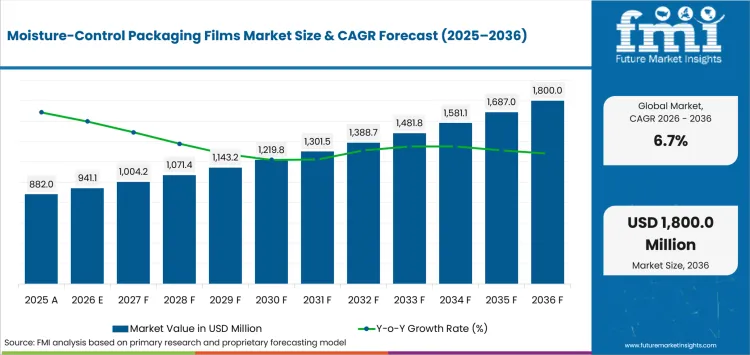
USD 941.1 million in 2026 and USD 1800.0 million by 2036 at a 6.7% CAGR.
Demand for moisture-control packaging films is projected to expand at 6.7% CAGR between 2026 and 2036, increasing valuation from USD 941.1 million in 2026 to USD 1800.0 million by 2036. Moisture management remains a critical consideration in fresh produce packaging because excessive water loss can accelerate quality deterioration during storage and distribution. EFSA's December 2025 assessment of fresh produce packaging identified water loss and loss of turgidity among the factors considered when evaluating packaging exemptions. The review places greater emphasis on the ability of packaging formats to preserve product condition and shelf life. Film suppliers must therefore demonstrate consistent moisture-retention performance as fresh produce programs adapt to evolving European packaging requirements.
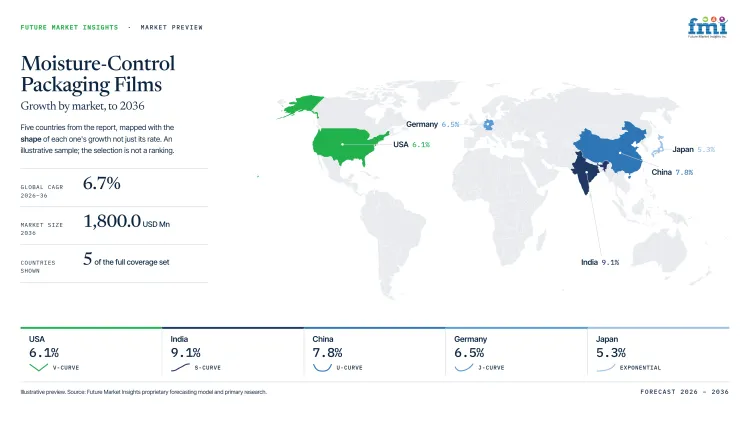
During the forecast period, Brazil is expected to rise at 7.1% CAGR against 6.6% CAGR in the United Kingdom and 5.3% CAGR in Japan. United Kingdom adoption faces a recovery test for household flexible plastic packaging. GOV.UK guidance updated in September 2025 states that no flexible-plastic category exceeds a 14% kerbside collection rate. High-barrier packaging films need documented moisture protection and a workable recovery classification for British programs. Japan's moderate forecast reflects mature specifications that require product-specific shelf-life evidence for film replacement.
Key Takeaways of Moisture-Control Packaging Films Market
- Moisture-related spoilage and condensation increase demand for films that preserve saleable quality across chilled food and moisture-sensitive healthcare packaging.
- Anti-fog films are projected to account for 28.0% by product type in 2026 due to frequent condensation during refrigerated display.
- Polyolefin is estimated to hold 42.0% by material in 2026 owing to water-vapor resistance and a broad heat-sealing range.
- Roll stock is forecast to represent 34.0% by format in 2026 driven by repeat use on automated forming and sealing equipment.
- Qualification slows adoption as barrier performance must remain stable during line trials and meet recycling rules in each intended selling market.
- Amcor plc, Sealed Air Corporation, Coveris, Klöckner Pentaplast, ProAmpac, Aptar CSP Technologies, Wipak Group and SÜDPACK compete in this market.
Analyst Perspective
"Moisture-control film selection should begin with the product failure that threatens saleable quality during storage or display. A specification earns repeat orders once it controls that risk at line speed without weakening seals or the required recycling classification."
- Nandini Roy Choudhury, Principal Consultant, Future Market Insights
How is the Moisture-Control Packaging Films Market segmented?
The moisture-control packaging films market is segmented by product type, material, format, application, end use, sales channel and region.
Product type covers anti-fog films, humidity-regulating breathable films, desiccant-integrated films, high-barrier WVTR films and others. Material includes polyolefin, PET, PLA bio-films, PA-EVOH structures and others. Format covers roll stock, bags and pouches, lidding films and others. Application covers fresh produce, meat and seafood, bakery and snacks, dairy, pharma and nutraceutical uses and others. End use covers food processing, grocery retail, healthcare and others. Sales channel includes direct OEM supply, packaging distributors, online e-commerce and others.
What makes anti-fog films central to the product type category?
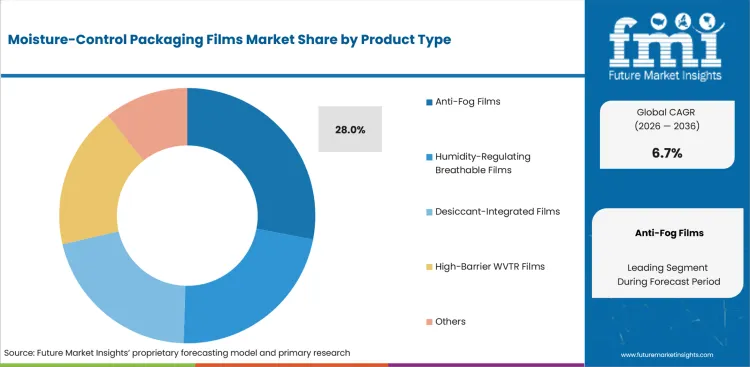
Anti-fog films manage condensation at the chilled-pack interface and preserve product visibility during refrigerated display. In August 2025, SÜDPACK grouped its PE and PP CarbonLite films with optional anti-fog performance for flow-pack formats. That format lets refrigerated food lines compare antifog packaging films with water-vapor protection under normal sealing conditions.
- Anti-fog films are projected to hold 28.0% share in 2026 owing to frequent condensation across refrigerated retail displays.
- Refrigerated processors assess clarity during temperature cycling and verify seal integrity across the intended shelf-life period. The same trial establishes whether the anti-fog treatment remains effective across distribution and retail handling.
Why does polyolefin lead the material category?
Polyolefin combines water-vapor resistance with a heat-sealing window across high-volume food lines. Film engineers can adjust gauge and surface treatment within familiar PE and PP conversion routes used for recycle-ready films. Commercial value depends on maintaining barrier performance and seal integrity at normal operating speed.
- By material, polyolefin is forecast to represent 42.0% in 2026 driven by familiar PE and PP sealing behavior across high-volume lines.
- Amcor reported in April 2026 that Paysan Breton Emmental had moved to AmPrima PP film across nearly 2,000 points of sale. The rollout pairs polypropylene film with sealing integrity and compatibility on the producer's existing packaging equipment.
How does roll stock support the format category?
Within the food packaging market, roll stock lets plants form packages on automated equipment and replenish qualified specifications across scheduled runs. Moisture-control functions stay inside the web and avoid a separate filling component. ProAmpac reported in June 2026 that commercialized MP-1000 moisture-adsorbing film was available in roll stock and premade pouch formats for moisture-sensitive applications.
- By format, roll stock is estimated to hold 34.0% in 2026 owing to repeat film use on automated forming and sealing equipment.
- Food plants qualify roll-fed structures by checking unwind behavior beside seal strength at commercial speed. A stable specification supports scheduled replenishment across repeated commercial packaging production runs.
What supports fresh produce as the leading application?
Fresh produce releases water and continues respiring inside the package during chilled distribution. Films must limit dehydration without trapping enough humidity to damage appearance or shorten saleable life. Processors match permeability to crop type across active and modified atmosphere packaging programs and recyclable lidding films.
- The application category is forecast to be led by fresh produce at 30.0% share in 2026 due to continuous humidity movement during chilled distribution.
- Coveris completed its Hartlepool centre of excellence for wicketted bags in November 2025 with added capacity for produce formats. In-house extrusion and conversion shorten crop-specific trials and replenishment of an approved PE structure.
What are the drivers, restraints and opportunities in the Moisture-Control Packaging Films Market?
Product-loss control increases film demand, but qualification and recycling rules narrow acceptable structures as integrated moisture adsorption expands sensitive-product applications.
- Driver: Moisture damage turns lost saleable quality into a measurable reason to test films against specific storage and distribution conditions.
- Restraint: Barrier layers must retain seal performance on installed equipment and meet recovery rules applied in each intended selling market.
- Opportunity: High-barrier mono-material films and active packaging structures offer alternatives to separate desiccants or poorly classified multilayer structures in qualified applications.
Shelf-Life Testing Supports Repeat Film Orders
Food programs qualify a new film against the shelf life required for the packed product. Coveris launched a monomaterial tortilla-wrap structure in August 2025 following tests that confirmed at least six months of shelf life and protection against mould. The completed trial gives food plants a documented qualification route for recyclable film that preserves shelf life on existing thermoforming lines.
Recycling Rules Limit Acceptable Barrier Structures
Barrier layers and active coatings can change how flexible-film structures are classified for recovery. The European Commission reported in February 2025 that Regulation (EU) 2025/40 entered into force across packaging and packaging waste. Affected film programs must pair moisture performance with documented recyclability and material-composition requirements for the intended European application.
Separate Lidding Assessments Support Film Redesign
Moisture-control film redesign separates barrier performance from tray recyclability once the lid is assessed as its own flexible-plastic component. PackUK and Defra's September 2025 supplementary RAM guidance states that lidding films on trays should be assessed separately as flexible plastic. Food programs can compare moisture protection and recovery status without treating the tray and lid as one material decision.
Which country CAGRs are profiled in the Moisture-Control Packaging Films Market?
| Country | CAGR |
|---|---|
| Brazil | 7.1% |
| United Kingdom | 6.6% |
| Germany | 6.5% |
| United States | 6.1% |
| Japan | 5.3% |
How do country-level CAGRs compare in the Moisture-Control Packaging Films Market?
The five forecasts span 1.8 percentage points from Brazil at 7.1% to Japan at 5.3%. Their spacing reflects different qualification and film-recovery conditions and does not measure current national market size.
- Brazil records 7.1% CAGR as warm distribution routes increase the value of films that manage condensation and moisture across fresh-food categories.
- The United Kingdom reaches 6.6% CAGR as recycling performance and producer reporting influence which barrier structures retailers are prepared to qualify.
- Germany posts 6.5% CAGR as advanced film conversion operates beside recovery rules that favor clearly classified mono-material structures.
- The United States expands at 6.1% CAGR owing to extensive refrigerated storage and large processing networks that support repeated packaging trials.
- Japan advances at 5.3% CAGR as mature pack specifications require documented shelf-life gains for replacement of established film structures.
Comparable CAGRs can produce different market entry conditions. The full report provides country-level CAGR analysis across North America, Latin America, Europe, East Asia, South Asia and Pacific, and the Middle East and Africa.
Country-wise Analysis
- Brazilian food packagers serve warm inland routes and coastal export chains that expose chilled produce and meat to changing humidity during long distribution cycles. Moisture-control packaging film sales in Brazil are forecast to expand at 7.1% CAGR by 2036. Conab's July 2026 report noted that Brazilian wholesale centers handled 16.6 million tonnes of fruit and vegetables in 2025, highlighting the scale of fresh-food distribution activities that rely on effective moisture management during storage and transport. The wholesale volume supports broad fresh-food trial activity but film manufacturers need food-contact documentation and crop-specific line results so regional processors can convert evaluation rolls into recurring orders across seasonal harvest and retail distribution programs in fresh produce categories nationwide.
- United Kingdom retailers and food processors use centralized specifications that connect film approval with shelf-life evidence and national recovery rules across large product ranges. The United Kingdom moisture-control packaging films sector is projected to record 6.6% CAGR during the assessment period. Defra's July 2025 report showed that plastic packaging reached a 51.0% recycling rate under methodology 1 in 2024, reflecting increasing emphasis on packaging solutions that balance product protection with material recovery objectives. The recovery result supports material redesign but flexible films need product-specific recyclability evidence and line results so retail programs can approve moisture barriers without weakening shelf life or adding avoidable disposal exposure across major national chilled and ambient ranges.
- German food and healthcare packagers work near established converting and sorting infrastructure that supports moisture-barrier trials across major food and pharmaceutical production clusters in domestic plants. In Germany, moisture-control packaging films demand is predicted to advance at 6.5% CAGR through 2036. The German Environment Agency's January 2026 report indicated that material recycling of plastic packaging reached 70% in 2024, underscoring the importance of packaging formats that can align with established recycling and sorting systems. The recovery system favors clearly classified structures but multilayer films require seal and shelf-life proof on installed equipment so conversion teams can qualify moisture protection without compromising automated sorting compatibility or production stability across regulated food and healthcare applications.
- United States food processors rely on a broad refrigerated warehouse network that connects regional production with national retail programs across several chilled categories. Moisture-control packaging films demand in the United States is forecast to rise at 6.1% CAGR over the forecast period. USDA's November 2025 description of more than 800 warehouses storing refrigerated products for at least 30 days illustrates the scale of the country's cold-chain infrastructure, where humidity control remains an important packaging consideration. The cold-storage base expands the number of relevant trial environments but plant approval depends on documented clarity and seal stability plus technical support that can maintain the same film specification across regional processing and distribution operations with consistent service coverage.
- Japanese processors favor stable packaging specifications and smaller production runs that require product-specific evidence for replacing established anti-fog or humidity-control structures. Adoption of moisture-control packaging films in Japan is estimated to expand at 5.3% CAGR through 2036. The agriculture ministry's June 2026 estimate of 2.37 million tonnes of business food loss in fiscal 2024 highlights the ongoing focus on shelf-life extension and food-waste reduction across the country's food supply chain. The measured loss burden supports shelf-life evaluation but local programs require dependable supply at modest volumes and clear approval records so laboratory moisture performance can become a recurring commercial specification across established retailer and processor programs for refrigerated food categories and seasonal launches.
Who are the notable companies in the Moisture-Control Packaging Films Market?
Amcor plc, Sealed Air Corporation, Coveris, Klöckner Pentaplast, ProAmpac, Aptar CSP Technologies, Wipak Group and SÜDPACK are the notable companies serving this market.
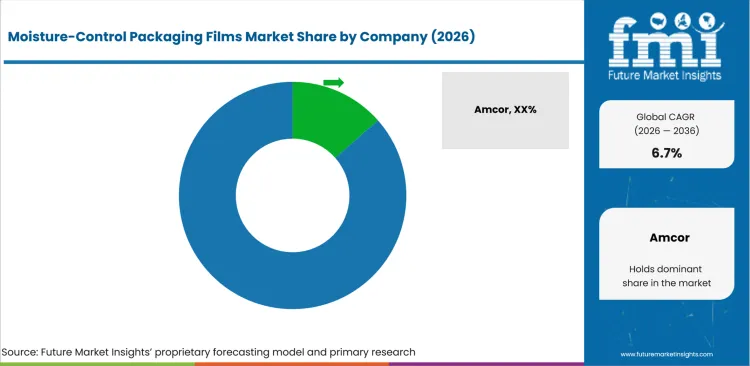
Competition spans global film groups alongside food-packaging systems companies and active-material specialists serving distinct moisture-control routes. Entry barriers rise from multilayer extrusion plus food-contact controls and commercial line qualification.
- Amcor plc, Sealed Air Corporation and Coveris combine broad film portfolios with line support across food and healthcare applications.
- Klöckner Pentaplast, Wipak Group and SÜDPACK focus on barrier and lidding films for chilled foods plus medical packaging films requiring qualification.
- ProAmpac and Aptar CSP Technologies focus on moisture-adsorbing films integrating active polymer inside roll stock or pouch structures.
Competitive Benchmarking: Moisture-Control Packaging Films Market
| Company | Moisture-Control Route Breadth | Food and Healthcare Qualification | Line-Integration Support | Geographic Reach |
|---|---|---|---|---|
| Amcor plc | High | High | Medium | Global |
| Sealed Air Corporation | Medium | Medium | High | Americas, Europe and Asia-Pacific |
| Coveris | High | High | High | Europe with selected international customers |
| Klöckner Pentaplast | Medium | Medium | Medium | Global production and commercial reach |
| ProAmpac | High | Medium | High | North America, Europe and Asia |
| Aptar CSP Technologies | Medium | Medium | Medium | North America, Europe and Asia-Pacific |
| Wipak Group | Medium | High | High | Europe with international customer programs |
| SÜDPACK | High | High | High | Europe, Americas and Asia-Pacific |
Key Developments in the Moisture-Control Packaging Films Market
- In March 2026, Amcor plc added a high-barrier recycle-ready film line at Lugo di Vicenza for lidding and pouch formats serving food and healthcare applications.
- In January 2026, SÜDPACK Medica launched MedHub with stocked moisture-resistant film and Tyvek pouches produced in ISO-certified cleanrooms for recurring healthcare packaging orders.
- In September 2025, Coveris introduced MonoFlexBP with thermoformable bottom films and high-barrier lidding for refrigerated foods on existing PP tray-sealing machinery.
Key Players in the Moisture-Control Packaging Films Market
Global Flexible-Film Platforms
- Amcor plc
- Sealed Air Corporation
- Coveris
Barrier and Lidding Film Specialists
- Klöckner Pentaplast
- Wipak Group
- SÜDPACK
Active Moisture-Control Specialists
- ProAmpac
- Aptar CSP Technologies
Moisture-Control Packaging Films Market - Report Scope
| Coverage field | Report scope |
|---|---|
| Market breakdown | By product type, material, format, application, end use, sales channel and region. |
| Quantitative Units | Revenue in USD million and CAGR in %. |
| Market Definition | Commercial flexible films that control condensation, humidity, or water-vapor transfer within food, healthcare, and related sensitive-product packaging. |
| Regions Covered | North America, Latin America, Europe, East Asia, South Asia and Pacific and Middle East and Africa. |
| Countries Covered | Brazil, United Kingdom, Germany, United States, Japan, and 20+ countries included in the full report. |
| Key Companies Profiled | Amcor plc, Sealed Air Corporation, Coveris, Klöckner Pentaplast, ProAmpac, Aptar CSP Technologies, Wipak Group, SÜDPACK. |
| Forecast Period | 2026 to 2036. |
| Approach | Primary and secondary research with market triangulation. |
Moisture-Control Packaging Films Market - Research Methodology
| Method | Approach |
|---|---|
| Primary Research | FMI analysts gathered input from manufacturers, service providers, technology developers, distributors, end users, procurement teams, and subject-matter experts. Interviews examined purchasing decisions, product or service evaluation, adoption barriers, approval requirements, pricing considerations, and expectations for technical or commercial support. Respondents were also asked what evidence is required before a trial, pilot, or initial order develops into regular purchasing. |
| Desk Research | Desk research covered government statistics, regulatory publications, trade data, industry associations, technical literature, standards, company filings, product information, and official corporate announcements. Sources were reviewed for relevance, publication date, geographic coverage, and consistency with the defined market scope. Claims relating to performance, applications, approvals, capacity, investment, and commercial activity were retained only when supported by credible public evidence. |
| Market Sizing and Forecasting | The market model combined the baseline value with historical performance, segment structure, pricing and volume indicators, adoption levels, company participation, and country-level demand conditions. Forecast assumptions considered economic activity, investment trends, regulatory developments, technology adoption, purchasing cycles, supply availability, and barriers to wider market use. Segment and regional estimates were reconciled before the final market total was calculated. |
| Data Validation | Estimates were checked against multiple independent indicators, including public data, company activity, trade patterns, industry developments, and findings from primary interviews. Validation also tested whether products, services, applications, and company revenues fell within the defined market boundaries. Adjacent categories, unsupported claims, overlapping revenues, and activities without direct market relevance were excluded to reduce double counting and maintain consistency across segments and countries. |
Moisture-Control Packaging Films Market by Segments
Moisture-Control Packaging Films Market segmented by Product Type:
- Anti-Fog Films
- Humidity-Regulating Breathable Films
- Desiccant-Integrated Films
- High-Barrier WVTR Films
- Others
Moisture-Control Packaging Films Market segmented by Material:
- Polyolefin
- PET
- PLA - Bio-Films
- PA - EVOH Structures
- Others
Moisture-Control Packaging Films Market segmented by Format:
- Roll Stock
- Bags & Pouches
- Lidding Films
- Others
Moisture-Control Packaging Films Market segmented by Application:
- Fresh Produce
- Meat & Seafood
- Bakery & Snacks
- Dairy
- Pharma & Nutraceutical
- Others
Moisture-Control Packaging Films Market segmented by End Use:
- Food Processing
- Grocery Retail
- Healthcare
- Others
Moisture-Control Packaging Films Market segmented by Sales Channel:
- Direct - OEM Supply
- Packaging Distributors
- Online - E-commerce
- Others
Moisture-Control Packaging Films Market by Region:
- North America
- United States
- Canada
- Latin America
- Brazil
- Mexico
- Chile
- Rest of Latin America
- Western Europe
- Germany
- United Kingdom
- Italy
- Spain
- France
- Nordics
- Benelux
- Rest of Western Europe
- Eastern Europe
- Russia
- Poland
- Hungary
- Balkan and Baltic States
- Rest of Eastern Europe
- East Asia
- China
- Japan
- South Korea
- South Asia and Pacific
- India
- ASEAN
- Australia and New Zealand
- Rest of South Asia and Pacific
- Middle East and Africa
- Kingdom of Saudi Arabia
- Other GCC Countries
- Türkiye
- South Africa
- Other African Union Countries
- Rest of Middle East and Africa
Research Sources and Bibliography
- European Food Safety Authority. (2025, December 16). Call for data on unprocessed fresh produce packaging.
- Department for Environment, Food & Rural Affairs. (2025, September 4). Recyclability assessment methodology: assessing materials.
- SÜDPACK Verpackungen SE & Co. KG. (2025, August 28). Less CO2, more performance: CarbonLite® by SÜDPACK.
- Amcor plc. (2026, April 28). Study shows 70% of French consumers prefer easy-close hard cheese packaging. Amcor and Laïta go a step further.
- ProAmpac. (2026, June 10). ProAmpac and Ozzi Named Finalists for World Food Innovation Awards 2026 with Moisture Adsorbing Technology.
- Coveris. (2025, November 20). Coveris Announces Centre of Excellence for Wicketted Bags.
- Coveris. (2025, August 18). Coveris introduces monomaterial tortilla wraps.
- European Commission, Directorate-General for Environment. (2025, February 11). New rules enter into force for a more sustainable and competitive packaging economy.
- PackUK and Department for Environment, Food & Rural Affairs. (2025, September 4). Recyclability assessment methodology: supplementary guidance.
- Companhia Nacional de Abastecimento. (2026, July 28). Comercialização de frutas e de hortaliças nas Ceasas brasileiras totalizam 16,6 milhões de toneladas em 2025.
- Department for Environment, Food & Rural Affairs. (2025, July 23). UK statistics on waste.
- German Environment Agency and Central Agency Packaging Register. (2026, January 27). Facts against myths: Packaging waste recycling in Germany is working.
- USA Department of Agriculture, National Agricultural Statistics Service. (2025, November 19). Cold Storage.
- Ministry of Agriculture, Forestry and Fisheries of Japan. (2026, June 30).
- Amcor plc. (2026, March 9). Amcor’s expanded facility in Italy will meet demand for recyclable packaging.
- SÜDPACK Medica AG. (2026, January 8). SÜDPACK Medica launches new service for the healthcare industry.
- Coveris. (2025, September 10). Coveris combines freshness and sustainability with new monomaterial pack for refrigerated goods.
- SÜDPACK Verpackungen SE & Co. KG. (2026, July 23). Expansion of SÜDPACK’s Coulmer site completed.
- Klöckner Pentaplast. (2025, February 6). kp launches 100% Tray2Tray® market-first pilot in the UK in partnership with Tesco and Hilton Foods.
- Wipak Group. (2026, April 29). Wipak films running live on partner machinery at Interpack 2026.
- Amcor plc. (2025, September 5). Amcor to showcase its versatility at Fachpack.
- Sealed Air Corporation. (2025, September 9). CRYOVAC® Brand Food Packaging Installs 4,000th Rotary Vacuum Packaging System.
- SGS FIMKO OY. (2025, September 30). Certificate FI25/00000052.
- ProAmpac. (2025, March 27). ProAmpac Expands Active and Intelligent Packaging with Advanced Sustainable Moisture Adsorbing Solutions.
- SÜDPACK Verpackungen SE & Co. KG. (2026, July 22). SÜDPACK Planova®: Bio-based PLA film for fresh herbs and cut flowers.
This bibliography is provided for reader reference and is not exhaustive. The full report contains the complete reference list and detailed citations
This Report Answers
- How does moisture-control film demand change by 2036?
- Which moisture risks lead to repeat film orders?
- Why do anti-fog films lead product type in 2026?
- Why does polyolefin lead material selection in 2026?
- Why does roll stock suit automated packaging lines?
- How do national recovery rules affect film qualification?
- Which companies combine barrier films with technical support?
- What limits multilayer and active-film adoption?
- Which applications benefit from integrated moisture adsorption?
Frequently Asked Questions
How big is the moisture-control packaging films market in 2026?
The moisture-control packaging films market is estimated at USD 941.1 million in 2026. Growth is driven by demand from food and healthcare packaging applications that require effective moisture management to enhance product stability and shelf life.
What is the CAGR of the moisture-control packaging films market from 2026 to 2036?
The moisture-control packaging films market is projected to grow at a CAGR of 6.7% between 2026 and 2036. Expansion is supported by increasing adoption of advanced packaging solutions designed to regulate moisture and improve product protection.
Which material segment is projected to account for 42.0% of the moisture-control packaging films market?
Polyolefin is projected to account for 42.0% of the market in 2026. Its leading share is supported by strong sealing performance, broad processing capabilities, and suitability for moisture-control packaging applications.
Which product type is expected to grow fastest in the moisture-control packaging films market?
Desiccant-integrated films are expected to be the fastest-growing product type through 2036. Their growth is driven by the ability to actively absorb excess moisture and improve package performance in sensitive applications.
Which companies are active in the moisture-control packaging films market?
Key companies operating in the market include Amcor plc, Sealed Air Corporation, Coveris, Klöckner Pentaplast, ProAmpac, Aptar CSP Technologies, Wipak Group, and SÜDPACK. These companies compete through moisture-control technologies, barrier film solutions, and packaging application expertise.
Preview the report firsthand - request a free sample
Get SampleGet the brochure for pricing and purchase details.
Get PDFTable of Content
- Key Takeaways
- Market Size and CAGR
- Top Growth Driver
- Fastest Growing Segment
- Leading Region
- Key Companies
- Emerging Opportunities
- Executive Summary
- Global Market Outlook
- Demand-side Trends
- Supply-side Trends
- Technology Roadmap Analysis
- Analysis and Recommendations
- Analyst Perspective (What is happening? Why now? What should investors know?)
- Key Questions Answered
- How large is the market?
- What is the CAGR?
- What are key trends?
- Which region dominates?
- Who are the leaders?
- Market Overview
- Market Coverage / Taxonomy
- Market Definition / Scope / Limitations
- Research Methodology
- Chapter Orientation
- Analytical Lens and Working Hypotheses
- Market Structure, Signals, and Trend Drivers
- Benchmarking and Cross-market Comparability
- Market Sizing, Forecasting, and Opportunity Mapping
- Research Design and Evidence Framework
- Desk Research Programme (Secondary Evidence)
- Expert Input and Fieldwork (Primary Evidence)
- Tooling, Models, and Reference Databases
- Data Engineering and Model Build
- Quality Assurance and Audit Trail
- Market Background
- Market Dynamics (Drivers, Restraints, Opportunity, Trends)
- Scenario Forecast (Optimistic, Likely, Conservative)
- Impact Analysis
- AI Impact
- Sustainability Impact
- Regulatory Impact
- Technology Impact
- Consumer / Buyer Analysis
- Purchase Drivers
- Adoption Barriers
- Buyer Journey
- Opportunity Map Analysis
- Product Life Cycle Analysis
- Supply Chain Analysis
- Investment Feasibility Matrix
- Value Chain Analysis
- PESTLE and Porter's Analysis
- Regulatory Landscape
- Regional Parent Market Outlook
- Production and Consumption Statistics
- Import and Export Statistics
- Global Market Analysis and Forecast, 2021 to 2036
- Historical Market Size Value (USD Million) Analysis, 2021 to 2025
- Current and Future Market Size Value (USD Million) Projections, 2026 to 2036
- Y-o-Y Growth Trend Analysis
- Absolute $ Opportunity Analysis
- Global Market Pricing Analysis, 2021 to 2036
- Global Market Analysis and Forecast, By Product Type, 2021 to 2036
- Introduction / Key Findings
- Historical Market Size Value (USD Million) Analysis By Product Type, 2021 to 2025
- Current and Future Market Size Value (USD Million) Analysis and Forecast By Product Type, 2026 to 2036
- Anti-Fog Films
- Humidity-Regulating Breathable Films
- Desiccant-Integrated Films
- High-Barrier WVTR Films
- Others
- Anti-Fog Films
- Y-o-Y Growth Trend Analysis By Product Type, 2021 to 2025
- Absolute $ Opportunity Analysis By Product Type, 2026 to 2036
- Global Market Analysis and Forecast, By Material, 2021 to 2036
- Introduction / Key Findings
- Historical Market Size Value (USD Million) Analysis By Material, 2021 to 2025
- Current and Future Market Size Value (USD Million) Analysis and Forecast By Material, 2026 to 2036
- Polyolefin
- PET
- PLA - Bio-Films
- PA - EVOH Structures
- Others
- Polyolefin
- Y-o-Y Growth Trend Analysis By Material, 2021 to 2025
- Absolute $ Opportunity Analysis By Material, 2026 to 2036
- Global Market Analysis and Forecast, By Format, 2021 to 2036
- Introduction / Key Findings
- Historical Market Size Value (USD Million) Analysis By Format, 2021 to 2025
- Current and Future Market Size Value (USD Million) Analysis and Forecast By Format, 2026 to 2036
- Roll Stock
- Bags & Pouches
- Lidding Films
- Others
- Roll Stock
- Y-o-Y Growth Trend Analysis By Format, 2021 to 2025
- Absolute $ Opportunity Analysis By Format, 2026 to 2036
- Global Market Analysis and Forecast, By Application, 2021 to 2036
- Introduction / Key Findings
- Historical Market Size Value (USD Million) Analysis By Application, 2021 to 2025
- Current and Future Market Size Value (USD Million) Analysis and Forecast By Application, 2026 to 2036
- Fresh Produce
- Meat & Seafood
- Bakery & Snacks
- Dairy
- Pharma & Nutraceutical
- Others
- Fresh Produce
- Y-o-Y Growth Trend Analysis By Application, 2021 to 2025
- Absolute $ Opportunity Analysis By Application, 2026 to 2036
- Global Market Analysis and Forecast, By End Use, 2021 to 2036
- Introduction / Key Findings
- Historical Market Size Value (USD Million) Analysis By End Use, 2021 to 2025
- Current and Future Market Size Value (USD Million) Analysis and Forecast By End Use, 2026 to 2036
- Food Processing
- Grocery Retail
- Others
- Healthcare
- Food Processing
- Y-o-Y Growth Trend Analysis By End Use, 2021 to 2025
- Absolute $ Opportunity Analysis By End Use, 2026 to 2036
- Global Market Analysis and Forecast, By Sales Channel
- Introduction / Key Findings
- Historical Market Size Value (USD Million) Analysis By Sales Channel, 2021 to 2025
- Current and Future Market Size Value (USD Million) Analysis and Forecast By Sales Channel, 2026 to 2036
- Direct - OEM Supply
- Packaging Distributors
- Online - E-commerce
- Others
- Direct - OEM Supply
- Y-o-Y Growth Trend Analysis By Sales Channel, 2021 to 2025
- Absolute $ Opportunity Analysis By Sales Channel, 2026 to 2036
- Global Market Analysis and Forecast, By Region, 2021 to 2036
- Introduction
- Historical Market Size Value (USD Million) Analysis By Region, 2021 to 2025
- Current Market Size Value (USD Million) Analysis and Forecast By Region, 2026 to 2036
- North America
- Latin America
- Western Europe
- Eastern Europe
- East Asia
- South Asia and Pacific
- Middle East & Africa
- Market Attractiveness Analysis By Region
- North America Market Analysis and Forecast, By Country, 2021 to 2036
- Historical Market Size Value (USD Million) Trend Analysis By Market Taxonomy, 2021 to 2025
- Market Size Value (USD Million) Forecast By Market Taxonomy, 2026 to 2036
- By Country
- USA
- Canada
- By Product Type
- By Material
- By Format
- By Application
- By End Use
- By Sales Channel
- By Country
- Market Attractiveness Analysis
- By Country
- By Product Type
- By Material
- By Format
- By Application
- By End Use
- By Sales Channel
- Key Takeaways
- Latin America Market Analysis and Forecast, By Country
- Historical Market Size Value (USD Million) Trend Analysis By Market Taxonomy, 2021 to 2025
- Market Size Value (USD Million) Forecast By Market Taxonomy, 2026 to 2036
- By Country
- Brazil
- Mexico
- Chile
- Rest of Latin America
- By Product Type
- By Material
- By Format
- By Application
- By End Use
- By Sales Channel
- By Country
- Market Attractiveness Analysis
- By Country
- By Product Type
- By Material
- By Format
- By Application
- By End Use
- By Sales Channel
- Key Takeaways
- Western Europe Market Analysis and Forecast, By Country
- Historical Market Size Value (USD Million) Trend Analysis By Market Taxonomy, 2021 to 2025
- Market Size Value (USD Million) Forecast By Market Taxonomy, 2026 to 2036
- By Country
- Germany
- UK
- Italy
- Spain
- France
- Nordic
- BENELUX
- Rest of Western Europe
- By Product Type
- By Material
- By Format
- By Application
- By End Use
- By Sales Channel
- By Country
- Market Attractiveness Analysis
- By Country
- By Product Type
- By Material
- By Format
- By Application
- By End Use
- By Sales Channel
- Key Takeaways
- Eastern Europe Market Analysis and Forecast, By Country
- Historical Market Size Value (USD Million) Trend Analysis By Market Taxonomy, 2021 to 2025
- Market Size Value (USD Million) Forecast By Market Taxonomy, 2026 to 2036
- By Country
- Russia
- Poland
- Hungary
- Balkan & Baltic
- Rest of Eastern Europe
- By Product Type
- By Material
- By Format
- By Application
- By End Use
- By Sales Channel
- By Country
- Market Attractiveness Analysis
- By Country
- By Product Type
- By Material
- By Format
- By Application
- By End Use
- By Sales Channel
- Key Takeaways
- East Asia Market Analysis and Forecast, By Country
- Historical Market Size Value (USD Million) Trend Analysis By Market Taxonomy, 2021 to 2025
- Market Size Value (USD Million) Forecast By Market Taxonomy, 2026 to 2036
- By Country
- China
- Japan
- South Korea
- By Product Type
- By Material
- By Format
- By Application
- By End Use
- By Sales Channel
- By Country
- Market Attractiveness Analysis
- By Country
- By Product Type
- By Material
- By Format
- By Application
- By End Use
- By Sales Channel
- Key Takeaways
- South Asia and Pacific Market Analysis and Forecast, By Country
- Historical Market Size Value (USD Million) Trend Analysis By Market Taxonomy, 2021 to 2025
- Market Size Value (USD Million) Forecast By Market Taxonomy, 2026 to 2036
- By Country
- India
- ASEAN
- Australia & New Zealand
- Rest of South Asia and Pacific
- By Product Type
- By Material
- By Format
- By Application
- By End Use
- By Sales Channel
- By Country
- Market Attractiveness Analysis
- By Country
- By Product Type
- By Material
- By Format
- By Application
- By End Use
- By Sales Channel
- Key Takeaways
- Middle East & Africa Market Analysis and Forecast, By Country
- Historical Market Size Value (USD Million) Trend Analysis By Market Taxonomy, 2021 to 2025
- Market Size Value (USD Million) Forecast By Market Taxonomy, 2026 to 2036
- By Country
- Kingdom of Saudi Arabia
- Other GCC Countries
- Türkiye
- South Africa
- Other African Union
- Rest of Middle East & Africa
- By Product Type
- By Material
- By Format
- By Application
- By End Use
- By Sales Channel
- By Country
- Market Attractiveness Analysis
- By Country
- By Product Type
- By Material
- By Format
- By Application
- By End Use
- By Sales Channel
- Key Takeaways
- Key Countries Market Analysis
- USA
- Pricing Analysis
- Market Share Analysis, 2025
- By Product Type
- By Material
- By Format
- By Application
- By End Use
- By Sales Channel
- Canada
- Pricing Analysis
- Market Share Analysis, 2025
- By Product Type
- By Material
- By Format
- By Application
- By End Use
- By Sales Channel
- Mexico
- Pricing Analysis
- Market Share Analysis, 2025
- By Product Type
- By Material
- By Format
- By Application
- By End Use
- By Sales Channel
- Brazil
- Pricing Analysis
- Market Share Analysis, 2025
- By Product Type
- By Material
- By Format
- By Application
- By End Use
- By Sales Channel
- Chile
- Pricing Analysis
- Market Share Analysis, 2025
- By Product Type
- By Material
- By Format
- By Application
- By End Use
- By Sales Channel
- Germany
- Pricing Analysis
- Market Share Analysis, 2025
- By Product Type
- By Material
- By Format
- By Application
- By End Use
- By Sales Channel
- UK
- Pricing Analysis
- Market Share Analysis, 2025
- By Product Type
- By Material
- By Format
- By Application
- By End Use
- By Sales Channel
- Italy
- Pricing Analysis
- Market Share Analysis, 2025
- By Product Type
- By Material
- By Format
- By Application
- By End Use
- By Sales Channel
- Spain
- Pricing Analysis
- Market Share Analysis, 2025
- By Product Type
- By Material
- By Format
- By Application
- By End Use
- By Sales Channel
- France
- Pricing Analysis
- Market Share Analysis, 2025
- By Product Type
- By Material
- By Format
- By Application
- By End Use
- By Sales Channel
- India
- Pricing Analysis
- Market Share Analysis, 2025
- By Product Type
- By Material
- By Format
- By Application
- By End Use
- By Sales Channel
- ASEAN
- Pricing Analysis
- Market Share Analysis, 2025
- By Product Type
- By Material
- By Format
- By Application
- By End Use
- By Sales Channel
- Australia & New Zealand
- Pricing Analysis
- Market Share Analysis, 2025
- By Product Type
- By Material
- By Format
- By Application
- By End Use
- By Sales Channel
- China
- Pricing Analysis
- Market Share Analysis, 2025
- By Product Type
- By Material
- By Format
- By Application
- By End Use
- By Sales Channel
- Japan
- Pricing Analysis
- Market Share Analysis, 2025
- By Product Type
- By Material
- By Format
- By Application
- By End Use
- By Sales Channel
- South Korea
- Pricing Analysis
- Market Share Analysis, 2025
- By Product Type
- By Material
- By Format
- By Application
- By End Use
- By Sales Channel
- Russia
- Pricing Analysis
- Market Share Analysis, 2025
- By Product Type
- By Material
- By Format
- By Application
- By End Use
- By Sales Channel
- Poland
- Pricing Analysis
- Market Share Analysis, 2025
- By Product Type
- By Material
- By Format
- By Application
- By End Use
- By Sales Channel
- Hungary
- Pricing Analysis
- Market Share Analysis, 2025
- By Product Type
- By Material
- By Format
- By Application
- By End Use
- By Sales Channel
- Kingdom of Saudi Arabia
- Pricing Analysis
- Market Share Analysis, 2025
- By Product Type
- By Material
- By Format
- By Application
- By End Use
- By Sales Channel
- Türkiye
- Pricing Analysis
- Market Share Analysis, 2025
- By Product Type
- By Material
- By Format
- By Application
- By End Use
- By Sales Channel
- South Africa
- Pricing Analysis
- Market Share Analysis, 2025
- By Product Type
- By Material
- By Format
- By Application
- By End Use
- By Sales Channel
- USA
- Market Structure Analysis
- Competition Dashboard
- Competition Benchmarking
- Market Share Analysis of Top Players
- By Regional
- By Product Type
- By Material
- By Format
- By Application
- By End Use
- By Sales Channel
- Emerging Startups
- Innovation Benchmarking
- Competition Analysis
- Competition Deep Dive
- Amcor
- Overview
- Product Portfolio
- Profitability by Market Segments
- Sales Footprint
- Strategy Overview
- Marketing Strategy
- Product Strategy
- Channel Strategy
- Sealed Air
- Berry Global
- Aptar CSP Technologies
- Coveris
- Mondi
- Klockner Pentaplast
- ProAmpac
- Winpak
- StePac
- Amcor
- Case Studies
- Success Stories
- Recent Developments
- Competition Deep Dive
- Assumptions & Acronyms Used


