

- Market Size (2026)
- USD 1.2 Bn
- Forecast (2036)
- USD 2.5 Bn
- CAGR (2026 to 2036)
- 7.8%
How big is Freshness-Control Packaging Films Market in 2026?
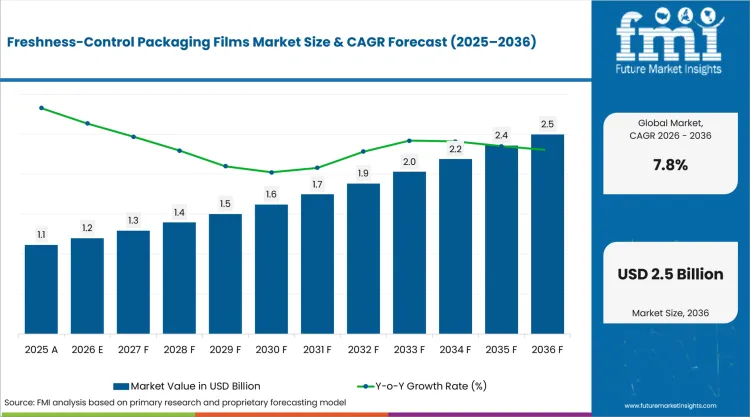
USD 1.2 billion in 2026 and USD 2.5 billion by 2036 at a 7.8% CAGR.
Demand for freshness-control packaging films is projected to rise at 7.8% CAGR between 2026 and 2036. The market is projected to increase from USD 1.2 billion in 2026 to USD 2.5 billion by 2036. Food-loss reduction remains a key justification for investment in freshness-preservation technologies. FAO reported in September 2025 that fruit and vegetables recorded a 25.4% food loss rate among major commodity groups. The scale of losses creates opportunities for packaging solutions that extend saleable life and improve product recovery across distribution networks.
Route length and approval burden alter purchasing conditions across food markets with different distribution and compliance requirements. United States processors emphasize avoided shrink across long routes, whereas European retailers add recycling evidence to package trials. Japan rewards stable film quality, whereas Brazilian exporters place greater weight on humidity control during ocean transport. A February 2026 USA Food Waste Pact report recorded 3.98 million tons of unsold retail food and USD 26.9 billion in lost sales during 2024. Those losses strengthen the commercial case for active and modified atmosphere packaging supported by verified shelf-life results.
Key Takeaways of Freshness-Control Packaging Films Market
- Food processors adopt freshness-control films once measured shelf-life gains reduce rejected cases and retail shrink enough to recover the packaging premium.
- Modified Atmosphere (MAP) Films are projected to account for 32.0% of technology demand in 2026 due to direct control of oxygen and carbon dioxide exchange around respiring foods.
- Polyolefin (PE - PP) is estimated to hold 40.0% by material in 2026 owing to sealability and established converting capacity.
- Bags & Pouches are forecast to represent 36.0% share in 2026 due to the active film area available across retail and bulk loads.
- Product-specific permeability, food-contact documentation and line trials extend approval during processor evaluation of a replacement film specification.
- StePacPPC, Amcor, Sealed Air, Coveris, Sumitomo Bakelite, PerfoTec, TransFRESH (Hazel Technologies) and Klöckner Pentaplast are some notable companies
Analyst Perspective
“Package trials earn repeat orders by reproducing the product’s real respiration rate and temperature profile under commercial conditions. Suppliers that combine measurable shelf-life gains with stable seals and recyclable structures can defend a premium without forcing disruptive line changes.”
- Nandini Roy Choudhury, Principal Consultant, Future Market Insights
How is the Freshness-Control Packaging Films Market segmented?
The freshness-control packaging films market is segmented by technology, material, format, application, end use, sales channel and region.
Market taxonomy covers technology, material, format, application, end use, sales channel and regional demand across the full report. Technology includes modified atmosphere, micro-perforated breathable, ethylene-scavenging, antimicrobial-active and humidity-control films with distinct preservation functions. Material and format analysis covers polyolefin, PLA bio-films, cellulose, PET, bags, pouches, roll stock and lidding films. Applications separate fresh produce, fresh-cut salads, bakery, meat, seafood and other perishables with different shelf-life requirements. End-use and channel analysis distinguishes processors, retailers, foodservice operations, direct supply, distributors and online sales.
Why do modified atmosphere (MAP) Films lead the technology category?
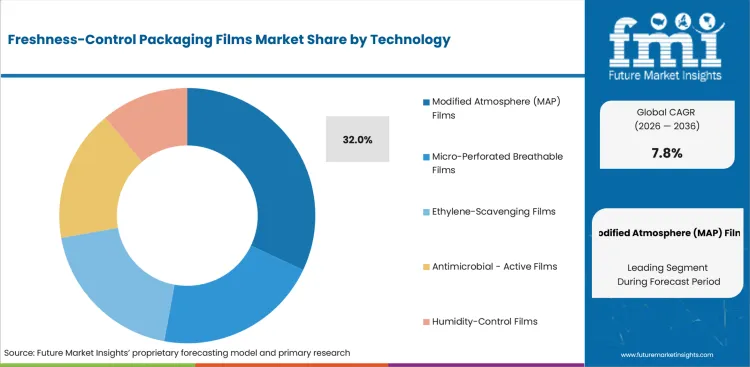
Modified atmosphere films match oxygen and carbon dioxide transfer to the packed crop’s respiration rate. Calibration links active and intelligent packaging with commodity weight, film area and route temperature exposure. Approved films must also retain antifog performance and seal strength on the commercial filling line.
- In 2026, Modified Atmosphere (MAP) Films are expected to lead technology with 32.0% share because respiring foods require controlled gas exchange.
- Long-distance export programs require crop-specific permeability data that remains valid across temperature changes during ocean transport. StePacPPC reported in January 2026 that Xtend MA/MH packaging protected dragon fruit during shipment to distant markets.
Why does polyolefin (PE - PP) lead the material category?
Polyolefin structures combine sealability, toughness and low material mass across high-volume food-packaging converting operations at commercial scale. The broad converter base also shortens trial-material lead times for processors using established PE and PP sealing windows. Producers can perforate or coextrude these food packaging films to adjust gas and moisture transfer without replacing familiar filling equipment.
- By material, Polyolefin (PE - PP) is estimated to hold 40.0% in 2026 owing to sealability and established converting capacity.
- Packaging engineers must preserve antifog behavior and seal strength during material simplification to avoid failures that erase calibrated permeability benefits.
How do bags & pouches retain leadership in the format category?
Bags and pouches surround the product load and provide a broad surface for gas and moisture exchange. Packers can adjust product weight on established filling lines, while peelable lidding films cover applications that require rigid trays and different presentation formats.
- Bags & Pouches are set to lead the format category with 36.0% share in 2026 due to scalable pack sizes and broad functional film area.
- Export programs require crop-specific evidence under changing temperatures and extended storage conditions before adopting a new pouch. TransFRESH (Hazel Technologies) reported in February 2025 that BreatheWay protected melons during a 46-day Central America-to-Japan shipment and reduced defects versus existing MAP bags.
What supports fresh produce leadership in the application category?
Fresh produce continues to respire after harvest, so unsuitable permeability can cause damaging gas levels or condensation during distribution. Film selection starts with crop respiration and route temperature, while high-barrier lidding films and breathable structures require separate qualification despite serving the same application.
- The application category is forecast to be led by Fresh Produce at 38.0% share in 2026 due to continued respiration inside packed crops.
- Ocean freight needs measured respiration and perforation settings that remain stable across the intended route. PerfoTec reported in January 2025 that its technology supported Belgian Brussels sprouts by sea instead of costlier air freight.
What are the drivers, restraints and opportunities in the Freshness-Control Packaging Films Market?
Food-loss economics supports adoption, product-specific qualification slows conversion and recyclable barrier structures provide the clearest revenue route.
- Driver: Processors adopt freshness-control films once longer saleable life reduces rejected cases and retail shrink enough to recover the packaging premium.
- Restraint: Commodity-specific gas transfer, food-contact documentation and line trials extend approval during any change to an established film specification.
- Opportunity: Recycle-ready structures can gain contracts if their barrier, antifog and sealing performance match the approved film on existing equipment.
Food-Loss Economics Supports Measured Adoption
Processors compare the film premium with rejected cases, code-life losses and downgraded product across the intended distribution route and pack size. ReFED estimated in April 2026 that the United States generated 70 million tons of surplus food during 2024 with a total value of USD 380 billion. Route trials convert film interest into orders by translating shelf-life performance into a documented operating saving across repeat shipments.
Qualification Work Delays Film Conversion
Respiration changes with crop condition and temperature, so laboratory permeability cannot replace commercial testing under planned production settings. European packaging rules add recyclability evidence beside food-contact and seal validation from August 2026 across lidding, pouch and roll-stock specifications. Access to migration and barrier testing therefore influences approval time, trial cost and the number of providers able to support a complete specification change.
Recycle-Ready Barrier Films Expand Revenue Routes
Recycle-ready structures qualify for contracts by preserving gas balance, antifog behavior and sealing performance on existing filling equipment. In February 2025, Klöckner Pentaplast paired FlexiLid containing 30% post-consumer recycled content with a fully recycled PET tray during a Tesco and Hilton Foods pilot. Similar PCR lidding films need processor trials that confirm shelf life, machinability and food-contact requirements ahead of wider conversion.
Which country CAGRs are profiled in the Freshness-Control Packaging Films Market?
| Country | CAGR |
|---|---|
| Brazil | 8.2% |
| United Kingdom | 7.7% |
| Germany | 7.6% |
| United States | 7.2% |
| Japan | 6.4% |
How do country-level CAGRs compare in the Freshness-Control Packaging Films Market?
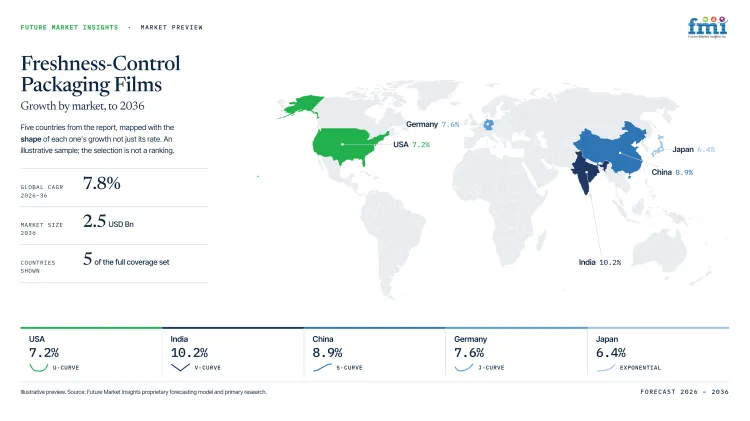
The profiled forecasts span 1.8 percentage points from Brazil at 8.2% to Japan at 6.4%. The narrow range masks different conversion routes across exports and retailer rules, with technical service and package qualification changing by pack type.
- Brazil’s forecast reflects expanding fruit exports that reward humidity control and films proven across long ocean routes with changing temperatures and varied packhouse conditions.
- The United Kingdom outlook is expanding because private-label programs compare food-waste savings with producer-responsibility costs and recyclable package design across fresh and chilled ranges.
- Germany is rising as retailers demand shelf-life proof beside recyclable lidding films and documented migration performance during material redesign.
- The United States advances as processors use route trials to compare avoided shrink with film cost and line performance across seasonal foodservice accounts.
- Japan from a mature base that rewards stable specifications and detailed technical files prior to changes across approved packages and smaller lots.
Comparable CAGRs can produce different market entry conditions because route length, packaging regulation and technical service requirements vary by country. The full report provides country-level CAGR analysis across seven FMI regions covering established and emerging commercial routes.
Country-wise Analysis
- Brazilian fruit exporters need films that manage humidity and respiration across inland handling, port dwell time and long ocean routes serving distant produce markets with variable temperatures and commodity-specific commercial loading patterns. Brazil is estimated to post 8.2% CAGR over the forecast period, driven by seasonal export programs that require crop-specific shelf-life validation and local technical support near major packing regions and ports during harvests. Brazil's agriculture ministry reported in July 2025 that 2024 fruit exports exceeded one million tonnes and USD 1.38 billion, although variable temperatures and limited specialist conversion can slow local qualification and repeat orders.
- UK retailers compare shelf-life gains with producer-responsibility costs, making recyclable construction part of the same decision as barrier performance and stable sealing across existing packing lines during national private-label approval programs and chilled-food ranges. The UK Freshness-Control Packaging Films sector is projected to record 7.7% CAGR during the assessment period, aided by retailer-led trials and established flexible-packaging conversion across fresh and chilled foods with measurable waste targets. DEFRA reported in December 2024 that UK food waste reached 10.7 million tonnes in 2021, yet higher-barrier films must pass recyclability reviews and stable line trials before final private-label specification approval at scale.
- Sales of Freshness-Control Packaging Films in Germany are forecast to expand at 7.6% CAGR by 2036, reinforced by retailer waste targets and established packaging laboratories that support migration testing and controlled line trials. Germany's food ministry reported in December 2024 that participating wholesalers and retailers reduced food waste by 24%, although film producers must preserve barrier and seal performance under European packaging rules and existing tray systems. German retailers assess food protection beside packaging recyclability, forcing film redesign programs to pass shelf-life and material-recovery tests during the same commercial approval cycle across private-label ranges and national food retail portfolios.
- Freshness-Control Packaging Films demand in the USA is forecast to rise at 7.2% CAGR over the forecast period, supported by route trials that compare avoided shrink with film cost without slowing line output. USDA joined EPA and FDA in June 2024 to release a national strategy targeting a 50% reduction in food loss and waste by 2030. US processors and foodservice distributors test freshness-control films against case rejection and remaining shelf life, then verify seal integrity under normal temperature profiles across seasonal products plus extended national distribution lanes and export routes
- Japanese food companies use detailed package specifications and controlled qualification, favoring stable permeability and sealing results across smaller production lots and precise retail presentation standards for fresh products and prepared national food ranges. Adoption of Freshness-Control Packaging Films in Japan is estimated to expand at 6.4% CAGR through 2036, supported by mature cold-chain operations and documented production controls across approved sites and national distribution programs. Japan's Consumer Affairs Agency reported in June 2026 that national food loss reached 4.61 million tonnes in fiscal 2024, but film producers must provide repeatable technical files and responsive local trial support during qualification.
Who are the notable companies in the Freshness-Control Packaging Films Market?
StePacPPC, Amcor, Sealed Air, Coveris, Sumitomo Bakelite Co., Ltd., PerfoTec, TransFRESH (Hazel Technologies) and Klöckner Pentaplast are the notable companies serving this market across several application routes.
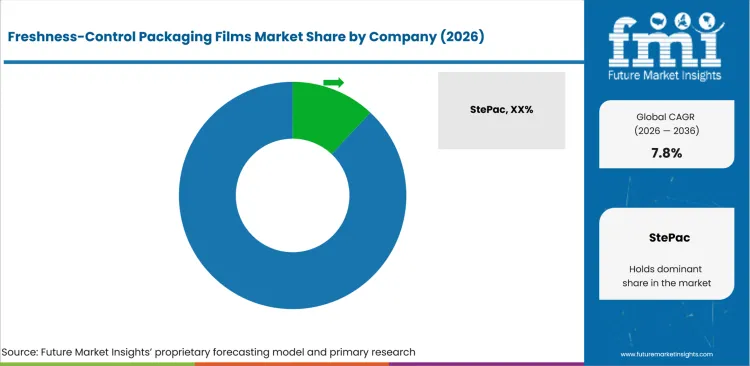
The industry remains fragmented between crop-specific atmosphere specialists, global film groups and integrated food-packaging systems. Respiration data, food-contact records and commercial line trials determine entry difficulty more directly than portfolio size. Recycle-ready films require application evidence that confirms seal performance and shelf-life retention before processors approve a material change.
- StePacPPC and Sumitomo Bakelite compete with crop-specific gas-control data that supports commercial qualification across fresh-produce routes. PerfoTec and TransFRESH (Hazel Technologies) add postharvest trial support for respiration matching across export and retail distribution programs.
- Amcor and Sealed Air combine broad film portfolios with multinational account coverage, converting capacity and technical service for fresh-food processors.
- Coveris emphasizes Freshlife wicketted bags and recyclable PE formats, while Klöckner Pentaplast supplies barrier lidding with recycled-content options for established tray systems.
Competitive Benchmarking: Freshness-Control Packaging Films Market
| Company | Respiration and Barrier-Control Depth | Fresh-Food Film Integration | Application Qualification Evidence | Geographic Reach |
|---|---|---|---|---|
| StePacPPC | High | High | High | Americas, Europe, Middle East and Asia-Pacific |
| Amcor | Low | Medium | Medium | Global |
| Sealed Air | Medium | High | High | Global |
| Coveris | Medium | Medium | High | Europe and selected international markets |
| Sumitomo Bakelite Co., Ltd. | Low | Medium | Low | Japan and selected international markets |
| PerfoTec | Low | Low | Low | Europe, North America and selected export markets |
| TransFRESH (Hazel Technologies) | Medium | High | Medium | North America and selected international produce routes |
| Klöckner Pentaplast | Low | Medium | Low | Europe, North America and Asia-Pacific |
Key Developments in the Freshness-Control Packaging Films Market
- In May 2026, StePacPPC transitioned its fresh-produce film manufacturing system to FSSC 22000 Version 6. The certification aligns its food-safety controls with GFSI requirements used during processor and export-program qualification.
- In March 2026, Amcor added a production line at its Lugo di Vicenza site for large-scale high-barrier recycle-ready films used in lidding and pouches. The 7,000-square-metre expansion adds laboratory and curing capacity for food processors qualifying recyclable structures across several commercial applications.
- In March 2025, Sumitomo Bakelite’s P-Plus top seal entered first commercial use on Seven Premium fresh pineapple packs at Peace Deli’s Nagareyama kitchen. The adoption moved crop-calibrated permeability from bag formats into a retail top-seal program for prepared fresh fruit.
Key Players in the Freshness-Control Packaging Films Market
Produce-Specific Atmosphere and Respiration Platforms
- StePacPPC
- Sumitomo Bakelite Co., Ltd.
- PerfoTec
- TransFRESH (Hazel Technologies)
Global Fresh-Food Film and Equipment Systems
- Amcor
- Sealed Air
Barrier Film and Recyclable Converting Platforms
- Coveris
- Klöckner Pentaplast
Freshness-Control Packaging Films Market - Report Scope
| Coverage field | Report scope |
|---|---|
| Market breakdown | By technology, material, format, application, end use, sales channel and region. |
| Quantitative Units | Revenue in USD billion and CAGR in %. |
| Market Definition | Revenue includes flexible films and film-derived packs that control gas exchange, ethylene, humidity, microorganisms or condensation to preserve perishable food. Ordinary commodity film, packaging equipment, rigid containers, separate sachets, cold-chain services and finished-food revenue are excluded. |
| Regions Covered | North America, Latin America, Western Europe, Eastern Europe, East Asia, South Asia and Pacific, and Middle East and Africa. |
| Countries Covered | United States, Germany, Japan, United Kingdom, Brazil, and 20+ countries included in the full report. |
| Key Companies Profiled | StePacPPC, Amcor, Sealed Air, Coveris, Sumitomo Bakelite Co., Ltd., PerfoTec, TransFRESH (Hazel Technologies) and Klöckner Pentaplast. |
| Forecast Period | 2026 to 2036. |
| Approach | Primary and secondary research with market triangulation. |
Freshness-Control Packaging Films Market - Research Methodology
| Method | Approach |
|---|---|
| Primary Research | FMI analysts gathered input from manufacturers, service providers, technology developers, distributors, end users, procurement teams, and subject-matter experts. Interviews examined purchasing decisions, product or service evaluation, adoption barriers, approval requirements, pricing considerations, and expectations for technical or commercial support. Respondents were also asked what evidence is required before a trial, pilot, or initial order develops into regular purchasing. |
| Desk Research | Desk research covered government statistics, regulatory publications, trade data, industry associations, technical literature, standards, company filings, product information, and official corporate announcements. Sources were reviewed for relevance, publication date, geographic coverage, and consistency with the defined market scope. Claims relating to performance, applications, approvals, capacity, investment, and commercial activity were retained only when supported by credible public evidence. |
| Market Sizing and Forecasting | The market model combined the baseline value with historical performance, segment structure, pricing and volume indicators, adoption levels, company participation, and country-level demand conditions. Forecast assumptions considered economic activity, investment trends, regulatory developments, technology adoption, purchasing cycles, supply availability, and barriers to wider market use. Segment and regional estimates were reconciled before the final market total was calculated. |
| Data Validation | Estimates were checked against multiple independent indicators, including public data, company activity, trade patterns, industry developments, and findings from primary interviews. Validation also tested whether products, services, applications, and company revenues fell within the defined market boundaries. Adjacent categories, unsupported claims, overlapping revenues, and activities without direct market relevance were excluded to reduce double counting and maintain consistency across segments and countries. |
Freshness-Control Packaging Films Market by Segments
Freshness-Control Packaging Films Market segmented by Technology:
- Modified Atmosphere (MAP) Films
- Micro-Perforated Breathable Films
- Ethylene-Scavenging Films
- Antimicrobial - Active Films
- Humidity-Control Films
Freshness-Control Packaging Films Market segmented by Material:
- Polyolefin (PE - PP)
- PLA - Bio-Films
- Cellulose Films
- PET
- Others
Freshness-Control Packaging Films Market segmented by Format:
- Bags & Pouches
- Flow Wrap - Roll Stock
- Lidding Films
- Others
Freshness-Control Packaging Films Market segmented by Application:
- Fresh Produce
- Fresh-Cut & Salads
- Bakery
- Meat & Seafood
- Others
Freshness-Control Packaging Films Market segmented by End Use:
- Food Processors & Packers
- Grocery Retail
- Foodservice
- Others
Freshness-Control Packaging Films Market segmented by Sales Channel:
- Direct - OEM Supply
- Packaging Distributors
- Online - E-commerce
- Others
Freshness-Control Packaging Films Market by Region:
- North America
- United States
- Canada
- Latin America
- Brazil
- Mexico
- Chile
- Rest of Latin America
- Western Europe
- Germany
- United Kingdom
- Italy
- Spain
- France
- Nordics
- Benelux
- Rest of Western Europe
- Eastern Europe
- Russia
- Poland
- Hungary
- Balkan and Baltic States
- Rest of Eastern Europe
- East Asia
- China
- Japan
- South Korea
- South Asia and Pacific
- India
- ASEAN
- Australia and New Zealand
- Rest of South Asia and Pacific
- Middle East and Africa
- Kingdom of Saudi Arabia
- Other GCC Countries
- Türkiye
- South Africa
- Other African Union Countries
- Rest of Middle East and Africa
Research Sources and Bibliography
- Food and Agriculture Organization of the United Nations. (2025, September 29). On the International Day of Awareness of Food Loss and Waste, learn how FAO is leveraging data to save food and advance the 2030 Agenda.
- USA Food Waste Pact. (2026, February 25). 2025 Data Report.
- StePacPPC. (2026, January 19). StePacPPC’s Advanced Packaging Extends Global Access of Dragon Fruit.
- TransFRESH (Hazel Technologies). (2025, February 3). Modified Atmosphere Packaging solution helps improve melon quality.
- PerfoTec. (2025, January 2). How PerfoTec Technology Keeps Brussels Sprouts Fresh at Sea.
- ReFED. (2026, April 7). Progress on the Plate: 2026 USA Food Waste Report.
- European Commission. (2025, February 11). Packaging waste.
- Klöckner Pentaplast. (2025, February 6). kp launches 100% Tray2Tray® market-first pilot in the UK in partnership with Tesco and Hilton Foods.
- Ministério da Agricultura e Pecuária. (2025, July 1). A fruta mais exportada pelo Brasil é a manga.
- Department for Environment, Food & Rural Affairs. (2024, December 11). United Kingdom Food Security Report 2024: Theme 2: UK Food Supply Sources.
- Bundesministerium für Ernährung und Landwirtschaft. (2024, December 3). Pakt gegen Lebensmittelverschwendung erfolgreich angelaufen.
- USA Department of Agriculture, USA Environmental Protection Agency, & USA Food and Drug Administration. (2024, June). National Strategy for Reducing Food Loss and Waste and Recycling Organics.
- Consumer Affairs Agency. (2026, June 30).
- Amcor. (2026, March 9). Amcor’s expanded facility in Italy will meet demand for recyclable packaging.
- Sumitomo Bakelite Co., Ltd.. (2025, May 14).
- StePacPPC. (2026, May 24). Transition to FSSC 22000 Certification.
- Sealed Air. (2026, January 7). CRYOVAC® Brand Food Packaging Marks 85 Years of Innovation, Performance and Customer Service.
- Coveris. (2025, November 20). Coveris Announces Centre of Excellence for Wicketted Bags.
- StePacPPC. (2026, March 6). StePacPPC Opens New Regional Office in Hermosillo, Mexico.
- TransFRESH (Hazel Technologies). (2025, March 17). New packaging technology eliminates the need for ice when shipping broccoli.
This bibliography is provided for reader reference and is not exhaustive. The full report contains the complete reference list and detailed citations.
This Report Answers
- What is the Freshness-Control Packaging Films Market size in 2026 and what value is forecast for 2036?
- Which food-loss and distribution conditions support demand for the Freshness-Control Packaging Films Market?
- Why do Modified Atmosphere (MAP) Films hold the leading technology share?
- How do polyolefin structures balance permeability, sealing performance and conversion cost?
- Why do bags and pouches retain the leading format share?
- How do Brazil, the United Kingdom, Germany, the United States and Japan differ in commercial entry conditions?
- Which companies provide crop-specific gas control, broad fresh-food film systems or recyclable barrier platforms?
- Which qualification steps determine whether a shelf-life trial becomes repeat purchasing?
Frequently Asked Questions
What is the Freshness-Control Packaging Films Market size in 2026?
Approximately USD 1.2 billion is the estimated 2026 value with market projected to reach USD 2.5 billion by 2036 as processors use verified gas and humidity control to protect saleable food across longer distribution routes.
What is the CAGR of the Freshness-Control Packaging Films Market from 2026 to 2036?
A 7.8% CAGR is projected for the Freshness-Control Packaging Films Market from 2026 to 2036. Growth depends on shelf-life gains recovering the film premium once permeability and food-contact evidence pass commercial review and stable seals remain repeatable across production runs.
Which technology segment is projected to dominate f the Freshness-Control Packaging Films Market?
Modified Atmosphere (MAP) Films are projected to account for 32.0% of the freshness-control packaging films market by technology in 2026. Their position reflects direct control of oxygen and carbon dioxide exchange around respiring produce across fresh-produce bags, liners and top-seal formats.
How much incremental opportunity is forecast for the Freshness-Control Packaging Films Market by 2036?
Around USD 1.3 billion in incremental revenue is forecast for the freshness-control packaging films market between 2026 and 2036. The increase represents the difference between the approved 2026 and 2036 values under the report model and does not measure a segment growth rate.
Which companies are active in the Freshness-Control Packaging Films Market?
Eight profiled companies are active in the Freshness-Control Packaging Films Market across crop-specific films and global converting systems, including StePacPPC and Sumitomo Bakelite. PerfoTec and Hazel Technologies add respiration control alongside Amcor and Sealed Air in global converting plus Coveris and Klöckner Pentaplast in recyclable barrier films.
Preview the report firsthand - request a free sample
Get SampleGet the brochure for pricing and purchase details.
Get PDFTable of Content
- Key Takeaways
- Market Size and CAGR
- Top Growth Driver
- Fastest Growing Segment
- Leading Region
- Key Companies
- Emerging Opportunities
- Executive Summary
- Global Market Outlook
- Demand-side Trends
- Supply-side Trends
- Technology Roadmap Analysis
- Analysis and Recommendations
- Analyst Perspective (What is happening? Why now? What should investors know?)
- Key Questions Answered
- How large is the market?
- What is the CAGR?
- What are key trends?
- Which region dominates?
- Who are the leaders?
- Market Overview
- Market Coverage / Taxonomy
- Market Definition / Scope / Limitations
- Research Methodology
- Chapter Orientation
- Analytical Lens and Working Hypotheses
- Market Structure, Signals, and Trend Drivers
- Benchmarking and Cross-market Comparability
- Market Sizing, Forecasting, and Opportunity Mapping
- Research Design and Evidence Framework
- Desk Research Programme (Secondary Evidence)
- Expert Input and Fieldwork (Primary Evidence)
- Tooling, Models, and Reference Databases
- Data Engineering and Model Build
- Quality Assurance and Audit Trail
- Market Background
- Market Dynamics (Drivers, Restraints, Opportunity, Trends)
- Scenario Forecast (Optimistic, Likely, Conservative)
- Impact Analysis
- AI Impact
- Sustainability Impact
- Regulatory Impact
- Technology Impact
- Consumer / Buyer Analysis
- Purchase Drivers
- Adoption Barriers
- Buyer Journey
- Opportunity Map Analysis
- Product Life Cycle Analysis
- Supply Chain Analysis
- Investment Feasibility Matrix
- Value Chain Analysis
- PESTLE and Porter's Analysis
- Regulatory Landscape
- Regional Parent Market Outlook
- Production and Consumption Statistics
- Import and Export Statistics
- Global Market Analysis and Forecast, 2021 to 2036
- Historical Market Size Value (USD Million) Analysis, 2021 to 2025
- Current and Future Market Size Value (USD Million) Projections, 2026 to 2036
- Y-o-Y Growth Trend Analysis
- Absolute $ Opportunity Analysis
- Global Market Pricing Analysis, 2021 to 2036
- Global Market Analysis and Forecast, By Technology, 2021 to 2036
- Introduction / Key Findings
- Historical Market Size Value (USD Million) Analysis By Technology, 2021 to 2025
- Current and Future Market Size Value (USD Million) Analysis and Forecast By Technology, 2026 to 2036
- Modified Atmosphere (MAP) Films
- Micro-Perforated Breathable Films
- Ethylene-Scavenging Films
- Antimicrobial - Active Films
- Humidity-Control Films
- Modified Atmosphere (MAP) Films
- Y-o-Y Growth Trend Analysis By Technology, 2021 to 2025
- Absolute $ Opportunity Analysis By Technology, 2026 to 2036
- Global Market Analysis and Forecast, By Material, 2021 to 2036
- Introduction / Key Findings
- Historical Market Size Value (USD Million) Analysis By Material, 2021 to 2025
- Current and Future Market Size Value (USD Million) Analysis and Forecast By Material, 2026 to 2036
- Polyolefin (PE - PP)
- PLA - Bio-Films
- Cellulose Films
- PET
- Others
- Polyolefin (PE - PP)
- Y-o-Y Growth Trend Analysis By Material, 2021 to 2025
- Absolute $ Opportunity Analysis By Material, 2026 to 2036
- Global Market Analysis and Forecast, By Format, 2021 to 2036
- Introduction / Key Findings
- Historical Market Size Value (USD Million) Analysis By Format, 2021 to 2025
- Current and Future Market Size Value (USD Million) Analysis and Forecast By Format, 2026 to 2036
- Bags & Pouches
- Flow Wrap - Roll Stock
- Lidding Films
- Others
- Bags & Pouches
- Y-o-Y Growth Trend Analysis By Format, 2021 to 2025
- Absolute $ Opportunity Analysis By Format, 2026 to 2036
- Global Market Analysis and Forecast, By Application, 2021 to 2036
- Introduction / Key Findings
- Historical Market Size Value (USD Million) Analysis By Application, 2021 to 2025
- Current and Future Market Size Value (USD Million) Analysis and Forecast By Application, 2026 to 2036
- Fresh Produce
- Fresh-Cut & Salads
- Bakery
- Meat & Seafood
- Others
- Fresh Produce
- Y-o-Y Growth Trend Analysis By Application, 2021 to 2025
- Absolute $ Opportunity Analysis By Application, 2026 to 2036
- Global Market Analysis and Forecast, By End Use, 2021 to 2036
- Introduction / Key Findings
- Historical Market Size Value (USD Million) Analysis By End Use, 2021 to 2025
- Current and Future Market Size Value (USD Million) Analysis and Forecast By End Use, 2026 to 2036
- Food Processors & Packers
- Grocery Retail
- Foodservice
- Others
- Food Processors & Packers
- Y-o-Y Growth Trend Analysis By End Use, 2021 to 2025
- Absolute $ Opportunity Analysis By End Use, 2026 to 2036
- Global Market Analysis and Forecast, By Sales Channel
- Introduction / Key Findings
- Historical Market Size Value (USD Million) Analysis By Sales Channel, 2021 to 2025
- Current and Future Market Size Value (USD Million) Analysis and Forecast By Sales Channel, 2026 to 2036
- Direct - OEM Supply
- Packaging Distributors
- Online - E-commerce
- Others
- Direct - OEM Supply
- Y-o-Y Growth Trend Analysis By Sales Channel, 2021 to 2025
- Absolute $ Opportunity Analysis By Sales Channel, 2026 to 2036
- Global Market Analysis and Forecast, By Region, 2021 to 2036
- Introduction
- Historical Market Size Value (USD Million) Analysis By Region, 2021 to 2025
- Current Market Size Value (USD Million) Analysis and Forecast By Region, 2026 to 2036
- North America
- Latin America
- Western Europe
- Eastern Europe
- East Asia
- South Asia and Pacific
- Middle East & Africa
- Market Attractiveness Analysis By Region
- North America Market Analysis and Forecast, By Country, 2021 to 2036
- Historical Market Size Value (USD Million) Trend Analysis By Market Taxonomy, 2021 to 2025
- Market Size Value (USD Million) Forecast By Market Taxonomy, 2026 to 2036
- By Country
- USA
- Canada
- By Technology
- By Material
- By Format
- By Application
- By End Use
- By Sales Channel
- By Country
- Market Attractiveness Analysis
- By Country
- By Technology
- By Material
- By Format
- By Application
- By End Use
- By Sales Channel
- Key Takeaways
- Latin America Market Analysis and Forecast, By Country
- Historical Market Size Value (USD Million) Trend Analysis By Market Taxonomy, 2021 to 2025
- Market Size Value (USD Million) Forecast By Market Taxonomy, 2026 to 2036
- By Country
- Brazil
- Mexico
- Chile
- Rest of Latin America
- By Technology
- By Material
- By Format
- By Application
- By End Use
- By Sales Channel
- By Country
- Market Attractiveness Analysis
- By Country
- By Technology
- By Material
- By Format
- By Application
- By End Use
- By Sales Channel
- Key Takeaways
- Western Europe Market Analysis and Forecast, By Country
- Historical Market Size Value (USD Million) Trend Analysis By Market Taxonomy, 2021 to 2025
- Market Size Value (USD Million) Forecast By Market Taxonomy, 2026 to 2036
- By Country
- Germany
- UK
- Italy
- Spain
- France
- Nordic
- BENELUX
- Rest of Western Europe
- By Technology
- By Material
- By Format
- By Application
- By End Use
- By Sales Channel
- By Country
- Market Attractiveness Analysis
- By Country
- By Technology
- By Material
- By Format
- By Application
- By End Use
- By Sales Channel
- Key Takeaways
- Eastern Europe Market Analysis and Forecast, By Country
- Historical Market Size Value (USD Million) Trend Analysis By Market Taxonomy, 2021 to 2025
- Market Size Value (USD Million) Forecast By Market Taxonomy, 2026 to 2036
- By Country
- Russia
- Poland
- Hungary
- Balkan & Baltic
- Rest of Eastern Europe
- By Technology
- By Material
- By Format
- By Application
- By End Use
- By Sales Channel
- By Country
- Market Attractiveness Analysis
- By Country
- By Technology
- By Material
- By Format
- By Application
- By End Use
- By Sales Channel
- Key Takeaways
- East Asia Market Analysis and Forecast, By Country
- Historical Market Size Value (USD Million) Trend Analysis By Market Taxonomy, 2021 to 2025
- Market Size Value (USD Million) Forecast By Market Taxonomy, 2026 to 2036
- By Country
- China
- Japan
- South Korea
- By Technology
- By Material
- By Format
- By Application
- By End Use
- By Sales Channel
- By Country
- Market Attractiveness Analysis
- By Country
- By Technology
- By Material
- By Format
- By Application
- By End Use
- By Sales Channel
- Key Takeaways
- South Asia and Pacific Market Analysis and Forecast, By Country
- Historical Market Size Value (USD Million) Trend Analysis By Market Taxonomy, 2021 to 2025
- Market Size Value (USD Million) Forecast By Market Taxonomy, 2026 to 2036
- By Country
- India
- ASEAN
- Australia & New Zealand
- Rest of South Asia and Pacific
- By Technology
- By Material
- By Format
- By Application
- By End Use
- By Sales Channel
- By Country
- Market Attractiveness Analysis
- By Country
- By Technology
- By Material
- By Format
- By Application
- By End Use
- By Sales Channel
- Key Takeaways
- Middle East & Africa Market Analysis and Forecast, By Country
- Historical Market Size Value (USD Million) Trend Analysis By Market Taxonomy, 2021 to 2025
- Market Size Value (USD Million) Forecast By Market Taxonomy, 2026 to 2036
- By Country
- Kingdom of Saudi Arabia
- Other GCC Countries
- Türkiye
- South Africa
- Other African Union
- Rest of Middle East & Africa
- By Technology
- By Material
- By Format
- By Application
- By End Use
- By Sales Channel
- By Country
- Market Attractiveness Analysis
- By Country
- By Technology
- By Material
- By Format
- By Application
- By End Use
- By Sales Channel
- Key Takeaways
- Key Countries Market Analysis
- USA
- Pricing Analysis
- Market Share Analysis, 2025
- By Technology
- By Material
- By Format
- By Application
- By End Use
- By Sales Channel
- Canada
- Pricing Analysis
- Market Share Analysis, 2025
- By Technology
- By Material
- By Format
- By Application
- By End Use
- By Sales Channel
- Mexico
- Pricing Analysis
- Market Share Analysis, 2025
- By Technology
- By Material
- By Format
- By Application
- By End Use
- By Sales Channel
- Brazil
- Pricing Analysis
- Market Share Analysis, 2025
- By Technology
- By Material
- By Format
- By Application
- By End Use
- By Sales Channel
- Chile
- Pricing Analysis
- Market Share Analysis, 2025
- By Technology
- By Material
- By Format
- By Application
- By End Use
- By Sales Channel
- Germany
- Pricing Analysis
- Market Share Analysis, 2025
- By Technology
- By Material
- By Format
- By Application
- By End Use
- By Sales Channel
- UK
- Pricing Analysis
- Market Share Analysis, 2025
- By Technology
- By Material
- By Format
- By Application
- By End Use
- By Sales Channel
- Italy
- Pricing Analysis
- Market Share Analysis, 2025
- By Technology
- By Material
- By Format
- By Application
- By End Use
- By Sales Channel
- Spain
- Pricing Analysis
- Market Share Analysis, 2025
- By Technology
- By Material
- By Format
- By Application
- By End Use
- By Sales Channel
- France
- Pricing Analysis
- Market Share Analysis, 2025
- By Technology
- By Material
- By Format
- By Application
- By End Use
- By Sales Channel
- India
- Pricing Analysis
- Market Share Analysis, 2025
- By Technology
- By Material
- By Format
- By Application
- By End Use
- By Sales Channel
- ASEAN
- Pricing Analysis
- Market Share Analysis, 2025
- By Technology
- By Material
- By Format
- By Application
- By End Use
- By Sales Channel
- Australia & New Zealand
- Pricing Analysis
- Market Share Analysis, 2025
- By Technology
- By Material
- By Format
- By Application
- By End Use
- By Sales Channel
- China
- Pricing Analysis
- Market Share Analysis, 2025
- By Technology
- By Material
- By Format
- By Application
- By End Use
- By Sales Channel
- Japan
- Pricing Analysis
- Market Share Analysis, 2025
- By Technology
- By Material
- By Format
- By Application
- By End Use
- By Sales Channel
- South Korea
- Pricing Analysis
- Market Share Analysis, 2025
- By Technology
- By Material
- By Format
- By Application
- By End Use
- By Sales Channel
- Russia
- Pricing Analysis
- Market Share Analysis, 2025
- By Technology
- By Material
- By Format
- By Application
- By End Use
- By Sales Channel
- Poland
- Pricing Analysis
- Market Share Analysis, 2025
- By Technology
- By Material
- By Format
- By Application
- By End Use
- By Sales Channel
- Hungary
- Pricing Analysis
- Market Share Analysis, 2025
- By Technology
- By Material
- By Format
- By Application
- By End Use
- By Sales Channel
- Kingdom of Saudi Arabia
- Pricing Analysis
- Market Share Analysis, 2025
- By Technology
- By Material
- By Format
- By Application
- By End Use
- By Sales Channel
- Türkiye
- Pricing Analysis
- Market Share Analysis, 2025
- By Technology
- By Material
- By Format
- By Application
- By End Use
- By Sales Channel
- South Africa
- Pricing Analysis
- Market Share Analysis, 2025
- By Technology
- By Material
- By Format
- By Application
- By End Use
- By Sales Channel
- USA
- Market Structure Analysis
- Competition Dashboard
- Competition Benchmarking
- Market Share Analysis of Top Players
- By Regional
- By Technology
- By Material
- By Format
- By Application
- By End Use
- By Sales Channel
- Emerging Startups
- Innovation Benchmarking
- Competition Analysis
- Competition Deep Dive
- StePac
- Overview
- Product Portfolio
- Profitability by Market Segments
- Sales Footprint
- Strategy Overview
- Marketing Strategy
- Product Strategy
- Channel Strategy
- Amcor
- Sealed Air
- Berry Global
- Coveris
- Mondi
- Sumitomo Bakelite
- Perfotec
- BreatheWay (Curation Foods)
- Klockner Pentaplast
- StePac
- Case Studies
- Success Stories
- Recent Developments
- Competition Deep Dive
- Assumptions & Acronyms Used


