

- Market Size (2026)
- USD 582.7 Mn
- Forecast (2036)
- USD 1354.4 Mn
- CAGR (2026 to 2036)
- 8.8%
How big is the flatbread & tortilla production lines market in 2026?
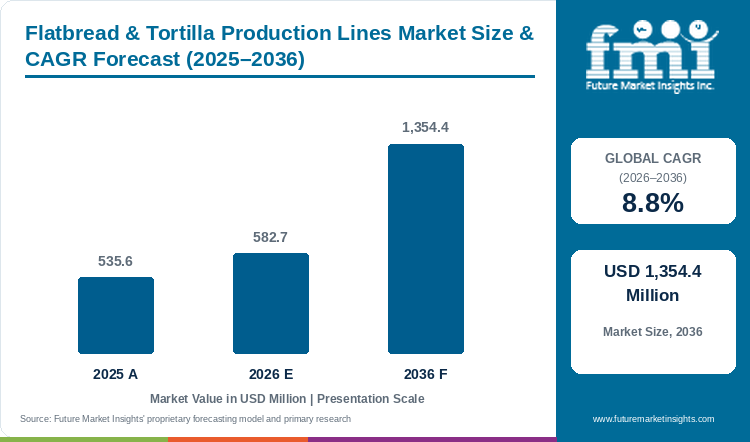
The market was valued at USD 535.6 million in 2025 and is expected to reach USD 582.7 million in 2026. It is projected to reach USD 1,354.4 million by 2036 at a CAGR of 8.8% from 2026 to 2036.
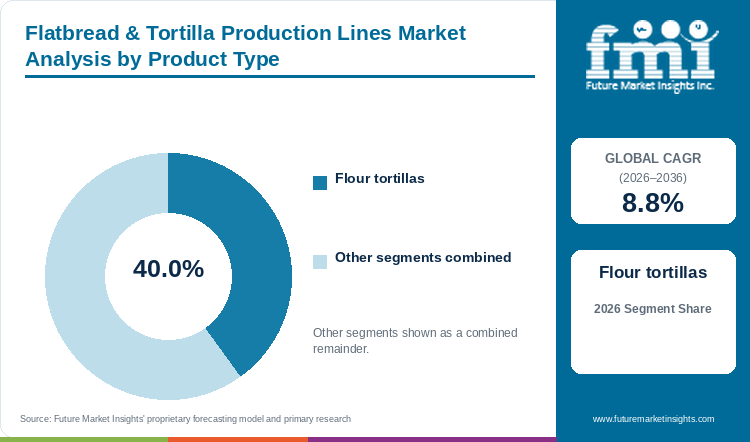
The flatbread and tortilla production lines market was valued at USD 535.6 million in 2025, is estimated at USD 582.7 million in 2026, and is projected to reach USD 1,354.4 million by 2036 at an 8.8% CAGR from 2026 to 2036. In 2026, Flour tortillas account for 40.0% of Product Type demand. The 500-2,000 kg/hr capacity band holds 38.0% of its axis, while Fully automatic / robotic lines represent 46.0% of the Automation Level category. Orders depend on repeatable thickness and oven performance as well as acceptance of factory hygiene and planned downtime. This capital-equipment category reflects manufacturers moving from short, labor-intensive runs to engineered forming and controlled thermal processing. AMF Bakery Systems publishes dedicated tortilla production configurations spanning mixing and high-temperature tunnel ovens.[1] Such integrated designs enable buyers to specify yield and repeatability across the process instead of buying individual machines without interface guarantees. The investment decision still requires a workable payback case based on throughput, scrap, and labor coverage.
Key Market Trends & Insights
- By Product Type: Flour tortillas lead Product Type with a 40.0% share in 2026; industrial buyers can standardize pliable wraps across high-volume runs.
- By Capacity: The 500-2,000 kg/hr class leads Capacity with a 38.0% share in 2026 because it balances scaled output with space and changeover constraints.
- By Automation Level: Fully automatic / robotic holds 46.0% of Automation Level in 2026 as synchronized depositing, transferring, and baking help reduce labor exposure.
Regional Highlights
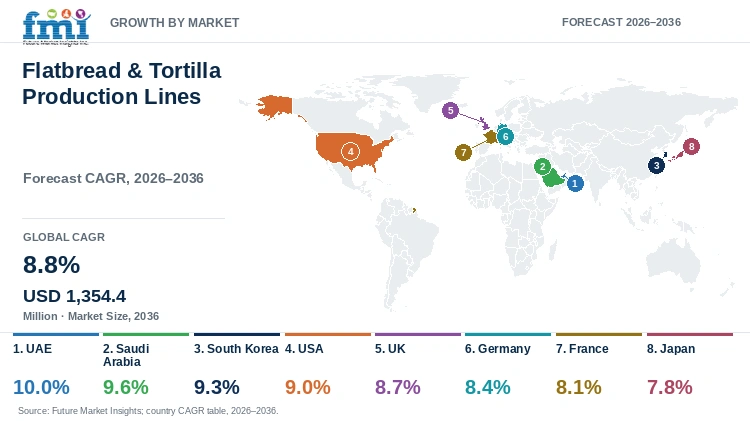
- The UAE leads the flatbread and tortilla line country outlook at 10.0% CAGR for 2026 to 2036, with forming consistency and controlled baking central to equipment selection.
- Saudi Arabia follows at 9.6% and South Korea at 9.3%; Japan's 7.8% forecast is the lowest in the group and suggests a slower pace of line replacement.
Market Size & Forecast
Table 1: Flatbread & Tortilla Production Lines Market Size and Forecast (USD million), 2025 to 2036
| Market size and forecast | Value |
|---|---|
| 2025 Value (actual) | USD 535.6 million |
| Estimated market size in 2026 | USD 582.7 million |
| Projected market size by 2036 | USD 1,354.4 million |
| CAGR (2026-2036) | 8.8% |
The buying environment differs across the profiled countries. The UAE ministry’s 2024 Transform 4.0 initiative emphasized industrial digitalization, while UK manufacturers reported persistent labor vacancies in the Food and Drink Federation’s second-quarter 2025 review.[21][23] In Japan, agricultural ministry reporting describes automation pressure in food manufacturing but underscores the need for hygienic robot integration.[25] These facts describe differing investment conditions rather than measured tortilla-line orders. Suppliers must translate each environment into a factory-specific specification for product changeovers, local service, and validated output before purchase orders follow.
The assessment covers Product Type, Capacity, Automation Level, End User, Sales Channel, and Region for 2026 to 2036. The equipment scope covers configured dough preparation and forming stages. It also includes baking, cooling, and line controls intended for flatbreads or tortillas.
The profiled companies are AMF Bakery Systems, Buhler Group, Baker Perkins, Rademaker, FRITSCH Group, Rheon Automatic Machinery, Mecatherm, Middleby, Reading Bakery Systems, and Kaak Group. Capabilities differ materially by dedicated tortilla-line scope.
Table 2: Supporting Industry Indicators for the Flatbread & Tortilla Production Lines Market
| Indicator | Data point | Why it matters | Source |
|---|---|---|---|
| Tortilla-line ownership | In November 2024, Middleby acquired JC Ford, a specialist in automated flour- and corn-tortilla production systems.[7] | The transaction demonstrated the strategic value attached to full-line tortilla equipment. Middleby subsequently spun off its food-processing operations in July 2026, so the 2024 acquisition does not establish its current ownership of JC Ford.[8] | [7][8] |
| Pilot bakery, June 2025 | In June 2025, AMF Bakery Systems and Puratos announced the opening of a joint pilot bakery in New Jersey.[2] | Commercial bakers can trial ingredients and machinery before full production commitment. The facility supports a de-risking model for integrated projects, although the announcement does not disclose dedicated tortilla capacity or sales. | [2] |
| Manufacturing investment | In July 2026, FRITSCH Group began construction of a new headquarters and manufacturing site in Iphofen, Germany.[5] | Its parent MULTIVAC reported an investment of about EUR 75.0 million and a targeted 2028 completion.[5] The project signals longer-term machine-building commitment; it is not existing 2026 tortilla-line output capacity. | [5] |
Demand Intensity Analysis
Demand is concentrated on lines that protect tortilla texture and output consistency while reducing manual handling through pressing, sheeting, and controlled baking.
Upfront line cost and commissioning risk remain constraints. Recipe variability and sanitation complicate supplier changes. So do spare-parts response and demonstrated yield.
The increase from USD 582.7 million in 2026 to USD 1,354.4 million in 2036 represents USD 771.7 million in additional market revenue over the forecast period.
Table 3: Demand Intensity Metrics for the Flatbread & Tortilla Production Lines Market, 2026 to 2036
| Demand intensity metric | Value | Basis |
|---|---|---|
| Flatbread & Tortilla Production Lines Market value CAGR | 8.8% | Global market value growth, 2026 to 2036 |
| Flour tortillas share in 2026 | 40.0% | Product Type classification |
| 500-2,000 kg/hr share in 2026 | 38.0% | Capacity classification |
| Fully automatic / robotic share in 2026 | 46.0% | Automation Level classification |
| Added revenue through 2036 | USD 771.7 million | Increase in market revenue from 2026 to 2036 |
Analyst Perspective
Equipment spending is most likely to convert when a vendor demonstrates the specified tortilla’s flexibility and shelf-life behavior at the buyer’s target throughput. Local commissioning and spares support are as consequential as nominal line speed.
- Nandini Roy Choudhury, Principal Consultant, FMI
How is the flatbread & tortilla production lines market segmented?
The market is segmented by Product Type, Capacity, Automation Level, End User, and Sales Channel.
Product Type comprises Flour tortillas, Corn tortillas, Low-carb & high-protein, and Flavored. Capacity covers 500-2,000 kg/hr, Below 500 kg/hr, and Above 2,000 kg/hr. Automation Level includes Fully automatic / robotic, Semi-automatic, and Manual. End User includes Industrial bakeries, In-store & retail bakeries, Artisan bakeries, and Foodservice / QSR central kitchens. Sales Channel comprises Direct OEM sales, Dealers & distributors, and Aftermarket & refurbished.
Why do Flour tortillas anchor the Product Type category?
Flour-tortilla recipes support broad wrap and foodservice uses while demanding consistent extensibility after heating and cooling. Buyers therefore favor accurate dough division and pressing or sheeting settings that can reproduce weight and diameter without damaging flexibility. Dedicated equipment can also reduce the trial burden for multiple flour-based recipes. Corn tortillas need different preparation and heating behavior, while specialty formulations can create additional cleaning and texture-control requirements.
- Flour tortillas hold 40.0% of Product Type in 2026; reproducible size and pliability favor line-level recipe control.
- In its dedicated tortilla-system literature, AMF describes flour and corn dough mixing with controlled dough temperature, followed by high-temperature oven configurations for tortilla production.
What positions 500-2,000 kg/hr as the core Capacity band?
A midrange line offers enough output for an industrial supplier serving several distribution channels without assuming continuous mega-plant loading. Smaller bakeries may purchase isolated equipment first, while very large factories face more difficult shutdown coordination and redundancy planning. In the middle band, production managers can align changeovers with distributor order batches and maintain practical access for cleaning. The viable capacity is set by downstream cooling and stacking as much as by dough-feed rates.
- 500-2,000 kg/hr represents 38.0% of Capacity in 2026; its throughput can fit factories balancing variety and utilization.
- Rademaker documents modular flatbread sheeting technology with configurable downstream handling. Its specification illustrates the need to rate a line as an integrated system rather than infer saleable output from one module.
How do Fully automatic / robotic lines shape automation purchasing?
Automatic tortilla lines reduce repeated human contact during dough depositing and shaping. They also automate oven transfer, cooling, and collection. The strongest purchasing case arises where manual interventions undermine product consistency or create hygiene and labor constraints. Yet automation creates new requirements for sensor calibration, fault recovery, and maintenance skills. Buyers should test stoppages and restarts under actual dough conditions rather than assume a nominal speed is sustained through entire shifts.
- Fully automatic / robotic lines represent 46.0% of Automation Level in 2026; synchronized motion limits handoffs and process drift.
- In June 2026 Royal Kaak announced sheeting-line upgrades involving cleaner handling and additional process visibility. The example shows development of automation building blocks, not a verified dedicated tortilla-line launch.
Why are Industrial bakeries the primary End User?
Industrial bakeries control recipes and distribution schedules across multiple accounts, making line availability central to revenue assurance. Their procurement teams typically require documented product trials, hygienic access, and contractual commissioning responsibilities. Once an oven or sheeter becomes a production bottleneck, one integrated project may be less disruptive than incremental fixes that preserve the original constraint. Retail and artisan sites continue to require compact solutions with lower installation complexity.
- Industrial bakeries hold 47.0% of End User in 2026; repeat orders and longer scheduled runs reward predictable output.
- In June 2025, AMF and Puratos opened a pilot bakery for commercial recipe and equipment trials. Producers can use this setting to test whether a proposed flatbread process delivers the required product before committing to a full-scale line.
What makes Direct OEM sales the favored Sales Channel?
A dedicated tortilla system joins dough handling to shaping and heat transfer. A buyer therefore needs clear responsibility for start-up yield and interface faults. Direct OEM contracting is suitable for those acceptance tests and for spare-parts plans embedded in service agreements. Dealers can offer regional access where the plant is small or procurement is modular, while refurbished equipment appeals when capital is limited and compatible components are available.
- Direct OEM sales account for 54.0% of Sales Channel in 2026; integration and commissioning accountability favor direct contracts.
- In April 2026 Reading Bakery Systems expanded EMEA customer-care and regional sales roles. The documented action supports why buyers examine post-installation coverage, although its snack-line business is broader than this category.
What are the drivers, restraints and opportunities in the flatbread & tortilla production lines market?
Stable high-volume flatbread demand supports automation investment, while trial-to-production risk delays capital approval and modular hygienic lines create an opening for lower-risk conversion.
- Driver: Repeatable high-volume output with less manual handling and steadier oven performance.
- Restraint: Capital payback uncertainty arising from validation costs and planned production shutdowns.
- Opportunity: Modular changeover tooling and accessible service that allow more recipes on a verified operating platform.
Industrial tortilla makers have an operational incentive to synchronize dough mixing and forming with baking. A misaligned transfer stage can create stretch defects even when upstream mixing is stable. Middleby disclosed its acquisition of JC Ford in November 2024 and described automated flour- and corn-tortilla systems. That company action illustrates the strategic value placed on specialized equipment, not an industry-wide order statistic. Plant managers will still need to quantify reject reductions and sustained shifts before approving an integrated production line.
The main obstacle sits between the equipment quotation and the first accepted production run. Plants must validate tortilla diameter and bend behavior against specified throughput while meeting cleaning and guarding requirements. ISO 14159 provides hygiene-design guidance for food machinery, while the US Food and Drug Administration sets manufacturing practice requirements that affect US food plants.[27] These obligations can increase engineering work where legacy ovens or conveyors are being retained. A line with an attractive nameplate rate may fail the investment test if sanitation changeovers or maintenance support consume the expected productivity gain.
An addressable opening lies in factories that need flexibility before they need maximum continuous output. Rademaker describes configurable flatbread tooling and rapid product changeovers, including tortilla formats. The commercial opportunity is a line upgrade that can process different dough consistencies without wholesale equipment replacement. Suppliers able to demonstrate stable run time and provide local operator training can reduce perceived execution risk. Where only a dough mixer or oven is evidenced, the commercial offer should be defined as a component integration rather than a proven complete tortilla line.
Which country CAGRs are profiled in the flatbread & tortilla production lines market?
Profiled country growth rates cover 2026 to 2036.
Table 4: Country growth outlook for the Flatbread & Tortilla Production Lines Market
| Country | CAGR |
|---|---|
| UAE | 10.0% |
| Saudi Arabia | 9.6% |
| South Korea | 9.3% |
| USA | 9.0% |
| UK | 8.7% |
| Germany | 8.4% |
| France | 8.1% |
| Japan | 7.8% |
How do country-level CAGRs compare in the flatbread & tortilla production lines market?
The profiled range extends from 10.0% in the UAE to 7.8% in Japan, a 2.2 percentage-point spread. The UAE and Saudi Arabia are at the upper end of this selection. Germany, France, and Japan have more moderate rates. These growth rates describe forecast spending patterns rather than absolute country sales or current installed equipment counts.
- UAE: Manufacturing automation programs and food-security priorities can improve the investment case for digitally monitored bakery assets.
- Saudi Arabia: Food-industrial park investment and large institutional demand centers place a premium on throughput and field-service coverage.
- South Korea: Export-oriented food manufacturing increases attention to adaptable formats and repeatable process controls.
- USA: Established tortilla consumption supports replacement projects focused on labor handling, yields, and uptime.
- UK: Persistent vacancy pressure increases the value of dependable automation while weak operating confidence complicates funding.
- Germany: A large food-processing employment base supports modernized bakery systems and stringent hygiene specifications.
- France: Food-industry production conditions favor flexible bakery equipment, but spending remains project-specific.
- Japan: Hygienic robotic integration and constrained factory labor make serviceable automation particularly relevant.
Only the eight listed countries are individually profiled here. The regional taxonomy later in the report provides wider category coverage without implying a separate CAGR estimate for every constituent market.
Country-wise Analysis
UAE
The UAE has the fastest profiled expansion at a 10.0% CAGR from 2026 to 2036. Its Ministry of Industry and Advanced Technology set out Transform 4.0 in 2024 to accelerate manufacturing digitization. The federal food-security strategy also prioritizes a more resilient food system. Both are enabling conditions rather than verified tortilla equipment purchases. The relevant buyers include bakery producers supplying foodservice distribution and private-label retail channels. Line proposals need to address high ambient temperatures, food-safety control, and local servicing. Automation suppliers can differentiate through validated oven zoning and accessible spares instead of relying only on production-speed claims.
Saudi Arabia
Saudi Arabia combines industrial-policy support with demand from institutional and large foodservice networks. The profile assigns 9.6% CAGR for 2026 to 2036. In May 2026 the Saudi Press Agency reported hundreds of food factories in the Makkah region and additional industrial development planned for Jeddah. This is a broad food-manufacturing indicator, not a flatbread-line order book. Tortilla and flatbread investments would be expected to compete against other bakery capital projects for utilities and plant-floor space. Buyers should prioritize hygienic design and local parts availability where a centralized kitchen serves widely dispersed delivery points.
South Korea
Manufacturers in South Korea can use flexible dough-processing assets to serve domestic convenience channels and export variants. A 9.3% CAGR is profiled for 2026 to 2036. The agriculture ministry reported record K-Food+ exports for 2025 in January 2026, supporting the wider setting of export-oriented food production. Those exports are not evidence of tortilla-specific volumes. Suppliers entering the country must demonstrate that their tooling handles product dimensions and formulations chosen by local clients. Demonstrated restart reliability and operator-language support can matter more than a large theoretical capacity range.
USA
The USA provides a mature operating environment for flour- and corn-tortilla equipment. Its profile is 9.0% CAGR from 2026 to 2036. The US Census Bureau reported a Hispanic population of about 68 million as of July 2024, providing demographic context rather than a direct measure of tortilla consumption. Equipment requirements reflect both long-run industrial plants and suppliers serving restaurants or retail. A replacement line can be justified through fewer weight deviations and reduced manual transfers. FDA hygiene obligations also shape how manufacturers evaluate cleaning access and thermal control during factory acceptance testing.[18]
UK
Labor availability is a material procurement variable for UK bakery operators. Over 2026 to 2036, the UK rate is 8.7%. In its second-quarter 2025 report the Food and Drink Federation documented food and drink manufacturing vacancy pressure above the broader manufacturing benchmark. A supplier may therefore win attention by eliminating repetitive dough transfer and packing handoffs. That does not remove pressure on capital budgets or the need for skilled maintenance. Purchase approvals will depend on whether equipment can deliver output across mixed wrap formats without expensive changes to the surrounding factory layout.
Germany
Germany is profiled at an 8.4% CAGR from 2026 to 2036. Destatis reported in April 2025 that food-industry employment had increased over the preceding decade. This indicates the size of the country’s industrial food-processing ecosystem, not its dedicated tortilla equipment base. Buyers may place greater emphasis on documented safety systems and maintainable line components alongside energy use. Local machinery suppliers already active in dough processing can support engineering discussions, but scope must distinguish tortilla forming from conventional bread lines. Acceptance tests should cover sanitation access and product uniformity at planned shift duration.
France
French industrial food processors serve bakery and prepared-food applications with differing product runs. The 2026 to 2036 outlook assigns France an 8.1% CAGR. INSEE food-industry series published in July 2026 provides evidence of activity in the wider agro-food sector, but does not isolate tortilla equipment demand. Local integration capabilities may help buyers adapt baking and cooling modules to flatbread specifications. The commercial barrier is conversion of a bakery-system reference into evidence for the exact dough and texture required. A credible offer should specify the tested formulation and demonstrate cleaning procedures before site commissioning.
Japan
Japan has a 7.8% CAGR profile from 2026 to 2036, the lowest in the covered group. The Japanese agricultural ministry’s fiscal 2024 white paper describes food manufacturing productivity and ongoing labor-saving efforts. Such evidence supports interest in safe automation but does not document tortilla purchases. Pita and other flatbread sheeting configurations may offer a technical starting point for local machinery qualification. Production managers are likely to examine footprint efficiency, cleaning access, and service response where factory labor is constrained. The path to a contract is a recipe-specific demonstration of yield rather than an assertion of universal equipment compatibility.
Who are the notable companies in the flatbread & tortilla production lines market?
AMF Bakery Systems, Buhler Group, Baker Perkins, Rademaker, FRITSCH Group, Rheon Automatic Machinery, Mecatherm, Middleby, Reading Bakery Systems, and Kaak Group are the notable companies profiled in this market.
Competitive roles vary sharply between companies offering documented tortilla forming and firms supplying process stages common to other bakery systems. AMF Bakery Systems and Rademaker publish explicit tortilla or flatbread production solutions. FRITSCH Group provides tortilla-relevant forming technology, while Rheon Automatic Machinery lists pita within its stress-free sheeting applications. Reading Bakery Systems contributes continuous mixing expertise but has substantial snack-system exposure. Kaak Group, Baker Perkins, and Mecatherm demonstrate bakery process integration with direct tortilla-line scope less clearly documented. Buhler Group supports upstream corn preparation rather than finished flatbread manufacture. Middleby acquired tortilla specialist JC Ford in 2024, then completed the spin-off of its food-processing business in July 2026. This makes its current participation principally a historical ownership reference.
- Dedicated flatbread forming and tortilla process solutions: AMF Bakery Systems, Rademaker, FRITSCH Group, and Rheon Automatic Machinery.
- Shared-process bakery engineering and equipment modules: Baker Perkins, Mecatherm, Reading Bakery Systems, and Kaak Group. Direct dedicated-line participation should be qualified case by case.
- Upstream and historical context: Buhler Group provides corn-processing technology outside the finished-line scope; Middleby is retained for documented historic tortilla-system ownership before the 2026 separation.
Competitive Benchmarking: Flatbread & Tortilla Production Lines Market
Table 5: Company capabilities for the Flatbread & Tortilla Production Lines Market
| Company | Flatbread Forming | Integrated Process Modules | Trial / Support Tools | Geographic Reach |
|---|---|---|---|---|
| AMF Bakery Systems | High | High | High | North America; international equipment offerings |
| Buhler Group | Unscored | Unscored | Unscored | Upstream corn-masa projects; dedicated-line reach unverified |
| Baker Perkins | Unscored | Medium | Medium | Europe and North America via wider Coperion bakery network |
| Rademaker | High | High | Medium | Europe; international industrial flatbread sales channels |
| FRITSCH Group | High | Medium | Medium | Germany; international MULTIVAC network |
| Rheon Automatic Machinery | Medium | Unscored | Medium | Japan, North America and Europe for bakery equipment |
| Mecatherm | Unscored | Medium | High | France; international bakery projects, tortilla scope unverified |
| Middleby | Unscored | Unscored | Unscored | Historical U.S. JC Ford ownership; spun off in July 2026 |
| Reading Bakery Systems | Unscored | Medium | High | United States and EMEA customer-support network |
| Kaak Group | Medium | High | High | Europe, Americas and Africa for broad bakery-line equipment |
Scoring basis: Flatbread Forming rates documented shaping equipment suitable for tortilla or comparable soft flatbread; High reflects dedicated offerings and Medium narrower documented applications. Integrated Process Modules rates breadth of connected dough and thermal stages, with High indicating established multi-stage bakery integration and Medium a more limited fit to this market. Trial / Support Tools covers verified pilot capability, process monitoring, and after-sales infrastructure. High indicates broad documented support and Medium partial coverage. Low means a documented limitation, not absence of evidence; unavailable public information remains Unscored. Ratings indicate documented capability, not sales position or contractual qualification.
Key Developments in the Flatbread & Tortilla Production Lines Market
In November 2024, Middleby acquired JC Ford, a specialist in automated flour- and corn-tortilla production systems.[7] The transaction demonstrated the strategic value attached to full-line tortilla equipment. Middleby subsequently spun off its food-processing operations in July 2026, so the 2024 acquisition does not establish its current ownership of JC Ford.[8]
In June 2025, AMF Bakery Systems and Puratos announced the opening of a joint pilot bakery in New Jersey.[2] Commercial bakers can trial ingredients and machinery before full production commitment. The facility supports a de-risking model for integrated projects, although the announcement does not disclose dedicated tortilla capacity or sales.
In July 2026, FRITSCH Group began construction of a new headquarters and manufacturing site in Iphofen, Germany.[5] Its parent MULTIVAC reported an investment of about EUR 75.0 million and a targeted 2028 completion.[5] The project signals longer-term machine-building commitment; it is not existing 2026 tortilla-line output capacity.
Key Players in the Flatbread & Tortilla Production Lines Market
Dedicated Tortilla and Flatbread Forming Platforms
- AMF Bakery Systems
- Rademaker
- FRITSCH Group
- Rheon Automatic Machinery
Bakery Process Integration and Supporting Modules
- Baker Perkins
- Mecatherm
- Reading Bakery Systems
- Kaak Group
Upstream Equipment and Historic Tortilla-System Ownership
- Buhler Group
- Middleby
Flatbread & Tortilla Production Lines Market - Report Scope
Table 6: Report scope for the Flatbread & Tortilla Production Lines Market
| Coverage field | Report scope |
|---|---|
| Market breakdown | Product Type; Capacity; Automation Level; End User; Sales Channel; Region. |
| Quantitative Units | USD million |
| Market Definition | Revenue from capital sales of purpose-built tortilla and flatbread production lines and allocable bundled dough-preparation, forming, baking, cooling, and control modules. Includes relevant refurbished line transactions but excludes finished-product sales, standalone masa milling, tortilla-chip lines, unrelated bakery or packaging equipment, and separately billed generic service activity. Do not double-count modules within complete-line projects. |
| Regions Covered | North America, Latin America, Western Europe, Eastern Europe, East Asia, South Asia and Pacific, Middle East and Africa |
| Countries Covered | UAE, Saudi Arabia, South Korea, USA, UK, Germany, France, Japan |
| Key Companies Profiled | AMF Bakery Systems, Buhler Group, Baker Perkins, Rademaker, FRITSCH Group, Rheon Automatic Machinery, Mecatherm, Middleby, Reading Bakery Systems, Kaak Group |
| Forecast Period | 2026 to 2036 |
| Approach | Primary and secondary research with market triangulation. |
Flatbread & Tortilla Production Lines Market - Research Methodology
Table 7: Research approach for the Flatbread & Tortilla Production Lines Market
| Method | Approach |
|---|---|
| Primary Research | FMI analysts gathered input from manufacturers, service providers, technology developers, distributors, end users, procurement teams and subject-matter experts. Interviews examined purchasing decisions, product or service evaluation, adoption barriers, approval requirements, pricing considerations and expectations for technical or commercial support. Respondents were also asked what evidence is required before a trial, pilot, or initial order develops into regular purchasing. |
| Desk Research | Desk research covered government statistics, regulatory publications, trade data, industry associations, technical literature, standards, company filings, product information and official corporate announcements. Sources were reviewed for relevance, publication date, geographic coverage and consistency with the defined market scope. Claims relating to performance, applications, approvals, capacity, investment and commercial activity were retained only when supported by credible public evidence. |
| Market Sizing and Forecasting | The market model combined the baseline value with historical performance, segment structure, pricing and volume indicators, adoption levels, company participation and country-level demand conditions. Forecast assumptions considered economic activity, investment trends, regulatory developments, technology adoption, purchasing cycles, supply availability and barriers to wider market use. Segment and regional estimates were reconciled before the final market total was calculated. |
| Data Validation | Estimates were checked against multiple independent indicators, including public data, company activity, trade patterns, industry developments and findings from primary interviews. Validation also tested whether products, services, applications and company revenues fell within the defined market boundaries. Adjacent categories, unsupported claims, overlapping revenues and activities without direct market relevance were excluded to reduce double counting and maintain consistency across segments and countries. |
Flatbread & Tortilla Production Lines Market by Segments
Product Type
- Flour tortillas
- Corn tortillas
- Low-carb & high-protein
- Flavored
Capacity
- 500-2,000 kg/hr
- Below 500 kg/hr
- Above 2,000 kg/hr
Automation Level
- Fully automatic / robotic
- Semi-automatic
- Manual
End User
- Industrial bakeries
- In-store & retail bakeries
- Artisan bakeries
- Foodservice / QSR central kitchens
Sales Channel
- Direct OEM sales
- Dealers & distributors
- Aftermarket & refurbished
Flatbread & Tortilla Production Lines Market by Region
- North America
- United States
- Canada
- Latin America
- Brazil
- Mexico
- Argentina
- Chile
- Western Europe
- Germany
- France
- United Kingdom
- Italy
- Spain
- Benelux
- Nordics
- Eastern Europe
- Poland
- Czech Republic
- Romania
- Hungary
- East Asia
- China
- Japan
- South Korea
- South Asia and Pacific
- India
- ASEAN
- Australia and New Zealand
- Middle East and Africa
- GCC Countries
- South Africa
- Türkiye
- Israel
Research Sources and Bibliography
- [1] AMF Bakery Systems (n.d.). Tortilla Production Solutions.
- [2] AMF Bakery Systems (2025, June 9). AMF and Puratos Launch Joint Pilot Bakery Facility to Accelerate Commercial Baking Innovation.
- [3] Rademaker (n.d.). Flatbread Line.
- [4] FRITSCH (n.d.). Fiesta Mexicana with Tortillas.
- [5] MULTIVAC Group (2026, July 20). Groundbreaking Ceremony for New Company Headquarters.
- [6] Rheon Automatic Machinery (n.d.). V4 Stress-Free Sheeting Line.
- [7] The Middleby Corporation (2024, November 1). Middleby Acquires JC Ford, Leader in Chip and Tortilla Production Systems.
- [8] The Middleby Corporation (2026, July 6). Middleby Completes Spin-off of Midera Food Processing.
- [9] Royal Kaak (2026, June 8). Royal Kaak Introduces New Innovations for DrieM Sheeting Lines.
- [10] MECATHERM (2025, May 18). MECATHERM Facilitates Production Line Operations with MyMECATHERM Digital Platform.
- [11] MECATHERM (n.d.). Mecaflex Line.
- [12] Coperion Food, Health & Nutrition (2025, April). Coperion: Unifying Expertise for the Baking Industry.
- [13] Reading Bakery Systems (n.d.). Improving Hydration During the Mixing Process.
- [14] Reading Bakery Systems (2026, April 9). Reading Bakery Systems Expands Customer Care and Sales Leadership in EMEA.
- [15] Reading Bakery Systems (2026, August 31). Reading Bakery Systems Promotes Matt Risser to Director of Sales, Exact Mixing.
- [16] Buhler Group (2022, March 17). Bühler Hands Over First Prime Masa Plant in India.
- [17] U.S. Census Bureau (2025, August 27). National Hispanic Heritage Month: 2025.
- [18] U.S. Food and Drug Administration (n.d.). Current Good Manufacturing Practices (CGMPs) for Food and Dietary Supplements.
- [19] Federal Statistical Office of Germany (Destatis) (2025, April 2). Beschäftigung in der Nahrungsmittelindustrie im Zehnjahresvergleich gestiegen.
- [20] INSEE (2026, July 21). Indicateurs macroéconomiques de l’industrie agroalimentaire.
- [21] Food and Drink Federation (2025, August 27). State of Industry Report: Q2 2025.
- [22] Saudi Press Agency (2026, May 24). Ministry of Industry and Mineral Resources: Food Industry Factories in Makkah Region.
- [23] UAE Ministry of Industry and Advanced Technology (2024, June 10). Transform 4.0 Initiative to Advance Industrial Digitalization.
- [24] United Arab Emirates Government (2024, December 30). National Food Security Strategy 2051.
- [25] Japan Ministry of Agriculture, Forestry and Fisheries (2025). FY2024 Annual Report on Food, Agriculture and Rural Areas: Food Industry.
- [26] Republic of Korea Ministry of Agriculture, Food and Rural Affairs (2026, January 20). K-Food+ Exports Set New Record in 2025.
- [27] International Organization for Standardization (2002). ISO 14159:2002: Safety of Machinery: Hygiene Requirements for the Design of Machinery.
This Report Answers
- What is the projected value of the flatbread & tortilla production lines market in 2026 and 2036?
- Which industrial and workforce pressures support demand for automated tortilla production?
- Why do Flour tortillas lead the Product Type mix?
- Why is the 500-2,000 kg/hr class prominent in Capacity demand?
- How do the eight profiled country CAGRs differ across 2026 to 2036?
- Which profiled companies provide dedicated lines and which support only adjacent process stages?
- What limits adoption or switching between qualified equipment suppliers?
- What should purchasers test before commissioning a flatbread or tortilla line?
Frequently Asked Questions
How big is the flatbread & tortilla production lines market in 2026 and what is expected by 2036?
The market is valued at USD 582.7 million in 2026 and is forecast to reach USD 1,354.4 million in 2036. The projection concerns production-line equipment rather than finished tortillas or other baked foods.
What is the growth rate of the flatbread & tortilla production lines market from 2026 to 2036?
The projected CAGR is 8.8% from 2026 to 2036. Actual equipment purchases depend on buyer qualification and the timing of plant capital expenditure.
Which Product Type segment leads in 2026?
Flour tortillas lead Product Type with 40.0% in 2026. The format places a premium on consistent dough handling and a pliable finished product.
Which Capacity segment accounts for the largest share in 2026?
The 500-2,000 kg/hr class leads Capacity with 38.0% in 2026. It serves factories seeking industrial output without assuming constant utilization of the largest line designs.
Which profiled countries have the highest CAGR from 2026 to 2036?
The UAE leads at 10.0%, followed by Saudi Arabia at 9.6% and South Korea at 9.3%. These are growth rates and do not rank countries by current market size.
Which companies are profiled in the flatbread & tortilla production lines market?
The profiled companies are AMF Bakery Systems, Buhler Group, Baker Perkins, Rademaker, FRITSCH Group, Rheon Automatic Machinery, Mecatherm, Middleby, Reading Bakery Systems, and Kaak Group. Their publicly documented roles extend from dedicated tortilla equipment to broader bakery modules and historical ownership exposure.
Preview the report firsthand - request a free sample
Get SampleGet the brochure for pricing and purchase details.
Get PDFTable of Content
- Key Takeaways
- Market Size and CAGR
- Top Growth Driver
- Fastest Growing Segment
- Leading Region
- Key Companies
- Emerging Opportunities
- Executive Summary
- Global Market Outlook
- Demand-side Trends
- Supply-side Trends
- Technology Roadmap Analysis
- Analysis and Recommendations
- Analyst Perspective (What is happening? Why now? What should investors know?)
- Key Questions Answered
- How large is the market?
- What is the CAGR?
- What are key trends?
- Which region dominates?
- Who are the leaders?
- Market Overview
- Market Coverage / Taxonomy
- Market Definition / Scope / Limitations
- Research Methodology
- Chapter Orientation
- Analytical Lens and Working Hypotheses
- Market Structure, Signals, and Trend Drivers
- Benchmarking and Cross-market Comparability
- Market Sizing, Forecasting, and Opportunity Mapping
- Research Design and Evidence Framework
- Desk Research Programme (Secondary Evidence)
- Expert Input and Fieldwork (Primary Evidence)
- Tooling, Models, and Reference Databases
- Data Engineering and Model Build
- Quality Assurance and Audit Trail
- Market Background
- Market Dynamics (Drivers, Restraints, Opportunity, Trends)
- Scenario Forecast (Optimistic, Likely, Conservative)
- Impact Analysis
- AI Impact
- Sustainability Impact
- Regulatory Impact
- Technology Impact
- Consumer / Buyer Analysis
- Purchase Drivers
- Adoption Barriers
- Buyer Journey
- Opportunity Map Analysis
- Product Life Cycle Analysis
- Supply Chain Analysis
- Investment Feasibility Matrix
- Value Chain Analysis
- PESTLE and Porter's Analysis
- Regulatory Landscape
- Regional Parent Market Outlook
- Production and Consumption Statistics
- Import and Export Statistics
- Global Market Analysis and Forecast, 2021 to 2036
- Historical Market Size Value (USD Million) Analysis, 2021 to 2025
- Current and Future Market Size Value (USD Million) Projections, 2026 to 2036
- Y-o-Y Growth Trend Analysis
- Absolute $ Opportunity Analysis
- Global Market Pricing Analysis, 2021 to 2036
- Global Market Analysis and Forecast, By Product Type, 2021 to 2036
- Introduction / Key Findings
- Historical Market Size Value (USD Million) Analysis By Product Type, 2021 to 2025
- Current and Future Market Size Value (USD Million) Analysis and Forecast By Product Type, 2026 to 2036
- Flour tortillas
- Corn tortillas
- Low-carb & high-protein
- Flavored
- Y-o-Y Growth Trend Analysis By Product Type, 2021 to 2025
- Absolute $ Opportunity Analysis By Product Type, 2026 to 2036
- Global Market Analysis and Forecast, By Capacity, 2021 to 2036
- Introduction / Key Findings
- Historical Market Size Value (USD Million) Analysis By Capacity, 2021 to 2025
- Current and Future Market Size Value (USD Million) Analysis and Forecast By Capacity, 2026 to 2036
- 500-2,000 kg/hr
- Below 500 kg/hr
- Above 2,000 kg/hr
- Y-o-Y Growth Trend Analysis By Capacity, 2021 to 2025
- Absolute $ Opportunity Analysis By Capacity, 2026 to 2036
- Global Market Analysis and Forecast, By Automation Level, 2021 to 2036
- Introduction / Key Findings
- Historical Market Size Value (USD Million) Analysis By Automation Level, 2021 to 2025
- Current and Future Market Size Value (USD Million) Analysis and Forecast By Automation Level, 2026 to 2036
- Fully automatic / robotic
- Semi-automatic
- Manual
- Y-o-Y Growth Trend Analysis By Automation Level, 2021 to 2025
- Absolute $ Opportunity Analysis By Automation Level, 2026 to 2036
- Global Market Analysis and Forecast, By End User, 2021 to 2036
- Introduction / Key Findings
- Historical Market Size Value (USD Million) Analysis By End User, 2021 to 2025
- Current and Future Market Size Value (USD Million) Analysis and Forecast By End User, 2026 to 2036
- Industrial bakeries
- In-store & retail bakeries
- Artisan bakeries
- Foodservice / QSR central kitchens
- Y-o-Y Growth Trend Analysis By End User, 2021 to 2025
- Absolute $ Opportunity Analysis By End User, 2026 to 2036
- Global Market Analysis and Forecast, By Sales Channel, 2021 to 2036
- Introduction / Key Findings
- Historical Market Size Value (USD Million) Analysis By Sales Channel, 2021 to 2025
- Current and Future Market Size Value (USD Million) Analysis and Forecast By Sales Channel, 2026 to 2036
- Direct OEM sales
- Dealers & distributors
- Aftermarket & refurbished
- Y-o-Y Growth Trend Analysis By Sales Channel, 2021 to 2025
- Absolute $ Opportunity Analysis By Sales Channel, 2026 to 2036
- Global Market Analysis and Forecast, By Region, 2021 to 2036
- Introduction
- Historical Market Size Value (USD Million) Analysis By Region, 2021 to 2025
- Current Market Size Value (USD Million) Analysis and Forecast By Region, 2026 to 2036
- North America
- Latin America
- Western Europe
- Eastern Europe
- East Asia
- South Asia and Pacific
- Middle East and Africa
- Market Attractiveness Analysis By Region
- North America Market Analysis and Forecast, By Country, 2021 to 2036
- Historical Market Size Value (USD Million) Trend Analysis By Market Taxonomy, 2021 to 2025
- Market Size Value (USD Million) Forecast By Market Taxonomy, 2026 to 2036
- By Country
- United States
- Canada
- By Product Type
- By Capacity
- By Automation Level
- By End User
- By Sales Channel
- By Country
- Market Attractiveness Analysis
- By Country
- By Product Type
- By Capacity
- By Automation Level
- By End User
- By Sales Channel
- Key Takeaways
- Latin America Market Analysis and Forecast, By Country
- Historical Market Size Value (USD Million) Trend Analysis By Market Taxonomy, 2021 to 2025
- Market Size Value (USD Million) Forecast By Market Taxonomy, 2026 to 2036
- By Country
- Brazil
- Mexico
- Argentina
- Chile
- By Product Type
- By Capacity
- By Automation Level
- By End User
- By Sales Channel
- By Country
- Market Attractiveness Analysis
- By Country
- By Product Type
- By Capacity
- By Automation Level
- By End User
- By Sales Channel
- Key Takeaways
- Western Europe Market Analysis and Forecast, By Country
- Historical Market Size Value (USD Million) Trend Analysis By Market Taxonomy, 2021 to 2025
- Market Size Value (USD Million) Forecast By Market Taxonomy, 2026 to 2036
- By Country
- Germany
- France
- United Kingdom
- Italy
- Spain
- Benelux
- Nordics
- By Product Type
- By Capacity
- By Automation Level
- By End User
- By Sales Channel
- By Country
- Market Attractiveness Analysis
- By Country
- By Product Type
- By Capacity
- By Automation Level
- By End User
- By Sales Channel
- Key Takeaways
- Eastern Europe Market Analysis and Forecast, By Country
- Historical Market Size Value (USD Million) Trend Analysis By Market Taxonomy, 2021 to 2025
- Market Size Value (USD Million) Forecast By Market Taxonomy, 2026 to 2036
- By Country
- Poland
- Czech Republic
- Romania
- Hungary
- By Product Type
- By Capacity
- By Automation Level
- By End User
- By Sales Channel
- By Country
- Market Attractiveness Analysis
- By Country
- By Product Type
- By Capacity
- By Automation Level
- By End User
- By Sales Channel
- Key Takeaways
- East Asia Market Analysis and Forecast, By Country
- Historical Market Size Value (USD Million) Trend Analysis By Market Taxonomy, 2021 to 2025
- Market Size Value (USD Million) Forecast By Market Taxonomy, 2026 to 2036
- By Country
- China
- Japan
- South Korea
- By Product Type
- By Capacity
- By Automation Level
- By End User
- By Sales Channel
- By Country
- Market Attractiveness Analysis
- By Country
- By Product Type
- By Capacity
- By Automation Level
- By End User
- By Sales Channel
- Key Takeaways
- South Asia and Pacific Market Analysis and Forecast, By Country
- Historical Market Size Value (USD Million) Trend Analysis By Market Taxonomy, 2021 to 2025
- Market Size Value (USD Million) Forecast By Market Taxonomy, 2026 to 2036
- By Country
- India
- ASEAN
- Australia and New Zealand
- By Product Type
- By Capacity
- By Automation Level
- By End User
- By Sales Channel
- By Country
- Market Attractiveness Analysis
- By Country
- By Product Type
- By Capacity
- By Automation Level
- By End User
- By Sales Channel
- Key Takeaways
- Middle East and Africa Market Analysis and Forecast, By Country
- Historical Market Size Value (USD Million) Trend Analysis By Market Taxonomy, 2021 to 2025
- Market Size Value (USD Million) Forecast By Market Taxonomy, 2026 to 2036
- By Country
- GCC Countries
- South Africa
- Türkiye
- Israel
- By Product Type
- By Capacity
- By Automation Level
- By End User
- By Sales Channel
- By Country
- Market Attractiveness Analysis
- By Country
- By Product Type
- By Capacity
- By Automation Level
- By End User
- By Sales Channel
- Key Takeaways
- Key Countries Market Analysis
- United States
- Pricing Analysis
- Market Share Analysis, 2025
- By Product Type
- By Capacity
- By Automation Level
- By End User
- By Sales Channel
- Canada
- Pricing Analysis
- Market Share Analysis, 2025
- By Product Type
- By Capacity
- By Automation Level
- By End User
- By Sales Channel
- Mexico
- Pricing Analysis
- Market Share Analysis, 2025
- By Product Type
- By Capacity
- By Automation Level
- By End User
- By Sales Channel
- Brazil
- Pricing Analysis
- Market Share Analysis, 2025
- By Product Type
- By Capacity
- By Automation Level
- By End User
- By Sales Channel
- Chile
- Pricing Analysis
- Market Share Analysis, 2025
- By Product Type
- By Capacity
- By Automation Level
- By End User
- By Sales Channel
- Germany
- Pricing Analysis
- Market Share Analysis, 2025
- By Product Type
- By Capacity
- By Automation Level
- By End User
- By Sales Channel
- United Kingdom
- Pricing Analysis
- Market Share Analysis, 2025
- By Product Type
- By Capacity
- By Automation Level
- By End User
- By Sales Channel
- Italy
- Pricing Analysis
- Market Share Analysis, 2025
- By Product Type
- By Capacity
- By Automation Level
- By End User
- By Sales Channel
- Spain
- Pricing Analysis
- Market Share Analysis, 2025
- By Product Type
- By Capacity
- By Automation Level
- By End User
- By Sales Channel
- France
- Pricing Analysis
- Market Share Analysis, 2025
- By Product Type
- By Capacity
- By Automation Level
- By End User
- By Sales Channel
- India
- Pricing Analysis
- Market Share Analysis, 2025
- By Product Type
- By Capacity
- By Automation Level
- By End User
- By Sales Channel
- ASEAN
- Pricing Analysis
- Market Share Analysis, 2025
- By Product Type
- By Capacity
- By Automation Level
- By End User
- By Sales Channel
- Australia and New Zealand
- Pricing Analysis
- Market Share Analysis, 2025
- By Product Type
- By Capacity
- By Automation Level
- By End User
- By Sales Channel
- China
- Pricing Analysis
- Market Share Analysis, 2025
- By Product Type
- By Capacity
- By Automation Level
- By End User
- By Sales Channel
- Japan
- Pricing Analysis
- Market Share Analysis, 2025
- By Product Type
- By Capacity
- By Automation Level
- By End User
- By Sales Channel
- South Korea
- Pricing Analysis
- Market Share Analysis, 2025
- By Product Type
- By Capacity
- By Automation Level
- By End User
- By Sales Channel
- Poland
- Pricing Analysis
- Market Share Analysis, 2025
- By Product Type
- By Capacity
- By Automation Level
- By End User
- By Sales Channel
- Hungary
- Pricing Analysis
- Market Share Analysis, 2025
- By Product Type
- By Capacity
- By Automation Level
- By End User
- By Sales Channel
- Türkiye
- Pricing Analysis
- Market Share Analysis, 2025
- By Product Type
- By Capacity
- By Automation Level
- By End User
- By Sales Channel
- South Africa
- Pricing Analysis
- Market Share Analysis, 2025
- By Product Type
- By Capacity
- By Automation Level
- By End User
- By Sales Channel
- UAE
- Pricing Analysis
- Market Share Analysis, 2025
- By Product Type
- By Capacity
- By Automation Level
- By End User
- By Sales Channel
- Saudi Arabia
- Pricing Analysis
- Market Share Analysis, 2025
- By Product Type
- By Capacity
- By Automation Level
- By End User
- By Sales Channel
- United States
- Market Structure Analysis
- Competition Dashboard
- Competition Benchmarking
- Market Share Analysis of Top Players
- By Regional
- By Product Type
- By Capacity
- By Automation Level
- By End User
- By Sales Channel
- Emerging Startups
- Innovation Benchmarking
- Competition Analysis
- Competition Deep Dive
- AMF Bakery Systems
- Overview
- Product Portfolio
- Profitability by Market Segments
- Sales Footprint
- Strategy Overview
- Marketing Strategy
- Product Strategy
- Channel Strategy
- Buhler Group
- Baker Perkins
- Rademaker
- FRITSCH Group
- Rheon Automatic Machinery
- Mecatherm
- Middleby
- Reading Bakery Systems
- Kaak Group
- AMF Bakery Systems
- Case Studies
- Success Stories
- Recent Developments
- Competition Deep Dive
- Assumptions & Acronyms Used


