

- Market Size (2026)
- USD 5.6 Bn
- Forecast (2036)
- USD 45.1 Bn
- CAGR (2026 to 2036)
- 23.2%
How big is AI in Food & Ingredient Innovation Market in 2026?
USD 5.6 billion in 2026 and USD 45.1 billion by 2036 at a 23.2% CAGR.
Demand for AI in food & ingredient innovation is projected to expand at 23.2% CAGR between 2026 and 2036, increasing valuation from USD 5.6 billion in 2026 to USD 45.1 billion by 2036. Repeated R&D use turns food technology investment into recurring formulation work across manufacturer portfolios. dsm-firmenich reported in February 2026 that its AI tools assisted formulation development and generated provisional flavor formulas across operating business units. Repeated operating use ties model spending to product-development decisions that recur across multiple briefs instead of isolated experiments.
Country conversion diverges across integrated food ingredients workflows even with similar AI access. China is expected to rise at 20.5% CAGR versus Germany at 19.3% CAGR between 2026 and 2036. In June 2025, China’s Ministry of Industry and Information Technology reported 72.8% penetration of digital R&D design tools among key food enterprises. The wider digital base lowers basic integration work for Chinese manufacturers, whereas German adoption depends more on proving model recommendations inside bioprocess and application settings.
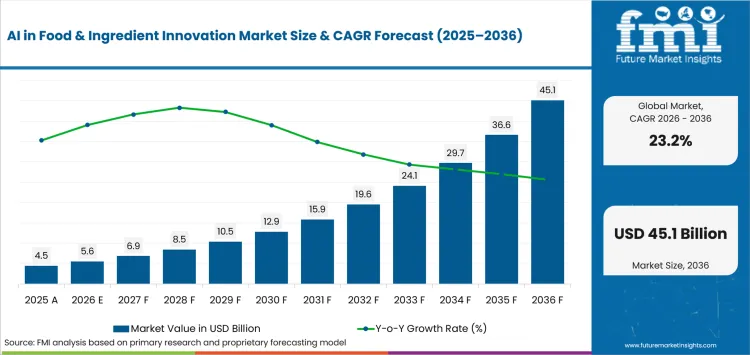
Key Takeaways of AI In Food Ingredient Innovation Market
- Food R&D teams increase AI spending as repeated screening decisions reduce expensive physical iterations without removing laboratory validation requirements.
- Based on application, formulation is projected to account for 41.0% in 2026 due to AI ranking recipe and ingredient options ahead of costly pilot work.
- By technology, ML is estimated to hold 51.8% in 2026 owing to predictive models fitting established screening and property-estimation workflows.
- The end user category is forecast to be led by food manufacturers at 38.0% share in 2026 due to control over commercial formulas and scale-up accountability.
- Poor data lineage and weak physical evidence slow adoption by making model recommendations harder to reproduce during technical and regulatory qualification.
- IFF, Givaudan, dsm-firmenich, Ingredion, Brightseed, NotCo AI, Shiru and Barry Callebaut are some companies profiled across the competitive analysis.
Analyst Perspective
"Food manufacturers should judge AI systems by how much they narrow a formulation search without weakening evidence needed for pilot production. Repeat use depends on recommendations surviving sensory review and process testing across more than one product brief."
- Nandini Roy Choudhury, Principal Consultant, Future Market Insights
How is the AI In Food Ingredient Innovation Market segmented?
The AI in food & ingredient innovation market is segmented by application, technology, end user and region.
Application separates formulation and predictive sensory work from supply chain and sustainability use cases across food innovation workflows. Technology covers ML and generative AI alongside computer vision as distinct methods used for screening and prediction tasks. End user categories include food manufacturers and foodservice operators plus retailers and household users that control different implementation routes.
Why does formulation lead demand within the application category?
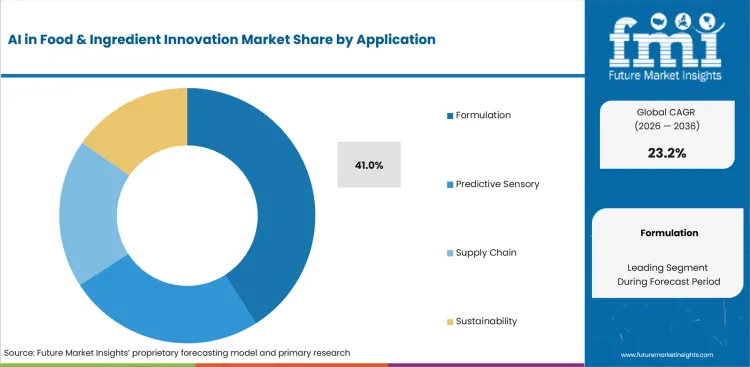
Barry Callebaut’s November 2025 agreement with NotCo AI puts AI-guided recipe development inside commercial chocolate work using ingredient and manufacturing data. The arrangement gives formulation teams a defined commercial brief, but digital recommendations must survive sensory review and pilot processing across renovation and new-product programs to reach commercial production at scale.
- By application, formulation is estimated to hold 41.0% in 2026 owing to candidate ranking that narrows recipe options ahead of bench testing.
- Food additive reformulation adds recurring work as ingredient substitutions can alter texture and processing behavior that laboratories must validate in commercial recipes.
Why does ML lead demand within the technology category?
ML gives food R&D teams a predictive layer for ranking ingredient candidates across datasets too large for manual screening. Brightseed expanded its proprietary bioactive dataset to 21 million natural compounds in April 2026 and tied that scale to its AI-native discovery platform. Larger libraries make disciplined prioritization more useful by letting laboratories focus physical tests on fewer candidates with stronger predicted fit.
- In 2026, ML is expected to lead technology with 51.8% share because predictive models fit established screening and property-estimation workflows.
- Protein ingredients favor ML as sequence-to-function relationships require computational filtering followed by physical tests that confirm performance in target food matrices.
Why do food manufacturers lead demand within the end user category?
Food manufacturers control commercial formulas and absorb the cost of weak digital recommendations during scale-up or launch qualification. Their R&D teams prefer systems that fit sensory review and processing controls as manufacturers retain accountability for the finished product.
- Food manufacturers are projected to hold 38.1% share in 2026 owing to recurring product pipelines that require repeated formulation and scale-up decisions.
- The Magnum Ice Cream Company began a United States pilot with NotCo AI in September 2025 for AI-guided formats and nutritional profiles. Food flavor development becomes more practical as category experts retain decision control during physical product tests and final recipe choices.
What are the drivers, restraints and opportunities in the AI in Food & Ingredient Innovation Market?
Complex formulation briefs increase screening demand, validation requirements slow deployment and discovery-to-scale services add recurring co-development revenue.
- Driver: Multi-constraint product briefs increase the value of AI systems that rank ingredient and formulation candidates ahead of physical trials that consume laboratory resources.
- Restraint: Weak data lineage and insufficient application evidence raise validation cost as manufacturers prepare model recommendations for commercial qualification.
- Opportunity: AI discovery companies can add recurring co-development revenue by linking candidate selection with laboratory validation and a credible manufacturing route.
Complex Formulation Briefs Increase Screening Value
Food R&D teams face larger search spaces as health targets and alternative protein ingredients add interacting formulation constraints. IFT reported in July 2025 that CoDeveloper pairs AI-powered formulation tools with more than 85 years of peer-reviewed food science. Faster computational screening narrows personalized nutrition briefs, but manufacturers need physical tests to justify pilot resources.
Data Assurance Raises Qualification Costs
Untraceable inputs delay deployment by preventing technical teams from reproducing the route from data to recommendation. The Food Standards Agency’s June 2026 report examined four AI assurance cases including manufactured-food compliance and emphasized human oversight plus validation. Weak records raise qualification cost as flavor compounds and other formulation outputs must remain auditable across internal and external review.
Discovery-to-Scale Services Extend Revenue Routes
AI-selected ingredients gain commercial value once discovery teams can produce enough material for application testing and scale-up work. Shiru and GreenLab announced a March 2025 partnership that adds corn-based protein expression to Shiru’s AI-driven discovery work. Food biotechnology companies can extend revenue into co-development and scale-up services as selected proteins move from digital screening toward usable production volumes.
Which country CAGRs are profiled in the AI in Food & Ingredient Innovation Market?
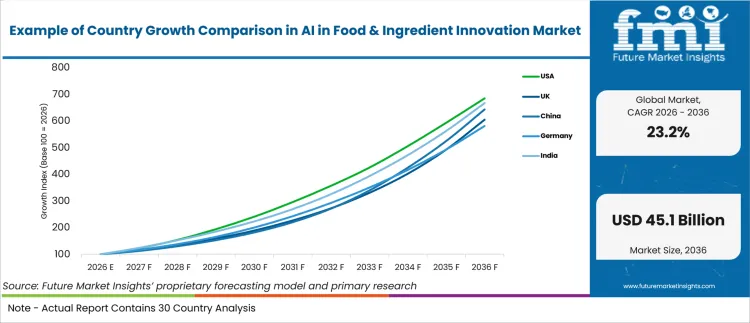
| Country | CAGR |
|---|---|
| USA | 21.3% |
| India | 20.9% |
| China | 20.5% |
| UK | 19.7% |
| Germany | 19.3% |
How do country-level CAGRs compare in the AI in Food & Ingredient Innovation Market?
The five profiled CAGRs span 2.0 percentage points and form two operating groups. USA, India and China cluster between 20.5% and 21.3%, while UK and Germany remain separated by only 0.4 percentage points. The narrow spread makes digital readiness and qualification burden more useful for sales sequencing because enterprise adoption follows different technical and regulatory routes.
- USA combines deep food R&D capacity with repeated enterprise validation work.
- India combines growing innovation activity with uneven digital readiness among smaller processors.
- China pairs high digital R&D penetration with policy-led industrial digitization.
- UK places heavier emphasis on data lineage and accountable model use.
- Germany links AI development with bioprocess scale-up and manufacturing proof.
Comparable growth rates still produce different entry conditions across these markets. The full report provides country-level CAGR analysis across North America, Latin America, Europe, East Asia, South Asia, Oceania and the Middle East and Africa.
Country-wise Analysis
- USA food developers work across large manufacturer and research networks that connect computational screening with laboratory tests for protein functionality and formulation decisions across repeat product launches and ingredient substitutions in national portfolios. USA is estimated to post 21.3% CAGR over the forecast period, supported by R&D capacity that can absorb software integration and repeated validation across enterprise food portfolios and product-renewal programs nationwide for established brands. USDA ARS reported in August 2025 that researchers used AI on 1,039 seed storage proteins across 215 species for food-processing classification, yet platform companies must prove those rankings transfer into repeatable food-specific tests.
- India’s food-processing base combines large manufacturers with many smaller processors, so AI adoption depends on technical funding, skilled staff and systems that fit uneven digital maturity. AI in food & ingredient innovation sales in India are forecast to expand at 20.9% CAGR by 2036, supported by product-development investment and wider use of digital tools in organized processing. In December 2025, MoFPI reported 126,353 PMFME beneficiaries trained and said its R&D scheme funds AI, IoT and blockchain adoption, giving research institutions a funded route for digital projects while smaller processors still face gaps in technical depth and integration capacity across national processing networks.
- China’s large food manufacturers operate with a comparatively advanced digital design base, which lowers the initial systems barrier for AI-assisted formulation and ingredient-development work across major industrial processors. In China, AI in food & ingredient innovation demand is predicted to advance at 20.5% CAGR through 2036, supported by digital R&D adoption and national policy backing for food-industry digitization. In June 2025, the Ministry of Industry and Information Technology reported 72.8% penetration of digital R&D design tools among key food enterprises, although smaller firms and subsectors still require implementation support before similar digital capability becomes routine across the broader processing base.
- UK food companies operate in an assurance-led environment that permits AI experimentation but places transparent data lineage and explainable outputs inside regulated product-development decisions and manufacturer quality reviews across formulation and safety work. The Food Standards Agency Science Council recorded a June 2025 workshop involving food manufacturers plus academia and the AI industry, grounding local adoption in practical questions about food-safety assurance and accountable model use. Adoption of AI in food & ingredient innovation in UK is estimated to expand at 19.7% CAGR through 2036, aided by research capacity but limited by documentation needed for regulated manufacturing use and routine enterprise deployment.
- German ingredient developers pair process-engineering depth with biomanufacturing research that connects digital model tuning to pilot equipment for novel food inputs, but qualification depends on repeatable performance as biological systems approach industrial scale. Germany's AI in food & ingredient innovation outlook is anticipated to advance at 19.3% CAGR over the assessment period, supported by process-engineering depth and access to national scale-up research programs including fermentation and cocoa-cell work. Fraunhofer IME reported in July 2026 that COCO-AI targets 10,000-litre bioreactors plus six ingredient formulations and two prototype chocolate bars, making manufacturing variability a practical test for wider commercial adoption in customer qualification programs.
Who are the notable companies in the AI in Food & Ingredient Innovation Market?
IFF, Givaudan, dsm-firmenich, Ingredion, Brightseed, NotCo AI, Shiru and Barry Callebaut are the notable companies profiled in this market.
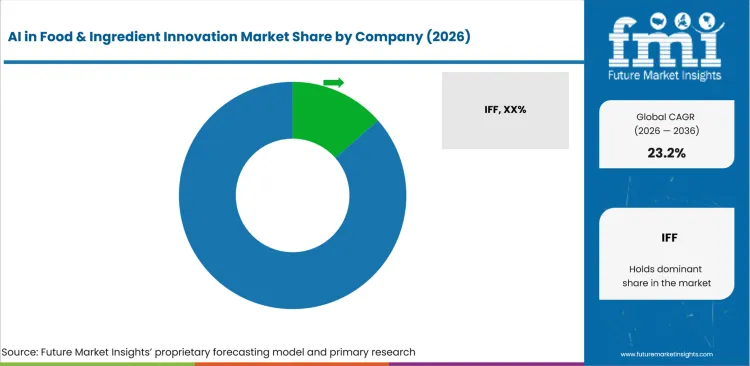
Competition is fragmented between global ingredient companies and AI-native specialists that enter different stages of food product development without controlling the full workflow. Food-specific data and application testing form the main entry barriers as manufacturers need digital recommendations to survive repeated formulation and scale-up work.
- IFF, Givaudan and dsm-firmenich combine food science with digital creation systems for manufacturer formulation and application development.
- Ingredion, Brightseed and Shiru connect computational discovery with validation or production partners for specialized functional food ingredients.
- NotCo AI and Barry Callebaut connect AI-guided formulation with manufacturer data and physical product-development resources for category-specific programs.
Competitive Benchmarking: AI in Food & Ingredient Innovation Market
| Company | AI Discovery & Formulation | Physical Validation & Application Testing | Enterprise Co-development & Scale-up | Geographic Reach |
|---|---|---|---|---|
| IFF | High | Medium | Medium | Global |
| Givaudan | Medium | Medium | Medium | Global |
| dsm-firmenich | High | High | Medium | Global |
| Ingredion | Medium | Medium | Medium | Global |
| Brightseed | High | Medium | Medium | United States and international partnerships |
| NotCo AI | High | Medium | Medium | United States and Latin America |
| Shiru | High | Medium | Medium | United States and global partnerships |
| Barry Callebaut | Medium | High | Medium | Global |
Key Developments in the AI in Food & Ingredient Innovation Market
- In May 2026, Brightseed launched Hummingbird to extend its AI platform from biological discovery into development-stage evaluation and prioritization for product opportunities.
- In March 2026, Ingredion detailed collaboration with Shiru using a curated database of more than 77 million natural protein sequences to identify naturally derived prebiotic candidates.
- In February 2026, Barry Callebaut opened its Singapore Global Innovation Center with an AI center of excellence and pilot facilities for chocolate formulation plus process testing.
Key Players in the AI in Food & Ingredient Innovation Market
Integrated Sensory and Formulation Platforms
- IFF
- Givaudan
- dsm-firmenich
Ingredient Discovery and Co-development Networks
- Ingredion
- Brightseed
- Shiru
AI-led Formulation and Category Platforms
- NotCo AI
- Barry Callebaut
AI in Food & Ingredient Innovation Market - Report Scope
| Coverage field | Report scope |
|---|---|
| Market breakdown | By application, technology, end user and region. |
| Quantitative Units | Revenue USD billion and CAGR in %. |
| Market Definition | Commercial revenue covers AI software and separately valued AI-enabled services for ingredient discovery, formulation, predictive sensory work, supply-chain decisions and sustainability analysis while excluding downstream product and ordinary ingredient revenue. |
| Regions Covered | North America, Latin America, Europe, East Asia, South Asia and Pacific and Middle East and Africa. |
| Countries Covered | USA, China, India, UK, Germany, and 20+ countries included in the full report. |
| Key Companies Profiled | IFF, Givaudan, dsm-firmenich, Ingredion, Brightseed, NotCo AI, Shiru and Barry Callebaut. |
| Forecast Period | 2026 to 2036. |
| Approach | Primary and secondary research with market triangulation. |
AI in Food & Ingredient Innovation Market - Research Methodology
| Method | Approach |
|---|---|
| Primary Research | FMI analysts gathered input from manufacturers, service providers, technology developers, distributors, end users, procurement teams, and subject-matter experts. Interviews examined purchasing decisions, product or service evaluation, adoption barriers, approval requirements, pricing considerations, and expectations for technical or commercial support. Respondents were also asked what evidence is required before a trial, pilot, or initial order develops into regular purchasing. |
| Desk Research | Desk research covered government statistics, regulatory publications, trade data, industry associations, technical literature, standards, company filings, product information, and official corporate announcements. Sources were reviewed for relevance, publication date, geographic coverage, and consistency with the defined market scope. Claims relating to performance, applications, approvals, capacity, investment, and commercial activity were retained only when supported by credible public evidence. |
| Market Sizing and Forecasting | The market model combined the baseline value with historical performance, segment structure, pricing and volume indicators, adoption levels, company participation, and country-level demand conditions. Forecast assumptions considered economic activity, investment trends, regulatory developments, technology adoption, purchasing cycles, supply availability, and barriers to wider market use. Segment and regional estimates were reconciled before the final market total was calculated. |
| Data Validation | Estimates were checked against multiple independent indicators, including public data, company activity, trade patterns, industry developments, and findings from primary interviews. Validation also tested whether products, services, applications, and company revenues fell within the defined market boundaries. Adjacent categories, unsupported claims, overlapping revenues, and activities without direct market relevance were excluded to reduce double counting and maintain consistency across segments and countries. |
AI in Food & Ingredient Innovation Market by Segments
AI in Food & Ingredient Innovation Market segmented by Application:
- Formulation
- Predictive Sensory
- Supply Chain
- Sustainability
AI in Food & Ingredient Innovation Market segmented by Technology:
- ML
- Generative AI
- Computer Vision
AI in Food & Ingredient Innovation Market segmented by End User:
- Food Manufacturers
- Foodservice Operators
- Retailers
- Household
AI in Food & Ingredient Innovation Market by Region:
- North America
- United States
- Canada
- Latin America
- Brazil
- Mexico
- Chile
- Rest of Latin America
- Western Europe
- Germany
- United Kingdom
- Italy
- Spain
- France
- Nordics
- Benelux
- Rest of Western Europe
- Eastern Europe
- Russia
- Poland
- Hungary
- Balkan and Baltic States
- Rest of Eastern Europe
- East Asia
- China
- Japan
- South Korea
- South Asia and Pacific
- India
- ASEAN
- Australia and New Zealand
- Rest of South Asia and Pacific
- Middle East and Africa
- Kingdom of Saudi Arabia
- Other GCC Countries
- Türkiye
- South Africa
- Other African Union Countries
- Rest of Middle East and Africa
Research Sources and Bibliography
- dsm-firmenich. (2026, February 20). Data governance and AI.
- Ministry of Industry and Information Technology of the People’s Republic of China. (2025, June 10).
- Barry Callebaut. (2025, November 18). Barry Callebaut Partners with NotCo AI to Unlock Next-Level Chocolate Innovation.
- Brightseed, Inc. (2026, April 15). Brightseed Expands World’s Largest Proprietary Bioactive Dataset to 21 Million Compounds, Strengthening AI-Native Innovation Platform.
- The Magnum Ice Cream Company. (2025, September 22). The Magnum Ice Cream Company partners with NotCo AI.
- Institute of Food Technologists. (2025, July 2). IFT Launches Groundbreaking Research & Development Tool to Support Accelerated Product Development Demands.
- Food Standards Agency. (2026, June 25). Science Council report of project ‘artificial intelligence applications in food safety and authenticity’.
- Shiru. (2025, March 12). Shiru and GreenLab Partner to Scale Sustainable Protein Production Through Novel Corn-Based Expression System.
- USA Department of Agriculture, Agricultural Research Service. (2025, August 13). Unraveling the physicochemical differences among Osborne protein classes via bioinformatics and AI.
- Food Standards Agency Science Council. (2025, August 4). Science Council 2025 meetings.
- Fraunhofer Institute for Molecular Biology and Applied Ecology IME. (2026, July 15). Making cocoa without a tree: how the "COCO-AI" project innovates sustainable ingredient production.
- IFF. (2026, July 28). The Future of Digital Flavor Innovation.
- Givaudan. (2026, January 29). AI-powered Ooby™: a creative ally in food and beverage innovation.
- dsm-firmenich. (2025, May 20). On the rise: dsm-firmenich opens state-of-the-art Princeton Baking Innovation Center in Princeton, NJ.
- Brightseed, Inc. (2026, May 13). Brightseed Launches Hummingbird™, Advancing Its AI-Powered Innovation Platform from Discovery to Development.
- Ingredion Incorporated. (2026, March 18). What’s next in food innovation: How AI and microbiome measurement are driving a new era of ingredient discovery.
- Barry Callebaut. (2026, February 10). Barry Callebaut Opens Global Innovation Center in Singapore, Pioneering the Future of Chocolate Through AI and Advanced Innovation.
- Ministry of Food Processing Industries, Government of India. (2025, December 4). Measures to Stablize Food Availability. Press Information Bureau.
- Ministry of Industry and Information Technology of the People’s Republic of China. (2025, June 10). [Six questions and one graphic: Understanding the Food Industry Digital Transformation Implementation Plan].
This bibliography is provided for reader reference and is not exhaustive. The full report contains the complete reference list and detailed citations.
This Report Answers
- What explains the market value change between 2026 and 2036?
- What increases recurring AI spending across food product development?
- Why does formulation account for 41.0% of application revenue?
- How does ML's 51.8% share shape screening workflows?
- Why do food manufacturers hold 38.0% of end-user revenue?
- How do adoption conditions differ across USA, UK and Germany?
- Which business models shape competition across AI-enabled food innovation?
- Which validation conditions delay enterprise deployment in regulated food development?
Frequently Asked Questions
How big is the AI in Food & Ingredient Innovation Market in 2026?
The AI in food & ingredient innovation market is expected to be valued at USD 5.6 billion in 2026. Recurring use across food R&D turns repeated development programs into ongoing software and service spending toward USD 45.1 billion by 2036.
What is the CAGR of the AI in Food & Ingredient Innovation Market from 2026 to 2036?
The AI in food & ingredient innovation market is projected to grow at 23.2% CAGR from 2026 to 2036. Predictive screening and formulation tools turn repeated product-development decisions into recurring software and service spending.
Which application segment is projected to account for 41.0% of the AI in Food & Ingredient Innovation Market?
The AI in food & ingredient innovation market is estimated to derive 41.0% of 2026 application revenue from formulation. Candidate ranking narrows recipe options so laboratory testing and pilot validation focus on the most credible formulations.
Which technology segment is projected to account for 51.8% of the AI in Food & Ingredient Innovation Market?
The AI in food & ingredient innovation market is estimated to derive 51.8% of 2026 technology revenue from ML. Predictive models fit structured screening and property-estimation tasks across food R&D datasets used for repeated candidate evaluation.
Which companies are active in the AI in Food & Ingredient Innovation Market?
The AI in food & ingredient innovation market includes IFF, Givaudan, dsm-firmenich, Ingredion, Brightseed, NotCo AI, Shiru and Barry Callebaut. Their roles differ across discovery and formulation validation plus enterprise co-development that connects digital recommendations with commercial food programs.
Preview the report firsthand - request a free sample
Get SampleGet the brochure for pricing and purchase details.
Get PDFTable of Content
- Key Takeaways
- Market Size and CAGR
- Top Growth Driver
- Fastest Growing Segment
- Leading Region
- Key Companies
- Emerging Opportunities
- Executive Summary
- Global Market Outlook
- Demand-side Trends
- Supply-side Trends
- Technology Roadmap Analysis
- Analysis and Recommendations
- Analyst Perspective (What is happening? Why now? What should investors know?)
- Key Questions Answered
- How large is the market?
- What is the CAGR?
- What are key trends?
- Which region dominates?
- Who are the leaders?
- Market Overview
- Market Coverage / Taxonomy
- Market Definition / Scope / Limitations
- Research Methodology
- Chapter Orientation
- Analytical Lens and Working Hypotheses
- Market Structure, Signals, and Trend Drivers
- Benchmarking and Cross-market Comparability
- Market Sizing, Forecasting, and Opportunity Mapping
- Research Design and Evidence Framework
- Desk Research Programme (Secondary Evidence)
- Expert Input and Fieldwork (Primary Evidence)
- Tooling, Models, and Reference Databases
- Data Engineering and Model Build
- Quality Assurance and Audit Trail
- Market Background
- Market Dynamics (Drivers, Restraints, Opportunity, Trends)
- Scenario Forecast (Optimistic, Likely, Conservative)
- Impact Analysis
- AI Impact
- Sustainability Impact
- Regulatory Impact
- Technology Impact
- Consumer / Buyer Analysis
- Purchase Drivers
- Adoption Barriers
- Buyer Journey
- Opportunity Map Analysis
- Product Life Cycle Analysis
- Supply Chain Analysis
- Investment Feasibility Matrix
- Value Chain Analysis
- PESTLE and Porter's Analysis
- Regulatory Landscape
- Regional Parent Market Outlook
- Production and Consumption Statistics
- Import and Export Statistics
- Global Market Analysis and Forecast, 2021 to 2036
- Historical Market Size Value (USD Billion) Analysis, 2021 to 2025
- Current and Future Market Size Value (USD Billion) Projections, 2026 to 2036
- Y-o-Y Growth Trend Analysis
- Absolute $ Opportunity Analysis
- Global Market Pricing Analysis, 2021 to 2036
- Global Market Analysis and Forecast, By Application, 2021 to 2036
- Introduction / Key Findings
- Historical Market Size Value (USD Billion) Analysis By Application, 2021 to 2025
- Current and Future Market Size Value (USD Billion) Analysis and Forecast By Application, 2026 to 2036
- Formulation
- Predictive Sensory
- Supply Chain
- Sustainability
- Formulation
- Y-o-Y Growth Trend Analysis By Application, 2021 to 2025
- Absolute $ Opportunity Analysis By Application, 2026 to 2036
- Global Market Analysis and Forecast, By Technology, 2021 to 2036
- Introduction / Key Findings
- Historical Market Size Value (USD Billion) Analysis By Technology, 2021 to 2025
- Current and Future Market Size Value (USD Billion) Analysis and Forecast By Technology, 2026 to 2036
- ML
- Generative AI
- Computer Vision
- ML
- Y-o-Y Growth Trend Analysis By Technology, 2021 to 2025
- Absolute $ Opportunity Analysis By Technology, 2026 to 2036
- Global Market Analysis and Forecast, By End User, 2021 to 2036
- Introduction / Key Findings
- Historical Market Size Value (USD Billion) Analysis By End User, 2021 to 2025
- Current and Future Market Size Value (USD Billion) Analysis and Forecast By End User, 2026 to 2036
- Food Manufacturers
- Foodservice Operators
- Retailers
- Household
- Food Manufacturers
- Y-o-Y Growth Trend Analysis By End User, 2021 to 2025
- Absolute $ Opportunity Analysis By End User, 2026 to 2036
- Global Market Analysis and Forecast, By Region, 2021 to 2036
- Introduction
- Historical Market Size Value (USD Billion) Analysis By Region, 2021 to 2025
- Current Market Size Value (USD Billion) Analysis and Forecast By Region, 2026 to 2036
- North America
- Latin America
- Western Europe
- Eastern Europe
- East Asia
- South Asia and Pacific
- Middle East & Africa
- Market Attractiveness Analysis By Region
- North America Market Analysis and Forecast, By Country, 2021 to 2036
- Historical Market Size Value (USD Billion) Trend Analysis By Market Taxonomy, 2021 to 2025
- Market Size Value (USD Billion) Forecast By Market Taxonomy, 2026 to 2036
- By Country
- USA
- Canada
- By Application
- By Technology
- By End User
- By Country
- Market Attractiveness Analysis
- By Country
- By Application
- By Technology
- By End User
- Key Takeaways
- Latin America Market Analysis and Forecast, By Country
- Historical Market Size Value (USD Billion) Trend Analysis By Market Taxonomy, 2021 to 2025
- Market Size Value (USD Billion) Forecast By Market Taxonomy, 2026 to 2036
- By Country
- Brazil
- Mexico
- Chile
- Rest of Latin America
- By Application
- By Technology
- By End User
- By Country
- Market Attractiveness Analysis
- By Country
- By Application
- By Technology
- By End User
- Key Takeaways
- Western Europe Market Analysis and Forecast, By Country
- Historical Market Size Value (USD Billion) Trend Analysis By Market Taxonomy, 2021 to 2025
- Market Size Value (USD Billion) Forecast By Market Taxonomy, 2026 to 2036
- By Country
- Germany
- UK
- Italy
- Spain
- France
- Nordic
- BENELUX
- Rest of Western Europe
- By Application
- By Technology
- By End User
- By Country
- Market Attractiveness Analysis
- By Country
- By Application
- By Technology
- By End User
- Key Takeaways
- Eastern Europe Market Analysis and Forecast, By Country
- Historical Market Size Value (USD Billion) Trend Analysis By Market Taxonomy, 2021 to 2025
- Market Size Value (USD Billion) Forecast By Market Taxonomy, 2026 to 2036
- By Country
- Russia
- Poland
- Hungary
- Balkan & Baltic
- Rest of Eastern Europe
- By Application
- By Technology
- By End User
- By Country
- Market Attractiveness Analysis
- By Country
- By Application
- By Technology
- By End User
- Key Takeaways
- East Asia Market Analysis and Forecast, By Country
- Historical Market Size Value (USD Billion) Trend Analysis By Market Taxonomy, 2021 to 2025
- Market Size Value (USD Billion) Forecast By Market Taxonomy, 2026 to 2036
- By Country
- China
- Japan
- South Korea
- By Application
- By Technology
- By End User
- By Country
- Market Attractiveness Analysis
- By Country
- By Application
- By Technology
- By End User
- Key Takeaways
- South Asia and Pacific Market Analysis and Forecast, By Country
- Historical Market Size Value (USD Billion) Trend Analysis By Market Taxonomy, 2021 to 2025
- Market Size Value (USD Billion) Forecast By Market Taxonomy, 2026 to 2036
- By Country
- India
- ASEAN
- Australia & New Zealand
- Rest of South Asia and Pacific
- By Application
- By Technology
- By End User
- By Country
- Market Attractiveness Analysis
- By Country
- By Application
- By Technology
- By End User
- Key Takeaways
- Middle East & Africa Market Analysis and Forecast, By Country
- Historical Market Size Value (USD Billion) Trend Analysis By Market Taxonomy, 2021 to 2025
- Market Size Value (USD Billion) Forecast By Market Taxonomy, 2026 to 2036
- By Country
- Kingdom of Saudi Arabia
- Other GCC Countries
- Türkiye
- South Africa
- Other African Union
- Rest of Middle East & Africa
- By Application
- By Technology
- By End User
- By Country
- Market Attractiveness Analysis
- By Country
- By Application
- By Technology
- By End User
- Key Takeaways
- Key Countries Market Analysis
- USA
- Pricing Analysis
- Market Share Analysis, 2025
- By Application
- By Technology
- By End User
- Canada
- Pricing Analysis
- Market Share Analysis, 2025
- By Application
- By Technology
- By End User
- Mexico
- Pricing Analysis
- Market Share Analysis, 2025
- By Application
- By Technology
- By End User
- Brazil
- Pricing Analysis
- Market Share Analysis, 2025
- By Application
- By Technology
- By End User
- Chile
- Pricing Analysis
- Market Share Analysis, 2025
- By Application
- By Technology
- By End User
- Germany
- Pricing Analysis
- Market Share Analysis, 2025
- By Application
- By Technology
- By End User
- UK
- Pricing Analysis
- Market Share Analysis, 2025
- By Application
- By Technology
- By End User
- Italy
- Pricing Analysis
- Market Share Analysis, 2025
- By Application
- By Technology
- By End User
- Spain
- Pricing Analysis
- Market Share Analysis, 2025
- By Application
- By Technology
- By End User
- France
- Pricing Analysis
- Market Share Analysis, 2025
- By Application
- By Technology
- By End User
- India
- Pricing Analysis
- Market Share Analysis, 2025
- By Application
- By Technology
- By End User
- ASEAN
- Pricing Analysis
- Market Share Analysis, 2025
- By Application
- By Technology
- By End User
- Australia & New Zealand
- Pricing Analysis
- Market Share Analysis, 2025
- By Application
- By Technology
- By End User
- China
- Pricing Analysis
- Market Share Analysis, 2025
- By Application
- By Technology
- By End User
- Japan
- Pricing Analysis
- Market Share Analysis, 2025
- By Application
- By Technology
- By End User
- South Korea
- Pricing Analysis
- Market Share Analysis, 2025
- By Application
- By Technology
- By End User
- Russia
- Pricing Analysis
- Market Share Analysis, 2025
- By Application
- By Technology
- By End User
- Poland
- Pricing Analysis
- Market Share Analysis, 2025
- By Application
- By Technology
- By End User
- Hungary
- Pricing Analysis
- Market Share Analysis, 2025
- By Application
- By Technology
- By End User
- Kingdom of Saudi Arabia
- Pricing Analysis
- Market Share Analysis, 2025
- By Application
- By Technology
- By End User
- Türkiye
- Pricing Analysis
- Market Share Analysis, 2025
- By Application
- By Technology
- By End User
- South Africa
- Pricing Analysis
- Market Share Analysis, 2025
- By Application
- By Technology
- By End User
- USA
- Market Structure Analysis
- Competition Dashboard
- Competition Benchmarking
- Market Share Analysis of Top Players
- By Regional
- By Application
- By Technology
- By End User
- Emerging Startups
- Innovation Benchmarking
- Competition Analysis
- Competition Deep Dive
- IFF
- Overview
- Product Portfolio
- Profitability by Market Segments
- Sales Footprint
- Strategy Overview
- Marketing Strategy
- Product Strategy
- Channel Strategy
- Givaudan
- dsm-firmenich
- Ingredion
- Brightseed
- NotCo
- Shiru
- Climax Foods
- Turtle Tree
- IFF
- Case Studies
- Success Stories
- Recent Developments
- Competition Deep Dive
- Assumptions & Acronyms Used


