

- Market Size (2026)
- USD 17.4 Bn
- Forecast (2036)
- USD 46.4 Bn
- CAGR (2026 to 2036)
- 10.3%
How big is Alternative Protein Ingredients Market in 2026?
USD 17.4 billion in 2026 and USD 46.4 billion by 2036 at a 10.3% CAGR.
Sales of alternative protein ingredients are projected to expand from USD 17.4 billion in 2026 to USD 46.4 billion by 2036 at a 10.3% CAGR. Commercial growth depends on formulation work across plant-based protein and nutrition applications in food categories worldwide. Pea protein offers familiar isolate and concentrate formats that simplify formulation across several commercial production systems. The Good Food Institute’s 2026 review reported capacity gains beside persistent taste and accessibility problems across the industry. Ingredient producers therefore compete on stable solubility and texture rather than protein content across customer trials. Commercial orders expand once production batches confirm reliable performance through heat treatment and expected storage conditions.
Regulatory treatment changes with the ingredient source and the production method used to create the final protein. Precision fermentation systems create additional dossier work since production organisms and outputs require product-specific review. European manufacturers compare technical performance with authorization cost and permitted uses prior to committing a formula to scale. United States formulators can use established GRAS notice pathways for defined ingredient substances and intended food applications. Ingredient producers gain repeat orders by matching documentation with each customer’s exact process and sales geography.
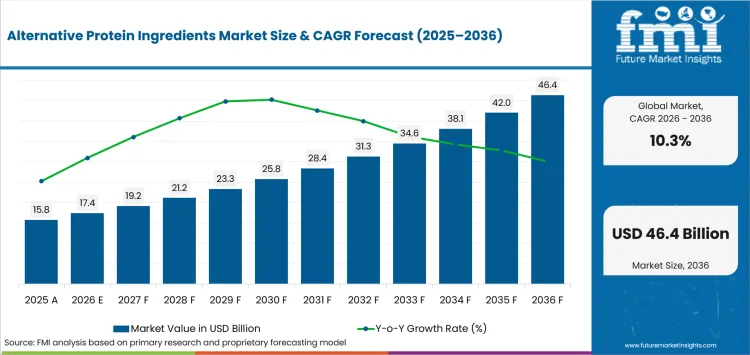
Key Takeaways of Alternative Protein Ingredients Market
- Demand for alternative protein ingredients is driven by nutrition delivery and functional performance requirements across established food production systems, with manufacturers requiring stable behavior under commercial heat and storage conditions before changing approved formulations.
- By source, plant-based ingredients hold the leading share at 49.4% in 2026, attributable to broad crop availability and established processing knowledge across soy and pulse proteins.
- Dry form is the dominant product segment, holding 58.1% share in 2026, owing to shelf stability and efficient transport across multi-site manufacturing networks.
- Meat & dairy alternatives account for 35.9% application share in 2026, driven by demanding texture and nutrition requirements within finished products.
- Regulatory dossiers and allergen controls influence the interval between ingredient trials and recurring commercial purchasing, with reliable crop sourcing and application support improving conversion from laboratory validation into routine production.
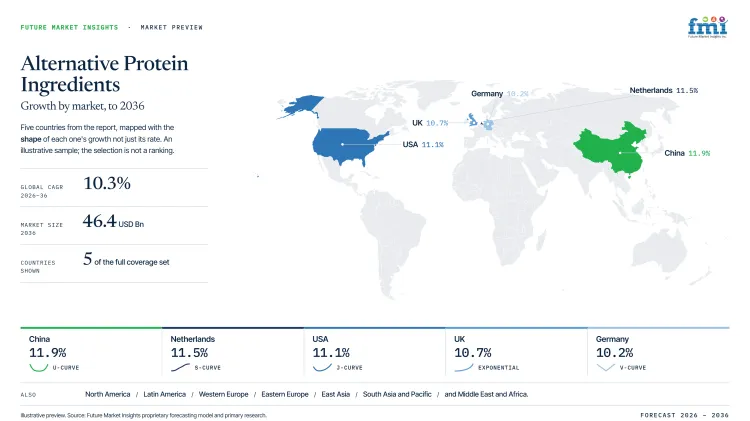
- China, the Netherlands, and the USA record CAGRs of 11.9%, 11.5%, and 11.1% respectively through 2036, while Germany and the UK present different approval costs despite mature food manufacturing and active alternative-protein development programs.
- Competition centers on ADM, Cargill, Bunge, Ingredion, Kerry Group, dsm-firmenich, Roquette, and Solar Foods, with vendors differentiating through crop sourcing scale, application development and sensory support, and specialized protein technologies with distinct feedstocks.
Analyst Perspective
Commercial confidence in alternative protein ingredients depends on each protein preserving functional performance across the customer's normal operating range, not just on protein concentration claims. Producers that connect specification control with regulatory responsibility and verified application support tend to shorten the gap between trial and recurring order. Manufacturers should test ingredient behavior under intended heat treatment and shelf-life conditions before commercial rollout, since expansion needs measured results across multiple batches and more than one application environment.
-Nandini Roy Choudhury, Principal Analyst at Future Market Insights
Source: FMI's proprietary forecasting model and primary research
How is the Alternative Protein Ingredients Market segmented?
The alternative protein ingredients industry is segmented by source, form, application, and region.
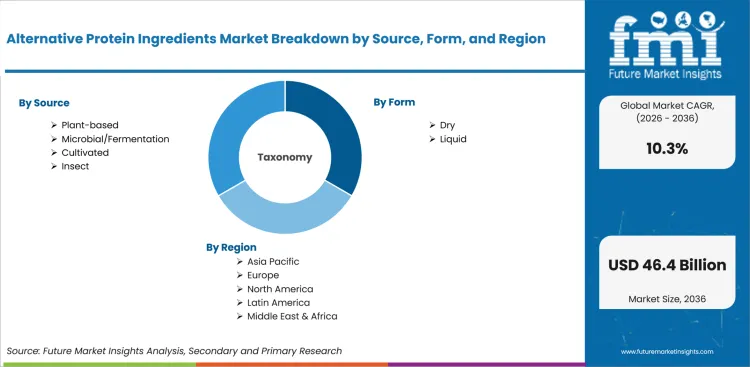
The segmentation framework separates protein origin from physical form and the final application receiving each ingredient. Source categories cover plant proteins and microbial platforms alongside fermentation-derived systems plus cultivated and insect proteins. Each source presents different feedstock requirements and regulatory pathways across large-scale commercial food production operations. Form analysis distinguishes dry powders from liquid systems since storage and dosing conditions differ across manufacturing sites. Application analysis covers meat and dairy alternatives together with bakery products and beverages plus sports nutrition and feed uses. The framework lets manufacturers compare nutrition with processing risk across one connected ingredient purchasing decision. New biological routes can be assessed against established precision fermentation suppliers without treating every production method as commercially equivalent.
What supports demand for plant-based ingredients within the source category?
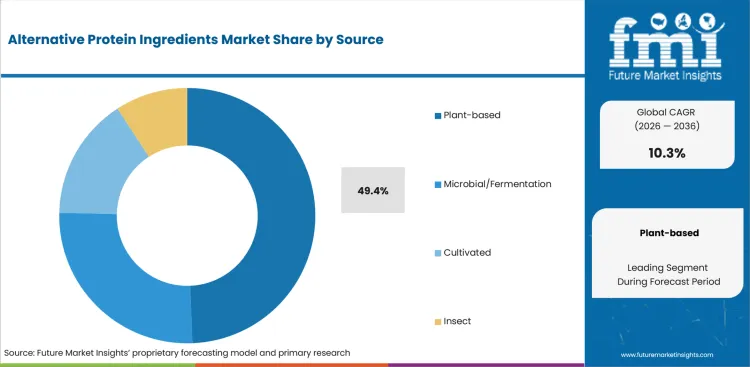
Plant-based proteins give food manufacturers familiar crop inputs and established isolate or concentrate formats across several production systems. In February 2026, Roquette launched a pea protein isolate designed to reduce vegetal notes without additional masking ingredients or processing aids. The advancement addresses a persistent sensory barrier at ingredient level and can shorten formulation work across high-protein foods. Related fava bean proteins give application teams another pulse option without relying on one crop or extraction route. Manufacturers must still validate solubility and flavor stability through heat treatment and the intended storage period.
- Plant-based is likely to capture 49.4% share in 2026 attributable to broad crop availability and established processing knowledge. Ingredient producers can combine soy and pulse proteins with familiar concentrate or textured formats across several applications. Portfolio breadth reduces dependence on one biological platform and supports formulation choices across nutrition and sensory requirements.
- Food manufacturers adopt plant-based ingredients through staged trials that compare flavor and line behavior against approved formulations. Application teams then test repeat commercial batches under the intended heat treatment and storage period. Commercial use broadens once the ingredient meets nutrition targets without requiring costly masking systems or frequent stabilizer changes.
How is dry positioned within the form category?
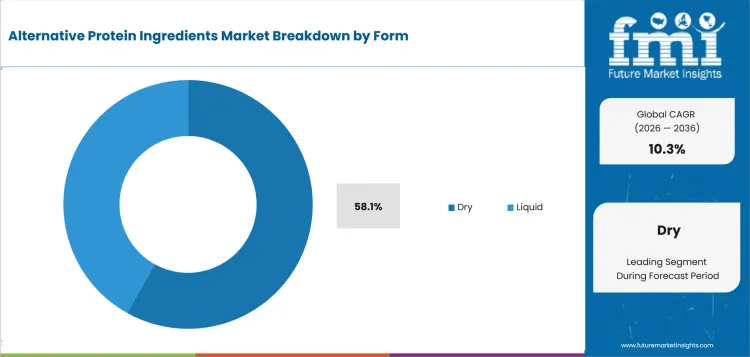
Dry ingredients support centralized production and longer distribution routes without the handling requirements associated with liquid concentrates. In May 2026, ADM launched eight soy and pea protein ingredients across isolates and concentrates plus textured formats for North America and Europe. The launch included beverage powders and dry-extrusion options that broaden practical use across different manufacturing systems. Plant-based ingredients remain commercially useful in this form since powder formats support inventory control across distributed production sites. Production teams must control powder flow and moisture since poor storage can weaken dispersion during automated dosing.
- By form, dry is estimated to hold 58.1% in 2026 owing to shelf stability and efficient transport across multi-site manufacturing networks. Powder formats let manufacturers hold several protein recipes without refrigerated bulk storage or frequent short-distance deliveries. The position reflects practical inventory control and flexible dosing requirements rather than protein concentration alone.
- Processors favor dry formats that disperse consistently without excessive dusting or agglomeration during automated dosing. Production teams evaluate flow behavior and moisture pickup under the manufacturing plant’s actual storage conditions. Ingredient producers gain recurring orders by providing packaging guidance and batch controls that preserve solubility throughout the customer’s holding period.
What makes meat & dairy alternatives central to the application category?
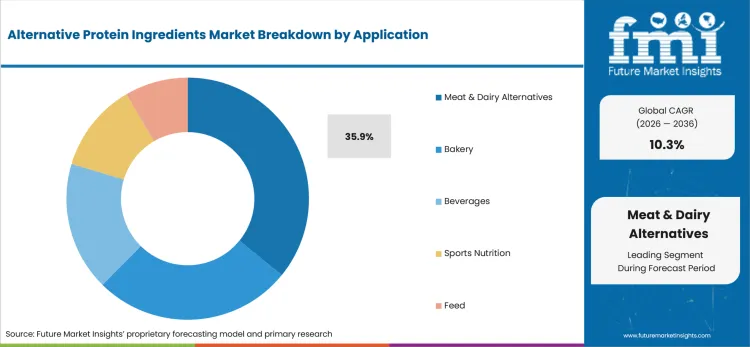
Meat and dairy alternatives require proteins to support nutrition plus texture and sensory acceptance within one finished product. In July 2025, GEA opened a USD 20 million alternative-protein technology center with pilot lines for plant-based processing and precision fermentation. The center combines spray drying and aseptic filling with separation systems that let developers test production at industrially relevant scale. The development connects ingredient selection with the wider plant-based food category through products judged on flavor and familiarity. A formulation failure can increase waste and delay launch schedules despite meeting the stated protein target.
- By application, meat & dairy alternatives are forecast to represent 35.9% in 2026 driven by demanding texture and nutrition requirements. A selected protein must support bite and emulsion stability alongside nutrition claims within one formulation. The segment concentrates value in ingredients that solve several production requirements without adding excessive processing complexity.
- Brand owners adopt alternative proteins once pilot products survive processing and storage without unacceptable flavor or texture changes. Product teams then compare consumer acceptance with production yield across more than one commercial recipe and package format. Wider use follows as a validated protein system supports several formats with limited equipment adjustment or additional reformulation.
What are the drivers, restraints, and opportunities in the Alternative Protein Ingredients Market?
Demand rises as food manufacturers fortify established products with proteins that preserve texture and taste. Process-specific authorization and sensory variability can delay qualification by increasing dossier work and repeated formulation testing. Commercial openings emerge for pulse and microbial ingredients that reduce formulation trade-offs through verified application support.
- Driver: Protein fortification across established foods creates direct demand for ingredients that preserve routine production performance.
- Restraint: Process-specific authorization and sensory variability can materially delay ingredient qualification across unfamiliar protein sources.
- Opportunity: Pulse and biological production platforms can reduce formulation trade-offs through verified application support and scalable supply.
Protein fortification across established foods creates a direct and measurable demand driver for alternative ingredient producers. In May 2026, Bunge opened a United States soy protein facility for bakery and plant-based meat applications. The site combines regional soybean supply with commercial ingredient production and a customer application center. Additional capacity supports market revenue once food manufacturers receive consistent taste and color plus technical help for current processing lines. The production route matters commercially since application support can shorten qualification across several customer recipes.
Regulatory classification creates a material commercial restraint for familiar protein sources produced through unfamiliar processes. The European Commission consultation list treats a high-purity pea concentrate as non-novel but classifies a plant protein concentrate fermented with shiitake mycelium as novel. The classification difference changes dossier cost and commercial timing across planned European food product launches. Ingredient developers must define production organisms and processing steps prior to selecting the correct authorization route with food manufacturers. Incomplete classification work can delay customer trials and postpone recurring commercial ingredient purchases across Europe.
Source diversification creates an opening for proteins that reduce taste or processing limitations in current formulations. In May 2026, the AlinOVeg project reported progress across pea and fava bean proteins and plant-based alternatives to cheese and desserts. The collaboration links crop development with protein isolates and consumer-focused product research across a French value chain. Development across insect protein and fungal platforms broadens source choice but requires product-specific authorization and clear consumer positioning. Commercial gains depend on application support that converts differentiated proteins into repeatable customer recipes and stable commercial production.
Which country CAGRs are profiled in the Alternative Protein Ingredients Market?
| Country | CAGR |
|---|---|
| USA | 11.1% |
| Germany | 10.2% |
| UK | 10.7% |
| Netherlands | 11.5% |
| China | 11.9% |
How do country-level CAGRs compare in the Alternative Protein Ingredients Market?
The country comparison shows a relatively narrow spread in projected growth rates across the alternative protein ingredients market. China and the Netherlands form a closely aligned upper group with only a small gap between their forecasts. The USA follows nearby and remains connected to the upper cluster through a limited difference in projected expansion. The UK and Germany create a lower group with modest separation from the countries above them. The overall gap between the first and last country is 1.7 percentage points which highlights a concentrated growth outlook across major alternative protein markets. These differences reflect variations in product innovation, ingredient commercialization and food industry adoption rather than major differences in consumer interest.
- China shows a notable position within the comparison as demand for diversified protein sources supports investment in plant-based, fermentation-derived and other alternative protein ingredients.
- The Netherlands remains close to China in CAGR terms but follows a different market path through strong food technology capabilities and active development of next-generation protein ingredients.
- The USA occupies an important position within the group as established ingredient suppliers and food manufacturers continue to expand alternative protein product portfolios.
- The UK remains relatively close to the USA yet market development is supported by growing demand for sustainable food options and continued innovation across protein formulations.
- Germany forms part of the lower cluster while maintaining steady progress through ingredient innovation and increasing incorporation of alternative proteins into mainstream food applications.
Comparable CAGRs do not create identical market conditions across countries. Differences in consumer preferences, regulatory frameworks, manufacturing capacity and ingredient approval requirements can influence the pace of commercialization and product adoption. As a result, companies may encounter different market entry and scaling conditions despite relatively similar growth forecasts. The full report provides country-level CAGR analysis across North America, Latin America, Europe, East Asia, South Asia, Oceania and the Middle East and Africa.
Country-wise Analysis
- United States food manufacturers can use pea proteins through established GRAS notice pathways for defined substances and intended applications. The alternative protein ingredients market is projected to post 11.1% CAGR over the forecast period aided by domestic processing and documented notification routes. In June 2026, FDA inventory records listed ten notices returned by a pea-protein search across several ingredient preparations. The records give formulation teams multiple documented routes but each notice remains tied to its stated substance and intended use. Current United States supplier portfolios combine domestic ingredient production with application support for large food accounts across major manufacturing regions. A changed process or use can require separate regulatory review and revised labeling support before recurring commercial production begins.
- German food manufacturers operate within a mature meat-substitute production base and established regional ingredient-processing infrastructure. The alternative protein ingredients market is forecast to record 10.2% CAGR through 2036 shaped by active reformulation and local technical capacity. The Federal Statistical Office reported in May 2026 that meat-substitute production reached 124,900 tonnes during 2025. The agency also recorded a 1.2% annual decline which shows that ingredient adoption must improve product value instead of relying on category volume. BENEO’s Offstein faba plant gives manufacturers a nearby ingredient source and shorter technical coordination route. Commercial expansion can stall as weak consumer repeat purchases limit the return from otherwise efficient local production.
- United Kingdom regulators classify animal-cell cultivated products as products of animal origin under national food-safety guidance. The alternative protein ingredients market is anticipated to expand at 10.7% CAGR between 2026 and 2036 influenced by regulatory clarification and structured assessment support. In December 2025, the Food Standards Agency and Food Standards Scotland published the first United Kingdom safety guidance for these products. A separate two-year regulatory sandbox launched in March 2025 gives developers direct engagement during dossier preparation. The program can improve technical training on evidence expectations and reduce avoidable regulatory submission gaps. Products require authorization for legal sale and the extended review creates material timing and financing pressure for smaller developers.
- Dutch processors can claim environmental investment support for qualifying equipment used to make plant-based meat and dairy alternatives. The alternative protein ingredients market is forecast to reach 11.5% CAGR by 2036 reinforced by tax support for qualifying production equipment. In December 2025, the Netherlands Enterprise Agency confirmed a 45% MIA rate for eligible 2026 equipment. The incentive can reduce taxable investment cost for processors that satisfy every equipment and input condition. Qualifying systems must use European-grown plant material or fungal ingredients and satisfy defined protein thresholds. The scheme also requires a five-year payback condition for the supported production installation to qualify. Imported feedstocks or faster-return projects can fall outside the incentive and weaken the capital case for otherwise suitable equipment. The eligibility boundary directs public support toward specific production routes instead of every alternative-protein installation.
- Chinese ingredient processors can source soybeans through a large domestic crop base documented by national production statistics. Alternative protein ingredient sales are predicted to expand at 11.9% CAGR from 2026 to 2036 supported by the country’s large domestic soybean crop. In December 2025, the National Bureau of Statistics reported soybean output of 23.932 million tons for that year. Domestic crop availability can shorten sourcing routes for soy concentrates and textured proteins used in mainstream foods. Processors can use established soybean handling systems without building a separate feedstock network for every plant-protein application. Regional crop variation can affect protein concentration and color across commercial ingredient batches during routine production. Functional consistency and product-specific authorization remain material frictions for newer microbial or cultivated ingredients outside established plant-protein routes.
Who are the notable companies in the Alternative Protein Ingredients Market?
ADM, Cargill, Ingredion, Kerry Group, dsm-firmenich, Roquette, Bunge, and Solar Foods are the notable companies shaping this market.
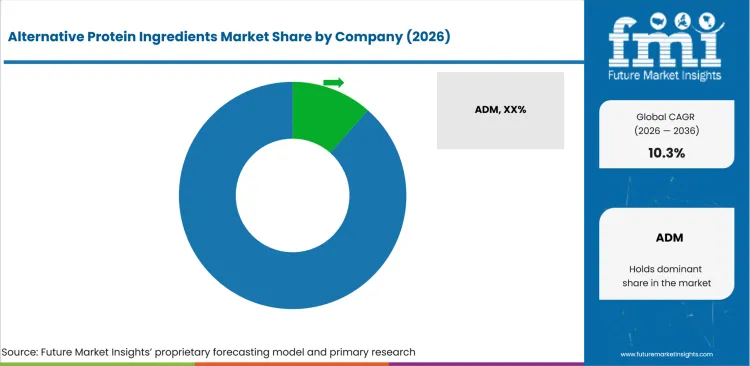
The competitive outlook includes companies that control crop sourcing and protein processing alongside specialists focused on formulation or biological production. Diversified groups use application centers to support several protein sources and commercial forms across major food categories. Focused producers compete through differentiated functionality or production methods that solve narrower commercial formulation problems. The evaluation separates source breadth from form coverage and process integration instead of using corporate size as a proxy. The wider competitive set includes commercial mycoprotein producers beside gas-fermentation specialists with focused single-platform ingredient portfolios.
- ADM and Cargill operate diversified protein platforms while Bunge concentrates verified soy-protein production in North America. ADM and Cargill support several source families through application expertise and scaled supply across multiple regions. Bunge competes through several soy formats plus customer support that connects commercial protein production with food manufacturing.
- Ingredion and Kerry Group combine plant-protein portfolios with dsm-firmenich formulation expertise and integrated sensory capabilities. Ingredion supports several pulse sources through North American production while Kerry spans pea and soy plus wheat systems globally. dsm-firmenich differentiates canola and pulse proteins through integrated taste support for demanding nutrition and alternative-food applications.
- Roquette and Solar Foods represent specialized protein technology models built around different feedstocks and production routes. Roquette supports four plant sources through a broad ingredient portfolio and globally distributed technical centers. Solar Foods concentrates commercial investment on Solein from gas fermentation while regulatory access and application development determine expansion across each intended sales geography.
Competitive Benchmarking: Alternative Protein Ingredients Market
| Company | Source | Form | Process Integration | Geographic Reach |
|---|---|---|---|---|
| ADM | Medium | High | High | Global |
| Cargill | High | High | High | Global |
| Ingredion | High | Medium | High | North America |
| Kerry Group | Medium | High | High | Global |
| dsm-firmenich | Medium | High | High | Europe and international markets |
| Roquette | High | Medium | High | Global |
| Bunge | Low | High | High | North America |
| Solar Foods | Low | Low | Medium | Finland with sales in Singapore and the United States |
Key Developments in the Alternative Protein Ingredients Market
- In July 2026, Ingredion introduced a pea-and-rice protein blend for ready-to-mix and ready-to-drink applications, as well as plant-based yogurt. The development combines complete protein quality with a clean taste and smooth texture across high-moisture formulations. The launch extends plant-protein use beyond traditional meat analogs into beverage and dairy-alternative formats across commercial product development.
- In July 2025, dsm-firmenich introduced ModulaSENSE maskers for Vertis CanolaPRO in ready-to-mix drinks and protein bars. The system targets bitterness and astringency that can restrict higher protein inclusion within these applications. The development connects a canola isolate with a matching taste solution rather than offering protein content alone.
- In June 2025, Roquette added textured wheat and pea proteins to the NUTRALYS portfolio for meat-alternative formulations. The products provide different structures and processing options that broaden the company’s commercial textured range. Food manufacturers can select a plant source and texture profile against the intended finished-product format. Broader format choice can reduce reformulation work across established extrusion and preparation systems while supporting fibrous or large-chunk applications.
- In October 2025, Solar Foods achieved production parameters at Factory 01 that support 160 tonnes of annual Solein capacity. The facility sustained the productivity and energy-efficiency conditions needed to operate at its stated annual design capacity. Solein remained a single-source microbial protein that requires dedicated application development for each finished product.
Key Players in the Alternative Protein Ingredients Market
Diversified Plant Protein Suppliers
- ADM
- Cargill
- Bunge
Formulation and Specialty Protein Providers
- Ingredion
- Kerry Group
- dsm-firmenich
Specialized Protein Technology Companies
- Roquette
- Solar Foods
Alternative Protein Ingredients Market - Report Scope
| Coverage field | Report scope |
|---|---|
| Market breakdown | Source, Form, Application, and Region. |
| Quantitative Units | USD Billion, CAGR in %. |
| Market Definition | Revenue from protein ingredients used directly in food and beverage formulations plus nutrition and feed applications. The scope includes plant-based and microbial sources together with fermentation-derived and cultivated or insect proteins. Finished branded foods and unrelated processing equipment remain outside the defined revenue boundary. |
| Regions Covered | North America, Latin America, Western Europe, Eastern Europe, East Asia, South Asia and Pacific, and Middle East and Africa. |
| Countries Covered | USA, Germany, UK, Netherlands, China, plus more than twenty-five additional countries across the regions covered. |
| Key Companies Profiled | ADM, Cargill, Ingredion, Kerry Group, dsm-firmenich, Roquette, Bunge, and Solar Foods |
| Forecast Period | 2026 to 2036. |
| Approach | Hybrid bottom-up and top-down market sizing supported by primary interviews and official desk research. |
Alternative Protein Ingredients Market - Research Methodology
| Method | Approach |
|---|---|
| Primary Research | FMI analysts gathered input from manufacturers, service providers, technology developers, distributors, end users, sourcing teams, and subject-matter experts. Interviews examined purchasing decisions, product or service evaluation, adoption barriers, approval requirements, pricing considerations, and expectations for technical or commercial support. Respondents were also asked what evidence is required before a trial, pilot, or initial order develops into regular purchasing. |
| Desk Research | Desk research covered government statistics, regulatory publications, trade data, industry associations, technical literature, standards, company filings, product information, and official corporate announcements. Sources were reviewed for relevance, publication date, geographic coverage, and consistency with the defined market scope. Claims relating to performance, applications, approvals, capacity, investment, and commercial activity were retained only when supported by credible public evidence. |
| Market Sizing and Forecasting | The market model combined the baseline value with historical performance, segment structure, pricing and volume indicators, adoption levels, company participation, and country-level demand conditions. Forecast assumptions considered economic activity, investment trends, regulatory developments, technology adoption, purchasing cycles, supply availability, and barriers to wider market use. Segment and regional estimates were reconciled before the final market total was calculated. |
| Data Validation | Estimates were checked against multiple independent indicators, including public data, company activity, trade patterns, industry developments, and findings from primary interviews. Validation also tested whether products, services, applications, and company revenues fell within the defined market boundaries. Adjacent categories, unsupported claims, overlapping revenues, and activities without direct market relevance were excluded to reduce double counting and maintain consistency across segments and countries. |
Alternative Protein Ingredients Market by Segments
Alternative Protein Ingredients Market segmented by Source:
- Plant-based
- Microbial/Fermentation
- Cultivated
- Insect
Alternative Protein Ingredients Market segmented by Form:
- Dry
- Liquid
Alternative Protein Ingredients Market segmented by Application:
- Meat & Dairy Alternatives
- Bakery
- Beverages
- Sports Nutrition
- Feed
Alternative Protein Ingredients Market by Region:
- North America
- United States
- Canada
- Latin America
- Brazil
- Mexico
- Argentina
- Chile
- Western Europe
- Germany
- France
- United Kingdom
- Italy
- Spain
- Benelux
- Nordics
- Eastern Europe
- Poland
- Czech Republic
- Romania
- Hungary
- East Asia
- China
- Japan
- South Korea
- South Asia and Pacific
- India
- ASEAN
- Australia and New Zealand
- Middle East and Africa
- GCC Countries
- South Africa
- Türkiye
- Israel
Research Sources and Bibliography
- The Good Food Institute. (2026). State of the Industry: Plant-based meat, seafood, eggs, dairy, and ingredients.
- European Commission. (n.d.). Novel Food.
- European Commission. (n.d.). Consultation process on novel food status.
- Roquette Frères. (2026, February 23). Launch of Breakthrough Clean-Tasting Pea Protein Isolate.
- ADM. (2026, May 20). ADM Advances Protein Innovation with New Ingredient Solutions.
- GEA Group. (2025, July 18). GEA opens New Food technology center in the USA to boost alternative proteins’ scale-up.
- Bunge Global SA. (2026, May 11). Bunge Opens New Soy Protein Facility in Morristown, Indiana.
- Roquette Frères. (2026, May 12). “Innovating in Plant-Based Food”: the AlinOVeg project.
- USA Food and Drug Administration. (2026, June 1). GRAS Notices.
- Federal Statistical Office of Germany. (2026, May 18). Nach jahrelangem Anstieg: Fleischersatz-Produktion sinkt 2025 um 1,2 % gegenüber dem Vorjahr.
- Food Standards Agency. (2025, December 5). FSA and FSS publish first UK safety guidance on cell-cultivated products.
- Food Standards Agency. (2025, March 10). FSA launches pioneering regulatory programme for cell-cultivated products.
- Netherlands Enterprise Agency. (2025, December 16). Productieapparatuur voor vlees-, vis- en zuivelvervangers.
- National Bureau of Statistics of China. (2025, December 12). Bulletin on the National Grain Production in 2025.
- BENEO. (2025, April 11). BENEO inaugurates new pulse-processing plant.
- Ingredion Incorporated. (2026, July 6). Ingredion to Spotlight Next-Generation Solutions for Texture, Clean Labels and Positive Nutrition at IFT FIRST 2026.
- dsm-firmenich. (2025, July 10). dsm-firmenich launches new ModulaSENSE® maskers: unlocking the full potential of Vertis™ CanolaPRO® in ready-to-mix drinks and protein bars.
- Roquette Frères. (2025, June 17). NUTRALYS® Portfolio: New Textured Wheat and Pea Proteins.
- Solar Foods Oyj. (2025, October 20). Solar Foods’ Factory 01 has reached its productivity targets.
- Roquette Frères. (n.d.). Leading provider of plant-based ingredients for food and nutrition.
- Roquette Frères. (2026, February 24). NUTRALYS® Plant Protein Ingredients.
- Roquette Frères. (2026, February 24). NUTRALYS® Pea Protein - Isolates.
This bibliography is provided for reader reference and is not exhaustive. The full report contains the complete reference list and detailed citations.
This Report Answers
- How large is the alternative protein ingredients market in 2026 and 2036?
- Which source and form segments hold the leading 2026 shares across major applications?
- Why do plant-based ingredients remain central to commercial formulation and sourcing decisions?
- How do dry formats affect storage and transport alongside dosing across food manufacturing networks?
- Which regulatory and sensory constraints slow ingredient qualification and recurring purchases?
- How do country growth rates differ across the five profiled national markets?
- Which companies provide broad protein portfolios or specialized biological production platforms?
- How should companies compare source breadth and form coverage with process integration capabilities?
- Which recent company developments changed commercial protein capacity or formulation support?
Frequently Asked Questions
How big is the Alternative Protein Ingredients Market in 2026?
The alternative protein ingredients market is valued at USD 17.4 billion in 2026 and is set to reach USD 46.4 billion by 2036. Growth reflects food manufacturers fortifying established products with proteins that preserve texture, taste, and nutrition across large-scale commercial food production systems worldwide.
What is the CAGR of the Alternative Protein Ingredients Market from 2026 to 2036?
The alternative protein ingredients market grows at a CAGR of 10.3% between 2026 and 2036, supported by protein fortification across established food categories as manufacturers require predictable solubility and texture before replacing ingredients across approved commercial recipes and production lines.
Which form leads the Alternative Protein Ingredients Market?
Dry ingredients account for 58.1% of the alternative protein ingredients market by form in 2026, supported by shelf stability and efficient transport that let manufacturers hold several protein recipes without refrigerated bulk storage or frequent short-distance deliveries across multi-site food manufacturing networks.
How much will the Alternative Protein Ingredients Market add between 2026 and 2036?
The alternative protein ingredients market is set to add USD 29.0 billion between 2026 and 2036, growing from USD 17.4 billion to USD 46.4 billion as protein fortification extends across a widening base of established food categories and commercial production lines worldwide.
Who are the leading companies in the Alternative Protein Ingredients Market?
Five companies lead the alternative protein ingredients market, including ADM, Cargill, Bunge, Ingredion, and Kerry Group, competing through crop sourcing, scaled protein processing, ingredient portfolio breadth, formulation expertise, and application development support across major global commercial food production regions worldwide.
Preview the report firsthand - request a free sample
Get SampleGet the brochure for pricing and purchase details.
Get PDFTable of Content
- Key Takeaways
- Market Size and CAGR
- Top Growth Driver
- Fastest Growing Segment
- Leading Region
- Key Companies
- Emerging Opportunities
- Executive Summary
- Global Market Outlook
- Demand-side Trends
- Supply-side Trends
- Technology Roadmap Analysis
- Analysis and Recommendations
- Analyst Perspective (What is happening? Why now? What should investors know?)
- Key Questions Answered
- How large is the market?
- What is the CAGR?
- What are key trends?
- Which region dominates?
- Who are the leaders?
- Market Overview
- Market Coverage / Taxonomy
- Market Definition / Scope / Limitations
- Research Methodology
- Chapter Orientation
- Analytical Lens and Working Hypotheses
- Market Structure, Signals, and Trend Drivers
- Benchmarking and Cross-market Comparability
- Market Sizing, Forecasting, and Opportunity Mapping
- Research Design and Evidence Framework
- Desk Research Programme (Secondary Evidence)
- Expert Input and Fieldwork (Primary Evidence)
- Tooling, Models, and Reference Databases
- Data Engineering and Model Build
- Quality Assurance and Audit Trail
- Market Background
- Market Dynamics (Drivers, Restraints, Opportunity, Trends)
- Scenario Forecast (Optimistic, Likely, Conservative)
- Impact Analysis
- AI Impact
- Sustainability Impact
- Regulatory Impact
- Technology Impact
- Consumer / Buyer Analysis
- Purchase Drivers
- Adoption Barriers
- Buyer Journey
- Opportunity Map Analysis
- Product Life Cycle Analysis
- Supply Chain Analysis
- Investment Feasibility Matrix
- Value Chain Analysis
- PESTLE and Porter's Analysis
- Regulatory Landscape
- Regional Parent Market Outlook
- Production and Consumption Statistics
- Import and Export Statistics
- Global Market Analysis and Forecast, 2021 to 2036
- Historical Market Size Value (USD Billion) Analysis, 2021 to 2025
- Current and Future Market Size Value (USD Billion) Projections, 2026 to 2036
- Y-o-Y Growth Trend Analysis
- Absolute $ Opportunity Analysis
- Global Market Pricing Analysis, 2021 to 2036
- Global Market Analysis and Forecast, By Source, 2021 to 2036
- Introduction / Key Findings
- Historical Market Size Value (USD Billion) Analysis By Source, 2021 to 2025
- Current and Future Market Size Value (USD Billion) Analysis and Forecast By Source, 2026 to 2036
- Plant-based
- Microbial/Fermentation
- Cultivated
- Insect
- Plant-based
- Y-o-Y Growth Trend Analysis By Source, 2021 to 2025
- Absolute $ Opportunity Analysis By Source, 2026 to 2036
- Global Market Analysis and Forecast, By Form, 2021 to 2036
- Introduction / Key Findings
- Historical Market Size Value (USD Billion) Analysis By Form, 2021 to 2025
- Current and Future Market Size Value (USD Billion) Analysis and Forecast By Form, 2026 to 2036
- Dry
- Liquid
- Dry
- Y-o-Y Growth Trend Analysis By Form, 2021 to 2025
- Absolute $ Opportunity Analysis By Form, 2026 to 2036
- Global Market Analysis and Forecast, By Application, 2021 to 2036
- Introduction / Key Findings
- Historical Market Size Value (USD Billion) Analysis By Application, 2021 to 2025
- Current and Future Market Size Value (USD Billion) Analysis and Forecast By Application, 2026 to 2036
- Meat & Dairy Alternatives
- Bakery
- Beverages
- Sports Nutrition
- Feed
- Meat & Dairy Alternatives
- Y-o-Y Growth Trend Analysis By Application, 2021 to 2025
- Absolute $ Opportunity Analysis By Application, 2026 to 2036
- Global Market Analysis and Forecast, By Region, 2021 to 2036
- Introduction
- Historical Market Size Value (USD Billion) Analysis By Region, 2021 to 2025
- Current Market Size Value (USD Billion) Analysis and Forecast By Region, 2026 to 2036
- North America
- Latin America
- Western Europe
- Eastern Europe
- East Asia
- South Asia and Pacific
- Middle East & Africa
- Market Attractiveness Analysis By Region
- North America Market Analysis and Forecast, By Country, 2021 to 2036
- Historical Market Size Value (USD Billion) Trend Analysis By Market Taxonomy, 2021 to 2025
- Market Size Value (USD Billion) Forecast By Market Taxonomy, 2026 to 2036
- By Country
- USA
- Canada
- By Source
- By Form
- By Application
- By Country
- Market Attractiveness Analysis
- By Country
- By Source
- By Form
- By Application
- Key Takeaways
- Latin America Market Analysis and Forecast, By Country
- Historical Market Size Value (USD Billion) Trend Analysis By Market Taxonomy, 2021 to 2025
- Market Size Value (USD Billion) Forecast By Market Taxonomy, 2026 to 2036
- By Country
- Brazil
- Mexico
- Chile
- Rest of Latin America
- By Source
- By Form
- By Application
- By Country
- Market Attractiveness Analysis
- By Country
- By Source
- By Form
- By Application
- Key Takeaways
- Western Europe Market Analysis and Forecast, By Country
- Historical Market Size Value (USD Billion) Trend Analysis By Market Taxonomy, 2021 to 2025
- Market Size Value (USD Billion) Forecast By Market Taxonomy, 2026 to 2036
- By Country
- Germany
- UK
- Italy
- Spain
- France
- Nordic
- BENELUX
- Rest of Western Europe
- By Source
- By Form
- By Application
- By Country
- Market Attractiveness Analysis
- By Country
- By Source
- By Form
- By Application
- Key Takeaways
- Eastern Europe Market Analysis and Forecast, By Country
- Historical Market Size Value (USD Billion) Trend Analysis By Market Taxonomy, 2021 to 2025
- Market Size Value (USD Billion) Forecast By Market Taxonomy, 2026 to 2036
- By Country
- Russia
- Poland
- Hungary
- Balkan & Baltic
- Rest of Eastern Europe
- By Source
- By Form
- By Application
- By Country
- Market Attractiveness Analysis
- By Country
- By Source
- By Form
- By Application
- Key Takeaways
- East Asia Market Analysis and Forecast, By Country
- Historical Market Size Value (USD Billion) Trend Analysis By Market Taxonomy, 2021 to 2025
- Market Size Value (USD Billion) Forecast By Market Taxonomy, 2026 to 2036
- By Country
- China
- Japan
- South Korea
- By Source
- By Form
- By Application
- By Country
- Market Attractiveness Analysis
- By Country
- By Source
- By Form
- By Application
- Key Takeaways
- South Asia and Pacific Market Analysis and Forecast, By Country
- Historical Market Size Value (USD Billion) Trend Analysis By Market Taxonomy, 2021 to 2025
- Market Size Value (USD Billion) Forecast By Market Taxonomy, 2026 to 2036
- By Country
- India
- ASEAN
- Australia & New Zealand
- Rest of South Asia and Pacific
- By Source
- By Form
- By Application
- By Country
- Market Attractiveness Analysis
- By Country
- By Source
- By Form
- By Application
- Key Takeaways
- Middle East & Africa Market Analysis and Forecast, By Country
- Historical Market Size Value (USD Billion) Trend Analysis By Market Taxonomy, 2021 to 2025
- Market Size Value (USD Billion) Forecast By Market Taxonomy, 2026 to 2036
- By Country
- Kingdom of Saudi Arabia
- Other GCC Countries
- Türkiye
- South Africa
- Other African Union
- Rest of Middle East & Africa
- By Source
- By Form
- By Application
- By Country
- Market Attractiveness Analysis
- By Country
- By Source
- By Form
- By Application
- Key Takeaways
- Key Countries Market Analysis
- USA
- Pricing Analysis
- Market Share Analysis, 2025
- By Source
- By Form
- By Application
- Canada
- Pricing Analysis
- Market Share Analysis, 2025
- By Source
- By Form
- By Application
- Mexico
- Pricing Analysis
- Market Share Analysis, 2025
- By Source
- By Form
- By Application
- Brazil
- Pricing Analysis
- Market Share Analysis, 2025
- By Source
- By Form
- By Application
- Chile
- Pricing Analysis
- Market Share Analysis, 2025
- By Source
- By Form
- By Application
- Germany
- Pricing Analysis
- Market Share Analysis, 2025
- By Source
- By Form
- By Application
- UK
- Pricing Analysis
- Market Share Analysis, 2025
- By Source
- By Form
- By Application
- Italy
- Pricing Analysis
- Market Share Analysis, 2025
- By Source
- By Form
- By Application
- Spain
- Pricing Analysis
- Market Share Analysis, 2025
- By Source
- By Form
- By Application
- France
- Pricing Analysis
- Market Share Analysis, 2025
- By Source
- By Form
- By Application
- India
- Pricing Analysis
- Market Share Analysis, 2025
- By Source
- By Form
- By Application
- ASEAN
- Pricing Analysis
- Market Share Analysis, 2025
- By Source
- By Form
- By Application
- Australia & New Zealand
- Pricing Analysis
- Market Share Analysis, 2025
- By Source
- By Form
- By Application
- China
- Pricing Analysis
- Market Share Analysis, 2025
- By Source
- By Form
- By Application
- Japan
- Pricing Analysis
- Market Share Analysis, 2025
- By Source
- By Form
- By Application
- South Korea
- Pricing Analysis
- Market Share Analysis, 2025
- By Source
- By Form
- By Application
- Russia
- Pricing Analysis
- Market Share Analysis, 2025
- By Source
- By Form
- By Application
- Poland
- Pricing Analysis
- Market Share Analysis, 2025
- By Source
- By Form
- By Application
- Hungary
- Pricing Analysis
- Market Share Analysis, 2025
- By Source
- By Form
- By Application
- Kingdom of Saudi Arabia
- Pricing Analysis
- Market Share Analysis, 2025
- By Source
- By Form
- By Application
- Türkiye
- Pricing Analysis
- Market Share Analysis, 2025
- By Source
- By Form
- By Application
- South Africa
- Pricing Analysis
- Market Share Analysis, 2025
- By Source
- By Form
- By Application
- USA
- Market Structure Analysis
- Competition Dashboard
- Competition Benchmarking
- Market Share Analysis of Top Players
- By Regional
- By Source
- By Form
- By Application
- Emerging Startups
- Innovation Benchmarking
- Competition Analysis
- Competition Deep Dive
- ADM
- Overview
- Product Portfolio
- Profitability by Market Segments
- Sales Footprint
- Strategy Overview
- Marketing Strategy
- Product Strategy
- Channel Strategy
- Cargill
- Ingredion
- Kerry Group
- dsm-firmenich
- Roquette
- SternMaid
- Beyond Meat
- Impossible Foods
- ADM
- Case Studies
- Success Stories
- Recent Developments
- Competition Deep Dive
- Assumptions & Acronyms Used


