

- Market Size (2026)
- USD 628.3 Mn
- Forecast (2036)
- USD 2268.7 Mn
- CAGR (2026 to 2036)
- 13.7%
How big is Mycoprotein & Mycelium Ingredients Market in 2026?
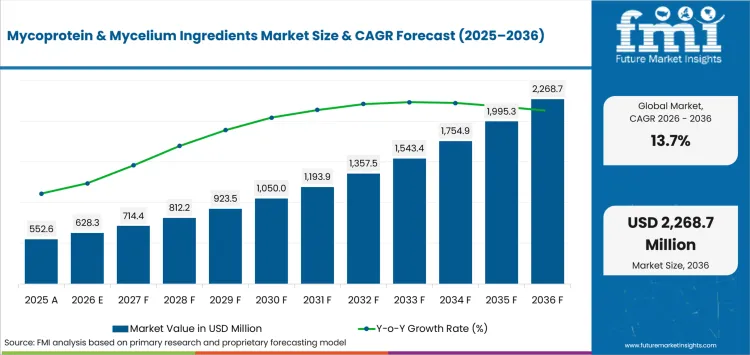
USD 628.3 million in 2026 and USD 2,268.7 million by 2036 at a 13.7% CAGR.
Demand for mycoprotein and mycelium ingredients are forecast to expand at a 13.7% CAGR from 2026 to 2036, supported by lawful food uses and commercial fermentation capacity. The forecast lifts valuation from USD 628.3 million to USD 2,268.7 million across ingredient revenues. The Food Standards Agency and Food Standards Scotland reported in June 2026 that the United Kingdom has industrial biomass-fermentation capacity and expanding ingredient supply. Their assessment identified cost-effective scale-up as the principal challenge for newer fungal ingredients entering broader applications. Commercial teams evaluating fermented protein systems must compare strain status with usable capacity and application support before approving recurring customer programs.
European Union entry depends on the specific fungal strain and its documented consumption history rather than a broad mycoprotein category label. The European Commission listed Fusarium venenatum A 3/5 as not novel in August 2024, but classified strain NRRL 26228 as a novel food in December 2024. United States entry follows a different route since FDA reviews GRAS conclusions for defined substances and intended uses through its notification program. Manufacturers must align strain identity and food categories with the correct national dossier before planning commercial production. The regulatory distinction affects food supplement uses and meat-alternative launches differently because the same fungal platform may not carry identical lawful uses across jurisdictions.
Key Takeaways of Mycoprotein & Mycelium Ingredients Market
- Demand for mycoprotein and mycelium ingredients is driven by regulated fungal ingredients creating commercial value through aligned approvals and reliable production during customer qualification.
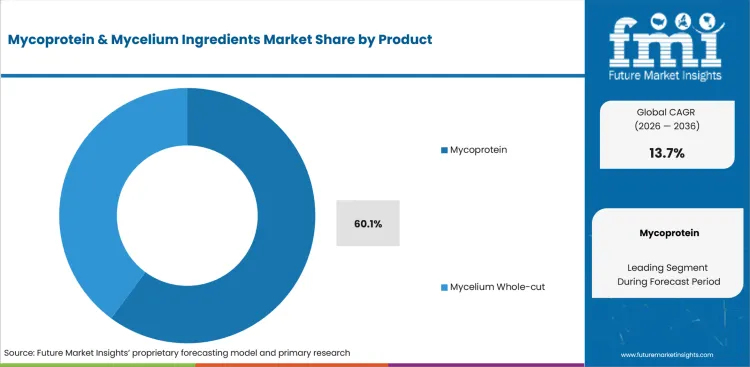
- By product, mycoprotein holds the leading share at 60.1% in 2026, due to established manufacturing routes and broad formulation flexibility across several food formats.
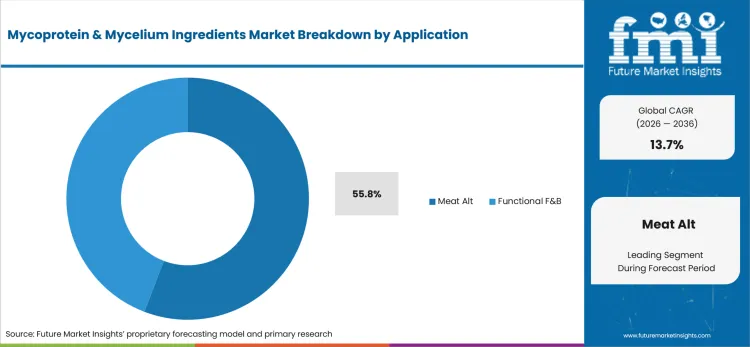
- Meat alternatives lead the application category at 55.8% share in 2026, due to fungal texture within familiar meal formats that improve product bite and structure.
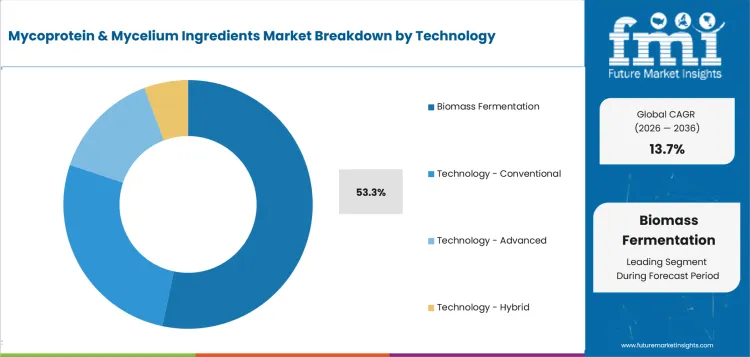
- Biomass fermentation is the dominant technology segment, holding 53.3% share in 2026, driven by direct whole-biomass recovery and scalable production.
- Repeat orders depend on batch consistency, since one failed formulation can delay approvals across several customer products and jurisdictions simultaneously.
- The Netherlands and the USA record CAGRs of 16.6% and 16.2% respectively through 2036, while Sweden and Germany require locally compliant dossiers as commercial teams balance smaller customer pools against accessible European distribution networks.
- Competition centers on The Protein Brewery, ENOUGH, Quorn Foods, MyForest Foods, BMC Ingredients, Kynda, The Fynder Group, and Cargill (ABUNDA), with vendors differentiating through fermentation capacity with B2B application support, proprietary fungal biomass tied to consumer products, and emerging or established regional customer channel access.
Analyst Perspective
Mycoprotein's commercial lead rests on downstream flexibility, since processors can adjust inclusion levels without rebuilding forming and cooking operations, but that same adaptability means the ingredient's real qualification bottleneck sits in specification clarity between developer and manufacturer, not in the biomass itself. Biomass fermentation's whole-cell recovery route simplifies downstream processing on paper, yet the financing and facility scale-up required, evident in The Protein Brewery's multi-thousand-tonne capacity build, signals that dependable volume has to arrive before application work can convert into recurring orders rather than one-off trials. Meat alternative applications will likely separate winners from also-rans based on whether whole-cut formats can justify their premium against refrigerated distribution costs, since fungal texture only pays off commercially if the visible eating benefit clears that pricing bar for retail buyers.
- Nandini Roy Choudhury, Principal Analyst at Future Market Insights
Source: FMI's proprietary forecasting model and primary research
How is the Mycoprotein & Mycelium Ingredients Market segmented?
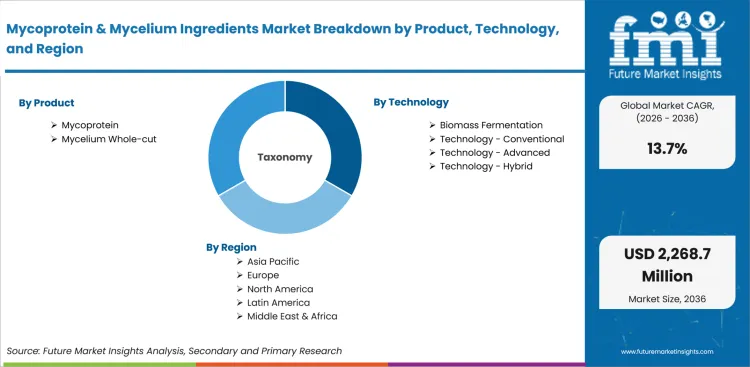
The mycoprotein and mycelium ingredients industry is segmented by product, technology, application, and region.
The segmentation framework separates ingredient form from production method and the food application carrying the final commercial requirement. Product analysis distinguishes mycoprotein powders from whole-cut mycelium formats that retain more of the cultivated structure. Technology analysis compares biomass fermentation with conventional and advanced process routes that differ in strain control and downstream handling. Application analysis follows meat alternatives and functional foods because each category uses different texture and nutrition performance thresholds. Regional analysis compares local approval routes and production support across the complete defined country coverage and service networks. The mycoprotein ingredients comparison helps manufacturers connect segment leadership with qualification work rather than treating every fungal platform as interchangeable.
What supports demand for mycoprotein within the product category?
Mycoprotein ingredient developers offer concentrated fungal biomass that food manufacturers can dose into several formulations without preserving a complete cultivated structure. Quorn Foods states that its Fusarium venenatum mycoprotein is grown through fermentation and shaped for multiple finished-product formats. The process creates a versatile protein base that can be used in mince and pieces across established product lines. Comparable fermented mycoprotein formats must demonstrate stable flavor and texture across the customer process rather than relying on ingredient composition alone.
- The product category is forecast to be led by mycoprotein at 60.1% share in 2026 due to established manufacturing routes and broad formulation flexibility. Processors can adjust inclusion levels without rebuilding downstream forming and cooking operations across the complete production line. The position therefore reflects repeatable integration across several food formats rather than dependence on one consumer product.
- Nutrition brands and food manufacturers adopt mycoprotein once qualification confirms protein quality and acceptable sensory performance across normal shelf life. The ingredient can serve supplements and mainstream foods through different dosage forms and processing conditions. Adoption slows if specification limits or regulatory responsibilities remain unclear between the ingredient developer and finished-product manufacturer during recurring commercial supply.
How does biomass fermentation shape demand within the technology category?
Biomass fermentation converts rapidly growing fungal cells into the ingredient itself rather than producing one isolated molecule for later purification. ENOUGH describes its patented process as feeding renewable raw materials into fungal fermentation and recovering whole biomass for food use. The route can simplify downstream recovery but requires disciplined control of aeration and heat removal across larger vessels. Scaled production requires fermentation control and application development before regular customer orders become commercially defensible.
- By technology, biomass fermentation is forecast to represent 53.3% share in 2026 driven by direct whole-biomass recovery and scalable production. Invest-NL reported in September 2025 that The Protein Brewery completed a financing round and prepared its Breda facility for 2,500 tonnes annually. The investment shows why functional food ingredients need dependable capacity before customer application work converts scale into recurring orders.
- Ingredient developers favor biomass fermentation if vessels and utilities maintain repeatable growth conditions across every validated production batch. Food manufacturers evaluate plant-based formulation ingredients beside fungal biomass to determine whether texture gains justify revised recipes and allergen controls. Adoption remains cautious if scale-up changes particle structure or introduces sensory variation that laboratory batches did not reveal.
What makes meat alt central to the application category?
Meat alternatives give fungal biomass a direct performance role since natural hyphal structures can contribute bite and fibrous texture. MyForest Foods describes a vertical growing method that preserves sheets of fungal tissue before harvest and final preparation. Whole-cut formats retain visible structure through cooking while powders support blended formulations across familiar meal products. Manufacturers assessing meat substitute applications should test cooking loss and texture retention across the intended serving format.
- Based on application, meat alt is projected to account for 55.8% share in 2026 due to fungal texture within familiar meal formats. Manufacturers can use powders and whole-cut sheets through different forming methods and consumer price points across several finished products. The share reflects a direct performance function that improves product texture rather than broad interest in alternative proteins.
- Meat alternative products gain traction if whole-cut mycelium delivers recognizable texture without extensive forming equipment. Retail food manufacturers can use familiar bacon or cutlet formats to explain preparation and sensory value across established channels. Adoption weakens if premium pricing exceeds the visible eating benefit or refrigerated distribution limits consistent availability.
What are the drivers, restraints, and opportunities in the Mycoprotein & Mycelium Ingredients Market?
Regulatory clarity and scalable fermentation support demand, while qualification costs and strain-specific approval requirements continue to shape commercial adoption.
- Driver: Approved fungal ingredients and established fermentation capacity give manufacturers clearer routes from formulation trials to commercial production.
- Restraint: Strain-specific safety dossiers and batch evidence can extend qualification timelines across jurisdictions and food application categories.
- Opportunity: Application partnerships can convert nutritional fungal biomass into differentiated dairy alternatives and broader plant-based formulations.
Regulatory acceptance gives food manufacturers defined ingredient conditions and usable formulation boundaries for commercial planning programs. The European Commission adopted Regulation (EU) 2026/1507 on July 3, 2026 to authorize Rhizomucor pusillus mycelium for specified foods. The authorization will apply from July 26, 2026 and will grant The Protein Brewery a five-year protected European Union route. Manufacturers can now plan dairy-alternative applications around defined labeling and compositional conditions instead of an unresolved approval pathway.
Incomplete dossiers remain a challenge since fungal strains require evidence covering identity and production together with stability and allergenicity. At its June 2025 meeting, the Advisory Committee on Novel Foods and Processes recorded information gaps for Fusarium flavolapis across several safety areas. Documented gaps can delay commercial schedules even after a production process performs reliably at validated scale. Ingredient developers need jurisdiction-specific documentation plans and accountable regulatory owners before promising launch dates to customers or contract manufacturers.
Application development creates an opportunity to use fungal nutrition inside products that currently compromise protein content or sensory quality. The Protein Brewery received an EU LIFE grant in December 2025 to scale Fermotein for dairy alternatives. The funded program combines fermentation scale-up with application validation and targeted health research across commercially relevant dairy formats. Similar work across dairy alternative formulations can create value by resolving an existing formulation trade-off through verified application evidence.
Which country CAGRs are profiled in the Mycoprotein & Mycelium Ingredients Market?
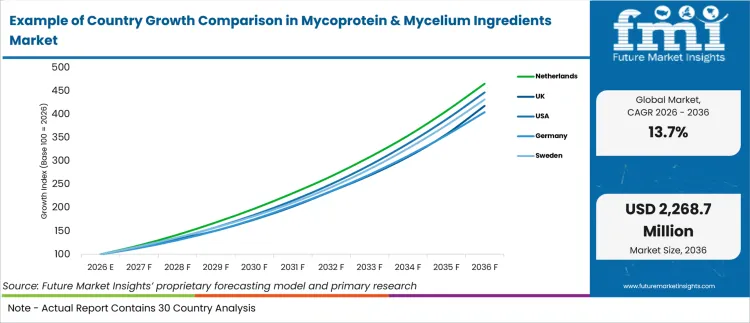
| Country | CAGR |
|---|---|
| Netherlands | 16.6% |
| UK | 15.4% |
| USA | 16.2% |
| Germany | 15.0% |
| Sweden | 15.8% |
How do country-level CAGRs compare in the Mycoprotein & Mycelium Ingredients Market?
The country comparison shows a relatively narrow spread in projected growth rates across the mycoprotein & mycelium ingredients market. The Netherlands and the USA form a closely aligned upper group with only a limited difference between their forecasts. Sweden follows nearby and remains connected to this cluster through a small gap in projected expansion. The UK and Germany create a lower pair that is separated from the upper group by a moderate step-down. The overall gap between the first and last country is 1.6 percentage points which indicates a concentrated growth outlook across the markets profiled. These differences reflect the pace of fermentation technology adoption, alternative protein innovation and commercial scaling of mycoprotein and mycelium-based ingredients.
- The Netherlands shows a notable position within the comparison as its established food technology ecosystem supports the development and commercialization of next-generation fungal protein ingredients.
- The USA remains close to the Netherlands in CAGR terms but follows a different market path through growing investment in alternative protein companies and expanding applications across food categories.
- Sweden occupies a closely connected position within the comparison as sustainability-focused food innovation continues to support the adoption of mycelium-based ingredient platforms.
- The UK remains relatively close to Sweden yet market expansion is supported by strong consumer interest in alternative proteins and continued product development activities.
- Germany forms part of the lower group while maintaining steady progress through investments in fermentation-based food technologies and ingredient innovation.
Comparable CAGRs do not create identical market conditions across countries. Differences in production capacity, regulatory approval pathways, investment activity and food manufacturer adoption can influence how quickly mycoprotein and mycelium ingredients move from development to large-scale commercialization. As a result, companies may encounter different market entry and expansion requirements despite relatively similar growth forecasts. The full report provides country-level CAGR analysis across North America, Latin America, Europe, East Asia, South Asia, Oceania and the Middle East and Africa.
Country-wise Analysis
- Dutch ingredient developers operate near established fermentation facilities and European food customers that can support repeated application trials. The Netherlands is forecast to advance at 16.6% CAGR through 2036, enabled by local scale-up finance and specialized biotechnology infrastructure. The Netherlands Enterprise Agency confirmed for 2026 that qualifying microorganism production systems can receive 45% MIA and 75% Vamil benefits. The incentive can improve project economics for bioreactors and stabilization equipment used to produce food ingredients from microorganisms. Local food businesses can arrange direct purchases or co-development programs with application laboratories and contract manufacturers. The main friction remains the cost of validating each strain and end use before new capacity converts into dependable customer orders.
- United Kingdom manufacturers already use industrial mycoprotein capacity and nationwide retail channels across several meat-free product formats. Quorn Foods reported on April 28, 2026 that Marlow Foods held a 31% United Kingdom category share during the year ending December 2025. UK demand is projected to expand at 15.4% CAGR from 2026 to 2036, supported by installed production and familiar consumer applications. The filing also showed that operating losses halved while the business remained cash positive and continued product investment. Manufacturers can access established technical teams and retail distribution without building an entirely new service route for every formulation. New fungal strains face dossier work and allergen assessment that can extend launch schedules beyond ordinary product development cycles. Commercial entrants should budget for local regulatory work even though existing retail channels reduce distribution and customer education costs.
- United States food manufacturers use a formal GRAS notification system and a broad network of formulation partners across packaged foods. The USA is projected to record 16.2% CAGR through 2036, strengthened by defined federal review pathways and varied commercial applications. Federal review gives ingredient developers a defined route to document identity and intended uses across customer qualification programs. The Food and Drug Administration closed GRAS Notice 1255 in November 2025 with no questions regarding Fusarium compactum fungal protein. Application laboratories can use the listed food categories to plan formulation work and regulatory documentation with commercial customers. Commercial friction arises since every new strain and proposed use pattern requires evidence that cannot transfer automatically from another fungal ingredient.
- German food companies can work with local fermentation specialists that convert food-processing side streams into mycelium protein for commercial formulation programs. Bioökonomie.de reported in February 2026 that Kynda opened a combined research and production center in Jelmstorf to accelerate industrial mycelium-protein use. Germany is forecast to post 15.0% CAGR over the forecast period, underpinned by local process development and access to European food channels. The center gives manufacturers nearby support for substrate testing and repeated application trials across available regional production equipment. Local starter-culture production can reduce service distance for manufacturers that need repeated process adjustments across commercial trials. Commercial friction remains substantial because small runs and recipe adjustments can keep ingredient costs above established plant-protein systems.
- Swedish food businesses must establish whether a new fungal ingredient has pre-1997 consumption history or requires European Union authorization. Sweden is projected to advance at 15.8% CAGR by 2036, shaped by regulatory support and a concentrated base of product developers. Livsmedelsverket stated in March 2025 that novel foods require approval prior to sale and described advisory support for smaller applicants. The advisory service helps smaller companies clarify study design and dossier preparation prior to submitting a complete European application. Ingredient developers can serve Sweden through European distribution while using local regulatory consultants and customer application teams for qualification. Limited domestic manufacturing scale remains a material friction that can increase service distance and complicate small-volume technical trials.
Who are the notable companies in the Mycoprotein & Mycelium Ingredients Market?
The Protein Brewery B.V.; Marlow Foods Limited; 3F BIO LTD; MyForest Foods; The Better Meat Co. (BMC Ingredients); Kynda Biotech GmbH; The Fynder Group, Inc.; and Cargill are notable companies shaping this market.
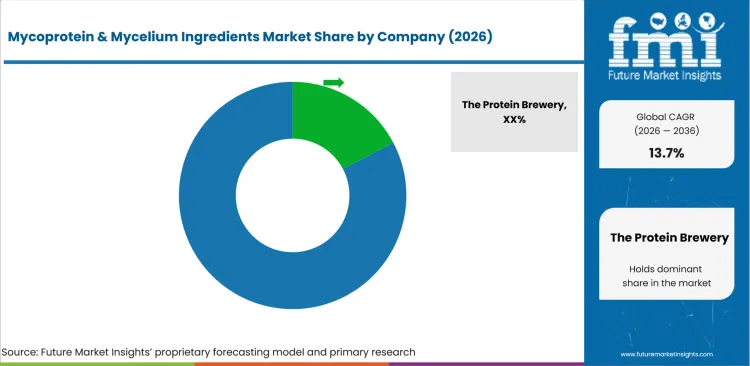
The competitive field combines ingredient specialists with consumer brands and application partners that convert fungal biomass into commercial products. Ingredient developers compete through strain performance and fermentation economics together with technical support for customer formulation and regulatory work. Consumer brands compete through retail access and familiar formats that translate mycoprotein performance into visible purchase decisions. Application partners extend alternative-protein formulation portfolios through technical support and established customer access across several food categories. Commercial leadership depends on supply reliability since attractive laboratory performance cannot support repeat orders without dependable specifications and delivery.
- The Protein Brewery and ENOUGH develop business-to-business mycoprotein ingredients through commercial fermentation capacity and customer application support. Cargill extends ENOUGH's ABUNDA platform through formulation expertise and international customer relationships without controlling the underlying fermentation technology. Selection depends on verified capacity and application coverage across intended customer formats and documented regional supply routes.
- Marlow Foods Limited and MyForest Foods connect proprietary fungal biomass with consumer products and dedicated manufacturing processes. Their commercial positions depend on retail access and product renewal together with reliable production across routine sales cycles. Selection depends on current product availability and documented manufacturing continuity rather than past distribution claims.
- BMC Ingredients supplies Rhiza mycoprotein through business-to-business application partnerships and FDA GRN 1117 records defined meat and alternative-product uses. Kynda Biotech supports side-stream fermentation from starter cultures through process equipment while The Fynder Group operates a development-stage fungal platform. Selection depends on current supply scale and verified application support because technical promise cannot replace dependable commercial availability.
Competitive Benchmarking: Mycoprotein & Mycelium Ingredients Market
| Company | Product | Technology | Process Integration | Geographic Reach |
|---|---|---|---|---|
| The Protein Brewery B.V. | High | High | High | Europe and North America |
| Marlow Foods Limited (Quorn Foods) | High | High | Medium | Europe, North America, and Asia-Pacific |
| 3F BIO LTD (ENOUGH) | High | High | High | Europe |
| MyForest Foods | Low | Medium | Medium | North America |
| The Better Meat Co. (BMC Ingredients) | High | Medium | Medium | United States |
| Kynda Biotech GmbH | Low | Medium | High | Europe |
| The Fynder Group, Inc. | Low | Medium | Medium | North America |
| Cargill | Low | Low | High | Europe, Middle East, and Africa |
Key Developments in the Mycoprotein & Mycelium Ingredients Market
- In June 2026, The Protein Brewery received support through a Series B extension announced by Invest-NL and led by the ABN AMRO Sustainable Impact Fund. The financing supports production expansion and commercial growth across Europe while strengthening the scientific foundation for Fermotein. Invest-NL also reported secured 2026 sales and measurable progress toward broader European rollout across food manufacturing accounts. The development gives manufacturers a more credible supply route for application trials that require dependable ingredient availability.
- In March 2025, MyForest Foods benefited from Ecovative securing more than USD 11 million to expand MyBacon production and establish a food science laboratory. MyBacon had reached more than 1,200 retailers across North America and demonstrated distribution beyond a limited regional pilot. The investment connected consumer demand with another production line and expanded development capacity for whole-cut products. The expansion provides commercial evidence that structured mycelium can progress into repeated retail supply across established customer accounts.
- In July 2026, The Fynder Group had its Fy Protein novel-food application recorded as withdrawn by the Food Standards Agency on July 1. The withdrawn status removes that dossier from active British risk assessment and prevents manufacturers from treating it as an approval pathway. Commercial planning in the United Kingdom must exclude authorization through the closed application during near-term market entry. Any renewed route would require a fresh or revised submission under the applicable novel-food process.
- In May 2026, Quorn Foods relaunched its chilled mince product in Tesco and Sainsbury’s with a four-ingredient recipe and no artificial ingredients. Quorn stated that the product cooks in under ten minutes and became the first chilled item within its simplified range. The launch translated established mycoprotein capacity into a familiar meal format supported by revised labeling and faster preparation. The development shows how incumbents can renew demand through formulation changes rather than entirely new technology.
Key Players in the Mycoprotein & Mycelium Ingredients Market
Mycoprotein Ingredient and Fermentation Developers
- The Protein Brewery B.V.
- 3F BIO LTD (ENOUGH)
- The Better Meat Co. (BMC Ingredients)
- Kynda Biotech GmbH
Scaled Consumer Product and Manufacturing Groups
- Marlow Foods Limited (Quorn Foods)
- MyForest Foods
Mycelium Platform and Application Specialists
- The Fynder Group, Inc.
- Cargill
Mycoprotein & Mycelium Ingredients Market - Report Scope
| Coverage field | Report scope |
|---|---|
| Market breakdown | Product, technology, application, and region. |
| Quantitative Units | Revenue in USD Million, CAGR in %. |
| Market Definition | Revenue from fungal biomass ingredients and whole-cut mycelium formats sold for food manufacturing and commercial finished-food production. The scope includes defined fermentation technologies and application support directly connected to the named segments. |
| Regions Covered | North America; Latin America; Western Europe; Eastern Europe; East Asia; South Asia and Pacific; and Middle East and Africa. |
| Countries Covered | Netherlands; UK; USA; Germany; Sweden; plus more than twenty-five additional countries across the regions covered. |
| Key Companies Profiled | The Protein Brewery B.V.; Marlow Foods Limited; 3F BIO LTD; MyForest Foods; The Better Meat Co. (BMC Ingredients); Kynda Biotech GmbH; The Fynder Group, Inc.; and Cargill. |
| Forecast Period | 2026 to 2036. |
| Approach | Hybrid bottom-up and top-down market sizing supported by primary interviews and official desk research. |
Mycoprotein & Mycelium Ingredients Market - Research Methodology
| Method | Approach |
|---|---|
| Primary Research | FMI analysts gathered input from manufacturers, service providers, technology developers, distributors, end users, sourcing teams, and subject-matter experts. Interviews examined purchasing decisions, product or service evaluation, adoption barriers, approval requirements, pricing considerations, and expectations for technical or commercial support. Respondents were also asked what evidence is required before a trial, pilot, or initial order develops into regular purchasing. |
| Desk Research | Desk research covered government statistics, regulatory publications, trade data, industry associations, technical literature, standards, company filings, product information, and official corporate announcements. Sources were reviewed for relevance, publication date, geographic coverage, and consistency with the defined market scope. Claims relating to performance, applications, approvals, capacity, investment, and commercial activity were retained only when supported by credible public evidence. |
| Market Sizing and Forecasting | The market model combined the baseline value with historical performance, segment structure, pricing and volume indicators, adoption levels, company participation, and country-level demand conditions. Forecast assumptions considered economic activity, investment trends, regulatory developments, technology adoption, purchasing cycles, supply availability, and barriers to wider market use. Segment and regional estimates were reconciled before the final market total was calculated. |
| Data Validation | Estimates were checked against multiple independent indicators, including public data, company activity, trade patterns, industry developments, and findings from primary interviews. Validation also tested whether products, services, applications, and company revenues fell within the defined market boundaries. Adjacent categories, unsupported claims, overlapping revenues, and activities without direct market relevance were excluded to reduce double counting and maintain consistency across segments and countries. |
Mycoprotein & Mycelium Ingredients Market by Segments
Mycoprotein & Mycelium Ingredients Market segmented by Product:
- Mycoprotein
- Mycelium Whole-cut
Mycoprotein & Mycelium Ingredients Market segmented by Technology:
- Biomass Fermentation
- Technology - Conventional
- Technology - Advanced
- Technology - Hybrid
Mycoprotein & Mycelium Ingredients Market segmented by Application:
- Meat Alt
- Functional F&B
Mycoprotein & Mycelium Ingredients Market by Region:
- North America
- United States
- Canada
- Latin America
- Brazil
- Mexico
- Argentina
- Chile
- Western Europe
- Germany
- France
- United Kingdom
- Italy
- Spain
- Benelux
- Nordics
- Eastern Europe
- Poland
- Czech Republic
- Romania
- Hungary
- East Asia
- China
- Japan
- South Korea
- South Asia and Pacific
- India
- ASEAN
- Australia and New Zealand
- Middle East and Africa
- GCC Countries
- South Africa
- Türkiye
- Israel
Research Sources and Bibliography
- Food Standards Agency and Food Standards Scotland. (2026, June 25). Top emerging UK food innovations: 2025-2035.
- European Commission. (n.d.). Consultation process on novel food status.
- USA Food and Drug Administration. (n.d.). Generally recognized as safe (GRAS).
- Quorn Foods. (2026, February 17). How is Quorn made?
- Invest-NL. (2025, September 22). The Protein Brewery ready for commercial growth with € 30 million investment.
- MyForest Foods. (n.d.). Our process.
- European Commission. (2026, July 3). Commission Implementing Regulation (EU) 2026/1507 of 3 July 2026 authorising the placing on the market of Rhizomucor pusillus mycelium as a novel food and amending Implementing Regulation (EU) 2017/2470.
- Advisory Committee on Novel Foods and Processes. (2025, June 24). 172nd ACNFP Meeting.
- The Protein Brewery. (2025, December 16). The Protein Brewery Secures €2.3 Million EU LIFE Grant to bring next-gen nutritious mycoprotein powder to dairy alternatives.
- Rijksdienst voor Ondernemend Nederland. (2025, December 16). Productiesysteem met micro-organismen.
- Quorn Foods. (2026, April 28). Marlow Foods Limited 2025 accounts.
- USA Food and Drug Administration. (2025, November 18). GRAS notice 1255: Mycelial biomass of Fusarium compactum CGMCC 41312 (fungal protein).
- Bioökonomie.de. (2026, February 9). Kynda eröffnet neuen Standort für Pilzmycel aus Nebenströmen.
- Livsmedelsverket. (2025, March 26). Möjlighet till stöd och hjälp när du ska ansöka om godkännande av nya livsmedel (novel food).
- The Protein Brewery. (n.d.). Applications.
- USA Food and Drug Administration. (2024, July 9). GRN No. 1117: Mycelial biomass from Neurospora crassa.
- Invest-NL. (2026, June 29). Invest-NL reinvests in The Protein Brewery to scale sustainable food ingredients.
- Ecovative. (2025, March 27). Ecovative secures over $11 million as its mycelium products gain momentum in food, materials, and wellness.
- Food Standards Agency. (2026, July 1). RP-1637: Fy Protein™ [Regulated product application record].
- Quorn Foods. (2026, May 1). Back by popular demand, Quorn family favourite, Chilled Mince - now with no artificial ingredients!
This bibliography is provided for reader reference and is not exhaustive. The full report contains the complete reference list and detailed citations.
This Report Answers
- How large is the mycoprotein & mycelium ingredients market in 2026 and 2036?
- Which regulatory and production conditions support investment in commercial fungal protein ingredients?
- Why does Mycoprotein hold the leading Product share during 2026?
- How does Biomass Fermentation influence ingredient economics and application performance?
- Why does Meat Alt account for the leading Application share during 2026?
- How do country growth rates differ across the Netherlands, UK, USA, Germany, and Sweden?
- Which companies provide fungal ingredients, manufacturing scale, consumer products, or application support?
- What limits qualification and commercial scale-up across new fungal strains and food categories?
- Which operating tests should manufacturers complete before approving larger orders or broader launches?
Frequently Asked Questions
How big is the Mycoprotein & Mycelium Ingredients Market in 2026?
The mycoprotein and mycelium ingredients market is valued at USD 628.3 million in 2026 and is forecast to reach USD 2268.7 million by 2036. Growth reflects lawful food uses and commercial fermentation capacity expanding across the United Kingdom's industrial biomass-fermentation base and broader supply networks.
What is the CAGR of the Mycoprotein & Mycelium Ingredients Market from 2026 to 2036?
The mycoprotein and mycelium ingredients market grows at a CAGR of 13.7% between 2026 and 2036, supported by approved fungal ingredients and established fermentation capacity that give manufacturers clearer routes from formulation trials to commercial production.
Which technology leads the Mycoprotein & Mycelium Ingredients Market?
Biomass fermentation accounts for 53.3% of the mycoprotein and mycelium ingredients market by technology in 2026, driven by direct whole-biomass recovery and scalable production requiring disciplined control of aeration and heat removal across larger vessels.
How much will the Mycoprotein & Mycelium Ingredients Market add between 2026 and 2036?
The mycoprotein and mycelium ingredients market is set to add USD 1640.4 million between 2026 and 2036, growing from USD 628.3 million to USD 2268.7 million as regulated fungal ingredients extend across a widening base of meat-alternative and dairy-alternative applications.
Who are the leading companies in the Mycoprotein & Mycelium Ingredients Market?
Five companies lead the mycoprotein and mycelium ingredients market, including The Protein Brewery, ENOUGH, Quorn Foods, MyForest Foods, and BMC Ingredients, competing through fermentation capacity, proprietary fungal biomass, and business-to-business application support.
Preview the report firsthand - request a free sample
Get SampleGet the brochure for pricing and purchase details.
Get PDFTable of Content
- Key Takeaways
- Market Size and CAGR
- Top Growth Driver
- Fastest Growing Segment
- Leading Region
- Key Companies
- Emerging Opportunities
- Executive Summary
- Global Market Outlook
- Demand-side Trends
- Supply-side Trends
- Technology Roadmap Analysis
- Analysis and Recommendations
- Analyst Perspective (What is happening? Why now? What should investors know?)
- Key Questions Answered
- How large is the market?
- What is the CAGR?
- What are key trends?
- Which region dominates?
- Who are the leaders?
- Market Overview
- Market Coverage / Taxonomy
- Market Definition / Scope / Limitations
- Research Methodology
- Chapter Orientation
- Analytical Lens and Working Hypotheses
- Market Structure, Signals, and Trend Drivers
- Benchmarking and Cross-market Comparability
- Market Sizing, Forecasting, and Opportunity Mapping
- Research Design and Evidence Framework
- Desk Research Programme (Secondary Evidence)
- Expert Input and Fieldwork (Primary Evidence)
- Tooling, Models, and Reference Databases
- Data Engineering and Model Build
- Quality Assurance and Audit Trail
- Market Background
- Market Dynamics (Drivers, Restraints, Opportunity, Trends)
- Scenario Forecast (Optimistic, Likely, Conservative)
- Impact Analysis
- AI Impact
- Sustainability Impact
- Regulatory Impact
- Technology Impact
- Consumer / Buyer Analysis
- Purchase Drivers
- Adoption Barriers
- Buyer Journey
- Opportunity Map Analysis
- Product Life Cycle Analysis
- Supply Chain Analysis
- Investment Feasibility Matrix
- Value Chain Analysis
- PESTLE and Porter's Analysis
- Regulatory Landscape
- Regional Parent Market Outlook
- Production and Consumption Statistics
- Import and Export Statistics
- Global Market Analysis and Forecast, 2021 to 2036
- Historical Market Size Value (USD Million) Analysis, 2021 to 2025
- Current and Future Market Size Value (USD Million) Projections, 2026 to 2036
- Y-o-Y Growth Trend Analysis
- Absolute $ Opportunity Analysis
- Global Market Pricing Analysis, 2021 to 2036
- Global Market Analysis and Forecast, By Product, 2021 to 2036
- Introduction / Key Findings
- Historical Market Size Value (USD Million) Analysis By Product, 2021 to 2025
- Current and Future Market Size Value (USD Million) Analysis and Forecast By Product, 2026 to 2036
- Mycoprotein
- Mycelium Whole-cut
- Mycoprotein
- Y-o-Y Growth Trend Analysis By Product, 2021 to 2025
- Absolute $ Opportunity Analysis By Product, 2026 to 2036
- Global Market Analysis and Forecast, By Technology, 2021 to 2036
- Introduction / Key Findings
- Historical Market Size Value (USD Million) Analysis By Technology, 2021 to 2025
- Current and Future Market Size Value (USD Million) Analysis and Forecast By Technology, 2026 to 2036
- Biomass Fermentation
- Technology - Conventional
- Technology - Advanced
- Technology - Hybrid
- Biomass Fermentation
- Y-o-Y Growth Trend Analysis By Technology, 2021 to 2025
- Absolute $ Opportunity Analysis By Technology, 2026 to 2036
- Global Market Analysis and Forecast, By Application, 2021 to 2036
- Introduction / Key Findings
- Historical Market Size Value (USD Million) Analysis By Application, 2021 to 2025
- Current and Future Market Size Value (USD Million) Analysis and Forecast By Application, 2026 to 2036
- Meat Alt
- Functional F&B
- Meat Alt
- Y-o-Y Growth Trend Analysis By Application, 2021 to 2025
- Absolute $ Opportunity Analysis By Application, 2026 to 2036
- Global Market Analysis and Forecast, By Region, 2021 to 2036
- Introduction
- Historical Market Size Value (USD Million) Analysis By Region, 2021 to 2025
- Current Market Size Value (USD Million) Analysis and Forecast By Region, 2026 to 2036
- North America
- Latin America
- Western Europe
- Eastern Europe
- East Asia
- South Asia and Pacific
- Middle East & Africa
- Market Attractiveness Analysis By Region
- North America Market Analysis and Forecast, By Country, 2021 to 2036
- Historical Market Size Value (USD Million) Trend Analysis By Market Taxonomy, 2021 to 2025
- Market Size Value (USD Million) Forecast By Market Taxonomy, 2026 to 2036
- By Country
- USA
- Canada
- By Product
- By Technology
- By Application
- By Country
- Market Attractiveness Analysis
- By Country
- By Product
- By Technology
- By Application
- Key Takeaways
- Latin America Market Analysis and Forecast, By Country
- Historical Market Size Value (USD Million) Trend Analysis By Market Taxonomy, 2021 to 2025
- Market Size Value (USD Million) Forecast By Market Taxonomy, 2026 to 2036
- By Country
- Brazil
- Mexico
- Chile
- Rest of Latin America
- By Product
- By Technology
- By Application
- By Country
- Market Attractiveness Analysis
- By Country
- By Product
- By Technology
- By Application
- Key Takeaways
- Western Europe Market Analysis and Forecast, By Country
- Historical Market Size Value (USD Million) Trend Analysis By Market Taxonomy, 2021 to 2025
- Market Size Value (USD Million) Forecast By Market Taxonomy, 2026 to 2036
- By Country
- Germany
- UK
- Italy
- Spain
- France
- Nordic
- BENELUX
- Rest of Western Europe
- By Product
- By Technology
- By Application
- By Country
- Market Attractiveness Analysis
- By Country
- By Product
- By Technology
- By Application
- Key Takeaways
- Eastern Europe Market Analysis and Forecast, By Country
- Historical Market Size Value (USD Million) Trend Analysis By Market Taxonomy, 2021 to 2025
- Market Size Value (USD Million) Forecast By Market Taxonomy, 2026 to 2036
- By Country
- Russia
- Poland
- Hungary
- Balkan & Baltic
- Rest of Eastern Europe
- By Product
- By Technology
- By Application
- By Country
- Market Attractiveness Analysis
- By Country
- By Product
- By Technology
- By Application
- Key Takeaways
- East Asia Market Analysis and Forecast, By Country
- Historical Market Size Value (USD Million) Trend Analysis By Market Taxonomy, 2021 to 2025
- Market Size Value (USD Million) Forecast By Market Taxonomy, 2026 to 2036
- By Country
- China
- Japan
- South Korea
- By Product
- By Technology
- By Application
- By Country
- Market Attractiveness Analysis
- By Country
- By Product
- By Technology
- By Application
- Key Takeaways
- South Asia and Pacific Market Analysis and Forecast, By Country
- Historical Market Size Value (USD Million) Trend Analysis By Market Taxonomy, 2021 to 2025
- Market Size Value (USD Million) Forecast By Market Taxonomy, 2026 to 2036
- By Country
- India
- ASEAN
- Australia & New Zealand
- Rest of South Asia and Pacific
- By Product
- By Technology
- By Application
- By Country
- Market Attractiveness Analysis
- By Country
- By Product
- By Technology
- By Application
- Key Takeaways
- Middle East & Africa Market Analysis and Forecast, By Country
- Historical Market Size Value (USD Million) Trend Analysis By Market Taxonomy, 2021 to 2025
- Market Size Value (USD Million) Forecast By Market Taxonomy, 2026 to 2036
- By Country
- Kingdom of Saudi Arabia
- Other GCC Countries
- Türkiye
- South Africa
- Other African Union
- Rest of Middle East & Africa
- By Product
- By Technology
- By Application
- By Country
- Market Attractiveness Analysis
- By Country
- By Product
- By Technology
- By Application
- Key Takeaways
- Key Countries Market Analysis
- USA
- Pricing Analysis
- Market Share Analysis, 2025
- By Product
- By Technology
- By Application
- Canada
- Pricing Analysis
- Market Share Analysis, 2025
- By Product
- By Technology
- By Application
- Mexico
- Pricing Analysis
- Market Share Analysis, 2025
- By Product
- By Technology
- By Application
- Brazil
- Pricing Analysis
- Market Share Analysis, 2025
- By Product
- By Technology
- By Application
- Chile
- Pricing Analysis
- Market Share Analysis, 2025
- By Product
- By Technology
- By Application
- Germany
- Pricing Analysis
- Market Share Analysis, 2025
- By Product
- By Technology
- By Application
- UK
- Pricing Analysis
- Market Share Analysis, 2025
- By Product
- By Technology
- By Application
- Italy
- Pricing Analysis
- Market Share Analysis, 2025
- By Product
- By Technology
- By Application
- Spain
- Pricing Analysis
- Market Share Analysis, 2025
- By Product
- By Technology
- By Application
- France
- Pricing Analysis
- Market Share Analysis, 2025
- By Product
- By Technology
- By Application
- India
- Pricing Analysis
- Market Share Analysis, 2025
- By Product
- By Technology
- By Application
- ASEAN
- Pricing Analysis
- Market Share Analysis, 2025
- By Product
- By Technology
- By Application
- Australia & New Zealand
- Pricing Analysis
- Market Share Analysis, 2025
- By Product
- By Technology
- By Application
- China
- Pricing Analysis
- Market Share Analysis, 2025
- By Product
- By Technology
- By Application
- Japan
- Pricing Analysis
- Market Share Analysis, 2025
- By Product
- By Technology
- By Application
- South Korea
- Pricing Analysis
- Market Share Analysis, 2025
- By Product
- By Technology
- By Application
- Russia
- Pricing Analysis
- Market Share Analysis, 2025
- By Product
- By Technology
- By Application
- Poland
- Pricing Analysis
- Market Share Analysis, 2025
- By Product
- By Technology
- By Application
- Hungary
- Pricing Analysis
- Market Share Analysis, 2025
- By Product
- By Technology
- By Application
- Kingdom of Saudi Arabia
- Pricing Analysis
- Market Share Analysis, 2025
- By Product
- By Technology
- By Application
- Türkiye
- Pricing Analysis
- Market Share Analysis, 2025
- By Product
- By Technology
- By Application
- South Africa
- Pricing Analysis
- Market Share Analysis, 2025
- By Product
- By Technology
- By Application
- USA
- Market Structure Analysis
- Competition Dashboard
- Competition Benchmarking
- Market Share Analysis of Top Players
- By Regional
- By Product
- By Technology
- By Application
- Emerging Startups
- Innovation Benchmarking
- Competition Analysis
- Competition Deep Dive
- The Protein Brewery
- Overview
- Product Portfolio
- Profitability by Market Segments
- Sales Footprint
- Strategy Overview
- Marketing Strategy
- Product Strategy
- Channel Strategy
- Quorn (Marlow)
- ENOUGH
- MyForest Foods
- Meati
- Mycorena
- Nature's Fynd
- The Protein Brewery
- Case Studies
- Success Stories
- Recent Developments
- Competition Deep Dive
- Assumptions & Acronyms Used


