

- Market Size (2026)
- USD 4.9 Bn
- Forecast (2036)
- USD 8.8 Bn
- CAGR (2026 to 2036)
- 6.0%
How big is the Food Glazing Agent Market in 2026?
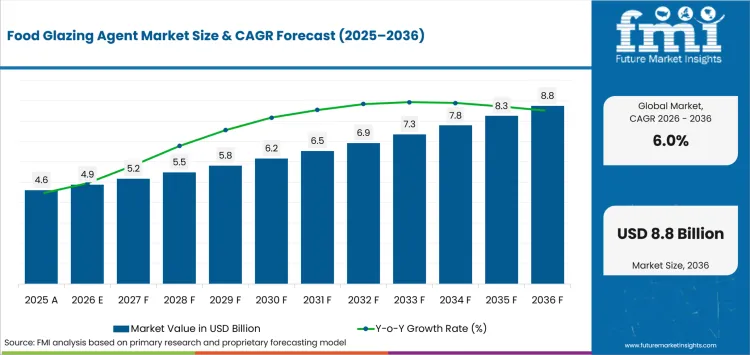
USD 4.9 billion in 2026, reaching USD 8.8 billion by 2036 at a 6.0% CAGR
The food glazing agent market was valued at USD 4.6 billion in 2025. The market is set to reach USD 4.9 billion by 2026-end and grow at a CAGR of 6.0% between 2026-2036 to reach USD 8.8 billion by 2036. Stearic Acid will dominate with a 60.0% share, while Bakery will lead with a 65.0% share.
Food glazing agent procurement is shaped by bakery and confectionery production volumes, clean-label ingredient preferences, and food safety coating requirements. Glazing agents provide surface protection, moisture barrier functionality, and visual appeal for baked goods, confectionery, and processed fruit products. Buyers include food processors, bakery ingredient purchasers, and confectionery manufacturers evaluating coating consistency, natural sourcing, and regulatory compliance.
Growth reflects expanding bakery and confectionery production in East Asia and sustained demand for natural glazing agents across North American and European food processing. FDA confirmed updated food additive regulations in its 2025 GRAS review, supporting procurement of stearic acid and shellac-based glazing agents for food contact applications.
What separates suppliers here is ingredient purity, coating application performance, and clean-label positioning. Mantrose-Haeuser and Capol compete on specialized confectionery and bakery glazing portfolios, and Kerry Group and ADM gain preference where broad food ingredient system integration and formulation support drive sourcing decisions.
Key Takeaways of Food Glazing Agent Market
- Bakery and confectionery production volumes are expected to sustain glazing agent procurement for surface coating and moisture barrier applications.
- Stearic Acid is expected to account for 60.0% of ingredient type demand in 2026 due to broad application across bakery and confectionery coating formulations.
- Bakery is projected to hold 65.0% of application type demand in 2026 because bread, pastry, and biscuit production generates the highest glazing agent consumption.
- Natural Food Glazing Agents is anticipated to represent 54.6% of source type demand in 2026, driven by clean-label reformulation and consumer preference for natural ingredients.
- China leads with an 8.1% CAGR through 2036 as bakery and confectionery production expansion sustains glazing agent procurement.
- Mantrose-Haeuser and Capol are expected to compete through specialized confectionery and bakery glazing portfolios.
Analyst Perspective
"Buyers are expected to judge stearic acid on performance and total cost of ownership rather than headline price. Food glazing agent adoption is expected to depend on bakery production volumes and clean-label reformulation timelines. Suppliers that combine natural ingredient sourcing with coating application consistency are likely to secure food processor supply agreements. Market success is projected to depend on meeting clean-label expectations while maintaining glazing performance across bakery, confectionery, and processed food applications."
- Nandini Roy Choudhury, Principal Consultant, Packaging Domain, Future Market Insights
Why is the Food Glazing Agent Market growing?
Rising Stearic Acid and Bakery demand across food end users
- Food-glazing-agent demand follows bakery and confectionery output and clean-label coating reformulation rather than commodity purchasing.
- China leads growth at 8.1% CAGR as bakery and confectionery production expansion sustains glazing agent procurement.
- Bakery holds 65.0% of application type revenue, indicating where standardization is concentrating buyer spend.
Because glaze appearance and shelf-life drive product value, food-glazing-agent spend concentrates with suppliers offering coating performance, clean-label options, and reliable supply into bakery and confectionery makers.
How is the Food Glazing Agent Market segmented?
The food glazing agent industry is segmented by ingredient type, application type, ingredient function type, source type, end use industry, and region.
The food glazing agent market is segmented by ingredient type, application type, ingredient function type, source type, end use industry, and region. By ingredient type, the market covers stearic acid, beeswax, carnauba wax, candelilla wax, shellac, and paraffin wax. By application type, the market covers bakery, confectionery, processed meat poultry and fish, fruits and vegetables, functional foods, and others. By ingredient function type, the market covers coating agents, surface finishing agents, firming agents, film agents, and others. By source type, the market covers natural food glazing agents, synthetic food glazing agents, and hybrid glazing formulations. By end use industry, the market covers food processing industry, beverage industry, and nutraceutical industry. Regions include North America, Latin America, Western Europe, Eastern Europe, East Asia, South Asia and Pacific, and the Middle East and Africa.
How does stearic acid shape demand within the ingredient type category?
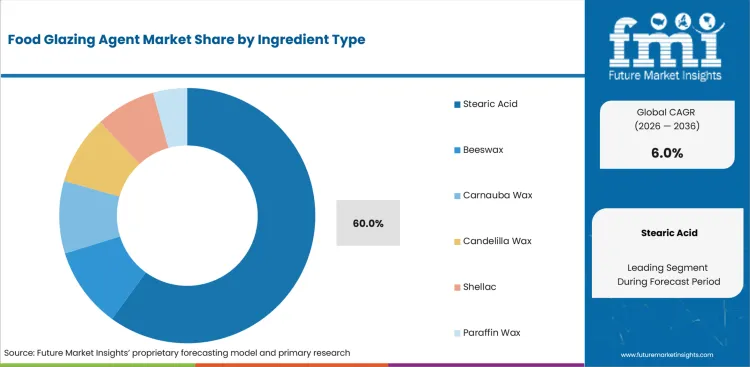
Ingredient type selection determines coating functionality and regulatory compliance. Stearic acid serves as a primary glazing and release agent across bakery and confectionery production.
- Stearic Acid is expected to account for 60.0% of ingredient type demand in 2026.
- Coating Agents is projected to hold 37.0% of ingredient function type demand in 2026 as surface protection and moisture barrier functionality remain primary glazing application drivers.
What supports demand for bakery within the application type category?
Application type selection determines formulation compatibility, labeling position, and processing performance. Bakery anchors the category, keeping buyer spend concentrated where qualification and service support are already established. Demand concentrates here because bread, pastry, and biscuit manufacturing generate the highest glazing agent volumes.
- Bakery is projected to hold 65.0% of application type demand in 2026 because bread, pastry, and biscuit manufacturing generate the highest glazing agent volumes.
- Food Processing Industry is forecast to represent 68.5% of end-use industry demand in 2026 as large-scale food production facilities drive ingredient procurement.
How do source type and end use industry shape procurement?
Source type and end use industry decide who controls the purchase and how the product reaches the account; together they determine formulation compatibility, labeling position, and processing performance. The shares below show which routes suppliers must qualify for.
- Natural Food Glazing Agents is expected to hold 54.6% of source type demand in 2026 as clean-label reformulation drives natural ingredient sourcing.
- Food Processing Industry is anticipated to account for 68.5% of end-use industry demand because large-scale bakery and confectionery production facilities generate the highest glazing agent consumption volumes.
What are the drivers, restraints, and opportunities in the Food Glazing Agent Market?
Near-term procurement is shaped by bakery production cycles, clean-label reformulation, and food safety coating requirements.
- Driver: Bakery and confectionery production expansion is expected to push glazing agent procurement as food processors scale surface coating operations.
- Restraint: Natural wax supply variability and price volatility for beeswax and carnauba wax are likely to slow adoption if sourcing costs exceed synthetic glazing alternatives.
- Opportunity: Clean-label reformulation programs are expected to open supplier access if natural glazing agents replace synthetic coatings in packaged food applications.
Bakery production expansion is expected to increase glazing agent procurement across food processing facilities. Kerry Group reported in its 2025 annual filing that food ingredient system revenues maintained growth across bakery and confectionery applications.
Natural wax supply variability is expected to limit adoption if carnauba and beeswax pricing fluctuations reduce margin for natural glazing formulations. FAO reported in 2025 that agricultural commodity price volatility continued to affect food ingredient sourcing decisions.
Clean-label reformulation creates a practical route by shifting food processor demand from synthetic to natural glazing agents. Mantrose-Haeuser reported in 2025 that its natural food coating portfolio expanded across bakery and confectionery applications in North America and Europe.
Which country CAGRs are profiled in the Food Glazing Agent Market?
China 8.1%, India 7.7%, UK 5.1%, USA 4.9%, Germany 4% through 2036
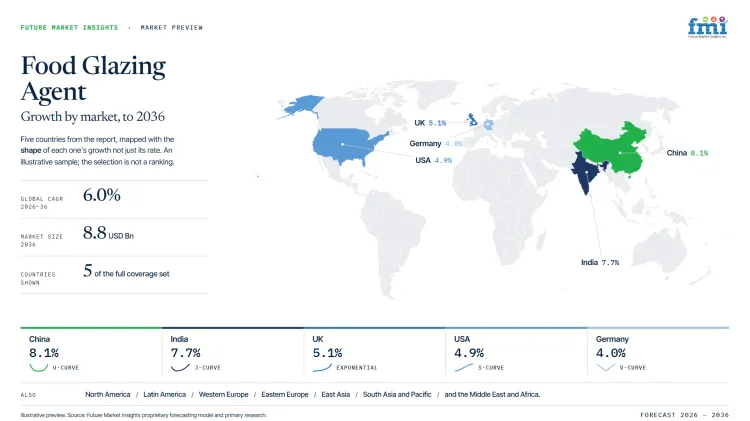
| Country | CAGR (2026 to 2036) |
|---|---|
| China | 8.1% |
| India | 7.7% |
| UK | 5.1% |
| USA | 4.9% |
| Germany | 4% |
Source: FMI's proprietary forecasting model and primary research. 5 of the countries covered in the full report are shown here as a representative subset.
How do country-level CAGRs compare in the Food Glazing Agent Market?
The country comparison spans 4.1 percentage points and reveals three distinct growth groups across the Food Glazing Agent Market. China and India form the upper tier with a 0.4-point difference, while the United Kingdom and the United States create a closely aligned middle group separated by 0.2 percentage points. Germany remains at the lower end with a 0.9-point gap from the United States.
- China leads the comparison at an 8.1% CAGR through 2036, supported by bakery and confectionery expansion and modern retail, which are increasing demand for premium food finishes.
- India follows at a 7.7% CAGR, remaining 0.4 percentage points below China. Packaged-bakery growth and rising confectionery consumption are widening glazing-agent adoption beyond metropolitan markets.
- The United Kingdom records a 5.1% CAGR, creating a 2.6-percentage-point gap from India. Retailer clean-label standards and confectionery reformulation influence product specifications and glazing-agent listings.
- The United States grows at a 4.9% CAGR, only 0.2 percentage points below the United Kingdom. Large bakery and confectionery volumes, clean-label reformulation and retail-channel demand provide a stable base for glazing-agent purchasing.
- Germany records a 4.0% CAGR, remaining 0.9 percentage points below the United States. Quality-led, export-oriented bakery and confectionery manufacturing shapes glazing specifications and supplier requirements.
Comparable CAGRs can still produce different market conditions. Differences in bakery and confectionery production, clean-label preferences, retail structures, reformulation activity, premium product positioning and manufacturing standards influence glazing-agent demand across countries. The full report provides country-lev
Country-wise Analysis
- China's bakery and confectionery expansion and modern retail growth pull glazing demand toward premium finished products. Demand in China is forecast to rise at an 8.1% CAGR over the forecast period, supported by glazing processing scale-up and modern retail growth. Stearic-acid-based glazes lead application-type demand in 2026, concentrating spend on bakery and confectionery coatings. Domestic glazing producers and local food-additive rules raise the bar for imported agents. Glazing suppliers need local additive clearances, stable supply into bakery and confectionery makers, and coating support to convert this growth.
- India's packaged-bakery growth and rising confectionery consumption broaden the glazing base beyond metro markets. Demand draws on bakery and confectionery production expansion. Adoption in India is estimated to expand at a 7.7% CAGR through 2036, supported by glazing processing modernization and packaged-food growth. Distribution reach and cold-chain gaps limit premium glazing penetration outside urban centers. Glazing suppliers need compliant additive documentation and distributor networks reaching regional bakery and confectionery makers.
- UK glazing specification is set by retailer clean-label standards and confectionery reformulation activity. In the United Kingdom, demand is predicted to advance at a 5.1% CAGR through 2036, supported by retailer glazing standards and stable processing volumes. Retailer audits and reformulation deadlines compress glazing supplier response times. Glazing suppliers need retailer-accepted clean-label documentation and reformulation support to hold listings.
- US glazing demand reflects large bakery and confectionery volumes, clean-label reformulation, and retail-channel requirements. The Food Glazing Agent Market in the United States is projected to record a 4.9% CAGR during the assessment period, supported by large glazing volumes and clean-label reformulation. Multi-site supply reliability and documentation demands favor scaled glazing incumbents. Glazing suppliers need clean-label documentation, application labs, and reliable multi-site supply to win national bakery and confectionery accounts.
- German food glazing agent buyers work to certification-heavy specifications across export-oriented food manufacturing. Sales in Germany are forecast to expand at a 4% CAGR by 2036, supported by quality-certified processing and export-oriented food manufacturing. Certification depth and audit requirements lengthen glazing supplier qualification. Glazing suppliers need certified documentation and application service to hold qualified positions with German processors.
Who are the notable companies in the Food Glazing Agent Market?
Mantrose-Haeuser Co., Inc., Capol GmbH, Kerry Group, ADM Corn Processing, DuPont de Nemours, Inc., Arla Foods Ingredients Group P/S, Zeelandia International B.V., and Masterol Foods Pty Ltd are the notable companies shaping this market.
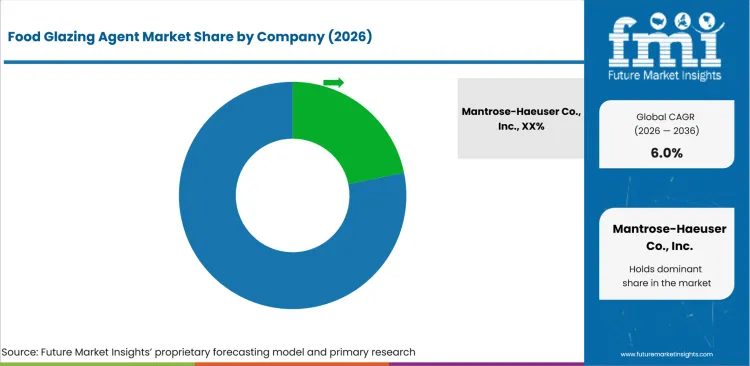
The field concentrates around glazing ingredient houses that pair coating expertise with certified supply and bakery and confectionery processor ties. Global food ingredient and coating companies compete across Food ingredient systems, Starch-based coating ingredients and Food protection ingredients throughout established accounts. Specialized food glazing and coating suppliers emphasize Confectionery and bakery glazing and Chocolate and confectionery coatings, while regional food coating manufacturers serve regional demand through Natural food coatings. A workable entry is a chocolate-coating or specialty-glaze niche, or a regional supply position for a bakery or confectionery category. Growth then depends on clean-label documentation, coating consistency, and reliable supply into bakery and confectionery makers. Breadth pays off through application labs that support coating reformulation and co-develop glaze systems with processors.
- Kerry Group and ADM Corn Processing combine Food ingredient systems and Starch-based coating ingredients across multiple national markets. DuPont de Nemours, Inc. adds Food protection ingredients through established account relationships. Their edge comes from confectionery and bakery glazing breadth with clean-label options.
- Mantrose-Haeuser Co., Inc., Capol GmbH and Zeelandia International B.V. follow focused routes across Confectionery and bakery glazing, Chocolate and confectionery coatings and Bakery ingredient systems. Their commercial edge comes from chocolate-coating and specialty-glaze niches rather than one standardized agent.
- Masterol Foods Pty Ltd, Strahl & Pitsch, Inc. and British Wax Refining Company Limited provide regional coverage through Natural food coatings. These firms compete on focused glazing strengths, though reach trails the global ingredient houses.
Competitive Benchmarking: Food Glazing Agent Market
| Company | Portfolio Relevance | Glazing Focus | Account Access | Service Reach |
|---|---|---|---|---|
| Mantrose-Haeuser Co., Inc. | High | Confectionery and bakery glazing | Strong | Global |
| Capol GmbH | High | Chocolate and confectionery coatings | Strong | Global |
| Kerry Group | High | Food ingredient systems | Strong | Global |
| ADM Corn Processing | Medium | Starch-based coating ingredients | Strong | Global |
| DuPont de Nemours, Inc. | Medium | Food protection ingredients | Strong | Global |
| Arla Foods Ingredients Group P/S | Medium | Dairy-based glazing ingredients | Strong | Regional |
| Zeelandia International B.V. | Medium | Bakery ingredient systems | Strong | Regional |
| Masterol Foods Pty Ltd | Medium | Natural food coatings | Moderate | Regional |
Source: Future Market Insights competitive analysis, 2026. Ratings reflect relative portfolio relevance, workflow or project fit, service capability, and geographic reach.
Key Developments in the Food Glazing Agent Market
- In January 2025, Kerry Group confirmed continued growth across its food ingredient systems division, including natural glazing and coating solutions for bakery and confectionery applications.
- In March 2025, Mantrose-Haeuser expanded its natural food coating portfolio with updated clean-label formulations for confectionery surface finishing in North America and Europe.
Key Players in the Food Glazing Agent Market
Global food ingredient and coating companies
- Kerry Group
- ADM Corn Processing
- DuPont de Nemours, Inc.
- Arla Foods Ingredients Group P/S
Specialized food glazing and coating suppliers
- Mantrose-Haeuser Co., Inc.
- Capol GmbH
- Zeelandia International B.V.
Regional food coating manufacturers
- Masterol Foods Pty Ltd
- Strahl & Pitsch, Inc.
- British Wax Refining Company Limited
Food Glazing Agent Market: Report Scope
| Coverage field | Report scope |
|---|---|
| Market breakdown | Ingredient type, application type, ingredient function type, source type, end use industry, and region. |
| Quantitative Units | Revenue in USD billion, 2026 base-year value of USD 4.9 billion, 2036 forecast value of USD 8.8 billion, and 6.0% CAGR. |
| Market Definition | Food glazing agents include stearic acid, beeswax, carnauba wax, shellac, and other coating ingredients used for surface protection, moisture barrier functionality, and visual appeal across bakery, confectionery, processed food, and nutraceutical applications. |
| Regions Covered | North America, Latin America, Western Europe, Eastern Europe, East Asia, South Asia and Pacific, and the Middle East and Africa. |
| Countries Covered | United States, China, India, Brazil, United Kingdom, Japan, and Germany. |
| Key Companies Profiled | Mantrose-Haeuser Co., Inc., Capol GmbH, Kerry Group, ADM Corn Processing, DuPont de Nemours, Inc., Arla Foods Ingredients Group P/S, Zeelandia International B.V., Masterol Foods Pty Ltd. |
| Forecast Period | 2026 to 2036. |
| Approach | FMI used primary interviews, source validation, company authentication, and proprietary demand modeling to estimate market size, segment shares, country CAGRs, and competitive positioning. |
Source: Future Market Insights, analysis driven by proprietary forecasting models and primary research
Food Glazing Agent Market: Research Methodology
| Method | Approach |
|---|---|
| Primary Research | FMI interviewed food glazing agent suppliers, institutional and retail buyers, distributors, and procurement leads. Inputs tested adoption triggers, product preferences, and replacement cycle patterns. |
| Desk Research | Desk research used government releases, regulator updates, standards-body references, company filings, and official product pages restricted to public sources. |
| Market Sizing and Forecasting | The forecast model linked 2026 revenue anchors to demand drivers, distribution reach, penetration rates, and country-specific conditions. Segment shares were cross-checked against product, application, and end-user patterns. |
| Data Validation | Data validation reconciled every external statistic against its source title, date, and reported figure. Forecast values were checked against the ten-year CAGR formula. |
Source: Future Market Insights (FMI) analysis, based on proprietary forecasting model and primary research
Market Segmentation Analysis
Food Glazing Agent Market Segmented by Ingredient Type:
- Stearic Acid
- Food Grade Stearic Acid
- Enhanced Surface Gloss
- Improved Product Stability
- Emulsified Stearic Acid Blends
- Uniform Food Coating Performance
- Extended Shelf Life Support
- Food Grade Stearic Acid
- Beeswax
- Natural Beeswax Coatings
- Enhanced Moisture Retention
- Improved Product Appearance
- Organic Beeswax Formulations
- Clean Label Food Applications
- Natural Preservation Support
- Natural Beeswax Coatings
- Carnauba Wax
- High Gloss Carnauba Coatings
- Premium Surface Shine
- Enhanced Product Protection
- Food Grade Carnauba Wax Blends
- Improved Texture Enhancement
- Long Lasting Coating Stability
- High Gloss Carnauba Coatings
- Candelilla Wax
- Plant Based Candelilla Coatings
- Vegan Friendly Applications
- Improved Surface Finish
- Blendable Candelilla Formulations
- Enhanced Product Durability
- Natural Gloss Enhancement
- Plant Based Candelilla Coatings
- Shellac
- Confectionery Shellac Coatings
- High Shine Candy Finishing
- Improved Moisture Barrier
- Fruit Coating Shellac Solutions
- Enhanced Shelf Life
- Improved Visual Appeal
- Confectionery Shellac Coatings
- Paraffin Wax
- Food Grade Paraffin Coatings
- Cost Effective Surface Protection
- Improved Product Preservation
- Processed Food Paraffin Blends
- Food Grade Paraffin Coatings
Food Glazing Agent Market Segmented by Application Type:
- Bakery
- Cakes And Pastries
- Enhanced Surface Shine
- Improved Freshness Retention
- Bread Coating Applications
- Moisture Barrier Protection
- Extended Shelf Life
- Cakes And Pastries
- Confectionery
- Hard Candy Coatings
- High Gloss Appearance
- Improved Texture Stability
- Chocolate Finishing Applications
- Enhanced Product Appeal
- Moisture Protection Support
- Hard Candy Coatings
- Processed Meat, Poultry & Fish
- Processed Meat Surface Coatings
- Improved Product Preservation
- Enhanced Texture Retention
- Seafood Glazing Applications
- Reduced Moisture Loss
- Improved Frozen Storage Stability
- Processed Meat Surface Coatings
- Fruits & Vegetables
- Fresh Fruit Coatings
- Enhanced Shelf Life
- Improved Visual Freshness
- Vegetable Surface Protection
- Reduced Moisture Evaporation
- Improved Product Handling
- Fresh Fruit Coatings
- Functional Foods
- Nutritional Bar Coatings
- Enhanced Product Stability
- Improved Consumer Appeal
- Fortified Food Applications
- Clean Label Ingredient Support
- Enhanced Functional Performance
- Nutritional Bar Coatings
- Others
Food Glazing Agent Market Segmented by Ingredient Function Type:
- Coating Agents
- Protective Food Coatings
- Enhanced Moisture Barrier
- Improved Product Durability
- Gloss Enhancing Coatings
- Premium Product Appearance
- Improved Consumer Attraction
- Protective Food Coatings
- Surface Finishing Agents
- High Shine Finishing Solutions
- Enhanced Visual Appeal
- Uniform Product Texture
- Smooth Surface Applications
- Improved Product Consistency
- Enhanced Shelf Presentation
- High Shine Finishing Solutions
- Firming Agents
- Texture Stabilizing Ingredients
- Improved Product Structure
- Enhanced Freshness Retention
- Fruit Firming Solutions
- Reduced Softening Effects
- Extended Storage Stability
- Texture Stabilizing Ingredients
- Film Agents
- Thin Film Food Coatings
- Improved Product Protection
- Enhanced Moisture Retention
- Edible Film Formulations
- Clean Label Applications
- Improved Packaging Compatibility
- Thin Film Food Coatings
- Others (Binding Agents And Stabilizing Agents)
- Food Binding Ingredients
- Enhanced Ingredient Cohesion
- Improved Product Stability
- Stabilizing Agent Blends
- Reduced Product Separation
- Enhanced Shelf Life Performance
- Food Binding Ingredients
Food Glazing Agent Market Segmented by Source Type:
- Natural Food Glazing Agents
- Plant Based Wax Sources
- Clean Label Ingredient Demand
- Enhanced Consumer Preference
- Animal Derived Glazing Agents
- Improved Surface Protection
- Traditional Food Applications
- Plant Based Wax Sources
- Synthetic Food Glazing Agents
- Synthetic Wax Formulations
- Cost Effective Food Processing
- Consistent Coating Performance
- Modified Glazing Compounds
- Enhanced Shelf Life Stability
- Improved Industrial Scalability
- Synthetic Wax Formulations
- Hybrid Glazing Formulations
- Natural And Synthetic Blends
- Balanced Performance Characteristics
- Enhanced Product Flexibility
- Customized Food Coating Solutions
- Application Specific Functionality
- Improved Processing Efficiency
- Natural And Synthetic Blends
Food Glazing Agent Market Segmented by End Use Industry:
- Food Processing Industry
- Processed Snack Manufacturing
- Enhanced Product Appearance
- Improved Shelf Stability
- Ready To Eat Food Applications
- Moisture Protection Support
- Improved Consumer Appeal
- Processed Snack Manufacturing
- Beverage Industry
- Functional Beverage Additives
- Enhanced Product Texture
- Improved Stability Performance
- Flavored Drink Applications
- Improved Ingredient Suspension
- Enhanced Product Consistency
- Functional Beverage Additives
- Nutraceutical Industry
- Dietary Supplement Coatings
- Improved Capsule Appearance
- Enhanced Product Protection
- Functional Nutrition Products
- Clean Label Ingredient Support
- Growing Health Conscious Demand
- Dietary Supplement Coatings
Food Glazing Agent Market by Region:
- North America
- USA
- Canada
- Mexico
- Latin America
- Brazil
- Chile
- Rest of Latin America
- Western Europe
- Germany
- UK
- Italy
- Spain
- France
- Nordic
- BENELUX
- Rest of Western Europe
- Eastern Europe
- Russia
- Poland
- Hungary
- Balkan & Baltic
- Rest of Eastern Europe
- East Asia
- China
- Japan
- South Korea
- South Asia and Pacific
- India
- ASEAN
- Australia & New Zealand
- Rest of South Asia and Pacific
- Middle East & Africa
- Kingdom of Saudi Arabia
- Other GCC Countries
- Türkiye
- South Africa
- Other African Union
- Rest of Middle East & Africa
Research Sources and Bibliography
- United States Food and Drug Administration. (2025). GRAS Review: Food Glazing Agent Additive Regulations.
- Food and Agriculture Organization. (2025). Agricultural Commodity Price and Food Ingredient Sourcing Trends.
- Kerry Group. (2025). Food Ingredient Systems Division Annual Report.
- Mantrose-Haeuser Co., Inc. (2025). Natural Food Coating Portfolio Update.
- European Food Safety Authority. (2025). Food Additive Re-evaluation: Glazing Agents.
- Food Safety and Standards Authority of India. (2025). Food Additive and Glazing Agent Regulation.
- China National Center for Food Safety. (2025). Food Additive Usage Standards and Compliance.
- Japan Agricultural Standards. (2025). Food Additive Qualification and Compliance Guidelines.
- Capol GmbH. (2025). Confectionery Coating Solutions Performance Report.
- ADM Corn Processing. (2025). Food Ingredient and Coating Product Portfolio Update.
This bibliography is provided for reader reference and uses primary government sources plus standards-body sources. Company sources are included.
This Report Answers
- What is the estimated 2026 value of the food glazing agent market?
- What market value is projected by 2036?
- What CAGR is forecast from 2026 to 2036?
- Which ingredient type is expected to account for a notable 2026 share?
- Which countries are profiled for CAGR comparison?
- Which companies are notable in the competitive landscape?
Frequently Asked Questions
How big is the Food Glazing Agent Market in 2026?
The Food Glazing Agent Market is valued at USD 4.9 billion in 2026 and is forecast to reach USD 8.8 billion by 2036, expanding at a 6.0% CAGR. The Food Glazing Agent Market grew from USD 4.6 billion in 2025, with Stearic Acid holding 60.0% of ingredient type demand in 2026.
What is the CAGR of the Food Glazing Agent Market from 2026 to 2036?
The Food Glazing Agent Market is projected to grow at a CAGR of 6.0% between 2026 and 2036, supported by expanding bakery and confectionery production in East Asia and sustained demand for natural glazing agents across North American and European food processing. Stearic Acid holds 60.0% of ingredient type demand in 2026.
Which ingredient type leads the Food Glazing Agent Market?
Stearic Acid accounts for 60.0% of the Food Glazing Agent Market by ingredient type in 2026, driven by expanding bakery and confectionery production in East Asia and sustained demand for natural glazing. The Food Glazing Agent Market grows at a 6.0% CAGR through 2036, while Bakery leads application type with 65.0% in 2026.
How much will the Food Glazing Agent Market add between 2026 and 2036?
The Food Glazing Agent Market is set to add USD 3.9 billion between 2026 and 2036, growing from USD 4.9 billion to USD 8.8 billion at a 6.0% CAGR. Bakery leads application type with 65.0% of Food Glazing Agent Market revenue in 2026, anchoring that incremental demand.
Who are the leading companies in the Food Glazing Agent Market?
The Food Glazing Agent Market profiles 8 key companies in 2026, led by Mantrose-Haeuser Co., Inc., Capol GmbH, Kerry Group, ADM Corn Processing, and DuPont de Nemours, Inc. These suppliers compete across ingredient type, where Stearic Acid holds 60.0% of Food Glazing Agent Market demand in 2026.
Preview the report firsthand - request a free sample
Get SampleGet the brochure for pricing and purchase details.
Get PDFTable of Content
- Key Takeaways
- Market Size and CAGR
- Top Growth Driver
- Fastest Growing Segment
- Leading Region
- Key Companies
- Emerging Opportunities
- Executive Summary
- Global Market Outlook
- Demand-side Trends
- Supply-side Trends
- Technology Roadmap Analysis
- Analysis and Recommendations
- Analyst Perspective (What is happening? Why now? What should investors know?)
- Key Questions Answered
- How large is the market?
- What is the CAGR?
- What are key trends?
- Which region dominates?
- Who are the leaders?
- Market Overview
- Market Coverage / Taxonomy
- Market Definition / Scope / Limitations
- Research Methodology
- Chapter Orientation
- Analytical Lens and Working Hypotheses
- Market Structure, Signals, and Trend Drivers
- Benchmarking and Cross-market Comparability
- Market Sizing, Forecasting, and Opportunity Mapping
- Research Design and Evidence Framework
- Desk Research Programme (Secondary Evidence)
- Expert Input and Fieldwork (Primary Evidence)
- Tooling, Models, and Reference Databases
- Data Engineering and Model Build
- Quality Assurance and Audit Trail
- Market Background
- Market Dynamics (Drivers, Restraints, Opportunity, Trends)
- Scenario Forecast (Optimistic, Likely, Conservative)
- Impact Analysis
- AI Impact
- Sustainability Impact
- Regulatory Impact
- Technology Impact
- Consumer / Buyer Analysis
- Purchase Drivers
- Adoption Barriers
- Buyer Journey
- Opportunity Map Analysis
- Product Life Cycle Analysis
- Supply Chain Analysis
- Investment Feasibility Matrix
- Value Chain Analysis
- PESTLE and Porter's Analysis
- Regulatory Landscape
- Regional Parent Market Outlook
- Production and Consumption Statistics
- Import and Export Statistics
- Global Market Analysis and Forecast, 2021 to 2036
- Historical Market Size Value (USD Billion) Analysis, 2021 to 2025
- Current and Future Market Size Value (USD Billion) Projections, 2026 to 2036
- Y-o-Y Growth Trend Analysis
- Absolute $ Opportunity Analysis
- Global Market Pricing Analysis, 2021 to 2036
- Global Market Analysis and Forecast, By Ingredient Type, 2021 to 2036
- Introduction / Key Findings
- Historical Market Size Value (USD Billion) Analysis By Ingredient Type, 2021 to 2025
- Current and Future Market Size Value (USD Billion) Analysis and Forecast By Ingredient Type, 2026 to 2036
- Stearic Acid
- Food Grade Stearic Acid
- Emulsified Stearic Acid Blends
- Beeswax
- Natural Beeswax Coatings
- Organic Beeswax Formulations
- Carnauba Wax
- High Gloss Carnauba Coatings
- Food Grade Carnauba Wax Blends
- Candelilla Wax
- Plant Based Candelilla Coatings
- Blendable Candelilla Formulations
- Shellac
- Confectionery Shellac Coatings
- Fruit Coating Shellac Solutions
- Paraffin Wax
- Food Grade Paraffin Coatings
- Processed Food Paraffin Blends
- Stearic Acid
- Y-o-Y Growth Trend Analysis By Ingredient Type, 2021 to 2025
- Absolute $ Opportunity Analysis By Ingredient Type, 2026 to 2036
- Global Market Analysis and Forecast, By Application Type, 2021 to 2036
- Introduction / Key Findings
- Historical Market Size Value (USD Billion) Analysis By Application Type, 2021 to 2025
- Current and Future Market Size Value (USD Billion) Analysis and Forecast By Application Type, 2026 to 2036
- Bakery
- Cakes And Pastries
- Bread Coating Applications
- Confectionery
- Hard Candy Coatings
- Chocolate Finishing Applications
- Processed Meat, Poultry & Fish
- Processed Meat Surface Coatings
- Seafood Glazing Applications
- Fruits & Vegetables
- Fresh Fruit Coatings
- Vegetable Surface Protection
- Functional Foods
- Nutritional Bar Coatings
- Fortified Food Applications
- Others
- Bakery
- Y-o-Y Growth Trend Analysis By Application Type, 2021 to 2025
- Absolute $ Opportunity Analysis By Application Type, 2026 to 2036
- Global Market Analysis and Forecast, By Ingredient Function Type, 2021 to 2036
- Introduction / Key Findings
- Historical Market Size Value (USD Billion) Analysis By Ingredient Function Type, 2021 to 2025
- Current and Future Market Size Value (USD Billion) Analysis and Forecast By Ingredient Function Type, 2026 to 2036
- Coating Agents
- Protective Food Coatings
- Gloss Enhancing Coatings
- Surface Finishing Agents
- High Shine Finishing Solutions
- Smooth Surface Applications
- Firming Agents
- Texture Stabilizing Ingredients
- Fruit Firming Solutions
- Film Agents
- Thin Film Food Coatings
- Edible Film Formulations
- Others (Binding Agents And Stabilizing Agents)
- Food Binding Ingredients
- Stabilizing Agent Blends
- Coating Agents
- Y-o-Y Growth Trend Analysis By Ingredient Function Type, 2021 to 2025
- Absolute $ Opportunity Analysis By Ingredient Function Type, 2026 to 2036
- Global Market Analysis and Forecast, By Source Type, 2021 to 2036
- Introduction / Key Findings
- Historical Market Size Value (USD Billion) Analysis By Source Type, 2021 to 2025
- Current and Future Market Size Value (USD Billion) Analysis and Forecast By Source Type, 2026 to 2036
- Natural Food Glazing Agents
- Plant Based Wax Sources
- Animal Derived Glazing Agents
- Synthetic Food Glazing Agents
- Synthetic Wax Formulations
- Modified Glazing Compounds
- Hybrid Glazing Formulations
- Natural And Synthetic Blends
- Customized Food Coating Solutions
- Natural Food Glazing Agents
- Y-o-Y Growth Trend Analysis By Source Type, 2021 to 2025
- Absolute $ Opportunity Analysis By Source Type, 2026 to 2036
- Global Market Analysis and Forecast, By End Use Industry, 2021 to 2036
- Introduction / Key Findings
- Historical Market Size Value (USD Billion) Analysis By End Use Industry, 2021 to 2025
- Current and Future Market Size Value (USD Billion) Analysis and Forecast By End Use Industry, 2026 to 2036
- Food Processing Industry
- Processed Snack Manufacturing
- Ready To Eat Food Applications
- Beverage Industry
- Functional Beverage Additives
- Flavored Drink Applications
- Nutraceutical Industry
- Dietary Supplement Coatings
- Functional Nutrition Products
- Food Processing Industry
- Y-o-Y Growth Trend Analysis By End Use Industry, 2021 to 2025
- Absolute $ Opportunity Analysis By End Use Industry, 2026 to 2036
- Global Market Analysis and Forecast, By Region, 2021 to 2036
- Introduction
- Historical Market Size Value (USD Billion) Analysis By Region, 2021 to 2025
- Current Market Size Value (USD Billion) Analysis and Forecast By Region, 2026 to 2036
- North America
- Latin America
- Western Europe
- Eastern Europe
- East Asia
- South Asia and Pacific
- Middle East & Africa
- Market Attractiveness Analysis By Region
- North America Market Analysis and Forecast, By Country, 2021 to 2036
- Historical Market Size Value (USD Billion) Trend Analysis By Market Taxonomy, 2021 to 2025
- Market Size Value (USD Billion) Forecast By Market Taxonomy, 2026 to 2036
- By Country
- USA
- Canada
- By Ingredient Type
- By Application Type
- By Ingredient Function Type
- By Source Type
- By End Use Industry
- By Country
- Market Attractiveness Analysis
- By Country
- By Ingredient Type
- By Application Type
- By Ingredient Function Type
- By Source Type
- By End Use Industry
- Key Takeaways
- Latin America Market Analysis and Forecast, By Country
- Historical Market Size Value (USD Billion) Trend Analysis By Market Taxonomy, 2021 to 2025
- Market Size Value (USD Billion) Forecast By Market Taxonomy, 2026 to 2036
- By Country
- Brazil
- Mexico
- Chile
- Rest of Latin America
- By Ingredient Type
- By Application Type
- By Ingredient Function Type
- By Source Type
- By End Use Industry
- By Country
- Market Attractiveness Analysis
- By Country
- By Ingredient Type
- By Application Type
- By Ingredient Function Type
- By Source Type
- By End Use Industry
- Key Takeaways
- Western Europe Market Analysis and Forecast, By Country
- Historical Market Size Value (USD Billion) Trend Analysis By Market Taxonomy, 2021 to 2025
- Market Size Value (USD Billion) Forecast By Market Taxonomy, 2026 to 2036
- By Country
- Germany
- UK
- Italy
- Spain
- France
- Nordic
- BENELUX
- Rest of Western Europe
- By Ingredient Type
- By Application Type
- By Ingredient Function Type
- By Source Type
- By End Use Industry
- By Country
- Market Attractiveness Analysis
- By Country
- By Ingredient Type
- By Application Type
- By Ingredient Function Type
- By Source Type
- By End Use Industry
- Key Takeaways
- Eastern Europe Market Analysis and Forecast, By Country
- Historical Market Size Value (USD Billion) Trend Analysis By Market Taxonomy, 2021 to 2025
- Market Size Value (USD Billion) Forecast By Market Taxonomy, 2026 to 2036
- By Country
- Russia
- Poland
- Hungary
- Balkan & Baltic
- Rest of Eastern Europe
- By Ingredient Type
- By Application Type
- By Ingredient Function Type
- By Source Type
- By End Use Industry
- By Country
- Market Attractiveness Analysis
- By Country
- By Ingredient Type
- By Application Type
- By Ingredient Function Type
- By Source Type
- By End Use Industry
- Key Takeaways
- East Asia Market Analysis and Forecast, By Country
- Historical Market Size Value (USD Billion) Trend Analysis By Market Taxonomy, 2021 to 2025
- Market Size Value (USD Billion) Forecast By Market Taxonomy, 2026 to 2036
- By Country
- China
- Japan
- South Korea
- By Ingredient Type
- By Application Type
- By Ingredient Function Type
- By Source Type
- By End Use Industry
- By Country
- Market Attractiveness Analysis
- By Country
- By Ingredient Type
- By Application Type
- By Ingredient Function Type
- By Source Type
- By End Use Industry
- Key Takeaways
- South Asia and Pacific Market Analysis and Forecast, By Country
- Historical Market Size Value (USD Billion) Trend Analysis By Market Taxonomy, 2021 to 2025
- Market Size Value (USD Billion) Forecast By Market Taxonomy, 2026 to 2036
- By Country
- India
- ASEAN
- Australia & New Zealand
- Rest of South Asia and Pacific
- By Ingredient Type
- By Application Type
- By Ingredient Function Type
- By Source Type
- By End Use Industry
- By Country
- Market Attractiveness Analysis
- By Country
- By Ingredient Type
- By Application Type
- By Ingredient Function Type
- By Source Type
- By End Use Industry
- Key Takeaways
- Middle East & Africa Market Analysis and Forecast, By Country
- Historical Market Size Value (USD Billion) Trend Analysis By Market Taxonomy, 2021 to 2025
- Market Size Value (USD Billion) Forecast By Market Taxonomy, 2026 to 2036
- By Country
- Kingdom of Saudi Arabia
- Other GCC Countries
- Türkiye
- South Africa
- Other African Union
- Rest of Middle East & Africa
- By Ingredient Type
- By Application Type
- By Ingredient Function Type
- By Source Type
- By End Use Industry
- By Country
- Market Attractiveness Analysis
- By Country
- By Ingredient Type
- By Application Type
- By Ingredient Function Type
- By Source Type
- By End Use Industry
- Key Takeaways
- Key Countries Market Analysis
- USA
- Pricing Analysis
- Market Share Analysis, 2025
- By Ingredient Type
- By Application Type
- By Ingredient Function Type
- By Source Type
- By End Use Industry
- Canada
- Pricing Analysis
- Market Share Analysis, 2025
- By Ingredient Type
- By Application Type
- By Ingredient Function Type
- By Source Type
- By End Use Industry
- Mexico
- Pricing Analysis
- Market Share Analysis, 2025
- By Ingredient Type
- By Application Type
- By Ingredient Function Type
- By Source Type
- By End Use Industry
- Brazil
- Pricing Analysis
- Market Share Analysis, 2025
- By Ingredient Type
- By Application Type
- By Ingredient Function Type
- By Source Type
- By End Use Industry
- Chile
- Pricing Analysis
- Market Share Analysis, 2025
- By Ingredient Type
- By Application Type
- By Ingredient Function Type
- By Source Type
- By End Use Industry
- Germany
- Pricing Analysis
- Market Share Analysis, 2025
- By Ingredient Type
- By Application Type
- By Ingredient Function Type
- By Source Type
- By End Use Industry
- UK
- Pricing Analysis
- Market Share Analysis, 2025
- By Ingredient Type
- By Application Type
- By Ingredient Function Type
- By Source Type
- By End Use Industry
- Italy
- Pricing Analysis
- Market Share Analysis, 2025
- By Ingredient Type
- By Application Type
- By Ingredient Function Type
- By Source Type
- By End Use Industry
- Spain
- Pricing Analysis
- Market Share Analysis, 2025
- By Ingredient Type
- By Application Type
- By Ingredient Function Type
- By Source Type
- By End Use Industry
- France
- Pricing Analysis
- Market Share Analysis, 2025
- By Ingredient Type
- By Application Type
- By Ingredient Function Type
- By Source Type
- By End Use Industry
- India
- Pricing Analysis
- Market Share Analysis, 2025
- By Ingredient Type
- By Application Type
- By Ingredient Function Type
- By Source Type
- By End Use Industry
- ASEAN
- Pricing Analysis
- Market Share Analysis, 2025
- By Ingredient Type
- By Application Type
- By Ingredient Function Type
- By Source Type
- By End Use Industry
- Australia & New Zealand
- Pricing Analysis
- Market Share Analysis, 2025
- By Ingredient Type
- By Application Type
- By Ingredient Function Type
- By Source Type
- By End Use Industry
- China
- Pricing Analysis
- Market Share Analysis, 2025
- By Ingredient Type
- By Application Type
- By Ingredient Function Type
- By Source Type
- By End Use Industry
- Japan
- Pricing Analysis
- Market Share Analysis, 2025
- By Ingredient Type
- By Application Type
- By Ingredient Function Type
- By Source Type
- By End Use Industry
- South Korea
- Pricing Analysis
- Market Share Analysis, 2025
- By Ingredient Type
- By Application Type
- By Ingredient Function Type
- By Source Type
- By End Use Industry
- Russia
- Pricing Analysis
- Market Share Analysis, 2025
- By Ingredient Type
- By Application Type
- By Ingredient Function Type
- By Source Type
- By End Use Industry
- Poland
- Pricing Analysis
- Market Share Analysis, 2025
- By Ingredient Type
- By Application Type
- By Ingredient Function Type
- By Source Type
- By End Use Industry
- Hungary
- Pricing Analysis
- Market Share Analysis, 2025
- By Ingredient Type
- By Application Type
- By Ingredient Function Type
- By Source Type
- By End Use Industry
- Kingdom of Saudi Arabia
- Pricing Analysis
- Market Share Analysis, 2025
- By Ingredient Type
- By Application Type
- By Ingredient Function Type
- By Source Type
- By End Use Industry
- Türkiye
- Pricing Analysis
- Market Share Analysis, 2025
- By Ingredient Type
- By Application Type
- By Ingredient Function Type
- By Source Type
- By End Use Industry
- South Africa
- Pricing Analysis
- Market Share Analysis, 2025
- By Ingredient Type
- By Application Type
- By Ingredient Function Type
- By Source Type
- By End Use Industry
- USA
- Market Structure Analysis
- Competition Dashboard
- Competition Benchmarking
- Market Share Analysis of Top Players
- By Regional
- By Ingredient Type
- By Application Type
- By Ingredient Function Type
- By Source Type
- By End Use Industry
- Emerging Startups
- Innovation Benchmarking
- Competition Analysis
- Competition Deep Dive
- Mantrose-Haeuser Co., Inc.
- Overview
- Product Portfolio
- Profitability by Market Segments
- Sales Footprint
- Strategy Overview
- Marketing Strategy
- Product Strategy
- Channel Strategy
- Capol GmbH
- Strahl & Pitsch, Inc.
- British Wax Refining Company Limited
- Kerry Group
- Masterol Foods Pty Ltd
- ADM Corn Processing
- DuPont de Nemours, Inc.
- Wuhu Deli Foods Co., Ltd.
- Ningbo J&S Botanics Inc.
- Arla Foods Ingredients Group P/S
- Macphie of Glenbervie Ltd.
- Mantrose UK Ltd.
- PothHille & Co Ltd.
- Ningbo J&S Botanics Inc.
- Zeelandia International B.V.
- Flo Chemical Corporation
- Ningbo Wanglong Technology Co., Ltd.
- AVATAR CORPORATION
- Mantrose-Haeuser Co., Inc.
- Case Studies
- Success Stories
- Recent Developments
- Competition Deep Dive
- Assumptions & Acronyms Used


