

- Market Size (2026)
- USD 3.9 Bn
- Forecast (2036)
- USD 6.7 Bn
- CAGR (2026 to 2036)
- 5.6%
How big is Flexible Adhesives Market in 2026?
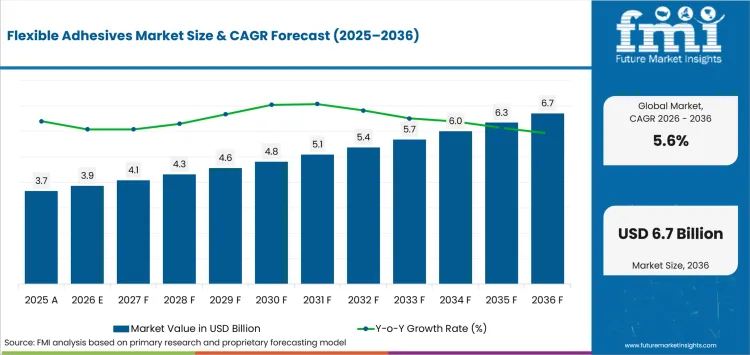
USD 3.9 billion in 2026 and USD 6.7 billion by 2036 at a 5.6% CAGR from 2026 to 2036.
Demand for flexible adhesives is projected to expand at 5.6% CAGR between 2026 and 2036, increasing valuation from USD 3.9 billion in 2026 to USD 6.7 billion by 2036. Automotive and packaging engineers need bonds that tolerate vibration and mixed-material strain. In May 2026, Henkel introduced Teroson EP 52 for automated body-in-white bonding with structural integrity and vibration damping in one adhesive. The design can replace separate bonding and damping steps on lines.
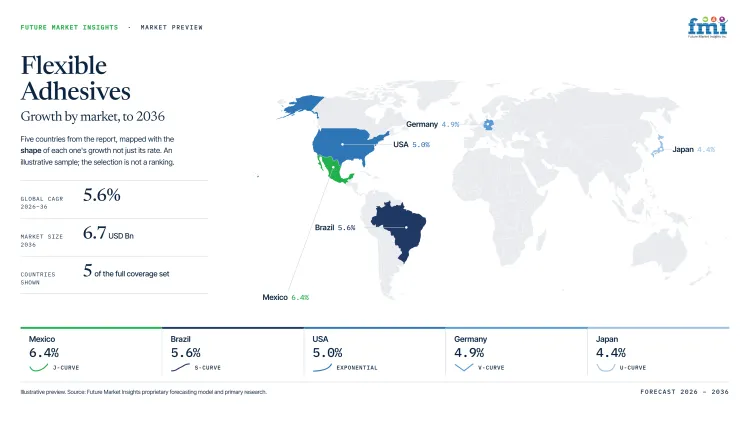
Manufacturing density changes the value of local inventory and technical service. Mexico's 6.4% CAGR exceeds Japan's 4.4% by 2.0 points because export assembly requires more line-transfer work. INEGI reported in June 2026 that Mexico produced 1,642,083 light vehicles during January-May, with light trucks representing 80.0%. Japan has a mature installed base, but longer validation and change-control cycles slow material substitution.
Key Takeaways
- Demand rises as vehicle lightweighting, flexible packaging redesign, and movement-prone construction joints increase the need for bonds that absorb strain without rigid fastening.
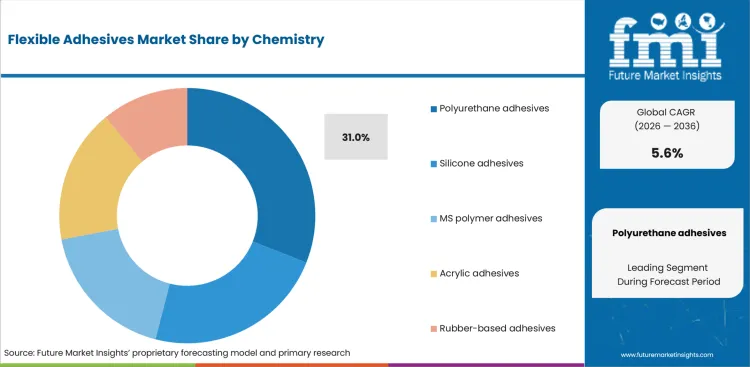
- Based on chemistry, polyurethane adhesives are projected to account for 31.0% in 2026 due to elastic bonds that tolerate mixed-material movement.
- By form, liquid adhesives are estimated to hold 32.0% in 2026 owing to metering flexibility for continuous coating and localized dispensing.
- In 2026, plastics are expected to lead substrate demand with 29.0% share because lightweight films and molded parts deform during service.
- Qualification time, worker-safety controls, emissions limits, and substrate preparation can delay a formulation change even after laboratory performance is acceptable.
- Some of the key players in this market include H.B. Fuller, Henkel, 3M, Sika, Arkema / Bostik, Dow, Avery Dennison, Jowat, and Mapei.
Analyst Perspective
"Flexible adhesive contracts depend on line-level proof of peel strength, ageing, wet-out, and cure behavior. Repeat orders follow once local stock and technical response protect production during material changes."
- Nikhil Kaitwade, Principal Consultant, Future Market Insights
How is the flexible adhesives market segmented?
The flexible adhesives market is segmented by chemistry, form, substrate, end use, and sales channel.
By chemistry, the analysis covers polyurethane adhesives, silicone adhesives, MS polymer adhesives, acrylic adhesives, and rubber-based adhesives. Form includes liquid, paste, film / tape, hot melt, and sealant-adhesive hybrid. Substrates comprise plastics, metals, rubber / elastomers, textiles, and composite materials. End uses include automotive, packaging, construction, electronics, and footwear / leather. Sales channels comprise industrial distributors, direct OEM supply, packaging converters, and construction supply.
What makes polyurethane adhesives central to the chemistry category?
Polyurethane chemistry earns repeat use where bonds must carry load without becoming brittle under vibration or temperature change. Automotive interiors expose that balance because lamination needs quick handling and heat resistance on mixed substrates.
- Polyurethane adhesives are set to lead the chemistry category with 31.0% share in 2026 due to strength retained under vibration and thermal cycling.
- Henkel introduced Technomelt PUR 6260 ECO in November 2025 for automotive interiors. The bio-based polyurethane hot melt processes at a lamination temperature 15 degrees Celsius below its standard comparator, reducing heat demand without changing the flexible-bonding role.
How does liquid form influence selection within the form category?
Liquid adhesives suit coating and dispensing processes that need wet-out over films, porous flooring, or joints with variable geometry. Process engineers adjust coat weight and bead size to fit line speed and substrate shape before cure begins.
- By form, liquid adhesives are forecast to represent 32.0% in 2026 driven by wet-out and metering flexibility on continuous or irregular production surfaces.
- Flooring installation shows the practical advantage after substrate preparation and open-time control are set. Sika introduced SikaBond-5900 and SikaBond-5800 in February 2025 with pressure-sensitive technology, easy spread, and high moisture resistance for resilient-floor applications.
Why do plastics lead the substrate category?
Plastic films and molded parts reduce weight but place adhesive selection under greater surface-energy and deformation constraints. Packaging converters therefore evaluate treatment method, peel strength, and ageing performance before approving a bond for serial production.
- The plastics segment is likely to capture 29.0% share in 2026 attributable to lightweight films and molded parts that require strain-tolerant joints in serial assemblies.
- Henkel launched a solvent-free laminating system in July 2025 for PET, aluminium, CPP, and polyolefin structures. The system targets retort processing up to 134 degrees Celsius, showing how plastic bonding increasingly depends on structure-specific qualification.
What supports automotive demand within the end use category?
Vehicle platforms use flexible bonds where metals, plastics, composites, and materials expand differently under heat or vibration. OEM engineering teams test ageing and production compatibility before approving a material change.
- Based on end use, automotive is projected to account for 25.0% in 2026 due to bonded joints carrying repeated vibration and thermal strain on vehicle platforms.
- Sika reported in April 2025 that its automotive and industry business gained technology share with local and international vehicle makers in Asia-Pacific. That activity keeps application engineering close to vehicle-platform changes rather than treating adhesive supply as a catalog sale.
What keeps industrial distributors important within the sales channel category?
Industrial distributors absorb order sizes from construction, maintenance, and manufacturing accounts that do not justify OEM supply. Their value comes from local stock, pack-size choice, and fast troubleshooting on surface preparation.
- By sales channel, industrial distributors are estimated to hold 32.0% in 2026 owing to local stock and application support for fragmented locally qualified orders.
- Sika agreed in February 2026 to acquire Akkim pending regulatory approvals, with the transaction expected to close in the third quarter. Sika said Akkim would extend distribution reach in Eastern Europe, Central Asia, the Middle East, and North Africa.
What are the drivers, restraints and opportunities in the Flexible Adhesives Market?
Lightweight assemblies and recyclable packs increase strain-tolerant bonding demand, while qualification and safety controls slow switching and certified low-emission systems offer a clearer route to approval.
- Driver: Multi-material vehicle and packaging designs require bonds that distribute stress without returning to rigid mechanical fastening.
- Restraint: Qualification, worker training, emissions controls, and cure variability can extend the cost and timing of a formulation change.
- Opportunity: Adhesive producers can win conversion programs by pairing recycling-compatible chemistry with application trials and complete compliance records.
Automotive lightweighting gives flexible adhesives a direct structural role because mixed substrates need joints that absorb movement without concentrated fastener loads. VDA stated in February 2026 that Germany produced 1.67 million electric passenger cars in 2025, up 23%, and these vehicles represented 40% of domestic passenger-car output. Higher electric-vehicle production increases the number of programs where bonding, sealing, vibration control, and low-weight joining are evaluated together.
Polyurethane qualification becomes slower where isocyanate chemistry triggers formal training and documentation duties. In June 2025, the European Chemicals Agency said its REF-15 enforcement project would inspect workplace controls for restricted substances including diisocyanates. The planned checks make training records and safe-use measures part of practical compliance. Adhesive producers therefore face slower conversion if application teams cannot document required controls before plant trials.
Packaging regulation gives recycling-compatible adhesives a clearer commercial route because the bond layer can determine whether a laminate passes recyclability assessment. The European Commission confirmed on August 11, 2026 that the Packaging and Packaging Waste Regulation applies from August 12, with all packaging required to be recyclable from 2030. Formulators that document recycling compatibility alongside seal and line-speed performance can shorten converter evaluation for redesigned structures.
Which country CAGRs are profiled in the Flexible Adhesives Market?
| Country | CAGR |
|---|---|
| Mexico | 6.4% |
| Brazil | 5.6% |
| South Korea | 5.5% |
| USA | 5.0% |
| Germany | 4.9% |
| Italy | 4.8% |
| Japan | 4.4% |
How do country-level CAGRs compare in the Flexible Adhesives Market?
The 2.0-point range separates Mexico from Japan, with Brazil and South Korea forming a second growth tier above the USA-Germany-Italy group. The spacing reflects different rates of manufacturing localization, converter investment, and approval turnover, not a ranking of current revenue. Mature markets may carry larger installed account pools despite slower forecast growth.
- Mexico: US-bound vehicle programs accelerate specification transfer between plants.
- Brazil: Multiple industrial centers make channel coverage commercially important.
- South Korea: Electronics programs require fast thermal-cycle qualification.
- USA: Mixed direct and distributor channels complicate account economics.
- Germany: Dense tier-one networks protect approved incumbent formulations.
- Italy: Regional flooring accounts reward nearby application support.
- Japan: Batch consistency outweighs rapid formulation turnover.
Similar CAGRs can carry different approval costs and sales cycles.
The full report provides country-level CAGR analysis across North America, Latin America, Western Europe, Eastern Europe, East Asia, South Asia and Pacific, and Middle East and Africa.
Country-wise Analysis
- Automotive plants in Mexico qualify adhesives at platform or line level, so stock near assembly clusters reduces disruption during material transfer. Flexible adhesive demand in Mexico is forecast to rise at 6.4% CAGR over the forecast period, tied to export-oriented vehicle production and supplier localization. INEGI's March 2026 release recorded 485,426 light-vehicle exports during January-February, up 1.4%, with the United States receiving 75.7% of the total. Imported specialty grades still face lead-time exposure. Formulators with local warehousing and Spanish-language application engineers can respond faster during trial changes without forcing plants to carry excessive safety stock.
- Industrial adhesive demand is spread over long freight corridors, making distributor coverage important beyond the largest manufacturing centers. IBGE reported in March 2026 that Brazilian industrial production rose 1.8% in January and 19 of 25 surveyed branches increased output. Brazil is estimated to post 5.6% CAGR through 2036, aided by a broad manufacturing base that gives distributors multiple application pools. Import timing and regional freight can widen delivered costs for specialty grades. Local pack sizes and trained distributors are therefore more useful than centralized stock for smaller converters and construction accounts outside the largest regional industrial centers.
- Korean vehicle and electronics programs expect adhesive formulators to respond quickly during design changes and local validation. MOTIR documented 352,000 vehicles produced in July 2026, up 11.3% year on year, with eco-friendly vehicles representing about 60% of domestic sales. Price pressure strengthens after engineering review. Flexible adhesive demand in South Korea is projected to record 5.5% CAGR during the assessment period, given faster electrification and electronics integration. Companies with local laboratories and short sample lead times can protect qualification speed for local OEM programs during launch cycles without sending every trial to an overseas technical center.
- The United States has large automotive and packaging accounts plus a construction channel sensitive to housing turnover. The Census Bureau estimated 628,000 new single-family home sales at a seasonally adjusted annual rate in June 2026, with inventory equal to 9.3 months of supply. Flexible adhesive demand in the USA is expected to maintain 5.0% CAGR through 2036 because multiple end uses generate replacement and installation work even as individual sectors soften. Slower housing activity can restrain flooring adhesive volumes. National offers also need documentation that meets different state emissions requirements and customer-specific approval rules at scale.
- German automotive and industrial accounts use detailed specifications that make documentation part of adhesive approval. Destatis data published in March 2026 showed January construction orders fell 5.1% month on month and 4.3% year on year, weakening one outlet beside Germany's dense manufacturing base. The main restraint is time spent clearing customer tests and chemical-safety requirements. Germany is forecast to advance at 4.9% CAGR over the forecast period, supported by engineering depth and established converter capacity. Low-monomer polyurethane options and complete declarations can reduce avoidable review loops during substitution for automotive, industrial, and construction accounts with long platform lives.
- Adhesive demand spans packaging converters, flooring installers, and specialized manufacturers served through regional distribution. Italy is anticipated to deliver 4.8% CAGR during the forecast period, tied to steady converter and construction activity. In February 2026, Istat documented a 4.8% increase in calendar-adjusted construction production during 2025, supporting installation work beyond packaging demand. Fragmented distribution can slow national rollouts where technical service is concentrated near major industrial centers. Producers that pair converter trials with clear recyclability or indoor-emissions records can serve packaging and construction accounts through separate qualification routes because each channel uses different site conditions at scale.
- Japanese manufacturers protect process stability through long qualification cycles and strict change control in automotive and electronics programs. JAMA's 2025 motor-industry report recorded more than 62.3 million passenger cars in use at the end of 2024, demonstrating installed-base depth instead of rapid fleet expansion. Flexible adhesive sales in Japan are forecast to expand at 4.4% CAGR by 2036, owing to high-specification bonding needs in a mature industrial base. Incumbent relationships and extended ageing tests can slow switching. New entrants need stable batch quality and local technical files during serial production before price or chemistry breadth becomes decisive.
Who are the notable companies in the Flexible Adhesives Market?
H.B. Fuller, Henkel, 3M, Sika, Arkema / Bostik, Dow, Avery Dennison, Jowat, and Mapei are notable companies active in this market.
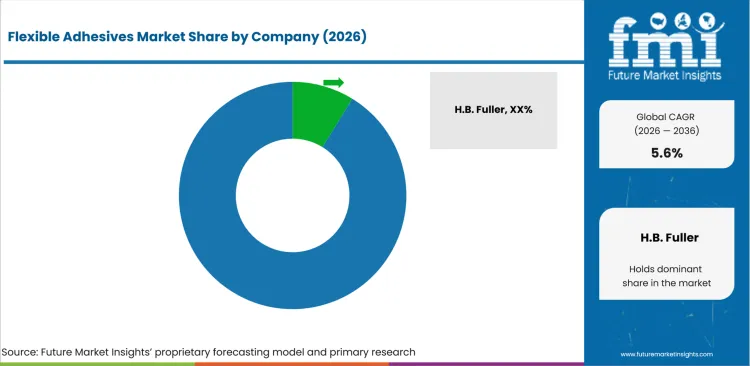
Competition splits among adhesive formulators, engineered tape producers, and application specialists. H.B. Fuller, Henkel, and Arkema / Bostik have packaging and industrial depth. 3M and Avery Dennison focus on pressure-sensitive constructions. Sika and Mapei are stronger in construction channels. Dow and Jowat serve industrial-converting applications. Entry barriers center on substrate qualification, local troubleshooting, and replacing an approved incumbent.
- H.B. Fuller, Henkel, and Arkema / Bostik: broad formulation platforms for packaging and industrial assembly.
- 3M, Sika, and Avery Dennison: tape and elastic-bonding systems for assembly and installation.
- Dow, Jowat, and Mapei: specialized chemistry and construction-channel positions.
Competitive Benchmarking: Flexible Adhesives Market
| Company | Flexible Chemistry Breadth | Converting and Tape Systems | Mobility and Construction Qualification | Geographic Reach |
|---|---|---|---|---|
| H.B. Fuller | High | High | High | Americas, Europe, and Asia-Pacific |
| Henkel | High | High | High | Americas, Europe, Asia-Pacific, and Middle East |
| 3M | Medium | High | High | Global industrial and converter channels |
| Sika | High | Medium | High | Global construction and transportation network |
| Arkema / Bostik | High | High | High | Europe, North America, Latin America, and Asia |
| Dow | High | Medium | Medium | Global materials and industrial customer base |
| Avery Dennison | Medium | High | Medium | Global manufacturing with regional technical support |
| Jowat | High | Medium | Medium | Europe, Americas, and Asia |
| Mapei | Medium | Low | High | Global construction distribution network |
Scoring basis: High chemistry breadth requires three chemistry families, Medium requires two, and Low identifies one. High converting and tape coverage requires laminating plus pressure-sensitive or tape capability. Medium covers one major route and Low one narrow route. Mobility and construction qualification uses rating logic for end-use coverage. Geographic reach is descriptive.
Key Developments in the Flexible Adhesives Market
- In February 2026, Henkel launched Loctite Liofol CS 7106 RE for cold sealing on barrier-coated paper, addressing packs that cannot tolerate heat during sealing. The recycler-compatible system gives converters another qualification route, subject to line trials on coated-paper structures.
- In December 2025, 3M launched Adhesive Mix Monitor for two-part structural adhesive dispensing, addressing mix-ratio failures that can invalidate bond quality. Real-time feedback provides a traceable application check, although substrate preparation and cure validation still require separate qualification.
- In October 2025, Avery Dennison completed its acquisition of Meridian Adhesives Group's flooring business, expanding its installation-adhesive position beyond pressure-sensitive label materials. The broader portfolio increases channel reach, but successful conversion still depends on distributor support and flooring-specific qualification.
Key Players in the Flexible Adhesives Market
Broad Formulation Platforms
- H.B. Fuller
- Henkel
- Arkema / Bostik
Engineered Tape and Elastic Bonding Systems
- 3M
- Sika
- Avery Dennison
Application-Specific Chemistry and Channel Specialists
- Dow
- Jowat
- Mapei
Flexible Adhesives Market - Report Scope
| Coverage field | Report scope |
|---|---|
| Market breakdown | By chemistry, form, substrate, end use, sales channel, and region. |
| Quantitative Units | USD billion. |
| Market Definition | Revenue from flexible adhesives sold by chemistry, form, substrate, end use, and sales channel within the defined product boundary. |
| Regions Covered | North America; Latin America; Western Europe; Eastern Europe; East Asia; South Asia and Pacific; Middle East and Africa. |
| Countries Covered | Mexico, Brazil, South Korea, USA, Germany, Italy, Japan, and 20+ countries included in the full report. |
| Key Companies Profiled | H.B. Fuller; Henkel; 3M; Sika; Arkema / Bostik; Dow; Avery Dennison; Jowat; Mapei. |
| Forecast Period | 2026 to 2036. |
| Approach | Primary and secondary research with market triangulation. |
Flexible Adhesives Market - Research Methodology
| Method | Approach |
|---|---|
| Primary Research | FMI analysts gathered input from manufacturers, service providers, technology developers, distributors, end users, procurement teams, and subject-matter experts. Interviews examined purchasing decisions, product or service evaluation, adoption barriers, approval requirements, pricing considerations, and expectations for technical or commercial support. Respondents were also asked what evidence is required before a trial, pilot, or initial order develops into regular purchasing. |
| Desk Research | Desk research covered government statistics, regulatory publications, trade data, industry associations, technical literature, standards, company filings, product information, and official corporate announcements. Sources were reviewed for relevance, publication date, geographic coverage, and consistency with the defined market scope. Claims relating to performance, applications, approvals, capacity, investment, and commercial activity were retained only when supported by credible public evidence. |
| Market Sizing and Forecasting | The market model combined the baseline value with historical performance, segment structure, pricing and volume indicators, adoption levels, company participation, and country-level demand conditions. Forecast assumptions considered economic activity, investment trends, regulatory developments, technology adoption, purchasing cycles, supply availability, and barriers to wider market use. Segment and regional estimates were reconciled before the final market total was calculated. |
| Data Validation | Estimates were checked against multiple independent indicators, including public data, company activity, trade patterns, industry developments, and findings from primary interviews. Validation also tested whether products, services, applications, and company revenues fell within the defined market boundaries. Adjacent categories, unsupported claims, overlapping revenues, and activities without direct market relevance were excluded to reduce double counting and maintain consistency across segments and countries. |
Flexible Adhesives Market by Segments
Flexible Adhesives Market segmented by Chemistry:
- Polyurethane adhesives
- Silicone adhesives
- MS polymer adhesives
- Acrylic adhesives
- Rubber-based adhesives
Flexible Adhesives Market segmented by Form:
- Liquid
- Paste
- Film / tape
- Hot melt
- Sealant-adhesive hybrid
Flexible Adhesives Market segmented by Substrate:
- Plastics
- Metals
- Rubber / elastomers
- Textiles
- Composite materials
Flexible Adhesives Market segmented by End Use:
- Automotive
- Packaging
- Construction
- Electronics
- Footwear / leather
Flexible Adhesives Market segmented by Sales Channel:
- Industrial distributors
- Direct OEM supply
- Packaging converters
- Construction supply
Flexible Adhesives Market by Region:
- North America
- United States
- Canada
- Latin America
- Brazil
- Mexico
- Argentina
- Chile
- Western Europe
- Germany
- France
- United Kingdom
- Italy
- Spain
- Benelux
- Nordics
- Eastern Europe
- Poland
- Czech Republic
- Romania
- Hungary
- East Asia
- China
- Japan
- South Korea
- South Asia and Pacific
- India
- ASEAN
- Australia and New Zealand
- Middle East and Africa
- GCC Countries
- South Africa
- Türkiye
- Israel
Research Sources and Bibliography
- Henkel. (2026, May 12). New Henkel automotive adhesive: one product, twice the power
- Instituto Nacional de Estadística y Geografía. (2026, June 8). Registro administrativo de la industria automotriz de vehículos ligeros. Mayo de 2026
- Henkel. (2025, November 12). Technomelt PUR 6260 ECO drives sustainability gains for automotive interiors
- Sika Corporation. (2025, February 27). Sika launches SikaBond-5900 and SikaBond-5800 resilient flooring adhesives
- Henkel. (2025, July 17). Henkel launches solvent-free adhesive system for safe and sustainable high-performance packaging
- Sika AG. (2025, April 15). Sika is generating growth in Q1 despite unpredictable markets and continues investing worldwide
- Sika AG. (2026, February 13). Sika to acquire Akkim
- German Association of the Automotive Industry. (2026, February 3). Car production in Germany in January 2026
- European Chemicals Agency. (2025, June 17). Next EU-wide REACH enforcement project on safe use of chemicals in workplaces
- European Commission. (2026, August 11). New EU rules on packaging enter into application
- Instituto Nacional de Estadística y Geografía. (2026, March 9). Registro administrativo de la industria automotriz de vehículos ligeros. Febrero de 2026
- Instituto Brasileiro de Geografia e Estatística. (2026, March 6). Industrial production up 1.8% in January
- Ministry of Trade, Industry and Resources, Republic of Korea. (2026, August 14). Automobile Exports Hit Record High for July; Government and Industry Join Forces on Future-Vehicle Transition and Mutual Growth
- USA Census Bureau. (2026, July 24). Monthly New Residential Sales, June 2026
- Federal Statistical Office of Germany. (2026, March 25). Auftragseingang im Bauhauptgewerbe im Januar 2026: -5,1 % zum Vormonat
- Italian National Institute of Statistics. (2026, February 20). Production in the construction sector - December 2025
- Japan Automobile Manufacturers Association. (2025). The Motor Industry of Japan 2025
- Henkel. (2026, February 26). Sealed for circularity: Henkel launches first cold seal solution for barrier-coated paper
- 3M Company. (2025, December 30). 3M™ Adhesive Mix Monitor reimagines two-part adhesive dispensing for manufacturers
- Avery Dennison Corporation. (2025, October 20). Avery Dennison completes acquisition of Meridian's flooring business
- H.B. Fuller Company. (2026). Annual reports
- Henkel AG & Co. KGaA. (2026). Annual Report 2025
- 3M Company. (2026). 2025 Annual Report
- Sika AG. (2025, July 29). Half-year report 2025
- Arkema. (2026). 2025 Annual and Sustainable Performance Report
- Dow Inc. (2026). 2025 Form 10-K
- Avery Dennison Corporation. (2026). 2025 Integrated Report
- Jowat SE. (2026). Jowat - Industrial adhesives
- MAPEI India. (2025, August 20). ISO 45001:2018 certificate annex
- Sika AG. (2025, January 16). Sika expands global footprint in Singapore and China
- Henkel. (2025, September 25). Henkel celebrates expansion of flagship manufacturing facility in Brandon, South Dakota, to advance mobility and electronics innovations
- Sika AG. (2025, March 4). Sika acquires building finishing company in the USA
- Henkel. (2025, October 27). Henkel launches RecycLab in China to pioneer a new packaging ecosystem
- Arkema. (2025, March 26). Arkema signs long-term biomethane supply agreement with ENGIE for Bostik sites in France
- Henkel. (2025, February 27). Henkel strengthens its electronics footprint in India
- Bostik. (2025, October 28). OB1 Multi-Surface Construction Sealant and Adhesive now available in the USA
- H.B. Fuller Company. (2026, May 28). H.B. Fuller Advances Sustainable Packaging, Enhancing Barrier Coating Solutions, with VerdaFresh, New Advanced Oxygen Barrier Technology
- 3M Company. (2026, June 22). 3M launches Ask 3M, an AI-powered tool for faster access to technical expertise
- Sika AG. (2026, May 19). Sika opens large-scale mortar production plant in New Jersey, USA, servicing major metropolitan areas
- Dow Inc. (2025, September 4). Dow launches DOWSIL™ EG-4175 Silicone Gel to enable higher voltage power electronics in electric vehicles and renewable energy technologies
- Avery Dennison Corporation. (2026, July 16). AD CleanFlake™ RFID tags from Avery Dennison receive first-to-market RecyClass Technology Approval for PET bottle recyclability
- Jowat SE. (2026, February 11). Confirmed Safety and Quality: New Adhesives with KOMO Certification from Jowat SE
- Mapei S.p.A. (2025, April 15). Mapei opens a new plant in Egypt
This bibliography is provided for reader reference and is not exhaustive. The full report contains the complete reference list and detailed citations
This Report Answers
- How large is the flexible adhesives market in 2026 and 2036?
- Which vehicle and packaging changes increase adhesive demand?
- Why do polyurethane adhesives lead the chemistry category?
- How does liquid form affect coating and dispensing?
- Why do plastics hold the leading substrate share?
- How do growth rates differ among profiled countries?
- Which companies provide broad formulations or adhesive systems?
- How do training and qualification requirements limit switching?
Frequently Asked Questions
How big is the flexible adhesives market in 2026?
The flexible adhesives market is valued at USD 3.9 billion in 2026 and is projected to reach USD 6.7 billion by 2036. Vehicle lightweighting and recyclable packaging redesign increase demand for bonds that tolerate movement.
What is the CAGR of the flexible adhesives market from 2026 to 2036?
The flexible adhesives market is projected to grow at a CAGR of 5.6% between 2026 and 2036. Expansion follows wider use of flexible bonding in vehicle assembly, packaging conversion, and construction installation.
Which chemistry leads the flexible adhesives market?
The polyurethane adhesives segment is expected to hold 31.0% of the flexible adhesives market by chemistry in 2026, attributable to bonds that retain elasticity under movement. Mixed-material assemblies also require strength after vibration and heat cycling.
Which form holds the largest share in the flexible adhesives market?
The liquid segment is expected to hold 32.0% of the flexible adhesives market by form in 2026, supported by adaptable coating and dispensing. Process engineers meter liquid adhesives over films, flooring, and irregular joints before cure.
Which countries are projected to record the highest growth in the flexible adhesives market?
Mexico is projected to grow at 6.4% CAGR, followed by Brazil at 5.6% and South Korea at 5.5% through 2036. Their growth routes differ through export manufacturing, regional distribution, and fast local engineering response.
Which companies are active in the flexible adhesives market?
Key companies operating in the flexible adhesives market include H.B. Fuller, Henkel, 3M, Sika, Arkema / Bostik, Dow, Avery Dennison, Jowat, and Mapei. Their positions differ through formulation breadth, pressure-sensitive tapes, application support, and distribution reach.
Preview the report firsthand - request a free sample
Get SampleGet the brochure for pricing and purchase details.
Get PDFTable of Content
- Key Takeaways
- Market Size and CAGR
- Top Growth Driver
- Fastest Growing Segment
- Leading Region
- Key Companies
- Emerging Opportunities
- Executive Summary
- Global Market Outlook
- Demand-side Trends
- Supply-side Trends
- Technology Roadmap Analysis
- Analysis and Recommendations
- Analyst Perspective (What is happening? Why now? What should investors know?)
- Key Questions Answered
- How large is the market?
- What is the CAGR?
- What are key trends?
- Which region dominates?
- Who are the leaders?
- Market Overview
- Market Coverage / Taxonomy
- Market Definition / Scope / Limitations
- Research Methodology
- Chapter Orientation
- Analytical Lens and Working Hypotheses
- Market Structure, Signals, and Trend Drivers
- Benchmarking and Cross-market Comparability
- Market Sizing, Forecasting, and Opportunity Mapping
- Research Design and Evidence Framework
- Desk Research Programme (Secondary Evidence)
- Expert Input and Fieldwork (Primary Evidence)
- Tooling, Models, and Reference Databases
- Data Engineering and Model Build
- Quality Assurance and Audit Trail
- Market Background
- Market Dynamics (Drivers, Restraints, Opportunity, Trends)
- Scenario Forecast (Optimistic, Likely, Conservative)
- Impact Analysis
- AI Impact
- Sustainability Impact
- Regulatory Impact
- Technology Impact
- Consumer / Buyer Analysis
- Purchase Drivers
- Adoption Barriers
- Buyer Journey
- Opportunity Map Analysis
- Product Life Cycle Analysis
- Supply Chain Analysis
- Investment Feasibility Matrix
- Value Chain Analysis
- PESTLE and Porter's Analysis
- Regulatory Landscape
- Regional Parent Market Outlook
- Production and Consumption Statistics
- Import and Export Statistics
- Global Market Analysis and Forecast, 2021 to 2036
- Historical Market Size Value (USD Billion) Analysis, 2021 to 2025
- Current and Future Market Size Value (USD Billion) Projections, 2026 to 2036
- Y-o-Y Growth Trend Analysis
- Absolute $ Opportunity Analysis
- Global Market Pricing Analysis, 2021 to 2036
- Global Market Analysis and Forecast, By Chemistry, 2021 to 2036
- Introduction / Key Findings
- Historical Market Size Value (USD Billion) Analysis By Chemistry, 2021 to 2025
- Current and Future Market Size Value (USD Billion) Analysis and Forecast By Chemistry, 2026 to 2036
- Polyurethane adhesives
- Silicone adhesives
- MS polymer adhesives
- Acrylic adhesives
- Rubber-based adhesives
- Polyurethane adhesives
- Y-o-Y Growth Trend Analysis By Chemistry, 2021 to 2025
- Absolute $ Opportunity Analysis By Chemistry, 2026 to 2036
- Global Market Analysis and Forecast, By Form, 2021 to 2036
- Introduction / Key Findings
- Historical Market Size Value (USD Billion) Analysis By Form, 2021 to 2025
- Current and Future Market Size Value (USD Billion) Analysis and Forecast By Form, 2026 to 2036
- Liquid
- Paste
- Film / tape
- Hot melt
- Sealant-adhesive hybrid
- Liquid
- Y-o-Y Growth Trend Analysis By Form, 2021 to 2025
- Absolute $ Opportunity Analysis By Form, 2026 to 2036
- Global Market Analysis and Forecast, By Substrate, 2021 to 2036
- Introduction / Key Findings
- Historical Market Size Value (USD Billion) Analysis By Substrate, 2021 to 2025
- Current and Future Market Size Value (USD Billion) Analysis and Forecast By Substrate, 2026 to 2036
- Plastics
- Metals
- Rubber / elastomers
- Textiles
- Composite materials
- Plastics
- Y-o-Y Growth Trend Analysis By Substrate, 2021 to 2025
- Absolute $ Opportunity Analysis By Substrate, 2026 to 2036
- Global Market Analysis and Forecast, By End Use, 2021 to 2036
- Introduction / Key Findings
- Historical Market Size Value (USD Billion) Analysis By End Use, 2021 to 2025
- Current and Future Market Size Value (USD Billion) Analysis and Forecast By End Use, 2026 to 2036
- Automotive
- Packaging
- Construction
- Electronics
- Footwear / leather
- Automotive
- Y-o-Y Growth Trend Analysis By End Use, 2021 to 2025
- Absolute $ Opportunity Analysis By End Use, 2026 to 2036
- Global Market Analysis and Forecast, By Sales Channel, 2021 to 2036
- Introduction / Key Findings
- Historical Market Size Value (USD Billion) Analysis By Sales Channel, 2021 to 2025
- Current and Future Market Size Value (USD Billion) Analysis and Forecast By Sales Channel, 2026 to 2036
- Industrial distributors
- Direct OEM supply
- Packaging converters
- Construction supply
- Industrial distributors
- Y-o-Y Growth Trend Analysis By Sales Channel, 2021 to 2025
- Absolute $ Opportunity Analysis By Sales Channel, 2026 to 2036
- Global Market Analysis and Forecast, By Region, 2021 to 2036
- Introduction
- Historical Market Size Value (USD Billion) Analysis By Region, 2021 to 2025
- Current Market Size Value (USD Billion) Analysis and Forecast By Region, 2026 to 2036
- North America
- Latin America
- Western Europe
- Eastern Europe
- East Asia
- South Asia and Pacific
- Middle East & Africa
- Market Attractiveness Analysis By Region
- North America Market Analysis and Forecast, By Country, 2021 to 2036
- Historical Market Size Value (USD Billion) Trend Analysis By Market Taxonomy, 2021 to 2025
- Market Size Value (USD Billion) Forecast By Market Taxonomy, 2026 to 2036
- By Country
- USA
- Canada
- By Chemistry
- By Form
- By Substrate
- By End Use
- By Sales Channel
- By Country
- Market Attractiveness Analysis
- By Country
- By Chemistry
- By Form
- By Substrate
- By End Use
- By Sales Channel
- Key Takeaways
- Latin America Market Analysis and Forecast, By Country
- Historical Market Size Value (USD Billion) Trend Analysis By Market Taxonomy, 2021 to 2025
- Market Size Value (USD Billion) Forecast By Market Taxonomy, 2026 to 2036
- By Country
- Brazil
- Mexico
- Chile
- Rest of Latin America
- By Chemistry
- By Form
- By Substrate
- By End Use
- By Sales Channel
- By Country
- Market Attractiveness Analysis
- By Country
- By Chemistry
- By Form
- By Substrate
- By End Use
- By Sales Channel
- Key Takeaways
- Western Europe Market Analysis and Forecast, By Country
- Historical Market Size Value (USD Billion) Trend Analysis By Market Taxonomy, 2021 to 2025
- Market Size Value (USD Billion) Forecast By Market Taxonomy, 2026 to 2036
- By Country
- Germany
- UK
- Italy
- Spain
- France
- Nordic
- BENELUX
- Rest of Western Europe
- By Chemistry
- By Form
- By Substrate
- By End Use
- By Sales Channel
- By Country
- Market Attractiveness Analysis
- By Country
- By Chemistry
- By Form
- By Substrate
- By End Use
- By Sales Channel
- Key Takeaways
- Eastern Europe Market Analysis and Forecast, By Country
- Historical Market Size Value (USD Billion) Trend Analysis By Market Taxonomy, 2021 to 2025
- Market Size Value (USD Billion) Forecast By Market Taxonomy, 2026 to 2036
- By Country
- Russia
- Poland
- Hungary
- Balkan & Baltic
- Rest of Eastern Europe
- By Chemistry
- By Form
- By Substrate
- By End Use
- By Sales Channel
- By Country
- Market Attractiveness Analysis
- By Country
- By Chemistry
- By Form
- By Substrate
- By End Use
- By Sales Channel
- Key Takeaways
- East Asia Market Analysis and Forecast, By Country
- Historical Market Size Value (USD Billion) Trend Analysis By Market Taxonomy, 2021 to 2025
- Market Size Value (USD Billion) Forecast By Market Taxonomy, 2026 to 2036
- By Country
- China
- Japan
- South Korea
- By Chemistry
- By Form
- By Substrate
- By End Use
- By Sales Channel
- By Country
- Market Attractiveness Analysis
- By Country
- By Chemistry
- By Form
- By Substrate
- By End Use
- By Sales Channel
- Key Takeaways
- South Asia and Pacific Market Analysis and Forecast, By Country
- Historical Market Size Value (USD Billion) Trend Analysis By Market Taxonomy, 2021 to 2025
- Market Size Value (USD Billion) Forecast By Market Taxonomy, 2026 to 2036
- By Country
- India
- ASEAN
- Australia & New Zealand
- Rest of South Asia and Pacific
- By Chemistry
- By Form
- By Substrate
- By End Use
- By Sales Channel
- By Country
- Market Attractiveness Analysis
- By Country
- By Chemistry
- By Form
- By Substrate
- By End Use
- By Sales Channel
- Key Takeaways
- Middle East & Africa Market Analysis and Forecast, By Country
- Historical Market Size Value (USD Billion) Trend Analysis By Market Taxonomy, 2021 to 2025
- Market Size Value (USD Billion) Forecast By Market Taxonomy, 2026 to 2036
- By Country
- Kingdom of Saudi Arabia
- Other GCC Countries
- Türkiye
- South Africa
- Other African Union
- Rest of Middle East & Africa
- By Chemistry
- By Form
- By Substrate
- By End Use
- By Sales Channel
- By Country
- Market Attractiveness Analysis
- By Country
- By Chemistry
- By Form
- By Substrate
- By End Use
- By Sales Channel
- Key Takeaways
- Key Countries Market Analysis
- USA
- Pricing Analysis
- Market Share Analysis, 2025
- By Chemistry
- By Form
- By Substrate
- By End Use
- By Sales Channel
- Canada
- Pricing Analysis
- Market Share Analysis, 2025
- By Chemistry
- By Form
- By Substrate
- By End Use
- By Sales Channel
- Mexico
- Pricing Analysis
- Market Share Analysis, 2025
- By Chemistry
- By Form
- By Substrate
- By End Use
- By Sales Channel
- Brazil
- Pricing Analysis
- Market Share Analysis, 2025
- By Chemistry
- By Form
- By Substrate
- By End Use
- By Sales Channel
- Chile
- Pricing Analysis
- Market Share Analysis, 2025
- By Chemistry
- By Form
- By Substrate
- By End Use
- By Sales Channel
- Germany
- Pricing Analysis
- Market Share Analysis, 2025
- By Chemistry
- By Form
- By Substrate
- By End Use
- By Sales Channel
- UK
- Pricing Analysis
- Market Share Analysis, 2025
- By Chemistry
- By Form
- By Substrate
- By End Use
- By Sales Channel
- Italy
- Pricing Analysis
- Market Share Analysis, 2025
- By Chemistry
- By Form
- By Substrate
- By End Use
- By Sales Channel
- Spain
- Pricing Analysis
- Market Share Analysis, 2025
- By Chemistry
- By Form
- By Substrate
- By End Use
- By Sales Channel
- France
- Pricing Analysis
- Market Share Analysis, 2025
- By Chemistry
- By Form
- By Substrate
- By End Use
- By Sales Channel
- India
- Pricing Analysis
- Market Share Analysis, 2025
- By Chemistry
- By Form
- By Substrate
- By End Use
- By Sales Channel
- ASEAN
- Pricing Analysis
- Market Share Analysis, 2025
- By Chemistry
- By Form
- By Substrate
- By End Use
- By Sales Channel
- Australia & New Zealand
- Pricing Analysis
- Market Share Analysis, 2025
- By Chemistry
- By Form
- By Substrate
- By End Use
- By Sales Channel
- China
- Pricing Analysis
- Market Share Analysis, 2025
- By Chemistry
- By Form
- By Substrate
- By End Use
- By Sales Channel
- Japan
- Pricing Analysis
- Market Share Analysis, 2025
- By Chemistry
- By Form
- By Substrate
- By End Use
- By Sales Channel
- South Korea
- Pricing Analysis
- Market Share Analysis, 2025
- By Chemistry
- By Form
- By Substrate
- By End Use
- By Sales Channel
- Russia
- Pricing Analysis
- Market Share Analysis, 2025
- By Chemistry
- By Form
- By Substrate
- By End Use
- By Sales Channel
- Poland
- Pricing Analysis
- Market Share Analysis, 2025
- By Chemistry
- By Form
- By Substrate
- By End Use
- By Sales Channel
- Hungary
- Pricing Analysis
- Market Share Analysis, 2025
- By Chemistry
- By Form
- By Substrate
- By End Use
- By Sales Channel
- Kingdom of Saudi Arabia
- Pricing Analysis
- Market Share Analysis, 2025
- By Chemistry
- By Form
- By Substrate
- By End Use
- By Sales Channel
- Türkiye
- Pricing Analysis
- Market Share Analysis, 2025
- By Chemistry
- By Form
- By Substrate
- By End Use
- By Sales Channel
- South Africa
- Pricing Analysis
- Market Share Analysis, 2025
- By Chemistry
- By Form
- By Substrate
- By End Use
- By Sales Channel
- USA
- Market Structure Analysis
- Competition Dashboard
- Competition Benchmarking
- Market Share Analysis of Top Players
- By Regional
- By Chemistry
- By Form
- By Substrate
- By End Use
- By Sales Channel
- Emerging Startups
- Innovation Benchmarking
- Competition Analysis
- Competition Deep Dive
- H.B. Fuller
- Overview
- Product Portfolio
- Profitability by Market Segments
- Sales Footprint
- Strategy Overview
- Marketing Strategy
- Product Strategy
- Channel Strategy
- Henkel
- 3M
- Sika
- Arkema / Bostik
- Dow
- Avery Dennison
- Jowat
- Pidilite Industries not included
- Mapei
- H.B. Fuller
- Case Studies
- Success Stories
- Recent Developments
- Competition Deep Dive
- Assumptions & Acronyms Used


