

- Market Size (2026)
- USD 1.4 Bn
- Forecast (2036)
- USD 2.9 Bn
- CAGR (2026 to 2036)
- 7.6%
High-Elasticity Adhesives for Flexible Body Joints Market Size, Market Forecast and Outlook By FMI
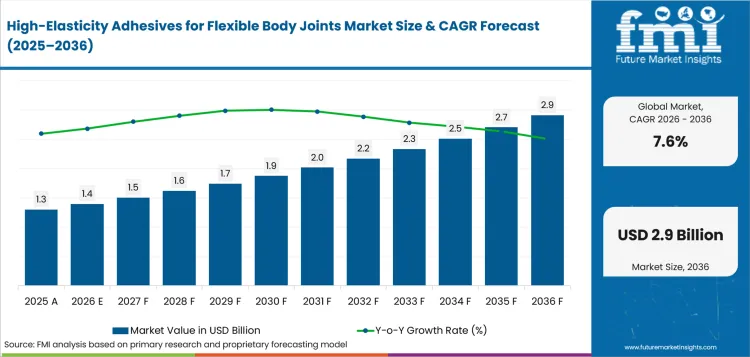
The high-elasticity adhesives for flexible body joints market is forecast to advance from USD 1.3 billion in 2025 to USD 2.9 billion by 2036 at a 7.6% CAGR, as mixed-material vehicle bodies and joint fatigue requirements raise adhesive use, with passenger cars holding 71.0% share and robotic dispensing capturing 59.0% share as manufacturers focus on vibration control and body-shop approval.
Key Takeaways, Market Size, and Forecast
- 2026 Market Size: USD 1.4 billion
- 2036 Market Size: USD 2.9 billion
- Forecast CAGR: 7.6% from 2026 to 2036
- Leading Vehicle Type: Passenger cars
- Passenger Cars Share in 2026: 71.0%
- Leading Application Method: Robotic dispensing
- Robotic Dispensing Share in 2026: 59.0%
- Fastest-growing Country: India
- India CAGR: 8.7% through 2036
Summary of the High-Elasticity Adhesives for Flexible Body Joints Market
- Demand and Growth Drivers
- Vehicle manufacturers are using elastic bonding to reduce panel vibration and limit fatigue stress across flexible body joints.
- Mixed-material vehicle bodies need adhesives able to absorb movement between coated steel and aluminum panels.
- Automated body shops require stable bead control across long seams and curved closures during high-volume assembly.
- Product and Segment View
- Modified epoxy leads resin chemistry use as toughened systems balance bond strength with movement absorption.
- Polyurethane is important for flexible joints needing high elongation across body structures and closure panels.
- Anti-flutter joints are important as hood panels and door skins require vibration control after vehicle assembly.
- Geography and Competitive Outlook
- China and India are expanding vehicle production depth and body-shop automation across new passenger car platforms.
- Demand in the United States is shaped by established body-in-white lines and repair network requirements.
- Suppliers with OEM approvals and dispensing support are better placed as body shops limit material switching risk.
- Analyst Opinion
- Nikhil Kaitwade, Principal Consultant for Automotive domain at FMI, says, “High-elasticity adhesives for flexible body joints are becoming a specification decision for vehicle body engineers. Body shops need fatigue absorption and stable dispensing performance in the same material. Suppliers with proven e-coat compatibility and application engineering access are likely to win earlier platform positions.”
- High-Elasticity Adhesives for Flexible Body Joints Market Value Analysis
- High-elasticity adhesives for flexible body joints are moving from sealing use toward engineered joining in vehicle bodies.
- Passenger car programs use flexible bonding to control panel vibration across doors and roof structures.
- Mixed-metal vehicle body structures strengthen adoption as manufacturers require movement tolerance and dependable corrosion sealing.
- Value creation is linked to bead consistency and cure behavior during body-in-white assembly programs.
Vehicle makers need adhesives to handle body movement without adding extra weight or extra process steps. DuPont’s broad bake adhesive data shows a 25°C lower e-coat oven window and a 150°C for 15 minutes lap shear requirement, so suppliers with proven low-bake performance become easier to approve for body-shop programs. Henkel’s Sika states SikaPower SmartFlow can handle oily steel surfaces with up to 3 g/m² oil uptake during heat curing. The same source names steel and aluminum as common body-shop substrates for SikaPower adhesives. This helps suppliers prove adhesion reliability on mixed-material body structures without adding extra preparation steps. DuPont’s BETAFORCE™ development is relevant for EV-related bonding because it bonds aluminum laminated film substrates without primer or pretreatment and includes 30% renewable and bio-based material by weight. 3M lists Scotch-Weld Flexible Acrylic Adhesive 8600 Series with up to 200% elongation. It offers 10-minute or 25-minute open times for flexible assembly work. This helps adhesive suppliers prove process timing and mixed-material bonding for vehicle body applications.
High-Elasticity Adhesives for Flexible Body Joints Market Definition
The high-elasticity adhesives for flexible body joints market includes modified epoxy, polyurethane, silane polymer, silicone hybrid, and acrylic adhesives used in vehicle body structures requiring movement tolerance. These adhesives serve anti-flutter joints, hem flange bonding, roof ditch seams, door modules, closure panels, and flexible body assemblies across passenger cars and commercial vehicles. The scope excludes windshield bonding adhesives, battery pack adhesives, thermal interface materials, mechanical fasteners, welding consumables, and cosmetic sealers sold outside flexible body-joint applications.
High-Elasticity Adhesives for Flexible Body Joints Market Inclusions
Market scope covers all commercially traded high-elasticity adhesives for flexible body joints categorized by resin chemistry, including modified epoxy, polyurethane, silane polymer, silicone hybrid, and acrylic systems; joint applications, including anti-flutter joints, hem flange bonding, roof ditch seams, door modules, and closure panels; vehicle types, including passenger cars, light commercial vehicles, heavy trucks, and buses; application methods, including robotic dispensing, manual cartridges, pumpable bulk systems, and film tapes; and performance functions, including NVH damping, fatigue relief, gap filling, corrosion sealing, and crash absorption. Revenue scope covers 2026 to 2036. The key stakeholders include automotive adhesive manufacturers, resin and additive suppliers, vehicle OEMs, body-in-white engineering teams, tier component manufacturers, adhesive dispensing equipment providers, collision repair networks, system integrators, distributors, testing laboratories, and regulatory bodies overseeing automotive material compliance.
High-Elasticity Adhesives for Flexible Body Joints Market Exclusions
The scope does not include windshield bonding adhesives, battery pack adhesives, thermal interface materials, paint-shop cosmetic sealers, mechanical fasteners, welding consumables, standalone dispensing equipment, or general industrial adhesives sold outside flexible vehicle body-joint applications.
High-Elasticity Adhesives for Flexible Body Joints Market Research Methodology
- Primary Research: FMI analysts reviewed automotive adhesive supplier portfolios and body-shop specification patterns across major vehicle manufacturing clusters.
- Desk Research: Public vehicle production data and official supplier materials were checked against body-joint application evidence.
- Market Sizing and Forecasting: Market size used automotive adhesive parent demand and flexible body-joint application intensity.
- Data Validation: Forecast checks compared body-in-white adhesive use with passenger car output and supplier qualification coverage.
Why is the High-Elasticity Adhesives for Flexible Body Joints Market Growing?
- Vehicle bodies use flexible adhesives as mixed materials create movement across joined panels during thermal cycling.
- High-speed body shops need stable adhesive beads across long seams and curved closures during automated dispensing.
- Cabin comfort targets raise demand for joints able to reduce vibration inside thin panels after final assembly.
- Repair networks need cartridge systems matching original flexible joint performance after panel replacement and corrosion repair.
Passenger vehicle output keeps flexible adhesive demand linked to body-in-white design choices across major vehicle platforms. OICA production statistics released in 2025 recorded global motor vehicle production for 2024 across passenger cars and commercial vehicles. Flexible body-joint adhesives benefit from the same production base as OEMs increase bonded seam use in closures. Manufacturers comparing joint sealing options review demand for automotive sealants during body-shop material planning.
EV platform expansion strengthens the case for flexible adhesive systems in doors and roof structures. Battery-electric and hybrid vehicle architectures are increasing pressure on body engineers to reduce weight across vehicle bodies and closures. Adjacent automotive adhesives & sealants industry analysis reflects the wider shift toward bonding and sealing in automotive assembly.
Market Segmentation Analysis
- Modified epoxy adhesives are expected to hold 39.0% of resin chemistry share in 2026, reflecting their use in joints requiring strength and fatigue absorption.
- Anti-flutter joints are forecast to capture 34.0% of joint application share as closure panels need vibration control after assembly.
- Passenger cars are anticipated to account for 71.0% of vehicle type use in 2026 through high platform volumes and frequent body-joint specification.
- Robotic dispensing is projected to represent 59.0% of application method adoption as automated body shops prioritize bead consistency.
- NVH damping is expected to contribute 36.0% of performance function share in 2026 with flexible joints helping reduce panel vibration.
The market for high-elasticity adhesives for flexible body joints is divided into groups based on resin chemistry, joint application, vehicle type, application method, performance function, sales channel, and region. There are modified epoxy, polyurethane, silane polymer, silicone hybrid, and acrylic systems under resin chemistry. By joint application, the market includes anti-flutter joints, hem flange bonding, roof ditch seams, door modules, and closure panels. By vehicle type, the market covers passenger cars, light commercial vehicles, heavy trucks, and buses. Based on application method, it includes robotic dispensing, manual cartridges, pumpable bulk systems, and film tapes. By performance function, the market includes NVH damping, fatigue relief, gap filling, corrosion sealing, and crash absorption. By sales channel, the market is segmented into OEM fitment and aftermarket.
Insights into High-Elasticity Adhesives for Flexible Body Joints Market by Resin Chemistry
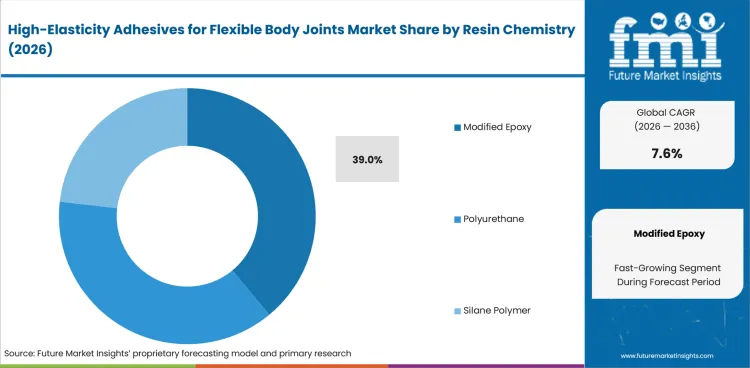
- Modified epoxy adhesives are expected to account for 39.0% share in 2026 with toughened systems helping body joints absorb fatigue stress.
- Polyurethane adhesives serve designs needing higher elongation and softer movement control in flexible joint applications. Adjacent polyurethane (PU) adhesives market outlook indicates the broader chemistry base used by formulators in industrial adhesive systems.
Insights into High-Elasticity Adhesives for Flexible Body Joints Market by Joint Application
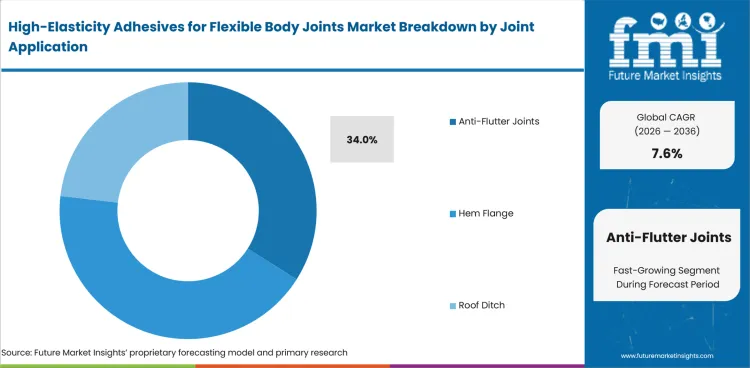
- Anti-flutter joints are forecast to hold 34.0% share in 2026 as hood panels need vibration control after assembly.
- Hem flange bonding gains use in closures as manufacturers combine adhesive beads with crimped metal edges for durability.
Insights into High-Elasticity Adhesives for Flexible Body Joints Market by Vehicle Type
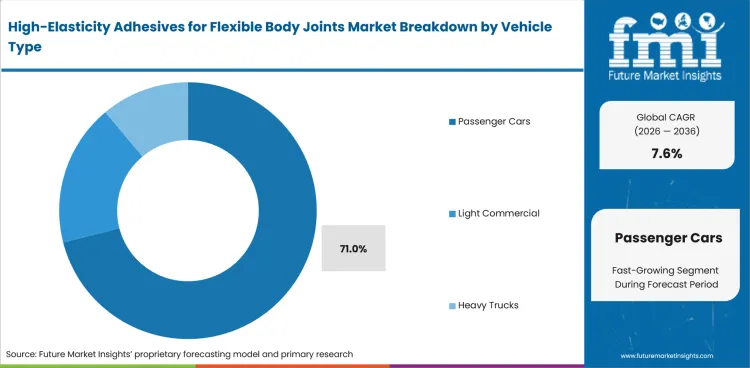
- Passenger cars are anticipated to hold 71.0% share in 2026 as high-volume car platforms consume the largest body-joint adhesive volumes.
- Light commercial vehicles use flexible body-joint adhesives for cargo doors and roof panels exposed to repeated loading. Linked demand for adhesives for electric vehicle power batteries points to broader eV adhesive specification activity.
Insights into High-Elasticity Adhesives for Flexible Body Joints Market by Application Method
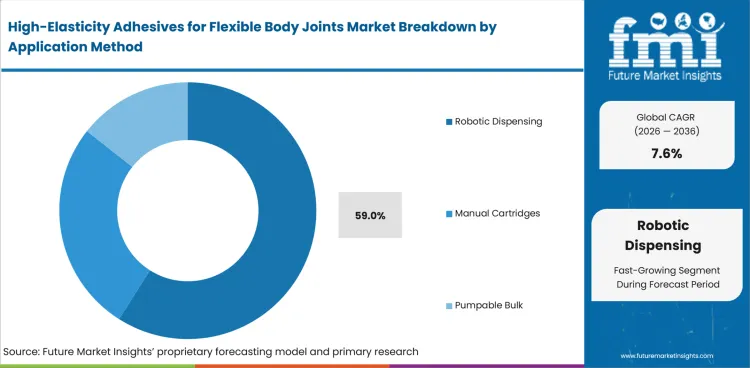
- Robotic dispensing is expected to account for 59.0% share in 2026 as automated body shops need consistent bead height and placement.
- Manual cartridges retain relevance for service repair and low-volume assembly programs requiring controlled application after panel replacement. Related industrial adhesives industry analysis helps frame broader factory adhesive use across automated production settings.
Insights into High-Elasticity Adhesives for Flexible Body Joints Market by Performance Function
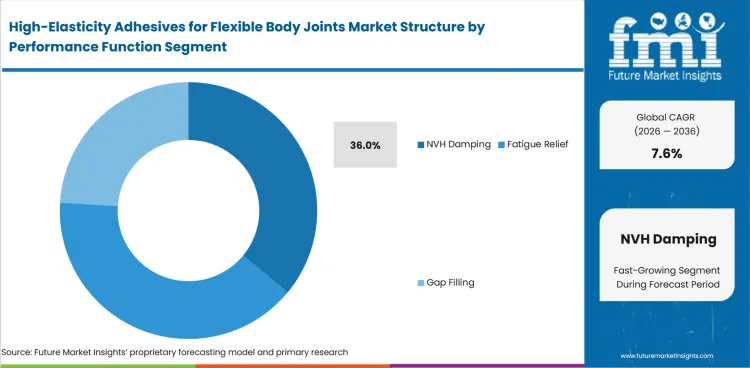
- NVH damping is projected to represent 36.0% share in 2026 as flexible joints reduce vibration transfer through panels.
- Fatigue relief is important in mixed-material structures exposed to thermal movement during vehicle service life.
High-Elasticity Adhesives for Flexible Body Joints Market Drivers, Restraints and Opportunities
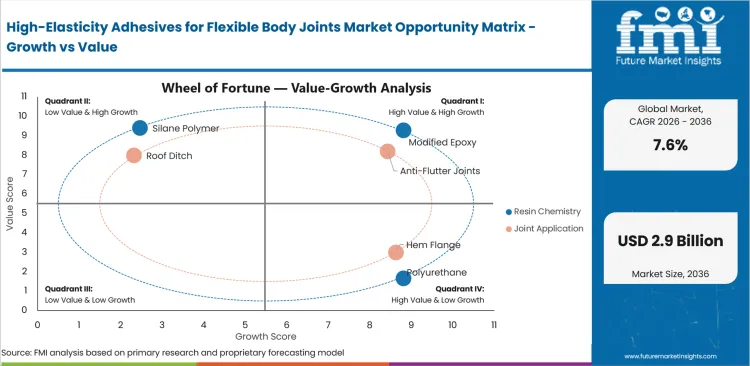
- Driver: Mixed-material vehicle bodies increase demand for flexible adhesives as closure panels need movement tolerance and fatigue control.
- Restraint: Long qualification cycles can delay adhesive switching as body joints require corrosion testing and e-coat validation.
- Opportunity: Low-bake and damping-enabled adhesives create supplier differentiation for OEMs seeking easier body-shop integration.
Flexible body-joint adhesive use is reinforced by vehicle designs using steel and aluminum across closures and roof structures. Henkel reported in May 2026 that the Teroson EP 52 Series combines structural integrity with vibration damping in one heat-curing solvent-free adhesive. Combined strength and damping allow manufacturers to reduce separate acoustic materials during body assembly. OEMs now compare cure behavior with bead stability before approving flexible adhesives. Suppliers with proven dispensing performance and body-shop validation can protect program share during platform cycles.
Application-Side Demand and Supply Chain Analysis
Application demand is leading where adhesive bonding improves closure durability and cabin refinement. DuPont reported in August 2024 BETAFORCE elastic structural adhesive contains renewable and bio-based materials by weight. The same release linked the adhesive to elastic structural bonding for EV battery assembly applications. This reinforces supplier focus on flexible materials with adhesion strength and sustainability credentials. Body-joint adhesive suppliers must read EV platform needs and body-shop validation cycles together before setting capacity plans.
Trade Flow and Regional Supply Analysis
Regional demand exposure gives flexible body-joint adhesives a platform supply profile. International Energy Agency reported in May 2026 electric car sales topped 20 million globally in 2025. EV scale increases pressure on lightweight body structures and fatigue-resistant joining across major assembly regions. Importers and OEM plants prefer suppliers with local technical service and stable specialty adhesive availability. Producers with regional formulation capacity and application engineering access are better placed to reduce approval delays.
Competitive Landscape and Strategic Positioning
High-Elasticity Adhesives for Flexible Body Joints Market Analysis By Company
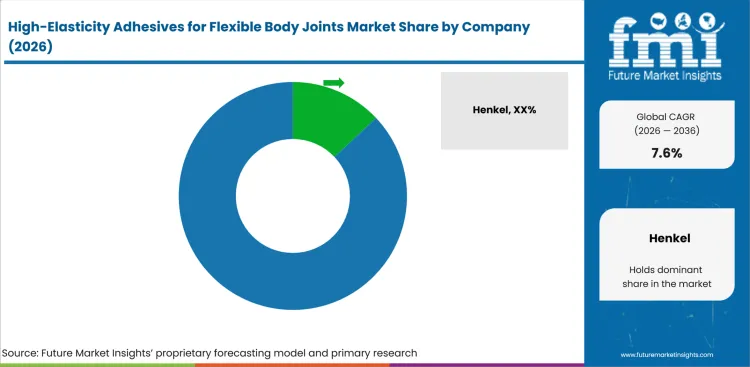
High-elasticity adhesives for flexible body joints competition is shaped by OEM qualification and body-shop application support. Global suppliers compete on e-coat compatibility and documented fatigue performance for vehicle body engineers across platform programs.
- Henkel leads through broad automotive adhesive coverage and strong body-shop application engineering for OEM programs.
- Sika and DuPont compete on structural bonding systems and flexible adhesive technologies for body-in-white applications.
- 3M and HB Fuller serve automotive bonding users through liquid adhesive and tape-based application options.
- Arkema and PPG Industries provide adjacent adhesive and sealant capabilities across transportation and industrial bonding.
Henkel holds a high position through OEM access and broad automotive material coverage across body applications. Sika builds its position through body-shop adhesives covering anti-flutter and hem-flange applications. DuPont adds elastic structural adhesive expertise through BETAMATE and BETAFORCE product families. 3M builds demand through structural adhesive products and automotive repair visibility.
High qualification cost and precise process fitment create barriers across body-in-white programs. Competitive priorities center on fatigue performance and dispensing reliability across vehicle production clusters. Manufacturers prefer suppliers with validated e-coat compatibility and clear application guidance. Suppliers with stronger technical service near assembly hubs are positioned to reduce validation risk and win repeat orders.
Key Companies in the High-Elasticity Adhesives for Flexible Body Joints Market
Key global companies active in the high-elasticity adhesives for flexible body joints market include:
- Henkel, Sika, and DuPont have strong body-shop adhesive portfolios for flexible vehicle body joints.
- 3M, HB Fuller, and Arkema compete across structural adhesive systems and automotive bonding applications.
- PPG Industries serves manufacturers through adjacent sealant and coating technologies for vehicle body applications.
Competitive Benchmarking: High-Elasticity Adhesives for Flexible Body Joints Market
|
Company |
Body-Shop Qualification |
Elastic Joint Portfolio |
Dispensing Support |
|
Henkel |
High |
High |
Strong |
|
Sika |
High |
High |
Strong |
|
DuPont |
High |
High |
Strong |
|
3M |
Medium |
High |
Strong |
|
HB Fuller |
Medium |
Medium |
Moderate |
|
Arkema |
Medium |
Medium |
Moderate |
|
PPG Industries |
Medium |
Medium |
Moderate |
Source: Future Market Insights, 2026.
Key Developments in High-Elasticity Adhesives for Flexible Body Joints Market
- In May 2026, Henkel introduced the Teroson EP 52 Series, a heat-curing, solvent-free, one-component structural adhesive for automotive Body-in-White production. The product combines structural integrity with vibration damping and is compatible with automated dispensing systems used for structural and hem flange bonding.
- In August 2024, DuPont announced that its BETAFORCE™ elastic structural adhesive won a 2024 R&D 100 Award in the Mechanical/Materials category. The adhesive is designed for EV battery assembly and pouch cell bonding, with elastic properties supporting durability and crashworthiness. DuPont’s BETAFORCE page positions the technology for high-performance bonding of vehicle structures and body assembly applications involving dissimilar substrates, structural integrity, durability, crashworthiness, lightweighting, and NVH performance.
Key Players in the High-Elasticity Adhesives for Flexible Body Joints Market
Major Global Players
- Henkel
- Sika
- DuPont
- 3M
- HB Fuller
- Arkema
- PPG Industries
Specialist Players
- Parker LORD
- DELO Industrial Adhesives
- Jowat
- Dinitrol
- ITW Performance Polymers
Analysis of High-Elasticity Adhesives for Flexible Body Joints Market by Key Countries
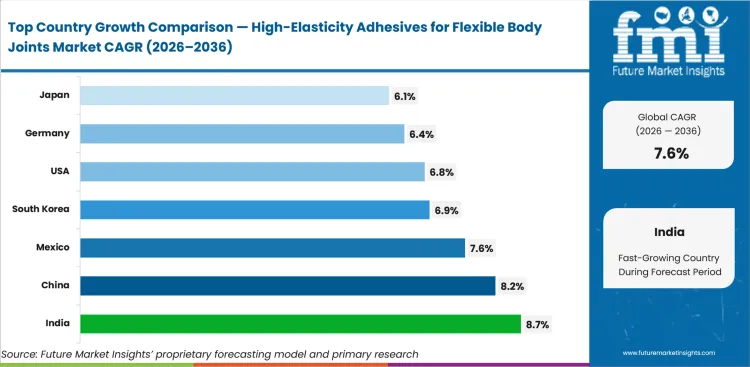
.webp "Top Country Growth Comparison High Elasticity Adhesives For Flexible Body Joints Market Cagr (2026 2036)")
|
Country |
CAGR |
|
India |
8.7% |
|
China |
8.2% |
|
Mexico |
7.6% |
|
South Korea |
6.9% |
|
United States |
6.8% |
|
Germany |
6.4% |
|
Japan |
6.1% |
Source: Future Market Insights, 2026.
Demand Outlook for High-Elasticity Adhesives for Flexible Body Joints Industry in India
Country Snapshot
Country Market Snapshot Table
|
Parameter |
Value |
|
Market Size in 2025 (Value) |
USD 1.3 billion |
|
Market Forecast in 2036 (Value) |
USD 2.9 billion |
|
CAGR (2026-2036) |
8.7% |
|
Years Considered |
2021-2036 |
|
Base Year |
2025 |
|
Forecast Period |
2026-2036 |
|
Units Considered |
Value (USD Bn) |
|
Leading Sub-Region |
Maharashtra automotive corridor |
Fastest-growing country market · 2026 to 2036
India High-Elasticity Adhesives for Flexible Body Joints Industry Outlook
Body-shop adhesive demand in India is shaped by passenger vehicle assembly in Maharashtra and Tamil Nadu. SIAM and the Ministry of Heavy Industries keep local vehicle manufacturing central to industrial policy. Adhesive suppliers with training programs can enter plants upgrading from manual sealant use toward automated body joining.
Export-oriented component plants in Pune and Chennai require repeatable joints for closure panels and roof assemblies. Local manufacturers evaluate cure reliability and cartridge handling before adopting higher-specification flexible adhesives. Domestic service availability holds importance as first-time users need practical help during dispensing trials.
Key Growth Drivers
- Localized vehicle assembly increases flexible adhesive demand across passenger car closures, as SIAM reported 4,643,439 passenger vehicle sales during April 2025 to March 2026, reinforcing body-joint material use.
- Export-oriented component plants require repeatable bonding for doors and roof assemblies in Maharashtra automotive clusters.
- Staged automation favors cartridge and pumpable adhesive formats as mid-sized suppliers avoid full body-shop redesign.
- Passenger vehicle body programs create higher adhesive qualification needs, as SIAM reported 1,079,871 commercial vehicle sales during April 2025 to March 2026, reinforcing broader assembly material demand.
Key Restraints
- Smaller component manufacturers face adoption delays as dispensing systems add capital cost before material savings appear.
- Imported specialty adhesive inputs can raise inventory risk for body shops serving vehicle platforms in Pune.
- Training shortages limit consistent bead application, as India’s staged automation base requires local service depth for adhesive trials.
What makes India unique
India is unique as suppliers can enter through staged body-shop upgrades before full automated adhesive programs scale.
Key Companies
- Henkel India
- Sika India
- 3M India
- Pidilite Industries
- DuPont India
Sales & Marketing Channels
- Automotive supplier project channels
- Pune body-shop integrators
- Chennai adhesive distributors
- OEM technical service teams
Country Segment Breakdown Table
|
Segment |
Sub-Segments |
|
By Resin Chemistry |
Modified Epoxy · Polyurethane · Silane Polymer · Silicone Hybrid · Acrylic |
|
By Joint Application |
Anti-Flutter Joints · Hem Flange · Roof Ditch · Door Modules · Closure Panels |
|
By Vehicle Type |
Passenger Cars · Light Commercial · Heavy Trucks · Buses |
|
By Application Method |
Robotic Dispensing · Manual Cartridges · Pumpable Bulk · Film Tapes |
|
By Performance Function |
NVH Damping · Fatigue Relief · Gap Filling · Corrosion Sealing · Crash Absorption |
| Key Sub-Regions Covered, Provinces / Municipalities | Maharashtra, Tamil Nadu, Gujarat, Karnataka, Haryana, Uttar Pradesh, Telangana, Andhra Pradesh |
Frequently Asked Questions
How fast is India's high-elasticity adhesives for flexible body joints industry growing?
India’s high-elasticity adhesives for flexible body joints industry is forecast to expand at 8.7% CAGR from 2026 to 2036.
Who leads the India high-elasticity adhesives for flexible body joints industry?
Henkel India, Sika India, and 3M India lead through automotive adhesive portfolios and local technical service access.
What is driving industry outlook in India’s high-elasticity adhesives for flexible body joints industry?
Passenger vehicle production and export-focused component programs are increasing demand for qualified flexible body-joint adhesives.
Sales Analysis of High-Elasticity Adhesives for Flexible Body Joints Industry in China
Country Snapshot
Country Market Snapshot Table
|
Parameter |
Value |
|
Market Size in 2025 (Value) |
USD 1.3 billion |
|
Market Forecast in 2036 (Value) |
USD 2.9 billion |
|
CAGR (2026-2036) |
8.2% |
|
Years Considered |
2021-2036 |
|
Base Year |
2025 |
|
Forecast Period |
2026-2036 |
|
Units Considered |
Value (USD Bn) |
|
Leading Sub-Region |
Yangtze River Delta manufacturing belt |
EV platform scale market · 2026 to 2036
China High-Elasticity Adhesives for Flexible Body Joints Industry Outlook
China’s adhesive demand is shaped by EV platform depth across Shanghai and the Yangtze River Delta. CAAM and national industrial policy keep local vehicle output central to supplier selection. Adhesive formulators with stable local supply can reduce approval pressure for body-in-white programs.
Chinese vehicle makers specify flexible joint materials for mixed-metal closures and roof structures. Local technical teams gain importance as body shops compare bead stability during automated dispensing.
Key Growth Drivers
- EV body programs increase flexible adhesive use, as China’s State Council reported 16.626 million NEV units produced in 2025, reinforcing mixed-material joining demand.
- Domestic supplier localization lowers lead time for modified epoxy and polyurethane adhesive approval.
- Large assembly scale increases robotic dispensing demand, as China’s State Council reported 16.49 million NEV units sold in 2025, reinforcing automated body-shop material use.
- OEM body engineers evaluate fatigue relief in anti-flutter joints across local passenger car platforms.
Key Restraints
- Price pressure from local adhesive producers can narrow margins for imported specialty chemistries.
- Platform approval cycles are demanding, as CAAM data cited by China’s State Council in January 2026 confirms large NEV production scale, constraining fast material switching.
- Regional concentration around coastal manufacturing clusters can slow adhesive adoption in inland assembly plants.
What makes China unique
China is unique as EV production scale can move approved flexible body-joint adhesives into high-volume platforms quickly.
Key Companies
- Henkel China
- Sika China
- DuPont China
- 3M China
- Arkema China
Sales & Marketing Channels
- Local OEM engineering teams
- Yangtze River Delta body-shop integrators
- Regional adhesive distributors
- Automotive technical service centers
Country Segment Breakdown Table
|
Segment |
Sub-Segments |
|
By Resin Chemistry |
Modified Epoxy · Polyurethane · Silane Polymer · Silicone Hybrid · Acrylic |
|
By Joint Application |
Anti-Flutter Joints · Hem Flange · Roof Ditch · Door Modules · Closure Panels |
|
By Vehicle Type |
Passenger Cars · Light Commercial · Heavy Trucks · Buses |
|
By Application Method |
Robotic Dispensing · Manual Cartridges · Pumpable Bulk · Film Tapes |
|
By Performance Function |
NVH Damping · Fatigue Relief · Gap Filling · Corrosion Sealing · Crash Absorption |
| Key Sub-Regions Covered, Provinces / Municipalities | Shanghai, Jiangsu, Zhejiang, Guangdong, Chongqing, Hubei, Shandong, Tianjin |
Frequently Asked Questions
How fast is China's high-elasticity adhesives for flexible body joints industry growing?
China’s high-elasticity adhesives for flexible body joints industry is forecast to expand at 8.2% CAGR from 2026 to 2036.
Who leads the China high-elasticity adhesives for flexible body joints industry?
Henkel China, Sika China, and DuPont China lead through OEM access and local body-shop adhesive qualification.
What is driving adoption in China's high-elasticity adhesives for flexible body joints industry?
EV platform scale and automated body-shop expansion are increasing use of fatigue-resistant flexible adhesives.
Demand Analysis of High-Elasticity Adhesives for Flexible Body Joints Industry in Mexico
Country Snapshot
Country Market Snapshot Table
|
Parameter |
Value |
|
Market Size in 2025 (Value) |
USD 1.3 billion |
|
Market Forecast in 2036 (Value) |
USD 2.9 billion |
|
CAGR (2026-2036) |
7.6% |
|
Years Considered |
2021-2036 |
|
Base Year |
2025 |
|
Forecast Period |
2026-2036 |
|
Units Considered |
Value (USD Bn) |
|
Leading Sub-Region |
Bajío automotive corridor |
Export manufacturing expansion market · 2026 to 2036
Mexico High-Elasticity Adhesives for Flexible Body Joints Industry Outlook
Mexico’s industry is propelled by export vehicle assembly in Bajío and Nuevo León. INEGI’s light vehicle administrative record places production and export data at the center of supplier planning. Adhesive suppliers with cross-border service access can serve OEM plants linked with North American programs.
Export platforms require body-joint adhesives approved for repeatable performance under high-volume schedules. North American vehicle programs raise demand for anti-flutter and hem-flange bonding across light truck production.
Key Growth Drivers
- Export assembly programs raise adhesive qualification needs, as INEGI reported 3,953,494 light vehicles produced during January to December 2025, reinforcing body-shop material demand.
- Light truck production increases flexible joint use across closures and roof panels in Bajío plants.
- North American platform exposure raises service requirements, as INEGI reported 3,385,785 light vehicles exported during January to December 2025, reinforcing OEM adhesive demand.
- Tier suppliers in Guanajuato and Coahuila require cartridge and bulk adhesive formats for localized assembly work.
Key Restraints
- Export concentration exposes adhesive demand to North American vehicle scheduling changes and tariff reviews.
- USA destination exposure boosts demand risk, as INEGI reported 78.4% of Mexico light vehicle exports went to the United States in 2025, constraining supplier planning.
- Imported specialty adhesive reliance can extend inventory cycles for plants outside Bajío and Nuevo León.
What makes Mexico unique
Mexico is unique as export vehicle production directly links adhesive approval with North American platform requirements.
Key Companies
- Henkel Mexico
- Sika Mexico
- 3M Mexico
- DuPont Mexico
- PPG Mexico
Sales & Marketing Channels
- Bajío system integrators
- OEM plant project offices
- Cross-border distributor branches
- Collision repair supply networks
Country Segment Breakdown Table
|
Segment |
Sub-Segments |
|
By Resin Chemistry |
Modified Epoxy · Polyurethane · Silane Polymer · Silicone Hybrid · Acrylic |
|
By Joint Application |
Anti-Flutter Joints · Hem Flange · Roof Ditch · Door Modules · Closure Panels |
|
By Vehicle Type |
Passenger Cars · Light Commercial · Heavy Trucks · Buses |
|
By Application Method |
Robotic Dispensing · Manual Cartridges · Pumpable Bulk · Film Tapes |
|
By Performance Function |
NVH Damping · Fatigue Relief · Gap Filling · Corrosion Sealing · Crash Absorption |
| Key Sub-Regions Covered, Provinces / Municipalities | Guanajuato, Nuevo León, Coahuila, Puebla, San Luis Potosí, Querétaro, Aguascalientes, Estado de México |
Frequently Asked Questions
How fast is Mexico's high-elasticity adhesives for flexible body joints industry growing?
Mexico’s high-elasticity adhesives for flexible body joints industry is forecast to expand at 7.6% CAGR from 2026 to 2036.
Who leads the Mexico high-elasticity adhesives for flexible body joints industry?
Henkel Mexico, Sika Mexico, and 3M Mexico lead through OEM supply access and adhesive distribution coverage.
What is driving demand in Mexico's high-elasticity adhesives for flexible body joints industry?
Export vehicle assembly and light truck production are raising demand for qualified flexible body-joint adhesives.
Opportunity Analysis of High-Elasticity Adhesives for Flexible Body Joints Industry in South Korea
Country Snapshot
Country Market Snapshot Table
|
Parameter |
Value |
|
Market Size in 2025 (Value) |
USD 1.3 billion |
|
Market Forecast in 2036 (Value) |
USD 2.9 billion |
|
CAGR (2026-2036) |
6.9% |
|
Years Considered |
2021-2036 |
|
Base Year |
2025 |
|
Forecast Period |
2026-2036 |
|
Units Considered |
Value (USD Bn) |
|
Leading Sub-Region |
Ulsan automotive corridor |
High-automation vehicle base · 2026 to 2036
South Korea High-Elasticity Adhesives for Flexible Body Joints Industry Outlook
South Korea’s adhesive demand is shaped by automated vehicle assembly in Ulsan and Gyeonggi. IEA EV evidence points to stronger electrified vehicle activity during 2025. Adhesive suppliers need proof of fatigue relief and automated dispensing stability for highly controlled production lines.
Korean manufacturers evaluate flexible body-joint adhesives through uptime and repeatable application quality. Vehicle and electronics manufacturing practices raise expectations for process documentation and surface finish control.
Key Growth Drivers
- EV adoption raises lightweight body demands, as IEA reported Korean electric car sales exceeded 200,000 units in 2025, reinforcing flexible joint requirements.
- Ulsan vehicle plants require body adhesives with stable bead placement across high-volume assembly lines.
- Connected factories favor documented adhesive processes, as IEA reported Korea reached 11% electric car sales share in 2025, reinforcing EV body material planning.
- Electronics manufacturing culture increases attention to surface quality and low-variation adhesive application.
Key Restraints
- Mature automation practice can make material replacement selective across established body-shop processes.
- EV subsidy timing can affect platform schedules, as IEA reported government purchase guideline timing influenced Korean EV sales in 2025, constraining demand visibility.
- Strict supplier qualification raises trial cost for adhesive entrants lacking local engineering resources.
What makes South Korea unique
South Korea is unique as EV adoption and automated assembly depth enhance demand for tightly controlled adhesive dispensing.
Key Companies
- Henkel Korea
- Sika Korea
- DuPont Korea
- 3M Korea
- KCC Corporation
Sales & Marketing Channels
- Ulsan OEM project channels
- Gyeonggi technical service teams
- Factory automation distributors
- Vehicle repair material partners
Country Segment Breakdown Table
|
Segment |
Sub-Segments |
|
By Resin Chemistry |
Modified Epoxy · Polyurethane · Silane Polymer · Silicone Hybrid · Acrylic |
|
By Joint Application |
Anti-Flutter Joints · Hem Flange · Roof Ditch · Door Modules · Closure Panels |
|
By Vehicle Type |
Passenger Cars · Light Commercial · Heavy Trucks · Buses |
|
By Application Method |
Robotic Dispensing · Manual Cartridges · Pumpable Bulk · Film Tapes |
|
By Performance Function |
NVH Damping · Fatigue Relief · Gap Filling · Corrosion Sealing · Crash Absorption |
| Key Sub-Regions Covered, Provinces / Municipalities | Ulsan, Gyeonggi-do, Chungcheongnam-do, Gyeongsangnam-do, Incheon, Busan, Daegu, Gwangju |
Frequently Asked Questions
How fast is South Korea's high-elasticity adhesives for flexible body joints industry growing?
South Korea’s high-elasticity adhesives for flexible body joints industry is forecast to expand at 6.9% CAGR from 2026 to 2036.
Who leads the South Korea high-elasticity adhesives for flexible body joints industry?
Henkel Korea, Sika Korea, and DuPont Korea lead through OEM body-shop adhesive coverage and technical service access.
What is driving adoption in South Korea's high-elasticity adhesives for flexible body joints industry?
EV sales and automated vehicle assembly are increasing demand for controlled flexible adhesive dispensing.
Future Outlook for High-Elasticity Adhesives for Flexible Body Joints Industry in United States
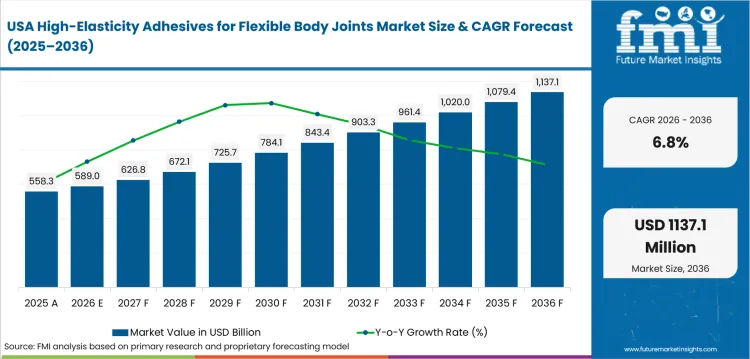
Country Snapshot
Country Market Snapshot Table
|
Parameter |
Value |
|
Market Size in 2025 (Value) |
USD 1.3 billion |
|
Market Forecast in 2036 (Value) |
USD 2.9 billion |
|
CAGR (2026-2036) |
6.8% |
|
Years Considered |
2021-2036 |
|
Base Year |
2025 |
|
Forecast Period |
2026-2036 |
|
Units Considered |
Value (USD Bn) |
|
Leading Sub-Region |
Great Lakes automotive corridor |
Large installed vehicle base · 2026 to 2036
United States High-Elasticity Adhesives for Flexible Body Joints Industry Outlook
United States adhesive demand is shaped by established vehicle plants across Michigan and the Southern assembly corridor. NADA sales evidence keeps the replacement and new-vehicle base important for material planning. Suppliers with OEM approvals can serve both assembly plants and collision repair channels.
USA body engineers evaluate flexible adhesives through fatigue resistance and corrosion performance. EV program timing adds uncertainty for some suppliers but mixed-material closures keep bonding requirements active. Related structural adhesive industry analysis is relevant as OEMs compare structural joining choices for body assemblies.
Key Growth Drivers
- Established vehicle demand sustains body-joint adhesive use, as NADA reported 16.2 million new light-vehicle sales in 2025, reinforcing OEM and repair material needs.
- Collision repair channels require cartridge systems matching original flexible body-joint performance after panel replacement.
- Great Lakes assembly programs improve recurring qualification demand, as NADA reported 2.4% higher new light-vehicle sales in 2025, reinforcing platform refresh activity.
- Southern vehicle plants use flexible adhesives for closures and roof panels across mixed-material designs.
Key Restraints
- EV demand visibility can shift adhesive program timing across vehicle platforms in the United States.
- Tax credit changes can affect electrified platform planning, as IEA reported weaker USA EV demand late in 2025, constraining material scheduling.
- OEM approval cycles make supplier switching slow after adhesive selection for body-in-white programs.
What makes United States unique
United States is unique as OEM body programs and collision repair channels both influence adhesive qualification needs.
Key Companies
- Henkel Corporation
- Sika Corporation
- DuPont
- 3M
- HB Fuller
Sales & Marketing Channels
- OEM body-shop engineering offices
- Collision repair distributors
- Great Lakes technical service branches
- Tier supplier procurement teams
Country Segment Breakdown Table
|
Segment |
Sub-Segments |
|
By Resin Chemistry |
Modified Epoxy · Polyurethane · Silane Polymer · Silicone Hybrid · Acrylic |
|
By Joint Application |
Anti-Flutter Joints · Hem Flange · Roof Ditch · Door Modules · Closure Panels |
|
By Vehicle Type |
Passenger Cars · Light Commercial · Heavy Trucks · Buses |
|
By Application Method |
Robotic Dispensing · Manual Cartridges · Pumpable Bulk · Film Tapes |
|
By Performance Function |
NVH Damping · Fatigue Relief · Gap Filling · Corrosion Sealing · Crash Absorption |
| Key Sub-Regions Covered, Provinces / Municipalities | Michigan, Ohio, Indiana, Kentucky, Tennessee, Alabama, South Carolina, Texas |
Frequently Asked Questions
How fast is the United States high-elasticity adhesives for flexible body joints industry growing?
United States high-elasticity adhesives for flexible body joints industry is forecast to expand at 6.8% CAGR from 2026 to 2036.
Who leads the United States high-elasticity adhesives for flexible body joints industry?
Henkel Corporation, Sika Corporation, and DuPont lead through OEM adhesive qualification and technical service coverage.
What is driving industry outlook in the United States high-elasticity adhesives for flexible body joints industry?
Established vehicle production and collision repair demand are increasing use of validated flexible body-joint adhesives.
Demand Outlook for High-Elasticity Adhesives for Flexible Body Joints Industry in the Germany
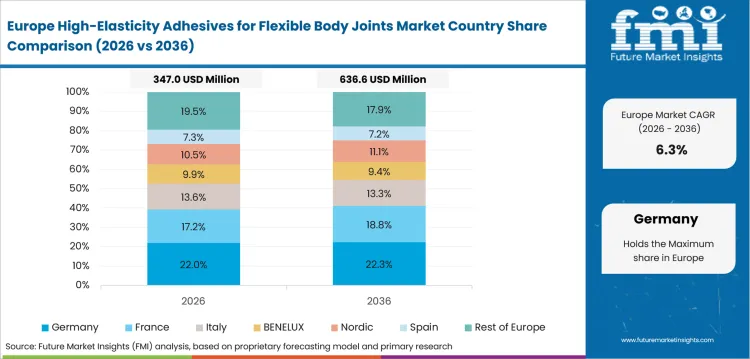
Country Snapshot
Country Market Snapshot Table
|
Parameter |
Value |
|
Market Size in 2025 (Value) |
USD 1.3 billion |
|
Market Forecast in 2036 (Value) |
USD 2.9 billion |
|
CAGR (2026-2036) |
6.4% |
|
Years Considered |
2021-2036 |
|
Base Year |
2025 |
|
Forecast Period |
2026-2036 |
|
Units Considered |
Value (USD Bn) |
|
Leading Sub-Region |
Bavaria and Baden-Württemberg automotive belt |
Premium engineering market · 2026 to 2036
Germany High-Elasticity Adhesives for Flexible Body Joints Industry Outlook
Germany’s adhesive demand is shaped by premium body engineering in Bavaria and Baden-Württemberg. VDA production evidence keeps electric vehicle manufacturing central to body material decisions. Suppliers must document fatigue performance and e-coat compatibility before reaching German body-shop programs.
German OEMs use flexible adhesives in closure panels requiring precise bead control and stable cure behavior. Engineering teams connect adhesive selection with long vehicle life and low rework rates.
Key Growth Drivers
- Electric vehicle body production raises adhesive performance needs, as VDA reported 40% electric share of German passenger car production in 2025, reinforcing flexible joint use.
- Premium vehicle platforms require low-variation adhesive beads across doors and roof assemblies.
- Domestic production depth sustains supplier qualification, as VDA reported 2.5 million passenger cars produced in Germany during the first seven months of 2025, reinforcing body-shop material demand.
- Engineering-led supplier selection supports proven e-coat compatibility and fatigue testing records.
Key Restraints
- Strict validation cycles lengthen approval periods for new modified epoxy and polyurethane adhesives.
- Lower production versus pre-crisis levels can narrow near-term adhesive volumes, as VDA reported seven-month 2025 production was 12% below 2019, constraining faster uptake.
- High documentation requirements increase entry barriers for regional formulators without OEM testing history.
What makes Germany unique
Germany is unique as premium vehicle engineering makes adhesive proof and process documentation central to supplier selection.
Key Companies
- Henkel Germany
- Sika Germany
- DuPont Germany
- 3M Germany
- DELO Industrial Adhesives
Sales & Marketing Channels
- OEM engineering offices
- Bavaria body-shop integrators
- Baden-Württemberg technical centers
- Automotive adhesive distributors
Country Segment Breakdown Table
|
Segment |
Sub-Segments |
|
By Resin Chemistry |
Modified Epoxy · Polyurethane · Silane Polymer · Silicone Hybrid · Acrylic |
|
By Joint Application |
Anti-Flutter Joints · Hem Flange · Roof Ditch · Door Modules · Closure Panels |
|
By Vehicle Type |
Passenger Cars · Light Commercial · Heavy Trucks · Buses |
|
By Application Method |
Robotic Dispensing · Manual Cartridges · Pumpable Bulk · Film Tapes |
|
By Performance Function |
NVH Damping · Fatigue Relief · Gap Filling · Corrosion Sealing · Crash Absorption |
| Key Sub-Regions Covered, Provinces / Municipalities | Bavaria, Baden-Württemberg, Lower Saxony, North Rhine-Westphalia, Saxony, Hesse, Bremen, Saarland |
Frequently Asked Questions
How fast is Germany's high-elasticity adhesives for flexible body joints industry growing?
Germany’s high-elasticity adhesives for flexible body joints industry is forecast to expand at 6.4% CAGR from 2026 to 2036.
Who leads the Germany high-elasticity adhesives for flexible body joints industry?
Henkel Germany, Sika Germany, and DuPont Germany lead through OEM qualification and engineering service depth.
What is driving demand in Germany's high-elasticity adhesives for flexible body joints industry?
Premium vehicle body engineering and electric vehicle production are increasing demand for validated elastic adhesive systems.
In-depth Analysis of High-Elasticity Adhesives for Flexible Body Joints Industry in Japan
Country Snapshot
Country Market Snapshot Table
|
Parameter |
Value |
|
Market Size in 2025 (Value) |
USD 1.3 billion |
|
Market Forecast in 2036 (Value) |
USD 2.9 billion |
|
CAGR (2026-2036) |
6.1% |
|
Years Considered |
2021-2036 |
|
Base Year |
2025 |
|
Forecast Period |
2026-2036 |
|
Units Considered |
Value (USD Bn) |
|
Leading Sub-Region |
Chubu manufacturing region |
Precision assembly industry · 2026 to 2036
Japan High-Elasticity Adhesives for Flexible Body Joints Industry Outlook
Japan’s adhesive demand is shaped by compact vehicle platforms and precision assembly in Aichi. JAMA classification and production records make passenger car body design central to material selection. Adhesive suppliers with exact bead control and local service can serve compact platform requirements.
Japanese manufacturers evaluate flexible body-joint adhesives through reliability across long model cycles. Closure panels and roof structures require stable bonding without added repair complexity. Related adhesive films revenue analysis is relevant as engineering teams compare adhesive formats for controlled assembly work.
Key Growth Drivers
- Compact vehicle platforms require precise adhesive placement, as JAMA reported 7,139,188 passenger cars in its September 2025 Motor Industry of Japan release, reinforcing body-joint scale.
- Chubu production clusters favor suppliers with local technical service and validated dispensing guidance.
- Mature manufacturing practice increases proof requirements, as JAMA’s September 2025 release classifies passenger cars under road vehicle categories by engine capacity, reinforcing platform-specific material planning.
- Repair networks need compatible cartridge adhesives for compact vehicle closure panels and roof seams.
Key Restraints
- Long model cycles can slow approval of new flexible adhesive systems across established vehicle platforms.
- Factory layout limits can restrict robotic dispensing upgrades in older Chubu body shops.
- High reliability expectations raise qualification cost, as JAMA’s September 2025 vehicle classification detail reinforces strict platform-specific engineering, constraining quick material substitution.
What makes Japan unique
Japan is unique as compact vehicle architecture makes bead precision and long-cycle reliability central to adhesive approval.
Key Companies
- Henkel Japan
- Sika Japan
- DuPont Japan
- 3M Japan
- Cemedine
Sales & Marketing Channels
- Chubu OEM engineering offices
- Aichi technical service centers
- Automotive repair distributors
- Factory adhesive application partners
Country Segment Breakdown Table
|
Segment |
Sub-Segments |
|
By Resin Chemistry |
Modified Epoxy · Polyurethane · Silane Polymer · Silicone Hybrid · Acrylic |
|
By Joint Application |
Anti-Flutter Joints · Hem Flange · Roof Ditch · Door Modules · Closure Panels |
|
By Vehicle Type |
Passenger Cars · Light Commercial · Heavy Trucks · Buses |
|
By Application Method |
Robotic Dispensing · Manual Cartridges · Pumpable Bulk · Film Tapes |
|
By Performance Function |
NVH Damping · Fatigue Relief · Gap Filling · Corrosion Sealing · Crash Absorption |
| Key Sub-Regions Covered, Provinces / Municipalities | Aichi, Shizuoka, Kanagawa, Saitama, Tochigi, Hiroshima, Fukuoka, Osaka |
Frequently Asked Questions
How fast is Japan's high-elasticity adhesives for flexible body joints industry growing?
Japan’s high-elasticity adhesives for flexible body joints industry is forecast to expand at 6.1% CAGR from 2026 to 2036.
Who leads the Japan high-elasticity adhesives for flexible body joints industry?
Henkel Japan, Sika Japan, and DuPont Japan lead through OEM adhesive coverage and local service capacity.
What is driving industry outlook in Japan's high-elasticity adhesives for flexible body joints market?
Compact vehicle platforms and precision assembly needs are increasing use of controlled flexible body-joint adhesives.
Report Scope and Coverage
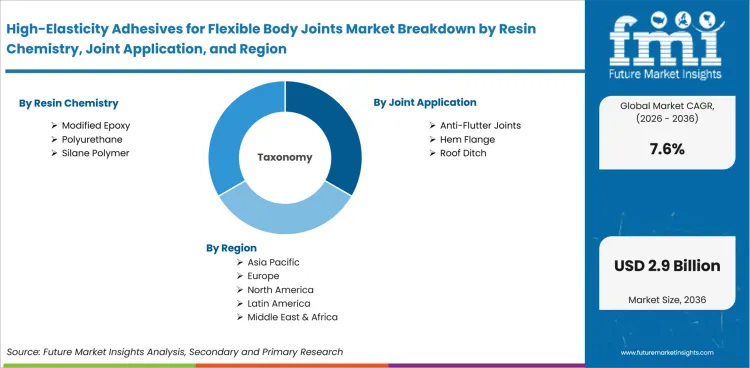
|
Parameter |
Details |
|
Market size by 2036 |
USD 2.9 billion |
|
Growth rate |
7.6% CAGR (2026-2036) |
|
Forecast period |
2026 to 2036 |
|
Base year value (2026) |
USD 1.4 billion |
|
By resin chemistry |
Modified Epoxy, Polyurethane, Silane Polymer, Silicone Hybrid, Acrylic |
|
By joint application |
Anti-Flutter Joints, Hem Flange, Roof Ditch, Door Modules, Closure Panels |
|
By vehicle type |
Passenger Cars, Light Commercial Vehicles, Heavy Trucks, Buses |
|
By application method |
Robotic Dispensing, Manual Cartridges, Pumpable Bulk Systems, Film Tapes |
|
By performance function |
NVH Damping, Fatigue Relief, Gap Filling, Corrosion Sealing, Crash Absorption |
|
By sales channel |
OEM Fitment, Aftermarket |
|
Regions covered |
North America, Latin America, Western Europe, Eastern Europe, East Asia, South Asia and Pacific, Middle East and Africa |
|
Countries covered |
India, China, Mexico, South Korea, United States, Germany, Japan, and 30 plus countries |
|
Key companies profiled |
Henkel, Sika, DuPont, 3M, HB Fuller, Arkema, PPG Industries, Parker LORD, DELO Industrial Adhesives, Jowat |
|
Approach |
Hybrid bottom-up and top-down methodology using vehicle production pools, body-joint adhesive intensity, OEM qualification patterns, supplier portfolios, and application method adoption across major automotive regions. |
High-Elasticity Adhesives for Flexible Body Joints Market Breakdown by Resin Chemistry, Joint Application, Vehicle Type, Application Method, Performance Function, and Region
High-Elasticity Adhesives for Flexible Body Joints Market Segmented by Resin Chemistry
- Modified Epoxy
- Polyurethane
- Silane Polymer
- Silicone Hybrid
- Acrylic
High-Elasticity Adhesives for Flexible Body Joints Market Segmented by Joint Application
- Anti-Flutter Joints
- Hem Flange
- Roof Ditch
- Door Modules
- Closure Panels
High-Elasticity Adhesives for Flexible Body Joints Market Segmented by Vehicle Type
- Passenger Cars
- Light Commercial
- Heavy Trucks
- Buses
High-Elasticity Adhesives for Flexible Body Joints Market Segmented by Application Method
- Robotic Dispensing
- Manual Cartridges
- Pumpable Bulk
- Film Tapes
High-Elasticity Adhesives for Flexible Body Joints Market Segmented by Performance Function
- NVH Damping
- Fatigue Relief
- Gap Filling
- Corrosion Sealing
- Crash Absorption
High-Elasticity Adhesives for Flexible Body Joints Market by Region
- North America
- Latin America
- Western Europe
- Eastern Europe
- East Asia
- South Asia and Pacific
- Middle East and Africa
Research Sources and Bibliography
- European Automobile Manufacturers’ Association. (2026, April 2). Economic and market report: Global and EU auto industry full-year 2025.
- International Energy Agency. (2025, May 14). Global EV Outlook 2025: Trends in electric car markets.
- International Organization of Motor Vehicle Manufacturers. (2025). Production statistics.
- DuPont. (2024, August 6). DuPont BETAMATE™ broad bake adhesive wins 2024 Altair Enlighten Award.
- DuPont. (2024, August 15). DuPont BETAFORCE™ elastic structural adhesive wins R&D 100 Award.
- Henkel. (2024, October 30). Fueling the future: How Henkel contributes to shape e-mobility.
- Sika Automotive. (2024, March 28). Sika exhibits and presents at the Joining in Car Body Engineering Conference 2024.
- Society of Indian Automobile Manufacturers. (2026, April 15). Auto industry performance of Q4 (Jan-March 2026) & FY 2025-26. Society of Indian Automobile Manufacturers.
- State Council of the People’s Republic of China. (2026, January 14). China’s auto output, sales reach new highs in 2025. State Council of the People’s Republic of China.
- Instituto Nacional de Estadística y Geografía. (2026, January 9). Registro Administrativo de la Industria Automotriz de Vehículos Ligeros (RAIAVL), diciembre de 2025 [PDF]. Instituto Nacional de Estadística y Geografía.
- International Energy Agency. (2026). Trends in electric cars: Global EV Outlook 2026. International Energy Agency.
- National Automobile Dealers Association. (2025, December 31). December 2025 market beat: New light-vehicle sales totaled 16.2 million units in 2025. National Automobile Dealers Association.
- Verband der Automobilindustrie. (2025, August 4). Production and market in July 2025. Verband der Automobilindustrie.
- Japan Automobile Manufacturers Association. (2025, September). The motor industry of Japan 2025 [PDF]. Japan Automobile Manufacturers Association.
- International Organization of Motor Vehicle Manufacturers. (2026, April 23). Auto industry growth shifted east in 2025 amid global repositioning.
- USA Energy Information Administration. (2025, January 28). USA propane prices have traded higher so far this winter compared with last winter. Today in Energy.
- DuPont. (2024, August 15). DuPont BETAFORCE™ elastic structural adhesive wins R&D 100 Award.
- Henkel. (2026, May 12). New Henkel automotive adhesive: One product, twice the power
- 3M. (2026). Acrylic adhesives for structural bonding applications. 3M.
Sika. (2026). SikaPower® SmartFlow: Injection adhesives for vehicle body construction. Sika
This Report Answers
- How big is the high-elasticity adhesives for flexible body joints market in 2026 and what revenue is expected by 2036?
- Which resin chemistry is expected to hold the leading share in 2026?
- Which body-joint application creates the main demand pool for high-elasticity adhesives?
- How do robotic dispensing and manual cartridges compare across body-shop adhesive use?
- Which countries are expected to record stronger market expansion?
- How do e-coat compatibility and fatigue performance affect supplier selection?
- Which companies are active and valid in high-elasticity adhesives for flexible body joints?
- Which sources support the market outlook and company development checks?
Frequently Asked Questions
How big is the high-elasticity adhesives for flexible body joints market in 2026?
High-elasticity adhesives for flexible body joints market is expected to reach USD 1.4 billion in 2026 as vehicle bodies use more flexible bonding across closures.
What will the high-elasticity adhesives for flexible body joints market reach by 2036?
High-elasticity adhesives for flexible body joints market is forecast to reach USD 2.9 billion by 2036 with demand shaped by mixed-material body structures.
What CAGR is expected for the high-elasticity adhesives for flexible body joints market?
High-elasticity adhesives for flexible body joints demand is expected to expand at 7.6% CAGR from 2026 to 2036 as body shops increase adhesive bonding.
Which resin chemistry leads the high-elasticity adhesives for flexible body joints market?
Modified epoxy adhesives are expected to hold 39.0% share in 2026 as toughened systems balance bond strength and fatigue absorption.
Which joint application leads demand for high-elasticity adhesives for flexible body joints?
Anti-flutter joints are forecast to hold 34.0% share in 2026 as closure panels need vibration control and movement absorption.
Which country records the stronger pace in high-elasticity adhesives for flexible body joints?
India is expected to record 8.7% CAGR by 2036 as passenger vehicle production and component exports expand body-joint adhesive use.
Which companies are active in the high-elasticity adhesives for flexible body joints market?
Henkel and Sika are active suppliers. DuPont and 3M serve body-shop bonding through structural adhesive and flexible adhesive portfolios.
What is included in high-elasticity adhesives for flexible body joints market scope?
Scope includes modified epoxy and polyurethane adhesives. Robotic dispensing systems and manual cartridge formats used for flexible vehicle body joints are included.
Preview the report firsthand - request a free sample
Get SampleGet the brochure for pricing and purchase details.
Get PDFTable of Content
- Key Takeaways
- Market Size and CAGR
- Top Growth Driver
- Fastest Growing Segment
- Leading Region
- Key Companies
- Emerging Opportunities
- Executive Summary
- Global Market Outlook
- Demand-side Trends
- Supply-side Trends
- Technology Roadmap Analysis
- Analysis and Recommendations
- Analyst Perspective (What is happening? Why now? What should investors know?)
- Key Questions Answered
- How large is the market?
- What is the CAGR?
- What are key trends?
- Which region dominates?
- Who are the leaders?
- Market Overview
- Market Coverage / Taxonomy
- Market Definition / Scope / Limitations
- Research Methodology
- Chapter Orientation
- Analytical Lens and Working Hypotheses
- Market Structure, Signals, and Trend Drivers
- Benchmarking and Cross-market Comparability
- Market Sizing, Forecasting, and Opportunity Mapping
- Research Design and Evidence Framework
- Desk Research Programme (Secondary Evidence)
- Expert Input and Fieldwork (Primary Evidence)
- Tooling, Models, and Reference Databases
- Data Engineering and Model Build
- Quality Assurance and Audit Trail
- Market Background
- Market Dynamics (Drivers, Restraints, Opportunity, Trends)
- Scenario Forecast (Optimistic, Likely, Conservative)
- Impact Analysis
- AI Impact
- Sustainability Impact
- Regulatory Impact
- Technology Impact
- Consumer / Buyer Analysis
- Purchase Drivers
- Adoption Barriers
- Buyer Journey
- Opportunity Map Analysis
- Product Life Cycle Analysis
- Supply Chain Analysis
- Investment Feasibility Matrix
- Value Chain Analysis
- PESTLE and Porter's Analysis
- Regulatory Landscape
- Regional Parent Market Outlook
- Production and Consumption Statistics
- Import and Export Statistics
- Global Market Analysis and Forecast, 2021 to 2036
- Historical Market Size Value (USD Billion) & Volume (Unit) Analysis, 2021 to 2025
- Current and Future Market Size Value (USD Billion) & Volume (Unit) Projections, 2026 to 2036
- Y-o-Y Growth Trend Analysis
- Absolute $ Opportunity Analysis
- Global Market Pricing Analysis, 2021 to 2036
- Global Market Analysis and Forecast, By Resin Chemistry, 2021 to 2036
- Introduction / Key Findings
- Historical Market Size Value (USD Billion) & Volume (Unit) Analysis By Resin Chemistry, 2021 to 2025
- Current and Future Market Size Value (USD Billion) & Volume (Unit) Analysis and Forecast By Resin Chemistry, 2026 to 2036
- Modified Epoxy
- Polyurethane
- Silane Polymer
- Silicone Hybrid
- Acrylic
- Modified Epoxy
- Y-o-Y Growth Trend Analysis By Resin Chemistry, 2021 to 2025
- Absolute $ Opportunity Analysis By Resin Chemistry, 2026 to 2036
- Global Market Analysis and Forecast, By Joint Application, 2021 to 2036
- Introduction / Key Findings
- Historical Market Size Value (USD Billion) & Volume (Unit) Analysis By Joint Application, 2021 to 2025
- Current and Future Market Size Value (USD Billion) & Volume (Unit) Analysis and Forecast By Joint Application, 2026 to 2036
- Anti-Flutter Joints
- Hem Flange
- Roof Ditch
- Door Modules
- Closure Panels
- Anti-Flutter Joints
- Y-o-Y Growth Trend Analysis By Joint Application, 2021 to 2025
- Absolute $ Opportunity Analysis By Joint Application, 2026 to 2036
- Global Market Analysis and Forecast, By Vehicle Type, 2021 to 2036
- Introduction / Key Findings
- Historical Market Size Value (USD Billion) & Volume (Unit) Analysis By Vehicle Type, 2021 to 2025
- Current and Future Market Size Value (USD Billion) & Volume (Unit) Analysis and Forecast By Vehicle Type, 2026 to 2036
- Passenger Cars
- Light Commercial
- Heavy Trucks
- Buses
- Passenger Cars
- Y-o-Y Growth Trend Analysis By Vehicle Type, 2021 to 2025
- Absolute $ Opportunity Analysis By Vehicle Type, 2026 to 2036
- Global Market Analysis and Forecast, By Application Method, 2021 to 2036
- Introduction / Key Findings
- Historical Market Size Value (USD Billion) & Volume (Unit) Analysis By Application Method, 2021 to 2025
- Current and Future Market Size Value (USD Billion) & Volume (Unit) Analysis and Forecast By Application Method, 2026 to 2036
- Robotic Dispensing
- Manual Cartridges
- Pumpable Bulk
- Film Tapes
- Robotic Dispensing
- Y-o-Y Growth Trend Analysis By Application Method, 2021 to 2025
- Absolute $ Opportunity Analysis By Application Method, 2026 to 2036
- Global Market Analysis and Forecast, By Performance Function, 2021 to 2036
- Introduction / Key Findings
- Historical Market Size Value (USD Billion) & Volume (Unit) Analysis By Performance Function, 2021 to 2025
- Current and Future Market Size Value (USD Billion) & Volume (Unit) Analysis and Forecast By Performance Function, 2026 to 2036
- NVH Damping
- Fatigue Relief
- Gap Filling
- Corrosion Sealing
- Crash Absorption
- NVH Damping
- Y-o-Y Growth Trend Analysis By Performance Function, 2021 to 2025
- Absolute $ Opportunity Analysis By Performance Function, 2026 to 2036
- Global Market Analysis and Forecast, By Region, 2021 to 2036
- Introduction
- Historical Market Size Value (USD Billion) & Volume (Unit) Analysis By Region, 2021 to 2025
- Current Market Size Value (USD Billion) & Volume (Unit) Analysis and Forecast By Region, 2026 to 2036
- North America
- Latin America
- Western Europe
- Eastern Europe
- East Asia
- South Asia and Pacific
- Middle East & Africa
- Market Attractiveness Analysis By Region
- North America Market Analysis and Forecast, By Country, 2021 to 2036
- Historical Market Size Value (USD Billion) & Volume (Unit) Trend Analysis By Market Taxonomy, 2021 to 2025
- Market Size Value (USD Billion) & Volume (Unit) Forecast By Market Taxonomy, 2026 to 2036
- By Country
- USA
- Canada
- Mexico
- By Resin Chemistry
- By Joint Application
- By Vehicle Type
- By Application Method
- By Performance Function
- By Country
- Market Attractiveness Analysis
- By Country
- By Resin Chemistry
- By Joint Application
- By Vehicle Type
- By Application Method
- By Performance Function
- Key Takeaways
- Latin America Market Analysis and Forecast, By Country
- Historical Market Size Value (USD Billion) & Volume (Unit) Trend Analysis By Market Taxonomy, 2021 to 2025
- Market Size Value (USD Billion) & Volume (Unit) Forecast By Market Taxonomy, 2026 to 2036
- By Country
- Brazil
- Chile
- Rest of Latin America
- By Resin Chemistry
- By Joint Application
- By Vehicle Type
- By Application Method
- By Performance Function
- By Country
- Market Attractiveness Analysis
- By Country
- By Resin Chemistry
- By Joint Application
- By Vehicle Type
- By Application Method
- By Performance Function
- Key Takeaways
- Western Europe Market Analysis and Forecast, By Country
- Historical Market Size Value (USD Billion) & Volume (Unit) Trend Analysis By Market Taxonomy, 2021 to 2025
- Market Size Value (USD Billion) & Volume (Unit) Forecast By Market Taxonomy, 2026 to 2036
- By Country
- Germany
- UK
- Italy
- Spain
- France
- Nordic
- BENELUX
- Rest of Western Europe
- By Resin Chemistry
- By Joint Application
- By Vehicle Type
- By Application Method
- By Performance Function
- By Country
- Market Attractiveness Analysis
- By Country
- By Resin Chemistry
- By Joint Application
- By Vehicle Type
- By Application Method
- By Performance Function
- Key Takeaways
- Eastern Europe Market Analysis and Forecast, By Country
- Historical Market Size Value (USD Billion) & Volume (Unit) Trend Analysis By Market Taxonomy, 2021 to 2025
- Market Size Value (USD Billion) & Volume (Unit) Forecast By Market Taxonomy, 2026 to 2036
- By Country
- Russia
- Poland
- Hungary
- Balkan & Baltic
- Rest of Eastern Europe
- By Resin Chemistry
- By Joint Application
- By Vehicle Type
- By Application Method
- By Performance Function
- By Country
- Market Attractiveness Analysis
- By Country
- By Resin Chemistry
- By Joint Application
- By Vehicle Type
- By Application Method
- By Performance Function
- Key Takeaways
- East Asia Market Analysis and Forecast, By Country
- Historical Market Size Value (USD Billion) & Volume (Unit) Trend Analysis By Market Taxonomy, 2021 to 2025
- Market Size Value (USD Billion) & Volume (Unit) Forecast By Market Taxonomy, 2026 to 2036
- By Country
- China
- Japan
- South Korea
- By Resin Chemistry
- By Joint Application
- By Vehicle Type
- By Application Method
- By Performance Function
- By Country
- Market Attractiveness Analysis
- By Country
- By Resin Chemistry
- By Joint Application
- By Vehicle Type
- By Application Method
- By Performance Function
- Key Takeaways
- South Asia and Pacific Market Analysis and Forecast, By Country
- Historical Market Size Value (USD Billion) & Volume (Unit) Trend Analysis By Market Taxonomy, 2021 to 2025
- Market Size Value (USD Billion) & Volume (Unit) Forecast By Market Taxonomy, 2026 to 2036
- By Country
- India
- ASEAN
- Australia & New Zealand
- Rest of South Asia and Pacific
- By Resin Chemistry
- By Joint Application
- By Vehicle Type
- By Application Method
- By Performance Function
- By Country
- Market Attractiveness Analysis
- By Country
- By Resin Chemistry
- By Joint Application
- By Vehicle Type
- By Application Method
- By Performance Function
- Key Takeaways
- Middle East & Africa Market Analysis and Forecast, By Country
- Historical Market Size Value (USD Billion) & Volume (Unit) Trend Analysis By Market Taxonomy, 2021 to 2025
- Market Size Value (USD Billion) & Volume (Unit) Forecast By Market Taxonomy, 2026 to 2036
- By Country
- Kingdom of Saudi Arabia
- Other GCC Countries
- Türkiye
- South Africa
- Other African Union
- Rest of Middle East & Africa
- By Resin Chemistry
- By Joint Application
- By Vehicle Type
- By Application Method
- By Performance Function
- By Country
- Market Attractiveness Analysis
- By Country
- By Resin Chemistry
- By Joint Application
- By Vehicle Type
- By Application Method
- By Performance Function
- Key Takeaways
- Key Countries Market Analysis
- USA
- Pricing Analysis
- Market Share Analysis, 2025
- By Resin Chemistry
- By Joint Application
- By Vehicle Type
- By Application Method
- By Performance Function
- Canada
- Pricing Analysis
- Market Share Analysis, 2025
- By Resin Chemistry
- By Joint Application
- By Vehicle Type
- By Application Method
- By Performance Function
- Mexico
- Pricing Analysis
- Market Share Analysis, 2025
- By Resin Chemistry
- By Joint Application
- By Vehicle Type
- By Application Method
- By Performance Function
- Brazil
- Pricing Analysis
- Market Share Analysis, 2025
- By Resin Chemistry
- By Joint Application
- By Vehicle Type
- By Application Method
- By Performance Function
- Chile
- Pricing Analysis
- Market Share Analysis, 2025
- By Resin Chemistry
- By Joint Application
- By Vehicle Type
- By Application Method
- By Performance Function
- Germany
- Pricing Analysis
- Market Share Analysis, 2025
- By Resin Chemistry
- By Joint Application
- By Vehicle Type
- By Application Method
- By Performance Function
- UK
- Pricing Analysis
- Market Share Analysis, 2025
- By Resin Chemistry
- By Joint Application
- By Vehicle Type
- By Application Method
- By Performance Function
- Italy
- Pricing Analysis
- Market Share Analysis, 2025
- By Resin Chemistry
- By Joint Application
- By Vehicle Type
- By Application Method
- By Performance Function
- Spain
- Pricing Analysis
- Market Share Analysis, 2025
- By Resin Chemistry
- By Joint Application
- By Vehicle Type
- By Application Method
- By Performance Function
- France
- Pricing Analysis
- Market Share Analysis, 2025
- By Resin Chemistry
- By Joint Application
- By Vehicle Type
- By Application Method
- By Performance Function
- India
- Pricing Analysis
- Market Share Analysis, 2025
- By Resin Chemistry
- By Joint Application
- By Vehicle Type
- By Application Method
- By Performance Function
- ASEAN
- Pricing Analysis
- Market Share Analysis, 2025
- By Resin Chemistry
- By Joint Application
- By Vehicle Type
- By Application Method
- By Performance Function
- Australia & New Zealand
- Pricing Analysis
- Market Share Analysis, 2025
- By Resin Chemistry
- By Joint Application
- By Vehicle Type
- By Application Method
- By Performance Function
- China
- Pricing Analysis
- Market Share Analysis, 2025
- By Resin Chemistry
- By Joint Application
- By Vehicle Type
- By Application Method
- By Performance Function
- Japan
- Pricing Analysis
- Market Share Analysis, 2025
- By Resin Chemistry
- By Joint Application
- By Vehicle Type
- By Application Method
- By Performance Function
- South Korea
- Pricing Analysis
- Market Share Analysis, 2025
- By Resin Chemistry
- By Joint Application
- By Vehicle Type
- By Application Method
- By Performance Function
- Russia
- Pricing Analysis
- Market Share Analysis, 2025
- By Resin Chemistry
- By Joint Application
- By Vehicle Type
- By Application Method
- By Performance Function
- Poland
- Pricing Analysis
- Market Share Analysis, 2025
- By Resin Chemistry
- By Joint Application
- By Vehicle Type
- By Application Method
- By Performance Function
- Hungary
- Pricing Analysis
- Market Share Analysis, 2025
- By Resin Chemistry
- By Joint Application
- By Vehicle Type
- By Application Method
- By Performance Function
- Kingdom of Saudi Arabia
- Pricing Analysis
- Market Share Analysis, 2025
- By Resin Chemistry
- By Joint Application
- By Vehicle Type
- By Application Method
- By Performance Function
- Türkiye
- Pricing Analysis
- Market Share Analysis, 2025
- By Resin Chemistry
- By Joint Application
- By Vehicle Type
- By Application Method
- By Performance Function
- South Africa
- Pricing Analysis
- Market Share Analysis, 2025
- By Resin Chemistry
- By Joint Application
- By Vehicle Type
- By Application Method
- By Performance Function
- USA
- Market Structure Analysis
- Competition Dashboard
- Competition Benchmarking
- Market Share Analysis of Top Players
- By Regional
- By Resin Chemistry
- By Joint Application
- By Vehicle Type
- By Application Method
- By Performance Function
- Emerging Startups
- Innovation Benchmarking
- Competition Analysis
- Competition Deep Dive
- Henkel
- Overview
- Product Portfolio
- Profitability by Market Segments (Product/Region/Sales Channel)
- Sales Footprint
- Strategy Overview
- Marketing Strategy
- Product Strategy
- Channel Strategy
- Sika
- DuPont
- 3M
- HB Fuller
- Arkema
- PPG Industries
- Parker LORD
- DELO Industrial Adhesives
- Jowat
- Dinitrol
- ITW Performance Polymers
- Henkel
- Case Studies
- Success Stories
- Recent Developments
- Competition Deep Dive
- Assumptions & Acronyms Used


