

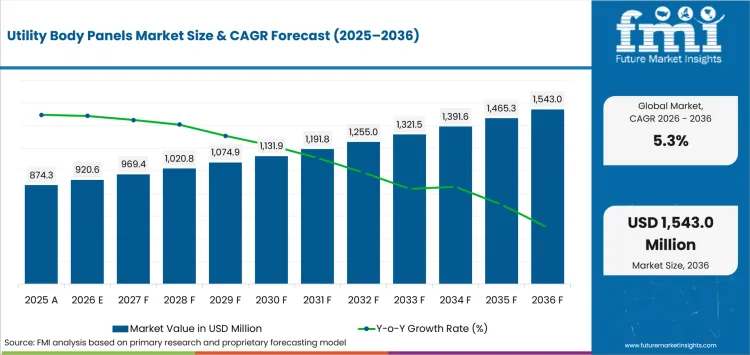
- Market Size (2026)
- USD 920.6 Mn
- Forecast (2036)
- USD 1543.0 Mn
- CAGR (2026 to 2036)
- 5.3%
How big is Utility Body Panels Market in 2026?
USD 920.6 million in 2026 and USD 1543.0 million by 2036 at a 5.3% CAGR.
Demand for utility body panels is expected to grow at a 5.3% CAGR between 2026 and 2036, with market value rising from USD 920.6 million to USD 1,543.0 million. Growth comes from two distinct sources: production of new vocational bodies and continued repair of service bodies that remain useful after localized damage. Side structures, compartment doors, floors, roofs, and bulkheads can all require replacement during a vehicle’s operating life, which means panel demand continues well beyond the initial body build. Utility infrastructure work, routine fleet maintenance, collision repair, and corrosion-related refurbishment all contribute to this recurring requirement. For buyers, the decision is less about the panel itself than about how quickly and accurately it can be integrated.
Replacement parts must match existing compartment dimensions, joining points, surface finish, and body construction. Panels specified for new bodies also need to meet payload, corrosion, and final-stage vehicle requirements. Lightweight materials can free up carrying capacity, but fleets still weigh that advantage against repairability, local parts availability, installation effort, and the cost of keeping a service vehicle off the road.
Key Takeaways
- Field-service activity and infrastructure work support demand at both ends of the vehicle lifecycle, from panels installed on new vocational bodies to replacement sections used during repair and refurbishment.
- Side compartment panels are expected to account for 31.0% of Panel Type demand in 2026. Their position reflects the way service bodies place frequently accessed storage, doors, and shelving along the sides of the vehicle.
- Aluminum panels are projected to hold 34.0% of Material demand in 2026. Fleets value the material where lower body weight and resistance to corrosion can improve lifecycle economics.
- Service trucks are forecast to represent 32.0% of Vehicle Type demand in 2026. Their compartment-heavy body designs typically use several panel types within the same vehicle, increasing panel content per unit.
- Painted panels are expected to capture 28.0% of Finish demand in 2026. Paint remains practical for fleet branding, corrosion protection, and localized refinishing when only part of the body needs repair.
- Body builders are projected to account for 38.0% of Sales Channel demand in 2026. They usually determine panel dimensions, attachment methods, finish requirements, and structural interfaces during the body-engineering stage.
- Supplier switching can be difficult when replacement geometry, joining details, and compliance requirements are body-specific. Modular lightweight designs create an opportunity to reduce both payload penalties and repair time when they are engineered around repeatable body platforms.
- Reading Truck, Knapheide, Morgan Truck Body, Royal Truck Body, Dakota Bodies, Maintainer Corporation, Warner Bodies, Ranger Design, Stahl / JB Poindexter, and Scelzi Enterprises compete from different positions across integrated service bodies, custom vocational builds, replacement support, and modular upfit systems.
Analyst Perspective
"The panel itself is rarely the expensive part of a failed repair. Fleet economics turn on whether a side wall, door or floor section fits the existing body without extra fabrication and whether the vehicle returns to service on schedule. Suppliers that combine lightweight materials with stable drawings, corrosion-compatible joining and dependable replacement availability will have the clearest route to repeat orders."
- Nikhil Kaitwade, Principal Consultant, Future Market Insights
How is the utility body panels market segmented?
The market is segmented by Panel Type, Material, Vehicle Type, Finish, Sales Channel and Region.
Panel Type identifies the structural or access function performed within a vocational body. Material distinguishes aluminum, protected steels and composites according to payload, corrosion and fabrication requirements. Vehicle Type reflects the body platform and duty cycle, while Finish captures appearance and corrosion systems. Sales Channel separates panels integrated during body construction from repair, fleet-service and aftermarket routes after the vehicle enters operation.
Why do Painted panels lead the Finish category?
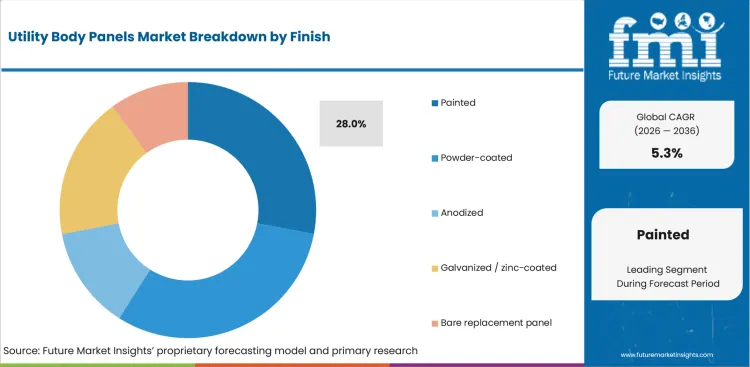
Paint systems let fleets combine corrosion protection with corporate color and localized repair. A repaired door or side section can be refinished to match adjacent bodywork without replacing every surrounding panel. Powder coating remains important for factory durability, while anodizing is more specific to exposed aluminum. As automotive composites gain relevance in adjacent vehicle structures, finish and repair compatibility will remain important for mixed-material body programs. Paint therefore covers the broadest mix of new-body and repair conditions.
- Painted panels are forecast to account for 28.0% of Finish demand in 2026.
- Dakota Bodies documents zinc-rich primer and durable powder-coat options across utility and service-body families, showing how final appearance and corrosion protection are engineered together at the body stage.
Why do Side compartment panels lead the Panel Type category?
Service bodies place tools and consumables in externally accessible compartments so crews can work from either side of the vehicle without unloading the center bed. Side structures therefore carry door openings, shelving interfaces, seals and hinges while remaining exposed to dents, corrosion and repeated opening cycles. Localized damage can often be repaired without replacing the entire body, creating a recurring parts stream in addition to original-body production.
- Side compartment panels are forecast to account for 31.0% of Panel Type demand in 2026.
- Scelzi Enterprises documented vertical front compartments and open-top side storage in its Ranch Hauler configuration during 2025, illustrating how side architecture remains central to work-body packaging.
Why do Aluminum panels lead the Material category?
Aluminum can reduce body mass and preserve chassis capacity for tools, cranes, fluids and crew equipment. It also reduces rust exposure in wet or salted operating environments. The wider shift toward lightweight body panels makes mass reduction more visible in vocational platforms. The trade-off is the need for compatible joining, reinforcement and repair procedures, so aluminum is most attractive where payload or lifecycle corrosion carries a measurable operating penalty rather than as a universal replacement for steel.
- Aluminum panels are forecast to account for 34.0% of Material demand in 2026.
- Knapheide introduced an Aluminum Combo Body in April 2025 with a stated body weight of about 1,200 pounds on a Ford E-Transit chassis, linking lighter body construction directly with payload-sensitive work vehicles.
Why do Service trucks lead the Vehicle Type category?
Service trucks concentrate several panel functions in one platform. A typical body can combine side compartments, doors, floor sections, a front bulkhead and roof or canopy structures, all exposed to frequent opening cycles and jobsite damage. Because the body can remain useful through more than one repair event, fleets create a clearer panel-replacement lifecycle than simpler pickup conversions that rely on bolt-on storage modules.
- Service trucks are forecast to account for 32.0% of Vehicle Type demand in 2026.
- Maintainer Corporation continues to offer steel and aluminum service-body configurations with compartmented storage across its Signature Series, reinforcing the link between service-truck duty and multi-panel body construction.
Why do Body builders lead the Sales Channel category?
Body builders control the point where panel dimensions become part of a completed vocational vehicle. They set door openings, compartment spacing, attachment details, corrosion interfaces and finish specifications before delivery to the fleet. Repair shops remain important after sale, but they generally work from the body builder's established geometry and part identification. Engineering control at final-stage construction therefore supports body builders as the leading route to market.
- Body builders are forecast to account for 38.0% of Sales Channel demand in 2026.
- USA final-stage certification rules under 49 CFR Parts 567 and 568 make body integration an engineering responsibility, strengthening the value of controlled geometry and documented installation at the body-builder stage.
What are the drivers, restraints and opportunities in the Utility Body Panels Market?
Field-service workloads support demand, exact-fit and certification requirements restrain substitution, and lightweight modular designs create an opportunity to reduce payload loss and repair downtime.
- Driver: Infrastructure renewal and recurring fleet-service work increase original-body production and targeted repair of compartmented vocational vehicles.
- Restraint: Panel geometry, joining method, finish compatibility and final-stage vehicle requirements can increase validation and installation work when a fleet changes supplier.
- Opportunity: Lightweight, repairable panel modules can improve payload economics and shorten restoration time when suppliers standardize interfaces for specific body families.
Infrastructure spending increases the workload carried by utility vehicles and service fleets even when it does not translate directly into a panel order. USA grid-resilience programs have funded transmission and distribution upgrades that require mobile crews, while utilities and contractors continue to repair bodies already in service. Panel suppliers benefit when the body remains economically repairable and localized damage can be restored without retiring the entire vehicle.
The integration burden is the main friction. Replacement parts must match existing body dimensions and joining details, while new designs must fit the chassis and the final vehicle configuration. This matters across commercial vehicles because upfit changes can affect body strength, payload, corrosion interfaces and certification assumptions. Standard part identification, installation documentation and local repair support reduce the cost of switching or restoring a vehicle.
Lightweighting creates the clearest design opening. Growth in light commercial vehicles and electrified vocational platforms makes body mass more visible because storage, tools and equipment compete for gross vehicle capacity. Aluminum and selected composite panels can create usable payload, but adoption depends on repair methods and attachment design. Suppliers that connect weight reduction with replaceable sections can address both original builds and fleet refurbishment.
Which country CAGRs are covered in the Utility Body Panels Market?
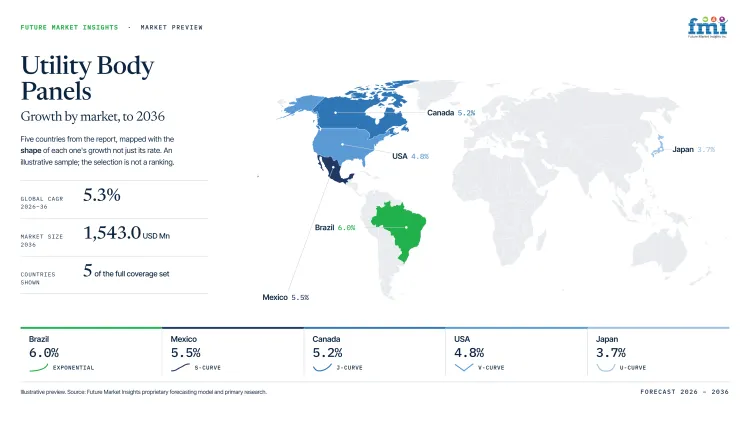
| Country | CAGR |
|---|---|
| Brazil | 6.0% |
| USA | 4.8% |
| Japan | 3.7% |
| Mexico | 5.5% |
| Canada | 5.2% |
| Australia | 5.4% |
| UK | 4.5% |
How do country-level CAGRs compare in the Utility Body Panels Market?
The seven covered countries span 2.3 percentage points, from Brazil at 6.0% CAGR to Japan at 3.7% from 2026 to 2036. Mexico, Australia and Canada form a 5.2% to 5.5% group, while USA and UK sit at 4.8% and 4.5%. The rates indicate forecast pace rather than absolute revenue size, so fleet scale, body-builder concentration, corrosion exposure and replacement-channel economics still determine commercial priority.
- Brazil at 6.0% is 0.5 percentage points above Mexico. Local fabrication and regional parts coverage can matter as much as the rate itself because fleet bodies operate across a geographically dispersed market.
- Mexico at 5.5%, Australia at 5.4% and Canada at 5.2% form a tight group, but production cycles, long-distance service requirements and winter corrosion create different purchasing tests.
- USA at 4.8% remains a broad body-builder and fleet-service market where replacement availability and application coverage can outweigh a modest forecast-rate difference.
- UK at 4.5% sits 0.8 percentage points above Japan, with electrified light-commercial adoption increasing attention to payload while Japan retains tighter packaging and mature replacement practices.
- Japan at 3.7% has the lowest forecast rate in the covered set, increasing the importance of body-specific fit, lightweight construction and dependable domestic upfit support.
Regional analysis spans North America, Latin America, Western Europe, Eastern Europe, East Asia, South Asia and Pacific, and the Middle East and Africa.
Country-wise Analysis
- Brazil: Demand for Utility Body Panels in Brazil is forecast to expand at 6.0% CAGR from 2026 to 2036. SENATRAN publishes monthly fleet tables by state and vehicle type, supporting a granular view of the installed vehicle base. A dispersed fleet increases the value of local fabrication, corrosion-resistant materials and replacement part identification that can work through regional distributors.
- USA: Demand for Utility Body Panels in the USA is forecast to rise at 4.8% CAGR from 2026 to 2036. The Bureau of Transportation Statistics maintains the Vehicle Inventory and Use Survey as a core source on USA truck operating characteristics. The diversity of chassis classes and custom body configurations makes application coverage, parts traceability and repair support central to supplier selection.
- Japan: Demand for Utility Body Panels in Japan is forecast to expand at 3.7% CAGR from 2026 to 2036. A 2025 transport-ministry support program for lower-carbon diesel trucks reflects continued fleet modernization alongside tight dimensional and weight constraints. Panel suppliers need precise body-specific designs and close coordination with domestic upfit practices.
- Mexico: Demand for Utility Body Panels in Mexico is forecast to expand at 5.5% CAGR from 2026 to 2036. INEGI tracks heavy-vehicle production, sales and exports each month, reflecting a substantial manufacturing ecosystem. Suppliers can improve conversion by locating fabrication and common replacement parts close to body plants and high-volume chassis applications.
- Canada: Demand for Utility Body Panels in Canada is forecast to expand at 5.2% CAGR from 2026 to 2036. Statistics Canada reported about 1.87 million new motor-vehicle registrations in 2025, with pickup registrations increasing 0.9%. Winter exposure raises the lifecycle value of aluminum, protected steel, weather sealing and dependable regional parts supply.
- Australia: Demand for Utility Body Panels in Australia is forecast to expand at 5.4% CAGR from 2026 to 2036. Rewiring the Nation includes major transmission investment, creating sustained field-service requirements across long distances. Repairable modules and strategically positioned parts stock can reduce the cost of taking a service vehicle out of operation in remote areas.
- UK: Demand for Utility Body Panels in the UK is forecast to expand at 4.5% CAGR from 2026 to 2036. The Department for Transport reported more than 22,000 zero-emission light goods vehicles first registered in 2024. As electrified work vehicles expand, body mass and interior packaging become more visible in fleet upfit decisions, supporting lighter panel systems where repairability is maintained.
Who are the notable companies in the Utility Body Panels Market?
Reading Truck, Knapheide, Morgan Truck Body, Royal Truck Body, Dakota Bodies, Maintainer Corporation, Warner Bodies, Ranger Design, Stahl / JB Poindexter, and Scelzi Enterprises.
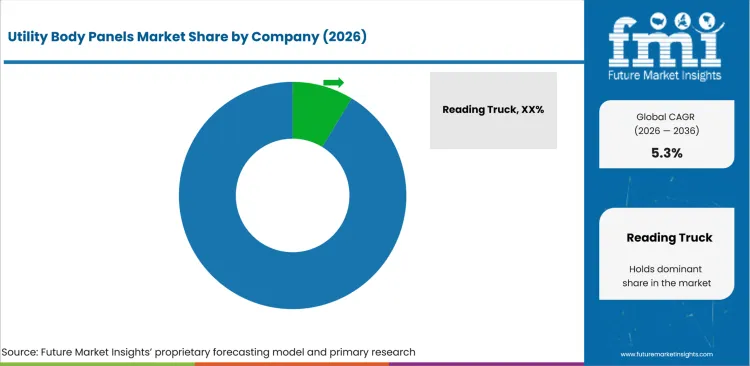
Competition is defined by control over the complete body interface rather than sheet-forming capability alone. Integrated service-body manufacturers coordinate compartments, doors, floors, coatings and attachment points within a repeatable platform. Custom vocational specialists compete where utility, crane, telecom and maintenance fleets need unusual storage geometry. Modular pickup and van upfit suppliers add another route by using lightweight, replaceable systems that can be installed later in the vehicle lifecycle.
- Integrated service-body platforms: Reading Truck, Knapheide, Royal Truck Body, Warner Bodies and Stahl / JB Poindexter combine body engineering with established upfit, parts or distributor channels.
- Custom infrastructure and field-service bodies: Dakota Bodies, Maintainer Corporation and Scelzi Enterprises emphasize compartmented vocational bodies for utility, maintenance and other field-service fleets.
- Modular and commercial-body systems: Ranger Design and Morgan Truck Body contribute modular pickup, van or panelized commercial-body capabilities that influence lightweighting, storage integration and repairability.
Competitive Benchmarking: Utility Body Panels Market
| Company | Body / panel integration | Material options | Repair / upfit support | Primary reach |
|---|---|---|---|---|
| Reading Truck | Service, crane, aerial and combo bodies | Steel and aluminum body options | Truck centers, distributors, parts and upfit support | United States and Canada |
| Knapheide | Service, utility, platform and combo bodies | Steel and aluminum designs | Equipment centers, distributors and replacement support | North America |
| Morgan Truck Body | Commercial truck-body engineering | Metal and composite panel constructions by body family | Manufacturing and service network | North America |
| Royal Truck Body | Service and utility bodies | Steel and aluminum configurations | Parts and service-body support | United States |
| Dakota Bodies | Utility, line, crane, canopy and custom bodies | Aluminum, stainless steel and galvannealed steel | Custom engineering and regional support | United States |
| Maintainer Corporation | Service, lube and welding bodies | Steel and aluminum service-body options | Dealer network, custom engineering and parts support | North America |
| Warner Bodies | Service and utility bodies | Steel and selected lightweight options | Distributor and replacement-parts support | United States |
| Ranger Design | Modular pickup and van upfit systems | Aluminum and corrosion-resistant modular components | Reseller network and fast-install upfit architecture | North America |
| Stahl / JB Poindexter | Service-body platform and group-level vocational capability | Steel-focused and body-specific options | Distributor and service support | United States and Canada |
| Scelzi Enterprises | Service, utility and hybrid work bodies | Steel and aluminum body configurations | Regional manufacturing, sales and repair support | Western United States |
The comparison focuses on observable body architecture, material choice, replacement access and upfit support. Different suppliers can serve the same fleet through integrated welded bodies, modular systems or specialized vocational configurations, so buyer fit depends on the body family and repair route rather than a single supplier rank.
Key Developments in the Utility Body Panels Market
- In March 2026, Reading Truck introduced a new Combo Body together with RHD-46 and RHD-67 heavy-duty service bodies at Work Truck Week. The additions expand compartment and platform configurations for field fleets, increasing the number of body architectures that require coordinated side, door, floor and reinforcement panels.
- In March 2026, Ranger Design launched the Trazer Canopy as the final component of its modular Truck Utility System. The aluminum canopy integrates with the rack and toolboxes through a drill-free upfit, showing how replaceable panelized systems can create enclosed storage without a conventional welded service body.
- In April 2025, Knapheide introduced an Aluminum Combo Body that combines service-body storage with a rear platform and was shown on a Ford E-Transit chassis. The 1,200-pound body highlights the growing importance of panel mass and usable payload on electric and weight-sensitive work vehicles.
- In December 2025, Scelzi Enterprises added the Ranch Hauler to its work-truck range. The hybrid design combines side compartments with a mini-flatbed and rear workdeck, expanding demand for coordinated doors, side structures, floors and finish systems within one body layout.
Key Players in the Utility Body Panels Market
Integrated Service-Body Platforms
- Reading Truck
- Knapheide
- Royal Truck Body
- Warner Bodies
- Stahl / JB Poindexter
Custom Infrastructure and Field-Service Bodies
- Dakota Bodies
- Maintainer Corporation
- Scelzi Enterprises
Modular Upfit and Commercial-Body Systems
- Ranger Design
- Morgan Truck Body
Utility Body Panels Market - Report Scope
| Coverage field | Report scope |
|---|---|
| Market breakdown | Panel Type; Material; Vehicle Type; Finish; Sales Channel |
| Quantitative Units | USD Million |
| Market Definition | Revenue includes utility-body panel assemblies and replacement panels sold within the defined panel, material, vehicle, finish and channel categories. Complete finished-vehicle revenue, complete downstream body revenue and adjacent vehicle components outside the stated panel boundary are excluded. |
| Regions Covered | North America; Latin America; Western Europe; Eastern Europe; East Asia; South Asia and Pacific; Middle East and Africa |
| Countries Covered | Brazil; USA; Japan; Mexico; Canada; Australia; UK; and additional countries across the covered regions |
| Key Companies | Reading Truck, Knapheide, Morgan Truck Body, Royal Truck Body, Dakota Bodies, Maintainer Corporation, Warner Bodies, Ranger Design, Stahl / JB Poindexter, and Scelzi Enterprises |
| Forecast Period | 2026 to 2036 |
| Approach | Market sizing reconciles panel demand by body type and channel with commercial-vehicle activity, fleet service requirements, supplier capacity, material substitution and replacement cycles. |
Utility Body Panels Market - Research Methodology
| Method | Approach |
|---|---|
| Primary Research | FMI engages truck-body manufacturers, upfitters, panel fabricators, distributors, fleet-service organizations, procurement teams and subject-matter specialists to understand panel specifications, material choice, replacement cycles, lead times and purchasing friction. |
| Desk Research | Research reviews government vehicle statistics, transport and energy agencies, vehicle certification requirements, company filings, product documentation, industry releases and public fleet information relevant to utility and service-body demand. |
| Market Sizing and Forecasting | Sizing combines panel demand by type, material, vehicle application, finish and channel with checks against commercial-vehicle production, fleet turnover, infrastructure activity, repair demand, lightweighting and supplier capacity through 2036. |
| Data Validation | Findings are cross-checked across company, channel, country and application evidence. Validation removes double counting between complete-body revenue and panel revenue and excludes adjacent vehicle components outside the defined boundary. |
Utility Body Panels Market by Segments
Utility Body Panels Market segmented by Panel Type:
- Side compartment panels
- Door panels
- Floor panels
- Roof panels
- Bulkhead panels
Utility Body Panels Market segmented by Material:
- Aluminum panels
- Galvanized steel panels
- Stainless steel panels
- FRP/composite panels
- High-strength steel panels
Utility Body Panels Market segmented by Vehicle Type:
- Service trucks
- Utility vans
- Pickup conversions
- Municipal trucks
- Emergency service bodies
Utility Body Panels Market segmented by Finish:
- Painted
- Powder-coated
- Anodized
- Galvanized / zinc-coated
- Bare replacement panel
Utility Body Panels Market segmented by Sales Channel:
- Body builders
- Repair / replacement channel
- Fleet service
- Aftermarket distributors
Utility Body Panels Market by Region:
-
- North America
- United States
- Canada
- Latin America
- Brazil
- Mexico
- Argentina
- Chile
- Western Europe
- Germany
- France
- United Kingdom
- Italy
- Spain
- Benelux
- Nordics
- Eastern Europe
- Poland
- Czech Republic
- Romania
- Hungary
- East Asia
- China
- Japan
- South Korea
- South Asia and Pacific
- India
- ASEAN
- Australia and New Zealand
- Middle East and Africa
- GCC Countries
- South Africa
- Türkiye
- Israel
- North America
Research Sources and Bibliography
- USA Department of Energy (2024, October 18). Grid Resilience and Innovation Partnerships.
- Electronic Code of Federal Regulations. 49 CFR Parts 567 and 568, vehicle certification and staged manufacturing requirements.
- Bureau of Transportation Statistics (2026, July 29). Vehicle Inventory and Use Survey.
- Ministério dos Transportes, SENATRAN (2025). Frota de Veículos - 2025.
- Instituto Nacional de Estadística y Geografía (2026). Heavy-vehicle sales, production and export statistics.
- Statistics Canada (2026, March 12). New motor vehicle registrations, fourth quarter 2025.
- Department for Transport, United Kingdom (2025, June 11). Vehicle licensing statistics, United Kingdom: 2024.
- Ministry of Land, Infrastructure, Transport and Tourism, Japan (2025, June 9). Support for introduction of lower-carbon diesel trucks.
- Australian Department of Climate Change, Energy, the Environment and Water (2026, May 13). Rewiring the Nation.
- Reading Truck (2026, March 11). New Combo Body and heavy-duty service bodies at Work Truck Week 2026.
- Ranger Design (2026, March 11). Trazer Canopy launch for the Truck Utility System.
- Knapheide (2025, April 28). Aluminum Combo Truck Body Concept Revealed.
- Scelzi Enterprises (2025, December). Ranch Hauler Body.
- Dakota Bodies (2025). Truck Bodies and utility-body material configurations.
- Maintainer Corporation (2026). Service-body portfolio and 50-year company milestone.
This Report Answers
- What fleet-service and infrastructure mechanisms support demand for utility body panels?
- Why do side compartment panels remain central to service-body architecture?
- How do aluminum panels affect payload and corrosion economics?
- Why do service trucks create the broadest multi-panel demand within the vehicle mix?
- How do finish requirements influence new-body and repair workflows?
- How do country growth conditions differ across Brazil, USA, Japan, Mexico, Canada, Australia and UK?
- Which capabilities separate integrated body builders from modular upfit suppliers?
- How do fit, joining, certification and replacement lead times restrain supplier switching?
- What should fleet engineering and procurement teams evaluate before specifying utility body panels?
Frequently Asked Questions
What is driving growth in the Utility Body Panels Market?
Growth is supported by recurring field-service work, vocational-body production and repair of compartmented bodies that remain economically useful. Panel demand rises when fleets restore localized collision or corrosion damage instead of replacing the complete body.
Who are the key players in the Utility Body Panels Market?
Reading Truck, Knapheide, Morgan Truck Body, Royal Truck Body, Dakota Bodies, Maintainer Corporation, Warner Bodies, Ranger Design, Stahl / JB Poindexter, and Scelzi Enterprises are among the key companies serving integrated service bodies, custom vocational bodies, modular upfits and replacement support.
What notable restraint affects the Utility Body Panels Market?
Exact-fit geometry is the main restraint. A lower-cost panel can still create rework or downtime when dimensions, attachment points, material interfaces or finish do not match the existing body.
Why should executives track the Utility Body Panels Market?
Panel demand links fleet uptime with body-builder production, repair economics and lightweighting. Replacement availability can create durable revenue between complete vehicle purchases, while material choice affects payload and corrosion cost.
What business problem does the Utility Body Panels Market address?
Utility body panels create structural and weather-protected surfaces for tools and equipment on vocational vehicles. Replacement panels also let fleets restore localized damage while preserving a body that remains operationally useful.
What should fleet decision-makers evaluate?
Teams should compare geometry, material, corrosion protection, joining method, payload impact, finish, installation labor and local parts availability. They should also confirm that modifications remain compatible with the body builder's integration assumptions.
What limits return on investment?
Returns weaken when a low-price panel requires custom fitting, specialized refinishing or long vehicle downtime. Delayed parts supply can cost more than the panel itself when a service truck is unavailable for field work.
What supports long-term commercial confidence?
Recurring field-service requirements and the repairable nature of compartmented work bodies support ongoing demand. Lightweighting and corrosion management create additional replacement and redesign opportunities as fleets modernize.
Preview the report firsthand - request a free sample
Get SampleGet the brochure for pricing and purchase details.
Get PDFTable of Content
- Key Takeaways
- Market Size and CAGR
- Top Growth Driver
- Fastest Growing Segment
- Leading Region
- Key Companies
- Emerging Opportunities
- Executive Summary
- Global Market Outlook
- Demand-side Trends
- Supply-side Trends
- Technology Roadmap Analysis
- Analysis and Recommendations
- Analyst Perspective (What is happening? Why now? What should investors know?)
- Key Questions Answered
- How large is the market?
- What is the CAGR?
- What are key trends?
- Which region dominates?
- Who are the leaders?
- Market Overview
- Market Coverage / Taxonomy
- Market Definition / Scope / Limitations
- Research Methodology
- Chapter Orientation
- Analytical Lens and Working Hypotheses
- Market Structure, Signals, and Trend Drivers
- Benchmarking and Cross-market Comparability
- Market Sizing, Forecasting, and Opportunity Mapping
- Research Design and Evidence Framework
- Desk Research Programme (Secondary Evidence)
- Expert Input and Fieldwork (Primary Evidence)
- Tooling, Models, and Reference Databases
- Data Engineering and Model Build
- Quality Assurance and Audit Trail
- Market Background
- Market Dynamics (Drivers, Restraints, Opportunity, Trends)
- Scenario Forecast (Optimistic, Likely, Conservative)
- Impact Analysis
- AI Impact
- Sustainability Impact
- Regulatory Impact
- Technology Impact
- Consumer / Buyer Analysis
- Purchase Drivers
- Adoption Barriers
- Buyer Journey
- Opportunity Map Analysis
- Product Life Cycle Analysis
- Supply Chain Analysis
- Investment Feasibility Matrix
- Value Chain Analysis
- PESTLE and Porter's Analysis
- Regulatory Landscape
- Regional Parent Market Outlook
- Production and Consumption Statistics
- Import and Export Statistics
- Global Market Analysis and Forecast, 2021 to 2036
- Historical Market Size Value (USD Million) Analysis, 2021 to 2025
- Current and Future Market Size Value (USD Million) Projections, 2026 to 2036
- Y-o-Y Growth Trend Analysis
- Absolute $ Opportunity Analysis
- Global Market Pricing Analysis, 2021 to 2036
- Global Market Analysis and Forecast, By Panel Type, 2021 to 2036
- Introduction / Key Findings
- Historical Market Size Value (USD Million) Analysis By Panel Type, 2021 to 2025
- Current and Future Market Size Value (USD Million) Analysis and Forecast By Panel Type, 2026 to 2036
- Side compartment panels
- Door panels
- Floor panels
- Roof panels
- Bulkhead panels
- Side compartment panels
- Y-o-Y Growth Trend Analysis By Panel Type, 2021 to 2025
- Absolute $ Opportunity Analysis By Panel Type, 2026 to 2036
- Global Market Analysis and Forecast, By Material, 2021 to 2036
- Introduction / Key Findings
- Historical Market Size Value (USD Million) Analysis By Material, 2021 to 2025
- Current and Future Market Size Value (USD Million) Analysis and Forecast By Material, 2026 to 2036
- Aluminum panels
- Galvanized steel panels
- Stainless steel panels
- FRP/composite panels
- High-strength steel panels
- Aluminum panels
- Y-o-Y Growth Trend Analysis By Material, 2021 to 2025
- Absolute $ Opportunity Analysis By Material, 2026 to 2036
- Global Market Analysis and Forecast, By Vehicle Type, 2021 to 2036
- Introduction / Key Findings
- Historical Market Size Value (USD Million) Analysis By Vehicle Type, 2021 to 2025
- Current and Future Market Size Value (USD Million) Analysis and Forecast By Vehicle Type, 2026 to 2036
- Service trucks
- Utility vans
- Pickup conversions
- Municipal trucks
- Emergency service bodies
- Service trucks
- Y-o-Y Growth Trend Analysis By Vehicle Type, 2021 to 2025
- Absolute $ Opportunity Analysis By Vehicle Type, 2026 to 2036
- Global Market Analysis and Forecast, By Finish, 2021 to 2036
- Introduction / Key Findings
- Historical Market Size Value (USD Million) Analysis By Finish, 2021 to 2025
- Current and Future Market Size Value (USD Million) Analysis and Forecast By Finish, 2026 to 2036
- Painted
- Powder-coated
- Anodized
- Galvanized / zinc-coated
- Bare replacement panel
- Painted
- Y-o-Y Growth Trend Analysis By Finish, 2021 to 2025
- Absolute $ Opportunity Analysis By Finish, 2026 to 2036
- Global Market Analysis and Forecast, By Sales Channel, 2021 to 2036
- Introduction / Key Findings
- Historical Market Size Value (USD Million) Analysis By Sales Channel, 2021 to 2025
- Current and Future Market Size Value (USD Million) Analysis and Forecast By Sales Channel, 2026 to 2036
- Body builders
- Repair / replacement channel
- Fleet service
- Aftermarket distributors
- Body builders
- Y-o-Y Growth Trend Analysis By Sales Channel, 2021 to 2025
- Absolute $ Opportunity Analysis By Sales Channel, 2026 to 2036
- Global Market Analysis and Forecast, By Region, 2021 to 2036
- Introduction
- Historical Market Size Value (USD Million) Analysis By Region, 2021 to 2025
- Current Market Size Value (USD Million) Analysis and Forecast By Region, 2026 to 2036
- North America
- Latin America
- Western Europe
- Eastern Europe
- East Asia
- South Asia and Pacific
- Middle East & Africa
- Market Attractiveness Analysis By Region
- North America Market Analysis and Forecast, By Country, 2021 to 2036
- Historical Market Size Value (USD Million) Trend Analysis By Market Taxonomy, 2021 to 2025
- Market Size Value (USD Million) Forecast By Market Taxonomy, 2026 to 2036
- By Country
- USA
- Canada
- By Panel Type
- By Material
- By Vehicle Type
- By Finish
- By Sales Channel
- By Country
- Market Attractiveness Analysis
- By Country
- By Panel Type
- By Material
- By Vehicle Type
- By Finish
- By Sales Channel
- Key Takeaways
- Latin America Market Analysis and Forecast, By Country
- Historical Market Size Value (USD Million) Trend Analysis By Market Taxonomy, 2021 to 2025
- Market Size Value (USD Million) Forecast By Market Taxonomy, 2026 to 2036
- By Country
- Brazil
- Mexico
- Chile
- Rest of Latin America
- By Panel Type
- By Material
- By Vehicle Type
- By Finish
- By Sales Channel
- By Country
- Market Attractiveness Analysis
- By Country
- By Panel Type
- By Material
- By Vehicle Type
- By Finish
- By Sales Channel
- Key Takeaways
- Western Europe Market Analysis and Forecast, By Country
- Historical Market Size Value (USD Million) Trend Analysis By Market Taxonomy, 2021 to 2025
- Market Size Value (USD Million) Forecast By Market Taxonomy, 2026 to 2036
- By Country
- Germany
- UK
- Italy
- Spain
- France
- Nordic
- BENELUX
- Rest of Western Europe
- By Panel Type
- By Material
- By Vehicle Type
- By Finish
- By Sales Channel
- By Country
- Market Attractiveness Analysis
- By Country
- By Panel Type
- By Material
- By Vehicle Type
- By Finish
- By Sales Channel
- Key Takeaways
- Eastern Europe Market Analysis and Forecast, By Country
- Historical Market Size Value (USD Million) Trend Analysis By Market Taxonomy, 2021 to 2025
- Market Size Value (USD Million) Forecast By Market Taxonomy, 2026 to 2036
- By Country
- Russia
- Poland
- Hungary
- Balkan & Baltic
- Rest of Eastern Europe
- By Panel Type
- By Material
- By Vehicle Type
- By Finish
- By Sales Channel
- By Country
- Market Attractiveness Analysis
- By Country
- By Panel Type
- By Material
- By Vehicle Type
- By Finish
- By Sales Channel
- Key Takeaways
- East Asia Market Analysis and Forecast, By Country
- Historical Market Size Value (USD Million) Trend Analysis By Market Taxonomy, 2021 to 2025
- Market Size Value (USD Million) Forecast By Market Taxonomy, 2026 to 2036
- By Country
- China
- Japan
- South Korea
- By Panel Type
- By Material
- By Vehicle Type
- By Finish
- By Sales Channel
- By Country
- Market Attractiveness Analysis
- By Country
- By Panel Type
- By Material
- By Vehicle Type
- By Finish
- By Sales Channel
- Key Takeaways
- South Asia and Pacific Market Analysis and Forecast, By Country
- Historical Market Size Value (USD Million) Trend Analysis By Market Taxonomy, 2021 to 2025
- Market Size Value (USD Million) Forecast By Market Taxonomy, 2026 to 2036
- By Country
- India
- ASEAN
- Australia & New Zealand
- Rest of South Asia and Pacific
- By Panel Type
- By Material
- By Vehicle Type
- By Finish
- By Sales Channel
- By Country
- Market Attractiveness Analysis
- By Country
- By Panel Type
- By Material
- By Vehicle Type
- By Finish
- By Sales Channel
- Key Takeaways
- Middle East & Africa Market Analysis and Forecast, By Country
- Historical Market Size Value (USD Million) Trend Analysis By Market Taxonomy, 2021 to 2025
- Market Size Value (USD Million) Forecast By Market Taxonomy, 2026 to 2036
- By Country
- Kingdom of Saudi Arabia
- Other GCC Countries
- Türkiye
- South Africa
- Other African Union
- Rest of Middle East & Africa
- By Panel Type
- By Material
- By Vehicle Type
- By Finish
- By Sales Channel
- By Country
- Market Attractiveness Analysis
- By Country
- By Panel Type
- By Material
- By Vehicle Type
- By Finish
- By Sales Channel
- Key Takeaways
- Key Countries Market Analysis
- USA
- Pricing Analysis
- Market Share Analysis, 2025
- By Panel Type
- By Material
- By Vehicle Type
- By Finish
- By Sales Channel
- Canada
- Pricing Analysis
- Market Share Analysis, 2025
- By Panel Type
- By Material
- By Vehicle Type
- By Finish
- By Sales Channel
- Mexico
- Pricing Analysis
- Market Share Analysis, 2025
- By Panel Type
- By Material
- By Vehicle Type
- By Finish
- By Sales Channel
- Brazil
- Pricing Analysis
- Market Share Analysis, 2025
- By Panel Type
- By Material
- By Vehicle Type
- By Finish
- By Sales Channel
- Chile
- Pricing Analysis
- Market Share Analysis, 2025
- By Panel Type
- By Material
- By Vehicle Type
- By Finish
- By Sales Channel
- Germany
- Pricing Analysis
- Market Share Analysis, 2025
- By Panel Type
- By Material
- By Vehicle Type
- By Finish
- By Sales Channel
- UK
- Pricing Analysis
- Market Share Analysis, 2025
- By Panel Type
- By Material
- By Vehicle Type
- By Finish
- By Sales Channel
- Italy
- Pricing Analysis
- Market Share Analysis, 2025
- By Panel Type
- By Material
- By Vehicle Type
- By Finish
- By Sales Channel
- Spain
- Pricing Analysis
- Market Share Analysis, 2025
- By Panel Type
- By Material
- By Vehicle Type
- By Finish
- By Sales Channel
- France
- Pricing Analysis
- Market Share Analysis, 2025
- By Panel Type
- By Material
- By Vehicle Type
- By Finish
- By Sales Channel
- India
- Pricing Analysis
- Market Share Analysis, 2025
- By Panel Type
- By Material
- By Vehicle Type
- By Finish
- By Sales Channel
- ASEAN
- Pricing Analysis
- Market Share Analysis, 2025
- By Panel Type
- By Material
- By Vehicle Type
- By Finish
- By Sales Channel
- Australia & New Zealand
- Pricing Analysis
- Market Share Analysis, 2025
- By Panel Type
- By Material
- By Vehicle Type
- By Finish
- By Sales Channel
- China
- Pricing Analysis
- Market Share Analysis, 2025
- By Panel Type
- By Material
- By Vehicle Type
- By Finish
- By Sales Channel
- Japan
- Pricing Analysis
- Market Share Analysis, 2025
- By Panel Type
- By Material
- By Vehicle Type
- By Finish
- By Sales Channel
- South Korea
- Pricing Analysis
- Market Share Analysis, 2025
- By Panel Type
- By Material
- By Vehicle Type
- By Finish
- By Sales Channel
- Russia
- Pricing Analysis
- Market Share Analysis, 2025
- By Panel Type
- By Material
- By Vehicle Type
- By Finish
- By Sales Channel
- Poland
- Pricing Analysis
- Market Share Analysis, 2025
- By Panel Type
- By Material
- By Vehicle Type
- By Finish
- By Sales Channel
- Hungary
- Pricing Analysis
- Market Share Analysis, 2025
- By Panel Type
- By Material
- By Vehicle Type
- By Finish
- By Sales Channel
- Kingdom of Saudi Arabia
- Pricing Analysis
- Market Share Analysis, 2025
- By Panel Type
- By Material
- By Vehicle Type
- By Finish
- By Sales Channel
- Türkiye
- Pricing Analysis
- Market Share Analysis, 2025
- By Panel Type
- By Material
- By Vehicle Type
- By Finish
- By Sales Channel
- South Africa
- Pricing Analysis
- Market Share Analysis, 2025
- By Panel Type
- By Material
- By Vehicle Type
- By Finish
- By Sales Channel
- USA
- Market Structure Analysis
- Competition Dashboard
- Competition Benchmarking
- Market Share Analysis of Top Players
- By Regional
- By Panel Type
- By Material
- By Vehicle Type
- By Finish
- By Sales Channel
- Emerging Startups
- Innovation Benchmarking
- Competition Analysis
- Competition Deep Dive
- Reading Truck
- Overview
- Product Portfolio
- Profitability by Market Segments
- Sales Footprint
- Strategy Overview
- Marketing Strategy
- Product Strategy
- Channel Strategy
- Knapheide
- Morgan Truck Body
- Royal Truck Body
- Dakota Bodies
- Maintainer Corporation
- Warner Bodies
- Ranger Design
- Stahl / JB Poindexter
- Scelzi Enterprises
- Reading Truck
- Case Studies
- Success Stories
- Recent Developments
- Competition Deep Dive
- Assumptions & Acronyms Used


