

- Market Size (2026)
- USD 96.0 Mn
- Forecast (2036)
- USD 594.0 Mn
- CAGR (2026 to 2036)
- 20.0%
How big is the Follow-Me & Personal Cargo Robots Market in 2026?
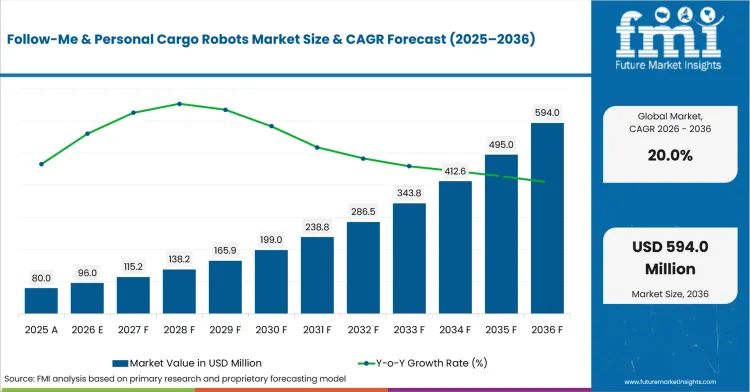
Demand for Follow-Me & Personal Cargo Robots is projected to expand at 20.0% CAGR between 2026 and 2036, increasing valuation from USD 96.0 million in 2026 to USD 594.0 million by 2036.
Demand for follow-me and personal cargo robots stands at USD 96.0 million in 2026 and climbs to USD 594.0 million by 2036, growing at a 20.0% CAGR, one of the faster growth rates among personal mobility hardware categories. Growth is driven by golf courses, resorts, campuses, and public venues adopting autonomous carrying robots to cut manual load handling and give users a more convenient way to move belongings across large open spaces. Piaggio Fast Forward's Gitamini and Gitaplus remain the most visible commercial products in this category, and continued vendor investment in these lines signals steady confidence that consumer and light-commercial demand for personal cargo robots is durable rather than a short-lived novelty.
Battery life, navigation reliability on uneven outdoor terrain, and price relative to simpler carrying alternatives work against faster adoption, since a robot that struggles on gravel, hills, or crowded walkways undercuts the convenience case it's built on. Buyers increasingly weigh navigation accuracy and long-term reliability as heavily as carrying capacity before committing to a purchase. The stronger opportunities lie in compact designs suited for everyday personal use, deployment across recreational and hospitality venues, and battery and obstacle-detection improvements that extend usable range in mixed indoor-outdoor settings. By product type, application, and end-use setting, cost and navigation requirements differ enough to warrant separate treatment. Regionally, US manufacturers lead on navigation and AI-driven obstacle detection, European developers focus on reliability across recreational and commercial settings, and Asian companies prioritize compact form factors and battery efficiency for everyday personal use.
Key Takeaways of Follow-Me & Personal Cargo Robots Market
- Demand for follow-me and personal cargo robots is driven by growing adoption of autonomous mobility solutions across consumer, recreational, and commercial environments, with convenience and labour efficiency supporting adoption.
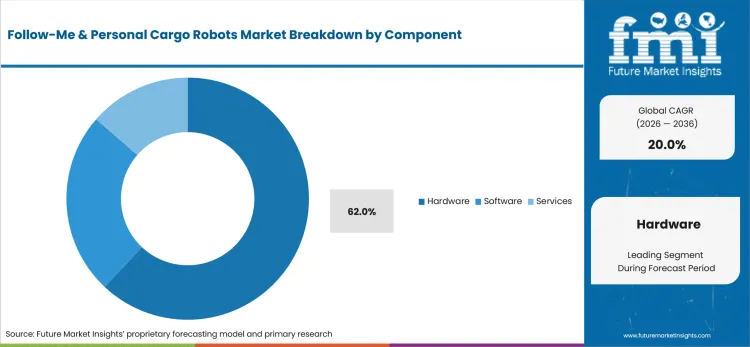
- By component, hardware is expected to lead with 62.0% share in 2026, remaining the primary investment across deployed systems.
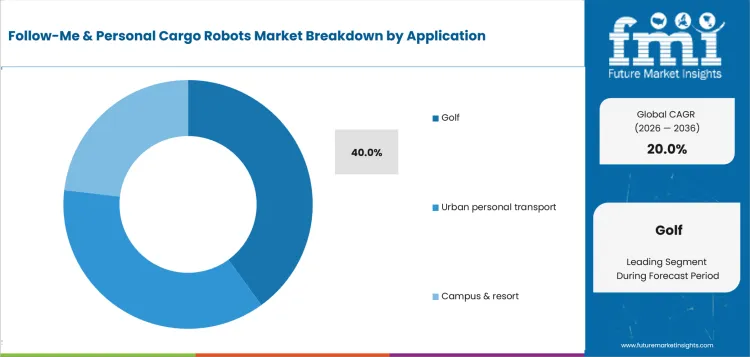
- Golf is the dominant application segment, projected to hold 40.0% share in 2026, driven by facilities increasingly adopting autonomous caddies to improve player convenience.
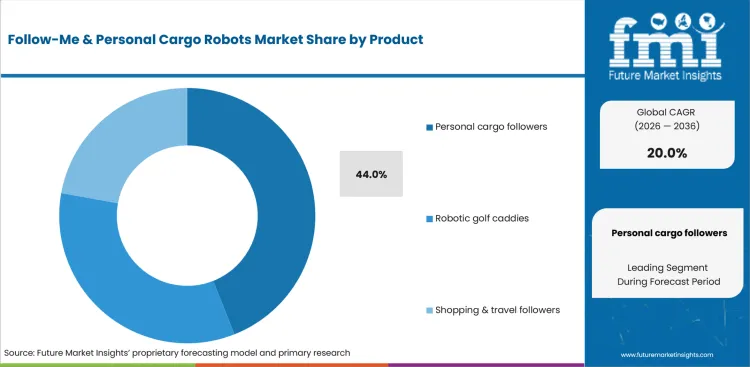
- Personal cargo followers are estimated to lead the product category with 44.0% share in 2026, owing to broader everyday usability.
- Reliable autonomous navigation and easy transport of personal items remain key adoption factors, while high costs and limited everyday use remain constraints on wider adoption.
- The United States, Europe, and East Asia are expected to remain key markets, shaped by consumer acceptance, recreational deployment, and investment in autonomous mobility technologies.
- Competition centers on navigation capability, tracking precision, battery optimisation, and software refinement, with vendors differentiating through reliable everyday operation and long-term ownership experience.
Analyst Perspective
"The follow-me and personal cargo robots market is progressing as users place greater value on dependable mobility than on autonomous features alone. Commercial acceptance will be shaped by how reliably these robots navigate crowded and unpredictable environments, adapt to changing routes, and reduce the physical effort associated with carrying equipment or personal belongings. Manufacturers that deliver consistent real-world performance, intuitive operation, and reliable lifecycle support will be better placed to expand adoption across airports, healthcare, hospitality, logistics, and personal mobility applications."
- Rahul Pandita, Principal Consultant at FMI
How is the Follow-Me & Personal Cargo Robots Market segmented?
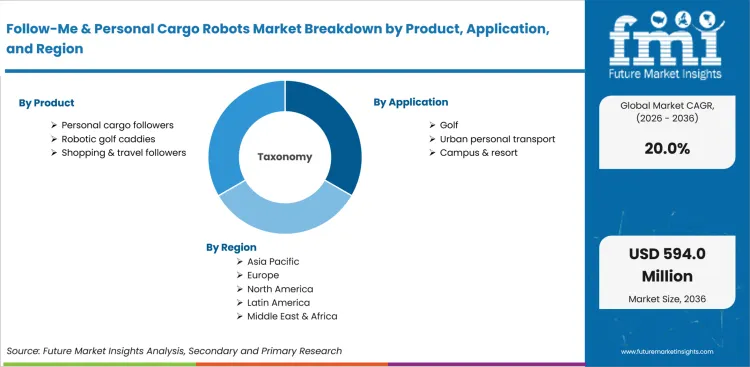
The follow-me & personal cargo robots market is segmented by product, application, component, end user, sales channel, and region.
Product segmentation comprises personal cargo followers, robotic golf caddies, and utility transport robots. Application coverage includes golf, personal mobility, and hospitality & leisure. Component analysis covers hardware, navigation software & AI, and services. End-user assessment includes consumers, golf clubs & resorts, and commercial facilities. Sales channels comprise direct sales, specialty retail, and online platforms. Regional analysis covers North America, Latin America, Europe, East Asia, South Asia & Pacific, Oceania, and the Middle East & Africa.
Why are personal cargo followers leading product demand?
Autonomous cargo followers provide practical assistance across multiple everyday environments without requiring dedicated infrastructure. Consumers value equipment capable of transporting bags, shopping items, and recreational gear through intelligent user tracking and obstacle avoidance.
- Personal cargo followers remain the dominant product category, reaching 44.0% of demand in 2026. Greater flexibility across recreational activities and everyday mobility continues encouraging wider product acceptance than application-specific robotic transport systems.
- Manufacturers continue refining computer vision, autonomous following algorithms, and terrain adaptability to improve movement across pedestrian environments. Lightweight construction and longer operating range also strengthen product appeal among individual users.
Why does golf generate the greatest application demand?
Golf courses provide a controlled outdoor environment that suits autonomous following technology and repetitive equipment transport. Robotic caddies help players move clubs across long distances while reducing physical effort throughout each round.
- Golf occupies the leading position within the application mix at 40.0% during 2026. Course operators and golfers continue adopting robotic caddies that improve convenience while allowing users to concentrate on gameplay instead of manually transporting equipment.
- Continued improvements in route planning, slope detection, and user-following accuracy support dependable operation across varied course conditions. Mobile application integration also enhances control and operating convenience.
Why does hardware remain the largest component segment?
Every autonomous cargo robot depends on integrated mechanical systems that deliver stable mobility, navigation accuracy, and safe operation across different environments. Motors, sensors, batteries, cameras, chassis assemblies, and control electronics therefore represent the foundation of overall product performance.
- Hardware stands at the forefront of the component landscape with 62.0% in 2026. Product manufacturers continue directing investment toward durable mechanical assemblies that improve navigation precision, carrying capability, and long-term operational reliability.
- Navigation software & AI strengthen autonomous decision-making through object recognition, user tracking, and route optimisation. Service offerings continue supporting software updates, maintenance programmes, and technical assistance throughout product ownership.
What are the drivers, restraints, and opportunities in the Follow-Me & Personal Cargo Robots Market?
Growing acceptance of autonomous mobility solutions continues encouraging adoption of robotic cargo carriers across recreational, commercial, and consumer environments. Higher purchase costs remain a barrier for many first-time buyers, whereas advances in artificial intelligence and personal mobility technologies are creating additional opportunities for product developers.
- Driver: Increasing preference for hands-free mobility solutions is encouraging adoption of autonomous cargo robots across leisure and everyday applications.
- Restraint: Higher ownership costs together with battery performance expectations continue influencing purchasing decisions among potential users.
- Opportunity: Progress in autonomous navigation and intelligent tracking technologies is creating new opportunities across consumer and commercial mobility applications.
Manual transportation of personal belongings often reduces convenience across golf courses, resorts, campuses, and public venues. Autonomous cargo robots simplify everyday movement by following users through intelligent navigation and obstacle detection. During January 2025, Piaggio Fast Forward expanded availability of its Gitamini and Gitaplus robotic carriers across additional retail channels, reflecting continued confidence in autonomous personal transport for everyday use.
Affordability continues limiting wider adoption despite growing consumer awareness. Autonomous transport robots combine advanced sensors, artificial intelligence processors, electric drive systems, precision cameras, and high-capacity batteries within compact platforms that increase manufacturing complexity. Many buyers continue evaluating operating reliability, maintenance requirements, and long-term battery performance before making purchasing decisions.
Artificial intelligence continues improving autonomous mobility across personal transport applications. Advances in computer vision, environmental mapping, and intelligent route planning are enabling cargo robots to navigate increasingly complex surroundings with greater accuracy. Manufacturers delivering dependable navigation together with longer battery endurance are expected to strengthen commercial acceptance as autonomous mobility expands into new consumer and recreational environments.
Which country CAGRs are profiled in the Follow-Me & Personal Cargo Robots Market?
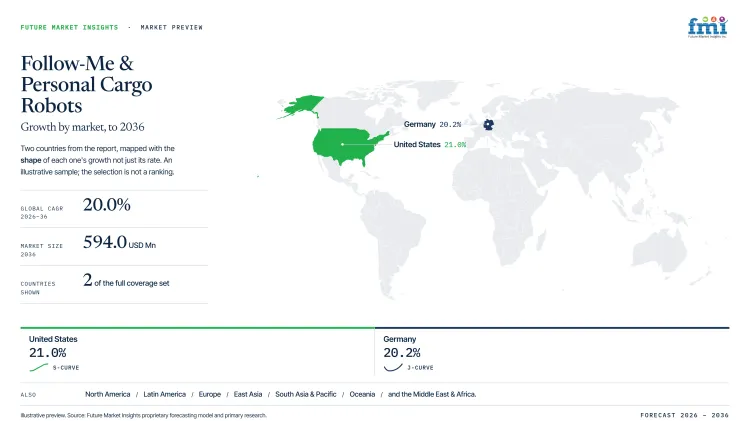
| Country | CAGR |
|---|---|
| Germany | 20.2% |
| United States | 21.0% |
Source: FMI proprietary forecasting model and primary research.
How do country-level CAGRs compare in the Follow-Me & Personal Cargo Robots Market?
The comparison spans just 0.8 percentage points, indicating that both profiled markets are expected to advance at a very similar pace in the follow-me & personal cargo robots market. The United States leads with a CAGR of 21.0%, while Germany follows at 20.2%. The narrow difference suggests growing interest in autonomous load-carrying robots across commercial and personal mobility applications, although purchasing priorities and deployment environments differ between the two markets.
- The United States records the higher CAGR at 21.0%. Demand is increasing for autonomous robots that accompany users while transporting tools, luggage, groceries and other personal cargo across airports, campuses, logistics facilities and commercial sites. Product development continues to emphasize AI-based navigation, obstacle avoidance and hands-free mobility.
- Germany follows with a CAGR of 20.2%, remaining only 0.8 percentage points behind the United States. The market reflects growing evaluation of follow-me robots for industrial facilities, commercial environments and mobility assistance, where autonomous cargo transport helps improve operational efficiency and reduce manual material handling. Strong engineering capabilities and continued investment in intelligent robotics support steady commercialization.
Comparable CAGRs do not necessarily translate into identical commercial opportunities. Differences in robotics adoption, labor costs, application priorities and regulatory frameworks influence deployment strategies and long-term market potential. The full report provides country-level CAGR analysis across North America, Latin America, Europe, East Asia, South Asia, Oceania and the Middle East and Africa.
Country-wise Analysis
Commercial adoption reflects differences in recreational infrastructure, autonomous mobility investment, and consumer acceptance across major economies. Germany continues emphasizing engineering quality and outdoor mobility solutions, whereas the United States benefits from wider deployment of autonomous technologies across consumer and leisure applications.
-
Growth across Germany is forecast to reach 20.2% CAGR between 2026 and 2036, supported by continued advancement in intelligent mobility technologies for recreational and commercial use. According to the German Golf Association, more than 687,000 registered golfers were active during 2024, encouraging continued interest in autonomous golf caddies and follow-me cargo robots that improve convenience throughout golf facilities.
-
The United States continues leading the assessment period with a projected CAGR of 21.0% through 2036. The Consumer Technology Association identified artificial intelligence and autonomous consumer technologies among the principal innovation themes presented at CES 2025, reflecting sustained industry attention toward intelligent mobility products that simplify everyday transportation tasks.
Who are the notable companies in the Follow-Me & Personal Cargo Robots Market?
Piaggio Fast Forward, Stewart Golf, Motocaddy, FTR Systems, Yamaha Motor Co., Ltd., and Hyundai Motor Company are among the companies participating in the Follow-Me & Personal Cargo Robots market.
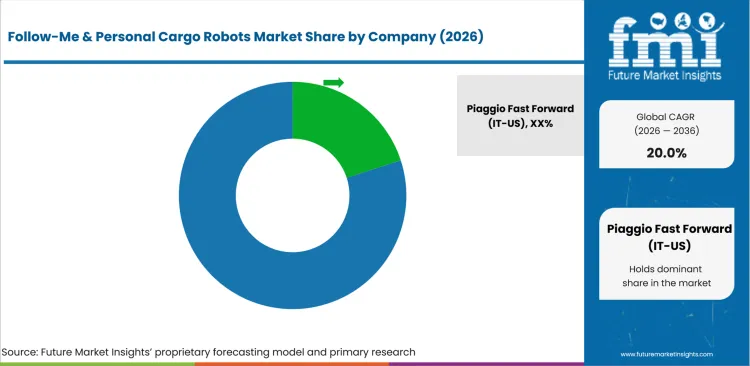
Product differentiation increasingly reflects autonomous tracking performance, navigation intelligence, terrain adaptability, and long-term operating reliability instead of carrying capacity alone. Manufacturers continue refining computer vision, artificial intelligence, battery efficiency, and user safety to improve everyday operation across consumer and recreational environments. Product durability, software upgrades, and dependable after-sales support also influence purchasing decisions as autonomous mobility solutions gain wider commercial acceptance.
- Piaggio Fast Forward, Stewart Golf, and Motocaddy continue advancing autonomous cargo mobility through intelligent follow-me technology, obstacle detection, and compact transport platforms designed for recreational and personal use. Product development emphasizes dependable navigation together with simplified user interaction across varied outdoor environments.
- FTR Systems concentrate on robotic golf caddies equipped with autonomous tracking, remote navigation, and terrain management capabilities. Continued refinement of mobility software and battery systems improves operational consistency throughout extended golf sessions.
Competitive Benchmarking: Follow-Me & Personal Cargo Robots Market
| Company | Autonomous Navigation | Product Innovation | Mobility Technology | Geographic Presence |
|---|---|---|---|---|
| Piaggio Fast Forward | High | High | High | North America & Europe |
| Stewart Golf | High | High | Medium | Europe |
| Motocaddy | High | Medium | Medium | Europe |
| FTR Systems | Medium | High | Medium | North America |
| Yamaha Motor Co., Ltd. | High | Medium | High | Global |
| Hyundai Motor Company | Medium | High | High | Global |
Scoring reflects autonomous mobility capability, navigation intelligence, commercial product maturity, and international presence across personal cargo robotics.
Source: FMI proprietary competitive assessment based on company portfolios and primary research.
Key Developments in the Follow-Me & Personal Cargo Robots Market
- In January 2025, Piaggio Fast Forward expanded commercial availability of its Gitamini and Gitaplus robotic cargo carriers through additional retail channels, strengthening accessibility for consumer mobility applications.
- In March 2025, Stewart Golf introduced continued enhancements to its autonomous follow technology across electric golf trolley platforms, improving navigation precision and operational stability throughout golf courses.
- In June 2025, Hyundai Motor Company demonstrated additional robotics and autonomous mobility technologies under its Robotics LAB initiative, supporting continued advancement of intelligent personal transport systems applicable to future cargo-following robots.
Key Players in the Follow-Me & Personal Cargo Robots Market
- Piaggio Fast Forward
- Stewart Golf
- Motocaddy
- FTR Systems
- Yamaha Motor Co., Ltd.
Follow-Me & Personal Cargo Robots Market Report Scope
| Coverage Field | Report Scope |
|---|---|
| Market Breakdown | Product, application, component, end user, sales channel, country, and regional analysis. |
| Quantitative Units | Revenue in USD Million, volume in units, and CAGR in %. |
| Market Definition | Follow-me & personal cargo robots are autonomous robotic mobility platforms designed to transport personal belongings or equipment by tracking users through computer vision, sensors, and intelligent navigation technologies across indoor and outdoor environments. |
| Regions Covered | North America, Latin America, Europe, East Asia, South Asia & Pacific, Oceania, and the Middle East & Africa. |
| Countries Covered | United States, Germany, United Kingdom, Japan, China, South Korea, France, Australia, and more than 30 additional countries. |
| Key Companies Profiled | Piaggio Fast Forward, Stewart Golf, Motocaddy, FTR Systems, Yamaha Motor Co., Ltd., and Hyundai Motor Company. |
| Forecast Period | 2026 to 2036, with 2025 used as the historical market-size reference. |
| Approach | Hybrid bottom-up and top-down market sizing supported by manufacturer activity, product benchmarking, consumer adoption patterns, recreational mobility demand, and regional autonomous robotics deployment. |
Source: FMI proprietary research and market analysis.
Follow-Me & Personal Cargo Robots Market Research Methodology
| Method | Approach |
|---|---|
| Primary Research |
FMI analysts gathered input from manufacturers, service providers, technology developers, distributors, end users, sourcing teams, and subject-matter experts. Interviews examined purchasing decisions, product or service evaluation, adoption barriers, approval requirements, pricing considerations, and expectations for technical or commercial support. Respondents were also asked what evidence is required before a trial, pilot, or initial order develops into regular purchasing. |
| Secondary Research | Desk research covered government statistics, regulatory publications, trade data, industry associations, technical literature, standards, company filings, product information, and official corporate announcements. Sources were reviewed for relevance, publication date, geographic coverage, and consistency with the defined market scope. Claims relating to performance, applications, approvals, capacity, investment, and commercial activity were retained only when supported by credible public evidence. |
| Market Estimation | The market model combined the baseline value with historical performance, segment structure, pricing and volume indicators, adoption levels, company participation, and country-level demand conditions. Forecast assumptions considered economic activity, investment trends, regulatory developments, technology adoption, purchasing cycles, supply availability, and barriers to wider market use. Segment and regional estimates were reconciled before the final market total was calculated. |
| Forecast Validation | Estimates were checked against multiple independent indicators, including public data, company activity, trade patterns, industry developments, and findings from primary interviews. Validation also tested whether products, services, applications, and company revenues fell within the defined market boundaries. Adjacent categories, unsupported claims, overlapping revenues, and activities without direct market relevance were excluded to reduce double counting and maintain consistency across segments and countries. |
Source: Future Market Insights (FMI) analysis based on proprietary forecasting models and primary research
Follow-Me & Personal Cargo Robots Market by Segments
By Product
- Personal Cargo Followers
- Robotic Golf Caddies
- Utility Transport Robots
By Application
- Golf
- Personal Mobility
- Hospitality & Leisure
By Component
- Hardware
- Navigation Software & AI
- Services
By End User
- Consumers
- Golf Clubs & Resorts
- Commercial Facilities
By Sales Channel
- Direct Sales
- Specialty Retail
- Online Platforms
By Region
- North America
- United States
- Canada
- Latin America
- Brazil
- Mexico
- Argentina
- Europe
- Germany
- United Kingdom
- France
- Italy
- Spain
- Rest of Europe
- East Asia
- Japan
- China
- South Korea
- South Asia & Pacific
- India
- ASEAN
- Australia & New Zealand
- Rest of South Asia & Pacific
- Oceania
- Australia
- New Zealand
- Middle East & Africa
- GCC Countries
- South Africa
- Rest of Middle East & Africa
This Report Answers
- What is the estimated value of the follow-me & personal cargo robots market in 2026 and 2036?
- What CAGR is projected for the follow-me & personal cargo robots market between 2026 and 2036?
- Which product, application, and component remain at the forefront of commercial demand?
- What factors are encouraging adoption of autonomous cargo robots?
- How do country growth prospects compare across major markets?
- Which companies continue shaping competition in follow-me & personal cargo robots?
- How does Future Market Insights estimate market size and validate forecast assumptions?
- Which purchasing considerations influence adoption across recreational and consumer applications?
- How are artificial intelligence and autonomous navigation strengthening personal cargo mobility?
Frequently Asked Questions
What is encouraging demand for follow-me & personal cargo robots?
Growing interest in autonomous mobility, hands-free transport, and intelligent navigation continues encouraging adoption across consumer, recreational, and commercial environments.
Who are the leading companies in the follow-me & personal cargo robots market?
Major participants include Piaggio Fast Forward, Stewart Golf, Motocaddy, FTR Systems, CaddyTrek, Segway Navimow, Yamaha Motor Co., Ltd., and Hyundai Motor Company.
What continues limiting wider adoption?
Higher purchase costs, battery endurance expectations, and long-term maintenance considerations continue influencing buying decisions across first-time users.
Why is the market attracting greater industry attention?
Advances in autonomous navigation, computer vision, and intelligent mobility are expanding practical applications for robotic cargo transport across multiple environments.
Which applications continue creating commercial opportunities?
Golf facilities, hospitality venues, educational campuses, airports, and consumer mobility applications continue expanding deployment opportunities.
What should buyers evaluate before purchasing a follow-me cargo robot?
Navigation accuracy, payload capacity, battery life, terrain adaptability, software support, safety performance, and long-term operating reliability remain important evaluation factors.
Preview the report firsthand - request a free sample
Get SampleGet the brochure for pricing and purchase details.
Get PDFTable of Content
- Key Takeaways
- Market Size and CAGR
- Top Growth Driver
- Fastest Growing Segment
- Leading Region
- Key Companies
- Emerging Opportunities
- Executive Summary
- Global Market Outlook
- Demand-side Trends
- Supply-side Trends
- Technology Roadmap Analysis
- Analysis and Recommendations
- Analyst Perspective (What is happening? Why now? What should investors know?)
- Key Questions Answered
- How large is the market?
- What is the CAGR?
- What are key trends?
- Which region dominates?
- Who are the leaders?
- Market Overview
- Market Coverage / Taxonomy
- Market Definition / Scope / Limitations
- Research Methodology
- Chapter Orientation
- Analytical Lens and Working Hypotheses
- Market Structure, Signals, and Trend Drivers
- Benchmarking and Cross-market Comparability
- Market Sizing, Forecasting, and Opportunity Mapping
- Research Design and Evidence Framework
- Desk Research Programme (Secondary Evidence)
- Expert Input and Fieldwork (Primary Evidence)
- Tooling, Models, and Reference Databases
- Data Engineering and Model Build
- Quality Assurance and Audit Trail
- Market Background
- Market Dynamics (Drivers, Restraints, Opportunity, Trends)
- Scenario Forecast (Optimistic, Likely, Conservative)
- Impact Analysis
- AI Impact
- Sustainability Impact
- Regulatory Impact
- Technology Impact
- Consumer / Buyer Analysis
- Purchase Drivers
- Adoption Barriers
- Buyer Journey
- Opportunity Map Analysis
- Product Life Cycle Analysis
- Supply Chain Analysis
- Investment Feasibility Matrix
- Value Chain Analysis
- PESTLE and Porter's Analysis
- Regulatory Landscape
- Regional Parent Market Outlook
- Production and Consumption Statistics
- Import and Export Statistics
- Global Market Analysis and Forecast, 2021 to 2036
- Historical Market Size Value (USD Million) Analysis, 2021 to 2025
- Current and Future Market Size Value (USD Million) Projections, 2026 to 2036
- Y-o-Y Growth Trend Analysis
- Absolute $ Opportunity Analysis
- Global Market Pricing Analysis, 2021 to 2036
- Global Market Analysis and Forecast, By Product, 2021 to 2036
- Introduction / Key Findings
- Historical Market Size Value (USD Million) Analysis By Product, 2021 to 2025
- Current and Future Market Size Value (USD Million) Analysis and Forecast By Product, 2026 to 2036
- Personal cargo followers
- Robotic golf caddies
- Shopping & travel followers
- Personal cargo followers
- Y-o-Y Growth Trend Analysis By Product, 2021 to 2025
- Absolute $ Opportunity Analysis By Product, 2026 to 2036
- Global Market Analysis and Forecast, By Application, 2021 to 2036
- Introduction / Key Findings
- Historical Market Size Value (USD Million) Analysis By Application, 2021 to 2025
- Current and Future Market Size Value (USD Million) Analysis and Forecast By Application, 2026 to 2036
- Golf
- Urban personal transport
- Campus & resort
- Golf
- Y-o-Y Growth Trend Analysis By Application, 2021 to 2025
- Absolute $ Opportunity Analysis By Application, 2026 to 2036
- Global Market Analysis and Forecast, By Component, 2021 to 2036
- Introduction / Key Findings
- Historical Market Size Value (USD Million) Analysis By Component, 2021 to 2025
- Current and Future Market Size Value (USD Million) Analysis and Forecast By Component, 2026 to 2036
- Hardware
- Software
- Services
- Hardware
- Y-o-Y Growth Trend Analysis By Component, 2021 to 2025
- Absolute $ Opportunity Analysis By Component, 2026 to 2036
- Global Market Analysis and Forecast, By End User, 2021 to 2036
- Introduction / Key Findings
- Historical Market Size Value (USD Million) Analysis By End User, 2021 to 2025
- Current and Future Market Size Value (USD Million) Analysis and Forecast By End User, 2026 to 2036
- Consumers
- Golf clubs & resorts
- Retail & hospitality
- Consumers
- Y-o-Y Growth Trend Analysis By End User, 2021 to 2025
- Absolute $ Opportunity Analysis By End User, 2026 to 2036
- Global Market Analysis and Forecast, By Sales Channel, 2021 to 2036
- Introduction / Key Findings
- Historical Market Size Value (USD Million) Analysis By Sales Channel, 2021 to 2025
- Current and Future Market Size Value (USD Million) Analysis and Forecast By Sales Channel, 2026 to 2036
- Direct online
- Specialty retail
- Rental at venues
- Direct online
- Y-o-Y Growth Trend Analysis By Sales Channel, 2021 to 2025
- Absolute $ Opportunity Analysis By Sales Channel, 2026 to 2036
- Global Market Analysis and Forecast, By Region, 2021 to 2036
- Introduction
- Historical Market Size Value (USD Million) Analysis By Region, 2021 to 2025
- Current Market Size Value (USD Million) Analysis and Forecast By Region, 2026 to 2036
- North America
- Latin America
- Western Europe
- Eastern Europe
- East Asia
- South Asia and Pacific
- Middle East & Africa
- Market Attractiveness Analysis By Region
- North America Market Analysis and Forecast, By Country, 2021 to 2036
- Historical Market Size Value (USD Million) Trend Analysis By Market Taxonomy, 2021 to 2025
- Market Size Value (USD Million) Forecast By Market Taxonomy, 2026 to 2036
- By Country
- USA
- Canada
- By Product
- By Application
- By Component
- By End User
- By Sales Channel
- By Country
- Market Attractiveness Analysis
- By Country
- By Product
- By Application
- By Component
- By End User
- By Sales Channel
- Key Takeaways
- Latin America Market Analysis and Forecast, By Country
- Historical Market Size Value (USD Million) Trend Analysis By Market Taxonomy, 2021 to 2025
- Market Size Value (USD Million) Forecast By Market Taxonomy, 2026 to 2036
- By Country
- Brazil
- Mexico
- Chile
- Rest of Latin America
- By Product
- By Application
- By Component
- By End User
- By Sales Channel
- By Country
- Market Attractiveness Analysis
- By Country
- By Product
- By Application
- By Component
- By End User
- By Sales Channel
- Key Takeaways
- Western Europe Market Analysis and Forecast, By Country
- Historical Market Size Value (USD Million) Trend Analysis By Market Taxonomy, 2021 to 2025
- Market Size Value (USD Million) Forecast By Market Taxonomy, 2026 to 2036
- By Country
- Germany
- UK
- Italy
- Spain
- France
- Nordic
- BENELUX
- Rest of Western Europe
- By Product
- By Application
- By Component
- By End User
- By Sales Channel
- By Country
- Market Attractiveness Analysis
- By Country
- By Product
- By Application
- By Component
- By End User
- By Sales Channel
- Key Takeaways
- Eastern Europe Market Analysis and Forecast, By Country
- Historical Market Size Value (USD Million) Trend Analysis By Market Taxonomy, 2021 to 2025
- Market Size Value (USD Million) Forecast By Market Taxonomy, 2026 to 2036
- By Country
- Russia
- Poland
- Hungary
- Balkan & Baltic
- Rest of Eastern Europe
- By Product
- By Application
- By Component
- By End User
- By Sales Channel
- By Country
- Market Attractiveness Analysis
- By Country
- By Product
- By Application
- By Component
- By End User
- By Sales Channel
- Key Takeaways
- East Asia Market Analysis and Forecast, By Country
- Historical Market Size Value (USD Million) Trend Analysis By Market Taxonomy, 2021 to 2025
- Market Size Value (USD Million) Forecast By Market Taxonomy, 2026 to 2036
- By Country
- China
- Japan
- South Korea
- By Product
- By Application
- By Component
- By End User
- By Sales Channel
- By Country
- Market Attractiveness Analysis
- By Country
- By Product
- By Application
- By Component
- By End User
- By Sales Channel
- Key Takeaways
- South Asia and Pacific Market Analysis and Forecast, By Country
- Historical Market Size Value (USD Million) Trend Analysis By Market Taxonomy, 2021 to 2025
- Market Size Value (USD Million) Forecast By Market Taxonomy, 2026 to 2036
- By Country
- India
- ASEAN
- Australia & New Zealand
- Rest of South Asia and Pacific
- By Product
- By Application
- By Component
- By End User
- By Sales Channel
- By Country
- Market Attractiveness Analysis
- By Country
- By Product
- By Application
- By Component
- By End User
- By Sales Channel
- Key Takeaways
- Middle East & Africa Market Analysis and Forecast, By Country
- Historical Market Size Value (USD Million) Trend Analysis By Market Taxonomy, 2021 to 2025
- Market Size Value (USD Million) Forecast By Market Taxonomy, 2026 to 2036
- By Country
- Kingdom of Saudi Arabia
- Other GCC Countries
- Türkiye
- South Africa
- Other African Union
- Rest of Middle East & Africa
- By Product
- By Application
- By Component
- By End User
- By Sales Channel
- By Country
- Market Attractiveness Analysis
- By Country
- By Product
- By Application
- By Component
- By End User
- By Sales Channel
- Key Takeaways
- Key Countries Market Analysis
- USA
- Pricing Analysis
- Market Share Analysis, 2025
- By Product
- By Application
- By Component
- By End User
- By Sales Channel
- Canada
- Pricing Analysis
- Market Share Analysis, 2025
- By Product
- By Application
- By Component
- By End User
- By Sales Channel
- Mexico
- Pricing Analysis
- Market Share Analysis, 2025
- By Product
- By Application
- By Component
- By End User
- By Sales Channel
- Brazil
- Pricing Analysis
- Market Share Analysis, 2025
- By Product
- By Application
- By Component
- By End User
- By Sales Channel
- Chile
- Pricing Analysis
- Market Share Analysis, 2025
- By Product
- By Application
- By Component
- By End User
- By Sales Channel
- Germany
- Pricing Analysis
- Market Share Analysis, 2025
- By Product
- By Application
- By Component
- By End User
- By Sales Channel
- UK
- Pricing Analysis
- Market Share Analysis, 2025
- By Product
- By Application
- By Component
- By End User
- By Sales Channel
- Italy
- Pricing Analysis
- Market Share Analysis, 2025
- By Product
- By Application
- By Component
- By End User
- By Sales Channel
- Spain
- Pricing Analysis
- Market Share Analysis, 2025
- By Product
- By Application
- By Component
- By End User
- By Sales Channel
- France
- Pricing Analysis
- Market Share Analysis, 2025
- By Product
- By Application
- By Component
- By End User
- By Sales Channel
- India
- Pricing Analysis
- Market Share Analysis, 2025
- By Product
- By Application
- By Component
- By End User
- By Sales Channel
- ASEAN
- Pricing Analysis
- Market Share Analysis, 2025
- By Product
- By Application
- By Component
- By End User
- By Sales Channel
- Australia & New Zealand
- Pricing Analysis
- Market Share Analysis, 2025
- By Product
- By Application
- By Component
- By End User
- By Sales Channel
- China
- Pricing Analysis
- Market Share Analysis, 2025
- By Product
- By Application
- By Component
- By End User
- By Sales Channel
- Japan
- Pricing Analysis
- Market Share Analysis, 2025
- By Product
- By Application
- By Component
- By End User
- By Sales Channel
- South Korea
- Pricing Analysis
- Market Share Analysis, 2025
- By Product
- By Application
- By Component
- By End User
- By Sales Channel
- Russia
- Pricing Analysis
- Market Share Analysis, 2025
- By Product
- By Application
- By Component
- By End User
- By Sales Channel
- Poland
- Pricing Analysis
- Market Share Analysis, 2025
- By Product
- By Application
- By Component
- By End User
- By Sales Channel
- Hungary
- Pricing Analysis
- Market Share Analysis, 2025
- By Product
- By Application
- By Component
- By End User
- By Sales Channel
- Kingdom of Saudi Arabia
- Pricing Analysis
- Market Share Analysis, 2025
- By Product
- By Application
- By Component
- By End User
- By Sales Channel
- Türkiye
- Pricing Analysis
- Market Share Analysis, 2025
- By Product
- By Application
- By Component
- By End User
- By Sales Channel
- South Africa
- Pricing Analysis
- Market Share Analysis, 2025
- By Product
- By Application
- By Component
- By End User
- By Sales Channel
- USA
- Market Structure Analysis
- Competition Dashboard
- Competition Benchmarking
- Market Share Analysis of Top Players
- By Regional
- By Product
- By Application
- By Component
- By End User
- By Sales Channel
- Emerging Startups
- Innovation Benchmarking
- Competition Analysis
- Competition Deep Dive
- Piaggio Fast Forward (IT-US)
- Overview
- Product Portfolio
- Profitability by Market Segments
- Sales Footprint
- Strategy Overview
- Marketing Strategy
- Product Strategy
- Channel Strategy
- Stewart Golf (UK)
- Motocaddy (UK)
- Piaggio Fast Forward (IT-US)
- Case Studies
- Success Stories
- Recent Developments
- Competition Deep Dive
- Assumptions & Acronyms Used


