
- Market Size (2026)
- USD 1188.0 Mn
- Forecast (2036)
- USD 2686.1 Mn
- CAGR (2026 to 2036)
- 8.5%
How big is the Fractional Flow Reserve (FFR) Market in 2026?
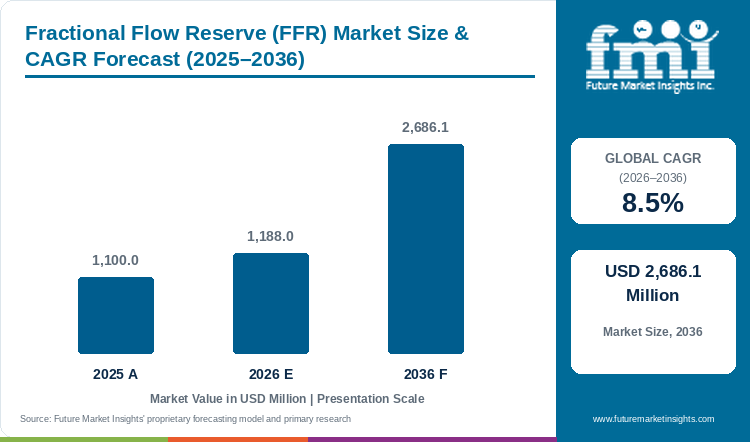
Revenue in the global fractional flow reserve market is forecast to climb to USD 2,686.1 million in 2036 at a CAGR of 8.5% between 2026 and 2036. The market was valued at USD 1,100.0 million in 2025, with USD 1,188.0 million estimated for 2026.
Fractional Flow Reserve (FFR) Market Size and Forecast
Table 1: Fractional Flow Reserve (FFR) Market Size and Forecast
| Market size and forecast | Value |
|---|---|
| Market size in 2025 | USD 1,100.0 million |
| Estimated market size in 2026 | USD 1,188.0 million |
| Projected market size by 2036 | USD 2,686.1 million |
| CAGR from 2026 to 2036 | 8.5% |
Source: Future Market Insights analysis of the fractional flow reserve (FFR) market, 2026.
Coronary physiology suppliers now compete for the assessment budget before a stent decision, as well as for the disposable used during that assessment. The ALL-RISE randomized trial published in March 2026 enrolled 1,930 patients. Its one-year composite event rate was 6.9% with FFRangio and 7.1% with pressure-wire guidance, meeting the trial's noninferiority criterion. That finding gives one angiography-derived platform an outcomes-based purchasing argument.
Medtronic completed its CathWorks acquisition on 20 April 2026 for USD 585.0 million, plus potential earn-out payments. The transaction brings FFRangio into a broader cardiovascular sales organization. Wire suppliers retain recurring case revenue and established measurement workflows. Software suppliers seek additional use from images already acquired in the laboratory. The commercial issue is therefore the division of physiology spending between an installed system, its disposable and an analysis license. Demand in the adjacent coronary stents market remains relevant to treatment activity, but FFR assessment also generates revenue when a lesion is left unstented.
Key Market Trends & Insights
- Physiology platforms are widening beyond a single FFR measurement. Abbott's PressureWire X supports FFR and resting full-cycle ratio alongside coronary flow reserve and microvascular resistance measurements. Laboratories can evaluate one platform across several diagnostic services, and each test keeps its own clinical purpose.
- Suppliers compete on workflow as well as on wire price. Philips combines OmniWire with iFR co-registration, which maps a pressure result to the angiographic image.
- Console compatibility affects wire contracts. Boston Scientific offers COMET II with FFR, DFR and Pd/Pa on its AVVIGO+ platform, so shared imaging and physiology infrastructure is relevant when a hospital considers changing its wire contract.
Regional Highlights
- China, India and South Korea are gaining share of global revenue. FMI projects China rising from 10.0% to 15.6%, India rising from 3.0% to 4.3% and South Korea rising from 4.0% to 4.3% by 2036.
- Revenue rises in the United States, Japan and Germany, though each loses global share. FMI projects the United States slipping from 30.0% to 27.1%, Japan slipping from 14.0% to 11.5% and Germany slipping from 8.0% to 7.2% over 2026 to 2036.
Analyst Perspective
“FMI expects the strongest commercial offers to make an interpretable physiology result available within the laboratory's existing decision process. A low disposable price cannot compensate for incompatible equipment or an assessment that staff cannot complete reliably. Conversely, software adoption requires more than a wire-free demonstration. Hospitals need evidence for the specific algorithm, suitable images and a clear payment arrangement. Procurement will increasingly compare the cost of a completed assessment with its documented clinical use.”
- Anurag Sharma, Principal Consultant, FMI
How is the Fractional Flow Reserve (FFR) Market segmented?
- By product: Pressure Guidewires and Consumables. Consoles and Systems. Angiography-Derived FFR Software.
- By technique: Hyperaemic FFR. Non-Hyperaemic Indices (iFR, RFR). Computational FFR.
- By end user: Hospitals. Cardiac Catheterisation Laboratories. Specialty Cardiac Centres.
- By region: North America. Western Europe. East Asia. South Asia. Rest of world.
Why does the Pressure Guidewires and Consumables segment lead by Product in the Fractional Flow Reserve (FFR) Market in 2026?
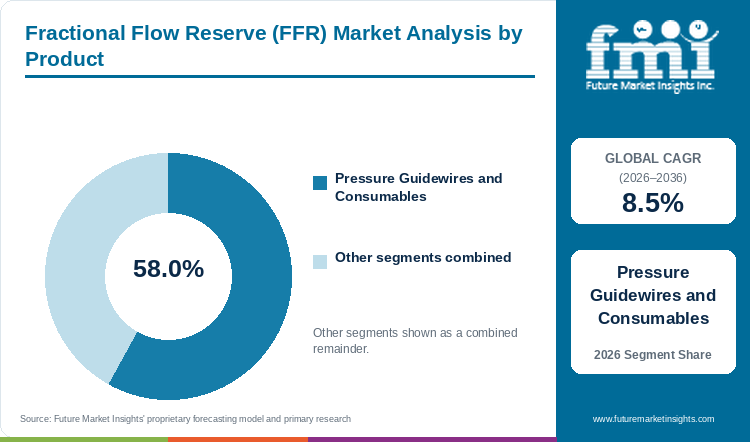
The Pressure Guidewires and Consumables segment holds 58.0% of the Fractional Flow Reserve (FFR) Market by product in 2026.
Consumable revenue persists as assessments recur across an installed physiology system. The commercial relationship is unusually close to the chosen console because the pressure sensor, signal connection and analysis software form a usable package. A hospital considering another wire must assess that package's compatibility and the practical cost of changing it.
Pressure sensing, signal connection and analysis software differ by supplier, so a wire is priced inside a package. That makes a uniform price-per-wire comparison incomplete. The broader guidewires market provides manufacturing context.
FMI projects a 6.8% CAGR for Pressure Guidewires and Consumables over 2026 to 2036. Their share declines from 58.0% to 49.7% as software expands more quickly. This is a loss of mix share alongside increasing revenue. Suppliers must protect dependable recurring use while acknowledging that some eligible assessments will be completed without their disposable.
Consoles and Systems and Angiography-Derived FFR Software together hold the remaining 42.0% by product.
Table 2: Product, 2026 Share
| Leading Share | 2026 market share |
|---|---|
| Pressure Guidewires and Consumables | 58.0% |
| All Other Segments Combined Share | 42.0% |
Source: Future Market Insights analysis of the fractional flow reserve (FFR) market, 2026.
Why does the Hyperaemic FFR segment lead by Technique in the Fractional Flow Reserve (FFR) Market in 2026?
The Hyperaemic FFR segment holds 48.0% of the Fractional Flow Reserve (FFR) Market by technique in 2026.
Hyperaemic FFR remains an established reference for judging whether an intermediate lesion is functionally important. The American Heart Association's November 2025 scientific statement examines evidence-based invasive physiological assessment and the difference between evidence-supported practice and procedural tradition. For procurement, that makes validated interpretation and measurement quality relevant to a platform's continued use.
Resting indices alter the competitive balance without eliminating wire expenditure. Non-Hyperaemic Indices account for 40.0% in 2026 and are projected at USD 1,029.8 million in 2036. The same laboratory may use different approaches for different clinical circumstances.
Computational FFR has the fastest technique CAGR at 16.0% through 2036. Evidence remains algorithm-specific. ALL-RISE compared FFRangio with pressure-wire assessment, while FAST III evaluated CAAS vFFR. Hyperaemic FFR suppliers retain an evidentiary reference position but face a widening set of credible workflow alternatives.
Non-Hyperaemic Indices (iFR, RFR) and Computational FFR together hold the remaining 52.0% by technique.
Table 3: Technique, 2026 Share
| Leading Share | 2026 market share |
|---|---|
| Hyperaemic FFR | 48.0% |
| All Other Segments Combined Share | 52.0% |
Source: Future Market Insights analysis of the fractional flow reserve (FFR) market, 2026.
Why does the Hospitals segment lead by End User in the Fractional Flow Reserve (FFR) Market in 2026?
The Hospitals segment accounts for 72.0% of the Fractional Flow Reserve (FFR) Market by end user in 2026.
Hospital purchasing brings equipment installation, consumable supply and clinical governance into the same contract discussion. The addressable assessment occurs during catheterisation, so access to an established coronary service is the direct commercial determinant.
Britain's current BCIS audit collection explicitly separates diagnostic-only intracoronary physiology from physiology measured during a PCI case. A test can consume a wire or analysis license without a stent procedure following. Counting only PCI-related demand would omit part of hospital physiology activity.
Hospitals remain the leading end-user group at 70.1% in 2036. Cardiac Catheterisation Laboratories rise to 17.1% and Specialty Cardiac Centres to 12.8%. Suppliers competing across the groups need to align service terms with the actual buyer and contract. Joint consideration with intravascular imaging is relevant where an integrated platform supports both modalities, although imaging and pressure assessment answer different clinical questions.
Cardiac Catheterisation Laboratories and Specialty Cardiac Centres together account for the remaining 28.0% by end user.
Table 4: End User, 2026 Share
| Leading Share | 2026 market share |
|---|---|
| Hospitals | 72.0% |
| All Other Segments Combined Share | 28.0% |
Source: Future Market Insights analysis of the fractional flow reserve (FFR) market, 2026.
What are the key drivers restraints and opportunities?
Evidence-led lesion assessment supports demand. Measurement and implementation costs constrain routine use. Angiography-derived physiology opens an additional route to assessment within existing catheter laboratories.
Driver
More defensible selection of intermediate coronary lesions creates demand for a documented physiological result before revascularization.
Restraint
The complete cost includes equipment compatibility, staff time, consumables and the consequences of unusable measurements or images.
Opportunity
Validated angiography-derived software can compete for assessments where a wire-based workflow is difficult to introduce consistently.
How do purchasing rules and qualification affect fractional flow reserve (FFR) market demand?
The opportunity is the assessment of uncertain lesions, not indiscriminate testing of every coronary artery. European guidance recommends functional assessment for appropriate intermediate stenoses and cautions against systematic routine wire measurement of all vessels. Suppliers therefore benefit when a laboratory identifies eligible cases and records the result in a way clinicians can use. A larger intervention program does not automatically produce proportional physiology orders.
Public clinical evidence became more commercially relevant in 2026. The ALL-RISE and FAST III results allow the evaluated image-based systems to be discussed using patient outcomes instead of diagnostic agreement alone. Hospitals can consider a wider range of approaches, while retaining the limits of each trial. FMI expects this competition to expand assessment choice and shift the revenue mix toward software. It need not reduce total disposable revenue because the overall procedure base continues growing.
What limits reliable fractional flow reserve (FFR) market supply and quality?
Technical reliability is an economic issue when a borderline result determines whether an intervention proceeds. One pressure-wire manufacturer's labeling identifies several influences on measurement accuracy and requires appropriately trained users. A supplier's performance claim should therefore be evaluated within its stated test conditions.
Image-based systems have a different implementation burden. Their output depends on suitable angiographic acquisition and the validated algorithm. Procurement needs to address integration, support and the handling of unsuitable studies. For international supply, commercial availability must also be checked by jurisdiction. Trial publication, regulatory authorization and payment coverage are separate events.
Where can suppliers win additional business in the fractional flow reserve (FFR) market?
The strongest opportunity is to connect a documented physiology service with a purchasing arrangement that remains workable as volumes change. A laboratory with substantial wire use may value compatible consumables and service continuity. Another may prioritize an image-analysis route for selected cases.
India's government health technology assessment explicitly calls for better local costing and information on avoided interventions. That finding supports targeted economic evaluation alongside clinical evidence. In the broader interventional cardiology devices market, physiology suppliers can differentiate through a clearly defined assessment service instead of unsupported claims about the total cost of cardiac care.
Fractional Flow Reserve (FFR) Market by Country (2026 to 2036)
Table 5: Fractional Flow Reserve (FFR) Market Country Growth Forecast
| Country | CAGR, 2026 to 2036 |
|---|---|
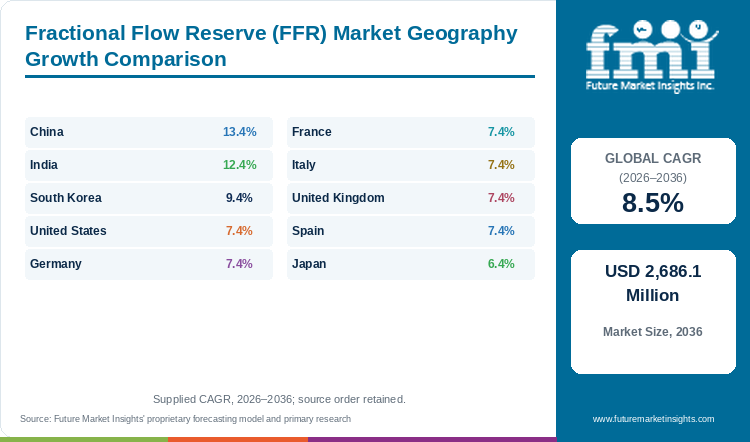
| China | 13.4% |
| India | 12.4% |
| South Korea | 9.4% |
| United States | 7.4% |
| Germany | 7.4% |
| France | 7.4% |
| Italy | 7.4% |
| United Kingdom | 7.4% |
| Spain | 7.4% |
| Japan | 6.4% |
Source: Future Market Insights analysis of the fractional flow reserve (FFR) market, 2026.
China
Domestic randomized evidence gives China's image-based physiology market a concrete basis for expansion. The five-year FAVOR III China report, published online in June 2026, compared QFR-guided PCI with angiography-guided PCI. Major adverse cardiac events occurred in 17.5% and 21.1% respectively. The comparator was angiographic guidance, which matters when interpreting the result commercially. It was not a demonstration that every computational method matches every pressure-wire strategy.
China has the highest national CAGR in FMI's outlook at 13.4% from 2026 to 2036. Revenue rises from USD 118.8 million to USD 418.4 million. Its global revenue share increases from 10.0% to 15.6%, making the country a larger part of the overall competitive opportunity. Growth of USD 299.6 million leaves China second among the ten named countries.
The trial provides evidence for a defined approach that can be discussed with interventional departments. Converting that evidence into broader procurement still requires an appropriate software offer and a workable clinical workflow. An image-based product depends on the quality of the angiograms used for analysis. Direct pressure assessment retains relevance where images or clinical circumstances fall outside a particular software's evaluated use. FMI therefore expects growth to include a changing product mix, instead of a simple substitution of software for every wire. Suppliers should connect their proposed price to an actual assessment volume and eligible case base.
India
Cost effectiveness is a central commercial question in India because the additional assessment has to be paid for within a local treatment pathway. The government's December 2023 FFR health technology assessment called for fuller Indian costing and better information on how many interventions are avoided in practice. Its discussion of potential savings was conditional.
India's market grows from USD 35.6 million in 2026 to USD 114.8 million in FMI's 2036 outlook. The 12.4% CAGR over 2026 to 2036 is the second-highest among the ten named countries. Revenue share rises from 3.0% to 4.3%. That expansion offers meaningful account development opportunities, but a national disease burden is insufficient to identify paying assessment demand. The USD 79.2 million rise over the decade ranks India fifth for increase.
Suppliers need an offer that a catheterisation service can evaluate using its own prices and eligible cases. For wire-based systems, recurring disposable expenditure and existing equipment matter. An image-based alternative may change the cost structure, but still needs usable images, appropriate evidence and local authorization. Hospitals comparing the routes should consider the completed assessment and its clinical purpose. Importantly, the wider cost of stents or the total intervention should not be included in the FFR revenue figure. FMI expects growth to depend on clinically justified use that remains affordable within the buyer's actual service arrangement.
South Korea
South Korea's 2026 interventional consensus provides a current clinical framework for discussing physiological assessment. Published online in June, it recommends FFR or iFR to guide revascularization in intermediate lesions and addresses invasive coronary testing within a wider chronic coronary syndrome pathway. The document is expert consensus, not a regulatory authorization for an individual device.
FMI expects revenue to increase from USD 47.5 million in 2026 to USD 116.7 million in 2036. The 9.4% CAGR from 2026 to 2036 exceeds the global rate. South Korea's share of global revenue consequently rises from 4.0% to 4.3%. The opportunity is to turn a supported clinical role into regular appropriate use, while preserving the distinction between techniques and products. In the fractional flow reserve market, South Korea's revenue rises 2.5 times across the decade, compared with 2.3 times globally. By absolute increase, South Korea ranks sixth with USD 69.2 million over the decade.
A commercial offer can address direct pressure measurement or an image-based approach, but each needs its own local availability and evidence. For established laboratories, compatibility with the installed system influences the disposable decision. For a software addition, acceptable image acquisition and a usable interpretation process become part of the assessment cost. Supplier education has commercial relevance when it clarifies these boundaries and supports the laboratory's chosen service. It should not become a claim that all patients with coronary disease require an additional FFR test.
United States
The United States accounts for USD 356.4 million in 2026, or 30.0% of global revenue. Its commercial significance lies in the scale of an established assessment market in which hospitals can compare pressure-wire platforms with newly supported software options. FMI projects a 7.4% CAGR from 2026 to 2036 and revenue of USD 727.3 million at the end of the period. Growth continues even as the country's share of global value declines to 27.1%.
The American Heart Association published an invasive physiology scientific statement in November 2025. This keeps the quality of the completed assessment central to supplier discussions. A hospital does not secure that quality simply by buying a wire with a lower unit price. Equipment availability, a usable result and a clear clinical record influence whether the assessment becomes routine.
Medtronic's completed CathWorks acquisition adds a significant corporate route to the software market. It changes the supplier relationship without making a clinical trial result equivalent to universal hospital adoption. Established wire vendors can defend existing accounts through platform continuity. Software suppliers must convert evidence into contracts and regular eligible-case use. For buyers, the relevant comparison is the cost and scope of the proposed service. The national forecast does not assume that every catheterisation or PCI case will require an FFR product. Purchasing committees will therefore compare unit cost with the number of cases in which a result changes the procedure plan.
Germany
Germany's physiology opportunity sits within a well-established coronary care system where a change in assessment practice must be justified alongside existing services. The DGK overview of the 2025 German Heart Report focuses on coronary disease and summarizes reporting-year 2023 care. That focus gives appropriate lesion assessment a relevant service context without establishing a national FFR utilization rate.
Revenue of USD 95.0 million in 2026 grows to USD 194.0 million in FMI's 2036 outlook. The forecast CAGR is 7.4% from 2026 to 2036. Germany's share of global revenue moves from 8.0% to 7.2%, reflecting faster growth elsewhere as well as continued domestic expansion. In the fractional flow reserve market, Germany contributes USD 99.0 million of new revenue, fourth of ten.
For hospital buyers, the competitive question is how a proposed physiology system fits the coronary decision process. European guidance recognizes functional assessment of appropriate intermediate lesions and distinguishes it from the visual severity of a narrowing. Suppliers need to show which cases their product can assess, what the result contributes and how the offer connects to current equipment. A broad cardiovascular portfolio does not itself demonstrate superior physiology performance. Conversely, a specialist software vendor must support integration and ongoing clinical use as well as the initial installation. The absolute increase in Germany's forecast revenue leaves room for both established consumables and selected software adoption.
France
France illustrates the difference between a useful device category and a proven incremental advantage over another supplier. HAS's published COMET opinion recorded sufficient expected service for defined stable coronary disease situations. It assigned no improvement over other FFR measurement guidewires. Its 2020 opinion date and 2021 publication make it an established assessment reference for FFR guidewires.
Hospital assessment can consider equipment compatibility, the technical offer and contract terms without treating a manufacturer's product description as a comparative clinical result. A French hospital's practical comparison is therefore the supplier's service continuity and contract scope, since the published opinion gives no basis for ranking one guidewire above another.
FMI forecasts French revenue from USD 59.4 million in 2026 to USD 121.2 million in 2036, at a 7.4% CAGR over 2026 to 2036. Global share declines from 5.0% to 4.5% as other national markets expand faster. This creates an opportunity for additional sales within a measured growth setting. Pressure-wire supply remains supported by established clinical use. Angiography-derived entrants must establish their own authorization, evidence and payment position. The presence of a favorable evaluation for one wire cannot be transferred to a different software category. Buyers should preserve those distinctions when considering an integrated physiology contract or adding an alternative method to the laboratory. In the fractional flow reserve market, France adds USD 61.8 million, ranking seventh for increase.
Italy
Italy offers unusually useful service-level evidence for assessing commercial penetration. In October 2026, GISE reported 2025 activity from 254 catheterisation laboratories. It recorded 19,690 coronary functional assessments, including 17,023 coronary physiology procedures and 2,667 CFR or IMR assessments.
The same GISE release recorded 160,035 PCI procedures in 2025. A physiology assessment can be diagnostic, and the service categories do not automatically produce a precise adoption percentage. They do provide a grounded way to discuss existing laboratory activity and the services being developed.
FMI projects Italy's fractional flow reserve revenue at USD 47.5 million in 2026 and USD 97.0 million in 2036. A 7.4% CAGR applies over 2026 to 2036. Suppliers seeking this growth need to address laboratory practice as well as the supply contract. GISE's interest in wider full-physiology services creates a reason to consider the breadth of a platform, but it does not mean that all microvascular testing revenue belongs in FFR. A precise product offer should separate coronary stenosis assessment from adjacent measurements. This protects both the buyer's comparison and the supplier's revenue case as new capabilities enter tender discussions. Italy revenue rises 2.0 times over the decade, below the 2.3 times for the world total. Italy falls from 4.0% to 3.6% of global revenue. Italy records a USD 49.5 million increase, joint eighth of the ten.
United Kingdom
British audit practice makes a commercially important distinction visible: diagnostic physiology can have value even when PCI does not follow. BCIS's 2025/2026 audit collection asks separately for diagnostic-only intracoronary physiology studies, including FFR and resting indices. It directs laboratories to record physiology associated with a PCI case in the main procedure analysis.
For a supplier, that means assessment demand cannot be reconstructed simply by applying a fixed wire rate to stent activity. The clinical decision may be to defer intervention. The assessment still requires the relevant consumable or software service. An account proposal should therefore begin with the laboratory's actual diagnostic and interventional workflows, not a generic national intervention ratio.
The United Kingdom market is forecast to grow from USD 47.5 million in 2026 to USD 97.0 million in 2036. FMI's CAGR is 7.4% over 2026 to 2036. Revenue expands while global share declines from 4.0% to 3.6%. Commercial competition concerns the cost of delivering an interpretable assessment within an accountable service. New software suppliers must show which cases can be completed within their supported workflow. For both groups, good records are relevant to service review and adoption discussions. Audit categories should inform the purchasing question without being mistaken for a national market-size estimate. In the fractional flow reserve market, the United Kingdom's 7.4% CAGR sits 1.1 points below the global 8.5%. The United Kingdom's 2026 revenue ranks joint sixth of ten.
Spain
Spain's national interventional registry provides a view of the service base that suppliers must reach. The 2024 registry, published in 2025, included 118 hospitals and reported 169,142 diagnostic procedures. Participation was voluntary and the data were not audited. Those limits prevent the report from being treated as a complete commercial census.
The evidence nevertheless places physiology purchasing within active catheterisation services. Additional diagnostic activity creates opportunities to discuss how uncertain lesions are assessed. Suppliers need to distinguish a plausible eligible case base from the total number of diagnostic or interventional procedures. The registry therefore supports planning around active catheterisation sites, while individual wire sales still depend on how many of those sites adopt physiology routinely.
FMI values the Spanish FFR market at USD 35.6 million in 2026 and projects USD 72.7 million by 2036. Growth of 7.4% a year over 2026 to 2036 brings substantial absolute expansion, while global share moves from 3.0% to 2.7%. The account-level decision remains specific to the hospital's current platforms and clinical pathway. An existing wire supplier can compete on continuity and a defined consumable offer. A software entrant must establish that its analysis can be delivered using suitable images and that its payment terms fit the expected use. The USD 37.1 million rise over the decade ranks Spain last for increase.
Japan
Japanese practice gives physiology suppliers a demanding clinical reference point. The JCS 2022 focused update discusses FFR and non-hyperaemic indices in stable coronary disease, including the distinct outcomes evidence supporting iFR. This is a reason to distinguish individual resting measurements in a commercial offer.
FMI estimates Japan's market at USD 166.3 million in 2026, the second-largest national revenue contribution. A 6.4% CAGR over 2026 to 2036 brings the market to USD 309.0 million. Growth is slower than the global rate, so its revenue share declines from 14.0% to 11.5%. Suppliers can still add meaningful sales in a market where the starting base is already substantial. The gain of USD 142.7 million equals 9.5% of the global increase of USD 1,498.1 million.
The commercial task is to sustain reliable use while introducing alternatives that fit an existing diagnostic pathway. A medical-device group identifies Japan among the markets where its co-promotion arrangement for an angiography-derived system operated before acquisition. That provides a documented route for angiography-derived assessment, without demonstrating equal availability for every competing system. Wire manufacturers remain relevant where clinicians need direct pressure measurement or an established platform connection. Local product authorization and the terms of the hospital's purchase remain separate from a guideline's discussion of a technique. A supplier proposing a change should explain exactly which assessment it replaces and which services the existing system continues to support.
Who are the notable companies in the Fractional Flow Reserve (FFR) Market?
Notable companies in the Fractional Flow Reserve (FFR) Market include Abbott, Philips, Boston Scientific, Medtronic and CathWorks, a Medtronic business.
Abbott, Philips and Boston Scientific each supply pressure-wire approaches with distinct platform connections. Their competitive positions are therefore tied to recurring consumables and the installed systems used to interpret results. ACIST Medical offers a sensor-bearing microcatheter, while Opsens supplies optical pressure-wire technology. Opsens is part of Haemonetics following the completed December 2023 acquisition.
Medtronic and CathWorks are not independent corporate competitors after the April 2026 transaction. CathWorks remains the FFRangio product business within Medtronic's commercial ownership. Pie Medical Imaging supplies CAAS vFFR and competes through angiographic analysis instead of its own disposable pressure wire.
Terumo and HeartFlow are adjacent references and not FFR market participants. Terumo's documented coronary portfolio includes guidewires and other intervention tools. These are adjacent to physiology purchasing, but an ordinary guidewire is not an FFR pressure sensor. HeartFlow's FFRCT analysis uses coronary CT angiography and sits earlier in the diagnostic pathway. CT-derived analysis is outside this report's defined catheterisation and angiography-derived revenue scope. Both companies influence the purchasing pathway around FFR, while revenue from their adjacent products remains outside the defined total.
Key Developments in the Fractional Flow Reserve (FFR) Market
- On 20 April 2026, Medtronic completed its acquisition of CathWorks. The transaction converts the previous co-promotion relationship into ownership of the FFRangio business.
Key Players in the Fractional Flow Reserve (FFR) Market
- Abbott
- Philips
- Boston Scientific
- Medtronic
- CathWorks, a Medtronic business
- Opsens, a Haemonetics business
- ACIST Medical
- Pie Medical Imaging
Fractional Flow Reserve (FFR) Market Report Scope
Table 6: Fractional Flow Reserve (FFR) Market Report Scope
| Coverage field | Report scope |
|---|---|
| Market definition | Coronary pressure-wire and sensor-based systems, consumables, related resting-index assessment and angiography-derived FFR software used during catheterisation |
| Product breakdown | Pressure Guidewires and Consumables. Consoles and Systems. Angiography-Derived FFR Software |
| Technique breakdown | Hyperaemic FFR. Non-Hyperaemic Indices (iFR, RFR). Computational FFR |
| End-user breakdown | Hospitals. Cardiac Catheterisation Laboratories. Specialty Cardiac Centres |
| Revenue units | USD million |
| Country coverage | United States, Japan, China, Germany, France, Italy, United Kingdom, South Korea, Spain and India |
| Competitive coverage | Abbott, Philips, Boston Scientific, Medtronic, Opsens, ACIST Medical, CathWorks and Pie Medical Imaging, with current ownership identified and the adjacent offers of Terumo and HeartFlow discussed separately |
| Exclusions | Total catheterisation fees, stent revenue, ordinary guidewires without pressure sensing, CT-derived FFR revenue and unrelated structural-heart products |
| Quantitative Units | USD million |
Source: Future Market Insights analysis of the fractional flow reserve (FFR) market, 2026.
Fractional Flow Reserve (FFR) Market Research Methodology
This assessment combines FMI's revenue and procedure outlook with secondary review of original clinical studies, professional guidance, national service reporting and manufacturer disclosures. Numerical and scope checks distinguish direct coronary physiology, angiography-derived software and adjacent diagnostic products. Country interpretation addresses clinical evidence and purchasing conditions. Corporate ownership is assessed as of 9 November 2026.
Fractional Flow Reserve (FFR) Market by Segments
Fractional Flow Reserve (FFR) Market segmented by Product:
- Pressure Guidewires and Consumables
- Consoles and Systems
- Angiography-Derived FFR Software
Fractional Flow Reserve (FFR) Market segmented by Technique:
- Hyperaemic FFR
- Non-Hyperaemic Indices (iFR, RFR)
- Computational FFR
Fractional Flow Reserve (FFR) Market segmented by End User:
- Hospitals
- Cardiac Catheterisation Laboratories
- Specialty Cardiac Centres
Fractional Flow Reserve (FFR) Market by Region
- North America
- United States
- Western Europe
- Germany
- France
- Italy
- United Kingdom
- Spain
- East Asia
- Japan
- China
- South Korea
- South Asia
- India
- Rest of world
Research Sources and Bibliography
- Abbott. (Accessed 2026, November 9). PressureWire X Guidewire. Manufacturer product documentation. https://www.cardiovascular.abbott/us/en/hcp/products/percutaneous-coronary-intervention/pressurewireX-guidewires-physiology/about.html
- ACIST Medical Systems. (Accessed 2026, November 9). Navvus II Rapid Exchange FFR MicroCatheter. Manufacturer product documentation. https://acist.com/products/acist-rxi/navvusii-catheter/
- American Heart Association. (2025, November 20). Evidence-Based Practices in the Cardiac Catheterization Laboratory 2025. Professional Heart Daily. https://professional.heart.org/en/science-news/evidence-based-practices-in-the-cardiac-catheterization-laboratory-2025
- Bastante, T., et al. (2025). Spanish cardiac catheterization and coronary intervention registry: 34th official report of the Interventional Cardiology Association of the Spanish Society of Cardiology, 1990-2024. Revista Española de Cardiología, 78(11), 992-1003. DOI: 10.1016/j.rec.2025.07.009. https://www.revespcardiol.org/en-spanish-cardiac-catheterization-and-coro-articulo-S1885585725002397-pdf-file
- Boston Scientific. (Accessed 2026, November 9). COMET II Pressure Guidewire. Manufacturer product documentation. https://www.bostonscientific.com/us/en/healthcare-professionals/products/ffr-and-ivus-systems/comet-ii-pressure-guidewire/fp90000199.html
- Boston Scientific. (Accessed 2026, November 9). COMET II Pressure Guidewire: indications, safety and warnings. https://www.bostonscientific.com/us/en/healthcare-professionals/products/ffr-and-ivus-systems/comet-ii-pressure-guidewire/fp90000199/indications-safety-and-warnings.html
- British Cardiovascular Intervention Society. (Accessed 2026, November 9). PCI and Adult Structural Annual Intervention Audit 2025/2026. https://www.bcis.org.uk/pci-and-adult-structural-annual-intervention-audit-2025-2026/
- Fearon, W. F., et al. (2026, March 29). Angiography-Derived Fractional Flow Reserve to Guide PCI. New England Journal of Medicine, 395, 9-19. DOI: 10.1056/NEJMoa2600949.
- GISE. (2026, October 16). Leggere i dati significa trasformarli in conoscenza e qualità delle cure. National catheterisation laboratory activity for 2025. https://gise.it/notiziacongresso/100
- Haemonetics. (2023, December 12). Haemonetics Corporation Completes Acquisition of OpSens Inc.
- Haute Autorité de Santé. (2021, January 25). COMET: Guide de mesure de la fraction de flux de réserve coronaire. CNEDiMTS opinion dated 20 October 2020. https://www.has-sante.fr/jcms/p_3225425/fr/comet
- Health Technology Assessment in India Regional Resource Center. (2023, December). Effectiveness of FFR vs. Angiography Guided Percutaneous Coronary Interventions in Patients with Stable Coronary Artery Disease. Department of Health Research. https://htain.dhr.gov.in/images/pdf/outcome_reports/72.FFR_Revised_Report_%28FINAL_V1_2Feb.pdf
- HeartFlow. (2025, September). HeartFlow FFRCT Analysis Value Dossier: Executive Summary. https://www.heartflow.com/wp-content/uploads/2025/09/25_0703_hfl_marketaccess_value-dossier.pdf
- Medtronic. (2026, April 20). Medtronic completes acquisition of CathWorks, expanding its leadership in transforming care for patients with cardiovascular disease.
- Nakano, S., et al. (2022). JCS 2022 Guideline Focused Update on Diagnosis and Treatment in Patients With Stable Coronary Artery Disease. Circulation Journal, 86. DOI: 10.1253/circj.CJ-21-1041. https://www.jstage.jst.go.jp/article/circj/86/5/86_CJ-21-1041/_pdf
- Philips. (Accessed 2026, November 9). OmniWire pressure guide wire. Manufacturer product documentation. https://www.usa.philips.com/healthcare/product/HCIGTDOMNIWIRE/undefined
- Rudolph, V., et al. (2025). Der Deutsche Herzbericht - Update 2025. Kardiologie, 19, 469-474. DGK publication overview, accessed 2026, November 9. https://herzmedizin.de/fuer-aerzte-und-fachpersonal/dgk/leitlinien/leitlinien-katalog/der-deutsche-herzbericht-update-2025
- Siemens Healthineers. (2026, March 29). FAST III Study Validates Less-Invasive Method for Coronary Revascularization Guidance as Safe and Effective Alternative. . Supporting product and trial information: Pie Medical Imaging, CAAS vFFR, https://www.piemedicalimaging.com/product/caas-workstation/vffr.
- Terumo Interventional Systems. (Accessed 2026, November 9). Complex Coronary Intervention and Coronary Product Portfolio. https://www.terumois.com/procedural-solutions/complex-coronary.html
- Vrints, C., et al. (2024, August 30). 2024 ESC Guidelines for the management of chronic coronary syndromes. European Heart Journal, 45, 3415-3537. DOI: 10.1093/eurheartj/ehae177. https://academic.oup.com/eurheartj/article/45/36/3415/7743115
- Lee, J. M., et al. (2026, June 18). Korean Society of Interventional Cardiology Expert Consensus for the Management of Chronic Coronary Syndrome: Part 1. Korean Circulation Journal, 56(7), 531-561. DOI: 10.4070/kcj.2026.0191. https://pmc.ncbi.nlm.nih.gov/articles/PMC13368462/
- Zhang, H., et al., FAVOR III China Study Group. (2026, June 10, online publication). Angiographic Quantitative Flow Ratio-Guided Coronary Intervention: 5-Year Follow-Up From the FAVOR III China Randomized Trial. Journal of the American College of Cardiology, 88(8), 800-812. DOI: 10.1016/j.jacc.2026.04.037. https://pubmed.ncbi.nlm.nih.gov/42268156/
This bibliography is provided for reader reference and is not exhaustive. The full report contains the complete reference list and detailed citations.
Table of Content
- Key Takeaways
- Market Size and CAGR
- Top Growth Driver
- Fastest Growing Segment
- Leading Region
- Key Companies
- Emerging Opportunities
- Executive Summary
- Global Market Outlook
- Demand-side Trends
- Supply-side Trends
- Technology Roadmap Analysis
- Analysis and Recommendations
- Analyst Perspective (What is happening? Why now? What should investors know?)
- Key Questions Answered
- How large is the market?
- What is the CAGR?
- What are key trends?
- Which region dominates?
- Who are the leaders?
Read More...
- Market Overview
- Market Coverage / Taxonomy
- Market Definition / Scope / Limitations
- Research Methodology
- Chapter Orientation
- Analytical Lens and Working Hypotheses
- Market Structure, Signals, and Trend Drivers
- Benchmarking and Cross-market Comparability
- Market Sizing, Forecasting, and Opportunity Mapping
- Research Design and Evidence Framework
- Desk Research Programme (Secondary Evidence)
- Expert Input and Fieldwork (Primary Evidence)
- Tooling, Models, and Reference Databases
- Data Engineering and Model Build
- Quality Assurance and Audit Trail
- Market Background
- Market Dynamics (Drivers, Restraints, Opportunity, Trends)
- Scenario Forecast (Optimistic, Likely, Conservative)
- Impact Analysis
- AI Impact
- Sustainability Impact
- Regulatory Impact
- Technology Impact
- Consumer / Buyer Analysis
- Purchase Drivers
- Adoption Barriers
- Buyer Journey
- Opportunity Map Analysis
- Product Life Cycle Analysis
- Supply Chain Analysis
- Investment Feasibility Matrix
- Value Chain Analysis
- PESTLE and Porter's Analysis
- Regulatory Landscape
- Regional Parent Market Outlook
- Production and Consumption Statistics
- Import and Export Statistics
- Global Market Analysis and Forecast, 2021 to 2036
- Historical Market Size Value (USD Million) Analysis, 2021 to 2025
- Current and Future Market Size Value (USD Million) Projections, 2026 to 2036
- Y-o-Y Growth Trend Analysis
- Absolute $ Opportunity Analysis
- Global Market Pricing Analysis, 2021 to 2036
- Global Market Analysis and Forecast, By Product, 2021 to 2036
- Introduction / Key Findings
- Historical Market Size Value (USD Million) Analysis By Product, 2021 to 2025
- Current and Future Market Size Value (USD Million) Analysis and Forecast By Product, 2026 to 2036
- Pressure Guidewires and Consumables
- Consoles and Systems
- Angiography-Derived FFR Software
- Y-o-Y Growth Trend Analysis By Product, 2021 to 2025
- Absolute $ Opportunity Analysis By Product, 2026 to 2036
- Global Market Analysis and Forecast, By Technique, 2021 to 2036
- Introduction / Key Findings
- Historical Market Size Value (USD Million) Analysis By Technique, 2021 to 2025
- Current and Future Market Size Value (USD Million) Analysis and Forecast By Technique, 2026 to 2036
- Hyperaemic FFR
- Non-Hyperaemic Indices (iFR, RFR)
- Computational FFR
- Y-o-Y Growth Trend Analysis By Technique, 2021 to 2025
- Absolute $ Opportunity Analysis By Technique, 2026 to 2036
- Global Market Analysis and Forecast, By End User, 2021 to 2036
- Introduction / Key Findings
- Historical Market Size Value (USD Million) Analysis By End User, 2021 to 2025
- Current and Future Market Size Value (USD Million) Analysis and Forecast By End User, 2026 to 2036
- Hospitals
- Cardiac Catheterisation Laboratories
- Specialty Cardiac Centres
- Y-o-Y Growth Trend Analysis By End User, 2021 to 2025
- Absolute $ Opportunity Analysis By End User, 2026 to 2036
- Global Market Analysis and Forecast, By Region, 2021 to 2036
- Introduction
- Historical Market Size Value (USD Million) Analysis By Region, 2021 to 2025
- Current Market Size Value (USD Million) Analysis and Forecast By Region, 2026 to 2036
- North America
- Western Europe
- East Asia
- South Asia
- Market Attractiveness Analysis By Region
- North America Market Analysis and Forecast, By Country, 2021 to 2036
- Historical Market Size Value (USD Million) Trend Analysis By Market Taxonomy, 2021 to 2025
- Market Size Value (USD Million) Forecast By Market Taxonomy, 2026 to 2036
- By Country
- United States
- By Product
- By Technique
- By End User
- By Country
- Market Attractiveness Analysis
- By Country
- By Product
- By Technique
- By End User
- Key Takeaways
- Western Europe Market Analysis and Forecast, By Country
- Historical Market Size Value (USD Million) Trend Analysis By Market Taxonomy, 2021 to 2025
- Market Size Value (USD Million) Forecast By Market Taxonomy, 2026 to 2036
- By Country
- Germany
- France
- Italy
- United Kingdom
- Spain
- By Product
- By Technique
- By End User
- By Country
- Market Attractiveness Analysis
- By Country
- By Product
- By Technique
- By End User
- Key Takeaways
- East Asia Market Analysis and Forecast, By Country
- Historical Market Size Value (USD Million) Trend Analysis By Market Taxonomy, 2021 to 2025
- Market Size Value (USD Million) Forecast By Market Taxonomy, 2026 to 2036
- By Country
- Japan
- China
- South Korea
- By Product
- By Technique
- By End User
- By Country
- Market Attractiveness Analysis
- By Country
- By Product
- By Technique
- By End User
- Key Takeaways
- South Asia Market Analysis and Forecast, By Country
- Historical Market Size Value (USD Million) Trend Analysis By Market Taxonomy, 2021 to 2025
- Market Size Value (USD Million) Forecast By Market Taxonomy, 2026 to 2036
- By Country
- India
- Rest of world
- By Product
- By Technique
- By End User
- By Country
- Market Attractiveness Analysis
- By Country
- By Product
- By Technique
- By End User
- Key Takeaways
- Key Countries Market Analysis
- United States
- Pricing Analysis
- Market Share Analysis, 2025
- By Product
- By Technique
- By End User
- Germany
- Pricing Analysis
- Market Share Analysis, 2025
- By Product
- By Technique
- By End User
- United Kingdom
- Pricing Analysis
- Market Share Analysis, 2025
- By Product
- By Technique
- By End User
- Italy
- Pricing Analysis
- Market Share Analysis, 2025
- By Product
- By Technique
- By End User
- Spain
- Pricing Analysis
- Market Share Analysis, 2025
- By Product
- By Technique
- By End User
- France
- Pricing Analysis
- Market Share Analysis, 2025
- By Product
- By Technique
- By End User
- India
- Pricing Analysis
- Market Share Analysis, 2025
- By Product
- By Technique
- By End User
- China
- Pricing Analysis
- Market Share Analysis, 2025
- By Product
- By Technique
- By End User
- Japan
- Pricing Analysis
- Market Share Analysis, 2025
- By Product
- By Technique
- By End User
- South Korea
- Pricing Analysis
- Market Share Analysis, 2025
- By Product
- By Technique
- By End User
- United States
- Market Structure Analysis
- Competition Dashboard
- Competition Benchmarking
- Market Share Analysis of Top Players
- By Regional
- By Product
- By Technique
- By End User
- Emerging Startups
- Innovation Benchmarking
- Competition Analysis
- Competition Deep Dive
- Abbott
- Overview
- Product Portfolio
- Profitability by Market Segments
- Sales Footprint
- Strategy Overview
- Marketing Strategy
- Product Strategy
- Channel Strategy
- Philips
- Boston Scientific
- Medtronic
- CathWorks
- Opsens
- ACIST Medical
- Pie Medical Imaging
- CathWorks, a Medtronic business
- Opsens, a Haemonetics business
- Abbott
- Case Studies
- Success Stories
- Recent Developments
- Competition Deep Dive
- Assumptions & Acronyms Used
List of Tables
- Table 1: Global Market Value (USD Million) Forecast by Region, 2021 to 2036
- Table 2: Global Market Value (USD Million) Forecast by Product, 2021 to 2036
- Table 3: Global Market Value (USD Million) Forecast by Technique, 2021 to 2036
- Table 4: Global Market Value (USD Million) Forecast by End User, 2021 to 2036
- Table 5: North America Market Value (USD Million) Forecast by Country, 2021 to 2036
- Table 6: North America Market Value (USD Million) Forecast by Product, 2021 to 2036
- Table 7: North America Market Value (USD Million) Forecast by Technique, 2021 to 2036
- Table 8: North America Market Value (USD Million) Forecast by End User, 2021 to 2036
- Table 9: Western Europe Market Value (USD Million) Forecast by Country, 2021 to 2036
- Table 10: Western Europe Market Value (USD Million) Forecast by Product, 2021 to 2036
- Table 11: Western Europe Market Value (USD Million) Forecast by Technique, 2021 to 2036
- Table 12: Western Europe Market Value (USD Million) Forecast by End User, 2021 to 2036
- Table 13: East Asia Market Value (USD Million) Forecast by Country, 2021 to 2036
- Table 14: East Asia Market Value (USD Million) Forecast by Product, 2021 to 2036
- Table 15: East Asia Market Value (USD Million) Forecast by Technique, 2021 to 2036
- Table 16: East Asia Market Value (USD Million) Forecast by End User, 2021 to 2036
- Table 17: South Asia Market Value (USD Million) Forecast by Country, 2021 to 2036
- Table 18: South Asia Market Value (USD Million) Forecast by Product, 2021 to 2036
- Table 19: South Asia Market Value (USD Million) Forecast by Technique, 2021 to 2036
- Table 20: South Asia Market Value (USD Million) Forecast by End User, 2021 to 2036
List of Figures
- Figure 1: Global Market Pricing Analysis
- Figure 2: Global Market Value (USD Million) Forecast 2021-2036
- Figure 3: Global Market Value Share and BPS Analysis by Product, 2026 and 2036
- Figure 4: Global Market Y-o-Y Growth Comparison by Product, 2026-2036
- Figure 5: Global Market Attractiveness Analysis by Product
- Figure 6: Global Market Value Share and BPS Analysis by Technique, 2026 and 2036
- Figure 7: Global Market Y-o-Y Growth Comparison by Technique, 2026-2036
- Figure 8: Global Market Attractiveness Analysis by Technique
- Figure 9: Global Market Value Share and BPS Analysis by End User, 2026 and 2036
- Figure 10: Global Market Y-o-Y Growth Comparison by End User, 2026-2036
- Figure 11: Global Market Attractiveness Analysis by End User
- Figure 12: Global Market Value (USD Million) Share and BPS Analysis by Region, 2026 and 2036
- Figure 13: Global Market Y-o-Y Growth Comparison by Region, 2026-2036
- Figure 14: Global Market Attractiveness Analysis by Region
- Figure 15: North America Market Incremental Dollar Opportunity, 2026-2036
- Figure 16: Western Europe Market Incremental Dollar Opportunity, 2026-2036
- Figure 17: East Asia Market Incremental Dollar Opportunity, 2026-2036
- Figure 18: South Asia Market Incremental Dollar Opportunity, 2026-2036
- Figure 19: North America Market Value Share and BPS Analysis by Country, 2026 and 2036
- Figure 20: North America Market Value Share and BPS Analysis by Product, 2026 and 2036
- Figure 21: North America Market Y-o-Y Growth Comparison by Product, 2026-2036
- Figure 22: North America Market Attractiveness Analysis by Product
- Figure 23: North America Market Value Share and BPS Analysis by Technique, 2026 and 2036
- Figure 24: North America Market Y-o-Y Growth Comparison by Technique, 2026-2036
- Figure 25: North America Market Attractiveness Analysis by Technique
- Figure 26: North America Market Value Share and BPS Analysis by End User, 2026 and 2036
- Figure 27: North America Market Y-o-Y Growth Comparison by End User, 2026-2036
- Figure 28: North America Market Attractiveness Analysis by End User
- Figure 29: Western Europe Market Value Share and BPS Analysis by Country, 2026 and 2036
- Figure 30: Western Europe Market Value Share and BPS Analysis by Product, 2026 and 2036
- Figure 31: Western Europe Market Y-o-Y Growth Comparison by Product, 2026-2036
- Figure 32: Western Europe Market Attractiveness Analysis by Product
- Figure 33: Western Europe Market Value Share and BPS Analysis by Technique, 2026 and 2036
- Figure 34: Western Europe Market Y-o-Y Growth Comparison by Technique, 2026-2036
- Figure 35: Western Europe Market Attractiveness Analysis by Technique
- Figure 36: Western Europe Market Value Share and BPS Analysis by End User, 2026 and 2036
- Figure 37: Western Europe Market Y-o-Y Growth Comparison by End User, 2026-2036
- Figure 38: Western Europe Market Attractiveness Analysis by End User
- Figure 39: East Asia Market Value Share and BPS Analysis by Country, 2026 and 2036
- Figure 40: East Asia Market Value Share and BPS Analysis by Product, 2026 and 2036
- Figure 41: East Asia Market Y-o-Y Growth Comparison by Product, 2026-2036
- Figure 42: East Asia Market Attractiveness Analysis by Product
- Figure 43: East Asia Market Value Share and BPS Analysis by Technique, 2026 and 2036
- Figure 44: East Asia Market Y-o-Y Growth Comparison by Technique, 2026-2036
- Figure 45: East Asia Market Attractiveness Analysis by Technique
- Figure 46: East Asia Market Value Share and BPS Analysis by End User, 2026 and 2036
- Figure 47: East Asia Market Y-o-Y Growth Comparison by End User, 2026-2036
- Figure 48: East Asia Market Attractiveness Analysis by End User
- Figure 49: South Asia Market Value Share and BPS Analysis by Country, 2026 and 2036
- Figure 50: South Asia Market Value Share and BPS Analysis by Product, 2026 and 2036
- Figure 51: South Asia Market Y-o-Y Growth Comparison by Product, 2026-2036
- Figure 52: South Asia Market Attractiveness Analysis by Product
- Figure 53: South Asia Market Value Share and BPS Analysis by Technique, 2026 and 2036
- Figure 54: South Asia Market Y-o-Y Growth Comparison by Technique, 2026-2036
- Figure 55: South Asia Market Attractiveness Analysis by Technique
- Figure 56: South Asia Market Value Share and BPS Analysis by End User, 2026 and 2036
- Figure 57: South Asia Market Y-o-Y Growth Comparison by End User, 2026-2036
- Figure 58: South Asia Market Attractiveness Analysis by End User
- Figure 59: Global Market - Tier Structure Analysis
- Figure 60: Global Market - Company Share Analysis
Frequently Asked Questions
How big is the fractional flow reserve (FFR) market in 2026?
FMI estimates the market at USD 1,188.0 million in 2026, up from USD 1,100.0 million in 2025. It is forecast to reach USD 2,686.1 million by 2036 at a 8.5% CAGR.
Which product leads the fractional flow reserve (FFR) market in 2026?
Pressure Guidewires and Consumables leads by product with 58.0% in 2026. All other segments together hold 42.0%.
Which technique and end user lead in 2026?
Hyperaemic FFR holds 48.0% by technique and Hospitals holds 72.0% by end user in FMI's 2026 assessment.
Which market is forecast to grow fastest through 2036?
China has the highest forecast CAGR at 13.4% during 2026 to 2036, followed by India at 12.4%.
Does the market include CT-derived FFR analysis?
The defined revenue scope covers catheterisation-based pressure assessment and angiography-derived software. HeartFlow's CT-derived analysis is discussed as an adjacent competitive influence and is excluded from the revenue total.[22]
Preview the report firsthand - request a free sample
Get SampleGet the brochure for pricing and purchase details.
Get PDF
