
- Market Size (2026)
- USD 103,800.0 Mn
- Forecast (2036)
- USD 153,649.4 Mn
- CAGR (2026 to 2036)
- 4.0%
How big is the Funeral and Cremation Services Market in 2026?
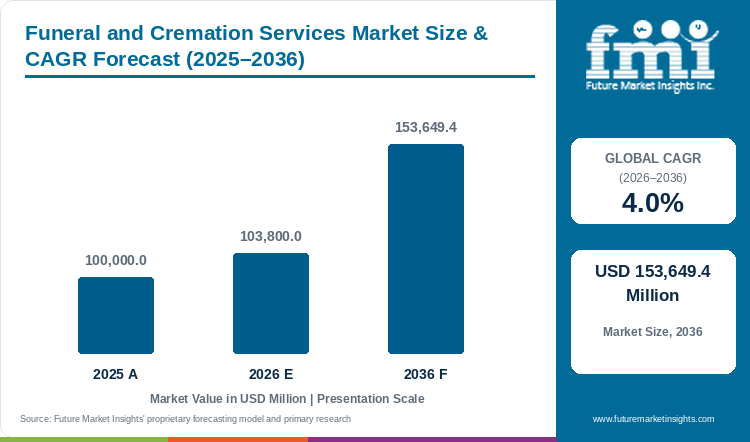
FMI projects the global funeral and cremation services market at USD 153,649.4 million in 2036, a 4.0% CAGR from 2026 to 2036. The market was valued at USD 100,000.0 million in 2025 and is estimated at USD 103,800.0 million in 2026.
Funeral and Cremation Services Market Size and Forecast
Table 1: Funeral and Cremation Services Market Size and Forecast
| Market size and forecast | Value |
|---|---|
| Market size in 2025 | USD 100,000.0 million |
| Estimated market size in 2026 | USD 103,800.0 million |
| Projected market size by 2036 | USD 153,649.4 million |
| CAGR from 2026 to 2036 | 4.0% |
Source: Future Market Insights analysis of the funeral and cremation services market, 2026.
Revenue per arrangement is becoming more important than service volume. Service Corporation International reported a 2.8% increase in comparable average funeral revenue per service during the third quarter of 2026. Comparable services performed fell 0.1%, while its comparable cremation rate reached 65.0%. That combination lets a funeral operator's revenue improve while case numbers fall.
Families still choose the form and extent of remembrance after deciding on disposition. Operators therefore compete on a clearly priced arrangement and dependable local delivery, alongside the cremation itself. At-Need Services remain the leading timing category at 80.0%, keeping immediate availability central to branch economics. Carriage Services' November 2026 release reported 2.5% growth in consolidated funeral contracts during the third quarter and a 1.9% increase in average revenue per contract. The stronger commercial proposition combines reliable case handling with a service offer that remains viable as customers select fewer traditional burial goods.
Key Market Trends & Insights
- Mature cremation markets leave little growth from disposition conversion. Canada's cremation share reached 77.4% in CANA's 2025 statistical series. Operators need to consider the paid service surrounding each arrangement.
- Fee regulation is shaping the revenue base. China's January 2026 charging policy separates basic from non-basic funeral services and requires local fee catalogues. Revenue expansion depends partly on which services may be charged for and how those charges are disclosed.
- Facility modernisation absorbs cash even where demand is established. Dignity reported GBP 9.4 million of crematoria environmental modernisation investment during 2025.
Regional Highlights
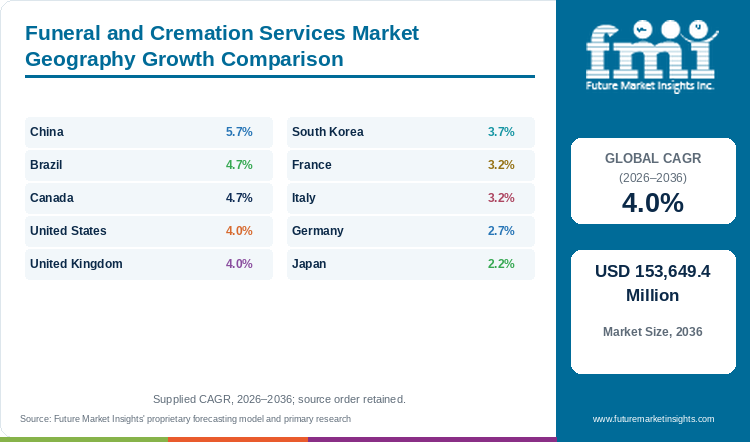
- China, Brazil and Canada grow fastest among the named countries. FMI projects CAGRs of China at 5.7%, Brazil at 4.7% and Canada at 4.7% over 2026 to 2036 against 4.0% for the global market.
- Japan grows slowest at 2.2% over the same period. Germany at 2.7%, France and Italy at 3.2% each and South Korea at 3.7% also sit below the 4.0% global rate.
Analyst Perspective
“The most durable branch economics come from matching staff and facilities to the arrangements families actually select. Cremation growth does not automatically protect margins. Operators need transparent prices, careful scheduling and a credible remembrance offer at several spending levels. Advance planning adds a future service commitment, but the funds supporting that commitment must remain distinct from revenue earned by carrying out a funeral.”
- Anurag Sharma, Principal Consultant, FMI
How is the Funeral and Cremation Services Market segmented?
- By service: Burial Services, Cremation Services, and Other Disposition Services.
- By component: Funeral Director and Ceremony Services, Cremation and Burial Fees, and Caskets, Urns and Merchandise.
- By timing: At-Need Services, Pre-Need Services, and Memorial and Aftercare Services.
- By region: North America, Latin America, Western Europe, East Asia, and Rest of world.
Why does the Cremation Services segment lead by Service in the Funeral and Cremation Services Market in 2026?
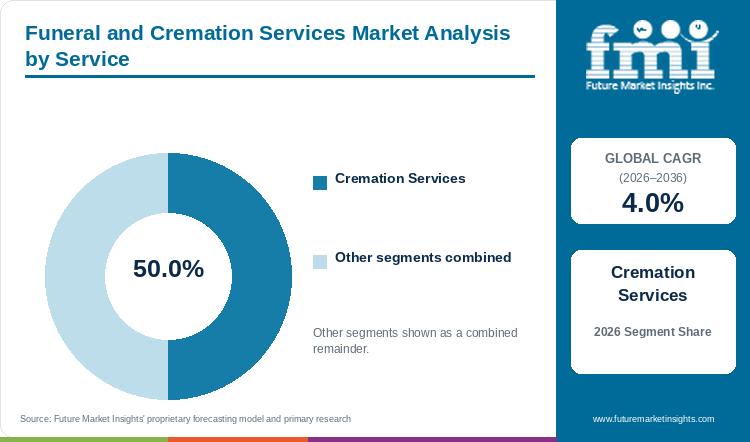
The Cremation Services segment holds 50.0% of the Funeral and Cremation Services Market by service in 2026.
Cremation's lead reflects a broad disposition category that includes products of different cost. An unattended service and a cremation followed by a staffed remembrance event use different amounts of labour and venue time. A supplier deciding where to invest must distinguish the number of cremations from the value of the complete arrangement.
CANA's statistics establish that cremation already accounts for a majority of dispositions in both the United States and Canada. Those national percentages measure cremations relative to deaths, while FMI's global service classification measures revenue.
FMI forecasts a 5.3% CAGR for Cremation Services over 2026 to 2036. Its share reaches 56.7% in 2036, while Burial Services retain a substantial 34.0%. Operators consequently face a change in revenue mix while burial demand continues. The relevant capacity decision concerns accessible cremation appointments, service rooms and the staffing needed for different formats. Expansion should follow the circumstances of the local catchment and the condition of existing facilities.
Burial Services and Other Disposition Services together hold the remaining 50.0% by service.
Table 2: Service, 2026 Share
| Leading Share | 2026 market share |
|---|---|
| Cremation Services | 50.0% |
| All Other Segments Combined Share | 50.0% |
Source: Future Market Insights analysis of the funeral and cremation services market, 2026.
Why does the Funeral Director and Ceremony Services segment lead by Component in the Funeral and Cremation Services Market in 2026?
The Funeral Director and Ceremony Services segment holds 55.0% of the Funeral and Cremation Services Market by component in 2026.
Professional coordination remains the leading revenue component even as the disposition mix changes. Its economics depend on trained staff, vehicles, premises and the amount of time committed to each family. These costs move independently of casket sales. An operator replacing burial merchandise revenue with a service-led offer must price the professional work clearly enough to recover its cost.
France's revised quotation format took effect in July 2025. It distinguishes legally required items from other services and makes clear that some requirements arise only in particular circumstances. Disclosure rules make the professional service offer more visible and comparable.
The component grows at a 3.9% CAGR in FMI's 2026 to 2036 outlook. Its share eases to 54.4% by 2036, while Cremation and Burial Fees reach 26.4%. That balance gives operators a reason to examine facility access as carefully as branch sales. A funeral director may arrange the service while paying a separately operated crematorium. The commercial advantage lies in dependable coordination and a clear total quotation, whether the facilities are owned or contracted. A fully integrated offer is tested against actual local operating arrangements.
Cremation and Burial Fees and Caskets, Urns and Merchandise together hold the remaining 45.0% by component.
Table 3: Component, 2026 Share
| Leading Share | 2026 market share |
|---|---|
| Funeral Director and Ceremony Services | 55.0% |
| All Other Segments Combined Share | 45.0% |
Source: Future Market Insights analysis of the funeral and cremation services market, 2026.
Why does the At-Need Services segment lead by Timing in the Funeral and Cremation Services Market in 2026?
The At-Need Services segment holds 80.0% of the Funeral and Cremation Services Market by timing in 2026.
Immediate arrangements lead because the service must be organised at the point of need, even where a family has discussed preferences earlier. The practical requirement is local capacity that can be mobilised promptly. A branch with an extensive advance-planning pipeline still needs enough trained staff and appointment access when those obligations mature.
The UK's Financial Conduct Authority treats a prepaid funeral plan as a regulated financial arrangement and advises customers to check that the provider has the relevant authorisation. That framework is separate from price disclosure for a funeral being purchased now.
FMI expects the At-Need Services share to decline to 76.0% by 2036, with a 3.5% CAGR across the decade. Pre-Need Services grow faster at 6.5% and reach a 17.7% share. This is a gradual change, leaving immediate arrangements the principal operating workload. For consolidators, the attraction of advance relationships is better visibility into future commitments. The corresponding obligation is to maintain service capacity and funding discipline over time. An aggressive plan-sales strategy increases exposure when the delivery structure is unrealistic.
Pre-Need Services and Memorial and Aftercare Services together hold the remaining 20.0% by timing.
Table 4: Timing, 2026 Share
| Leading Share | 2026 market share |
|---|---|
| At-Need Services | 80.0% |
| All Other Segments Combined Share | 20.0% |
Source: Future Market Insights analysis of the funeral and cremation services market, 2026.
What are the key drivers restraints and opportunities?
Revenue growth is supported by changes in service realisation and formal provision. Local staffing constraints, regulated charges and uneven case volumes limit expansion. Cremation-related remembrance and well-funded advance relationships provide distinct commercial openings.
Driver
Professional service and facility revenue can grow faster than case numbers when arrangements change and operators recover the cost of delivery.
Restraint
A fixed branch and crematorium cost base remains exposed to uneven mortality, affordable-service requirements and limits on discretionary spending.
Opportunity
Operators can develop a clear range of cremation and remembrance services while improving the reliability of local handovers and appointments.
How do purchasing rules and qualification affect funeral and cremation services market demand?
The revenue forecast is materially stronger than the service-volume forecast. FMI therefore sees service realisation and market composition as central to the decade's growth argument. SCI's first nine months of 2026 demonstrate the need for that distinction. Higher average funeral revenue per service partly offset lower comparable service volumes, while fixed operating costs continued to affect profit. End-of-life care that precedes many arrangements is covered in FMI's palliative care market.
Formal service standards can also change what operators must deliver and disclose. China's revised funeral regulations took effect in March 2026 with an explicit public-welfare emphasis. Providers must work within the service and fee structure permitted locally. The adjacent geriatric care services market offers a useful view of earlier stages of support, but care expenditure is excluded from funeral-service valuation.
What limits reliable funeral and cremation services market supply and quality?
The most immediate financial risk is a mismatch between a branch's capacity and its actual service load. Staff and facilities must remain available even when quarterly case numbers fall. Carriage's November 2026 update reduced its full-year revenue expectations after weaker first-half mortality and other operating pressures. Preservation and handling equipment used in mortuary work is covered in FMI's mortuary equipment market.
Pricing rules add another constraint. The CMA's UK guidance requires standardised price information and separate disclosure of additional options. Standardised disclosure exposes an uncompetitive charge inside a bundle. In markets with public fees or concessions, facility returns also depend on contractual terms. The risk review must separate commercial funeral services from cemetery property and financial-plan assets, which have different economic and regulatory characteristics.
Where can suppliers win additional business in the funeral and cremation services market?
The opportunity is to retain a family's paid remembrance relationship after the disposition choice has changed. That may involve a modest attended gathering or a more extensive ceremony. It requires a menu that is clear before purchase and a delivery structure suited to the actual arrangement.
Dignity's June 2026 disclosure described investment in crematoria and the relaunch of its direct-cremation brand during December 2025. Its later group identity brought several existing brands under Life Services. These are examples of portfolio and operating changes. FMI sees the stronger opportunity in selective service development supported by demonstrable local capacity, with each adjacent activity evaluated on its own economics.
Funeral and Cremation Services Market by Country (2026 to 2036)
Table 5: Funeral and Cremation Services Market Country Growth Forecast
| Country | CAGR, 2026 to 2036 |
|---|---|
| China | 5.7% |
| Brazil | 4.7% |
| Canada | 4.7% |
| United States | 4.0% |
| United Kingdom | 4.0% |
| South Korea | 3.7% |
| France | 3.2% |
| Italy | 3.2% |
| Germany | 2.7% |
| Japan | 2.2% |
Source: Future Market Insights analysis of the funeral and cremation services market, 2026.
China
China's 2026 reforms make affordability and the permitted fee structure central to commercial planning. The National Development and Reform Commission's January notice distinguishes basic and non-basic funeral items. It places basic services under government-guided charging arrangements and requires local service-fee catalogues. A provider's addressable revenue therefore depends on the relevant local rules and service responsibilities. Charges for additional items stay within each local catalogue.
The country is forecast to expand at a 5.7% CAGR between 2026 and 2036, the highest rate among the ten national profiles. FMI estimates its 2036 revenue at USD 27,085.3 million. By 2036, China accounts for 17.6% of global revenue. China compounds at 5.7%, which is 1.7 points above the global 4.0%.
The State Council's revised regulations took effect on 30 March 2026 and emphasised the public-welfare character of funeral provision. For suppliers, this increases the importance of knowing the operating role attached to each facility and the services that a locality expects it to provide. A broad offering may help a provider serve different family choices, but the chargeable service must remain consistent with the applicable catalogue. FMI sees a stronger commercial basis in efficient provision and clear service differentiation than in assuming unrestricted price increases. Local execution also matters for merchandise sourcing, because the national charging policy addresses the supply of affordable funeral goods.
Brazil
São Paulo's current concession guidance draws an important boundary between winning a funeral arrangement and operating the associated fixed facility. SP Regula's September 2026 page explains that concessionaires may provide funeral services throughout the city. Cemetery and cremation services remain tied to the facilities allocated in each concession block.
This local structure informs FMI's commercial interpretation of Brazil, where revenue is forecast to expand at a 4.7% CAGR from 2026 to 2036. The projected 2036 value is USD 4,925.0 million. São Paulo is one operating example, and each Brazilian municipality sets its own arrangements. An operator entering another location needs to assess that locality's arrangements and permitted activities separately.
For investors, branch reach and control of facility capacity are different competitive assets. A network may attract arrangements across a wide urban area while relying on designated locations for the disposition stage. That can affect transport requirements, scheduling and the amount of service performed by the arranging branch. It also means that the announced size of a concession differs from funeral-service sales. FMI sees the stronger commercial opportunity in reliable execution within the actual concession and municipal setting. Price and service scope need to remain clear when a customer's arrangement involves several organisations. Only the professional services and relevant merchandise belong in this report's revenue measure, with cemetery land transactions excluded.
Canada
Canada's high cremation share makes the paid service around disposition a central commercial issue. CANA's 2025 series places the national cremation rate at 77.4%. A market at that starting point has limited room for growth from burial-to-cremation conversion. Operators need to examine the arrangement selected with each cremation and the cost of supplying it. The Canadian figure is a disposition statistic and sits apart from market revenue.
FMI projects a 4.7% CAGR for Canada over 2026 to 2036, with revenue rising to USD 3,283.3 million. Canada's 2036 revenue equals 2.1% of the global total. Canada grows at 4.7% a year, 0.7 points faster than the global rate. Canada's 2036 revenue equals 66.7% of Brazil's, although both countries share a 4.7% CAGR. The outlook is also shaped by provincial oversight. In its September 2026 annual-report notice, the Bereavement Authority of Ontario described progress in licensing and financial-compliance response while acknowledging further work on regulatory guidance.
Park Lawn's completed 2024 private transaction also changes the corporate context of a significant North American operator. Its former public listing no longer applies. The transaction gives no national funeral-service share. FMI's view is that a credible local offer needs both an appropriate service range and clear operational responsibility. Mature cremation demand places particular weight on room scheduling, staffing and the total price of remembrance.
United States
The United States combines large funeral networks with price disclosure that preserves the customer's ability to select separate goods and services. The FTC explains that consumers may purchase only the arrangements they want and may provide a casket or urn bought elsewhere. For an operator, merchandise attachment is consequently a choice by the family. A high cremation mix makes that distinction increasingly important to the revenue earned from each case.
FMI projects a 4.0% CAGR for the United States from 2026 to 2036, with revenue reaching USD 32,233.8 million at the end of the period. Its 2036 revenue equals 21.0% of the global market, and its CAGR matches the 4.0% global rate. SCI's reporting separates comparable activity from acquired locations. An expanding operator network can show sales growth even when its established branches handle fewer services. An investor evaluating local demand needs to preserve that difference.
FMI's commercial reading is that professional direction and the remembrance offer carry more weight as families change disposition preferences. A branch still needs an affordable arrangement that covers its actual labour and facility commitment. The clearest competitive position is a dependable local offer whose total price and included services are understandable before the customer commits. Scale supports investment, while the individual branch remains the point where a family's service expectations must be met.
United Kingdom
The CMA requires funeral directors to display standardised price information and additional options. The FCA separately regulates prepaid funeral-plan providers. A group active in both areas must satisfy different obligations at the point of sale and over the lifetime of the plan.
Against this setting, FMI projects a 4.0% CAGR for the United Kingdom over 2026 to 2036 and revenue of USD 6,139.8 million in 2036. Its 2036 revenue equals 4.0% of the global market, and its CAGR matches the 4.0% global rate. The operating opportunity includes several arrangement formats. The current brands of one UK group illustrate that diversity: the Life Services identity launched in September 2026 above its funeral director, Farewill, Simplicity Cremations and crematoria businesses. This UK group is separate from SCI's North American memorial brand.
FMI sees clear service and brand positioning as commercially important. A direct-cremation brand and a local attended-funeral branch may reach customers with different spending decisions, even when they share ownership. Their pricing and facilities reflect the different resources each case consumes. Broader legal and estate services may support a customer relationship, but their income falls outside this funeral-services definition. Operators have a stronger basis for investment when they can show how each funeral format covers the staff and facility capacity required to deliver it.
South Korea
South Korea's capacity discussion concerns the location and timing of supply as much as national cremation adoption. A February 2026 Bank of Korea study reported that cremation reached 94.0% of dispositions in 2024. Yet the proportion completed on the third day of funeral rites was only 75.5% in 2025, below its 2019 level. These measures describe different aspects of the service. Widespread adoption leaves the availability of a convenient appointment in the relevant catchment open.
The country is projected to grow at a 3.7% CAGR in FMI's 2026 to 2036 outlook, reaching USD 2,982.3 million. The commercial interpretation is therefore focused on effective access and coordination. A national facility count can conceal pressure in major cities or available capacity far from the family arranging the funeral. Expanding a funeral hall leaves the constraint in place when the disposition appointment remains scarce.
The Bank of Korea discussed ways to improve supply incentives and examined the constraints affecting urban cremation infrastructure. Its proposed measures are still at the proposal stage. For companies, the near-term task is to work within the operating arrangements that actually exist. A facility investment requires a defensible local demand case and the necessary permissions. The wider need for support at the end of life also connects with earlier care provision, but medical and residential-care income is excluded here. FMI sees the most useful differentiation in an arrangement that combines clear responsibility with predictable access to the facilities needed to complete it.
France
France changed the way funeral quotations distinguish required and optional services in July 2025. The DGCCRF's explanation lists the items that are legally compulsory and those that depend on circumstances, while treating a funeral ceremony separately from the core obligatory services. That structure makes the difference between the minimum arrangement and a more extensive offer visible before purchase. For providers, the quotation becomes part of how they demonstrate the value of professional work.
FMI expects France to reach USD 5,682.6 million in funeral and cremation services revenue by 2036. The forecast CAGR is 3.2% across 2026 to 2036. This is a service outlook, so funeral insurance contracts and cemetery property sit outside the total. Those adjacent arrangements can influence payment or customer access and remain separate economic activity. France reaches 3.7% of the global market by 2036. A 3.2% CAGR leaves France 0.8 points below the 4.0% global pace.
The commercial implication is a need for precise service descriptions. A firm that relies on a broad package label may find it harder to show why its quotation differs from a competitor's. A well-described ceremony can command a different price from an unaccompanied disposition, but the difference should correspond to the work delivered. Local staffing and facility relationships remain important because a family selects a complete sequence of services. FMI's view is that the revised quotation structure supports comparison and places more responsibility on the operator to make optional service value explicit.
Italy
Milan's funeral and cemetery regulation provides a useful example of the municipal layer in Italian provision. The version amended in April 2025 sets out the relationship between service tariffs, local administration and assistance for qualifying indigent cases.
Italy's market is forecast at a 3.2% CAGR between 2026 and 2036, reaching USD 4,262.0 million by 2036. By 2036, Italy accounts for 2.8% of global revenue. A 3.2% CAGR leaves Italy 0.8 points below the 4.0% global pace. Italy's 2036 revenue equals 75.0% of France's, and both countries share a 3.2% CAGR. FMI's assessment includes professional arrangement and disposition services. Cemetery land sales are outside the value boundary. Municipal rules may also cover concessions and burial infrastructure, which fall outside this forecast.
FMI regards the ability to coordinate private work with municipal procedures as a practical source of differentiation. The funeral director's own fee is only one part of the family's arrangement. The selected locality and form of disposition also affect the services that must be organised. This gives regional operators a reason to build reliable local relationships before extending their coverage. The stronger investment case identifies the facilities available within the catchment and the work the operator will perform directly. Additional venues should follow that service case, with their operating costs distinguished from the charges collected on behalf of another provider.
Germany
Labour availability and service inflation give a concrete view of Germany. Destatis reported in October 2026 that 900 people were training as funeral professionals at the end of 2025. It also recorded around 32,000 jobs across approximately 4,200 funeral-trade enterprises in 2024. Those figures describe the trade's own statistical coverage.
The same release reported a 3.2% rise in funeral-service prices and cemetery fees during 2025, compared with 2.2% for overall consumer prices. Price growth can lift nominal sales, but it also reflects an environment where customers face a higher bill. FMI forecasts German revenue growth at a 2.7% CAGR from 2026 to 2036, taking the market to USD 6,765.9 million. Germany reaches 4.4% of the global market by 2036. Against the 4.0% global rate, Germany grows at 2.7% a year and trails by 1.3 points. Germany's 2036 revenue exceeds the United Kingdom's by 10.2%, although Germany grows more slowly than the United Kingdom.
For a German operator, the commercial task is to maintain professional capacity while offering an understandable service range. Municipal fees and private funeral charges need to be considered separately. A business selling an arrangement across several localities must know the actual service costs attached to its delivery choices. FMI's outlook therefore favours measured investment in service quality and operational continuity, with local evidence behind any additional premises or staff commitment.
Japan
Tokyo's 2026 crematorium study shows why capacity investment needs a local operating case. The survey covered facilities and municipalities inside and outside the capital. It reported different roles for public and private crematoria, including differences in utilisation and charging. Interview respondents did not describe an immediate overall shortage, although they saw a need to consider future increases in deaths. That evidence supports advance planning, and each new facility still needs its own near-term demand case.
Japan's funeral and cremation services revenue is forecast to grow at a 2.2% CAGR during 2026 to 2036, reaching USD 18,040.5 million. Japan's 2036 revenue equals 11.7% of the global total. Japan compounds at 2.2%, which is 1.8 points below the global 4.0%. It remains a large market, but its slower growth rate changes the investment question. Operators need to examine service formats and the cost of maintaining premises before expanding their footprint.
FMI considers appointment access and the coordination of the complete funeral to be the more useful competitive measures. Private and public fees have different contexts, so a simple average of advertised cremation prices can misrepresent the family's total expenditure. Regional travel and the relationship between a funeral director and the selected facility also affect the practical offer. The relevant adjacent work in senior in-home care services concerns support before death. It should remain distinct from the professional arrangements valued here. A commercially sound funeral network must earn its return from the services it actually supplies and the catchments it can reliably reach.
Who are the notable companies in the Funeral and Cremation Services Market?
Notable companies in the Funeral and Cremation Services Market include Service Corporation International, Dignity, within Life Services Group, Carriage Services, StoneMor, doing business as Everstory Partners and Park Lawn Corporation.
The documented competitors have different operating footprints and capital structures. Service Corporation International combines funeral locations and cemeteries across the United States and Canada. Its Dignity Memorial brand must be distinguished from UK Dignity. Carriage Services is a US operator that reports funeral and cemetery performance separately. Those separate results are useful because interment property revenue and funeral arrangement economics differ.
StoneMor's current legal website identifies the business as operating under the Everstory Partners name. Park Lawn Corporation completed its private ownership transaction with interests associated with Homesteaders Life Company and Birch Hill in August 2024. Propel Funeral Partners documents funeral homes, cremation facilities and related operations in Australia and New Zealand. It contributes a different regional comparison from the North American consolidators.
FMI's assessment focuses on the service infrastructure that these businesses operate and the role of local brands. Corporate scale leaves pricing and service delivery to vary by branch. UK Dignity's broader Life Services portfolio also contains legal activities that are outside this market definition. The professional arrangement and the activities of a wider corporate group must therefore be assessed separately when comparing operators.
Key Developments in the Funeral and Cremation Services Market
- On 28 September 2026, Dignity introduced Life Services Group as the corporate identity above its existing customer-facing brands. Its announcement described shared technology and continued use of the established brand names.
- Propel Funeral Partners' 2026 annual report described five acquisitions completed during the fiscal year and since its end. The reported network included 213 locations across Australia and New Zealand, with 42 cremation facilities.
Key Players in the Funeral and Cremation Services Market
- Service Corporation International
- Dignity, within Life Services Group
- Carriage Services
- StoneMor, doing business as Everstory Partners
- Park Lawn Corporation
- Propel Funeral Partners
- Koyo Memorial Park
Funeral and Cremation Services Market Report Scope
Table 6: Funeral and Cremation Services Market Report Scope
| Coverage field | Report scope |
|---|---|
| Market definition | Professional funeral arrangement, body preparation, ceremonies, transport, burial and cremation, together with crematorium operation. |
| Included merchandise | Caskets, urns and other merchandise sold with a funeral. |
| Principal exclusions | Cemetery land sales, insurance premiums, trust-fund balances, medical care, legal services and separately sold upstream equipment. |
| Quantitative Units | USD million |
| Volume and realisation | Million services. 2026 global average revenue realisation per service. |
| Segmentation | Service, Component and Timing. |
| National coverage | United States, China, Japan, Germany, United Kingdom, France, Italy, Brazil, Canada and South Korea. Separate Rest of world aggregate. |
| Company coverage | Service Corporation International, Dignity, Carriage Services, StoneMor, Park Lawn Corporation, Propel Funeral Partners and Koyo Memorial Park. |
| Commercial focus | Arrangement mix, professional delivery costs, local facility access, price disclosure, advance-service obligations and documented operator positioning. |
Source: Future Market Insights analysis of the funeral and cremation services market, 2026.
Funeral and Cremation Services Market Research Methodology
The assessment combines FMI's value and service outlook with secondary review of public operator disclosures and local regulatory material. Analysis separates disposition, component and timing classifications, then compares national operating conditions. Company roles reflect documented current identities. Cemetery land, financial-plan assets and adjacent care or legal income are kept outside the professional-service revenue boundary.
Funeral and Cremation Services Market by Segments
Funeral and Cremation Services Market segmented by Service:
- Burial Services
- Cremation Services
- Other Disposition Services
Funeral and Cremation Services Market segmented by Component:
- Funeral Director and Ceremony Services
- Cremation and Burial Fees
- Caskets, Urns and Merchandise
Funeral and Cremation Services Market segmented by Timing:
- At-Need Services
- Pre-Need Services
- Memorial and Aftercare Services
Funeral and Cremation Services Market by Region
- North America
- United States
- Canada
- Latin America
- Brazil
- Western Europe
- Germany
- United Kingdom
- France
- Italy
- East Asia
- China
- Japan
- South Korea
- Rest of world aggregate
Research Sources and Bibliography
- Bank of Korea. (2026, February 10). Revitalising essential end-of-life industries in a super-aged society, BOK Issue Note 2026-5.
- Bereavement Authority of Ontario. (2026, September 3). BAO Annual Report demonstrates progress in consumer protection and in guidance to licensed professionals, with more work to be done.
- Carriage Services. (2026, November 4). Carriage Services Announces Third Quarter 2026 Results, Updates 2026 Guidance and Strategic Acquisitions Timeline.
- Competition and Markets Authority. (2025, January 21). Compliance checklist for funeral directors.
- Comune di Milano. (2025, April 14 amendment). Regolamento dei servizi funebri e cimiteriali del Comune di Milano.
- Cremation Association of North America. (2026). Industry Statistical Information and 2026 Annual Statistics Report Summary. Accessed November 9, 2026.
- Dignity Group Holdings. (2026, June 8). Dignity strengthens position as leading end-of-life services provider.
- Direction générale de la concurrence, de la consommation et de la répression des fraudes. (2025, February 25). Prestations funéraires: le modèle de devis des opérateurs funéraires change au 1er juillet 2025.
- Everstory Partners. (Accessed November 9, 2026). Terms of Service.
- Federal Trade Commission. (2012, July; current guidance accessed November 9, 2026). The FTC Funeral Rule.
- Financial Conduct Authority. (2026, March 6 update). Funeral plans: check your provider is authorised.
- Life Services Group. (2026, September 28). Introducing Life Services Group: a new chapter for Dignity.
- National Development and Reform Commission, Ministry of Civil Affairs and Ministry of Finance. (2026, January 26; published January 27). Notice on Further Improving Funeral Service Charging Policies, NDRC Price No. 108.
- Park Lawn Corporation. (2024, August 9). Park Lawn Announces Completion of Going Private Transaction with Homesteaders Life Company and Birch Hill Equity Partners.
- Propel Funeral Partners. (2026). Annual Report 2026.
- Service Corporation International. (2026, October). Form 10-Q for the quarter ended September 30, 2026. US Securities and Exchange Commission.
- SP Regula, Prefeitura de São Paulo. (2026, September 16). Concessionárias e Agências Funerárias: Limite de Atuação das Concessionárias de Serviços Funerários e Cemiteriais.
- State Council of the People's Republic of China. (2026, January 7). China revises regulations to enable affordable funeral service.
- Statistisches Bundesamt. (2026, October 26). Zahl der Auszubildenden zur Bestattungsfachkraft auf neuem Höchststand, press release N073.
- Tokyo Metropolitan Government. (2026, March 31). Publication of the survey on the operation of crematoria.
Table of Content
- Key Takeaways
- Market Size and CAGR
- Top Growth Driver
- Fastest Growing Segment
- Leading Region
- Key Companies
- Emerging Opportunities
- Executive Summary
- Global Market Outlook
- Demand-side Trends
- Supply-side Trends
- Technology Roadmap Analysis
- Analysis and Recommendations
- Analyst Perspective (What is happening? Why now? What should investors know?)
- Key Questions Answered
- How large is the market?
- What is the CAGR?
- What are key trends?
- Which region dominates?
- Who are the leaders?
Read More...
- Market Overview
- Market Coverage / Taxonomy
- Market Definition / Scope / Limitations
- Research Methodology
- Chapter Orientation
- Analytical Lens and Working Hypotheses
- Market Structure, Signals, and Trend Drivers
- Benchmarking and Cross-market Comparability
- Market Sizing, Forecasting, and Opportunity Mapping
- Research Design and Evidence Framework
- Desk Research Programme (Secondary Evidence)
- Expert Input and Fieldwork (Primary Evidence)
- Tooling, Models, and Reference Databases
- Data Engineering and Model Build
- Quality Assurance and Audit Trail
- Market Background
- Market Dynamics (Drivers, Restraints, Opportunity, Trends)
- Scenario Forecast (Optimistic, Likely, Conservative)
- Impact Analysis
- AI Impact
- Sustainability Impact
- Regulatory Impact
- Technology Impact
- Consumer / Buyer Analysis
- Purchase Drivers
- Adoption Barriers
- Buyer Journey
- Opportunity Map Analysis
- Product Life Cycle Analysis
- Supply Chain Analysis
- Investment Feasibility Matrix
- Value Chain Analysis
- PESTLE and Porter's Analysis
- Regulatory Landscape
- Regional Parent Market Outlook
- Production and Consumption Statistics
- Import and Export Statistics
- Global Market Analysis and Forecast, 2021 to 2036
- Historical Market Size Value (USD Million) Analysis, 2021 to 2025
- Current and Future Market Size Value (USD Million) Projections, 2026 to 2036
- Y-o-Y Growth Trend Analysis
- Absolute $ Opportunity Analysis
- Global Market Pricing Analysis, 2021 to 2036
- Global Market Analysis and Forecast, By Service, 2021 to 2036
- Introduction / Key Findings
- Historical Market Size Value (USD Million) Analysis By Service, 2021 to 2025
- Current and Future Market Size Value (USD Million) Analysis and Forecast By Service, 2026 to 2036
- Burial Services
- Cremation Services
- Other Disposition Services
- Y-o-Y Growth Trend Analysis By Service, 2021 to 2025
- Absolute $ Opportunity Analysis By Service, 2026 to 2036
- Global Market Analysis and Forecast, By Component, 2021 to 2036
- Introduction / Key Findings
- Historical Market Size Value (USD Million) Analysis By Component, 2021 to 2025
- Current and Future Market Size Value (USD Million) Analysis and Forecast By Component, 2026 to 2036
- Funeral Director and Ceremony Services
- Cremation and Burial Fees
- Caskets, Urns and Merchandise
- Y-o-Y Growth Trend Analysis By Component, 2021 to 2025
- Absolute $ Opportunity Analysis By Component, 2026 to 2036
- Global Market Analysis and Forecast, By Timing, 2021 to 2036
- Introduction / Key Findings
- Historical Market Size Value (USD Million) Analysis By Timing, 2021 to 2025
- Current and Future Market Size Value (USD Million) Analysis and Forecast By Timing, 2026 to 2036
- At-Need Services
- Pre-Need Services
- Memorial and Aftercare Services
- Y-o-Y Growth Trend Analysis By Timing, 2021 to 2025
- Absolute $ Opportunity Analysis By Timing, 2026 to 2036
- Global Market Analysis and Forecast, By Region, 2021 to 2036
- Introduction
- Historical Market Size Value (USD Million) Analysis By Region, 2021 to 2025
- Current Market Size Value (USD Million) Analysis and Forecast By Region, 2026 to 2036
- North America
- Latin America
- Western Europe
- East Asia
- Market Attractiveness Analysis By Region
- North America Market Analysis and Forecast, By Country, 2021 to 2036
- Historical Market Size Value (USD Million) Trend Analysis By Market Taxonomy, 2021 to 2025
- Market Size Value (USD Million) Forecast By Market Taxonomy, 2026 to 2036
- By Country
- United States
- Canada
- By Service
- By Component
- By Timing
- By Country
- Market Attractiveness Analysis
- By Country
- By Service
- By Component
- By Timing
- Key Takeaways
- Latin America Market Analysis and Forecast, By Country
- Historical Market Size Value (USD Million) Trend Analysis By Market Taxonomy, 2021 to 2025
- Market Size Value (USD Million) Forecast By Market Taxonomy, 2026 to 2036
- By Country
- Brazil
- By Service
- By Component
- By Timing
- By Country
- Market Attractiveness Analysis
- By Country
- By Service
- By Component
- By Timing
- Key Takeaways
- Western Europe Market Analysis and Forecast, By Country
- Historical Market Size Value (USD Million) Trend Analysis By Market Taxonomy, 2021 to 2025
- Market Size Value (USD Million) Forecast By Market Taxonomy, 2026 to 2036
- By Country
- Germany
- United Kingdom
- France
- Italy
- By Service
- By Component
- By Timing
- By Country
- Market Attractiveness Analysis
- By Country
- By Service
- By Component
- By Timing
- Key Takeaways
- East Asia Market Analysis and Forecast, By Country
- Historical Market Size Value (USD Million) Trend Analysis By Market Taxonomy, 2021 to 2025
- Market Size Value (USD Million) Forecast By Market Taxonomy, 2026 to 2036
- By Country
- China
- Japan
- South Korea
- Rest of world aggregate
- By Service
- By Component
- By Timing
- By Country
- Market Attractiveness Analysis
- By Country
- By Service
- By Component
- By Timing
- Key Takeaways
- Key Countries Market Analysis
- United States
- Pricing Analysis
- Market Share Analysis, 2025
- By Service
- By Component
- By Timing
- Canada
- Pricing Analysis
- Market Share Analysis, 2025
- By Service
- By Component
- By Timing
- Brazil
- Pricing Analysis
- Market Share Analysis, 2025
- By Service
- By Component
- By Timing
- Germany
- Pricing Analysis
- Market Share Analysis, 2025
- By Service
- By Component
- By Timing
- United Kingdom
- Pricing Analysis
- Market Share Analysis, 2025
- By Service
- By Component
- By Timing
- Italy
- Pricing Analysis
- Market Share Analysis, 2025
- By Service
- By Component
- By Timing
- France
- Pricing Analysis
- Market Share Analysis, 2025
- By Service
- By Component
- By Timing
- China
- Pricing Analysis
- Market Share Analysis, 2025
- By Service
- By Component
- By Timing
- Japan
- Pricing Analysis
- Market Share Analysis, 2025
- By Service
- By Component
- By Timing
- South Korea
- Pricing Analysis
- Market Share Analysis, 2025
- By Service
- By Component
- By Timing
- United States
- Market Structure Analysis
- Competition Dashboard
- Competition Benchmarking
- Market Share Analysis of Top Players
- By Regional
- By Service
- By Component
- By Timing
- Emerging Startups
- Innovation Benchmarking
- Competition Analysis
- Competition Deep Dive
- Service Corporation International
- Overview
- Product Portfolio
- Profitability by Market Segments
- Sales Footprint
- Strategy Overview
- Marketing Strategy
- Product Strategy
- Channel Strategy
- Dignity
- Carriage Services
- StoneMor
- Park Lawn Corporation
- Propel Funeral Partners
- Dignity, within Life Services Group
- StoneMor, doing business as Everstory Partners
- Koyo Memorial Park
- Service Corporation International
- Case Studies
- Success Stories
- Recent Developments
- Competition Deep Dive
- Assumptions & Acronyms Used
List of Tables
- Table 1: Global Market Value (USD Million) Forecast by Region, 2021 to 2036
- Table 2: Global Market Value (USD Million) Forecast by Service, 2021 to 2036
- Table 3: Global Market Value (USD Million) Forecast by Component, 2021 to 2036
- Table 4: Global Market Value (USD Million) Forecast by Timing, 2021 to 2036
- Table 5: North America Market Value (USD Million) Forecast by Country, 2021 to 2036
- Table 6: North America Market Value (USD Million) Forecast by Service, 2021 to 2036
- Table 7: North America Market Value (USD Million) Forecast by Component, 2021 to 2036
- Table 8: North America Market Value (USD Million) Forecast by Timing, 2021 to 2036
- Table 9: Latin America Market Value (USD Million) Forecast by Country, 2021 to 2036
- Table 10: Latin America Market Value (USD Million) Forecast by Service, 2021 to 2036
- Table 11: Latin America Market Value (USD Million) Forecast by Component, 2021 to 2036
- Table 12: Latin America Market Value (USD Million) Forecast by Timing, 2021 to 2036
- Table 13: Western Europe Market Value (USD Million) Forecast by Country, 2021 to 2036
- Table 14: Western Europe Market Value (USD Million) Forecast by Service, 2021 to 2036
- Table 15: Western Europe Market Value (USD Million) Forecast by Component, 2021 to 2036
- Table 16: Western Europe Market Value (USD Million) Forecast by Timing, 2021 to 2036
- Table 17: East Asia Market Value (USD Million) Forecast by Country, 2021 to 2036
- Table 18: East Asia Market Value (USD Million) Forecast by Service, 2021 to 2036
- Table 19: East Asia Market Value (USD Million) Forecast by Component, 2021 to 2036
- Table 20: East Asia Market Value (USD Million) Forecast by Timing, 2021 to 2036
List of Figures
- Figure 1: Global Market Pricing Analysis
- Figure 2: Global Market Value (USD Million) Forecast 2021-2036
- Figure 3: Global Market Value Share and BPS Analysis by Service, 2026 and 2036
- Figure 4: Global Market Y-o-Y Growth Comparison by Service, 2026-2036
- Figure 5: Global Market Attractiveness Analysis by Service
- Figure 6: Global Market Value Share and BPS Analysis by Component, 2026 and 2036
- Figure 7: Global Market Y-o-Y Growth Comparison by Component, 2026-2036
- Figure 8: Global Market Attractiveness Analysis by Component
- Figure 9: Global Market Value Share and BPS Analysis by Timing, 2026 and 2036
- Figure 10: Global Market Y-o-Y Growth Comparison by Timing, 2026-2036
- Figure 11: Global Market Attractiveness Analysis by Timing
- Figure 12: Global Market Value (USD Million) Share and BPS Analysis by Region, 2026 and 2036
- Figure 13: Global Market Y-o-Y Growth Comparison by Region, 2026-2036
- Figure 14: Global Market Attractiveness Analysis by Region
- Figure 15: North America Market Incremental Dollar Opportunity, 2026-2036
- Figure 16: Latin America Market Incremental Dollar Opportunity, 2026-2036
- Figure 17: Western Europe Market Incremental Dollar Opportunity, 2026-2036
- Figure 18: East Asia Market Incremental Dollar Opportunity, 2026-2036
- Figure 19: North America Market Value Share and BPS Analysis by Country, 2026 and 2036
- Figure 20: North America Market Value Share and BPS Analysis by Service, 2026 and 2036
- Figure 21: North America Market Y-o-Y Growth Comparison by Service, 2026-2036
- Figure 22: North America Market Attractiveness Analysis by Service
- Figure 23: North America Market Value Share and BPS Analysis by Component, 2026 and 2036
- Figure 24: North America Market Y-o-Y Growth Comparison by Component, 2026-2036
- Figure 25: North America Market Attractiveness Analysis by Component
- Figure 26: North America Market Value Share and BPS Analysis by Timing, 2026 and 2036
- Figure 27: North America Market Y-o-Y Growth Comparison by Timing, 2026-2036
- Figure 28: North America Market Attractiveness Analysis by Timing
- Figure 29: Latin America Market Value Share and BPS Analysis by Country, 2026 and 2036
- Figure 30: Latin America Market Value Share and BPS Analysis by Service, 2026 and 2036
- Figure 31: Latin America Market Y-o-Y Growth Comparison by Service, 2026-2036
- Figure 32: Latin America Market Attractiveness Analysis by Service
- Figure 33: Latin America Market Value Share and BPS Analysis by Component, 2026 and 2036
- Figure 34: Latin America Market Y-o-Y Growth Comparison by Component, 2026-2036
- Figure 35: Latin America Market Attractiveness Analysis by Component
- Figure 36: Latin America Market Value Share and BPS Analysis by Timing, 2026 and 2036
- Figure 37: Latin America Market Y-o-Y Growth Comparison by Timing, 2026-2036
- Figure 38: Latin America Market Attractiveness Analysis by Timing
- Figure 39: Western Europe Market Value Share and BPS Analysis by Country, 2026 and 2036
- Figure 40: Western Europe Market Value Share and BPS Analysis by Service, 2026 and 2036
- Figure 41: Western Europe Market Y-o-Y Growth Comparison by Service, 2026-2036
- Figure 42: Western Europe Market Attractiveness Analysis by Service
- Figure 43: Western Europe Market Value Share and BPS Analysis by Component, 2026 and 2036
- Figure 44: Western Europe Market Y-o-Y Growth Comparison by Component, 2026-2036
- Figure 45: Western Europe Market Attractiveness Analysis by Component
- Figure 46: Western Europe Market Value Share and BPS Analysis by Timing, 2026 and 2036
- Figure 47: Western Europe Market Y-o-Y Growth Comparison by Timing, 2026-2036
- Figure 48: Western Europe Market Attractiveness Analysis by Timing
- Figure 49: East Asia Market Value Share and BPS Analysis by Country, 2026 and 2036
- Figure 50: East Asia Market Value Share and BPS Analysis by Service, 2026 and 2036
- Figure 51: East Asia Market Y-o-Y Growth Comparison by Service, 2026-2036
- Figure 52: East Asia Market Attractiveness Analysis by Service
- Figure 53: East Asia Market Value Share and BPS Analysis by Component, 2026 and 2036
- Figure 54: East Asia Market Y-o-Y Growth Comparison by Component, 2026-2036
- Figure 55: East Asia Market Attractiveness Analysis by Component
- Figure 56: East Asia Market Value Share and BPS Analysis by Timing, 2026 and 2036
- Figure 57: East Asia Market Y-o-Y Growth Comparison by Timing, 2026-2036
- Figure 58: East Asia Market Attractiveness Analysis by Timing
- Figure 59: Global Market - Tier Structure Analysis
- Figure 60: Global Market - Company Share Analysis
Frequently Asked Questions
How big is the funeral and cremation services market in 2026?
FMI estimates the market at USD 103,800.0 million in 2026, up from USD 100,000.0 million in 2025. It is forecast to reach USD 153,649.4 million by 2036 at a 4.0% CAGR.
Which service leads the funeral and cremation services market in 2026?
Cremation Services leads by service with 50.0% in 2026. All other segments together hold 50.0%.
Which component and timing lead in 2026?
Funeral Director and Ceremony Services holds 55.0% by component and At-Need Services holds 80.0% by timing in FMI's 2026 assessment.
Which market is forecast to grow fastest through 2036?
China has the highest forecast CAGR at 5.7% during 2026 to 2036, followed by Brazil and Canada at 4.7%.
Are cemetery land sales and prepaid-plan funds included?
Cemetery land sales and financial-plan assets are excluded. The assessment concerns professional services, crematorium operation and merchandise sold with a funeral. Advance relationships are considered through the relevant service activity, without adding trust or insurance balances.
Preview the report firsthand - request a free sample
Get SampleGet the brochure for pricing and purchase details.
Get PDF
