

- Market Size (2026)
- USD 195.3 Mn
- Forecast (2036)
- USD 312.1 Mn
- CAGR (2026 to 2036)
- 4.8%
General-Purpose Aerosol Lubricants for Aircraft MRO Market Outlook for 2026 to 2036
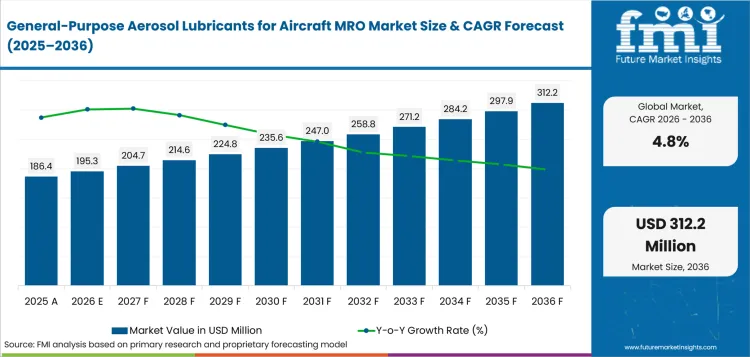
The general-purpose aerosol lubricants for aircraft MRO market size stood at USD 186.4 million in 2025. Industry revenue is likely to cross USD 195.3 million in 2026 and scale to USD 312.1 million by 2036 at 4.8% CAGR. Commercial aircraft MRO is estimated to account for 48.3% share of end use in 2026. By sales channel, authorized distributors are likely to represent 45.6% share in 2026.
Aircraft MRO buyers are narrowing lubricant choices around access safety and paperwork control during short maintenance windows. DuPont stated in 2025, MOLYKOTE D-321 R is available in bulk liquid or aerosolized spray form for parts that cannot be disassembled. This supports dry film aerosol use near fan blade roots and hard-to-reach aircraft components during overhaul work. Packaging rules add another selection gate as 49 CFR 173.306 limits metal aerosol container capacity to 1 L and set pressure controls at 54.4°C.
Distributors with compliant outer packaging and shipment control gain stronger value in MRO consumable supply. Chemistry review is tightening as the Organization for Economic Co-operation and Development identified micro-powder PTFE as a lubricant PFAS additive in June 2025. SOCOMORE’s WADIS 24 gives buyers a non-repeated supplier example with 400 mL aerosol packaging and water displacement for treated surfaces. Supplier choice will favor aerosol formats with clear use points and disclosed chemistry.
Summary of General-Purpose Aerosol Lubricants for Aircraft MRO Market
- Demand and Growth Drivers
- Aircraft line checks use aerosol lubricants for small mechanisms requiring quick access and limited mess during short ground time.
- Aging fleets raise maintenance touches as operators protect hinges and cables before corrosion causes harder repair work.
- Approved chemical handling favors documented cans carrying safety data and batch records through distributor channels.
- Product and Segment View
- Commercial MRO is anticipated to dominate end use with 48.3% share in 2026, led by airlines keeping narrowbody aircraft in heavy use.
- Authorized distributors are projected to lead sales channel with 45.6% share in 2026 due to buyers requiring traceable stock and fast replenishment.
- Petroleum based chemistry is expected to account for 41.7% share in 2026 with familiar performance across general shop tasks.
- Geography and Competitive Outlook
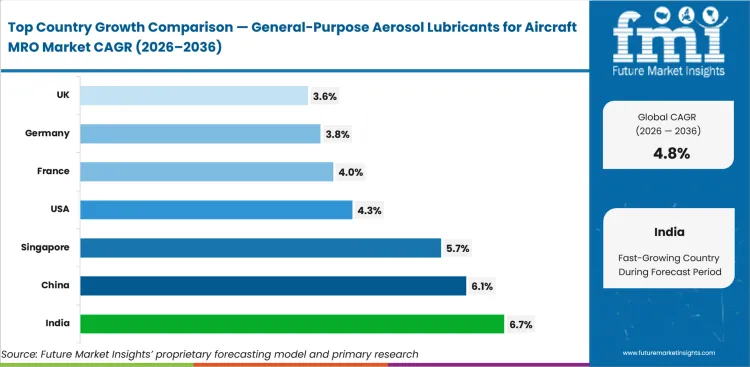
- India is projected to record 6.7% CAGR by 2036, driven by new aircraft service capacity raising demand for shop consumables.
- China is expected to expand at 6.1% CAGR by 2036 with fleet activity and domestic maintenance growth supporting aerosol use.
- ITW Pro Brands and ADDEV Materials compete with aviation-specific product ranges and distributor reach.
- CRC Industries and McGean-Rohco compete through maintenance chemical breadth and repair-station familiarity.
- Analyst Opinion
- Nikhil Kaitwade, Principal Consultant for Automotive at FMI, opines, "Aircraft aerosol lubricant buying is less about the can and more about release risk. Line mechanics need products allowed by the maintenance manual and simple to record. Commercial airlines will keep asking for smaller packs with traceable supply history as hangar time stays tight. Suppliers with aviation approvals and quick distributor access will hold stronger repeat orders. Clients should watch how MRO operators cut waste and shop time without creating audit issues."
- General-Purpose Aerosol Lubricants for Aircraft MRO Market Value Analysis
- Revenue growth is tied to maintenance frequency as aerosol cans are replaced after repeated use across line and hangar tasks.
- Value improves when suppliers offer cans with precise spray control lowering overspray near cables and cabin fittings.
- Aerosol packaging supports premium pricing as repair stations pay for clean application and lower risk of lubricant waste.
- Distributor-held inventory shapes value capture since aviation buyers prefer approved stock with safety documents available at order time.
Key Takeaways, Market Size, and Forecast
- The general-purpose aerosol lubricants for aircraft MRO market was valued at USD 186.4 million in 2025.
- Industry value is anticipated to reach USD 312.1 million by 2036 as approved aerosol formats keep routine aircraft maintenance work moving.
- From 2026 to 2036, the sector is expected to expand at 4.8% CAGR.
- Industry revenue is forecast to create an incremental opportunity of USD 116.8 million during the forecast period.
- Commercial MRO is projected to account for 48.3% share in 2026 due to airlines keeping aircraft in service longer.
- Authorized distributors are likely to hold 45.6% share in 2026, led by repair stations favoring traceable supply routes.
- India is set to record 6.7% CAGR by 2036, followed by China at 6.1% CAGR with new maintenance capacity and rising narrowbody fleet activity.
General-Purpose Aerosol Lubricants for Aircraft MRO Market Definition
General-purpose aerosol lubricants for aircraft MRO are spray-packaged lubricating products used during aircraft maintenance and overhaul. Scope includes penetrating oils and dry film sprays. Silicone sprays and grease aerosols are counted if approved for aircraft maintenance. Use cases cover hinges and cables. Airframe joints and access panels are counted when lubrication is the main task.
General-Purpose Aerosol Lubricants for Aircraft MRO Market Inclusions
Scope includes aerosol lubricants categorized by product type and chemistry. Aircraft area and sales channel are used to map buyer behavior. Revenue covers finished spray cans sold through approved distributors and MRO direct accounts. Key stakeholders include airline maintenance teams and aircraft chemical distributors.
General-Purpose Aerosol Lubricants for Aircraft MRO Market Exclusions
Scope excludes turbine oils and hydraulic fluids. Aviation fuel additives and bulk lubricants are outside the revenue count. Air compressor lubricants used outside aircraft service are excluded. Aircraft cleaners and cabin disinfectant aerosols are excluded since lubrication is not the main function.
General-Purpose Aerosol Lubricants for Aircraft MRO Market Research Methodology
- Primary Research: FMI analysts reviewed buyer needs across airline maintenance teams and aircraft chemical distributors. Interviews focused on approval checks and replacement frequency.
- Desk Research: Official aviation traffic data and aircraft maintenance guidance supported scope mapping. Desk checks reviewed aerospace maintenance chemicals and adjacent shop consumables.
- Market Sizing and Forecasting: Forecast values used aerosol can use and aircraft maintenance intensity.
- Data Validation: Checks compared 2026 value with 2036 value and tested CAGR consistency across seven country rates. Company portfolios and aviation chemical evidence were reviewed before finalizing the forecast.
Why is the General-Purpose Aerosol Lubricants for Aircraft MRO Market Growing?
- Line maintenance teams need spray formats reaching hinges and cable runs during short aircraft turnaround windows.
- Older aircraft programs increase small-part care as operators reduce friction and moisture issues before checks become longer.
- Repair stations prefer approved distributor stock supporting clean handling and traceable maintenance records.
Aircraft maintenance is becoming more service-heavy as operators keep fleets active and push routine checks through tighter work windows. Airbus stated in its 2025 Global Services Forecast, aviation services demand is expected to rise 10% in 2025 and reach USD 311 billion by 2044. Such service pool supports repeat use of aerosol lubricants around access points and small moving parts. Boeing’s 2025 Services Market Outlook places support and services demand at USD 4.7 trillion for 2025 to 2044. Maintenance and supply chain activity form part of such service need. Aerosol lubricants gain importance since they help technicians apply product quickly near cables and panels. This supports adjacent demand across aircraft lubricant and commercial aircraft MRO channels.
Market Segmentation Analysis
- Penetrating oils are likely to account for 32.8% share in 2026, influenced by mechanics needing fast release of tight parts.
- With an estimated 41.7% share in 2026, petroleum-based chemistry is expected to lead across routine shop tasks.
- Airframe work is forecast to hold 35.4% share in 2026 with frequent attention to hinges and panels.
- Commercial MRO is anticipated to capture 48.3% share in 2026 as airline checks create repeat consumable orders.
- Authorized distributors are expected to direct 45.6% share in 2026 through documented supply and stock availability.
Segmentation is divided into five parent groups reflecting how aircraft maintenance teams specify aerosol lubricants. Product type separates penetrating oils and dry film lubricants. Silicone sprays and cable lubricants complete the main product set. Chemistry reflects petroleum based and silicone-based choices. Aircraft area shows the use point during maintenance work. End use separates commercial MRO from general aviation and defense service. Sales channel tracks whether the can reaches users through MRO direct supply or approved distributors.
Insights into General-Purpose Aerosol Lubricants for Aircraft MRO Market by Product Type
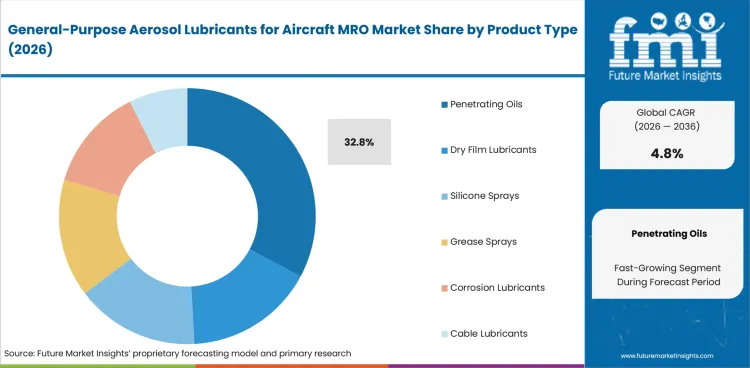
- Penetrating oils are projected to account for 32.8% share in 2026 due to mechanics needing fast release of tight fasteners and hinge points during aircraft checks.
- Dry film lubricants gain value as repair teams seek cleaner application on tracks and access areas requiring low residue after service work.
Insights into General-Purpose Aerosol Lubricants for Aircraft MRO Market by Chemistry
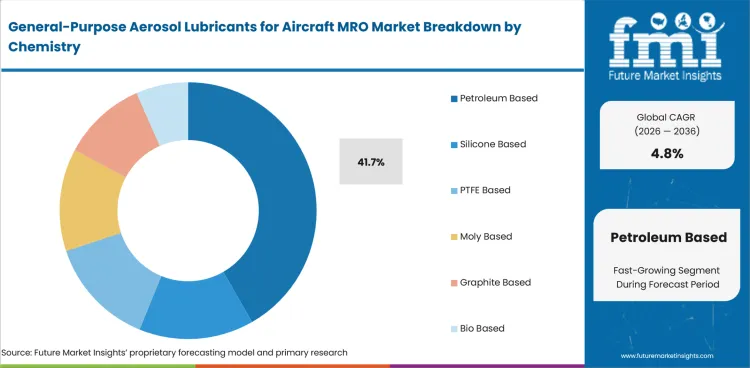
- Petroleum-based chemistry is expected to represent 41.7% share in 2026 with broad use across routine lubrication and moisture-control tasks.
- PTFE-based and moly-based formulations are gaining selective use as aircraft maintenance teams compare friction control with chemical documentation needs.
Insights into General-Purpose Aerosol Lubricants for Aircraft MRO Market by Aircraft Area
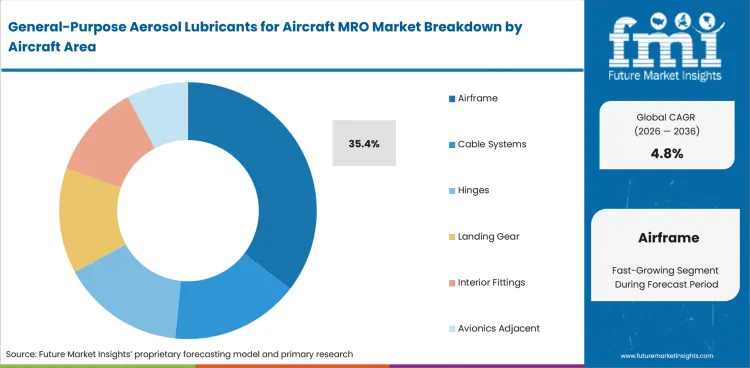
- Airframe work is forecast to hold 35.4% share in 2026, reflecting hinges and access panels need repeated movement control during line checks.
- Cable systems maintain steady demand as technicians use aerosol cans to reach confined runs without setting up bulk dispensing tools.
Insights into General-Purpose Aerosol Lubricants for Aircraft MRO Market by End Use
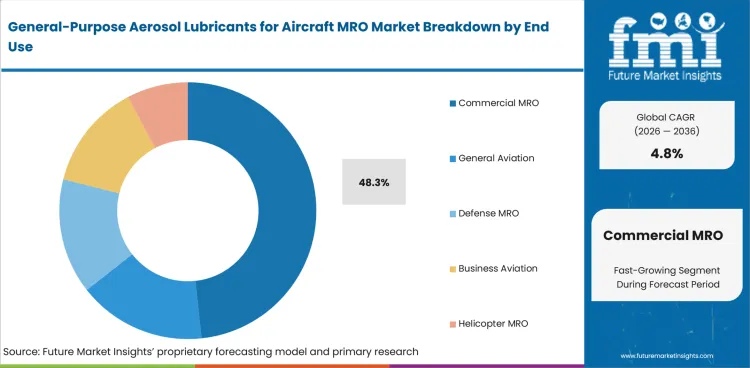
- Commercial MRO is anticipated to capture 48.3% share in 2026 as airline checks influence repeat orders for approved spray lubricants.
- General aviation service adds value as smaller repair shops need easy-to-use cans for hinges and control linkages during scheduled maintenance.
Insights into General-Purpose Aerosol Lubricants for Aircraft MRO Market by Sales Channel
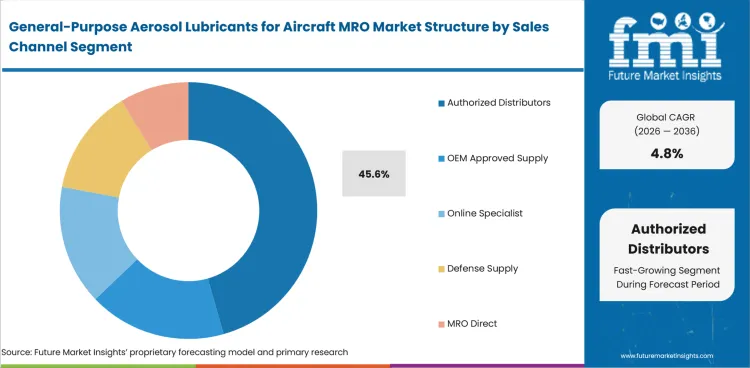
- Authorized distributors are expected to direct 45.6% share in 2026 through documented supply and ready stock for approved aircraft maintenance products.
- MRO direct supply gains relevance as large repair sites standardize aerosol lubricants across hangar stores and recurring work packs.
General-Purpose Aerosol Lubricants for Aircraft MRO Market Drivers, Restraints and Opportunities
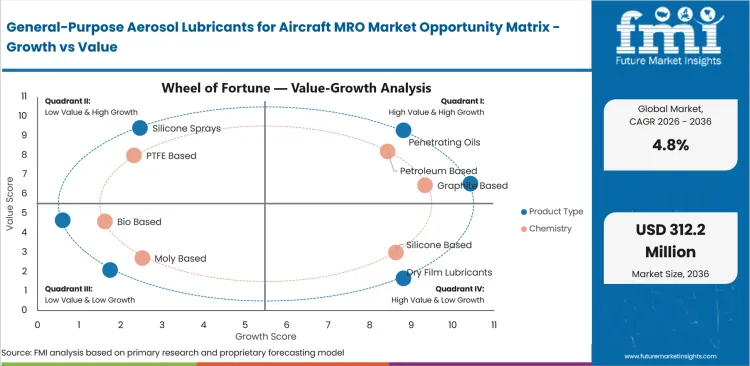
- Driver: Extended aircraft use increases repeat lubrication work around hinges and access hardware during scheduled maintenance.
- Restraint: Aerosol formulation choices face tighter scrutiny as solvent content and chemical reporting rules affect supplier acceptance.
- Opportunity: Traceable distributor supply gives brands a stronger route into maintenance stores avoiding undocumented chemical stock.
Aircraft service activity is expected to keep aerosol lubricant use steady as routine checks increase across active fleets. Airports Council International stated in a July 2025 ICAO working paper, reporting total passenger traffic reached 9.4 billion in 2024 after an 8.4% increase over 2023. Higher traffic raises inspection frequency and supports spray lubricant use around hinges and access panels. U.S. Environmental Protection Agency stated in January 2025, Section 183(e) of the Clean Air Act requires controls on VOC emissions from consumer and commercial product categories which includes aerosol coatings, to reduce ozone-forming emissions. It also states, the 2025 amendments improve consistency between state and federal aerosol coating rules.
Production Capacity and Supplier Footprint Analysis
Production capacity for aircraft MRO aerosol lubricants is likely to stay focussed in specialized aerosol filling regions with strong can-making and formulation support. European Aerosol Federation stated in its September 2025 annual report, the European Union produced over 3.4 billion aerosol units in 2024, with Germany, France, and Italy accounting for over 60% of annual aerosol production.
It also stated, Germany, France, Italy, the Netherlands, and Spain produced over 2.9 billion aerosol dispensers in 2024. Such production footprint supports supply of specialized spray lubricants used in maintenance stores, especially where aircraft chemical distributors need reliable filling capacity and short replenishment cycles.
Import Dependence and Trade Flow Analysis
Import dependence will remain important for aircraft MRO aerosol lubricants since approved aviation consumables move through cross-border aerospace supply networks before reaching repair stations. Aerospace Industries Association reported in June 2025, the United States aerospace and defense sector exported USD 138.6 billion in goods during 2024 and imported USD 64.83 billion in goods used in American technology and servicing.
It also recorded a USD 73.9 billion trade surplus for the sector. This indicates strong export competitiveness even as maintenance supply chains rely on inbound specialty inputs and approved components. Suppliers with trade-ready documentation and regional distributor stock should gain an advantage in aircraft lubricant and commercial aircraft MRO channels.
Analysis of General-Purpose Aerosol Lubricants for Aircraft MRO Market by Key Countries
.webp "Top Country Growth Comparison General Purpose Aerosol Lubricants For Aircraft Mro Market Cagr (2026 2036)")
| Country | CAGR |
|---|---|
| India | 6.7% |
| China | 6.1% |
| Singapore | 5.7% |
| United States | 4.3% |
| France | 4.0% |
| Germany | 3.8% |
| United Kingdom | 3.6% |
Source: Future Market Insights, 2026.
Sales Analysis of General-Purpose Aerosol Lubricants for Aircraft MRO Market in India
Fastest-growing country market · 2026 to 2036
India Market Outlook
- India leads the country set with a 6.7% CAGR by 2036. New airline capacity and local MRO policy support approved aerosol lubricant use across line checks and hangar work.
- India’s supplier structure is moving toward authorized aviation chemical distributors. Airlines need traceable cans for hinges and access hardware as domestic repair work expands.
Key Growth Drivers
- India’s Ministry of Civil Aviation reported in March 2025 stating 149 MROs were approved for line and base maintenance, influencing approved consumable demand for Commercial MRO.
- India’s Ministry of Civil Aviation reported in March 2025 announcing 49 standalone MROs were approved for base maintenance, reflecting wider use of Airframe and Cable Systems lubricants.
- Increase in airports from 74 in 2014 to 164 in 2025 was reported by India’s Ministry of Civil Aviation in 2026, widening line maintenance access for authorized distributors.
Key Restraints
- India’s Ministry of Civil Aviation in March 2025 stated only 7 MROs were approved for aircraft overhaul, limiting deeper use of specialty dry film lubricants.
- India’s MRO base remains uneven across states, resulting in slow stocking of Petroleum Based and PTFE Based aerosol products outside main hubs.
- Import-linked specialty cans can face longer approval paths leading delayed repeat ordering for OEM approved supply programs.
What makes India unique?
India combines fast fleet growth with new domestic maintenance capacity, creating a direct route from airline expansion to approved aerosol lubricant demand.
Key Companies
- ADDEV Materials Zip-Chem
- ITW Pro Brands
- CRC Industries
- DuPont MOLYKOTE
- SOCOMORE
- Callington
- McGean-Rohco Inc.
- ROCOL
Sales & Marketing Channels
- Authorized aviation chemical distributors
- Airline MRO stores
- Aircraft lubricant supply channels
- Commercial aircraft MRO stores
- Airport maintenance hubs
- OEM Approved Supply programs
Market Taxonomy & Sub-Regions Covered
| Segment | Sub-Segments |
|---|---|
| By Product Type | Penetrating Oils · Dry Film Lubricants · Silicone Sprays · Grease Sprays · Corrosion Lubricants · Cable Lubricants |
| By Chemistry | Petroleum Based · Silicone Based · PTFE Based · Moly Based · Graphite Based · Bio Based |
| By Aircraft Area | Airframe · Cable Systems · Hinges · Landing Gear · Interior Fittings · Avionics Adjacent |
| By End Use | Commercial MRO · General Aviation · Defense MRO · Business Aviation · Helicopter MRO |
| By Sales Channel | MRO Direct · Authorized Distributors · OEM Approved Supply · Online Specialist · Defense Supply |
| Key Sub-Regions Covered-States/Airport MRO Hubs | Karnataka, Maharashtra, Delhi NCR, Telangana, Tamil Nadu, Gujarat, Uttar Pradesh, Kerala |
Frequently Asked Questions
How fast is India’s general-purpose aerosol lubricants for aircraft MRO market growing?
India is the fastest-growing country market at 6.7% CAGR from 2026 to 2036.
Who leads the India general-purpose aerosol lubricants for aircraft MRO market?
ADDEV Materials Zip-Chem, ITW Pro Brands and CRC Industries hold strong relevance through aviation chemical and distributor access.
What is driving demand in India?
Growth is led by approved MRO expansion and airline maintenance localization.
Sales Analysis of General-Purpose Aerosol Lubricants for Aircraft MRO Market in China
Second-fastest-growing country market · 2026 to 2036
China Market Outlook
- China is expected to expand at 6.1% CAGR by 2036. Large civil aviation traffic and localized maintenance activity support aerosol lubricant use across airframe access points and cable systems.
- China’s supplier structure depends on local documentation and distributor stock near major aviation clusters. Imported brands need Chinese-language safety data and approved channel support before gaining repeat orders.
Key Growth Drivers
- State Council of the People’s Republic of China reported in January 2026 that China’s civil aviation passenger traffic exceeded 770 million trips in 2025. This supports repeat line maintenance demand for commercial aircraft MRO products.
- State Council of the People’s Republic of China reported in January 2026, cargo and mail traffic exceeded 10 million tonnes in 2025. This supports lubricant use around cargo doors and airframe service points.
- The same State Council update stated that China’s civil aviation sector achieved steady growth in 2025. This supports wider use of approved aerosol lubricants through local MRO stores and Authorized Distributors.
Key Restraints
- High activity around major airport hubs concentrates distributor demand. This can limit channel reach for new aerosol lubricant brands outside core maintenance locations.
- Imported aerosol lubricants need localized safety data and approval support. This can slow acceptance for PTFE Based and Moly Based formulations.
- Domestic product familiarity creates pricing pressure. This can limit premium positioning for specialized Dry Film Lubricants.
What makes China unique?
China combines large aircraft activity with maintenance localization. Brands need approval proof, local documentation and distributor availability before scaling across airline maintenance stores.
Key Companies
- CRC Industries China
- ITW Pro Brands
- ADDEV Materials Zip-Chem
- DuPont MOLYKOTE
- SOCOMORE
- Callington
- McGean-Rohco Inc.
- ROCOL
Sales & Marting keChannels
- Local aviation chemical distributors
- Airline maintenance depots
- Aircraft lubricant stockists
- Commercial aircraft MRO supply programs
- Airport repair hubs
- OEM Approved Supply programs
Market Taxonomy & Sub-Regions Covered
| Segment | Sub-Segments |
|---|---|
| By Product Type | Penetrating Oils · Dry Film Lubricants · Silicone Sprays · Grease Sprays · Corrosion Lubricants · Cable Lubricants |
| By Chemistry | Petroleum Based · Silicone Based · PTFE Based · Moly Based · Graphite Based · Bio Based |
| By Aircraft Area | Airframe · Cable Systems · Hinges · Landing Gear · Interior Fittings · Avionics Adjacent |
| By End Use | Commercial MRO · General Aviation · Defense MRO · Business Aviation · Helicopter MRO |
| By Sales Channel | MRO Direct · Authorized Distributors · OEM Approved Supply · Online Specialist · Defense Supply |
| Key Sub-Regions Covered - Provinces / Municipalities | Guangdong, Shanghai, Beijing, Sichuan, Zhejiang, Jiangsu, Shandong, Hainan |
Frequently Asked Questions
How fast is China’s general-purpose aerosol lubricants for aircraft MRO market growing?
China is the second-fastest-growing country market at 6.1% CAGR from 2026 to 2036.
Who leads the China general-purpose aerosol lubricants for aircraft MRO market?
CRC Industries, ITW Pro Brands and ADDEV Materials Zip-Chem compete through MRO chemical access and aviation product coverage.
What is driving demand in China?
Growth is led by civil aviation passenger traffic and localized maintenance demand.
Sales Analysis of General-Purpose Aerosol Lubricants for Aircraft MRO Market in Singapore
Regional MRO hub · 2026 to 2036
Singapore Market Outlook
- Singapore is forecast to grow at 5.7% CAGR by 2036. The country acts as a regional maintenance base rather than a large domestic fleet market.
- Aircraft aerosol lubricant demand is tied to high-value MRO work and regional line maintenance. Repair teams need approved products with strong documentation and low-waste application.
Key Growth Drivers
- Changi Airport Group reported in May 2025 that FY2024/25 passenger traffic increased 9% to 68.4 million, promoting frequent aircraft turn activity.
- SIA Engineering reported in May 2025, its line maintenance network would extend to 36 airports in 9 countries, influencing regional aerosol lubricant adoption.
- Changi Airport Group reported in January 2026 that Changi handled 69.98 million passengers in 2025. This supports repeat commercial aircraft MRO demand.
Key Restraints
- Singapore’s domestic aircraft base is limited. This makes demand dependent on regional airline and third-party MRO activity.
- High facility and labor costs increase pressure to reduce aerosol waste. This can slow acceptance for poorly controlled spray formats.
- Regional repair concentration creates selective supplier approval. This limits brands without strong documentation and distributor support.
What makes Singapore unique?
Singapore converts regional MRO concentration into high-value consumable demand. Approved aerosol lubricants gain value through documentation and fast regional supply.
Key Companies
- SOCOMORE
- ADDEV Materials Zip-Chem
- CRC Industries
- ITW Pro Brands
- DuPont MOLYKOTE
- Callington
- McGean-Rohco Inc.
- ROCOL
- Sales & Marketing Channels
- Regional aviation chemical distributors
- Third-party MRO stores
Commercial aircraft MRO service channels
- Aircraft lubricant suppliers
- Changi-linked repair hubs
- Specialist aerospace importers
Market Taxonomy & Sub-Regions Covered
| Segment | Sub-Segments |
|---|---|
| By Product Type | Penetrating Oils · Dry Film Lubricants · Silicone Sprays · Grease Sprays · Corrosion Lubricants · Cable Lubricants |
| By Chemistry | Petroleum Based · Silicone Based · PTFE Based · Moly Based · Graphite Based · Bio Based |
| By Aircraft Area | Airframe · Cable Systems · Hinges · Landing Gear · Interior Fittings · Avionics Adjacent |
| By End Use | Commercial MRO · General Aviation · Defense MRO · Business Aviation · Helicopter MRO |
| By Sales Channel | MRO Direct · Authorized Distributors · OEM Approved Supply · Online Specialist · Defense Supply |
| Key Sub-Regions Covered - Aviation Zones / Industrial Areas | Changi, Seletar, Loyang, Tampines, Jurong, Tuas, Paya Lebar, Airport Logistics Park |
Frequently Asked Questions
How fast is Singapore’s general-purpose aerosol lubricants for aircraft MRO market growing?
Singapore is anticipated to grow at 5.7% CAGR from 2026 to 2036.
Who leads the Singapore general-purpose aerosol lubricants for aircraft MRO market?
SOCOMORE, ADDEV Materials Zip-Chem and CRC Industries are relevant through aviation chemical distribution and regional MRO supply.
What is driving demand in Singapore?
Growth is driven by regional line maintenance and traceable aircraft chemical supply.Sales Analysis of General-Purpose Aerosol Lubricants for Aircraft MRO Market in the United States
Largest country opportunity · 2026 to 2036
United States Market Outlook
- The United States is expected to grow at 4.3% CAGR by 2036. Airline operations and repair-station activity create the broadest country opportunity in the covered set.
- Supplier strength depends on aviation familiarity and distributor reach. Repair stations prefer products with safety data and repeatable stock availability.
Key Growth Drivers
- The Bureau of Transportation Statistics reported in March 2026 that U.S. airlines carried 81.2 million scheduled passengers in December 2025. This supports recurring aircraft service routines.
- The Bureau of Transportation Statistics reported 69.9 million domestic passengers in December 2025. This supports frequent line maintenance demand.
- The Bureau of Transportation Statistics reported 11.3 million international passengers in December 2025. This supports cross-border aircraft service needs.
Key Restraints
- USA Department of Transportation Office of Inspector General reported 33% vacancies in one FAA certificate management office as of July 2025. This can slow oversight and approval workflows for maintenance channels.
- The same oversight review found that 13 of 22 required inspections were not completed in fiscal year 2024 for certain essential maintenance providers. This increases compliance pressure on repair stations.
- Distributor fragmentation across general aviation and airline maintenance can limit consistent stock placement for specialty Dry Film Lubricants.
What makes the United States unique?
The United States combines airline MRO scale with a large general aviation service base. This creates wider aerosol lubricant demand across commercial and smaller aircraft maintenance.
Key Companies
- ITW Pro Brands
- CRC Industries
- ADDEV Materials Zip-Chem
- DuPont MOLYKOTE
- SOCOMORE
- McGean-Rohco Inc.
- Callington
- ROCOL
Sales & Marketing Channels
- Authorized distributors
- Independent repair stations
- Airline maintenance stores
- Aircraft lubricant channels
- Commercial aircraft MRO programs
- General aviation service centers
Market Taxonomy & Sub-Regions Covered
| Segment | Sub-Segments |
|---|---|
| By Product Type | Penetrating Oils · Dry Film Lubricants · Silicone Sprays · Grease Sprays · Corrosion Lubricants · Cable Lubricants |
| By Chemistry | Petroleum Based · Silicone Based · PTFE Based · Moly Based · Graphite Based · Bio Based |
| By Aircraft Area | Airframe · Cable Systems · Hinges · Landing Gear · Interior Fittings · Avionics Adjacent |
| By End Use | Commercial MRO · General Aviation · Defense MRO · Business Aviation · Helicopter MRO |
| By Sales Channel | MRO Direct · Authorized Distributors · OEM Approved Supply · Online Specialist · Defense Supply |
| Key Sub-Regions Covered - States / Aviation Hubs | Texas, Florida, California, Georgia, Washington, Arizona, Ohio, North Carolina |
Frequently Asked Questions
How fast is the United States general-purpose aerosol lubricants for aircraft MRO market growing?
The United States is expected to rise at 4.3% CAGR from 2026 to 2036.
Who leads the United States general-purpose aerosol lubricants for aircraft MRO market?
ITW Pro Brands and CRC Industries hold strong channel relevance, while ADDEV Materials Zip-Chem supports aircraft-specific supply.
What is driving demand in the United States?
Demand is driven by airline service volume and wide repair-station coverage.Sales Analysis of General-Purpose Aerosol Lubricants for Aircraft MRO Market in France
European aerospace chemical hub · 2026 to 2036
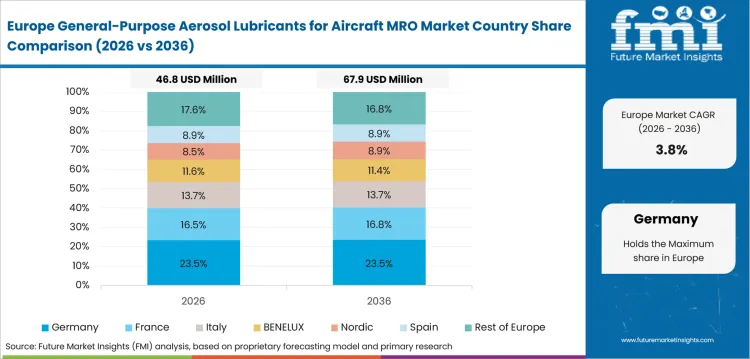
France Market Outlook
- France is projected at 4.0% CAGR by 2036. Aerospace service links and European chemical supply make France important for approved aerosol lubricant demand.
- Supplier relevance is shaped by documentation and aircraft chemical know-how. France also benefits from proximity to European aerosol filling capacity and specialist aviation chemical suppliers.
Key Growth Drivers
- Groupe ADP reported in January 2026 that Paris Aéroport traffic reached 107.0 million passengers in full-year 2025. This supports repeated aircraft servicing.
- Groupe ADP reported in January 2026 that full-year Group traffic reached 379.0 million passengers in 2025. This supports maintenance consumable flow across French-linked airports.
- Eurostat reported in December 2025 that Paris Charles de Gaulle recorded 70 million passengers in 2024. This supports high Commercial MRO activity around France’s main hub.
Key Restraints
- Groupe ADP reported in January 2026 that Paris Aéroport traffic rose only 3.4% in 2025. This signals steadier volume growth than India and China.
- European chemical documentation adds time before new aerosol products enter approved MRO stores. This can slow supplier switching.
- Premium labor and facility costs increase pressure to limit overspray and waste from aerosol cans.
What makes France unique?
France combines aerospace service activity with aviation chemical specialization. Suppliers win when approval records and repair-site confidence support repeat orders.
Key Companies
- SOCOMORE
- ADDEV Materials Zip-Chem
- DuPont MOLYKOTE
- CRC Industries
- ITW Pro Brands
- McGean-Rohco Inc.
- ROCOL
- Callington
Sales & Marketing Channels
- Aviation chemical distributors
- Aerospace MRO stores
- Aircraft lubricant supply routes
- Commercial aircraft MRO channels
- Engine service supply channels
- OEM Approved Supply programs
Market Taxonomy & Sub-Regions Covered
| Segment | Sub-Segments |
|---|---|
| By Product Type | Penetrating Oils · Dry Film Lubricants · Silicone Sprays · Grease Sprays · Corrosion Lubricants · Cable Lubricants |
| By Chemistry | Petroleum Based · Silicone Based · PTFE Based · Moly Based · Graphite Based · Bio Based |
| By Aircraft Area | Airframe · Cable Systems · Hinges · Landing Gear · Interior Fittings · Avionics Adjacent |
| By End Use | Commercial MRO · General Aviation · Defense MRO · Business Aviation · Helicopter MRO |
| By Sales Channel | MRO Direct · Authorized Distributors · OEM Approved Supply · Online Specialist · Defense Supply |
| Key Sub-Regions Covered - Regions / Aerospace Hubs | Île-de-France, Occitanie, Nouvelle-Aquitaine, Provence-Alpes-Côte d’Azur, Auvergne-Rhône-Alpes, Grand Est, Pays de la Loire, Brittany |
Frequently Asked Questions
How fast is France’s general-purpose aerosol lubricants for aircraft MRO market growing?
France is projected at 4.0% CAGR from 2026 to 2036.
Who leads the France general-purpose aerosol lubricants for aircraft MRO market?
SOCOMORE, ADDEV Materials Zip-Chem and DuPont MOLYKOTE are relevant through aviation chemical and lubricant evidence.
What is driving demand in France?
Demand is driven by Paris-linked aircraft activity and European chemical documentation.
Sales Analysis of General-Purpose Aerosol Lubricants for Aircraft MRO Market in Germany
Precision MRO country market · 2026 to 2036
Germany Market Outlook
- Germany is forecast at 3.8% CAGR by 2036. Process discipline and component repair requirements shape aerosol lubricant buying across German MRO channels.
- The country is a quality-driven market rather than a high-speed growth market. Buyers favor documented products and controlled application around components.
Key Growth Drivers
- Fraport reported in January 2026 that Frankfurt Airport welcomed around 63.2 million passengers in 2025. This supports scheduled maintenance activity.
- Lufthansa Group reported in 2026 that MRO segment revenue rose 12% in 2025 to EUR 8,049 million. This supports higher maintenance service activity.
- Eurostat reported that Frankfurt Main handled 61.5 million passengers in 2024. This supports recurring aircraft check activity around Germany’s main hub.
Key Restraints
- Fraport reported in January 2026 that Frankfurt passenger growth was around 2.6% in 2025. This indicates slower traffic expansion than Asian repair hubs.
- German repair channels often require strong proof before accepting substitute aerosols. This can slow entry for new PTFE Based products.
- Component repair discipline limits low-documentation products. This reduces opportunity for generic aerosol suppliers.
What makes Germany unique?
Germany is a documentation-led MRO consumables market. Suppliers need repeatable product behavior and clear approval support before repair sites switch.
Key Companies
- DuPont MOLYKOTE
- ROCOL
- SOCOMORE
- ADDEV Materials Zip-Chem
- ITW Pro Brands
- CRC Industries
- McGean-Rohco Inc.
- Callington
Sales & Marketing Channels
- Authorized aerospace distributors
- Component repair shops
- Airline maintenance stores
- Aircraft lubricant supply channels
- Commercial aircraft MRO channels
- European MRO buying groups
Market Taxonomy & Sub-Regions Covered
| Segment | Sub-Segments |
|---|---|
| By Product Type | Penetrating Oils · Dry Film Lubricants · Silicone Sprays · Grease Sprays · Corrosion Lubricants · Cable Lubricants |
| By Chemistry | Petroleum Based · Silicone Based · PTFE Based · Moly Based · Graphite Based · Bio Based |
| By Aircraft Area | Airframe · Cable Systems · Hinges · Landing Gear · Interior Fittings · Avionics Adjacent |
| By End Use | Commercial MRO · General Aviation · Defense MRO · Business Aviation · Helicopter MRO |
| By Sales Channel | MRO Direct · Authorized Distributors · OEM Approved Supply · Online Specialist · Defense Supply |
| Key Sub-Regions Covered - States / Aviation Hubs | Hesse, Bavaria, Hamburg, North Rhine-Westphalia, Lower Saxony, Baden-Württemberg, Berlin-Brandenburg, Saxony |
Frequently Asked Questions
How fast is Germany’s general-purpose aerosol lubricants for aircraft MRO market growing?
Germany is forecast at 3.8% CAGR from 2026 to 2036.
Who leads the Germany general-purpose aerosol lubricants for aircraft MRO market?
DuPont MOLYKOTE, ROCOL and SOCOMORE are relevant through specialty lubricant and aircraft chemical positions.
What is driving demand in Germany?
Demand is driven by component repair activity and documented MRO material requirements.
Sales Analysis of General-Purpose Aerosol Lubricants for Aircraft MRO Market in the United Kingdom
Established aviation service country market · 2026 to 2036
United Kingdom Market Outlook
- The United Kingdom is expected to post 3.6% CAGR by 2036. Established airline maintenance activity and regulated repair approvals support steady aerosol lubricant demand.
- The country’s value comes from documentation-heavy repair work. Brands need traceable supply and product proof before repeat store placement.
Key Growth Drivers
- UK Civil Aviation Authority reported in February 2026 that UK airports handled 302 million passengers in 2025. This supports recurring aircraft maintenance activity.
- UK Civil Aviation Authority reported in March 2025 that over 600 U.S.-based maintenance organization approvals were issued during 2024 to 2025. This supports cross-border maintenance coverage.
- UK Civil Aviation Authority reported in February 2026 that passenger numbers increased 2% in 2025. This supports steady line maintenance needs.
Key Restraints
- UK Civil Aviation Authority annual accounts reported that U.S.-based maintenance organizations now require UK Part-145 approval for UK aircraft work. This adds compliance steps for overseas service providers.
- The UK market grows from an established aviation base. This limits faster volume expansion compared with India and China.
- Skilled repair capacity can slow new aerosol product evaluation. This supports familiar brands and approved distributor stock.
What makes the United Kingdom unique?
The United Kingdom is a regulated maintenance market with cross-border approval needs. Aerosol lubricant brands must prove fit for Part 145-linked repair work.
Key Companies
- ROCOL
- ITW Pro Brands
- CRC Industries
- DuPont MOLYKOTE
- ADDEV Materials Zip-Chem
- SOCOMORE
- Callington
- McGean-Rohco Inc.
Sales & Marketing Channels
- Authorized distributors
- Part 145 repair stations
- Airline maintenance stores
- Commercial aircraft MRO supply programs
- Aircraft lubricant channels
- Business aviation service centers
Market Taxonomy & Sub-Regions Covered
| Segment | Sub-Segments |
|---|---|
| By Product Type | Penetrating Oils · Dry Film Lubricants · Silicone Sprays · Grease Sprays · Corrosion Lubricants · Cable Lubricants |
| By Chemistry | Petroleum Based · Silicone Based · PTFE Based · Moly Based · Graphite Based · Bio Based |
| By Aircraft Area | Airframe · Cable Systems · Hinges · Landing Gear · Interior Fittings · Avionics Adjacent |
| By End Use | Commercial MRO · General Aviation · Defense MRO · Business Aviation · Helicopter MRO |
| By Sales Channel | MRO Direct · Authorized Distributors · OEM Approved Supply · Online Specialist · Defense Supply |
| Key Sub-Regions Covered - Nations / Aviation Hubs | England, Scotland, Wales, Northern Ireland, Greater London, West Midlands, South East England, North West England |
Frequently Asked Questions
How fast is the United Kingdom general-purpose aerosol lubricants for aircraft MRO market growing?
The United Kingdom is expected to post 3.6% CAGR from 2026 to 2036.
Who leads the United Kingdom general-purpose aerosol lubricants for aircraft MRO market?
ROCOL, ITW Pro Brands and CRC Industries are relevant through lubricant supply and MRO chemical channel reach.
What is driving demand in the United Kingdom?
Demand is driven by airport passenger activity, Part 145-linked approval needs and distributor-backed chemical supply.
Competitive Landscape and Strategic Positioning
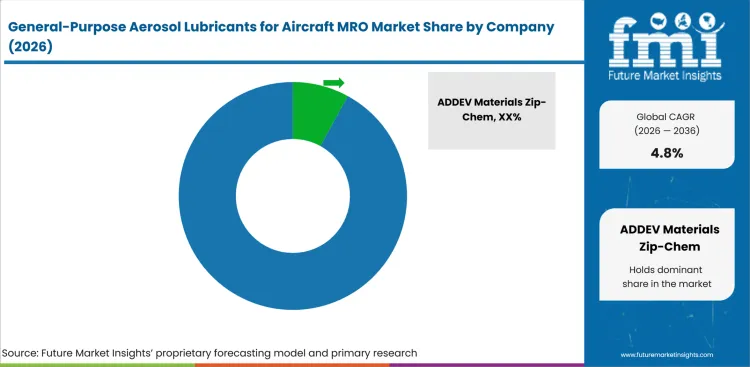
- Brands world-wide hold an advantage through aviation approvals and distributor reach across aircraft maintenance stores.
- Specialist aviation chemical suppliers compete based on aircraft task fit and packaging options suited to hangar work.
- Entry barriers come from safety data and approval evidence as buyers avoid unproven substitute products.
- Smaller suppliers can gain share when they reduce waste and simplify documentation for specific repair tasks.
Competition is shaped by approval proof and repair-station trust. ITW Pro Brands and CRC Industries compete depending on established maintenance chemical ranges used by aviation service teams. ADDEV Materials Zip-Chem and McGean-Rohco hold stronger specialist positions led by aircraft chemical depth. Buyers compare suppliers on task fit and safety document quality before price becomes the main issue.
Supplier positioning is also shaped by chemistry and application control. DuPont MOLYKOTE gives the field a dry-film lubricant angle for parts requiring low-friction coating support. SOCOMORE adds water-displacing and surface treatment capability for aircraft maintenance environments. ROCOL and Callington support smaller service needs through practical chemical ranges and distributor-led access.
Specialist suppliers can win by narrowing focus around aviation packaging and traceability. Repair stations need products which mechanics understand and material controllers can record easily. Aerosol lubricant suppliers combining clean application with batch-level documents can strengthen repeat orders. Channel training therefore becomes more valuable than product description alone.
Key Companies in the General-Purpose Aerosol Lubricants for Aircraft MRO Market
Competitive structure is better understood by aviation chemical specialists and broad MRO chemical brands. Aerospace lubricant specialists form the third competitive group.
Aviation chemical specialists: ADDEV Materials Zip-Chem and McGean-Rohco focus on aircraft maintenance products for cables and airframes. Callington and SOCOMORE support aviation maintenance driven by specialty chemical formats and surface-care products.
Broad MRO chemical brands: ITW Pro Brands and CRC Industries compete with wide maintenance chemical ranges and distributor access. Repair stations use these brands where familiar shop products need aviation-ready documentation.
Aerospace lubricant specialists: ROCOL and DuPont MOLYKOTE compete led by lubricant chemistry depth and specialty friction-control products. Their role is stronger in selected applications than in broad aerosol shop supply.
Competitive Benchmarking: General-Purpose Aerosol Lubricants for Aircraft MRO Market
| Company | Aviation Approval Depth | Aerosol Packaging Control | MRO Channel Reach | Geographic Footprint |
|---|---|---|---|---|
| ADDEV Materials Zip-Chem | Very Strong | Very Strong | Strong | Global aviation |
| ITW Pro Brands | Strong | Strong | Very Strong | Global |
| CRC Industries | Strong | Strong | Strong | North America and Europe |
| McGean-Rohco | Strong | Moderate | Strong | Global aviation |
| SOCOMORE | Strong | Strong | Moderate | Europe and global |
| DuPont MOLYKOTE | Strong | Moderate | Strong | Global |
| Callington | Moderate | Strong | Moderate | Asia Pacific and global |
| ROCOL | Moderate | Moderate | Moderate | Europe and export |
Source: Future Market Insights competitive analysis 2026. Ratings reflect approval depth, aerosol packaging control and MRO channel reach.
Key Developments in General-Purpose Aerosol Lubricants for Aircraft MRO Market
- In February 2025, Lufthansa Technik and WestJet signed a 15-year engine maintenance agreement and announced a new Calgary repair station for LEAP-1B engines.
- In September 2025, Zip-Chem published its aviation product brochure listing Aero-Lube aerosol lubricants for cables and tracks.
- In September 2025, GE Aerospace announced a USD 75.0 million Asia Pacific MRO investment to expand engine test cells and repair capability.
Key Players in the General-Purpose Aerosol Lubricants for Aircraft MRO Market
- ADDEV Materials Zip-Chem
- McGean-Rohco Inc.
- Callington
- ITW Pro Brands
- CRC Industries
- ROCOL
- DuPont MOLYKOTE
- SOCOMORE
Market Report Scope
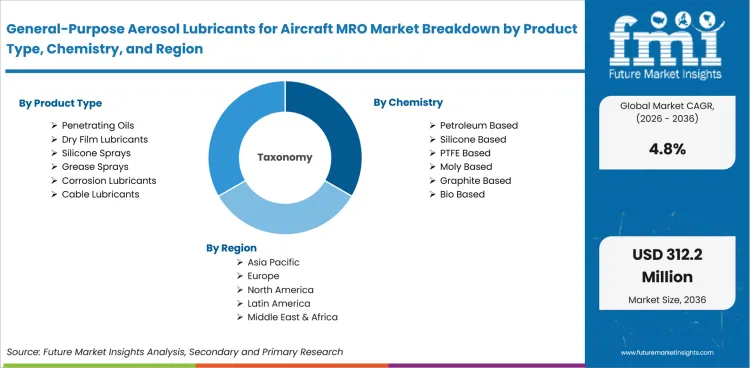
| Parameter | Details |
|---|---|
| Quantitative units | USD 195.3 million to USD 312.1 million at 4.8% CAGR |
| Market definition | Finished aerosol lubricants sold for aircraft maintenance, repair, and overhaul tasks |
| By product type | Penetrating oils, dry film lubricants, silicone sprays, grease sprays, corrosion lubricants, cable lubricants |
| By chemistry | Petroleum based, silicone based, PTFE based, moly based, graphite based, bio based |
| By aircraft area | Airframe, cable systems, hinges, landing gear, interior fittings, avionics adjacent |
| By end use | Commercial MRO, general aviation, defense MRO, business aviation, helicopter MRO |
| By sales channel | MRO direct, authorized distributors, OEM approved supply, online specialist, defense supply |
| Regions covered | North America, Latin America, Europe, East Asia, South Asia and Pacific, Middle East and Africa |
| Countries covered | India, China, Singapore, United States, France, Germany, United Kingdom, 30+ countries |
| Key companies profiled | ADDEV Materials Zip-Chem, McGean-Rohco Inc., Callington, ITW Pro Brands, CRC Industries, ROCOL, DuPont MOLYKOTE, SOCOMORE
|
| Forecast period | 2026 to 2036 |
| Approach | Hybrid bottom-up and top-down methodology using aircraft maintenance intensity, aerosol can usage, distributor checks, and country MRO signals |
Source: Future Market Insights, 2026.
General-Purpose Aerosol Lubricants for Aircraft MRO Market Breakdown by Product Type, Chemistry, Aircraft Area, End Use, Sales Channel, and Region
By Product Type
- Penetrating Oils
- Dry Film Lubricants
- Silicone Sprays
- Grease Sprays
- Corrosion Lubricants
- Cable Lubricants
By Chemistry
- Petroleum Based
- Silicone Based
- PTFE Based
- Moly Based
- Graphite Based
- Bio Based
By Aircraft Area
- Airframe
- Cable Systems
- Hinges
- Landing Gear
- Interior Fittings
- Avionics Adjacent
By End Use
- Commercial MRO
- General Aviation
- Defense MRO
- Business Aviation
- Helicopter MRO
By Sales Channel
- MRO Direct
- Authorized Distributors
- OEM Approved Supply
- Online Specialist
- Defense Supply
By Region
- North America
- United States
- Canada
- Mexico
- Latin America
- Brazil
- Chile
- Rest of Latin America
- Europe
- Germany
- United Kingdom
- France
- Italy
- Spain
- Rest of Europe
- East Asia
- China
- Japan
- South Korea
- South Asia and Pacific
- India
- ASEAN
- Singapore
- Australia and New Zealand
- Middle East and Africa
- Kingdom of Saudi Arabia
- United Arab Emirates
- South Africa
- Rest of Middle East and Africa
Research Sources and Bibliography
- Ministry of Civil Aviation. (2025, March). Annual report 2024–25. Government of India.
- China Daily. (2026, January 7). Civil aviation soars and aims to go higher in 2026.
- Changi Airport Group. (2025, May 23). Changi Airport Group posts strong recovery in FY2024/25. Singapore Exchange.
- SIA Engineering Company. (2025, May 9). SIA Engineering Group full year results for the year ended 31 March 2025.
- Changi Airport Group. (2026). Traffic statistics and data.
- Bureau of Transportation Statistics. (2026, March 17). December 2025 U.S. airline traffic data down 2.6% from the same month last year. U.S. Department of Transportation.
- Aéroports de Paris SA. (2026, January 15). December and full-year 2025 traffic figures.
- Eurostat. (2025, December). Air passenger transport statistics. European Commission.
- Fraport AG. (2026, January 16). Fraport traffic figures 2025: Broad growth across airport portfolio.
- Lufthansa Group. (2026). MRO business segment. In Annual report 2025.
- UK Civil Aviation Authority. (2026, February 26). UK aviation officially breaks records with over 300m passenger journeys in 2025.
- UK Civil Aviation Authority. (2025). CAA annual report and accounts 2024/25.
- Organization for Economic Co-operation and Development. (2025). Per- and polyfluoroalkyl substances (PFAS) and alternatives in hydraulic oils and lubricants: Report on commercial availability and current uses. OECD Publishing.
- DuPont. (2024). MOLYKOTE® D-321 R anti-friction coating. DuPont.
- Electronic Code of Federal Regulations. (2026). 49 CFR § 173.306: Limited quantities of compressed gases. U.S. Government Publishing Office.
- Airbus. (2025, October 9). Airbus projects resilient growth of services market in the next 20 years. Airbus.
- Boeing. (2025). Commercial Services Market Outlook 2025–2044. Boeing.
- Airports Council International. (2025, July 29). State of the industry and outlook for airport traffic. International Civil Aviation Organization.
- European Aerosol Federation. (2025, September). FEA annual report 2025.
- Aerospace Industries Association. (2025, June 10). 2025 facts & figures: American aerospace and defense industry continues economic dominance.
- USA Environmental Protection Agency. (2025, January 6). Fact sheet: Final amendments to aerosol coatings national volatile organic compound emission standards.
- Civil Aviation Administration of China. (2026, April 22). CAAC releases statistical bulletin of civil aviation industry development in 2025.
- Ministry of Civil Aviation. (2026, March 21). Annual report 2025–26. Government of India.
- Safran. (2025, November 26). Safran steps up expansion in India for civil and military aviation and deepens commitment to “Make in India”. Safran Group.
- GE Aerospace. (2025, September 3). GE Aerospace investing US$75 million to expand and upgrade MRO facilities in Asia Pacific. GE Aerospace.
- Zip-Chem Products. (2025, September 9). Zip-Chem aviation product brochure. Zip-Chem Products.
- Lufthansa Technik. (2025, February 13). WestJet and Lufthansa Technik sign multi-billion-dollar agreement for world-class aircraft engine maintenance services. Lufthansa Technik.
- Royal Aeronautical Society. (2026, March). Addressing civil aviation engineering and maintenance personnel shortages. Royal Aeronautical Society.
Bibliography uses official public body and company sources from 2025 onward.
This Report Answers
- What is the 2026 value of the general-purpose aerosol lubricants for aircraft MRO market?
- What is the 2036 forecast value for general-purpose aerosol lubricants used in aircraft MRO?
- Which end use is projected to hold the leading 2026 share in this market?
- Which sales channel is expected to account for the leading share in 2026?
- How do aviation approvals and distributor records influence aerosol lubricant buying?
- Which countries are forecast to expand faster than the market average world-wide?
- Which companies sell or support aircraft maintenance aerosol lubricant products?
- How does FMI size and forecast this aircraft MRO aerosol lubricant category?
Frequently Asked Questions
What is the general-purpose aerosol lubricants for aircraft MRO market value in 2026?
In 2026, the general-purpose aerosol lubricants for aircraft MRO market value is anticipated to cross USD 195.3 million.
What will the general-purpose aerosol lubricants for aircraft MRO market reach by 2036?
By 2036, the general-purpose aerosol lubricants for aircraft MRO industry revenue is projected to reach USD 312.1 million.
What CAGR is projected for the general-purpose aerosol lubricants for aircraft MRO market?
The sector is expected to expand at 4.8% CAGR from 2026 to 2036 as repeat maintenance work supports can demand.
Which product type leads the general-purpose aerosol lubricants for aircraft MRO market?
Penetrating oils are projected to lead with 32.8% share in 2026, reflecting tight parts needing fast wetting.
Which end use leads the general-purpose aerosol lubricants for aircraft MRO market?
Commercial MRO is expected to garner 48.3% share in 2026, led by airline maintenance influencing repeat can demand.
Which sales channel leads the general-purpose aerosol lubricants for aircraft MRO market?
Authorized distributors are forecast to hold 45.6% share in 2026 since repair stations prefer traceable chemical supply.
Which country grows fastest in the general-purpose aerosol lubricants for aircraft MRO market?
India is projected to record 6.7% CAGR by 2036 as new maintenance capacity expands approved consumable demand.
What is included in the general-purpose aerosol lubricants for aircraft MRO market?
Scope covers spray-packaged lubricants used on hinges and cables. Airframe joints and approved adjacent areas are counted when lubrication is the main task.
Preview the report firsthand - request a free sample
Get SampleGet the brochure for pricing and purchase details.
Get PDFTable of Content
- Key Takeaways
- Market Size and CAGR
- Top Growth Driver
- Fastest Growing Segment
- Leading Region
- Key Companies
- Emerging Opportunities
- Executive Summary
- Global Market Outlook
- Demand-side Trends
- Supply-side Trends
- Technology Roadmap Analysis
- Analysis and Recommendations
- Analyst Perspective (What is happening? Why now? What should investors know?)
- Key Questions Answered
- How large is the market?
- What is the CAGR?
- What are key trends?
- Which region dominates?
- Who are the leaders?
- Market Overview
- Market Coverage / Taxonomy
- Market Definition / Scope / Limitations
- Research Methodology
- Chapter Orientation
- Analytical Lens and Working Hypotheses
- Market Structure, Signals, and Trend Drivers
- Benchmarking and Cross-market Comparability
- Market Sizing, Forecasting, and Opportunity Mapping
- Research Design and Evidence Framework
- Desk Research Programme (Secondary Evidence)
- Expert Input and Fieldwork (Primary Evidence)
- Tooling, Models, and Reference Databases
- Data Engineering and Model Build
- Quality Assurance and Audit Trail
- Market Background
- Market Dynamics (Drivers, Restraints, Opportunity, Trends)
- Scenario Forecast (Optimistic, Likely, Conservative)
- Impact Analysis
- AI Impact
- Sustainability Impact
- Regulatory Impact
- Technology Impact
- Consumer / Buyer Analysis
- Purchase Drivers
- Adoption Barriers
- Buyer Journey
- Opportunity Map Analysis
- Product Life Cycle Analysis
- Supply Chain Analysis
- Investment Feasibility Matrix
- Value Chain Analysis
- PESTLE and Porter's Analysis
- Regulatory Landscape
- Regional Parent Market Outlook
- Production and Consumption Statistics
- Import and Export Statistics
- Global Market Analysis and Forecast, 2021 to 2036
- Historical Market Size Value (USD Million) & Volume (Unit) Analysis, 2021 to 2025
- Current and Future Market Size Value (USD Million) & Volume (Unit) Projections, 2026 to 2036
- Y-o-Y Growth Trend Analysis
- Absolute $ Opportunity Analysis
- Global Market Pricing Analysis, 2021 to 2036
- Global Market Analysis and Forecast, By Product Type, 2021 to 2036
- Introduction / Key Findings
- Historical Market Size Value (USD Million) & Volume (Unit) Analysis By Product Type, 2021 to 2025
- Current and Future Market Size Value (USD Million) & Volume (Unit) Analysis and Forecast By Product Type, 2026 to 2036
- Penetrating Oils
- Dry Film Lubricants
- Silicone Sprays
- Grease Sprays
- Corrosion Lubricants
- Cable Lubricants
- Penetrating Oils
- Y-o-Y Growth Trend Analysis By Product Type, 2021 to 2025
- Absolute $ Opportunity Analysis By Product Type, 2026 to 2036
- Global Market Analysis and Forecast, By Chemistry, 2021 to 2036
- Introduction / Key Findings
- Historical Market Size Value (USD Million) & Volume (Unit) Analysis By Chemistry, 2021 to 2025
- Current and Future Market Size Value (USD Million) & Volume (Unit) Analysis and Forecast By Chemistry, 2026 to 2036
- Petroleum Based
- Silicone Based
- PTFE Based
- Moly Based
- Graphite Based
- Bio Based
- Petroleum Based
- Y-o-Y Growth Trend Analysis By Chemistry, 2021 to 2025
- Absolute $ Opportunity Analysis By Chemistry, 2026 to 2036
- Global Market Analysis and Forecast, By Aircraft Area, 2021 to 2036
- Introduction / Key Findings
- Historical Market Size Value (USD Million) & Volume (Unit) Analysis By Aircraft Area, 2021 to 2025
- Current and Future Market Size Value (USD Million) & Volume (Unit) Analysis and Forecast By Aircraft Area, 2026 to 2036
- Airframe
- Cable Systems
- Hinges
- Landing Gear
- Interior Fittings
- Avionics Adjacent
- Airframe
- Y-o-Y Growth Trend Analysis By Aircraft Area, 2021 to 2025
- Absolute $ Opportunity Analysis By Aircraft Area, 2026 to 2036
- Global Market Analysis and Forecast, By End Use, 2021 to 2036
- Introduction / Key Findings
- Historical Market Size Value (USD Million) & Volume (Unit) Analysis By End Use, 2021 to 2025
- Current and Future Market Size Value (USD Million) & Volume (Unit) Analysis and Forecast By End Use, 2026 to 2036
- Commercial MRO
- General Aviation
- Defense MRO
- Business Aviation
- Helicopter MRO
- Commercial MRO
- Y-o-Y Growth Trend Analysis By End Use, 2021 to 2025
- Absolute $ Opportunity Analysis By End Use, 2026 to 2036
- Global Market Analysis and Forecast, By Sales Channel, 2021 to 2036
- Introduction / Key Findings
- Historical Market Size Value (USD Million) & Volume (Unit) Analysis By Sales Channel, 2021 to 2025
- Current and Future Market Size Value (USD Million) & Volume (Unit) Analysis and Forecast By Sales Channel, 2026 to 2036
- Authorized Distributors
- MRO Direct
- OEM Approved Supply
- Online Specialist
- Defense Supply
- Authorized Distributors
- Y-o-Y Growth Trend Analysis By Sales Channel, 2021 to 2025
- Absolute $ Opportunity Analysis By Sales Channel, 2026 to 2036
- Global Market Analysis and Forecast, By Region, 2021 to 2036
- Introduction
- Historical Market Size Value (USD Million) & Volume (Unit) Analysis By Region, 2021 to 2025
- Current Market Size Value (USD Million) & Volume (Unit) Analysis and Forecast By Region, 2026 to 2036
- North America
- Latin America
- Western Europe
- Eastern Europe
- East Asia
- South Asia and Pacific
- Middle East & Africa
- Market Attractiveness Analysis By Region
- North America Market Analysis and Forecast, By Country, 2021 to 2036
- Historical Market Size Value (USD Million) & Volume (Unit) Trend Analysis By Market Taxonomy, 2021 to 2025
- Market Size Value (USD Million) & Volume (Unit) Forecast By Market Taxonomy, 2026 to 2036
- By Country
- USA
- Canada
- Mexico
- By Product Type
- By Chemistry
- By Aircraft Area
- By End Use
- By Sales Channel
- By Country
- Market Attractiveness Analysis
- By Country
- By Product Type
- By Chemistry
- By Aircraft Area
- By End Use
- By Sales Channel
- Key Takeaways
- Latin America Market Analysis and Forecast, By Country
- Historical Market Size Value (USD Million) & Volume (Unit) Trend Analysis By Market Taxonomy, 2021 to 2025
- Market Size Value (USD Million) & Volume (Unit) Forecast By Market Taxonomy, 2026 to 2036
- By Country
- Brazil
- Chile
- Rest of Latin America
- By Product Type
- By Chemistry
- By Aircraft Area
- By End Use
- By Sales Channel
- By Country
- Market Attractiveness Analysis
- By Country
- By Product Type
- By Chemistry
- By Aircraft Area
- By End Use
- By Sales Channel
- Key Takeaways
- Western Europe Market Analysis and Forecast, By Country
- Historical Market Size Value (USD Million) & Volume (Unit) Trend Analysis By Market Taxonomy, 2021 to 2025
- Market Size Value (USD Million) & Volume (Unit) Forecast By Market Taxonomy, 2026 to 2036
- By Country
- Germany
- UK
- Italy
- Spain
- France
- Nordic
- BENELUX
- Rest of Western Europe
- By Product Type
- By Chemistry
- By Aircraft Area
- By End Use
- By Sales Channel
- By Country
- Market Attractiveness Analysis
- By Country
- By Product Type
- By Chemistry
- By Aircraft Area
- By End Use
- By Sales Channel
- Key Takeaways
- Eastern Europe Market Analysis and Forecast, By Country
- Historical Market Size Value (USD Million) & Volume (Unit) Trend Analysis By Market Taxonomy, 2021 to 2025
- Market Size Value (USD Million) & Volume (Unit) Forecast By Market Taxonomy, 2026 to 2036
- By Country
- Russia
- Poland
- Hungary
- Balkan & Baltic
- Rest of Eastern Europe
- By Product Type
- By Chemistry
- By Aircraft Area
- By End Use
- By Sales Channel
- By Country
- Market Attractiveness Analysis
- By Country
- By Product Type
- By Chemistry
- By Aircraft Area
- By End Use
- By Sales Channel
- Key Takeaways
- East Asia Market Analysis and Forecast, By Country
- Historical Market Size Value (USD Million) & Volume (Unit) Trend Analysis By Market Taxonomy, 2021 to 2025
- Market Size Value (USD Million) & Volume (Unit) Forecast By Market Taxonomy, 2026 to 2036
- By Country
- China
- Japan
- South Korea
- By Product Type
- By Chemistry
- By Aircraft Area
- By End Use
- By Sales Channel
- By Country
- Market Attractiveness Analysis
- By Country
- By Product Type
- By Chemistry
- By Aircraft Area
- By End Use
- By Sales Channel
- Key Takeaways
- South Asia and Pacific Market Analysis and Forecast, By Country
- Historical Market Size Value (USD Million) & Volume (Unit) Trend Analysis By Market Taxonomy, 2021 to 2025
- Market Size Value (USD Million) & Volume (Unit) Forecast By Market Taxonomy, 2026 to 2036
- By Country
- India
- ASEAN
- Australia & New Zealand
- Rest of South Asia and Pacific
- By Product Type
- By Chemistry
- By Aircraft Area
- By End Use
- By Sales Channel
- By Country
- Market Attractiveness Analysis
- By Country
- By Product Type
- By Chemistry
- By Aircraft Area
- By End Use
- By Sales Channel
- Key Takeaways
- Middle East & Africa Market Analysis and Forecast, By Country
- Historical Market Size Value (USD Million) & Volume (Unit) Trend Analysis By Market Taxonomy, 2021 to 2025
- Market Size Value (USD Million) & Volume (Unit) Forecast By Market Taxonomy, 2026 to 2036
- By Country
- Kingdom of Saudi Arabia
- Other GCC Countries
- Türkiye
- South Africa
- Other African Union
- Rest of Middle East & Africa
- By Product Type
- By Chemistry
- By Aircraft Area
- By End Use
- By Sales Channel
- By Country
- Market Attractiveness Analysis
- By Country
- By Product Type
- By Chemistry
- By Aircraft Area
- By End Use
- By Sales Channel
- Key Takeaways
- Key Countries Market Analysis
- USA
- Pricing Analysis
- Market Share Analysis, 2025
- By Product Type
- By Chemistry
- By Aircraft Area
- By End Use
- By Sales Channel
- Canada
- Pricing Analysis
- Market Share Analysis, 2025
- By Product Type
- By Chemistry
- By Aircraft Area
- By End Use
- By Sales Channel
- Mexico
- Pricing Analysis
- Market Share Analysis, 2025
- By Product Type
- By Chemistry
- By Aircraft Area
- By End Use
- By Sales Channel
- Brazil
- Pricing Analysis
- Market Share Analysis, 2025
- By Product Type
- By Chemistry
- By Aircraft Area
- By End Use
- By Sales Channel
- Chile
- Pricing Analysis
- Market Share Analysis, 2025
- By Product Type
- By Chemistry
- By Aircraft Area
- By End Use
- By Sales Channel
- Germany
- Pricing Analysis
- Market Share Analysis, 2025
- By Product Type
- By Chemistry
- By Aircraft Area
- By End Use
- By Sales Channel
- UK
- Pricing Analysis
- Market Share Analysis, 2025
- By Product Type
- By Chemistry
- By Aircraft Area
- By End Use
- By Sales Channel
- Italy
- Pricing Analysis
- Market Share Analysis, 2025
- By Product Type
- By Chemistry
- By Aircraft Area
- By End Use
- By Sales Channel
- Spain
- Pricing Analysis
- Market Share Analysis, 2025
- By Product Type
- By Chemistry
- By Aircraft Area
- By End Use
- By Sales Channel
- France
- Pricing Analysis
- Market Share Analysis, 2025
- By Product Type
- By Chemistry
- By Aircraft Area
- By End Use
- By Sales Channel
- India
- Pricing Analysis
- Market Share Analysis, 2025
- By Product Type
- By Chemistry
- By Aircraft Area
- By End Use
- By Sales Channel
- ASEAN
- Pricing Analysis
- Market Share Analysis, 2025
- By Product Type
- By Chemistry
- By Aircraft Area
- By End Use
- By Sales Channel
- Australia & New Zealand
- Pricing Analysis
- Market Share Analysis, 2025
- By Product Type
- By Chemistry
- By Aircraft Area
- By End Use
- By Sales Channel
- China
- Pricing Analysis
- Market Share Analysis, 2025
- By Product Type
- By Chemistry
- By Aircraft Area
- By End Use
- By Sales Channel
- Japan
- Pricing Analysis
- Market Share Analysis, 2025
- By Product Type
- By Chemistry
- By Aircraft Area
- By End Use
- By Sales Channel
- South Korea
- Pricing Analysis
- Market Share Analysis, 2025
- By Product Type
- By Chemistry
- By Aircraft Area
- By End Use
- By Sales Channel
- Russia
- Pricing Analysis
- Market Share Analysis, 2025
- By Product Type
- By Chemistry
- By Aircraft Area
- By End Use
- By Sales Channel
- Poland
- Pricing Analysis
- Market Share Analysis, 2025
- By Product Type
- By Chemistry
- By Aircraft Area
- By End Use
- By Sales Channel
- Hungary
- Pricing Analysis
- Market Share Analysis, 2025
- By Product Type
- By Chemistry
- By Aircraft Area
- By End Use
- By Sales Channel
- Kingdom of Saudi Arabia
- Pricing Analysis
- Market Share Analysis, 2025
- By Product Type
- By Chemistry
- By Aircraft Area
- By End Use
- By Sales Channel
- Türkiye
- Pricing Analysis
- Market Share Analysis, 2025
- By Product Type
- By Chemistry
- By Aircraft Area
- By End Use
- By Sales Channel
- South Africa
- Pricing Analysis
- Market Share Analysis, 2025
- By Product Type
- By Chemistry
- By Aircraft Area
- By End Use
- By Sales Channel
- USA
- Market Structure Analysis
- Competition Dashboard
- Competition Benchmarking
- Market Share Analysis of Top Players
- By Regional
- By Product Type
- By Chemistry
- By Aircraft Area
- By End Use
- By Sales Channel
- Emerging Startups
- Innovation Benchmarking
- Competition Analysis
- Competition Deep Dive
- ADDEV Materials Zip-Chem
- Overview
- Product Portfolio
- Profitability by Market Segments (Product/Region/Sales Channel)
- Sales Footprint
- Strategy Overview
- Marketing Strategy
- Product Strategy
- Channel Strategy
- ITW Pro Brands
- CRC Industries
- DuPont MOLYKOTE
- SOCOMORE
- Callington
- McGean-Rohco Inc.
- ROCOL
- ADDEV Materials Zip-Chem
- Case Studies
- Success Stories
- Recent Developments
- Competition Deep Dive
- Assumptions & Acronyms Used


