

- Market Size (2026)
- USD 1464.0 Mn
- Forecast (2036)
- USD 2385.3 Mn
- CAGR (2026 to 2036)
- 5.0%
How big is Aircraft Fuel Tank Sealants Market in 2026?
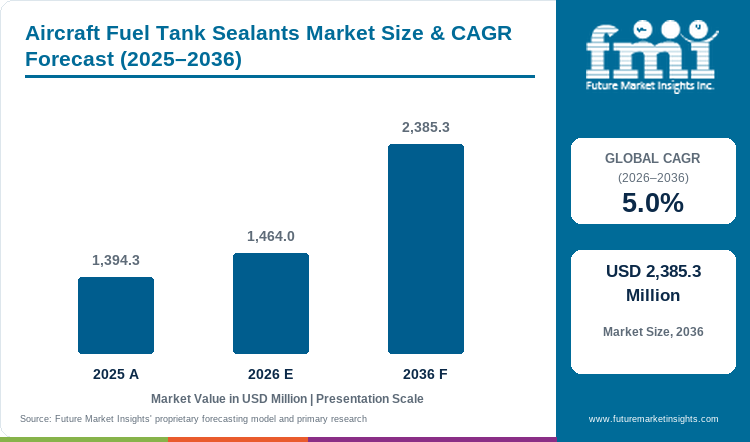
USD 1,464.0 million in 2026 and USD 2,385.3 million by 2036, expanding at 5.0% CAGR.
Demand for aircraft fuel tank sealants is projected to expand at 5.0% CAGR from 2026 through 2036. Market value rises from USD 1,394.3 million in 2025 to USD 1,464.0 million in 2026 and reaches USD 2,385.3 million by 2036. Aircraft builders use qualified sealants during tank assembly and factory leak testing. In January 2026, Airbus reported 793 aircraft deliveries for 2025 and a year-end backlog of 8,754 aircraft. These delivery volumes and backlog support aerospace adhesives and sealants used across ongoing aircraft production. Installed fleets need repair sealant when maintenance work reopens joints within the approved fuel boundary.
Germany is projected to expand at 5.0% CAGR through 2036, compared with 4.7% for Japan. In May 2026, BDLI reported that German civil aviation activity grew 15% during 2025. Higher output increases the number of aircraft build steps that require approved tank sealing. In March 2025, METI reviewed Japan's aircraft plan and supporting test sites. Local approval rules shape which aircraft fuel systems tasks develop into qualified sealant orders. Program schedules and approval timing guide supplier access across both national aircraft industries.
Key Takeaways
- Aircraft production and fuel-tank repair create separate demand cycles for qualified sealing materials.
- Polysulfide sealants are projected to hold 48.0% of chemistry in 2026, supported by established aircraft approvals.
- Commercial aircraft are set to hold 43.0% of aircraft type in 2026, reflecting factory and repair requirements.
- Two-part sealants are estimated at 50.0% of cure type in 2026 because crews can control work life.
- Qualification reviews can delay supplier changes even when another approved candidate carries a lower material price.
- Key players include PPG Aerospace, 3M, Syensqo, Flamemaster, Parker LORD, Henkel, Dow, Huntsman, Chemetall / BASF, and Hylomar.
Analyst Perspective
"The commercial opportunity lies in sealant systems that combine approved chemistry with task-sized packs and handling tools that reduce repair time. Adoption remains constrained by aircraft qualification rules because any material change must protect the approved process and production schedule."
- Nikhil Kaitwade, Principal Consultant, Future Market Insights
How is the aircraft fuel tank sealants market segmented?
The aircraft fuel tank sealants market is segmented by Chemistry, Aircraft Type, Cure Type, Sales Channel, Application, and Region.
Chemistry covers polysulfide, polythioether, silicone, fluorosilicone, and epoxy sealants used across aircraft fuel systems. Aircraft Type covers commercial aircraft, business jets, military aircraft, helicopters, and regional aircraft serving different program and maintenance needs. Cure Type covers two-part, rapid-cure, low-density, and high-temperature sealants, while Sales Channel includes aircraft OEMs, MRO distribution, defense programs, and sealant distributors. Application covers integral fuel tanks, wet wing sealing, access panels, rivets/fasteners, and repair patches across factory and service work.
What supports polysulfide sealants within the chemistry category?
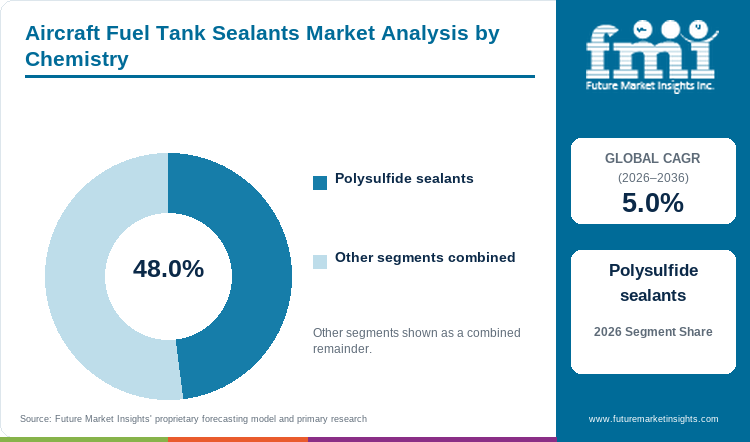
Polysulfide sealants remain common across long-running aircraft programs because approved grades match established fuel-tank repair and production instructions. Fuel exposure and aircraft movement require a cured seal that stays flexible around structural joints and fasteners. Repair manuals list approved aerospace sealants for controlled tasks, keeping material selection tied to each aircraft platform. Fast-cure alternatives can reduce task time, but aircraft programs require testing before crews replace an approved grade.
- Polysulfide sealants are projected to hold 48.0% of Chemistry in 2026, supported by established aircraft approvals.
- This established market position is reflected in March 2025, when SOCOMORE described Flamemaster as a fuel-tank sealant supplier for military and commercial aircraft.
How does commercial aircraft production shape the aircraft type category?
Commercial aircraft require sealant during factory assembly and later maintenance because both stages can expose or reopen fuel-tank joints. Production crews apply approved material before factory leak tests and final tank checks. Maintenance teams performing commercial aircraft MRO use qualified grades when access work or seepage breaks an existing sealed boundary. These recurring tasks create separate material needs across production and in-service maintenance cycles.
- Commercial aircraft are expected to hold 43.0% of Aircraft Type in 2026, supported by factory and repair requirements.
- This production-driven demand is underscored by Airbus, which reported 793 aircraft deliveries for 2025 in January 2026 and a year-end backlog of 8,754 aircraft.
Why do two-part sealants hold the cure type position?
Two-part sealants keep base and cure components separate until technicians begin the aircraft task. Mixing starts a defined work-life window that crews match to repair size and planned application time. Short work-life grades suit small repairs, while longer grades give crews more time across extended seams. The same timing logic guides industrial adhesives and helps crews keep approved chemistry within planned repair work.
- Two-part sealants are estimated to hold 50.0% of Cure Type in 2026, enabled by controlled work life during mixing.
- Investment in aerospace sealant capacity supports this segment position: in May 2025, PPG announced that its planned Shelby site is expected to produce its aerospace coatings and sealants line.
What keeps aircraft OEMs central to the sales channel category?
Aircraft OEMs control approved sealant lists for new programs because engineering teams define materials before factory use begins. Those choices establish the specification route that later aircraft maintenance and overhaul work must follow. MRO distributors supply qualified material under the same program rules and documentation requirements. Factory approval can support later service orders for the same sealant without reopening material qualification.
- Aircraft OEMs are likely to capture 42.0% of Sales Channel in 2026, attributable to design authority over factory sealant choices.
- OEM influence is visible in Airbus's September 2025 report that its Augsburg teams sealed and leak-tested rear-center-tank modules before aircraft integration.
How do integral fuel tanks shape application demand?
Integral fuel tanks use the aircraft structure itself as part of the fuel boundary. Crews seal structural seams and fastener points before factory leak tests confirm tank integrity. Maintenance work can reopen those joints and create a need for fresh qualified sealant. Wet structures contain many aerospace fasteners, so sealing demand extends across several tank interfaces and repair points.
- Integral fuel tanks are forecast to represent 38.0% of Application in 2026, supported by the many sealed interfaces inside each tank boundary.
- This application demand is illustrated by Airbus's September 2025 report that Augsburg teams sealed tank modules before leak testing and shipment.
What are the drivers, restraints and opportunities in the Aircraft Fuel Tank Sealants Market?
Aircraft output sustains demand, qualification controls slow supplier changes, and application tools can reduce sealing time without changing the approved material boundary.
- Driver: Higher aircraft output and recurring fuel-tank repair increase use of qualified sealants across active aircraft programs.
- Restraint: Qualification rules can delay material changes because each sealant must meet aircraft approval requirements.
- Opportunity: Faster application tools can reduce task time while crews retain approved chemistry and documented work steps.
Aircraft production creates a steady need for qualified fuel-tank sealing materials. Every integral tank requires sealed joints before leak testing and final aircraft acceptance. In January 2026, Airbus reported 793 commercial aircraft deliveries for 2025 and an 8,754-aircraft year-end backlog. The backlog supports factory sealing across future production years and keeps approved material active through several tank assembly steps before delivery. Installed fleets require more material when checks and repairs reopen previously sealed fuel-tank joints. Service work can also require new aircraft seals when crews disturb an existing fuel barrier. One approved system can support OEM and MRO orders across the same aircraft program. Recurring repairs extend qualified material use across each aircraft service life.
Aircraft quality systems treat approved sealants as controlled parts of the build process. In September 2025, Chemetall reported that Airbus gave it top SQIP status for delivery and quality. Airbus reviews key suppliers each year and can lower ratings when performance falls below program requirements. A sealant change can trigger technical review that reduces the value of a small material-price saving. Teams using automated aircraft inspection can identify defects earlier during production and repair work. The repair material must still match the approved aircraft instruction for the specific task. Review time and rework risk can outweigh savings from a lower sealant price. A failed change can delay production and push back aircraft release, while existing approvals reduce routine sourcing risk.
Application tools can reduce sealing time without changing the approved aircraft chemistry. In September 2025, Henkel introduced a compact aerospace touchup pen for narrow fastener holes. The tool controls applied material and reduces waste during repair work. Fuel-tank sealants use different chemistries, but crews face similar handling limits during preparation and application. During aircraft refurbishing, crews value tools that reduce handling while keeping written work steps unchanged. Sealant makers can pair approved materials with simple dispensers and task-sized packs for specific jobs. Field support can reduce setup errors during remote repairs and planned shop work. Better handling limits waste from partly used mixed sealant and can lower total task cost.
Which country CAGRs are profiled in the Aircraft Fuel Tank Sealants Market?
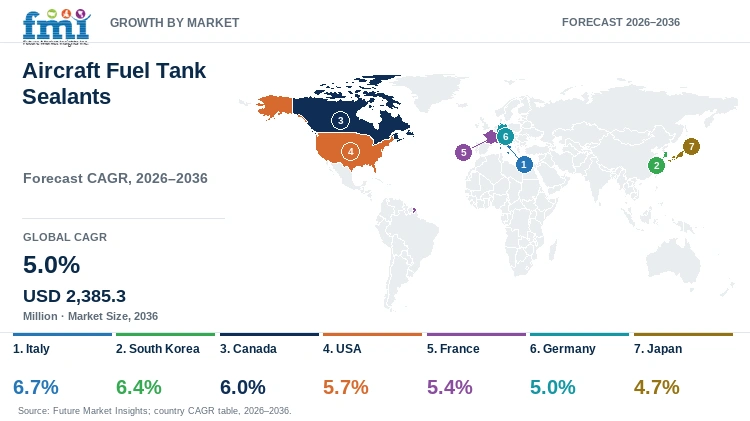
| Country | CAGR |
|---|---|
| Italy | 6.7% |
| South Korea | 6.4% |
| Canada | 6.0% |
| USA | 5.7% |
| France | 5.4% |
| Germany | 5.0% |
| Japan | 4.7% |
How do country-level CAGRs compare in the Aircraft Fuel Tank Sealants Market?
The seven country CAGRs span 2.0 percentage points from Italy at 6.7% to Japan at 4.7%. Italy and South Korea form the upper range, while Canada and the USA occupy the middle range. Country CAGRs compare forecast speed rather than revenue, and local program conditions explain how each national outlook develops.
- Italy's mix of defense and civil aerospace work creates separate specification routes that qualified sealant suppliers must support across domestic programs.
- South Korea's defense procurement structure prioritizes program-specific documentation that supports military qualification and acceptance across serial aircraft production.
- Canada's business-jet manufacturing base creates repeat qualification needs for sealants used across factory assembly and later fleet maintenance.
- The USA combines large OEM and MRO networks, creating several purchasing points for qualified sealants across production and fleet service.
- France's export-oriented civil aerospace industry relies on qualified material supply that can support sustained aircraft production across domestic assembly sites.
- Germany's established aircraft production sites place sealant selection inside controlled tank assembly and leak-test procedures rather than stand-alone material buying.
- Japan's aircraft development system places new sealant grades behind formal testing and documentation before programs can add them to approved material lists.
Similar CAGRs can hide different buying conditions because aircraft programs and approval routes vary across countries. Qualified stock must match each local production schedule and approved material path.
The full report provides country-level CAGR analysis across North America, Latin America, Western Europe, Eastern Europe, East Asia, South Asia and Pacific, and the Middle East and Africa.
Country-wise Analysis
- Italy combines military trainer production with civil aircraft-parts work across domestic aerospace plants. Aircraft fuel tank sealant demand is forecast to rise at 6.7% CAGR through 2036, supported by this mixed production base. In June 2025, Leonardo announced that the M-345 entered Italian Air Force service and is made at Venegono Superiore. Contract timing can make yearly sealant use uneven across active military and civil aircraft programs. Uneven program use makes shelf life and approved stock more important for local material planning. Technical support and smaller packs help match defense repair rules while limiting waste during lower material draws. Local stock must match build dates without aging before production or repair crews need the material.
- South Korea is moving the KF-21 from flight testing into serial production under a national defense program. Fuel tank sealant demand is forecast to rise at 6.4% CAGR through 2036, tied to the fighter build schedule. In May 2025, DAPA reported that the first production aircraft entered final assembly. In January 2026, DAPA reported that flight testing ended after about 1,600 flights. Military approval remains tied to each program and its contracted aircraft configuration. Technical support and delivery plans must match assembly dates with the required acceptance records. Late stock or missing records can delay aircraft acceptance and disrupt planned assembly work. Local service can reduce timing risk without replacing the formal military approval path.
- Canada combines business-jet production with military aircraft purchases across its national aviation network. Fuel tank sealant demand is estimated to expand at 6.0% CAGR through 2036, influenced by aircraft output and fleet use. In February 2026, Statistics Canada reported 5.8 million aircraft movements during 2025. The same national record showed aircraft movements rising 3.1% from 2024 across Canadian aviation. Canada has fewer high-value aircraft programs than the USA, making repair schedules more uneven across locations. Pack sizes and stock plans must protect sealant shelf life during those irregular maintenance cycles. Local distribution can serve factory and repair work while limiting unused mixed material and aging stock. Smaller lots help plants and service sites match approved inventory with changing repair demand.
- US aircraft production and repair span many manufacturing plants and maintenance sites across the country. The USA is projected to grow at 5.7% CAGR through 2036, supported by new aircraft builds and fleet repair. In June 2026, AIA reported about 434,000 aircraft jobs during 2025. The same industry data counted about 9,300 aerospace and defense sites across the United States. Approval rules remain a major barrier to changing sealant sources across active aircraft programs. Local stock and specification support help factories respond when production schedules change. Large fleets require repair records that keep approved material available outside normal factory cycles. A supplier serving both channels can reduce delays and keep the same approved material in use.
- France ties fuel tank sealant demand to commercial aircraft output and final assembly activity. Sales are forecast to expand at 5.4% CAGR through 2036, reinforced by civil aircraft production. In May 2026, GIFAS reported that French aerospace exports rose 14.6% during 2025. The same report recorded 5.5% higher order intake and a 74% civil aviation share. Faster line rates raise the cost of rework across scheduled aircraft assembly stations. Approved stock and pack formats must match each station task and its written process. Local technical support matters when a sealing problem threatens the next planned aircraft movement. Fast response protects the build schedule and limits rework during production operations. Local inventory also helps crews avoid delays during planned sealing work.
- Germany has large aircraft plants with strict production steps for fuel-bearing structures. Fuel tank sealant demand is predicted to advance at 5.0% CAGR through 2036, shaped by civil aerospace activity. In May 2026, BDLI reported that civil aviation activity grew 15% during 2025. The same record placed aerospace employment at about 130,000 people. Airbus uses its Augsburg hangar for tank assembly and factory leak tests. Aircraft approval rules limit quick changes to sealant sources during active production. Work-life choices and technical support must match the written process at each station. Sealant deliveries must align with Airbus build dates and local stock rules. Aging inventory can increase waste or trigger extra quality checks, so local support helps control stock risk.
- Japanese aircraft programs use formal planning and long reviews before new materials enter production. Sealant demand is forecast to rise at 4.7% CAGR through 2036, linked to program spending and approval timing. In March 2025, METI convened its aircraft panel to review the national plan and test sites. A material change can spend months under review before an aircraft program accepts the new grade. Technical support and local supply must keep each program record current throughout the approval process. Local service can shorten trial response time without bypassing the formal acceptance route. Long approval periods make pack size and shelf life important for local inventory planning. Stock plans must prevent aging while teams wait for final material acceptance.
Who are the notable companies in the Aircraft Fuel Tank Sealants Market?
PPG Aerospace, 3M, Syensqo, Flamemaster, Parker LORD, Henkel, Dow, Huntsman, Chemetall / BASF, and Hylomar are active within the defined aircraft fuel tank sealants supply boundary.
Competition spans direct sealant makers and wider aircraft-material groups that enter programs through different qualification routes. PPG Aerospace, 3M, Flamemaster, and Chemetall / BASF publish direct aircraft-sealing evidence, while Syensqo, Parker LORD, Henkel, and Huntsman supply qualified aerospace materials. Dow and Hylomar serve narrower fuel-resistant roles, while aircraft approval and technical support shape access to each active program.
- Direct sealing suppliers include PPG Aerospace, 3M, Flamemaster, and Chemetall / BASF.
- Qualified materials groups include Syensqo, Parker LORD, Henkel, and Huntsman.
- Dow and Hylomar hold narrower fuel-resistant roles in approved aircraft applications.
Competitive Benchmarking: Aircraft Fuel Tank Sealants Market
| Company | Direct Sealant Evidence | Application Breadth | Qualification Access | Geographic Reach |
|---|---|---|---|---|
| PPG Aerospace | High | High | High | Global |
| 3M | High | High | High | Global |
| Syensqo | Low | High | High | Global |
| Flamemaster | High | Medium | High | North America and global channels |
| Parker LORD | Low | Medium | High | North America, Europe, Asia-Pacific |
| Henkel | Medium | High | High | Global |
| Dow | Low | Medium | Medium | Global |
| Huntsman | Low | Medium | High | Global |
| Chemetall / BASF | Medium | Medium | High | Europe and global support |
| Hylomar | Low | Low | Medium | United Kingdom and export channels |
A High rating requires current evidence for fuel-tank or aircraft sealants in documented aerospace use. Medium marks narrower aircraft evidence, while Low identifies adjacent material evidence within the defined supply boundary. Application Breadth rates documented aerospace uses, while Qualification Access reflects approvals or verified customer relationships.
Key Developments in the Aircraft Fuel Tank Sealants Market
- In March 2026, Syensqo secured a multi-year Boeing agreement for advanced composites and adhesive solutions.
- In September 2025, Chemetall / BASF expanded Azelis distribution rights for aerospace technologies in the Philippines.
- In May 2025, PPG Aerospace announced a Shelby facility for its full aerospace coatings and sealants line.
Key Players in the Aircraft Fuel Tank Sealants Market
Direct fuel-tank and aerospace sealant suppliers
- PPG Aerospace
- 3M
- Flamemaster
- Chemetall / BASF
Aerospace adhesives and qualified materials suppliers
- Syensqo
- Parker LORD
- Henkel
- Huntsman
Specialty fuel-resistant materials suppliers
- Dow
- Hylomar
Aircraft Fuel Tank Sealants Market - Report Scope
| Coverage field | Report scope |
|---|---|
| Market breakdown | By chemistry, aircraft type, cure type, sales channel, application, and region. |
| Quantitative Units | USD million. |
| Market Definition | Aerospace-grade sealing compounds sold for aircraft fuel-tank and fuel-exposed structural sealing are included. General-purpose sealants, fuel-system hardware, coatings, primers, and MRO labor are excluded. |
| Regions Covered | North America, Latin America, Western Europe, Eastern Europe, East Asia, South Asia and Pacific, and Middle East and Africa. |
| Countries Covered | Italy, South Korea, Canada, USA, France, Germany, Japan, and 20+ countries included in the full report. |
| Key Companies Profiled | PPG Aerospace, 3M, Syensqo, Flamemaster, Parker LORD, Henkel, Dow, Huntsman, Chemetall / BASF, Hylomar. |
| Forecast Period | 2026 to 2036. |
| Approach | Primary and secondary research with market triangulation. |
Aircraft Fuel Tank Sealants Market - Research Methodology
| Method | Approach |
|---|---|
| Primary Research | FMI analysts gathered input from manufacturers, service providers, technology developers, distributors, end users, procurement teams, and subject-matter experts. Interviews examined purchasing decisions, product or service evaluation, adoption barriers, approval requirements, pricing considerations, and expectations for technical or commercial support. Respondents were also asked what evidence is required before a trial, pilot, or initial order develops into regular purchasing. |
| Desk Research | Desk research covered government statistics, regulatory publications, trade data, industry associations, technical literature, standards, company filings, product information, and official corporate announcements. Sources were reviewed for relevance, publication date, geographic coverage, and consistency with the defined market scope. Claims relating to performance, applications, approvals, capacity, investment, and commercial activity were retained only when supported by credible public evidence. |
| Market Sizing and Forecasting | The market model combined the baseline value with historical performance, segment structure, pricing and volume indicators, adoption levels, company participation, and country-level demand conditions. Forecast assumptions considered economic activity, investment trends, regulatory developments, technology adoption, purchasing cycles, supply availability, and barriers to wider market use. Segment and regional estimates were reconciled before the final market total was calculated. |
| Data Validation | Estimates were checked against multiple independent indicators, including public data, company activity, trade patterns, industry developments, and findings from primary interviews. Validation also tested whether products, services, applications, and company revenues fell within the defined market boundaries. Adjacent categories, unsupported claims, overlapping revenues, and activities without direct market relevance were excluded to reduce double counting and maintain consistency across segments and countries. |
Aircraft Fuel Tank Sealants Market by Segments
Aircraft Fuel Tank Sealants Market segmented by Chemistry:
- Polysulfide sealants
- Polythioether sealants
- Silicone sealants
- Fluorosilicone sealants
- Epoxy sealants
Aircraft Fuel Tank Sealants Market segmented by Aircraft Type:
- Commercial aircraft
- Business jets
- Military aircraft
- Helicopters
- Regional aircraft
Aircraft Fuel Tank Sealants Market segmented by Cure Type:
- Two-part sealants
- Rapid-cure sealants
- Low-density sealants
- High-temperature sealants
Aircraft Fuel Tank Sealants Market segmented by Sales Channel:
- Aircraft OEMs
- MRO distribution
- Defense programs
- Sealant distributors
Aircraft Fuel Tank Sealants Market segmented by Application:
- Integral fuel tanks
- Wet wing sealing
- Access panels
- Rivets - fasteners
- Repair patches
Aircraft Fuel Tank Sealants Market by Region:
- North America
- United States
- Canada
- Latin America
- Brazil
- Mexico
- Chile
- Rest of Latin America
- Western Europe
- Germany
- United Kingdom
- Italy
- Spain
- France
- Nordics
- Benelux
- Rest of Western Europe
- Eastern Europe
- Russia
- Poland
- Hungary
- Balkan and Baltic States
- Rest of Eastern Europe
- East Asia
- China
- Japan
- South Korea
- South Asia and Pacific
- India
- ASEAN
- Australia and New Zealand
- Rest of South Asia and Pacific
- Middle East and Africa
- Kingdom of Saudi Arabia
- Other GCC Countries
- Türkiye
- South Africa
- Other African Union Countries
- Rest of Middle East and Africa
Research Sources and Bibliography
- Airbus. (2026, January 12). Airbus reports 793 commercial aircraft deliveries in 2025.
- German Aerospace Industries Association (BDLI). (2026, May 27). BDLI industry data 2026: Aerospace industry sets new records for revenue and employment.
- Ministry of Economy, Trade and Industry, Japan. (2025, March 25). Second Aircraft Industry Subcommittee meeting.
- Defense Acquisition Program Administration, Republic of Korea. (2025, May 20). KF-21 reaches a major milestone toward timely operational deployment.
- Defense Acquisition Program Administration, Republic of Korea. (2026, January 13). KF-21 flight test program completed after approximately 1,600 flights.
- Statistics Canada. (2026, February 26). Aircraft movement and civil aviation statistics, December 2025.
- Aerospace Industries Association. (2026, June 25). 2026 AIA facts and figures: U.S. aerospace and defense industry.
- GIFAS. (2026, May 11). 2025 results: The French aerospace industry remains strongly positioned for the future.
- Leonardo. (2025, June 12). Italy brings innovation to pilot training: The M-345 enters service with the Italian Air Force.
- SOCOMORE. (2025, March 11). SOCOMORE and FLAMEMASTER at MRO Americas 2025.
- PPG. (2025, May 8). PPG to invest $380 million to build new U.S. manufacturing facility in Shelby, N.C. for aerospace coatings and sealants.
- Airbus. (2025, September 30). Airbus opens new production hangar at its Augsburg site.
- Chemetall / BASF. (2025, September 25). Chemetall receives the Airbus SQIP 2025 award for its 2024 performance.
- Henkel. (2025, September 16). Henkel compact conversion coating pen simplifies aircraft touchup.
- SOCOMORE. (2026, August 28). Socomore & 3Chem at MRO Asia-Pacific 2026.
- Chemetall / BASF and Azelis. (2025, September 30). Azelis and Chemetall expand distribution agreement for aerospace technologies in Southeast Asia.
- Syensqo. (2026, July 9). Syensqo breaks ground on manufacturing expansion at its site in Havre de Grace, Maryland.
- Dow. (2026, June 23). Dow expands product and innovation capabilities to support continued growth in specialty silicones markets.
- 3M. (2026, June 23). 3M and Airbus announce agreement to advance A220 passenger comfort and aircraft performance.
- Huntsman Corporation. (2026, April 15). Huntsman turns regulatory compliance into innovation advancements for aerospace OEMs.
- BSI. (2025, August 8). Certificate of Registration: LORD Corporation AS9100D and ISO 9001:2015.
- Syensqo. (2026, March 9). Syensqo secures new long-term agreement with Boeing.
- Syensqo. (2026, April 14). Syensqo and Toray Group strengthen aerospace supply security through strategic partnership.
- PPG. (2026, June 9). PPG showcases aerospace innovations supporting customer productivity.
- SOCOMORE. (2026, April 7). SOCOMORE heads to MRO Americas 2026 in Orlando.
- Syensqo. (2026, July 29). Syensqo signs multi-year supply agreement with Airbus.
- 3M. (2026, July 17). 3M partners with JetZero to reshape aviation.
- Henkel. (2025, April 15). Precise dosing for safety-relevant components with the new Sonderhoff DM80 Static Mix dosing machine.
- Henkel. (2026). Annual Report 2025.
- Chemetall / BASF. (2025, May 15). Chemetall moves towards sustainability goals by using 100% renewable electricity at its Langelsheim site in Germany.
This bibliography is provided for reader reference and is not exhaustive. The full report contains the complete reference list and detailed citations.
This Report Answers
- What market values define aircraft fuel tank sealants in 2026 and 2036?
- Which production and repair activities support recurring demand for qualified sealants?
- Why do polysulfide sealants hold 48.0% of Chemistry revenue in 2026?
- How does commercial aircraft production create demand across factory and repair work?
- Why do two-part sealants hold 50.0% of Cure Type revenue in 2026?
- How do aircraft qualification controls affect supplier switching and material selection?
- How do the seven profiled country CAGRs differ across national programs?
- Which companies supply qualified fuel-tank sealing and related aerospace materials?
Frequently Asked Questions
How big is the aircraft fuel tank sealants market?
The aircraft fuel tank sealants market is valued at USD 1,464.0 million in 2026. It is projected to reach USD 2,385.3 million by 2036 under the current forecast. New aircraft use approved sealant during tank assembly and factory leak testing. Fleet repairs require the same qualified materials when service work reopens sealed tank joints.
What is the aircraft fuel tank sealants market CAGR?
The market is projected to grow at 5.0% CAGR from 2026 through 2036. Commercial and defense aircraft programs keep approved sealants active across production and repair work. Long approval cycles slow source changes even when another qualified material carries a lower unit price.
Which chemistry segment leads in 2026?
Polysulfide sealants are projected to hold 48.0% of Chemistry revenue in 2026. Their fuel resistance and flexibility support use across integral tank joints and fasteners. Aircraft programs keep proven grades because new sealants must pass platform tests before crews change materials. Long approval work can slow source changes across active production and maintenance programs.
Which cure type leads in 2026?
Two-part sealants are estimated to hold 50.0% share in 2026. Separate base and cure components let technicians control work life for each aircraft task. Short work-life grades suit smaller repairs, while longer grades provide more time for extended seams.
Which companies are active in this market?
Key companies include PPG Aerospace, 3M, Syensqo, Flamemaster, Parker LORD, Henkel, Dow, Huntsman, Chemetall / BASF, and Hylomar. Some companies make direct fuel-tank sealants, while others supply qualified aircraft adhesives or fuel-resistant materials.
Preview the report firsthand - request a free sample
Get SampleGet the brochure for pricing and purchase details.
Get PDFTable of Content
- Key Takeaways
- Market Size and CAGR
- Top Growth Driver
- Fastest Growing Segment
- Leading Region
- Key Companies
- Emerging Opportunities
- Executive Summary
- Global Market Outlook
- Demand-side Trends
- Supply-side Trends
- Technology Roadmap Analysis
- Analysis and Recommendations
- Analyst Perspective (What is happening? Why now? What should investors know?)
- Key Questions Answered
- How large is the market?
- What is the CAGR?
- What are key trends?
- Which region dominates?
- Who are the leaders?
- Market Overview
- Market Coverage / Taxonomy
- Market Definition / Scope / Limitations
- Research Methodology
- Chapter Orientation
- Analytical Lens and Working Hypotheses
- Market Structure, Signals, and Trend Drivers
- Benchmarking and Cross-market Comparability
- Market Sizing, Forecasting, and Opportunity Mapping
- Research Design and Evidence Framework
- Desk Research Programme (Secondary Evidence)
- Expert Input and Fieldwork (Primary Evidence)
- Tooling, Models, and Reference Databases
- Data Engineering and Model Build
- Quality Assurance and Audit Trail
- Market Background
- Market Dynamics (Drivers, Restraints, Opportunity, Trends)
- Scenario Forecast (Optimistic, Likely, Conservative)
- Impact Analysis
- AI Impact
- Sustainability Impact
- Regulatory Impact
- Technology Impact
- Consumer / Buyer Analysis
- Purchase Drivers
- Adoption Barriers
- Buyer Journey
- Opportunity Map Analysis
- Product Life Cycle Analysis
- Supply Chain Analysis
- Investment Feasibility Matrix
- Value Chain Analysis
- PESTLE and Porter's Analysis
- Regulatory Landscape
- Regional Parent Market Outlook
- Production and Consumption Statistics
- Import and Export Statistics
- Global Market Analysis and Forecast, 2021 to 2036
- Historical Market Size Value (USD Million) Analysis, 2021 to 2025
- Current and Future Market Size Value (USD Million) Projections, 2026 to 2036
- Y-o-Y Growth Trend Analysis
- Absolute $ Opportunity Analysis
- Global Market Pricing Analysis, 2021 to 2036
- Global Market Analysis and Forecast, By Chemistry, 2021 to 2036
- Introduction / Key Findings
- Historical Market Size Value (USD Million) Analysis By Chemistry, 2021 to 2025
- Current and Future Market Size Value (USD Million) Analysis and Forecast By Chemistry, 2026 to 2036
- Polysulfide sealants
- Polythioether sealants
- Silicone sealants
- Fluorosilicone sealants
- Epoxy sealants
- Y-o-Y Growth Trend Analysis By Chemistry, 2021 to 2025
- Absolute $ Opportunity Analysis By Chemistry, 2026 to 2036
- Global Market Analysis and Forecast, By Aircraft Type, 2021 to 2036
- Introduction / Key Findings
- Historical Market Size Value (USD Million) Analysis By Aircraft Type, 2021 to 2025
- Current and Future Market Size Value (USD Million) Analysis and Forecast By Aircraft Type, 2026 to 2036
- Commercial aircraft
- Business jets
- Military aircraft
- Helicopters
- Regional aircraft
- Y-o-Y Growth Trend Analysis By Aircraft Type, 2021 to 2025
- Absolute $ Opportunity Analysis By Aircraft Type, 2026 to 2036
- Global Market Analysis and Forecast, By Cure Type, 2021 to 2036
- Introduction / Key Findings
- Historical Market Size Value (USD Million) Analysis By Cure Type, 2021 to 2025
- Current and Future Market Size Value (USD Million) Analysis and Forecast By Cure Type, 2026 to 2036
- Two-part sealants
- Rapid-cure sealants
- Low-density sealants
- High-temperature sealants
- Y-o-Y Growth Trend Analysis By Cure Type, 2021 to 2025
- Absolute $ Opportunity Analysis By Cure Type, 2026 to 2036
- Global Market Analysis and Forecast, By Sales Channel, 2021 to 2036
- Introduction / Key Findings
- Historical Market Size Value (USD Million) Analysis By Sales Channel, 2021 to 2025
- Current and Future Market Size Value (USD Million) Analysis and Forecast By Sales Channel, 2026 to 2036
- Aircraft OEMs
- MRO distribution
- Defense programs
- Sealant distributors
- Y-o-Y Growth Trend Analysis By Sales Channel, 2021 to 2025
- Absolute $ Opportunity Analysis By Sales Channel, 2026 to 2036
- Global Market Analysis and Forecast, By Application, 2021 to 2036
- Introduction / Key Findings
- Historical Market Size Value (USD Million) Analysis By Application, 2021 to 2025
- Current and Future Market Size Value (USD Million) Analysis and Forecast By Application, 2026 to 2036
- Integral fuel tanks
- Wet wing sealing
- Access panels
- Rivets - fasteners
- Repair patches
- Y-o-Y Growth Trend Analysis By Application, 2021 to 2025
- Absolute $ Opportunity Analysis By Application, 2026 to 2036
- Global Market Analysis and Forecast, By Region, 2021 to 2036
- Introduction
- Historical Market Size Value (USD Million) Analysis By Region, 2021 to 2025
- Current Market Size Value (USD Million) Analysis and Forecast By Region, 2026 to 2036
- North America
- Latin America
- Western Europe
- Eastern Europe
- East Asia
- South Asia and Pacific
- Middle East and Africa
- Market Attractiveness Analysis By Region
- North America Market Analysis and Forecast, By Country, 2021 to 2036
- Historical Market Size Value (USD Million) Trend Analysis By Market Taxonomy, 2021 to 2025
- Market Size Value (USD Million) Forecast By Market Taxonomy, 2026 to 2036
- By Country
- United States
- Canada
- By Chemistry
- By Aircraft Type
- By Cure Type
- By Sales Channel
- By Application
- By Country
- Market Attractiveness Analysis
- By Country
- By Chemistry
- By Aircraft Type
- By Cure Type
- By Sales Channel
- By Application
- Key Takeaways
- Latin America Market Analysis and Forecast, By Country
- Historical Market Size Value (USD Million) Trend Analysis By Market Taxonomy, 2021 to 2025
- Market Size Value (USD Million) Forecast By Market Taxonomy, 2026 to 2036
- By Country
- Brazil
- Mexico
- Chile
- Rest of Latin America
- By Chemistry
- By Aircraft Type
- By Cure Type
- By Sales Channel
- By Application
- By Country
- Market Attractiveness Analysis
- By Country
- By Chemistry
- By Aircraft Type
- By Cure Type
- By Sales Channel
- By Application
- Key Takeaways
- Western Europe Market Analysis and Forecast, By Country
- Historical Market Size Value (USD Million) Trend Analysis By Market Taxonomy, 2021 to 2025
- Market Size Value (USD Million) Forecast By Market Taxonomy, 2026 to 2036
- By Country
- Germany
- United Kingdom
- Italy
- Spain
- France
- Nordics
- Benelux
- Rest of Western Europe
- By Chemistry
- By Aircraft Type
- By Cure Type
- By Sales Channel
- By Application
- By Country
- Market Attractiveness Analysis
- By Country
- By Chemistry
- By Aircraft Type
- By Cure Type
- By Sales Channel
- By Application
- Key Takeaways
- Eastern Europe Market Analysis and Forecast, By Country
- Historical Market Size Value (USD Million) Trend Analysis By Market Taxonomy, 2021 to 2025
- Market Size Value (USD Million) Forecast By Market Taxonomy, 2026 to 2036
- By Country
- Russia
- Poland
- Hungary
- Balkan and Baltic States
- Rest of Eastern Europe
- By Chemistry
- By Aircraft Type
- By Cure Type
- By Sales Channel
- By Application
- By Country
- Market Attractiveness Analysis
- By Country
- By Chemistry
- By Aircraft Type
- By Cure Type
- By Sales Channel
- By Application
- Key Takeaways
- East Asia Market Analysis and Forecast, By Country
- Historical Market Size Value (USD Million) Trend Analysis By Market Taxonomy, 2021 to 2025
- Market Size Value (USD Million) Forecast By Market Taxonomy, 2026 to 2036
- By Country
- China
- Japan
- South Korea
- By Chemistry
- By Aircraft Type
- By Cure Type
- By Sales Channel
- By Application
- By Country
- Market Attractiveness Analysis
- By Country
- By Chemistry
- By Aircraft Type
- By Cure Type
- By Sales Channel
- By Application
- Key Takeaways
- South Asia and Pacific Market Analysis and Forecast, By Country
- Historical Market Size Value (USD Million) Trend Analysis By Market Taxonomy, 2021 to 2025
- Market Size Value (USD Million) Forecast By Market Taxonomy, 2026 to 2036
- By Country
- India
- ASEAN
- Australia and New Zealand
- Rest of South Asia and Pacific
- By Chemistry
- By Aircraft Type
- By Cure Type
- By Sales Channel
- By Application
- By Country
- Market Attractiveness Analysis
- By Country
- By Chemistry
- By Aircraft Type
- By Cure Type
- By Sales Channel
- By Application
- Key Takeaways
- Middle East and Africa Market Analysis and Forecast, By Country
- Historical Market Size Value (USD Million) Trend Analysis By Market Taxonomy, 2021 to 2025
- Market Size Value (USD Million) Forecast By Market Taxonomy, 2026 to 2036
- By Country
- Kingdom of Saudi Arabia
- Other GCC Countries
- Türkiye
- South Africa
- Other African Union Countries
- Rest of Middle East and Africa
- By Chemistry
- By Aircraft Type
- By Cure Type
- By Sales Channel
- By Application
- By Country
- Market Attractiveness Analysis
- By Country
- By Chemistry
- By Aircraft Type
- By Cure Type
- By Sales Channel
- By Application
- Key Takeaways
- Key Countries Market Analysis
- United States
- Pricing Analysis
- Market Share Analysis, 2025
- By Chemistry
- By Aircraft Type
- By Cure Type
- By Sales Channel
- By Application
- Canada
- Pricing Analysis
- Market Share Analysis, 2025
- By Chemistry
- By Aircraft Type
- By Cure Type
- By Sales Channel
- By Application
- Mexico
- Pricing Analysis
- Market Share Analysis, 2025
- By Chemistry
- By Aircraft Type
- By Cure Type
- By Sales Channel
- By Application
- Brazil
- Pricing Analysis
- Market Share Analysis, 2025
- By Chemistry
- By Aircraft Type
- By Cure Type
- By Sales Channel
- By Application
- Chile
- Pricing Analysis
- Market Share Analysis, 2025
- By Chemistry
- By Aircraft Type
- By Cure Type
- By Sales Channel
- By Application
- Germany
- Pricing Analysis
- Market Share Analysis, 2025
- By Chemistry
- By Aircraft Type
- By Cure Type
- By Sales Channel
- By Application
- United Kingdom
- Pricing Analysis
- Market Share Analysis, 2025
- By Chemistry
- By Aircraft Type
- By Cure Type
- By Sales Channel
- By Application
- Italy
- Pricing Analysis
- Market Share Analysis, 2025
- By Chemistry
- By Aircraft Type
- By Cure Type
- By Sales Channel
- By Application
- Spain
- Pricing Analysis
- Market Share Analysis, 2025
- By Chemistry
- By Aircraft Type
- By Cure Type
- By Sales Channel
- By Application
- France
- Pricing Analysis
- Market Share Analysis, 2025
- By Chemistry
- By Aircraft Type
- By Cure Type
- By Sales Channel
- By Application
- India
- Pricing Analysis
- Market Share Analysis, 2025
- By Chemistry
- By Aircraft Type
- By Cure Type
- By Sales Channel
- By Application
- ASEAN
- Pricing Analysis
- Market Share Analysis, 2025
- By Chemistry
- By Aircraft Type
- By Cure Type
- By Sales Channel
- By Application
- Australia and New Zealand
- Pricing Analysis
- Market Share Analysis, 2025
- By Chemistry
- By Aircraft Type
- By Cure Type
- By Sales Channel
- By Application
- China
- Pricing Analysis
- Market Share Analysis, 2025
- By Chemistry
- By Aircraft Type
- By Cure Type
- By Sales Channel
- By Application
- Japan
- Pricing Analysis
- Market Share Analysis, 2025
- By Chemistry
- By Aircraft Type
- By Cure Type
- By Sales Channel
- By Application
- South Korea
- Pricing Analysis
- Market Share Analysis, 2025
- By Chemistry
- By Aircraft Type
- By Cure Type
- By Sales Channel
- By Application
- Russia
- Pricing Analysis
- Market Share Analysis, 2025
- By Chemistry
- By Aircraft Type
- By Cure Type
- By Sales Channel
- By Application
- Poland
- Pricing Analysis
- Market Share Analysis, 2025
- By Chemistry
- By Aircraft Type
- By Cure Type
- By Sales Channel
- By Application
- Hungary
- Pricing Analysis
- Market Share Analysis, 2025
- By Chemistry
- By Aircraft Type
- By Cure Type
- By Sales Channel
- By Application
- Kingdom of Saudi Arabia
- Pricing Analysis
- Market Share Analysis, 2025
- By Chemistry
- By Aircraft Type
- By Cure Type
- By Sales Channel
- By Application
- Türkiye
- Pricing Analysis
- Market Share Analysis, 2025
- By Chemistry
- By Aircraft Type
- By Cure Type
- By Sales Channel
- By Application
- South Africa
- Pricing Analysis
- Market Share Analysis, 2025
- By Chemistry
- By Aircraft Type
- By Cure Type
- By Sales Channel
- By Application
- United States
- Market Structure Analysis
- Competition Dashboard
- Competition Benchmarking
- Market Share Analysis of Top Players
- By Regional
- By Chemistry
- By Aircraft Type
- By Cure Type
- By Sales Channel
- By Application
- Emerging Startups
- Innovation Benchmarking
- Competition Analysis
- Competition Deep Dive
- PPG Aerospace
- Overview
- Product Portfolio
- Profitability by Market Segments
- Sales Footprint
- Strategy Overview
- Marketing Strategy
- Product Strategy
- Channel Strategy
- 3M
- Syensqo
- Flamemaster
- Parker LORD
- Henkel
- Dow
- Huntsman
- Chemetall / BASF
- Hylomar
- PPG Aerospace
- Case Studies
- Success Stories
- Recent Developments
- Competition Deep Dive
- Assumptions & Acronyms Used


