

- Market Size (2026)
- USD 5.1 Bn
- Forecast (2036)
- USD 9.2 Bn
- CAGR (2026 to 2036)
- 6.0%
How big is Aircraft Fuel Tank Inerting Modules Market in 2026?
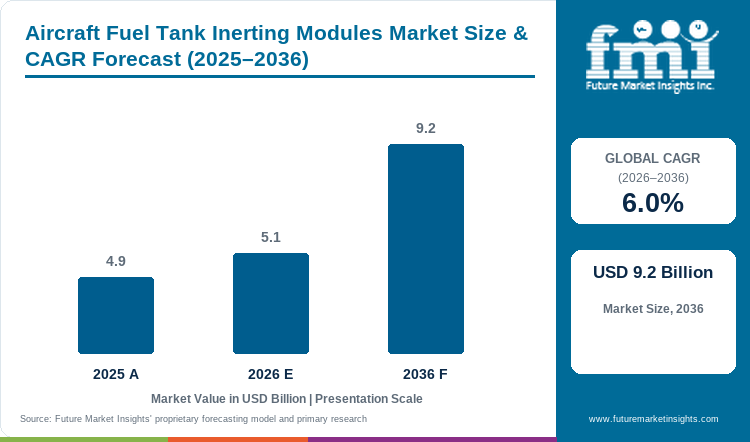
USD 5.1 Billion in 2026 and USD 9.2 Billion by 2036 at a 6.0% CAGR.
Sales of aircraft fuel tank inerting modules are estimated to grow at a 6.0% CAGR from USD 5.1 billion in 2026 to USD 9.2 billion by 2036, compared with USD 4.9 billion in 2025. Demand exists because fuel-vapor flammability has to be controlled within the certified aircraft architecture rather than through a stand-alone safety accessory. An inerting package must deliver nitrogen-enriched air at the required flow while working with the aircraft's pneumatic supply, fuel-tank geometry and control logic. Once that configuration is approved, new aircraft production creates first-fit demand and the installed fleet creates a long replacement cycle for separation modules, controls and related hardware.
Aircraft production and fleet sustainment generate different inerting-module orders. High-rate narrow-body manufacturing creates repeated shipset demand, while defense fleets place more weight on configuration-controlled sustainment. These modules also sit inside a wider network of aircraft fuel systems where pumps, venting hardware and fuel-management controls must remain compatible with the approved aircraft configuration. France and Germany benefit from Airbus production activity, while the USA combines commercial aircraft manufacturing with a large defense and airline support base. Norway has a smaller fleet but a concentrated F-35 sustainment requirement. Japan and Canada depend more heavily on program-specific procurement and approved support routes.
Key Takeaways
- Fuel-tank safety requirements and aircraft production create designed-in demand that continues through the operating life of the aircraft.
- OBIGGS modules are projected to hold 34.0% of Module Type revenue in 2026 because buyers value one integrated generation and control architecture.
- Narrow-body aircraft account for 38.0% of Aircraft Type demand, while hollow fiber membrane technology leads its category with 52.0% share in 2026.
- Aircraft OEMs hold 48.0% of Sales Channel demand because type-design authority determines the approved module interface and maintenance baseline.
- Qualification cost restrains supplier substitution, while longer membrane life and easier health monitoring create aftermarket value.
- Parker Aerospace, Eaton Aerospace, Safran Aerosystems, Collins Aerospace, Honeywell Aerospace and Air Liquide Advanced Technologies are notable participants in the defined market.
Analyst Perspective
An approved inerting system supports both aircraft production and decades of fleet maintenance. Membrane durability and repair turnaround determine much of its lifetime cost. Improvements are most useful when replacement modules preserve nitrogen-enriched air output, control behavior and the aircraft's approved interfaces.
- Nikhil Kaitwade, Principal Consultant, Future Market Insights
How is the aircraft fuel tank inerting modules market segmented?
Module Type, Aircraft Type, Technology, Sales Channel, Application and Region
The aircraft fuel tank inerting modules market is segmented by Module Type, Aircraft Type, Technology, Sales Channel, Application and Region. Module Type includes OBIGGS modules, air separation modules, inerting control units, nitrogen-generation modules and integrated inerting packs. Aircraft Type includes narrow-body aircraft, wide-body aircraft, regional aircraft, military aircraft and business jets. Technology includes hollow fiber membrane, pressure swing adsorption, catalytic inerting and hybrid systems. Sales Channel includes aircraft OEMs, Tier-1 fuel-system integrators, MRO / retrofit channels and defense programs. Application includes center tank inerting, wing tank inerting, auxiliary fuel tanks and military survivability systems.
Why do OBIGGS modules lead demand within the Module Type category?
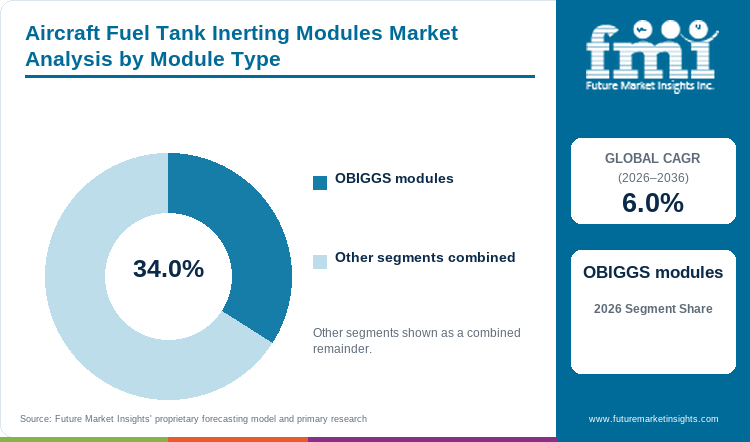
OBIGGS modules bring nitrogen generation, conditioning and flow control into a defined aircraft safety function. An OEM can therefore qualify the package against one performance envelope instead of managing unrelated components individually. That structure is commercially useful because an air separation element does not operate independently. Its output depends on inlet-air quality, temperature and pressure as well as the distribution path into the tank. Complete OBIGGS packages also give maintenance teams a clearer route for fault isolation and replacement when aircraft health monitoring identifies declining system performance.
- OBIGGS modules are estimated to hold 34.0% of the Module Type category in 2026.
- Integrated packages gain value when generation hardware and controls can be maintained without changing the approved aircraft interfaces.
Why do Narrow-body aircraft lead demand within the Aircraft Type category?
Narrow-body aircraft combine high annual production with a very large operating fleet, so qualified inerting hardware earns revenue at delivery and later through spares and overhaul. Airbus reported in June 2026 that ten A320 Family final assembly lines were operating across Toulouse, Hamburg, Mobile and Tianjin, with a backlog of 7,499 A320 Family aircraft at the end of May. Each new aircraft extends the future installed base for qualified separation modules and controllers. The same production scale supports adjacent systems such as aircraft actuators where platform qualification also turns a high-volume program into long-duration aftermarket demand.
- Narrow-body aircraft account for 38.0% of the Aircraft Type category in 2026.
- High production cadence spreads qualification investment across more shipsets and creates a larger future pool of serviceable modules.
Why does Hollow fiber membrane lead demand within the Technology category?
Hollow fiber membranes generate nitrogen-enriched air continuously without the switching cycle associated with an adsorption bed. This suits aircraft where size and weight have to be controlled while inerting output remains predictable across the operating envelope. The membrane itself, however, is only part of the commercial proposition. Contamination and thermal exposure can alter performance, so inlet conditioning becomes important to module life. That creates a direct connection with aircraft filters because protecting the air stream can reduce degradation before it reaches the separation element.
- Hollow fiber membrane technology is estimated to hold 52.0% of the Technology category in 2026.
- Suppliers compete on separation efficiency and durability as well as the ability to protect membrane performance inside the aircraft installation.
Why do Aircraft OEMs lead demand within the Sales Channel category?
Aircraft OEMs control the interface where inerting capacity becomes part of the type design. They determine how the module connects with pneumatic air supply and tank distribution, while also defining electrical logic and maintenance requirements. A change to one module can therefore affect several approved interfaces. This makes the OEM channel commercially valuable before aircraft delivery and helps the originally approved architecture remain influential in the aftermarket. Control hardware also overlaps with the wider aerospace valves market because pressure and flow management have to remain compatible with the qualified system.
- Aircraft OEMs are projected to account for 48.0% of Sales Channel demand in 2026.
- Tier-1 integrators and MRO organizations remain important, but their work normally stays within an aircraft configuration already approved by the type-design authority.
Why does Center tank inerting lead demand within the Application category?
Center tanks can present a demanding flammability-control case because their thermal environment and operating pattern differ from conventional unheated wing tanks. The system has to move enough nitrogen-enriched air through the tank volume while keeping oxygen concentration within the approved operating requirement. A substantial installed base of transport aircraft also supports recurring module replacement and inspection. Wing tank inerting becomes more important on newer architectures, but center tank programs retain a large qualification and service history.
- Center tank inerting accounts for 44.0% of the Application category in 2026.
- Replacement demand is supported by the installed transport-aircraft base as separation modules and associated controls move through scheduled maintenance cycles.
What are the drivers, restraints and opportunities in the Aircraft Fuel Tank Inerting Modules Market?
Aircraft production and fuel-tank safety requirements support demand, aircraft-level qualification restrains supplier changes and longer-life monitored modules create aftermarket opportunity.
- Driver: New aircraft production and continued fuel-tank safety requirements create first-fit demand followed by recurring replacement activity.
- Restraint: A different module can change pressure drop, thermal behavior or output and may require additional aircraft-level engineering work before approval.
- Opportunity: Longer-life air separation modules and better condition monitoring can reduce unscheduled removals without forcing a redesign of the aircraft interface.
Aircraft production converts directly into module demand when an inerting system is part of the approved aircraft configuration. Airbus inaugurated its second modernized A320 Family final assembly line in Toulouse in June 2026 and said its global network had reached ten A320 Family final assembly lines. For an approved inerting supplier, the effect is not limited to the original shipset. Each delivery creates a future maintenance requirement for controllers and separation modules. Production cadence therefore determines how quickly today's line-fit position becomes tomorrow's installed aftermarket.
Changing a certified inerting configuration adds engineering cost. Nitrogen-enriched air output depends on aircraft air supply and tank volume. Engineers also have to account for distribution behavior and fault response. A replacement part that appears mechanically interchangeable can still alter system performance. Airlines and defense operators therefore have an economic reason to remain with established configurations until reliability or lifecycle savings justify the engineering effort needed for a change.
Condition monitoring can help schedule module maintenance before an unexpected removal. Honeywell's 2025 work on F-35 PTMS depot activation shows how safety-critical aircraft systems can be supported through regional repair capability rather than returned through one central route. Better health monitoring can make this approach more useful for inerting hardware by identifying deterioration before it disrupts aircraft availability. That opportunity also intersects with aircraft automated inspection and monitoring as operators seek more condition-based maintenance across aircraft systems.
Which country CAGRs are profiled in the Aircraft Fuel Tank Inerting Modules Market?
| Country | CAGR |
|---|---|
| Norway | 6.5% |
| USA | 5.9% |
| Japan | 4.4% |
| France | 6.2% |
| Germany | 5.2% |
| Canada | 5.5% |
| Italy | 4.9% |
How do country-level CAGRs compare in the Aircraft Fuel Tank Inerting Modules Market?
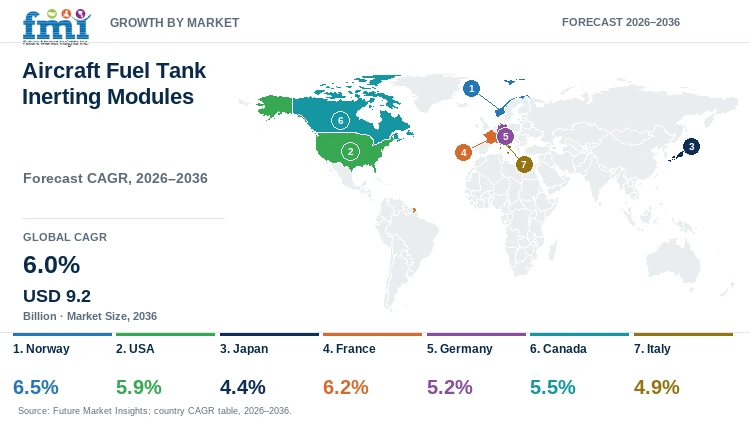
Norway leads the profiled countries at 6.5% CAGR from 2026 to 2036, while Japan is at 4.4%, a 2.1 percentage-point spread. Norway's demand is concentrated in defense-fleet sustainment. France and Germany supply commercial aircraft production, and the USA combines manufacturing with a large operating fleet. These activities create different mixes of first-fit modules, replacement units and repair work.
- Norway leads the group at 6.5% CAGR, with its smaller fleet base making defense sustainment activity more visible in percentage growth.
- France follows at 6.2%, supported by Airbus production and the expanding A320 Family industrial system.
- The USA reaches 5.9%, while Canada records 5.5% as North American demand combines commercial manufacturing with military fleet support.
- Germany is forecast at 5.2% and Italy at 4.9%, reflecting established European aerospace production and sustainment activity.
- Japan posts 4.4% CAGR, with procurement moving through controlled program structures and longer qualification cycles.
Final assembly requires modules delivered to an aircraft's production schedule. Fleet sustainment requires qualified spares and repair capacity over a much longer service life. Both depend on preserving the approved inerting configuration, but their order timing and inventory requirements differ.
Country-wise Analysis
- Norway: Demand for aircraft fuel tank inerting modules is forecast to expand at 6.5% CAGR from 2026 to 2036. The Ministry of Defence reported in April 2025 that all 52 planned F-35 aircraft had been delivered and a new maintenance facility was under construction at Rygge Air Base. With fleet delivery complete, support requirements center on qualified spares and repair access throughout the aircraft's service life.
- USA: Demand is forecast to rise at 5.9% CAGR through 2036. Honeywell reported in February 2025 that it was supporting F-35 PTMS depot activation at Fleet Readiness Center East, with PTMS performing fuel-tank inerting among its safety-critical functions. Commercial fleets create an additional replacement base through the broader aircraft maintenance, repair and overhaul market. The opportunity is therefore split between OEM-approved commercial support and defense depot sustainment.
- Japan: Demand is forecast to grow at 4.4% CAGR from 2026 to 2036. Centralized defense procurement and domestic aircraft integration make approved program access important. Module suppliers must preserve configuration control through replacement and repair, with local support capable of maintaining the required pneumatic, electrical and tank-distribution interfaces.
- France: Demand is projected to expand at 6.2% CAGR. Airbus inaugurated its second modernized A320 Family final assembly line in Toulouse in June 2026 and said the site formed part of a ten-line global A320 production network. The supplier issue is therefore rate readiness. A qualified module source has to maintain output without creating configuration changes that interrupt final assembly.
- Germany: Demand is forecast to rise at 5.2% CAGR through 2036. Hamburg operates four A320 Family final assembly lines within Airbus' 2026 production network. That concentration makes production discipline and engineering change control important to module suppliers. Module suppliers must support assembly schedules while keeping spares and repair capacity available for aircraft in service.
- Canada: Demand is forecast to expand at 5.5% CAGR. Canada's fighter transition is building a new sustainment requirement alongside its established aerospace support industry. The commercial need shifts over time from transition spares toward deeper domestic maintenance as the fleet and supporting infrastructure mature. Suppliers that can transfer repair capability without disturbing configuration control are better placed for the later phase of the program.
- Italy: Demand is forecast to rise at 4.9% CAGR from 2026 to 2036. In March 2025, a U.S. Air Forces in Europe F-35 entered the Cameri facility for planned depot maintenance, illustrating the site's role in multinational F-35 sustainment. For inerting hardware, the practical requirement is access to approved components and repair processes that can fit scheduled depot work across aircraft operated by more than one country.
Who are the notable companies in the Aircraft Fuel Tank Inerting Modules Market?
Parker Aerospace, Eaton Aerospace, Safran Aerosystems, Collins Aerospace, Honeywell Aerospace and Air Liquide Advanced Technologies serve the defined aircraft fuel tank inerting modules market.
Competition centers on three capabilities: responsibility for the complete inerting architecture, gas-separation technology and access to the aircraft through production or lifecycle support. Parker Aerospace and Eaton Aerospace compete through fuel-system integration and inerting hardware. Safran Aerosystems combines OBIGGS architecture with air separation modules and control equipment. Collins Aerospace participates through air-management systems that include fuel tank inerting, while Honeywell integrates the function within the F-35 PTMS. Air Liquide supplies membrane-based nitrogen generation for aviation applications.
- Integrated fuel and inerting systems: Parker Aerospace, Eaton Aerospace and Safran Aerosystems.
- Air-management and defense integration: Collins Aerospace and Honeywell Aerospace.
- Membrane nitrogen generation: Air Liquide Advanced Technologies.
Competitive Benchmarking: Aircraft Fuel Tank Inerting Modules Market
| Company | Certified Inerting System Integration | Air Separation / Nitrogen Generation | Controls & Lifecycle Support | Geographic Reach |
|---|---|---|---|---|
| Parker Aerospace | High | High | High | Global commercial and defense programs |
| Eaton Aerospace | High | High | High | Global commercial and military aerospace |
| Safran Aerosystems | High | High | High | Europe, North America and Asia |
| Collins Aerospace | High | Medium | High | Global commercial and defense support |
| Honeywell Aerospace | High | Medium | High | Global defense and commercial aerospace |
| Air Liquide Advanced Technologies | Medium | High | Medium | International aerospace programs |
Scoring basis: High indicates broad direct capability within the rated criterion. Medium indicates narrower documented participation. Certified Inerting System Integration considers responsibility for inerting or closely integrated aircraft air-management architecture. Air Separation / Nitrogen Generation considers membrane or other onboard gas-generation capability. Controls & Lifecycle Support covers control hardware and service infrastructure relevant to the operating life of the system.
Key Developments in the Aircraft Fuel Tank Inerting Modules Market
- In February 2025, Honeywell detailed expanded depot activation and sustainment support for the F-35 Power and Thermal Management System. Honeywell identifies fuel-tank inerting among the PTMS safety-critical functions, linking the development directly to longer-term repair access for inerting-related hardware.
- In April 2025, Eaton named Air Support as its first aerospace authorized service center in Europe, the Middle East and Africa for local repair and overhaul of selected aircraft fuel components. The development expands Eaton's regional aerospace fuel-system service model and reduces turnaround exposure for supported components.
- In June 2026, Airbus inaugurated its second modernized A320 Family final assembly line in Toulouse. Airbus said its global A320 network had reached ten final assembly lines and was supporting a production trajectory toward 75 aircraft per month, increasing the production runway for qualified line-fit systems.
Key Players in the Aircraft Fuel Tank Inerting Modules Market
Integrated Fuel and Inerting System Suppliers
- Parker Aerospace
- Eaton Aerospace
- Safran Aerosystems
Air Management and Defense-System Suppliers
- Collins Aerospace
- Honeywell Aerospace
Membrane and Nitrogen-Generation Specialists
- Air Liquide Advanced Technologies
Aircraft Fuel Tank Inerting Modules Market - Report Scope
| Coverage field | Report scope |
|---|---|
| Market breakdown | Module Type; Aircraft Type; Technology; Sales Channel; Application |
| Quantitative Units | USD Billion |
| Market Definition | Revenue includes first-fit and replacement aircraft fuel tank inerting modules sold within the defined segmentation universe. It includes air separation modules, inerting control units, nitrogen-generation modules and integrated inerting packs. Complete aircraft revenue and adjacent non-inerting fuel-system revenue are excluded. |
| Regions Covered | North America; Latin America; Western Europe; Eastern Europe; East Asia; South Asia and Pacific; Middle East and Africa |
| Countries Covered | Norway, USA, Japan, France, Germany, Canada, Italy and more than twenty-five additional countries in the full report |
| Key Companies Profiled | Parker Aerospace; Eaton Aerospace; Safran Aerosystems; Collins Aerospace; Honeywell Aerospace; Air Liquide Advanced Technologies |
| Forecast Period | 2026 to 2036 |
| Approach | Primary research, desk research, program analysis and market triangulation |
Aircraft Fuel Tank Inerting Modules Market - Research Methodology
| Method | Approach |
|---|---|
| Primary Research | FMI engages aircraft-system suppliers, OEM and Tier-1 engineering teams, airline and MRO procurement functions, defense sustainment stakeholders and aerospace specialists. Discussions examine qualification pathways, module replacement triggers, channel behavior and lifecycle support requirements. |
| Desk Research | Research covers current aviation requirements, aircraft-production announcements, defense-program information, company filings, current product literature and dated corporate developments relevant to the defined market. |
| Market Sizing and Forecasting | Market sizing considers aircraft production cadence, module content, installed-fleet replacement activity, program timing and country operating conditions. Forecast assumptions include production ramps, fleet sustainment, qualification friction and module service life. |
| Data Validation | Findings are compared across program activity, current supplier positioning, aircraft production and primary-market input. Revenue is limited to the defined module and integrated inerting-system boundary. |
Aircraft Fuel Tank Inerting Modules Market by Segments
Aircraft Fuel Tank Inerting Modules Market segmented by Module Type:
- OBIGGS modules
- Air separation modules
- Inerting control units
- Nitrogen-generation modules
- Integrated inerting packs
Aircraft Fuel Tank Inerting Modules Market segmented by Aircraft Type:
- Narrow-body aircraft
- Wide-body aircraft
- Regional aircraft
- Military aircraft
- Business jets
Aircraft Fuel Tank Inerting Modules Market segmented by Technology:
- Hollow fiber membrane
- Pressure swing adsorption
- Catalytic inerting
- Hybrid systems
Aircraft Fuel Tank Inerting Modules Market segmented by Sales Channel:
- Aircraft OEMs
- Tier-1 fuel-system integrators
- MRO / retrofit channels
- Defense programs
Aircraft Fuel Tank Inerting Modules Market segmented by Application:
- Center tank inerting
- Wing tank inerting
- Auxiliary fuel tanks
- Military survivability systems
Aircraft Fuel Tank Inerting Modules Market by Region:
- North America
- United States
- Canada
- Latin America
- Brazil
- Mexico
- Argentina
- Chile
- Western Europe
- Germany
- France
- United Kingdom
- Italy
- Spain
- Benelux
- Nordics
- Eastern Europe
- Poland
- Czech Republic
- Romania
- Hungary
- East Asia
- China
- Japan
- South Korea
- South Asia and Pacific
- India
- ASEAN
- Australia and New Zealand
- Middle East and Africa
- GCC Countries
- South Africa
- Türkiye
- Israel
Research Sources and Bibliography
- Norwegian Ministry of Defence. April 28, 2025. Norway Unveils Its First Joint Strike Missile and Celebrates Delivery of All 52 F-35 Fighter Jets.
- Honeywell Aerospace Technologies. February 24, 2025. Honeywell Enhances F-35 Support and Fleet Readiness.
- Japan Ministry of Defense. February 2025. Progress and Budget in Fundamental Reinforcement of Defense Capabilities.
- Eaton. April 8, 2025. Eaton Names Air Support as First Aerospace Authorized Service Center in EMEA.
- Airbus. June 15, 2026. Airbus Inaugurates New A320 Family Final Assembly Line in Toulouse.
- U.S. Department of Defense, Defense Visual Information Distribution Service. March 27, 2025. First USAFE Aircraft Inducted into Euro-Med Airframe MRO&U Facility, Cameri.
- Parker-Hannifin Corporation. September 2025. Products Statement - Aerospace & Defense Market.
- Eaton Aerospace. Accessed September 2026. Air Separation Module and On-board Inert Gas Generating System.
- Safran Aerosystems. Accessed September 2026. Inerting Systems for Fuel Tank Flammability Risk Reduction.
- Collins Aerospace. Accessed September 2026. Air Management Systems.
- Air Liquide Engineering & Technologies. Accessed September 2026. Inert Gas Generation for Aircraft Safety.
This Report Answers
- How large is the Aircraft Fuel Tank Inerting Modules Market in 2025, 2026 and 2036?
- Why do OBIGGS modules lead the Module Type category?
- Why are narrow-body aircraft the largest Aircraft Type segment in 2026?
- What supports hollow fiber membrane leadership within the Technology category?
- Why do aircraft OEMs retain the largest share of Sales Channel demand?
- How do growth conditions differ across Norway, USA, Japan, France, Germany, Canada and Italy?
- How does aircraft-level qualification affect supplier switching and retrofit economics?
- Which companies combine inerting-system integration with separation technology and lifecycle support?
Frequently Asked Questions
How big is the Aircraft Fuel Tank Inerting Modules Market in 2026?
The Aircraft Fuel Tank Inerting Modules Market is valued at USD 5.1 billion in 2026 and is projected to reach USD 9.2 billion by 2036. The market was valued at USD 4.9 billion in 2025.
What is the CAGR of the Aircraft Fuel Tank Inerting Modules Market from 2026 to 2036?
The market is forecast to expand at a 6.0% CAGR from 2026 to 2036 as new aircraft production adds first-fit systems and operating fleets create replacement requirements.
Which segments lead the Aircraft Fuel Tank Inerting Modules Market in 2026?
OBIGGS modules lead Module Type with 34.0% share. Narrow-body aircraft account for 38.0% of Aircraft Type demand, hollow fiber membrane leads Technology with 52.0%, aircraft OEMs hold 48.0% of Sales Channel demand and center tank inerting accounts for 44.0% of Application demand.
Which country has the highest profiled CAGR?
Norway records the highest profiled CAGR at 6.5% from 2026 to 2036. France follows at 6.2%, the USA at 5.9%, Canada at 5.5%, Germany at 5.2%, Italy at 4.9% and Japan at 4.4%.
Which companies are active in the Aircraft Fuel Tank Inerting Modules Market?
Notable companies include Parker Aerospace, Eaton Aerospace, Safran Aerosystems, Collins Aerospace, Honeywell Aerospace and Air Liquide Advanced Technologies. Their positions differ across complete system integration, nitrogen-generation technology and lifecycle support.
Preview the report firsthand - request a free sample
Get SampleGet the brochure for pricing and purchase details.
Get PDFTable of Content
- Key Takeaways
- Market Size and CAGR
- Top Growth Driver
- Fastest Growing Segment
- Leading Region
- Key Companies
- Emerging Opportunities
- Executive Summary
- Global Market Outlook
- Demand-side Trends
- Supply-side Trends
- Technology Roadmap Analysis
- Analysis and Recommendations
- Analyst Perspective (What is happening? Why now? What should investors know?)
- Key Questions Answered
- How large is the market?
- What is the CAGR?
- What are key trends?
- Which region dominates?
- Who are the leaders?
- Market Overview
- Market Coverage / Taxonomy
- Market Definition / Scope / Limitations
- Research Methodology
- Chapter Orientation
- Analytical Lens and Working Hypotheses
- Market Structure, Signals, and Trend Drivers
- Benchmarking and Cross-market Comparability
- Market Sizing, Forecasting, and Opportunity Mapping
- Research Design and Evidence Framework
- Desk Research Programme (Secondary Evidence)
- Expert Input and Fieldwork (Primary Evidence)
- Tooling, Models, and Reference Databases
- Data Engineering and Model Build
- Quality Assurance and Audit Trail
- Market Background
- Market Dynamics (Drivers, Restraints, Opportunity, Trends)
- Scenario Forecast (Optimistic, Likely, Conservative)
- Impact Analysis
- AI Impact
- Sustainability Impact
- Regulatory Impact
- Technology Impact
- Consumer / Buyer Analysis
- Purchase Drivers
- Adoption Barriers
- Buyer Journey
- Opportunity Map Analysis
- Product Life Cycle Analysis
- Supply Chain Analysis
- Investment Feasibility Matrix
- Value Chain Analysis
- PESTLE and Porter's Analysis
- Regulatory Landscape
- Regional Parent Market Outlook
- Production and Consumption Statistics
- Import and Export Statistics
- Global Market Analysis and Forecast, 2021 to 2036
- Historical Market Size Value (USD Billion) Analysis, 2021 to 2025
- Current and Future Market Size Value (USD Billion) Projections, 2026 to 2036
- Y-o-Y Growth Trend Analysis
- Absolute $ Opportunity Analysis
- Global Market Pricing Analysis, 2021 to 2036
- Global Market Analysis and Forecast, By Module Type, 2021 to 2036
- Introduction / Key Findings
- Historical Market Size Value (USD Billion) Analysis By Module Type, 2021 to 2025
- Current and Future Market Size Value (USD Billion) Analysis and Forecast By Module Type, 2026 to 2036
- OBIGGS modules
- Air separation modules
- Inerting control units
- Nitrogen-generation modules
- Integrated inerting packs
- Y-o-Y Growth Trend Analysis By Module Type, 2021 to 2025
- Absolute $ Opportunity Analysis By Module Type, 2026 to 2036
- Global Market Analysis and Forecast, By Aircraft Type, 2021 to 2036
- Introduction / Key Findings
- Historical Market Size Value (USD Billion) Analysis By Aircraft Type, 2021 to 2025
- Current and Future Market Size Value (USD Billion) Analysis and Forecast By Aircraft Type, 2026 to 2036
- Narrow-body aircraft
- Wide-body aircraft
- Regional aircraft
- Military aircraft
- Business jets
- Y-o-Y Growth Trend Analysis By Aircraft Type, 2021 to 2025
- Absolute $ Opportunity Analysis By Aircraft Type, 2026 to 2036
- Global Market Analysis and Forecast, By Technology, 2021 to 2036
- Introduction / Key Findings
- Historical Market Size Value (USD Billion) Analysis By Technology, 2021 to 2025
- Current and Future Market Size Value (USD Billion) Analysis and Forecast By Technology, 2026 to 2036
- Hollow fiber membrane
- Pressure swing adsorption
- Catalytic inerting
- Hybrid systems
- Y-o-Y Growth Trend Analysis By Technology, 2021 to 2025
- Absolute $ Opportunity Analysis By Technology, 2026 to 2036
- Global Market Analysis and Forecast, By Sales Channel, 2021 to 2036
- Introduction / Key Findings
- Historical Market Size Value (USD Billion) Analysis By Sales Channel, 2021 to 2025
- Current and Future Market Size Value (USD Billion) Analysis and Forecast By Sales Channel, 2026 to 2036
- Aircraft OEMs
- Tier-1 fuel-system integrators
- MRO / retrofit channels
- Defense programs
- Y-o-Y Growth Trend Analysis By Sales Channel, 2021 to 2025
- Absolute $ Opportunity Analysis By Sales Channel, 2026 to 2036
- Global Market Analysis and Forecast, By Application, 2021 to 2036
- Introduction / Key Findings
- Historical Market Size Value (USD Billion) Analysis By Application, 2021 to 2025
- Current and Future Market Size Value (USD Billion) Analysis and Forecast By Application, 2026 to 2036
- Center tank inerting
- Wing tank inerting
- Auxiliary fuel tanks
- Military survivability systems
- Y-o-Y Growth Trend Analysis By Application, 2021 to 2025
- Absolute $ Opportunity Analysis By Application, 2026 to 2036
- Global Market Analysis and Forecast, By Region, 2021 to 2036
- Introduction
- Historical Market Size Value (USD Billion) Analysis By Region, 2021 to 2025
- Current Market Size Value (USD Billion) Analysis and Forecast By Region, 2026 to 2036
- North America
- Latin America
- Western Europe
- Eastern Europe
- East Asia
- South Asia and Pacific
- Middle East and Africa
- Market Attractiveness Analysis By Region
- North America Market Analysis and Forecast, By Country, 2021 to 2036
- Historical Market Size Value (USD Billion) Trend Analysis By Market Taxonomy, 2021 to 2025
- Market Size Value (USD Billion) Forecast By Market Taxonomy, 2026 to 2036
- By Country
- United States
- Canada
- By Module Type
- By Aircraft Type
- By Technology
- By Sales Channel
- By Application
- By Country
- Market Attractiveness Analysis
- By Country
- By Module Type
- By Aircraft Type
- By Technology
- By Sales Channel
- By Application
- Key Takeaways
- Latin America Market Analysis and Forecast, By Country
- Historical Market Size Value (USD Billion) Trend Analysis By Market Taxonomy, 2021 to 2025
- Market Size Value (USD Billion) Forecast By Market Taxonomy, 2026 to 2036
- By Country
- Brazil
- Mexico
- Argentina
- Chile
- By Module Type
- By Aircraft Type
- By Technology
- By Sales Channel
- By Application
- By Country
- Market Attractiveness Analysis
- By Country
- By Module Type
- By Aircraft Type
- By Technology
- By Sales Channel
- By Application
- Key Takeaways
- Western Europe Market Analysis and Forecast, By Country
- Historical Market Size Value (USD Billion) Trend Analysis By Market Taxonomy, 2021 to 2025
- Market Size Value (USD Billion) Forecast By Market Taxonomy, 2026 to 2036
- By Country
- Germany
- France
- United Kingdom
- Italy
- Spain
- Benelux
- Nordics
- By Module Type
- By Aircraft Type
- By Technology
- By Sales Channel
- By Application
- By Country
- Market Attractiveness Analysis
- By Country
- By Module Type
- By Aircraft Type
- By Technology
- By Sales Channel
- By Application
- Key Takeaways
- Eastern Europe Market Analysis and Forecast, By Country
- Historical Market Size Value (USD Billion) Trend Analysis By Market Taxonomy, 2021 to 2025
- Market Size Value (USD Billion) Forecast By Market Taxonomy, 2026 to 2036
- By Country
- Poland
- Czech Republic
- Romania
- Hungary
- By Module Type
- By Aircraft Type
- By Technology
- By Sales Channel
- By Application
- By Country
- Market Attractiveness Analysis
- By Country
- By Module Type
- By Aircraft Type
- By Technology
- By Sales Channel
- By Application
- Key Takeaways
- East Asia Market Analysis and Forecast, By Country
- Historical Market Size Value (USD Billion) Trend Analysis By Market Taxonomy, 2021 to 2025
- Market Size Value (USD Billion) Forecast By Market Taxonomy, 2026 to 2036
- By Country
- China
- Japan
- South Korea
- By Module Type
- By Aircraft Type
- By Technology
- By Sales Channel
- By Application
- By Country
- Market Attractiveness Analysis
- By Country
- By Module Type
- By Aircraft Type
- By Technology
- By Sales Channel
- By Application
- Key Takeaways
- South Asia and Pacific Market Analysis and Forecast, By Country
- Historical Market Size Value (USD Billion) Trend Analysis By Market Taxonomy, 2021 to 2025
- Market Size Value (USD Billion) Forecast By Market Taxonomy, 2026 to 2036
- By Country
- India
- ASEAN
- Australia and New Zealand
- By Module Type
- By Aircraft Type
- By Technology
- By Sales Channel
- By Application
- By Country
- Market Attractiveness Analysis
- By Country
- By Module Type
- By Aircraft Type
- By Technology
- By Sales Channel
- By Application
- Key Takeaways
- Middle East and Africa Market Analysis and Forecast, By Country
- Historical Market Size Value (USD Billion) Trend Analysis By Market Taxonomy, 2021 to 2025
- Market Size Value (USD Billion) Forecast By Market Taxonomy, 2026 to 2036
- By Country
- GCC Countries
- South Africa
- Türkiye
- Israel
- By Module Type
- By Aircraft Type
- By Technology
- By Sales Channel
- By Application
- By Country
- Market Attractiveness Analysis
- By Country
- By Module Type
- By Aircraft Type
- By Technology
- By Sales Channel
- By Application
- Key Takeaways
- Key Countries Market Analysis
- United States
- Pricing Analysis
- Market Share Analysis, 2025
- By Module Type
- By Aircraft Type
- By Technology
- By Sales Channel
- By Application
- Canada
- Pricing Analysis
- Market Share Analysis, 2025
- By Module Type
- By Aircraft Type
- By Technology
- By Sales Channel
- By Application
- Mexico
- Pricing Analysis
- Market Share Analysis, 2025
- By Module Type
- By Aircraft Type
- By Technology
- By Sales Channel
- By Application
- Brazil
- Pricing Analysis
- Market Share Analysis, 2025
- By Module Type
- By Aircraft Type
- By Technology
- By Sales Channel
- By Application
- Chile
- Pricing Analysis
- Market Share Analysis, 2025
- By Module Type
- By Aircraft Type
- By Technology
- By Sales Channel
- By Application
- Germany
- Pricing Analysis
- Market Share Analysis, 2025
- By Module Type
- By Aircraft Type
- By Technology
- By Sales Channel
- By Application
- United Kingdom
- Pricing Analysis
- Market Share Analysis, 2025
- By Module Type
- By Aircraft Type
- By Technology
- By Sales Channel
- By Application
- Italy
- Pricing Analysis
- Market Share Analysis, 2025
- By Module Type
- By Aircraft Type
- By Technology
- By Sales Channel
- By Application
- Spain
- Pricing Analysis
- Market Share Analysis, 2025
- By Module Type
- By Aircraft Type
- By Technology
- By Sales Channel
- By Application
- France
- Pricing Analysis
- Market Share Analysis, 2025
- By Module Type
- By Aircraft Type
- By Technology
- By Sales Channel
- By Application
- India
- Pricing Analysis
- Market Share Analysis, 2025
- By Module Type
- By Aircraft Type
- By Technology
- By Sales Channel
- By Application
- ASEAN
- Pricing Analysis
- Market Share Analysis, 2025
- By Module Type
- By Aircraft Type
- By Technology
- By Sales Channel
- By Application
- Australia and New Zealand
- Pricing Analysis
- Market Share Analysis, 2025
- By Module Type
- By Aircraft Type
- By Technology
- By Sales Channel
- By Application
- China
- Pricing Analysis
- Market Share Analysis, 2025
- By Module Type
- By Aircraft Type
- By Technology
- By Sales Channel
- By Application
- Japan
- Pricing Analysis
- Market Share Analysis, 2025
- By Module Type
- By Aircraft Type
- By Technology
- By Sales Channel
- By Application
- South Korea
- Pricing Analysis
- Market Share Analysis, 2025
- By Module Type
- By Aircraft Type
- By Technology
- By Sales Channel
- By Application
- Poland
- Pricing Analysis
- Market Share Analysis, 2025
- By Module Type
- By Aircraft Type
- By Technology
- By Sales Channel
- By Application
- Hungary
- Pricing Analysis
- Market Share Analysis, 2025
- By Module Type
- By Aircraft Type
- By Technology
- By Sales Channel
- By Application
- Türkiye
- Pricing Analysis
- Market Share Analysis, 2025
- By Module Type
- By Aircraft Type
- By Technology
- By Sales Channel
- By Application
- South Africa
- Pricing Analysis
- Market Share Analysis, 2025
- By Module Type
- By Aircraft Type
- By Technology
- By Sales Channel
- By Application
- Norway
- Pricing Analysis
- Market Share Analysis, 2025
- By Module Type
- By Aircraft Type
- By Technology
- By Sales Channel
- By Application
- United States
- Market Structure Analysis
- Competition Dashboard
- Competition Benchmarking
- Market Share Analysis of Top Players
- By Regional
- By Module Type
- By Aircraft Type
- By Technology
- By Sales Channel
- By Application
- Emerging Startups
- Innovation Benchmarking
- Competition Analysis
- Competition Deep Dive
- Parker Aerospace
- Overview
- Product Portfolio
- Profitability by Market Segments
- Sales Footprint
- Strategy Overview
- Marketing Strategy
- Product Strategy
- Channel Strategy
- Eaton Aerospace
- Safran Aerosystems
- Collins Aerospace
- Honeywell Aerospace
- Air Liquide Advanced Technologies
- Parker Aerospace
- Case Studies
- Success Stories
- Recent Developments
- Competition Deep Dive
- Assumptions & Acronyms Used


