

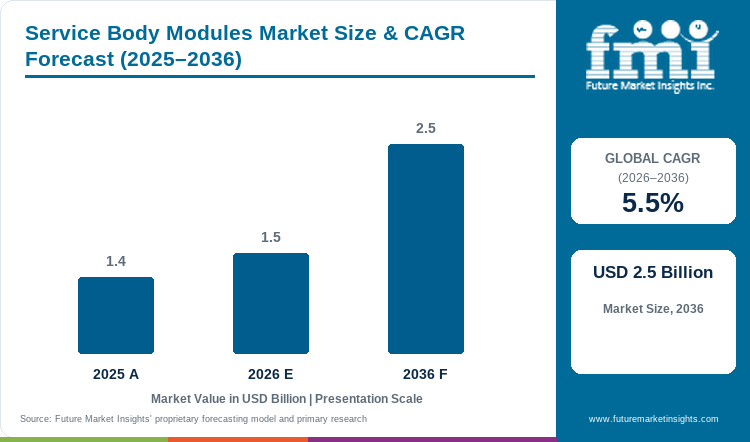
- Market Size (2026)
- USD 1.5 Bn
- Forecast (2036)
- USD 2.5 Bn
- CAGR (2026 to 2036)
- 5.5%
How big is Service Body Modules Market in 2026?
USD 1.5 Billion in 2026 and USD 2.5 Billion by 2036 at a 5.5% CAGR.
Utility and infrastructure fleets create recurring demand when work shifts away from fixed depots. In March 2026, the U.S. Department of Energy announced an approximately USD 1.9 billion SPARK funding opportunity for transmission upgrades. The funding itself does not buy service bodies. It increases the volume of line and substation work that mobile crews must support. Fleet teams then specify secure tool storage, onboard power or crane-ready structures around the work package carried by each crew.
The purchase decision is constrained at the body-chassis interface. Final-stage manufacturers in the USA must account for applicable certification duties under 49 CFR Parts 567 and 568, while every cabinet, compressor or crane consumes payload. Body weight affects how much job equipment remains available after the upfit. Similar fitment pressure is visible in adjacent chassis extension kits where installation geometry and completed-vehicle responsibility shape the specification. For service body modules, the order converts when the body carries the required job kit without compromising compliance or uptime.
Key Takeaways
- The market is projected to rise from USD 1.5 Billion in 2026 to USD 2.5 Billion by 2036 at a 5.5% CAGR.
- Tool compartment modules account for 29.0% of 2026 demand. Pickup service bodies account for 28.0% because many field crews need external storage without moving to a heavier vocational chassis.
- Steel represents 42.0% of Material demand in 2026. Fleets continue to value familiar fabrication and repair practices where body mass is not the binding constraint.
- Truck upfitters account for 36.0% of Sales Channel demand, while utility service represents 27.0% of End Use demand. Both shares reflect the importance of integrated fitment around a defined crew workflow.
- Mexico is forecast at 6.2% CAGR from 2026 to 2036. Australia is forecast at 5.7%, Brazil at 5.6%, Canada at 5.4%, USA at 5.0%, Germany at 4.4% and Japan at 3.8%.
- Payload and final-stage integration remain the main conversion risks. Lightweight pre-engineered modules create room for tools and auxiliary systems while reducing the engineering required for repeated fleet configurations.
Analyst Perspective
“The commercial bottleneck sits at the body-chassis interface. A fleet may want more storage or lifting capacity, yet the configuration still has to stay inside the payload envelope and reach service without repeated engineering changes. Suppliers that validate common crew packages around specific chassis can shorten the specification cycle and make replacement orders easier to repeat.”
- Nikhil Kaitwade, Principal Consultant, Future Market Insights
How is the service body modules market segmented?
The market is analyzed by Module Type, Vehicle Type, Material, Sales Channel, and End Use.
Each segmentation axis captures a different constraint in the completed work vehicle. Module Type reflects the job function placed inside or on the body. Vehicle Type sets the available chassis envelope. Material changes weight and repair economics. Sales Channel identifies who carries installation responsibility. End Use reflects the crew workflow that determines tool density and support equipment. The same body architecture also creates demand for utility body panels because doors, compartment walls and structural sections must match the service layout.
What makes Tool compartment modules central to the Module Type category?
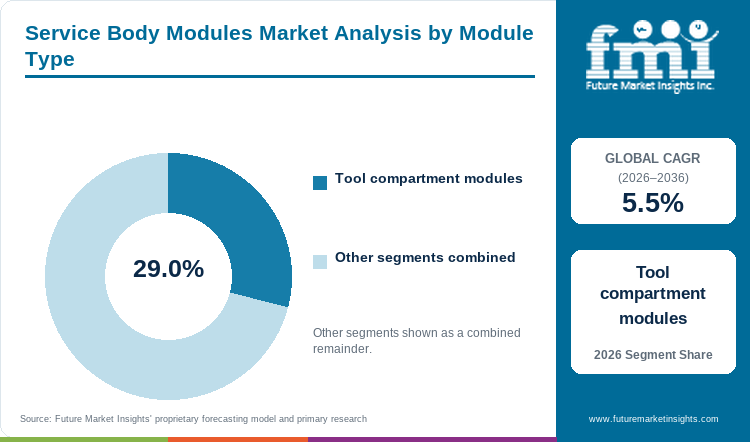
Tool compartments turn a vehicle into controlled mobile storage without changing the basic body architecture. Technicians can separate high-value tools from parts and safety gear, then add shelves or drawers around a familiar access pattern. The benefit appears before more specialized equipment is added because a crew can reduce loading time and avoid depot returns caused by missing items.
- Tool compartment modules account for 29.0% of the market in 2026, reflecting their use as a baseline functional layer for field-service storage and access.
- Reading Truck stated in March 2026 that its RHD-46 and RHD-67 bodies use deep organized compartments and configurable layouts for construction, utility and field-service work.
Why do Pickup service bodies account for 28.0% of Vehicle Type demand?
Pickup-based service bodies combine road maneuverability with external storage for daily maintenance work. They suit crews that need to reach dispersed sites and carry a repeatable tool set rather than a full mobile workshop. A broad pickup chassis base also gives procurement teams more choices around cab layout and powertrain. Heavier trucks remain relevant when cranes or larger compressors become part of the job package.
- Pickup service bodies hold a 28.0% share in 2026 because they cover a broad range of service duties without the operating burden of a larger vocational truck.
- Knapheide reported in April 2025 that its Aluminum Combo Body concept weighed 1,200 pounds on a Ford E-Transit chassis, showing how body mass can become a direct fitment constraint when payload is limited.
What supports Steel within the Material category?
Steel remains common where fleets prioritize impact tolerance and familiar repair practices. Service bodies experience frequent door cycles plus road vibration. They also face tool impacts and weather exposure. Steel is well understood by body builders and repair shops, and reinforced areas can be incorporated for towing or crane preparation. Aluminum becomes more attractive when corrosion resistance or payload preservation carries more weight in the purchase decision.
- Steel represents 42.0% of the market in 2026, supported by established fabrication methods and fleet familiarity with repair procedures.
- Knapheide announced in August 2025 that redesigned double-spring door retainers would be introduced across steel bodies after 40,000 development test cycles, showing continued engineering around high-cycle compartment hardware.
How do Truck upfitters shape the Sales Channel category?
Truck upfitters convert a catalog body into a road-ready work vehicle. They reconcile chassis dimensions with axle loading and electrical interfaces. Cranes or compressors must fit alongside storage without creating a poor weight distribution. Because fleets often buy a completed work package, the upfitter can influence supplier choice and delivery sequencing. This same installation role connects service bodies with flatbed body kits when fleets need open platform space alongside vocational storage.
- Truck upfitters account for 36.0% of Sales Channel demand in 2026 because they coordinate body installation with chassis and accessory integration.
- Reading Truck stated in March 2026 that it supported customers through 22 truck centers plus a partner distribution network across the USA and Canada, reinforcing the role of local installation and service capacity.
What drives Utility service within the End Use category?
Utility crews must carry tools and repair parts across dispersed assets. Many work packages also require lifting support or onboard power. A modular body lets a fleet match these functions to specific crew types instead of loading every truck with the same equipment. Uptime matters because outage response can make vehicle availability operationally important. Telecom and municipal fleets share parts of this workflow, yet utility specifications often place greater weight on repeatable compartment access and electrical integration.
- Utility service holds a 27.0% share in 2026 because grid and network maintenance require repeated field access to tools and job-specific support equipment.
- Service-body demand also overlaps with the utility vehicle market where payload flexibility and jobsite mobility influence fleet replacement decisions.
What are the drivers, restraints and opportunities in the Service Body Modules Market?
Infrastructure field work increases mobile-service requirements. Payload and final-stage integration can restrict the finished configuration. Pre-engineered lightweight modules can shorten fitment while preserving carrying capacity.
- Driver: Utility and construction programs move more inspection and maintenance work into the field, increasing the need for organized storage and job-specific support equipment on vocational vehicles.
- Restraint: Payload limits and completed-vehicle compliance can force fleets to remove desired equipment, move to a heavier chassis or accept a longer engineering cycle.
- Opportunity: Chassis-specific lightweight module packages can preserve payload and reduce repeat engineering across conventional and electrified work vehicles.
Field workload converts into module demand through crew productivity
Demand begins with organizations that must keep distributed infrastructure operating. The U.S. Department of Energy announced approximately USD 1.9 billion for the SPARK transmission-upgrade opportunity in March 2026. More line and substation work places crews away from fixed depots for longer periods. A service body can keep tools and parts on the same vehicle, while power or lifting equipment extends the tasks that can be completed at the site. Revenue capture is stronger when suppliers package modules around recurring crew roles because the same configuration can be repeated across replacement cycles.
Configuration risk can delay an otherwise justified purchase
The restraint appears when the work package meets the chassis. Final-stage certification duties apply to vehicles manufactured in two or more stages in the USA. Cabinets and drawers consume payload. Cranes and compressors can alter weight distribution, while electrical loads add another integration layer. A fleet may need a different chassis or a lighter material choice before the vehicle can be approved. The result is a longer specification cycle even when the operational need is clear.
Pre-engineered packages can reduce fitment work
Lightweighting creates value when it releases payload for tools or auxiliary systems. Knapheide showed a 1,200-pound Aluminum Combo Body on a Ford E-Transit chassis in April 2025. Suppliers can extend the same principle through validated storage, electrical and crane-prep packages for common pickup and medium-duty platforms. Transferable modules can also lower replacement cost when the chassis leaves service before the storage system does. Open-workspace configurations may also overlap with drop-side bodies when the job requires side access to cargo as well as protected tool storage.
Which country CAGRs are profiled in the Service Body Modules Market?
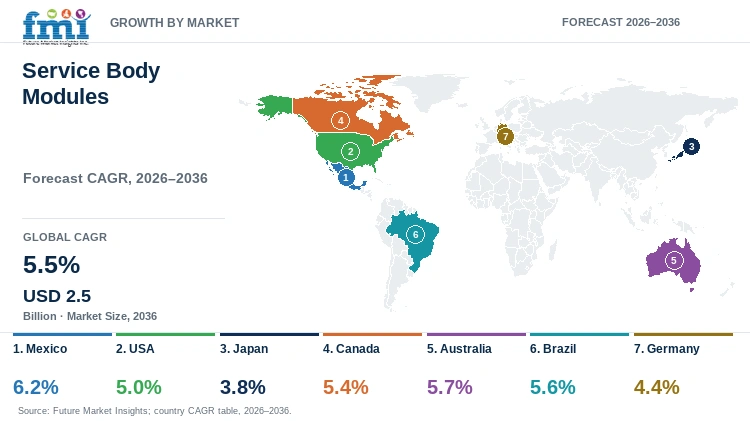
| Country | CAGR |
|---|---|
| Mexico | 6.2% |
| USA | 5.0% |
| Japan | 3.8% |
| Canada | 5.4% |
| Australia | 5.7% |
| Brazil | 5.6% |
| Germany | 4.4% |
How do country-level CAGRs compare in the Service Body Modules Market?
Across the key countries in this market, forecast rates span from 6.2% in Mexico to 3.8% in Japan for 2026 to 2036. The spread reflects different fleet investment cycles and infrastructure workloads. It should be read as a timing signal rather than a direct measure of country revenue. Chassis availability and local body-building capacity can change how quickly field-service demand converts into completed vehicle orders.
- Mexico at 6.2% sits 0.5 percentage points above Australia at 5.7%, with transmission expansion creating a direct utility-fleet workload.
- Australia at 5.7% and Brazil at 5.6% are close in forecast rate, yet long-distance field service in Australia differs from Brazil’s distribution-network investment cycle.
- Canada at 5.4% and USA at 5.0% both support large field-service fleets. Canada adds winter durability and long-distance coverage to the specification test.
- Germany at 4.4% and Japan at 3.8% place more weight on lifecycle economics and compact fitment than on rapid fleet expansion.
Country-wise Analysis
- Mexico is forecast to expand at 6.2% CAGR from 2026 to 2036. CFE announced in August 2025 that the 2025-2030 transmission plan covers 275 new transmission lines and 524 substation works under an USD 8.177 billion investment. That program creates a visible pipeline of utility construction and maintenance work across dispersed sites. Service-body demand will depend on whether local upfitters can repeat utility configurations across available chassis without extending delivery schedules.
- USA is forecast to expand at 5.0% CAGR from 2026 to 2036. The U.S. Department of Energy announced an approximately USD 1.9 billion SPARK funding opportunity in March 2026 for transmission upgrades. Large fleets can standardize bodies across several chassis classes, but final-stage compliance and payload management remain part of every completed configuration. Suppliers with pre-engineered body packages can reduce specification time for repeat fleet orders.
- Japan is forecast to expand at 3.8% CAGR from 2026 to 2036. The Ministry of Land, Infrastructure, Transport and Tourism published its fiscal 2025 construction investment outlook in August 2025, covering a mature construction base. Compact vehicle envelopes place tighter limits on body length and external width. Smaller module packages can therefore carry more value than large mechanic-body configurations when access and vehicle usability are the binding constraints.
- Canada is forecast to expand at 5.4% CAGR from 2026 to 2036. Statistics Canada reported in February 2026 that utility capital expenditures were expected to rise 9.7% in 2026 as grid reliability projects moved forward. Long service territories increase the cost of a depot return, while winter exposure raises the value of corrosion control and dependable compartment hardware. National fleets also benefit when the same body specification can be serviced across provinces.
- Australia is forecast to expand at 5.7% CAGR from 2026 to 2036. The Australian Bureau of Statistics reported that seasonally adjusted engineering construction work rose 7.1% in the March 2026 quarter. Remote maintenance work can turn vehicle downtime into a larger operating penalty than in dense urban routes. Payload-conscious bodies and spare-parts availability therefore become practical purchase tests for fleets working across long distances.
- Brazil is forecast to expand at 5.6% CAGR from 2026 to 2036. ANEEL reported in June 2026 that distributors invested about BRL 41 billion in distribution networks during 2025. The field workload supports service bodies for utility crews and contractors, while regional fleet economics can make highly customized upfits harder to standardize nationally. Modular option packs can help body builders match local duty requirements without loading every truck with the same equipment.
- Germany is forecast to expand at 4.4% CAGR from 2026 to 2036. Bundesnetzagentur stated in May 2026 that network tariffs cover around EUR 37 billion of annual costs and that congestion management remains an important system issue. Mature fleet economics raise the threshold for replacing a body that still works. Suppliers therefore need to show how a layout reduces technician time or preserves payload over the vehicle life rather than relying on fleet expansion alone.
Who are the notable companies in the Service Body Modules Market?
Knapheide, Reading Truck, Maintainer Corporation, Stellar Industries, CM Truck Beds, Royal Truck Body, Warner Bodies, Dakota Bodies, Ranger Design, and Morgan Truck Body are the notable companies profiled in this market.
Competition is shaped by how much of the completed service vehicle a supplier can engineer around the body. Knapheide and Reading Truck combine compartmented bodies with broader upfit options. Maintainer Corporation and Stellar Industries pair storage with mechanic-truck equipment or lifting systems. CM Truck Beds and Royal Truck Body focus more heavily on vocational body configuration. Warner Bodies and Dakota Bodies serve custom fleet layouts, while Ranger Design and Morgan Truck Body approach mobile service through modular pickup, van or enclosed-body architectures.
- Integrated service-body and lifting systems: Knapheide, Reading Truck, Maintainer Corporation, and Stellar Industries combine body structure with storage plus optional lifting or power equipment.
- Utility body and fleet configuration specialists: CM Truck Beds, Royal Truck Body, Warner Bodies, and Dakota Bodies compete through vocational layouts and material or chassis choices.
- Modular mobile-service and enclosed-body platforms: Ranger Design and Morgan Truck Body address reconfigurable pickup, van or enclosed mobile-service formats.
Competitive Benchmarking: Service Body Modules Market
| Company | Modular Storage and Compartment Depth | Crane and Power Integration | Material and Chassis Flexibility | Geographic Reach |
|---|---|---|---|---|
| Knapheide | High | Medium | High | U.S. upfit and dealer network |
| Reading Truck | High | High | High | USA and Canada |
| Maintainer Corporation | High | High | High | U.S. vocational fleet market |
| Stellar Industries | High | High | High | U.S. base with distributor reach |
| CM Truck Beds | Medium | Medium | High | U.S. dealer network |
| Royal Truck Body | Medium | Unscored | Medium | Western U.S. fleet and dealer market |
| Warner Bodies | Medium | Unscored | Medium | United States-focused |
| Dakota Bodies | High | Medium | High | United States-focused |
| Ranger Design | High | Unscored | High | USA and Canada |
| Morgan Truck Body | Medium | Unscored | Medium | North American vocational fleet market |
Scoring basis: Modular Storage and Compartment Depth reflects the documented breadth of cabinets, drawers, shelves and configurable storage in service-body offerings. Crane and Power Integration reflects crane-ready structures, compressors, electrical service or related onboard equipment. Material and Chassis Flexibility reflects documented material choice plus fit across different chassis or duty classes. High indicates broad documented capability. Medium indicates credible but narrower coverage. Low is reserved for a documented limitation. Geographic Reach reflects documented commercial or service presence relevant to vocational work trucks.
Key Developments in the Service Body Modules Market
- In March 2026, Reading Truck unveiled its Combo Body plus RHD-46 and RHD-67 heavy-duty service bodies at Work Truck Week. The Combo Body combined enclosed compartments with an open rear platform, while the RHD models added reinforced torsion-box construction for Class 4 through Class 7 applications.
- In March 2026, Stellar Industries showcased the 2026 TMAX Aluminum Mechanic Truck and the EC3200 Electric Service Crane at Work Truck Week. The display included mechanic-truck configurations with an air compressor or lube skid, extending the mix of storage, lifting and field-support equipment that can be integrated on one vehicle.
- In August 2025, Knapheide announced redesigned double-spring door retainers for its steel bodies. The company reported 40,000 development test cycles and planned a gradual rollout across product families after initial use on a steel PGTE body.
Key Players in the Service Body Modules Market
Integrated Service-Body and Lifting Systems
- Knapheide
- Reading Truck
- Maintainer Corporation
- Stellar Industries
Utility Body and Fleet Configuration Specialists
- CM Truck Beds
- Royal Truck Body
- Warner Bodies
- Dakota Bodies
Modular Mobile-Service and Enclosed-Body Platforms
- Ranger Design
- Morgan Truck Body
Service Body Modules Market - Report Scope
| Coverage field | Report scope |
|---|---|
| Market breakdown | Module Type, Vehicle Type, Material, Sales Channel, End Use |
| Quantitative Units | USD Billion |
| Market Definition | Revenue includes modular service-body structures and integrated storage or work-system modules sold for vocational pickups, light-duty trucks, medium-duty trucks, utility vans, and fleet maintenance vehicles. It excludes donor chassis revenue, downstream finished work-truck revenue, standalone equipment sold outside service-body integration, and adjacent cargo-body or generic toolbox revenue. |
| Regions Covered | North America; Latin America; Western Europe; Eastern Europe; East Asia; South Asia and Pacific; Middle East and Africa |
| Countries Covered | Mexico, USA, Japan, Canada, Australia, Brazil, Germany, and more than twenty-five additional countries in the full report |
| Key Companies Profiled | Knapheide; Reading Truck; Maintainer Corporation; Stellar Industries; CM Truck Beds; Royal Truck Body; Warner Bodies; Dakota Bodies; Ranger Design; Morgan Truck Body |
| Forecast Period | 2026 to 2036 |
| Approach | FMI applies a hybrid bottom-up and top-down sizing approach that reconciles manufacturer offerings with upfit channels, fleet procurement, vehicle classes, end-use demand and macroeconomic indicators within the defined revenue boundary. |
Service Body Modules Market - Research Methodology
| Method | Approach |
|---|---|
| Primary Research | Structured discussions with service-body manufacturers, truck upfitters, distributors, fleet procurement teams, field-service operators and subject-matter specialists are used to test purchasing criteria, replacement cycles, material choices, installation constraints and channel behavior. |
| Desk Research | Research reviews government infrastructure and fleet statistics, vehicle manufacturing and certification rules, company filings, official product documentation, company announcements, trade information and standards-related material relevant to the defined market. |
| Market Sizing and Forecasting | Sizing reconciles service-body and module supply with vehicle classes, channels, fleet applications, replacement activity and country operating conditions. Forecast assumptions consider infrastructure investment, fleet renewal, upfit activity, payload constraints, material mix, configuration complexity and product-mix changes. |
| Data Validation | Findings are cross-checked across independent source types and reviewed for scope consistency. The process excludes donor chassis revenue, finished downstream vehicle revenue, adjacent body categories and duplicate revenue that could be counted through both a body supplier and an upfit channel. |
Service Body Modules Market by Segments
Service Body Modules Market segmented by Module Type:
- Tool compartment modules
- Electrical service modules
- Compressor/generator modules
- Drawer and shelf modules
- Crane-ready body modules
Service Body Modules Market segmented by Vehicle Type:
- Pickup service bodies
- Light-duty trucks
- Medium-duty trucks
- Utility vans
- Fleet maintenance trucks
Service Body Modules Market segmented by Material:
- Steel
- Aluminum
- Stainless steel
- Composite panels
Service Body Modules Market segmented by Sales Channel:
- Truck upfitters
- Body builders
- Fleet procurement
- Aftermarket distributors
Service Body Modules Market segmented by End Use:
- Utility service
- Construction service
- Telecom service
- Municipal fleet
- Mobile repair
Service Body Modules Market by Region
- North America
- United States
- Canada
- Latin America
- Brazil
- Mexico
- Argentina
- Chile
- Western Europe
- Germany
- France
- United Kingdom
- Italy
- Spain
- Benelux
- Nordics
- Eastern Europe
- Poland
- Czech Republic
- Romania
- Hungary
- East Asia
- China
- Japan
- South Korea
- South Asia and Pacific
- India
- ASEAN
- Australia and New Zealand
- Middle East and Africa
- GCC Countries
- South Africa
- Türkiye
- Israel
Research Sources and Bibliography
- U.S. Department of Energy (2026, March 12). Energy Department Announces USD 1.9B Investment in Critical Grid Infrastructure to Reduce Electricity Costs.
- Electronic Code of Federal Regulations (2026, accessed August). 49 CFR Subtitle B, Chapter V: Parts 567 and 568.
- Comisión Federal de Electricidad (2025, August 21). CFE invertirá 8 mil 177 mdd para fortalecer Red de Transmisión en beneficio de 50 millones de mexicanas y mexicanos.
- Ministry of Land, Infrastructure, Transport and Tourism, Japan (2025, August 29). FY2025 Construction Investment Outlook.
- Statistics Canada (2026, February 25). Non-residential capital and repair expenditures, 2024 revised, 2025 preliminary and 2026 intentions.
- Australian Bureau of Statistics (2026, June 24). Engineering Construction Activity, Australia, March 2026.
- Agência Nacional de Energia Elétrica (2026, June 8). Plano de Desenvolvimento da Distribuição - PDD 2026.
- Bundesnetzagentur (2026, May 27). Latest considerations on reform of the electricity network tariff system.
- Reading Truck (2026, March 11). Reading Truck Unveils All-New Bodies at Work Truck Week 26.
- Stellar Industries (2026, March 10). Stellar Highlights Work Truck Solutions at NTEA Work Truck Week 2026.
- Knapheide (2025, August 29). Improved Door Retainers for Work Truck Bodies Announced.
- Knapheide (2025, April 28). Aluminum Combo Truck Body Concept Revealed.
- Maintainer Corporation (accessed 2026, August). High-Performance Service and Lube Truck Bodies.
- Ranger Design (accessed 2026, August). Trazer Truck Products.
This Report Answers
- What is the Service Body Modules Market size in 2026 and what value is forecast for 2036?
- Which field-service workloads support demand for service body modules?
- Why do tool compartment modules account for 29.0% of Module Type demand in 2026?
- How do pickup service bodies affect chassis selection and module demand?
- Why does steel account for 42.0% of Material demand in 2026?
- How do growth rates differ across Mexico, USA, Japan, Canada, Australia, Brazil and Germany?
- How do notable suppliers differ in storage depth, lifting integration and chassis flexibility?
- What should fleet managers and truck upfitters evaluate before approving a service body configuration?
Frequently Asked Questions
What is driving growth in the Service Body Modules Market?
Growth is supported by utility and construction work that must be completed away from fixed depots. Telecom and mobile maintenance add recurring demand. Fleets respond by carrying secure storage and parts access on vocational vehicles, with onboard power or lifting capability added when the work package requires it.
Who are the key players in the Service Body Modules Market?
The profiled companies are Knapheide, Reading Truck, Maintainer Corporation, Stellar Industries, CM Truck Beds, Royal Truck Body, Warner Bodies, Dakota Bodies, Ranger Design, and Morgan Truck Body. Their positions span integrated service bodies, utility-body configuration and modular mobile-service systems.
What notable restraint affects the Service Body Modules Market?
The main restraint is the trade-off between desired equipment and the chassis payload or compliance envelope. Cranes and compressors add weight. Electrical systems add integration work. A body can therefore require a different chassis or a reduced equipment package before it enters service.
Why should executives track the Service Body Modules Market?
Service body choices affect field productivity and fleet capital cost. They also influence technician access and the time required to put a new vehicle into service. Repeatable module packages can improve fleet consistency across replacement cycles.
What should fleet managers evaluate before specifying a service body?
Fleet managers should evaluate payload after upfit and compartment layout against the planned duty cycle. Material durability and chassis compatibility also matter. Electrical demand, serviceability and local upfit support should be checked before a configuration is approved.
What limits return on investment in the Service Body Modules Market?
Returns weaken when a body is over-specified or difficult to service. Installation time and vehicle downtime can outweigh a lower acquisition price. Payload loss also reduces value when the completed truck can no longer carry the crew equipment it was intended to support.
Preview the report firsthand - request a free sample
Get SampleGet the brochure for pricing and purchase details.
Get PDFTable of Content
- Key Takeaways
- Market Size and CAGR
- Top Growth Driver
- Fastest Growing Segment
- Leading Region
- Key Companies
- Emerging Opportunities
- Executive Summary
- Global Market Outlook
- Demand-side Trends
- Supply-side Trends
- Technology Roadmap Analysis
- Analysis and Recommendations
- Analyst Perspective (What is happening? Why now? What should investors know?)
- Key Questions Answered
- How large is the market?
- What is the CAGR?
- What are key trends?
- Which region dominates?
- Who are the leaders?
- Market Overview
- Market Coverage / Taxonomy
- Market Definition / Scope / Limitations
- Research Methodology
- Chapter Orientation
- Analytical Lens and Working Hypotheses
- Market Structure, Signals, and Trend Drivers
- Benchmarking and Cross-market Comparability
- Market Sizing, Forecasting, and Opportunity Mapping
- Research Design and Evidence Framework
- Desk Research Programme (Secondary Evidence)
- Expert Input and Fieldwork (Primary Evidence)
- Tooling, Models, and Reference Databases
- Data Engineering and Model Build
- Quality Assurance and Audit Trail
- Market Background
- Market Dynamics (Drivers, Restraints, Opportunity, Trends)
- Scenario Forecast (Optimistic, Likely, Conservative)
- Impact Analysis
- AI Impact
- Sustainability Impact
- Regulatory Impact
- Technology Impact
- Consumer / Buyer Analysis
- Purchase Drivers
- Adoption Barriers
- Buyer Journey
- Opportunity Map Analysis
- Product Life Cycle Analysis
- Supply Chain Analysis
- Investment Feasibility Matrix
- Value Chain Analysis
- PESTLE and Porter's Analysis
- Regulatory Landscape
- Regional Parent Market Outlook
- Production and Consumption Statistics
- Import and Export Statistics
- Global Market Analysis and Forecast, 2021 to 2036
- Historical Market Size Value (USD Billion) Analysis, 2021 to 2025
- Current and Future Market Size Value (USD Billion) Projections, 2026 to 2036
- Y-o-Y Growth Trend Analysis
- Absolute $ Opportunity Analysis
- Global Market Pricing Analysis, 2021 to 2036
- Global Market Analysis and Forecast, By Module Type, 2021 to 2036
- Introduction / Key Findings
- Historical Market Size Value (USD Billion) Analysis By Module Type, 2021 to 2025
- Current and Future Market Size Value (USD Billion) Analysis and Forecast By Module Type, 2026 to 2036
- Tool compartment modules
- Electrical service modules
- Compressor/generator modules
- Drawer and shelf modules
- Crane-ready body modules
- Y-o-Y Growth Trend Analysis By Module Type, 2021 to 2025
- Absolute $ Opportunity Analysis By Module Type, 2026 to 2036
- Global Market Analysis and Forecast, By Vehicle Type, 2021 to 2036
- Introduction / Key Findings
- Historical Market Size Value (USD Billion) Analysis By Vehicle Type, 2021 to 2025
- Current and Future Market Size Value (USD Billion) Analysis and Forecast By Vehicle Type, 2026 to 2036
- Pickup service bodies
- Light-duty trucks
- Medium-duty trucks
- Utility vans
- Fleet maintenance trucks
- Y-o-Y Growth Trend Analysis By Vehicle Type, 2021 to 2025
- Absolute $ Opportunity Analysis By Vehicle Type, 2026 to 2036
- Global Market Analysis and Forecast, By Material, 2021 to 2036
- Introduction / Key Findings
- Historical Market Size Value (USD Billion) Analysis By Material, 2021 to 2025
- Current and Future Market Size Value (USD Billion) Analysis and Forecast By Material, 2026 to 2036
- Steel
- Aluminum
- Stainless steel
- Composite panels
- Y-o-Y Growth Trend Analysis By Material, 2021 to 2025
- Absolute $ Opportunity Analysis By Material, 2026 to 2036
- Global Market Analysis and Forecast, By Sales Channel, 2021 to 2036
- Introduction / Key Findings
- Historical Market Size Value (USD Billion) Analysis By Sales Channel, 2021 to 2025
- Current and Future Market Size Value (USD Billion) Analysis and Forecast By Sales Channel, 2026 to 2036
- Truck upfitters
- Body builders
- Fleet procurement
- Aftermarket distributors
- Y-o-Y Growth Trend Analysis By Sales Channel, 2021 to 2025
- Absolute $ Opportunity Analysis By Sales Channel, 2026 to 2036
- Global Market Analysis and Forecast, By End Use, 2021 to 2036
- Introduction / Key Findings
- Historical Market Size Value (USD Billion) Analysis By End Use, 2021 to 2025
- Current and Future Market Size Value (USD Billion) Analysis and Forecast By End Use, 2026 to 2036
- Utility service
- Construction service
- Telecom service
- Municipal fleet
- Mobile repair
- Y-o-Y Growth Trend Analysis By End Use, 2021 to 2025
- Absolute $ Opportunity Analysis By End Use, 2026 to 2036
- Global Market Analysis and Forecast, By Region, 2021 to 2036
- Introduction
- Historical Market Size Value (USD Billion) Analysis By Region, 2021 to 2025
- Current Market Size Value (USD Billion) Analysis and Forecast By Region, 2026 to 2036
- North America
- Latin America
- Western Europe
- Eastern Europe
- East Asia
- South Asia and Pacific
- Middle East and Africa
- Market Attractiveness Analysis By Region
- North America Market Analysis and Forecast, By Country, 2021 to 2036
- Historical Market Size Value (USD Billion) Trend Analysis By Market Taxonomy, 2021 to 2025
- Market Size Value (USD Billion) Forecast By Market Taxonomy, 2026 to 2036
- By Country
- United States
- Canada
- By Module Type
- By Vehicle Type
- By Material
- By Sales Channel
- By End Use
- By Country
- Market Attractiveness Analysis
- By Country
- By Module Type
- By Vehicle Type
- By Material
- By Sales Channel
- By End Use
- Key Takeaways
- Latin America Market Analysis and Forecast, By Country
- Historical Market Size Value (USD Billion) Trend Analysis By Market Taxonomy, 2021 to 2025
- Market Size Value (USD Billion) Forecast By Market Taxonomy, 2026 to 2036
- By Country
- Brazil
- Mexico
- Argentina
- Chile
- By Module Type
- By Vehicle Type
- By Material
- By Sales Channel
- By End Use
- By Country
- Market Attractiveness Analysis
- By Country
- By Module Type
- By Vehicle Type
- By Material
- By Sales Channel
- By End Use
- Key Takeaways
- Western Europe Market Analysis and Forecast, By Country
- Historical Market Size Value (USD Billion) Trend Analysis By Market Taxonomy, 2021 to 2025
- Market Size Value (USD Billion) Forecast By Market Taxonomy, 2026 to 2036
- By Country
- Germany
- France
- United Kingdom
- Italy
- Spain
- Benelux
- Nordics
- By Module Type
- By Vehicle Type
- By Material
- By Sales Channel
- By End Use
- By Country
- Market Attractiveness Analysis
- By Country
- By Module Type
- By Vehicle Type
- By Material
- By Sales Channel
- By End Use
- Key Takeaways
- Eastern Europe Market Analysis and Forecast, By Country
- Historical Market Size Value (USD Billion) Trend Analysis By Market Taxonomy, 2021 to 2025
- Market Size Value (USD Billion) Forecast By Market Taxonomy, 2026 to 2036
- By Country
- Poland
- Czech Republic
- Romania
- Hungary
- By Module Type
- By Vehicle Type
- By Material
- By Sales Channel
- By End Use
- By Country
- Market Attractiveness Analysis
- By Country
- By Module Type
- By Vehicle Type
- By Material
- By Sales Channel
- By End Use
- Key Takeaways
- East Asia Market Analysis and Forecast, By Country
- Historical Market Size Value (USD Billion) Trend Analysis By Market Taxonomy, 2021 to 2025
- Market Size Value (USD Billion) Forecast By Market Taxonomy, 2026 to 2036
- By Country
- China
- Japan
- South Korea
- By Module Type
- By Vehicle Type
- By Material
- By Sales Channel
- By End Use
- By Country
- Market Attractiveness Analysis
- By Country
- By Module Type
- By Vehicle Type
- By Material
- By Sales Channel
- By End Use
- Key Takeaways
- South Asia and Pacific Market Analysis and Forecast, By Country
- Historical Market Size Value (USD Billion) Trend Analysis By Market Taxonomy, 2021 to 2025
- Market Size Value (USD Billion) Forecast By Market Taxonomy, 2026 to 2036
- By Country
- India
- ASEAN
- Australia and New Zealand
- By Module Type
- By Vehicle Type
- By Material
- By Sales Channel
- By End Use
- By Country
- Market Attractiveness Analysis
- By Country
- By Module Type
- By Vehicle Type
- By Material
- By Sales Channel
- By End Use
- Key Takeaways
- Middle East and Africa Market Analysis and Forecast, By Country
- Historical Market Size Value (USD Billion) Trend Analysis By Market Taxonomy, 2021 to 2025
- Market Size Value (USD Billion) Forecast By Market Taxonomy, 2026 to 2036
- By Country
- GCC Countries
- South Africa
- Türkiye
- Israel
- By Module Type
- By Vehicle Type
- By Material
- By Sales Channel
- By End Use
- By Country
- Market Attractiveness Analysis
- By Country
- By Module Type
- By Vehicle Type
- By Material
- By Sales Channel
- By End Use
- Key Takeaways
- Key Countries Market Analysis
- United States
- Pricing Analysis
- Market Share Analysis, 2025
- By Module Type
- By Vehicle Type
- By Material
- By Sales Channel
- By End Use
- Canada
- Pricing Analysis
- Market Share Analysis, 2025
- By Module Type
- By Vehicle Type
- By Material
- By Sales Channel
- By End Use
- Mexico
- Pricing Analysis
- Market Share Analysis, 2025
- By Module Type
- By Vehicle Type
- By Material
- By Sales Channel
- By End Use
- Brazil
- Pricing Analysis
- Market Share Analysis, 2025
- By Module Type
- By Vehicle Type
- By Material
- By Sales Channel
- By End Use
- Chile
- Pricing Analysis
- Market Share Analysis, 2025
- By Module Type
- By Vehicle Type
- By Material
- By Sales Channel
- By End Use
- Germany
- Pricing Analysis
- Market Share Analysis, 2025
- By Module Type
- By Vehicle Type
- By Material
- By Sales Channel
- By End Use
- United Kingdom
- Pricing Analysis
- Market Share Analysis, 2025
- By Module Type
- By Vehicle Type
- By Material
- By Sales Channel
- By End Use
- Italy
- Pricing Analysis
- Market Share Analysis, 2025
- By Module Type
- By Vehicle Type
- By Material
- By Sales Channel
- By End Use
- Spain
- Pricing Analysis
- Market Share Analysis, 2025
- By Module Type
- By Vehicle Type
- By Material
- By Sales Channel
- By End Use
- France
- Pricing Analysis
- Market Share Analysis, 2025
- By Module Type
- By Vehicle Type
- By Material
- By Sales Channel
- By End Use
- India
- Pricing Analysis
- Market Share Analysis, 2025
- By Module Type
- By Vehicle Type
- By Material
- By Sales Channel
- By End Use
- ASEAN
- Pricing Analysis
- Market Share Analysis, 2025
- By Module Type
- By Vehicle Type
- By Material
- By Sales Channel
- By End Use
- Australia and New Zealand
- Pricing Analysis
- Market Share Analysis, 2025
- By Module Type
- By Vehicle Type
- By Material
- By Sales Channel
- By End Use
- China
- Pricing Analysis
- Market Share Analysis, 2025
- By Module Type
- By Vehicle Type
- By Material
- By Sales Channel
- By End Use
- Japan
- Pricing Analysis
- Market Share Analysis, 2025
- By Module Type
- By Vehicle Type
- By Material
- By Sales Channel
- By End Use
- South Korea
- Pricing Analysis
- Market Share Analysis, 2025
- By Module Type
- By Vehicle Type
- By Material
- By Sales Channel
- By End Use
- Poland
- Pricing Analysis
- Market Share Analysis, 2025
- By Module Type
- By Vehicle Type
- By Material
- By Sales Channel
- By End Use
- Hungary
- Pricing Analysis
- Market Share Analysis, 2025
- By Module Type
- By Vehicle Type
- By Material
- By Sales Channel
- By End Use
- Türkiye
- Pricing Analysis
- Market Share Analysis, 2025
- By Module Type
- By Vehicle Type
- By Material
- By Sales Channel
- By End Use
- South Africa
- Pricing Analysis
- Market Share Analysis, 2025
- By Module Type
- By Vehicle Type
- By Material
- By Sales Channel
- By End Use
- Australia
- Pricing Analysis
- Market Share Analysis, 2025
- By Module Type
- By Vehicle Type
- By Material
- By Sales Channel
- By End Use
- United States
- Market Structure Analysis
- Competition Dashboard
- Competition Benchmarking
- Market Share Analysis of Top Players
- By Regional
- By Module Type
- By Vehicle Type
- By Material
- By Sales Channel
- By End Use
- Emerging Startups
- Innovation Benchmarking
- Competition Analysis
- Competition Deep Dive
- Knapheide
- Overview
- Product Portfolio
- Profitability by Market Segments
- Sales Footprint
- Strategy Overview
- Marketing Strategy
- Product Strategy
- Channel Strategy
- Reading Truck
- Maintainer Corporation
- Stellar Industries
- CM Truck Beds
- Royal Truck Body
- Warner Bodies
- Dakota Bodies
- Ranger Design
- Morgan Truck Body
- Knapheide
- Case Studies
- Success Stories
- Recent Developments
- Competition Deep Dive
- Assumptions & Acronyms Used


