

- Market Size (2026)
- USD 860.7 Mn
- Forecast (2036)
- USD 1415.4 Mn
- CAGR (2026 to 2036)
- 5.1%
How big is Drop-Side Bodies Market in 2026?
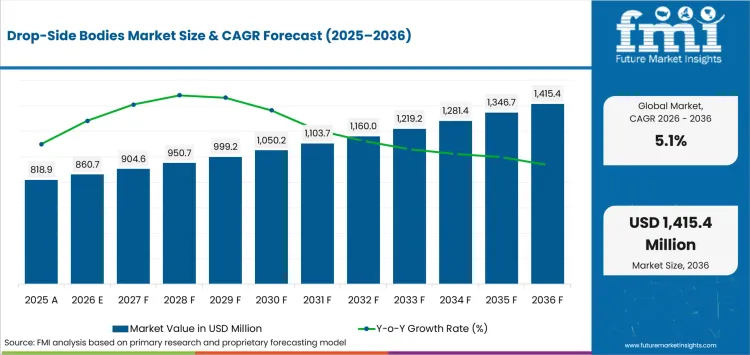
USD 860.7 million in 2026 and USD 1415.4 million by 2036 at a 5.1% CAGR.
Demand for drop-side bodies is projected to expand at 5.1% CAGR between 2026 and 2036, lifting valuation from USD 860.7 million to USD 1415.4 million. Demand is supported by commercial-vehicle replacement cycles because body upgrades are often evaluated when fleets extend vehicle service life or refurbish existing assets. ACEA reported in February 2025 that more than 30 million vans were in operation, with an average age of 12.5 years. The large and aging vehicle parc creates opportunities for body replacement and retrofit activity where operators seek lower weight, improved cargo access or faster side-loading capability. Orders are more likely to convert when the upgrade improves daily vehicle utilization without requiring full vehicle replacement.
Mature van fleets do not replace work bodies at the same pace because daily mileage varies sharply between operators. Great Britain logged 58.8 billion van miles in 2025 according to the Department for Transport, which was 10.0% above 2019. Fleet management systems expose utilization and repair histories, so high-mileage operators reach body replacement decisions sooner than fleets with lighter duty cycles.
Key Takeaways
- Work fleets specify drop-side bodies where direct side access removes repeated handling and preserves useful chassis payload during daily site work.
- By body type, aluminum drop-side bodies are estimated to hold 32.0% in 2026 owing to lower body mass and corrosion resistance.
- In 2026, light commercial vehicles are expected to lead vehicle class with 37.0% share because compact chassis suit frequent stop-and-load work.
- Two-side drop is projected to hold 27.0% share in 2026 owing to broad side access without full three-way tipping hardware.
- Bespoke mounting work slows conversion where completed vehicles need additional approval records and tight payload control before fleet handover.
- Some of the key players in this market include Humbaur, MEILLER, Kögel, Ifor Williams, Knapheide, Edbro, Bevan Group, and Thompsons UK.
Analyst Perspective
"Drop-side bodies pay back fastest where side access cuts handling time without surrendering payload to heavier structures. Repeat orders favor bodybuilders that pre-engineer mounting geometry and approval records for the same chassis families."
- Nikhil Kaitwade, Principal Consultant, Future Market Insights
How is the drop-side bodies market segmented?
The drop-side bodies market is segmented by body type, vehicle class, side configuration, sales channel, and end use.
Body type covers aluminum drop-side, steel drop-side, tipping drop-side, removable side, modular systems, and custom bodies. Vehicle class includes light, medium, and heavy commercial vehicles. Side configuration covers one-side, two-side, three-side, drop, and removable sides. Sales channels include body builders, dealer upfitters, fleet and OEM contracts, and aftermarket installers. End uses cover construction, agriculture, logistics, municipal services, landscaping, and utilities.
What makes aluminum drop-side bodies central to the body type category?
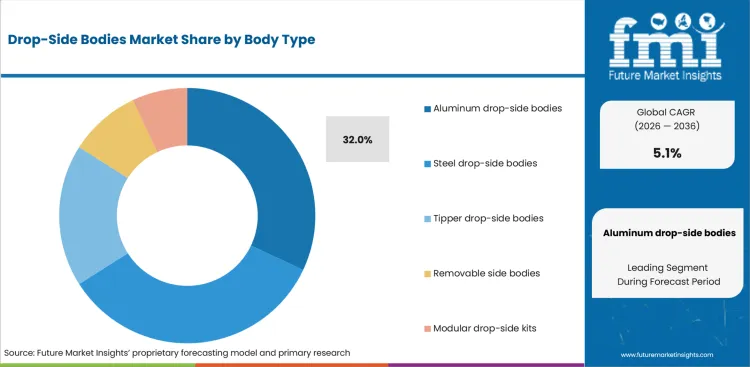
Aluminum bodies protect payload on work vehicles that already carry crews and tools near legal weight limits. Weight control also affects lightweight automotive body panels, but drop-side bodies face repeated hinge impacts and direct loading damage. Repairable side sections therefore influence lifetime cost as much as the initial body mass over several duty cycles.
- By body type, aluminum drop-side bodies are estimated to hold 32.0% in 2026 owing to payload preservation on weight-sensitive chassis.
- Payload-focused conversions depend on body mass and side-access hardware being proven together on a working chassis. Knapheide disclosed in April 2025 that its aluminum Combo Body concept weighed 1,200 pounds and used 18-inch drop-down aluminum stake racks on a Ford E-Transit chassis.
Why do light commercial vehicles lead the vehicle class category?
Light commercial vehicles suit builders and service crews that need compact road dimensions with a useful loading deck. Electric commercial vehicle MRO requirements raise the value of service access because battery hardware occupies conversion space below the body. Dealers also quote repeat body packages faster on commonly stocked chassis during routine fleet replacement tenders.
- Light commercial vehicles are set to lead the vehicle class with 37.0% share in 2026 due to frequent stop-and-load work on compact chassis.
- Van electrification makes body weight more visible because conversion hardware competes with battery mass for usable payload. ACEA documented in July 2026 that electrically-chargeable vans gained 41.6% in the first half of 2026 and reached a 13.2% registration share.
How does two-side drop retain the lead in side configuration?
Two-side drop bodies let crews approach palletized or bagged cargo from either flank without a complete three-way tipping mechanism. The layout preserves deck access beside tipper body equipment or truck-mounted cranes that occupy body space. Routine cargo can therefore be loaded from either side without starting a tipping cycle on active construction sites.
- In 2026, two-side drop is expected to lead side configuration with 27.0% share because crews gain two-sided access without full tipping hardware.
- Side-wall dimensions affect loading access and durability long before a fleet decides whether full tipping hardware is justified. Humbaur presented steel side walls measuring 350 millimeters on its Tridem tipper and 400 millimeters on ProSteel models at bauma in March 2025.
What supports body builders as the leading sales channel?
Body builders control the engineering step between a bare chassis and a registrable working vehicle. They coordinate body mount fasteners with axle limits and body clearances before delivery. Repeat mounting plans reduce installation variation on commercial fleet orders using the same chassis specification during repeat replacement programs.
- By sales channel, body builders are forecast to represent 41.0% in 2026 driven by chassis integration and approval work within the conversion job.
- Tailored body conversion stays with the bodybuilder because chassis integration must be resolved before a fleet accepts the finished vehicle. Isuzu Truck UK stated in June 2025 that a Brit-Tipp dropside-bodied 7.5-tonne truck joined LTC Mobility's 60-vehicle fleet after a tailored body conversion.
What are the drivers, restraints and opportunities in the Drop-Side Bodies Market?
Frequent site loading sustains demand, whereas approval work and body weight slow bespoke conversions and favor repeatable lightweight packages.
- Driver: Side access reduces handling steps on work vehicles that repeatedly load tools, materials, and site equipment during active shifts.
- Restraint: Added body mass and approval work can reduce legal payload or extend lead times before a converted chassis enters service.
- Opportunity: Standardized aluminum mounting packages can shorten engineering work for repeat orders built on common electric or low-emission chassis.
Active site work rewards faster loading
Construction fleets value side access because crews repeatedly move tools and materials during active site shifts. The Australian Bureau of Statistics recorded a 5.4% rise in seasonally adjusted engineering construction work during the June 2025 quarter. Construction equipment attachments and side-access bodies reduce handling time on active sites without forcing fleets into a larger chassis class.
Approval and payload limits slow bespoke builds
Approval work becomes a planning constraint once a bespoke body changes the completed vehicle weight or dimensional envelope. Bodybuilders can reuse tested mounting records and axle weight sensors to shorten final checks on familiar chassis. April 2026 UK guidance requires worst-case chassis-body testing for certain multi-stage or non-standardized zero-emission vehicles, which keeps unproven pairings slower to approve.
Repeatable electric-chassis packages reduce engineering time
Battery mass reduces the payload left for bodywork and cargo on electric vans carrying tools or site materials. Reusable aluminum mounting packages therefore reduce repeated engineering effort for fleets ordering the same electric chassis in volume. ACEA put electrically-chargeable vans at 11.2% of EU registrations in 2025 compared with 6.1% one year earlier, widening the fleet pool where body weight receives closer scrutiny.
Which country CAGRs are profiled in the Drop-Side Bodies Market?
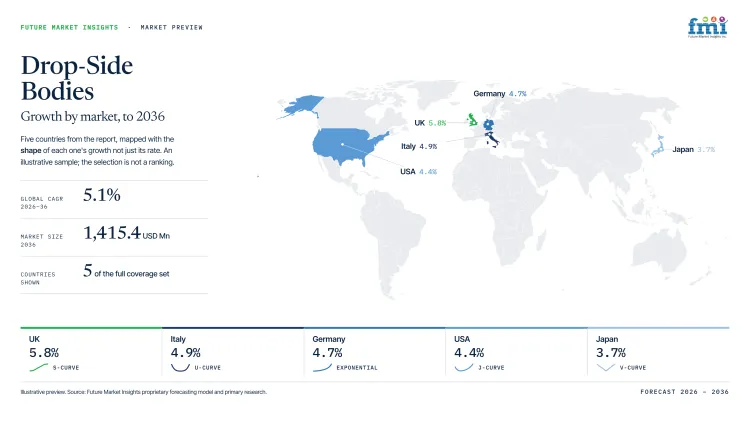
| Country | CAGR |
|---|---|
| UK | 5.8% |
| South Africa | 5.4% |
| Australia | 5.2% |
| Italy | 4.9% |
| Germany | 4.7% |
| USA | 4.4% |
| Japan | 3.7% |
How do country-level CAGRs compare in the Drop-Side Bodies Market?
The profiled markets separate into three growth bands rather than one uniform replacement cycle. The UK, South Africa and Australia exceed 5.0% CAGR, Italy and Germany form the middle band, and the USA and Japan advance more slowly. The 2.1-point spread is modest, but fleet use and conversion access still separate the growth bands.
- UK dealer density supports repeat conversions on familiar light-commercial chassis used by local trades and service fleets.
- South African municipal tenders favor simple bodies that contractors can repair with widely available hinges and latches.
- Australian civil contractors value open side access for mixed materials carried between dispersed regional worksites.
- Italian urban access favors compact chassis and narrower decks for contractors serving dense municipal and building zones.
- German fleets place load security and corrosion performance ahead of simple body price during formal specification reviews.
- US utility fleets rely on regional dealer relationships that keep body parts and service close to operating territories.
- Japanese municipal routes reward controlled side clearance on compact chassis used in narrow streets and crowded loading areas.
Similar CAGRs therefore lead to different entry routes because local service channels and fleet specifications shape replacement decisions. The full report provides country-level CAGR analysis across North America, Latin America, Europe, East Asia, South Asia, Oceania and the Middle East and Africa.
Country-wise Analysis
- High annual van mileage puts body durability and payload control under daily pressure for UK construction and service fleets. The UK drop-side bodies sector is projected to record 5.8% CAGR during the assessment period due to rising zero-emission light goods vehicle adoption. Department for Transport data published in April 2026 counted 30,524 zero-emission LGV registrations during 2025 and a 9.3% share of new LGVs. Approved repeat chassis pairings let established bodybuilders shorten scheduled fleet replacement while keeping parts common within contracted fleet programs. Bespoke variants still face longer sign-off because gross-weight limits and approval records must match the completed vehicle.
- In South African municipal fleets, road and utility tenders often determine when work-body orders enter the market. In November 2025 Statistics South Africa documented 748 public-sector institutions and a third consecutive annual increase in infrastructure investment. South Africa is estimated to post 5.4% CAGR over the forecast period given recurring road and municipal programs. Local workshops favor repairable steel hardware because vehicles frequently work far from major bodybuilding centers and need repairs without specialist tooling during municipal maintenance work. Financing limits premium specifications and can stretch replacement cycles for contractors unable to absorb lengthy parts delays on municipal contracts.
- Far from major bodybuilder workshops, Australian contractors place unusual value on simple repairs and locally available hardware. Adoption of drop-side bodies in Australia is estimated to expand at 5.2% CAGR through 2036 tied to construction employment and work-ready chassis packages. Construction employment reached 1,242,600 people in June 2025 according to the Australian Bureau of Statistics. Dealer-backed standard bodies keep replacement parts available in regional service areas and reduce downtime after hinge or side-panel damage without factory-specific shipments. Long transport distances penalize proprietary components and favor designs that independent workshops can repair during routine fleet use on inland sites.
- Regional bodybuilders serve Italian contractors with compact urban vehicles and heavier construction chassis that require different deck dimensions. Istat's February 2026 release recorded a 4.8% increase in calendar-adjusted construction production on average during 2025. Demand for drop-side bodies in Italy is forecast to rise at 4.9% CAGR over the forecast period attributable to continued construction activity. Dealer-bodybuilder relationships provide repeat customers with familiar chassis and service support for municipal or building fleets operating locally with predictable fit during repeat ordering. Fragmented conversion capacity can lengthen delivery outside major industrial regions and makes national fleet standardization harder to maintain.
- German fleet specifications usually require clear evidence of chassis fit and approval documentation before a repeat body layout enters service. Germany's drop-side bodies outlook is anticipated to advance at 4.7% CAGR over the assessment period reinforced by construction orders and dense bodybuilder capacity. In February 2026 Destatis reported that real main-construction orders increased 6.8% during 2025. Local engineering coverage supports tested chassis-body combinations and keeps repair records available for repeat fleet purchases under local warranty and inspection schedules. Higher documentation expectations restrict loosely specified custom builds and reward companies able to reproduce approved layouts consistently over several vehicle batches.
- In the United States, dealer and upfit networks determine how work-body products reach construction and utility fleets. Bureau of Labor Statistics data released in February 2026 showed construction employment rising by 33,000 jobs in January including 30,700 specialty-trade positions. By 2036, US drop-side body demand is projected to grow at 4.4% CAGR shaped by replacement needs in construction and field service. Distributor networks give manufacturers service reach without one national body specification and keep repair parts close to operating fleets. Fragmented state channels raise selling costs and favor companies that stock parts beyond a regional installation center.
- Dense urban routes in Japan put strict limits on body width and side-loading clearance for compact commercial vehicles. Drop-side body sales in Japan are forecast to expand at 3.7% CAGR by 2036 aided by logistics experiments focused on loading and vehicle operations. Six use cases were selected in July 2025 for automated logistics-road demonstrations by Japan's Ministry of Land, Infrastructure, Transport and Tourism. Automation trials can improve loading coordination for fleets already operating compact chassis and tightly scheduled depot movements before the next departure window. Smaller vehicle envelopes restrict body dimensions and keep large drop-side formats less attractive than in spacious construction markets.
Who are the notable companies in the Drop-Side Bodies Market?
Humbaur, MEILLER, Kögel, Ifor Williams, Knapheide, Edbro, Bevan Group, and Thompsons UK are the notable companies serving this market.
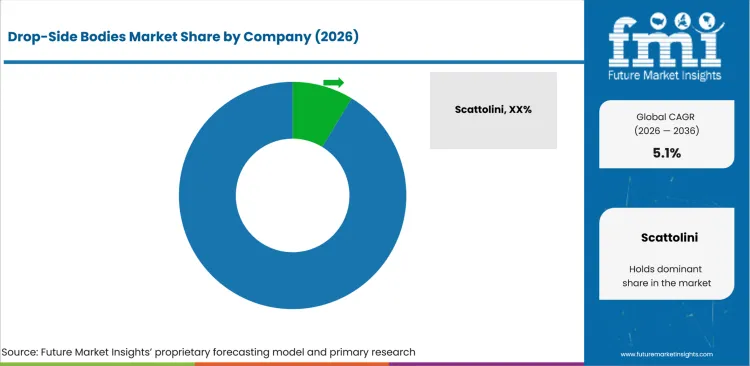
Competition separates trailer specialists from tipping-system manufacturers and regional work-truck bodybuilders serving distinct chassis classes and loading duties. Entry depends on documented chassis fit, payload performance, repair coverage, and repeat fleet production at commercial scale.
- Humbaur, Kögel, and Ifor Williams serve construction transport with trailer and platform body formats for varied load profiles.
- MEILLER and Edbro focus on tipping bodies and hydraulic integration for heavier commercial vehicles in construction service.
- Knapheide serves North American work-truck fleets, with Bevan Group and Thompsons UK building complete bodies tied to installation and service requirements.
Competitive Benchmarking: Drop-Side Bodies Market
| Company | Payload & Weight Optimization | Drop-Side / Tipper Configuration Breadth | Chassis & OEM Integration | Geographic Reach |
|---|---|---|---|---|
| Humbaur | Medium | High | Low | Europe |
| MEILLER | High | High | High | Europe and international OEM channels |
| Kögel | High | Medium | Low | Europe |
| Ifor Williams | High | High | Low | UK, Europe and export distributor markets |
| Knapheide | High | High | High | North America |
| Edbro | High | Low | Medium | Europe, Türkiye and international HDV markets |
| Bevan Group | High | High | High | United Kingdom |
| Thompsons UK | High | High | High | United Kingdom |
For payload optimization High requires documented lightweight engineering, Medium requires a stated weight-control feature and Low identifies verified standard-weight construction. Configuration breadth is High with at least three relevant body formats, Medium with two formats and Low with one documented format. Chassis integration is High for documented OEM or multi-chassis programs, Medium for one verified route and Low identifies verified stand-alone body or trailer programs.
Key Developments in the Drop-Side Bodies Market
- In July 2025, Knapheide introduced the Steel PGTE body for Class 2 and larger chassis cabs after presenting the platform at Work Truck Week.
- In May 2025, Thompsons UK supplied six Loadmaster X-Lite tipping bodies to Lime Logistics with achievable payload of about 19.5 tonnes.
- In April 2025, Kögel introduced a new tipper at bauma with a minimum empty weight near 5,200 kilograms and 24 or 27 cubic meter volume options.
Key Players in the Drop-Side Bodies Market
Trailer and Platform Specialists
- Humbaur
- Kögel
- Ifor Williams
Tipping and Hydraulic Specialists
- MEILLER
- Edbro
Work-Truck Bodybuilders and Converters
- Knapheide
- Bevan Group
- Thompsons UK
Drop-Side Bodies Market - Report Scope
| Coverage field | Report scope |
|---|---|
| Market breakdown | By body type, vehicle class, side configuration, sales channel, end use, and region. |
| Quantitative Units | USD million. |
| Market Definition | Commercial drop-side and tipping work bodies fitted to light, medium, and heavy commercial vehicle chassis for side-access cargo handling. |
| Regions Covered | North America, Latin America, Europe, East Asia, South Asia and Pacific, and Middle East and Africa. |
| Countries Covered | UK, South Africa, Australia, Italy, Germany, USA, Japan, and 20+ countries included in the full report. |
| Key Companies Profiled | Humbaur, MEILLER, Kögel, Ifor Williams, Knapheide, Edbro, Bevan Group, Thompsons UK. |
| Forecast Period | 2026 to 2036. |
| Approach | Primary and secondary research with market triangulation. |
Drop-Side Bodies Market - Research Methodology
| Method | Approach |
|---|---|
| Primary Research | FMI analysts gathered input from manufacturers, service providers, technology developers, distributors, end users, procurement teams, and subject-matter experts. Interviews examined purchasing decisions, product or service evaluation, adoption barriers, approval requirements, pricing considerations, and expectations for technical or commercial support. Respondents were also asked what evidence is required before a trial, pilot, or initial order develops into regular purchasing. |
| Desk Research | Desk research covered government statistics, regulatory publications, trade data, industry associations, technical literature, standards, company filings, product information, and official corporate announcements. Sources were reviewed for relevance, publication date, geographic coverage, and consistency with the defined market scope. Claims relating to performance, applications, approvals, capacity, investment, and commercial activity were retained only when supported by credible public evidence. |
| Market Sizing and Forecasting | The market model combined the baseline value with historical performance, segment structure, pricing and volume indicators, adoption levels, company participation, and country-level demand conditions. Forecast assumptions considered economic activity, investment trends, regulatory developments, technology adoption, purchasing cycles, supply availability, and barriers to wider market use. Segment and regional estimates were reconciled before the final market total was calculated. |
| Data Validation | Estimates were checked against multiple independent indicators, including public data, company activity, trade patterns, industry developments, and findings from primary interviews. Validation also tested whether products, services, applications, and company revenues fell within the defined market boundaries. Adjacent categories, unsupported claims, overlapping revenues, and activities without direct market relevance were excluded to reduce double counting and maintain consistency across segments and countries. |
Drop-Side Bodies Market by Segments
Drop-Side Bodies Market segmented by Body Type:
- Aluminum drop-side bodies
- Steel drop-side bodies
- Tipper drop-side bodies
- Removable side bodies
- Modular drop-side kits
Drop-Side Bodies Market segmented by Vehicle Class:
- Light commercial vehicles
- Medium-duty trucks
- Heavy-duty trucks
- Pickup conversions
Drop-Side Bodies Market segmented by Side Configuration:
- Two-side drop
- Three-side drop
- Removable panels
- Hinged tailgate integrated
Drop-Side Bodies Market segmented by Sales Channel:
- Body builders
- Dealer upfitters
- Fleet procurement
- Aftermarket installers
Drop-Side Bodies Market segmented by End Use:
- Construction
- Municipal services
- Agriculture
- Landscaping
- General freight
Drop-Side Bodies Market by Region:
- North America
- United States
- Canada
- Latin America
- Brazil
- Mexico
- Argentina
- Chile
- Western Europe
- Germany
- France
- United Kingdom
- Italy
- Spain
- Benelux
- Nordics
- Eastern Europe
- Poland
- Czech Republic
- Romania
- Hungary
- East Asia
- China
- Japan
- South Korea
- South Asia and Pacific
- India
- ASEAN
- Australia and New Zealand
- Middle East and Africa
- GCC Countries
- South Africa
- Türkiye
- Israel
Research Sources and Bibliography
- European Automobile Manufacturers’ Association. (2025, February 7). Fact sheet: Vans.
- Department for Transport. (2026, May 20). Road traffic estimates in Great Britain, 2025: Traffic in Great Britain by vehicle type.
- Knapheide. (2025, April 28). Aluminum Combo Truck Body Concept Revealed.
- European Automobile Manufacturers’ Association. (2026, July 29). New commercial vehicle registrations: vans +1.9%, trucks +9.8%, buses +22.7% in H1 2026.
- Humbaur GmbH. (2025, March 6). Humbaur at BAUMA 2025 with construction classics from the heavy duty and passenger car sectors.
- Isuzu Truck UK. (2025, June 19). LTC takes fleet to the next level with 7.5 tonne Isuzu.
- Australian Bureau of Statistics. (2025, September 24). Engineering Construction Activity, Australia, June 2025.
- Department for Transport. (2026, April 1). Zero emission van and truck grant: how to complete the application form.
- European Automobile Manufacturers’ Association. (2026, January 29). New commercial vehicle registrations: vans -8.8%, trucks -6.2%, buses +7.5% in 2025.
- Department for Transport. (2026, April 29). Vehicle licensing statistics, United Kingdom: 2025.
- Statistics South Africa. (2025, October). Economic wrap-up for October 2025.
- Australian Bureau of Statistics. (2025, September 5). Labour Account Australia, June 2025.
- Istat. (2026, February 20). Production in the construction sector - December 2025.
- Federal Statistical Office of Germany. (2026, February 25). KORREKTUR: Auftragseingang im Bauhauptgewerbe 2025 um 6,8 % höher als im Vorjahr.
- USA Bureau of Labor Statistics. (2026, February 13). Total nonfarm payroll employment up by 130,000 in January 2026.
- Ministry of Land, Infrastructure, Transport and Tourism. (2025, July 31). FY2025 demonstration experiment toward social implementation of automated logistics roads.
- Kögel Trailer GmbH. (2025, April 8). Kögel Trailer presents new tipper trailer at bauma 2025.
- Edbro Hydraulics Ltd. (2025, March 24). Edbro Hydraulics Ltd acquired by Orsan Industries.
- Edbro Hydraulics Ltd. (2025, June 12). Edbro introduces Revolutionary Manufacturing Line for HP Series Cylinders.
- Bevan Group. (2026, February 20). Bevan Group’s new French connection drives next-day bodies offer.
- Ifor Williams Trailers Ltd. (2026, January 19). Ifor Williams Trailers launches lighter Tow-Max range.
- Ifor Williams Trailers Ltd. (2026, March 25). North Wales trailer giant drives into South America with 50 jobs boost.
- MEILLER. (2025, April 7). MEILLER presents its portfolio at bauma 2025.
- Kögel Trailer GmbH. (2025, September 29). Kögel tipper body wins first TTW Reader Award.
- Isuzu Truck UK. (2025, August 28). New Isuzu for John Smith (Melbourne).
- Knapheide. (2025, July 30). New Steel PGTE Gooseneck Truck Body Released.
- Thompsons UK. (2025, May 15). Six new tippers put Thompsons in the Lime-Lite!
- Daimler Truck AG. (2025, April 7). Daimler Truck brand FUSO at bauma 2025: New additional eCanter variants for construction and gardening/landscaping industries.
- Knapheide. (2025, August 29). Improved Work Truck Bed Door Retainers Announced.
- MEILLER. (2024, February 9). Quality Management System according to ISO 9001.
- Kögel Trailer GmbH. (2025, June 5). General purchase terms and conditions (GPC), status 05/06/2025.
This bibliography is provided for reader reference and is not exhaustive. The full report contains the complete reference list and detailed citations.
This Report Answers
- How large is the drop-side bodies market in 2026 and 2036?
- Why do work fleets specify side-access bodies for repeated loading?
- Why do aluminum bodies hold the largest body type share?
- Why do light commercial vehicles lead the vehicle class mix?
- How do approval and payload limits affect conversion lead times?
- Which profiled countries record the highest forecast CAGRs?
- How do bodybuilders differ from tipping-system specialists?
- Which companies recorded material developments after January 2025?
Frequently Asked Questions
How big is the drop-side bodies market in 2026?
The drop-side bodies market is valued at USD 860.7 million in 2026 and is projected to reach USD 1,415.4 million by 2036. Repeated site loading sustains growth because side access reduces handling without forcing fleets into a larger chassis class.
What is the CAGR of the drop-side bodies market from 2026 to 2036?
The drop-side bodies market is projected to grow at a CAGR of 5.1% between 2026 and 2036. Replacement demand strengthens as operators compare useful payload and loading time on aging commercial-vehicle fleets.
Which body type leads the drop-side bodies market?
The aluminum drop-side bodies segment is expected to hold 32.0% of the drop-side bodies market in 2026, driven by lower body mass on payload-sensitive chassis. Corrosion resistance also suits fleets exposed to weather and frequent washing during demanding regular service cycles.
Which vehicle class leads the drop-side bodies market?
The light commercial vehicles segment is expected to hold 37.0% of the drop-side bodies market in 2026, supported by compact chassis for frequent stop-and-load work. Repeat chassis packages also let bodybuilders quote common fleet conversions faster during scheduled commercial replacement programs.
How much value will the drop-side bodies market add between 2026 and 2036?
The drop-side bodies market is expected to add USD 554.7 million in value between 2026 and 2036. Commercial-vehicle replacement supports that increase where side access improves loading without forcing fleets into a larger chassis class.
Which countries are projected to record the highest growth in the drop-side bodies market?
The UK is projected to grow at 5.8% CAGR, followed by South Africa at 5.4% and Australia at 5.2% through 2036. Fleet renewal and infrastructure work shape these outlooks alongside different regional service and conversion conditions.
Which companies are active in the drop-side bodies market?
Key companies operating in the drop-side bodies market include Humbaur, MEILLER, Kögel, Ifor Williams, Knapheide, Edbro, Bevan Group, and Thompsons UK. These companies compete through body engineering, tipping systems, chassis integration, and regional conversion and aftersales support.
Preview the report firsthand - request a free sample
Get SampleGet the brochure for pricing and purchase details.
Get PDFTable of Content
- Key Takeaways
- Market Size and CAGR
- Top Growth Driver
- Fastest Growing Segment
- Leading Region
- Key Companies
- Emerging Opportunities
- Executive Summary
- Global Market Outlook
- Demand-side Trends
- Supply-side Trends
- Technology Roadmap Analysis
- Analysis and Recommendations
- Analyst Perspective (What is happening? Why now? What should investors know?)
- Key Questions Answered
- How large is the market?
- What is the CAGR?
- What are key trends?
- Which region dominates?
- Who are the leaders?
- Market Overview
- Market Coverage / Taxonomy
- Market Definition / Scope / Limitations
- Research Methodology
- Chapter Orientation
- Analytical Lens and Working Hypotheses
- Market Structure, Signals, and Trend Drivers
- Benchmarking and Cross-market Comparability
- Market Sizing, Forecasting, and Opportunity Mapping
- Research Design and Evidence Framework
- Desk Research Programme (Secondary Evidence)
- Expert Input and Fieldwork (Primary Evidence)
- Tooling, Models, and Reference Databases
- Data Engineering and Model Build
- Quality Assurance and Audit Trail
- Market Background
- Market Dynamics (Drivers, Restraints, Opportunity, Trends)
- Scenario Forecast (Optimistic, Likely, Conservative)
- Impact Analysis
- AI Impact
- Sustainability Impact
- Regulatory Impact
- Technology Impact
- Consumer / Buyer Analysis
- Purchase Drivers
- Adoption Barriers
- Buyer Journey
- Opportunity Map Analysis
- Product Life Cycle Analysis
- Supply Chain Analysis
- Investment Feasibility Matrix
- Value Chain Analysis
- PESTLE and Porter's Analysis
- Regulatory Landscape
- Regional Parent Market Outlook
- Production and Consumption Statistics
- Import and Export Statistics
- Global Market Analysis and Forecast, 2021 to 2036
- Historical Market Size Value (USD Million) Analysis, 2021 to 2025
- Current and Future Market Size Value (USD Million) Projections, 2026 to 2036
- Y-o-Y Growth Trend Analysis
- Absolute $ Opportunity Analysis
- Global Market Pricing Analysis, 2021 to 2036
- Global Market Analysis and Forecast, By Body Type, 2021 to 2036
- Introduction / Key Findings
- Historical Market Size Value (USD Million) Analysis By Body Type, 2021 to 2025
- Current and Future Market Size Value (USD Million) Analysis and Forecast By Body Type, 2026 to 2036
- Aluminum drop-side bodies
- Steel drop-side bodies
- Tipper drop-side bodies
- Removable side bodies
- Modular drop-side kits
- Aluminum drop-side bodies
- Y-o-Y Growth Trend Analysis By Body Type, 2021 to 2025
- Absolute $ Opportunity Analysis By Body Type, 2026 to 2036
- Global Market Analysis and Forecast, By Vehicle Class, 2021 to 2036
- Introduction / Key Findings
- Historical Market Size Value (USD Million) Analysis By Vehicle Class, 2021 to 2025
- Current and Future Market Size Value (USD Million) Analysis and Forecast By Vehicle Class, 2026 to 2036
- Light commercial vehicles
- Medium-duty trucks
- Heavy-duty trucks
- Pickup conversions
- Light commercial vehicles
- Y-o-Y Growth Trend Analysis By Vehicle Class, 2021 to 2025
- Absolute $ Opportunity Analysis By Vehicle Class, 2026 to 2036
- Global Market Analysis and Forecast, By Side Configuration, 2021 to 2036
- Introduction / Key Findings
- Historical Market Size Value (USD Million) Analysis By Side Configuration, 2021 to 2025
- Current and Future Market Size Value (USD Million) Analysis and Forecast By Side Configuration, 2026 to 2036
- Two-side drop
- Three-side drop
- Removable panels
- Hinged tailgate integrated
- Two-side drop
- Y-o-Y Growth Trend Analysis By Side Configuration, 2021 to 2025
- Absolute $ Opportunity Analysis By Side Configuration, 2026 to 2036
- Global Market Analysis and Forecast, By Sales Channel, 2021 to 2036
- Introduction / Key Findings
- Historical Market Size Value (USD Million) Analysis By Sales Channel, 2021 to 2025
- Current and Future Market Size Value (USD Million) Analysis and Forecast By Sales Channel, 2026 to 2036
- Body builders
- Dealer upfitters
- Fleet procurement
- Aftermarket installers
- Body builders
- Y-o-Y Growth Trend Analysis By Sales Channel, 2021 to 2025
- Absolute $ Opportunity Analysis By Sales Channel, 2026 to 2036
- Global Market Analysis and Forecast, By End Use, 2021 to 2036
- Introduction / Key Findings
- Historical Market Size Value (USD Million) Analysis By End Use, 2021 to 2025
- Current and Future Market Size Value (USD Million) Analysis and Forecast By End Use, 2026 to 2036
- Construction
- Municipal services
- Agriculture
- Landscaping
- General freight
- Construction
- Y-o-Y Growth Trend Analysis By End Use, 2021 to 2025
- Absolute $ Opportunity Analysis By End Use, 2026 to 2036
- Global Market Analysis and Forecast, By Region, 2021 to 2036
- Introduction
- Historical Market Size Value (USD Million) Analysis By Region, 2021 to 2025
- Current Market Size Value (USD Million) Analysis and Forecast By Region, 2026 to 2036
- North America
- Latin America
- Western Europe
- Eastern Europe
- East Asia
- South Asia and Pacific
- Middle East & Africa
- Market Attractiveness Analysis By Region
- North America Market Analysis and Forecast, By Country, 2021 to 2036
- Historical Market Size Value (USD Million) Trend Analysis By Market Taxonomy, 2021 to 2025
- Market Size Value (USD Million) Forecast By Market Taxonomy, 2026 to 2036
- By Country
- USA
- Canada
- By Body Type
- By Vehicle Class
- By Side Configuration
- By Sales Channel
- By End Use
- By Country
- Market Attractiveness Analysis
- By Country
- By Body Type
- By Vehicle Class
- By Side Configuration
- By Sales Channel
- By End Use
- Key Takeaways
- Latin America Market Analysis and Forecast, By Country
- Historical Market Size Value (USD Million) Trend Analysis By Market Taxonomy, 2021 to 2025
- Market Size Value (USD Million) Forecast By Market Taxonomy, 2026 to 2036
- By Country
- Brazil
- Mexico
- Chile
- Rest of Latin America
- By Body Type
- By Vehicle Class
- By Side Configuration
- By Sales Channel
- By End Use
- By Country
- Market Attractiveness Analysis
- By Country
- By Body Type
- By Vehicle Class
- By Side Configuration
- By Sales Channel
- By End Use
- Key Takeaways
- Western Europe Market Analysis and Forecast, By Country
- Historical Market Size Value (USD Million) Trend Analysis By Market Taxonomy, 2021 to 2025
- Market Size Value (USD Million) Forecast By Market Taxonomy, 2026 to 2036
- By Country
- Germany
- UK
- Italy
- Spain
- France
- Nordic
- BENELUX
- Rest of Western Europe
- By Body Type
- By Vehicle Class
- By Side Configuration
- By Sales Channel
- By End Use
- By Country
- Market Attractiveness Analysis
- By Country
- By Body Type
- By Vehicle Class
- By Side Configuration
- By Sales Channel
- By End Use
- Key Takeaways
- Eastern Europe Market Analysis and Forecast, By Country
- Historical Market Size Value (USD Million) Trend Analysis By Market Taxonomy, 2021 to 2025
- Market Size Value (USD Million) Forecast By Market Taxonomy, 2026 to 2036
- By Country
- Russia
- Poland
- Hungary
- Balkan & Baltic
- Rest of Eastern Europe
- By Body Type
- By Vehicle Class
- By Side Configuration
- By Sales Channel
- By End Use
- By Country
- Market Attractiveness Analysis
- By Country
- By Body Type
- By Vehicle Class
- By Side Configuration
- By Sales Channel
- By End Use
- Key Takeaways
- East Asia Market Analysis and Forecast, By Country
- Historical Market Size Value (USD Million) Trend Analysis By Market Taxonomy, 2021 to 2025
- Market Size Value (USD Million) Forecast By Market Taxonomy, 2026 to 2036
- By Country
- China
- Japan
- South Korea
- By Body Type
- By Vehicle Class
- By Side Configuration
- By Sales Channel
- By End Use
- By Country
- Market Attractiveness Analysis
- By Country
- By Body Type
- By Vehicle Class
- By Side Configuration
- By Sales Channel
- By End Use
- Key Takeaways
- South Asia and Pacific Market Analysis and Forecast, By Country
- Historical Market Size Value (USD Million) Trend Analysis By Market Taxonomy, 2021 to 2025
- Market Size Value (USD Million) Forecast By Market Taxonomy, 2026 to 2036
- By Country
- India
- ASEAN
- Australia & New Zealand
- Rest of South Asia and Pacific
- By Body Type
- By Vehicle Class
- By Side Configuration
- By Sales Channel
- By End Use
- By Country
- Market Attractiveness Analysis
- By Country
- By Body Type
- By Vehicle Class
- By Side Configuration
- By Sales Channel
- By End Use
- Key Takeaways
- Middle East & Africa Market Analysis and Forecast, By Country
- Historical Market Size Value (USD Million) Trend Analysis By Market Taxonomy, 2021 to 2025
- Market Size Value (USD Million) Forecast By Market Taxonomy, 2026 to 2036
- By Country
- Kingdom of Saudi Arabia
- Other GCC Countries
- Türkiye
- South Africa
- Other African Union
- Rest of Middle East & Africa
- By Body Type
- By Vehicle Class
- By Side Configuration
- By Sales Channel
- By End Use
- By Country
- Market Attractiveness Analysis
- By Country
- By Body Type
- By Vehicle Class
- By Side Configuration
- By Sales Channel
- By End Use
- Key Takeaways
- Key Countries Market Analysis
- USA
- Pricing Analysis
- Market Share Analysis, 2025
- By Body Type
- By Vehicle Class
- By Side Configuration
- By Sales Channel
- By End Use
- Canada
- Pricing Analysis
- Market Share Analysis, 2025
- By Body Type
- By Vehicle Class
- By Side Configuration
- By Sales Channel
- By End Use
- Mexico
- Pricing Analysis
- Market Share Analysis, 2025
- By Body Type
- By Vehicle Class
- By Side Configuration
- By Sales Channel
- By End Use
- Brazil
- Pricing Analysis
- Market Share Analysis, 2025
- By Body Type
- By Vehicle Class
- By Side Configuration
- By Sales Channel
- By End Use
- Chile
- Pricing Analysis
- Market Share Analysis, 2025
- By Body Type
- By Vehicle Class
- By Side Configuration
- By Sales Channel
- By End Use
- Germany
- Pricing Analysis
- Market Share Analysis, 2025
- By Body Type
- By Vehicle Class
- By Side Configuration
- By Sales Channel
- By End Use
- UK
- Pricing Analysis
- Market Share Analysis, 2025
- By Body Type
- By Vehicle Class
- By Side Configuration
- By Sales Channel
- By End Use
- Italy
- Pricing Analysis
- Market Share Analysis, 2025
- By Body Type
- By Vehicle Class
- By Side Configuration
- By Sales Channel
- By End Use
- Spain
- Pricing Analysis
- Market Share Analysis, 2025
- By Body Type
- By Vehicle Class
- By Side Configuration
- By Sales Channel
- By End Use
- France
- Pricing Analysis
- Market Share Analysis, 2025
- By Body Type
- By Vehicle Class
- By Side Configuration
- By Sales Channel
- By End Use
- India
- Pricing Analysis
- Market Share Analysis, 2025
- By Body Type
- By Vehicle Class
- By Side Configuration
- By Sales Channel
- By End Use
- ASEAN
- Pricing Analysis
- Market Share Analysis, 2025
- By Body Type
- By Vehicle Class
- By Side Configuration
- By Sales Channel
- By End Use
- Australia & New Zealand
- Pricing Analysis
- Market Share Analysis, 2025
- By Body Type
- By Vehicle Class
- By Side Configuration
- By Sales Channel
- By End Use
- China
- Pricing Analysis
- Market Share Analysis, 2025
- By Body Type
- By Vehicle Class
- By Side Configuration
- By Sales Channel
- By End Use
- Japan
- Pricing Analysis
- Market Share Analysis, 2025
- By Body Type
- By Vehicle Class
- By Side Configuration
- By Sales Channel
- By End Use
- South Korea
- Pricing Analysis
- Market Share Analysis, 2025
- By Body Type
- By Vehicle Class
- By Side Configuration
- By Sales Channel
- By End Use
- Russia
- Pricing Analysis
- Market Share Analysis, 2025
- By Body Type
- By Vehicle Class
- By Side Configuration
- By Sales Channel
- By End Use
- Poland
- Pricing Analysis
- Market Share Analysis, 2025
- By Body Type
- By Vehicle Class
- By Side Configuration
- By Sales Channel
- By End Use
- Hungary
- Pricing Analysis
- Market Share Analysis, 2025
- By Body Type
- By Vehicle Class
- By Side Configuration
- By Sales Channel
- By End Use
- Kingdom of Saudi Arabia
- Pricing Analysis
- Market Share Analysis, 2025
- By Body Type
- By Vehicle Class
- By Side Configuration
- By Sales Channel
- By End Use
- Türkiye
- Pricing Analysis
- Market Share Analysis, 2025
- By Body Type
- By Vehicle Class
- By Side Configuration
- By Sales Channel
- By End Use
- South Africa
- Pricing Analysis
- Market Share Analysis, 2025
- By Body Type
- By Vehicle Class
- By Side Configuration
- By Sales Channel
- By End Use
- USA
- Market Structure Analysis
- Competition Dashboard
- Competition Benchmarking
- Market Share Analysis of Top Players
- By Regional
- By Body Type
- By Vehicle Class
- By Side Configuration
- By Sales Channel
- By End Use
- Emerging Startups
- Innovation Benchmarking
- Competition Analysis
- Competition Deep Dive
- Scattolini
- Overview
- Product Portfolio
- Profitability by Market Segments
- Sales Footprint
- Strategy Overview
- Marketing Strategy
- Product Strategy
- Channel Strategy
- Humbaur
- Meiller
- Kögel
- Ifor Williams
- VFS Southampton
- Ingimex
- Knapheide
- Edbro
- Fuso body partners
- Scattolini
- Case Studies
- Success Stories
- Recent Developments
- Competition Deep Dive
- Assumptions & Acronyms Used


