

- Industry Size (2026)
- USD 11.1 Bn
- Forecast (2036)
- USD 18.2 Bn
- CAGR (2026 to 2036)
- 5.0%
Side and Curtain Airbags Market Forecast and Outlook 2026 to 2036
The side and curtain airbags market is likely to be valued at USD 11.1 billion in 2026 and is projected to reach USD 18.2 billion by 2036, reflecting a CAGR of 5.0%. Market performance is influenced by the increasing focus on vehicle occupant safety, stringent crash test regulations, and rising adoption of advanced safety features across passenger vehicles.
Production is concentrated among suppliers with validated deployment reliability, certified material strength, and integration expertise for multiple vehicle platforms. Regional adoption varies according to automotive safety mandates, vehicle fleet composition, and consumer awareness of passive safety systems. Smaller suppliers face significant challenges in meeting global certification standards, crash-test validation, and integration with advanced seat and roof systems, which limits their participation in large-scale OEM programs.
Value capture in the market is dominated by companies offering side and curtain airbags with proven deployment reliability, material durability, and compatibility across vehicle segments. Competitive advantage is maintained through long-term OEM partnerships, adherence to evolving safety standards, and integration support during vehicle assembly.
Market outcomes are influenced by product reliability, design adaptability, and compliance with regional safety regulations rather than sheer production volume. Profitability is reinforced for suppliers able to combine validated materials, precise manufacturing, and integration services that support high-volume automotive programs, while smaller or regional players often experience constrained access due to certification, engineering, and scale limitations.
Quick Stats of the Side and Curtain Airbags Market
- Side and Curtain Airbags Market Value (2026): USD 11.1 billion
- Side and Curtain Airbags Forecast Value (2036): USD 18.2 billion
- Side and Curtain Airbags Forecast CAGR 2026 to 2036: 5.0%
- Leading Airbag Type in Side and Curtain Airbags Market: Curtain airbags (56 % share)
- Leading Inflator Technology in Side and Curtain Airbags Market: Hybrid inflators (44 % share)
- Key Growth Regions in Side and Curtain Airbags Market: India, China, Mexico, South Korea, USA
- Top Players in Side and Curtain Airbags Market: Autoliv, ZF Lifetec, Joyson Safety Systems, Toyoda Gosei, Hyundai Mobis, Nihon Plast, Ashimori, Daicel, ARC Automotive, Furukawa Electric
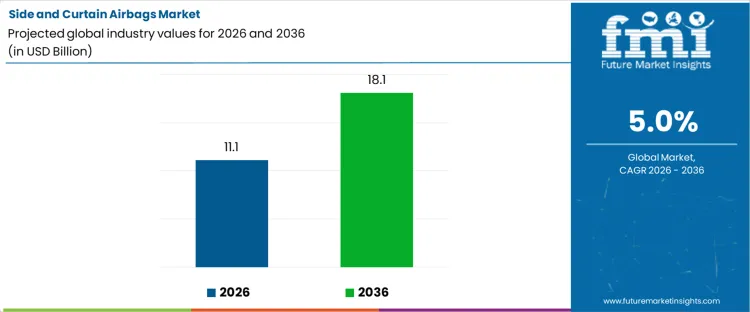
What is the Growth Forecast for Side and Curtain Airbags Market through 2036?
Between 2026 and 2031, the side and curtain airbags market is projected to grow from USD 11.1 billion to USD 13.6 billion, an increase of USD 2.5 billion, reflecting a CAGR of 5.0%. Growth is driven by curtain airbags, thorax side airbags, and pelvis/torso combination airbags across hybrid, stored gas, and pyrotechnic inflator technologies. Passenger cars, SUVs, and light commercial vehicles are primary applications. OEM and Tier 1 direct supply, aftermarket service, and remanufacturing channels support adoption. Expansion is supported by rising vehicle safety standards, regulatory mandates, and increasing consumer awareness of crash protection systems.
From 2031 to 2036, the market is expected to expand from USD 13.6 billion to USD 18.2 billion, adding USD 4.6 billion. Growth is fueled by broader adoption across vehicle classes, enhanced inflator technologies, and rising integration in new vehicle models. Market drivers include improved occupant protection, stricter safety regulations, and increasing aftermarket and replacement demand. Competitive advantage favors suppliers providing validated airbags, certified inflators, and strong OEM partnerships. Leading companies include Autoliv, ZF Lifetec, Joyson Safety Systems, Toyoda Gosei, Hyundai Mobis, Nihon Plast, Ashimori, Daicel, ARC Automotive, and Furukawa Electric.
Side and Curtain Airbags Market Key Takeaways
| Metric | Value |
|---|---|
| Market Value (2026) | USD 11.1 billion |
| Forecast Value (2036) | USD 18.2 billion |
| Forecast CAGR 2026 to 2036 | 5.00% |
Source: FMI analysis based on primary research and proprietary forecasting model
How Are Side and Curtain Airbags Enhancing Vehicle Safety?
Side and curtain airbags are increasingly adopted to provide lateral protection for occupants during side-impact and rollover events, improving overall vehicle safety. Historically, passenger protection relied on seatbelts and frontal airbags, leaving occupants vulnerable in lateral collisions. Modern side and curtain airbag systems integrate advanced sensors, rapid-deployment inflators, and strategically placed cushions to reduce head, neck, and torso injuries. Automotive OEMs, airbag module suppliers, and safety regulators prioritize deployment reliability, sensor accuracy, and compliance with global crash safety standards. Early adoption focused on premium passenger vehicles, while current demand spans SUVs, sedans, and electric vehicles, driven by stricter safety regulations, consumer safety expectations, and vehicle safety ratings. Deployment speed, cushion coverage, and material durability influence supplier selection.
Increasing regulatory safety mandates, consumer awareness, and crash-test performance requirements are shaping market growth. Compared with earlier side-impact protection measures, contemporary airbags emphasize precise sensor integration, rapid inflation, and structural coverage to mitigate injuries. Cost structures depend on inflator technology, sensor accuracy, and assembly precision, concentrating margins among suppliers delivering certified, high-performance systems. Vehicle manufacturers adopt side and curtain airbags to improve crash-test outcomes, enhance occupant safety, and meet regulatory requirements. By 2036, these airbags are expected to become standard across passenger, commercial, and electric vehicles, supporting occupant protection, crash performance, and compliance with global automotive safety standards.
How Are Airbag Types Influencing Occupant Protection in Side and Curtain Safety Systems?
The demand for side and curtain airbags is segmented by airbag type and inflator technology. Airbag types include curtain airbags, thorax side airbags, pelvis and torso combination modules, and other designs. Inflator technologies include hybrid, stored gas, and pyrotechnic systems. Adoption is shaped by crash protection standards, multi-row seating requirements, and integration with electronic safety controls. Uptake is driven by increasing regulatory requirements, safety rating programs, and rising consumer awareness. Airbag type and inflator selection depend on deployment speed, occupant positioning, and structural integration to ensure reliable protection across passenger vehicles, SUVs, and commercial vehicles.
How Are Curtain Airbags Maintaining Dominance Among Airbag Types in Side-Impact Protection?
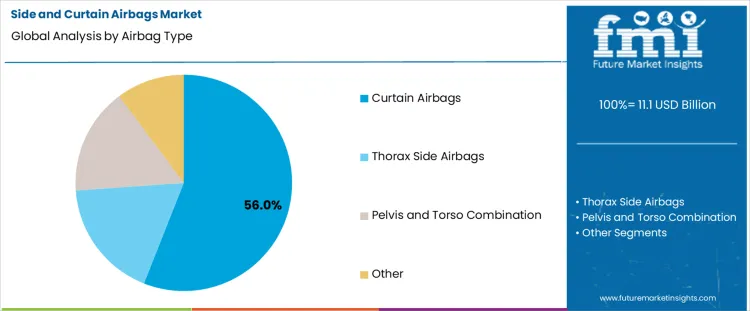
Curtain airbags account for approximately 56% of airbag type demand, leading the segment. Their primary role is to protect occupants’ heads during side collisions and rollover events. These airbags deploy from roof rails along the window line, shielding multiple seating rows simultaneously. Adoption is influenced by the need to reduce head injury risk, meet NCAP testing protocols, and accommodate various interior layouts. Operational procedures include calibration of side-impact sensors, deployment timing verification, and inspection of stowage mechanisms. Curtain airbags are designed to withstand prolonged exposure to heat, vibration, and humidity without degradation, ensuring consistent protection.
Vehicle design and functional factors reinforce adoption. Curtains must deploy reliably across different seating configurations, including rear and middle seats. They integrate with torso airbags to provide comprehensive lateral protection, reduce intrusion risks, and improve overall safety ratings. The combination of durability, multi-row coverage, and rapid deployment makes curtain airbags essential for modern passenger and commercial vehicles.
Why Are Hybrid Inflators Leading the Inflator Technology Segment in Side and Curtain Airbags?
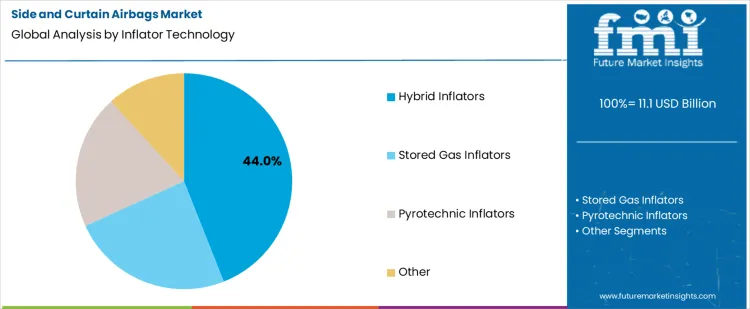
Hybrid inflators account for approximately 44% of inflator technology demand, making them the largest segment. They combine stored gas and pyrotechnic mechanisms to provide rapid, controlled airbag deployment. Adoption is driven by the need for precision under varying temperatures and vehicle conditions. Operational procedures include verification of gas canister pressure, pyrotechnic ignition calibration, and deployment timing tests. Hybrid inflators ensure airbags fully expand within milliseconds, maintaining occupant safety during side-impact and rollover scenarios.
Thermal and operational stresses further reinforce adoption. Inflators must function under extreme heat, vibration, and long-term storage conditions without failure. Hybrid inflators lead because they provide consistent inflation, improve crash performance, and integrate seamlessly with vehicle crash sensors. Their adoption ensures rapid, controlled deployment, enhances occupant protection, and supports compliance with international automotive safety regulations.
How Are Side and Curtain Airbags Enhancing Vehicle Occupant Protection?
Side and curtain airbags are increasingly adopted in passenger vehicles, SUVs, and crossovers to reduce injury risk during side-impact collisions and rollover accidents. Adoption is strongest in regions with stringent crash safety standards, high vehicle production, and growing consumer safety awareness. Airbags are selected for deployment speed, coverage area, and integration with side-impact sensors. Growth is driven by regulatory mandates, rising demand for occupant protection, and advancements in vehicle crash detection systems. Investment focuses on sensor calibration, airbag material durability, and rapid deployment mechanisms. OEMs prioritize airbags that provide consistent protection while minimizing injury from impact and inflation forces.
Why Are Vehicle Safety Regulations and Crash Test Standards Driving Adoption?
Demand is influenced by local crash test requirements, rollover safety regulations, and insurance incentives for safer vehicles. Manufacturers adopt side and curtain airbags to meet side-impact protection criteria, reduce injury risk, and maintain safety ratings. Systems offering fast deployment, reliable sensor integration, and broad coverage gain preference. Adoption is concentrated in regions with high vehicle safety enforcement and strong consumer awareness. Occupant protection, compliance with crash standards, and injury mitigation drive procurement more than cost. Suppliers providing validated, high-performance airbags gain competitive advantage among OEMs and safety system integrators.
What Factors Restrict Broader Deployment of Side and Curtain Airbags?
High manufacturing and integration costs, sensor calibration complexity, and vehicle design constraints limit adoption. Airbag performance can be affected by deployment timing, occupant positioning, and interior space variations. Integration with side panels, curtain rails, and electronic control units requires precise engineering. Smaller manufacturers or regions with lenient safety standards adopt airbags more slowly. These factors concentrate early deployment among premium and mass-market vehicle OEMs, and regions with strict side-impact and rollover safety regulations.
How Are Sensor Integration and Deployment Precision Shaping Market Dynamics?
Airbags are designed for rapid inflation, optimal coverage, and minimal occupant injury risk while responding to side-impact sensors. Collaboration between airbag suppliers, vehicle engineers, and electronic control system developers ensures performance validation, deployment accuracy, and durability. Pilot testing evaluates inflation timing, coverage effectiveness, and sensor responsiveness before full-scale production. Quality monitoring, sensor alignment, and material certification maintain consistent performance. Focus is on occupant protection, deployment reliability, and safety compliance rather than cost or volume. These approaches enable broader adoption of side and curtain airbags across regional and global automotive markets.
What is the Demand for Side and Curtain Airbags by Country?
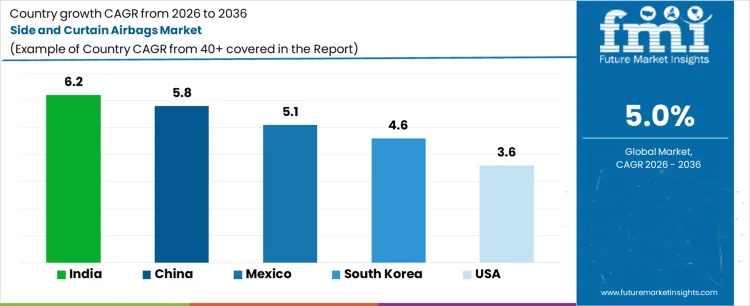
| Country | CAGR (%) |
|---|---|
| China | 5.8% |
| India | 6.2% |
| Mexico | 5.1% |
| South Korea | 4.6% |
| USA | 3.6% |
Source: FMI analysis based on primary research and proprietary forecasting model
Demand for side and curtain airbags is rising as automotive manufacturers focus on vehicle safety, regulatory compliance, and passenger protection in collisions. India leads with a 6.2% CAGR, driven by increasing adoption of safety features in new vehicles, rising vehicle production, and stricter safety regulations. China follows at 5.8%, supported by expanding automotive manufacturing and safety-conscious consumer demand. Mexico records 5.1% growth, shaped by growing domestic vehicle production and regulatory standards. South Korea grows at 4.6%, influenced by safety regulations and premium vehicle adoption. The USA shows 3.6% CAGR, reflecting a mature market with high existing penetration of advanced airbag systems.
How is China experiencing growth in the side and curtain airbags market?
China is experiencing growth at a CAGR of 5.8%, supported by adoption of side and curtain airbags market solutions to enhance vehicle occupant safety, impact protection, and crash performance. Manufacturers and suppliers are producing airbags optimized for rapid deployment, durability, and compliance with automotive safety standards. Demand is concentrated in automotive production hubs, assembly plants, and R&D centers. Investments focus on material quality, production reliability, and adherence to safety regulations rather than large-scale deployment. Growth reflects increasing vehicle production, industrial adoption of advanced safety systems, and regulatory emphasis on passenger protection.
- Vehicle safety drives adoption.
- Airbags optimize impact protection and rapid deployment.
- Automotive hubs and R&D centers concentrate demand.
- Material quality and safety compliance guide investment.
How is India witnessing growth in the side and curtain airbags market?
India is witnessing growth at a CAGR of 6.2%, fueled by adoption of side and curtain airbags market solutions to improve occupant protection, crash performance, and vehicle safety standards. Manufacturers and suppliers are deploying airbags optimized for rapid inflation, durability, and integration with vehicle safety systems. Demand is concentrated in automotive manufacturing hubs, assembly facilities, and R&D centers. Investments prioritize material performance, system reliability, and compliance with safety regulations rather than fleet-scale deployment. Growth reflects rising vehicle production, industrial adoption of advanced safety technologies, and increasing focus on passenger protection.
- Occupant safety drives adoption.
- Airbags provide rapid inflation and impact protection.
- Manufacturing hubs and assembly centers concentrate demand.
- Material performance and regulatory compliance guide investment.
How is Mexico experiencing growth in the side and curtain airbags market?
Mexico is experiencing growth at a CAGR of 5.1%, supported by adoption of side and curtain airbags market solutions to enhance vehicle safety, crash protection, and occupant injury reduction. Manufacturers and suppliers are producing airbags optimized for deployment speed, durability, and integration with vehicle safety systems. Demand is concentrated in automotive production hubs, assembly plants, and component manufacturing centers. Investments focus on material quality, operational reliability, and compliance with automotive safety standards rather than large-scale deployment. Growth reflects industrial adoption of advanced safety systems, moderate vehicle production, and regulatory emphasis on passenger protection.
- Vehicle safety drives adoption.
- Airbags optimize deployment speed and impact protection.
- Production hubs and assembly plants concentrate demand.
- Material quality and regulatory compliance guide investment.
How is South Korea witnessing growth in the side and curtain airbags market?
South Korea is witnessing growth at a CAGR of 4.6%, fueled by adoption of side and curtain airbags market solutions to improve occupant protection, crash safety, and structural reliability in vehicles. Manufacturers and suppliers are deploying airbags optimized for rapid inflation, durability, and integration with vehicle safety systems. Demand is concentrated in automotive manufacturing hubs, assembly plants, and R&D centers. Investments prioritize material performance, safety compliance, and production reliability rather than fleet-scale deployment. Growth reflects industrial adoption of advanced airbag systems, moderate vehicle production, and emphasis on passenger safety.
- Occupant protection drives adoption.
- Airbags provide rapid inflation and durability.
- Manufacturing hubs and R&D centers concentrate demand.
- Material performance and safety compliance guide investment.
How is the United States experiencing growth in the side and curtain airbags market?
United States is experiencing growth at a CAGR of 3.6%, supported by adoption of side and curtain airbags market solutions to improve vehicle occupant safety, impact protection, and crash performance. Manufacturers and suppliers are producing airbags optimized for rapid deployment, material durability, and integration with vehicle safety systems. Demand is concentrated in automotive assembly plants, production hubs, and R&D centers. Investments focus on material quality, regulatory compliance, and production reliability rather than large-scale deployment. Growth reflects moderate vehicle production, industrial adoption of advanced safety systems, and focus on occupant protection.
- Vehicle safety drives adoption.
- Airbags ensure rapid deployment and impact protection.
- Assembly plants and production hubs concentrate demand.
- Material quality and compliance guide investment.
Who Competes in the Side and Curtain Airbags Market and What Defines Their Capabilities?
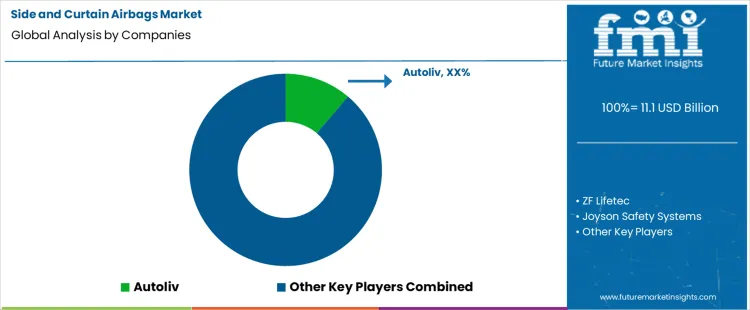
Competition in the side and curtain airbags market is defined by deployment reliability, material durability, and compliance with automotive safety regulations. Autoliv supplies side and curtain airbags engineered for rapid deployment, high tear strength, and consistent occupant protection performance. ZF Lifetec develops airbags with integrated sensor and inflator systems optimized for side impact and rollover scenarios. Joyson Safety Systems provides curtain and side airbags designed for precise deployment timing, durability, and regulatory compliance. Toyoda Gosei delivers airbags with lightweight materials and high folding efficiency for compact packaging. Hyundai Mobis supplies side and curtain airbags integrated with vehicle electronics and crash sensing systems.
Nihon Plast provides airbags optimized for consistent inflation and long-term material performance. Ashimori delivers side airbags with enhanced tear resistance and reliability. Daicel develops inflator and airbag module systems for side and curtain protection. ARC Automotive provides modular airbag systems for diverse vehicle platforms. Furukawa Electric supplies components supporting airbag deployment and sensor integration. Other regional and specialty suppliers focus on material innovation, inflator technology, and integration with advanced crash sensing. Competitive differentiation arises from deployment speed, material durability, integration with electronic systems, and compliance with global safety standards for side-impact and rollover protection.
Key Players in the Side and Curtain Airbags Market
- Autoliv
- ZF Lifetec
- Joyson Safety Systems
- Toyoda Gosei
- Hyundai Mobis
- Nihon Plast
- Ashimori
- Daicel
- ARC Automotive
- Furukawa Electric
Scope of the Report
| Items | Values |
|---|---|
| Quantitative Units (2026) | USD billion |
| Airbag Type | Curtain Airbags, Thorax Side Airbags, Pelvis and Torso Combination, Other |
| Inflator Technology | Hybrid Inflators, Stored Gas Inflators, Pyrotechnic Inflators, Other |
| Vehicle Class | Passenger Cars, SUVs and Crossovers, Light Commercial Vehicles, Other |
| Sales Channel | OEM and Tier 1 Direct Supply, Aftermarket Service, Remanufacturing, Other |
| Region | Asia Pacific, Europe, North America, Latin America, Middle East & Africa |
| Key Countries Covered | China, India, Mexico, South Korea, USA |
| Key Companies Profiled | Autoliv, ZF Lifetec, Joyson Safety Systems, Toyoda Gosei, Hyundai Mobis, Nihon Plast, Ashimori, Daicel, ARC Automotive, Furukawa Electric |
| Additional Attributes | Dollar sales by airbag type, inflator technology, and vehicle class; regional CAGR, volume and value growth projections; adoption across passenger, SUV, LCV, and other vehicle segments; focus on rapid deployment, material durability, and crash protection; margins concentrated among suppliers delivering validated, high-performance airbag systems; competitive advantage from OEM partnerships, sensor integration, inflator certification, and compliance with global side-impact and rollover safety standards. |
Side and Curtain Airbags Market Segmentation
By Airbag Type:
- Curtain Airbags
- Thorax Side Airbags
- Pelvis and Torso Combination
- Other
By Inflator Technology:
- Hybrid Inflators
- Stored Gas Inflators
- Pyrotechnic Inflators
- Other
By Vehicle Class:
- Passenger Cars
- SUVs and Crossovers
- Light Commercial Vehicles
- Other
By Sales Channel:
- OEM and Tier 1 Direct Supply
- Aftermarket Service
- Remanufacturing
- Other
By Region
- Asia Pacific
- China
- Japan
- South Korea
- India
- Australia & New Zealand
- ASEAN
- Rest of Asia Pacific
- Europe
- Germany
- United Kingdom
- France
- Italy
- Spain
- Nordic
- BENELUX
- Rest of Europe
- North America
- United States
- Canada
- Mexico
- Latin America
- Brazil
- Chile
- Rest of Latin America
- Middle East & Africa
- Kingdom of Saudi Arabia
- Other GCC Countries
- Turkey
- South Africa
- Other African Union
- Rest of Middle East & Africa
Bibliography
- National Highway Traffic Safety Administration (NHTSA). (2024). Federal Motor Vehicle Safety Standard (FMVSS) No. 214 - Side impact protection.
- National Highway Traffic Safety Administration (NHTSA). (2024). Federal Motor Vehicle Safety Standard (FMVSS) No. 226 - Ejection mitigation (curtain airbag and rollover protection requirements).
- United Nations Economic Commission for Europe (UNECE). (2024). UN Regulation No. 95 - Protection of occupants in the event of a lateral collision.
- United Nations Economic Commission for Europe (UNECE). (2024). UN Regulation No. 135 - Pole side impact test for curtain and side head protection systems.
- International Organization for Standardization (ISO). (2024). ISO 13232 - Motor vehicles: Test procedures for evaluating occupant protection in side-impact and lateral crash scenarios.
Frequently Asked Questions
How big is the side and curtain airbags market in 2026?
The global side and curtain airbags market is estimated to be valued at USD 11.1 billion in 2026.
What will be the size of side and curtain airbags market in 2036?
The market size for the side and curtain airbags market is projected to reach USD 18.1 billion by 2036.
How much will be the side and curtain airbags market growth between 2026 and 2036?
The side and curtain airbags market is expected to grow at a 5.0% CAGR between 2026 and 2036.
What are the key product types in the side and curtain airbags market?
The key product types in side and curtain airbags market are curtain airbags, thorax side airbags, pelvis and torso combination and other.
Which inflator technology segment to contribute significant share in the side and curtain airbags market in 2026?
In terms of inflator technology, hybrid inflators segment to command 44.0% share in the side and curtain airbags market in 2026.
Preview the report firsthand - request a free sample
Get SampleGet the brochure for pricing and purchase details.
Get PDFTable of Content
- Executive Summary
- Global Market Outlook
- Demand-side Trends
- Supply-side Trends
- Technology Roadmap Analysis
- Analysis and Recommendations
- Market Overview
- Market Coverage / Taxonomy
- Market Definition / Scope / Limitations
- Market Background
- Market Dynamics
- Drivers
- Restraints
- Opportunity
- Trends
- Scenario Forecast
- Demand in Optimistic Scenario
- Demand in Likely Scenario
- Demand in Conservative Scenario
- Opportunity Map Analysis
- Product Life Cycle Analysis
- Supply Chain Analysis
- Investment Feasibility Matrix
- Value Chain Analysis
- PESTLE and Porter’s Analysis
- Regulatory Landscape
- Regional Parent Market Outlook
- Production and Consumption Statistics
- Import and Export Statistics
- Market Dynamics
- Global Market Analysis 2021 to 2025 and Forecast, 2026 to 2036
- Historical Market Size Value (USD Million) Analysis, 2021 to 2025
- Current and Future Market Size Value (USD Million) Projections, 2026 to 2036
- Y-o-Y Growth Trend Analysis
- Absolute $ Opportunity Analysis
- Global Market Pricing Analysis 2021 to 2025 and Forecast 2026 to 2036
- Global Market Analysis 2021 to 2025 and Forecast 2026 to 2036, By Airbag Type
- Introduction / Key Findings
- Historical Market Size Value (USD Million) Analysis By Airbag Type , 2021 to 2025
- Current and Future Market Size Value (USD Million) Analysis and Forecast By Airbag Type , 2026 to 2036
- Curtain Airbags
- Thorax Side Airbags
- Pelvis and Torso Combination
- Other
- Curtain Airbags
- Y-o-Y Growth Trend Analysis By Airbag Type , 2021 to 2025
- Absolute $ Opportunity Analysis By Airbag Type , 2026 to 2036
- Global Market Analysis 2021 to 2025 and Forecast 2026 to 2036, By Inflator Technology
- Introduction / Key Findings
- Historical Market Size Value (USD Million) Analysis By Inflator Technology, 2021 to 2025
- Current and Future Market Size Value (USD Million) Analysis and Forecast By Inflator Technology, 2026 to 2036
- Hybrid Inflators
- Stored Gas Inflators
- Pyrotechnic Inflators
- Other
- Hybrid Inflators
- Y-o-Y Growth Trend Analysis By Inflator Technology, 2021 to 2025
- Absolute $ Opportunity Analysis By Inflator Technology, 2026 to 2036
- Global Market Analysis 2021 to 2025 and Forecast 2026 to 2036, By Vehicle Class
- Introduction / Key Findings
- Historical Market Size Value (USD Million) Analysis By Vehicle Class, 2021 to 2025
- Current and Future Market Size Value (USD Million) Analysis and Forecast By Vehicle Class, 2026 to 2036
- Passenger Cars
- SUVs and Crossovers
- Light Commercial Vehicles
- Other
- Passenger Cars
- Y-o-Y Growth Trend Analysis By Vehicle Class, 2021 to 2025
- Absolute $ Opportunity Analysis By Vehicle Class, 2026 to 2036
- Global Market Analysis 2021 to 2025 and Forecast 2026 to 2036, By Sales Channel
- Introduction / Key Findings
- Historical Market Size Value (USD Million) Analysis By Sales Channel, 2021 to 2025
- Current and Future Market Size Value (USD Million) Analysis and Forecast By Sales Channel, 2026 to 2036
- OEM and Tier 1 Direct Supply
- Aftermarket Service
- Remanufacturing
- Other
- OEM and Tier 1 Direct Supply
- Y-o-Y Growth Trend Analysis By Sales Channel, 2021 to 2025
- Absolute $ Opportunity Analysis By Sales Channel, 2026 to 2036
- Global Market Analysis 2021 to 2025 and Forecast 2026 to 2036, By Region
- Introduction
- Historical Market Size Value (USD Million) Analysis By Region, 2021 to 2025
- Current Market Size Value (USD Million) Analysis and Forecast By Region, 2026 to 2036
- North America
- Latin America
- Western Europe
- Eastern Europe
- East Asia
- South Asia and Pacific
- Middle East & Africa
- Market Attractiveness Analysis By Region
- North America Market Analysis 2021 to 2025 and Forecast 2026 to 2036, By Country
- Historical Market Size Value (USD Million) Trend Analysis By Market Taxonomy, 2021 to 2025
- Market Size Value (USD Million) Forecast By Market Taxonomy, 2026 to 2036
- By Country
- USA
- Canada
- Mexico
- By Airbag Type
- By Inflator Technology
- By Vehicle Class
- By Sales Channel
- By Country
- Market Attractiveness Analysis
- By Country
- By Airbag Type
- By Inflator Technology
- By Vehicle Class
- By Sales Channel
- Key Takeaways
- Latin America Market Analysis 2021 to 2025 and Forecast 2026 to 2036, By Country
- Historical Market Size Value (USD Million) Trend Analysis By Market Taxonomy, 2021 to 2025
- Market Size Value (USD Million) Forecast By Market Taxonomy, 2026 to 2036
- By Country
- Brazil
- Chile
- Rest of Latin America
- By Airbag Type
- By Inflator Technology
- By Vehicle Class
- By Sales Channel
- By Country
- Market Attractiveness Analysis
- By Country
- By Airbag Type
- By Inflator Technology
- By Vehicle Class
- By Sales Channel
- Key Takeaways
- Western Europe Market Analysis 2021 to 2025 and Forecast 2026 to 2036, By Country
- Historical Market Size Value (USD Million) Trend Analysis By Market Taxonomy, 2021 to 2025
- Market Size Value (USD Million) Forecast By Market Taxonomy, 2026 to 2036
- By Country
- Germany
- UK
- Italy
- Spain
- France
- Nordic
- BENELUX
- Rest of Western Europe
- By Airbag Type
- By Inflator Technology
- By Vehicle Class
- By Sales Channel
- By Country
- Market Attractiveness Analysis
- By Country
- By Airbag Type
- By Inflator Technology
- By Vehicle Class
- By Sales Channel
- Key Takeaways
- Eastern Europe Market Analysis 2021 to 2025 and Forecast 2026 to 2036, By Country
- Historical Market Size Value (USD Million) Trend Analysis By Market Taxonomy, 2021 to 2025
- Market Size Value (USD Million) Forecast By Market Taxonomy, 2026 to 2036
- By Country
- Russia
- Poland
- Hungary
- Balkan & Baltic
- Rest of Eastern Europe
- By Airbag Type
- By Inflator Technology
- By Vehicle Class
- By Sales Channel
- By Country
- Market Attractiveness Analysis
- By Country
- By Airbag Type
- By Inflator Technology
- By Vehicle Class
- By Sales Channel
- Key Takeaways
- East Asia Market Analysis 2021 to 2025 and Forecast 2026 to 2036, By Country
- Historical Market Size Value (USD Million) Trend Analysis By Market Taxonomy, 2021 to 2025
- Market Size Value (USD Million) Forecast By Market Taxonomy, 2026 to 2036
- By Country
- China
- Japan
- South Korea
- By Airbag Type
- By Inflator Technology
- By Vehicle Class
- By Sales Channel
- By Country
- Market Attractiveness Analysis
- By Country
- By Airbag Type
- By Inflator Technology
- By Vehicle Class
- By Sales Channel
- Key Takeaways
- South Asia and Pacific Market Analysis 2021 to 2025 and Forecast 2026 to 2036, By Country
- Historical Market Size Value (USD Million) Trend Analysis By Market Taxonomy, 2021 to 2025
- Market Size Value (USD Million) Forecast By Market Taxonomy, 2026 to 2036
- By Country
- India
- ASEAN
- Australia & New Zealand
- Rest of South Asia and Pacific
- By Airbag Type
- By Inflator Technology
- By Vehicle Class
- By Sales Channel
- By Country
- Market Attractiveness Analysis
- By Country
- By Airbag Type
- By Inflator Technology
- By Vehicle Class
- By Sales Channel
- Key Takeaways
- Middle East & Africa Market Analysis 2021 to 2025 and Forecast 2026 to 2036, By Country
- Historical Market Size Value (USD Million) Trend Analysis By Market Taxonomy, 2021 to 2025
- Market Size Value (USD Million) Forecast By Market Taxonomy, 2026 to 2036
- By Country
- Kingdom of Saudi Arabia
- Other GCC Countries
- Turkiye
- South Africa
- Other African Union
- Rest of Middle East & Africa
- By Airbag Type
- By Inflator Technology
- By Vehicle Class
- By Sales Channel
- By Country
- Market Attractiveness Analysis
- By Country
- By Airbag Type
- By Inflator Technology
- By Vehicle Class
- By Sales Channel
- Key Takeaways
- Key Countries Market Analysis
- USA
- Pricing Analysis
- Market Share Analysis, 2025
- By Airbag Type
- By Inflator Technology
- By Vehicle Class
- By Sales Channel
- Canada
- Pricing Analysis
- Market Share Analysis, 2025
- By Airbag Type
- By Inflator Technology
- By Vehicle Class
- By Sales Channel
- Mexico
- Pricing Analysis
- Market Share Analysis, 2025
- By Airbag Type
- By Inflator Technology
- By Vehicle Class
- By Sales Channel
- Brazil
- Pricing Analysis
- Market Share Analysis, 2025
- By Airbag Type
- By Inflator Technology
- By Vehicle Class
- By Sales Channel
- Chile
- Pricing Analysis
- Market Share Analysis, 2025
- By Airbag Type
- By Inflator Technology
- By Vehicle Class
- By Sales Channel
- Germany
- Pricing Analysis
- Market Share Analysis, 2025
- By Airbag Type
- By Inflator Technology
- By Vehicle Class
- By Sales Channel
- UK
- Pricing Analysis
- Market Share Analysis, 2025
- By Airbag Type
- By Inflator Technology
- By Vehicle Class
- By Sales Channel
- Italy
- Pricing Analysis
- Market Share Analysis, 2025
- By Airbag Type
- By Inflator Technology
- By Vehicle Class
- By Sales Channel
- Spain
- Pricing Analysis
- Market Share Analysis, 2025
- By Airbag Type
- By Inflator Technology
- By Vehicle Class
- By Sales Channel
- France
- Pricing Analysis
- Market Share Analysis, 2025
- By Airbag Type
- By Inflator Technology
- By Vehicle Class
- By Sales Channel
- India
- Pricing Analysis
- Market Share Analysis, 2025
- By Airbag Type
- By Inflator Technology
- By Vehicle Class
- By Sales Channel
- ASEAN
- Pricing Analysis
- Market Share Analysis, 2025
- By Airbag Type
- By Inflator Technology
- By Vehicle Class
- By Sales Channel
- Australia & New Zealand
- Pricing Analysis
- Market Share Analysis, 2025
- By Airbag Type
- By Inflator Technology
- By Vehicle Class
- By Sales Channel
- China
- Pricing Analysis
- Market Share Analysis, 2025
- By Airbag Type
- By Inflator Technology
- By Vehicle Class
- By Sales Channel
- Japan
- Pricing Analysis
- Market Share Analysis, 2025
- By Airbag Type
- By Inflator Technology
- By Vehicle Class
- By Sales Channel
- South Korea
- Pricing Analysis
- Market Share Analysis, 2025
- By Airbag Type
- By Inflator Technology
- By Vehicle Class
- By Sales Channel
- Russia
- Pricing Analysis
- Market Share Analysis, 2025
- By Airbag Type
- By Inflator Technology
- By Vehicle Class
- By Sales Channel
- Poland
- Pricing Analysis
- Market Share Analysis, 2025
- By Airbag Type
- By Inflator Technology
- By Vehicle Class
- By Sales Channel
- Hungary
- Pricing Analysis
- Market Share Analysis, 2025
- By Airbag Type
- By Inflator Technology
- By Vehicle Class
- By Sales Channel
- Kingdom of Saudi Arabia
- Pricing Analysis
- Market Share Analysis, 2025
- By Airbag Type
- By Inflator Technology
- By Vehicle Class
- By Sales Channel
- Turkiye
- Pricing Analysis
- Market Share Analysis, 2025
- By Airbag Type
- By Inflator Technology
- By Vehicle Class
- By Sales Channel
- South Africa
- Pricing Analysis
- Market Share Analysis, 2025
- By Airbag Type
- By Inflator Technology
- By Vehicle Class
- By Sales Channel
- USA
- Market Structure Analysis
- Competition Dashboard
- Competition Benchmarking
- Market Share Analysis of Top Players
- By Regional
- By Airbag Type
- By Inflator Technology
- By Vehicle Class
- By Sales Channel
- Competition Analysis
- Competition Deep Dive
- Autoliv
- Overview
- Product Portfolio
- Profitability by Market Segments (Product/Age /Sales Channel/Region)
- Sales Footprint
- Strategy Overview
- Marketing Strategy
- Product Strategy
- Channel Strategy
- ZF Lifetec
- Joyson Safety Systems
- Toyoda Gosei
- Hyundai Mobis
- Nihon Plast
- Ashimori
- Daicel
- ARC Automotive
- Furukawa Electric
- Autoliv
- Competition Deep Dive
- Assumptions & Acronyms Used
- Research Methodology


