

- Industry Size (2026)
- USD 3.18 Bn
- Forecast (2036)
- USD 5.69 Bn
- CAGR (2026 to 2036)
- 6%
Residential Hydronic Underfloor Heating Market Size, Market Forecast and Outlook By FMI
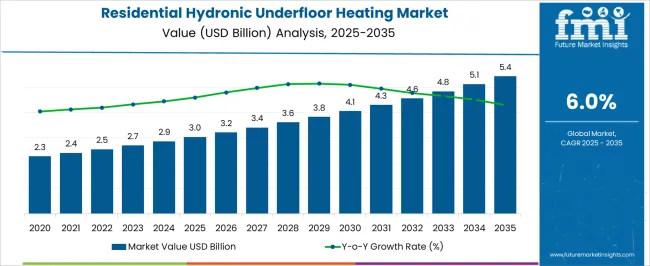
The residential hydronic underfloor heating market was valued at USD 3 billion in 2025, projected to reach USD 3.18 billion in 2026, and is forecast to expand to USD 5.69 billion by 2036 at a 6% CAGR. The growing installed base of heat pumps in residential buildings is driving specification of low-temperature emitter systems that maximize heat pump coefficient of performance. Hydronic underfloor heating operates at 35 to 45 degrees Celsius flow temperatures, matching heat pump output characteristics more efficiently than conventional radiator systems requiring 55 to 75 degrees Celsius.
Summary of Residential Hydronic Underfloor Heating Market
- Market Snapshot:
- The residential hydroni:c underfloor heating market is valued at USD 3 billion in 2025 and is projected to reach USD 5.69 billion by 2036.
- The industry is expected to grow at a 6% CAGR from 2026 to 2036, creating an incremental opportunity of USD 2.51 billion.
- The market is positioned at the intersection of heat pump deployment and building envelope performance optimization, where low-temperature emitter compatibility defines system-level heating efficiency.
- Demand and Growth Drivers:
- Growing heat pump installations in residential buildings are creating demand for low-temperature emitter systems that maximize heat pump coefficient of performance at 35 to 45 degree Celsius flow temperatures.
- Prefabricated dry-lay panel systems have reduced retrofit installation time by approximately 40%, expanding the addressable market for underfloor heating in occupied residential properties.
- Building energy code updates favouring radiant floor heating over high-temperature radiator systems are driving specification changes in new residential construction permits.
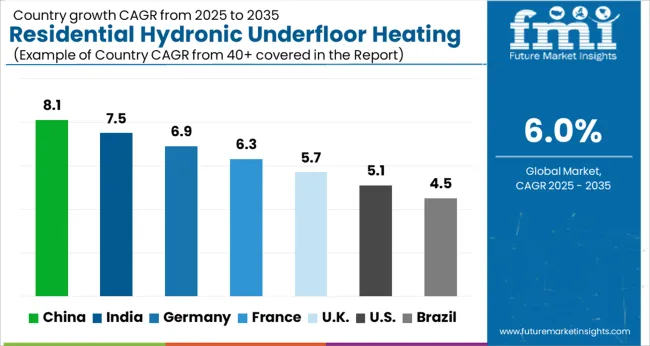
- Among key countries, China at 8.1%, India at 7.5%, Germany at 6.9%, France at 6.3%, UK at 5.7%, USA at 5.1%, Brazil at 4.5%.
- Product and Segment View:
- The market includes wet screed installations, dry-lay panel systems, and prefabricated modular hydronic underfloor heating solutions for residential buildings.
- Retrofit leads by Facility with 59.3% share in 2026.
- Single Family leads by Application with 64.7% share in 2026.
- Scope includes market scope includes hydronic pipe networks (pex, pert, multilayer), underfloor heating manifolds, wet screed and dry-lay installation systems, prefabricated heating panels, insulation boards, and zonal control valves. Electric underfloor heating mats and cables are excluded.
- Geography and Competitive Outlook:
- China and India are the fastest-growing markets at 8.1% and 7.5% CAGR respectively, driven by expanding heat pump adoption and building code requirements for low-temperature heating emitters.
- USA represents a mature demand base where Passive House certification requirements and radiant heating preferences sustain specification demand.
- Competition is shaped by system integration capabilities, installation simplicity, and compatibility with low-temperature heat sources, with key players including Uponor, Amuheat, Danfoss, Eckermann Heating and Cooling, HeatLink Group, Hurlcon Hydronic Heating, MAGNUM Heating.
- Analyst Opinion at FMI:
- Nikhil Kaitwade, Principal Consultant for Building Materials, opines: 'In my analysis, I have observed that hydronic underfloor heating has become the technically optimal emitter for the growing heat pump installed base. Contractors installing high-temperature radiators alongside low-temperature heat pumps are delivering systems that operate below rated efficiency, creating callback and warranty liability exposure. Specifiers who fail to integrate low-flow-temperature distribution into heat pump project designs risk losing competitive positioning as building performance testing becomes a compliance requirement.'
- Strategic Implications / Executive Takeaways:
- Underfloor heating manufacturers must develop prefabricated dry-lay systems that reduce retrofit installation time to capture the growing market of heat pump retrofit projects in occupied residential properties.
- Heat pump specifiers should integrate hydronic underfloor distribution as the default emitter recommendation to maximize system coefficient of performance and avoid callback liability from undersized radiator installations.
- Building developers must include underfloor heating zoning and manifold infrastructure in new construction plans to meet emerging building performance testing requirements for low-temperature heating systems.
Residential Hydronic Underfloor Heating Market Key Takeaways
| Metric | Details |
|---|---|
| Industry Size (2026) | USD 3.18 billion |
| Industry Value (2036) | USD 5.69 billion |
| CAGR (2026-2036) | 6% |
Source: Future Market Insights, 2026
The incremental opportunity of USD 2.51 billion over the forecast period is shaped by both new construction mandates and a growing retrofit cycle in existing housing stock. Retrofit installations account for 59.3% of demand as homeowners replacing gas boilers with heat pumps simultaneously upgrade their heat distribution systems. Prefabricated panel systems and dry-lay installation methods have reduced retrofit labour time by approximately 40% compared to traditional wet screed systems, expanding the addressable market in occupied properties.
China leads at 8.1% CAGR, driven by the integration of hydronic underfloor heating as a standard specification in northern China residential developments connected to clean heating district networks. India follows at 7.5%, propelled by adoption in high-altitude residential construction in Himachal Pradesh, Jammu & Kashmir, and Uttarakhand where winter heating is a structural requirement. Germany registers 6.9%, anchored by the GEG building energy law that incentivises low-temperature heating systems compatible with heat pump installations in new residential construction. France advances at 6.3%, supported by RE2020 building regulations favouring low-temperature radiant heating systems that optimize heat pump performance in all new residential permits. The United Kingdom posts 5.7%, driven by the Future Homes Standard requiring low-flow-temperature heating systems in all new builds from 2025. The United States expands at 5.1%, supported by growing radiant heating adoption in cold-climate states and Passive House certification requirements favouring hydronic distribution. Brazil records 4.5% growth as luxury residential developments in southern states incorporate hydronic underfloor heating as a differentiating comfort specification.
Residential Hydronic Underfloor Heating Market Definition
The residential hydronic underfloor heating market covers water-based radiant floor heating systems designed to distribute thermal energy through pipe networks embedded in or beneath floor structures in residential buildings. Systems include wet screed installations, dry-lay panel systems, and prefabricated modular underfloor heating solutions connected to heat pumps, boilers, or district heating networks for space heating in single-family and multi-family housing.
Residential Hydronic Underfloor Heating Market Inclusions
Market scope includes hydronic pipe networks (PEX, PERT, multilayer), underfloor heating manifolds, wet screed and dry-lay installation systems, prefabricated heating panels, insulation boards, and zonal control valves. Both new construction and retrofit installations for residential applications are covered.
Residential Hydronic Underfloor Heating Market Exclusions
Electric underfloor heating mats and cables are excluded. The scope omits commercial and industrial radiant floor systems, radiant ceiling panels, and wall-mounted radiant heating systems. Heat generation equipment (boilers, heat pumps) sold separately from the underfloor distribution system falls outside analytical parameters.
Residential Hydronic Underfloor Heating Market Research Methodology
- Primary Research: Analysts engaged with underfloor heating installers, building energy consultants, and hydronic system distributors to map specification requirements, retrofit installation constraints, and heat pump integration patterns.
- Desk Research: Data collection phases aggregated building permit databases, heating system specification records, heat pump installation statistics, and radiant heating product certification registries.
- Market-Sizing and Forecasting: Baseline values derive from a bottom-up aggregation of installation tracking data, applying region-specific adoption curves to project future deployment velocity.
- Data Validation and Update Cycle: Projections are tested against publicly reported expenditure guidance from leading industry participants and cross-referenced with regulatory filing data.
Why is the Residential Hydronic Underfloor Heating Market Growing?
The residential hydronic underfloor heating market is expanding steadily, driven by the growing emphasis on energy-efficient heating solutions and improved indoor comfort. Developments in building design and construction practices have increasingly integrated underfloor heating systems to meet stricter energy performance standards. Hydronic systems, which utilize heated water circulated through pipes, are favored for their uniform heat distribution, low operating costs, and compatibility with renewable energy sources such as heat pumps.
Government incentives and regulatory policies promoting sustainable housing have further encouraged adoption, particularly in regions with colder climates. Technological advancements in installation methods and system controls have reduced setup time and improved efficiency, making hydronic underfloor heating more accessible to homeowners.
Demand is also being stimulated by the integration of these systems into smart home ecosystems, enabling enhanced temperature regulation and energy management. Segmental growth is expected to be led by installations in new buildings, where integration is more cost-effective, and single-family homes, which benefit most from customizable and efficient heating layouts.
Segmental Analysis
The residential hydronic underfloor heating market is segmented by facility, application, and geographic regions. By facility, residential hydronic underfloor heating market is divided into new buildings and retrofit. In terms of application, residential hydronic underfloor heating market is classified into single family and multi family. Regionally, the residential hydronic underfloor heating industry is classified into North America, Latin America, Western Europe, Eastern Europe, Balkan & Baltic Countries, Russia & Belarus, Central Asia, East Asia, South Asia & Pacific, and the Middle East & Africa.
Insights into the Facility Segment: New Buildings
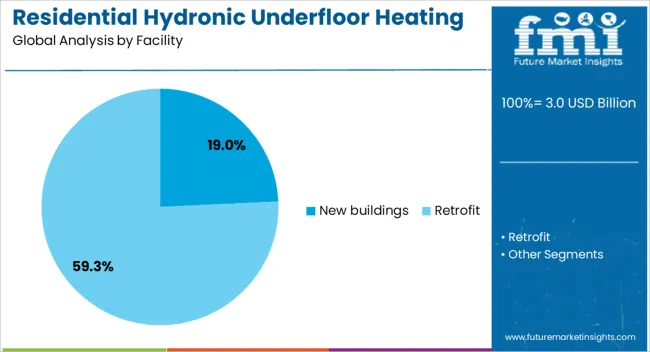
The new buildings segment is projected to account for the majority of the residential hydronic underfloor heating market revenue in 2026, maintaining its dominance due to the ease of system integration during construction. Installing hydronic systems in new buildings is more cost-efficient compared to retrofitting, as it allows for optimal pipe layout design, proper insulation placement, and compatibility with the building’s heating infrastructure from the outset. Construction industry reports have highlighted that modern housing developments increasingly prioritize underfloor heating to meet energy efficiency certifications and enhance property value.
Additionally, new housing projects often incorporate renewable energy systems, such as solar thermal or heat pumps, which align seamlessly with hydronic heating. The growing number of large-scale residential developments in urban and suburban areas has further supported the segment’s expansion. With regulatory frameworks and consumer demand both favoring sustainable heating solutions, the new buildings segment is expected to remain a key growth driver in the market.
Insights into the Application Segment: Single Family
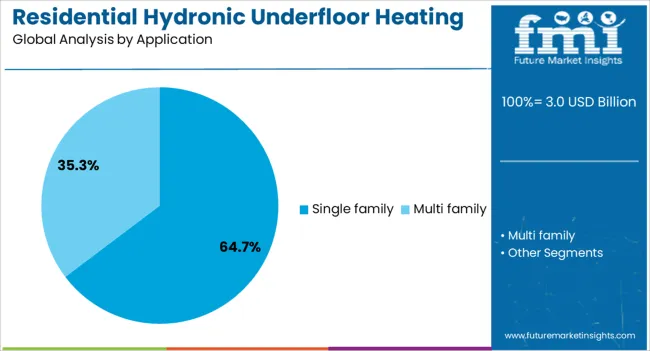
The single family segment is projected to hold 64.7% of the residential hydronic underfloor heating market revenue in 2026, securing its position as the leading application category. This dominance has been supported by homeowners’ preference for comfort, energy savings, and the aesthetic benefits of a heating system that eliminates visible radiators. Single-family homes typically have larger floor areas and more flexibility in layout design, allowing for the efficient installation of hydronic systems across multiple rooms.
Industry sources have noted that homeowners in this segment are more likely to invest in premium heating solutions that enhance property value and provide long-term cost benefits. Additionally, rising disposable incomes, combined with greater awareness of indoor air quality benefits, have driven adoption in the single-family housing market. The ability to pair underfloor systems with renewable energy sources and smart thermostats has further strengthened the appeal of hydronic heating in this category, ensuring continued market leadership.
What are the Drivers, Restraints, and Key Trends of the Residential Hydronic Underfloor Heating Market?
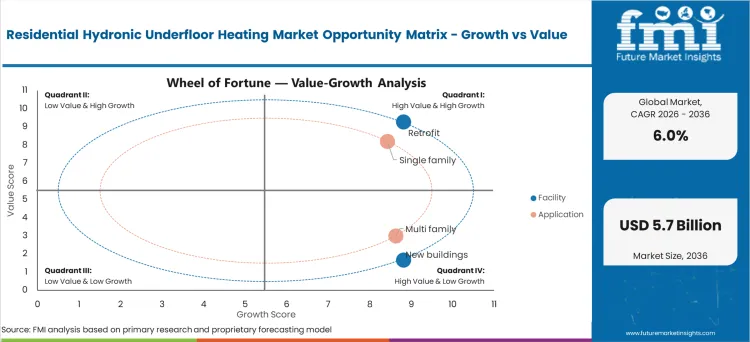
The residential hydronic underfloor heating market is expanding as homeowners seek efficient, evenly distributed indoor warmth with energy-saving potential. This system circulates heated water through floor tubing to provide consistent comfort while reducing reliance on conventional radiators. Europe and North America dominate due to high adoption in modern and retrofitted homes, whereas Asia Pacific shows increasing interest with rising residential construction and awareness of energy-efficient solutions. Manufacturers emphasize precise system design, advanced control mechanisms, and long-term reliability, even as installation complexity, upfront costs, and regional regulations shape adoption patterns.
Ensuring System Reliability and Performance
Delivering consistent heating performance is a primary concern in residential hydronic underfloor systems. Variations in pipe quality, flow rates, and manifold configuration can lead to uneven temperature distribution or reduced efficiency. Proper installation, balancing, and pressure testing are essential to prevent leaks or system failure. Homebuilders and contractors require equipment that meets recognized standards for durability and safety, while consumers expect long-term performance without frequent maintenance. Companies investing in rigorous quality checks, certified components, and clear installation guidance establish trust with both professionals and homeowners. Inconsistent results or installation errors can hinder market confidence, making reliable product design and validation critical for widespread acceptance.
System Design and Integration Features
Advances in system engineering are improving comfort, efficiency, and adaptability. Optimized tubing layouts, advanced manifold designs, and precise thermostatic controls allow homeowners to tailor heating to individual rooms and floor types. Integration with smart home systems and programmable schedules enhances user convenience and energy management. Manufacturers offering modular or pre-fabricated solutions simplify installation in new and renovated homes. Accurate hydraulic modeling ensures uniform heat distribution while maintaining energy efficiency. These features allow suppliers to differentiate their offerings, positioning products as both high-performing and adaptable to modern residential construction trends, thereby appealing to builders, architects, and homeowners seeking advanced home comfort solutions.
Expanding Residential Applications
The use of hydronic underfloor heating is broadening beyond luxury homes to mainstream residential projects. It is increasingly installed in apartments, multi-family buildings, and retrofitted properties where space-saving and aesthetic considerations favor floor-level heating. Rising awareness of energy efficiency, lower operating costs, and the desire for enhanced thermal comfort drive adoption. Manufacturers that provide solutions compatible with renewable energy sources, such as heat pumps or solar thermal systems, can address environmentally conscious buyers. Support for various flooring types, including tile, wood, and vinyl, further expands market potential. The growing preference for seamless heating and integration with modern interior design encourages wider deployment across diverse residential segments.
Regulatory Requirements and Supply Considerations
Market growth is influenced by building codes, energy efficiency standards, and safety regulations that differ across regions. Compliance with hydraulic system standards, pressure testing guidelines, and certification requirements is critical for market entry. Supply chains for key components, including high-grade piping, manifolds, and insulation materials, affect lead times and installation readiness. Seasonal demand in residential construction can create variability in availability. Competition exists between established manufacturers and emerging local suppliers offering cost-competitive solutions. Companies that manage regulatory alignment, component sourcing, and professional training support gain a competitive edge, while others risk project delays or reduced adoption due to installation or compliance challenges.
Analysis of Residential Hydronic Underfloor Heating Market By Key Countries
| Country | CAGR |
|---|---|
| China | 8.1% |
| India | 7.5% |
| Germany | 6.9% |
| France | 6.3% |
| UK | 5.7% |
| USA | 5.1% |
| Brazil | 4.5% |
.webp "Top Country Growth Comparison Residential Hydronic Underfloor Heating Market Cagr (2026 2036)")
The global residential hydronic underfloor heating market was projected to grow at a 6.0% CAGR through 2036, driven by demand in residential and commercial construction projects. Among BRICS nations, China recorded 8.1% growth as large-scale manufacturing and installation projects were executed and regional compliance standards were enforced, while India at 7.5% growth saw commissioning of new production facilities and rising adoption in housing developments. In the OECD region, Germany at 6.9% maintained significant production under strict building and safety regulations, while the United Kingdom at 5.7% relied on moderate-scale manufacturing and steady uptake in residential projects. The USA, expanding at 5.1%, remained a mature market with consistent installation and replacement demand, supported by adherence to federal and state-level building codes and quality standards. This report includes insights on 40+ countries; the top five markets are shown here for reference.
Residential Hydronic Underfloor Heating Market Growth in China
The residential hydronic underfloor heating market in China is growing at an 8.1% CAGR, driven by rising urbanization, increasing disposable income, and demand for energy-efficient heating solutions. Homeowners in major cities are adopting underfloor heating systems for comfort, consistent temperature control, and reduced energy costs. Real estate developers are integrating underfloor heating in premium housing projects, boosting market penetration. Manufacturers are focusing on high-quality and low-maintenance systems suitable for diverse climates across the country. Government incentives and policies encouraging energy-efficient building solutions are further promoting adoption. Both new constructions and renovation projects are contributing to demand. Technological advancements, including advanced thermostatic controls and smart integration with home automation systems, are enhancing consumer appeal. The market is expected to continue its growth trajectory as awareness of comfort, efficiency, and sustainability increases among urban households.
- Urban homeowners adopted energy-efficient heating solutions
- Real estate developers integrated underfloor heating in premium projects
- Smart and low-maintenance systems increased market appeal
Residential Hydronic Underfloor Heating Market Expansion in India
The residential hydronic underfloor heating market in India is expanding at a 7.5% CAGR, supported by increasing urban housing development and rising consumer awareness of energy-efficient solutions. Premium residential projects are incorporating underfloor heating for comfort and consistent temperature management. Manufacturers are offering systems adapted to Indian climates and household requirements, with easy installation and low maintenance. Government initiatives promoting sustainable building practices and green construction are encouraging adoption. Both new residential buildings and retrofitting projects are contributing to market growth. Consumers in metropolitan areas are showing preference for smart heating solutions that allow precise temperature control. Partnerships between real estate developers and heating solution providers are further accelerating adoption. With growing awareness and investment in quality residential infrastructure, the market is expected to maintain steady growth over the coming years.
- Urban residential projects adopted energy-efficient underfloor heating
- Manufacturers introduced climate-adapted and low-maintenance systems
- Government initiatives promoted sustainable building practices
Residential Hydronic Underfloor Heating Market Trends in Germany
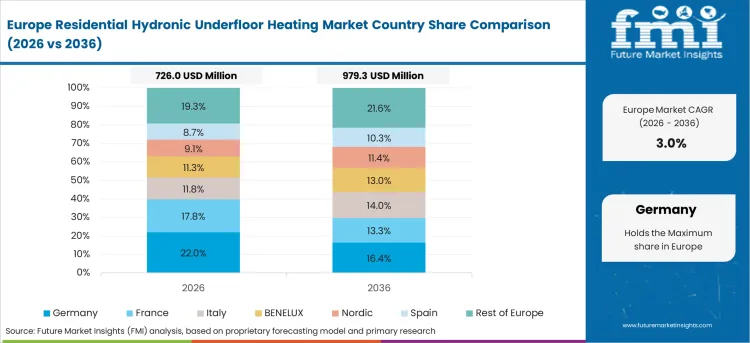
The residential hydronic underfloor heating market in Germany is growing at a 6.9% CAGR, supported by high awareness of energy efficiency and sustainable building practices. Homeowners are adopting underfloor heating for comfort, consistent warmth, and reduced energy consumption. Government regulations and incentives for energy-efficient construction are encouraging installation in both new and renovated homes. Manufacturers are introducing advanced systems with smart thermostats and zoning controls for improved performance. Urban and suburban households are driving adoption, particularly in regions with colder climates. Integration with renewable energy sources, including heat pumps and solar-assisted systems, is becoming increasingly common. The focus on environmentally friendly and cost-effective solutions is promoting steady market growth. Market players are also emphasizing long-term service contracts and system reliability to increase consumer confidence.
- Homeowners adopted underfloor heating for energy efficiency and comfort
- Government incentives encouraged installation in new and renovated homes
- Integration with renewable energy solutions increased adoption
Residential Hydronic Underfloor Heating Market Progress in the United Kingdom
The residential hydronic underfloor heating market in the United Kingdom is expanding at a 5.7% CAGR, driven by rising consumer awareness of energy-efficient heating and increasing urban housing developments. Homeowners are investing in underfloor heating for comfort, even temperature distribution, and reduced energy costs. Developers are integrating systems in modern residential projects to appeal to premium buyers. Manufacturers are offering low-maintenance solutions with smart controls that allow precise regulation of indoor temperatures. Government initiatives promoting energy-efficient construction and building retrofits are supporting market growth. Both new residential buildings and renovation projects are contributing to adoption. The market continues to grow steadily as households prioritize energy savings, comfort, and sustainable living solutions.
- Urban homeowners adopted underfloor heating for comfort and efficiency
- Developers integrated systems in modern residential projects
- Smart controls and low-maintenance solutions increased appeal
Residential Hydronic Underfloor Heating Market Insights in the United States
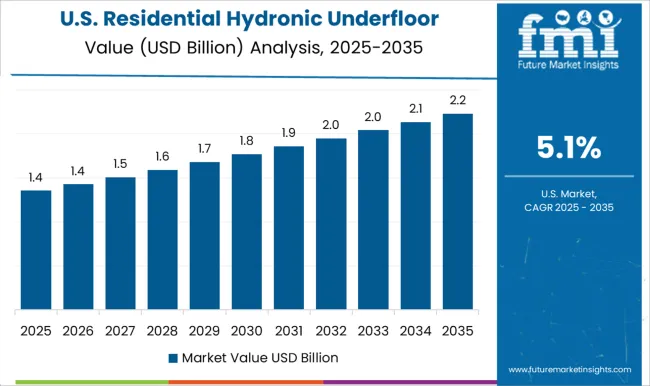
The residential hydronic underfloor heating market in the United States is growing at a 5.1% CAGR, supported by increasing demand for energy-efficient and sustainable heating solutions. Homeowners are installing underfloor heating systems for even heat distribution, comfort, and cost savings. Real estate developers and high-end residential projects are incorporating these systems to increase property value and attract buyers. Manufacturers are offering both water-based and hybrid solutions with advanced temperature controls and easy installation. Government initiatives promoting energy-efficient buildings and retrofits are helping market expansion. Both new constructions and renovations are contributing to adoption. The market is also benefiting from technological advancements such as smart thermostats and integration with home automation systems. Increasing awareness of comfort, efficiency, and environmental benefits is expected to drive steady growth in the coming years.
- Homeowners adopted underfloor heating for comfort and energy savings
- Developers integrated systems in premium residential projects
- Smart controls and hybrid systems increased market appeal
Competitive Landscape of Residential Hydronic Underfloor Heating Market
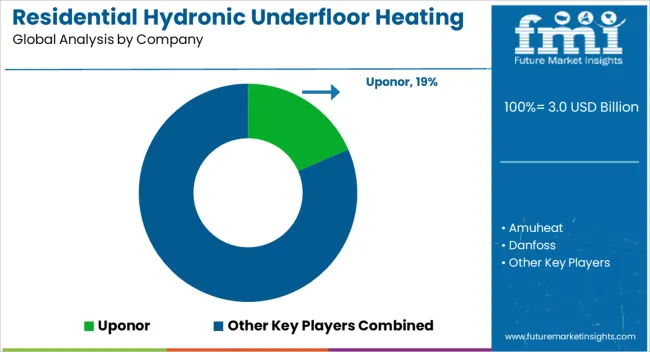
Uponor, Amuheat, and Danfoss supply residential hydronic underfloor heating (UFH) systems for single- and multi-family homes, with brochures highlighting pipe diameter, flow rate, and floor coverage per circuit. Eckermann Heating and Cooling, HeatLink Group, and Hurlcon Hydronic Heating provide pre-engineered UFH solutions, with datasheets detailing manifold specifications, pump compatibility, and maximum system pressure. MAGNUM Heating, OMNIE, and PIPELIFE INTERNATIONAL focus on modular systems for quick installation and retrofit applications, with brochures emphasizing pipe flexibility, thermal efficiency, and temperature uniformity. REHAU, Roth, and Schlüter-Systems deliver systems for both concrete and timber floor constructions, with technical literature presenting pipe spacing recommendations, insulation compatibility, and pump head requirements.
Therma-HEXX, Ambiente, Warmboard, Warmup, and Watts provide fully integrated UFH kits, with datasheets highlighting energy delivery, zonal control options, and leak detection features. Other regional suppliers compete with cost-effective solutions for small- to mid-sized residences, with brochures emphasizing simplified installation, corrosion resistance, and compliance with local building codes and standards. Market strategies focus on energy transfer efficiency, modularity, and ease of installation. Leading suppliers such as Uponor and Danfoss emphasize high-efficiency pipes with low thermal losses and precise control for multi-zone applications. Amuheat and HeatLink differentiate through pre-assembled manifold units, rapid-install pipe layouts, and integration with smart thermostats. Observed industry patterns indicate investment in cross-linked polyethylene (PEX) tubing, press-fit connectors, and combined radiant heating/cooling solutions. Product roadmaps frequently include pre-assembled manifolds with flow meters, insulation-backed piping for heat retention, and hybrid systems compatible with heat pumps or boilers.
Differentiation is achieved through verified flow capacity, temperature uniformity, and detailed technical guidance provided in brochures. Brochures and datasheets are used to communicate pipe material, diameter, maximum operating temperature, flow rate, insulation type, pump compatibility, manifold configuration, and system pressure limits. Uponor, Danfoss, and Amuheat literature emphasizes thermal efficiency, installation flexibility, and zonal control. Eckermann, HeatLink, and Hurlcon brochures highlight pre-engineered layouts, pump head requirements, and piping spacing. REHAU, Roth, and Schlüter datasheets provide concrete- and timber-floor compatibility, leak detection, and pressure testing guidance. Therma-HEXX, Warmup, and Watts materials detail fully integrated kits, energy delivery rates, and smart thermostat compatibility. Tables, diagrams, and installation charts are consistently included to allow HVAC engineers, home builders, and procurement specialists to evaluate system suitability efficiently. Market adoption is determined not only by thermal performance but also by the clarity and technical depth of brochures, making documentation essential for competitive positioning.
Key Players in the Residential Hydronic Underfloor Heating Market
- Uponor
- Amuheat
- Danfoss
- Eckermann Heating and Cooling
- HeatLink Group
- Hurlcon Hydronic Heating
- MAGNUM Heating
- OMNIE
- PIPELIFE INTERNATIONAL
- REHAU
- Roth
- Schlüter-Systems
- Therma-HEXX
- Ambiente
- Warmboard
- Warmup
- Watts
Scope of the Report
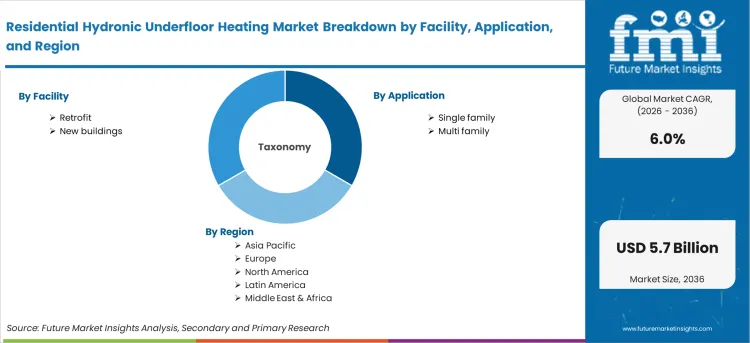
| Metric | Value |
|---|---|
| Quantitative Units | USD 3.18 billion to USD 5.69 billion, at a CAGR of 6% |
| Market Definition | The residential hydronic underfloor heating market covers water-based radiant floor heating systems designed to distribute thermal energy through pipe networks embedded in or beneath floor structures ... |
| Segmentation | Facility: Retrofit, New Buildings; Application: Single Family, Multi Family |
| Regions Covered | North America, Latin America, Europe, East Asia, South Asia, Oceania, Middle East & Africa |
| Countries Covered | China, India, Germany, France, UK, USA, Brazil, and 40 plus countries |
| Key Companies Profiled | Uponor, Amuheat, Danfoss, Eckermann Heating and Cooling, HeatLink Group, Hurlcon Hydronic Heating, MAGNUM Heating, OMNIE, PIPELIFE INTERNATIONAL, REHAU, Roth, Schluter-Systems, Therma-HEXX, Ambiente, Warmboard, Warmup, Watts |
| Forecast Period | 2026 to 2036 |
| Approach | Forecasting models apply a bottom-up methodology starting with installation tracking data and projecting conversion rates using region-specific adoption curves. |
Residential Hydronic Underfloor Heating Market by Segments
Facility:
- New buildings
- Retrofit
Application:
- Single family
- Multi family
Region:
- North America
- USA
- Canada
- Mexico
- Latin America
- Brazil
- Chile
- Rest of Latin America
- Western Europe
- Germany
- UK
- Italy
- Spain
- France
- Nordic
- BENELUX
- Rest of Western Europe
- Eastern Europe
- Russia
- Poland
- Hungary
- Balkan & Baltic
- Rest of Eastern Europe
- East Asia
- China
- Japan
- South Korea
- South Asia and Pacific
- India
- ASEAN
- Australia & New Zealand
- Rest of South Asia and Pacific
- Middle East & Africa
- Kingdom of Saudi Arabia
- Other GCC Countries
- Turkiye
- South Africa
- Other African Union
- Rest of Middle East & Africa
Bibliography
- European Committee for Standardization. (2024). EN 1264: Water-based surface embedded heating and cooling systems. CEN.
- UK Department for Levelling Up, Housing and Communities. (2024). Future Homes Standard consultation response. DLUHC.
- Passive House Institute. (2024). Passive House certification criteria for radiant heating systems. PHI.
- International Energy Agency. (2024). Heating system efficiency and emitter compatibility analysis. IEA.
- German Federal Ministry for Housing, Urban Development and Building. (2024). GEG implementation guidelines for heating system specification. BMWSB.
This bibliography is provided for reader reference. The full Future Market Insights report contains the complete reference list with primary research documentation.
Frequently Asked Questions
How large is the demand for Residential Hydronic Underfloor Heating Market in the global market in 2026?
Demand for residential hydronic underfloor heating in the global market is estimated to be valued at USD 3.18 billion in 2026.
What will be the market size of Residential Hydronic Underfloor Heating Market in the global market by 2036?
Market size for residential hydronic underfloor heating is projected to reach USD 5.69 billion by 2036.
What is the expected demand growth for Residential Hydronic Underfloor Heating Market between 2026 and 2036?
Demand for residential hydronic underfloor heating is expected to grow at a CAGR of 6% between 2026 and 2036.
Which Facility is poised to lead global sales by 2026?
Retrofit accounts for 59.3% share in 2026 as existing homeowners replacing gas boilers with heat pumps are simultaneously upgrading heat distribution to low-temperature-compatible underfloor systems.
How is the role of Single Family in driving Residential Hydronic Underfloor Heating Market adoption in 2026?
Single Family represents 64.7% of Application share in 2026 as single-family detached homes offer the largest floor area for hydronic pipe network installation and typically have direct access to screed or subfloor layers.
What is driving demand in China?
China is projected to grow at a CAGR of 8.1% during 2026 to 2036, driven by integration of hydronic underfloor heating as standard specification in northern China residential developments.
What is Residential Hydronic Underfloor Heating and what is it mainly used for?
Residential hydronic underfloor heating uses water-based pipe networks embedded in floor structures to distribute thermal energy for whole-room space heating. These systems are designed to operate at low flow temperatures compatible with heat pump installations.
How does FMI build and validate the Residential Hydronic Underfloor Heating Market forecast?
Forecasting models apply a bottom-up methodology starting with residential heating system installation records and underfloor heating project completion tracking data and cross-validate projections against publicly reported expenditure data from leading industry participants.
Preview the report firsthand - request a free sample
Get SampleGet the brochure for pricing and purchase details.
Get PDFTable of Content
- Executive Summary
- Global Market Outlook
- Demand-side Trends
- Supply-side Trends
- Technology Roadmap Analysis
- Analysis and Recommendations
- Market Overview
- Market Coverage / Taxonomy
- Market Definition / Scope / Limitations
- Research Methodology
- Chapter Orientation
- Analytical Lens and Working Hypotheses
- Market Structure, Signals, and Trend Drivers
- Benchmarking and Cross-market Comparability
- Market Sizing, Forecasting, and Opportunity Mapping
- Research Design and Evidence Framework
- Desk Research Programme (Secondary Evidence)
- Company Annual and Sustainability Reports
- Peer-reviewed Journals and Academic Literature
- Corporate Websites, Product Literature, and Technical Notes
- Earnings Decks and Investor Briefings
- Statutory Filings and Regulatory Disclosures
- Technical White Papers and Standards Notes
- Trade Journals, Industry Magazines, and Analyst Briefs
- Conference Proceedings, Webinars, and Seminar Materials
- Government Statistics Portals and Public Data Releases
- Press Releases and Reputable Media Coverage
- Specialist Newsletters and Curated Briefings
- Sector Databases and Reference Repositories
- FMI Internal Proprietary Databases and Historical Market Datasets
- Subscription Datasets and Paid Sources
- Social Channels, Communities, and Digital Listening Inputs
- Additional Desk Sources
- Expert Input and Fieldwork (Primary Evidence)
- Primary Modes
- Qualitative Interviews and Expert Elicitation
- Quantitative Surveys and Structured Data Capture
- Blended Approach
- Why Primary Evidence is Used
- Field Techniques
- Interviews
- Surveys
- Focus Groups
- Observational and In-context Research
- Social and Community Interactions
- Stakeholder Universe Engaged
- C-suite Leaders
- Board Members
- Presidents and Vice Presidents
- R&D and Innovation Heads
- Technical Specialists
- Domain Subject-matter Experts
- Scientists
- Physicians and Other Healthcare Professionals
- Governance, Ethics, and Data Stewardship
- Research Ethics
- Data Integrity and Handling
- Primary Modes
- Tooling, Models, and Reference Databases
- Desk Research Programme (Secondary Evidence)
- Data Engineering and Model Build
- Data Acquisition and Ingestion
- Cleaning, Normalisation, and Verification
- Synthesis, Triangulation, and Analysis
- Quality Assurance and Audit Trail
- Market Background
- Market Dynamics
- Drivers
- Restraints
- Opportunity
- Trends
- Scenario Forecast
- Demand in Optimistic Scenario
- Demand in Likely Scenario
- Demand in Conservative Scenario
- Opportunity Map Analysis
- Product Life Cycle Analysis
- Supply Chain Analysis
- Investment Feasibility Matrix
- Value Chain Analysis
- PESTLE and Porter’s Analysis
- Regulatory Landscape
- Regional Parent Market Outlook
- Production and Consumption Statistics
- Import and Export Statistics
- Market Dynamics
- Global Market Analysis 2021 to 2025 and Forecast, 2026 to 2036
- Historical Market Size Value (USD Million) Analysis, 2021 to 2025
- Current and Future Market Size Value (USD Million) Projections, 2026 to 2036
- Y-o-Y Growth Trend Analysis
- Absolute $ Opportunity Analysis
- Global Market Pricing Analysis 2021 to 2025 and Forecast 2026 to 2036
- Global Market Analysis 2021 to 2025 and Forecast 2026 to 2036, By Facility
- Introduction / Key Findings
- Historical Market Size Value (USD Million) Analysis By Facility , 2021 to 2025
- Current and Future Market Size Value (USD Million) Analysis and Forecast By Facility , 2026 to 2036
- Retrofit
- New buildings
- Retrofit
- Y-o-Y Growth Trend Analysis By Facility , 2021 to 2025
- Absolute $ Opportunity Analysis By Facility , 2026 to 2036
- Global Market Analysis 2021 to 2025 and Forecast 2026 to 2036, By Application
- Introduction / Key Findings
- Historical Market Size Value (USD Million) Analysis By Application, 2021 to 2025
- Current and Future Market Size Value (USD Million) Analysis and Forecast By Application, 2026 to 2036
- Single family
- Multi family
- Single family
- Y-o-Y Growth Trend Analysis By Application, 2021 to 2025
- Absolute $ Opportunity Analysis By Application, 2026 to 2036
- Global Market Analysis 2021 to 2025 and Forecast 2026 to 2036, By Region
- Introduction
- Historical Market Size Value (USD Million) Analysis By Region, 2021 to 2025
- Current Market Size Value (USD Million) Analysis and Forecast By Region, 2026 to 2036
- North America
- Latin America
- Western Europe
- Eastern Europe
- East Asia
- South Asia and Pacific
- Middle East & Africa
- Market Attractiveness Analysis By Region
- North America Market Analysis 2021 to 2025 and Forecast 2026 to 2036, By Country
- Historical Market Size Value (USD Million) Trend Analysis By Market Taxonomy, 2021 to 2025
- Market Size Value (USD Million) Forecast By Market Taxonomy, 2026 to 2036
- By Country
- USA
- Canada
- Mexico
- By Facility
- By Application
- By Country
- Market Attractiveness Analysis
- By Country
- By Facility
- By Application
- Key Takeaways
- Latin America Market Analysis 2021 to 2025 and Forecast 2026 to 2036, By Country
- Historical Market Size Value (USD Million) Trend Analysis By Market Taxonomy, 2021 to 2025
- Market Size Value (USD Million) Forecast By Market Taxonomy, 2026 to 2036
- By Country
- Brazil
- Chile
- Rest of Latin America
- By Facility
- By Application
- By Country
- Market Attractiveness Analysis
- By Country
- By Facility
- By Application
- Key Takeaways
- Western Europe Market Analysis 2021 to 2025 and Forecast 2026 to 2036, By Country
- Historical Market Size Value (USD Million) Trend Analysis By Market Taxonomy, 2021 to 2025
- Market Size Value (USD Million) Forecast By Market Taxonomy, 2026 to 2036
- By Country
- Germany
- UK
- Italy
- Spain
- France
- Nordic
- BENELUX
- Rest of Western Europe
- By Facility
- By Application
- By Country
- Market Attractiveness Analysis
- By Country
- By Facility
- By Application
- Key Takeaways
- Eastern Europe Market Analysis 2021 to 2025 and Forecast 2026 to 2036, By Country
- Historical Market Size Value (USD Million) Trend Analysis By Market Taxonomy, 2021 to 2025
- Market Size Value (USD Million) Forecast By Market Taxonomy, 2026 to 2036
- By Country
- Russia
- Poland
- Hungary
- Balkan & Baltic
- Rest of Eastern Europe
- By Facility
- By Application
- By Country
- Market Attractiveness Analysis
- By Country
- By Facility
- By Application
- Key Takeaways
- East Asia Market Analysis 2021 to 2025 and Forecast 2026 to 2036, By Country
- Historical Market Size Value (USD Million) Trend Analysis By Market Taxonomy, 2021 to 2025
- Market Size Value (USD Million) Forecast By Market Taxonomy, 2026 to 2036
- By Country
- China
- Japan
- South Korea
- By Facility
- By Application
- By Country
- Market Attractiveness Analysis
- By Country
- By Facility
- By Application
- Key Takeaways
- South Asia and Pacific Market Analysis 2021 to 2025 and Forecast 2026 to 2036, By Country
- Historical Market Size Value (USD Million) Trend Analysis By Market Taxonomy, 2021 to 2025
- Market Size Value (USD Million) Forecast By Market Taxonomy, 2026 to 2036
- By Country
- India
- ASEAN
- Australia & New Zealand
- Rest of South Asia and Pacific
- By Facility
- By Application
- By Country
- Market Attractiveness Analysis
- By Country
- By Facility
- By Application
- Key Takeaways
- Middle East & Africa Market Analysis 2021 to 2025 and Forecast 2026 to 2036, By Country
- Historical Market Size Value (USD Million) Trend Analysis By Market Taxonomy, 2021 to 2025
- Market Size Value (USD Million) Forecast By Market Taxonomy, 2026 to 2036
- By Country
- Kingdom of Saudi Arabia
- Other GCC Countries
- Turkiye
- South Africa
- Other African Union
- Rest of Middle East & Africa
- By Facility
- By Application
- By Country
- Market Attractiveness Analysis
- By Country
- By Facility
- By Application
- Key Takeaways
- Key Countries Market Analysis
- USA
- Pricing Analysis
- Market Share Analysis, 2025
- By Facility
- By Application
- Canada
- Pricing Analysis
- Market Share Analysis, 2025
- By Facility
- By Application
- Mexico
- Pricing Analysis
- Market Share Analysis, 2025
- By Facility
- By Application
- Brazil
- Pricing Analysis
- Market Share Analysis, 2025
- By Facility
- By Application
- Chile
- Pricing Analysis
- Market Share Analysis, 2025
- By Facility
- By Application
- Germany
- Pricing Analysis
- Market Share Analysis, 2025
- By Facility
- By Application
- UK
- Pricing Analysis
- Market Share Analysis, 2025
- By Facility
- By Application
- Italy
- Pricing Analysis
- Market Share Analysis, 2025
- By Facility
- By Application
- Spain
- Pricing Analysis
- Market Share Analysis, 2025
- By Facility
- By Application
- France
- Pricing Analysis
- Market Share Analysis, 2025
- By Facility
- By Application
- India
- Pricing Analysis
- Market Share Analysis, 2025
- By Facility
- By Application
- ASEAN
- Pricing Analysis
- Market Share Analysis, 2025
- By Facility
- By Application
- Australia & New Zealand
- Pricing Analysis
- Market Share Analysis, 2025
- By Facility
- By Application
- China
- Pricing Analysis
- Market Share Analysis, 2025
- By Facility
- By Application
- Japan
- Pricing Analysis
- Market Share Analysis, 2025
- By Facility
- By Application
- South Korea
- Pricing Analysis
- Market Share Analysis, 2025
- By Facility
- By Application
- Russia
- Pricing Analysis
- Market Share Analysis, 2025
- By Facility
- By Application
- Poland
- Pricing Analysis
- Market Share Analysis, 2025
- By Facility
- By Application
- Hungary
- Pricing Analysis
- Market Share Analysis, 2025
- By Facility
- By Application
- Kingdom of Saudi Arabia
- Pricing Analysis
- Market Share Analysis, 2025
- By Facility
- By Application
- Turkiye
- Pricing Analysis
- Market Share Analysis, 2025
- By Facility
- By Application
- South Africa
- Pricing Analysis
- Market Share Analysis, 2025
- By Facility
- By Application
- USA
- Market Structure Analysis
- Competition Dashboard
- Competition Benchmarking
- Market Share Analysis of Top Players
- By Regional
- By Facility
- By Application
- Competition Analysis
- Competition Deep Dive
- Uponor
- Overview
- Product Portfolio
- Profitability by Market Segments (Product/Age /Sales Channel/Region)
- Sales Footprint
- Strategy Overview
- Marketing Strategy
- Product Strategy
- Channel Strategy
- Amuheat
- Danfoss
- Eckermann Heating and Cooling
- HeatLink Group
- Hurlcon Hydronic Heating
- MAGNUM Heating
- OMNIE
- PIPELIFE INTERNATIONAL
- REHAU
- Roth
- Schlüter-Systems
- Therma-HEXX
- Ambiente
- Warmboard
- Warmup
- Watts
- Uponor
- Competition Deep Dive
- Assumptions & Acronyms Used


