

- Industry Size (2026)
- USD 2.63 Bn
- Forecast (2036)
- USD 25.1 Bn
- CAGR (2026 to 2036)
- 25.3%
Residential Smart Water Metering Market Size, Market Forecast and Outlook By FMI
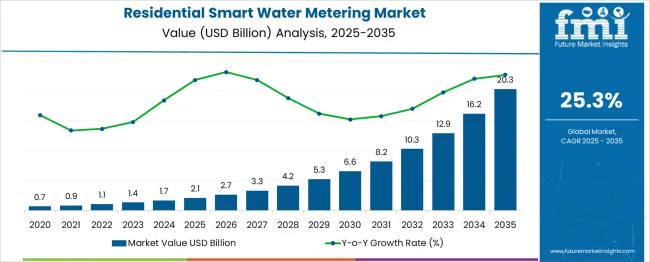
The residential smart water metering market was valued at USD 2.1 billion in 2025, projected to reach USD 2.63 billion in 2026, and is forecast to expand to USD 25.1 billion by 2036 at a 25.3% CAGR. Municipal water utilities facing non-revenue water losses exceeding 30% in many jurisdictions are mandating smart meter deployment to detect leaks, eliminate meter tampering, and implement volumetric billing at the household level. AMI technology accounts for 59.7% of deployments as utilities prioritize two-way communication capability for demand management and real-time leak detection alerts.
Summary of Residential Smart Water Metering Market
- Market Snapshot:
- The residential smart water metering market is valued at USD 2.1 billion in 2025 and is projected to reach USD 25.1 billion by 2036.
- The industry is expected to grow at a 25.3% CAGR from 2026 to 2036, creating an incremental opportunity of USD 22.47 billion.
- The market is at the earliest stage of a utility infrastructure modernization cycle where government mandates, non-revenue water reduction targets, and measurement technology transitions define competitive positioning.
- Demand and Growth Drivers:
- Municipal water utilities facing non-revenue water losses exceeding 30% are mandating smart meter deployment for leak detection, tamper prevention, and volumetric billing.
- Regulatory requirements for individual hot water consumption metering in multi-family buildings are driving installation volumes in Europe and Asia.
- The transition from manual meter reading to automated data collection reduces utility operational costs by 40% to 60% per meter point.
- Among key countries, China at 34.2%, India at 31.6%, Germany at 29.1%, France at 26.6%, UK at 24.0%, USA at 21.5%, Brazil at 19.0%.
- Product and Segment View:
- The market includes AMI and AMR residential water meters with wireless communication for automated consumption data collection, leak detection, and volumetric billing.
- AMI leads by Technology with 59.7% share in 2026.
- Hot Water Meter leads by Product with 53.4% share in 2026.
- Scope includes market scope includes ami and amr residential water meters, ultrasonic and electromagnetic flow measurement devices, communication modules, data concentrators, and firmware platforms. Commercial and industrial water meters are excluded.
- Geography and Competitive Outlook:
- China and India are the fastest-growing markets at 34.2% and 31.6% CAGR respectively, driven by expanding municipal water loss reduction mandates and digital water infrastructure investment programmes.
- USA represents a mature demand base where EPA WaterSense alignment and state-level AMI mandates in water-scarce municipalities sustain smart water meter deployment.
- Competition is shaped by measurement accuracy, communication reliability, and integration with utility meter data management systems, with key players including Itron, Aclara Technologies, Apator, Arad Group, Badger Meter, BMETERS, Diehl Stiftung.
- Analyst Opinion at FMI:
- Nikhil Kaitwade, Principal Consultant for Infrastructure, opines: 'In my analysis, I have observed that residential smart water metering is following the adoption trajectory of smart electric meters with a five-to-seven-year lag. Water utilities that delay AMI procurement will face compounding non-revenue water losses that erode financial viability. Meter manufacturers maintaining mechanical-only production lines without parallel ultrasonic and electromagnetic smart meter development face exclusion from the procurement cycles that will define the next decade of water utility infrastructure investment.'
- Strategic Implications / Executive Takeaways:
- Water meter manufacturers must accelerate ultrasonic and electromagnetic AMI product development to capture the procurement cycles replacing mechanical meters in residential networks.
- Municipal water utility procurement directors should structure smart meter contracts with interoperability provisions that prevent vendor lock-in and enable future communication protocol migration.
- Data analytics providers must develop residential-specific leak detection algorithms that distinguish between meter anomalies and actual household water loss events to minimize false alert rates.
Residential Smart Water Metering Market Key Takeaways
| Metric | Details |
|---|---|
| Industry Size (2026) | USD 2.63 billion |
| Industry Value (2036) | USD 25.1 billion |
| CAGR (2026-2036) | 25.3% |
Source: Future Market Insights, 2026
The incremental opportunity of USD 22.47 billion over the forecast period reflects the convergence of aging mechanical meter replacement cycles, water scarcity mandates, and government-funded digital water infrastructure programmes. Hot water meters command 53.4% of product share as regulatory requirements for individual hot water consumption metering in multi-family buildings drive installation volumes in Europe and Asia. The transition from manual meter reading to automated data collection is reducing utility operational costs by 40% to 60% per meter point, strengthening the return-on-investment case for municipal procurement.
China leads at 34.2% CAGR, driven by the Ministry of Housing and Urban-Rural Development mandate requiring smart water metering in all new residential construction and pilot programmes retrofitting 100 million meters in existing housing stock. India follows at 31.6%, propelled by the Atal Mission for Rejuvenation and Urban Transformation mandating smart water metering in designated smart cities and the Jal Jeevan Mission tracking household water delivery. Germany registers 29.1%, anchored by the Heating Cost Allocation Ordinance requiring individual hot water consumption metering in multi-family residential buildings. France advances at 26.6%, supported by the Loi Warsmann mandate for individual water metering in multi-family housing and Suez/Veolia smart meter deployment programmes. The United Kingdom posts 24.0%, driven by Ofwat water company performance commitments requiring leakage reduction and smart meter installation targets in water-stressed regions. The United States expands at 21.5%, supported by EPA WaterSense programme alignment and state public utility commission mandates for advanced metering infrastructure in water-scarce municipalities. Brazil records 19.0% growth as sanitation framework law reforms mandate metering modernization and non-revenue water reduction targets for municipal water concessionaires.
Residential Smart Water Metering Market Definition
The residential smart water metering market encompasses electronically enabled water measurement devices that record, store, and communicate household water consumption data to utility management systems via wireless communication protocols. Products include advanced metering infrastructure meters with two-way communication, automatic meter reading devices, and associated data concentrators and communication modules deployed at residential water service connection points for hot and cold water measurement.
Residential Smart Water Metering Market Inclusions
Market scope includes AMI and AMR residential water meters, ultrasonic and electromagnetic flow measurement devices, communication modules, data concentrators, and firmware platforms. Both hot water and cold water meter configurations for single-family and multi-family installations are covered.
Residential Smart Water Metering Market Exclusions
Commercial and industrial water meters are excluded. The scope omits mechanical water meters without electronic communication capability, water quality monitoring sensors, and meter data management software platforms. Bulk water meters for district metering areas fall outside analytical parameters.
Residential Smart Water Metering Market Research Methodology
- Primary Research: Analysts engaged with municipal water utility metering programme managers, smart meter deployment contractors, and water infrastructure consultants to map procurement requirements and deployment priorities.
- Desk Research: Data collection phases aggregated municipal water utility metering programme databases, non-revenue water loss statistics, water quality regulatory requirements, and metering equipment trade data.
- Market-Sizing and Forecasting: Baseline values derive from a bottom-up aggregation of installation and procurement tracking data, applying region-specific adoption curves to project future deployment velocity.
- Data Validation and Update Cycle: Projections are tested against publicly reported expenditure guidance from leading industry participants and cross-referenced with regulatory filing data.
Why is the Residential Smart Water Metering Market Growing?
Urbanization, coupled with growing environmental awareness, has pushed municipal bodies and utilities to adopt smart metering solutions that support sustainable usage patterns and reduce non-revenue water losses. Regulatory mandates promoting digital infrastructure in utility services and government-led initiatives for smart city development have further accelerated market adoption. Consumers are also displaying greater interest in solutions that offer usage transparency, billing accuracy, and smartphone integration.
Future growth is expected to be driven by the integration of IoT, advanced data analytics, and remote monitoring capabilities, enhancing user control and utility efficiency. As infrastructure modernization continues and technology costs decline, residential deployment of smart water meters is projected to expand across both developed and emerging economies.
Segmental Analysis
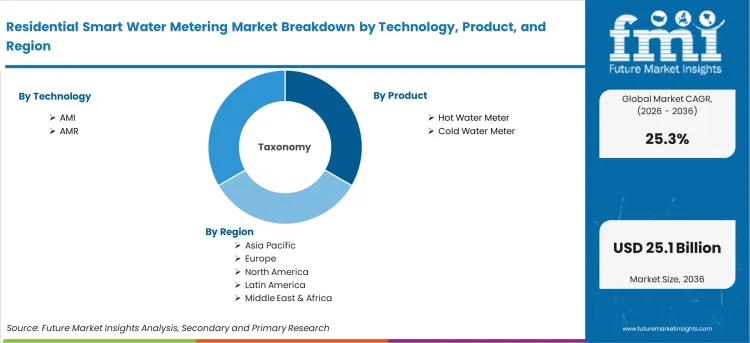
The residential smart water metering market is segmented by technology and product, and geographic regions. The residential smart water metering market is divided into AMI and AMR. In terms of the product, the residential smart water metering market is classified into Hot Water Meter and Cold Water Meter. Regionally, the residential smart water metering industry is classified into North America, Latin America, Western Europe, Eastern Europe, Balkan & Baltic Countries, Russia & Belarus, Central Asia, East Asia, South Asia & Pacific, and the Middle East & Africa.
Insights into the AMI Technology Segment
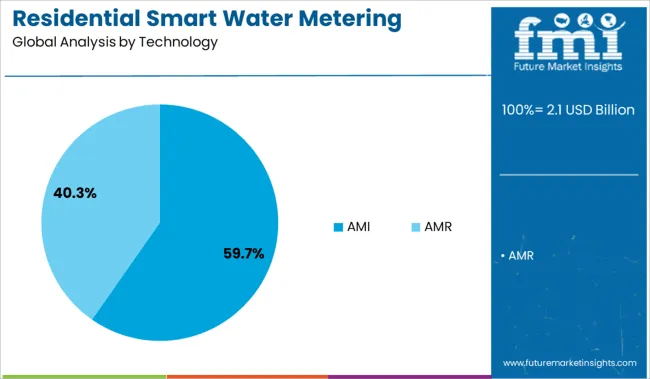
The AMI technology segment leads the residential smart water metering market with a dominant 59.7% share, highlighting its role in enabling two-way communication between meters and utility providers. Advanced Metering Infrastructure allows for real-time data collection, remote meter reading, and immediate leak detection, which significantly enhances operational efficiency and customer service.
Utilities are increasingly adopting AMI to reduce manual labor costs, address billing disputes, and comply with data-driven regulatory requirements. The ability to analyze consumption patterns in real time enables proactive maintenance and effective demand management.
Furthermore, AMI’s compatibility with smart grid infrastructure positions it as a strategic investment for long-term water conservation and digital transformation efforts. As smart city projects and sustainability goals intensify, the AMI segment is expected to maintain its market leadership due to its high functionality, scalability, and regulatory alignment.
Insights into the Hot Water Meter Product Segment
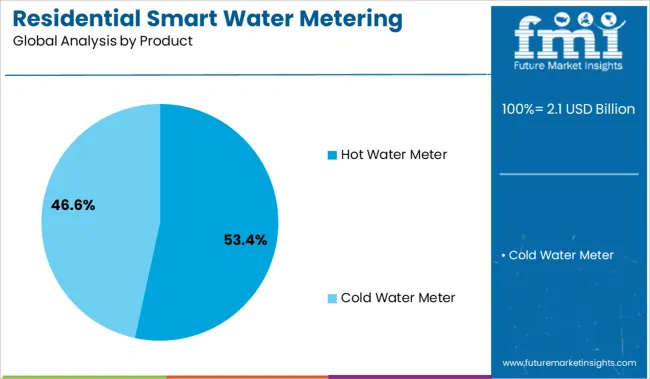
Hot water meters account for a leading 53.4% share in the product category, reflecting their widespread adoption in residential buildings for accurate monitoring of thermal water consumption. These meters are particularly critical in multi-unit dwellings and urban residential complexes where centralized water heating systems are common.
The increasing need for cost allocation transparency and energy efficiency in water heating has driven demand for precise, durable, and tamper-resistant hot water metering solutions. Technological advancements have improved meter performance under high-temperature conditions and enabled integration with smart home platforms.
The rising emphasis on energy conservation, coupled with stricter building efficiency codes, continues to support the growth of this segment. Future adoption is expected to grow further as smart home developers and utility companies prioritize hot water metering to optimize resource usage and billing practices in residential environments.
What are the Drivers, Restraints, and Key Trends of the Residential Smart Water Metering Market?
Smart water meters have been deployed to enable accurate household consumption monitoring, reduce water loss, and streamline billing processes. Features such as automatic meter readings, leak detection alerts, and Bluetooth or RF connectivity are being included in new smart metering systems. Utilities and municipalities have adopted remote meter reading and data analytics platforms driven by regulatory water management targets and the need to improve customer engagement. Devices supporting two-way communication and modular replacements have been preferred by service providers aiming to modernize residential metering infrastructure.
Inline Leak Detection and Billing Transparency Boost Adoption
Adoption of residential smart water meters is driven by their capability to deliver accurate consumption data and early leak detection. Meters integrated with flow sensors and communication modules identify abnormal patterns, preventing significant water loss and property damage. Automated meter reading eliminates manual errors, reduces the need for field visits, and supports transparent billing processes. Consumer-facing dashboards and mobile applications provide real-time usage insights, allowing proactive conservation. Regulatory initiatives promoting water conservation and non-revenue water reduction further accelerate utility deployments. Transitioning from manual systems to digital metering enhances operational efficiency, improves revenue assurance, and strengthens customer engagement. Smart meters also enable demand forecasting and dynamic pricing strategies through continuous data collection.
Connectivity Instability and Data Overload Restrict Growth
Growth in smart water metering faces challenges from inconsistent connectivity in low-signal areas, causing delays in data transmission and billing updates. RF and cellular modules present variations in power efficiency and reliability, complicating hardware selection and deployment. Hourly consumption readings generate large data volumes, creating pressure on utility analytics platforms to support real-time processing. Deployment requires scheduling home visits, retrofitting old meters, and securing consumer approvals, adding complexity and cost. Data security concerns, including risks of hacking and unauthorized access, remain significant. Additionally, high upfront costs compared to traditional mechanical meters limit adoption by smaller utilities with constrained budgets, delaying modernization initiatives in cost-sensitive regions.
Analysis of Residential Smart Water Metering Market By Key Countries
.webp "Top Country Growth Comparison Residential Smart Water Metering Market Cagr (2026 2036)")
| Country | CAGR |
|---|---|
| China | 34.2% |
| India | 31.6% |
| Germany | 29.1% |
| France | 26.6% |
| UK | 24.0% |
| USA | 21.5% |
| Brazil | 19.0% |
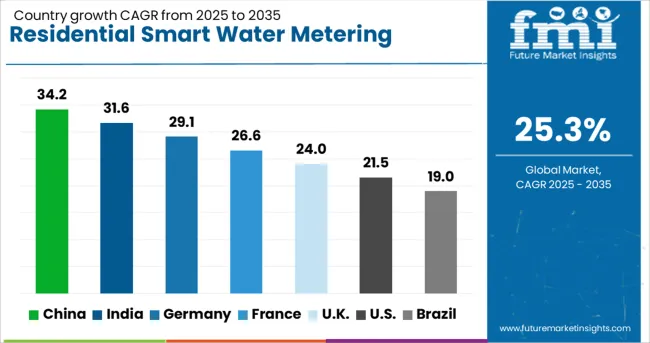
The global residential smart water metering market is projected to grow at a 25.3% CAGR from 2025 to 2035. Of the five profiled markets among 40 analyzed, China leads at 34.2%, followed by India at 31.6% and Germany at 29.1%, while France posts 26.6% and the United Kingdom records 24.0%. These figures represent growth premiums of +35% for China, +25% for India, and +15% for Germany, whereas France and the UK track closer to the global baseline. Key drivers include large-scale smart city deployments in China, nationwide water efficiency initiatives in India, advanced IoT integration in Germany, government-backed metering mandates in France, and infrastructure digitalization in the UK. The report includes analysis of over 40 countries, with five profiled below for reference.
Growth of Residential Smart Water Metering Market in China
China is projected to grow at a 34.2% CAGR, driven by extensive smart city programs and utility digitalization across Tier I and Tier II cities. Government mandates for real-time water monitoring accelerate IoT-enabled meter adoption. Domestic manufacturers are scaling production of ultrasonic and electromagnetic meters integrated with cloud-based platforms for analytics. Expansion of high-rise residential projects and municipal modernization projects further supports deployments. E-commerce procurement channels enhance access for private developers and municipal contracts. Cloud-integrated metering solutions enable accurate billing, early leak detection, and predictive maintenance, creating efficiency across large distribution networks. The strong push for digital infrastructure positions China as a global leader in advanced water metering deployments.
- IoT-enabled ultrasonic meters dominate urban installations.
- Smart city initiatives mandate connected metering systems.
- Cloud-based solutions improve billing accuracy and management.
Adoption Trends for Residential Smart Water Metering Market in India
India is expected to register a 31.6% CAGR, supported by national water conservation programs and accelerated housing development under government-led initiatives. Utilities are increasingly deploying AMI systems to monitor consumption and detect leaks in real time. Domestic manufacturers are introducing low-cost smart meters for semi-urban and rural zones, reducing reliance on mechanical meters. Partnerships between global IoT providers and Indian OEMs drive localization of advanced technologies. Digital payment integration improves billing transparency and enhances consumer experience. Smart metering adoption is gaining momentum in municipal distribution grids and private housing projects, ensuring operational efficiency and reduced non-revenue water losses. Growing urbanization and technology-driven governance frameworks strengthen future demand.
- AMI systems expand municipal and private water networks.
- Cost-effective smart meters target rural and semi-urban areas.
- IoT partnerships accelerate localized innovation for mass rollout.
Modernization Initiatives for Residential Smart Water Metering Market in France
France is projected to grow at a 26.6% CAGR, driven by regulatory measures promoting efficient water and energy use. Utilities prioritize two-way communication meters to improve demand forecasting and billing accuracy. Vendors invest in interoperability standards to ensure compatibility with legacy infrastructure, accelerating large-scale rollouts. AMI deployment expands coverage in suburban and rural grids, improving operational transparency. Manufacturers integrate AI-driven leakage detection systems and automated billing to enhance reliability and reduce non-revenue water. Digital engagement platforms help consumers monitor usage through apps and web dashboards, reinforcing conservation efforts. Growing focus on reducing water loss and modernizing utility infrastructure drives significant investment in advanced metering technology.
- Two-way communication systems improve network data accuracy.
- AI-driven leak detection enhances operational performance.
- AMI deployment expands to rural and suburban areas.
Market Expansion of Residential Smart Water Metering Market in the United Kingdom
The United Kingdom is expected to grow at a 24.0% CAGR, supported by water infrastructure modernization and energy-efficiency objectives. Smart meter installations are gaining momentum in high-density residential clusters through government funding initiatives. Utilities are deploying NB-IoT and LoRaWAN connectivity for reliable real-time data exchange across complex urban networks. Cloud-based monitoring platforms offer consumers usage dashboards and predictive analytics, enabling better water management. Manufacturers introduce retrofit-ready compact meters suitable for older housing stock, reducing installation complexity. Collaborations with cloud service providers ensure secure data handling and remote diagnostics for improved system uptime. Integration of smart meters with home automation platforms further accelerates adoption.
- NB-IoT and LoRaWAN enhance connectivity for smart meters.
- Compact retrofit designs target legacy housing systems.
- Cloud-enabled diagnostics strengthen predictive maintenance.
Technological Advancements in Residential Smart Water Metering Market in Germany
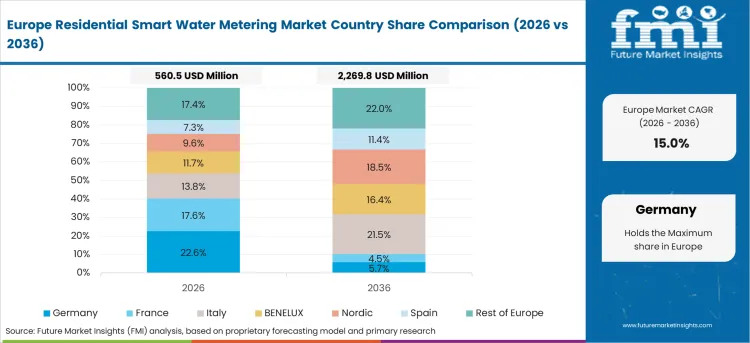
Germany is forecast to achieve a 29.1% CAGR, driven by EU energy-efficiency mandates and rapid adoption of smart home technologies. Wireless ultrasonic meters dominate installations across multi-family housing, providing real-time data transmission for utilities. Manufacturers prioritize designs with long-life batteries to extend operational lifespan and minimize service interruptions. Cloud-based platforms support predictive analytics for leak detection and usage optimization. Integration of smart meters with district heating and water recycling systems enables bundled smart utility packages for urban infrastructure projects. Digital twin applications in municipal networks enhance modeling for resource management and planning. The focus on interoperability and sustainability positions Germany as a hub for advanced water metering technology.
- Wireless ultrasonic meters dominate residential deployments.
- Battery-optimized designs extend service life and reduce maintenance.
- Integration with heating and water systems enhances efficiency.
Competitive Landscape of Residential Smart Water Metering Market
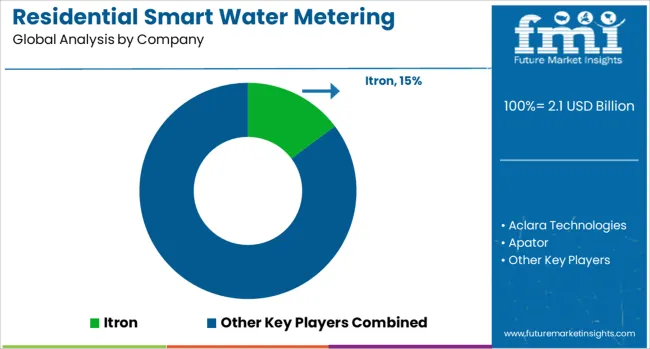
The residential smart water metering market is dominated by Itron, with a significant share, leveraging AMI-enabled meters and advanced IoT infrastructure for utilities. Key players such as Aclara Technologies, Kamstrup, Sensus (Xylem), Badger Meter, Neptune Technology Group, Diehl Stiftung, Honeywell International, and Landis+Gyr provide AMR and AMI solutions integrated with wireless protocols including LoRaWAN and Wireless M-Bus. Regional manufacturers like Apator, Arad Group, BMETERS, Schneider Electric, Sontex, and Zenner International address localized needs across Europe, Asia, and Latin America. Competitive differentiation is centered on accurate leak detection, real-time data analytics, and interoperability with smart home systems. Utilities increasingly prefer vendors offering scalable endpoint networks and secure platforms that ensure compliance with regulatory and water conservation mandates.
Scope of the Report
| Metric | Value |
|---|---|
| Quantitative Units | USD 2.63 billion to USD 25.1 billion, at a CAGR of 25.3% |
| Market Definition | The residential smart water metering market encompasses electronically enabled water measurement devices that record, store, and communicate household water consumption data to utility management system |
| Segmentation | Technology: AMI, AMR; Product: Hot Water Meter, Cold Water Meter |
| Regions Covered | North America, Latin America, Europe, East Asia, South Asia, Oceania, Middle East & Africa |
| Countries Covered | China, India, Germany, France, UK, USA, Brazil, and 40 plus countries |
| Key Companies Profiled | Itron, Aclara Technologies, Apator, Arad Group, Badger Meter, BMETERS, Diehl Stiftung, Honeywell International, Kamstrup, Landis+Gyr, Neptune Technology Group, Ningbo Water Meter, Schneider Electric, Sensus, Siemens, Sontex, Zenner International |
| Forecast Period | 2026 to 2036 |
| Approach | Forecasting models apply a bottom-up methodology starting with installation tracking data and projecting adoption rates using region-specific deployment curves. |
Residential Smart Water Metering Market by Segments
Technology:
- AMI
- AMR
Product:
- Hot Water Meter
- Cold Water Meter
Region:
- North America
- USA
- Canada
- Mexico
- Latin America
- Brazil
- Chile
- Rest of Latin America
- Western Europe
- Germany
- UK
- Italy
- Spain
- France
- Nordic
- BENELUX
- Rest of Western Europe
- Eastern Europe
- Russia
- Poland
- Hungary
- Balkan & Baltic
- Rest of Eastern Europe
- East Asia
- China
- Japan
- South Korea
- South Asia and Pacific
- India
- ASEAN
- Australia & New Zealand
- Rest of South Asia and Pacific
- Middle East & Africa
- Kingdom of Saudi Arabia
- Other GCC Countries
- Turkiye
- South Africa
- Other African Union
- Rest of Middle East & Africa
Bibliography
- World Health Organization. (2024). Guidelines for drinking-water quality, smart metering and water safety planning. WHO.
- European Commission. (2024). Drinking Water Directive 2020/2184 implementation guidance on smart metering. European Commission.
- Ministry of Housing and Urban-Rural Development, China. (2024). Smart water metering deployment guidelines for residential construction. MOHURD.
- U.S. Environmental Protection Agency. (2024). WaterSense programme guidelines for metering and data management. EPA.
- Ofwat. (2024). PR24 water company performance commitments on smart metering and leakage reduction. Ofwat.
This bibliography is provided for reader reference. The full Future Market Insights report contains the complete reference list with primary research documentation.
Frequently Asked Questions
How large is the demand for Residential Smart Water Metering Market in the global market in 2026?
Demand for residential smart water metering in the global market is estimated to be valued at USD 2.63 billion in 2026.
What will be the market size of Residential Smart Water Metering Market in the global market by 2036?
Market size for residential smart water metering is projected to reach USD 25.1 billion by 2036.
What is the expected demand growth for Residential Smart Water Metering Market between 2026 and 2036?
Demand for residential smart water metering is expected to grow at a CAGR of 25.3% between 2026 and 2036.
Which Technology is poised to lead global sales by 2026?
AMI accounts for 59.7% share in 2026 as AMI enables two-way communication for demand management, real-time leak detection alerts, and dynamic tariff implementation at the household level.
How is the role of Hot Water Meter in driving Residential Smart Water Metering Market adoption in 2026?
Hot Water Meter represents 53.4% of Product share in 2026 as regulatory requirements for individual hot water consumption metering in multi-family buildings drive hot water meter installation volumes in Europe and Asia.
What is driving demand in China?
China is projected to grow at a CAGR of 34.2% during 2026 to 2036, driven by the Ministry of Housing mandate requiring smart water metering in all new residential construction and pilot programmes retrofitting 100 million meters.
What is Residential Smart Water Metering and what is it mainly used for?
Residential smart water meters are electronically enabled devices that record and wirelessly communicate household water consumption data to utility management systems. They are used for automated billing, leak detection, and non-revenue water loss reduction.
How does FMI build and validate the Residential Smart Water Metering Market forecast?
Forecasting models apply a bottom-up methodology starting with municipal water meter procurement contracts and deployment tracking data and cross-validate projections against publicly reported expenditure data from leading industry participants.
Preview the report firsthand - request a free sample
Get SampleGet the brochure for pricing and purchase details.
Get PDFTable of Content
- Executive Summary
- Global Market Outlook
- Demand-side Trends
- Supply-side Trends
- Technology Roadmap Analysis
- Analysis and Recommendations
- Market Overview
- Market Coverage / Taxonomy
- Market Definition / Scope / Limitations
- Research Methodology
- Chapter Orientation
- Analytical Lens and Working Hypotheses
- Market Structure, Signals, and Trend Drivers
- Benchmarking and Cross-market Comparability
- Market Sizing, Forecasting, and Opportunity Mapping
- Research Design and Evidence Framework
- Desk Research Programme (Secondary Evidence)
- Company Annual and Sustainability Reports
- Peer-reviewed Journals and Academic Literature
- Corporate Websites, Product Literature, and Technical Notes
- Earnings Decks and Investor Briefings
- Statutory Filings and Regulatory Disclosures
- Technical White Papers and Standards Notes
- Trade Journals, Industry Magazines, and Analyst Briefs
- Conference Proceedings, Webinars, and Seminar Materials
- Government Statistics Portals and Public Data Releases
- Press Releases and Reputable Media Coverage
- Specialist Newsletters and Curated Briefings
- Sector Databases and Reference Repositories
- FMI Internal Proprietary Databases and Historical Market Datasets
- Subscription Datasets and Paid Sources
- Social Channels, Communities, and Digital Listening Inputs
- Additional Desk Sources
- R&D and Innovation Heads
- Technical Specialists
- Domain Subject-matter Experts
- Scientists
- Physicians and Other Healthcare Professionals
- Desk Research Programme (Secondary Evidence)
- Governance, Ethics, and Data Stewardship
- Research Ethics
- Data Integrity and Handling
- Tooling, Models, and Reference Databases
- Data Engineering and Model Build
- Data Acquisition and Ingestion
- Cleaning, Normalisation, and Verification
- Synthesis, Triangulation, and Analysis
- Quality Assurance and Audit Trail
- Market Background
- Market Dynamics
- Drivers
- Restraints
- Opportunity
- Trends
- Scenario Forecast
- Demand in Optimistic Scenario
- Demand in Likely Scenario
- Demand in Conservative Scenario
- Opportunity Map Analysis
- Product Life Cycle Analysis
- Supply Chain Analysis
- Investment Feasibility Matrix
- Value Chain Analysis
- PESTLE and Porter’s Analysis
- Regulatory Landscape
- Regional Parent Market Outlook
- Production and Consumption Statistics
- Import and Export Statistics
- Market Dynamics
- Global Market Analysis 2021 to 2025 and Forecast, 2026 to 2036
- Historical Market Size Value (USD Million) Analysis, 2021 to 2025
- Current and Future Market Size Value (USD Million) Projections, 2026 to 2036
- Y-o-Y Growth Trend Analysis
- Absolute $ Opportunity Analysis
- Global Market Pricing Analysis 2021 to 2025 and Forecast 2026 to 2036
- Global Market Analysis 2021 to 2025 and Forecast 2026 to 2036, By Technology
- Introduction / Key Findings
- Historical Market Size Value (USD Million) Analysis By Technology , 2021 to 2025
- Current and Future Market Size Value (USD Million) Analysis and Forecast By Technology , 2026 to 2036
- AMI
- AMR
- AMI
- Y-o-Y Growth Trend Analysis By Technology , 2021 to 2025
- Absolute $ Opportunity Analysis By Technology , 2026 to 2036
- Global Market Analysis 2021 to 2025 and Forecast 2026 to 2036, By Product
- Introduction / Key Findings
- Historical Market Size Value (USD Million) Analysis By Product, 2021 to 2025
- Current and Future Market Size Value (USD Million) Analysis and Forecast By Product, 2026 to 2036
- Hot Water Meter
- Cold Water Meter
- Hot Water Meter
- Y-o-Y Growth Trend Analysis By Product, 2021 to 2025
- Absolute $ Opportunity Analysis By Product, 2026 to 2036
- Global Market Analysis 2021 to 2025 and Forecast 2026 to 2036, By Region
- Introduction
- Historical Market Size Value (USD Million) Analysis By Region, 2021 to 2025
- Current Market Size Value (USD Million) Analysis and Forecast By Region, 2026 to 2036
- North America
- Latin America
- Western Europe
- Eastern Europe
- East Asia
- South Asia and Pacific
- Middle East & Africa
- Market Attractiveness Analysis By Region
- North America Market Analysis 2021 to 2025 and Forecast 2026 to 2036, By Country
- Historical Market Size Value (USD Million) Trend Analysis By Market Taxonomy, 2021 to 2025
- Market Size Value (USD Million) Forecast By Market Taxonomy, 2026 to 2036
- By Country
- USA
- Canada
- Mexico
- By Technology
- By Product
- By Country
- Market Attractiveness Analysis
- By Country
- By Technology
- By Product
- Key Takeaways
- Latin America Market Analysis 2021 to 2025 and Forecast 2026 to 2036, By Country
- Historical Market Size Value (USD Million) Trend Analysis By Market Taxonomy, 2021 to 2025
- Market Size Value (USD Million) Forecast By Market Taxonomy, 2026 to 2036
- By Country
- Brazil
- Chile
- Rest of Latin America
- By Technology
- By Product
- By Country
- Market Attractiveness Analysis
- By Country
- By Technology
- By Product
- Key Takeaways
- Western Europe Market Analysis 2021 to 2025 and Forecast 2026 to 2036, By Country
- Historical Market Size Value (USD Million) Trend Analysis By Market Taxonomy, 2021 to 2025
- Market Size Value (USD Million) Forecast By Market Taxonomy, 2026 to 2036
- By Country
- Germany
- UK
- Italy
- Spain
- France
- Nordic
- BENELUX
- Rest of Western Europe
- By Technology
- By Product
- By Country
- Market Attractiveness Analysis
- By Country
- By Technology
- By Product
- Key Takeaways
- Eastern Europe Market Analysis 2021 to 2025 and Forecast 2026 to 2036, By Country
- Historical Market Size Value (USD Million) Trend Analysis By Market Taxonomy, 2021 to 2025
- Market Size Value (USD Million) Forecast By Market Taxonomy, 2026 to 2036
- By Country
- Russia
- Poland
- Hungary
- Balkan & Baltic
- Rest of Eastern Europe
- By Technology
- By Product
- By Country
- Market Attractiveness Analysis
- By Country
- By Technology
- By Product
- Key Takeaways
- East Asia Market Analysis 2021 to 2025 and Forecast 2026 to 2036, By Country
- Historical Market Size Value (USD Million) Trend Analysis By Market Taxonomy, 2021 to 2025
- Market Size Value (USD Million) Forecast By Market Taxonomy, 2026 to 2036
- By Country
- China
- Japan
- South Korea
- By Technology
- By Product
- By Country
- Market Attractiveness Analysis
- By Country
- By Technology
- By Product
- Key Takeaways
- South Asia and Pacific Market Analysis 2021 to 2025 and Forecast 2026 to 2036, By Country
- Historical Market Size Value (USD Million) Trend Analysis By Market Taxonomy, 2021 to 2025
- Market Size Value (USD Million) Forecast By Market Taxonomy, 2026 to 2036
- By Country
- India
- ASEAN
- Australia & New Zealand
- Rest of South Asia and Pacific
- By Technology
- By Product
- By Country
- Market Attractiveness Analysis
- By Country
- By Technology
- By Product
- Key Takeaways
- Middle East & Africa Market Analysis 2021 to 2025 and Forecast 2026 to 2036, By Country
- Historical Market Size Value (USD Million) Trend Analysis By Market Taxonomy, 2021 to 2025
- Market Size Value (USD Million) Forecast By Market Taxonomy, 2026 to 2036
- By Country
- Kingdom of Saudi Arabia
- Other GCC Countries
- Turkiye
- South Africa
- Other African Union
- Rest of Middle East & Africa
- By Technology
- By Product
- By Country
- Market Attractiveness Analysis
- By Country
- By Technology
- By Product
- Key Takeaways
- Key Countries Market Analysis
- USA
- Pricing Analysis
- Market Share Analysis, 2025
- By Technology
- By Product
- Canada
- Pricing Analysis
- Market Share Analysis, 2025
- By Technology
- By Product
- Mexico
- Pricing Analysis
- Market Share Analysis, 2025
- By Technology
- By Product
- Brazil
- Pricing Analysis
- Market Share Analysis, 2025
- By Technology
- By Product
- Chile
- Pricing Analysis
- Market Share Analysis, 2025
- By Technology
- By Product
- Germany
- Pricing Analysis
- Market Share Analysis, 2025
- By Technology
- By Product
- UK
- Pricing Analysis
- Market Share Analysis, 2025
- By Technology
- By Product
- Italy
- Pricing Analysis
- Market Share Analysis, 2025
- By Technology
- By Product
- Spain
- Pricing Analysis
- Market Share Analysis, 2025
- By Technology
- By Product
- France
- Pricing Analysis
- Market Share Analysis, 2025
- By Technology
- By Product
- India
- Pricing Analysis
- Market Share Analysis, 2025
- By Technology
- By Product
- ASEAN
- Pricing Analysis
- Market Share Analysis, 2025
- By Technology
- By Product
- Australia & New Zealand
- Pricing Analysis
- Market Share Analysis, 2025
- By Technology
- By Product
- China
- Pricing Analysis
- Market Share Analysis, 2025
- By Technology
- By Product
- Japan
- Pricing Analysis
- Market Share Analysis, 2025
- By Technology
- By Product
- South Korea
- Pricing Analysis
- Market Share Analysis, 2025
- By Technology
- By Product
- Russia
- Pricing Analysis
- Market Share Analysis, 2025
- By Technology
- By Product
- Poland
- Pricing Analysis
- Market Share Analysis, 2025
- By Technology
- By Product
- Hungary
- Pricing Analysis
- Market Share Analysis, 2025
- By Technology
- By Product
- Kingdom of Saudi Arabia
- Pricing Analysis
- Market Share Analysis, 2025
- By Technology
- By Product
- Turkiye
- Pricing Analysis
- Market Share Analysis, 2025
- By Technology
- By Product
- South Africa
- Pricing Analysis
- Market Share Analysis, 2025
- By Technology
- By Product
- USA
- Market Structure Analysis
- Competition Dashboard
- Competition Benchmarking
- Market Share Analysis of Top Players
- By Regional
- By Technology
- By Product
- Competition Analysis
- Competition Deep Dive
- Itron
- Overview
- Product Portfolio
- Profitability by Market Segments (Product/Age /Sales Channel/Region)
- Sales Footprint
- Strategy Overview
- Marketing Strategy
- Product Strategy
- Channel Strategy
- Aclara Technologies
- Apator
- Arad Group
- Badger Meter
- BMETERS
- Diehl Stiftung
- Honeywell International
- Kamstrup
- Landis+Gyr
- Nepune Technology Group
- Ningbo Water Meter
- Schneider Electric
- Sensus
- Siemens
- Sontex
- Zenner International
- Itron
- Competition Deep Dive
- Assumptions & Acronyms Used


