

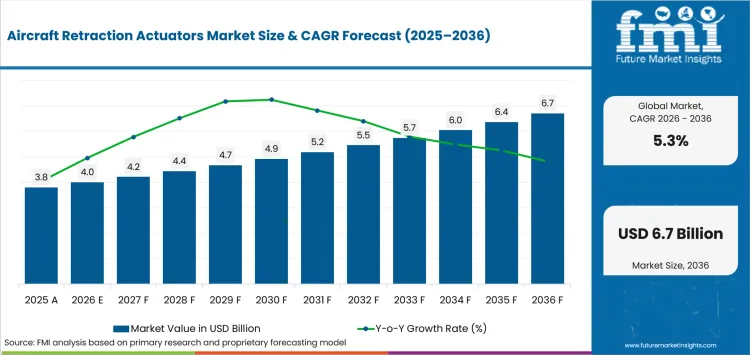
- Market Size (2026)
- USD 4.0 Bn
- Forecast (2036)
- USD 6.7 Bn
- CAGR (2026 to 2036)
- 5.3%
How big is Aircraft Retraction Actuators Market in 2026?
USD 4.0 billion in 2026 and USD 6.7 billion by 2036 at a 5.3% CAGR.
Demand for aircraft retraction actuators is projected to expand at 5.3% CAGR between 2026 and 2036, increasing valuation from USD 4.0 billion in 2026 to USD 6.7 billion by 2036. Aircraft production converts into actuator demand once landing-gear integrators freeze interfaces and release qualified shipsets. Airbus delivered 793 commercial aircraft in 2025 and closed the year with an 8,754-aircraft backlog in its January 12, 2026 release. The backlog gives qualified retraction hardware a long production runway and later feeds spares and overhaul demand.
North American actuator work can enter through production investment as well as fleet repair. Canada Economic Development for Quebec Regions listed 28 defense projects on February 18 2026, including productivity equipment for Heroux-Devtek landing-gear work. The investment increases qualified manufacturing capacity near export programs, although aircraft-specific approval and program access still control actuator awards.
Key Takeaways
- Aircraft production backlogs and in-service maintenance sustain original-equipment, repair, and replacement demand for qualified retraction hardware.
- Based on actuator type, hydraulic retraction actuators are projected to account for 35.0% in 2026 due to certified high-force interfaces and a large installed base.
- In 2026, commercial aircraft are expected to lead aircraft type with 43.0% share because serial production and high utilization support shipset and aftermarket revenue.
- The hydraulic actuation segment is likely to capture 52.0% share in 2026 attributable to certified high-load aircraft that already distribute hydraulic power.
- Long qualification cycles and failure-mode validation raise switching costs once a retraction system enters an approved aircraft baseline.
- Some of the key players in this market include Parker Aerospace, Collins Aerospace, Moog, Safran Landing Systems, Liebherr-Aerospace, Eaton Aerospace, Woodward, and Heroux-Devtek.
Analyst Perspective
"Retraction-actuator programs are won at the interfaces: stroke, lock timing, power supply, and emergency extension must all clear the aircraft baseline. A cheaper unit has little commercial value if it increases certification work or leaves the operator without approved repair capacity."
- Nikhil Kaitwade, Principal Consultant, Future Market Insights
How is the aircraft retraction actuators market segmented?
The market is assessed by actuator type, aircraft type, technology, sales channel, application, and region.
Actuator type covers hydraulic retraction, electro-hydraulic, and electromechanical actuators. Aircraft type includes commercial, military, business, regional, and rotary-wing aircraft. Technology covers hydraulic, electric, sensor-integrated, and integrated locking architectures. Sales channels include landing gear Tier-1s, aircraft OEMs, MRO providers, and defense programs. Applications cover extension and retraction, gear-door movement, emergency deployment, and position-locking support.
Why do hydraulic retraction actuators lead the actuator type category?
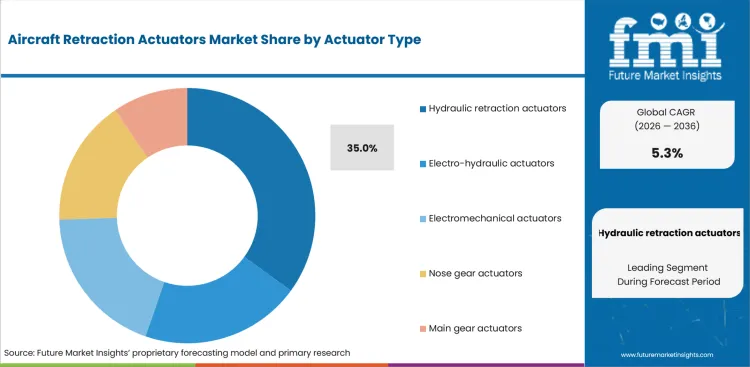
Hydraulic retraction actuators suit landing gear that needs high force from compact hardware and already has aircraft hydraulic power available. EASA's September 18, 2025 AD 2025-0202 required inspections of specified A330 and A340 nose-landing-gear retraction actuators. The action ties installed hydraulic units directly to controlled maintenance and repeat overhaul work.
- By actuator type, hydraulic retraction actuators are estimated to hold 35.0% in 2026 due to certified high-force interfaces and a large installed base.
- Operators overhaul these units under controlled maintenance instructions. Controlled maintenance supports repeat demand without implying hydraulic architecture will lead every new aircraft program.
Why do commercial aircraft lead the aircraft type category?
Commercial programs pair large serial runs with decades of fleet maintenance. Boeing's April 22, 2026 first-quarter results recorded 143 commercial deliveries and a backlog above 6,100 airplanes. The production horizon keeps qualified landing-gear components in demand after the original design award. Program commonality also raises the value of configuration control between delivery lots and repair cycles.
- In 2026, commercial aircraft are expected to lead aircraft type with 43.0% share because production volume and fleet utilization sustain original-equipment and replacement demand.
- Airlines also value predictable repair turnaround and rotable access. A landing-gear defect can remove an otherwise serviceable aircraft from revenue operation.
How does hydraulic actuation retain the technology lead?
Hydraulic actuation retains an advantage on aircraft that already route high-pressure power to landing gear, steering, and braking loads. Eaton expanded its Proponent agreement on October 15, 2025 to distribute more commercial fuel and actuation components, including spares from its Grand Rapids hydraulics facility. The agreement strengthens aftermarket access even as new programs consider electric alternatives.
- The hydraulic actuation segment is likely to capture 52.0% share in 2026 attributable to certified aircraft that already carry pumps, reservoirs, valves, and maintenance procedures.
- Electric and electro-hydraulic designs gain ground on aircraft that can trade centralized piping against motors, power electronics and revised emergency logic.
Why does landing gear extension and retraction lead the application category?
Landing-gear retraction sets the sequence for doors, locks, emergency deployment, and position feedback. EASA's July 7, 2026 revision of AD 2025-0158 required inspections of main landing-gear door actuators on A318, A319, A320, and A321 aircraft. The directive requires qualification to cover the connected gear sequence rather than actuator stroke alone.
- By application, landing gear extension and retraction is forecast to represent 48.0% in 2026 driven by mandatory gear movement and its linked door, lock and emergency functions.
- Integrators therefore assess more than stroke and force. Qualification also covers locks, timing, feedback, emergency behavior, and the effect of a component change on the approved system.
What are the drivers, restraints and opportunities in the Aircraft Retraction Actuators Market?
Aircraft production and fleet maintenance increase demand, qualification slows supplier changes, and more-electric architectures give new-platform programs a selective design route.
- Driver: Production backlogs and scheduled landing-gear maintenance sustain new, repaired, and replacement actuator demand.
- Restraint: Aircraft-specific qualification makes component substitution expensive once system interfaces and failure cases are approved.
- Opportunity: Electromechanical and local electro-hydraulic designs can win applications on aircraft whose power architectures are being redesigned.
Serial output is one source of actuator revenue because landing-gear overhaul cycles continue long after delivery. Liebherr's March 21 2025 SkyWest agreement covers 262 Embraer 175-E1 aircraft and reserves overhaul induction slots through 2032. The contract converts a defined installed fleet into scheduled landing-gear work, giving repair and replacement hardware a predictable route into maintenance planning.
Qualification slows substitution because a retraction change can affect aircraft loads plus hydraulic and emergency-control interfaces. EASA issued AD 2026-0125R1 on June 30 2026 after a DA42 nose-landing-gear hydraulic actuator rod-end issue required controlled inspection. For air transport MRO, the directive makes traceable parts and approved maintenance data prerequisites for switching, so price gains weight only after the new source clears those controls.
New aircraft give electric actuation its clearest entry route because power distribution and thermal control can be designed with the retraction mechanism. Woodward completed its acquisition of Safran's North American electromechanical actuation business on July 21 2025 and acquired intellectual property plus operating assets and long-term customer agreements. Retraction designs still need program-specific proof covering load capability and locking plus thermal behavior and emergency deployment.
Which country CAGRs are profiled in the Aircraft Retraction Actuators Market?
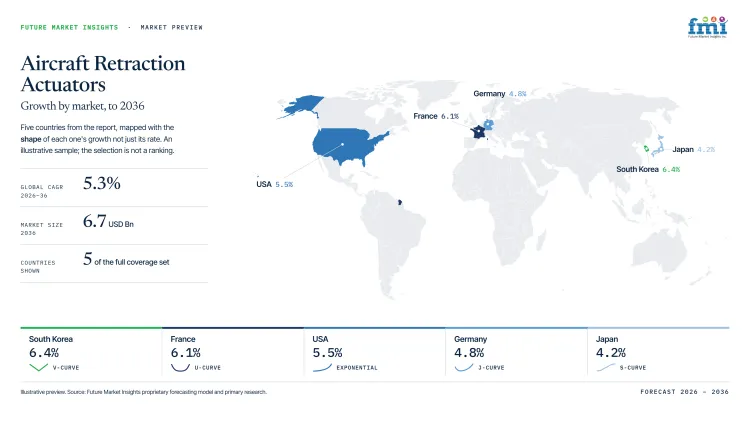
| Country | CAGR |
|---|---|
| South Korea | 6.4% |
| France | 6.1% |
| Canada | 5.8% |
| USA | 5.5% |
| Italy | 5.1% |
| Germany | 4.8% |
| Japan | 4.2% |
How do country-level CAGRs compare in the Aircraft Retraction Actuators Market?
South Korea leads the profiled group at 6.4% CAGR. France follows at 6.1%, while Canada and USA form a mid-high band at 5.8% and 5.5%. Italy sits at 5.1%. Germany and Japan form the lower-growth band at 4.8% and 4.2%. The spread between South Korea and Japan is 2.2 percentage points.
- South Korea concentrates entry inside KF-21 program qualification.
- France rewards proximity to landing-system engineering and overhaul centers.
- Canada favors cross-border qualification for export-oriented landing-gear programs.
- USA fleet scale makes repair turnaround and rotables decisive.
- Italy channels demand through civil and military platform relationships.
- Japanese airline procurement places strong weight on reliability management and long-term component availability.
- Germany german buyers favor program-specific components that enter the aircraft baseline through structured qualification.
Comparable CAGRs still produce different revenue mixes because program access, fleet age, and local service depth guide order conversion. The full report provides country-level CAGR analysis across North America, Latin America, Europe, East Asia, South Asia, Oceania and the Middle East and Africa.
Country-wise Analysis
- South Korea ties retraction-actuator access to KF-21 production and domestic sustainment, making program relationships more valuable than broad catalog availability for new component companies. DAPA's April 9 2026 program page documents the first production KF-21 rollout and aircraft retraction actuator demand in South Korea is forecast to rise at 6.4% CAGR over the forecast period, tied to serial output and fleet support. Korean manufacturing depth can shorten engineering response and spares planning for approved partners, while defense qualification and technology-transfer controls keep other entrants dependent on local companies able to maintain technical records and support over the aircraft program life.
- France concentrates landing-system engineering near Airbus production and specialist overhaul operations, giving qualified component companies early access to interface decisions during design freeze and repair planning cycles in practice. Airbus opened its second modernized A320 Family final assembly line in Toulouse on June 15 2026 and linked the site directly to its production ramp for narrowbody output. France's aircraft retraction actuators sector is projected to record 6.1% CAGR during the assessment period, given that industrial base, but any source change must still clear locks and doors plus sensors and emergency logic before the aircraft certification baseline accepts serial production.
- Canada pairs specialized landing-gear manufacturing with North American fleet activity, so export programs and domestic utilization both influence retraction-actuator orders and repair demand through MRO cycles. Canada is estimated to post 5.8% CAGR over the forecast period, attributable to nearby machining and overhaul capacity while Statistics Canada's February 26 2026 release counted 5.8 million aircraft movements in 2025 and a 3.1% annual increase. External OEM schedules can still disrupt plant loading and specialized labor is finite, which gives an advantage to companies that can carry cross-border qualification records while keeping repair capacity close to the fleets they serve.
- USA retraction-actuator demand spans large civil and defense fleets, with approved repair capacity and aircraft-on-ground response carrying as much commercial weight as original-equipment access. Eaton announced a USD 18.5 million Orchard Park expansion on May 9 2025 that adds 50,000 square feet and 77 jobs while increasing aerospace actuation capacity. In the USA, aircraft retraction actuator demand is predicted to advance at 5.5% CAGR through 2036, helped by domestic production and repair depth, but a challenger still needs traceable parts plus dependable rotables and repair turnaround that justify moving work away from an incumbent source over time.
- Italy routes retraction-actuator work through civil fleets plus military and trainer programs, making defined platform relationships more useful than broad distribution for new entrants. Aircraft retraction actuator sales in Italy are forecast to expand at 5.1% CAGR by 2036 because active fleets keep landing-gear maintenance in regular schedules and utilization while ENAC's January 2026 data counted 229.7 million passengers at 44 commercial airports during 2025, up 5.0% from 2024. Program concentration and national-security controls narrow open entry routes, so companies need approved technical data and repair support that can maintain continuity across both civil and defense operating requirements.
- German buyers favor program-specific components that enter the aircraft baseline through structured qualification. Demand for aircraft retraction actuators in Germany is forecast to rise at a 4.8% CAGR from 2026 to 2036. Crane Aerospace & Electronics stated on August 19, 2024 that Deutsche Aircraft selected its proximity sensing system for the D328eco regional aircraft. The award shows how position feedback becomes embedded in a new landing-system architecture. The main constraint is the limited volume of individual regional programs and their long certification path. Suppliers need to reuse proven interfaces where possible and support traceability through entry into service.
- Japanese airline procurement places strong weight on reliability management and long-term component availability. Demand for Aircraft Retraction Actuators in Japan is forecast to expand at a 4.2% CAGR from 2026 to 2036. Moog reported in 2021 that Japan Airlines signed a long-term support agreement for Boeing 787 landing gear actuation components. The agreement covered maintenance and reliability management plus inventory access. This model favors contracted support over transactional replacement buying. The main constraint is conservative approval of design or supplier changes on in-service fleets. Vendors should offer local or regional spares and predictable flight-hour support economics.
Who are the notable companies in the Aircraft Retraction Actuators Market?
Parker Aerospace, Collins Aerospace, Moog, Safran Landing Systems, Liebherr-Aerospace, Eaton Aerospace, Woodward, and Heroux-Devtek are notable companies serving this market.
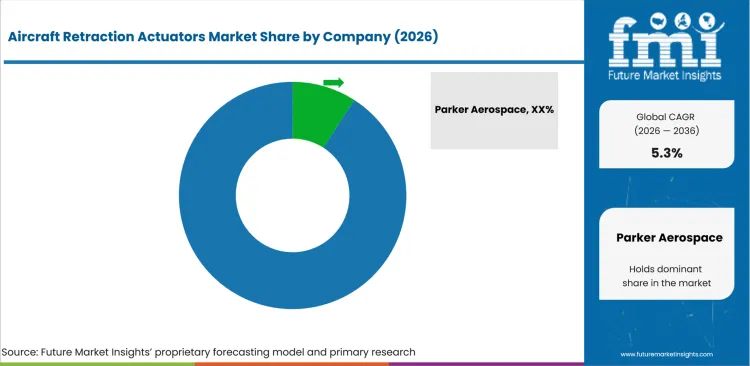
Competition centers on aircraft-baseline access, retraction-system integration, actuation breadth, and installed-fleet support. Integrated landing-gear companies control more interfaces, whereas focused motion-control companies compete where their hardware fits the system authority. Adjacent landing-system work also includes aircraft brake systems, sensing, and overhaul support.
- Integrated landing-gear platforms: Collins Aerospace, Safran Landing Systems, Liebherr-Aerospace, and Heroux-Devtek.
- Actuation and motion-control specialists: Parker Aerospace, Moog, Eaton Aerospace, and Woodward.
Competitive Benchmarking: Aircraft Retraction Actuators Market
| Company | Retraction-System Integration | Hydraulic-Electric Breadth | Lifecycle Support | Geographic Reach |
|---|---|---|---|---|
| Parker Aerospace | Medium | High | High | North America, Europe, and Asia-Pacific |
| Collins Aerospace | High | Medium | High | North America, Europe, Asia-Pacific, and Middle East |
| Moog | Medium | High | High | North America, Europe, and Asia-Pacific |
| Safran Landing Systems | High | High | High | Europe, North America, and Asia-Pacific |
| Liebherr-Aerospace | High | High | High | Europe, North America, and Asia-Pacific |
| Eaton Aerospace | Medium | High | Medium | North America, Europe, and Asia-Pacific |
| Woodward | Medium | High | Medium | North America, Europe, and Asia-Pacific |
| Heroux-Devtek | High | High | High | North America and Europe |
Scoring basis: High retraction-system integration requires documented responsibility for a complete gear system or several aircraft interfaces. Medium identifies actuator or subsystem integration, and Low indicates a documented component-only role. High hydraulic-electric breadth requires public evidence that a company works in both architecture classes. Medium means one primary class plus adjacent capability, whereas Low identifies one narrow class. High lifecycle support requires broad repair, spares, and long-term service coverage for active aircraft programs. Lifecycle support scores Medium for narrower documented service and Low for a limited repair route. Geographic reach is descriptive and records the regions supported by current company evidence.
Key Developments in the Aircraft Retraction Actuators Market
- In June 2026, Collins Aerospace opened its expanded Tajęcina, Poland facility, raising landing-gear production capacity by nearly 25% for commercial and defense programs.
- In May 2026, Liebherr-Aerospace signed a service agreement with Finnair for Airbus A350 nose-landing-gear overhauls, with the maintenance campaign scheduled through 2034.
- In June 2025, Safran Landing Systems renewed its long-term spare-parts and technical-support agreement with Revima for landing-gear overhaul facilities in France and Thailand.
Key Players in the Aircraft Retraction Actuators Market
Integrated Landing Gear and Lifecycle Platforms
- Collins Aerospace
- Safran Landing Systems
- Liebherr-Aerospace
- Heroux-Devtek
Actuation and Motion-Control Specialists
- Parker Aerospace
- Moog
- Eaton Aerospace
- Woodward
Aircraft Retraction Actuators Market - Report Scope
| Coverage field | Report scope |
|---|---|
| Market breakdown | By actuator type, aircraft type, technology, sales channel, application, and region. |
| Quantitative Units | USD billion. |
| Market Definition | Aircraft landing-gear retraction actuators and directly related actuation content used to extend, retract, lock, or support controlled landing-gear movement. |
| Regions Covered | North America, Latin America, Western Europe, Eastern Europe, East Asia, South Asia and Pacific, and Middle East and Africa. |
| Countries Covered | South Korea, France, Canada, USA, Italy, and 20+ countries included in the full report. |
| Key Companies Profiled | Parker Aerospace, Collins Aerospace, Moog, Safran Landing Systems, Liebherr-Aerospace, Eaton Aerospace, Woodward, and Heroux-Devtek. |
| Forecast Period | 2026 to 2036. |
| Approach | Primary and secondary research with market triangulation. |
Aircraft Retraction Actuators Market - Research Methodology
| Method | Approach |
|---|---|
| Primary Research | FMI analysts gathered input from manufacturers, service providers, technology developers, distributors, end users, procurement teams, and subject-matter experts. Interviews examined purchasing decisions, product or service evaluation, adoption barriers, approval requirements, pricing considerations, and expectations for technical or commercial support. Respondents were also asked what evidence is required before a trial, pilot, or initial order develops into regular purchasing. |
| Desk Research | Desk research covered government statistics, regulatory publications, trade data, industry associations, technical literature, standards, company filings, product information, and official corporate announcements. Sources were reviewed for relevance, publication date, geographic coverage, and consistency with the defined market scope. Claims relating to performance, applications, approvals, capacity, investment, and commercial activity were retained only when supported by credible public evidence. |
| Market Sizing and Forecasting | The market model combined the baseline value with historical performance, segment structure, pricing and volume indicators, adoption levels, company participation, and country-level demand conditions. Forecast assumptions considered economic activity, investment trends, regulatory developments, technology adoption, purchasing cycles, supply availability, and barriers to wider market use. Segment and regional estimates were reconciled before the final market total was calculated. |
| Data Validation | Estimates were checked against multiple independent indicators, including public data, company activity, trade patterns, industry developments, and findings from primary interviews. Validation also tested whether products, services, applications, and company revenues fell within the defined market boundaries. Adjacent categories, unsupported claims, overlapping revenues, and activities without direct market relevance were excluded to reduce double counting and maintain consistency across segments and countries. |
Aircraft Retraction Actuators Market by Segments
Aircraft Retraction Actuators Market segmented by Actuator Type:
- Hydraulic Retraction Actuators
- Electro-Hydraulic Actuators
- Electromechanical Actuators
Aircraft Retraction Actuators Market segmented by Aircraft Type:
- Commercial Aircraft
- Military Aircraft
- Business Jets
- Regional Aircraft
- Rotary-Wing Aircraft
Aircraft Retraction Actuators Market segmented by Technology:
- Hydraulic Actuation
- Electric Actuation
- Smart / Sensor-Integrated Actuation
- Integrated Locking Architectures
Aircraft Retraction Actuators Market segmented by Sales Channel:
- Landing Gear Tier-1s
- Aircraft OEMs
- MRO Providers
- Defense Programs
Aircraft Retraction Actuators Market segmented by Application:
- Landing Gear Extension / Retraction
- Gear-Door Actuation
- Emergency Deployment
- Position-Locking Support
Aircraft Retraction Actuators Market by Region:
- North America
- United States
- Canada
- Latin America
- Brazil
- Mexico
- Chile
- Rest of Latin America
- Western Europe
- Germany
- United Kingdom
- Italy
- Spain
- France
- Nordics
- Benelux
- Rest of Western Europe
- Eastern Europe
- Russia
- Poland
- Hungary
- Balkan and Baltic States
- Rest of Eastern Europe
- East Asia
- China
- Japan
- South Korea
- South Asia and Pacific
- India
- ASEAN
- Australia and New Zealand
- Rest of South Asia and Pacific
- Middle East and Africa
- Kingdom of Saudi Arabia
- Other GCC Countries
- Türkiye
- South Africa
- Other African Union Countries
- Rest of Middle East and Africa
Research Sources and Bibliography
- Airbus. (2026, January 12). Airbus reports 793 commercial aircraft deliveries in 2025.
- Canada Economic Development for Quebec Regions. (2026, February 18). Government of Canada supports Quebec’s defence sector: Backgrounder.
- European Union Aviation Safety Agency. (2025, September 18). AD 2025-0202: Landing gear - Nose landing gear retraction actuator - Inspection.
- The Boeing Company. (2026, April 22). Boeing reports first quarter results.
- Eaton. (2025, October 15). Eaton expands product offerings and extends distribution agreement with Proponent.
- European Union Aviation Safety Agency. (2026, July 7). AD 2025-0158R2: Landing gear - Main landing gear door actuators - Inspections.
- Liebherr. (2025, March 21). Liebherr signs landing gear overhaul agreement with SkyWest Airlines.
- European Union Aviation Safety Agency. (2026, June 30). AD 2026-0125R1: Landing gear - Nose landing gear hydraulic actuator rod end - Inspection.
- Woodward. (2025, July 21). Woodward completes acquisition of Safran’s North American electromechanical actuation business.
- Defense Acquisition Program Administration. (2026, April 9). [방사청-26-011] KF-21 양산 1호기 출고.
- Airbus. (2026, June 15). Airbus inaugurates new A320 Family final assembly line in Toulouse.
- Statistics Canada. (2026, February 26). Aircraft movement and civil aviation statistics, December 2025.
- Eaton. (2025, May 9). Eaton announces $18.5M expansion of Orchard Park, New York aerospace manufacturing facility.
- Ente Nazionale per l’Aviazione Civile. (2026, January). Air Traffic Data 2025 - Executive Summary.
- RTX. (2026, June 2). Collins Aerospace opens expanded manufacturing facility in Tajęcina, Poland.
- Liebherr. (2026, May 22). Liebherr and Finnair sign Airbus A350 nose landing gear overhaul agreement.
- Safran. (2025, June 18). Safran and Revima strengthen their landing gear collaboration.
- Moog Inc. (2025, June 17). Moog Inc. names S3 AeroDefense as worldwide distributor for military global sustainment.
- RTX. (2025, November 18). Collins Aerospace and Emirates expand main landing gear maintenance services agreement for A380 aircraft.
- Safran. (2026, February 13). Safran establishes a new landing gear facility in Morocco.
- Liebherr. (2026, April 15). Jeh Aerospace signs Long-Term Agreement with Liebherr-Aerospace for precision landing gear components.
- Eaton. (2025, April 8). Eaton names VSE Aviation as first authorized aerospace service center in Americas.
- Parker-Hannifin Corporation. (2026, August 21). Annual report on Form 10-K.
- RTX. (2026, January 21). Collins Aerospace signs three-year parts distribution agreements for C-130 wheels and brakes.
- Moog Inc.. (2026, July 21). Moog Inc. extends Taiwan distribution agreement with AIDC.
- Safran. (2025, June 4). Safran inaugurates new industrial facilities for landing and braking systems in Molsheim, France.
- Liebherr. (2026, April 16). Liebherr signs landing gear overhaul agreement with Envoy Air.
- Eaton Corporation plc. (2026, February 26). Form 10-K.
- Woodward. (2025, June 16). Woodward Selected by Airbus as Supplier for the Hydraulic A350 Spoiler Actuation System.
- Héroux-Devtek Inc. (2025, February 11). HÉROUX-DEVTEK ANNOUNCES COMPLETION OF ACQUISITION BY PLATINUM EQUITY.
This bibliography is provided for reader reference and is not exhaustive. The full report contains the complete reference list and detailed citations.
This Report Answers
- What is the aircraft retraction actuators market size in 2026 and 2036?
- Which aircraft production and fleet-support conditions sustain demand for retraction actuators?
- Why do hydraulic retraction actuators hold the leading actuator type position?
- How do commercial aircraft production and utilization affect original-equipment and aftermarket demand?
- Why does hydraulic actuation retain the leading technology share?
- How do country CAGRs differ across South Korea, France, Canada, USA, and Italy?
- Which companies provide landing-gear integration, actuation, and lifecycle support?
- How do qualification requirements limit supplier switching?
- Where can electromechanical and electro-hydraulic designs gain new aircraft applications?
Frequently Asked Questions
How big is the aircraft retraction actuators market in 2026?
The aircraft retraction actuators market is valued at USD 4.0 billion in 2026 and is projected to reach USD 6.7 billion by 2036. Aircraft production and scheduled landing-gear maintenance sustain the forecast.
What is the CAGR of the aircraft retraction actuators market from 2026 to 2036?
The aircraft retraction actuators market is projected to grow at a CAGR of 5.3% between 2026 and 2036. Qualified shipset demand and repair or replacement work on installed fleets support expansion.
Which actuator type leads the aircraft retraction actuators market?
The hydraulic retraction actuators segment is expected to hold 35.0% of the aircraft retraction actuators market in 2026, driven by high-force performance and certified hydraulic interfaces. The installed base also sustains overhaul demand.
Which aircraft type holds the largest share in the aircraft retraction actuators market?
The commercial aircraft segment is expected to hold 43.0% of aircraft type in 2026, attributable to serial production and intensive fleet utilization. Long service lives then sustain overhaul and replacement work.
Which companies are active in the aircraft retraction actuators market?
Key companies operating in the market include Parker Aerospace, Collins Aerospace, Moog, Safran Landing Systems, Liebherr-Aerospace, Eaton Aerospace, Woodward, and Heroux-Devtek. These companies compete through system access, actuation depth, repair coverage, and qualified program support.
Preview the report firsthand - request a free sample
Get SampleGet the brochure for pricing and purchase details.
Get PDFTable of Content
- Key Takeaways
- Market Size and CAGR
- Top Growth Driver
- Fastest Growing Segment
- Leading Region
- Key Companies
- Emerging Opportunities
- Executive Summary
- Global Market Outlook
- Demand-side Trends
- Supply-side Trends
- Technology Roadmap Analysis
- Analysis and Recommendations
- Analyst Perspective (What is happening? Why now? What should investors know?)
- Key Questions Answered
- How large is the market?
- What is the CAGR?
- What are key trends?
- Which region dominates?
- Who are the leaders?
- Market Overview
- Market Coverage / Taxonomy
- Market Definition / Scope / Limitations
- Research Methodology
- Chapter Orientation
- Analytical Lens and Working Hypotheses
- Market Structure, Signals, and Trend Drivers
- Benchmarking and Cross-market Comparability
- Market Sizing, Forecasting, and Opportunity Mapping
- Research Design and Evidence Framework
- Desk Research Programme (Secondary Evidence)
- Expert Input and Fieldwork (Primary Evidence)
- Tooling, Models, and Reference Databases
- Data Engineering and Model Build
- Quality Assurance and Audit Trail
- Market Background
- Market Dynamics (Drivers, Restraints, Opportunity, Trends)
- Scenario Forecast (Optimistic, Likely, Conservative)
- Impact Analysis
- AI Impact
- Sustainability Impact
- Regulatory Impact
- Technology Impact
- Consumer / Buyer Analysis
- Purchase Drivers
- Adoption Barriers
- Buyer Journey
- Opportunity Map Analysis
- Product Life Cycle Analysis
- Supply Chain Analysis
- Investment Feasibility Matrix
- Value Chain Analysis
- PESTLE and Porter's Analysis
- Regulatory Landscape
- Regional Parent Market Outlook
- Production and Consumption Statistics
- Import and Export Statistics
- Global Market Analysis and Forecast, 2021 to 2036
- Historical Market Size Value (USD Billion) Analysis, 2021 to 2025
- Current and Future Market Size Value (USD Billion) Projections, 2026 to 2036
- Y-o-Y Growth Trend Analysis
- Absolute $ Opportunity Analysis
- Global Market Pricing Analysis, 2021 to 2036
- Global Market Analysis and Forecast, By Actuator Type, 2021 to 2036
- Introduction / Key Findings
- Historical Market Size Value (USD Billion) Analysis By Actuator Type, 2021 to 2025
- Current and Future Market Size Value (USD Billion) Analysis and Forecast By Actuator Type, 2026 to 2036
- Hydraulic retraction actuators
- Electro-hydraulic actuators
- Electromechanical actuators
- Nose gear actuators
- Main gear actuators
- Hydraulic retraction actuators
- Y-o-Y Growth Trend Analysis By Actuator Type, 2021 to 2025
- Absolute $ Opportunity Analysis By Actuator Type, 2026 to 2036
- Global Market Analysis and Forecast, By Aircraft Type, 2021 to 2036
- Introduction / Key Findings
- Historical Market Size Value (USD Billion) Analysis By Aircraft Type, 2021 to 2025
- Current and Future Market Size Value (USD Billion) Analysis and Forecast By Aircraft Type, 2026 to 2036
- Commercial aircraft
- Business jets
- Military aircraft
- Helicopters
- Regional aircraft
- Commercial aircraft
- Y-o-Y Growth Trend Analysis By Aircraft Type, 2021 to 2025
- Absolute $ Opportunity Analysis By Aircraft Type, 2026 to 2036
- Global Market Analysis and Forecast, By Technology, 2021 to 2036
- Introduction / Key Findings
- Historical Market Size Value (USD Billion) Analysis By Technology, 2021 to 2025
- Current and Future Market Size Value (USD Billion) Analysis and Forecast By Technology, 2026 to 2036
- Hydraulic actuation
- Electric actuation
- Smart position-sensing
- Integrated lock actuator
- Hydraulic actuation
- Y-o-Y Growth Trend Analysis By Technology, 2021 to 2025
- Absolute $ Opportunity Analysis By Technology, 2026 to 2036
- Global Market Analysis and Forecast, By Sales Channel, 2021 to 2036
- Introduction / Key Findings
- Historical Market Size Value (USD Billion) Analysis By Sales Channel, 2021 to 2025
- Current and Future Market Size Value (USD Billion) Analysis and Forecast By Sales Channel, 2026 to 2036
- Landing gear Tier-1s
- Aircraft OEMs
- MRO/spares
- Defense programs
- Landing gear Tier-1s
- Y-o-Y Growth Trend Analysis By Sales Channel, 2021 to 2025
- Absolute $ Opportunity Analysis By Sales Channel, 2026 to 2036
- Global Market Analysis and Forecast, By Application, 2021 to 2036
- Introduction / Key Findings
- Historical Market Size Value (USD Billion) Analysis By Application, 2021 to 2025
- Current and Future Market Size Value (USD Billion) Analysis and Forecast By Application, 2026 to 2036
- Landing gear extension/retraction
- Gear door actuation
- Emergency deployment
- Position locking support
- Landing gear extension/retraction
- Y-o-Y Growth Trend Analysis By Application, 2021 to 2025
- Absolute $ Opportunity Analysis By Application, 2026 to 2036
- Global Market Analysis and Forecast, By Region, 2021 to 2036
- Introduction
- Historical Market Size Value (USD Billion) Analysis By Region, 2021 to 2025
- Current Market Size Value (USD Billion) Analysis and Forecast By Region, 2026 to 2036
- North America
- Latin America
- Western Europe
- Eastern Europe
- East Asia
- South Asia and Pacific
- Middle East & Africa
- Market Attractiveness Analysis By Region
- North America Market Analysis and Forecast, By Country, 2021 to 2036
- Historical Market Size Value (USD Billion) Trend Analysis By Market Taxonomy, 2021 to 2025
- Market Size Value (USD Billion) Forecast By Market Taxonomy, 2026 to 2036
- By Country
- USA
- Canada
- By Actuator Type
- By Aircraft Type
- By Technology
- By Sales Channel
- By Application
- By Country
- Market Attractiveness Analysis
- By Country
- By Actuator Type
- By Aircraft Type
- By Technology
- By Sales Channel
- By Application
- Key Takeaways
- Latin America Market Analysis and Forecast, By Country
- Historical Market Size Value (USD Billion) Trend Analysis By Market Taxonomy, 2021 to 2025
- Market Size Value (USD Billion) Forecast By Market Taxonomy, 2026 to 2036
- By Country
- Brazil
- Mexico
- Chile
- Rest of Latin America
- By Actuator Type
- By Aircraft Type
- By Technology
- By Sales Channel
- By Application
- By Country
- Market Attractiveness Analysis
- By Country
- By Actuator Type
- By Aircraft Type
- By Technology
- By Sales Channel
- By Application
- Key Takeaways
- Western Europe Market Analysis and Forecast, By Country
- Historical Market Size Value (USD Billion) Trend Analysis By Market Taxonomy, 2021 to 2025
- Market Size Value (USD Billion) Forecast By Market Taxonomy, 2026 to 2036
- By Country
- Germany
- UK
- Italy
- Spain
- France
- Nordic
- BENELUX
- Rest of Western Europe
- By Actuator Type
- By Aircraft Type
- By Technology
- By Sales Channel
- By Application
- By Country
- Market Attractiveness Analysis
- By Country
- By Actuator Type
- By Aircraft Type
- By Technology
- By Sales Channel
- By Application
- Key Takeaways
- Eastern Europe Market Analysis and Forecast, By Country
- Historical Market Size Value (USD Billion) Trend Analysis By Market Taxonomy, 2021 to 2025
- Market Size Value (USD Billion) Forecast By Market Taxonomy, 2026 to 2036
- By Country
- Russia
- Poland
- Hungary
- Balkan & Baltic
- Rest of Eastern Europe
- By Actuator Type
- By Aircraft Type
- By Technology
- By Sales Channel
- By Application
- By Country
- Market Attractiveness Analysis
- By Country
- By Actuator Type
- By Aircraft Type
- By Technology
- By Sales Channel
- By Application
- Key Takeaways
- East Asia Market Analysis and Forecast, By Country
- Historical Market Size Value (USD Billion) Trend Analysis By Market Taxonomy, 2021 to 2025
- Market Size Value (USD Billion) Forecast By Market Taxonomy, 2026 to 2036
- By Country
- China
- Japan
- South Korea
- By Actuator Type
- By Aircraft Type
- By Technology
- By Sales Channel
- By Application
- By Country
- Market Attractiveness Analysis
- By Country
- By Actuator Type
- By Aircraft Type
- By Technology
- By Sales Channel
- By Application
- Key Takeaways
- South Asia and Pacific Market Analysis and Forecast, By Country
- Historical Market Size Value (USD Billion) Trend Analysis By Market Taxonomy, 2021 to 2025
- Market Size Value (USD Billion) Forecast By Market Taxonomy, 2026 to 2036
- By Country
- India
- ASEAN
- Australia & New Zealand
- Rest of South Asia and Pacific
- By Actuator Type
- By Aircraft Type
- By Technology
- By Sales Channel
- By Application
- By Country
- Market Attractiveness Analysis
- By Country
- By Actuator Type
- By Aircraft Type
- By Technology
- By Sales Channel
- By Application
- Key Takeaways
- Middle East & Africa Market Analysis and Forecast, By Country
- Historical Market Size Value (USD Billion) Trend Analysis By Market Taxonomy, 2021 to 2025
- Market Size Value (USD Billion) Forecast By Market Taxonomy, 2026 to 2036
- By Country
- Kingdom of Saudi Arabia
- Other GCC Countries
- Türkiye
- South Africa
- Other African Union
- Rest of Middle East & Africa
- By Actuator Type
- By Aircraft Type
- By Technology
- By Sales Channel
- By Application
- By Country
- Market Attractiveness Analysis
- By Country
- By Actuator Type
- By Aircraft Type
- By Technology
- By Sales Channel
- By Application
- Key Takeaways
- Key Countries Market Analysis
- USA
- Pricing Analysis
- Market Share Analysis, 2025
- By Actuator Type
- By Aircraft Type
- By Technology
- By Sales Channel
- By Application
- Canada
- Pricing Analysis
- Market Share Analysis, 2025
- By Actuator Type
- By Aircraft Type
- By Technology
- By Sales Channel
- By Application
- Mexico
- Pricing Analysis
- Market Share Analysis, 2025
- By Actuator Type
- By Aircraft Type
- By Technology
- By Sales Channel
- By Application
- Brazil
- Pricing Analysis
- Market Share Analysis, 2025
- By Actuator Type
- By Aircraft Type
- By Technology
- By Sales Channel
- By Application
- Chile
- Pricing Analysis
- Market Share Analysis, 2025
- By Actuator Type
- By Aircraft Type
- By Technology
- By Sales Channel
- By Application
- Germany
- Pricing Analysis
- Market Share Analysis, 2025
- By Actuator Type
- By Aircraft Type
- By Technology
- By Sales Channel
- By Application
- UK
- Pricing Analysis
- Market Share Analysis, 2025
- By Actuator Type
- By Aircraft Type
- By Technology
- By Sales Channel
- By Application
- Italy
- Pricing Analysis
- Market Share Analysis, 2025
- By Actuator Type
- By Aircraft Type
- By Technology
- By Sales Channel
- By Application
- Spain
- Pricing Analysis
- Market Share Analysis, 2025
- By Actuator Type
- By Aircraft Type
- By Technology
- By Sales Channel
- By Application
- France
- Pricing Analysis
- Market Share Analysis, 2025
- By Actuator Type
- By Aircraft Type
- By Technology
- By Sales Channel
- By Application
- India
- Pricing Analysis
- Market Share Analysis, 2025
- By Actuator Type
- By Aircraft Type
- By Technology
- By Sales Channel
- By Application
- ASEAN
- Pricing Analysis
- Market Share Analysis, 2025
- By Actuator Type
- By Aircraft Type
- By Technology
- By Sales Channel
- By Application
- Australia & New Zealand
- Pricing Analysis
- Market Share Analysis, 2025
- By Actuator Type
- By Aircraft Type
- By Technology
- By Sales Channel
- By Application
- China
- Pricing Analysis
- Market Share Analysis, 2025
- By Actuator Type
- By Aircraft Type
- By Technology
- By Sales Channel
- By Application
- Japan
- Pricing Analysis
- Market Share Analysis, 2025
- By Actuator Type
- By Aircraft Type
- By Technology
- By Sales Channel
- By Application
- South Korea
- Pricing Analysis
- Market Share Analysis, 2025
- By Actuator Type
- By Aircraft Type
- By Technology
- By Sales Channel
- By Application
- Russia
- Pricing Analysis
- Market Share Analysis, 2025
- By Actuator Type
- By Aircraft Type
- By Technology
- By Sales Channel
- By Application
- Poland
- Pricing Analysis
- Market Share Analysis, 2025
- By Actuator Type
- By Aircraft Type
- By Technology
- By Sales Channel
- By Application
- Hungary
- Pricing Analysis
- Market Share Analysis, 2025
- By Actuator Type
- By Aircraft Type
- By Technology
- By Sales Channel
- By Application
- Kingdom of Saudi Arabia
- Pricing Analysis
- Market Share Analysis, 2025
- By Actuator Type
- By Aircraft Type
- By Technology
- By Sales Channel
- By Application
- Türkiye
- Pricing Analysis
- Market Share Analysis, 2025
- By Actuator Type
- By Aircraft Type
- By Technology
- By Sales Channel
- By Application
- South Africa
- Pricing Analysis
- Market Share Analysis, 2025
- By Actuator Type
- By Aircraft Type
- By Technology
- By Sales Channel
- By Application
- USA
- Market Structure Analysis
- Competition Dashboard
- Competition Benchmarking
- Market Share Analysis of Top Players
- By Regional
- By Actuator Type
- By Aircraft Type
- By Technology
- By Sales Channel
- By Application
- Emerging Startups
- Innovation Benchmarking
- Competition Analysis
- Competition Deep Dive
- Parker Aerospace
- Overview
- Product Portfolio
- Profitability by Market Segments
- Sales Footprint
- Strategy Overview
- Marketing Strategy
- Product Strategy
- Channel Strategy
- Collins Aerospace
- Moog
- Safran Landing Systems
- Liebherr-Aerospace
- Eaton Aerospace
- Crane Aerospace & Electronics
- Woodward
- Triumph Group
- Heroux-Devtek
- Parker Aerospace
- Case Studies
- Success Stories
- Recent Developments
- Competition Deep Dive
- Assumptions & Acronyms Used


