

- Market Size (2026)
- USD 4.9 Bn
- Forecast (2036)
- USD 9.1 Bn
- CAGR (2026 to 2036)
- 6.5%
How big is Aircraft Power Cables Market in 2026?
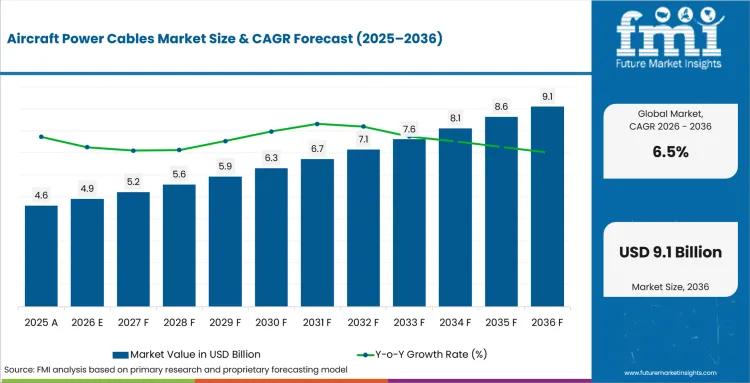
USD 4.9 billion in 2026 and USD 9.1 billion by 2036 at a 6.5% CAGR.
Demand for aircraft power cables is projected to expand at 6.5% CAGR between 2026 and 2036, increasing valuation from USD 4.9 billion in 2026 to USD 9.1 billion by 2036. Airframe programs require qualified cable families as aircraft electrification raises onboard loads across protected distribution networks.
Recurring cable orders depend on scheduled aircraft production and approved configuration control across each delivery program. That operating base remained active as GAMA reported 3,230 airplane shipments during 2025 in February 2026. Aircraft generators and cable assemblies must arrive with traceable conductor and termination records so production teams avoid undocumented substitutions.
Key Takeaways of Aircraft Power Cables Market
- Rising onboard power loads increase demand for lighter cables that preserve thermal margins across certified aircraft electrical architectures.
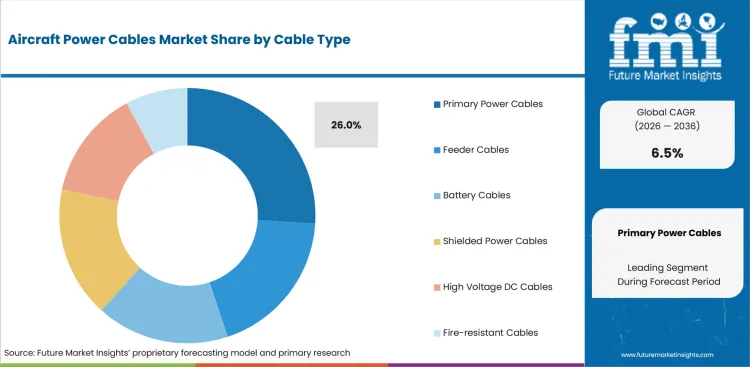
- Primary power cables are projected to represent 26.0% share in 2026 owing to direct generator-to-distribution requirements.
- Copper is estimated to account for 38.0% share in 2026 due to established termination methods and dependable conductivity.
- Low voltage is forecast to capture 48.0% share in 2026 driven by extensive conventional aircraft circuits.
- Lengthy platform qualification restrains adoption as cable changes require coordinated evidence across terminals and maintenance instructions.
- Prysmian Group, Lynxeo, TE Connectivity, Amphenol, Glenair, W. L. Gore & Associates, Safran Electrical & Power and Harbour Industries serve aircraft power programs.
Analyst Perspective
"Aircraft programs should compare power cables through the complete conductor, termination and approval package rather than unit price alone. A lighter design earns commercial value by preserving routing access and avoiding changes to certified maintenance instructions."
- Nikhil Kaitwade, Principal Consultant, Future Market Insights
How is the Aircraft Power Cables Market segmented?
The aircraft power cables industry is segmented by cable type, conductor, voltage class, aircraft type, application, sales channel and region.
Aircraft power cables are segmented by cable type, conductor, voltage class, aircraft type, application, sales channel and region. Cable type includes primary, feeder, battery, shielded, high-voltage direct-current and fire-resistant cables, while conductor covers copper, plated copper and aluminum alloy. Voltage class spans low, medium and high systems, aircraft type covers five platform groups, applications cover distribution and onboard loads, and sales channels include aircraft OEMs, harness integrators, MRO providers and defense programs.
Why do primary power cables hold the largest share within the cable type category?
Primary power cables carry generated electricity into protected distribution networks serving flight systems and high-load equipment. Their routing affects conductor size and termination design across the aircraft wire and cable market.
- By cable type, primary power cables are forecast to represent 26.0% in 2026 driven by direct generator-to-bus distribution requirements.
- Harness engineers use flexible feeder designs to preserve routing access inside crowded airframes during installation work. NASA’s High-Power Advanced Cable Technology rig, published in 2025, tests advanced aircraft wiring at up to 1,500 amps and in simulated high-altitude conditions, showing why feeder-cable selection now depends on thermal performance and altitude-related insulation behavior rather than product claims alone.
Why does copper retain the largest share within the conductor category?
Copper remains familiar to production teams that control crimp geometry and contact resistance across approved aviation connector assemblies. Glenair offers plated copper conductors for aircraft power cables that operate across different temperature ranges during service.
- Copper is set to lead the conductor category with 38.0% share in 2026 due to established terminal interfaces and repair methods.
- Maintenance organizations already use approved tools for copper terminations across large installed aircraft fleets worldwide. Matching conductor plating with temperature exposure preserves contact resistance and reduces repeat inspection work during scheduled cable replacement.
How does low voltage support demand within the voltage class category?
Low-voltage circuits remain widespread across lighting and cabin equipment using established aircraft protection practices today. Engineers also check battery interfaces against aircraft battery market requirements during proposed conductor dimension changes.
- By voltage class, low voltage is estimated to hold 48.0% in 2026 owing to extensive conventional loads across civil and military aircraft.
- Program teams retain established architectures until added power density justifies qualification work across the complete electrical system. NASA’s 2025 technical reporting notes that electrified flight increases demand toward megawatt-level power transfer and that high voltage at or above 300 V is used to reduce conductor weight, but partial-discharge vulnerability becomes a limiting design issue at altitude.
What supports narrowbody demand within the aircraft type category?
Narrowbody programs repeat common wiring configurations across high-volume aircraft families and generate recurring demand for qualified cable assemblies. Airbus reported 607 A320 family aircraft deliveries worldwide during 2025 in its January 2026 announcement.
- In 2026, narrowbody aircraft are expected to lead the aircraft type category with 33.0% share because large fleets support repeatable production standards.
- Airframers prefer cable families shared across variants as common tooling and documentation reduce disruption during rate increases. Platform upgrades connect established airframes with more electric aircraft programs carrying higher onboard loads across familiar production systems.
What are the drivers, restraints and opportunities in the aircraft power cables market?
Higher onboard loads increase cable requirements, qualification slows design changes and high-voltage programs reward controlled partial discharge with lower weight.
- Driver: More-electric aircraft architectures require cables that carry higher power without adding excessive weight or thermal exposure.
- Restraint: Cable substitutions require coordinated testing across every conductor-to-terminal interface so aircraft approval can update maintenance instructions.
- Opportunity: High-voltage programs favor integrated cable and termination packages that control partial discharge and preserve routing flexibility at altitude.
Higher electrical loads increase conductor and insulation requirements across propulsion and auxiliary systems throughout certified aircraft. Cable manufacturers must preserve thermal margin and separate power routes from communication paths serving the aerospace fiber optics market.
Certification slows substitution as each cable interacts with approved terminals and aircraft-specific maintenance instructions during platform approval. Aircraft maintenance organizations require complete training and configuration files to release a new cable for routine replacement.
High-voltage programs justify lighter conductors through cable systems that control partial discharge across altitude and temperature changes. NASA’s HiACT testbed evaluates high-current and high-voltage aircraft wiring under simulated high-altitude conditions, giving power-system teams a public technical benchmark for cable qualification beyond individual supplier datasheets.
Which country CAGRs are profiled in the Aircraft Power Cables Market?
| Country | CAGR |
|---|---|
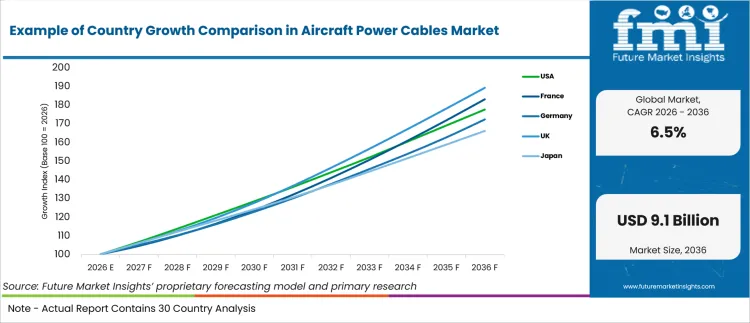
| United Kingdom | 6.6% |
| France | 6.2% |
| United States | 5.9% |
| Germany | 5.6% |
| Japan | 5.2% |
How do country-level CAGRs compare in the Aircraft Power Cables Market?
The country outlook range spans 1.4 percentage points across five countries and describes forecast pace without measuring current revenue or installed aircraft volume.
- United Kingdom demand benefits from mature maintenance networks that convert replacement schedules into qualified cable orders.
- France follows a similar pace through concentrated aircraft production and specialist cable engineering capacity for long programs.
- United States growth reflects a larger fleet operating through separate civil and defense approval routes.
- Germany depends more heavily on traceable maintenance files and aircraft-specific technical support during replacement work.
- Japan faces slower conversion as limited technical staffing offsets disciplined domestic maintenance procedures across national fleets.
Comparable CAGRs can produce different market entry conditions. The full report provides country-level CAGR analysis across North America, Latin America, Europe, East Asia, South Asia and Pacific, and the Middle East and Africa.
Country-wise Analysis
- The United Kingdom's aircraft power cable outlook is anticipated to advance at 6.6% CAGR over the assessment period, supported by mature MRO access and established distributor channels near major operating bases. The CAA's aircraft register statistics include a 1 January 2026 file that separates United Kingdom aircraft by class and airworthiness category and gives maintenance organizations a framework for wiring inspections across commercial aircraft and rotorcraft with different approval histories. Varied platform records remain a material friction as maintenance teams need rapid cross-reference support and locally stocked approved cable grades during time-sensitive maintenance releases across several domestic operating regions.
- France concentrates aircraft assembly and specialist cable engineering inside an export network that supports long production programs, regional maintenance activity and coordinated qualification work across commercial and defense aircraft platforms nationwide. Aircraft power cable sales in France are forecast to expand at 6.2% CAGR by 2036, reinforced by established airframe expertise and specialized aerospace manufacturing capacity for complex programs. GIFAS reported 230,500 aerospace employees for 2025 in May 2026 and confirmed a substantial engineering base but capacity pressure among smaller manufacturers requires dependable schedules that prevent late conductor or insulation changes during tightly planned assembly and retrofit cycles.
- United States aircraft programs combine large civil fleets with defense platforms that use different cable specifications across fragmented purchasing and approval routes within regional aerospace clusters and nationwide maintenance bases. The FAA counted 6,949 commercial aircraft during 2025 in its 2026 forecast, giving cable manufacturers a substantial service base across established airline and cargo operations. In the United States, aircraft power cable demand is predicted to advance at 5.9% CAGR through 2036, shaped by extensive OEM and MRO networks as program fragmentation requires stocked aerospace grades plus fast engineering responses so termination questions do not delay purchase orders or maintenance releases.
- Germany links commercial maintenance capacity with defense aviation programs that require traceable wiring support across long aircraft service lives and controlled configuration records for scheduled replacement work across commercial transport aircraft and naval aviation fleets. Germany is estimated to post 5.6% CAGR over the forecast period, aided by established maintenance engineering and local qualification expertise across civil and military service networks. Lufthansa Technik announced support for eight German Navy P-8A aircraft in November 2025, establishing a domestic component and training route even as platform-specific terminals require local stock plus complete technical files for approved cable exchange during planned depot maintenance.
- Japan relies on disciplined maintenance procedures and coordinated technical training across airlines and domestic service organizations using aircraft-specific wiring instructions during scheduled inspections across mixed commercial and regional fleets nationwide. Japan's transport ministry published its maintenance-engineer and pilot workforce report in March 2025 after selecting 15 priority themes that included training efficiency and wider use of available personnel nationwide. By 2036, Japan is projected to grow at 5.2% CAGR, influenced by structured qualification practices and dependable domestic engineering support though limited skilled labor requires Japanese documentation plus distributor training for faster troubleshooting across aircraft fleets with different wiring instructions.
Who are the notable companies in the Aircraft Power Cables Market?
Prysmian Group, Lynxeo, TE Connectivity, Amphenol, Glenair, W. L. Gore & Associates, Safran Electrical & Power and Harbour Industries are the notable companies serving this market.
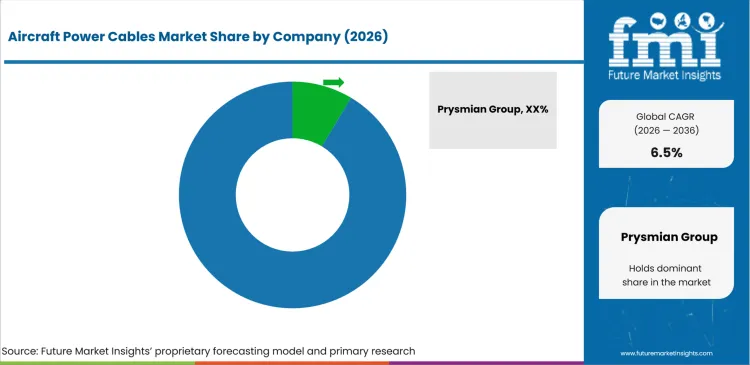
Competition centers on a limited set of global cable groups and specialist interconnect manufacturers serving certified aircraft programs. Entry remains narrow as new producers must prove cable performance and maintain platform documentation across long approval cycles.
- Prysmian Group, Lynxeo and W. L. Gore & Associates compete through broad airframe wire and power-feeder portfolios.
- TE Connectivity, Amphenol and Glenair combine high-voltage cabling with connector systems for integrated aircraft power distribution.
- Safran Electrical & Power integrates complete wiring systems and Harbour Industries serves specialized aerospace power-cable requirements.
Competitive Benchmarking: Aircraft Power Cables Market
| Company | Aircraft Power Cable Breadth | High-Voltage Capability | Qualification Support | Geographic Reach |
|---|---|---|---|---|
| Prysmian Group | High | High | High | Global or multi-region |
| Lynxeo | High | Medium | High | Global or multi-region |
| TE Connectivity | Medium | High | High | Global or multi-region |
| Glenair | Medium | High | High | Global or multi-region |
| W. L. Gore & Associates | High | High | High | Global or multi-region |
| Safran Electrical & Power | High | Medium | High | Global or multi-region |
| Amphenol | Medium | Medium | High | Global or multi-region |
| Harbour Industries | Medium | Medium | Medium | North America and selected export markets |
Key Developments in the Aircraft Power Cables Market
- In July 2026, Lynxeo signed a distribution agreement with FDH Electronics that expanded United States access to its aerospace wire and cable portfolio.
- In July 2026, Safran Electrical & Power inaugurated a Chihuahua wiring factory built to support current aircraft programs and next-generation platforms.
- In May 2025, W. L. Gore & Associates joined Team FLRAA as a wire and cable supplier for the United States Army's next-generation rotorcraft program.
Aircraft Power Cables Market - Report Scope
| Coverage field | Report scope |
|---|---|
| Market breakdown | By cable type, conductor, voltage class, aircraft type, application, sales channel and region. |
| Quantitative Units | Revenue in USD billion and CAGR on % |
| Market Definition | The market covers aircraft power cables sold for generation, distribution, battery, starter and high-power systems across civil and military aircraft. |
| Regions Covered | North America, Latin America, Europe, East Asia, South Asia and Pacific, and Middle East and Africa. |
| Countries Covered | United Kingdom, France, United States, Germany, Japan and 20+ countries included in the full report. |
| Key Companies Profiled | Prysmian Group, Lynxeo, TE Connectivity, Amphenol, Glenair, W. L. Gore & Associates, Safran Electrical & Power, Harbour Industries |
| Forecast Period | 2026 to 2036. |
| Approach | Primary and secondary research with market triangulation. |
Aircraft Power Cables Market - Research Methodology
| Method | Approach |
|---|---|
| Primary Research | FMI analysts gathered input from manufacturers, service providers, technology developers, distributors, end users, procurement teams, and subject-matter experts. Interviews examined purchasing decisions, product or service evaluation, adoption barriers, approval requirements, pricing considerations, and expectations for technical or commercial support. Respondents were also asked what evidence is required before a trial, pilot, or initial order develops into regular purchasing. |
| Desk Research | Desk research covered government statistics, regulatory publications, trade data, industry associations, technical literature, standards, company filings, product information, and official corporate announcements. Sources were reviewed for relevance, publication date, geographic coverage, and consistency with the defined market scope. Claims relating to performance, applications, approvals, capacity, investment, and commercial activity were retained only when supported by credible public evidence. |
| Market Sizing and Forecasting | The market model combined the baseline value with historical performance, segment structure, pricing and volume indicators, adoption levels, company participation, and country-level demand conditions. Forecast assumptions considered economic activity, investment trends, regulatory developments, technology adoption, purchasing cycles, supply availability, and barriers to wider market use. Segment and regional estimates were reconciled before the final market total was calculated. |
| Data Validation | Estimates were checked against multiple independent indicators, including public data, company activity, trade patterns, industry developments, and findings from primary interviews. Validation also tested whether products, services, applications, and company revenues fell within the defined market boundaries. Adjacent categories, unsupported claims, overlapping revenues, and activities without direct market relevance were excluded to reduce double counting and maintain consistency across segments and countries. |
Aircraft Power Cables Market by Segments
Aircraft Power Cables Market segmented by Cable Type:
- Primary Power Cables
- Feeder Cables
- Battery Cables
- Shielded Power Cables
- High Voltage DC Cables
- Fire-resistant Cables
Aircraft Power Cables Market segmented by Conductor:
- Copper
- Tin-plated Copper
- Nickel-plated Copper
- Aluminum Alloy
Aircraft Power Cables Market segmented by Voltage Class:
- Low Voltage
- Medium Voltage
- High Voltage / HVDC
Aircraft Power Cables Market segmented by Aircraft Type:
- Narrowbody
- Widebody
- Regional / Business Jets
- Military Aircraft
- Helicopters / UAVs
Aircraft Power Cables Market segmented by Application:
- Power Distribution
- Engine / APU Wiring
- Battery & Starter Systems
- Cabin / Galley Power
- More-electric Aircraft Systems
Aircraft Power Cables Market segmented by Sales Channel:
- Aircraft OEMs
- Harness Integrators
- MRO / Aftermarket
- Defense Programs
Aircraft Power Cables Market by Region:
- North America
- United States
- Canada
- Latin America
- Brazil
- Chile
- Mexico
- Rest of Latin America
- Western Europe
- Germany
- United Kingdom
- Italy
- Spain
- France
- Nordics
- Benelux
- Rest of Western Europe
- Eastern Europe
- Russia
- Poland
- Hungary
- Balkan and Baltic States
- Rest of Eastern Europe
- East Asia
- China
- Japan
- South Korea
- South Asia and Pacific
- India
- ASEAN
- Australia and New Zealand
- Rest of South Asia and Pacific
- Middle East and Africa
- Kingdom of Saudi Arabia
- Other GCC Countries
- Türkiye
- South Africa
- Other African Union Countries
- Rest of Middle East and Africa
Research Sources and Bibliography
- General Aviation Manufacturers Association. (2026, February 18). GAMA Releases 2025 Aircraft Shipment and Billing Report.
- Airbus. (2026, January 12). Airbus reports 793 commercial aircraft deliveries in 2025.
- Civil Aviation Authority. (2026, January 1). UK registered aircraft as at 1 January 2026 by aircraft class and COFA PTF category.
- Groupement des Industries Françaises Aéronautiques et Spatiales. (2026, May 11). 2025 Results: The French Aerospace Industry Remains Strongly Positioned for the Future.
- Federal Aviation Administration. (2026). FAA Aerospace Forecast Fiscal Years 2026-2046.
- Lufthansa Technik. (2025, November 20). Boeing contracts Lufthansa Technik Defense for sustainment of German Navy’s P-8A Poseidon.
- Ministry of Land, Infrastructure, Transport and Tourism. (2025, March 28). 「航空整備士・操縦士の人材確保・活用に関する検討会」最終とりまとめの公表 ~更なる航空業界の成長を目指します!!~.
- NASA. (2025, September 10). High-Power Advanced Cable Technology (HiACT).
- Lizcano, M. (2024, December 23). Novel Power Transmission Solutions for Megawatt Scale Electric Aircraft. NASA Technical Reports Server.
- W. L. Gore & Associates. (2026). GORE® Power Feeder Cables for Aerospace & Defense. Retrieved August 3, 2026.
- Safran. (2026). Safran Electrical & Power - Smarter electrical solutions for a better flight. Retrieved August 3, 2026.
- Amphenol. (2026). Commercial Aerospace. Retrieved August 3, 2026.
- Harbour Industries, LLC. (2026). High-Temp Aerospace Data & Power Cables. Retrieved August 3, 2026.
- Lynxeo. (2026, July 22). Lynxeo strengthens its USA aerospace presence through a new distribution agreement with FDH Electronics.
- Safran. (2026, July 2). Safran inaugurates new electrical wiring factory in Chihuahua, Mexico.
- W. L. Gore & Associates. (2025, May). W. L. Gore & Associates Joins Team FLRAA as a Wire and Cable Supplier for the USA Army’s Future Long Range Assault Aircraft Program.
This bibliography is provided for reader reference and is not exhaustive. The full report contains the complete reference list and detailed citations
This Report Answers
- How large is the aircraft power cables market in 2026 and 2036?
- Which cable type accounts for the largest aircraft power cable share in 2026?
- Why does copper remain central to aircraft conductor selection across certified platforms?
- How do low-voltage circuits shape current aircraft power cable demand?
- Which aircraft type supports recurring cable volume across major production programs?
- What slows adoption of newly designed aircraft power cable families?
- How do country growth rates differ across the five profiled markets?
- Which companies provide aircraft power cables and qualification support?
- How should engineering teams compare cable options during aircraft qualification?
Frequently Asked Questions
How big is the Aircraft Power Cables Market in 2026?
The aircraft power cables market is valued at USD 4.9 billion in 2026 and is forecast to reach USD 9.1 billion by 2036. Growth is supported by rising onboard power loads across more-electric aircraft architectures that sustain recurring demand for qualified cable families within certified distribution networks throughout civil and military production programs.
What is the CAGR of the Aircraft Power Cables Market from 2026 to 2036?
The aircraft power cables market grows at a CAGR of 6.5% between 2026 and 2036, supported by airframe programs adopting qualified cable families once conductor, termination, and approval packages preserve thermal margins and satisfy configuration control requirements across scheduled production and maintenance replacement cycles worldwide.
Which cable type leads the Aircraft Power Cables Market?
Primary power cables account for 26.0% of the aircraft power cables market by cable type in 2026, driven by direct generator-to-bus distribution requirements that position these cables across protected distribution networks serving flight systems and high-load equipment throughout certified civil and military aircraft architectures.
How much will the Aircraft Power Cables Market add between 2026 and 2036?
The aircraft power cables market is set to add USD 4.2 billion between 2026 and 2036, growing from USD 4.9 billion to USD 9.1 billion as more-electric aircraft architectures, high-voltage program expansion, and recurring fleet replacement requirements drive qualified cable demand across civil production and defense platform programs globally.
Who are the leading companies in the Aircraft Power Cables Market?
Eight companies shape competition in the aircraft power cables market, including Prysmian Group, Lynxeo, TE Connectivity, Amphenol, Glenair, W. L. Gore & Associates, Safran Electrical & Power, and Harbour Industries, competing through broad airframe wire portfolios, high-voltage cable systems, integrated wiring solutions, and platform qualification support across global civil and military aircraft programs.
Preview the report firsthand - request a free sample
Get SampleGet the brochure for pricing and purchase details.
Get PDFTable of Content
- Key Takeaways
- Market Size and CAGR
- Top Growth Driver
- Fastest Growing Segment
- Leading Region
- Key Companies
- Emerging Opportunities
- Executive Summary
- Global Market Outlook
- Demand-side Trends
- Supply-side Trends
- Technology Roadmap Analysis
- Analysis and Recommendations
- Analyst Perspective (What is happening? Why now? What should investors know?)
- Key Questions Answered
- How large is the market?
- What is the CAGR?
- What are key trends?
- Which region dominates?
- Who are the leaders?
- Market Overview
- Market Coverage / Taxonomy
- Market Definition / Scope / Limitations
- Research Methodology
- Chapter Orientation
- Analytical Lens and Working Hypotheses
- Market Structure, Signals, and Trend Drivers
- Benchmarking and Cross-market Comparability
- Market Sizing, Forecasting, and Opportunity Mapping
- Research Design and Evidence Framework
- Desk Research Programme (Secondary Evidence)
- Expert Input and Fieldwork (Primary Evidence)
- Tooling, Models, and Reference Databases
- Data Engineering and Model Build
- Quality Assurance and Audit Trail
- Market Background
- Market Dynamics (Drivers, Restraints, Opportunity, Trends)
- Scenario Forecast (Optimistic, Likely, Conservative)
- Impact Analysis
- AI Impact
- Sustainability Impact
- Regulatory Impact
- Technology Impact
- Consumer / Buyer Analysis
- Purchase Drivers
- Adoption Barriers
- Buyer Journey
- Opportunity Map Analysis
- Product Life Cycle Analysis
- Supply Chain Analysis
- Investment Feasibility Matrix
- Value Chain Analysis
- PESTLE and Porter's Analysis
- Regulatory Landscape
- Regional Parent Market Outlook
- Production and Consumption Statistics
- Import and Export Statistics
- Global Market Analysis and Forecast, 2021 to 2036
- Historical Market Size Value (USD Billion) Analysis, 2021 to 2025
- Current and Future Market Size Value (USD Billion) Projections, 2026 to 2036
- Y-o-Y Growth Trend Analysis
- Absolute $ Opportunity Analysis
- Global Market Pricing Analysis, 2021 to 2036
- Global Market Analysis and Forecast, By Cable Type, 2021 to 2036
- Introduction / Key Findings
- Historical Market Size Value (USD Billion) Analysis By Cable Type, 2021 to 2025
- Current and Future Market Size Value (USD Billion) Analysis and Forecast By Cable Type, 2026 to 2036
- Primary Power Cables
- Feeder Cables
- Battery Cables
- Shielded Power Cables
- High Voltage DC Cables
- Fire-resistant Cables
- Primary Power Cables
- Y-o-Y Growth Trend Analysis By Cable Type, 2021 to 2025
- Absolute $ Opportunity Analysis By Cable Type, 2026 to 2036
- Global Market Analysis and Forecast, By Conductor, 2021 to 2036
- Introduction / Key Findings
- Historical Market Size Value (USD Billion) Analysis By Conductor, 2021 to 2025
- Current and Future Market Size Value (USD Billion) Analysis and Forecast By Conductor, 2026 to 2036
- Copper
- Tin-plated Copper
- Nickel-plated Copper
- Aluminum Alloy
- Copper
- Y-o-Y Growth Trend Analysis By Conductor, 2021 to 2025
- Absolute $ Opportunity Analysis By Conductor, 2026 to 2036
- Global Market Analysis and Forecast, By Voltage Class, 2021 to 2036
- Introduction / Key Findings
- Historical Market Size Value (USD Billion) Analysis By Voltage Class, 2021 to 2025
- Current and Future Market Size Value (USD Billion) Analysis and Forecast By Voltage Class, 2026 to 2036
- Low Voltage
- Medium Voltage
- High Voltage / HVDC
- Low Voltage
- Y-o-Y Growth Trend Analysis By Voltage Class, 2021 to 2025
- Absolute $ Opportunity Analysis By Voltage Class, 2026 to 2036
- Global Market Analysis and Forecast, By Aircraft Type, 2021 to 2036
- Introduction / Key Findings
- Historical Market Size Value (USD Billion) Analysis By Aircraft Type, 2021 to 2025
- Current and Future Market Size Value (USD Billion) Analysis and Forecast By Aircraft Type, 2026 to 2036
- Narrowbody
- Widebody
- Regional / Business Jets
- Military Aircraft
- Helicopters / UAVs
- Narrowbody
- Y-o-Y Growth Trend Analysis By Aircraft Type, 2021 to 2025
- Absolute $ Opportunity Analysis By Aircraft Type, 2026 to 2036
- Global Market Analysis and Forecast, By Application, 2021 to 2036
- Introduction / Key Findings
- Historical Market Size Value (USD Billion) Analysis By Application, 2021 to 2025
- Current and Future Market Size Value (USD Billion) Analysis and Forecast By Application, 2026 to 2036
- Power Distribution
- Engine / APU Wiring
- Battery & Starter Systems
- Cabin / Galley Power
- More-electric Aircraft Systems
- Power Distribution
- Y-o-Y Growth Trend Analysis By Application, 2021 to 2025
- Absolute $ Opportunity Analysis By Application, 2026 to 2036
- Global Market Analysis and Forecast, By Sales Channel
- Introduction / Key Findings
- Historical Market Size Value (USD Billion) Analysis By Sales Channel, 2021 to 2025
- Current and Future Market Size Value (USD Billion) Analysis and Forecast By Sales Channel, 2026 to 2036
- Aircraft OEMs
- Harness Integrators
- MRO / Aftermarket
- Defense Programs
- Aircraft OEMs
- Y-o-Y Growth Trend Analysis By Sales Channel, 2021 to 2025
- Absolute $ Opportunity Analysis By Sales Channel, 2026 to 2036
- Global Market Analysis and Forecast, By Region, 2021 to 2036
- Introduction
- Historical Market Size Value (USD Billion) Analysis By Region, 2021 to 2025
- Current Market Size Value (USD Billion) Analysis and Forecast By Region, 2026 to 2036
- North America
- Latin America
- Western Europe
- Eastern Europe
- East Asia
- South Asia and Pacific
- Middle East & Africa
- Market Attractiveness Analysis By Region
- North America Market Analysis and Forecast, By Country, 2021 to 2036
- Historical Market Size Value (USD Billion) Trend Analysis By Market Taxonomy, 2021 to 2025
- Market Size Value (USD Billion) Forecast By Market Taxonomy, 2026 to 2036
- By Country
- USA
- Canada
- By Cable Type
- By Conductor
- By Voltage Class
- By Aircraft Type
- By Application
- By Sales Channel
- By Country
- Market Attractiveness Analysis
- By Country
- By Cable Type
- By Conductor
- By Voltage Class
- By Aircraft Type
- By Application
- By Sales Channel
- Key Takeaways
- Latin America Market Analysis and Forecast, By Country
- Historical Market Size Value (USD Billion) Trend Analysis By Market Taxonomy, 2021 to 2025
- Market Size Value (USD Billion) Forecast By Market Taxonomy, 2026 to 2036
- By Country
- Brazil
- Mexico
- Chile
- Rest of Latin America
- By Cable Type
- By Conductor
- By Voltage Class
- By Aircraft Type
- By Application
- By Sales Channel
- By Country
- Market Attractiveness Analysis
- By Country
- By Cable Type
- By Conductor
- By Voltage Class
- By Aircraft Type
- By Application
- By Sales Channel
- Key Takeaways
- Western Europe Market Analysis and Forecast, By Country
- Historical Market Size Value (USD Billion) Trend Analysis By Market Taxonomy, 2021 to 2025
- Market Size Value (USD Billion) Forecast By Market Taxonomy, 2026 to 2036
- By Country
- Germany
- UK
- Italy
- Spain
- France
- Nordic
- BENELUX
- Rest of Western Europe
- By Cable Type
- By Conductor
- By Voltage Class
- By Aircraft Type
- By Application
- By Sales Channel
- By Country
- Market Attractiveness Analysis
- By Country
- By Cable Type
- By Conductor
- By Voltage Class
- By Aircraft Type
- By Application
- By Sales Channel
- Key Takeaways
- Eastern Europe Market Analysis and Forecast, By Country
- Historical Market Size Value (USD Billion) Trend Analysis By Market Taxonomy, 2021 to 2025
- Market Size Value (USD Billion) Forecast By Market Taxonomy, 2026 to 2036
- By Country
- Russia
- Poland
- Hungary
- Balkan & Baltic
- Rest of Eastern Europe
- By Cable Type
- By Conductor
- By Voltage Class
- By Aircraft Type
- By Application
- By Sales Channel
- By Country
- Market Attractiveness Analysis
- By Country
- By Cable Type
- By Conductor
- By Voltage Class
- By Aircraft Type
- By Application
- By Sales Channel
- Key Takeaways
- East Asia Market Analysis and Forecast, By Country
- Historical Market Size Value (USD Billion) Trend Analysis By Market Taxonomy, 2021 to 2025
- Market Size Value (USD Billion) Forecast By Market Taxonomy, 2026 to 2036
- By Country
- China
- Japan
- South Korea
- By Cable Type
- By Conductor
- By Voltage Class
- By Aircraft Type
- By Application
- By Sales Channel
- By Country
- Market Attractiveness Analysis
- By Country
- By Cable Type
- By Conductor
- By Voltage Class
- By Aircraft Type
- By Application
- By Sales Channel
- Key Takeaways
- South Asia and Pacific Market Analysis and Forecast, By Country
- Historical Market Size Value (USD Billion) Trend Analysis By Market Taxonomy, 2021 to 2025
- Market Size Value (USD Billion) Forecast By Market Taxonomy, 2026 to 2036
- By Country
- India
- ASEAN
- Australia & New Zealand
- Rest of South Asia and Pacific
- By Cable Type
- By Conductor
- By Voltage Class
- By Aircraft Type
- By Application
- By Sales Channel
- By Country
- Market Attractiveness Analysis
- By Country
- By Cable Type
- By Conductor
- By Voltage Class
- By Aircraft Type
- By Application
- By Sales Channel
- Key Takeaways
- Middle East & Africa Market Analysis and Forecast, By Country
- Historical Market Size Value (USD Billion) Trend Analysis By Market Taxonomy, 2021 to 2025
- Market Size Value (USD Billion) Forecast By Market Taxonomy, 2026 to 2036
- By Country
- Kingdom of Saudi Arabia
- Other GCC Countries
- Türkiye
- South Africa
- Other African Union
- Rest of Middle East & Africa
- By Cable Type
- By Conductor
- By Voltage Class
- By Aircraft Type
- By Application
- By Sales Channel
- By Country
- Market Attractiveness Analysis
- By Country
- By Cable Type
- By Conductor
- By Voltage Class
- By Aircraft Type
- By Application
- By Sales Channel
- Key Takeaways
- Key Countries Market Analysis
- USA
- Pricing Analysis
- Market Share Analysis, 2025
- By Cable Type
- By Conductor
- By Voltage Class
- By Aircraft Type
- By Application
- By Sales Channel
- Canada
- Pricing Analysis
- Market Share Analysis, 2025
- By Cable Type
- By Conductor
- By Voltage Class
- By Aircraft Type
- By Application
- By Sales Channel
- Mexico
- Pricing Analysis
- Market Share Analysis, 2025
- By Cable Type
- By Conductor
- By Voltage Class
- By Aircraft Type
- By Application
- By Sales Channel
- Brazil
- Pricing Analysis
- Market Share Analysis, 2025
- By Cable Type
- By Conductor
- By Voltage Class
- By Aircraft Type
- By Application
- By Sales Channel
- Chile
- Pricing Analysis
- Market Share Analysis, 2025
- By Cable Type
- By Conductor
- By Voltage Class
- By Aircraft Type
- By Application
- By Sales Channel
- Germany
- Pricing Analysis
- Market Share Analysis, 2025
- By Cable Type
- By Conductor
- By Voltage Class
- By Aircraft Type
- By Application
- By Sales Channel
- UK
- Pricing Analysis
- Market Share Analysis, 2025
- By Cable Type
- By Conductor
- By Voltage Class
- By Aircraft Type
- By Application
- By Sales Channel
- Italy
- Pricing Analysis
- Market Share Analysis, 2025
- By Cable Type
- By Conductor
- By Voltage Class
- By Aircraft Type
- By Application
- By Sales Channel
- Spain
- Pricing Analysis
- Market Share Analysis, 2025
- By Cable Type
- By Conductor
- By Voltage Class
- By Aircraft Type
- By Application
- By Sales Channel
- France
- Pricing Analysis
- Market Share Analysis, 2025
- By Cable Type
- By Conductor
- By Voltage Class
- By Aircraft Type
- By Application
- By Sales Channel
- India
- Pricing Analysis
- Market Share Analysis, 2025
- By Cable Type
- By Conductor
- By Voltage Class
- By Aircraft Type
- By Application
- By Sales Channel
- ASEAN
- Pricing Analysis
- Market Share Analysis, 2025
- By Cable Type
- By Conductor
- By Voltage Class
- By Aircraft Type
- By Application
- By Sales Channel
- Australia & New Zealand
- Pricing Analysis
- Market Share Analysis, 2025
- By Cable Type
- By Conductor
- By Voltage Class
- By Aircraft Type
- By Application
- By Sales Channel
- China
- Pricing Analysis
- Market Share Analysis, 2025
- By Cable Type
- By Conductor
- By Voltage Class
- By Aircraft Type
- By Application
- By Sales Channel
- Japan
- Pricing Analysis
- Market Share Analysis, 2025
- By Cable Type
- By Conductor
- By Voltage Class
- By Aircraft Type
- By Application
- By Sales Channel
- South Korea
- Pricing Analysis
- Market Share Analysis, 2025
- By Cable Type
- By Conductor
- By Voltage Class
- By Aircraft Type
- By Application
- By Sales Channel
- Russia
- Pricing Analysis
- Market Share Analysis, 2025
- By Cable Type
- By Conductor
- By Voltage Class
- By Aircraft Type
- By Application
- By Sales Channel
- Poland
- Pricing Analysis
- Market Share Analysis, 2025
- By Cable Type
- By Conductor
- By Voltage Class
- By Aircraft Type
- By Application
- By Sales Channel
- Hungary
- Pricing Analysis
- Market Share Analysis, 2025
- By Cable Type
- By Conductor
- By Voltage Class
- By Aircraft Type
- By Application
- By Sales Channel
- Kingdom of Saudi Arabia
- Pricing Analysis
- Market Share Analysis, 2025
- By Cable Type
- By Conductor
- By Voltage Class
- By Aircraft Type
- By Application
- By Sales Channel
- Türkiye
- Pricing Analysis
- Market Share Analysis, 2025
- By Cable Type
- By Conductor
- By Voltage Class
- By Aircraft Type
- By Application
- By Sales Channel
- South Africa
- Pricing Analysis
- Market Share Analysis, 2025
- By Cable Type
- By Conductor
- By Voltage Class
- By Aircraft Type
- By Application
- By Sales Channel
- USA
- Market Structure Analysis
- Competition Dashboard
- Competition Benchmarking
- Market Share Analysis of Top Players
- By Regional
- By Cable Type
- By Conductor
- By Voltage Class
- By Aircraft Type
- By Application
- By Sales Channel
- Emerging Startups
- Innovation Benchmarking
- Competition Analysis
- Competition Deep Dive
- Prysmian Group
- Overview
- Product Portfolio
- Profitability by Market Segments
- Sales Footprint
- Strategy Overview
- Marketing Strategy
- Product Strategy
- Channel Strategy
- Nexans
- TE Connectivity
- Amphenol
- Collins Aerospace
- Carlisle Interconnect Technologies
- Glenair
- Leoni
- Judco Manufacturing
- Harbour Industries
- Prysmian Group
- Case Studies
- Success Stories
- Recent Developments
- Competition Deep Dive
- Assumptions & Acronyms Used


