

- Market Size (2026)
- USD 2.6 Bn
- Forecast (2036)
- USD 5.6 Bn
- CAGR (2026 to 2036)
- 8.0%
More-Electric Aircraft Power Generation Systems Market Size, Market Forecast and Outlook By FMI
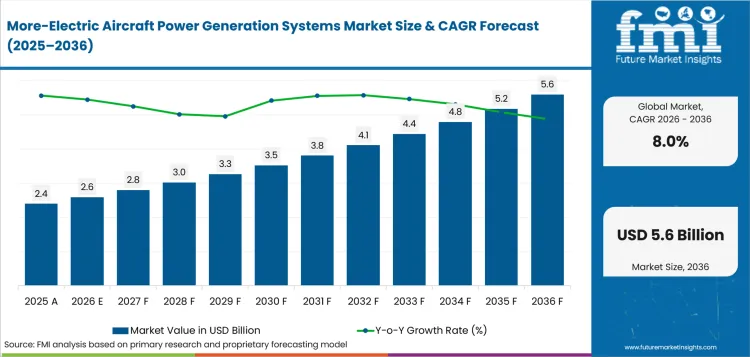
More-electric aircraft power generation systems market was valued at USD 2.4 billion in 2025. Market value is expected to reach USD 2.6 billion in 2026 and USD 5.6 billion by 2036. Demand is forecast to rise at 8.0% CAGR from 2026 to 2036. OEM installation is expected to represent 62.4% share of fitment demand in 2026. Commercial aircraft are forecast to account for 56.3% share of aircraft type demand in 2026.
Key Takeaways, Market Size, and Forecast
- More-electric aircraft power generation systems market stood at USD 2.4 billion in 2025.
- Industry value is forecast to reach USD 5.6 billion by 2036.
- Industry value is expected to rise at 8.0% CAGR from 2026 to 2036.
- Market demand is forecast to add USD 3.0 billion in incremental opportunity across the forecast period.
- OEM installation is expected to represent 62.4% share of fitment demand in 2026.
- Commercial aircraft are anticipated to account for 56.3% share of aircraft type demand in 2026.
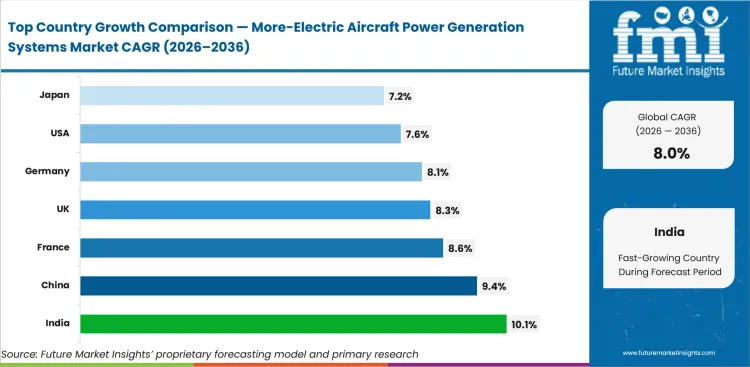
- India at 10.1% CAGR and China at 9.4% CAGR are forecast to record above-market pace through 2036.
Summary of the More-Electric Aircraft Power Generation Systems Market
- Demand and Growth Drivers
- Aircraft makers are shifting more flight functions toward electric control as they look for lighter systems and better power management.
- Airlines need reliable onboard power because newer aircraft carry more electrical loads across cabin systems and flight controls.
- Generator repair demand is improving as high aircraft use creates more service need for starter-generators and integrated drive generators.
- Product and Segment View
- Variable-frequency generators are preferred in newer aircraft because they support changing engine speeds without adding heavy drive hardware.
- Starter-generators are benefitting use because one unit can start the engine and support power supply after takeoff.
- Generator control units are important because they manage voltage and help detect faults before they affect aircraft operation.
- Geography and Competitive Outlook
- The United States and France have strong supplier depth because aircraft power systems need certified design and service support.
- China and India are important growth markets because airline activity is rising and fleets need more reliable power systems.
- Competition will depend on certified generator design and repair access because aircraft makers need proven systems with clear service support.
- Analyst Opinion
- Nikhil Kaitwade, Principal Consultant at FMI says, “More-electric aircraft power generation is becoming a design choice for aircraft makers. Power output needs to rise without adding excess weight or heat. Suppliers able to certify compact generators with reliable control units will secure better access to new aircraft programs and overhaul channels.”
- More-Electric Aircraft Power Generation Systems Market Value Analysis
- The more-electric aircraft power generation systems market is moving from basic onboard power supply into a more defined aircraft electrification segment.
- Market value is supported by aircraft designs that shift more flight functions toward electric control.
- The market is gaining value from starter-generators and variable-frequency generators used in newer aircraft platforms.
- Airlines and aircraft makers need power systems that reduce weight and support safer fault detection during flight.
- Long-term value is tied to certified generator packages that can support higher electrical loads without adding excess system complexity.
Power generation is becoming a certification issue as aircraft move toward electric and hybrid propulsion. In July 2024, EASA stated that electric and hybrid propulsion systems include generators and power management systems. This means suppliers must prove how each system works inside the aircraft, not just how the generator performs on its own. Safran Electrical & Power was selected by Boeing in July 2024 to provide the electrical power generation system for the X-66 NASA Sustainable Flight Demonstrator. The system provides more than 100 kW of electrical power and is designed to reduce hydro-mechanical losses by close to 50%. In January 2026, GE Aerospace said a modified GE Passport engine completed hybrid-electric ground testing. The test covered power transfer and power extraction without energy storage. This supports demand for generation controls that can serve different flight phases without making batteries central to every aircraft design.
More-Electric Aircraft Power Generation Systems Market Definition
More-electric aircraft power generation systems are aircraft electrical units that create and control onboard power for flight systems. The market covers equipment that supports engine start, power conversion and steady electrical supply across newer aircraft designs. These systems are used as aircraft makers shift more functions from hydraulic operation toward electric control. Demand is tied to safer power flow, lower system weight and better fault detection during flight.
More-Electric Aircraft Power Generation Systems Market Inclusions
Market scope covers more-electric aircraft power generation systems categorized by system type, including variable-frequency generators and starter-generators. Integrated drive generators, generator control units and turbogenerators are included as certified aircraft power generation equipment. Power rating includes below 50 kVA and 50 to 250 kVA. Higher power bands cover 250 to 500 kVA and above 500 kVA systems. Aircraft type includes commercial aircraft and business aviation. Rotorcraft and military aircraft are included for mission and platform-specific power needs. Fitment includes OEM installation and aftermarket replacement. End use covers narrow-body aircraft and wide-body aircraft. Regional aircraft, rotorcraft and defense platforms complete the end-use coverage. Revenue scope covers 2026 to 2036. Key stakeholders include aircraft manufacturers and engine OEMs. Aircraft electrical system suppliers, generator manufacturers and generator control unit providers are included. Airlines, defense operators, MRO providers, certification bodies and aerospace component suppliers are also covered.
More-Electric Aircraft Power Generation Systems Market Exclusions
Scope excludes ground power units and airport charging equipment. General aircraft wiring is excluded unless sold as part of a certified generation package. Standalone batteries and propulsion motors are excluded unless bundled with a generator or turbogenerator system. Cabin power outlets are excluded unless connected to aircraft-level generation upgrades.
More-Electric Aircraft Power Generation Systems Market Research Methodology
- Primary Research: FMI analysts reviewed generator suppliers and MRO providers across major aviation countries.
- Desk Research: Public aviation data and trade body figures were used for market checks.
- Market Sizing and Forecasting: Market size was built from aircraft deliveries and generator content per platform.
- Data Validation: Forecast checks compared fleet activity and hybrid-electric test milestones across civil and defense aviation.
Why is the More-Electric Aircraft Power Generation Systems Market Growing?
- Fleet renewal is increasing OEM demand as new aircraft need higher onboard electrical supply for avionics and electric actuation.
- Hybrid-electric aircraft work is raising interest in generator packages able to support electric propulsion trials.
- Aftermarket programs are expanding as airlines need faster repair access for IDGs and APU generators.
Power generation demand is rising as aircraft carry more electrical loads across flight control, cabin and mission systems. Safran Electrical & Power and Lufthansa Technik expanded their APU generator MRO partnership for Airbus A320 family aircraft in October 2025. The agreement supports maintenance and overhaul services for generator equipment used across a large commercial aircraft fleet. It adds value to the market because more-electric aircraft depend on reliable generator service after delivery.
Traffic recovery supports generator repair demand across airline fleets. IATA reported 82.0% load factor in January 2026 and a record result for the month. Higher aircraft use lifts generator duty cycles and increases repair need. MRO providers with approved IDG and starter-generator capability can support operators facing longer aircraft service lives.
Market Segmentation Analysis
- Variable-frequency generators are forecast to represent 44.7% share in 2026.
- Commercial aircraft are expected to form 56.3% share in 2026. f
- The 50 to 250 kVA power band is anticipated to account for 38.6% share in 2026.
- OEM installation is forecast to represent 62.4% share of fitment demand in 2026.
- Narrow-body aircraft are expected to take 41.5% share of end-use demand in 2026.
The market is divided into five primary segment groups based on system type and power rating. Aircraft type, fitment and end use complete the structure. System type covers variable-frequency generators and starter-generators. Integrated drive generators and generator control units complete the group. Power rating covers below 50 kVA and 50 to 250 kVA. 250 to 500 kVA and above 500 kVA complete the power scope. Aircraft type covers commercial aircraft and business aviation. Rotorcraft and military aircraft complete the aircraft scope. Fitment covers OEM installation and aftermarket replacement. End use covers narrow-body aircraft and wide-body aircraft. Regional aircraft, rotorcraft and defense platforms complete the end-use scope.
Insights into More-Electric Aircraft Power Generation Systems Market by System Type
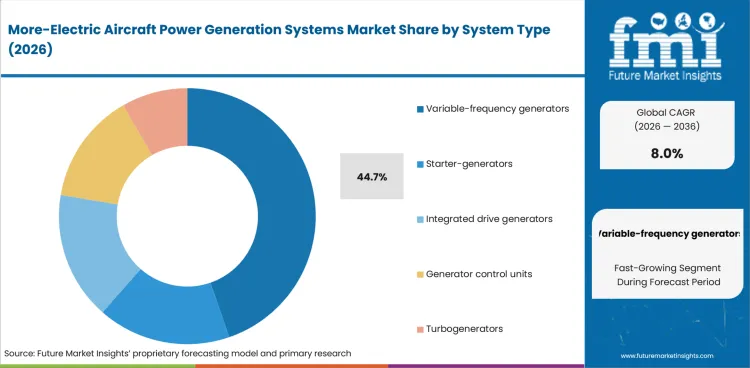
- Variable-frequency generators are expected to account for 44.7% share in 2026 as newer aircraft need power output that can match engine speed without adding heavy drive hardware.
- Starter-generators support the demand for aviation power supply needs because one unit can start the engine and supply aircraft power after takeoff.
Insights into More-Electric Aircraft Power Generation Systems Market by Power Rating
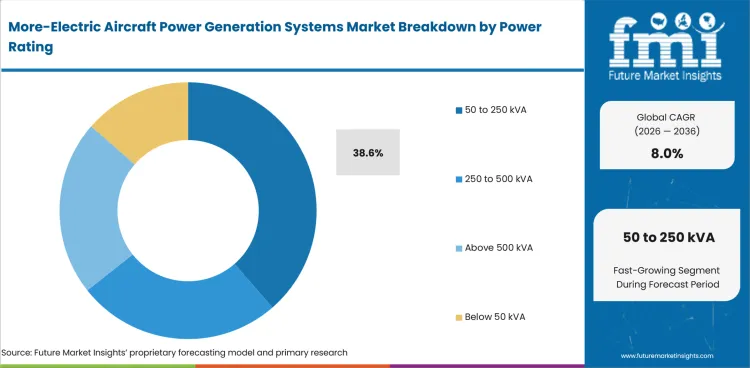
- In 2026, 50 to 250 kVA systems are anticipated to hold 38.6% share as they suit narrow-body aircraft and business jets without forcing major cooling changes.
- Above 500 kVA systems are getting attention in distributed electric propulsion power distribution systems outlook because hybrid aircraft tests need higher power transfer.
Insights into More-Electric Aircraft Power Generation Systems Market by Aircraft Type
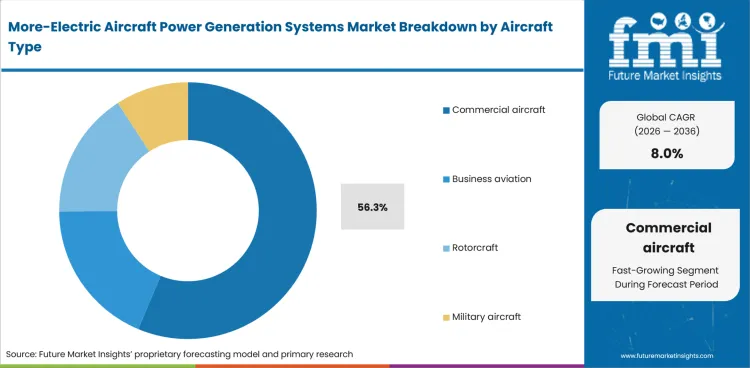
- Commercial aircraft are forecast to hold 56.3% share in 2026 as aircraft makers need certified generator packages for new fleet deliveries.
- Rotorcraft and defense aircraft need rugged power systems since mission electronics place higher pressure on generator reliability and fault control.
Insights into More-Electric Aircraft Power Generation Systems Market by Fitment
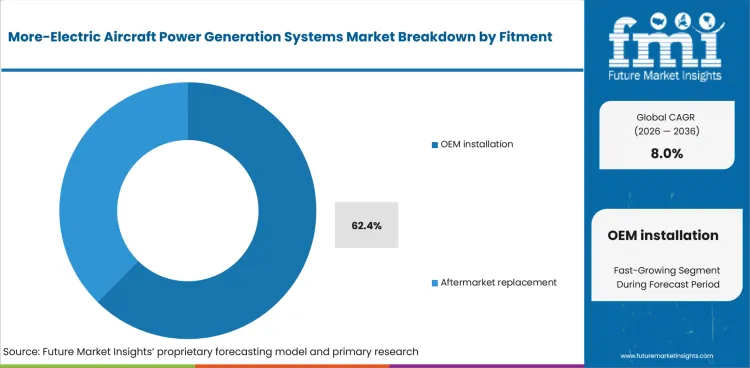
- OEM installation is expected to represent 62.4% share in 2026 as generator output and control software must match the aircraft design before certification.
- Aftermarket replacement supports aircraft dc-dc converter demand as older aircraft need reliable power conversion and generator repair support.
Insights into More-Electric Aircraft Power Generation Systems Market by End Use
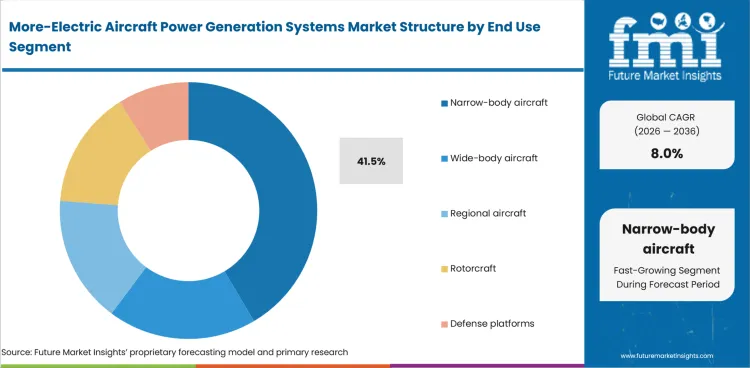
- In 2026, narrow-body aircraft are forecast to account for 41.5% share as short-haul fleets need reliable power generation through frequent flight cycles.
- Wide-body aircraft need stronger generator control as cabin systems and aircraft wire and cable loads increase across long-haul platforms.
More-Electric Aircraft Power Generation Systems Market Drivers, Restraints, and Opportunities
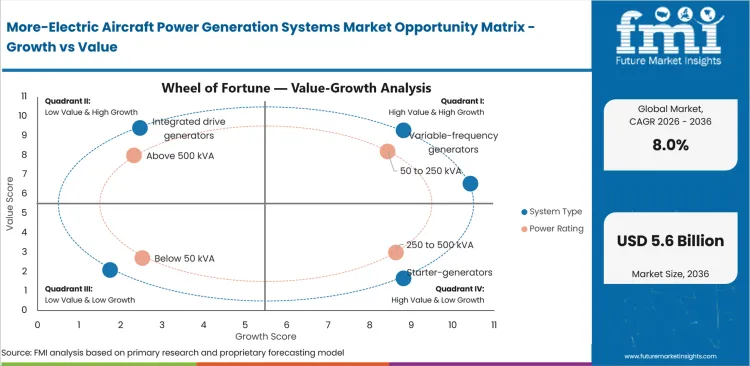
- High-voltage aircraft architecture is raising demand for certified generator and control unit packages.
- Thermal and arcing risks can slow qualification as aircraft power levels move beyond older low-voltage layouts.
- Demand for distributed electric propulsion power distribution systems create new opportunities for suppliers with generator and converter testing depth.
Power Extraction Raises Generator Content
Hybrid-electric aircraft work is moving generator value closer to propulsion design. Eaton joined the Airbus-led HYLENA research project in November 2025 to support hydrogen-electric propulsion system development. The project combines solid oxide fuel cells with turbomachinery and electric power distribution. Generator suppliers benefit from such programs because electric aircraft need stable power transfer, fault protection and safe load control in flight.
High-Voltage Certification Slows Upgrades
Higher voltage improves aircraft power density but adds more certification pressure. Aircraft makers need proof that insulation, cooling and fault response work under altitude and temperature stress. Generator control units must protect the aircraft from unstable power flow during engine speed changes. Smaller suppliers can lose access to large programs if test data is weak or service support is limited.
Turbogenerators Open Hybrid Routes
Turbogenerators create a bridge between conventional engines and electric propulsion. Eaton’s HYLENA role shows how aircraft electrical distribution is becoming part of propulsion design. Battery-turbine hybrid propulsion control units will matter more as turbine output, battery support and generator control need to work together. Suppliers able to package hardware with clear control software will have better access to aircraft-level programs.
Analysis of More-Electric Aircraft Power Generation Systems Market by Key Countries
.webp "Top Country Growth Comparison More Electric Aircraft Power Generation Systems Market Cagr (2026 2036)")
| Country | CAGR% |
|---|---|
| United States | 7.6% |
| China | 9.4% |
| India | 10.1% |
| Germany | 8.1% |
| France | 8.6% |
| Japan | 7.2% |
| United Kingdom | 8.3% |
Source: Future Market Insights, 2026.
Sales Analysis of More-Electric Aircraft Power Generation Systems Market in the United States
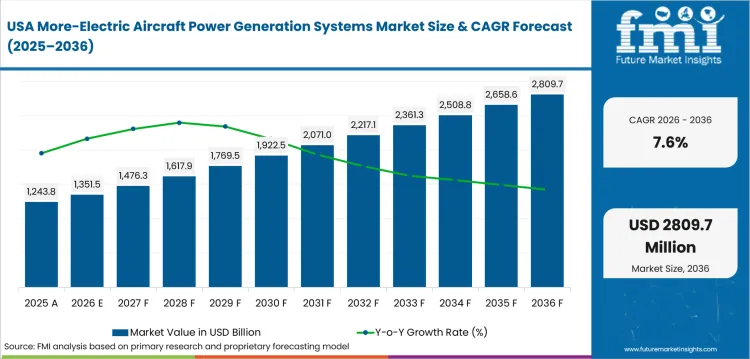
Established aerospace production base · 2026 to 2036
United States Market Outlook
United States demand is supported by aircraft production, defense aviation and certified power-system repair needs. Aircraft makers need generator packages that can pass safety checks before platform integration.
Aftermarket demand is also important as airlines need IDG repair and starter-generator overhaul. Defense aircraft add another use case because mission electronics need stable onboard power.
Key Growth Drivers
- Aerospace Industries Association reported USD 995.0 billion in USA aerospace and defense business activity in 2024, supporting demand for certified power generation hardware.
- Defense aircraft need higher electrical output for mission electronics, which supports generator control units and starter-generator repair.
- AMETEK MRO expanded aircraft power generation repair capability in May 2025, supporting faster service access for U.S. operators.
Key Restraints
- Aerospace Industries Association reported USD 64.83 billion in USA aerospace and defense imports in 2024, which can expose generator programs to supply timing pressure.
- FAA approval needs can slow upgrades as generator output and fault protection must pass aircraft-level checks.
What makes the United States unique
United States demand is shaped by aircraft output and defense aircraft modernization. Local repair depth gives airlines better access to IDG and starter-generator overhaul services.
Key Companies
- Collins Aerospace
- GE Aerospace
- Honeywell Aerospace Technologies
- AMETEK MRO
Sales & Service Channels
- Aircraft OEM programs
- Defense aircraft upgrade contracts
- Airline MRO centers
- Certified component repair shops
Market Taxonomy & Sub-Regions Covered
| Segment | Sub-Segments |
|---|---|
| By System Type | Variable-Frequency Generators · Starter-Generators · Integrated Drive Generators · Generator Control Units · Turbogenerators |
| By Fitment | OEM Installation · Aftermarket Replacement |
| Key Sub-Regions Covered | Washington · Ohio · Kansas · Arizona |
Frequently Asked Questions
How fast is the United States more-electric aircraft power generation systems market moving?
The United States market is expected to record 7.6% CAGR from 2026 to 2036.
Who leads the United States more-electric aircraft power generation systems market?
Collins Aerospace and GE Aerospace hold strong positions through aircraft electrical systems and hybrid-electric testing.
What is driving demand in the United States?
Demand is supported by aircraft production, defense electronics and local MRO repair depth.
Sales Analysis of More-Electric Aircraft Power Generation Systems Market in China
High fleet activity market · 2026 to 2036
China Market Outlook
China demand is supported by airline traffic and domestic aircraft programs. Aircraft power generation systems are needed for new aircraft and repair channels tied to airline fleets.
Local aircraft production gives China a stronger role in generator sourcing. Suppliers still need certification support and service coverage before they can serve aircraft programs at scale.
Key Growth Drivers
- CAAC reported 1,143.64 billion yuan in civil aviation operating revenue in 2025, supporting demand for aircraft power systems.
- China’s passenger traffic reached 770.0 million in 2025, which increases use cycles for onboard power generation systems.
- Domestic aircraft programs create demand for generator packages and generator control units tied to local certification work.
Key Restraints
- CAAC reported 91.09% domestic passenger flight regularity in 2025, which puts pressure on airlines to avoid unproven replacement parts.
- Imported generator systems can face longer approval routes if local documentation and service support are limited.
What makes China unique
China combines a large airline fleet with domestic aircraft development. Local sourcing goals can support domestic suppliers once airworthiness proof is strong.
Key Companies
- COMAC
- AVIC
- AECC Commercial Aircraft Engine Co., Ltd.
- AVIC Airborne Systems Co., Ltd.
Sales & Service Channels
- Domestic aircraft programs
- Airline technical centers
- OEM supplier approval routes
- State-backed aerospace supply programs
Market Taxonomy & Sub-Regions Covered
| Segment | Sub-Segments |
|---|---|
| By Aircraft Type | Commercial Aircraft · Rotorcraft · Military Aircraft |
| By System Type | Variable-Frequency Generators · Starter-Generators · Generator Control Units · Turbogenerators |
| Key Sub-Regions Covered | Shanghai · Beijing · Xi’an · Chengdu |
Frequently Asked Questions
How fast is China’s more-electric aircraft power generation systems market moving?
China is forecast to expand at 9.4% CAGR from 2026 to 2036.
Who leads China’s more-electric aircraft power generation systems market?
COMAC and AVIC shape local demand through aircraft programs and airborne systems activity.
What is driving demand in China?
Demand is supported by airline activity, domestic aircraft development and local sourcing plans.
Sales Analysis of More-Electric Aircraft Power Generation Systems Market in India
Fastest country pace · 2026 to 2036
India Market Outlook
India demand is supported by airline fleet expansion and higher aircraft use. Certified generator systems are needed as airlines add aircraft and build service capacity.
MRO demand is getting importance as aircraft movements rise. Airlines need faster testing and repair for power generation units to reduce aircraft downtime.
Key Growth Drivers
- India’s Ministry of Civil Aviation recorded 6,533.0 domestic aircraft movements on 30 May 2026, supporting demand for generator service.
- India’s regional air connectivity program covered 93.0 airports up to January 2026, widening the aircraft service network.
- Airline fleet expansion supports OEM-installed generators and certified replacement parts.
Key Restraints
- Wider airport coverage can strain local MRO capacity as smaller airports need stronger technical support for aircraft systems.
- DGCA approval requirements can slow local repair entry for generator control units and IDGs.
What makes India unique
India combines fast traffic expansion with a developing MRO network. Local service depth is becoming important as airlines seek shorter turnaround time.
Key Companies
- Hindustan Aeronautics Limited
- Tata Advanced Systems Limited
- Air India Engineering Services Limited
- Aequs
Sales & Service Channels
- Airline fleet contracts
- Approved MRO workshops
- Aircraft OEM channels
- Defense aviation supply programs
Market Taxonomy & Sub-Regions Covered
| Segment | Sub-Segments |
|---|---|
| By Fitment | OEM Installation · Aftermarket Replacement |
| By End Use | Narrow-Body Aircraft · Regional Aircraft · Defense Platforms |
| Key Sub-Regions Covered | Bengaluru · Hyderabad · Delhi NCR · Pune |
Frequently Asked Questions
How fast is India’s more-electric aircraft power generation systems market moving?
India is expected to move at 10.1% CAGR from 2026 to 2036.
Who leads India’s more-electric aircraft power generation systems market?
HAL and Tata Advanced Systems support the local aerospace supply structure.
What is driving demand in India?
Demand is supported by fleet expansion with aircraft movements and the need for faster repair access.
Sales Analysis of More-Electric Aircraft Power Generation Systems Market in Germany
European systems engineering center · 2026 to 2036
Germany Market Outlook
Germany demand is supported by aerospace systems engineering and aircraft power electronics work. Suppliers need strong test records as more-electric aircraft use higher power loads.
Local demand is tied to civil aviation and defense aircraft systems. High-voltage components need reliable insulation and fault protection before aircraft use.
Key Growth Drivers
- BDLI reported German aerospace revenue of EUR 62.0 billion in 2025, supporting demand for aircraft electrical systems.
- BDLI reported 130,000 aerospace employees in 2025, supporting supplier depth for aircraft systems work.
- German aerospace research spending supports high-voltage power panels and generator control units.
Key Restraints
- BDLI reported a 66% export ratio for Germany’s aerospace industry in 2025, exposing suppliers to global delivery schedules and cross-border approval pressure.
- EASA-linked approval needs can extend timelines for generator control and high-voltage equipment.
What makes Germany unique
Germany has strong aircraft systems engineering depth. Local suppliers can support testing, conversion hardware and electrical system integration.
Key Companies
- Lufthansa Technik
- Diehl Aviation
- Liebherr-Aerospace Lindenberg GmbH
- Hensoldt
Sales & Service Channels
- Aircraft systems suppliers
- MRO providers
- Defense aircraft programs
- European certification channels
Market Taxonomy & Sub-Regions Covered
| Segment | Sub-Segments |
|---|---|
| By System Type | Generator Control Units · Variable-Frequency Generators · Starter-Generators |
| By Power Rating | 50 to 250 kVA · 250 to 500 kVA · Above 500 kVA |
| Key Sub-Regions Covered | Hamburg · Bavaria · Bremen · Baden-Württemberg |
Frequently Asked Questions
How fast is Germany’s more-electric aircraft power generation systems market moving?
Germany is likely to advance at 8.1% CAGR from 2026 to 2036.
Who leads Germany’s more-electric aircraft power generation systems market?
Lufthansa Technik and Liebherr-Aerospace support aircraft systems and service depth.
What is driving demand in Germany?
Demand is supported by aerospace revenue, systems engineering and high-voltage testing work.
Sales Analysis of More-Electric Aircraft Power Generation Systems Market in France
Generator supplier depth market · 2026 to 2036
France Market Outlook
France demand is supported by strong aerospace production and local electrical system capability. Safran Electrical & Power gives the country a direct role in aircraft generators and starter-generators.
OEM installation is the main route as aircraft electrical systems must be approved before delivery. MRO demand is also supported by APU generator service activity for Airbus fleets.
Key Growth Drivers
- GIFAS reported EUR 85.6 billion in French aerospace revenue in 2025, supporting demand for aircraft electrical systems.
- GIFAS reported EUR 59.4 billion in aerospace exports in 2025, which supports certified system supply for global aircraft programs.
Key Restraints
- GIFAS reported exports made up 86.0% of consolidated aerospace revenue in 2025, which exposes suppliers to aircraft delivery timing.
- Certification needs can slow smaller suppliers seeking entry into generator and control unit programs.
What makes France unique
France has direct supplier strength in aircraft electrical power generation. Local aerospace output supports OEM fitment and MRO service work.
Key Companies
- Safran Electrical & Power
- Thales
- Exxelia
- Daher
Sales & Service Channels
- Aircraft OEM programs
- Airbus supply channels
- APU generator MRO
- Export-backed aerospace supply
Market Taxonomy & Sub-Regions Covered
| Segment | Sub-Segments |
|---|---|
| By Fitment | OEM Installation · Aftermarket Replacement |
| By System Type | Starter-Generators · Variable-Frequency Generators · Generator Control Units |
| Key Sub-Regions Covered | Île-de-France · Occitanie · Nouvelle-Aquitaine · Provence-Alpes-Côte d’Azur |
Frequently Asked Questions
How fast is France’s more-electric aircraft power generation systems market moving?
France is anticipated to rise at 8.6% CAGR from 2026 to 2036.
Who leads France’s more-electric aircraft power generation systems market?
Safran Electrical & Power holds the clearest local role in aircraft generator systems.
What is driving demand in France?
Demand is supported by aerospace output, generator MRO and certified electrical system supply.
Sales Analysis of More-Electric Aircraft Power Generation Systems Market in Japan
Precision supplier market · 2026 to 2036
Japan Market Outlook
Japan demand is supported by aerospace component depth and defense aviation programs. More-electric aircraft power systems need precision electronics and reliable component qualification.
Commercial fleets create replacement demand through imported aircraft operations. Defense aircraft support generator control units and rugged power hardware needs.
Key Growth Drivers
- SJAC stated that it brings together around 130.0 aerospace companies, supporting supplier depth for aircraft-related technologies.
- Defense aviation programs support demand for fault-tolerant generator control units.
- Imported commercial aircraft fleets create demand for certified replacement parts and approved service channels.
Key Restraints
- SJAC stated that its electronic procurement ordering systems are used by approximately 300 companies in Japan’s aerospace industry, supporting local sourcing but leaving aircraft generator qualification as a separate barrier.
- Smaller aircraft production scale limits domestic demand compared with the United States and France.
What makes Japan unique
Japan is stronger in aerospace components than full aircraft system volume. Precision electronics capability supports generator control and monitoring work.
Key Companies
- Mitsubishi Heavy Industries
- Kawasaki Heavy Industries
- ShinMaywa Industries
- Jamco Corporation
Sales & Service Channels
- Aircraft component supply
- Defense aviation programs
- Airline maintenance channels
- Approved imported-fleet service routes
Market Taxonomy & Sub-Regions Covered
| Segment | Sub-Segments |
|---|---|
| By System Type | Variable-Frequency Generators · Generator Control Units · Starter-Generators |
| By End Use | Commercial Aircraft · Defense Platforms · Regional Aircraft |
| Key Sub-Regions Covered | Tokyo · Nagoya · Gifu · Kobe |
Frequently Asked Questions
How fast is Japan’s more-electric aircraft power generation systems market moving?
Japan is forecast to register 7.2% CAGR from 2026 to 2036.
Who leads Japan’s more-electric aircraft power generation systems market?
Mitsubishi Heavy Industries and Kawasaki Heavy Industries support the local aerospace supply structure.
What is driving demand in Japan?
Demand is supported by precision components, defense aviation and replacement needs for imported fleets.
Sales Analysis of More-Electric Aircraft Power Generation Systems Market in the United Kingdom
Power electronics and MRO market · 2026 to 2036
United Kingdom Market Outlook
United Kingdom demand is supported by aircraft systems supply and power electronics capability. Suppliers need certified hardware that can support higher onboard electrical loads.
MRO activity supports replacement demand for older fleets. Generator control and power conversion demand can rise as aircraft programs shift toward lighter electrical architectures.
Key Growth Drivers
- ADS reported 156.0 commercial aircraft orders in January 2026, supporting demand for aircraft electrical components.
- ADS reported a global aircraft backlog of 16,456.0 units in January 2026, supporting long-term aerospace supply needs.
- Eaton completed the Ultra PCS acquisition in January 2026, expanding aerospace electronics and control capability.
Key Restraints
- ADS reported 66.0 aircraft deliveries in January 2026, showing that delivery pace must catch up with order depth.
- CAA and EASA-linked approval routes can slow qualification for high-voltage aircraft electrical equipment.
What makes the United Kingdom unique
United Kingdom demand is shaped by power electronics and aircraft systems work. Local MRO services support generator repair and replacement activity.
Key Companies
- Eaton Aerospace
- Parker Meggitt
- BAE Systems
- TT Electronics
Sales & Service Channels
- Aircraft systems supply
- Aerospace electronics channels
- Airline MRO providers
- Defense aircraft programs
Market Taxonomy & Sub-Regions Covered
| Segment | Sub-Segments |
|---|---|
| By Fitment | OEM Installation · Aftermarket Replacement |
| By System Type | Generator Control Units · Variable-Frequency Generators · Integrated Drive Generators |
| Key Sub-Regions Covered | Midlands · Bristol · London |
Frequently Asked Questions
How fast is the United Kingdom more-electric aircraft power generation systems market moving?
United Kingdom demand is forecast at 8.3% CAGR from 2026 to 2036.
Who leads the United Kingdom more-electric aircraft power generation systems market?
Eaton Aerospace and Parker Meggitt support aircraft electrical systems and power control needs.
What is driving demand in the United Kingdom?
Demand is supported by aircraft orders, power electronics capability and MRO service needs.
Competitive Landscape and Strategic Positioning
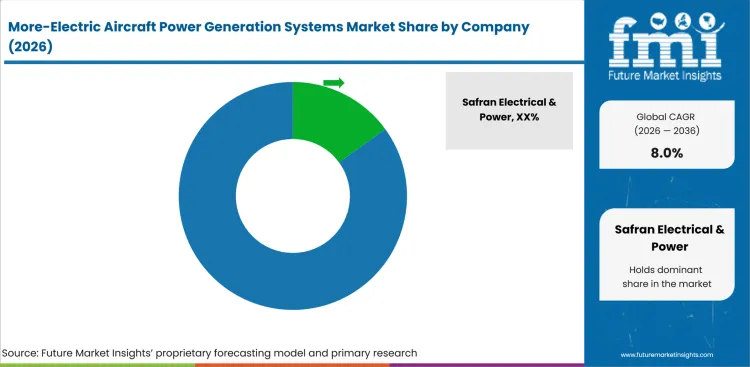
- Competition is centered on certified generator design, power density and generator control unit reliability.
- Leading suppliers win by pairing generator hardware with converters and aircraft-level test support.
- Aftermarket specialists secure service access by offering IDG and starter-generator overhaul near airline maintenance centers.
- Entry barriers include airworthiness approval, thermal management proof and high-voltage fault testing.
Safran Electrical & Power holds a strong share through AC generators and starter-generator depth. Its X-66 award in July 2024 covers a variable-frequency generator and control unit with more than 100.0 kW electrical output. Collins Aerospace holds strong positioning through IDG support and hybrid-electric test programs. Parker Meggitt and Honeywell support aircraft and defense applications with generator and controller capabilities.
Power output is only one competitive test. Suppliers must prove cooling and insulation across the full power architecture. Aerospace DC-DC converter and aircraft DC-DC converter needs rise as generator output moves toward higher-voltage DC layouts. Companies with qualification data and repair availability will stand out in OEM bids and aftermarket service.
Key Companies in the More-Electric Aircraft Power Generation Systems Market
- Generator and Electrical System Specialists: Safran Electrical & Power and Collins Aerospace hold strong positions through generators and starter-generators.
- Power Control Specialists: Parker Meggitt and Eaton Aerospace support generator control and aircraft power management needs.
- Hybrid Power Participants: GE Aerospace and Honeywell Aerospace Technologies support turbogenerator and motor-generator development for electric flight architectures.
- Aftermarket Support Specialists: AMETEK MRO supports generator repair and emergency power service needs.
Competitive Benchmarking: More-Electric Aircraft Power Generation Systems Market
| Company | Generator Depth | High-Voltage Testing | MRO Support | Geographic Footprint |
|---|---|---|---|---|
| Safran Electrical & Power | High | High | Medium | Global with French and U.S. depth |
| Collins Aerospace | High | High | High | Global with U.S. strength |
| Parker Meggitt | Medium | Medium | Medium | Europe and North America centered |
| GE Aerospace | Medium | High | Medium | Global engine platform depth |
| Honeywell Aerospace Technologies | Medium | Medium | Medium | Global aerospace systems depth |
| AMETEK MRO | Medium | Low | High | North America and global MRO |
| Eaton Aerospace | Low | Medium | Medium | Global power management footprint |
Source: Future Market Insights competitive analysis, 2026.
Key Developments in More-Electric Aircraft Power Generation Systems Market
- In September 2025, GE Aerospace and BETA Technologies formed a strategic partnership to develop a hybrid electric turbogenerator for advanced air mobility aircraft.
- In March 2026, Collins Aerospace completed the Clean Aviation Joint Undertaking HECATE project.
Key Players in the More-Electric Aircraft Power Generation Systems Market
Major Global Players
- Safran Electrical & Power
- Collins Aerospace
- Parker Meggitt
- GE Aerospace
- Honeywell Aerospace Technologies
Specialist and Regional Players
- AMETEK MRO
- Eaton Aerospace
Report Scope and Coverage
| Parameter | Details |
|---|---|
| Quantitative Units | USD 2.6 billion to USD 5.6 billion at 8.0% CAGR |
| Market Definition | Aircraft electrical power generation systems used to create and control onboard power for flight systems |
| Segments Covered | System type, power rating, aircraft type, fitment, end use, and region |
| System Type | Variable-frequency generators, starter-generators, integrated drive generators, generator control units, and turbogenerators |
| Power Rating | Below 50 kVA, 50 to 250 kVA, 250 to 500 kVA, and above 500 kVA |
| Aircraft Type | Commercial aircraft, business aviation, rotorcraft, and military aircraft |
| Fitment | OEM installation and aftermarket replacement |
| End Use | Narrow-body aircraft, wide-body aircraft, regional aircraft, rotorcraft, and defense platforms |
| Regions Covered | North America, Latin America, Western Europe, Eastern Europe, East Asia, South Asia and Pacific, Middle East and Africa |
| Countries Covered | United States, China, India, Germany, France, Japan, United Kingdom, and more than 30 countries |
| Key Companies Profiled | Safran Electrical & Power, Collins Aerospace, Parker Meggitt, GE Aerospace, Honeywell Aerospace Technologies, AMETEK MRO, and Eaton Aerospace |
| Forecast Period | 2026 to 2036 |
| Approach | Hybrid bottom-up and top-down method using aircraft deliveries, generator content, fitment mix, power rating split, and supplier activity |
| Source | Future Market Insights, 2026 |
Source: Future Market Insights, 2026.
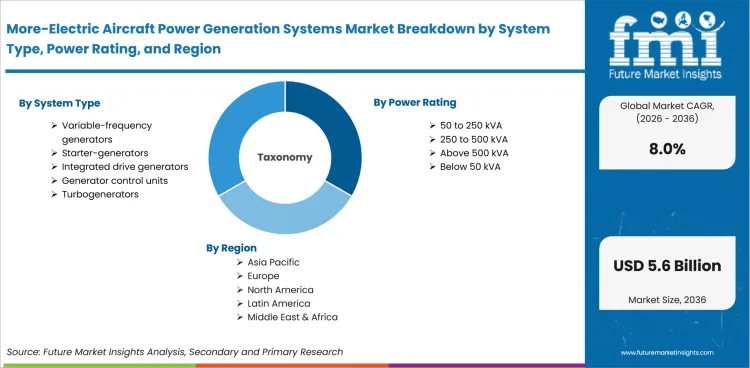
More-Electric Aircraft Power Generation Systems Market Breakdown by System Type, Power Rating, Aircraft Type, Fitment, End Use, and Region
More-Electric Aircraft Power Generation Systems Market Segmented by System Type:
- Variable-frequency generators
- Starter-generators
- Integrated drive generators
- Generator control units
- Turbogenerators
More-Electric Aircraft Power Generation Systems Market Segmented by Power Rating:
- Below 50 kVA
- 50 to 250 kVA
- 250 to 500 kVA
- Above 500 kVA
More-Electric Aircraft Power Generation Systems Market Segmented by Aircraft Type:
- Commercial aircraft
- Business aviation
- Rotorcraft
- Military aircraft
More-Electric Aircraft Power Generation Systems Market Segmented by Fitment:
- OEM installation
- Aftermarket replacement
More-Electric Aircraft Power Generation Systems Market Segmented by End Use:
- Narrow-body aircraft
- Wide-body aircraft
- Regional aircraft
- Rotorcraft
- Defense platforms
More-Electric Aircraft Power Generation Systems Market Segmented by Region:
- North America
- Latin America
- Western Europe
- Eastern Europe
- East Asia
- South Asia and Pacific
- Middle East and Africa
Research Sources and Bibliography
- Aerospace Industries Association. (2025, June 17). 2025 Facts & Figures: American aerospace & defense industry continues economic dominance. Aerospace Industries Association.
- ADS Group. (2026, February 26). Record start to 2026 as aircraft orders hit six-year high. ADS Group.
- AMETEK MRO. (2025, May 19). AMETEK MRO B&S Aircraft announces expanded power generation capabilities. AMETEK MRO.
- BDLI. (2026, May 27). BDLI Industry Data 2026: Aerospace industry sets new records for revenue and employment. Bundesverband der Deutschen Luft- und Raumfahrtindustrie.
- Civil Aviation Administration of China. (2026, April 22). CAAC releases Statistical Bulletin of Civil Aviation Industry Development in 2025. Civil Aviation Administration of China.
- Eaton. (2025, November 10). Eaton joins HYdrogen eLectrical Engine Novel Architecture (HYLENA) R&D project, taking sustainable aviation to new heights with revolutionary hydrogen-electric engines. Eaton.
- Eaton. (2026, January 23). Eaton completes acquisition of Ultra PCS Limited, expanding capabilities and solutions for next-generation aerospace and defense markets. Eaton.
- GE Aerospace. (2025, September 4). GE Aerospace and BETA Technologies partner to advance hybrid electric flight. GE Aerospace.
- GIFAS. (2026, May 11). 2025 results: The French aerospace industry remains strongly positioned for the future. GIFAS.
- GIFAS. (n.d.). Key figures. GIFAS.
- International Air Transport Association. (2026, March 2). 2026 begins with 3.8% air passenger demand growth. International Air Transport Association.
- Ministry of Civil Aviation, Government of India. (2026, May 30). Ministry of Civil Aviation dashboard: Domestic traffic and UDAN data. Ministry of Civil Aviation.
- RTX. (2026, March 17). RTX’s Collins Aerospace announces completion of Clean Aviation Joint Undertaking HECATE project. RTX.
- Safran. (2024, July 23). Safran selected by Boeing for X-66 NASA Sustainable Flight Demonstrator. Safran.
- Safran. (2025, October 15). Safran and Lufthansa Technik expand APU generator MRO partnership for Airbus A320 fleet. Safran.
- Safran. (2026, May 29). Safran awarded Innovation Fund grant for ENGINeUS PULL project. Safran.
- Society of Japanese Aerospace Companies. (2026, April). Japanese Aerospace Industry 2026. Society of Japanese Aerospace Companies
Questions Answered by the Report
- How large is the more-electric aircraft power generation systems market in 2026?
- What value is forecast for the market by 2036?
- Which system type is expected to hold a strong share in 2026?
- Which aircraft type creates the main demand route for generator packages?
- Which countries are expected to expand faster during the forecast period?
- How do OEM installation and aftermarket replacement differ in buying behavior?
- Which supplier capabilities are most important for high-voltage aircraft programs?
- How were market values and country CAGRs built?
Frequently Asked Questions
What is the value of the more-electric aircraft power generation systems market in 2026?
More-electric aircraft power generation systems market is expected to reach USD 2.6 billion in 2026, supported by fleet renewal and higher onboard electrical loads.
What is the forecast value by 2036?
Market value is forecast to reach USD 5.6 billion by 2036, with demand rising across OEM installation and certified aftermarket replacement.
What is the market CAGR from 2026 to 2036?
Demand is expected to rise at 8.0% CAGR from 2026 to 2036 as aircraft electrification and hybrid-electric testing expand supplier opportunities.
Which system type is expected to lead in 2026?
Variable-frequency generators are expected to account for 44.7% share in 2026 due to weight and efficiency benefits in newer aircraft designs.
Which aircraft type is expected to lead demand?
Commercial aircraft are forecast to account for 56.3% share in 2026 as Airbus and Boeing delivery programs create the main OEM route.
Which country is expected to record the fastest pace?
India is expected to move at 10.1% CAGR through 2036 as fleet use and airport activity increase the need for power generation components.
Which companies are active in the market?
Safran Electrical & Power and Collins Aerospace are active suppliers. Parker Meggitt, GE Aerospace, Honeywell Aerospace Technologies, AMETEK MRO and Eaton Aerospace are included.
What is the main restraint for suppliers?
High-voltage certification is the main restraint as generator output, thermal control and fault isolation must pass aircraft-level qualification.
Preview the report firsthand - request a free sample
Get SampleGet the brochure for pricing and purchase details.
Get PDFTable of Content
- Key Takeaways
- Market Size and CAGR
- Top Growth Driver
- Fastest Growing Segment
- Leading Region
- Key Companies
- Emerging Opportunities
- Executive Summary
- Global Market Outlook
- Demand-side Trends
- Supply-side Trends
- Technology Roadmap Analysis
- Analysis and Recommendations
- Analyst Perspective (What is happening? Why now? What should investors know?)
- Key Questions Answered
- How large is the market?
- What is the CAGR?
- What are key trends?
- Which region dominates?
- Who are the leaders?
- Market Overview
- Market Coverage / Taxonomy
- Market Definition / Scope / Limitations
- Research Methodology
- Chapter Orientation
- Analytical Lens and Working Hypotheses
- Market Structure, Signals, and Trend Drivers
- Benchmarking and Cross-market Comparability
- Market Sizing, Forecasting, and Opportunity Mapping
- Research Design and Evidence Framework
- Desk Research Programme (Secondary Evidence)
- Expert Input and Fieldwork (Primary Evidence)
- Tooling, Models, and Reference Databases
- Data Engineering and Model Build
- Quality Assurance and Audit Trail
- Market Background
- Market Dynamics (Drivers, Restraints, Opportunity, Trends)
- Scenario Forecast (Optimistic, Likely, Conservative)
- Impact Analysis
- AI Impact
- Sustainability Impact
- Regulatory Impact
- Technology Impact
- Consumer / Buyer Analysis
- Purchase Drivers
- Adoption Barriers
- Buyer Journey
- Opportunity Map Analysis
- Product Life Cycle Analysis
- Supply Chain Analysis
- Investment Feasibility Matrix
- Value Chain Analysis
- PESTLE and Porter's Analysis
- Regulatory Landscape
- Regional Parent Market Outlook
- Production and Consumption Statistics
- Import and Export Statistics
- Global Market Analysis and Forecast, 2021 to 2036
- Historical Market Size Value (USD Billion) & Volume (Unit) Analysis, 2021 to 2025
- Current and Future Market Size Value (USD Billion) & Volume (Unit) Projections, 2026 to 2036
- Y-o-Y Growth Trend Analysis
- Absolute $ Opportunity Analysis
- Global Market Pricing Analysis, 2021 to 2036
- Global Market Analysis and Forecast, By System Type, 2021 to 2036
- Introduction / Key Findings
- Historical Market Size Value (USD Billion) & Volume (Unit) Analysis By System Type, 2021 to 2025
- Current and Future Market Size Value (USD Billion) & Volume (Unit) Analysis and Forecast By System Type, 2026 to 2036
- Variable-frequency generators
- Starter-generators
- Integrated drive generators
- Generator control units
- Turbogenerators
- Variable-frequency generators
- Y-o-Y Growth Trend Analysis By System Type, 2021 to 2025
- Absolute $ Opportunity Analysis By System Type, 2026 to 2036
- Global Market Analysis and Forecast, By Power Rating, 2021 to 2036
- Introduction / Key Findings
- Historical Market Size Value (USD Billion) & Volume (Unit) Analysis By Power Rating, 2021 to 2025
- Current and Future Market Size Value (USD Billion) & Volume (Unit) Analysis and Forecast By Power Rating, 2026 to 2036
- 50 to 250 kVA
- Below 50 kVA
- 250 to 500 kVA
- Above 500 kVA
- 50 to 250 kVA
- Y-o-Y Growth Trend Analysis By Power Rating, 2021 to 2025
- Absolute $ Opportunity Analysis By Power Rating, 2026 to 2036
- Global Market Analysis and Forecast, By Aircraft Type, 2021 to 2036
- Introduction / Key Findings
- Historical Market Size Value (USD Billion) & Volume (Unit) Analysis By Aircraft Type, 2021 to 2025
- Current and Future Market Size Value (USD Billion) & Volume (Unit) Analysis and Forecast By Aircraft Type, 2026 to 2036
- Commercial aircraft
- Business aviation
- Rotorcraft
- Military aircraft
- Commercial aircraft
- Y-o-Y Growth Trend Analysis By Aircraft Type, 2021 to 2025
- Absolute $ Opportunity Analysis By Aircraft Type, 2026 to 2036
- Global Market Analysis and Forecast, By Fitment, 2021 to 2036
- Introduction / Key Findings
- Historical Market Size Value (USD Billion) & Volume (Unit) Analysis By Fitment, 2021 to 2025
- Current and Future Market Size Value (USD Billion) & Volume (Unit) Analysis and Forecast By Fitment, 2026 to 2036
- OEM installation
- Aftermarket replacement
- OEM installation
- Y-o-Y Growth Trend Analysis By Fitment, 2021 to 2025
- Absolute $ Opportunity Analysis By Fitment, 2026 to 2036
- Global Market Analysis and Forecast, By End Use, 2021 to 2036
- Introduction / Key Findings
- Historical Market Size Value (USD Billion) & Volume (Unit) Analysis By End Use, 2021 to 2025
- Current and Future Market Size Value (USD Billion) & Volume (Unit) Analysis and Forecast By End Use, 2026 to 2036
- Narrow-body aircraft
- Wide-body aircraft
- Regional aircraft
- Rotorcraft
- Defense platforms
- Narrow-body aircraft
- Y-o-Y Growth Trend Analysis By End Use, 2021 to 2025
- Absolute $ Opportunity Analysis By End Use, 2026 to 2036
- Global Market Analysis and Forecast, By Region, 2021 to 2036
- Introduction
- Historical Market Size Value (USD Billion) & Volume (Unit) Analysis By Region, 2021 to 2025
- Current Market Size Value (USD Billion) & Volume (Unit) Analysis and Forecast By Region, 2026 to 2036
- North America
- Latin America
- Western Europe
- Eastern Europe
- East Asia
- South Asia and Pacific
- Middle East & Africa
- Market Attractiveness Analysis By Region
- North America Market Analysis and Forecast, By Country, 2021 to 2036
- Historical Market Size Value (USD Billion) & Volume (Unit) Trend Analysis By Market Taxonomy, 2021 to 2025
- Market Size Value (USD Billion) & Volume (Unit) Forecast By Market Taxonomy, 2026 to 2036
- By Country
- USA
- Canada
- Mexico
- By System Type
- By Power Rating
- By Aircraft Type
- By Fitment
- By End Use
- By Country
- Market Attractiveness Analysis
- By Country
- By System Type
- By Power Rating
- By Aircraft Type
- By Fitment
- By End Use
- Key Takeaways
- Latin America Market Analysis and Forecast, By Country
- Historical Market Size Value (USD Billion) & Volume (Unit) Trend Analysis By Market Taxonomy, 2021 to 2025
- Market Size Value (USD Billion) & Volume (Unit) Forecast By Market Taxonomy, 2026 to 2036
- By Country
- Brazil
- Chile
- Rest of Latin America
- By System Type
- By Power Rating
- By Aircraft Type
- By Fitment
- By End Use
- By Country
- Market Attractiveness Analysis
- By Country
- By System Type
- By Power Rating
- By Aircraft Type
- By Fitment
- By End Use
- Key Takeaways
- Western Europe Market Analysis and Forecast, By Country
- Historical Market Size Value (USD Billion) & Volume (Unit) Trend Analysis By Market Taxonomy, 2021 to 2025
- Market Size Value (USD Billion) & Volume (Unit) Forecast By Market Taxonomy, 2026 to 2036
- By Country
- Germany
- UK
- Italy
- Spain
- France
- Nordic
- BENELUX
- Rest of Western Europe
- By System Type
- By Power Rating
- By Aircraft Type
- By Fitment
- By End Use
- By Country
- Market Attractiveness Analysis
- By Country
- By System Type
- By Power Rating
- By Aircraft Type
- By Fitment
- By End Use
- Key Takeaways
- Eastern Europe Market Analysis and Forecast, By Country
- Historical Market Size Value (USD Billion) & Volume (Unit) Trend Analysis By Market Taxonomy, 2021 to 2025
- Market Size Value (USD Billion) & Volume (Unit) Forecast By Market Taxonomy, 2026 to 2036
- By Country
- Russia
- Poland
- Hungary
- Balkan & Baltic
- Rest of Eastern Europe
- By System Type
- By Power Rating
- By Aircraft Type
- By Fitment
- By End Use
- By Country
- Market Attractiveness Analysis
- By Country
- By System Type
- By Power Rating
- By Aircraft Type
- By Fitment
- By End Use
- Key Takeaways
- East Asia Market Analysis and Forecast, By Country
- Historical Market Size Value (USD Billion) & Volume (Unit) Trend Analysis By Market Taxonomy, 2021 to 2025
- Market Size Value (USD Billion) & Volume (Unit) Forecast By Market Taxonomy, 2026 to 2036
- By Country
- China
- Japan
- South Korea
- By System Type
- By Power Rating
- By Aircraft Type
- By Fitment
- By End Use
- By Country
- Market Attractiveness Analysis
- By Country
- By System Type
- By Power Rating
- By Aircraft Type
- By Fitment
- By End Use
- Key Takeaways
- South Asia and Pacific Market Analysis and Forecast, By Country
- Historical Market Size Value (USD Billion) & Volume (Unit) Trend Analysis By Market Taxonomy, 2021 to 2025
- Market Size Value (USD Billion) & Volume (Unit) Forecast By Market Taxonomy, 2026 to 2036
- By Country
- India
- ASEAN
- Australia & New Zealand
- Rest of South Asia and Pacific
- By System Type
- By Power Rating
- By Aircraft Type
- By Fitment
- By End Use
- By Country
- Market Attractiveness Analysis
- By Country
- By System Type
- By Power Rating
- By Aircraft Type
- By Fitment
- By End Use
- Key Takeaways
- Middle East & Africa Market Analysis and Forecast, By Country
- Historical Market Size Value (USD Billion) & Volume (Unit) Trend Analysis By Market Taxonomy, 2021 to 2025
- Market Size Value (USD Billion) & Volume (Unit) Forecast By Market Taxonomy, 2026 to 2036
- By Country
- Kingdom of Saudi Arabia
- Other GCC Countries
- Türkiye
- South Africa
- Other African Union
- Rest of Middle East & Africa
- By System Type
- By Power Rating
- By Aircraft Type
- By Fitment
- By End Use
- By Country
- Market Attractiveness Analysis
- By Country
- By System Type
- By Power Rating
- By Aircraft Type
- By Fitment
- By End Use
- Key Takeaways
- Key Countries Market Analysis
- USA
- Pricing Analysis
- Market Share Analysis, 2025
- By System Type
- By Power Rating
- By Aircraft Type
- By Fitment
- By End Use
- Canada
- Pricing Analysis
- Market Share Analysis, 2025
- By System Type
- By Power Rating
- By Aircraft Type
- By Fitment
- By End Use
- Mexico
- Pricing Analysis
- Market Share Analysis, 2025
- By System Type
- By Power Rating
- By Aircraft Type
- By Fitment
- By End Use
- Brazil
- Pricing Analysis
- Market Share Analysis, 2025
- By System Type
- By Power Rating
- By Aircraft Type
- By Fitment
- By End Use
- Chile
- Pricing Analysis
- Market Share Analysis, 2025
- By System Type
- By Power Rating
- By Aircraft Type
- By Fitment
- By End Use
- Germany
- Pricing Analysis
- Market Share Analysis, 2025
- By System Type
- By Power Rating
- By Aircraft Type
- By Fitment
- By End Use
- UK
- Pricing Analysis
- Market Share Analysis, 2025
- By System Type
- By Power Rating
- By Aircraft Type
- By Fitment
- By End Use
- Italy
- Pricing Analysis
- Market Share Analysis, 2025
- By System Type
- By Power Rating
- By Aircraft Type
- By Fitment
- By End Use
- Spain
- Pricing Analysis
- Market Share Analysis, 2025
- By System Type
- By Power Rating
- By Aircraft Type
- By Fitment
- By End Use
- France
- Pricing Analysis
- Market Share Analysis, 2025
- By System Type
- By Power Rating
- By Aircraft Type
- By Fitment
- By End Use
- India
- Pricing Analysis
- Market Share Analysis, 2025
- By System Type
- By Power Rating
- By Aircraft Type
- By Fitment
- By End Use
- ASEAN
- Pricing Analysis
- Market Share Analysis, 2025
- By System Type
- By Power Rating
- By Aircraft Type
- By Fitment
- By End Use
- Australia & New Zealand
- Pricing Analysis
- Market Share Analysis, 2025
- By System Type
- By Power Rating
- By Aircraft Type
- By Fitment
- By End Use
- China
- Pricing Analysis
- Market Share Analysis, 2025
- By System Type
- By Power Rating
- By Aircraft Type
- By Fitment
- By End Use
- Japan
- Pricing Analysis
- Market Share Analysis, 2025
- By System Type
- By Power Rating
- By Aircraft Type
- By Fitment
- By End Use
- South Korea
- Pricing Analysis
- Market Share Analysis, 2025
- By System Type
- By Power Rating
- By Aircraft Type
- By Fitment
- By End Use
- Russia
- Pricing Analysis
- Market Share Analysis, 2025
- By System Type
- By Power Rating
- By Aircraft Type
- By Fitment
- By End Use
- Poland
- Pricing Analysis
- Market Share Analysis, 2025
- By System Type
- By Power Rating
- By Aircraft Type
- By Fitment
- By End Use
- Hungary
- Pricing Analysis
- Market Share Analysis, 2025
- By System Type
- By Power Rating
- By Aircraft Type
- By Fitment
- By End Use
- Kingdom of Saudi Arabia
- Pricing Analysis
- Market Share Analysis, 2025
- By System Type
- By Power Rating
- By Aircraft Type
- By Fitment
- By End Use
- Türkiye
- Pricing Analysis
- Market Share Analysis, 2025
- By System Type
- By Power Rating
- By Aircraft Type
- By Fitment
- By End Use
- South Africa
- Pricing Analysis
- Market Share Analysis, 2025
- By System Type
- By Power Rating
- By Aircraft Type
- By Fitment
- By End Use
- USA
- Market Structure Analysis
- Competition Dashboard
- Competition Benchmarking
- Market Share Analysis of Top Players
- By Regional
- By System Type
- By Power Rating
- By Aircraft Type
- By Fitment
- By End Use
- Emerging Startups
- Innovation Benchmarking
- Competition Analysis
- Competition Deep Dive
- Safran Electrical & Power
- Overview
- Product Portfolio
- Profitability by Market Segments (Product/Region/Sales Channel)
- Sales Footprint
- Strategy Overview
- Marketing Strategy
- Product Strategy
- Channel Strategy
- Collins Aerospace
- Parker Meggitt
- GE Aerospace
- Honeywell Aerospace Technologies
- AMETEK MRO
- Eaton Aerospace
- Safran Electrical & Power
- Case Studies
- Success Stories
- Recent Developments
- Competition Deep Dive
- Assumptions & Acronyms Used


