

- Market Size (2026)
- USD 3.1 Bn
- Forecast (2036)
- USD 5.1 Bn
- CAGR (2026 to 2036)
- 5.1%
How big is Aircraft Landing Gear Trunnions Market in 2026?
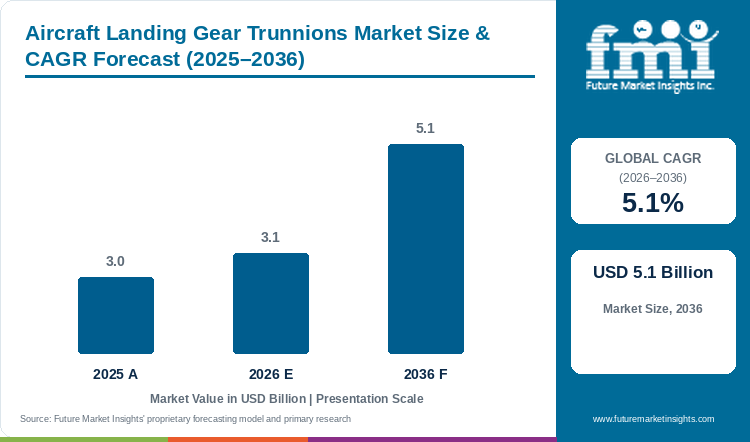
Demand for aircraft landing gear trunnions is projected to expand at 5.1% CAGR between 2026 and 2036. Market value was USD 3.0 billion in 2025 and is expected at USD 3.1 billion in 2026. It is projected to reach USD 5.1 billion by 2036.
Aircraft landing gear trunnion demand is forecast to rise from USD 3.1 billion in 2026 to USD 5.1 billion by 2036 at a 5.1% CAGR. Related Future Market Insights reports project aircraft tires at 8.1% CAGR, aircraft struts at 6.3%, aircraft lubricants at 5.2%, and aircraft MRO at 3.2% over their respective forecast periods. This comparison places trunnions below tires and struts, broadly in line with aircraft lubricants and above the wider MRO category. Growth is supported by two recurring demand streams: new aircraft require complete trunnion shipsets, while aging fleets generate inspection, overhaul, repair and replacement activity. This mix gives qualified suppliers exposure to both production schedules and the installed fleet, although program-specific approvals continue to govern access to each revenue stream.
Spain's 2,696,414 aircraft movements in 2025 support recurring demand for Aircraft MRO services across its installed fleet. Canada's aerospace market relies more on production schedules and export demand. AIAC and ISED reported in July 2026 that exports generated over 70% of Canadian aerospace manufacturing revenue in 2025. These different operating bases direct Spanish demand toward maintenance and Canadian demand toward parts for active aircraft programs.
Key Takeaways
- Commercial aircraft build schedules support trunnion demand through approved structural hardware required for every new landing gear shipset.
- By trunnion type, main landing gear trunnions are projected to account for 34.0% in 2026, supported by primary load transfer.
- By aircraft type, narrow-body aircraft are estimated to account for 33.0% in 2026, driven by recurring single-aisle production schedules.
- In 2026, high-strength steel is expected to hold 45.0% of material demand, supported by approved heat-treatment and finishing routes.
- FMI analysis suggests 6.1% CAGR for Spain over the assessment period, while Canada's 5.8% outlook is tied to export-oriented aerospace manufacturing.
- Aircraft Landing Gear Trunnions Market includes Safran Landing Systems, Collins Aerospace, Liebherr-Aerospace, Héroux-Devtek, TRIUMPH, Magellan Aerospace, Bharat Forge and GA Telesis Landing Gear Services.
Analyst Perspective
"Aircraft output keeps approved landing gear suppliers busy, and older fleets add more overhaul work. New capacity matters only where suppliers can match the material and process route already accepted by the aircraft program."
- Nikhil Kaitwade, Principal Consultant, Future Market Insights
How is the aircraft landing gear trunnions market segmented?
Aircraft Landing Gear Trunnions Market is segmented by five primary commercial axes and region: trunnion type, aircraft type, material, sales channel, manufacturing and region. Main landing gear trunnions are estimated at 34.0%, narrow-body aircraft at 33.0%, and high-strength steel at 45.0% in 2026.
Trunnion type includes main landing gear trunnions, nose gear trunnions, titanium trunnions, forged steel trunnions and machined trunnion assemblies.
Aircraft type includes narrow-body aircraft, wide-body aircraft, regional aircraft, business jets and military aircraft.
Material includes high-strength steel, titanium, aluminum bronze and specialty alloys.
Sales channel includes landing gear Tier-1s, aircraft OEMs, MRO/spares and defense programs.
Manufacturing includes forging, precision machining, heat treatment and surface coating/plating.
Region covers North America, Latin America, Western Europe, Eastern Europe, East Asia, South Asia and Pacific, and Middle East and Africa.
Why do main landing gear trunnions retain share in trunnion type demand?
Main landing gear trunnions are estimated to hold 34.0% of trunnion type revenue in 2026, supported by load transfer.
Main landing gear trunnions carry aircraft weight during landing, taxiing and ground parking. The load moves through a fixed airframe attachment, so each trunnion must match the program's geometry and inspection record. Landing gear struts absorb landing energy, but they do not replace the trunnion's structural attachment role.
- FMI's segment analysis indicates main landing gear trunnions at 34.0% of trunnion type revenue in 2026, supported by primary load transfer.
- In January 2026 EASA required A350 checks of trunnion-block fuse and retaining pins. Each inspected part remains tied to its maintenance record.
What supports narrow-body aircraft demand within the aircraft type category?
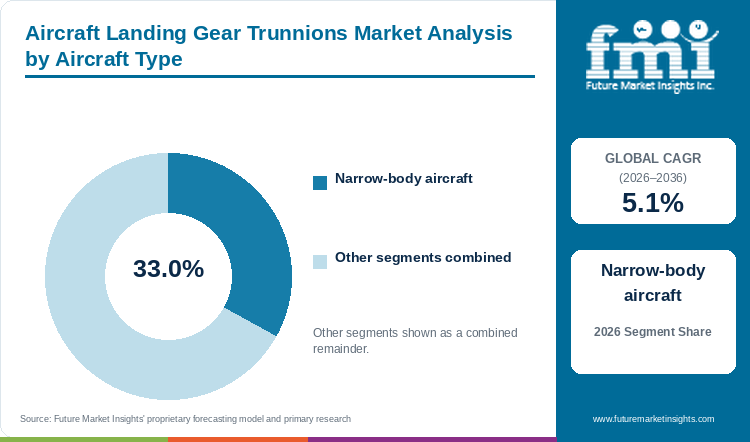
By aircraft type, narrow-body aircraft are projected to hold 33.0% in 2026, driven by recurring single-aisle production schedules.
Narrow-body programs generate repeat trunnion orders from large-volume purchases of the same aircraft families. Each family uses a fixed landing gear design, so the same trunnion interfaces recur on every aircraft. Aerospace fasteners and other structural parts follow the same production schedule. Qualified trunnion suppliers repeat one approved machining route through serial production.
- Narrow-body aircraft are estimated to hold 33.0% of aircraft type demand in 2026 through recurring single-aisle shipset volume.
- In January 2026 Boeing reported 447 deliveries from the 737 program during 2025. Each delivery required an approved landing gear shipset and associated structural hardware.
How does high-strength steel meet material needs in landing gear trunnions?
High-strength steel is forecast to represent 45.0% of material demand in 2026, supported by established qualified processing routes.
High-strength steel remains common in trunnions that carry repeated ground loads through a compact structural section. Existing aircraft programs already approve specific heat-treatment and finishing routes for steel. The existing approval reduces repeat qualification work during serial production. Aerospace titanium can reduce weight in selected designs, but changing material starts a separate approval path.
- High-strength steel is estimated to hold 45.0% of material demand in 2026, supported by aircraft programs with approved heat-treatment and finishing routes.
- Steel still needs controlled heat treatment and surface finishing before an approved aircraft program can accept the finished trunnion.
Why do landing gear Tier-1s remain central in sales channel demand?
Landing gear Tier-1s are expected to account for 44.0% of sales channel revenue in 2026, enabled by design-authority control.
Landing gear Tier-1s connect aircraft OEMs with component suppliers through their control of system drawings and interface data. The same drawings also govern aircraft actuators used in the approved landing gear assembly. Independent machine shops can supply trunnions once their material route and process records match that configuration.
- Landing gear Tier-1s are estimated to hold 44.0% of sales channel revenue in 2026, supported by control of system drawings and supplier approval.
- Tier-1 approval links trunnion interfaces and supplier records to the same aircraft configuration from part release through complete gear assembly.
Which conditions keep forging relevant within the trunnion manufacturing category?
Forging is projected to hold 37.0% of manufacturing revenue in 2026, owing to controlled metal flow before machining.
Trunnion production begins with a load-bearing metal blank, so forging remains central before precision machining. Controlled metal flow gives the blank the grain structure needed for repeated landing loads. Heat treatment then sets material properties, and machining produces the final dimensions required by the aerospace landing gear program.
- Forging is estimated to hold 37.0% of manufacturing revenue in 2026, supported by controlled metal flow in load-bearing trunnion blanks.
- Forged blanks move into serial production once heat-treatment and dimensional records match the approved machining route.
What are the drivers, restraints and opportunities in the Aircraft Landing Gear Trunnions Market?
In the aircraft landing gear trunnions market, aircraft output is the key driver, program approval the key restraint and fleet overhaul the key opportunity.
- Aircraft production expands trunnion demand through approved structural hardware required for every new landing gear shipset.
- Restraint: Program-specific material and process approval delays supplier changes despite available machining capacity.
- Opportunity: FMI's forecast model projects recurring trunnion work from fleet overhaul for providers that already hold approved landing gear repair routes.
Aircraft Production Raises Shipset Demand
Commercial aircraft production directly raises trunnion demand through approved structural hardware required for each landing gear shipset. Airbus forecast 42,060 new aircraft through 2045 in its July 2026 Global Market Forecast. Those build plans keep trunnion orders tied to aircraft drawings and approved supplier routes. Aircraft tires also rise with deliveries and follow the same aircraft build schedule. Trunnion suppliers face a narrower entry path because material and process records must match the aircraft program.
Program Approval Slows Supplier Changes
Supplier changes take time under aircraft programs that approve a defined material route and production process. In October 2025 the NTSB issued an urgent recommendation covering 1,883 Learjet aircraft. The recommendation called for checks of the aft trunnion pin and retaining bolt. Maintenance chemicals used during cleaning and surface work also follow aircraft-specific documentation. A new trunnion supplier must match the approved route before production can transfer.
Fleet Overhaul Extends Trunnion Demand
Regular landing gear inspection and overhaul keep trunnion demand active throughout an aircraft's service life. Wear or damage can move a trunnion from inspection to repair or replacement. GA Telesis published an April 2025 capability manual covering landing gear repair and specialized processing. The manual confirms that independent MRO providers can perform approved lifecycle work. Aircraft lubricants follow routine service schedules, but trunnion repair depends on part-specific approval. Regional overhaul can reduce routing time if the local shop already holds that approval.
Which country CAGRs are profiled in the Aircraft Landing Gear Trunnions Market?
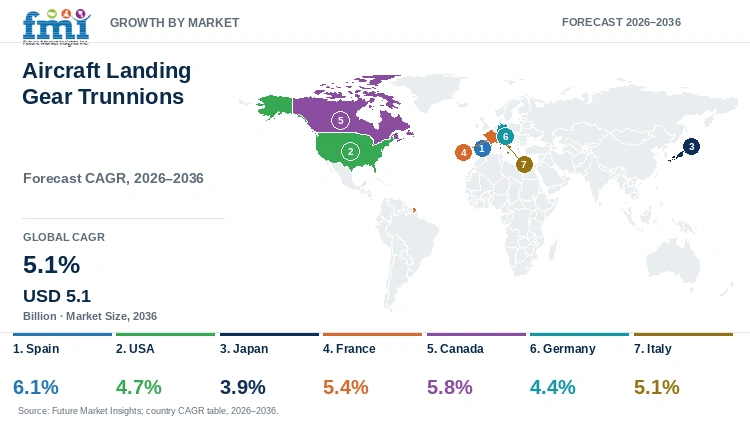
| Country | CAGR |
|---|---|
| Spain | 6.1% |
| USA | 4.7% |
| Japan | 3.9% |
| France | 5.4% |
| Canada | 5.8% |
| Germany | 4.4% |
| Italy | 5.1% |
How do country-level CAGRs compare in the Aircraft Landing Gear Trunnions Market?
Country demand follows two main routes: new aircraft programs and maintenance on installed fleets.
Local manufacturing supports new-build orders, while approved MRO capacity determines how much landing gear service remains inside each country.
- Spain combines dense airport traffic with Airbus-linked production and European defense work, supporting both overhaul and qualified structural demand.
- US aircraft production and its large installed fleet support both new-build trunnion orders and recurring landing gear overhaul work.
- Japan's airline network supports planned landing gear service, and imported aircraft remain tied to global OEM approval routes.
- France combines aircraft production with local landing-system manufacturing, so trunnion demand comes from new builds and approved component work.
- Canada's export-oriented aerospace base connects local machining and overhaul shops with aircraft programs outside the country.
- Germany combines European aircraft production with defense procurement, supporting qualified landing gear manufacturing and overhaul work.
- Italy's airport traffic supports fleet service, and European aerospace programs add qualified structural demand for new aircraft.
Full report country CAGRs cover: North America; Latin America; Western Europe; Eastern Europe; East Asia; South Asia and Pacific; Middle East and Africa.
Country-wise Analysis
- Spain has a service-heavy demand profile supported by high aircraft movement at its airports. The trunnions market is projected to expand at 6.1% CAGR over the forecast period. Aena reported 2,696,414 aircraft movements in 2025, which keeps landing gear inspections and overhaul visits frequent. European civil and defense programs add a second demand source for qualified structural hardware. Suppliers can serve both routes with approved machining and surface-treatment processes. Available machine capacity is not enough on its own because the aircraft program controls the accepted material and production route. Recurring fleet work and program-linked manufacturing give approved suppliers two distinct order channels in Spain.
- US demand comes from both a large installed fleet and continuing aircraft production. The market is forecast to grow at 4.7% CAGR during the assessment period. In May 2026 the FAA reported more than 24 million commercial operations at 529 towered airports in fiscal 2025. The flight volume keeps inspection and overhaul work spread through a large service network. Aircraft factories add new-build trunnion orders through separate OEM programs. Maintenance release requires configuration records for replacement parts, and production work requires first-article approval from new suppliers. The same qualification system governs both channels, so approved suppliers can serve fleet maintenance and aircraft production without changing the underlying aircraft configuration.
- Japan's trunnion demand is mainly tied to aircraft already in service. Demand is estimated to rise at 3.9% CAGR between 2026 and 2036. MLIT reported in June 2026 that Japanese operators carried 112.5 million domestic passengers and 23.46 million international passengers during fiscal 2025. The traffic base supports scheduled landing gear inspections and planned part replacement. Japan has less domestic airframe production than the larger manufacturing markets in this comparison, so service cycles carry more weight in the outlook. Buyers still need approved technical records before a trunnion can move between aircraft configurations. Aircraft-specific approval continues to govern stocking and overhaul decisions in Japan.
- France has a production-led trunnion market built around airframe programs and domestic landing-system manufacturing. The market is projected to record 5.4% CAGR over the projection period. In February 2026 the DGA reported 11 Rafale deliveries during 2025, plus one A400M and one MRTT. Those deliveries require program-specific structural hardware throughout the approved supply chain. Safran also maintains landing-system machining and finishing capability in France for civil and defense programs. Local suppliers can access new-build and continuing program work if their machining and finishing routes match the aircraft specification. The combination of aircraft output and landing-system capability keeps more trunnion value inside qualified domestic production.
- Canada's trunnion outlook is closely tied to export aircraft programs. The market is estimated to post 5.8% CAGR by 2036, supported by manufacturing and fleet-service capability. AIAC and ISED reported in July 2026 that the aerospace sector supported 218,700 jobs in 2025. The same report said exports generated more than 70% of aerospace manufacturing revenue. The export share links Canadian plants to foreign aircraft programs and their qualification rules. Landing gear engineering and overhaul provide a second source of demand from installed fleets. Approved program roles give Canadian suppliers access to production and service work, since additional machining capacity cannot replace qualification.
- Germany's trunnion demand follows aircraft program schedules more closely than airport traffic. The market is anticipated to advance at 4.4% CAGR over the assessment period. In October 2025 the Bundeswehr announced production of 20 Eurofighter Tranche 5 aircraft for Germany, with availability planned by 2034. The order adds structural hardware demand to an established civil aerospace base. Landing gear engineering and overhaul also keep approved service capacity in use. New machining capacity can join these programs once its finishing and production routes clear aircraft-specific approval. Approval timing determines the start of commercial production and limits how quickly new capacity can support the program.
- Italy combines active fleet service with participation in European aircraft programs. The market is forecast to expand at 5.1% CAGR during the forecast period. ENAC reported in May 2026 that Italian airports handled more than 229.7 million passengers during 2025. The traffic base keeps landing gear inspection and replacement work active on aircraft already in service. European aircraft programs add a second stream of structural orders for qualified manufacturers. Each trunnion still follows an approved machining and special-process chain before release to the aircraft program. Service demand and new-build work support different order routes, and both depend on suppliers maintaining the required aircraft configuration and production records.
Who are the notable companies in the aircraft landing gear trunnions market?
Notable companies in the Aircraft Landing Gear Trunnions Market include Safran Landing Systems, Collins Aerospace, Liebherr-Aerospace, Héroux-Devtek, TRIUMPH, Magellan Aerospace, Bharat Forge, and GA Telesis Landing Gear Services.
Competition remains moderately concentrated at the complete landing gear system level. A small group controls complete landing gear designs and aircraft interfaces. Safran Landing Systems, Collins Aerospace, Liebherr-Aerospace and Héroux-Devtek hold system or lifecycle roles. TRIUMPH combines landing gear supply with actuation for aircraft programs. Magellan Aerospace and Bharat Forge compete through metal manufacturing, whereas GA Telesis Landing Gear Services focuses on overhaul and exchange. The supplier base becomes broader once the aircraft interface is fixed. Approved component makers and service providers can then compete without owning the complete landing gear design.
- Integrated landing gear systems: Safran Landing Systems, Collins Aerospace, Liebherr-Aerospace, Héroux-Devtek and TRIUMPH supply complete systems or lifecycle support.
- Critical-metal manufacturing: Magellan Aerospace and Bharat Forge provide aerospace machining or forging for structural landing gear parts.
- Lifecycle services: GA Telesis Landing Gear Services provides landing gear overhaul and exchange support for commercial and military fleets.
Competitive Benchmarking: Aircraft Landing Gear Trunnions Market
| Company | Structural Authority | Critical-Metal Depth | Fleet-Life Support | Geographic Reach |
|---|---|---|---|---|
| Safran Landing Systems | High | High | High | High |
| Collins Aerospace | High | High | High | High |
| Liebherr-Aerospace | High | High | High | High |
| Héroux-Devtek | High | High | High | Medium |
| TRIUMPH | Medium | Medium | Low | Medium |
| Magellan Aerospace | Low | High | Low | Medium |
| Bharat Forge | Low | High | Low | Medium |
| GA Telesis Landing Gear Services | Low | Medium | High | Medium |
A High rating means public evidence covers most of the stated dimension. Medium indicates narrower documented coverage, and Low indicates limited evidence. Geographic reach uses the same scale for international operating coverage. The ratings compare documented capability breadth and do not measure market share or company quality.
Key Developments in the Aircraft Landing Gear Trunnions Market
- In June 2026, Collins Aerospace opened expanded Tajęcina capacity that raises landing gear system production by nearly 25% for commercial and defense programs.
- In June 2025, Safran Landing Systems opened new machining capacity and two surface-treatment lines at its Molsheim landing and braking systems site.
- In February 2025, Platinum Equity completed its acquisition of Héroux-Devtek. The landing gear manufacturer continued operating under its existing company name.
Key Players in the Aircraft Landing Gear Trunnions Market
Integrated Landing Gear System Houses
- Safran Landing Systems
- Collins Aerospace
- Liebherr-Aerospace
- Héroux-Devtek
- TRIUMPH
Critical-Metal Component Manufacturing
- Magellan Aerospace
- Bharat Forge
Lifecycle and Overhaul Services
- GA Telesis Landing Gear Services
Aircraft Landing Gear Trunnions Market - Report Scope
| Coverage field | Report scope |
|---|---|
| Market breakdown | By trunnion type, aircraft type, material, sales channel, manufacturing, and region. |
| Quantitative Units | USD billion. |
| Market Definition | Aircraft landing gear trunnions include load-bearing trunnion hardware and directly associated qualified manufacturing value used to attach or support landing gear structures. Unrelated landing gear assemblies, tires, brakes, and generic fasteners are excluded. |
| Regions Covered | North America, Latin America, Western Europe, Eastern Europe, East Asia, South Asia and Pacific, and Middle East and Africa. |
| Countries Covered | Spain, USA, Japan, France, Canada, Germany, Italy, and 20+ countries included in the full report. |
| Key Companies Profiled | Safran Landing Systems, Collins Aerospace, Liebherr-Aerospace, Héroux-Devtek, TRIUMPH, Magellan Aerospace, Bharat Forge, and GA Telesis Landing Gear Services. |
| Forecast Period | 2026 to 2036. |
| Approach | Primary and secondary research with market triangulation. |
Aircraft Landing Gear Trunnions Market - Research Methodology
| Method | Approach |
|---|---|
| Primary Research | FMI analysts gathered input from manufacturers, service providers, technology developers, distributors, end users, procurement teams, and subject-matter experts. Interviews examined purchasing decisions, product or service evaluation, adoption barriers, approval requirements, pricing considerations, and expectations for technical or commercial support. Respondents were also asked what evidence is required before a trial, pilot, or initial order develops into regular purchasing. |
| Desk Research | Desk research covered government statistics, regulatory publications, trade data, industry associations, technical literature, standards, company filings, product information, and official corporate announcements. Sources were reviewed for relevance, publication date, geographic coverage, and consistency with the defined market scope. Claims relating to performance, applications, approvals, capacity, investment, and commercial activity were retained only when supported by credible public evidence. |
| Market Sizing and Forecasting | The market model combined the baseline value with historical performance, segment structure, pricing and volume indicators, adoption levels, company participation, and country-level demand conditions. Forecast assumptions considered economic activity, investment trends, regulatory developments, technology adoption, purchasing cycles, supply availability, and barriers to wider market use. Segment and regional estimates were reconciled before the final market total was calculated. |
| Data Validation | Estimates were checked against multiple independent indicators, including public data, company activity, trade patterns, industry developments, and findings from primary interviews. Validation also tested whether products, services, applications, and company revenues fell within the defined market boundaries. Adjacent categories, unsupported claims, overlapping revenues, and activities without direct market relevance were excluded to reduce double counting and maintain consistency across segments and countries. |
Aircraft Landing Gear Trunnions Market by Segments
Aircraft Landing Gear Trunnions Market segmented by Trunnion Type:
- Main landing gear trunnions
- Nose gear trunnions
- Titanium trunnions
- Forged steel trunnions
- Machined trunnion assemblies
Aircraft Landing Gear Trunnions Market segmented by Aircraft Type:
- Narrow-body aircraft
- Wide-body aircraft
- Regional aircraft
- Business jets
- Military aircraft
Aircraft Landing Gear Trunnions Market segmented by Material:
- High-strength steel
- Titanium
- Aluminum bronze
- Specialty alloys
Aircraft Landing Gear Trunnions Market segmented by Sales Channel:
- Landing gear Tier-1s
- Aircraft OEMs
- MRO/spares
- Defense programs
Aircraft Landing Gear Trunnions Market segmented by Manufacturing:
- Forging
- Precision machining
- Heat treatment
- Surface coating/plating
Aircraft Landing Gear Trunnions Market by Region:
- North America
- United States
- Canada
- Latin America
- Brazil
- Mexico
- Argentina
- Chile
- Western Europe
- Germany
- France
- United Kingdom
- Italy
- Spain
- Benelux
- Nordics
- Eastern Europe
- Poland
- Czech Republic
- Romania
- Hungary
- East Asia
- China
- Japan
- South Korea
- South Asia and Pacific
- India
- ASEAN
- Australia and New Zealand
- Middle East and Africa
- GCC Countries
- South Africa
- Türkiye
- Israel
Research Sources and Bibliography
- Airbus. (2026, January 12). Airbus reports 793 commercial aircraft deliveries in 2025. Airbus.
- Airbus. (2026, July 8). Airbus forecasts traffic growth driven by urbanisation and increased connectivity made possible by aircraft efficiency.
- Aena. (2026, January 13). Los aeropuertos del Grupo Aena superan los 384,8 millones de pasajeros en 2025 [Aena Group airports exceed 384.8 million passengers in 2025].
- Aerospace Industries Association of Canada. (2026, July 15). AIAC & ISED release latest State of Canada’s Aerospace Industry Report.
- European Union Aviation Safety Agency. (2026, January 26). 2026-0018: Wings - Main Landing Gear Trunnion Block Fuse Pins and Retaining Pins - Inspection.
https://ad.easa.europa.eu/ad/2026-0018 - Boeing. (2026, January 13). Boeing announces fourth-quarter deliveries. Boeing.
- RTX. (n.d.). Landing gear. Collins Aerospace. Retrieved September 27, 2026.
- Safran. (n.d.). Landing gear systems & equipment. Retrieved September 27, 2026.
- Liebherr-Aerospace. (n.d.). Landing gear and ground control systems. Retrieved September 27, 2026.
- Héroux-Devtek. (n.d.). Landing gear. Retrieved September 27, 2026.
- Bharat Forge. (n.d.). Aerospace component details: Landing gear components. Retrieved September 28, 2026.
- National Transportation Safety Board. (2025, October 29). NTSB issues urgent recommendation on Learjet landing gear.
https://www.ntsb.gov/news/press-releases/Pages/mr20251029.aspx - GA Telesis. (2025, April 4). GA Telesis Landing Gear Services, LLC capability manual. GA Telesis.
- Federal Aviation Administration. (2026, May). FAA Aerospace Forecast Fiscal Years 2026-2046. Federal Aviation Administration.
- Ministry of Land, Infrastructure, Transport and Tourism, Japan. (2026, June 30). [Annual air transport statistics: FY2025 summary].
https://www.mlit.go.jp/report/press/joho05_hh_000909.html - Direction générale de l’armement. (2026, February 6). Un niveau historique de commandes passées par la DGA en 2025 [A historic level of orders placed by the DGA in 2025].
- Bundeswehr. (2025, October 15). Eurofighter Tranche 5 geht in Produktion: Deutschland erhält 20 Stück [Eurofighter Tranche 5 enters production: Germany receives 20 aircraft].
- Ente Nazionale per l’Aviazione Civile. (2026, May 11). Enac pubblica i Dati di Traffico 2025: aumento del 5% rispetto al 2024 per un totale di oltre 229,7 milioni di passeggeri negli aeroporti italiani [ENAC publishes 2025 traffic data: passenger traffic rises 5% to more than 229.7 million].
- TRIUMPH. (n.d.). Landing gear and actuation systems. Retrieved September 27, 2026.
- Magellan Aerospace. (n.d.). Major assemblies. Retrieved September 27, 2026.
- RTX. (2026, June 2). RTX’s Collins Aerospace opens expanded manufacturing facility in Tajęcina, Poland.
- Liebherr-Aerospace. (2026, April 16). Liebherr signs landing gear overhaul agreement with Envoy Air.
- Safran. (2025, June 4). Safran inaugurates new industrial facilities for landing and braking systems in Molsheim, France.
- GA Telesis, LLC. (2025, December 4). GA Telesis secures five-year landing gear overhaul agreement with major U.S. carrier.
- Safran. (2026, June 10). Boeing 787, Airbus A350 & A330: Safran Landing Systems expands its global MRO capabilities.
- Platinum Equity. (2025, February 12). Platinum Equity completes acquisition of Héroux-Devtek.
- Berkshire Partners. (2025, July 24). Warburg Pincus and Berkshire Partners complete acquisition of TRIUMPH.
This bibliography is provided for reader reference. The full report contains the complete reference list and detailed citations.
This Report Answers
- What is the Aircraft Landing Gear Trunnions Market size in 2026?
- What CAGR is forecast for Aircraft Landing Gear Trunnions during 2026-2036?
- Which segments hold notable 2026 shares in Aircraft Landing Gear Trunnions?
- Which countries show notable Aircraft Landing Gear Trunnions growth over 2026-2036?
- Which companies participate in the Aircraft Landing Gear Trunnions Market today?
- What scope defines the Aircraft Landing Gear Trunnions Market boundary today?
Frequently Asked Questions
What is the estimated 2026 value of aircraft landing gear trunnions?
The Aircraft Landing Gear Trunnions Market is estimated at USD 3.1 billion in 2026. The 2036 forecast places total market revenue at USD 5.1 billion.
What CAGR is projected for the aircraft landing gear trunnions market?
The Aircraft Landing Gear Trunnions Market is projected to expand at 5.1% CAGR between 2026 and 2036.
Why do main landing gear trunnions hold a notable 2026 share?
Main landing gear trunnions are estimated at 34.0% of trunnion type revenue in 2026. Their structural attachment transfers primary ground loads into the airframe.
Which aircraft type holds a notable 2026 share in this market?
Narrow-body aircraft are projected at 33.0% of aircraft type demand in 2026. Repeat single-aisle production keeps approved landing gear shipsets in regular production.
Which country has notable growth in aircraft landing gear trunnions?
Spain is projected to expand at 6.1% CAGR over the forecast period. Fleet service and European aircraft programs support the country's outlook.
Which companies are notable in the aircraft landing gear trunnions market?
Notable companies include Safran Landing Systems, Collins Aerospace, Liebherr-Aerospace, Héroux-Devtek, TRIUMPH, Magellan Aerospace, Bharat Forge and GA Telesis Landing Gear Services.
Preview the report firsthand - request a free sample
Get SampleGet the brochure for pricing and purchase details.
Get PDFTable of Content
- Key Takeaways
- Market Size and CAGR
- Top Growth Driver
- Fastest Growing Segment
- Leading Region
- Key Companies
- Emerging Opportunities
- Executive Summary
- Global Market Outlook
- Demand-side Trends
- Supply-side Trends
- Technology Roadmap Analysis
- Analysis and Recommendations
- Analyst Perspective (What is happening? Why now? What should investors know?)
- Key Questions Answered
- How large is the market?
- What is the CAGR?
- What are key trends?
- Which region dominates?
- Who are the leaders?
- Market Overview
- Market Coverage / Taxonomy
- Market Definition / Scope / Limitations
- Research Methodology
- Chapter Orientation
- Analytical Lens and Working Hypotheses
- Market Structure, Signals, and Trend Drivers
- Benchmarking and Cross-market Comparability
- Market Sizing, Forecasting, and Opportunity Mapping
- Research Design and Evidence Framework
- Desk Research Programme (Secondary Evidence)
- Expert Input and Fieldwork (Primary Evidence)
- Tooling, Models, and Reference Databases
- Data Engineering and Model Build
- Quality Assurance and Audit Trail
- Market Background
- Market Dynamics (Drivers, Restraints, Opportunity, Trends)
- Scenario Forecast (Optimistic, Likely, Conservative)
- Impact Analysis
- AI Impact
- Sustainability Impact
- Regulatory Impact
- Technology Impact
- Consumer / Buyer Analysis
- Purchase Drivers
- Adoption Barriers
- Buyer Journey
- Opportunity Map Analysis
- Product Life Cycle Analysis
- Supply Chain Analysis
- Investment Feasibility Matrix
- Value Chain Analysis
- PESTLE and Porter's Analysis
- Regulatory Landscape
- Regional Parent Market Outlook
- Production and Consumption Statistics
- Import and Export Statistics
- Global Market Analysis and Forecast, 2021 to 2036
- Historical Market Size Value (USD Billion) Analysis, 2021 to 2025
- Current and Future Market Size Value (USD Billion) Projections, 2026 to 2036
- Y-o-Y Growth Trend Analysis
- Absolute $ Opportunity Analysis
- Global Market Pricing Analysis, 2021 to 2036
- Global Market Analysis and Forecast, By Trunnion Type, 2021 to 2036
- Introduction / Key Findings
- Historical Market Size Value (USD Billion) Analysis By Trunnion Type, 2021 to 2025
- Current and Future Market Size Value (USD Billion) Analysis and Forecast By Trunnion Type, 2026 to 2036
- Main landing gear trunnions
- Nose gear trunnions
- Titanium trunnions
- Forged steel trunnions
- Machined trunnion assemblies
- Y-o-Y Growth Trend Analysis By Trunnion Type, 2021 to 2025
- Absolute $ Opportunity Analysis By Trunnion Type, 2026 to 2036
- Global Market Analysis and Forecast, By Aircraft Type, 2021 to 2036
- Introduction / Key Findings
- Historical Market Size Value (USD Billion) Analysis By Aircraft Type, 2021 to 2025
- Current and Future Market Size Value (USD Billion) Analysis and Forecast By Aircraft Type, 2026 to 2036
- Narrow-body aircraft
- Wide-body aircraft
- Regional aircraft
- Business jets
- Military aircraft
- Y-o-Y Growth Trend Analysis By Aircraft Type, 2021 to 2025
- Absolute $ Opportunity Analysis By Aircraft Type, 2026 to 2036
- Global Market Analysis and Forecast, By Material, 2021 to 2036
- Introduction / Key Findings
- Historical Market Size Value (USD Billion) Analysis By Material, 2021 to 2025
- Current and Future Market Size Value (USD Billion) Analysis and Forecast By Material, 2026 to 2036
- High-strength steel
- Titanium
- Aluminum bronze
- Specialty alloys
- Y-o-Y Growth Trend Analysis By Material, 2021 to 2025
- Absolute $ Opportunity Analysis By Material, 2026 to 2036
- Global Market Analysis and Forecast, By Sales Channel, 2021 to 2036
- Introduction / Key Findings
- Historical Market Size Value (USD Billion) Analysis By Sales Channel, 2021 to 2025
- Current and Future Market Size Value (USD Billion) Analysis and Forecast By Sales Channel, 2026 to 2036
- Landing gear Tier-1s
- Aircraft OEMs
- MRO/spares
- Defense programs
- Y-o-Y Growth Trend Analysis By Sales Channel, 2021 to 2025
- Absolute $ Opportunity Analysis By Sales Channel, 2026 to 2036
- Global Market Analysis and Forecast, By Manufacturing, 2021 to 2036
- Introduction / Key Findings
- Historical Market Size Value (USD Billion) Analysis By Manufacturing, 2021 to 2025
- Current and Future Market Size Value (USD Billion) Analysis and Forecast By Manufacturing, 2026 to 2036
- Forging
- Precision machining
- Heat treatment
- Surface coating/plating
- Y-o-Y Growth Trend Analysis By Manufacturing, 2021 to 2025
- Absolute $ Opportunity Analysis By Manufacturing, 2026 to 2036
- Global Market Analysis and Forecast, By Region, 2021 to 2036
- Introduction
- Historical Market Size Value (USD Billion) Analysis By Region, 2021 to 2025
- Current Market Size Value (USD Billion) Analysis and Forecast By Region, 2026 to 2036
- North America
- Latin America
- Western Europe
- Eastern Europe
- East Asia
- South Asia and Pacific
- Middle East and Africa
- Market Attractiveness Analysis By Region
- North America Market Analysis and Forecast, By Country, 2021 to 2036
- Historical Market Size Value (USD Billion) Trend Analysis By Market Taxonomy, 2021 to 2025
- Market Size Value (USD Billion) Forecast By Market Taxonomy, 2026 to 2036
- By Country
- United States
- Canada
- By Trunnion Type
- By Aircraft Type
- By Material
- By Sales Channel
- By Manufacturing
- By Country
- Market Attractiveness Analysis
- By Country
- By Trunnion Type
- By Aircraft Type
- By Material
- By Sales Channel
- By Manufacturing
- Key Takeaways
- Latin America Market Analysis and Forecast, By Country
- Historical Market Size Value (USD Billion) Trend Analysis By Market Taxonomy, 2021 to 2025
- Market Size Value (USD Billion) Forecast By Market Taxonomy, 2026 to 2036
- By Country
- Brazil
- Mexico
- Argentina
- Chile
- By Trunnion Type
- By Aircraft Type
- By Material
- By Sales Channel
- By Manufacturing
- By Country
- Market Attractiveness Analysis
- By Country
- By Trunnion Type
- By Aircraft Type
- By Material
- By Sales Channel
- By Manufacturing
- Key Takeaways
- Western Europe Market Analysis and Forecast, By Country
- Historical Market Size Value (USD Billion) Trend Analysis By Market Taxonomy, 2021 to 2025
- Market Size Value (USD Billion) Forecast By Market Taxonomy, 2026 to 2036
- By Country
- Germany
- France
- United Kingdom
- Italy
- Spain
- Benelux
- Nordics
- By Trunnion Type
- By Aircraft Type
- By Material
- By Sales Channel
- By Manufacturing
- By Country
- Market Attractiveness Analysis
- By Country
- By Trunnion Type
- By Aircraft Type
- By Material
- By Sales Channel
- By Manufacturing
- Key Takeaways
- Eastern Europe Market Analysis and Forecast, By Country
- Historical Market Size Value (USD Billion) Trend Analysis By Market Taxonomy, 2021 to 2025
- Market Size Value (USD Billion) Forecast By Market Taxonomy, 2026 to 2036
- By Country
- Poland
- Czech Republic
- Romania
- Hungary
- By Trunnion Type
- By Aircraft Type
- By Material
- By Sales Channel
- By Manufacturing
- By Country
- Market Attractiveness Analysis
- By Country
- By Trunnion Type
- By Aircraft Type
- By Material
- By Sales Channel
- By Manufacturing
- Key Takeaways
- East Asia Market Analysis and Forecast, By Country
- Historical Market Size Value (USD Billion) Trend Analysis By Market Taxonomy, 2021 to 2025
- Market Size Value (USD Billion) Forecast By Market Taxonomy, 2026 to 2036
- By Country
- China
- Japan
- South Korea
- By Trunnion Type
- By Aircraft Type
- By Material
- By Sales Channel
- By Manufacturing
- By Country
- Market Attractiveness Analysis
- By Country
- By Trunnion Type
- By Aircraft Type
- By Material
- By Sales Channel
- By Manufacturing
- Key Takeaways
- South Asia and Pacific Market Analysis and Forecast, By Country
- Historical Market Size Value (USD Billion) Trend Analysis By Market Taxonomy, 2021 to 2025
- Market Size Value (USD Billion) Forecast By Market Taxonomy, 2026 to 2036
- By Country
- India
- ASEAN
- Australia and New Zealand
- By Trunnion Type
- By Aircraft Type
- By Material
- By Sales Channel
- By Manufacturing
- By Country
- Market Attractiveness Analysis
- By Country
- By Trunnion Type
- By Aircraft Type
- By Material
- By Sales Channel
- By Manufacturing
- Key Takeaways
- Middle East and Africa Market Analysis and Forecast, By Country
- Historical Market Size Value (USD Billion) Trend Analysis By Market Taxonomy, 2021 to 2025
- Market Size Value (USD Billion) Forecast By Market Taxonomy, 2026 to 2036
- By Country
- GCC Countries
- South Africa
- Türkiye
- Israel
- By Trunnion Type
- By Aircraft Type
- By Material
- By Sales Channel
- By Manufacturing
- By Country
- Market Attractiveness Analysis
- By Country
- By Trunnion Type
- By Aircraft Type
- By Material
- By Sales Channel
- By Manufacturing
- Key Takeaways
- Key Countries Market Analysis
- United States
- Pricing Analysis
- Market Share Analysis, 2025
- By Trunnion Type
- By Aircraft Type
- By Material
- By Sales Channel
- By Manufacturing
- Canada
- Pricing Analysis
- Market Share Analysis, 2025
- By Trunnion Type
- By Aircraft Type
- By Material
- By Sales Channel
- By Manufacturing
- Mexico
- Pricing Analysis
- Market Share Analysis, 2025
- By Trunnion Type
- By Aircraft Type
- By Material
- By Sales Channel
- By Manufacturing
- Brazil
- Pricing Analysis
- Market Share Analysis, 2025
- By Trunnion Type
- By Aircraft Type
- By Material
- By Sales Channel
- By Manufacturing
- Chile
- Pricing Analysis
- Market Share Analysis, 2025
- By Trunnion Type
- By Aircraft Type
- By Material
- By Sales Channel
- By Manufacturing
- Germany
- Pricing Analysis
- Market Share Analysis, 2025
- By Trunnion Type
- By Aircraft Type
- By Material
- By Sales Channel
- By Manufacturing
- United Kingdom
- Pricing Analysis
- Market Share Analysis, 2025
- By Trunnion Type
- By Aircraft Type
- By Material
- By Sales Channel
- By Manufacturing
- Italy
- Pricing Analysis
- Market Share Analysis, 2025
- By Trunnion Type
- By Aircraft Type
- By Material
- By Sales Channel
- By Manufacturing
- Spain
- Pricing Analysis
- Market Share Analysis, 2025
- By Trunnion Type
- By Aircraft Type
- By Material
- By Sales Channel
- By Manufacturing
- France
- Pricing Analysis
- Market Share Analysis, 2025
- By Trunnion Type
- By Aircraft Type
- By Material
- By Sales Channel
- By Manufacturing
- India
- Pricing Analysis
- Market Share Analysis, 2025
- By Trunnion Type
- By Aircraft Type
- By Material
- By Sales Channel
- By Manufacturing
- ASEAN
- Pricing Analysis
- Market Share Analysis, 2025
- By Trunnion Type
- By Aircraft Type
- By Material
- By Sales Channel
- By Manufacturing
- Australia and New Zealand
- Pricing Analysis
- Market Share Analysis, 2025
- By Trunnion Type
- By Aircraft Type
- By Material
- By Sales Channel
- By Manufacturing
- China
- Pricing Analysis
- Market Share Analysis, 2025
- By Trunnion Type
- By Aircraft Type
- By Material
- By Sales Channel
- By Manufacturing
- Japan
- Pricing Analysis
- Market Share Analysis, 2025
- By Trunnion Type
- By Aircraft Type
- By Material
- By Sales Channel
- By Manufacturing
- South Korea
- Pricing Analysis
- Market Share Analysis, 2025
- By Trunnion Type
- By Aircraft Type
- By Material
- By Sales Channel
- By Manufacturing
- Poland
- Pricing Analysis
- Market Share Analysis, 2025
- By Trunnion Type
- By Aircraft Type
- By Material
- By Sales Channel
- By Manufacturing
- Hungary
- Pricing Analysis
- Market Share Analysis, 2025
- By Trunnion Type
- By Aircraft Type
- By Material
- By Sales Channel
- By Manufacturing
- Türkiye
- Pricing Analysis
- Market Share Analysis, 2025
- By Trunnion Type
- By Aircraft Type
- By Material
- By Sales Channel
- By Manufacturing
- South Africa
- Pricing Analysis
- Market Share Analysis, 2025
- By Trunnion Type
- By Aircraft Type
- By Material
- By Sales Channel
- By Manufacturing
- United States
- Market Structure Analysis
- Competition Dashboard
- Competition Benchmarking
- Market Share Analysis of Top Players
- By Regional
- By Trunnion Type
- By Aircraft Type
- By Material
- By Sales Channel
- By Manufacturing
- Emerging Startups
- Innovation Benchmarking
- Competition Analysis
- Competition Deep Dive
- Safran Landing Systems
- Overview
- Product Portfolio
- Profitability by Market Segments
- Sales Footprint
- Strategy Overview
- Marketing Strategy
- Product Strategy
- Channel Strategy
- Collins Aerospace
- Liebherr-Aerospace
- Héroux-Devtek
- TRIUMPH
- Magellan Aerospace
- Bharat Forge
- GA Telesis Landing Gear Services
- Safran Landing Systems
- Case Studies
- Success Stories
- Recent Developments
- Competition Deep Dive
- Assumptions & Acronyms Used


