

- Market Size (2026)
- USD 9.3 Bn
- Forecast (2036)
- USD 15.4 Bn
- CAGR (2026 to 2036)
- 5.2%
How big is Aircraft Wing Rib Assemblies Market in 2026?
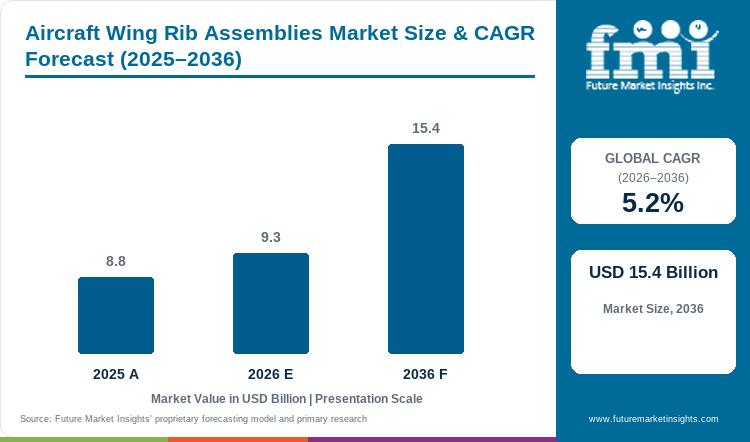
USD 9.3 billion in 2026 and USD 15.4 billion by 2036, expanding at 5.2% CAGR.
Sales of aircraft wing rib assemblies are estimated to rise at 5.2% CAGR through 2036. Valuation rises from USD 8.8 billion in 2025 to USD 9.3 billion in 2026 and reaches USD 15.4 billion by 2036. Each new aircraft uses many ribs to carry loads and maintain a stable wing shape. In July 2026, Boeing forecast 43,625 new commercial aircraft deliveries over the next twenty years. Boeing's delivery outlook keeps rib plants focused on monthly build rates and strict dimensional records. Higher aircraft output also increases demand for approved joining parts across the same wing assemblies. Stable tools and trained staff help plants maintain inspection records and convert production growth into recurring rib orders.
Aircraft demand becomes plant work at different speeds across major aerospace countries. France is projected at 6.5% CAGR through 2036, compared with 4.2% for Japan. Germany represents a middle case through its mature aircraft supply base. In May 2026, BDLI reported 130,000 aerospace jobs in Germany during 2025. Germany's large workforce supports complex structural work, but approval steps can delay new source qualification. French aircraft plants are adding capacity for planned increases in production rates. Japan relies more on long work-share contracts and cross-border design reviews for major aircraft programs. These program structures affect how quickly new rib awards move from qualification into serial production.
Key Takeaways
- Higher aircraft production and fleet replacement are raising recurring demand for approved wing-rib shipsets.
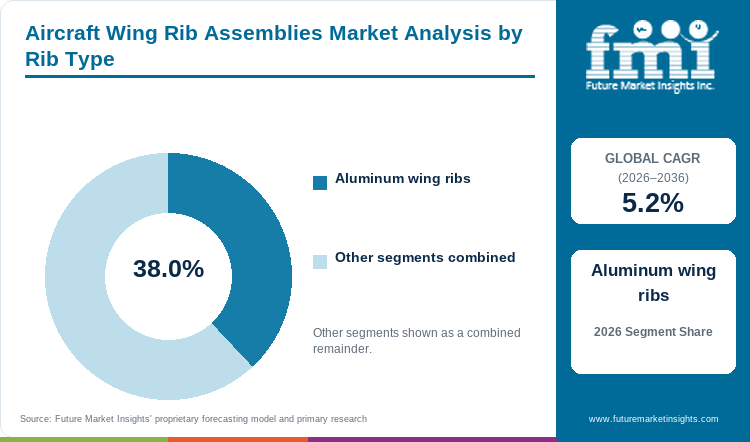
- Aluminum wing ribs are projected to hold 38.0% of rib type revenue in 2026, with familiar processes easing production and approval.
- Narrow-body aircraft are expected to hold 36.0% of aircraft type demand in 2026, tied to frequent shipsets from high-volume programs.
- Sheet metal formed production is forecast to represent 35.0% of manufacturing in 2026, with stable tooling suited to common aluminum rib shapes.
- Damage-tolerance approval and process checks can delay new rib sources even when suppliers add plant capacity.
- Key players include Boeing, Airbus Atlantic, GKN Aerospace, Kawasaki Heavy Industries, Mitsubishi Heavy Industries, Leonardo, Saab Aerostructures, Aernnova, Triumph Group, and Sonaca.
Analyst Perspective
“Long-term opportunity is strongest for rib suppliers that pair stable serial output with lighter structures that meet aircraft program approval requirements. Adoption of composite or hybrid ribs remains limited unless weight savings justify added inspection and qualification work without disrupting production cycle times.”
- Nikhil Kaitwade, Principal Consultant, Future Market Insights
How is the aircraft wing rib assemblies market segmented?
The aircraft wing rib assemblies market is segmented by Rib Type, Aircraft Type, Manufacturing, Sales Channel, Application and Region.
The aircraft wing rib assemblies market is segmented by rib type, aircraft type, manufacturing, sales channel, application, and region. Rib type includes aluminum, composite, titanium reinforcement, machined, and bonded assemblies. Aircraft type includes narrow-body, wide-body, regional, business, and military aircraft. Manufacturing includes sheet metal formed, machined, composite layup, and additive-hybrid routes. Sales channel covers aircraft OEMs, Tier-1 aerostructures, defense programs, and MRO-spares. Application includes main wing box, leading edge, trailing edge, and control surface support.
How do aluminum wing ribs shape demand within the Rib Type category?
Airframe engineers use aluminum forming and machining across established serial aircraft programs, giving production teams a familiar route for repeat rib work. Repair teams also understand how aluminum parts behave during long aircraft service lives, which supports established maintenance and inspection practices. Composite ribs can reduce weight but require tighter process control and additional inspection before serial use. Airbus began Wing of Tomorrow flight tests on an A321neo test aircraft in July 2026. That program keeps composite structures relevant for future rib designs without displacing established aluminum production. High-rate aluminum structures also depend on fastener manufacturing solutions that complete approved wing assembly work at planned build rates.
- Aluminum wing ribs are set to hold 38.0% of rib type revenue in 2026, as familiar forming and repair methods simplify repeat production.
- Airframe engineers select aluminum for rib shapes that meet load targets without composite cure steps or added inspection.
What supports narrow-body aircraft within the Aircraft Type category?
Narrow-body programs generate frequent wing shipsets because final assembly lines move aircraft through production every month. Airbus opened a second A320 Family final assembly line in Toulouse during June 2026, expanding the physical base for serial output. During the same month, Airbus maintained its end-2027 production-rate target for the A320 Family. Rib kits must reach each assembly point at the planned build rate so wing work can continue without interruption. Skins and spars follow the same schedule alongside aerospace landing gear, which keeps multiple structural systems tied to one production rhythm. This high-frequency schedule creates recurring rib demand throughout narrow-body production programs.
- Narrow-body aircraft are estimated to hold 36.0% of aircraft type demand in 2026, linked to frequent shipsets from high-rate programs.
- Wide-body and military aircraft use valuable structures, but lower build rates produce fewer monthly rib shipsets.
How does sheet metal formed manufacturing support serial rib production?
Sheet metal forming suits rib production that uses stable blanking and forming tools across repeat aircraft programs. Sonaca opened a larger Romanian hall for sheet metal forming and bonding in November 2025. The facility supports Airbus structures and provides additional forming capacity for higher aircraft output. Stable tools help producers hold repeat dimensions across common aluminum rib shapes during serial production. Ribs with deeper pockets need machining and multitasking machine tools to reach more complex geometry and dimensional requirements. This division keeps formed ribs efficient for repeat shapes, while machining handles features that demand more material removal and tighter control.
- Sheet metal formed manufacturing is expected to hold 35.0% of manufacturing in 2026, supported by stable tools for common rib shapes.
- Machined and composite ribs gain value when complex shapes require added processing and inspection with tighter dimensional control.
Why do aircraft OEMs retain control within the Sales Channel category?
Aircraft OEMs control design changes and often retain final approval for structural sources throughout serial aircraft programs. Tier-1 firms can place purchase orders, but the aircraft OEM keeps design authority over approved parts and source changes. Boeing bought Spirit AeroSystems in December 2025 and moved major structural work closer to its own operations. MRO-spares support long aircraft service periods through approved replacement demand rather than new-build production alone. Aircraft maintenance services also create recurring demand for approved structural parts as fleets remain in service. These approval responsibilities keep OEMs central to rib sourcing even when Tier-1 firms manage purchasing and production work.
- Aircraft OEMs are likely to hold 49.0% of sales-channel demand in 2026, driven by retained design authority over serial rib sourcing.
- Tier-1 firms and defense programs place large orders under rules that control approved designs and source changes.
What makes the main wing box central to the Application category?
Main wing box ribs carry loads between spars and wing covers throughout normal flight conditions. They also help maintain wing shape as loads move through the primary structure during each flight cycle. Leonardo reported higher B787 aerostructure activity for the first quarter in May 2026. The filing included increased output of 787 structural sections and stabilizers, showing continued production across related primary structures. Main wing box ribs remain central because their load-transfer role forms part of the aircraft's primary structural path. Composite flap fairings use related wing manufacturing skills but remain outside the defined rib assembly revenue boundary. Their separate function prevents adjacent wing components from being counted as rib demand.
- Main wing box ribs are forecast to hold 44.0% of application revenue in 2026, linked to their primary load-transfer role.
- Leading-edge and trailing-edge ribs support aerodynamic systems and represent a smaller share of primary wing structure demand.
What are the drivers, restraints and opportunities in the Aircraft Wing Rib Assemblies Market?
Aircraft production raises repeat shipset demand, certification slows source changes and lighter automated structures open a path to new work.
- Driver: Higher aircraft output and fleet replacement convert scheduled production into recurring demand for approved wing-rib shipsets.
- Restraint: Production approval and structural checks slow supplier changes because every new source must match the approved aircraft design.
- Opportunity: Composite and hybrid processes can reduce structural mass when suppliers prove stable output and repeatable production rates with reliable inspection quality.
Aircraft output converts backlog into recurring structural shipsets
Aircraft production converts large order backlogs into recurring demand for complete wing shipsets. Airbus opened a Toulouse delivery center with 16 A320 Family handover positions in September 2026. The center gives Airbus more room for planned increases in assembly and delivery rates. Rib producers feel that rate pressure because internal wing parts must arrive before aircraft handover. Aerospace fasteners face the same control requirement since they join ribs directly to the wing structure. Contract value depends on approved parts passing inspection at the required production rate. Each rib kit must also reach the planned monthly build point. A missing kit can delay wing assembly even when annual plant capacity appears sufficient.
Production approval makes source changes slower than capacity additions
Wing ribs form part of the certified aircraft load path, which makes source changes slower than capacity additions. In April 2026, the FAA described seven certification phases covering manufacturing and production approval. The FAA checks each producer's quality system against the approved design. A new rib source must prove material control and inspection before OEM deliveries begin. Automated aircraft inspection speeds record collection but cannot replace formal process approval. New tooling and heat-treatment changes may require extra qualification tests before production. Machining and bonding routes face the same approval rules during production. Each change needs evidence that the part matches the approved design. These requirements raise switching costs when an OEM needs more output before a new source receives approval.
Lighter structures create value through stable rates and certification
Composite and hybrid ribs offer a route to lower structural mass without abandoning planned production targets. GKN Aerospace joined DECSAM in November 2025 to scale additive manufacturing for flight-ready aerospace parts. The program uses in-process checks and production methods designed for higher manufacturing volumes. Selected hybrid ribs need similar controls because weight savings must justify added processing and inspection. Precision tool holders support accurate trimming and drilling on mixed-material structural components. Commercial adoption depends on structural testing and stable cycle times at planned aircraft rates. Rib producers connect lighter designs with plant evidence before programs move into regular production. That combination helps development work progress toward approved serial manufacturing.
Which country CAGRs are profiled in the Aircraft Wing Rib Assemblies Market?
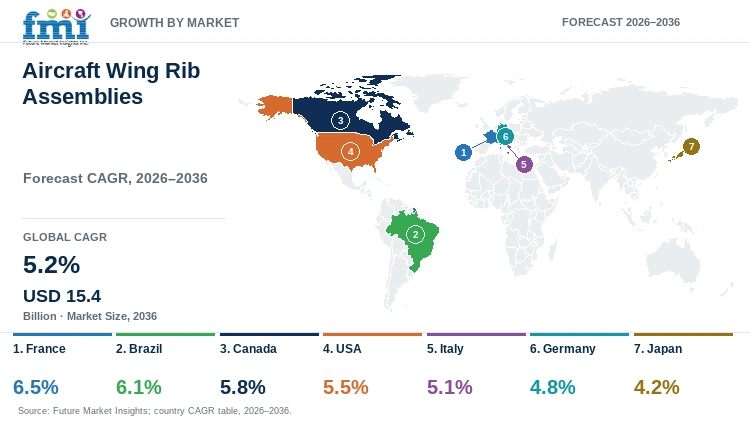
| Country | CAGR |
|---|---|
| France | 6.5% |
| Brazil | 6.1% |
| Canada | 5.8% |
| USA | 5.5% |
| Italy | 5.1% |
| Germany | 4.8% |
| Japan | 4.2% |
How do country-level CAGRs compare in the Aircraft Wing Rib Assemblies Market?
The profiled countries range from 4.2% to 6.5% CAGR through 2036. France and Brazil form the upper group as aircraft work expands across local production networks. Canada and the USA combine broad aircraft output with established structural supply systems. Italy and Germany rely on mature European work shares across several long-running aircraft programs. Japan grows more slowly, with international work-share programs requiring longer design reviews and source approval.
- France combines dense aerospace suppliers with high-rate commercial programs, keeping rib design and inspection work close to final assembly.
- Embraer production and wider approved manufacturing give Brazil more local opportunities for wing and body structural work.
- Canada's A220 and business-jet programs create recurring rib demand, with local engineering resolving qualification issues near final assembly.
- Large commercial and defense programs sustain US rib demand, although strict production oversight makes approved source changes more costly.
- Italy balances civil and defense structural workloads across industrial districts, while separate approval rules make plant planning more complex.
- Germany's mature Airbus-linked supply base handles complex rib work, and automation investments help protect delivery schedules as build rates rise.
- Japan receives stable structural work through long international programs, but cross-border design reviews can extend qualification timelines for new sources.
Similar CAGRs create different entry conditions across countries with different work-share rules and approval timelines. Production scale also affects how quickly approved rib work becomes recurring orders. The full report provides country analysis across seven regions and additional national forecasts within each regional group.
Country-wise Analysis
- France combines major aircraft plants with a dense local parts and engineering base. Wing rib demand in France is forecast to rise at 6.5% CAGR through 2036, supported by high-rate commercial programs requiring recurring structural shipsets. In May 2026, GIFAS reported that French aerospace export sales rose 14.6% during 2025. Export demand keeps French plants connected with customers beyond the domestic aircraft network. Toulouse facilities are adding capacity and need nearby rib design and inspection support. Aircraft seating systems face similar schedule pressure, but primary wing structures follow stricter approval rules. Local engineering teams help rib producers resolve design and quality issues before late parts disrupt monthly aircraft deliveries.
- Large commercial and defense aircraft programs create a broad base for US wing-rib demand. The USA is estimated to post 5.5% CAGR from 2026 to 2036, linked to recurring structural production across major programs. In July 2026, the FAA allowed Boeing to issue some airworthiness certificates again following a safety review. The agency continues independent inspections and audits of Boeing production activities. FAA oversight keeps quality records central to every change involving an approved wing-rib source. Large programs reward steady output, but producers must control every approved process change. Rib manufacturers can secure additional work by proving stable production and maintaining records that match the approved aircraft design.
- Japan participates in long aircraft programs through large industrial groups and specialist structural manufacturers. Wing rib demand in Japan is predicted to advance at 4.2% CAGR through 2036, shaped by long international work-share programs. Kawasaki Heavy Industries received Embraer's 2024 Best Suppliers Award in April 2025 for its aircraft work. The award confirms Japan's active role in cross-border programs with demanding schedule and quality requirements. Overseas design teams review major changes on shared aircraft programs and can extend source approval timelines. New entrants need proven process control and durable relationships with Japanese prime manufacturers. Those relationships help trial production progress toward regular work on shared international programs.
- Germany combines Airbus production with a deep network of engineering firms and specialized factories. Germany is estimated to post 4.8% CAGR through 2036, reinforced by mature Airbus-linked work across recurring structural programs. Airbus opened an automated A321XLR rear-center-tank hall in Augsburg during September 2025 to support higher build rates. The facility now uses automation on complex aircraft structures, but established approval checks remain necessary. German aerospace firms also face skilled-worker shortages and demanding cross-border delivery schedules. New equipment must increase output without creating additional testing or change-control delays. Stable production tools help rib manufacturers protect delivery dates across shared European programs as aircraft build rates increase.
- A220 production and business-jet assembly give Canada a broad aircraft manufacturing and supplier base. Canada is estimated to post 5.8% CAGR from 2026 to 2036, enabled by programs that create recurring structural demand. In July 2026, AIAC reported that Canada's aerospace sector supported 218,700 jobs during 2025. Airbus opened a Mirabel hub in May 2026 for composite work and factory robotics tied to A220 production. Rib producers must convert test projects into approved serial production before volumes can expand. Skilled workers and local engineering partners help resolve production problems near the A220 line. Stable output keeps planned aircraft rates moving without creating additional approval or delivery risk.
- Italian aerospace plants serve both civil aircraft production and long-running defense programs across several industrial districts. Italy's wing rib outlook is anticipated to advance at 5.1% CAGR through 2036, influenced by shared civil and defense production capacity. In June 2026, Italy's industry ministry said regional industrial districts form part of the national aerospace network. Those districts connect manufacturers with civil and defense programs that follow separate approval requirements. Italian plants must balance long defense schedules with less even civil-aircraft production. Flexible production lines can manage these shifts without weakening process control or inspection records. Early design coordination helps rib producers keep approved work packages stable as program volumes change.
- Embraer production and Gripen technology transfer give Brazil a growing local aircraft manufacturing and supplier base. Brazil is estimated to post 6.1% CAGR through 2036, attributable to wider approved manufacturing and expanding local structural work. In January 2026, Brazil's transport ministry said ANAC had approved eight national aircraft makers compared with four previously. The higher count expands the country's approved production base beyond a small group of manufacturers. Gripen and Embraer programs also provide local firms with more wing and body structure tasks. Imported inputs and program concentration can still create sourcing and schedule risks. Rib producers need strong inspection and design-for-manufacture support to secure longer approved serial production packages.
Who are the notable companies in the Aircraft Wing Rib Assemblies Market?
Boeing, Airbus Atlantic, GKN Aerospace, Kawasaki Heavy Industries, Mitsubishi Heavy Industries, Leonardo, Saab Aerostructures, Aernnova, Triumph Group, and Sonaca are active within the defined aircraft wing rib assemblies supply boundary.
Competition depends on wing design control and approved manufacturing capacity alongside consistent structural deliveries across long aircraft programs. Boeing now includes the former Spirit AeroSystems operations after completing the acquisition in December 2025, bringing major structural work closer to its aircraft business. Airbus Atlantic and other Tier-1 firms pursue long work packages, while aircraft strut systems remain outside the rib boundary despite similar qualification controls.
- Boeing and Airbus Atlantic combine aircraft program control with large commercial structure production networks.
- GKN Aerospace, Aernnova, and Sonaca produce metal and composite aircraft structures for long-running serial programs.
- Kawasaki Heavy Industries, Mitsubishi Heavy Industries, Leonardo, Saab Aerostructures, and Triumph Group support structural work across commercial or defense aircraft programs.
Competitive Benchmarking: Aircraft Wing Rib Assemblies Market
| Company | Wing Structural Integration | Multi-Material Process Depth | Program and Channel Breadth | Geographic Reach |
|---|---|---|---|---|
| Boeing | High | High | High | North America and global aircraft programs |
| Airbus Atlantic | High | High | High | Europe, North America and North Africa |
| GKN Aerospace | High | High | High | Europe, North America and Asia |
| Kawasaki Heavy Industries | High | Medium | High | Japan and global commercial programs |
| Mitsubishi Heavy Industries | High | High | High | Japan and international aircraft programs |
| Leonardo | Medium | High | High | Italy, Europe and international programs |
| Saab Aerostructures | Medium | Medium | High | Sweden, Brazil and defense programs |
| Aernnova | High | High | High | Europe, North America, Latin America and Asia |
| Triumph Group | Low | Medium | High | North America, Europe and Mexico |
| Sonaca | High | High | High | Europe, North America, Latin America and Asia |
The benchmark scores structural integration and process depth alongside program breadth using public evidence for aircraft structure work. High structural integration requires major aircraft-structure work or direct OEM control across relevant programs. A Medium rating covers important subassemblies without broad wing authority, while Low marks limited public evidence of direct wing work. High process depth requires several verified metal or composite manufacturing routes across relevant production systems. A Medium rating covers a smaller verified route set, whereas Low indicates limited public process evidence. High program breadth requires verified activity across several aircraft programs or sales channels.
Key Developments in the Aircraft Wing Rib Assemblies Market
- In July 2026, Sonaca signed an Otto Aerospace contract to design Phantom 3500 wing structures and prepare production through certification.
- In June 2025, GKN Aerospace launched ASPIRE to develop and test composite wing and flap structures for faster production.
- In June 2025, Leonardo formed Edgewing Systems with BAE Systems and JAIEC to lead GCAP aircraft design and development.
Key Players in the Aircraft Wing Rib Assemblies Market
OEM and integrated aircraft-structure control
- Boeing
- Airbus Atlantic
Multi-material Tier-1 aerostructure specialists
- GKN Aerospace
- Aernnova
- Sonaca
- Triumph Group
Program-specific commercial and defense structures
- Kawasaki Heavy Industries
- Mitsubishi Heavy Industries
- Leonardo
- Saab Aerostructures
Aircraft Wing Rib Assemblies Market - Report Scope
| Coverage field | Report scope |
|---|---|
| Market breakdown | By rib type, aircraft type, manufacturing, sales channel, application and region. |
| Quantitative Units | USD billion. |
| Market Definition | Commercial wing ribs, assembled rib sets, reinforcement ribs and rib-integrated subassemblies are included. Complete wings, raw materials, spars, skins, stringers and unrelated service labor are excluded. |
| Regions Covered | North America, Latin America, Western Europe, Eastern Europe, East Asia, South Asia and Pacific, and Middle East and Africa. |
| Countries Covered | France, Brazil, Canada, USA, Italy, Germany, Japan, and 20+ countries included in the full report. |
| Key Companies Profiled | Boeing, Airbus Atlantic, GKN Aerospace, Kawasaki Heavy Industries, Mitsubishi Heavy Industries, Leonardo, Saab Aerostructures, Aernnova, Triumph Group, and Sonaca. |
| Forecast Period | 2026 to 2036. |
| Approach | Primary and secondary research with market triangulation. |
Aircraft Wing Rib Assemblies Market - Research Methodology
| Method | Approach |
|---|---|
| Primary Research | FMI analysts gathered input from manufacturers, service providers, technology developers, distributors, end users, procurement teams, and subject-matter experts. Interviews examined purchasing decisions, product or service evaluation, adoption barriers, approval requirements, pricing considerations, and expectations for technical or commercial support. Respondents were also asked what evidence is required before a trial, pilot, or initial order develops into regular purchasing. |
| Desk Research | Desk research covered government statistics, regulatory publications, trade data, industry associations, technical literature, standards, company filings, product information, and official corporate announcements. Sources were reviewed for relevance, publication date, geographic coverage, and consistency with the defined market scope. Claims relating to performance, applications, approvals, capacity, investment, and commercial activity were retained only when supported by credible public evidence. |
| Market Sizing and Forecasting | The market model combined the baseline value with historical performance, segment structure, pricing and volume indicators, adoption levels, company participation, and country-level demand conditions. Forecast assumptions considered economic activity, investment trends, regulatory developments, technology adoption, purchasing cycles, supply availability, and barriers to wider market use. Segment and regional estimates were reconciled before the final market total was calculated. |
| Data Validation | Estimates were checked against multiple independent indicators, including public data, company activity, trade patterns, industry developments, and findings from primary interviews. Validation also tested whether products, services, applications, and company revenues fell within the defined market boundaries. Adjacent categories, unsupported claims, overlapping revenues, and activities without direct market relevance were excluded to reduce double counting and maintain consistency across segments and countries. |
Aircraft Wing Rib Assemblies Market by Segments
Aircraft Wing Rib Assemblies Market segmented by Rib Type:
- Aluminum wing ribs
- Composite wing ribs
- Titanium reinforcement ribs
- Machined rib assemblies
- Bonded rib assemblies
Aircraft Wing Rib Assemblies Market segmented by Aircraft Type:
- Narrow-body aircraft
- Wide-body aircraft
- Regional jets
- Business jets
- Military aircraft
Aircraft Wing Rib Assemblies Market segmented by Manufacturing:
- Sheet metal formed
- Machined
- Composite layup
- Additive-hybrid manufactured
Aircraft Wing Rib Assemblies Market segmented by Sales Channel:
- Aircraft OEMs
- Tier-1 aerostructures
- Defense programs
- MRO-spares
Aircraft Wing Rib Assemblies Market segmented by Application:
- Main wing box
- Leading edge
- Trailing edge
- Control surface support
Aircraft Wing Rib Assemblies Market by Region:
- North America
- United States
- Canada
- Latin America
- Brazil
- Mexico
- Argentina
- Chile
- Western Europe
- Germany
- France
- United Kingdom
- Italy
- Spain
- Benelux
- Nordics
- Eastern Europe
- Poland
- Czech Republic
- Romania
- Hungary
- East Asia
- China
- Japan
- South Korea
- South Asia and Pacific
- India
- ASEAN
- Australia and New Zealand
- Middle East and Africa
- GCC Countries
- South Africa
- Türkiye
- Israel
Research Sources and Bibliography
- Boeing. (2026, July 17). Boeing: Global commercial fleet will top 50,000 airplanes in 20 years as passenger traffic doubles.
- German Aerospace Industries Association. (2026, May 27). BDLI industry data 2026: Aerospace industry sets new records for revenue and employment.
- Airbus. (2026, July 21). Airbus launches new flight-test program for Wing of Tomorrow.
- Airbus. (2026, June 15). Airbus inaugurates new A320 Family final assembly line in Toulouse.
- Sonaca. (2025, November 13). Sonaca inaugurates a production hall in Romania.
- Boeing. (2025, December 8). Boeing completes acquisition of Spirit AeroSystems.
- Leonardo. (2026, May 6). Results at March 31, 2026.
- Airbus. (2026, September 15). Airbus strengthens A320 Family delivery capacity in Toulouse with a new delivery center.
- Federal Aviation Administration. (2026, April 23). How it works: Aircraft certification.
- GKN Aerospace. (2025, November 7). GKN Aerospace joins DECSAM program to scale aerospace additive manufacturing.
- Groupement des Industries Françaises Aéronautiques et Spatiales. (2026, May 11). The French aerospace industry remains strongly positioned for the future: 2025 results.
- Federal Aviation Administration. (2026, July 17). After months of safety review, FAA allows Boeing to resume issuing certificates for new airplanes.
- Kawasaki Heavy Industries. (2025, April 17). 2024 Embraer Best Suppliers Award received.
- Airbus. (2025, October). Ramping up A320 Family production.
- Aerospace Industries Association of Canada. (2026, July 15). State of Canada’s aerospace industry report 2026.
- Ministry of Enterprises and Made in Italy. (2026, June). National aerospace and space industrial network update.
- Ministry of Ports and Airports, Brazil. (2026, January 19). Civil aviation records historic results in 2025 and establishes the base for growth in 2026.
- Sonaca. (2026, July 21). Sonaca selected for Otto Aerospace’s Phantom 3500 program.
- GKN Aerospace. (2025, June 18). GKN Aerospace leads ASPIRE program to develop and demonstrate composite wing and flap structures.
- Leonardo. (2025, June 20). Global Combat Air Programme marks major milestone as industry partners launch Edgewing Systems.
- Airbus. (2025, December 8). Airbus completes acquisition of Spirit AeroSystems sites.
- Sonaca. (2025, October 3). A new European aerospace leader takes flight: Sonaca and Aciturri unite.
- GKN Aerospace. (2026, September 10). GKN Aerospace to advance key technologies for Sweden’s future combat air systems under new FMV agreement.
- Saab. (2025, September 24). Saab Brazil doubles Gripen rear-fuselage production.
- Aernnova. (2025, June 17). Aernnova and Mahindra Aerostructures announce a multi-year aircraft component contract.
- Triumph Group. (2025, July 24). Warburg Pincus and Berkshire Partners complete acquisition of TRIUMPH.
- Boeing. (2026, January 27). Boeing reports fourth-quarter and full-year 2025 results.
- Mitsubishi Heavy Industries. (2026, May 12). FY2025 financial results.
- Saab. (2026, March 25). First Gripen E fighter produced in Brazil is unveiled.
- Aernnova. (2025, June 19). Deutsche Aircraft selects Aernnova as empennage supplier for the D328eco program.
- Triumph Group. (2025, May 28). Annual report on Form 10-K for the fiscal year ended March 31, 2025.
- GKN Aerospace. (2025, October 8). GKN Aerospace and Airbus Helicopters sign MoU during Royal Visit to Toulouse.
- GKN Aerospace. (2026, April 13). GKN Aerospace and U.S. Air Force Research Laboratory to advance additive manufacturing for aerostructures.
- Kawasaki Heavy Industries. (2026, August 7). Financial results for first quarter FY2026.
- Leonardo. (2025, July 30). 1H 2025 results presentation.
This bibliography is provided for reader reference and is not exhaustive. The full report contains the complete reference list and detailed citations.
This Report Answers
- How large is the aircraft wing rib assemblies market through 2036?
- Which production conditions support recurring demand for wing rib assemblies?
- Which rib type holds the largest verified share during 2026?
- How do narrow-body production rates affect recurring rib shipset demand?
- Why does sheet metal formed manufacturing retain a large 2026 share?
- How do the profiled countries differ in forecast growth through 2036?
- Which structural qualification requirements can slow changes to approved suppliers?
- Which companies participate directly in aircraft wing rib assembly programs?
- How are composite and hybrid production routes changing supplier requirements?
Frequently Asked Questions
How big is the aircraft wing rib assemblies market in 2026?
The aircraft wing rib assemblies market is valued at USD 9.3 billion in 2026. The market is projected to reach USD 15.4 billion by 2036 as planned output and fleet replacement sustain recurring wing-rib orders.
What is the aircraft wing rib assemblies market CAGR through 2036?
The aircraft wing rib assemblies market is projected to grow at 5.2% CAGR from 2026 through 2036. New aircraft output and fleet replacement keep wing-rib orders recurring across planned production rates.
Which rib type leads the aircraft wing rib assemblies market?
Aluminum wing ribs are projected to account for 38.0% of rib type revenue in 2026. Familiar forming and machining methods simplify qualification across serial aircraft programs, and repair teams understand aluminum performance through long service lives.
Which manufacturing route leads the aircraft wing rib assemblies market?
Sheet metal formed production is expected to represent 35.0% of manufacturing revenue in 2026. Stable tooling limits production variation across common aluminum rib shapes used in higher-volume aircraft programs.
Which application leads demand for aircraft wing rib assemblies in 2026?
Main wing box applications are projected to account for 44.0% of application revenue in 2026. These ribs carry primary wing loads and hold systems inside the wing box throughout main assembly operations.
Which countries record the strongest aircraft wing rib growth?
France is projected to grow at 6.5% CAGR through 2036, followed by Brazil at 6.1% and Canada at 5.8%. Aircraft build plans and local work shares influence when approved rib orders enter recurring production.
Which companies are active in aircraft wing rib assembly programs?
Key players include Boeing, Airbus Atlantic, GKN Aerospace, Kawasaki Heavy Industries, Mitsubishi Heavy Industries, Leonardo, Saab Aerostructures, Aernnova, Triumph Group, and Sonaca. Competition depends on wing design work and material capability alongside aircraft program access and reliable structural production.
Preview the report firsthand - request a free sample
Get SampleGet the brochure for pricing and purchase details.
Get PDFTable of Content
- Key Takeaways
- Market Size and CAGR
- Top Growth Driver
- Fastest Growing Segment
- Leading Region
- Key Companies
- Emerging Opportunities
- Executive Summary
- Global Market Outlook
- Demand-side Trends
- Supply-side Trends
- Technology Roadmap Analysis
- Analysis and Recommendations
- Analyst Perspective (What is happening? Why now? What should investors know?)
- Key Questions Answered
- How large is the market?
- What is the CAGR?
- What are key trends?
- Which region dominates?
- Who are the leaders?
- Market Overview
- Market Coverage / Taxonomy
- Market Definition / Scope / Limitations
- Research Methodology
- Chapter Orientation
- Analytical Lens and Working Hypotheses
- Market Structure, Signals, and Trend Drivers
- Benchmarking and Cross-market Comparability
- Market Sizing, Forecasting, and Opportunity Mapping
- Research Design and Evidence Framework
- Desk Research Programme (Secondary Evidence)
- Expert Input and Fieldwork (Primary Evidence)
- Tooling, Models, and Reference Databases
- Data Engineering and Model Build
- Quality Assurance and Audit Trail
- Market Background
- Market Dynamics (Drivers, Restraints, Opportunity, Trends)
- Scenario Forecast (Optimistic, Likely, Conservative)
- Impact Analysis
- AI Impact
- Sustainability Impact
- Regulatory Impact
- Technology Impact
- Consumer / Buyer Analysis
- Purchase Drivers
- Adoption Barriers
- Buyer Journey
- Opportunity Map Analysis
- Product Life Cycle Analysis
- Supply Chain Analysis
- Investment Feasibility Matrix
- Value Chain Analysis
- PESTLE and Porter's Analysis
- Regulatory Landscape
- Regional Parent Market Outlook
- Production and Consumption Statistics
- Import and Export Statistics
- Global Market Analysis and Forecast, 2021 to 2036
- Historical Market Size Value (USD Billion) Analysis, 2021 to 2025
- Current and Future Market Size Value (USD Billion) Projections, 2026 to 2036
- Y-o-Y Growth Trend Analysis
- Absolute $ Opportunity Analysis
- Global Market Pricing Analysis, 2021 to 2036
- Global Market Analysis and Forecast, By Rib Type, 2021 to 2036
- Introduction / Key Findings
- Historical Market Size Value (USD Billion) Analysis By Rib Type, 2021 to 2025
- Current and Future Market Size Value (USD Billion) Analysis and Forecast By Rib Type, 2026 to 2036
- Aluminum wing ribs
- Composite wing ribs
- Titanium reinforcement ribs
- Machined rib assemblies
- Bonded rib assemblies
- Y-o-Y Growth Trend Analysis By Rib Type, 2021 to 2025
- Absolute $ Opportunity Analysis By Rib Type, 2026 to 2036
- Global Market Analysis and Forecast, By Aircraft Type, 2021 to 2036
- Introduction / Key Findings
- Historical Market Size Value (USD Billion) Analysis By Aircraft Type, 2021 to 2025
- Current and Future Market Size Value (USD Billion) Analysis and Forecast By Aircraft Type, 2026 to 2036
- Narrow-body aircraft
- Wide-body aircraft
- Regional jets
- Business jets
- Military aircraft
- Y-o-Y Growth Trend Analysis By Aircraft Type, 2021 to 2025
- Absolute $ Opportunity Analysis By Aircraft Type, 2026 to 2036
- Global Market Analysis and Forecast, By Manufacturing, 2021 to 2036
- Introduction / Key Findings
- Historical Market Size Value (USD Billion) Analysis By Manufacturing, 2021 to 2025
- Current and Future Market Size Value (USD Billion) Analysis and Forecast By Manufacturing, 2026 to 2036
- Sheet metal formed
- Machined
- Composite layup
- Additive-hybrid manufactured
- Y-o-Y Growth Trend Analysis By Manufacturing, 2021 to 2025
- Absolute $ Opportunity Analysis By Manufacturing, 2026 to 2036
- Global Market Analysis and Forecast, By Sales Channel, 2021 to 2036
- Introduction / Key Findings
- Historical Market Size Value (USD Billion) Analysis By Sales Channel, 2021 to 2025
- Current and Future Market Size Value (USD Billion) Analysis and Forecast By Sales Channel, 2026 to 2036
- Aircraft OEMs
- Tier-1 aerostructures
- Defense programs
- MRO-spares
- Y-o-Y Growth Trend Analysis By Sales Channel, 2021 to 2025
- Absolute $ Opportunity Analysis By Sales Channel, 2026 to 2036
- Global Market Analysis and Forecast, By Application, 2021 to 2036
- Introduction / Key Findings
- Historical Market Size Value (USD Billion) Analysis By Application, 2021 to 2025
- Current and Future Market Size Value (USD Billion) Analysis and Forecast By Application, 2026 to 2036
- Main wing box
- Leading edge
- Trailing edge
- Control surface support
- Y-o-Y Growth Trend Analysis By Application, 2021 to 2025
- Absolute $ Opportunity Analysis By Application, 2026 to 2036
- Global Market Analysis and Forecast, By Region, 2021 to 2036
- Introduction
- Historical Market Size Value (USD Billion) Analysis By Region, 2021 to 2025
- Current Market Size Value (USD Billion) Analysis and Forecast By Region, 2026 to 2036
- North America
- Latin America
- Western Europe
- Eastern Europe
- East Asia
- South Asia and Pacific
- Middle East and Africa
- Market Attractiveness Analysis By Region
- North America Market Analysis and Forecast, By Country, 2021 to 2036
- Historical Market Size Value (USD Billion) Trend Analysis By Market Taxonomy, 2021 to 2025
- Market Size Value (USD Billion) Forecast By Market Taxonomy, 2026 to 2036
- By Country
- United States
- Canada
- By Rib Type
- By Aircraft Type
- By Manufacturing
- By Sales Channel
- By Application
- By Country
- Market Attractiveness Analysis
- By Country
- By Rib Type
- By Aircraft Type
- By Manufacturing
- By Sales Channel
- By Application
- Key Takeaways
- Latin America Market Analysis and Forecast, By Country
- Historical Market Size Value (USD Billion) Trend Analysis By Market Taxonomy, 2021 to 2025
- Market Size Value (USD Billion) Forecast By Market Taxonomy, 2026 to 2036
- By Country
- Brazil
- Mexico
- Argentina
- Chile
- By Rib Type
- By Aircraft Type
- By Manufacturing
- By Sales Channel
- By Application
- By Country
- Market Attractiveness Analysis
- By Country
- By Rib Type
- By Aircraft Type
- By Manufacturing
- By Sales Channel
- By Application
- Key Takeaways
- Western Europe Market Analysis and Forecast, By Country
- Historical Market Size Value (USD Billion) Trend Analysis By Market Taxonomy, 2021 to 2025
- Market Size Value (USD Billion) Forecast By Market Taxonomy, 2026 to 2036
- By Country
- Germany
- France
- United Kingdom
- Italy
- Spain
- Benelux
- Nordics
- By Rib Type
- By Aircraft Type
- By Manufacturing
- By Sales Channel
- By Application
- By Country
- Market Attractiveness Analysis
- By Country
- By Rib Type
- By Aircraft Type
- By Manufacturing
- By Sales Channel
- By Application
- Key Takeaways
- Eastern Europe Market Analysis and Forecast, By Country
- Historical Market Size Value (USD Billion) Trend Analysis By Market Taxonomy, 2021 to 2025
- Market Size Value (USD Billion) Forecast By Market Taxonomy, 2026 to 2036
- By Country
- Poland
- Czech Republic
- Romania
- Hungary
- By Rib Type
- By Aircraft Type
- By Manufacturing
- By Sales Channel
- By Application
- By Country
- Market Attractiveness Analysis
- By Country
- By Rib Type
- By Aircraft Type
- By Manufacturing
- By Sales Channel
- By Application
- Key Takeaways
- East Asia Market Analysis and Forecast, By Country
- Historical Market Size Value (USD Billion) Trend Analysis By Market Taxonomy, 2021 to 2025
- Market Size Value (USD Billion) Forecast By Market Taxonomy, 2026 to 2036
- By Country
- China
- Japan
- South Korea
- By Rib Type
- By Aircraft Type
- By Manufacturing
- By Sales Channel
- By Application
- By Country
- Market Attractiveness Analysis
- By Country
- By Rib Type
- By Aircraft Type
- By Manufacturing
- By Sales Channel
- By Application
- Key Takeaways
- South Asia and Pacific Market Analysis and Forecast, By Country
- Historical Market Size Value (USD Billion) Trend Analysis By Market Taxonomy, 2021 to 2025
- Market Size Value (USD Billion) Forecast By Market Taxonomy, 2026 to 2036
- By Country
- India
- ASEAN
- Australia and New Zealand
- By Rib Type
- By Aircraft Type
- By Manufacturing
- By Sales Channel
- By Application
- By Country
- Market Attractiveness Analysis
- By Country
- By Rib Type
- By Aircraft Type
- By Manufacturing
- By Sales Channel
- By Application
- Key Takeaways
- Middle East and Africa Market Analysis and Forecast, By Country
- Historical Market Size Value (USD Billion) Trend Analysis By Market Taxonomy, 2021 to 2025
- Market Size Value (USD Billion) Forecast By Market Taxonomy, 2026 to 2036
- By Country
- GCC Countries
- South Africa
- Türkiye
- Israel
- By Rib Type
- By Aircraft Type
- By Manufacturing
- By Sales Channel
- By Application
- By Country
- Market Attractiveness Analysis
- By Country
- By Rib Type
- By Aircraft Type
- By Manufacturing
- By Sales Channel
- By Application
- Key Takeaways
- Key Countries Market Analysis
- United States
- Pricing Analysis
- Market Share Analysis, 2025
- By Rib Type
- By Aircraft Type
- By Manufacturing
- By Sales Channel
- By Application
- Canada
- Pricing Analysis
- Market Share Analysis, 2025
- By Rib Type
- By Aircraft Type
- By Manufacturing
- By Sales Channel
- By Application
- Mexico
- Pricing Analysis
- Market Share Analysis, 2025
- By Rib Type
- By Aircraft Type
- By Manufacturing
- By Sales Channel
- By Application
- Brazil
- Pricing Analysis
- Market Share Analysis, 2025
- By Rib Type
- By Aircraft Type
- By Manufacturing
- By Sales Channel
- By Application
- Chile
- Pricing Analysis
- Market Share Analysis, 2025
- By Rib Type
- By Aircraft Type
- By Manufacturing
- By Sales Channel
- By Application
- Germany
- Pricing Analysis
- Market Share Analysis, 2025
- By Rib Type
- By Aircraft Type
- By Manufacturing
- By Sales Channel
- By Application
- United Kingdom
- Pricing Analysis
- Market Share Analysis, 2025
- By Rib Type
- By Aircraft Type
- By Manufacturing
- By Sales Channel
- By Application
- Italy
- Pricing Analysis
- Market Share Analysis, 2025
- By Rib Type
- By Aircraft Type
- By Manufacturing
- By Sales Channel
- By Application
- Spain
- Pricing Analysis
- Market Share Analysis, 2025
- By Rib Type
- By Aircraft Type
- By Manufacturing
- By Sales Channel
- By Application
- France
- Pricing Analysis
- Market Share Analysis, 2025
- By Rib Type
- By Aircraft Type
- By Manufacturing
- By Sales Channel
- By Application
- India
- Pricing Analysis
- Market Share Analysis, 2025
- By Rib Type
- By Aircraft Type
- By Manufacturing
- By Sales Channel
- By Application
- ASEAN
- Pricing Analysis
- Market Share Analysis, 2025
- By Rib Type
- By Aircraft Type
- By Manufacturing
- By Sales Channel
- By Application
- Australia and New Zealand
- Pricing Analysis
- Market Share Analysis, 2025
- By Rib Type
- By Aircraft Type
- By Manufacturing
- By Sales Channel
- By Application
- China
- Pricing Analysis
- Market Share Analysis, 2025
- By Rib Type
- By Aircraft Type
- By Manufacturing
- By Sales Channel
- By Application
- Japan
- Pricing Analysis
- Market Share Analysis, 2025
- By Rib Type
- By Aircraft Type
- By Manufacturing
- By Sales Channel
- By Application
- South Korea
- Pricing Analysis
- Market Share Analysis, 2025
- By Rib Type
- By Aircraft Type
- By Manufacturing
- By Sales Channel
- By Application
- Poland
- Pricing Analysis
- Market Share Analysis, 2025
- By Rib Type
- By Aircraft Type
- By Manufacturing
- By Sales Channel
- By Application
- Hungary
- Pricing Analysis
- Market Share Analysis, 2025
- By Rib Type
- By Aircraft Type
- By Manufacturing
- By Sales Channel
- By Application
- Türkiye
- Pricing Analysis
- Market Share Analysis, 2025
- By Rib Type
- By Aircraft Type
- By Manufacturing
- By Sales Channel
- By Application
- South Africa
- Pricing Analysis
- Market Share Analysis, 2025
- By Rib Type
- By Aircraft Type
- By Manufacturing
- By Sales Channel
- By Application
- United States
- Market Structure Analysis
- Competition Dashboard
- Competition Benchmarking
- Market Share Analysis of Top Players
- By Regional
- By Rib Type
- By Aircraft Type
- By Manufacturing
- By Sales Channel
- By Application
- Emerging Startups
- Innovation Benchmarking
- Competition Analysis
- Competition Deep Dive
- Boeing
- Overview
- Product Portfolio
- Profitability by Market Segments
- Sales Footprint
- Strategy Overview
- Marketing Strategy
- Product Strategy
- Channel Strategy
- Airbus Atlantic
- GKN Aerospace
- Kawasaki Heavy Industries
- Mitsubishi Heavy Industries
- Leonardo
- Saab Aerostructures
- Aernnova
- Triumph Group
- Sonaca
- Boeing
- Case Studies
- Success Stories
- Recent Developments
- Competition Deep Dive
- Assumptions & Acronyms Used


