

- Market Size (2026)
- USD 974.8 Mn
- Forecast (2036)
- USD 1618.3 Mn
- CAGR (2026 to 2036)
- 5.2%
How big is Aircraft Potting Compounds Market in 2026?
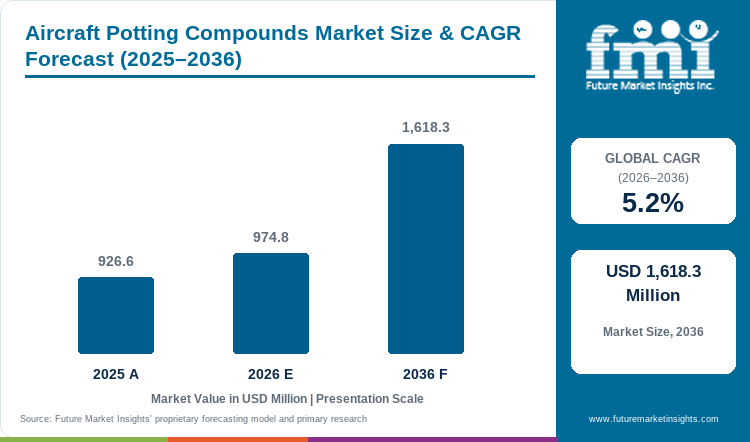
The aircraft potting compounds market was valued at USD 926.6 million in 2025, is estimated at USD 974.8 million in 2026, and is projected to reach USD 1,618.3 million by 2036 at 5.2% CAGR.
FMI expects the aircraft potting compounds market to expand at 5.2% CAGR from 2026 to 2036. Aircraft electronics are now fitted in compact housings. These housings need protection from heat and moisture. They also need to withstand vibration and electrical stress. FAA records showed 173,589 United States civil aircraft equipped with ADS-B in July 2026. This installed base is expected to support demand for serviceable flight electronics. Suppliers are focusing on dielectric protection and controlled cure behavior. Lot consistency is also needed after a material enters an approved production or repair process.
South Korea and Germany are creating demand through different aircraft programs. South Korea is projected to grow at 6.3% CAGR through 2036 as KF-21 production enters regular manufacturing. Korea.net reported about 1,600 KF-21 flight tests in May 2026. It also reported 13,000 flight-condition assessments before combat-suitability certification. These tests increase the need for materials that stay stable after a module has been approved. Germany is projected to expand at 4.9% CAGR through 2036. Its mature aircraft programs require documented material changes and local technical support. Both markets are expected to prefer stable formulations and qualified aerospace materials.
Key Takeaways
- Aircraft electronics will continue increasing demand for compounds that protect boards from heat, moisture, vibration, and electrical stress through 2036.
- Epoxy potting compounds are projected to hold 38.0% of chemistry demand in 2026, supported by rigid insulation requirements.
- Avionics modules are forecast at 30.0% of application demand in 2026, reinforced by dense electronics and qualification testing.
- Commercial aircraft are likely to capture 37.0% of aircraft type demand in 2026, linked to line-fit electronics and long service cycles.
- Qualification work will continue to slow resin switching because changes to a cured compound can reopen process and environmental checks.
- Notable companies include Henkel, 3M, Dow, Parker LORD, Huntsman, Momentive, Wacker Chemie, Master Bond, Dymax, and MG Chemicals among a wider supplier base.
Analyst Perspective
"Aircraft programs favor potting materials that protect electronics without reopening qualification work. Stable chemistry and plant support help approved processes remain usable through long production cycles."
- Nikhil Kaitwade, Principal Consultant, Future Market Insights
How is the aircraft potting compounds market segmented?
The aircraft potting compounds market is segmented by Chemistry, Application, Aircraft Type, Performance, Sales Channel, and Region.
The market is segmented on the basis of six categories. Region is the geographical segment.
Chemistry covers epoxy potting compounds, silicone potting compounds, polyurethane potting compounds, thermally conductive compounds, and low-density compounds.
Application covers avionics modules, sensors, connectors, power electronics, and lighting systems.
Aircraft type covers commercial aircraft, military aircraft, business jets, rotorcraft, and UAVs.
Performance covers vibration resistance, thermal management, moisture protection, flame retardancy, and EMI shielding.
Sales channel covers electronics suppliers, aircraft OEMs, defense programs, and MRO/repair channel.
What supports epoxy potting compounds within the Chemistry category?
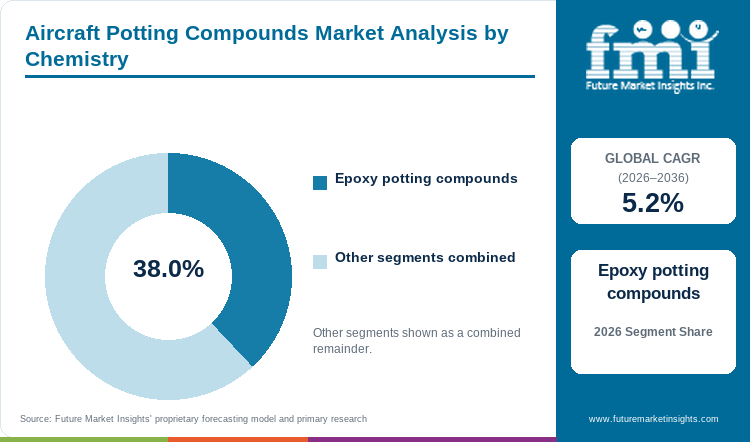
Epoxy potting compounds are expected to hold 38.0% of chemistry revenue in 2026, supported by rigid insulation and processing consistency.
Epoxy potting compounds are used in aircraft boards that need rigid insulation. These compounds also support controlled processing during assembly. Filler loading is adjusted to limit shrinkage and move heat away from the board. The selected viscosity must suit the dispensing process. These epoxy systems prevent unwanted electrical paths after cure. Engineers check cure temperature and thermal expansion before approving a material. Repair needs are reviewed at the same stage. Stable lot properties become important after approval because a material change can reopen process checks. Therefore, epoxy potting compounds are expected to remain prominent through 2036 for aircraft boards that require firm insulation.
- By chemistry, epoxy potting compounds are projected to hold 38.0% in 2026, supported by rigid insulation and repeatable processing requirements.
- In January 2025, Master Bond introduced EP53TC with 2.3 to 2.6 W/mK thermal conductivity for small potting applications.
How do avionics modules shape demand within the Application category?
Avionics modules are estimated to represent 30.0% of application demand in 2026, reflecting dense electronics and demanding qualification tests.
Avionics modules carry processors and sensors inside compact housings. These housings also contain power devices and connectors. The module is exposed to vibration and heat during flight. Moisture and electrical stress can further affect its performance. Potting compounds protect printed circuit boards by holding components in place and isolating exposed conductors after cure. Engineers select viscosity based on narrow gaps and connector clearance. The heat path is checked before the resin is finalized. Once approved, the resin becomes part of the manufacturing process. Any change in cure can lead to further review.
- In 2026, avionics modules are expected to lead application with 30.0% share, reinforced by dense electronics and qualification testing.
- Environmental test plans make resin selection part of the approved module design, increasing the cost of later formulation changes.
How do commercial aircraft shape the Aircraft Type category?
Commercial aircraft are projected to capture 37.0% of aircraft type demand in 2026, driven by line-fit electronics and service demand.
Commercial aircraft programs create demand for potting compounds during aircraft assembly. This demand continues when electronic modules are repaired or replaced. Potting compounds protect boards in cabin systems and lighting systems. They are also used in communication and control equipment. The material is needed for commercial aircraft repair programs after delivery. A large fleet makes material switching difficult. One formulation change can affect several approved module designs.
- Commercial aircraft are forecast to represent 37.0% of aircraft type demand in 2026, linked to line-fit electronics and long service cycles.
- Long production programs favor suppliers that can keep qualified material specifications and regional supply stable through repair cycles.
What supports vibration resistance within the Performance category?
Vibration resistance is anticipated to hold 25.0% of performance demand in 2026, owing to tighter control of component movement.
Aircraft modules face vibration and shock during operation. These conditions can move boards and fragile connections inside the enclosure. Cured potting keeps these parts in place. The material must not create high stress around solder joints. Softer silicone is used where movement needs to be absorbed and tougher epoxy is used where heavy components need stronger support. Thermal interface materials also share limited space inside the module. The potting compound must maintain the planned heat path. Therefore, vibration resistance is expected to remain important through 2036.
- Vibration resistance is set to lead performance with 25.0% share in 2026, tied to limiting component movement inside aircraft modules.
- Designers must balance vibration support with cure shrinkage and thermal movement so the compound does not introduce new assembly stress.
How do electronics suppliers shape the Sales Channel category?
Electronics suppliers are set to command 34.0% of sales channel demand in 2026, reinforced by module-stage material selection.
Electronics suppliers select potting chemistry before a module reaches final aircraft assembly. Process engineers then set the dispensing tool and mix ratio for the approved compound. Cure schedules and inspection steps are also fixed during this stage. The selected electronics adhesives and encapsulants become part of the daily production process. Aircraft OEMs and defense programs set the wider material requirements. Electronics plants manage material handling and process verification.
- Electronics suppliers are estimated to hold 34.0% of sales channel demand in 2026, shaped by material choices made during module design.
- In March 2026, Henkel opened a Bengaluru electronics application center with testing, dispensing, and material-validation capabilities.
What are the drivers, restraints and opportunities in the Aircraft Potting Compounds Market?
Through 2036, the Aircraft Potting Compounds Market is expected to be shaped by growing electronics protection needs, qualification barriers to switching, and opportunities in lighter thermally managed formulations.
- Driver: More aircraft electronics will continue to increase demand for insulation, vibration control, moisture protection, and heat management inside compact modules.
- Restraint: Qualification work will continue to delay resin switching because the cured compound becomes part of an approved electronic assembly.
- Opportunity: Thermally managed and lower-stress formulations are expected to protect higher-power electronics while limiting added mass around boards and power modules.
Growing Aircraft Electronics Protection Needs
Aircraft programs are using more digital flight and sensing functions inside protected modules. Communication and power functions are also being added. Each added board needs protection from moisture and vibration. It also needs protection from electrical stress and heat before service. The FAA forecast published in May 2026 listed 6,949 aircraft in the United States commercial fleet for 2025. The fleet is projected to reach 10,677 aircraft by 2046. This growing fleet is expected to increase the installed base of aircraft electronics. Qualified potting compounds are likely to remain important in new production and replacement work. Stable module processes will also be needed during later repair cycles.
Qualification Limits Material Switching
Qualification requirements limit material switching because cured potting becomes part of the tested board and enclosure. It is also part of the approved manufacturing process. A new formulation can change stiffness and cure heat. It can also affect flammability and dielectric performance. Stress around connectors and solder joints can change with the material. RTCA reported in January 2026 that the DO-160H review received over 2,000 comments across 26 sections in 2025. This review shows the range of conditions considered for airborne equipment. Module engineers need evidence that a material change will retain approved test limits. Lower resin prices are not expected to justify new validation in established aircraft programs.
Thermal Management with Lower Added Stress
The growing use of aircraft power electronics is increasing the need for potting compounds that remove heat. These materials must also maintain electrical insulation. Mechanical stress around the components needs to remain low. Power modules need materials that can move heat during repeated thermal cycles. NASA's HEATheR work published in January 2025 describes high waste-heat loads in megawatt-scale electrified aircraft systems. Silicone elastomers are used in related thermal-management systems where flexibility is needed. Electrical insulation is also required around compact electronics. Suppliers are expected to develop lower-density and lower-modulus formulations through 2036. These materials need verified thermal data before they are used in aircraft power electronics. Electrical and service-life data are also required.
Which country CAGRs are profiled in the Aircraft Potting Compounds Market?
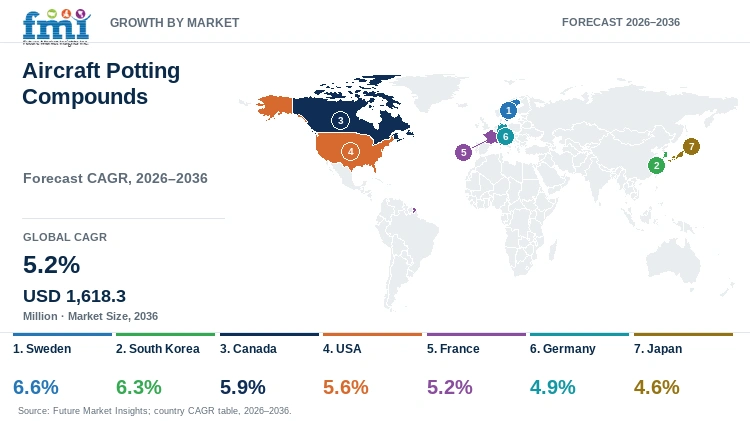
| Country | CAGR |
|---|---|
| Sweden | 6.6% |
| South Korea | 6.3% |
| Canada | 5.9% |
| USA | 5.6% |
| France | 5.2% |
| Germany | 4.9% |
| Japan | 4.6% |
How do country-level CAGRs compare in the Aircraft Potting Compounds Market?
The country forecasts differ by 2.0 percentage points through 2036. Each country follows a different program mix and qualification route. The full report covers more than 20 countries across the defined regions. This section compares the key countries listed below.
- Sweden is supporting long defense procurement horizons with specialist electronics programs that reward formulation continuity and technical support.
- South Korea is moving fighter electronics into regular production, increasing the value of stable materials across repeated manufacturing cycles.
- Canada is serving export-heavy aerospace supply chains where documentation must remain usable across customers and foreign approval systems.
- The USA is combining a large installed fleet with new-build and maintenance demand across commercial and general aviation electronics.
- France is raising aerospace production rates while financing and recruitment constraints are increasing pressure for predictable material processing.
- Germany is balancing mature civil and defense programs with established qualification histories that are slowing unnecessary resin changes.
- Japan is emphasizing supply-chain modernization, test infrastructure, and long supplier relationships across future aircraft and maintenance programs.
Similar growth rates can create different order patterns through 2036. This is because aircraft mix varies by country. Approval speed and technical support needs also differ.
Country-wise Analysis
- Sweden is projected to expand at 6.6% CAGR through 2036 due to demand from defense programs. These programs need specialized electronics that can support long aircraft service periods. The Swedish Government identified combat aircraft as a strategic materiel category in June 2025. Its defense industry strategy called for long-term orders and higher production capacity. It also called for secure access to key materials and components. Potting suppliers need stable formulations during qualification. Documented test behavior and local technical assistance are also important during the service period.
- South Korea is projected to grow at 6.3% CAGR through 2036 as KF-21 production moves into regular output. Aircraft electronics demand is increasing with repeated manufacturing cycles. Approved materials need to perform consistently across larger build volumes. Korea.net reported the first mass-produced KF-21 aircraft at Korea Aerospace Industries in March 2026. The first unit was scheduled for deployment after manufacturer and Air Force verification. Potting suppliers need stable cure behavior and reliable lot quality. Technical support is also needed for the qualified configuration. Domestic production is expected to create recurring material demand during the forecast period.
- Canada is projected to grow at 5.9% CAGR through 2036 as its aerospace base serves export programs. Module production across borders increases the need for records that remain consistent between plants. Innovation, Science and Economic Development Canada reported in July 2026 that 70% of aerospace revenue in 2025 was export oriented. Supply-chain activity represented 53% of these aerospace exports. Potting suppliers need documents that can travel with boards and modules sold into foreign aircraft programs. Aircraft sensors and avionics are used across program boundaries. Stable material properties can reduce avoidable review work.
- The USA is projected to rise at 5.6% CAGR through 2036 as active fleets support electronics demand. Protected avionics are used in commercial and general aviation programs. They are also used in defense and repair programs. The FAA's 2026 forecast places the active general aviation and air taxi fleet at 216,525 aircraft. Turbine fixed-wing aircraft add more electronics-intensive platforms to this installed base. Potting suppliers serve long repair cycles for replacement boards and module refurbishment. Qualification limits material switching. Technical support and dependable supply remain important.
- France is projected to record 5.2% CAGR through 2036 as aircraft production rates increase pressure on the national supplier base. In August 2025, the Direction generale des Entreprises published a survey of nearly 300 French aerospace suppliers. The survey found recruitment and financing issues during production ramp-ups. Potting suppliers can support plants through stable dispensing behavior. Predictable cure schedules can also limit process variation. Material changes still need customer approval. Reliable stock and simple processing remain useful during production ramps.
- Germany is projected to expand at 4.9% CAGR through 2036 as civil and defense programs continue through long qualification cycles. Buyers place importance on stable materials and documented changes. The Federal Government adopted a new aviation strategy in June 2026. It covers the aviation industry and air transport. Civil and military aircraft are also covered. Potting suppliers need consistent lots and clear application records before replacing approved formulations. Local engineering support can help during troubleshooting. Established test histories limit rapid resin substitution.
- Japan is projected to grow at 4.6% CAGR through 2036 as national aerospace planning focuses on supply chains and test infrastructure. Procurement favors dependable quality and long supplier relationships. METI's Aircraft Industry Subcommittee reviewed strategy execution and investment needs in March 2026. The agenda also covered supply-chain modernization and engine MRO. It included measures to strengthen the unmanned aircraft industrial base. Potting suppliers are expected to provide stable formulations and local trial support. Long design cycles limit quick chemistry changes.
Who are the notable companies in the Aircraft Potting Compounds Market?
A few notable companies in the Aircraft Potting Compounds Market include Henkel, 3M, Dow, Parker LORD, Huntsman, Momentive, Wacker Chemie, Master Bond, Dymax, and MG Chemicals among a broader supplier base covered in the report.
The market has a broad base of global and specialist formulators. The prominent companies are listed in the section below. Parker LORD operates within Parker Hannifin. Momentive Performance Materials is an indirect wholly owned subsidiary of KCC Corporation. Suppliers compete through chemistry range and qualification support. Broad portfolios cover silicone and epoxy systems for electronic protection. They also cover polyurethane adhesives for similar requirements. Specialist formulators serve specific board requirements. Buyers give importance to lot consistency because formulation changes can affect validated module processes.
- Broad electronics protection: Henkel, Dow, Momentive, and Wacker Chemie supply multiple resin or silicone routes for electronic assemblies.
- Aerospace materials access: 3M, Parker LORD, and Huntsman combine advanced materials portfolios with documented aerospace applications or customer relationships.
- Specialist encapsulation: Master Bond, Dymax, and MG Chemicals focus on application-specific resin systems, rapid curing, or high-reliability electronics protection.
Competitive Benchmarking: Aircraft Potting Compounds Market
| Company | Potting Chemistry Breadth | Thermal/Electrical Protection | Aerospace Qualification Fit | Geographic Reach |
|---|---|---|---|---|
| Henkel | High | High | Medium | Global |
| 3M | Medium | Medium | High | Global |
| Dow | High | High | Medium | Global |
| Parker LORD | Medium | High | High | Global |
| Huntsman | High | Medium | High | Global |
| Momentive | High | High | Medium | Global |
| Wacker Chemie | High | High | Low | Global |
| Master Bond | High | High | High | North America; international |
| Dymax | Medium | Medium | High | North America, Europe, Asia |
| MG Chemicals | High | Medium | Medium | North America, Europe; distributors |
High ratings show direct current evidence for the stated capability. Medium ratings show a narrower documented role. Low ratings show limited public evidence. Geographic reach is descriptive and is not a benchmark score. These ratings apply to each dimension shown. They do not establish an overall company ranking.
Key Developments in the Aircraft Potting Compounds Market
- In August 2026, Master Bond released EP55TCFL for bonding, sealing, and small potting applications with NASA low-outgassing compliance.
- In June 2026, Dow announced about USD 100 million of specialty-silicones investments through 2027, including electronics manufacturing and cooling laboratories.
- In January 2026, Henkel launched LOCTITE STYCAST US 8000 A/B, a polyurethane potting compound for industrial and power electronics protection.
Key Players in the Aircraft Potting Compounds Market
Global electronics protection suppliers
- Henkel
- 3M
- Dow
- Momentive
- Wacker Chemie
Aerospace and advanced resin suppliers
- Parker LORD
- Huntsman
- Master Bond
Focused encapsulation specialists
- Dymax
- MG Chemicals
Aircraft Potting Compounds Market - Report Scope
| Coverage field | Report scope |
|---|---|
| Market breakdown | By chemistry, application, aircraft type, performance, sales channel and region. |
| Quantitative Units | USD million. |
| Market Definition | Aircraft potting compounds used to encapsulate or protect aircraft electronic assemblies are included. Finished electronic modules, structural sealants, and unrelated molding materials are excluded. |
| Regions Covered | North America, Latin America, Western Europe, Eastern Europe, East Asia, South Asia and Pacific, and Middle East and Africa. |
| Countries Covered | Sweden, South Korea, Canada, USA, France, Germany, Japan, and 20+ countries included in the full report. |
| Key Companies Profiled | Henkel, 3M, Dow, Parker LORD, Huntsman, Momentive, Wacker Chemie, Master Bond, Dymax, and MG Chemicals. |
| Forecast Period | 2026 to 2036. |
| Approach | Primary and secondary research with market triangulation. |
Aircraft Potting Compounds Market - Research Methodology
| Method | Approach |
|---|---|
| Primary Research | FMI analysts gathered input from manufacturers, service providers, technology developers, distributors, end users, procurement teams, and subject-matter experts. Interviews examined purchasing decisions, product or service evaluation, adoption barriers, approval requirements, pricing considerations, and expectations for technical or commercial support. Respondents were also asked what evidence is required before a trial, pilot, or initial order develops into regular purchasing. |
| Desk Research | Desk research covered government statistics, regulatory publications, trade data, industry associations, technical literature, standards, company filings, product information, and official corporate announcements. Sources were reviewed for relevance, publication date, geographic coverage, and consistency with the defined market scope. Claims relating to performance, applications, approvals, capacity, investment, and commercial activity were retained only when supported by credible public evidence. |
| Market Sizing and Forecasting | The market model combined the baseline value with historical performance, segment structure, pricing and volume indicators, adoption levels, company participation, and country-level demand conditions. Forecast assumptions considered economic activity, investment trends, regulatory developments, technology adoption, purchasing cycles, supply availability, and barriers to wider market use. Segment and regional estimates were reconciled before the final market total was calculated. |
| Data Validation | Estimates were checked against multiple independent indicators, including public data, company activity, trade patterns, industry developments, and findings from primary interviews. Validation also tested whether products, services, applications, and company revenues fell within the defined market boundaries. Adjacent categories, unsupported claims, overlapping revenues, and activities without direct market relevance were excluded to reduce double counting and maintain consistency across segments and countries. |
Aircraft Potting Compounds Market by Segments
Aircraft Potting Compounds Market segmented by Chemistry:
- Epoxy potting compounds
- Silicone potting compounds
- Polyurethane potting compounds
- Thermally conductive compounds
- Low-density compounds
Aircraft Potting Compounds Market segmented by Application:
- Avionics modules
- Sensors
- Connectors
- Power electronics
- Lighting systems
Aircraft Potting Compounds Market segmented by Aircraft Type:
- Commercial aircraft
- Military aircraft
- Business jets
- Rotorcraft
- UAVs
Aircraft Potting Compounds Market segmented by Performance:
- Vibration resistance
- Thermal management
- Moisture protection
- Flame retardancy
- EMI shielding
Aircraft Potting Compounds Market segmented by Sales Channel:
- Electronics suppliers
- Aircraft OEMs
- Defense programs
- MRO/repair channel
Aircraft Potting Compounds Market by Region:
- North America
- United States
- Canada
- Latin America
- Brazil
- Mexico
- Chile
- Rest of Latin America
- Western Europe
- Germany
- United Kingdom
- Italy
- Spain
- France
- Nordics
- Benelux
- Rest of Western Europe
- Eastern Europe
- Russia
- Poland
- Hungary
- Balkan and Baltic States
- Rest of Eastern Europe
- East Asia
- China
- Japan
- South Korea
- South Asia and Pacific
- India
- ASEAN
- Australia and New Zealand
- Rest of South Asia and Pacific
- Middle East and Africa
- Kingdom of Saudi Arabia
- Other GCC Countries
- Türkiye
- South Africa
- Other African Union Countries
- Rest of Middle East and Africa
Research Sources and Bibliography
- Federal Aviation Administration. (2026, July 1). Current equipage levels. Country context: United States. https://www.faa.gov/air_traffic/technology/equipadsb/installation/current_equipage_levels
- Korea.net. (2026, May 8). Domestically developed fighter KF-21 certified 'combat suitable'. Country context: South Korea. https://www.korea.net/NewsFocus/Sci-Tech/view?articleId=292001
- Innovation, Science and Economic Development Canada. (2026, July). Canada's delegation at the Farnborough International Airshow to advance Canada's aerospace industry, boost competitiveness and strengthen the economy. Country context: Canada. https://www.canada.ca/en/innovation-science-economic-development/news/2026/07/canadas-delegation-at-the-farnborough-international-airshow-to-advance-canadas-aerospace-industry-boost-competitiveness-and-strengthen-the-economy.html
- Master Bond. (2025, January 20). Thermally conductive, flowable epoxy meets NASA low outgassing specifications. Country context: United States / global aerospace materials.
- RTCA. (2025, June). RTCA 2025 year-in-review: DO-160H revision activity. Country context: United States / global airborne equipment standards.
- Henkel. (2026, March 24). Henkel launches advanced customer application center for electronics solutions in India. Country context: Global electronics materials.
- Federal Aviation Administration. (2026, May). FAA Aerospace Forecast Fiscal Years 2026-2046. Country context: United States.
- National Aeronautics and Space Administration. (2025, January 30). High-Efficiency Electrified Aircraft Thermal Research (HEATheR). Country context: United States / global aviation technology.
- Government Offices of Sweden, Ministry of Defence. (2025, June 12). Defence industry strategy for a stronger Sweden. Country context: Sweden.
- Korea.net. (2026, March 26). President Lee hails mass production of homegrown fighter jet. Country context: South Korea.
- Direction générale des Entreprises. (2025, August 4). Les sous-traitants aéronautiques face au défi de la montée en cadence. Country context: France.
- Federal Government of Germany. (2026, June 10). Cabinet adopts new aviation strategy. Country context: Germany.
- Ministry of Economy, Trade and Industry, Japan. (2026, March 2). Aircraft Industry Subcommittee: strategy execution and investment materials. Country context: Japan.
- Master Bond. (2026, August 27). Thermally conductive, low modulus epoxy meets NASA low outgassing specifications. Country context: United States / global aerospace materials.
- Dow. (2026, June 23). Dow expands product and innovation capabilities to support continued growth in specialty silicones markets. Country context: Global electronics materials.
- Henkel. (2026, January 20). Henkel launches next generation polyurethane potting solution for industrial and power electronics reliability. Country context: Global electronics materials.
- Dymax. (2026, July 30). Dymax launches 9310 adhesive for high-reliability PCB reinforcement. Country context: United States / global electronics materials.
- Master Bond. (2026, June 5). Optically clear, high flexibility silicone meets NASA low outgassing specifications. Country context: United States / global aerospace materials.
- Dow. (2026, May 28). Dow launches DOWSIL TC-3120 Thermal Gel. Country context: Global electronics materials.
- 3M. (2026, July 17). 3M partners with JetZero to reshape aviation. Country context: United States / global aerospace materials.
- Parker Hannifin Corporation. (2025, July). Gap Fillers & Adhesives Quick Reference Sheet (SI3321 Rev. 1). Country context: United States / global electronics materials.
- Huntsman Corporation. (2026, February 18). Annual report on Form 10-K for the fiscal year ended December 31, 2025. Country context: Global advanced materials.
- Momentive Performance Materials. (2025, February 25). Momentive and Jiangxi Hungpai New Material Co., Ltd announce strategic joint venture agreement in Asia Pacific. Country context: Global specialty silicones.
- Wacker Chemie AG. (2025, January 23). WACKER Expands Production Capacity for Specialty Silicones in Asia. Country context: Global specialty silicones.
- Master Bond. (2026, January 14). Electrically insulating epoxy features ultra-high thermal conductivity. Country context: United States / global aerospace materials.
- Dymax. (2025, October 7). Dymax 9773 ruggedized adhesive meets NASA ASTM E595 low outgassing. Country context: United States / global aerospace electronics.
- MG Chemicals. (2025, April 14). 832HD Black 1:1 Epoxy Potting Compound California Proposition 65 compliance update. Country context: Canada / North American electronics materials.
- Henkel. (2026, May 26). Henkel ultra-low viscosity Technomelt material delivers rugged protection for challenging electronic device designs. Country context: Global electronics materials.
- Dow. (2025, September 4). Dow launches DOWSIL EG-4175 Silicone Gel for higher-voltage power electronics. Country context: Global electronics materials.
This bibliography is provided for reader reference and is not exhaustive. The full report contains the complete reference list and detailed citations.
This Report Answers
- What are the 2026 and 2036 aircraft potting compounds values?
- What supports recurring demand for aircraft potting compounds?
- Which chemistry holds 38.0% share in 2026?
- Which application holds 30.0% share in 2026?
- Which aircraft type holds 37.0% share in 2026?
- How does qualification slow resin switching once a resin is approved?
- Which countries are projected at 6.6% and 6.3% CAGR?
- What separates aircraft potting compounds suppliers?
- How do recent company actions change competitive positions?
Frequently Asked Questions
How big is the aircraft potting compounds market in 2026?
The aircraft potting compounds market reaches USD 974.8 million in 2026 and is projected at USD 1,618.3 million by 2036. The 2025 baseline is USD 926.6 million, consistent with the 5.2% CAGR path.
What is the CAGR of the aircraft potting compounds market from 2026 to 2036?
The aircraft potting compounds market is projected to grow at 5.2% CAGR from 2026 to 2036. The forecast rises from USD 974.8 million in 2026 to USD 1,618.3 million in 2036.
Which chemistry segment accounts for 38.0% share in the aircraft potting compounds market?
Epoxy potting compounds are estimated to hold 38.0% of chemistry demand in 2026. Their rigid insulation and predictable processing suit aircraft boards that can accept higher stiffness.
Which application segment accounts for 30.0% share in the aircraft potting compounds market?
Avionics modules are projected to account for 30.0% of application demand in 2026. Dense boards need protection that remains compatible with vibration, heat, moisture, and qualification requirements.
Which aircraft type accounts for 37.0% share in the aircraft potting compounds market?
Commercial aircraft are forecast to represent 37.0% of aircraft type demand in 2026. Line-fit electronics and long maintenance cycles keep qualified protection materials in use across program life.
Which profiled countries show higher growth in the aircraft potting compounds market?
Sweden is projected at 6.6% CAGR and South Korea at 6.3% through 2036. Sweden is supported by strategic defense production, while South Korea is moving the KF-21 into regular manufacturing.
Which companies are active in the aircraft potting compounds market?
A few notable companies include Henkel, 3M, Dow, Parker LORD, Huntsman, Momentive, Wacker Chemie, Master Bond, Dymax, and MG Chemicals. The full report covers a wider supplier group.
Preview the report firsthand - request a free sample
Get SampleGet the brochure for pricing and purchase details.
Get PDFTable of Content
- Key Takeaways
- Market Size and CAGR
- Top Growth Driver
- Fastest Growing Segment
- Leading Region
- Key Companies
- Emerging Opportunities
- Executive Summary
- Global Market Outlook
- Demand-side Trends
- Supply-side Trends
- Technology Roadmap Analysis
- Analysis and Recommendations
- Analyst Perspective (What is happening? Why now? What should investors know?)
- Key Questions Answered
- How large is the market?
- What is the CAGR?
- What are key trends?
- Which region dominates?
- Who are the leaders?
- Market Overview
- Market Coverage / Taxonomy
- Market Definition / Scope / Limitations
- Research Methodology
- Chapter Orientation
- Analytical Lens and Working Hypotheses
- Market Structure, Signals, and Trend Drivers
- Benchmarking and Cross-market Comparability
- Market Sizing, Forecasting, and Opportunity Mapping
- Research Design and Evidence Framework
- Desk Research Programme (Secondary Evidence)
- Expert Input and Fieldwork (Primary Evidence)
- Tooling, Models, and Reference Databases
- Data Engineering and Model Build
- Quality Assurance and Audit Trail
- Market Background
- Market Dynamics (Drivers, Restraints, Opportunity, Trends)
- Scenario Forecast (Optimistic, Likely, Conservative)
- Impact Analysis
- AI Impact
- Sustainability Impact
- Regulatory Impact
- Technology Impact
- Consumer / Buyer Analysis
- Purchase Drivers
- Adoption Barriers
- Buyer Journey
- Opportunity Map Analysis
- Product Life Cycle Analysis
- Supply Chain Analysis
- Investment Feasibility Matrix
- Value Chain Analysis
- PESTLE and Porter's Analysis
- Regulatory Landscape
- Regional Parent Market Outlook
- Production and Consumption Statistics
- Import and Export Statistics
- Global Market Analysis and Forecast, 2021 to 2036
- Historical Market Size Value (USD Million) Analysis, 2021 to 2025
- Current and Future Market Size Value (USD Million) Projections, 2026 to 2036
- Y-o-Y Growth Trend Analysis
- Absolute $ Opportunity Analysis
- Global Market Pricing Analysis, 2021 to 2036
- Global Market Analysis and Forecast, By Chemistry, 2021 to 2036
- Introduction / Key Findings
- Historical Market Size Value (USD Million) Analysis By Chemistry, 2021 to 2025
- Current and Future Market Size Value (USD Million) Analysis and Forecast By Chemistry, 2026 to 2036
- Epoxy potting compounds
- Silicone potting compounds
- Polyurethane potting compounds
- Thermally conductive compounds
- Low-density compounds
- Y-o-Y Growth Trend Analysis By Chemistry, 2021 to 2025
- Absolute $ Opportunity Analysis By Chemistry, 2026 to 2036
- Global Market Analysis and Forecast, By Application, 2021 to 2036
- Introduction / Key Findings
- Historical Market Size Value (USD Million) Analysis By Application, 2021 to 2025
- Current and Future Market Size Value (USD Million) Analysis and Forecast By Application, 2026 to 2036
- Avionics modules
- Sensors
- Connectors
- Power electronics
- Lighting systems
- Y-o-Y Growth Trend Analysis By Application, 2021 to 2025
- Absolute $ Opportunity Analysis By Application, 2026 to 2036
- Global Market Analysis and Forecast, By Aircraft Type, 2021 to 2036
- Introduction / Key Findings
- Historical Market Size Value (USD Million) Analysis By Aircraft Type, 2021 to 2025
- Current and Future Market Size Value (USD Million) Analysis and Forecast By Aircraft Type, 2026 to 2036
- Commercial aircraft
- Military aircraft
- Business jets
- Rotorcraft
- UAVs
- Y-o-Y Growth Trend Analysis By Aircraft Type, 2021 to 2025
- Absolute $ Opportunity Analysis By Aircraft Type, 2026 to 2036
- Global Market Analysis and Forecast, By Performance, 2021 to 2036
- Introduction / Key Findings
- Historical Market Size Value (USD Million) Analysis By Performance, 2021 to 2025
- Current and Future Market Size Value (USD Million) Analysis and Forecast By Performance, 2026 to 2036
- Vibration resistance
- Thermal management
- Moisture protection
- Flame retardancy
- EMI shielding
- Y-o-Y Growth Trend Analysis By Performance, 2021 to 2025
- Absolute $ Opportunity Analysis By Performance, 2026 to 2036
- Global Market Analysis and Forecast, By Sales Channel, 2021 to 2036
- Introduction / Key Findings
- Historical Market Size Value (USD Million) Analysis By Sales Channel, 2021 to 2025
- Current and Future Market Size Value (USD Million) Analysis and Forecast By Sales Channel, 2026 to 2036
- Electronics suppliers
- Aircraft OEMs
- Defense programs
- MRO/repair channel
- Y-o-Y Growth Trend Analysis By Sales Channel, 2021 to 2025
- Absolute $ Opportunity Analysis By Sales Channel, 2026 to 2036
- Global Market Analysis and Forecast, By Region, 2021 to 2036
- Introduction
- Historical Market Size Value (USD Million) Analysis By Region, 2021 to 2025
- Current Market Size Value (USD Million) Analysis and Forecast By Region, 2026 to 2036
- North America
- Latin America
- Western Europe
- Eastern Europe
- East Asia
- South Asia and Pacific
- Middle East and Africa
- Market Attractiveness Analysis By Region
- North America Market Analysis and Forecast, By Country, 2021 to 2036
- Historical Market Size Value (USD Million) Trend Analysis By Market Taxonomy, 2021 to 2025
- Market Size Value (USD Million) Forecast By Market Taxonomy, 2026 to 2036
- By Country
- United States
- Canada
- By Chemistry
- By Application
- By Aircraft Type
- By Performance
- By Sales Channel
- By Country
- Market Attractiveness Analysis
- By Country
- By Chemistry
- By Application
- By Aircraft Type
- By Performance
- By Sales Channel
- Key Takeaways
- Latin America Market Analysis and Forecast, By Country
- Historical Market Size Value (USD Million) Trend Analysis By Market Taxonomy, 2021 to 2025
- Market Size Value (USD Million) Forecast By Market Taxonomy, 2026 to 2036
- By Country
- Brazil
- Mexico
- Chile
- Rest of Latin America
- By Chemistry
- By Application
- By Aircraft Type
- By Performance
- By Sales Channel
- By Country
- Market Attractiveness Analysis
- By Country
- By Chemistry
- By Application
- By Aircraft Type
- By Performance
- By Sales Channel
- Key Takeaways
- Western Europe Market Analysis and Forecast, By Country
- Historical Market Size Value (USD Million) Trend Analysis By Market Taxonomy, 2021 to 2025
- Market Size Value (USD Million) Forecast By Market Taxonomy, 2026 to 2036
- By Country
- Germany
- United Kingdom
- Italy
- Spain
- France
- Nordics
- Benelux
- Rest of Western Europe
- By Chemistry
- By Application
- By Aircraft Type
- By Performance
- By Sales Channel
- By Country
- Market Attractiveness Analysis
- By Country
- By Chemistry
- By Application
- By Aircraft Type
- By Performance
- By Sales Channel
- Key Takeaways
- Eastern Europe Market Analysis and Forecast, By Country
- Historical Market Size Value (USD Million) Trend Analysis By Market Taxonomy, 2021 to 2025
- Market Size Value (USD Million) Forecast By Market Taxonomy, 2026 to 2036
- By Country
- Russia
- Poland
- Hungary
- Balkan and Baltic States
- Rest of Eastern Europe
- By Chemistry
- By Application
- By Aircraft Type
- By Performance
- By Sales Channel
- By Country
- Market Attractiveness Analysis
- By Country
- By Chemistry
- By Application
- By Aircraft Type
- By Performance
- By Sales Channel
- Key Takeaways
- East Asia Market Analysis and Forecast, By Country
- Historical Market Size Value (USD Million) Trend Analysis By Market Taxonomy, 2021 to 2025
- Market Size Value (USD Million) Forecast By Market Taxonomy, 2026 to 2036
- By Country
- China
- Japan
- South Korea
- By Chemistry
- By Application
- By Aircraft Type
- By Performance
- By Sales Channel
- By Country
- Market Attractiveness Analysis
- By Country
- By Chemistry
- By Application
- By Aircraft Type
- By Performance
- By Sales Channel
- Key Takeaways
- South Asia and Pacific Market Analysis and Forecast, By Country
- Historical Market Size Value (USD Million) Trend Analysis By Market Taxonomy, 2021 to 2025
- Market Size Value (USD Million) Forecast By Market Taxonomy, 2026 to 2036
- By Country
- India
- ASEAN
- Australia and New Zealand
- Rest of South Asia and Pacific
- By Chemistry
- By Application
- By Aircraft Type
- By Performance
- By Sales Channel
- By Country
- Market Attractiveness Analysis
- By Country
- By Chemistry
- By Application
- By Aircraft Type
- By Performance
- By Sales Channel
- Key Takeaways
- Middle East and Africa Market Analysis and Forecast, By Country
- Historical Market Size Value (USD Million) Trend Analysis By Market Taxonomy, 2021 to 2025
- Market Size Value (USD Million) Forecast By Market Taxonomy, 2026 to 2036
- By Country
- Kingdom of Saudi Arabia
- Other GCC Countries
- Türkiye
- South Africa
- Other African Union Countries
- Rest of Middle East and Africa
- By Chemistry
- By Application
- By Aircraft Type
- By Performance
- By Sales Channel
- By Country
- Market Attractiveness Analysis
- By Country
- By Chemistry
- By Application
- By Aircraft Type
- By Performance
- By Sales Channel
- Key Takeaways
- Key Countries Market Analysis
- United States
- Pricing Analysis
- Market Share Analysis, 2025
- By Chemistry
- By Application
- By Aircraft Type
- By Performance
- By Sales Channel
- Canada
- Pricing Analysis
- Market Share Analysis, 2025
- By Chemistry
- By Application
- By Aircraft Type
- By Performance
- By Sales Channel
- Mexico
- Pricing Analysis
- Market Share Analysis, 2025
- By Chemistry
- By Application
- By Aircraft Type
- By Performance
- By Sales Channel
- Brazil
- Pricing Analysis
- Market Share Analysis, 2025
- By Chemistry
- By Application
- By Aircraft Type
- By Performance
- By Sales Channel
- Chile
- Pricing Analysis
- Market Share Analysis, 2025
- By Chemistry
- By Application
- By Aircraft Type
- By Performance
- By Sales Channel
- Germany
- Pricing Analysis
- Market Share Analysis, 2025
- By Chemistry
- By Application
- By Aircraft Type
- By Performance
- By Sales Channel
- United Kingdom
- Pricing Analysis
- Market Share Analysis, 2025
- By Chemistry
- By Application
- By Aircraft Type
- By Performance
- By Sales Channel
- Italy
- Pricing Analysis
- Market Share Analysis, 2025
- By Chemistry
- By Application
- By Aircraft Type
- By Performance
- By Sales Channel
- Spain
- Pricing Analysis
- Market Share Analysis, 2025
- By Chemistry
- By Application
- By Aircraft Type
- By Performance
- By Sales Channel
- France
- Pricing Analysis
- Market Share Analysis, 2025
- By Chemistry
- By Application
- By Aircraft Type
- By Performance
- By Sales Channel
- India
- Pricing Analysis
- Market Share Analysis, 2025
- By Chemistry
- By Application
- By Aircraft Type
- By Performance
- By Sales Channel
- ASEAN
- Pricing Analysis
- Market Share Analysis, 2025
- By Chemistry
- By Application
- By Aircraft Type
- By Performance
- By Sales Channel
- Australia and New Zealand
- Pricing Analysis
- Market Share Analysis, 2025
- By Chemistry
- By Application
- By Aircraft Type
- By Performance
- By Sales Channel
- China
- Pricing Analysis
- Market Share Analysis, 2025
- By Chemistry
- By Application
- By Aircraft Type
- By Performance
- By Sales Channel
- Japan
- Pricing Analysis
- Market Share Analysis, 2025
- By Chemistry
- By Application
- By Aircraft Type
- By Performance
- By Sales Channel
- South Korea
- Pricing Analysis
- Market Share Analysis, 2025
- By Chemistry
- By Application
- By Aircraft Type
- By Performance
- By Sales Channel
- Russia
- Pricing Analysis
- Market Share Analysis, 2025
- By Chemistry
- By Application
- By Aircraft Type
- By Performance
- By Sales Channel
- Poland
- Pricing Analysis
- Market Share Analysis, 2025
- By Chemistry
- By Application
- By Aircraft Type
- By Performance
- By Sales Channel
- Hungary
- Pricing Analysis
- Market Share Analysis, 2025
- By Chemistry
- By Application
- By Aircraft Type
- By Performance
- By Sales Channel
- Kingdom of Saudi Arabia
- Pricing Analysis
- Market Share Analysis, 2025
- By Chemistry
- By Application
- By Aircraft Type
- By Performance
- By Sales Channel
- Türkiye
- Pricing Analysis
- Market Share Analysis, 2025
- By Chemistry
- By Application
- By Aircraft Type
- By Performance
- By Sales Channel
- South Africa
- Pricing Analysis
- Market Share Analysis, 2025
- By Chemistry
- By Application
- By Aircraft Type
- By Performance
- By Sales Channel
- Sweden
- Pricing Analysis
- Market Share Analysis, 2025
- By Chemistry
- By Application
- By Aircraft Type
- By Performance
- By Sales Channel
- United States
- Market Structure Analysis
- Competition Dashboard
- Competition Benchmarking
- Market Share Analysis of Top Players
- By Regional
- By Chemistry
- By Application
- By Aircraft Type
- By Performance
- By Sales Channel
- Emerging Startups
- Innovation Benchmarking
- Competition Analysis
- Competition Deep Dive
- Henkel
- Overview
- Product Portfolio
- Profitability by Market Segments
- Sales Footprint
- Strategy Overview
- Marketing Strategy
- Product Strategy
- Channel Strategy
- 3M
- Dow
- Parker LORD
- Huntsman
- Momentive
- Wacker Chemie
- Master Bond
- Dymax
- MG Chemicals
- Henkel
- Case Studies
- Success Stories
- Recent Developments
- Competition Deep Dive
- Assumptions & Acronyms Used


