
- Market Size (2026)
- USD 110.0 Mn
- Forecast (2036)
- USD 311.4 Mn
- CAGR (2026 to 2036)
- 11.0%
How big is the Glass Interposers Market in 2026?
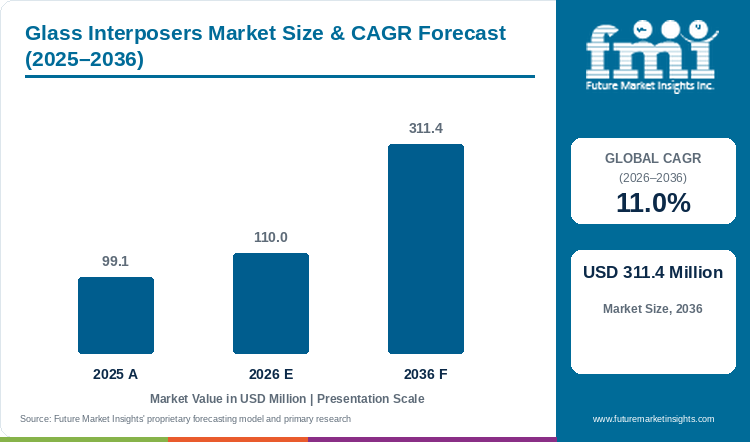
The Glass Interposers Market is projected to reach USD 311.4 million by 2036, growing at an 11.0% CAGR from 2026 to 2036. The market stands at USD 110.0 million in 2026.
Glass Interposers Market Size and Forecast
Table 1: Glass Interposers Market Size and Forecast
| Market size and forecast | Value |
|---|---|
| Market size in 2025 | USD 99.1 million |
| Estimated market size in 2026 | USD 110.0 million |
| Projected market size by 2036 | USD 311.4 million |
| CAGR from 2026 to 2036 | 11.0% |
Source: Future Market Insights analysis of the glass interposers market, 2026.
The market was valued at USD 99.1 million in 2025. On 23 September 2026, LPKF said it had received a letter of intent, not yet a firm order, from a leading Asian advanced packaging manufacturer for NEXAR LIDE systems. The letter, worth a mid-single-digit million euro amount, supports the ramp-up of that customer's first glass substrate production facility. LPKF now puts the addressable market for its advanced packaging process solutions at about EUR 1.7 billion by 2030, up from an earlier estimate of EUR 500.0 million.
Qualification and process cost decide adoption, not the price of the glass itself. In March 2026, LPKF said the question is no longer whether glass will move into advanced packaging but when ramp-up begins. Its 2026 outlook excludes potential high-volume orders because timing depends on qualification of downstream process steps. RENA says its alkaline etching process keeps selectivity high. Policy supports the wider semiconductor packaging chain. The EU Chips Act entered into force on 21 September 2023, and the European Commission proposed a Chips Act 2.0 in June 2026. The United Kingdom's semiconductor strategy of 19 May 2023 names advanced packaging as a possible specialism.
Key Market Trends & Insights
- On 23 September 2026, LPKF announced a letter of intent for LIDE systems from an Asian advanced packaging manufacturer. The manufacturer already runs an LPKF system and has fully qualified the laser-induced deep etching process.
- A multi-company effort on glass panel manufacturing is under way in Europe. The Glass Panel Technology Group, led by Fraunhofer IZM and made up of 15 companies, held its kick-off meeting in Berlin on 1 October 2025. The group is working on high-volume through-glass vias, redistribution layers and reliability testing.
- On 6 November 2026, RENA published a note on its ISMP 2026 talk. The talk covered tuning the shape of through-glass vias by wet etching for glass-core packaging substrates.
Regional Highlights
- North America: 3DGS in Albuquerque, New Mexico offers glass interposer designs inside photonics platforms for LiDAR, optical communications and quantum subsystems. On 14 October 2026, the US Commerce Department's CHIPS programme agreed to reallocate up to USD 955.0 million of an existing award toward silicon photonics, silicon-germanium and advanced packaging.
- Europe: the Chips Joint Undertaking supports five pilot lines for process development, testing and small-scale production. In July 2026, the Commission approved EUR 659.0 million of German State aid for four facilities.
- Asia Pacific: AGC lists through-glass-via wafers of 150 mm, 200 mm and 300 mm and panels of 510 x 515 mm. Tecnisco offers copper-plated through-glass vias on wafers up to about 200 mm. The Asian customer in LPKF's September 2026 letter of intent is preparing a first glass substrate production facility.
Analyst Perspective
“Glass interposers are a qualification story before they are a volume story. Suppliers that can show crack-free vias, flat thin glass and stable metallisation on the chosen wafer or panel size will win. Buyers should request via geometry, thickness variation and reliability results for their own stack. They should expect early supply in small lots from several processing sources, not from one large producer.”
- Sudip Saha, Principal Consultant, FMI
How is the Glass Interposers Market segmented?
- By substrate format: Wafers up to 200 mm, Panels (510 x 515 mm and larger) and 300 mm Wafers
- By application: 3D Packaging, 2.5D Packaging and Fan-Out Packaging
- By substrate technology: Via-Only TGV Glass, Copper-Filled TGV Glass and TGV Glass with RDL
- By end use industry: Consumer Electronics, Telecommunications, Automotive, Defense & Aerospace, Healthcare and Others
- By region: North America, Europe and Asia Pacific
Why do Wafers up to 200 mm lead by Substrate Format in the Glass Interposers Market in 2026?
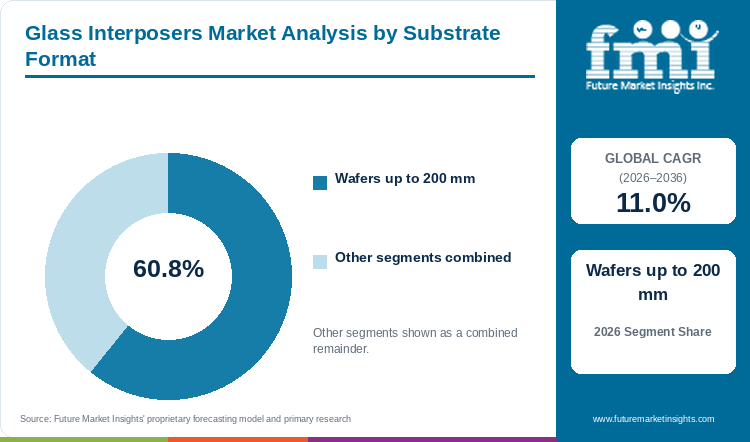
Wafers up to 200 mm account for 60.8% of the Glass Interposers Market by substrate format in 2026. AGC lists 150 mm, 200 mm and 300 mm wafers and 510 x 515 mm panels for its through-glass-via product. Its uses include glass interposers, 3D glass integrated passive devices, and MEMS and sensor devices [11]. Tecnisco gives wafers up to about 200 mm for its copper-plated through-glass-via product, with flatness under 0.1 mm for 8-inch wafers [15]. Small wafers lead because the early buyers are device makers that already run wafer-level lines for sensors, passives and photonics. Tecnisco says its glass products serve imaging equipment, sensors, mobile devices, semiconductors and bio and medical uses [14]. Larger formats are still being proved. RENA's etching process covers wafers from 6 to 12 inches and panels of 510 x 515 mm, 457 x 610 mm and 600 x 600 mm [16], and LPKF describes panel-level processing up to 600 mm x 600 mm [6]. Buyers working in the glass substrate space should confirm that larger-format lines are qualified before they specify them.
Table 2: Substrate Format, 2026 Share
| Leading Share | 2026 market share |
|---|---|
| Wafers up to 200 mm | 60.8% |
| All Other Segments Combined Share | 39.2% |
Source: Future Market Insights analysis of the glass interposers market, 2026.
Why does 3D Packaging lead by Application in the Glass Interposers Market in 2026?
3D Packaging accounts for 49.0% of the Glass Interposers Market by application in 2026. AGC describes its through-glass-via substrate as the glass substrate that enables 3D integration. It also lists a 3D circuit substrate for semiconductor packaging among its uses [11]. PLANOPTIK says glass core substrates let chips and sensors be stacked in very small spaces [13]. The 2.5D share of 29.0% reflects interposers that connect several chips side by side. PLANOPTIK describes interposers as high-density routing layers that connect multiple chips in one package. Its target uses are AI hardware, high-speed data communication and RF [13]. LPKF points to chiplet-based integration and co-packaged optics [7]. Fan-out packaging holds 22.0%. AGC sells carrier glass for wafer-level and panel-level packaging [12], and SCHOTT lists fan-out packaging among the processes served by its carrier wafers [9]. The carrier glass therefore overlaps with the fan-out wafer-level packaging market.
Table 3: Application, 2026 Share
| Leading Share | 2026 market share |
|---|---|
| 3D Packaging | 49.0% |
| All Other Segments Combined Share | 51.0% |
Source: Future Market Insights analysis of the glass interposers market, 2026.
Why does Via-Only TGV Glass lead by Substrate Technology in the Glass Interposers Market in 2026?
Via-Only TGV Glass accounts for 49.0% of the Glass Interposers Market by substrate technology in 2026. Each product is counted once, at the highest processing step its supplier sells. The steps are drilled vias, copper-filled vias and vias with redistribution layers. Most current sales stop at the drilled-via stage, and packagers add metal and wiring themselves. LPKF states that its LIDE process reaches aspect ratios up to 1:50 with zero micro-cracks and zero chipping [6]. AGC lists hole diameters of 20 to 150 micrometres in straight, taper and hourglass shapes [11]. RENA gives typical via diameters of 20 to 100 micrometres and aspect ratios of 1:4 to 1:10 [16]. Copper-Filled TGV Glass holds 29.0%. Tecnisco lists vias of 0.05 to 0.3 mm in synthetic quartz and TEMPAX alkali-free glass with copper plating [15]. TGV Glass with RDL holds 22.0%. LPKF lists redistribution layer line and space of 2/2 micrometres for glass packaging [6]. PLANOPTIK offers redistribution layer and solder mask among its glass core technologies [13].
Table 4: Substrate Technology, 2026 Share
| Leading Share | 2026 market share |
|---|---|
| Via-Only TGV Glass | 49.0% |
| All Other Segments Combined Share | 51.0% |
Source: Future Market Insights analysis of the glass interposers market, 2026.
Why does Consumer Electronics lead by End Use Industry in the Glass Interposers Market in 2026?
Consumer Electronics accounts for 34.0% of the Glass Interposers Market by end use industry in 2026. Its share reflects breadth of use across small, high-count devices. Tecnisco names imaging equipment, sensors and mobile devices among the uses of its glass products [14]. AGC lists MEMS and sensor devices, and 3D glass integrated passive devices, as uses of its through-glass-via substrates [11]. Other end uses are narrower but specific. Telecommunications holds 20.0%, and 3DGS combines glass interposers with its 3DHI platform for optical communications [18]. Automotive holds 15.0%. 3DGS lists glass substrates for automotive radar covering 70 to 150 GHz [18]. Healthcare holds 10.0%, in line with Tecnisco's bio and medical glass products [14]. LPKF expects AI-driven growth in high-performance computing to raise advanced packaging volumes [2]. As data-centre programmes qualify, the consumer share may fall.
Table 5: End Use Industry, 2026 Share
| Leading Share | 2026 market share |
|---|---|
| Consumer Electronics | 34.0% |
| All Other Segments Combined Share | 66.0% |
Source: Future Market Insights analysis of the glass interposers market, 2026.
What are the key drivers, restraints and opportunities?
Driver
Chiplet and AI packaging demand. LPKF says AI-driven growth in high-performance computing and rising wafer starts for high-performance chips are expected to increase advanced packaging volumes [2]. LPKF also states that glass interposers deliver superior electrical performance compared with silicon, with much lower dielectric losses [6]. 3DGS positions glass interposers with large panel formats and ultra-high-density interconnects for HPC and AI chiplet integration [18]. These are supplier claims, so buyers should treat them as qualification targets.
Process readiness. Equipment and etching suppliers now offer production-oriented routes. LPKF's customer in the September 2026 letter of intent has qualified LIDE and is preparing a first glass substrate production facility [1]. In its 23 July 2026 half-year report, LPKF said it had received a LIDE order from a leading specialty glass manufacturer. The order is intended to qualify that manufacturer for future advanced packaging supply chains [2]. RENA offers laser-plus-etching via formation on wafers and large panels [16]. Shared reliability work through the Glass Panel Technology Group covers thermal cycling, moisture sensitivity and vibration testing [4].
Restraint
Qualification before volume. LPKF's 2026 outlook excludes potential high-volume advanced packaging orders because ramp-up depends on qualification of downstream steps [3]. Its first-half 2026 revenue was EUR 36.5 million, down 38.3% from EUR 59.2 million, mainly because of the solar segment. Its chief executive said strategically relevant orders are needed to deliver proof of concept [2]. Glass capability alone does not show a volume track record.
Thin-glass handling. LPKF notes that thin glass is sensitive to stress, so surface and edge defects can affect yield [7]. SCHOTT supports thicknesses from below 200 micrometres to several millimetres. Its total thickness variation is as low as 0.5 micrometres for advanced uses [9]. That tight flatness requirement makes thickness control a key test. Via cracking, warpage and metallisation reliability decide which process routes pass customer audits.
Opportunity
Co-packaged optics. LPKF is working on integrating co-packaged optics on glass substrates [2], and its interposer page cites optical transparency for photonic integration [7]. 3DGS applies glass interposers in LiDAR, optical communication and quantum photonic subsystems [18]. For photonic integrated circuits, optical content changes the package design.
Broader glass and process menu. SCHOTT offers coefficients of thermal expansion between 3 and 10 ppm/K, which lets a packager match glass to silicon or other materials [9]. LPKF is expanding beyond via structuring into singulation of glass-based packages and laser bonding of multilayer glass stacks [2]. Suppliers that bundle glass, vias, metallisation and singulation can shorten customer qualification.
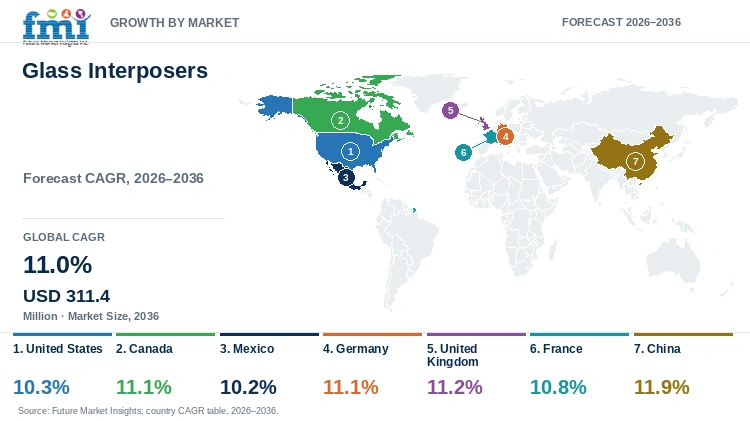
Glass Interposers Market by Country (2026 to 2036)
Table 6: Glass Interposers Market Country Growth Forecast
| Country | CAGR, 2026 to 2036 |
|---|---|
| United States | 10.3% |
| Canada | 11.1% |
| Mexico | 10.2% |
| Germany | 11.1% |
| United Kingdom | 11.2% |
| France | 10.8% |
| China | 11.9% |
Source: Future Market Insights analysis of the glass interposers market, 2026.
United States
3DGS is based in Albuquerque, New Mexico. It presents glass interposers for HPC and AI chiplet integration, and photonics platforms for LiDAR, optical communications and quantum subsystems [18]. The United States therefore has a domestic design-and-supply base for photonics-led interposers, as well as for compute packaging.
Intel said on 18 September 2023 that it was on track to deliver complete glass substrate solutions in the second half of the decade. It showed test units from its assembly and test technology development factories in Chandler, Arizona [19]. The Commerce Department's CHIPS programme page records that on 14 October 2026 the office agreed with GlobalFoundries to reallocate up to USD 955.0 million toward silicon photonics, silicon-germanium and advanced packaging [22].
Georgia Tech's packaging research centre lists a course titled Glass Core Packaging [23]. US demand is likely to start with prototype and low-volume lots. Qualified second sources will matter more than headline capacity.
Canada
Canada is a smaller, application-led market. Suppliers describe uses for glass interposers in optical communications, LiDAR and quantum photonics [18]. Its forecast CAGR of 11.1% is close to the global rate.
Canadian buyers are likely to source through North American channels. 3DGS in Albuquerque sells into photonics and HPC uses [18]. AGC and SCHOTT supply wafers and panels in formats from 150 mm wafers to 510 x 515 mm panels [11][9]. Supply from outside the country puts lead time and export documentation on the qualification checklist.
Because pilot volumes are small, a Canadian buyer gains more from sample access and design support than from price. To compare suppliers, ask for via geometry, thickness variation and reliability data on the buyer's own stack.
Mexico
Mexico's likely demand follows the uses that suppliers describe for their glass. Tecnisco names sensors and mobile devices [14]. 3DGS lists glass substrates for automotive radar covering 70 to 150 GHz [18].
Interposers here are an imported component, so buyers deal with suppliers in the United States, Europe or Asia. Shipping and qualification add time. The forecast CAGR of 10.2% is the lowest of the profiled countries.
The commercial opportunity lies in design-in at module makers, not in local glass processing. Buyers who specify wafer size early keep a wider supplier pool. Formats up to 200 mm are offered by both AGC and Tecnisco [11][15].
Germany
LPKF, headquartered in Garbsen, Germany, with about 700 employees, is the best-documented German supplier in this market. Its LIDE systems are the via-making step in the Asian customer ramp described in its September 2026 letter of intent [1]. Its first-half 2026 revenue of EUR 36.5 million was down 38.3%, mainly because of the solar segment. LPKF calls advanced packaging its key growth area [2][3].
The Glass Panel Technology Group, led by Fraunhofer IZM with 15 companies, held its kick-off in Berlin on 1 October 2025. The group covers through-glass vias, redistribution layers, large-panel substrates and reliability testing [4]. In February 2026, the QVLS-iLabs cluster in the Hanover-Braunschweig region received an additional EUR 15.0 million over three years from Germany's research ministry for quantum technologies [5]. LPKF develops glass components for that work.
Public support for the chip supply chain is growing. The European Commission lists X-Fab in Erfurt for advanced packaging under the Chips Act. In July 2026, it approved EUR 659.0 million of German State aid for four facilities [21]. German suppliers are more likely to lead in process equipment and research partnerships than in volume interposer output.
United Kingdom
The United Kingdom's National Semiconductor Strategy, published on 19 May 2023, plans up to GBP 200.0 million in 2023 to 2025 and up to GBP 1.0 billion over the following decade. It notes that packaging is usually done overseas but could become a specialism [20].
UK interposer demand is therefore tied to compound semiconductors, photonics and research users who buy from overseas suppliers. Glass offers features that suit photonics. LPKF cites optical transparency for photonic integration [7], and SCHOTT supplies glass with low surface roughness below 1 nanometre [9]. The forecast CAGR of 11.2% is the highest among the three profiled European countries.
For a UK buyer, the choice is between sample orders from European or Asian processors and joining research programmes. Purchase specifications should state the glass type, thickness range and via geometry. Suppliers list wide ranges, and the right combination differs by programme [9][11].
France
France is covered by the same European framework as Germany. The Chips Joint Undertaking supports five pilot lines for process development, testing and small-scale production. The European Commission proposed a Chips Act 2.0 in June 2026 [21].
French demand is met largely by European, US and Asian suppliers. SCHOTT offers carrier wafers and core panels with CTE between 3 and 10 ppm/K, with thickness variation as low as 0.5 micrometres [9]. PLANOPTIK offers glass interposers made with wafer-based processes from development to volume [13].
French users in photonics, sensors and telecommunications will probably treat glass interposers as a specialist component. Shared programme data, such as the thermal cycling and moisture tests planned by the Glass Panel Technology Group [4], can support supplier comparisons.
China
China has the highest forecast CAGR of the profiled countries, at 11.9%, against 11.0% for the global market. Equipment and wafer suppliers are most affected, since the early ramp centres on via formation and panel handling.
The clearer signal is equipment demand in the region. LPKF's letter of intent of 23 September 2026 comes from an Asian packaging manufacturer preparing its first glass substrate production facility. The company is not named, and the release does not give its country [1]. AGC lists wafers of 150 mm to 300 mm, and Tecnisco lists wafers up to about 200 mm. Both formats fit wafer-level lines [11][15].
Two points matter most in China: qualification time, and whether wafers are imported or processed regionally. Via diameter ranges differ by supplier, from 20 to 150 micrometres at AGC [11] to 0.05 to 0.3 mm at Tecnisco [15]. Designs should be tested against the range each supplier actually offers.
Who are the notable companies in the Glass Interposers Market?
Notable companies in the Glass Interposers Market include AGC Inc., SCHOTT AG, PLANOPTIK AG, 3DGS, TECNISCO, LTD., RENA Technologies and LPKF Laser & Electronics.
Position in the process chain shapes how each company competes. AGC and SCHOTT start from the glass itself. AGC sells through-glass-via wafers and panels from 150 mm to 510 x 515 mm, with hole diameters of 20 to 150 micrometres [11]. It also sells carrier glass for wafer-level and panel-level packaging [12]. SCHOTT supplies glass carrier wafers and glass core panels with CTE of 3 to 10 ppm/K and total thickness variation below 0.5 micrometres [9]. SCHOTT says its offer adheres to SEMI industry quality standards [9]. It also names semiconductors among its areas for future growth [10].
Processors turn glass into vias and metallised wafers. PLANOPTIK says it manufactures glass interposers with wafer-based processes from development to high volumes, and lists vias, metallisation, cavities, redistribution layers and solder mask as technologies [13]. Tecnisco offers copper-plated vias in synthetic quartz and TEMPAX glass [15]. 3DGS offers glass interposer designs inside photonics platforms [18]. Competition turns on via geometry, metallisation quality and glass choice.
Tool suppliers set the pace of the via step. LPKF sells LIDE systems and also runs a foundry through Vitrion, which offers laser glass etching, glass bonding, thin film deposition and inspection from first sample to volume manufacturing [8]. RENA combines laser weakening with alkaline etching and offers BatchGlass platforms for large-format glass [16]. A processor that adopts one of these routes links its yields to the tool supplier's roadmap.
Key Developments in the Glass Interposers Market
- On 23 September 2026, LPKF announced that a leading Asian advanced packaging manufacturer had signed a letter of intent for NEXAR LIDE systems. The letter is worth a mid-single-digit million euro amount, with firm orders expected shortly [1].
- On 23 July 2026, LPKF reported first-half revenue of EUR 36.5 million and raised its estimate of the addressable market for its advanced packaging process solutions to about EUR 1.7 billion by 2030 [2].
- On 26 March 2026, LPKF said its 2026 outlook excludes potential high-volume advanced packaging orders, with ramp-up timing dependent on qualification of downstream process steps [3].
- On 6 November 2026, RENA Technologies published a note on its ISMP 2026 presentation on tuning through-glass-via shapes by etching for glass-core packaging substrates [17].
Key Players in the Glass Interposers Market
- AGC Inc.
- SCHOTT AG
- PLANOPTIK AG
- 3DGS
- TECNISCO, LTD.
- RENA Technologies
- LPKF Laser & Electronics
Glass Interposers Market Report Scope
Table 7: Glass Interposers Market Report Scope
| Coverage field | Report scope |
|---|---|
| Market definition | Glass interposers and glass-based substrates with through-glass vias used for chip packaging, measured by value of sales |
| Substrate Format | Wafers up to 200 mm, Panels (510 x 515 mm and larger), 300 mm Wafers |
| Application | 3D Packaging, 2.5D Packaging, Fan-Out Packaging |
| Substrate Technology | Via-Only TGV Glass, Copper-Filled TGV Glass, TGV Glass with RDL |
| End Use Industry | Consumer Electronics, Telecommunications, Automotive, Defense & Aerospace, Healthcare, Others |
| Regions and profiled countries | North America, Europe and Asia Pacific. Profiled countries: United States, Canada, Mexico, Germany, United Kingdom, France and China. |
| Companies covered | AGC Inc., SCHOTT AG, PLANOPTIK AG, 3DGS, TECNISCO, LTD., RENA Technologies, LPKF Laser & Electronics |
| Forecast period | 2026 to 2036, with 2025 as the historical base year |
| Quantitative Units | USD million |
Source: Future Market Insights analysis of the glass interposers market, 2026.
Glass Interposers Market by Segments
Glass Interposers Market segmented by Substrate Format:
- Wafers up to 200 mm
- Panels (510 x 515 mm and larger)
- 300 mm Wafers
Glass Interposers Market segmented by Application:
- 3D Packaging
- 2.5D Packaging
- Fan-Out Packaging
Glass Interposers Market segmented by Substrate Technology:
- Via-Only TGV Glass
- Copper-Filled TGV Glass
- TGV Glass with RDL
Glass Interposers Market segmented by End Use Industry:
- Consumer Electronics
- Telecommunications
- Automotive
- Defense & Aerospace
- Healthcare
- Others
Glass Interposers Market by Region
- North America
- Europe
- Asia Pacific
- United States
- Canada
- Mexico
- Germany
- United Kingdom
- France
- China
Research Sources and Bibliography
- [1] LPKF Laser & Electronics. (2026, September 23). Leading Asian advanced semiconductor packaging manufacturer selects LPKF's glass processing equipment for production ramp-up. https://www.lpkf.com/en/news-press/press-releases-teaser/leading-asian-advanced-semiconductor-packaging-manufacturer-selects-lpkfs-glass-processing-equipment-for-production-ramp-up
- [2] LPKF Laser & Electronics. (2026, July 23). LPKF Presents Half-Year Financial Report. https://www.lpkf.com/en/news-press/press-releases-teaser/lpkf-presents-half-year-financial-report
- [3] LPKF Laser & Electronics. (2026, March 26). LPKF reports slight improvement in earnings in 2025 and initiates Group realignment. https://www.lpkf.com/en/news-press/press-releases-teaser/lpkf-reports-slight-improvement-in-earnings-in-2025-and-initiates-group-realignment
- [4] LPKF Laser & Electronics. (2025, October 28). LPKF delivers key strategic technology to Fraunhofer's Glass Panel Technology Group. https://www.lpkf.com/en/news-press/press-releases-teaser/lpkf-delivers-key-strategic-technology-to-fraunhofers-glass-panel-technology-group
- [5] LPKF Laser & Electronics. (2026, February 23). Path to Commercialization: LPKF Develops Glass Components for Quantum Computers in Funded QVLS-iLabs Future Cluster. https://www.lpkf.com/en/news-press/press-releases-teaser/path-to-commercialization-lpkf-develops-glass-components-for-quantum-computers
- [6] LPKF Laser & Electronics. (n.d.). LIDE technology for glass wafers and panels (Advanced Packaging). https://lide.lpkf.com/en/
- [7] LPKF Laser & Electronics. (n.d.). Glass interposers (Advanced Packaging applications). https://lide.lpkf.com/en/applications/glass-interposers
- [8] Vitrion, an LPKF company. (n.d.). End-to-End Foundry Services. https://vitrion.lpkf.com/en/
- [9] SCHOTT AG. (n.d.). Advanced IC-packaging and integration. https://www.schott.com/en-us/markets/semiconductor-and-datacom/advanced-ic-packaging-and-integration
- [10] Glass Online. (2026, January 22). SCHOTT revenues remain stable despite challenging market conditions. https://www.glassonline.com/schott-revenues-remain-stable-despite-challenging-market-conditions/
- [11] AGC Inc. (n.d.). Through Glass Vias (TGV). https://www.agc.com/en/products/electoric/detail/tgv.html
- [12] AGC Inc. (n.d.). Glass substrate for semiconductor packaging (SWAN). https://www.agc.com/en/products/electoric/detail/swan.html
- [13] PLANOPTIK AG. (n.d.). Glass Core Substrates. https://www.planoptik.com/en/products/glass_core_substrates/
- [14] TECNISCO, LTD. (n.d.). Company website, glass products. https://www.tecnisco.com/
- [15] TECNISCO, LTD. (n.d.). TGV (Cu-plated via). https://www.tecnisco.com/cross_edge/tgv.html
- [16] RENA Technologies. (n.d.). Through glass vias (TGV). https://www.rena.com/en/products/glass-sapphire/through-glass-vias-tgv
- [17] RENA Technologies. (2026, November 6). TGV Geometry for Glass-Core Packaging: RENA at ISMP 2026. https://www.rena.com/en/news-events/news/news-details/tgv-geometry-glass-core-packaging-ismp-2026
- [18] 3DGS. (n.d.). Glass interposers and photonics platforms. https://3dgsinc.com/
- [19] Intel Corporation. (2023, September 18). Intel Unveils Industry-Leading Glass Substrates to Meet the Demand for More Powerful Compute. https://www.intel.com/content/www/us/en/newsroom/news/intel-unveils-industry-leading-glass-substrates.html
- [20] UK Government, Department for Science, Innovation and Technology. (2023, May 19). National Semiconductor Strategy. https://www.gov.uk/government/publications/national-semiconductor-strategy/national-semiconductor-strategy
- [21] European Commission. (n.d.). European Chips Act. https://digital-strategy.ec.europa.eu/en/policies/european-chips-act
- [22] National Institute of Standards and Technology. (n.d.). CHIPS for America. https://www.nist.gov/chips
- [23] Georgia Institute of Technology, Packaging Research Center. (n.d.). Packaging Research Center. https://prc.gatech.edu/
Table of Content
- Key Takeaways
- Market Size and CAGR
- Top Growth Driver
- Fastest Growing Segment
- Leading Region
- Key Companies
- Emerging Opportunities
- Executive Summary
- Global Market Outlook
- Demand-side Trends
- Supply-side Trends
- Technology Roadmap Analysis
- Analysis and Recommendations
- Analyst Perspective (What is happening? Why now? What should investors know?)
- Key Questions Answered
- How large is the market?
- What is the CAGR?
- What are key trends?
- Which region dominates?
- Who are the leaders?
Read More...
- Market Overview
- Market Coverage / Taxonomy
- Market Definition / Scope / Limitations
- Research Methodology
- Chapter Orientation
- Analytical Lens and Working Hypotheses
- Market Structure, Signals, and Trend Drivers
- Benchmarking and Cross-market Comparability
- Market Sizing, Forecasting, and Opportunity Mapping
- Research Design and Evidence Framework
- Desk Research Programme (Secondary Evidence)
- Expert Input and Fieldwork (Primary Evidence)
- Tooling, Models, and Reference Databases
- Data Engineering and Model Build
- Quality Assurance and Audit Trail
- Market Background
- Market Dynamics (Drivers, Restraints, Opportunity, Trends)
- Scenario Forecast (Optimistic, Likely, Conservative)
- Impact Analysis
- AI Impact
- Sustainability Impact
- Regulatory Impact
- Technology Impact
- Consumer / Buyer Analysis
- Purchase Drivers
- Adoption Barriers
- Buyer Journey
- Opportunity Map Analysis
- Product Life Cycle Analysis
- Supply Chain Analysis
- Investment Feasibility Matrix
- Value Chain Analysis
- PESTLE and Porter's Analysis
- Regulatory Landscape
- Regional Parent Market Outlook
- Production and Consumption Statistics
- Import and Export Statistics
- Global Market Analysis and Forecast, 2021 to 2036
- Historical Market Size Value (USD Million) Analysis, 2021 to 2025
- Current and Future Market Size Value (USD Million) Projections, 2026 to 2036
- Y-o-Y Growth Trend Analysis
- Absolute $ Opportunity Analysis
- Global Market Pricing Analysis, 2021 to 2036
- Global Market Analysis and Forecast, By Substrate Format, 2021 to 2036
- Introduction / Key Findings
- Historical Market Size Value (USD Million) Analysis By Substrate Format, 2021 to 2025
- Current and Future Market Size Value (USD Million) Analysis and Forecast By Substrate Format, 2026 to 2036
- Wafers up to 200 mm
- Panels (510 x 515 mm and larger)
- 300 mm Wafers
- Y-o-Y Growth Trend Analysis By Substrate Format, 2021 to 2025
- Absolute $ Opportunity Analysis By Substrate Format, 2026 to 2036
- Global Market Analysis and Forecast, By Application, 2021 to 2036
- Introduction / Key Findings
- Historical Market Size Value (USD Million) Analysis By Application, 2021 to 2025
- Current and Future Market Size Value (USD Million) Analysis and Forecast By Application, 2026 to 2036
- 3D Packaging
- 2.5D Packaging
- Fan-Out Packaging
- Y-o-Y Growth Trend Analysis By Application, 2021 to 2025
- Absolute $ Opportunity Analysis By Application, 2026 to 2036
- Global Market Analysis and Forecast, By Substrate Technology, 2021 to 2036
- Introduction / Key Findings
- Historical Market Size Value (USD Million) Analysis By Substrate Technology, 2021 to 2025
- Current and Future Market Size Value (USD Million) Analysis and Forecast By Substrate Technology, 2026 to 2036
- Via-Only TGV Glass
- Copper-Filled TGV Glass
- TGV Glass with RDL
- Y-o-Y Growth Trend Analysis By Substrate Technology, 2021 to 2025
- Absolute $ Opportunity Analysis By Substrate Technology, 2026 to 2036
- Global Market Analysis and Forecast, By End Use Industry, 2021 to 2036
- Introduction / Key Findings
- Historical Market Size Value (USD Million) Analysis By End Use Industry, 2021 to 2025
- Current and Future Market Size Value (USD Million) Analysis and Forecast By End Use Industry, 2026 to 2036
- Consumer Electronics
- Telecommunications
- Automotive
- Defense & Aerospace
- Healthcare
- Others
- Y-o-Y Growth Trend Analysis By End Use Industry, 2021 to 2025
- Absolute $ Opportunity Analysis By End Use Industry, 2026 to 2036
- Global Market Analysis and Forecast, By Region, 2021 to 2036
- Introduction
- Historical Market Size Value (USD Million) Analysis By Region, 2021 to 2025
- Current Market Size Value (USD Million) Analysis and Forecast By Region, 2026 to 2036
- North America
- Europe
- Asia Pacific
- Market Attractiveness Analysis By Region
- North America Market Analysis and Forecast, By Country, 2021 to 2036
- Historical Market Size Value (USD Million) Trend Analysis By Market Taxonomy, 2021 to 2025
- Market Size Value (USD Million) Forecast By Market Taxonomy, 2026 to 2036
- By Country
- By Substrate Format
- By Application
- By Substrate Technology
- By End Use Industry
- Market Attractiveness Analysis
- By Country
- By Substrate Format
- By Application
- By Substrate Technology
- By End Use Industry
- Key Takeaways
- Europe Market Analysis and Forecast, By Country
- Historical Market Size Value (USD Million) Trend Analysis By Market Taxonomy, 2021 to 2025
- Market Size Value (USD Million) Forecast By Market Taxonomy, 2026 to 2036
- By Country
- By Substrate Format
- By Application
- By Substrate Technology
- By End Use Industry
- Market Attractiveness Analysis
- By Country
- By Substrate Format
- By Application
- By Substrate Technology
- By End Use Industry
- Key Takeaways
- Asia Pacific Market Analysis and Forecast, By Country
- Historical Market Size Value (USD Million) Trend Analysis By Market Taxonomy, 2021 to 2025
- Market Size Value (USD Million) Forecast By Market Taxonomy, 2026 to 2036
- By Country
- United States
- Canada
- Mexico
- Germany
- United Kingdom
- France
- China
- By Substrate Format
- By Application
- By Substrate Technology
- By End Use Industry
- By Country
- Market Attractiveness Analysis
- By Country
- By Substrate Format
- By Application
- By Substrate Technology
- By End Use Industry
- Key Takeaways
- Key Countries Market Analysis
- United States
- Pricing Analysis
- Market Share Analysis, 2025
- By Substrate Format
- By Application
- By Substrate Technology
- By End Use Industry
- Canada
- Pricing Analysis
- Market Share Analysis, 2025
- By Substrate Format
- By Application
- By Substrate Technology
- By End Use Industry
- Mexico
- Pricing Analysis
- Market Share Analysis, 2025
- By Substrate Format
- By Application
- By Substrate Technology
- By End Use Industry
- Germany
- Pricing Analysis
- Market Share Analysis, 2025
- By Substrate Format
- By Application
- By Substrate Technology
- By End Use Industry
- United Kingdom
- Pricing Analysis
- Market Share Analysis, 2025
- By Substrate Format
- By Application
- By Substrate Technology
- By End Use Industry
- France
- Pricing Analysis
- Market Share Analysis, 2025
- By Substrate Format
- By Application
- By Substrate Technology
- By End Use Industry
- China
- Pricing Analysis
- Market Share Analysis, 2025
- By Substrate Format
- By Application
- By Substrate Technology
- By End Use Industry
- United States
- Market Structure Analysis
- Competition Dashboard
- Competition Benchmarking
- Market Share Analysis of Top Players
- By Regional
- By Substrate Format
- By Application
- By Substrate Technology
- By End Use Industry
- Emerging Startups
- Innovation Benchmarking
- Competition Analysis
- Competition Deep Dive
- AGC Inc.
- Overview
- Product Portfolio
- Profitability by Market Segments
- Sales Footprint
- Strategy Overview
- Marketing Strategy
- Product Strategy
- Channel Strategy
- SCHOTT AG
- PLANOPTIK AG
- 3DGS
- TECNISCO, LTD.
- RENA Technologies
- LPKF Laser & Electronics
- AGC Inc.
- Case Studies
- Success Stories
- Recent Developments
- Competition Deep Dive
- Assumptions & Acronyms Used
List of Tables
- Table 1: Global Market Value (USD Million) Forecast by Region, 2021 to 2036
- Table 2: Global Market Value (USD Million) Forecast by Substrate Format, 2021 to 2036
- Table 3: Global Market Value (USD Million) Forecast by Application, 2021 to 2036
- Table 4: Global Market Value (USD Million) Forecast by Substrate Technology, 2021 to 2036
- Table 5: Global Market Value (USD Million) Forecast by End Use Industry, 2021 to 2036
- Table 6: North America Market Value (USD Million) Forecast by Country, 2021 to 2036
- Table 7: North America Market Value (USD Million) Forecast by Substrate Format, 2021 to 2036
- Table 8: North America Market Value (USD Million) Forecast by Application, 2021 to 2036
- Table 9: North America Market Value (USD Million) Forecast by Substrate Technology, 2021 to 2036
- Table 10: North America Market Value (USD Million) Forecast by End Use Industry, 2021 to 2036
- Table 11: Europe Market Value (USD Million) Forecast by Country, 2021 to 2036
- Table 12: Europe Market Value (USD Million) Forecast by Substrate Format, 2021 to 2036
- Table 13: Europe Market Value (USD Million) Forecast by Application, 2021 to 2036
- Table 14: Europe Market Value (USD Million) Forecast by Substrate Technology, 2021 to 2036
- Table 15: Europe Market Value (USD Million) Forecast by End Use Industry, 2021 to 2036
- Table 16: Asia Pacific Market Value (USD Million) Forecast by Country, 2021 to 2036
- Table 17: Asia Pacific Market Value (USD Million) Forecast by Substrate Format, 2021 to 2036
- Table 18: Asia Pacific Market Value (USD Million) Forecast by Application, 2021 to 2036
- Table 19: Asia Pacific Market Value (USD Million) Forecast by Substrate Technology, 2021 to 2036
- Table 20: Asia Pacific Market Value (USD Million) Forecast by End Use Industry, 2021 to 2036
List of Figures
- Figure 1: Global Market Pricing Analysis
- Figure 2: Global Market Value (USD Million) Forecast 2021-2036
- Figure 3: Global Market Value Share and BPS Analysis by Substrate Format, 2026 and 2036
- Figure 4: Global Market Y-o-Y Growth Comparison by Substrate Format, 2026-2036
- Figure 5: Global Market Attractiveness Analysis by Substrate Format
- Figure 6: Global Market Value Share and BPS Analysis by Application, 2026 and 2036
- Figure 7: Global Market Y-o-Y Growth Comparison by Application, 2026-2036
- Figure 8: Global Market Attractiveness Analysis by Application
- Figure 9: Global Market Value Share and BPS Analysis by Substrate Technology, 2026 and 2036
- Figure 10: Global Market Y-o-Y Growth Comparison by Substrate Technology, 2026-2036
- Figure 11: Global Market Attractiveness Analysis by Substrate Technology
- Figure 12: Global Market Value Share and BPS Analysis by End Use Industry, 2026 and 2036
- Figure 13: Global Market Y-o-Y Growth Comparison by End Use Industry, 2026-2036
- Figure 14: Global Market Attractiveness Analysis by End Use Industry
- Figure 15: Global Market Value (USD Million) Share and BPS Analysis by Region, 2026 and 2036
- Figure 16: Global Market Y-o-Y Growth Comparison by Region, 2026-2036
- Figure 17: Global Market Attractiveness Analysis by Region
- Figure 18: North America Market Incremental Dollar Opportunity, 2026-2036
- Figure 19: Europe Market Incremental Dollar Opportunity, 2026-2036
- Figure 20: Asia Pacific Market Incremental Dollar Opportunity, 2026-2036
- Figure 21: North America Market Value Share and BPS Analysis by Country, 2026 and 2036
- Figure 22: North America Market Value Share and BPS Analysis by Substrate Format, 2026 and 2036
- Figure 23: North America Market Y-o-Y Growth Comparison by Substrate Format, 2026-2036
- Figure 24: North America Market Attractiveness Analysis by Substrate Format
- Figure 25: North America Market Value Share and BPS Analysis by Application, 2026 and 2036
- Figure 26: North America Market Y-o-Y Growth Comparison by Application, 2026-2036
- Figure 27: North America Market Attractiveness Analysis by Application
- Figure 28: North America Market Value Share and BPS Analysis by Substrate Technology, 2026 and 2036
- Figure 29: North America Market Y-o-Y Growth Comparison by Substrate Technology, 2026-2036
- Figure 30: North America Market Attractiveness Analysis by Substrate Technology
- Figure 31: North America Market Value Share and BPS Analysis by End Use Industry, 2026 and 2036
- Figure 32: North America Market Y-o-Y Growth Comparison by End Use Industry, 2026-2036
- Figure 33: North America Market Attractiveness Analysis by End Use Industry
- Figure 34: Europe Market Value Share and BPS Analysis by Country, 2026 and 2036
- Figure 35: Europe Market Value Share and BPS Analysis by Substrate Format, 2026 and 2036
- Figure 36: Europe Market Y-o-Y Growth Comparison by Substrate Format, 2026-2036
- Figure 37: Europe Market Attractiveness Analysis by Substrate Format
- Figure 38: Europe Market Value Share and BPS Analysis by Application, 2026 and 2036
- Figure 39: Europe Market Y-o-Y Growth Comparison by Application, 2026-2036
- Figure 40: Europe Market Attractiveness Analysis by Application
- Figure 41: Europe Market Value Share and BPS Analysis by Substrate Technology, 2026 and 2036
- Figure 42: Europe Market Y-o-Y Growth Comparison by Substrate Technology, 2026-2036
- Figure 43: Europe Market Attractiveness Analysis by Substrate Technology
- Figure 44: Europe Market Value Share and BPS Analysis by End Use Industry, 2026 and 2036
- Figure 45: Europe Market Y-o-Y Growth Comparison by End Use Industry, 2026-2036
- Figure 46: Europe Market Attractiveness Analysis by End Use Industry
- Figure 47: Asia Pacific Market Value Share and BPS Analysis by Country, 2026 and 2036
- Figure 48: Asia Pacific Market Value Share and BPS Analysis by Substrate Format, 2026 and 2036
- Figure 49: Asia Pacific Market Y-o-Y Growth Comparison by Substrate Format, 2026-2036
- Figure 50: Asia Pacific Market Attractiveness Analysis by Substrate Format
- Figure 51: Asia Pacific Market Value Share and BPS Analysis by Application, 2026 and 2036
- Figure 52: Asia Pacific Market Y-o-Y Growth Comparison by Application, 2026-2036
- Figure 53: Asia Pacific Market Attractiveness Analysis by Application
- Figure 54: Asia Pacific Market Value Share and BPS Analysis by Substrate Technology, 2026 and 2036
- Figure 55: Asia Pacific Market Y-o-Y Growth Comparison by Substrate Technology, 2026-2036
- Figure 56: Asia Pacific Market Attractiveness Analysis by Substrate Technology
- Figure 57: Asia Pacific Market Value Share and BPS Analysis by End Use Industry, 2026 and 2036
- Figure 58: Asia Pacific Market Y-o-Y Growth Comparison by End Use Industry, 2026-2036
- Figure 59: Asia Pacific Market Attractiveness Analysis by End Use Industry
- Figure 60: Global Market - Tier Structure Analysis
- Figure 61: Global Market - Company Share Analysis
Frequently Asked Questions
How big is the glass interposers market in 2026?
The Glass Interposers Market is USD 110.0 million in 2026, up from USD 99.1 million in 2025. It is projected to reach USD 311.4 million by 2036, an 11.0% CAGR from 2026 to 2036.
Which substrate format leads the glass interposers market?
Wafers up to 200 mm lead with 60.8% of the market in 2026. Panels follow at 22.0% and 300 mm wafers at 17.2%. AGC lists 150 mm, 200 mm and 300 mm wafers and 510 x 515 mm panels [11]. Tecnisco gives wafers up to about 200 mm [15].
Which other applications and technologies matter?
By application, 2.5D Packaging holds 29.0% and Fan-Out Packaging 22.0%. By substrate technology, Copper-Filled TGV Glass holds 29.0% and TGV Glass with RDL 22.0%. LPKF lists redistribution layer line and space of 2/2 micrometres and panels up to 600 mm x 600 mm [6].
Which profiled country is forecast to grow fastest?
China has the highest forecast CAGR of the seven profiled countries at 11.9% from 2026 to 2036, ahead of the United Kingdom at 11.2%, Canada and Germany at 11.1% each. That is ahead of the global rate of 11.0%.
What policy items are affecting the market?
The EU Chips Act entered into force on 21 September 2023, and the European Commission proposed a Chips Act 2.0 in June 2026 [21]. The United Kingdom's National Semiconductor Strategy of 19 May 2023 plans up to GBP 1.0 billion over the following decade and notes that packaging is usually done overseas [20]. In the United States, a CHIPS programme agreement on 14 October 2026 reallocates up to USD 955.0 million of an existing award toward silicon photonics, silicon-germanium and advanced packaging [22].
What should a buyer check when choosing a supplier?
Start with the wafer or panel format, glass type and via geometry. AGC lists hole diameters of 20 to 150 micrometres and thickness of 0.1 mm to 1.0 mm [11]. RENA gives typical via diameters of 20 to 100 micrometres [16], and SCHOTT gives total thickness variation as low as 0.5 micrometres [9]. Then ask for reliability data on the buyer's own stack. LPKF notes that thin glass is sensitive to stress, and defects can affect yield [7].
Preview the report firsthand - request a free sample
Get SampleGet the brochure for pricing and purchase details.
Get PDF
