

- Market Size (2026)
- USD 954.7 Mn
- Forecast (2036)
- USD 2042.1 Mn
- CAGR (2026 to 2036)
- 7.9%
How big is Glioblastoma Tumor Treating Fields Therapy Market in 2026?
USD 954.7 million in 2026 and USD 2042.1 million by 2036 at a 7.9% CAGR
Demand for glioblastoma tumor treating fields therapy is projected to expand at 7.9% CAGR from 2026 to 2036, increasing the valuation from USD 954.7 million in 2026 to USD 2042.1 million by 2036, supported by recurring array use and broader funded access after specialist initiation. NovoCure reported in October 2025 that 4,277 patients were actively using Optune Gio for glioblastoma at quarter end. The active base shows that revenue depends on sustained monthly treatment rather than a single equipment sale. The therapy therefore sits within the wider brain tumor treatment pathway but follows a distinct recurring-service model tied to wear time and patient support.
Country economics differ because the United States has a larger established treatment base whereas the UK remains more dependent on evidence review and funded access decisions. Germany combines national reimbursement with specialist neuro-oncology channels that support routine treatment initiation and structured follow-up across experienced centers. Each patient requires array placement planning, repeated consumable supply, usage monitoring, and technical support outside the hospital. The market is projected to create USD 1,087.4 million in incremental opportunity by 2036, attributable to higher treated-patient months rather than a simple rise in device placements. Investment decisions therefore need to consider diagnostic referral capacity through brain cancer diagnostics and the operational cost of maintaining treatment after discharge.
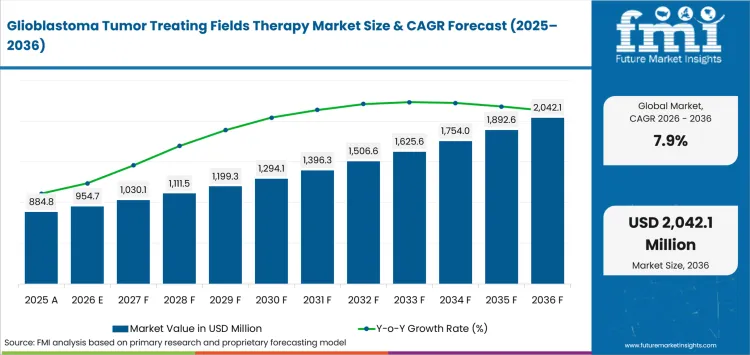
Key Takeaways of Glioblastoma Tumor Treating Fields Therapy Market
- Demand for glioblastoma tumor treating fields therapy is driven by wider reimbursement coverage and recurring transducer array use across active treatment months, with patient persistence throughout the prescribed period determining both clinical and commercial outcomes.
- By treatment setting, newly diagnosed glioblastoma holds the leading share at 69.2% in 2026, supported by maintenance-stage use alongside temozolomide following surgery and chemoradiation.
- TTFields systems lead the product type category at 32.5% share in 2026, attributable to the portable generator and treatment setup required before recurring transducer arrays can be deployed across home-based treatment months.
- Adult patients account for 62.9% share in 2026, reinforced by the approved adult indication and the concentration of treated glioblastoma cases across working-age and older adult populations.
- Hospitals capture 39.1% end-user share in 2026, led by specialist control over treatment initiation, reimbursement documentation, and the clinical handoff that enables prolonged home-based use.
- Japan, the United Kingdom, and Germany record CAGRs of 9.8%, 9.2%, and 8.8% respectively through 2036, shaped by national reimbursement frameworks, active brain cancer research investment, and established specialist prescribing centers.
- Competition is highly concentrated, centering on TTFields technology ownership and reimbursement access, with patient support capability and regional commercialization infrastructure determining how effectively companies convert treatment eligibility into recurring revenue.
Analyst Perspective
"The glioblastoma tumor treating fields therapy market will be defined by sustained treatment adherence and demonstrated clinical benefit rather than technology adoption alone. Physicians and payers are evaluating long-term outcomes, patient compliance, and reimbursement support as interconnected drivers of commercial success. Companies that strengthen clinical evidence, ensure uninterrupted patient support, and maintain reliable therapy access will be better positioned to expand adoption."
- Anurag Sharma, Principal Analyst at Future Market Insights
How is the Glioblastoma Tumor Treating Fields Therapy Market segmented?
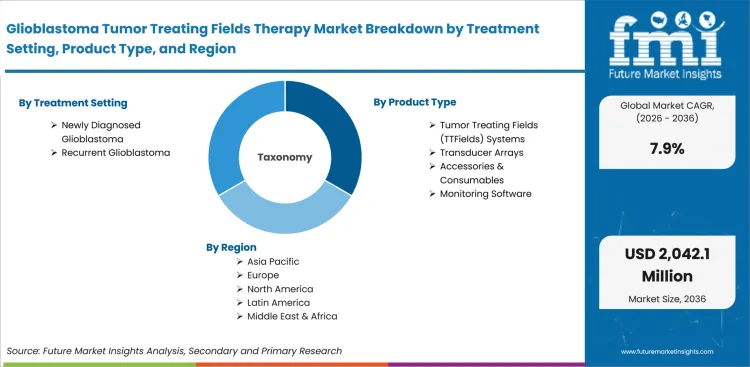
The market is segmented by Treatment Setting, Product Type, Patient Age Group, End User, and Region for the forecast period from 2026 to 2036.
The segmentation framework separates the clinical point of use from the physical components that generate recurring revenue. Treatment Setting distinguishes newly diagnosed and recurrent disease because the approved combinations and treatment sequence differ. Product Type separates the portable field generator from recurring arrays and other components that support monitored treatment delivery. Patient Age Group reflects the adult indication and the additional support needs seen in older populations. End User identifies the institution that evaluates eligibility and starts therapy before treatment continues at home. The final structure connects with the adjacent glioblastoma treatment drugs category without combining drug revenue with TTFields therapy revenue or overstating the role of adjacent oncology products.
How does newly diagnosed glioblastoma shape demand within the treatment setting category?
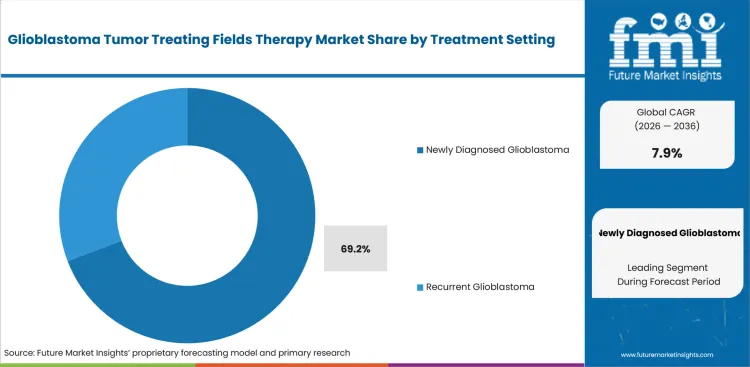
Newly diagnosed patients enter TTFields therapy after surgery and chemoradiation, which places the treatment inside a defined maintenance pathway. The Canadian Agency for Drugs and Technologies in Health reported in March 2024 that median overall survival in the EF-14 evidence was 20.9 months with Optune plus temozolomide versus 16.0 months with temozolomide alone. The result gives payers a direct clinical comparison and supports evaluation alongside the broader brain tumor drugs pathway.
- In 2026, newly diagnosed glioblastoma is projected to account for 69.2% share, supported by use after surgery and chemoradiation with maintenance temozolomide. Therapy starts in the maintenance stage before progression and can continue under specialist review throughout the clinically appropriate treatment period. Recurring treatment months remain available as long as clinical benefit and tolerance support ongoing use.
- Neuro-oncology teams draw demand toward Newly Diagnosed Glioblastoma owing to a clearer treatment sequence and an established evidence base. The commercial implication is a longer addressable treatment period for each clinically eligible patient in maintenance care. Revenue begins after coverage approval and array planning establish a practical start date for home-based treatment. Device education and continued wear then determine how much value is realized outside the hospital.
What supports demand for tumor treating fields systems within the product type category?
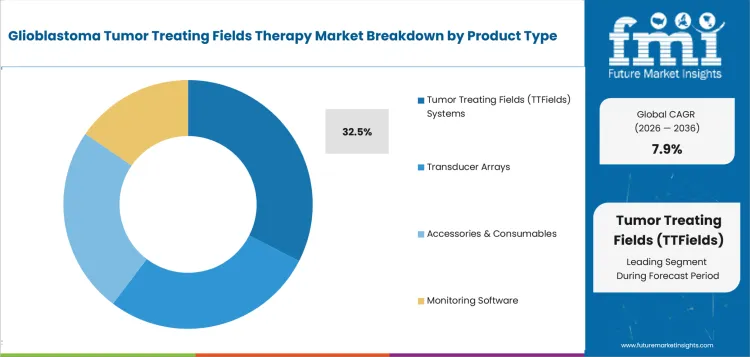
The TTFields system combines a portable generator with transducer arrays, batteries, accessories, and support services rather than operating as a stand-alone capital device. Zai Lab reported in May 2025 that it held an exclusive Greater China license for TTFields products and identified more than 45,000 glioblastoma patients in China each year. The patient pool explains why system access must be paired with recurring component supply and local service capability. Usage tracking links the device to oncology information systems that support treatment records and clinical review across established cancer programs.
- By product category, tumor treating fields systems are estimated to hold 32.5% share in 2026, attributable to the generator and treatment setup required before recurring arrays can be used. The system anchors the therapy relationship even though consumables and support services continue to generate value after the initial patient onboarding stage.
- Specialist centers arrange access to TTFields Systems through one portable platform that coordinates field delivery and power supply. The same platform supports usage records and provides continuing technical service throughout each active treatment month. Commercial demand depends on service readiness because hardware availability alone cannot maintain treatment across repeated home-use months. A system without reliable array replenishment or patient training cannot sustain the treatment months that support the commercial model.
How do neuro-oncology teams evaluate adult patients within the patient age group category?
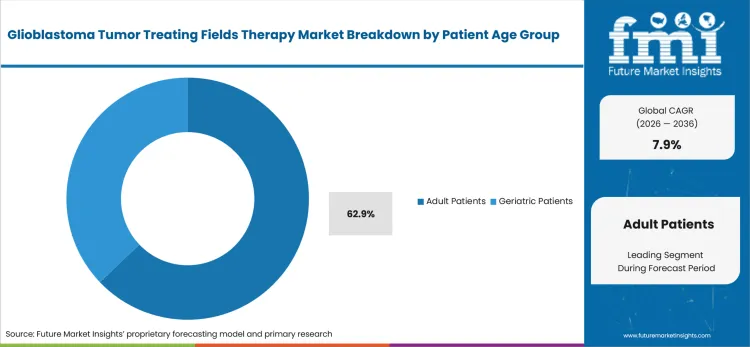
Adult eligibility covers a broad clinical population with different functional status, caregiver resources, and tolerance for daily device management. Japan’s National Cancer Center reported in April 2025 that the average age shown for glioblastoma was 58.8 years. The figure places many patients near an age range in which dexterity, mobility, and caregiver support can affect array changes and treatment persistence. Age therefore changes the service burden even though the clinical decision remains based on individual fitness and treatment goals.
- In 2026, Adult Patients are forecast to represent 62.9% share, reinforced by the approved adult indication and the concentration of treated glioblastoma cases in working-age and older adults. The segment includes patients with very different support needs, so service planning must account for both independent device use and caregiver-assisted array management.
- Neuro-oncology specialists evaluate Adult Patients through performance status and treatment tolerance across the maintenance period. Home support and willingness to maintain prolonged daily wear complete the practical assessment before treatment begins. Demand rises when clear education makes the routine manageable and treatment monitoring remains understandable throughout prolonged home use. Poor fit between the device routine and a patient’s daily life can shorten active use even after clinical eligibility is confirmed.
What makes Hospitals central to the end user category?
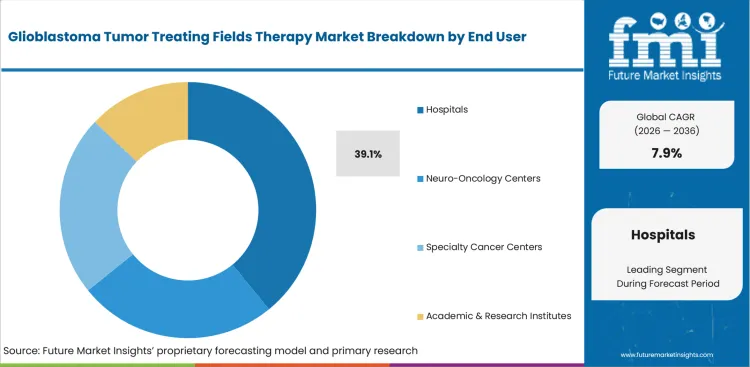
Hospitals control the transition from surgery and chemoradiation into TTFields therapy because diagnosis, treatment planning, and reimbursement records originate within specialist services. NovoCure reported in October 2025 that 1,675 Optune Gio prescriptions were received during the third quarter. The volume shows how prescribing centers shape the commercial funnel before patients continue treatment at home. Coordination with radiation therapy software matters during treatment sequencing, even though TTFields revenue remains separate from radiotherapy systems.
- Hospitals are projected to capture 39.1% share in 2026, led by specialist control of treatment initiation and access documentation. Neurosurgical, radiation oncology, and medical oncology teams confirm eligibility and complete access documentation before home use begins. Hospital influence continues through review of device use, skin tolerance, imaging results, and treatment continuation.
- Hospitals draw demand through an established glioblastoma pathway that includes surgery, radiation, and specialist maintenance planning. Temozolomide and follow-up imaging remain part of the same clinical sequence throughout specialist monitoring and treatment review. Procurement decisions therefore consider device support and reimbursement administration alongside clinical evidence and daily treatment requirements. Institutions that create a clear handoff to home treatment can reduce delays between the maintenance decision and active use.
What are the drivers, restraints, and opportunities in the Glioblastoma Tumor Treating Fields Therapy Market?
A 7.9% CAGR from 2026 to 2036 is supported by recurring treatment months; daily wear and payer economics constrain persistence; wider funded access creates a measured commercial opening.
- Driver: Funded access converts eligible patients into active treatment months, and recurring array use keeps revenue connected to continued therapy rather than a single device placement.
- Restraint: High treatment cost and the practical burden of prolonged daily wear can delay reimbursement or shorten active use after a prescription has been issued.
- Opportunity: New coverage pathways and stronger trial referral systems can widen access in countries that currently have limited routine use of TTFields therapy.
One factor supporting industry growth is the expansion of active treatment across countries with reimbursement pathways. NovoCure reported in April 2026 that 4,543 patients were actively using Optune Gio at quarter end, which was 9% more than one year earlier. The increase matters because each active patient requires recurring arrays, technical support, and usage monitoring. Commercial gains therefore depend on keeping eligible patients on therapy rather than increasing prescriptions without follow-through. The operating model has a closer link to image guided radiotherapy through treatment coordination than through shared product revenue.
A primary factor limiting growth is the persistent gap between documented clinical value and payer affordability thresholds. The Canadian Agency for Drugs and Technologies in Health reported in March 2024 that the submitted Optune fee was CAD 27,000 per month and the reviewed incremental cost-effectiveness ratio reached CAD 899,470 per quality-adjusted life-year. The assessment concluded that a 91% to 97% price reduction was needed at conventional thresholds. The market consequence is prolonged negotiation, restricted eligibility, or delayed coverage even where clinicians recognize a treatment role.
An emerging commercial opportunity is better research access in countries with limited routine TTFields use. The UK Department of Health and Social Care reported in January 2026 that brain cancer research had received a EUR 32.3 million funding boost since July 2024. The research funding does not guarantee adoption because TTFields requires a separate evidence, coverage, and service pathway. The additional funding can strengthen trial referral and local evidence generation across participating neuro-oncology centers. TTFields companies can use that environment to build credible service pathways before seeking broader funded access.
Which country CAGRs are profiled in the Glioblastoma Tumor Treating Fields Therapy Market?
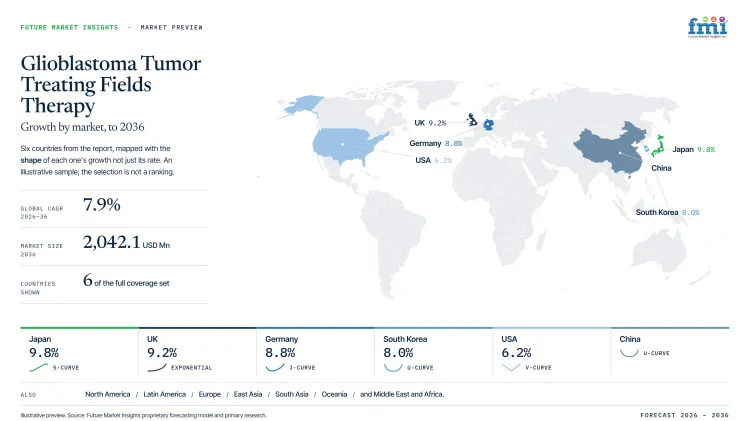
| Country | CAGR |
|---|---|
| USA | 6.2% |
| UK | 9.2% |
| Germany | 8.8% |
| Japan | 9.8% |
| South Korea | 8.0% |
How do country-level CAGRs compare in the Glioblastoma Tumor Treating Fields Therapy Market?
The comparison spans 3.6 percentage points and shows a pronounced separation below the main group. Japan and the UK form a compact upper pair despite notably different reimbursement maturity levels. Germany and South Korea occupy closely spaced middle positions supported by specialist neuro-oncology capability. The USA sits distinctly lower reflecting an established treated base that reduces launch-driven expansion opportunities.
- Japan combines national reimbursement with experienced hospitals that manage prolonged home treatment and caregiver support.
- UK growth reflects a lower routine-access base and research interest in non-drug glioblastoma treatment.
- Germany converts established reimbursement into recurring array demand across experienced prescribing centers and care teams.
- South Korea brings trial capability but still requires a formal funded pathway for routine treatment.
- The USA depends on referral conversion and treatment persistence rather than new national market access.
Comparable CAGRs create different commercial requirements because authorization and patient onboarding govern recurring treatment months. Suppliers must align array logistics and technical support with each country’s reimbursement process and care pathway. The full report provides country-level CAGR analysis across North America, Latin America, Europe, East Asia, South Asia, Oceania and the Middle East and Africa.
- The United States has an established reimbursement and treatment-support network for Optune Gio, so expansion depends on reaching eligible patients who are not yet treated. By 2036, the USA is projected to grow at 6.2% CAGR, supported by a large active base and broad private and Medicare coverage. NovoCure reported in April 2026 that 2,250 US patients were actively using Optune Gio at quarter end. The figure shows commercial depth but points to a mature-market challenge: further gains require better referral conversion and sustained use rather than a new national launch. Cancer centers should evaluate patient support capacity alongside adjacent MRI guided neurosurgical ablation investment and existing neuro-oncology service requirements. The practical priority is reducing delays between maintenance eligibility and authorization so clinically appropriate patients can start treatment without avoidable interruption.
- The UK market is shaped by active brain cancer research and a cautious evidence pathway for routine treatment funding. The country outlook is anticipated to advance at 9.2% CAGR over the forecast period, attributable to a lower commercial base and stronger trial infrastructure. Cancer Research UK reported in March 2025 that only two new drugs, temozolomide and bevacizumab, had been licensed for glioblastoma between 2000 and 2023. The limited drug pipeline increases interest in non-drug treatment options, but it does not remove the need for cost and implementation review. NHS neuro-oncology services require comprehensive evidence that covers patient selection, daily use, and budget impact. Commercial progress therefore depends on a credible access case that connects clinical evidence with implementation cost and patient support requirements.
- Germany has an established Optune Gio reimbursement pathway and a measurable treated population within specialist neuro-oncology centers. Demand in Germany is forecast to rise at 8.8% CAGR by 2036, reinforced by national reimbursement and experienced prescribing teams. NovoCure reported in October 2025 that 595 German patients were actively using Optune Gio at the end of the third quarter. The active base supports regular demand for arrays and patient support, yet it raises expectations for reliable service and documented usage. German hospitals can compare treatment continuity across experienced centers and identify avoidable patient drop-off after therapy initiation and early array use. Supplier selection is therefore influenced by reimbursement execution, array availability, and responsive technical support rather than device specifications alone.
- Japan combines national reimbursement with a specialist care system that concentrates glioblastoma treatment in experienced hospitals. Adoption of TTFields therapy in Japan is estimated to expand at 9.8% CAGR during the forecast period, led by established access and a defined patient pool. The National Cancer Center Japan reported in April 2025 that glioblastoma represented 11.1% of the listed brain tumor frequency and corresponded to an estimated 2,217 patients. The estimate helps frame the ceiling for treated volume and the need for careful referral selection. Japanese centers must balance treatment benefit with daily device management and the caregiver involvement required during repeated array changes. Continued expansion depends on consistent education, follow-up, and array supply across the full treatment period.
- South Korea concentrates complex brain tumor care in specialist hospitals and participated in the global TRIDENT development program for newly diagnosed glioblastoma. The South Korean sector is projected to record 8.0% CAGR through 2036, shaped by a smaller commercial base and the need for a formal access pathway. ClinicalTrials.gov listed three South Korean specialist sites for the 981-patient TRIDENT study in March 2026. The documented trial presence demonstrates local capability to evaluate TTFields within a controlled glioblastoma treatment protocol. Korean neuro-oncology centers still need local reimbursement criteria and service arrangements before routine commercial volume can scale. The main opportunity is converting trial experience into a funded pathway that supports patient onboarding and repeated array supply after treatment starts.
Who are the notable companies in the Glioblastoma Tumor Treating Fields Therapy Market?
NovoCure Limited and Zai Lab Limited hold direct commercial roles in glioblastoma Tumor Treating Fields therapy.
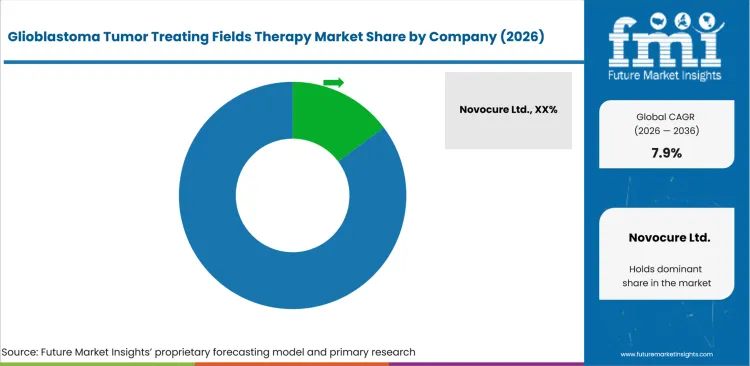
The market has a competitive structure because NovoCure owns and commercializes the TTFields platform, whereas Zai Lab holds an exclusive Greater China license. Their roles are complementary because each company operates a different part of the commercialization pathway and geographic structure. NovoCure controls technology development and clinical evidence through a commercial organization that operates across established active markets. The same organization manages product supply and patient support through country-specific reimbursement and service infrastructure. Zai Lab provides regional development and commercialization capacity across mainland China and the other Greater China territories covered by its license. Adjacent oncology companies remain relevant to diagnosis and treatment planning, including the brain metastasis therapeutics ecosystem, but they do not offer a TTFields system for glioblastoma.
- NovoCure Limited combines TTFields technology ownership with direct responsibility for regulatory submissions and reimbursement strategy. The company manages supply and patient-support functions through commercial teams operating across established active markets. Control of the therapy pathway creates commercial leverage, although NovoCure carries the cost of clinical evidence and market access. Technical service and consumable availability remain continuing obligations throughout every active treatment relationship and country program.
- Zai Lab Limited commercializes Optune Gio under an exclusive Greater China license and provides local hospital access, reimbursement work, and regional support. The partnership extends TTFields reach without requiring NovoCure to reproduce a full commercial organization in each Greater China market, although performance remains linked to regional policy and provider adoption.
Competitive Benchmarking: Glioblastoma Tumor Treating Fields Therapy Market
| Company | TTFields Technology Ownership | Glioblastoma Market Rights | Patient Access Infrastructure | Regional Market Access | Geographic Reach |
|---|---|---|---|---|---|
| NovoCure Limited | High | High | High | High | North America, Europe, Japan, Israel, and other active markets. |
| Zai Lab Limited | Low | High | High | High | Mainland China, Hong Kong, Macau, and Taiwan. |
Key Developments in the Glioblastoma Tumor Treating Fields Therapy Market
- January 2026, NovoCure Limited: Public health insurers in Czechia announced coverage for Optune Gio for adult patients with newly diagnosed glioblastoma. The development widened funded access in Central Europe and created a new setting for recurring treatment revenue. Early execution requires trained centers and clear eligibility documentation before patients can enter a supported home-treatment pathway. Patient onboarding must be paired with reliable support for array changes and usage monitoring outside the hospital.
- February 2026, NovoCure Limited: British Columbia became the first Canadian province to cover TTFields therapy for eligible adults with newly diagnosed glioblastoma through BC Cancer. The decision translated a national health technology assessment into a provincial access pathway for clinically eligible adults with newly diagnosed disease. Broader Canadian growth depends on whether other provinces adopt similar criteria and whether treatment services can support patients through repeated months of home use.
Key Players in the Glioblastoma Tumor Treating Fields Therapy Market
Direct TTFields System Developer
- NovoCure Limited
Licensed Greater China Commercialization Partner
- Zai Lab Limited
Glioblastoma Tumor Treating Fields Therapy Market - Report Scope
| Coverage field | Report scope |
|---|---|
| Market breakdown | Treatment Setting, Product Type, Patient Age Group, End User, and Region. |
| Market Definition | The market covers revenue from Tumor Treating Fields systems, transducer arrays, accessories, consumables, monitoring software, and directly associated therapy support used for glioblastoma treatment. |
| Regions Covered | North America, Latin America, Europe, East Asia, South Asia, Oceania, and Middle East and Africa. |
| Countries Covered | USA, UK, Germany, Japan, South Korea, and 5+ countries within the regional model. |
| Key Companies Profiled | NovoCure Limited and Zai Lab Limited. |
| Forecast Period | 2026 to 2036. |
| Approach | Hybrid bottom-up and top-down market sizing supported by primary interviews and official desk research. |
Glioblastoma Tumor Treating Fields Therapy Market - Research Methodology
| Method | Approach |
|---|---|
| Primary Research | FMI analysts gathered input from manufacturers, service providers, technology developers, distributors, end users, sourcing teams, and subject-matter experts. Interviews examined purchasing decisions, product or service evaluation, adoption barriers, approval requirements, pricing considerations, and expectations for technical or commercial support. Respondents were also asked what evidence is required before a trial, pilot, or initial order develops into regular purchasing. |
| Desk Research | Desk research covered government statistics, regulatory publications, trade data, industry associations, technical literature, standards, company filings, product information, and official corporate announcements. Sources were reviewed for relevance, publication date, geographic coverage, and consistency with the defined market scope. Claims relating to performance, applications, approvals, capacity, investment, and commercial activity were retained only when supported by credible public evidence. |
| Market Sizing and Forecasting | The market model combined the baseline value with historical performance, segment structure, pricing and volume indicators, adoption levels, company participation, and country-level demand conditions. Forecast assumptions considered economic activity, investment trends, regulatory developments, technology adoption, purchasing cycles, supply availability, and barriers to wider market use. Segment and regional estimates were reconciled before the final market total was calculated. |
| Data Validation | Estimates were checked against multiple independent indicators, including public data, company activity, trade patterns, industry developments, and findings from primary interviews. Validation also tested whether products, services, applications, and company revenues fell within the defined market boundaries. Adjacent categories, unsupported claims, overlapping revenues, and activities without direct market relevance were excluded to reduce double counting and maintain consistency across segments and countries. |
Glioblastoma Tumor Treating Fields Therapy Market by Segments
Treatment Setting
- Newly Diagnosed Glioblastoma
- Recurrent Glioblastoma
Product Type
- Tumor Treating Fields (TTFields) Systems
- Transducer Arrays
- Accessories and Consumables
- Monitoring Software
Patient Age Group
- Adult Patients
- Geriatric Patients
End User
- Hospitals
- Neuro-Oncology Centers
- Specialty Cancer Centers
- Academic and Research Institutes
Glioblastoma Tumor Treating Fields Therapy Market by Region:
- North America
- USA
- Canada
- Latin America
- Brazil
- Mexico
- Argentina
- Western Europe
- UK
- Germany
- France
- Spain
- Italy
- Eastern Europe
- Czechia
- Poland
- Romania
- East Asia
- Japan
- South Korea
- China
- South Asia
- India
- Oceania
- Australia
- New Zealand
- Middle East and Africa
- Israel
- GCC Countries
- South Africa
- Türkiye
Research Sources and Bibliography
- Canadian Agency for Drugs and Technologies in Health. (March 2024). Optune (NovoTTF-200A): CADTH Health Technology Review, Report No. OP0554.
- ClinicalTrials.gov. (March 30, 2026). EF-32: Pivotal, Randomized, Open-Label Study of Optune (Tumor Treating Fields, 200 kHz) Concomitant With Radiation Therapy and Temozolomide for the Treatment of Newly Diagnosed Glioblastoma (NCT04471844).
- Cancer Research UK. (March 4, 2025). Accelerating the Search for New Glioblastoma Treatments.
- Department of Health and Social Care. (January 31, 2026). Greater Access to Breakthrough Trials for Rare Cancer Patients.
- National Cancer Center Japan. (April 23, 2025). Brain Tumors.
- NovoCure Limited. (October 30, 2025). Novocure Reports Third Quarter 2025 Financial Results.
- NovoCure Limited. (February 24, 2026). Tumor Treating Fields (TTFields) Therapy to be Covered for Patients with Newly Diagnosed Glioblastoma Through British Columbia Cancer (BC Cancer).
- NovoCure Limited. (February 26, 2026). Annual Report on Form 10-K for the Fiscal Year Ended December 31, 2025.
- NovoCure Limited. (April 30, 2026). Novocure Reports First Quarter 2026 Financial Results.
- NovoCure Limited. (June 18, 2026). Novocure Announces Topline Data from the Phase 3 TRIDENT Trial Evaluating Earlier Use of Tumor Treating Fields Therapy in Newly Diagnosed Glioblastoma.
- Zai Lab Limited. (May 7, 2025). Annual Report for the Year Ended December 31, 2024.
All cited sources are primary non-commercial government, regulatory, academic, trade, or official corporate publications that directly support the article.
This Report Answers
- How does the market progress from 2026 to 2036?
- Why does Newly Diagnosed Glioblastoma account for 69.2% of Treatment Setting revenue in 2026?
- How do TTFields systems and recurring arrays create different revenue streams?
- Why do Adult Patients represent 62.9% of Patient Age Group revenue in 2026?
- How do hospitals influence treatment initiation and reimbursement before home use begins?
- Why do the five profiled country CAGRs differ despite a shared clinical product?
- How should direct TTFields companies be separated from adjacent neuro-oncology equipment suppliers?
- Which cost and treatment-burden factors can reduce active patient months?
- What commercial conditions support wider funded access across new countries?
Frequently Asked Questions
How big is the Glioblastoma Tumor Treating Fields Therapy Market in 2026?
The glioblastoma tumor treating fields therapy market is valued at USD 954.7 million in 2026 and is forecast to reach USD 2042.1 million by 2036.
What is the CAGR of the Glioblastoma Tumor Treating Fields Therapy Market from 2026 to 2036?
The glioblastoma tumor treating fields therapy market is projected to grow at a CAGR of 7.9% between 2026 and 2036, supported by broader funded access and recurring tumor treating fields therapy use.
Which treatment setting leads the Glioblastoma Tumor Treating Fields Therapy Market?
Newly Diagnosed Glioblastoma accounts for 69.2% of the Glioblastoma Tumor Treating Fields Therapy Market by treatment setting in 2026, driven by its defined maintenance pathway combining TTFields with temozolomide after surgery and chemoradiation.
Which country is growing fastest in the Glioblastoma Tumor Treating Fields Therapy Market?
Japan is the fastest-growing country in the Glioblastoma Tumor Treating Fields Therapy Market, expanding at a 9.8% CAGR through 2036, ahead of the market average of 7.9%, supported by national reimbursement and a defined specialist treatment pathway in experienced hospitals.
Who are the leading companies in the Glioblastoma Tumor Treating Fields Therapy Market?
Leading companies in the Glioblastoma Tumor Treating Fields Therapy Market include NovoCure Limited and Zai Lab Limited. The competitive structure is highly concentrated, with NovoCure holding full TTFields technology ownership and direct commercialization rights across North America, Europe, and Japan, while Zai Lab operates as the exclusive licensed partner across Greater China territories.
Preview the report firsthand - request a free sample
Get SampleGet the brochure for pricing and purchase details.
Get PDFTable of Content
- Key Takeaways
- Market Size and CAGR
- Top Growth Driver
- Fastest Growing Segment
- Leading Region
- Key Companies
- Emerging Opportunities
- Executive Summary
- Global Market Outlook
- Demand-side Trends
- Supply-side Trends
- Technology Roadmap Analysis
- Analysis and Recommendations
- Analyst Perspective (What is happening? Why now? What should investors know?)
- Key Questions Answered
- How large is the market?
- What is the CAGR?
- What are key trends?
- Which region dominates?
- Who are the leaders?
- Market Overview
- Market Coverage / Taxonomy
- Market Definition / Scope / Limitations
- Research Methodology
- Chapter Orientation
- Analytical Lens and Working Hypotheses
- Market Structure, Signals, and Trend Drivers
- Benchmarking and Cross-market Comparability
- Market Sizing, Forecasting, and Opportunity Mapping
- Research Design and Evidence Framework
- Desk Research Programme (Secondary Evidence)
- Expert Input and Fieldwork (Primary Evidence)
- Tooling, Models, and Reference Databases
- Data Engineering and Model Build
- Quality Assurance and Audit Trail
- Market Background
- Market Dynamics (Drivers, Restraints, Opportunity, Trends)
- Scenario Forecast (Optimistic, Likely, Conservative)
- Impact Analysis
- AI Impact
- Sustainability Impact
- Regulatory Impact
- Technology Impact
- Consumer / Buyer Analysis
- Purchase Drivers
- Adoption Barriers
- Buyer Journey
- Opportunity Map Analysis
- Product Life Cycle Analysis
- Supply Chain Analysis
- Investment Feasibility Matrix
- Value Chain Analysis
- PESTLE and Porter's Analysis
- Regulatory Landscape
- Regional Parent Market Outlook
- Production and Consumption Statistics
- Import and Export Statistics
- Global Market Analysis and Forecast, 2021 to 2036
- Historical Market Size Value (USD Million) Analysis, 2021 to 2025
- Current and Future Market Size Value (USD Million) Projections, 2026 to 2036
- Y-o-Y Growth Trend Analysis
- Absolute $ Opportunity Analysis
- Global Market Pricing Analysis, 2021 to 2036
- Global Market Analysis and Forecast, By Treatment Setting, 2021 to 2036
- Introduction / Key Findings
- Historical Market Size Value (USD Million) Analysis By Treatment Setting, 2021 to 2025
- Current and Future Market Size Value (USD Million) Analysis and Forecast By Treatment Setting, 2026 to 2036
- Newly Diagnosed Glioblastoma
- Recurrent Glioblastoma
- Newly Diagnosed Glioblastoma
- Y-o-Y Growth Trend Analysis By Treatment Setting, 2021 to 2025
- Absolute $ Opportunity Analysis By Treatment Setting, 2026 to 2036
- Global Market Analysis and Forecast, By Product Type, 2021 to 2036
- Introduction / Key Findings
- Historical Market Size Value (USD Million) Analysis By Product Type, 2021 to 2025
- Current and Future Market Size Value (USD Million) Analysis and Forecast By Product Type, 2026 to 2036
- Tumor Treating Fields (TTFields) Systems
- Transducer Arrays
- Accessories & Consumables
- Monitoring Software
- Tumor Treating Fields (TTFields) Systems
- Y-o-Y Growth Trend Analysis By Product Type, 2021 to 2025
- Absolute $ Opportunity Analysis By Product Type, 2026 to 2036
- Global Market Analysis and Forecast, By Patient Age Group, 2021 to 2036
- Introduction / Key Findings
- Historical Market Size Value (USD Million) Analysis By Patient Age Group, 2021 to 2025
- Current and Future Market Size Value (USD Million) Analysis and Forecast By Patient Age Group, 2026 to 2036
- Adult Patients
- Geriatric Patients
- Adult Patients
- Y-o-Y Growth Trend Analysis By Patient Age Group, 2021 to 2025
- Absolute $ Opportunity Analysis By Patient Age Group, 2026 to 2036
- Global Market Analysis and Forecast, By End User, 2021 to 2036
- Introduction / Key Findings
- Historical Market Size Value (USD Million) Analysis By End User, 2021 to 2025
- Current and Future Market Size Value (USD Million) Analysis and Forecast By End User, 2026 to 2036
- Hospitals
- Neuro-Oncology Centers
- Specialty Cancer Centers
- Academic & Research Institutes
- Hospitals
- Y-o-Y Growth Trend Analysis By End User, 2021 to 2025
- Absolute $ Opportunity Analysis By End User, 2026 to 2036
- Global Market Analysis and Forecast, By Region, 2021 to 2036
- Introduction
- Historical Market Size Value (USD Million) Analysis By Region, 2021 to 2025
- Current Market Size Value (USD Million) Analysis and Forecast By Region, 2026 to 2036
- North America
- Latin America
- Western Europe
- Eastern Europe
- East Asia
- South Asia and Pacific
- Middle East & Africa
- Market Attractiveness Analysis By Region
- North America Market Analysis and Forecast, By Country, 2021 to 2036
- Historical Market Size Value (USD Million) Trend Analysis By Market Taxonomy, 2021 to 2025
- Market Size Value (USD Million) Forecast By Market Taxonomy, 2026 to 2036
- By Country
- USA
- Canada
- By Treatment Setting
- By Product Type
- By Patient Age Group
- By End User
- By Country
- Market Attractiveness Analysis
- By Country
- By Treatment Setting
- By Product Type
- By Patient Age Group
- By End User
- Key Takeaways
- Latin America Market Analysis and Forecast, By Country
- Historical Market Size Value (USD Million) Trend Analysis By Market Taxonomy, 2021 to 2025
- Market Size Value (USD Million) Forecast By Market Taxonomy, 2026 to 2036
- By Country
- Brazil
- Mexico
- Chile
- Rest of Latin America
- By Treatment Setting
- By Product Type
- By Patient Age Group
- By End User
- By Country
- Market Attractiveness Analysis
- By Country
- By Treatment Setting
- By Product Type
- By Patient Age Group
- By End User
- Key Takeaways
- Western Europe Market Analysis and Forecast, By Country
- Historical Market Size Value (USD Million) Trend Analysis By Market Taxonomy, 2021 to 2025
- Market Size Value (USD Million) Forecast By Market Taxonomy, 2026 to 2036
- By Country
- Germany
- UK
- Italy
- Spain
- France
- Nordic
- BENELUX
- Rest of Western Europe
- By Treatment Setting
- By Product Type
- By Patient Age Group
- By End User
- By Country
- Market Attractiveness Analysis
- By Country
- By Treatment Setting
- By Product Type
- By Patient Age Group
- By End User
- Key Takeaways
- Eastern Europe Market Analysis and Forecast, By Country
- Historical Market Size Value (USD Million) Trend Analysis By Market Taxonomy, 2021 to 2025
- Market Size Value (USD Million) Forecast By Market Taxonomy, 2026 to 2036
- By Country
- Russia
- Poland
- Hungary
- Balkan & Baltic
- Rest of Eastern Europe
- By Treatment Setting
- By Product Type
- By Patient Age Group
- By End User
- By Country
- Market Attractiveness Analysis
- By Country
- By Treatment Setting
- By Product Type
- By Patient Age Group
- By End User
- Key Takeaways
- East Asia Market Analysis and Forecast, By Country
- Historical Market Size Value (USD Million) Trend Analysis By Market Taxonomy, 2021 to 2025
- Market Size Value (USD Million) Forecast By Market Taxonomy, 2026 to 2036
- By Country
- China
- Japan
- South Korea
- By Treatment Setting
- By Product Type
- By Patient Age Group
- By End User
- By Country
- Market Attractiveness Analysis
- By Country
- By Treatment Setting
- By Product Type
- By Patient Age Group
- By End User
- Key Takeaways
- South Asia and Pacific Market Analysis and Forecast, By Country
- Historical Market Size Value (USD Million) Trend Analysis By Market Taxonomy, 2021 to 2025
- Market Size Value (USD Million) Forecast By Market Taxonomy, 2026 to 2036
- By Country
- India
- ASEAN
- Australia & New Zealand
- Rest of South Asia and Pacific
- By Treatment Setting
- By Product Type
- By Patient Age Group
- By End User
- By Country
- Market Attractiveness Analysis
- By Country
- By Treatment Setting
- By Product Type
- By Patient Age Group
- By End User
- Key Takeaways
- Middle East & Africa Market Analysis and Forecast, By Country
- Historical Market Size Value (USD Million) Trend Analysis By Market Taxonomy, 2021 to 2025
- Market Size Value (USD Million) Forecast By Market Taxonomy, 2026 to 2036
- By Country
- Kingdom of Saudi Arabia
- Other GCC Countries
- Türkiye
- South Africa
- Other African Union
- Rest of Middle East & Africa
- By Treatment Setting
- By Product Type
- By Patient Age Group
- By End User
- By Country
- Market Attractiveness Analysis
- By Country
- By Treatment Setting
- By Product Type
- By Patient Age Group
- By End User
- Key Takeaways
- Key Countries Market Analysis
- USA
- Pricing Analysis
- Market Share Analysis, 2025
- By Treatment Setting
- By Product Type
- By Patient Age Group
- By End User
- Canada
- Pricing Analysis
- Market Share Analysis, 2025
- By Treatment Setting
- By Product Type
- By Patient Age Group
- By End User
- Mexico
- Pricing Analysis
- Market Share Analysis, 2025
- By Treatment Setting
- By Product Type
- By Patient Age Group
- By End User
- Brazil
- Pricing Analysis
- Market Share Analysis, 2025
- By Treatment Setting
- By Product Type
- By Patient Age Group
- By End User
- Chile
- Pricing Analysis
- Market Share Analysis, 2025
- By Treatment Setting
- By Product Type
- By Patient Age Group
- By End User
- Germany
- Pricing Analysis
- Market Share Analysis, 2025
- By Treatment Setting
- By Product Type
- By Patient Age Group
- By End User
- UK
- Pricing Analysis
- Market Share Analysis, 2025
- By Treatment Setting
- By Product Type
- By Patient Age Group
- By End User
- Italy
- Pricing Analysis
- Market Share Analysis, 2025
- By Treatment Setting
- By Product Type
- By Patient Age Group
- By End User
- Spain
- Pricing Analysis
- Market Share Analysis, 2025
- By Treatment Setting
- By Product Type
- By Patient Age Group
- By End User
- France
- Pricing Analysis
- Market Share Analysis, 2025
- By Treatment Setting
- By Product Type
- By Patient Age Group
- By End User
- India
- Pricing Analysis
- Market Share Analysis, 2025
- By Treatment Setting
- By Product Type
- By Patient Age Group
- By End User
- ASEAN
- Pricing Analysis
- Market Share Analysis, 2025
- By Treatment Setting
- By Product Type
- By Patient Age Group
- By End User
- Australia & New Zealand
- Pricing Analysis
- Market Share Analysis, 2025
- By Treatment Setting
- By Product Type
- By Patient Age Group
- By End User
- China
- Pricing Analysis
- Market Share Analysis, 2025
- By Treatment Setting
- By Product Type
- By Patient Age Group
- By End User
- Japan
- Pricing Analysis
- Market Share Analysis, 2025
- By Treatment Setting
- By Product Type
- By Patient Age Group
- By End User
- South Korea
- Pricing Analysis
- Market Share Analysis, 2025
- By Treatment Setting
- By Product Type
- By Patient Age Group
- By End User
- Russia
- Pricing Analysis
- Market Share Analysis, 2025
- By Treatment Setting
- By Product Type
- By Patient Age Group
- By End User
- Poland
- Pricing Analysis
- Market Share Analysis, 2025
- By Treatment Setting
- By Product Type
- By Patient Age Group
- By End User
- Hungary
- Pricing Analysis
- Market Share Analysis, 2025
- By Treatment Setting
- By Product Type
- By Patient Age Group
- By End User
- Kingdom of Saudi Arabia
- Pricing Analysis
- Market Share Analysis, 2025
- By Treatment Setting
- By Product Type
- By Patient Age Group
- By End User
- Türkiye
- Pricing Analysis
- Market Share Analysis, 2025
- By Treatment Setting
- By Product Type
- By Patient Age Group
- By End User
- South Africa
- Pricing Analysis
- Market Share Analysis, 2025
- By Treatment Setting
- By Product Type
- By Patient Age Group
- By End User
- USA
- Market Structure Analysis
- Competition Dashboard
- Competition Benchmarking
- Market Share Analysis of Top Players
- By Regional
- By Treatment Setting
- By Product Type
- By Patient Age Group
- By End User
- Emerging Startups
- Innovation Benchmarking
- Competition Analysis
- Competition Deep Dive
- Novocure Ltd.
- Overview
- Product Portfolio
- Profitability by Market Segments
- Sales Footprint
- Strategy Overview
- Marketing Strategy
- Product Strategy
- Channel Strategy
- Zai Lab Limited
- Siemens Healthineers AG
- GE HealthCare Technologies Inc.
- Koninklijke Philips N.V.
- Elekta AB
- Varian Medical Systems, Inc.
- Medtronic plc
- Accuray Incorporated
- Canon Medical Systems Corporation
- Novocure Ltd.
- Case Studies
- Success Stories
- Recent Developments
- Competition Deep Dive
- Assumptions & Acronyms Used


